







Abstract
Project Eyewatch is an online policing strategy that utilises Facebook to promote and facilitate community involvement in resolving local crime and policing issues. The strategy, which operates in the Australian police jurisdictions of Victoria, New South Wales and the Australian Capital Territory, has been described as an online version of Neighbourhood Watch and shares many of the objectives of the seminal community policing strategy. The accessibility, functionality and ubiquity of Facebook assist citizens to engage with police at any time and place, overcoming the need to attend face-to-face Neighbourhood Watch meetings. This article compares the objectives of Project Eyewatch and Neighbourhood Watch through the prism of contemporary policing approaches to community engagement. It considers whether social media is a panacea for ailing Neighbourhood Watch networks and poor police communication practices. The article is based on a recent study that evaluated the efficacy of Project Eyewatch as a strategy for engaging the public in community policing (Kelly, 2013). The study found that Project Eyewatch has great potential as a community-engagement strategy, but fundamental changes are needed in the way police engage and interact online with citizens if this potential is to be realised.
Introduction
Australian police organisations are increasingly using social media to meet their community policing objectives and to supplement traditional programmes such as Neighbourhood Watch. Since its introduction in Australia in the 1980s, Neighbourhood Watch has been consistently criticised for failing to achieve its crime-reduction objectives, for engaging with an unrepresentative (mostly elderly and crime-free) section of the community and for failing to facilitate genuine engagement between police and the public (Fleming, 2005; Fleming and O’Reilly, 2007; Rix et al., 2009; Weatherburn, 2004). Internationally, nearly half of all properly evaluated Neighbourhood Watch programmes have been unsuccessful (Holloway et al., 2008), leaving police managers to question the value of such programmes and even threatening the viability of the community policing approach. In recent years, there has been a renewed focus by governments in Australia and the United Kingdom on improving community engagement and customer service across all areas of government services, including policing (Burn, 2010). Policing organisations are now re-engaging with community policing, with social media at the centre of their renewed community engagement efforts (NSW Police Force, 2013).
The relatively simple functionality and ubiquity of Facebook allow citizens to engage with police at any time and place, overcoming the need to attend regular Neighbourhood Watch meetings, which were often scheduled at times and in locations that were inconvenient for a large section of the community (Rix et al., 2009). The Facebook-based community policing programme Project Eyewatch, which has been operating in New South Wales since 2011, in Victoria since 2012 and in the Australian Capital Territory since 2014, shares many of the crime reduction and community engagement objectives of Neighbourhood Watch. These objectives include giving the community greater access to police, fostering real-time engagement, seeking consensus on crime and policing problems, providing the community with up-to-date information on local crime and policing events, seeking public feedback and developing a high-value community network (NSW Police Force, 2013). According to NSW Police, Project Eyewatch strives to ‘reinvigorate community engagement and crime prevention through social media, essentially giving the Neighbourhood Watch program a 21st century makeover’ (Maxwell, 2013: 18). In NSW, Neighbourhood Watch groups are being encouraged to switch to the online environment of Project Eyewatch, although a small number of groups remain under the auspices of Neighbourhood Watch and are eschewing the use of social media (NSW Police Force, 2014).
This paper is based on a recent study by the authors that evaluated the efficacy of Project Eyewatch as a strategy for engaging the public in community policing (Kelly, 2013). The study sought to address the criticisms of Neighbourhood Watch and to evaluate the potential and performance of Project Eyewatch against contemporary measures of policing. Traditional evaluations of Neighbourhood Watch have generally focused on crime reduction objectives, but it has been argued that this focus was misguided and that the programme should instead have been evaluated against more modern policing objectives, including the programme’s ability to enhance public confidence and trust in local police (Fleming, 2005; Holloway et al., 2008; Reiner, 1992; Weatherburn, 2004).
Literature review
Early versions of Neighbourhood Watch, including Block Watch, Apartment Watch, Home Watch and Community Watch, began appearing internationally in the 1970s and in Australia in 1983 amid changing community attitudes about the role of police (Fleming, 2005; Hunter and Barker, 2011). Community policing was viewed both as a remedy to eroding public confidence and also a way to enhance police legitimacy and improve responsiveness to community concerns (Rosenbaum et al., 2011). In Australia, local Neighbourhood Watch groups incorporated areas that contained anything from 300 to 3000 households. The groups were generally much smaller in the United Kingdom and the United States, which typically included 20 to 30 households (Fleming, 2005). Engagement between police and the community occurred at regular public meetings, where policing and crime issues were discussed and information shared with citizens through face-to-face communication.
Evaluations have found that when Neighbourhood Watch operated well in one community, crime was often displaced to a neighbouring community. In many instances, the programme generated no improvements to reporting rates, clear-up rates, calls to the police, discernible improvements in home protection behaviour or change in the way people viewed police. Many local Neighbourhood Watch groups failed because of a lack of ongoing commitment by police and a short-term focus on community policing initiatives among policy makers and legislators. Additionally, most Neighbourhood Watch groups comprised a membership that was unrepresentative of the community, with a bias towards older, white, middle-class citizens (Bull, 2010; Fleming, 2005; Fleming and O’Reilly, 2007; Rix et al., 2009).
Despite being conceived because of a need to address eroding public confidence, enhance police legitimacy and improve police responsiveness to community concerns (Rosenbaum et al., 2011), Neighbourhood Watch was from the outset measured against crime statistics and crime reduction targets. On that basis, Neighbourhood Watch was widely regarded as only ever having limited success (Fleming, 2005; Fleming and O’Reilly, 2007; Rix et al., 2009; Weatherburn, 2004). Neighbourhood Watch might have achieved better outcomes had it been evaluated against modern measures of community policing or, to put it another way, as a ‘vehicle to enhance partnerships between police, other agencies and the community…[to] improve perceptions of safety and security and enhance community involvement in wider crime prevention initiatives’ (Fleming, 2005: 1). The historical focus on crime reduction outcomes makes it difficult for modern researchers to evaluate the efficacy of Neighbourhood Watch retrospectively. Instead, the study focused on evaluating the efficacy of Project Eyewatch and its influence on public perceptions of public confidence and trust. Because the problems of Neighbourhood Watch are well documented and the programme shares the same objectives and a similar design to Project Eyewatch, the results of the study were able to be extrapolated to a discussion on Neighbourhood Watch.
A recent review of Neighbourhood Watch by the NSW Police Force found that state-wide there are as few as 20 Neighbourhood Watch groups meeting regularly and that these groups have minimal input from local police (NSW Police Force, 2014). It found that the programme is struggling to encourage participation, maintain groups, raise community awareness and justify its effectiveness in preventing and reducing crime. However, the programme continues to operate under the auspices of a national body, Neighbourhood Watch Australasia, attract federal government funding and receive the support of all Australian policing jurisdictions, so its future is unclear (Neighbourhood Watch Australasia, 2014). NSW Neighbourhood Watch groups are being encouraged by police to switch to Project Eyewatch, which is very much a key focus of the NSW Police Force’s efforts to enhance its customer service across the organisation (Burn, 2010). However, there remain some Neighbourhood Watch groups that prefer to communicate in traditional ways. As such, the NSW Police Force continues to support both Neighbourhood Watch and Project Eyewatch as separate community policing programmes.
The NSW Police Force has established more than 110 Facebook sites since it launched Project Eyewatch in 2011. Eighty of these Facebook sites are administered by police in local communities while the other sites are either linked to specialist sections within the organisation, such as the NSW Police Academy, Rescue Squad and Homicide Squad, or to corporate spokespeople on topics as varied as youth, gender diversity and road safety (NSW Police Force, 2013). Any person, anywhere in the world, can access any of the Project Eyewatch sites and click on the ‘like’ button on the Facebook display and become a member of the site. Membership of each Project Eyewatch site ranges between a few hundred people in local area police commands, such as Flemington in Sydney’s inner west, and 17,000 in the regional NSW command of Newcastle. Many Project Eyewatch sites were only recently launched, hence their small memberships, whereas others have struggled to attract the attention of the public. This may be because the programme has been implemented with minimal publicity and expenditure, or because it can take time for new websites to generate an audience on the Internet (Boyd and Ellison, 2007).
There were two types of communication proposed by the architects of Project Eyewatch. The first involves a daily dialogue of asynchronous conversation between police and citizens, where pictures, videos and dialogue are posted on Facebook by police with a view to generating comments and feedback from the public. The second involves organised online forums between police and community groups, similar in focus to the traditional Neighbourhood Watch meetings that were held in public venues. It was proposed that police participate in the meetings, reporting back on the actions they have taken to address the issues and concerns raised on the forum (NSW Police Force, 2013; Maxwell, 2013).
Project Eyewatch was introduced by the NSW Police Force as part of a broader strategy to improve the organisation’s customer service delivery (Burn, 2010). The launch of the NSW Police Force’s customer service programme and subsequent implementation of Project Eyewatch coincided with a NSW State Government campaign to improve customer satisfaction and service delivery in all areas of government (Burn, 2010). Prior to the launch, Deputy Commissioner Catherine Burn said: ‘[The NSW Police Force] is now in a position to embark upon more challenging and ambitious strategies and approaches to improve not only satisfaction with policing services but also confidence in police’ (Burn, 2010: 252). This is a goal shared by policing organisations internationally, particularly in the United Kingdom, where public confidence has been a key measure of policing performance for more than a decade (Lee and McGovern, 2012; Mawby, 2010). Scholars have found that a one-on-one conversation with a member of the police has the effect of making a member of the public feel worthy of attention and respect (Bradford et al., 2009). It has also been shown that police organisations can increase public trust and confidence through interactivity, visibility, contact and by keeping the public informed of local crime issues (Bradford et al., 2009; Hohl et al., 2010; Jackson and Sunshine, 2007; NPIA, 2010; Quinton, 2011; Rix et al., 2009; Skogan, 2006; Tyler and Fagan, 2006).
In 2013, more than 83% of Australian households had access to the Internet in their home and more than 19 million Australians subscribed to a mobile telephone service with internet access (Australian Bureau of Statistics, 2013a, 2013b). According to Maxwell (2013: 18), at the core of Project Eyewatch is the ‘understanding that residents no longer have the time to meet in the town centre or in a neighbour’s living room to discuss local crime prevention’. Promoting and establishing Project Eyewatch almost entirely online has been considerably less expensive than for traditional policing programmes such as Neighbourhood Watch, which by the mid-1990s had to be rationalised and refocused on high-crime neighbourhoods in order to cut costs (Laycock and Tilley, 1995). The ease of use and connectivity of social networking services should also alleviate the physical difficulties and time pressures of travel, crowds and fixed hours for participation in traditional public meetings, while also facilitating lateral communication between members of the forum (Perlman, 2012).
Methodology
The study commenced with a comparison of Neighbourhood Watch and Project Eyewatch, establishing that the only significant difference between the two programmes is the latter’s use of social media to engage with the public. As Neighbourhood Watch has often failed to meet its crime reduction objectives (Holloway et al., 2008), this study followed the recommendation of scholars such as Fleming (2005) and Weatherburn (2004) that community policing programmes be evaluated against contemporary measures of policing, including the impact of police contact, engagement and visibility on public perceptions of confidence and trust.
The richest data were obtained from a content analysis of dialogue and engagement between police and the public on a sample of 10 Project Eyewatch Facebook sites. The Project Eyewatch sites with the largest memberships were selected for analysis on the basis that they were closest to operating at their full potential and engaging a broad and representative section of the community. By chance, the 10 largest sites included five based in the Sydney Metropolitan area and five from regional and country New South Wales. The sampled Project Eyewatch sites were the five regional sites of Newcastle, Brisbane Waters, Wagga Wagga, Port Stephens and Blue Mountains, and the five metropolitan sites of Hawkesbury, Sutherland, Campbelltown, Penrith and Mount Druitt. Three days of dialogue was collected from each of the sampled sites between the randomly selected dates of Monday 16 and Wednesday 18 September 2013. The only consideration given to the selection of these dates was that it followed the granting of human research ethics approval and did not coincide with a major event or disaster that would unusually impact the level of communication on the sites (Traffika, 2011).
The sample size was both large enough to capture accurately the extent and nature of police activity on the Facebook sites and to restrict the data collection to a manageable size for analysis. In 30 days of Facebook activity, there were 72 posts by police and nine by the public, initiating an additional 447 items of dialogue from both police and the public. Typically, police posted a media release or a picture to initiate an asynchronous discussion, while the public were restricted by the organisation’s Facebook settings to posting dialogue, generally in the form of an unsolicited question to police. The number of items of dialogue posted by both the police and the public varied considerably between Project Eyewatch sites, ranging from zero items on the Penrith site to 184 items on the Brisbane Waters site (Kelly, 2013).
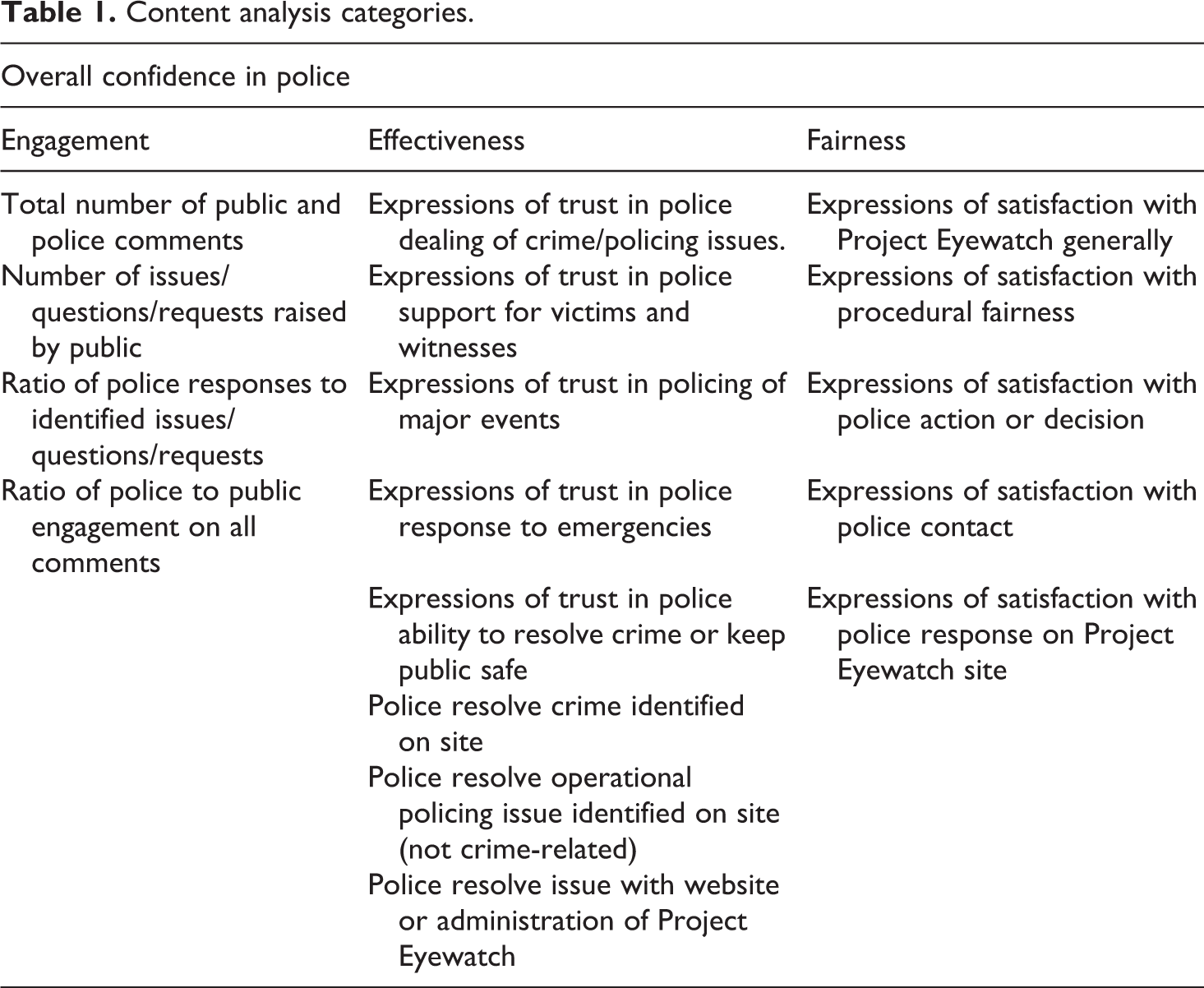
Major studies of public confidence in police have generally relied on the use of large public surveys and interviews to collect data (Hohl et al., 2010; Jackson and Bradford, 2010). As this study did not have the scope to interview the users of Project Eyewatch, it instead relied on a content analysis of dialogue from the sampled sites. While the method of data collection is different, there exists a strong link between this study and earlier studies. For example, it follows Jackson and Bradford (2010) in evaluating three distinct aspects of overall public confidence in police: trust in police effectiveness; trust in police fairness; and trust in police engagement and shared values. Within these three distinct aspects, Hohl et al. (2010) identified a number of items of public opinion that inform each aspect, and it is these items, 17 in total, that have been used in this study for its content analysis. Dialogue or actions, such as the provision of feedback by police, were able to be attributed to these items, recorded on a spreadsheet and quantitatively analysed (see Table 1 – for full classifications and results see Kelly, 2013).
Content analysis categories.
The final source of data was Facebook Insights, which provided data on the age, gender and geographical location of people accessing the sampled Project Eyewatch sites. The data were used to check if the average age of citizens accessing Project Eyewatch sites was consistent with Neighbourhood Watch, which has generally attracted an elderly clientele, and, more importantly, to check whether police on Facebook are engaging with their target audience – citizens from their local communities. Facebook Insights data were provided by the NSW Police Force as the information is not available to the public.
Results
The 10 largest Project Eyewatch sites had a total of 100,149 public subscribers, of which 66% are female. While Neighbourhood Watch tended to attract the elderly, the programme had no significant gender imbalance. The NSW Police Force cannot explain why women are more likely to access Project Eyewatch (Au, 2013), but it may be attributable to a general preference by women to use social media (Lenhart, et al. 2010).
The number of subscribers is comparatively small, given NSW’s total population of 7.38 million, which is serviced by 80 local area police commands with an average but significantly variable population of 92,250 in each command (Australian Bureau of Statistics, 2013c). Facebook Insights reveals that as few as 60% of people accessing regional Project Eyewatch sites reside in regional NSW and only 58% of people accessing metropolitan sites reside in Sydney (Kelly, 2013). Many are identified as residing outside of NSW and Australia. This shows that at least 40% of the people who police are engaging with on Project Eyewatch do not live in the area being policed.
While about 20% of Australia’s population is aged 55 or older (Australian Bureau of Statistics, 2013d), the study revealed that only 6% of Project Eyewatch subscribers are aged 55 or older, in contrast to Neighbourhood Watch, which has been criticised for having an imbalance towards older, white, middle-class citizens (Kelly, 2013; Rix et al., 2009). The implication is that where Neighbourhood Watch provided an ideal forum for the time-rich elderly, Project Eyewatch is more attractive to women and tech-savvy but time-poor younger working people.
The content analysis found that the actions of police administrators on Project Eyewatch varied significantly between sites and were often inconsistent with the programme’s objectives, which include giving the community greater access to police, fostering real-time engagement, seeking consensus on crime and policing problems, providing the community with up-to-date information, seeking public feedback and developing a high-value community network (NSW Police Force, 2013).
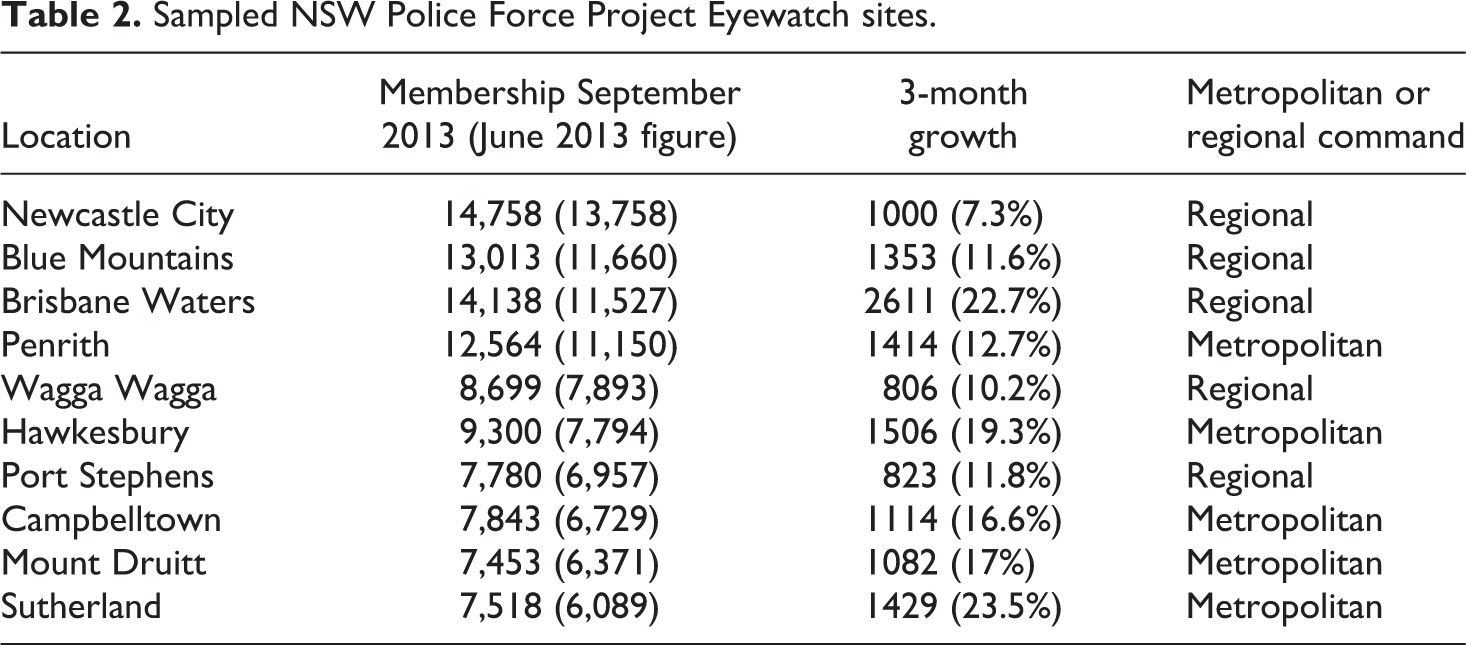
All of the sampled Project Eyewatch sites have steadily growing memberships. However, the study shows that those sites with higher levels of police interactivity are growing at a faster rate (see Table 2 and Table 3). Brisbane Waters attracted 2611 new members in three months from June to September, 2013, 1105 more than the second highest growth at Hawkesbury. Sutherland, a newer site with a smaller membership base, had the highest percentage growth. The membership growth evidenced in Table 2 is reflected by the levels of engagement and interactivity highlighted in Table 3, with Brisbane Waters police (25 posts) and Sutherland police (15 posts) significantly more engaging than the other sites. The 31 police and 153 public entries on the Brisbane Waters site are also an indication that communication is occurring between the police and the public on this site, whereas sites such as Penrith and Port Stephens have very few interactions.
Sampled NSW Police Force Project Eyewatch sites.
Engagement and interactivity on Project Eyewatch sites.
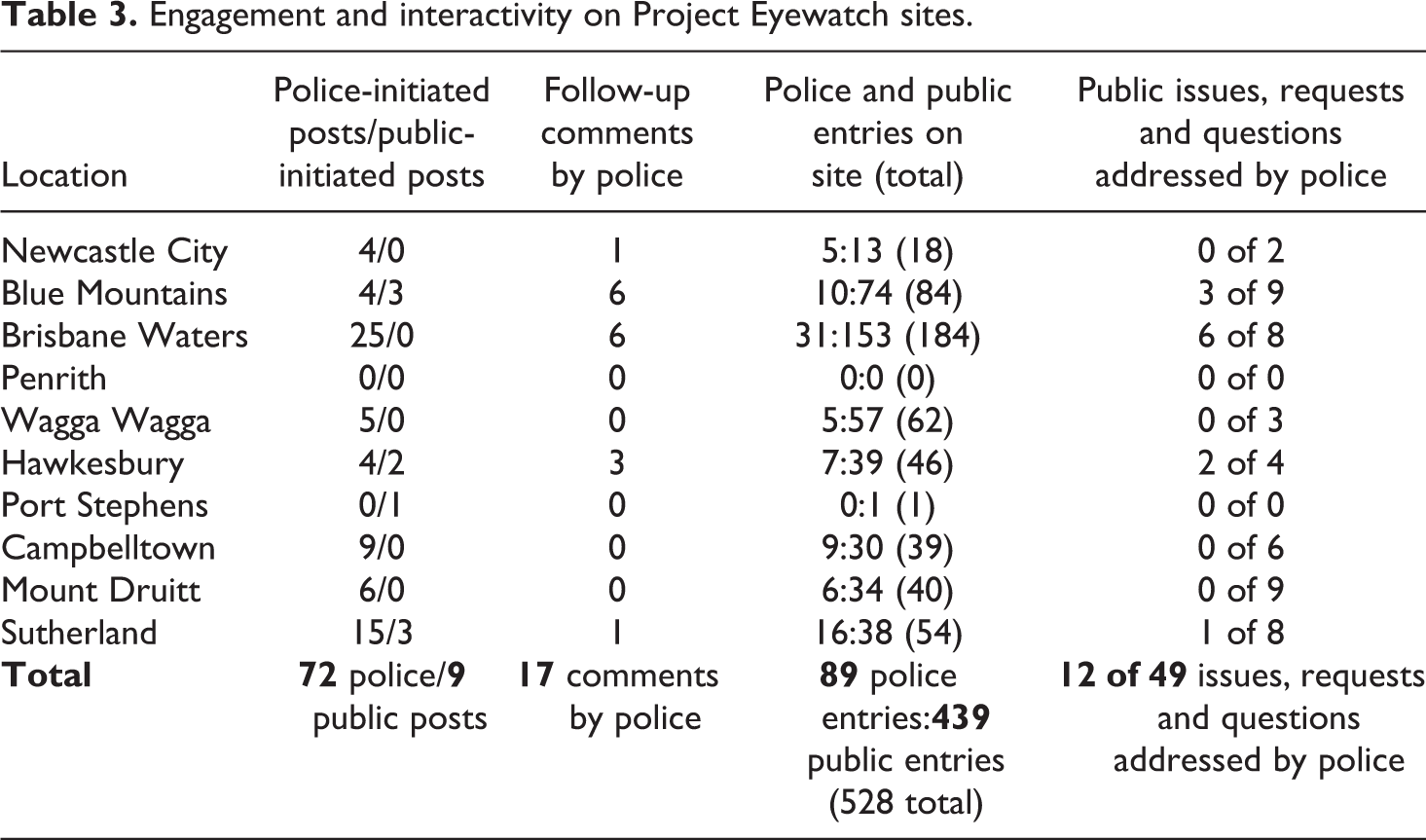
By establishing a network of Facebook pages, the NSW Police Force has essentially met the objective of giving the community greater access to police. Real-time engagement between the police and the public is encouraged by the Project Eyewatch design, but this objective is not being met to any great extent because of a lack of involvement by police on their own Facebook sites. The public made 439 comments and posts during the data collection period, compared with 72 posts by police and just 17 follow-up comments. Of the 37 issues, questions and requests posted by the public, police only responded to 12. Police at Brisbane Waters were the exception, responding to six of eight issues and generally maintaining a high-profile presence on the site.
As with Neighbourhood Watch, the designers of Project Eyewatch intended for the public to be involved in finding solutions to crime and policing problems. The study found no evidence that feedback provided by the public on Project Eyewatch sites had contributed to the resolution of a policing issue or crime investigation. If it did occur, then police failed to communicate that positive result on Facebook. The designers of Project Eyewatch intended that regular police–public forums be held on Facebook, but there is no evidence from the dialogue on any of the sites that these forums are occurring.
Project Eyewatch sites are often used by police to publish media releases, which are otherwise available on the organisation’s website, and for promoting public awareness campaigns such as National Missing Persons Week. Brisbane Waters was the only site that regularly provided information on crime events and statistics, information that would be likely to increase public confidence and trust in police (Hohl et al., 2010).
The final objective of Project Eyewatch – to develop a high-value community network — will take several years to achieve at the current rate of growth (see Table 2, above). Many sites have only a few hundred subscribers, and even the most popular sites have a membership of fewer than 10% of their local community. However, all of the 10 sampled sites grew between 7% and 23% in the three months from June to September 2013, suggesting that Project Eyewatch is growing and has not reached its full membership potential.
Discussion
Project Eyewatch has the capacity to overcome the problems of Neighbourhood Watch, which has been criticised for failing to achieve its objectives, for engaging with an unrepresentative (mostly elderly and often crime-free) section of the community and for failing to facilitate genuine engagement between police and the public (Fleming, 2005; Fleming and O’Reilly, 2007; Rix et al., 2009; Weatherburn, 2004). The focus on crime reduction outcomes has been consigned to history, allowing Project Eyewatch to be evaluated against contemporary policing priorities of enhancing police legitimacy and public engagement; the same ideals that led to the introduction of community policing in the first place (Rosenbaum et al., 2011). However, the study found that Project Eyewatch has so far failed to deliver on its potential and objectives.
Engagement on Project Eyewatch is possibly being hindered by concerns that police have about the risks of social networking and the issues that arise through the sharing of personal information on the Internet. The NSW Police Force is managing these risks through a combination of legislative, technological and human controls. Laws that limit or control access to the Internet are often opposed by large sections of the online community, who believe in the pervasive idea that cyberspace is free and distinguishable from the real world (Williams, 2007). It is possible that people do not want to engage with police online because they view the Internet as being different from the real world. Using the functions of the technology itself is a more effective way to regulate cyberspace because it can disrupt human action, impose constraints on how content is accessed and distributed, be instituted pervasively and with immediacy, be adaptive to changes in law, societal norms, market influences or cyber threats, be less contentious than regulation and be preventative rather than punitive (Lessig, 1999; Williams, 2007). Project Eyewatch uses the Facebook blocking function to prevent the posting of unlawful and offensive comments, as well as restricting the ability of the public to post images to the police Facebook sites. Moderator engagement with the site’s membership also helps to address issues as they arise and help ensure important corporate messages are not ignored or missed (Regester and Larkin, 2008). All Australian police jurisdictions are using social media but further research is needed before the risks are fully understood.
The study found that the objectives of Project Eyewatch are consistent with contemporary priorities in policing, that these objectives have the potential to facilitate effective communication, and that they would in a perfect world be likely to enhance public confidence and trust in the police. However, it was apparent that the objectives of Project Eyewatch were not being met in practice to any great extent. While all Project Eyewatch sites offer a similar aesthetic experience and promise engagement with the local police, the reality is that the experience a Project Eyewatch user has will vary greatly between sites. There is considerable inconsistency in the administration of Project Eyewatch across the organisation, with some sites, such as Brisbane Waters, making significant effort to engage the public and others, such as Penrith and Port Stephens, showing almost no evidence of engagement. Project Eyewatch sites with higher levels of police involvement and engagement performed better in relation to the programme’s objectives, but only one of the 10 sites (Brisbane Waters) was close to meeting these objectives.
It is clear from the data that police are using Project Eyewatch to transmit information, just as they would if they were issuing a media release, and in doing so they are using new technology to communicate in old ways. There is little evidence of interactivity and two-way communication occurring between the police and the public. This is in contrast to the intentions of the Project Eyewatch designers and the objectives of the programme, and of Neighbourhood Watch, which clearly seek to establish a platform for dialogic engagement between the public and police, where community feedback is used to inform and improve policing practice (NSW Police Force, 2013). It is possible that some Project Eyewatch administrators do not share the vision of senior management, as studies have shown that the enthusiasm of senior police for a project often contrasts with the attitude of operational police (Bull, 2010); that some do not realise the value of being active, engaging and interactive; or that adequate resources are not available in some police commands to properly monitor social media sites (Stevens, 2010). The fact that very few of the Project Eyewatch objectives are currently being met can also be attributed to the programme’s relative infancy, as the programme relies on police engaging with broad sections of the community.
Engagement is implicit in the objectives of Project Eyewatch, in literature on the topic of public confidence and trust, and in the customer service priorities of the NSW Police Force (Burn, 2010). If the Project Eyewatch objective of developing a high-value community network is to be realised, police must do more than create Facebook pages; they must also be active, engaging and interactive with the public, in keeping with contemporary standards of effective police communication (Bradford et al., 2009; Jackson and Sunshine, 2007; Rix et al., 2009; Skogan, 2006; Tyler and Fagan, 2006). The NSW Police recognises the need to improve the way it communicates with the public on Facebook. In a 2013 survey of its Facebook users, the organisation identified a need for police to loosen up the tone of conversation and be more human, share more content to maximise awareness of local Facebook pages, close the loop on missing persons and re-share old appeals, publish more proactive crime prevention tips and themed advice such as cyber security, and host live chats (Au, 2013).
The establishment of Project Eyewatch is evidence that police are embracing the use of web technology. As public awareness of Project Eyewatch increases and the community Facebook sites become larger and more representative of local communities it will be incumbent on police administrators to engage citizens in a ways that match the intent of the programme’s objectives. In doing so, Neighbourhood Watch might then be consigned to history with the knowledge that it has been replaced by a more effective programme.
Conclusion
This study focused on the efficacy of police social media engagement, showing that success was dependent on police interactivity and community participation. There would be value in future studies examining in more detail why people choose to access the police online and whether their decisions are affected by variables such as crime rates, community demographics and publicity. Further studies on the risks of social media would also help inform police efforts to expand their current social media exploits. This study revealed that at least 40% of Project Eyewatch users were from outside the targeted communities, an issue of importance to police, as the programme is based on the presumption that police engage with local citizens to improve local policing outcomes. Further research is needed on the composition of Project Eyewatch audiences and to determine how best police can target their social media activities.
This article compared Project Eyewatch with its parent programme Neighbourhood Watch, finding that both programmes have similar objectives and both seek to achieve these objectives by engaging with local communities. Facebook has given police access to new, diverse and much larger audiences, and it is clear that Project Eyewatch represents a meaningful attempt by police to engage in community policing practices. It is a necessary intervention as Neighbourhood Watch is struggling to maintain a presence in jurisdictions such as New South Wales, where there are as few as 20 active Neighbourhood Watch groups remaining. If police are to persist with the community policing approach, then they must find more effective and innovative ways to capture the attention of the public, including the use of social media. The extent and nature of engagement between police and the public on Project Eyewatch has thus fallen short of the programme’s ideals and objectives. Police administrators must be more interactive, responsive and informative with the public if the programme is to be a success. Only then will Project Eyewatch be able to bring Neighbourhood Watch into the 21st century.