







Abstract
Definitions of police corruption are usually associated with bribery and extortion. Police culture entails internalised and uncodified norms, rules and values that may enhance susceptibility of corruption within a police force. This article provides an empirical study on police corruption within the lower levels of the Afghan police due to the lack of studies conducted with them. Undertaking a social constructivist approach, the aim of the study is to provide the perceptions from Afghan police officers on the causes and practices of police corruption. The findings reveal that the main causes are heavily linked to unprofessionalism, low pay and the lack of controls. Police accountability is low and solidarity appears high. Moreover, patronage and the acceptance of corruption as a means to getting things done are part of social practices engrained in Afghan culture which leads to the practices of biased recruitment, bribery and extortion. In relation to noble cause corruption, there is no sense of mission and the idea of policing, as part of a mandate, has been lost in the Afghan police force. An understanding of police corruption and police culture from the perspective of street-level police officers is relevant to understand the main causes and practices of corruption and mitigate them to restore public faith in the police as a main port of security. This can prevent potential Taliban resurgence by deterring alternative security promoted by the insurgency.
Introduction
Police corruption hinders security and the rule of law which are already challenging segments of police reform in a war-torn state. This is evident in the context of Afghanistan. Police corruption in Afghanistan includes petty corruption and drug-related corruption, and the Interior Ministry is arguably systemically corrupt as it sells senior positions to the highest bidders. Corruption in the Afghan police force includes petty bribery and roadside extortion. In addition, the police engage in protection rackets for street vendors and shopkeepers to continue selling produce and other consumables. Moreover, violence and patronage are prevalent within the force. Police corruption can cause problems and harms. Public distrust and illegitimacy of the police force and the state are notable consequences. The poor are forced to pay a higher slice of their household income for bribes. Police culture has informed corrupt practices due to peer pressure and cultural norms to obtain bribes to supplement low salaries. Police officers pay a portion of bribes collected, in the form of kickbacks, up the chain of command to their superiors. The pervasiveness of police corruption has resulted in Taliban promoting local security networks as an alternative to the Afghan National Police (ANP). Therefore, examining police corruption and culture is particularly valuable in the context of Afghanistan as understanding these issues can in turn lead to organisational change, improvements in public opinion and rises in public confidence, compliance and cooperation with the police.
This article initially defines police corruption, which also covers police culture, in order to discuss corruption in war-torn societies. This is followed by the argument that corruption and police corruption are socially constructed and relevant to the society studied. This is why an empirical study with the lower levels of the Afghan police, which make up the majority of the 180,000, is carried out to analyse the perceptions of the main causes and practices of police corruption within the force. The subsequent section provides an overview of reform efforts within the ANP to challenge bribery, extortion and patronage. The methodology provides detail on the survey conducted with low-ranked Afghan police officers. The purpose of the study moves beyond a typology of police corruption and police culture. This study also investigates why corruption is so problematic and the implications of this for the Afghan government, the police, and the public and other stakeholders. The findings section reveals the meaning of corruption, main causes and practices of police corruption in Afghanistan which is based on the perceptions of the Afghan police surveyed. The stated causes include weak police oversight and poor vetting procedures and low pay and the main practices include unprofessionalism, bribery and extortion, patronage, violence and noble cause corruption. Patronage was also widely acknowledged as a form of corruption and some defined it as the meaning of police corruption. However, it must be noted that the literature covered is limited to these themes from the analysis. In the analysis section, a stark contrast with noble cause corruption is made due to the fact that there is no mission or mandate for the police force to protect, unlike during the Mujahidin regime. The penultimate section will provide a six-fold typology of police corruption in Afghanistan based on this study. This is followed by a conclusion based on the implications of the findings. Both weak police oversight and low pay are the main causes of Afghan police corruption which exacerbates police corruption in Afghanistan to an extent. The conclusion also provides brief policy recommendations and the argument that corruption is socially constructed which vary in non-Western contexts. It also covers the harms that police corruption brings and the consequences of it for the police, government, public and other international police reformers involved.
Police corruption and police culture
The purpose of this section is to provide a brief overview of both police corruption and culture to provide an understanding prior to its application to international situations and the context of Afghanistan.
Police corruption, according to Western literature, typically includes numerous activities such as bribery, extortion, perjury and embezzlement (Newburn, 1999; Punch, 2009). Punch (2009: 18) states that police corruption can legally be defined as a police officer performing an action against their duty knowingly for financial or material benefit or assurance of such gain. This includes scenarios when an official is promised considerable advantage or another reward for performing a duty or not performing a duty and when exercising legal discretion for certain illicit interests (Punch, 1985). A narrow approach of police corruption would regard the acceptance of bribes as corruption (Wilson, 1968). There are also a number of examples of police misconduct. These may include drug-related involvement in vice areas, drug use and sleeping on the job. Literature from Sayed and Bruce (1998) provide a typology of police corruption which includes nine types. This is based on Roebuck and Barker’s (1974) typology of police corruption which is the eight-fold typology traditionally used to discuss various forms of police corruption. The final type is an addition provided by Punch (1985). The nine activities include corruption of authority, kickbacks, opportunistic theft, shakedowns, protection of illegal activities, fixing, direct criminal activities, internal payoffs, and adding or planting of evidence.
Corruption of authority is existent when a police officer gains privileges without breaking the law such as free services, meals and drinks. Kickbacks involve money, goods or services that are received for referring business to a certain individual or company. Opportunistic theft concerns theft from those arrested, traffic accidents, committing crime on victims, corpses and stealing the property of deceased citizens. Shakedowns involve a bribe that is accepted for not pursuing an arrest, felony or confiscation of property. Protection of illegal activities engages the police to protect individuals or criminal groups involved in illicit activities such as drug trafficking, arms smuggling and prostitution permitting the illegal business to continue such operations. Fixing relates to subverting criminal investigations and proceedings, or losing traffic tickets. Direct criminal activities involve a police officer committing a crime against either a person or property to achieve personal benefit which clearly violates criminal and the interior’s norms or code of conduct. Internal payoffs concern police entitlements such as promotions, shift allocations and holidays that are purchased, exchanged and sold. Adding or planting of evidence in mainly narcotics cases is the most serious activity of police corruption. The work of Porter and Warrender (2009: 80–81) have covered the same literature and typology and added Punch’s (2000) further inclusion of extreme violence, fabrication of evidence, sexual harassment and drug dealing. The causes of corruption contribute to a range of practices that overlap with misconduct (the breach of internal rules) and police crime (when an officer breaks the law in a severe manner such as excessive means of violence). It could be argued that the typology of corruption can be updated and is often used interchangeably with police misconduct and crime. Therefore, a comprehensive definition of police corruption is the abuse of authority for private or divisional advantage but there are diverse typologies that focus on activities of police malfeasance.
Police culture may also impact on the behaviour and solidarity of police officers. Police culture can be defined as norms, values, views and ‘craft rules’ which provide guidelines on police conduct (Reiner, 1992: 109). Similarly, Chan (1996: 110) defines police culture as informal occupational values and norms that operate under a fixed hierarchical system of police institutions. Manning (1989: 360) argues that police culture is defined as accepted rules, practices and principles of police conduct, which are applied in certain situations, and generalised beliefs and rationales. These definitions of police culture maintain that the police are a distinct organisation and hold a separate set of beliefs, values and norms that determine police behaviour and conduct, both individually and operationally, when performing their duties (Cockcroft, 2013: 6).
For the purpose of this article, culture is defined as shared behavioural patterns and human social interactions, cognitive paradigms, and comprehension via a socialisation process (including inheritance). Based on this, culture shapes the interpretation of symbolic meaning, artefacts and behaviours and conditioning in similar manners for living and distinguishing members of a category from others (Banks and McGee Banks, 2009). In other words, culture is the pledge of knowledge, beliefs, religion, hierarchies, attitudes, values, perceptions of time, longitudinal relations, concepts of the world and material possessions and objects assimilated within a group or individuals over generations. When linking culture to the police, it may be passed on with the police from older officers to new recruits, which breeds petty and severe levels of corruption ‘under peer pressure’ as addressed from the Knapp Report (Fagan and MacDonald, 2013: 261). Based on this premise, it can be contended that peer pressure within a police force inspires low to high levels of corruption and it is the ‘bent’ police organisation that socialises officers into such corrupt practices (Sherman, 1985). Police culture explains the uncodified norms, ethics and values of a police force, with many that remain and are internalised by new recruits within a socialisation process, which is also a complex and fluid process. Furthermore, corporatism may play a role in shaping police culture and corruption. According to O’Malley and Hutchinson (2007: 164), police corporatism has intensified patrol officers’ resistance to new managerial practices in order to avoid disclosing the knowledge system of a ‘closed’ police institution. Police corporatism may be related to what respondents define as ‘pressure’.
Culture can change but not to suit the purposes of reformers due to the deep roots of culture and more narrowly police culture (Chan, 1997: 232).Police culture may continue with the same norms, values and beliefs or may change based on features within the cultural and social landscape and/or of the relationships between behaviour and culture (Cockcroft, 2013: 103).
Police subculture and the nature of police work may lead to delinquent and corrupt acts for the noble cause that is protected by internal solidarity (Crank and Caldero, 2010: 264). Corrupt behaviour can be for occupational benefit as opposed to individual gain. Noble cause corruption concerns police officers who bend rules to do good for the public such as lying in court, perjury or rigging a police report to apprehend a suspected criminal. The motivation is to achieve occupational gains and not individual gains. A police officer may be tempted to force street justice with the use of the ‘magic pencil’ to criminalise their suspect which leads to punishment (Caldero and Crank, 2004: 109). Within noble cause corruption, the police mandate concerns ‘a sense of mission’ that leads to dedication (Reiner, 1992: 111). The excess of commitment from police officers chasing their mission has led to the increase of noble cause corruption (Pollock and Reynolds, 2015: 198). Therefore, this article separates noble cause corruption (i.e. corruption for organisational gain) from traditional corruption (i.e. corruption for personal gain) purely for analytical, and not theoretical, purposes. Indeed, noble cause corruption and traditional corruption have different motivations and potentially different causes and, thus, are typically treated separately. By no means can one form of corruption (noble cause) be a cause of the other form (traditional) of corruption. These concepts of noble cause corruption and police solidarity are investigated when conducting research with Afghan police officers with the mindset that emotional investment in policing and motivation on the job may differ from Western literature on noble cause corruption.
Corruption and conflict within a global context
Now that an understanding of police corruption and police culture has been reached, this section covers the harms that corruption brings to international settings.
Corruption is a global phenomenon but does not necessarily have a relationship with armed conflict. As many examples of organised crime across the world show (e.g. Al Capone and his group in Chicago in the 1920s Sicilian Mafia), an armed conflict is not required for widespread corruption to flourish. However, because of the increased level of anomie that societies experience both during a conflict and post-conflict, armed conflicts may precipitate the spread of corruption. Durkheim’s anomie theory reflected the feeling of normlessness, a lack of societal norms, which exacerbates deviant activity. Anomie is a consequence of the division of labour and prompt social change to a modernised society which was evidenced from vast US immigrant migration as a consequence of the industrial revolution. Anomie leads to alienation because individuals do not hold an attachment to the social system because they do not believe in it or do not feel part of the system. The American dream of attaining wealth and prosperity (as the main cultural goal) had collapsed (Merton, 1938). Consequently, higher rates of criminal and unethical behaviour occurred from persons low on the socio-economic ladder to reach economic attainment. Anomie within a police department may encourage their police officers to engage in corruption and accept their deviant norms (Aultman, 1976). The structural conditions of the environment within a police department may also influence corruption via opportunity, motives and control (Hickman et al ., 2001). Anomie is applicable to the culture of a police department when goals have high importance which then ignores, via informal prospects or negligent enforcement, the legitimate means to reach these goals (Zschoche, 2011: 36).
Corruption usually predates conflicts and occasionally contributes to the conflict. During armed conflict, corruption becomes engrained and diffused. Warlords, armed militias and factions justify war due to frustration with the corrupt regime but use corrupt practices to protect their interests and illicit ventures by enticing the national security institutions and state militias to retain their power (Stanley, 1996). In Afghanistan, the Taliban were initially supported by the local population for ending the reign of corrupt Mujahidin warlords with a few prominent warlords being cycled in presidential and prime ministerial positions (Cramer and Goodhand, 2002). An informal political economy with participation from corrupt regional and local authorities and the local population can prolong devastating conflicts as evident in the 1989–1999 United Nations Transitional Authority in Cambodia (Le Billon, 2000).
In societies that are war-torn and developing from international transitional periods, corruption is rife due to ‘local capital accumulation’ and opportunities for corruption (Pugh, 2013: 84). Within these contexts, corruption has devastating effects on both the rule of law (Dobovšek and Škrbec, 2011: 17, 27–29) and security (the police and armed forces; Bakken, 2005: 21). In the Afghan context, the poor are forced to pay a higher portion of their household incomes as bribes (Singh, 2016: 46). Due to prevalent corrupt practices, the public may perceive the force and government as illegitimate (Singh, 2014: 646). This can result in problems for external stakeholders involved in police reform as a consequence of the lack of faith in their police reforms to oust corruption.
Corruption may be articulated as being an embedded cultural phenomenon. For instance, practices of administration corruption, namely petty bribery is cultural in Afghanistan. Even though corruption is hated by the public for leaving the poor impoverished, it is a locally accepted norm as a way of daily life (Bisogno et al ., 2010: 15; Mezias and Mezias, 2010: 270). In a December 2012 United Nations Office on Drugs and Crime (UNODC) survey for Afghanistan, 68% of the interviewees claimed that it is acceptable for a civil servant to accept small bribes from the public to top-up their low wages and 67% considered it occasionally acceptable for a civil servant to be hired from familial ties and friendship networks (Chawla et al ., 2012: 5). Corruption clearly damages an economy and it is unfair to the poor who are expected to pay bribes for services that should be free (Backman and Butler, 2003: 285). Yet, paying bribes is a daily method of doing business to get the job done (Genovese, 2010: 3–4). Therefore, as recently discussed, anomie and the promotion of informal rules within a police department to achieve organisational goals can exacerbate police corruption and deviance.
Corruption can easily be widespread and institutionalised in a fragile or developing state with weak institutions; a lack of law enforcement, political will and long-term commitment; and distorted rule of law (Narayanasamy, 2000: 41, 43). Systemic corruption can permeate a police institution due to low wages, incentives of engaging in corrupt practices and control feebleness which increase various opportunities resulting in the frustrated public bribing police officers to attain basic services (Edelbacher, 2005: 142–143). According to Quah (2011: 14), individuals are likely to engage in corruption if they are low-paid; witness plenty of opportunities to engage in corruption; and view corruption as being ‘a low-risk, high-reward activity’ even if they are caught due to non-severity of punishment. In states where the government fails to pay adequate wages for the state police, the police force may engage in corrupt practices to supplement their income and secure ‘economic survival’ (Rose-Ackerman, 1999: 72). In Latin American states, public officials are low-paid and as a consequence perform their duties ineffectively and corruption is embedded in bureaucratic systems (Bailey, 2009: 69). In many African countries, a main cause of corruption is low salaries for public employees (Mbaku, 2007: 75). In Sierra Leone, low pay has led to civil servants, judges and doctors engaging in bribery, namely demanding fees from litigants and patients (Keen, 2005: 310; Reno, 2010: 529); and the police extort bribes to supplement US$50 monthly to meet family expenses (Jörgel, 2011: 248).
Corruption can be both cultural and systemic due to the fact that systemic corruption infiltrates the entire public sector and occurs when an institution’s culture permits corrupt activities which usually involve staff, managers and political patrons wanting favours for political party interests (González de Asís et al ., 2009: 14–15). In Mexico, systemic corruption is widespread and has permeated every institution (including political, police, military and judicial institutions) with abundant bribery pervading daily life in all government sectors and a payment to get things done or an exchange of favours is expected (Dhywood, 2011: 31). A police officer in Mexico City pays his direct supervisor an estimated US$125 every shift as rent to work and recoup profit by charging mainly working-class people US$6 to ignore parking violations and US$12.50 to overlook running stop signs (Barkan and Bryjak, 2011). Similarly, in Nigeria, systemic corruption, namely bribery and nepotism, has encroached every government institution and daily business of paying bribes to get things done (Jacobs, 2008: 125).
The social construction of corruption
Now that subjective definitions of police corruption and police culture have been identified and corruption within conflict zones have been discussed, it will be argued that corruption is socially constructed to each society. The notion of corruption spans beyond Western ideals on the abuse of power, authority or office for private gain or benefit. Azfar et al. (2001: 44) convincingly argue that in some cultures, a gift or tip is provided to a public official for providing a service but it is debatable as to when a gift or tip constitutes as a bribe. Perceptions of corruption or unethical behaviour in highly industrialised democratic Western states, such as gift giving, can be viewed as good manners in other societies.
In China, there are social connections and relationships referred to as guanxi practices where giving gifts forms obligatory cooperation between two parties that have familiarity. Repaying gifts is done so based on what feels right and to avoid losing the interest and familiarity because refusal to accept or reciprocate to a gift customarily leads to ‘loss of face’ (Yang, 1989: 42). In addition, gift giving can also help others due to self-interest and material gain. This form of gift giving is not deemed as corruption in China but as reasonable demands, long-term friendships and personal relationships and assisting one another rather than selfish and illegal or corrupt individual benefit. Similar to China, in Russia informal contacts and personal networks are used to access public services and find ways to avoid formal procedures. This is known as blat. Blat concerns favours that are based on reciprocated efficiency, personal kinship ties or friendship that form moral duties to assist others in which bosses allocate favours to safeguard their self-image (Ledeneva, 1998: 1). Blat is similar to guanxi which both focus on establishing and maintaining personal and pacific relationships among the parties involved. Hence, social interactions that involve payments and tipping as reciprocity can become part of everyday life.
However, this also makes it difficult to see how corruption can be compared across countries except in a relativistic way – this is what is considered corruption here and in other countries there. Small favours voluntarily given without explicit demands or expectations of benefits – gratuities – are considered as corruptions under Roebuck and Barker’s (1974) typology of police corruption. Yet, Kania (2004) takes the opposite view by arguing that police officers should accept some minor perks, gratuities and gifts from the public in certain situations. For instance, Kania (2004) argues that it may be appropriate for a police officer to accept a gift or minor perk when the officer is thanked by a member of the public for their services rather than an attempt to corrupt an officer. As a response to Kania (2004), Coleman (2004: 38) argues that police officers should not accept gratuities that the public may perceive as a gesture to influence their judgement when conducting their duties. There are two aspects to this issue – gifting and other socially and culturally approved actions. Theoretically, I argue, insisting on the cultural diversity of conceptions of corruption makes it unlikely that a general theory can be developed, or that international regimes for controlling corruption can gain acceptance. There is a practical issue which drives this discussion more than a theoretical one. Afghanistan, and many other countries, receives aid and advice from Western-oriented cultural traditions brought by aid givers, including definitions of corruption. The delivery of aid and the judgements of how well aid and advice are used will have a pronounced Western, or democratic, bias at odds with local conceptions. One can argue that this disjunction makes it difficult to implement effective anti-corruption programmes. To accept local definitions would mean going against legal, cultural and possible personal constraints which is also difficult to do. Therefore, gift giving should not be considered corruption in certain societies.
A broader conception of corruption may stretch beyond gift giving and other immoral acts such as minor gratuities but in some cultures lying and ‘womanising’ are considered as corrupt. In the context of Afghanistan, fasad concerns an act that is dirty such as prostitution and such an act is not culturally tolerated (De Lauri, 2013: 534). Corruption may be perceived as prevalent in some societies and focus more on moral and ethical obligations. In a study with 1,825 survey respondents in nine Papua New Guinea provinces, Walton (2012) found that corruption is mainly deemed as the abuse of public trust for private benefit (28%), as evil activities (26%) and all immoral activities (17%). Most respondents emphasised moral and legal impositions. Sixty-eight per cent of the survey respondents claimed that minor immoral (and possibly illicit) behaviour, such as young women soliciting sex, is the greatest detriment to society. Bribery (60%) and embezzlement (39%) were acknowledged as fully corrupt but deemed as less detrimental activities of corruption (Walton, 2012: 3–7).
In Afghan society, corruption is deemed as an evil act but it is acknowledged that bribery is inescapable when citizens interact with public officials and judges, who are decent workers, and accept payoffs to proceed speedily with the citizen’s duties (Azami, 2009; Barfield, 2012). In Arabic, such bribery is referred to as reshwat that is directly translated as water attained from a well with the use of a bucket rather than a natural streamflow. In addition, transactions between citizens and judges often include a gift or favour which is known as bakhshish in Afghan courts; although this may also be deemed as reshwat. When describing bribery, the issue of harm is important. The reason that bribery or payment for doing one’s job (bakhshish, blat or other cultural terms for bribery) is considered corrupt is not just because of legalistic definitions; it is because of harm and inequality which affects justice. People who cannot afford to pay do not get government services, or people who pay more get ‘better’ justice against their victims. Local culture is based on gift giving, as also evident in China and Russia, to preserve social relations and get things done due to the acceptance that police officers and civil servants are low-paid. This is part of the value systems that justify these practices that would potentially be framed as corruption if Western literature is prescribed. Analysing corruption from a non-Western perspective is needed. This is why this study explores what Afghan police officers deem as corruption and/or everyday social interactions.
ANP reform efforts
Police corruption, police culture and the social construction of (defining) corruption have been identified. This permits an overview of reform efforts concerning the Afghan police force prior to an analysis on the causes, practices and meanings (definitions) of Afghan police corruption.
After the Bonn Agreement and removal of the Taliban, a new Ministry of Interior Affairs (MoIA) had limited control over the police forces at the provincial level and the police was hindered with widespread corruption (Pyman et al ., 2012: 29). In late 2001, the Afghan Interim Authority requested Germany to lead police reform due to its previous involvement and goals to adopt an ethnically balanced European democratic style police force that is familiar with human rights standards and anti-corruption (Feilke, 2010: 6–7). In order to support education for police forces, Germany spent US$70 million to renovate the National Police Academy in Kabul and 500 vehicles were donated (Jalalzai, 2005). On 18 March 2002, the German Police Project Office coordinated and supervised the reconstruction of the police academy and raised ANP officer’s salaries and combatted drugs which offered 90-day training for 500 non-commissioned cadets and 5-year programmes for 1,500 officer cadets and a 2.5-year option (Larivé, 2012: 189).
Although the ANP has increased from its inception in 2002, Germany could not advance police reforms at the pace to reach the 70,000 target that was set by donors and the Afghan government (Murray, 2007: 110–114). The police officers were untrained, had poor equipment, 70–90% was illiterate and remained loyal to warlords and local commanders rather than the central government (Murray, 2007).
This led to US intervention. In 2003, the United States intervened in police reform and established eight police training centres across Afghanistan and had trained 55,000 officers by late 2005 (Sedra, 2006a: 332). The United States established the Constabulary Training Programme to train police in Kabul’s Central Training Centre during early 2003 and seven other Regional Training Centres were created across the country (Sedra, 2004: 7). As at September 2005, 50,000 police officers received a training programme which included the fortnight Transition Integration Programme and a month-long course designed for illiterate officers (Sedra, 2006b). In 2006, the US-led military organisation named the Combined Security Transition Command – Afghanistan (CSTC-A) trained the ANP as well as the Afghan National Army (ANA). The United States focused on a short-term rapid training approach, which employed private companies such as DynCorp International, rather than long-term German and EU rule of law, human rights strengthening, governance, mentoring and civilian policing (Larivé, 2012: 190–192).
On 17 June 2007, the European Union Police Mission in Afghanistan (EUPOL) had taken over Germany as the lead role for police assistance which was originally mandated for 3 years (Morelli and Belkin, 2009: 30). EUPOL was extended until May 2013 and was later extended until December 2016. EUPOL was renewed based on US interests. The mission of EUPOL included mentoring, monitoring and creating a civilian law enforcement organisation which trained the MoIA but poor police training at the district level hampered the process (Piris, 2010: 272).
In July 2007, the number of the ANP that received some training reached 71,147 (Sedra, 2008). In November 2007, the United States implemented the 8-week Focused District Development (FDD) programme throughout 365 districts to improve the capability and reduce corruption within the ANP (Cordesman et al ., 2009: 102). While the district police were being trained, highly skilled local citizens (Afghan National Civil Order Police) replaced them to provide police performance reviews (Perito, 2009: 5). All untrained recruits were brought before a Regional Training Centre where various training for beginners to enhance Afghan police officers’ capabilities and build the rule of law and loyalty under the supervision of Police Mentoring Teams commenced (Leonard, 2008: 26). The entry-level for patrolmen are no formal education requirements and the maximum length of training is 8 weeks at a Regional Training Centre that consists of 1 week of basic police tasks, military tactics, weapons usage, survival tactics and counterinsurgency procedures (International Crisis Group, 2010: 4).
However, only four of the initial seven units reached their training proficiency within 10 months and most needed more time to finish the training cycle. Police behaviour remains poor due to the excessive use of coercion, corruption and extortion. In addition, a failure of distinction with the ANA is blurred . These shortcomings have resulted in disagreement with the United States striving to help the counterinsurgency similar to the Afghan military, but Europeans wish to construct a state under civilian aspects – a democratic rule of law and human rights (Larivé, 2012: 188, 195–196).
In addition to problems with training, poor MoIA leadership that had the duty to supervise the ANP resulted in inadequate salaries and the practice of extortion to supplement low wages (Cordesman et al ., 2010: 127). In May 2002, the United Nations Development Programme (UNDP) created the Law and Order Trust Fund for Afghanistan to permit donors such as the European Community to supply further funds for raising police salaries and providing police reform that had spent a total of an estimated €70 million (House of Commons – Defence Committee, 2007: 112). By 2004, a mere US$11.2 million of the US$65 million that had been requested was in use (Perito, 2009: 4–5). This failure of funding resulted in the Afghan government being unable to deploy the ANP outside of Kabul. Consequently, police chiefs at the district and provincial level have been claiming salaries for ‘ghost policemen’ (Azami, 2009: 1). Even in Kabul, the ANP are unpaid for months which lead to petty corruption that has damaged public trust (Miller and Perito, 2004). Corruption and funding issues to advance police reform in Afghanistan have impacted on stakeholders involved. As stated, Germany failed to advance reforms and EUPOL and CSTC-A had competing interests to deal with internal threats under human rights and the rule of law which conflicted with militaristic policing to fight the insurgency respectively. This has resulted in a lack of faith with stakeholders’ failure with both police reform and anti-corruption.
After pay and rank reform, in late 2005, which downsized senior positions and increased salaries, police wages remain low for lower ranked policemen to cater for families which intensify corruption and roadside extortion (Royal United Services Institute for Defence and Security Studies (RUSI), 2010: 10). Although patrolmen have increased by an additional 10,000 after the reform and ‘top heavy’ generals, colonels, captains and majors were reduced, wages remain locked at US$70–80 per month (Wilder, 2007: 39). Low pay remains a major contributor to bribery, roadside extortion and kickbacks to supplement incomes (Cann et al ., 2010; Cordesman et al ., 2010; Wilder, 2007: 39). It was stressed by 42% of a nationwide survey that bribery is prevalent when collaborating with the ANP (UNDP, 2009: 5–6). This heavily impacts on public opinion and faith within the Afghan police force. Although speculative, the literature suggests that this could be to supplement their low salaries, release Taliban detainees and drug mules or to pay slices of bribes, as kickbacks, to their superiors for the position or location in a vice area, usually a drug-producing one (Demirbüken et al ., 2009: 139; Hodes and Sedra, 2007: 39). Bribery may have a causal relationship with low pay.
Furthermore, bribery, extortion and kickbacks have led to prevalent police abuse. The ANP have been accused of raping women at road blockades and using young boys as sex slaves and petty corruption which has left many Afghans demanding the Taliban to be brought back to end police corruption (Houreld, 2013: 3). The Taliban have pledged to provide better security than the ANP (Sands, 2007; Singh, 2014: 627). The public, as identified from half of the respondents for a nationwide survey conducted by Integrity Watch Afghanistan (2010: 11), stress that corruption intensifies Taliban support and a third stated that the Taliban are fighting against corruption within the government. This has resulted in problems for the Afghan government and police force that are both, publicly and by the insurgency, perceived as immoral and illegitimate (Singh, 2014: 627). As a consequence, the public, which includes farmers, have supported local security networks and Taliban protection rather than turning to the state (Singh, 2016: 58, 66).
Despite the huge resources invested by international donors, there are further shortcomings to report. The creation of a patronage environment concerns many individuals and groups competing for favours from patrons that distribute state resources and jobs have disrupted police reform and clear policymaking (Giustozzi and Isaqzadeh, 2011: 17–18).
However, the literature argues that patronage is part of solidarity for many tribes traditionally and is part of retaining loyalty for trail Tajik Mujahidin elites who were brought back into the 2002 MoIA system on ethnic lines, even if unqualified (Giustozzi and Isaqzadeh, 2013; Katzman, 2010; Roy, 1990). Therefore, Afghanistan lacks police oversight. At the systemic level, the structures of the Afghan bureaucracy, from the central administration to ministries, are largely based on patronage. Weak vetting with the Afghan police can lead to corrupt practices, particularly at the institutional level, because those who fail entry examinations still enter posts based on patronage connections (Giustozzi, 2008: 225–256). To provide one of many examples, 14 police chiefs and 86 generals – some of whom have been engaged in previous human rights violations – were hired by former President Hamid Karzai despite failing their entry examinations (Wilder, 2007: 40–41). Therefore, the democratic regime in Afghanistan is weak and has formed patrimonial bureaucracies that have failed to provide adequate police oversight, vetting and meritocracy. I argue that an understanding of patronage is important but methods to counter it need to take caution. This is because patronage is traditional with solidarity groups that can be based on tribal ties and has proceeded with trail elites from the Mujahidin era. A minority of regional power holders at the provincial level who controlled these areas reserved their provincial policing systems better than the excessively centralised MoIA. This was evident with Mohammad Atta in Balk and Ismail Khan in Herat (Giustozzi and Isaqzadeh, 2011: 3). Private militias who were loyal to warlords, such as Atta and Khan, promptly filled the security void due to dysfunctional police departments and decentralised governance. Sajjad (2013: 60) also argues that ANP members retain loyalty to their local commanders instead of the state.
As part of anti-corruption strategy to address the failures with police reform, the Kabul-based EUPOL Anti-Corruption Implementation Plan concentrates on capacity building, prevention (which includes training) and enforcement. This is integral for the MoIA National Police Strategy to enhance meritocratic recruitment, accountability, sufficient police wages, raise public awareness and investigate corruption, drugs and terrorism via the Major Crimes Task Force (MCTF) under the auspices of the Attorney General’s Office. Stationing has also been part of anti-corruption strategy. In order to combat systemic corruption and patronage built on tribal and/or ethnic ties, CSTC-A helped to develop a centralised national recruitment programme. This was to prevent Regional Training Centre graduates from returning to the province where they were initially appointed (Singh, 2014: 634). In February 2010, this random assignment system was incorporated with the military to prevent graduates from purchasing posts from their senior officers (Brummet, 2010: 16). Now that the main tenets of anti-corruption strategy within the Afghan MoIA have been critically assessed, the empirical data collected will examine the main causes and practices of police corruption.
Research methodology: Empirical study with the Afghan police
The research methodology of this study refers to a face-to-face survey (of non-random sample) conducted with 50 low-ranked ANP participants in April–May 2016. The reason why the lower levels are targeted is because there are virtually no studies on the perceptions of corruption with the lower levels of the Afghan police despite them making up most of the 180,000 force size. Previous studies conducted by Wilder (2007) and Planty and Perito (2013) have conducted primary research on Afghan police corruption with senior Afghan officials and international training staff. However, the focus on street-level corruption is empirically ignored. Hence, this survey serves an empirical purpose and theoretical one when analysing the open-ended responses to the definitions of corruption.
The lower ranks of the Afghan police force consist of non-commissioned officers (NCOs). Sergeants are the highest NCO rank and the lowest is Patrolman. Within the Patrolman rank are four tiers. First Patrolman is followed by Second and Third Patrolman, with soldier positioned beneath Third Patrolman. Second Lieutenants followed by First Lieutenants are the lowest ranks of commissioned officers. 1 The survey was conducted with soldiers, sergeants and lieutenants in initially Kabul with 15 participants and successively in Nangarhar with 33 respondents and one in each Kunar and Laghman. Relocation was due to insecurity and accessibility issues in Kabul. The target group ends with lieutenants. This excluded one Major who was also involved which is within the ranked officers. The survey data are presented in aggregate only meaning that the data are based on the entire sample of low-ranked Afghan police officers. Cross tabulations, which focus on subgroups and analysis of the frequency of the results, and predictive analysis, are not undertaken due to the small sample. Therefore, the survey findings will be presented as a breakdown of percentages for closed-end questions.
The survey consisted of predetermined questions with some rigid categories on the types and intensity of corruption for the responses and open-ended questions on the definitions of police corruption, patronage and anti-corruption strategy. The respondents had the opportunity to select multiple options and had ‘other’ with an open-ended response if not on the list. The topics covered the demographics of the junior police, perceptions on corruption and the main causes and practices of corruption. The set questions contained in this survey were based on economic aspects of life, such as monthly salary, expenses and earners per household, and on recruitment, training and perceptions on corruption. The open-ended questions were based on police participants’ perceptions of corruption, the daily practices of corruption, cultural understandings of the Afghan police force, solidarity and relations with citizens and collective behaviours. The questions on the perceptions of the main causes and practices of police corruption consisted of fixed multiple options, other – please specify and any other comments. It is debatable whether all officers were likely to contribute to this research study a police corruption or just those that were not corrupt. This did not have implications on the study and for the police because questions did not ask about direct involvement in police malfeasance. The questions on the definitions of police corruption were purely based on an open-ended response without any fixed options provided. This is to tease out discussions on perceptions of what corruption entails in the eye of the beholders (social constructivist approach). One could criticise the approach of a structured questionnaire with some fixed response options because it would oppose the social constructivist approach. However, the respondents provided their own definitions of corruption. The answers were similar which is why they have been quantified in the findings. The fixed questions are based on perceptions of the intensity of corruption, whether police and rank reform are effective and the types of corruption that exist in the police force. Many of the questions had open-ended responses. Although a quantitative questionnaire was designed to fit within a 20-minute time frame, due to insecurity and time constraints, the purpose of the survey is to fulfil a qualitative nature. This is why the sample size is quite low for this study.
The survey questions have been translated from English to Dari by local agents, which have then been further translated by Afghan Post-war Reconstruction and Development Unit (PRDU) alumni to enhance the accuracy of translations. Local agents read the survey questions in Dari to the research participants and recorded the responses in English on the questionnaire response forms. This was so that the translation process did not take too much time in order to ensure that each survey could be completed in approximately 20 minutes.
Therefore, the preconceived notions of the prevalence, types of, and reasons for corruption will be investigated to contribute to the pre-existing harms and problems of police corruption and the repercussions it has on the Afghan government, the police force, the public and stakeholders. Similarly, Klockars et al . (2000) base their cross-cultural comparisons of corruption on the level of punishment which was related to seriousness rankings of corruption. Moreover, some semi-structured interviews conducted with Afghan police specialists in 2010 and 2012 will be referred to for illustrative purposes. However, the survey sample and few interviews do have value due to the exploratory nature of the work on the local (versus international) constructs of corruption.
In relation to this study, the police officers were selected with a street intercept strategy. Permission was granted from commanding and senior officers within a policing district/area to ask their officers within the area whether they wanted to participate in a short anonymous survey. This was explained with the use of local agents for translation purposes and permission briefing and consent forms were distributed. Subsequently, the areas, when permitted to enter for research purposes, were targeted for potential survey respondents. The police officers were asked an initial screening question on their rank. If they were either a soldier, patrolman, sergeant or lieutenant then they were provided information about the research and a consent form to sign if they wanted to complete the survey. Only seven officers declined but the remainder seemed enthusiastic about the research because they wanted to express their views on corruption. Moreover, only one commanding officer declined in Kabul which meant that the police officers in that particular zone could not be approached for a potential survey. The assurances of anonymity included a guarantee that the police respondents’ names, districts and job position would not be used so there could be no way of tracing their answers. Rank will not be identified in this study and the findings will solely be based on what the respondents have expressed, to conform to validity and reliability, but it must be noted that the results are not generalisable to the entirety of a district, province or Afghanistan.
Thematic analysis was utilised to examine themes within the data that are important to corruption and more narrowly the causes and practices of police corruption. The study is based on gathering a better understanding on the subjective perceptions of the causes and practices of police corruption. However, due to the small-scale survey and opportunistic purposive sampling strategy, as a consequence of the security and logistical constraints, this study cannot undergo tests for statistical significance. The analysis section will provide the findings and integrate them with the literature.
Analysis
The survey consisted of questions based on the police respondents’ perceptions of what corruption entails; the main causes and practices of corruption; and pervasiveness of it. The respondents provided three to four main causes and practices of corruption and some of these responses will be provided. These subsections will be split into the social construction of (defining) corruption, the main causes of corruption and the main practices of corruption. The end of this section will provide a summary of the analysis.
Social construction of (defining) corruption
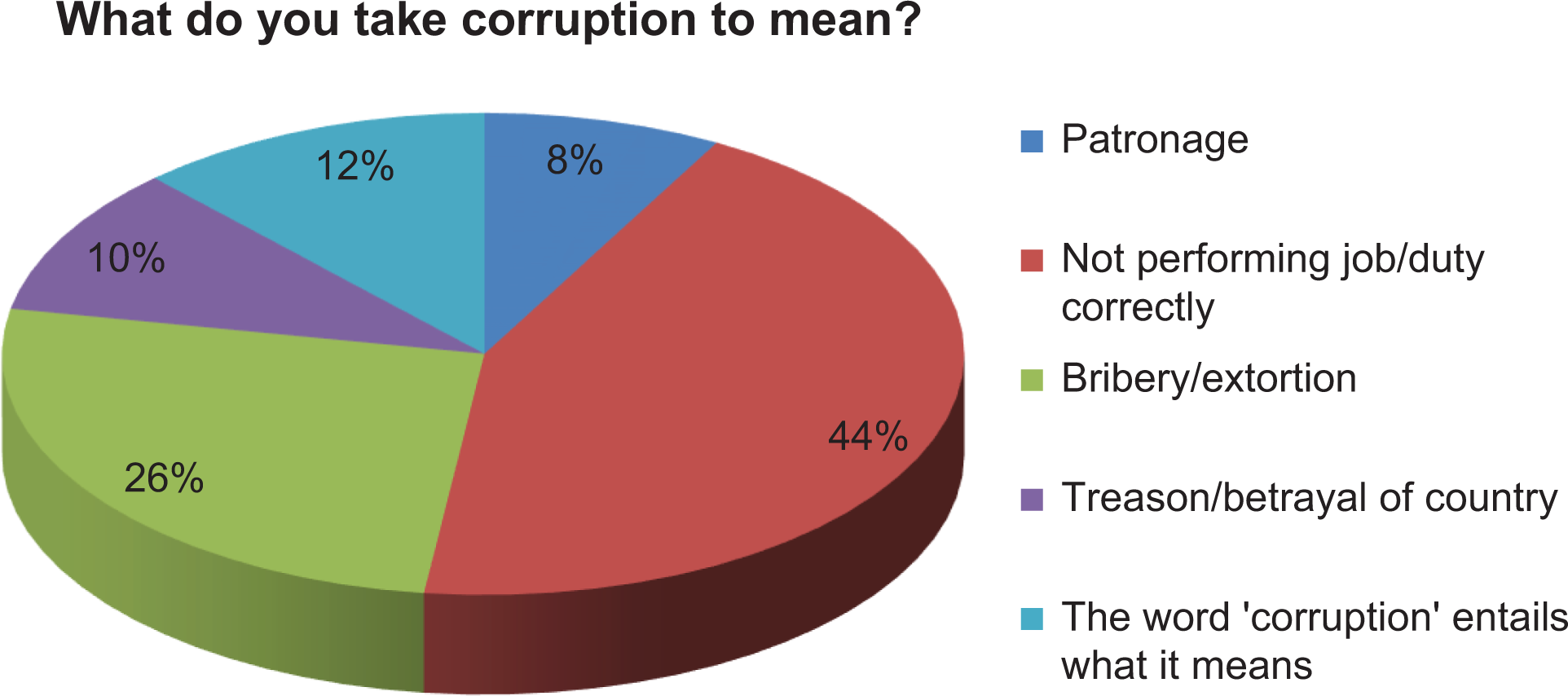
When the respondents were asked what they thought corruption meant, the respondents were provided a free text option so that the variations could openly be examined. There were only five variations which will be covered in turn (Figure 1).
Defining corruption.
Lack of professionalism
The highest reported perception (22 respondents) of what corruption entails included not performing the job or work duties correctly. This is a broad manifestation of corruption because not doing the job properly oversimplifies the notion as being similar to corruption. The perceptions stated were ‘someone who didn’t do his job correctly is corruption’ or ‘if someone does not perform his duties’. Similarly, other respondents stated that ‘laziness at work is corruption’, ‘breach of duty is corruption’ and ‘neglect of duty is corruption’. Other respondents claimed that ‘someone who didn’t do his job well’ is corruption, ‘treason and not doing one’s job correctly’ is corruption and ‘corruption means’ that someone ‘didn’t do his job’. Again, performing the job correctly provides an overly simplistic perception and/or link with corruption but this finding is presented because the participants deemed corruption as unprofessionalism.
Bribery and extortion
The second most reported conception of what constitutes corruption is bribery and extortion which was emphasised by 13 of the respondents. Perceptions are based on money, by either accepting or requesting a payment or gift, in exchange of performing normal duties. Two respondents stated that ‘doing a job for money is corruption’. These respondents held similar perceptions on bribery, extortion and gift giving qualifying as corruption. For instance, one of these respondents stated that ‘if someone wants money for doing a job it is corruption’. Two respondents stressed that ‘to get money for doing someone’s work; doing work for money is called corruption’ and ‘the person who takes money from someone to do his work is called corruption’. Another respondent similarly argued that ‘corruption’ persists when ‘people want money for doing their work’. These perceptions were supported by several additional respondents. For instance, ‘doing a job for money or a gift is corruption’ and ‘if someone did your work for money, it is corruption’. Moreover, it was argued that if ‘someone did not do his job correctly and wants money from others then it is corruption’. Two respondents also claimed that ‘someone who’ performs ‘any job for money is corrupt’ and ‘tampering with evidence of activities for bribes’ and ‘doing work for money’ is corruption. A respondent also argued that ‘bribes are a problem’ and is corruption. Therefore, the variable on the definitions of corruption reveal that basic practices of corruption – bribery in this example – has a relationship with the practices.
Based on these perceptions, corruption could be deemed as a requirement to get things done. This is part of a social contract to speed up processes (Azami, 2009). Most of the respondents stressed that paying for positions (46 participants) is a main practice of police corruption. The literature also contends that the MoIA sells positions to the highest bidders (Wilder, 2007: 52).
Corruption is self-explanatory
Six respondents stated that corruption is a term that is understood by the word itself or they did not know how to define the meaning. Five respondents stated that ‘corruption is corruption’ and ‘corruption means corruption’. One respondent stated ‘I don’t know what corruption is’. These perceptions reveal that corruption is a word that has an identifiable meaning that cannot be explained further. It could be argued that it may be referred to as two meanings. First, the word corruption undertakes the meaning of fasad which is something that is culturally and socially detested, for example, as an act of dirtiness. Second, corruption may literally refer to reshwat/bakhshish which entail a bribe payment as a form of social contract in exchange for the police to perform their duty which is an inescapable evil (Barfield, 2012; De Lauri, 2013).
Treason
Five respondents believed that corruption is based on treason and betrayal/dishonesty to Afghanistan. According to a respondent, ‘if someone engages in treason, it’s called corruption’. Moreover, ‘treason with someone is called corruption’. In relation to betrayal with Afghanistan, two respondents stressed that ‘a person who is betraying the country is corrupt’ and ‘disloyalty with our country is corruption or treason is corruption’. Another respondent claimed that ‘betrayal with the country is corruption’. Therefore, these perceptions are cemented on honour and integrity of the state and if breached then it may be regarded as a social and/or moral evil, in this case corruption.
Patronage
Four respondents cemented their conceptions of corruption on patronage which hinders the recruitment process. It was argued that ‘recruitment in the Afghan police is based on race, tribes and geographic location’ which overrides a person’s ‘qualification and talent’. Likewise, ‘recruitment’ is ‘based on relatives and relations’ and ‘if someone does one’ job ‘for relatives then it is called corruption’. Therefore, the recruitment of unskilled workers is related to patronage which was further stressed as the meaning of corruption from one of the participants. Another respondent contended that the ‘selection of persons without a qualification and profession’ is considered as the implication of corruption. In addition, 35 of the 50 survey respondents believed that patronage in the ANP recruitment occurs. Patronage is another practice of corruption which was strongly linked to the actual meaning of corruption.
These expressions infer that recruitment and police work should be based on fairness and open competition instead of favouring patronage relations. If these priorities are undermined, then it is perceived as corruption. However, Roy (1990), Katzman (2010) and Giustozzi and Isaqzadeh (2013) argue that patronage forms social solidarity within tribes and Tajik officers were brought back into the 2002 MoIA on ethnic lines.
Main causes of police corruption
The previous part of the analysis has revealed that the definitions of corruption are linked with the practices of bribery and patronage. This subsection covers the perceptions on the main causes of police corruption, which consists of the lack of police oversight, low pay, inadequate training and organisational (peer) pressure.
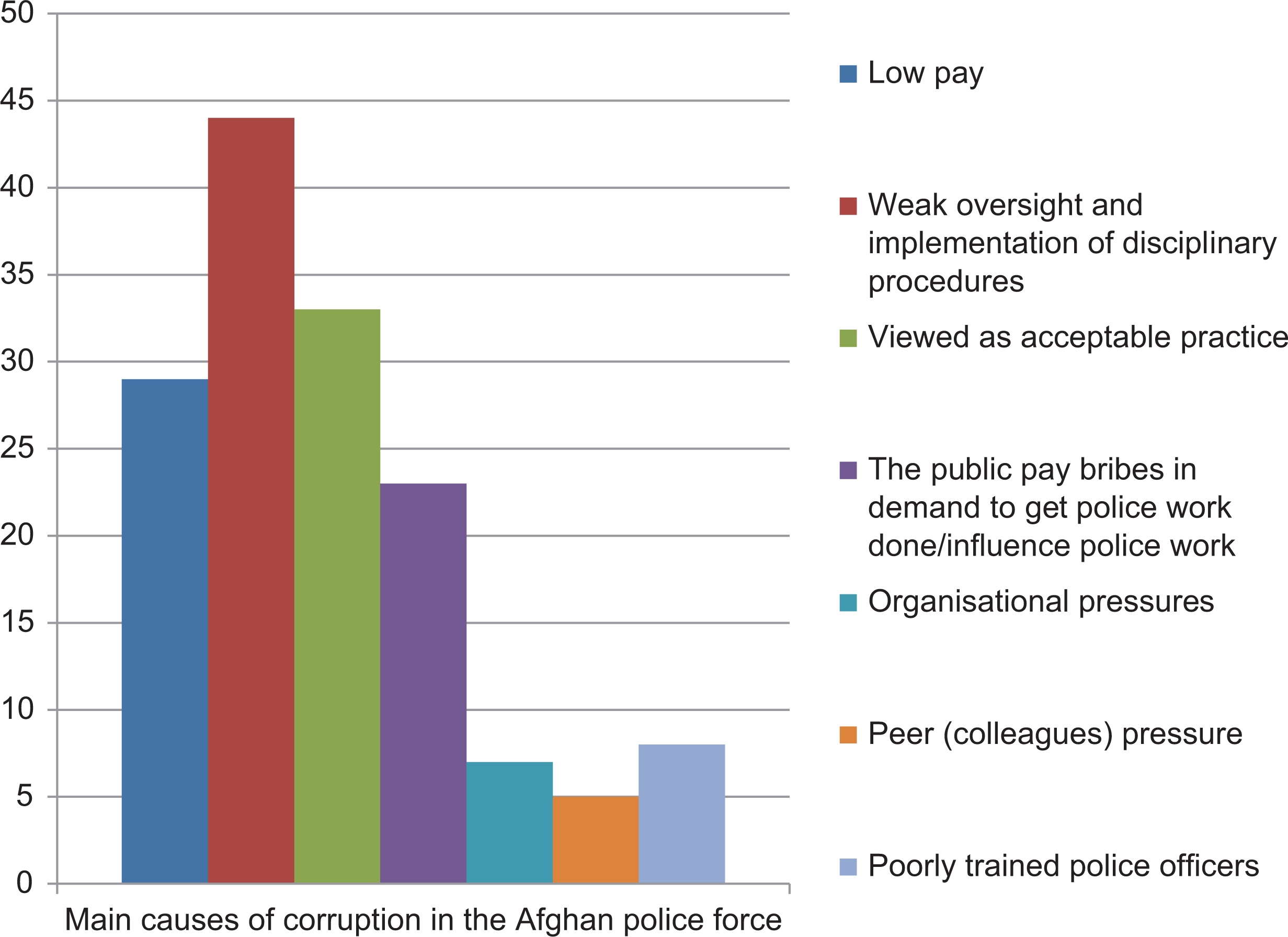
When the respondents were asked what the main causes of police corruption are in the police force, the respondents had the opportunity to select multiple options which also included ‘other – please specify’ with a space provided. Most of the respondents expressed several causes. These consisted of low pay, poor training, weak accountability and peer pressure. These will be discussed in turn (Figure 2).
Main causes of corruption in the Afghan police force.
Lack of police oversight
The greatest stated cause of police corruption is weak oversight and implementation of disciplinary procedures which was stressed by 44 respondents. Accountability and controls to punish police misbehaviour was not prioritised within the Afghan police force despite half of the respondents stating that it could deter police corruption. The majority of the respondents (47 out of 50) claimed that they had not witnessed or heard of any police officer being punished for misconduct. To illustrate, a respondent stressed that ‘until now nobody has been prosecuted’. Only three respondents stated that they were aware of police officers who had been fired or punished for engagement in a corrupt activity. Most of the respondents, which included a range of differently ranked NCOs, are in favour of disciplinary procedures and sanctions within the Afghan police force as an accountability and anti-corruption measure to deter police corruption and misconduct. However, some respondents were cynical of disciplinary procedures and sanctions. This may be due to the already reported very high levels of corruption in the Afghan police force resulting in institutional/systemic corruption and weak internal investigation units.
Punishing and disbanding police officers for misconduct is vital to discourage corrupt and/or illicit behaviour. This is to fight a systemically corrupt police institution (a rotten orchard) which could lead to the institutionalisation of corruption which would make it difficult to combat (Punch, 2009: 60). These findings on weak oversight, poor accountability and cynicism of sanctions have a relationship to the variables on the definitions and practices of police corruption insofar that they exacerbate patronage and weak meritocratic structures.
Low pay
A principal cause of Afghan police corruption is low pay as expressed by 29 respondents. Three of the respondents argued that low wages are the exclusive causes of corruption in the Afghan police force. To illustrate, a respondent stressed that ‘only salary can make the Afghan police force free of corruption’. The average salary of the 50 respondents is 11,451.20 Afghanistan Afghani (AFN) per month. 2 This differs from the literature. Wilder (2007: 39) argues that pay had increased to US$70 after pay reform and Cann et al . (2010) suggest that pay has further increased to US$120 monthly for patrolmen. The data actually show that pay has further increased but the respondents felt that living costs had also risen. The average living costs for all the respondents is 17,530 AFN monthly. This means that there is a deficit of 5,690.80 AFN per month. All the respondents who claimed that low pay is a main cause of corruption argued that bribery and extortion is the outcome to supplement low wages for economic necessity. Low pay is therefore a highly reported cause of police corruption which intensifies bribery and extortion as main practices of corruption.
Pay reform is an obvious, but not sole, policy recommendation to deter petty corruption. This finding links with the literature (cf. Cann et al ., 2010; Cordesman et al ., 2010; Wilder, 2007: 39) but does not provide anything new because police corruption in Afghanistan is prevalent. Pay and opportunity issues derive from classical criminology and opportunity theory in which the individual makes choices as a rational actor (homo economicus) and judgements are made to meet an individual’s subjective ends. The conditions of corruption increase when public servants and police officers are low-paid and are at low risk for engaging in high-reward corrupt activities for economic necessity (Quah, 2011: 14; Rose-Ackerman, 1999: 72).
However, I argue that this is speculative and low pay may merely serve as an excuse of the pervasiveness of police corruption. 3 The empirical evidence presented in this study indicates that most members of the ANP receive low wages but the lack of variance in this independent variable (lack of numbers with higher paid police officers) makes it difficult to show empirically that wages affect the incidence of corruption. Moreover, the cultural factors are of significance to identify what the police officers identify as police corruption. This may be linked to Punch’s (2009) notion that police corruption is conflated with the lack of professionalism and in some jurisdictions corruption is about personal gain. As argued in the literature about Africa and South East Asia, the role of local conditions and culture and how these communities frame corruption determines whether bribery and gift giving are considered as corruption to the relevant society (Azami, 2009; Barfield, 2012; Ledeneva, 1998; Walton, 2012; Yang, 1989). These cultural constructions, largely based on preserving social and business circles and labelling certain ‘dirty’ acts as corruption, contradict with the international definitions on police officers accepting bribes and seeking private or divisional gain.
Inadequate training
Eight respondents stressed that training was an additional cause of corruption. This was suggested in the ‘other – please specify’ section and was not part of the fixed response options. At least 80% of the Afghan police force is illiterate 4 and ‘the 90-day training programmes’ (8-week FDD programmes) are not adequate ‘even for a child to learn how to read’. 5 Inadequate training has a relationship with not performing the job or work duties satisfactorily. As a consequence, new police recruits, which include patrolmen, fall prey to corruption and narcotics-related activity regardless of the MoIA arranging these candidates before they are not trained (Checchia, 2012: 40).
Although some respondents claimed that poor training results in corruption, there is no clear indication of how the link is distinguished and thus further investigation would be needed on training enabling an officer to spot corruption or desist from it. Only 1 week of the FDD is spent on basic police skills and perhaps the lack of, or no, focus on identifying corruption and anti-corruption is a factor why some respondents believed that inadequate training results in corruption practices. However, the relationship between training, professionalism and corruption are ambiguous. The absence of appropriate training does not provide necessary reasons for a police officer to act corruptly. Different types of training, such as 7 weeks of survival skills and counterinsurgency, that would require some element of literacy, are part of FDD and 1 week consisted of basic policing skills (Planty and Perito, 2013: 2).
Organisational (peer) pressure
Police solidarity within the Afghan police force may be high because most of the respondents believed that accountability is weak. Moreover, 38 of the respondents thought that police corruption occurs at a very high level. Although the intensity of corruption appears very high, many respondents stated that corruption is largely unreported, and they were not aware of colleagues being disciplined for corruption. This could be linked with peer pressure to protect internal solidarity, alongside weak oversight, which makes accountability and reporting weak. Seven and five respondents respectively also perceived organisational pressures and peer (colleagues) pressure as the main causes of police corruption. There are a diverse range of respondents who consider the police as colleagues and an organisation forming pressure on police officers to engage in corrupt activity. This may be due to peer pressure and police corporatism inspiring low to severe forms of corruption which are unrevealed to management (O’Malley and Hutchinson, 2007: 164; Sherman, 1985). Moreover, peer pressure and the protection of colleagues could be due to internal informal rules and a feeling of alienation to society (anomie) which increases in phases of conflict.
Main practices of police corruption
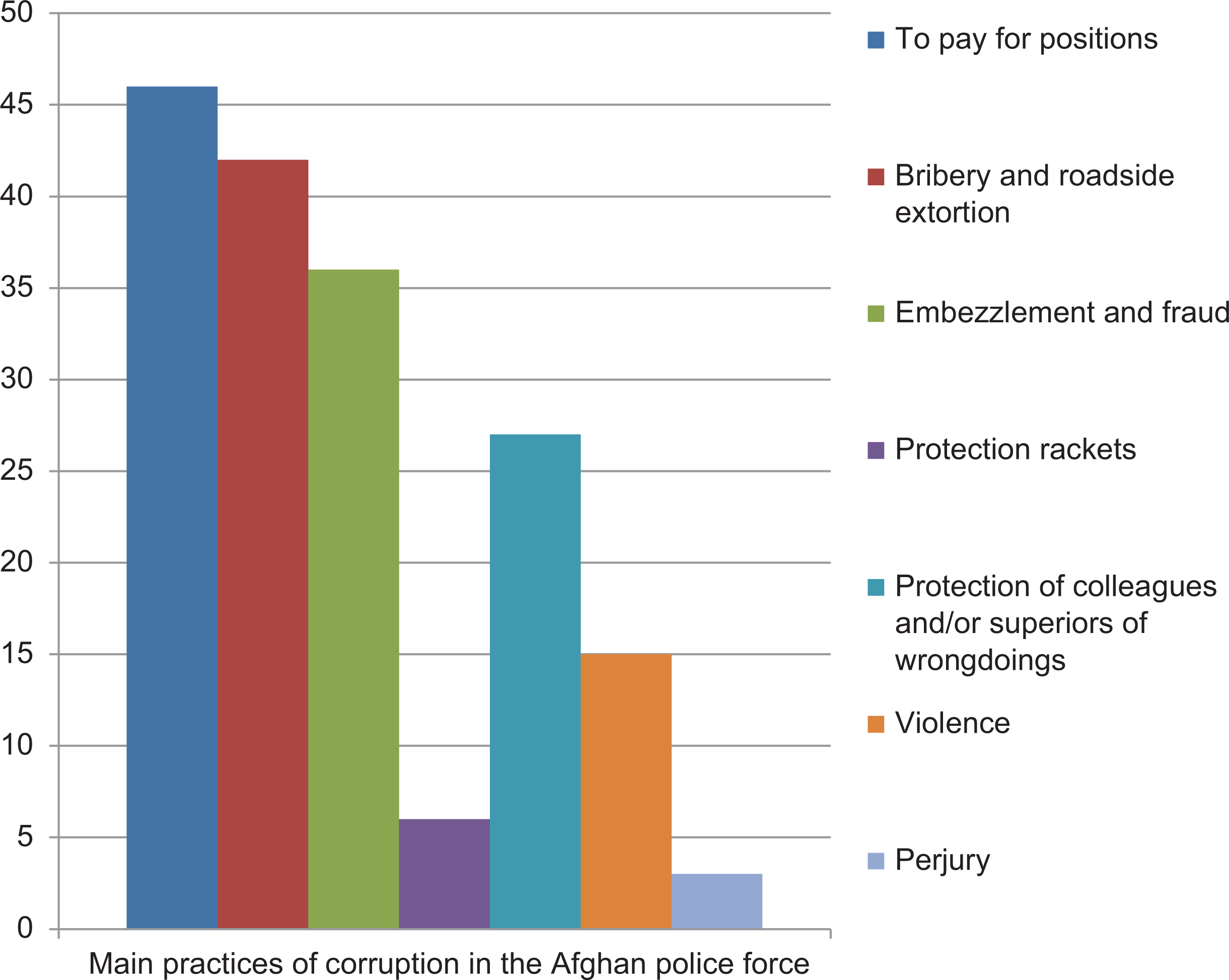
After the respondents expressed their perceptions on the main causes of police corruption, they were subsequently questioned in the world they work in what the main practices of corruption in the ANP entail. As with identifying the main causes of corruption, the respondents had the opportunity to select multiple options which also included ‘other – please specify’ and ‘any other comments’ with spaces provided. The respondents suggested that the main practices of corruption are linked to the main causes when asked ‘any other comments’. The main practices of police corruption as expressed by the respondents include paying for posts, bribery and extortion, police solidarity and delinquency, violence, and noble cause corruption. These will be covered in turn (Figure 3).
Main practices of corruption in the Afghan police force.
The figure suggests that participants reported the protection of colleagues and/or superiors of wrongdoing which may overlap, or at least point to a distinctive aspect of noble cause in Afghan policing. Based on these findings, one could infer that the noble cause is closely attached to the protection of peers rather than achieving a desired outcome.
Paying for posts
The uppermost stated practice of corruption concerns payments for posts which was expressed by 46 respondents. There was one respondent, a Nangarhar-based soldier, who only stated one main practice of corruption in the ANP which was to pay for positions. Based on this perception, systemic corruption is widespread within the MoIA. Individuals can buy or let a position. Police chiefs encourage street police to engage in corruption and the opium trade to pay bribes extorted to their seniors (Demirbüken et al ., 2009: 139). The pervasiveness of corruption within the ANP has repercussions on security. It has resulted in Taliban support because they have the ability to depict themselves as an alternative security provider other than the corrupt national police service influenced and trained by the international community (Singh, 2014: 627). This practice can be linked to prevalent patronage (as stated as the meaning of corruption) and weak oversight (as the main cause of corruption). These variables impact on meritocracy which results in patronage and job-selling. Internal payoffs are debatably a consequence of weak oversight and patronage.
Bribery and extortion
When the respondents were asked about the main practices of corruption, the second highest specified main practice is bribery and roadside extortion. This was highlighted by 42 participants. Subsequently, embezzlement and fraud was stressed by 36 participants as a main practice of Afghan police corruption. Bribery, extortion and kickbacks paid to appointers in drug-producing areas are recognised activities to supplement low wages (Demirbüken et al ., 2009: 139; Hodes and Sedra, 2007: 39). These perceptions reveal that patrolmen frequently extort bribes from citizens on an everyday basis due to low pay.
Moreover, questions based on the main practices of corruption included ‘any other comments’ after the ‘other – please specify’ part. Many of the respondents who selected bribery and roadside extortion as a main practice filled in the ‘any other comments’ part. They expressed that although bribery is recognised as a form of police corruption, it is a socially accepted practice in the Afghan police and state employees. Thirty-three of the respondents stressed that corruption functions as an acceptable practice. One could also infer that the pervasiveness of both causes (low pay) and practices (bribery and extortion) have a relationship with the definitions of corruption within the Afghan police force. Twenty-three of the respondents stated that the public pay bribes as a means of demand from the police to influence police work (23 respondents) which has a relationship with low pay (29 respondents) as the main cause of bribery.
Police solidarity and delinquency
The responses suggested that police solidarity may be a cause of weak police oversight. Twenty-seven of the respondents stated that the protection of colleagues and/or superiors of wrongdoings are a main practice of corruption in the Afghan police force. Further main practices of corruption emphasised by another respondent are based on police culture in the ANP. This includes protecting colleagues and/or superiors of wrongdoings and perjury and there is no awareness of any police officers being sacked, prosecuted, fined or punished for corruption. Three respondents indicated that perjury is a main practice of police corruption. Acts of perjury are related to dishonesty. This includes lying in court, tampering with evidence and fabricating a police report. Misbehaviour of peers or supervisors are regularly undisclosed or colleagues are sheltered during a process of investigation. This is a principal segment of police solidarity and deep-rooted police culture. Based on this premise, it can be argued that corruption is networked internally as a layer of protection (Miller, 2003). This upholds that the police are a unique organisation with a distinct culture that has shared working experiences within the force which is separate from other state institutions or the public.
Hence, perjury and the protection of colleagues and supervisors is part of the habitus, which is the engrained functional values of police work internalised by new recruits to conduct the job and behave in certain ways, as part of the socialisation process, during specific situations to reduce the feeling of alienation (Chan, 2004). This is linked to the field which is the nature of police work cemented on the structural conditions of police ‘institutional practice’.
These perceptions indicate that there is a police culture grounded on solidarity to protect colleagues and superiors of engaging in misbehaviour and deterrents for engaging in corruption are ineffective. Hence, police solidarity and peer pressure (practices of corruption) have a relationship with weak oversight and low accountability (causes of corruption).
Violence
Violence was another main stated practice of corruption in the Afghan police force. This was expressed by 15 out of the 50 participants. Police behaviour is therefore a problem due to the excessive means of violence. Related to violence and payments extracted to evade thrashings and vendor termination, six respondents stated that protection rackets were main practices of Afghan police corruption. Delinquency (affiliated with violence) and the demand of bribes, as payments, to evade the closure of businesses or permitting street vendors to remain selling produce are perceived as forms of police corruption which arguably remains existent in the ANP. Afghan police officers request to be sent to work in Kabul for more opportunities to illegally take money from street vendors to continue selling produce or run small businesses (Fitri, 2014). Violence, as a practice of police corruption, could be linked with the practices of extortion and protection rackets and the causes of inadequate training, organisational pressures and police solidarity. This is because if police officers lack knowledge with human rights, the correct use of force and are pressured by colleagues to engage in protection rackets for supplementary income, then violence and bribery and extortion are possible outcomes.
Noble cause corruption
In relation to the police engaging in corrupt activities for a noble cause, there were a few perceptions to indicate such instances. Rather, the Chairman of the PRDU argued that the ANP have no sense of pride and do not believe in their mandate or the solidarity of their police force for the greater good of the country: The Taliban…that has been radicalised by Mullah Omar since 1995 [is an] insurgency [that] fights constantly with little remuneration. In the 1990s, the police/militias under the Mujahidin had higher officials engaged in corruption but the lower were not engaged in corruption because they worked for a mandate, to protect people and have national pride for Afghanistan. Now, this has been lost as the police do not have any pride and do not know what they are working for.
6
Therefore, I argue that this perception reveals that noble cause corruption is an indicator of police professionalism (which was prioritised as the meaning (definition) of police corruption if not reached), on the basis that noble cause activities indicate a sense of mission among the police to work for the good of society and bring justice for the victims.
These findings indicate that there is a notable relationship between the variables on the definitions, causes and practices of corruption within the Afghan police force. Low pay is a cause of police corruption which intensifies bribery and extortion as main practices of police corruption. Bribery and extortion are perceived as prevalent which is why these practices are deemed as the actual definition of corruption. Weak oversight exacerbates the practices of patronage and job-selling. Poor oversight, alongside high police solidarity, also intensifies violence and protection rackets. Patronage was also perceived as prevalent which is why it was also defined as a definition of corruption. The relationship of these variables provides evidence that there is causation that stems from the causes of corruption that intensify the practices and are included in some of the definitions.
Summary of findings
These main findings presented all suggest, in different ways, that anti-corruption policies in Afghanistan have been a dismal failure, or may not have been pursued in good faith, or some combination of both. However, the conceptions of what corruption entails differ. Therefore, these findings, both in relation to prior expectations about the results of reforms in Afghanistan and arguably in a comparative context (if pursued), suggest that defining corruption from a social constructivist perspective, relevant to a given society and police force, and noble cause corruption, including motivations (and a lack of professionalism) for corrupt behaviour, are pivotal for understanding corruption. Although there was evidence of protecting colleagues and superiors, which could relate to the noble cause without a desired outcome, noble cause corruption for a desired outcome was absent due to there being no sense of mission or police pride among officers. This largely reassesses the notion of noble cause corruption within Afghan policing and potentially the broader context. It is unlikely that the distinction between traditional corruption and noble cause corruption can be neatly defined due to the contention of attaining a desired result against protecting colleagues and/or superiors. These themes that emerge from this research can inform police scholars on the context of Afghanistan while addressing these main points which can be investigated in other non-Western policing contexts. A six-fold typology, based on this study, can be presented on police corruption in Afghanistan: patronage and loyalty (recruitment is based on connections and a patrimonial bureaucracy); unprofessionalism (not performing duties correctly and treason) and lack of motivation (no noble cause or sense of mission); bribery and extortion (the alleged cause is low pay to supplement income which is culturally accepted but this is also due to the lack of police oversight and high solidarity); violence and protection rackets (demanding payments for vendors to continue selling produce or operating businesses); direct involvement and protection of drug-related activities (involves kickbacks paid to senior officers to continue working in high drug-producing areas); and payment for posts (internal payoffs to secure positions).
The typology does share some similarity with Roebuck and Barker’s (1974) typology, namely kickbacks, protection of illegal activities, direct criminal activities and internal payoffs. Moreover, the value of this framed typology can inform the reasons why police corruption is so harmful and problematic. Police corruption specifically impacts on the Afghan government, the police, the public and reformers involved. These problems are clearly related to the lack of professionalism, pride, integrity, human rights, oversight and meritocratic appointments. As a consequence, the public are forced to pay regular bribes which affects the poor sternly. The government and stakeholders are subsequently scrutinised by the public and international media for failing with reforms and curbing corruption in the ANP. This has resulted in wider support for the Taliban, who promoted a code of conduct to provide moral and just security for Afghan civilians and fight against the immoral and corrupt police force and state.
Klockars et al .’s (2000) seriousness rankings of corruption are consistent with the quantitative findings provided in this study. This study has provided the main causes and practices of corruption that are, to an extent, based on the level of punishment related to the activity of police corruption. Although the majority of the respondents did not define corruption as the abuse of authority for gain, bribery or other activities of police malfeasance, the respondents recognised these activities when ranking the main causes and practices of police corruption in the survey.
Conclusion
This article has addressed the varieties of police corruption with an empirical study of the Afghan police, particularly within the lower ranks. Similar to Western literature, the main practices of Afghan police corruption concern bribery and extortion (Newburn, 1999; Punch, 2009). However, when analysing the perceptions of the police respondents, there are variations to report. Afghan police corruption is linked to unprofessionalism, treason, patronage and the cultural acceptance of getting things done. A significant finding is that there is weak motivation within the Afghan police force and little noble cause or a mission to fight for. This was not the case with the Mujahidin fighting against the Soviet-supported communist government and subsequently the Taliban. As a policy recommendation, motivation can be raised if the police force is given a mandate to fight for such as a functional country which is similar to the Mujahidin. Extensive reform efforts from international intervention may have the reverse effect by the police force working to their agenda rather than for the country. Police culture is dependent on the regime and the ideology associated which fosters motivation (or lack of motivation) in the police force. Based on the findings, police accountability appears low and protecting colleagues is high which may be due to anomie and internal informal rules.
The typology of police corruption in Afghanistan includes patronage, noble cause corruption, gift giving and the social acceptance of paying bribes to low-paid police officers to get things done. This typology provides an explanation of these practices that frame corruption. However, these said practices would not necessarily constitute corruption in local Afghan conditions and culture. These cultural constructions are consistent with international explanations of corruption but are not always, excluding patronage which was detested by the survey respondents, deemed as corrupt conduct according to local custom. Understanding these issues can in turn lead to organisational change, improved public opinion and raised public cooperation and compliance with the Afghan police force. Better faith and legitimacy of the police, the government and other stakeholders to deter wider support for insurgent groups as an alternative security measure can thus be mitigated.
Footnotes
Acknowledgements
The author would like to thank all of the police respondents and the kindness of all gatekeepers involved.
Declaration of conflicting interests
The author(s) declared no potential conflicts of interest with respect to the research, authorship and/or publication of this article.
Funding
The author(s) received no financial support for the research, authorship and/or publication of this article.
