






Abstract
In 2016, policing in England and Wales became a degree-entry profession. The pathway for those entering the service without a pre-existing degree is the Police Constable Degree Apprenticeship (PCDA). Due its novelty, there is little extant research surrounding its efficacy. This study gathered perceptions of PCDA officers through a mix of quantitative and qualitative data and thematic analysis, finding that the programme is viewed quite negatively, but this is improving over time. The negativity is largely influenced by a police culture and hierarchy both reluctant to change and facing significant operational pressures hindering students’experience.
Keywords
Background
The Police Constable Degree Apprenticeship (PCDA) is one of three new entry routes open to prospective British police recruits under the Police Education Qualifications Framework (PEQF) introduced by the College of Policing (CoP) in 2016 (College of Policing, 2021). 1 Research conducted by Neyroud (2011) on behalf of the National Police Chief’s Council (NPCC), recommended that all new police joiners be educated to a higher standard on employment, or obtain educational qualification at the commencement of their service – albeit notably omitting the word ‘degree’ from the report. The requirement for a degree education was enacted by the Policing Vision 2025 report (National Police Chiefs' Council, 2015). The PCDA is the solution to the latter of Neyroud’s suggestions, whereby successful police applicants lacking a level six qualification (Gov.uk, n.d.) obtain one in recognition of their training, in partnership with Higher Education Institutions (HEIs) (Andrews, 2021; College of Policing, 2020a), as part of an integrated apprenticeship (UCAS, 2022). Whilst the intent of the PEQF is to professionalise the police force in line with similar careers (Neyroud, 2011; Paterson, 2011; White and Heslop, 2012; College of Policing, 2020b), there has been significant disquiet from some senior officers, staff associations and rank-and-file officers (serving and retired) about why police officers need a degree (Adderley and Vincent, 2021; Verma, n.d.; Leicestershire Police Federation, 2021). This is despite evidence-based research demonstrating the value such qualifications bring to policing (e.g. Brown, 2018; Paterson, 2015). The same critics and others have also voiced concern about the life experience of new recruits, specifically on the PCDA programme (Adderley and Vincent, 2021; Hymas, 2021) – and not without justification (Diggle, 2022).
To date, there has been scant research into the efficacy of the PCDA (or indeed any tertiary level police training (Huey, 2018)) primarily due to its novelty (Brown, 2018; Wood, 2020). Within that landscape, there is even less literature examining attitudes and perspectives of those who have undertaken the programme (Watkinson-Miley et al., 2022). This lack of research serves as an enabler for critics to vocalise their concerns without adequate, evidence-based rebuttals, or indeed, the opposite (Tangen and Rudkin, 2023). This study therefore seeks to partially fill that void by gathering data from PCDA officers about their perceptions of the programme.
The University of Derby was the first institution nationally to deliver this programme (University of Derby, 2021), which then expanded nationally, with all forces except Lincolnshire – who requested a judicial review over the matter (Creaghan, 2019) – implementing the scheme by the end of 2022. It is the aim of this research to hopefully inform CoP curriculum and Home Office policy, by establishing the perceived validity or otherwise of the PCDA programme and identifying opportunities for improvement.
Literature review
Various extant works examine the wider sphere of contemporary police training and the value in providing police officers with higher education. Some of these, such as pieces by Paterson (2011), Kratcoski and Edelbacher (2015) and Rogers and Frevel (2018) consider various ways police training links with higher education internationally, comparing and contrasting the diverse training methodologies, assessing their efficacy. Only the latter is able to consider the PEQF, with two chapters focusing on different aspects of this partnership – firstly the already mentioned ‘professionalisation agenda’ (Tong and Hallenberg, 2018) and secondly the partnership of the CoP with HEIs within the wider policing context (Rogers and Smith, 2018). These recent works are set against a century-long backdrop of international arguments in favour of professionalising policing through education (Vollmer and Schneider, 1917). These early proposals for education (above mere ‘training’) further evolved in the last half-century, to being that officers should obtain tertiary qualifications (Kilcup, 1983), with a focus on the academic method and criticality (Bell, 1979). In fact, as early as 1967 a US Presidential Commission suggested that ‘the ultimate aim of all police departments should be that all personnel with enforcement powers have baccalaureate degrees’ (cited in Hayeslip Jr, 1989: 49).
In spite of the success of advancing policing through the academic method in Britain being obvious by that same point (Andrews, 2020), it took until reforms in 2012, including the foundation of the CoP, to ultimately introduce this requirement in 2016 (Wood, 2020). Since that time the arguments regarding the necessity of constables requiring a degree have continued in earnest, with numerous researchers offering academically supported opinions about the subject (e.g. Cordner and Shain, 2011; Paterson, 2015; Brown, 2018; Williams and Norman, 2023; Tangen and Rudkin, 2023).
The obvious issue with relying on academically produced works to formulate a conclusion regarding the initiative’s validity is the inherent bias of those authors to extoll the value of higher education. The only exception to this is Brown (2018), who concludes that ‘the empirical evidence base is not strong enough to draw definitive conclusions about the improvements that more specific graduate attributes bring to policing and this is particularly the case for UK-based research’ (Brown, 2018: 9). Even more problematic for bias is the CoP’s own review of the PEQF (College of Policing, 2020b), which is unsurprisingly positive about the new entry routes; albeit acknowledging shortfalls in its ability to conduct comprehensive research – again due to the programmes’ novelty. The report cites findings from surveys to student officers to reach its conclusions but does not offer the raw results or in-depth analysis thereof (College of Policing, 2020b).
With specific regard to the PCDA, there are only currently three studies that have sought to understand its value. Brown (2018) considers the PCDA as one aspect of the PEQF, sat within the global context of the relevance of police higher education. She identifies that whilst there are apparent benefits, the students remaining full-time operational police officers can result in them experiencing adverse pressure from work responsibilities, coupled with negative police culture influencing their opinions and opportunity to implement academic initiatives or critical thinking. Simultaneously it was found to ‘limit opportunity for immersion in university life’ (Brown, 2018: 19) through students having to adhere to the Code of Ethics (College of Policing, 2014). This appears largely based however on hypotheticals; her study concluded very soon following the implementation of the PCDA programme, thereby allowing insufficient data for insightful critique.
There remain only two studies that have sought to gain insight into the legitimacy of the PCDA through speaking with students. The only ‘external’ research is that by Watkinson-Miley, et al. (2022). The authors of this interpretivist study obtained purely qualitative data from students undertaking the PCDA. Their findings revealed at worst general malaise, and at best ambivalence to the academic aspects of the programme with only a few of the participants (17%) citing the opportunity to gain a degree as a motivating factor to join the police. As the study was limited to only current students, and moreover only those within their first year of study at one HEI, conclusions that can be drawn from the research are limited. The authors do highlight this, and indeed make the recommendation for further study into PCDA officers’ experiences on a longitudinal basis (Watkinson-Miley, et al., 2022: 132). This study thereby seeks to answer that recommendation, providing further data from more experienced officers, and facilitating additional studies with yet more longevity.
The second is a survey by the CoP (2022) of 2152 PCDA officers. Its findings demonstrate that satisfaction rates with the PCDA are lower than DHEP in relation to university input, but the study splits out the university learning from the in-force learning, whilst simultaneously acknowledging that how this split is managed varies considerably between every force/HEI partnership – but not identifying how. Satisfaction rates with the PCDA are low but there is little insight as to why or recommendations to improve this; it is purely an analysis of the data with little quantitative support. This study therefore differs by intending to ascertain why the programme is not strongly favoured.
A study that utilises qualitative methods through interviewing Policing graduates to assess the efficacy of degree-level police education in Britain, is that by Williams, et al. (2019). They however seek to answer a broader question around the impact of higher education on police officers, by asking graduates of BSc Policing undertaken by the subjects part-time, in-service. Participants had between 6 and 22 years prior police service before graduating (Williams, et al., 2019: 262). No conclusions can therefore be drawn from their experiences in relation to evaluation of the PCDA. The authors did however conclude that even for these experienced officers, holding ranks up to chief inspector, police culture presented a barrier to introduction of evidence-based practice (EBP) or challenging extant procedures based on new research, mirroring Brown (2018). This is of significant relevance regards this study, as to whether PCDA graduates feel ideas espoused by HEIs and the CoP are being encouraged or even acknowledged within forces, and if this impacts their satisfaction with the programme. Williams et al. (2019) only spoke to officers who graduated before the introduction of the PEQF, so this work provides insight whether attitudes within the police have shifted to be more welcoming to academia since that time.
It can be demonstrated therefore that, despite the PCDA having been in existence for 4 years and subject to considerable debate, there are currently no independent studies that seek to evaluate the impact of the course on students and graduates thereof. This intends to fill that void, in parallel to another study that is currently taking place, but which focuses primarily on cost and diversity, alongside best practice for delivery (College of Policing, 2018). That study, funded by the CoP takes a longitudinal approach, tracking intakes over a 4-year period, using purely interpretivist interview and documentary analysis and focusing on the West Midlands region. It therefore differs in scope, intent and methodology from this work, and thus both would contribute meaningfully to the scant extant literature on this topic.
Other works examine the value of police education being delivered by those well versed in adult learning methods, as opposed to ‘trainers’ (e.g. Birzer and Tannehill, 2001; Birzer, 2003; McCoy, 2006; Vodde, 2009). All conclude that more effective andragogical knowledge is essential to increase the efficacy of training to both new and veteran officers. Whilst it is acknowledged that internal police training has developed significantly in this regard, there can be no substitute for the ongoing professional development of HEI lecturers and the access their role and training affords them to the latest research and practice. This is however a difficult aspect to test for herein due to the novelty of the programme and thus graduate outcomes are severely limited.
Hypotheses
The researcher was working from anecdotal feedback, that initial perceptions of the PCDA programme would be sceptical, but that over time, and especially post-graduation, this would change to a sense of worthiness and pride by alumni. It was anticipated that PCDA officers would believe that their peers and supervisors would possess little understanding of the intricacies, or indeed the simplicities, of the programme. It was also presumed that kinaesthetic aspects of the course would be significantly favoured above classroom-based inputs. It was further hypothesised that satisfaction rates amongst participants would show a temporal increase in correlation with their cohort numbers at each HEI, as student feedback was received and concerns addressed from each successive cohort.
Methodology
As identified, attempting to answer this question through a literature review would be an impossible task due to the lack of sources (Huey, 2018), which therefore necessitated primary data collection. Both Williams et al. (2019) and Watkinson-Miley, et al. (2022) in their studies obtained purely qualitative data through semi-structured interviewing. Whilst this interpretivist methodology can gain deeper insights (Carruthers, 1990; Alharahsheh and Pius, 2020), it did limit their number of respondents. Williams et al.’s (2019) study, for example, has an n value of merely 10 all from the same institution, and Watkinson-Miley et al., (2022) n of 30 who are all first years again at the same HEI, making them problematic to draw meaningful conclusions from.
Analysis of the data retrieved from purely qualitative methods can also be troublesome, with an increasing ‘acknowledgement of the inevitability of qualitative research being subjective’ (Walford, 1991: 1). Data gathered is very raw and it is up to the researcher to interpret that data into more general themes (Holliday, 2010). A mixture of both quantitative and qualitative data collection – or ‘across method triangulation’ (Denzin, 1970) – seemed to provide the best solution (Campbell and Fiske, 1959; Webb, et al., 1966). This enabled the gathering of larger datasets, with the ability for participants to clarify quantitative responses (Jick, 1979). This was done by using Likert scales (Likert, 1932) and free-text fields, allowing additional thematic analysis.
After gaining ethical approval, an anonymous MS Forms™ survey was disseminated through targeted means directly to current and former PCDA students. Data was sought from graduates, current and, crucially, resigned PCDA officers to capture a full range of views. Former officers were particularly important for the research to eliminate survivorship bias (McRaney, 2012). Approaches were made to lecturers at HEIs with a request to disseminate the survey to students; whilst concurrently appeals were made on social media (LinkedIn® and Reddit®) directly to PCDA students and bypassing third-party filtering. Through this means 214 responses were received; comprising 47 (22%) first-year student officers, 77 (36%) second-year, 61 (29%) third-year, 20 (9%) graduates and 9 (4%) who had resigned before graduation. These responses came from a range of 24 different HEIs across England and Wales, which represents at least one respondent from every HEI offering the PCDA.
Results and analysis
The finding, most strikingly apparent from the qualitative data, is the sheer variance in methods by which the PCDA is delivered at different institutions. This is even more surprising given the rigidity of the CoP PCDA curriculum (College of Policing, 2023). This is even obvious to officers themselves: ‘there’s been a lack of […] consistency in what has been directed from the [CoP] and this is evident when speaking with colleagues from other forces on the PCDA who have a completely different set up.’ (200)
A broad split would be to divide the teaching methods into two distinct camps; albeit significant variations remain between these divisions: • One approach is the model adopted by Buckinghamshire New (BNU), Derby, De Montfort (DMU) and Staffordshire Universities, among others. This involves more theoretical aspects (e.g. criminology, victimology, leadership and teamworking) being delivered by the HEIs; with legislation and policy, alongside more kinaesthetic approaches delivered by the forces. This shall hereafter be referred to as the ‘Collaborative Model’. • The other approach, most notably by the Babcock™ collaboration of London universities which delivers to the Met,
2
and the University of the West of England (UWE), delivers the entire training within the HEI. Especially notable in the Babcock™ method, is that lecturers are provided with a vast PowerPoint slide deck and expected to deliver that content largely verbatim. This will be referred to as the ‘Sole Model’.
Some participants reported that those HEIs who practiced the ‘Sole Model’ lacked the more practical, kinaesthetic attributes with qualitative replies confirming this: ‘In the previous questions it asked about aspects of PCDA. road safety training, drill/parade, posting to other departments and student experience. In my 3.5 years I have never had any of this ‘I believe that the university side of the course should focus on legislation and the actual law we use on a day to day shift. More practice situations replicating domestic incidents and mental health situations should be covered’ (162 – ARU) ‘The standard training before the degree route was introduced is clearly far more valuable in learning legislation and preparing for the role’ (108 – UWL) ‘Feel a large lack of knowledge, and as a result not a good operational PC but don’t worry none of that’s important! I can write the public a really interesting essay on evidence based policing!’ (134 – UEL)
A comparison between satisfaction levels with the programme does indicate that the ‘Collaborative Model’, with a mean ‘current satisfaction’ of the programme overall at 44% (n = 96) is preferred to the ‘Sole Model’ at 31% (n = 42). 3 Comparing participants reported expectations on beginning the programmes, contrasted with current satisfaction rates, shows a mean drop of 6% overall for ‘Collaborative Model’ and 14% for ‘Sole Model’ HEIs. This supports findings in the CoP’s New Recruits Survey, where in-force training on the PCDA (and DHEP) was viewed much better than on the IPLDP route, and orders of magnitude better than the HEI aspect (College of Policing, 2022).
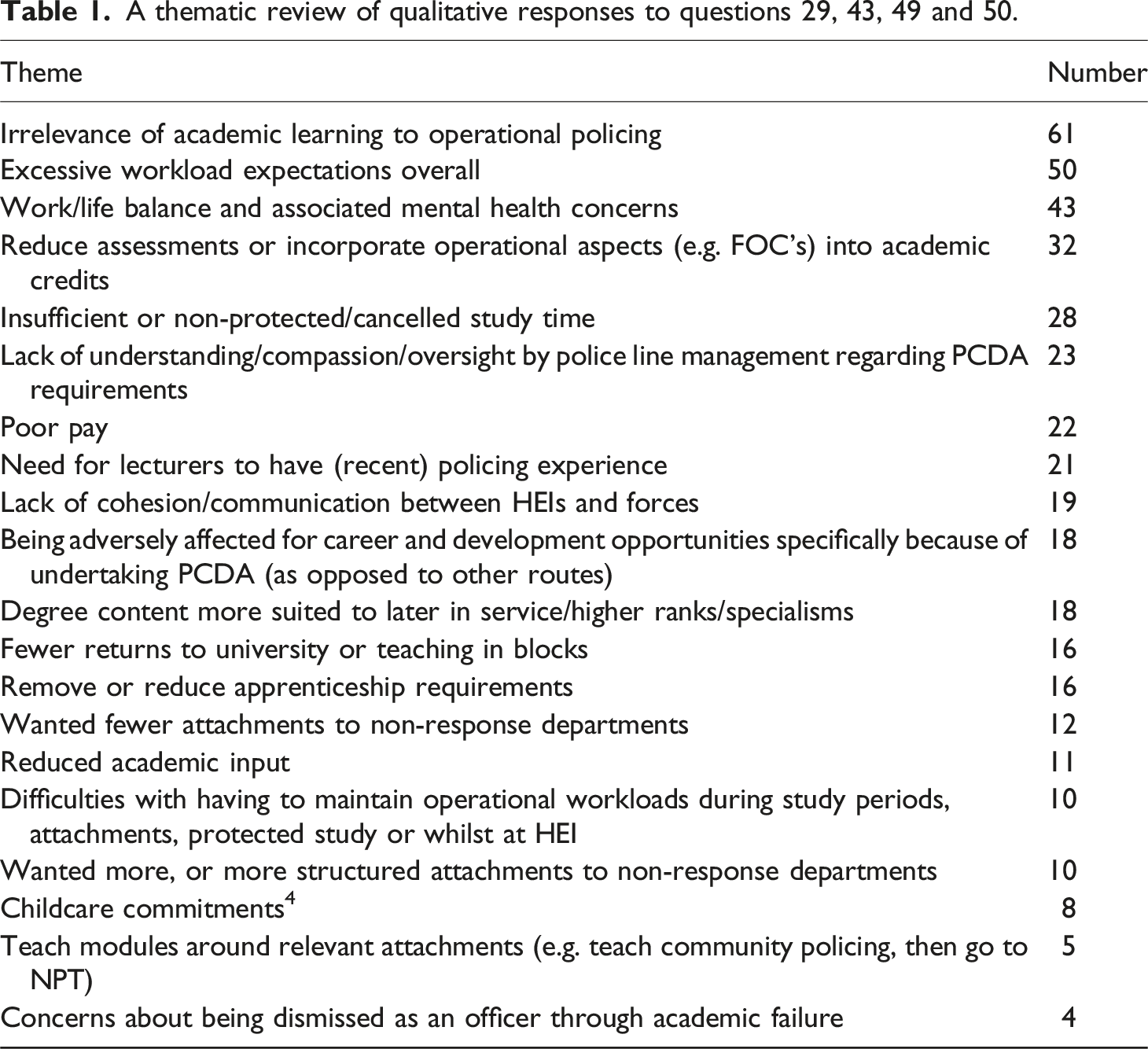
A thematic review of qualitative responses to questions 29, 43, 49 and 50.
One issue identified, supporting Brown (2018), was the expectations of officers to maintain ongoing operational workloads when attending university or attachments: ‘others have been expected to be watch[ing] their workload including taking statements and completing case files when on study leave’ (50). ‘Ensure that any workload is reallocated prior to students leaving for study time’ (98).
This can mean that officers are struggling to progress ongoing investigations and adhere to the Victim Code of Practice regarding updates and expediency (Ministry of Justice, 2021), when they should be having time protected to focus on academia. Participants identified this concern themselves as well: ‘It causes issues when multiple officers are absconded to uni at the same time for month or longer which means either other colleagues have to pick up more work or victims do not get the investigation they deserve’ (127) ‘It is an unrealistic expectation expecting officers […] to write many assignments and work books when they are dealing with many complex crimes and victims, this takes time away from dealing with crimes’ (166)
It appears that forces wish to treat PCDA officers the same as the prior Initial Police Learning and Development Programme (IPLDP), without consideration for the legally required 20% time allocation for off-the-job-learning (Department for Education, 2022: 4), reinforced by the CoP stating PCDA officers receive ‘a minimum level of off-the-job/protected learning time for the duration of the programme’ (College of Policing, 2020a). Apprentices in similar professions are supernumerary (Merrifield, 2016), but demonstrative of the level of understanding certain senior officers possess of the programme, Lancashire’s Chief Constable Chris Rowley was quoted as saying ‘unlike other organisations, police officers are not supernumerary’ and that ‘they don’t get protected study time’ (Faulkner, 2022). With the Department for Education funding apprenticeships, forces should be complying with their legal requirements to provide this.
This is a significant contributory factor to the stress abundantly experienced by respondents as evidenced by responses such as ‘No one else on the IPLDP for example is writing assignments on rest days etc’ (9); ‘I don’t get a chance to complete [assignments] at work so it falls to rest days’ (214); ‘Basically just trying to do the bare minimum I can to pass on my REST DAYS’ [emphasis in original] (220).
This was confirmed by Likert-scale answers to the question ‘how easy is it for you to get your protected study time’, between 1 - ‘not easy at all’ and 5 - ‘it’s guaranteed for me’, the mean was 2.76, but the modal answer was 1 (30%). Differences again could be found between the ‘Collaborative Model’ (mean 3) and ‘Sole Model’ (mean 2.2), albeit interestingly there is significant variation to responses within individual HEIs. This may be accounted for by differences in force, especially where HEIs deliver to multiple forces; but as this was an unanticipated result it is not possible to determine conclusively.
The lack of understanding of the PCDA by senior officers is a perception strongly felt by respondents, with the same 5-point Likert scale to the question ‘Do you feel senior management understand the PCDA?’ giving a mean value of 1.93. The graph of answers to this question (Figure 1) shows the distribution strongly skewed to the negative. Percentage of respondents who feel senior officers understand the PCDA on a 5-point Likert scale, 1 being “not at all”, 5 being “completely”.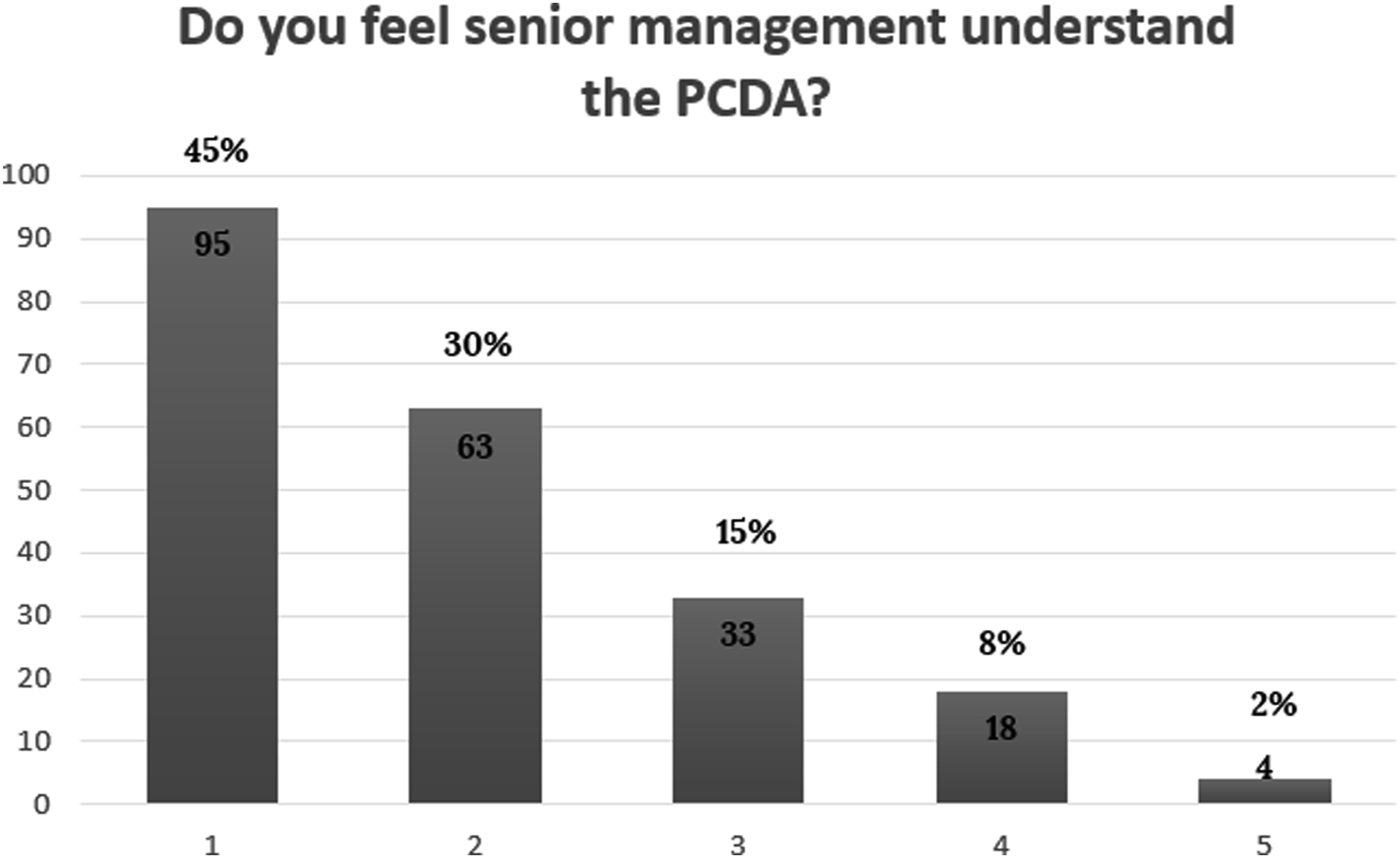
There is an improvement with regards the perceptions of supervisors (mean 2.2, mode 2) and colleagues (mean 2.09, mode 2). Tellingly however only ‘somehow force personnel should be aware of the work that PCDA officers have to do and how much they are expected to do. As I think this is underestimated massively by people that don’t know about the PCDA in detail.’ (9)
This was further exacerbated in eighteen of the qualitative responses, where candidates identified being actively disadvantaged by being on the PCDA pathway, as compared to others. Some such identified hindrances included PCDA students not being granted any specialist or even fundamental training such as blue light driving, tutoring, Taser®, method of entry, Intoxilyser® (drink driving), or Stinger®; or being permitted to move to departments other than emergency response.
Perhaps the key disadvantage faced by responding PCDA officers is that of pay which varies by force. West Yorkshire and Derbyshire Police, for instance, pay DHEP officers £26,682 on joining, but PCDA £23,556 (West Yorkshire Police, 2022; Derbyshire Police, n.d). South Wales Police offer only £21,402 to PCDA but pay DHEP the same (South Wales Police, 2023), as do Bedfordshire, but who pay £26,682 on both entry routes (plus additional £1500 South East weighting) (Bedfordshire Police, 2022). Some even reported that they remained a pay-point behind colleagues with similar lengths of service indefinitely.
Whilst the differences in pay between PCDA and other pathways was highlighted by some, pay overall was a significant issue for more, compounded by heavy workload expectations. This was the second most frequent theme identified in the qualitative answers, and often went hand-in-hand with the third most common, in which respondents identified a problematic work/life balance linked to adverse mental health. ‘The workload given by the University is unbelievable. My partner is studying a FULL TIME social work degree at Staffs Uni. If we compare my first PCDA year, to her first Social Work BA year, I had MORE assignments to complete than her, and this does not include trackers, APTEM [off-the-job learning] logs, and my full time police work (including my [independent patrol status] portfolio).’ (156) ‘The stress the current course is causing is horrendous. [I’m] now on medication. I’m not the only one, I know a number of others on my course that have also had to go to the doctors and are now medicated, this course make people ill’ (61)
One method of potentially overcoming this issue was identified by 16 participants, who made suggestions around delivering the HEI input in more defined ‘blocks’ of time, as opposed to sporadic returns throughout their 3-year probation. Five then went further suggesting these blocks should be taught relating to a specific subject matter, followed by an attachment to that area – for example, deliver a module relating to community policing, and then go on an attachment to neighbourhoods to put that teaching into practice. This was perhaps best summed up by participant 97: ‘Rearrange progression throughout the course and model it after nursing courses - Year 1: University 6 months, initial phase training 3 months, tutorship 3 months. Year 2: on patrol team 6 months, attachments 3 months, university 3 months. Year 3: University 2 months, protected study time 2 months, specialism team 8 months’
Or participant 207 (who resigned prior to completion of the course): ‘I am currently a cadet in the Merchant Navy and the programme is much better set out with fixed 6 month periods at university followed by 6 month periods with on the job based learning.’
This approach may also serve to alleviate some of the issues identified by 19 of the respondents, who identified poor communication and liaison between the HEIs and forces of being a noticeable issue – and not without a hint of irony. Interestingly, of the HEIs known to operate the ‘Collaborative Model’, this was a far more prevalent complaint (n = 7) than those in the ‘Sole Model’ (n = 2). This may represent that where HEIs are co-delivering with the forces, there is an implicit expectation that this should be seamless.
The most obvious theme to come out of the data however was that participants felt police officers did not need degrees. They also, concerningly, felt that the academic learning had not provided them value operationally even on just one occasion – for example, ‘being conscious of victimology or vulnerability when dealing with victims, or the benefits of multi-agency approaches when completing PPNs, etc.’. As significant a proportion as 59% said they had found no benefit from the academic input operationally on even one occasion, with only 32% saying they had (the remainder being unsure)
This majority seemingly finding no value in theories around safeguarding such as Rational Choice Theory (Cornish and Clarke, 1987), and the SARA problem solving model (Eck and Spelman, 1987) raises some significant concern around the influence of existing police culture on the perceptions of PCDA officers around their role. This is exemplified by some qualitative responses that suggested officers were having to ‘unlearn’ classroom content when operational, or that classroom learning did not ‘make for good response officers’. Others were more pragmatic about the application of their learning, such as participant 162: ‘I simply do not have time to consider hot spot policing when going from call to call.’
This links well to an ambiguity surrounding attachments to diverse police departments, which is an often advertised aspect of the PCDA programme which the CoP’s website states ‘provides an opportunity to specialise in one of the core areas of policing’ (College of Policing, 2020a). Whilst it has been noted that respondents felt carrying a workload between attachments was a negative aspect of the programme, others (n = 16) outright stated that they wanted fewer. Conversely some (n = 10) wanted more attachments, these seemingly coming from forces where staffing pressures were preventing attachments from taking place as advertised and thus preventing the wider experiential learning expected from the PCDA attachments.
This ambiguity around the benefits of attachments may well be resolved if the above-mentioned block teaching or ‘nursing teaching’ type delivery were implemented, thereby making the attachments more fundamentally integral.
There are some positives from the respondents however, with overall satisfaction levels seemingly recovering slowly after a sharp decline between 44% satisfaction in year 1 to 35% in year 2, but rising to 41% in year 3 and 39% post-graduation. This is further evidenced in the qualitative responses, especially from graduates and third years who state that they gain a real ‘sense of pride on completion’, but they do further support the underlying issue that the programme is a hard slog to reach that point. This still represents a significant issue however, and supports the CoP’s own findings (College of Policing, 2022), that satisfaction rates are markedly below 50% throughout.
By a different measure of increasing performance, Figure 2 shows mean current satisfaction rates by cohort progression within HEIs, overlaid with a line of best fit. This shows a general upward trend in satisfaction as programmes develop, suggesting feedback is being acted upon and programmes continuously developed. Current average (mean) satisfaction rates by intake cohort number. Note, there were 0 responses from anyone in a cohort 7.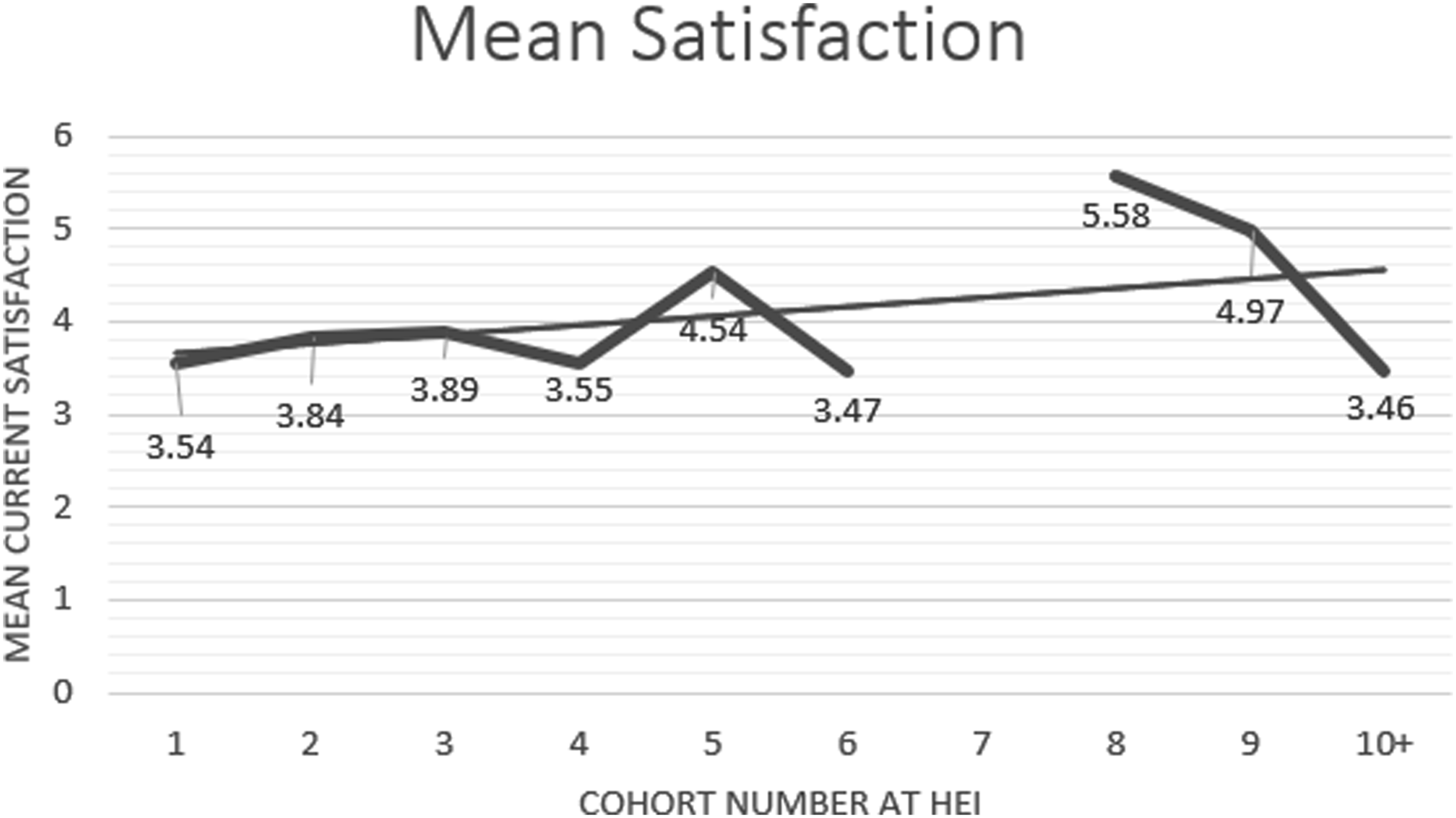
There is further optimism to be found into the validity of the programme from graduate respondents, in that a quarter of them had gone on to, or were currently applying for further qualifications; likely based that 19 of those 20 achieved First- or Upper Second-Class honours awards. There are signs however that some forces do not support or value the further education aspect in the qualitative responses: ‘your question framed it like people could finish PCDA and immediately go into a masters, which as far as I know is impossible. We are not supported in taking further education and I would have to quit police unless I am an inspector requiring it for a project. I had asked about completing a masters and their [sic] is no policing masters.’ (102)
Other positives are a direct rebuttal to some of the comments made by PCDA naysayers, including aspects such as entry age, (Figure 3) and prior employment, where 78% had previous full-time work and a further 14% part-time work. Only 1% were unemployed and 6% coming straight from full-time education. Entry age was asked specifically in narrower categories than captured nationally by the College of Policing (n = 3432) as outlined in Table 2. Age of respondents at time of recruitment onto the PCDA programme. Ages nationally of PCDA joiners, freedom of information request to College of Policing.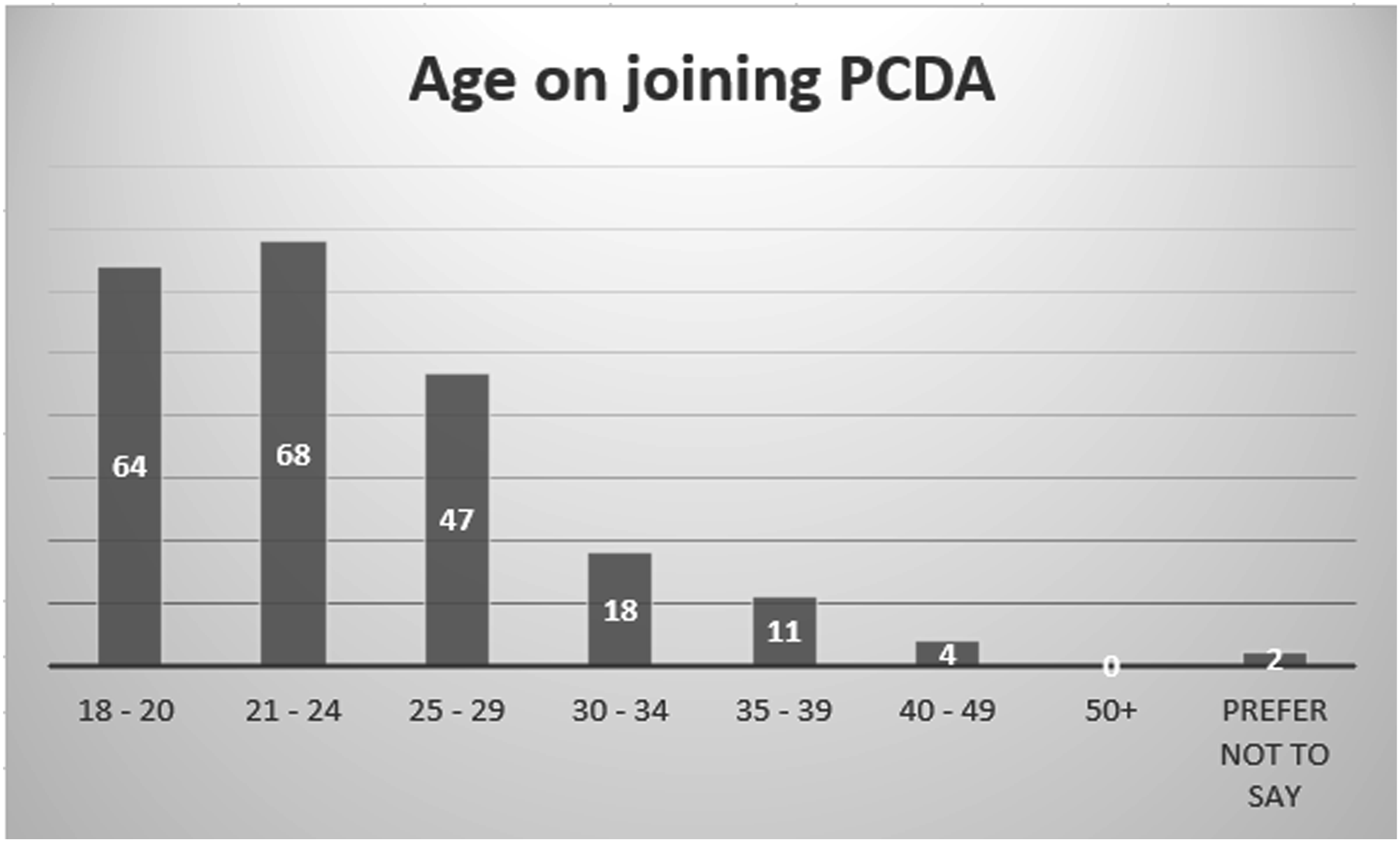

The average age of recruits in 1998 was 26-year-old (House of Commons, 1999), and taking an intermediate value of each the age ranges herein it is possible to calculate that the mean age of recruits to the PCDA is 24.42-year-old. This does represent a drop, but not a significant one enough to warrant the outcry of CC Nick Adderley (Adderley and Vincent, 2021); a view supported by Smiles (2021) in his review of recruit ages on the PEQF pathways. It is also important to note that older applicants are more likely to hold a degree already (Organisation for Economic Co-Operation and Development, 2022) and would therefore be recruited via the DHEP route; although this is not a certainty, as six participants (8, 48, 120, 172, 175 & 205) suggested they already held an undergraduate degree – something which shouldn’t be possible on the PCDA entry route.
With regards to visible diversity, national data obtained by a Freedom of Information Act request to the CoP covering the year 31st March 2020–21 (n = 3432) suggests skewed recruitment towards white males: 55% of recruits are male, 38% female and 7% don’t state. 92% of PCDA officers are White, 4% Asian, 2% Black, 1% East Asian and 1% ‘other’. The PCDA recruits mirror, or slightly better the statistic of the current police workforce nationally, where 93.1% of officers are White, and only 34% are female (Home Office, 2022). Why this pathway is not attracting more visibly diverse recruits is something that would require further research, alongside the same issue for the police workforce overall. Perceptions whether students' work on the PCDA has contributed to improvements or advancement in policing.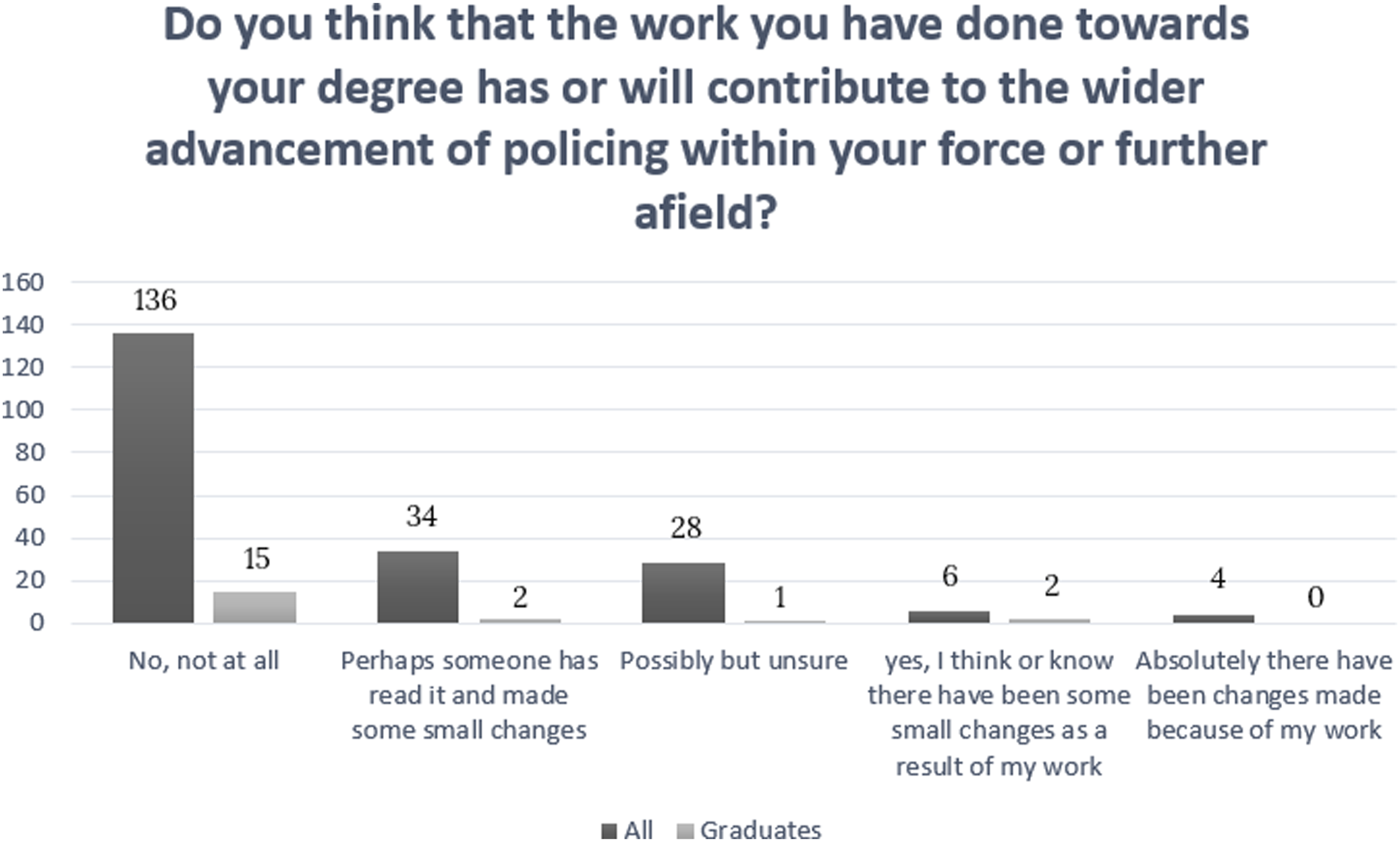
Finally, participants were asked how they would best describe the PCDA with 63% describing it as ‘new joiners are required to earn a degree to be a police officer’, 24% describing it as having to undertake an apprenticeship, and only 13% saying new officers get a degree in recognition of their training. This shifted when they were asked how they felt outsiders perceived it, to being 75% that ‘new joiners are required to earn a degree to be a police officer’, with the loss coming from the apprenticeship category, and the ‘earning a degree’ option remaining nearly the same. This shows a clear shift from respondents when asked how they believe others perceive the programme. It is the view of Andrews (2021), who states he went through the previous IPLDP training and now teaches the PCDA, that the content delivered, and to a degree (pardon the pun) the method of delivery (in a ‘Collaborative Model’ approach) are the same as current. He highlights the only difference being the third year and dissertation, meaning the description of ‘earning a degree as a result of the training’ is the most accurate. Current PCDA officers have not experienced the IPDLP and are therefore not able to make the comparison. The dissertation was introduced to be the key difference from the IPDLP, according to the CoP: ‘The project outcomes, once assessed and deemed to be of sufficiently high quality, can be shared via the College academic support network and What Works Centre. This enables other forces to benefit from and build upon the research.’ (College of Policing, 2020a)
There is currently though no evidence of this approach being taken, and therefore PCDA officers feel that this advertised intent to use their skills to develop policing simply does not hold true, and even less so for the graduate respondents (n = 20) (See Figure 4).
Finally, the overwhelming feeling among respondents is that ‘You do not need a degree to make you a better police officer, that’s the problem’ (90). This is perhaps partially influenced by a perception about society as a whole and where the police sit within that, as evidenced by participant 68 ‘The people are the public and the public are the police — our police service needs to be representative of our communities, the majority of whom DO NOT HAVE DEGREES.’ [emphasis in original]
The issue here being that current statistics show that actually 57% of adults between 25 and 34 years hold tertiary education, the demographic second most likely to come into contact with the police, after 18–24-year-olds (Harrell and Davis, 2020).5 This attitude seems to go hand-in-hand with the idea that learning should be focused ‘more around response team and how to become a good frontline police officer’ (111) than on criminological theory. This again perhaps shows a lack of understanding around the role of a response officer, when ‘at least 80% of officers’ time is spent dealing with incidents that involve protecting people from becoming victims of crime or to preventing crimes occurring. In addition, a significant percentage of emergency or priority incidents have been reported as relating to antisocial behaviour or other demands (such as concerns for welfare) which are not related to crimes.’ (Boulton, et al., 2016: 71)
This may account for the shift in perceptions around the validity of the theoretical aspect in year three and post-graduation, as gradually theory blends with operational reality. It may well also be that as ‘the causes and drivers of crime are not something the police can change or address. Poverty and income inequality are the result of Government policy’ (107), that efforts to induce officers with a belief they can affect social change are erroneous and quickly dashed.
Discussion and recommendations
It is abundantly clear from the results, in line with Watkinson-Miley et al., (2022), that there is at best ambivalence regarding the need for police officers to have a degree and dislike of the PCDA programme; and at worst, outright rejection of these on a wholesale basis. Whilst it is highly likely, as demonstrated from the literature, that existing police culture may significantly prime the new entrants towards this view, it is also apparent from the qualitative replies that the delivery of the PCDA within HEIs, paired with the general lack of support or buy-in from forces are significant drivers of the resentment. Overwhelmingly obvious though is that it is the demand expectations of the tripartite approach to the PCDA, of being full-time operational police officers with greater expectations than peers alongside being full-time students with assessment requirements akin to (or greater than) standard undergraduates, topped with fulfilling the additional apprenticeship standards. This is contrary to the virtues of good practice in HE espoused by Ashwin et al. (2020) through minimising assessment and workload, which practitioners at that level should be aware of, but crucially the CoP who designed the programmes may not be. These combine into a triple-threat where PCDA officers can lose their job through three different methods (operational errors, academic failure and apprenticeship issues), or not be adequately proficient in these areas and resign through mental illness or burnout.
The results around the perceptions of what the PCDA represents by both those on it, and their view of how others understand it – of ‘new joiners being required to earn a degree to become a police officer’ – summarises perhaps one of key failings of the programme’s inception; that being the marketing and PR around it at governmental, media and CoP levels. The curriculum of the PCDA does not represent a significant divergence from prior or even contemporary learning on the IPLDP. The only significant difference is the requirement to engage with academic literature and research to a deeper extent – primarily through the completion of a dissertation. It certainly does not depart drastically from the IPLDP in more recent years, where recruits earned a foundation degree in policing, accredited by HEIs (Andrews, 2021; University of Central Lancashire, 2015). There was however no outcry at that time regarding the academicisation of policing.
Perhaps therefore the fanfare signalling the arrival of the PEQF took the wrong framing, and instead of stating recruits now need a degree to be police officers (Dodd, 2016; Barrett, 2015), this should have been marketed much more strongly as officers earning a degree in recognition of their training. The similarities to, and natural evolution from foundation degrees could have been emphasised. Or perhaps even a complete lack of fuss made, and the marketing simply highlighting that training was undertaking a ‘refresh and modernisation’ with increased focus on contemporary methods and issues. Evidence could also have been cited demonstrating the value that professionalisation has brought to other careers such as nursing (e.g. Giddens, 2006; Lane and Kohlenberg, 2010); alongside the link that education has to professionalisation (Heslop, 2011; Neyroud, 2011). This could have been supported by real-world examples demonstrating the importance of EBP and its enhancement of policing.
Another recommendation is around the impact that the students perceive themselves having. The PCDA asks them to become subject-matter experts to an extent in the topic of their dissertation; but their experience suggests this insight then fails to be utilised. It is not shared widely and seemingly not consulted to develop policy or practice at a national or local levels. Whilst some forces (although by no means all) offer PCDA students a choice of general career path in the latter stages or on completion of the degree, even in the forces that do, this is only generally to ‘CID’, ‘response’ or ‘neighbourhoods’. There is no consideration, for example, of placing students who research drink driving for their dissertation, into casualty reduction or roads policing teams; or those who examine onset offending into youth offending teams. Obviously this could not be practical for every officer, otherwise there may be significant over-subscription to some areas; but there surely could be some scope for even a temporary posting or co-development around dissertation research findings.
The alternative to this is to take the research to a wider audience, perhaps with the publication of something akin to a ‘Journal of PCDA Officers’ Research’, or the CoP’s Going Equipped. The peer review process for such would be organic, as lecturers at HEIs already mark the dissertations, and only those that scored highest (or some other similar metric) would be chosen for inclusion therein – with suitable editing facilitated by lecturers or mentors. This would allow for the dissemination of the often high quality research and thus potentially impact on policing policy nationally. It may also incentivise the students with the associated benefits such publication would bring, for example on Competency and Values Framework-based interviews (College of Policing, 2016). An alternative to more traditional academic publication could be for the highest-scoring dissertations to be thematically collated in the CoP National Police Library or What Works Centre, for policy makers to consult when addressing those areas. Indeed, this is a stated aim of the PCDA programme by the CoP on its own website (College of Policing, 2020a), but one that respondents to this study clearly feel is not happening.
The final recommendation is to significantly align the delivery methods towards an identified best practice. In spite of the CoP stating that the PCDA should ‘standardise the learning provision across all forces, in particular, the initial learning for newly recruited officers’ (College of Policing, 2020a) and designing a rigid curriculum to ostensibly ensure this, it is abundantly evident that this is not happening, and that the opposite is in fact true with delivery methods as disparate, if not more so, than before. Two overarching divergent approaches have been identified in the ‘Collaborative’ and ‘Sole’ models, but with significant variation on a spectrum both between and within those categories. It was outside the scope of this research to assess differences in delivery styles, as that was not a hypothesised outcome but may present an interesting proposal for future research – especially into what constitutes best practice. This approach however has seemingly fostered tribalist views of ‘us’ and ‘them’ between HEIs and forces (Tajfel, 1978), evident in both models, but most notably so in the ‘Collaborative’. This is even evident in the CoP’s own satisfaction survey that divides the ‘in-force’ and ‘university’ training; thus themselves reinforcing the dichotomy (College of Policing, 2022)!
The learning is therefore not viewed holistically, and this may once again be because of the police culture of hostility towards change and novelty; it being easier to ascribe ‘difference’ to the HEIs. This suggests an argument for a provision much more along the ‘Sole Model’ approach, but this was viewed less favourably by the participants; perhaps as the ‘in-force’ aspect of the ‘Collaborative Model’ allows greater flexibility in additional content such as driving, Taser® or Stinger® training above and beyond the core CoP curriculum, which were apparently lacking in the former. HEIs are likely to only deliver what they are obligated to, and this is especially true with the profit-driven approach of the Babcock™ company.
It may well be that the abolition of the PCDA and an entirely novel method is required, and thus the final recommendation is that further research or study is undertaken in this area to ascertain what form that could take. Whatever means may be adopted, it must ensure that student officers do not retain workloads across attachments or study leave, and ensure the latter is both available and utilised to address the significant mental health concerns among respondents.
Conclusion
The high dissatisfaction rates with the PCDA programme by those on it does not lend itself to the shift in culture previously hoped for by Williams et al. (2019), through reaching a critical mass of graduates. Quite what this means for the programme, whose political future has already been shaken (Hamilton, 2022), is yet to be seen – especially in light of the maintenance of a non-degree entry route and the inevitable questions this casts on the future of the PCDA. Certainly something needs to change fundamentally, most importantly around the perceived relevance of the ‘academic’ input, alongside the level and balance of workloads through better provision of protected study time, and clarification of whether PCDA officers are indeed supernumerary. A clear direction from the CoP to forces on this matter would no doubt clear up this ambiguity.
The police culture of distain regarding the necessity for a degree is clear from the findings, but perhaps what is not so clear around this, is why; and this is harder to isolate. The PEQF was launched in 2016 with the first cohorts entering service from 2018 (University of Derby, 2021). This is concurrent with some of the biggest changes to policing in a generation. Austerity cuts saw staffing reductions of up to 25% in many UK regions, equating to up to a 2% decrease in officers per head of population (Draca and Langella, 2020). Police pay has also suffered similarly, with between 13% and 17% real terms pay cut since 2009 (Kirk, 2022; Social Market Foundation, 2023). This is represented in the research findings, where ‘pay’ is a key dissatisfaction; apprentices in some forces starting on lower pay than counterparts, despite the (significantly) higher workloads.
Recent years have also seen the highest numbers of experienced mid-service officers resigning on record – a 196% rise in a decade – now accounting for 42% of all police leavers. In 2012, they accounted for just 18% (Charman, 2022). Even with Operation Uplift – a political goal to recruit 20,000 additional officers, taking numbers back to pre-austerity levels – the focus has been entirely on recruitment, without any significant thought beyond that. This has evidently resulted in a significant imbalance between quantity over quality (House of Commons Committee of Public Accounts, 2022; Evans, 2023). Older generations’ wider attitudes towards ‘Millennials’, ‘Gen Z’ and supposed ‘woke culture’ and ‘culture wars’ as part of the contemporary zeitgeist (e.g. Slater, 2021; Spencer, 2022), has also no doubt contributed to negative perceptions of new recruits; reflected in popular satire of recruits entering service with ‘degrees in modern dance’ (Bullshire Police, 2022).
This ‘perfect storm’ of policing issues has combined to create some of the lowest public trust and confidence levels on record (YouGov, 2022). The new entry routes have provided a convenient scapegoat for those looking to cast blame elsewhere than their own failings; or indeed those who ironically do not wish to engage in a level of critical analysis to understand the substantially more deep-rooted causes of the current crisis; brutally laid bare, at least in the Metropolitan Police, by Baroness Casey (2023). It is entirely likely that the PEQF, and specifically herein the PCDA, have provided a ‘tangible’ scapegoat for the far more ethereal ideas of the general fall in pay, conditions, morale, political and public favour.
As outlined above however, it is yet early in the evolution of the PCDA, with HEIs and forces continually adapting, developing and responding to feedback, and widespread cultural change in any institution takes time. As it stands though, each HEI and force seems to deliver the programme in a distinct manner with no established best practice being identified. There is a glimmer of hope for the pathway, in that a quarter of graduate respondents are undertaking further study, suggesting that there is some level of benefit found by those completing the course. Graduates of the PCDA however remain scarce due to its novelty, so the sample size here is admittedly small, and timescales to have commenced further learning even smaller; but is nonetheless demonstrative of some optimism around the benefits of tertiary education in policing. This may only be realised as these graduates progress through the service and find themselves in a position to support further police education. As highlighted at the outset however, this study merely forms a baseline from which to track perceptions of the programme over time. Seemingly, there can only be one direction for these perceptions to take though, because currently they would struggle to be much lower. Is it therefore time to conclude that this pathway – but not the concept of HE in policing – is substantially reviewed or wholly redeveloped?
Footnotes
Declaration of conflicting interests
The author(s) declared no potential conflicts of interest with respect to the research, authorship, and/or publication of this article.
Funding
The author(s) received no financial support for the research, authorship, and/or publication of this article.
