







Abstract
Law enforcement officers experience high rates of stress associated with their work, potentially leading to alcohol use as a means of coping. Using data from a nationally representative survey of law enforcement officers in the U.S., we found that adjusted odds of binge drinking monthly or more frequently increased significantly with higher levels of administrative stress and each additional type of critical incident reported. Increased officer resilience had a significant association with decreased adjusted odds of binge drinking monthly or more frequently. Strategies for reducing stressors and building resiliency are important for reducing binge drinking and improving wellness among officers.
Introduction
Law enforcement officers have high exposure to stressful experiences, which may put them at increased risk of negative health consequences compared with other occupations (Mona et al., 2019). As part of their duties, officers experience potentially traumatic critical incidents, which include experiencing physical harm and witnessing harm inflicted upon others (Chopko et al., 2015). Beyond the stress associated with their duties, officers experience administrative stressors related to the policies and structures within their agencies, including perceived unfairness of department policies, tensions between leadership and frontline workers, lack of support among coworkers, punishment for “minor” infractions, feeling second-guessed on actions taken in the field, lack of reward for good performance, and overall low morale (Amaranto et al., 2003). Administrative stress may stem in part from rigid, hierarchical, bureaucratic organizational structures and regulations within police agencies, which inhibit perceived autonomy and therefore job satisfaction (Pagon et al., 2011; Shane, 2010). A systematic review of the effects of organizational stressors on mental wellbeing among police officers found strong evidence that these stressors are strongly related to psychological distress and emotional exhaustion (Purba and Demou, 2019).
Experiencing physical and psychological stress can precipitate excessive alcohol use as a coping mechanism (Brady and Sonne, 1999; Keyes et al., 2011, 2012). Stressful experiences have a particularly strong association with binge drinking, compared to other drinking patterns (Dawson et al., 2005). Defined by the National Institute on Alcohol Abuse and Alcoholism and the Substance Abuse and Mental Health Services Administration as drinking five or more alcoholic drinks (for men) or four or more alcoholic drinks (for women) per occasion, binge drinking is the most costly pattern of excessive alcohol use (Bouchery et al., 2011; National Institute on Alcohol Abuse and Alcoholism, 2011). It is associated with increased risk of chronic disease (e.g., cancer and heart disease), acute harm (e.g., injury), and alcohol use disorder (National Institute on Alcohol Abuse and Alcoholism, 2011; 2021; World Health Organization, 2019). Acute harms associated with binge drinking account for nearly half of all alcohol-related deaths (Center for Disease Control and Prevention, 2022). Among law enforcement officers specifically, excessive alcohol use has been linked with poor mental health and lower levels of well-being (Arble et al., 2018; Ballenger et al., 2011; Mumford et al., 2021).
Previous studies have documented high rates of alcohol use among law enforcement officers, with some of these studies indicating that officers’ alcohol use—and binge drinking, more specifically—exceeds that of other occupations and the general population (Ballenger et al., 2011; Chopko et al., 2013; Irizar et al., 2021; Mumford et al., 2021; Syed et al., 2020; Weir et al., 2012). Coping with stress is one of the primary reasons that officers consume alcohol (Davey et al., 2001; Lindsay and Shelley, 2009). Other research has found that organizational stressors (e.g., work relationships and role clarity) and exposure to critical incidents, including work-related injury and natural disasters, may be associated with increased drinking among officers (Chopko et al., 2013; Heavey et al., 2015; Houdmont and Jachens, 2021; Leino et al., 2012; Ménard and Arter, 2013; Syed et al., 2020).
While exposure to critical incidents and administrative (i.e., organizational) stressors may increase officers’ harmful alcohol use, officers’ resilience may play a key role as a protective factor. Resilience is a complex construct that has been defined as both a characteristic (i.e., the ability to adapt and achieve stability in a positive, integrative manner following adversity) and a process (i.e., to harness resources to maintain well-being) (Southwick et al., 2014). Resilience is positively correlated with perceived meaning in life, active coping, social support and life satisfaction, and negatively correlated with depression, anxiety, and post-traumatic stress (Aiena et al., 2015; The Resilience Center, 2022). Resilience is also associated with decreased alcohol consumption and negative alcohol-related consequences, including risk of alcohol use disorder (Bartone et al., 2012; Johnson et al., 2011; Long et al., 2017). Furthermore, increased resilience may buffer against negative alcohol-related consequences associated with traumatic stress exposure (Cusack et al., 2023; Kim et al., 2018; Morgan et al., 2018). Despite these promising findings, few studies have explored the relationship between resilience and alcohol use among law enforcement officers specifically.
Building on existing literature, the aim of this study is to assess how exposures to duty-related stressors (i.e., critical incidents) and the administrative stress of policework are related to binge drinking in a nationally representative sample of U.S. law enforcement officers. This study seeks to fill a gap by examining the relationship between officer binge drinking and resilience, which we hypothesize to be negatively associated with binge drinking. In line with the buffering hypothesis of resilience, we also expect that the association between stressors and binge drinking frequency will be lower among those with high resilience as opposed to low resilience (Cusack et al., 2023; Sheerin et al., 2018). Findings from this study may inform efforts to mitigate harmful drinking among officers, particularly interventions geared toward building resiliency in this population.
Methods
Participants
Data for this analysis come from a nationally representative, longitudinal survey administered through the Officer Safety and Wellness (OSAW) Initiative, funded by the National Institute of Justice (NIJ). Details on the survey methodology are available elsewhere (Mumford et al., 2021). Briefly, OSAW investigators used a two stage sampling process that included 1) selecting a nationally representative sample of municipal, county, Bureau of Indian Affairs, and state police/highway patrol law enforcement agencies, and 2) randomly selecting full-time sworn officers from the roster of each selected agency. Since women made up 11%–12% of the law enforcement workforce at the time of design, investigators oversampled female officers at a rate of 2:1 to enable sufficient sample size for comparisons across genders. The analysis presented in this paper draws on Wave 2 data, which included assessment of officers’ resilience. OSAW investigators collected Wave 2 data via an online survey from January 2020 to January 2021. Invited participants received email reminders during the field period; agency leadership did not receive notification of which invited officers completed the survey and which did not. No incentives were offered. Out of 7548 eligible officers invited to participate in Wave 2, 1890 (25%) completed the survey. Investigators applied sampling weights to adjust for probability of selection, including oversampling of female officers, and survey non-response; for more details on weighting, see Mumford et al., 2020. The Institutional Review Board at NORC at the University of Chicago reviewed and approved this study prior to data collection.
Measures
Binge drinking
To measure binge drinking, we adapted an item from the Alcohol Use Disorder Identification Test Consumption Questionnaire, an instrument widely used to screen for hazardous alcohol use (Bradley et al., 2007; Higgins-Biddle and Babor, 2018). Officers were asked about how often they engaged in binge drinking: “How often do you have 4 (if you are female) or 5 (if you are male) or more drinks on one occasion?” Response categories included: “Never,” “Less than Monthly,” “Monthly,” “Weekly,” and “Daily or Almost Daily.” To enhance comparability with national surveys assessing past-month binge drinking behaviors, we created a dichotomous indicator of whether participants reported binge drinking monthly, weekly, or daily (coded a 1) or less than monthly or never (coded as 0), which we used as our outcome in multivariable models, described further below (Bohm et al., 2021).
Administrative stress
The administrative stress measure was a global item based on a ten-item scale (Donnelly et al., 2014) pilot tested in 2019 with 107 law enforcement officers across three agencies in preparation for the nationally representative survey: “In your policing career, how much stress have you felt related to the administrative side of your job? (e.g., staff shortages, different rules for different people, bureaucratic red tape, policy changes, lack of training/resources)?” Officers had the option of selecting: “No stress,” “Low Stress,” “Moderate Stress,” “High Stress,” and “Very High Stress.”
To increase the stability of the reference group and to assess how potential strategies to reduce stress may mitigate binge drinking behavior, we reverse-coded this item (coding Very High Stress as 0).
Critical incident history
The survey included an inventory of 27 incidents that may lead to stress or trauma for officers, based on the Critical Incident History (CIH) Questionnaire and modified based on input with a panel of experts (Weiss et al., 2010). For each incident, officers were asked, “Please indicate whether you have ever witnessed, arrived at scene, or been connected in some way to any of the following…” Incidents included exposures related to experiencing harm or the threat of harm (e.g., “You were seriously beaten” or “You were shot at”) and encountering harm to others (e.g., “To carry out police duties, you had to use force resulting in injuries to you or suspect” or “Colleague or loved one killed intentionally”). Based on expert panel feedback, items were added to assess other stressful incidents (e.g., “You were attacked on social media for an action related to your police work”). For this analysis, we created a count variable to capture the number of critical incident types experienced by each participant.
Resilience
To assess resilience, the survey used the Resilience Scale-14, a fourteen-item scale capturing individual-level characteristics associated with positive adaptation to adversity, including self-reliance, purpose, equanimity, perseverance, and authenticity (Wagnild, 2009, 2016). Previous studies have demonstrated that the scale has a one-factor structure and strong reliability across a range of populations, including trauma responders (Chronbach’s alpha = 0.92) (Aiena et al., 2015; Gonzalez et al., 2019; Madewell et al., 2016). Survey participants rated each item using a five-point Likert-type scale, with increasing values indicating increasing levels of resilience (1 = Strongly Disagree, 2 = Disagree, 3 = Neutral, 4 = Agree, 5 = Strongly Agree). To align the scale with cut-offs from prior research using a seven-point scale, we summed responses and coded scores <46 as low resilience, ≥46 and <58 as moderate resilience, and ≥58 as high resilience (Pritzker and Minter, 2014). Because so few participants indicated low levels of resilience (3.15% of the analytical sample), we combined low and moderate levels of resilience to improve the stability of reference category (Low/Moderate resilience coded as 0, High resilience coded as 1).
Demographics
Officers also responded to survey questions on demographic factors, including their age (a continuous variable), gender (coded as 1 for female and 0 for male), education (coded as 1 for bachelor’s degree or higher, 0 otherwise), and relationship status (coded as 1 if married or living together with a partner, 0 otherwise). We recoded responses to questions about racial and ethnic identity into the following categories: White/Non-Latine (coded as 0), Black/Non-Latine, Latine, and All Other Races/Ethnicities, which included those identifying as Native Hawaiian or Other Pacific Islander, Asian, and multiple races.
Analysis
Of the 1890 participants, 33.4% had missing data on the key outcome of interest, binge drinking. Data were also missing for resilience (18.1 %), CIH count (15.5%), administrative stress (13.4%), race (0.6%), relationship status (0.3%), and age (0.1%). Overall, data were missing for 36.1% of observations. Participants with missing responses on the main outcome of interest, binge drinking, differed significantly from those who did not across several demographic factors: education (37.3% of those without a bachelor’s degree or higher had missing data vs 29.7% of those with a bachelor’s degree or higher, p = 0.001), race (48.1% of Black/Non-Latine had missing data vs 29.4% White/Non-Latine vs 36.5% Latine vs 44.3% of those with All Other Racial/Ethnic identities, p < 0.001), and gender (35.8% of Males had missing data vs 26.5% of Females, p < 0.001). To minimize bias and maximize use of available data, we used multiple imputation with chained equations (a combined 25 datasets and 250 iterations, each with an analytic sample of 1890), in line with best practices (Van Buuren, 2018).
We generated descriptive statistics, including the percentages and 95% Confidence Intervals (CIs) of officers reporting various levels of binge drinking frequency across subgroups. To assess subgroup differences, we calculated Pearson chi-square statistics for binary and categorical variables (gender, race, college education, relationship status, administrative stress levels, and resilience levels) and t test statistics for continuous variables (age, CIH count).
Using imputed data, we then fit a series of multivariable logistic regression models to assess the relationship between binge drinking monthly or more frequently (outcome of interest), demographic variables and key predictors of interest. We began with a base model (M0), which only included binge drinking and demographic variables. We tested the addition of number of years as a sworn officer to the base model (M0); after finding that it was highly collinear with age (VIF >10), we chose to retain age in lieu of years as a sworn health officer because of the established relationship between age and drinking behavior (SAMHSA Center for Behavioral Health Statistics and Quality, 2021). We then separately tested each predictor of interest in subsequent models—administrative stress (M1), CIH count (M2), and resilience (M3)—while controlling for demographic factors. Because stress exposure could be related to resilience levels, we ran two additional models controlling for both resilience and administrative stress (M4), and resilience and CIH count (M5).
Finally, we conducted stratified analyses to test whether the relationship between stress exposure (administrative stress and CIH count) varied by resilience level. To do this, we repeated our imputation procedure within each group (i.e., officers with moderate/low resilience and officers with high resilience) and reran models M1 and M2 within these subgroups (Van Buuren, 2018; White et al., 2011). Modeling the effect of administrative stress within imputed resilience subgroups required combining those with No Stress and Low Stress to mitigate small cell sizes.
Rerunning our models with different multiple imputation specifications (i.e., increasing to 35 combined datasets and 700 iterations) and again with non-imputed data yielded results that were consistent with what we present in this paper. We conducted all analyses in Stata version 17 (StataCorp, 2021).
Results
Sample characteristics
Characteristics of Weighted Sample, OSAW Initiative, n = 1890.
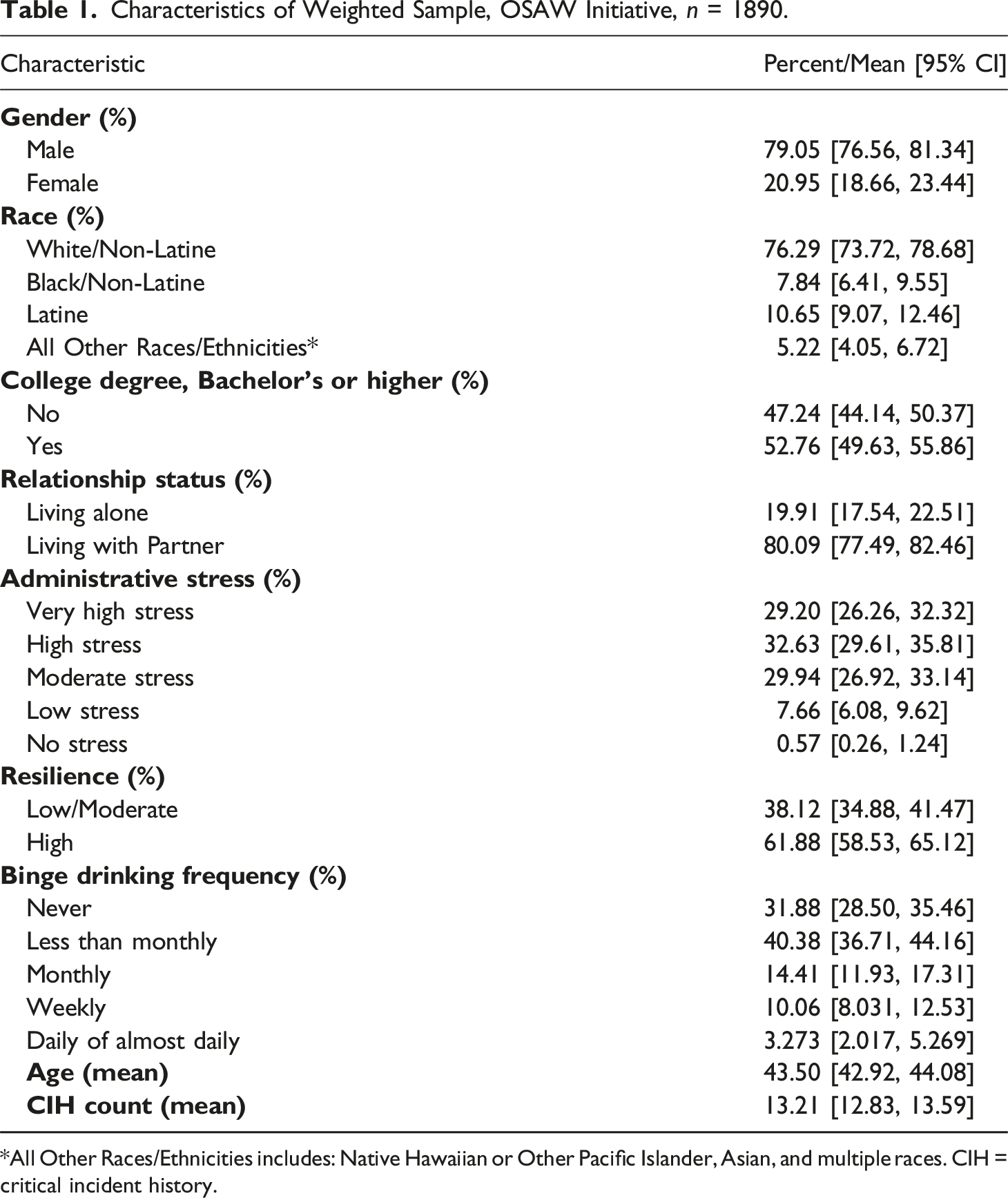
*All Other Races/Ethnicities includes: Native Hawaiian or Other Pacific Islander, Asian, and multiple races. CIH = critical incident history.
Bivariate results
In examining how binge drinking frequency varied across the demographic groups, we found that the proportion of officers reporting never binge drinking was significantly higher among females than males (p = 0.030) and among Black/Non-Latine officers compared to White/Non-Latine and Latine officers (p = 0.002). Conversely, binge drinking weekly or daily was significantly higher among males compared to females and among White/Non-Latine versus Black officers. Although bivariate differences in binge drinking frequency were not significant at the p = 0.05 level across education or relationship status, the proportion of officers binge drinking weekly or daily was higher among those who were single versus married and without a college degree versus college graduates. Officers reporting who reported never binge drinking were, on average, significantly older than those reporting drinking monthly or less, monthly, or weekly (p < 0.001).
For the key predictors of interest, proportions of officers reporting binge drinking monthly, weekly, or daily were higher among those with low as compared to high resilience levels (p = 0.007). Although were no significant bivariate differences in binge drinking frequency by administrative stress level, a greater percentage of officers with high or very high stress levels reported drinking monthly, weekly, or daily, compared to those with none to moderate stress levels (p = 0.221). The mean number of critical incidents ranged from 11.5 for those drinking daily or almost daily to 15 among those reporting binge drinking weekly with no significant differences in mean CIH count by binge drinking frequency (p = 0.538).
Multivariate results
Proportion of Officers Reporting Different Levels of Binge Drinking Frequency by Selected Covariates, OSAW Initiative, n = 1890.
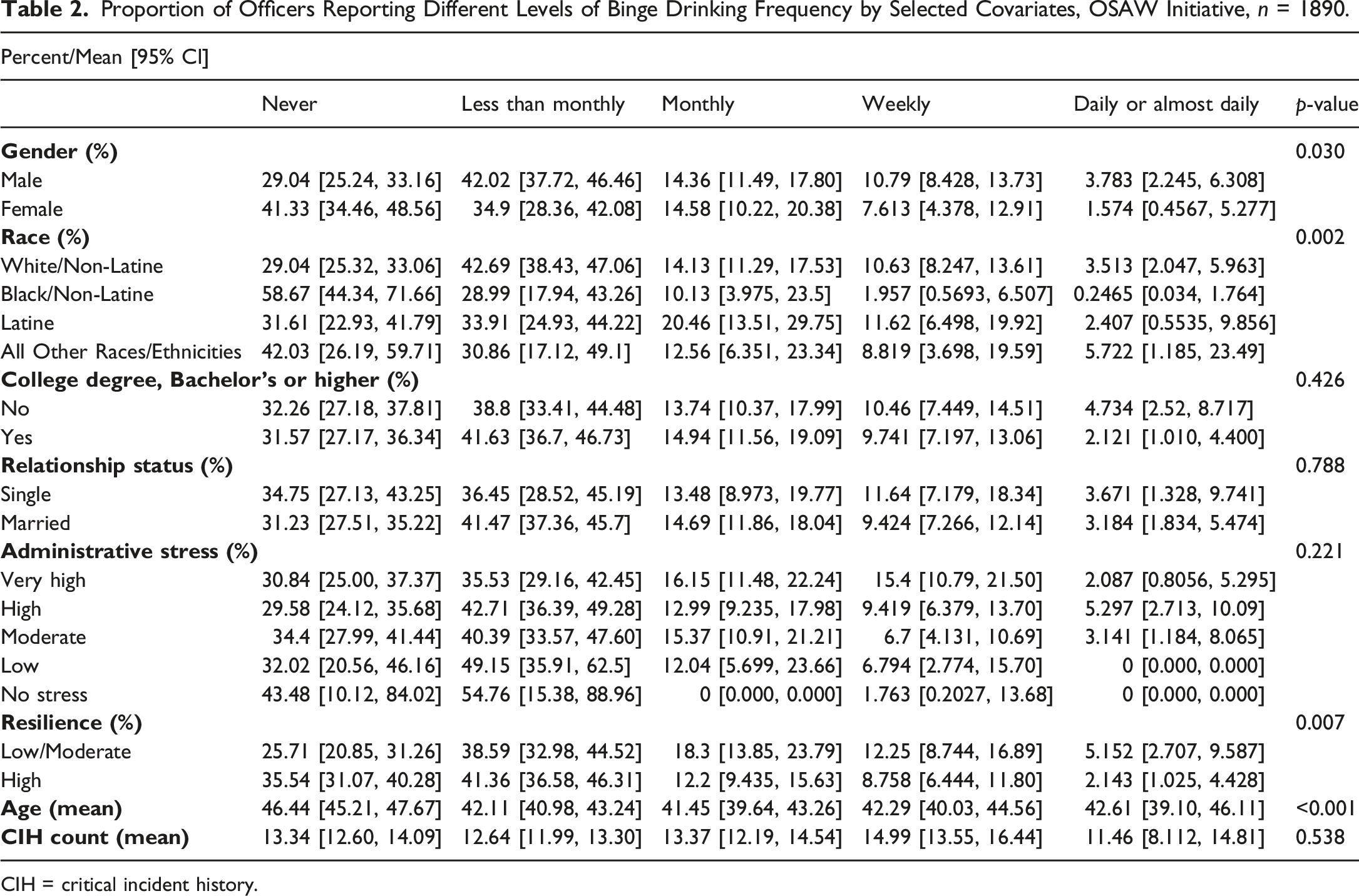
CIH = critical incident history.
Multivariate analysis of binge drinking monthly or more frequently.
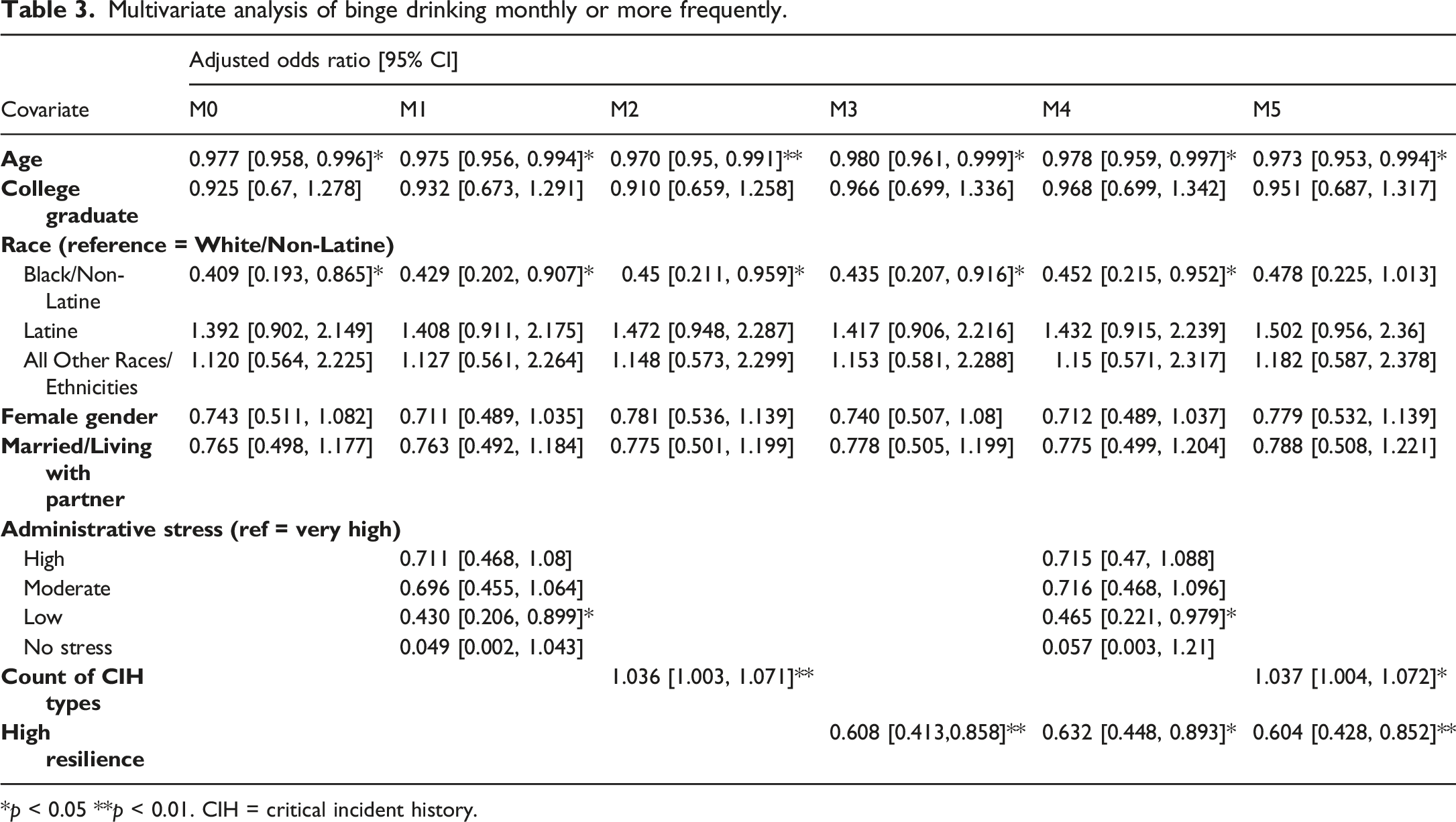
*p < 0.05 **p < 0.01. CIH = critical incident history.
In our model testing the effect of critical incident exposure (M2), we found that each additional type of critical incident experienced was associated with a 3.6% increase in the odds of binge drinking monthly or more frequently (AOR: 1.036, 95% CI: 1.003, 1.071). Compared to officers with low/moderate levels of resilience, those reporting high resilience had a 39.2% decrease in the odds of binge drinking monthly or more frequently (AOR: 0.608, 95% CI: 0.413, 0.858 in M3). We found that the relationship between resilience and binge drinking persisted in terms of both magnitude, direction, and significance level after controlling for administrative stress levels and CIH count in subsequent models (M4 and M5).
Multivariate analyses of administrative stress (M1) and critical incident count (M2) stratified by resilience.
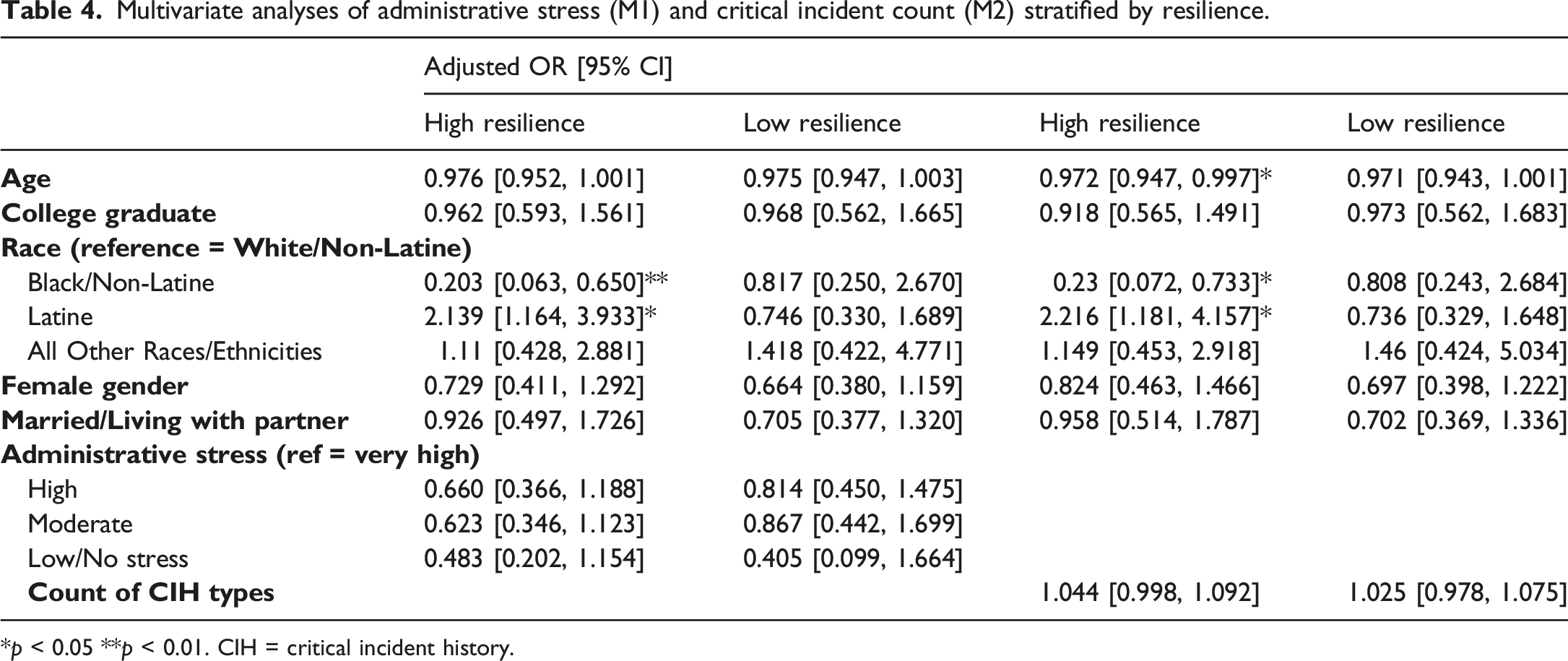
*p < 0.05 **p < 0.01. CIH = critical incident history.
Discussion
Building on prior studies documenting a link between stress exposure—specifically critical incidents and organizational stress—and alcohol use among law enforcement officers, this paper fills a gap in the literature by examining resilience as a protective factor against heavy alcohol use (Chopko et al., 2013; Heavey et al., 2015; Houdmont and Jachens, 2021; Leino et al., 2012; Ménard and Arter, 2013; Syed et al., 2020). This paper is also novel in that it provides nationally representative estimates of binge drinking frequencies among law enforcement officers across the U.S., including how these estimates vary by demographic subgroups.
For this analysis, we examined binge drinking, which is more closely associated with stressful experiences compared to other drinking patterns (Dawson et al., 2005). Overall, we found that 27.7% of officers reported drinking monthly or more frequently. The 2021 National Survey on Drug Use and Health (NSDUH) found that the prevalence of past 30 days binge drinking among adults age 18 and older in the U.S. was 23.3% (SAMHSA Center for Behavioral Health Statistics and Quality, 2021). Although differences in survey wording and populations render our results not directly comparable to NSDUH (i.e., NSDUH includes adults regardless of employment or disability status, whereas the OSAW sample is specific to employed officers who on average are younger and healthier than NSDUH adult samples), the current findings indicate that binge drinking prevalence is likely higher among law enforcement officers than the general population, a finding that comports with prior research (Irizar et al., 2021; Mumford et al., 2021; Syed et al., 2020; Weir et al., 2012). Consistent with national binge drinking prevalence trends from the 2021 NSDUH, we found that increased binge drinking frequency (i.e., binge drinking monthly or more frequently) was more common among younger officers, those who identified as White/Non-Latine versus Black, and men as compared to women.
We found high levels of administrative stress and critical incident exposure, with officers reporting exposure to an average of 13 critical incidents (out of 27) and 92% reporting at least a moderate degree of administrative stress. A large proportion of officers had high levels of resilience. In defining the construct of resilience, researchers have argued that exposure to adversity is necessary for the development of resilience (Southwick et al., 2014). Thus, high exposure to adversity, in combination with an acceptance of high stress as an inherent aspect of their jobs, may facilitate high levels of resilience among officers (Purba and Demou, 2019).
In line with our hypotheses, we found that high resilience was associated with significantly reduced odds of binge drinking monthly or more frequently when controlling for demographic factors and stress exposure in the form of administrative stress and critical incidents. Contrary to our hypotheses, we found that the relationship between these stressors and binge drinking did not vary by resilience levels. This result differs from other studies showing that resilience moderates the relationship between stress and alcohol use in other populations (Cusack et al., 2023; Morgan et al., 2018). Although resilience may not buffer against stressful exposures among officers directly, its independent relationship with reduced odds of binge drinking indicates that it is nevertheless an important intervention point for increasing officer wellness.
Common approaches to increasing resilience through training programs include cognitive behavioral coaching, stress inoculation, adapted attention and interpretation therapy, and interventions based in mindfulness, a non-judgmental attention to present-moment experiences (Bishop et al., 2004; Leppin et al., 2014). Resilience training has strong potential as a primary prevention approach; equipping officers with coping skills enables them to adapt positively and avoid experiencing negative health outcomes, rather than addressing these outcomes after they have already occurred (Papazoglou and Andersen, 2014). Preventing negative health outcomes stemming from stress exposure is important not only for safeguarding the wellness of officers and those with whom they interact, but also reducing the number of officers leaving the workforce on disability pensions (Price, 2017).
Several studies have demonstrated the feasibility, acceptability, and preliminary effectiveness of implementing resilience training programs in law enforcement settings (Arble et al., 2017; Arnetz et al., 2009; Ramey et al., 2017; Weltman et al., 2014). While reductions in harmful alcohol use are not typically the primary intended outcome for resilience training programs, Arble et al. (2017) found significant pre-post reductions in alcohol use among officers participating in an imagery-based prevention program with mindfulness and emotional awareness components (Arble et al., 2017; Leppin et al., 2014). Furthermore, a feasibility and preliminary efficacy trial of a mindfulness-based resilience training program showed that reductions in burnout were associated with significant reductions in alcohol use (Christopher et al., 2018; Kaplan et al., 2020; Rehder et al., 2021). These findings in conjunction with the results of our study highlight the need to further evaluate the utility of resilience training programs in reducing harmful alcohol use among law enforcement officers.
Although resiliency training holds strong promise for promoting well-being among officers, larger, longitudinal studies are needed to examine the extent to which intervention effects persist over time. More research is also needed to understand how reducing binge drinking could reduce harm and improve job performance among officers. Furthermore, it is important to focus not only on individual-level interventions, but also interpersonal and organizational-level resources and assets that can protect against adverse outcomes (Banyard and Hamby, 2022). Although critical incident exposure may be an inherent part of policework, organizational stressors are potentially modifiable. A systematic review identified lack of support, job demand, and interpersonal relationships with colleagues and supervisors as modifiable organizational factors linked with mental well-being among officers (Purba and Demou, 2019). Future studies should examine how strengths-based, multi-level approaches (i.e., those addressing individual, interpersonal, and organizational factors) may reduce binge drinking among officers.
Limitations
This study has several limitations. Because these data are self-reported, they are subject to recall bias and differential non-response. Under-reporting of alcohol consumption in surveys is a common phenomenon and more common among those with heavy and non-routine drinking patterns (Boniface et al., 2014). Secondly, the cross-sectional nature of this analysis limits our ability to draw conclusions about the temporal ordering of binge drinking behavior and stress exposure, as well as how resiliency levels change over time. The survey did not assess sexual orientation or whether officers had non-cisgender/non-binary gender identities; given the disproportionate rates of alcohol-related harm among sexual and gender minority populations, this is an important priority for future research (Talley et al., 2016). Lastly, data collection coincided with the COVID-19 pandemic and the murder of George Floyd in May of 2020; increased stress related to their duties as essential workers, and the expansion of national attention on policing behavior may have impacted officers’ coping behavior during this time.
Conclusions
This analysis of a nationally representative sample of law enforcement officers in the U.S. shows that administrative stress and critical incidents are associated with increased odds of binge drinking monthly or more frequently. Although resilience did not modify the relationship between these stress exposures and binge drinking, it was independently associated with reduced binge drinking frequency. Strategies to reduce stress exposure and increase resiliency among officers are important for improving officer wellness.
Footnotes
Acknowledgements
We would like to express our sincere gratitude to the agencies and dedicated officers who participated in this research. Further thanks are due to Poulami Maitra, Katelin Hudak, and Weiwei Liu who advised on our methodological approach.
Declaration of conflicting interests
The author(s) declared no potential conflicts of interest with respect to the research, authorship, and/or publication of this article.
Funding
The author(s) disclosed receipt of the following financial support for the research, authorship, and/or publication of this article: This work was supported by the National Institute of Justice (grant NIJ-2018-R2-CX-0026). The results reported herein correspond to specific aims of grant NIJ-2018-R2-CX-0026. Points of views in this paper are those of the authors and do not necessarily represent the official position or policies of the U.S. Department of Justice or any other organization.
