







Abstract
This article extends and tests the trust-as-evaluation approach that is dominant in political science. Citizens supposedly grant and withhold trust in politics based on an assessment of its merits. We argue that the relevance of performances and processes should be conditional on the values that citizens hold dear and the accuracy with which they perceive them. Through multilevel analyses of the European Value Survey 2008, we model the (conditional) effects of a wide range of macro-economic outcomes and procedural characteristics on two aspects of political trust: satisfaction with democracy and confidence in political institutions. We find that macro-economic outcomes do not relate to political trust once we control for corruption. The effects of corruption and macro-economic outcomes are indeed stronger among the higher educated. However, the effect of macro-economic outcomes is not conditional on citizens’ values. We discuss the theoretical implications of these findings for the use of the trust-as-evaluation approach.
Introduction
Trust of citizens in their national political institutions is an important facet of the legitimacy of representative democracy (Berelson, 1952). However, the functioning of democracy also benefits from a degree of healthy scepticism on the side of its citizens: an upheld judgement in seeking evidence to trust or distrust (Cook and Gronke, 2005). Scepticism about specific politicians and disagreement with policies motivate people to engage in politics (Hibbing and Theiss-Morse, 2002). Fundamental, diffuse support for the regime (the democratic principles) therefore differs from the more cyclical, specific support for the institutions and actors that function within that regime (Easton, 1975). A well-functioning representative democracy requires trust in the regime, but scepticism in the institutions and actors that govern it from day to day.
At its core, trust represents an evaluation of a relationship between a subject (the one who trusts) and an object (the one who is trusted) (Hardin, 2000). Low levels of trust would indicate a deteriorating relationship between citizens and their states. But if the nature of trust is fundamentally evaluative, then this begs the question to what extent citizens actually evaluate the economic or procedural performance of their country (e.g. Norris, 2011). In other words, do citizens retroactively judge the quality of the macro-economic outcomes or democratic procedures? And if so, do citizens decide to grant or withhold trust based on cross-sectional evidence on how well one’s own country is performing compared to other countries?
Political trust is known to be strongly related to perceptions of performance, accountability, impartiality, corruption, and so on (e.g. Van der Meer and Dekker, 2011). However, the extent to which political trust is based on actual policy performance and actual procedures remains hotly debated. Consider macro-economic outcomes. A large scholarly effort has been directed at assessing the relationship between macro-economic outcomes on indicators of political trust. Some conclude that economic success correlates with political trust (e.g. Anderson, 2009; Clarke et al., 1993; Cusack, 1999; Miller and Listhaug, 1999; Taylor, 2000), but many others that it does not (e.g. Dalton, 2004; Hakhverdian and Mayne, 2012; McAllister, 1999; Oskarsson, 2010; Rahn and Rudolph, 2005; Van der Meer, 2010). Corruption, on the other hand, is consistently found to have a strong, negative impact on political trust (Anderson and Tverdova, 2003; Della Porta, 2000; Hakhverdian and Mayne, 2012; Oskarsson, 2010; Van der Meer, 2010).
Yet although the cross-national literature on political trust generally suggests that citizens’ political trust reflects their country’s economic or procedural performance, the evaluative nature of political trust has remained surprisingly understudied. The contextual effects found in earlier studies are necessary but not sufficient evidence for the evaluative nature of political trust. Trust-as-evaluation also implies that the strength of these effects depends on the criteria that citizens find relevant.
The primary aim of this article is to push forward and test the evaluative character of political trust. We do so in two ways. First, we test to what extent the two main cross-sectional explanations in the scholarly literature – performance and process (Norris, 2011) – feature in citizens’ trust-calculus. In line with the broader literature, we focus on economic factors to capture policy performance and public sector corruption as the main procedural characteristics. We examine the correlates of political trust using a wider range of economic and non-economic indicators in a larger and more diverse sample of countries than has hitherto been done.
Second, we take the heterogeneity of the population into account. Trust-as-evaluation implies that trust is evaluated against some ideal or benchmark. These ideals differ between citizens as they are likely to have different criteria in mind when evaluating process or performance. Anderson and Singer (2008) introduce an important argument on the conditional nature of contextual determinants of political trust. They show that income inequality should induce distrust and dissatisfaction among those who care most about issues of redistribution. We present a more comprehensive test of their general argument by analysing whether citizens grant or withhold trust especially when that particular economic outcome features in their personal policy concerns. Similarly, although all citizens are likely to be repelled by corruption in most democracies, dysfunctional institutions are unlikely to affect all citizens equally if only due to heterogeneity in terms of cognitive and moral functions (Hakhverdian and Mayne, 2012).
We make use of the European Values Survey 2008 to test simultaneously a range of hypotheses on policy performance and political trust on a wide and diverse set of 42 countries. By employing multilevel models we are able to assess individual and contextual effects simultaneously and assess to what extent the supposed contextual effects of political performance and political procedures vary alongside citizen characteristics.
Theory
The Nature of Trust
At its core, trust constitutes a subjective evaluation of a relationship between a subject (the one who trusts) and an object (the one who is trusted): ‘A trusts B to do x’ (Hardin, 2000: 9). Given this relational nature of the concept, we should look for explanations of trust in characteristics of the subject (in this case, the citizens who trust or distrust), the object (the institution that is or is not trusted), and especially their interaction.
Which circumstances, then, enable citizens to trust national politics, that is, the regime and its institutions? Political trust may be considered rational to the extent that the object is evaluated by its own merits (Harteveld et al., 2013): trust as a rational attitude implies that the object of trust meets the requirements of being competent (able to perform according to expectations), caring (intrinsically committed), accountable (extrinsically committed due to encapsulated interest), and predictable (consistent) (Kasperson et al., 1992; Van der Meer, 2010). A less stringent approach, though, would be to focus not on rationality but on the cognitive basis of political trust: trust as an evaluation of politics against – conceptually idiosyncratic – ideals or benchmarks.
Economic Performance
Trust as an evaluative orientation implies that good performance in terms of substantive policy outcomes ought to induce high levels of political trust. Effectively, most political trust research has been restricted to one specific policy area: macro-economic performance. Miller and Listhaug (1999) claim that ‘economic performance is critical to overall public support of government’ (p. 216). In this view, both longitudinal and cross-national variance in political trust should be accounted for by economic successes and failures. What constitutes a success and what constitutes a failure is of obvious importance, but a matter that shall be addressed below when discussing the heterogeneity in citizens’ evaluations.
At first sight, evidence seems to lend credence to the economic claim. Longitudinally, fluctuations in political trust run parallel to fluctuations in consumer confidence (Bovens and Wille, 2008; Dalton, 2004; Keele, 2007; Van de Walle et al., 2008), while citizens’ trust in politics correlates more strongly with their economic evaluations than with other evaluations of the political system (Van der Meer and Dekker, 2011; see also Citrin and Green, 1986; Hetherington and Rudolph, 2008; Lawrence, 1997). However, these relationships are based on (individual and aggregate) subjective evaluations of the economy, not on its objective performance. And it remains highly contested whether objective economic performance affects political trust. There are about as many studies that find such effects (e.g. Anderson, 2009; Clarke et al., 1993; Cusack, 1999; Miller and Listhaug, 1999; Taylor, 2000) as studies that find no significant effects (e.g. Dalton, 2004; Hakhverdian and Mayne, 2012; Oskarsson, 2010; Rahn and Rudolph, 2005; Van der Meer, 2010), mixed effects depending on type of political trust (Weil, 1989) or even inverse effects (McAllister, 1999).
Many studies from both sides of the debate suffer from methodological shortcomings that are likely to affect their conclusions. Some performed ordinary least squares (OLS) regression on individual-level data, thereby disaggregating contextual characteristics, vastly underestimating standard errors, and making it more likely to find significant contextual effects (e.g. Miller and Listhaug, 1999; Taylor, 2000). Others focused on the aggregate level so that theoretically distinct characteristics such as individual-level unemployment and income get conflated with national performance indicators (e.g. Anderson, 2009; Clarke et al., 1993; McAllister, 1999; Miller and Listhaug, 1999; Weil, 1989). Finally, there were studies that estimated the effect of objective economic performance while controlling for subjective evaluations thereof, which makes non-significant contextual effects more likely as potential intermediary effects have already been included in the explanatory model (e.g. Oskarsson, 2010; Rahn and Rudolph, 2005). Even within the group of cross-nationally comparative studies that employed multilevel analyses, evidence is mixed. Some find significant macro-economic effects (Kotzian, 2011a, 2011b; Taylor, 2000), but studies that also take corruption into account find no significant effect at all (Hakhverdian and Mayne, 2012; Oskarsson, 2010; Van der Meer, 2010). Unfortunately, these studies have been based primarily on samples of relatively few and relatively homogeneous (Western and Central European) countries.
Of course there are many substantive outcomes that might feature within the informed assessments of citizens of their government’s economic record. We consider six of these economic indicators: economic development, growth, inflation, unemployment, budget deficits and income inequality. Based on the abovementioned scholarship on macro-economic performance, we would expect that development and growth are positively related to political trust, whereas inflation, unemployment, deficits and inequality are negatively related to political trust. Below, we specify conditional expectations regarding these economic variables.
Democratic Processes
Political trust may also be rooted in the quality of democratic procedures. Pippa Norris (2011) notes that process accounts ‘go beyond discontent with particular decisions or outcomes to tap more deep-rooted perceptions about how democracy works’ (p. 188). To the extent that political trust is an evaluation, citizens are likely to display higher levels of political trust in a context of institutional quality, rule of law, respect for human rights, electoral integrity, and so on, than in their absence (Dahlberg and Holmberg, 2014). ‘In a democratic society, the political sphere must not be widely viewed as unclean or degraded or corrupt’ (Berelson, 1952: 316).
Here, we shall focus on the degree of public sector corruption which is consistently found to have a strong, negative impact on political trust (Anderson and Tverdova, 2003; Della Porta, 2000; Hakhverdian and Mayne, 2012; Oskarsson, 2010; Van der Meer, 2010). This should come as no surprise as corruption functions as the prime antithesis to any trust relationship (Rothstein and Teorell, 2008). Widespread corruption undermines the efficiency and effectiveness of national politics. Corruption implies an absence of moral scruples, as by their actions corrupt political actors display an inherent lack of care for citizens. Corrupt practices thrive on an (institutional) lack of accountability. Moreover, corruption makes it extremely difficult for governments to devise and implement policies that are responsive to the general public (Rothstein and Uslaner, 2005; Warren, 2004). Therefore, the lower the countries’ level of corruption, the more likely citizens are to trust politics.
Who Cares About Performance?
We can push the trust-as-evaluation argument even further. That is to say, it matters not only how a polity performs in terms of the quality of its political process and the economic outputs it produces but also who evaluates this performance. Mishler and Rose (2001) write that ‘evaluations of performance reflect not only the aggregate performance of government but also individual circumstances and values’ (p. 36). Even if we expect citizens to incorporate budget deficits into their trust-calculus, the evaluative argument implies that it should matter most to those who prioritise budget deficits on the basis of their personal circumstances or ideology. Anderson and Singer (2008) have perhaps been the most explicit proponents of this view. Using economic inequality and left–right identifications as a test case, Anderson and Singer (2008) argue the following:
people’s ideological predispositions should motivate them to connect inequality with their views of the political system in different ways. Specifically, ideology is expected to act as a screen for how people view inequality and the extent to which they use it to judge the performance of the political system. Those who locate themselves on the right are likely to view inequality less negatively than those who do not. As a result, the effects of inequality on attitudes toward government should be muted among those on the right and more substantial among those on the left (p. 574).
There is nothing that limits the scope of this argument to left–right ideology and economic inequality. For one, if ideology functions as a screen such that those on the left are more sensitive to inequality than those on the right, we should expect similar dynamics regarding economic matters that concern the political right, such as inflation and budget deficits. Anderson and Singer (2008) are quite explicit about the general nature of their argument:
[…] the effects of macro-level performance on attitudes toward government are strengthened or weakened, depending on people’s predispositions to be supportive of political institutions or because of differences in people’s sensitivity to a particular macro-level outcome (or any outcome for that matter) (p. 574).
A long line of scholarship has established that elites and masses on the political left are sensitive to a distinct set of macro-economic factors compared to those on the right (e.g. Dassonneville and Lewis-Beck, 2013; Franzese, 2002; Hibbs, 1977; Rehm, 2011). While all may take pride in a strong economy, the extent to which this is a priority differs with ideology. We therefore test the abovementioned six economic outcomes in conditional form. Following Anderson and Singer (2008), we expect inequality to induce more distrust among the left. Unemployment should also feature more heavily in the evaluations of left-wing citizens, as lower occupational and income groups are the most likely losers of unemployment. Indeed, left-wing governments are punished more strongly for high levels of unemployment (Dassonneville and Lewis-Beck, 2013). As low inflation and balanced budgets are usually championed by the political right (e.g. De Simone and Sapio, 2013), we would expect the incidence of these factors to be associated with distrust among right-wing citizens in particular, while economic growth and development are expected to affect left and right to a more or less equal extent.
Who Cares About Process?
Similarly, the effect of corruption is likely to depend on the salience of the norm that the public sector should be clean of corruption. Recent studies suggest that education has such a norm-inducing function (Hakhverdian and Mayne, 2012): the higher educated are more likely to be morally troubled by lacking institutional quality than the lower educated. A range of liberal moral values, including equality and tolerance, grows with years of schooling (Bobo and Licari, 1989; Nie et al., 1996). The more educated are also likely to support and defend core democratic values and principles (Dalton, 1994; Hibbing and Theiss-Morse, 2002; McClosky and Zaller, 1984). 1 The net result is that the degree of public sector corruption is expected to have a larger impact on the political trust of the higher educated than the lower educated. 2
Who Is Aware of Performance and Process?
Moreover, cognitive accounts of trust place citizens’ informed assessment of the trust-relationship front and centre. Russell Hardin, one of the leading scholars in this tradition, emphasises the cognitive basis of trust. Citizens’ level of education functions as a precondition for citizens to evaluate politics cognitively. In other words, next to its norm-inducing function education has an accuracy-inducing function as well (Hakhverdian and Mayne, 2012). For instance, compared to the less educated, the higher educated are more likely to assess accurately their particular country’s overall respect for human rights (Anderson et al., 2005). Consequently, the higher educated are more likely to have acquired the necessary skills to judge political institutions on specific, objective criteria such as performance and process rather than on general (media) images. However, empirical evidence on the validity of this framework is mixed (see Hakhverdian and Mayne, 2012; Van der Meer, 2010; Van Elsas, 2013).
Data and Methodology
Scholars have approached the question on political trust as a reflection of macro-economic performance and/or procedural aspects basically in two ways. A large group of studies have taken up a cross-sectional design, by comparing political trust, performance and procedural quality across countries (e.g. Anderson and Singer, 2008; Anderson and Tverdova, 2003; Dahlberg and Holmberg, 2014; Della Porta, 2000; Hakhverdian and Mayne, 2012; Oskarsson, 2010) or municipalities (Rahn and Rudolph, 2005). This setup implicitly assumes that citizens base their trust on a comparison to other countries (or at least on a cross-nationally equivalent ‘absolute’ standard). Other studies approached political trust using a longitudinal design (e.g. Armingeon and Guthmann, 2014; Miller and Listhaug, 1999; Polavieja, 2013). This setup, in turn, assumes that citizens’ trust is based on a comparison to the country’s own past.
Based on this overview of the literature, we remain agnostic about the choice for a cross-sectional or longitudinal setup for now. Ideally, we would perform both types of analysis. Unfortunately, we lack longitudinal data that would enable the primary aim of this article, that is, pushing the trust-as-evaluation approach by (a) focusing on a larger and more diverse set of countries and (b) testing the conditionality of contextual effects. This requires a broad sample and detailed measures of respondents’ (left–right) position and level of education. Hence, we explore cross-national differences in political trust (confidence in political institutions and democratic satisfaction) and test our hypotheses using the 2008 wave of the European Value Survey (EVS). We return to this important distinction between longitudinal versus cross-sectional benchmarks in the concluding discussion.
Although the EVS covers 48 countries, we restricted our analyses to the 42 countries (+1, as we split Germany in former East and former West) that were at least partly democratic at that point in time and for which reliable contextual data were available. We therefore excluded Azerbaijan, Kosovo, Northern Cyprus, Northern Ireland and Belarus from the analyses. Malta had incomplete data on some economic measures and was excluded in a pairwise manner. Survey data were collected before September/October 2008 (i.e. when the Great Recession hit Europe) in the majority of these countries. Three countries completed the EVS rather late (2009–2010): Iceland, Sweden and Great Britain. Our conclusions are fully robust to the inclusion or exclusion of these countries. 3
The hypotheses and data in these multivariate tests have a hierarchical structure: individual citizens are nested in their countries of residence. We set out to explain individual and national differences in political trust simultaneously, using multilevel regression analysis (Snijders and Bosker, 1999) using the MLwiN 2.30 package (Rasbash et al., 2012). Individual data are derived from the EVS 2008 wave and contextual data from the Quality of Government data set (Teorell et al., 2011).
We performed pairwise deletion of respondents with the item non-response on income and listwise deletion on all other variables. All in all, our final analyses (with interaction effects in Table 3) are based on 51,255 respondents. 4
Dependent Variables
We study two dependent variables within the overarching label of political trust. The first is confidence in national political institutions. The measure is the sum score that we derived from two items – confidence in government and parliament – in response to the question: ‘Please look at this card and tell me, for each item listed, how much confidence you have in them, is it a great deal, quite a lot, not very much or none at all?’ The sum score of these two 4-point items ranges from 0 (no confidence at all) to 6 (a great deal of confidence). We interpret the distribution of the scores to be sufficiently quasi-interval to estimate linear multilevel regression models.
The second dependent variable, satisfaction with democracy, taps into more diffuse support for the functioning of the regime as a whole rather than the specific institutions and their actors. We base it on the question: ‘On the whole are you very satisfied, rather satisfied, not very satisfied or not at all satisfied with the way democracy is developing in our country?’ We dichotomised the variable so that it ranges from 0 (not at all satisfied/not very satisfied) to 1 (rather satisfied/very satisfied). We estimate binary logistic multilevel regression models on this variable.
Country-Level Variables
At the country level, we distinguish between countries’ economic performance and their institutional processes. All of these variables were collected for 2007 and 2008; it did not matter for our conclusions which year’s measures we included as country-level determinants.
For current economic performance, we focus on six indicators: gross domestic product (GDP)/capita (purchasing power parity (PPP)), GDP growth, unemployment, inflation, budget balance (higher values indicating surpluses) and economic inequality (gini). We use the World Development Indicators (WDI) of the World Bank to measure these variables. In rare instances where data were missing, we relied on other sources such as Eurostat, aligning them with the WDI-scale.
Our empirical tests of process accounts of trust rely on the degree of public sector corruption. For this, we use the Corruption Perception Index (CPI) 2008, issued by Transparency International, which is based on multiple expert surveys per country. After inverse coding, the measure ranges from 0 (no corruption) to 10 (highly corrupt).
We include two country-level controls. 5 The first of these is the Freedom House measure of political rights and civil liberties, which ranges from 0 to 10 (Freedom House, 2011). We also control for electoral system type by distinguishing between proportional systems (as the reference category), majoritarian systems, and mixed systems (compare Marien, 2011). This distinction is derived from the Democracy Time-Series data set compiled by Pippa Norris (2011).
Individual-Level Independent Variables
Left–right ideology and education constitute our main independent variables at the individual level. We measure left–right ideology by summing two strongly correlated survey items on economic redistribution (1 = equalise incomes, 10 = individual effort) and the role of the government (1 = state responsible that everyone is provided for, 10 = individuals should provide for themselves). Higher values indicate emphasis on individual effort and incentive and therefore capture attitudes of the political right. The variable ranges from −10 to +10. Our research strategy diverges from Anderson and Singer (2008) who employ left–right self-placement as their measure of ideology. Given that separate items on economic attitudes are readily available in most surveys, and certainly in the EVS, we see no reason to rely on the ideological identification question that performs poorly in terms of its cross-national equivalence compared to the composite measure that directly measures the theoretically relevant distinction. 6 The general monikers ‘left’ and ‘right’ have a widely differing meaning across contexts both between (e.g. Tavits and Letki, 2009) as well as within countries (De Vries et al., 2013).
We measure education as the highest completed level of education, recoded into seven categories (pre-primary/none, primary, lower secondary, (upper) secondary, post-secondary non-tertiary, first-stage tertiary and second-stage tertiary). We enter education as an interval variable although treating it categorically does not alter the main and interaction effects in a significant or substantive way.
Next to these variables we control for various individual-level characteristics, if only to check potential composition effects. These control variables are age (in years), gender, church attendance (ranging from ‘practically never’ to ‘more than weekly’), country of birth (native born vs born abroad), net household income (corrected for Purchase Power Parity), and work status (distinguishing between full-time employed, part-time employed, self-employed, military service, retired, housework, student, unemployed, disabled, and other).
Robustness Checks
We performed various robustness checks to our models. First, we built up our models to assess the extent to which the effects are stable across different model specifications. These subsequent specifications are illustrated in the tables below.
Second, we checked the extent to which our (lack of) cross-national effects are due to individual influential cases. Most notably, the effect of civil rights enforcement on confidence in national political institutions is affected by an influential case, Russia, which scores relatively high on confidence and is an outlier on civil rights enforcement (with a score of 4.75 on the Freedom House Polity index). However, the elimination of the influence of Russia from our models did not affect the direction and significance of the effect. Similarly, although the variables measuring inflation and budget deficit contain outliers, these do not drive the findings and can therefore not be considered influential cases.
Third, we assessed the extent to which the (lack of) cross-national effects were dependent on the inclusion of a whole group of countries, that is, the low-ranking democracies on the Freedom House scales such as Albania, Russia and Ukraine. However, when we only selected all full democracies in our data set, our outcomes remained substantively the same. Note that this was to be expected from previous studies on samples of Western, democratic countries such as the European Social Surveys (compare Hakhverdian and Mayne, 2012; Van der Meer, 2010).
Fourth, we examined whether the use of annual change scores in macro-economic performance as determinants of political (e.g. change in unemployment and inflation rates, change in the budgetary balance) would lead to different outcomes (compare Van der Brug et al. 2007). Ultimately, we found the same (lack of) main and marginal effects as in the original analyses below. 7
Finally, we assessed the extent to which various effects of key variables are due to non-linearity, by modelling them alternatively as nominal variables. The level of education has a curvilinear effect on the pooled data set. However, this is primarily because the education effect itself is conditional on contextual characteristics. Similarly, the effect of civil rights enforcement is somewhat curvilinear, bottoming out at a score of 9.5 (which is also the median score). Thus, relatively weak and relatively strong civil rights enforcement may stimulate confidence in political institutions. This, in turn, may reflect the relevance of strong (semi-)presidential authority over civil (and especially: minority) rights in the relatively young democracies of Central and Eastern Europe, that score low on civil rights enforcement.
Results
Exploring Cross-National Differences
Confidence in political institutions and satisfaction with democracy vary immensely across countries. Figure 1 illustrates the rates of satisfaction with democracy by country. The different colours represent the four quartiles by level of satisfaction.
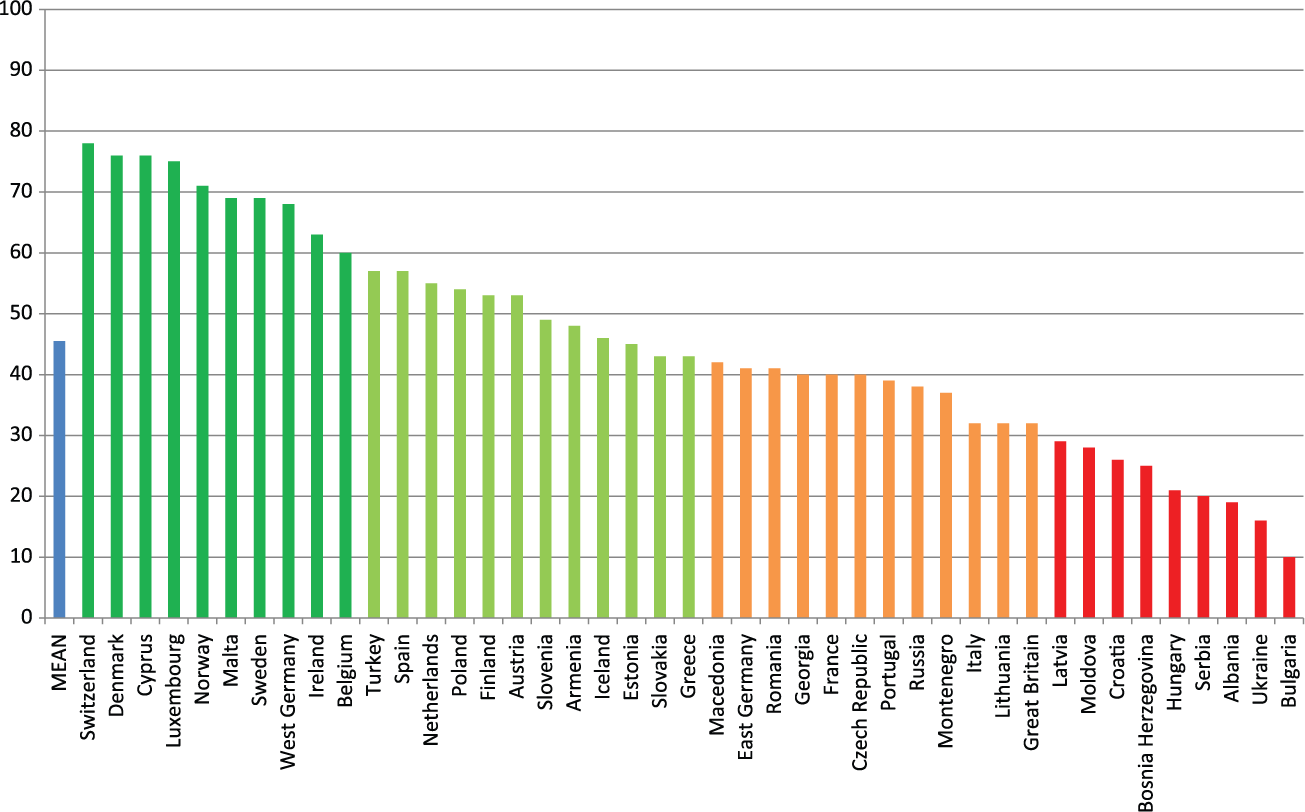
Satisfaction with Democracy (% Satisfied) by Country.
The cross-national average of satisfaction with democracy in these 43 European countries and regions is 46%. Satisfaction is high in the Nordic countries (Denmark, Finland, Norway, Sweden) and in the small EU member states (Cyprus, Luxembourg, Malta). We find the lowest satisfaction rates in the former East bloc, especially in South Eastern Europe – Bulgaria (10%), Ukraine, Albania, Serbia, Bosnia, Croatia and Moldova (28%) – as well as in Hungary. Among Western European countries, Great Britain and Italy (each 32% satisfaction) score remarkably low.
Figure 2 similarly shows the levels of confidence in national political institutions by country. The ordering of countries on the x-axis follows Figure 1; the colours illustrate four quartiles by levels of confidence.
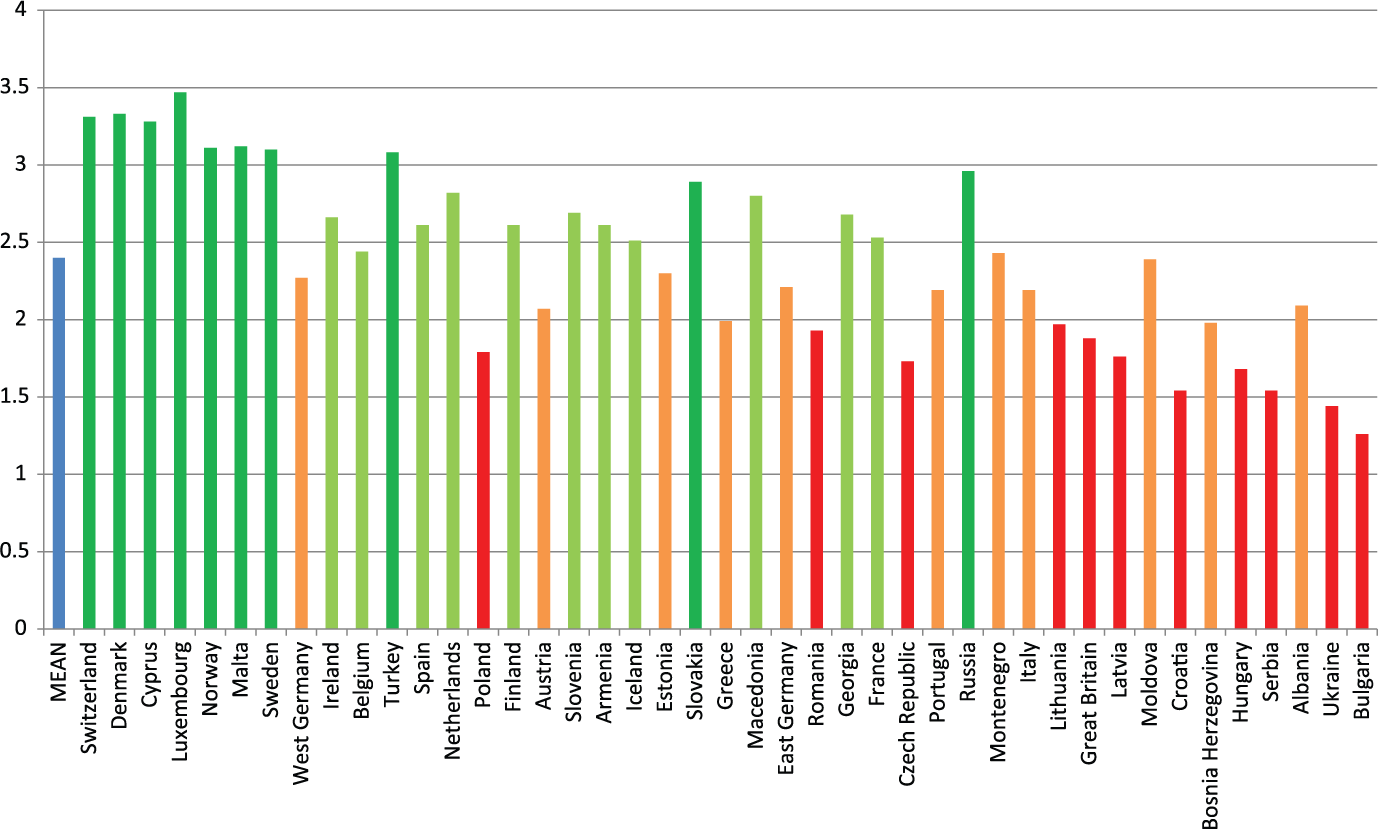
Confidence in Political Institutions (Government and Parliament) (0–6) by Country.
The country-level average confidence score is 2.4 (on a scale that ranges from 0 to 6). At the country level, satisfaction and confidence correlate strongly (0.85). Consequently, by and large the same geographical patterns arise for the confidence rates as for the satisfaction rates. Both aspects of trust are generally high in the Nordic countries and low in Central and Eastern Europe (compare Listhaug and Wiberg, 1995; Van der Meer, 2010). However, there are some notable differences to the patterns found for satisfaction with democracy. Confidence in political institutions is relatively low in West and East Germany, but relatively high in Russia, Slovakia and Macedonia.
While the descriptive analyses suggest large cross-national differences in the satisfaction and confidence rates, we need to assess the relative importance of the between-country variance compared to within-country variance. This is expressed through the intra-class correlation (ICC), that is, the between-country variance as a proportion of the total variance in the model. The ICC in the empty model is 13% for satisfaction with democracy and 15% for confidence in political institutions. These ICCs are highly comparable to those found in earlier studies and are quite substantial for cross-national survey-based public opinion research studies of this magnitude in terms of countries and respondents (Rahn and Rudolph, 2005).
Control Variables
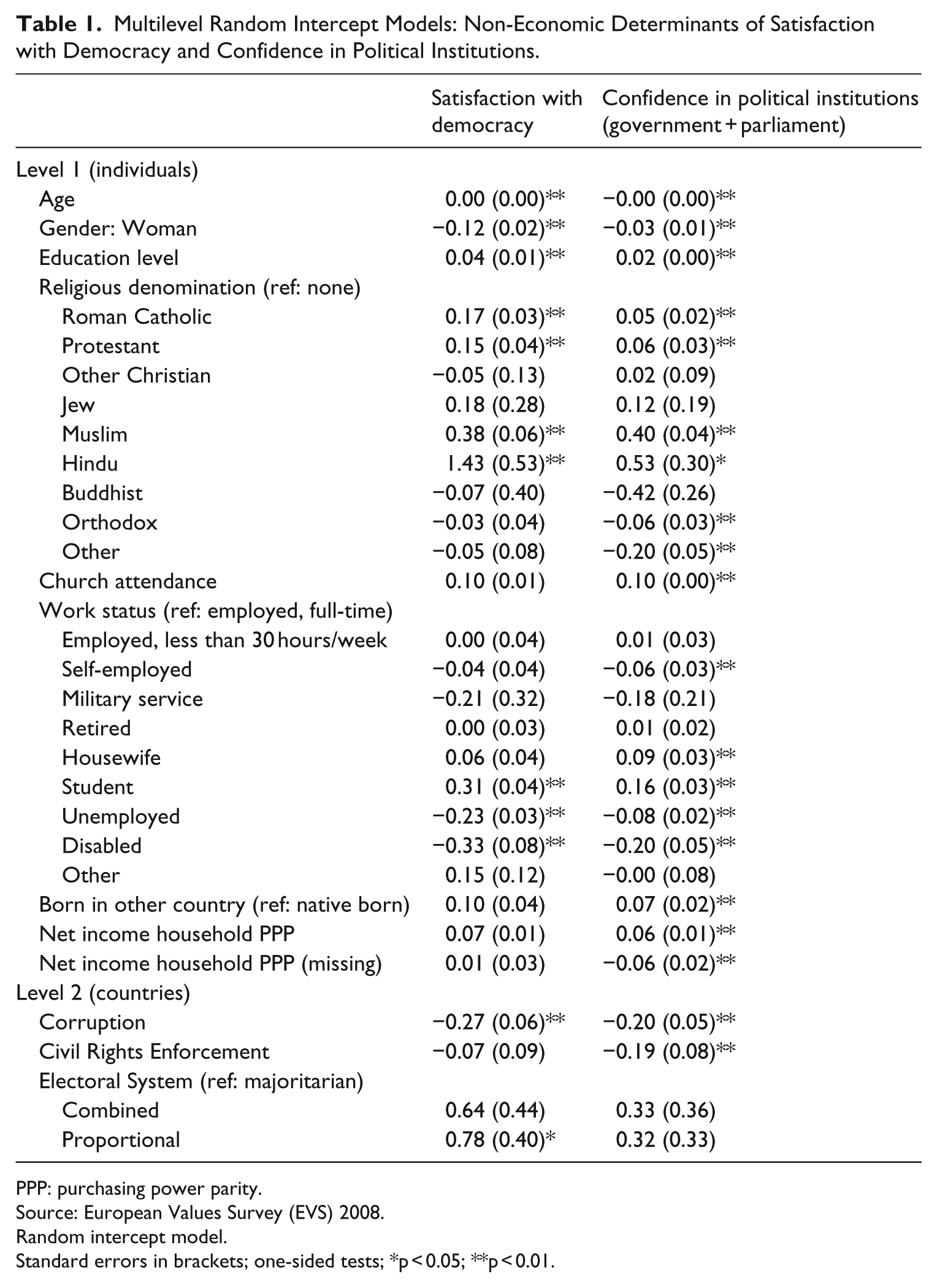
Table 1 describes the results from the multilevel models in which we predict confidence in institutions and satisfaction from our control variables. At the individual level, our findings are broadly in line with previous scholarship.
Multilevel Random Intercept Models: Non-Economic Determinants of Satisfaction with Democracy and Confidence in Political Institutions.
PPP: purchasing power parity.
Source: European Values Survey (EVS) 2008.
Random intercept model.
Standard errors in brackets; one-sided tests; *p < 0.05; **p < 0.01.
Overall, level of education has a positive effect. However, from a theoretical angle, a clear linear relationship of education level with political trust was not necessarily expected: we expect that the education effect is conditional on the quality of the country’s performance and procedures. We will turn to testing that expectation below.
The effect of age is small but positive on satisfaction with democracy and small but negative on confidence in political institutions. Women tend to have less trust than men. Religious citizens are more likely to trust than non-religious citizens, and trust increases with devoutness (church attendance). Although it might seem surprising that respondents who were born in another country are more likely to trust politics, this finding is in fact quite common and primarily due to immigrants’ positive comparison of politics in the host country to their country of origin (compare Röder and Mühlau, 2012). Finally, income has a positive effect. Given household income, the effects of work status are limited to students (more likely to trust) and self-employed, unemployed, and disabled (less likely to trust).
Looking at the contextual control variables, we find the very strong and robust effect of corruption on satisfaction with democracy and on confidence in political institutions that is reported throughout the literature. Controlled for corruption, majoritarian electoral systems significantly dampen satisfaction with democracy compared to proportional systems, but do not affect confidence in political institutions. The surprisingly negative effect of civil rights enforcement on political trust was already discussed above in the section on robustness checks.
The explanatory power of all individual-level determinants in Table 1 (i.e. excluding the contextual determinants) on both aspects of political trust remains rather limited. However, they also explain part of the cross-national variance in political trust as the socio-demographic composition of European countries differs by education, religion, and income. For satisfaction with democracy, we cannot assess the explained variance in absolute terms because the individual-level variance is fixed as π2/3 in multilevel logistic regression analysis (compare Snijders and Bosker, 1999), but we can conclude that the ICC dropped from 13% to 12%. For confidence in political institutions, the individual-level determinants in Table 1 explained no less than 20% of the cross-national differences, and the ICC dropped from 15% to 13%. This implies that much cross-national variance in political trust remains to be explained.
Macro-Economic Determinants
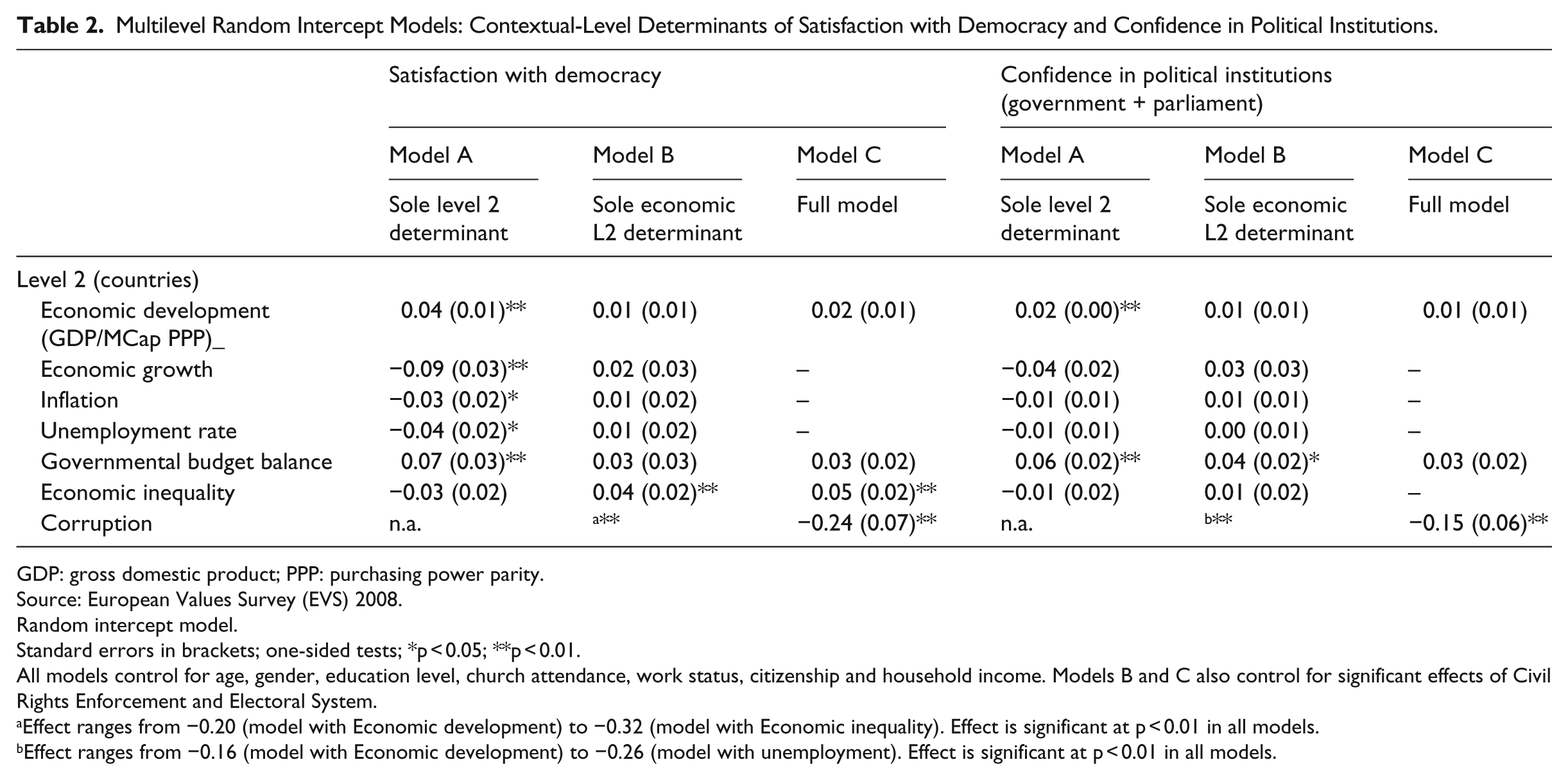
Next, we included the country-level determinants in a stepwise manner (include determinants separately; include by theoretical block; include all significant effects) to assess the consistency of the effects and prevent collinearity problems in the final models. Table 2 shows the results of the multivariate models (controlled for all individual-level determinants of Table 1).
Multilevel Random Intercept Models: Contextual-Level Determinants of Satisfaction with Democracy and Confidence in Political Institutions.
GDP: gross domestic product; PPP: purchasing power parity.
Source: European Values Survey (EVS) 2008.
Random intercept model.
Standard errors in brackets; one-sided tests; *p < 0.05; **p < 0.01.
All models control for age, gender, education level, church attendance, work status, citizenship and household income. Models B and C also control for significant effects of Civil Rights Enforcement and Electoral System.
Effect ranges from −0.20 (model with Economic development) to −0.32 (model with Economic inequality). Effect is significant at p < 0.01 in all models.
Effect ranges from −0.16 (model with Economic development) to −0.26 (model with unemployment). Effect is significant at p < 0.01 in all models.
When the six economic variables are entered as the sole country-level predictors, we find some significant effects on democratic satisfaction and confidence in national political institutions. However, none of the coefficients retain significance when we add corruption and control for civil rights enforcement and electoral system (Models B and C), with one exception. We reach outright counter-intuitive results on the effect of economic inequality on democratic satisfaction. Contrary to expectations, we find that economic inequality is actually positively related to satisfaction with the functioning of democracy. Although the effect only becomes apparent after controlling for the level of corruption, it is an otherwise stable effect.
In fact, level of corruption is the only contextual variable that consistently retains conventional levels of statistical significance across both our indicators of political trust.
Overall, these cross-sectional results emphasise the relevance of quality of government over economic performance. The contextual effects explain 64% and 42%, respectively, of the contextual variance remaining in the composition models.
Conditional Effects of Performance by Ideology
Up to this point, we modelled all effects as unconditional, where contextual characteristics were modelled to have the same impact on all types of citizens, and citizen characteristics were modelled to be similar regardless of their context. We first discuss whether or not economic performance affects levels of political trust depending on left–right ideology.
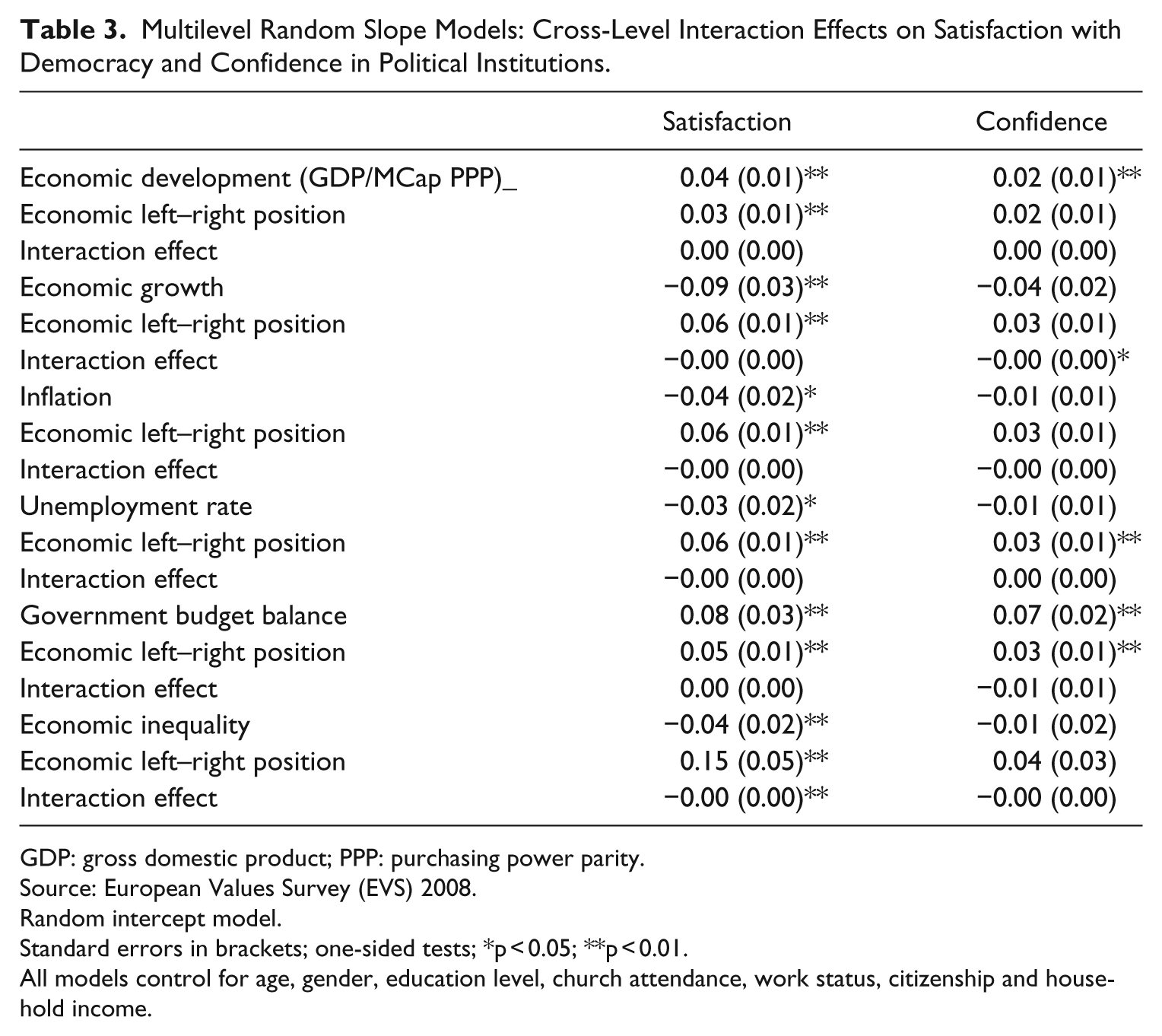
Table 3 extends the random intercept Models A from Table 2 by adding random slopes and modelling the interaction between economic performance and left–right ideology. Each interaction effect was modelled in isolation from the others. 8 We first note that those on the right tend to have higher levels of satisfaction and confidence. This actually mirrors the findings of Anderson and Singer (2008) who write that ‘left-wing voters are less likely to accept authority and the status quo than right wing and even centrist voters’ (p. 583).
Multilevel Random Slope Models: Cross-Level Interaction Effects on Satisfaction with Democracy and Confidence in Political Institutions.
GDP: gross domestic product; PPP: purchasing power parity.
Source: European Values Survey (EVS) 2008.
Random intercept model.
Standard errors in brackets; one-sided tests; *p < 0.05; **p < 0.01.
All models control for age, gender, education level, church attendance, work status, citizenship and household income.
However, that is as far as our results mirror the findings by Anderson and Singer. None of the six economic variables has a varying impact on political trust for the left or the right. None of the interaction terms is significant, except for the interaction term of left–right ideology and inequality as it pertains to democratic satisfaction, but this interaction runs in the opposite direction than what we had anticipated: it would suggest that economic inequality is more detrimental to satisfaction with democracy among right-wing citizens, and not at all among left-wing citizens. 9 Given the fact that this effect cannot be replicated using a different ideological measure (see Note 8) nor on a different, smaller, data set (see Note 6), the effect seems to be a curious fluke.
All in all, we are unable to find empirical backing for the cognitive argument as it relates to economic performance, neither in terms of direct effects nor conditional upon left–right ideology.
Conditional Effects of Performance and Process by Level of Education
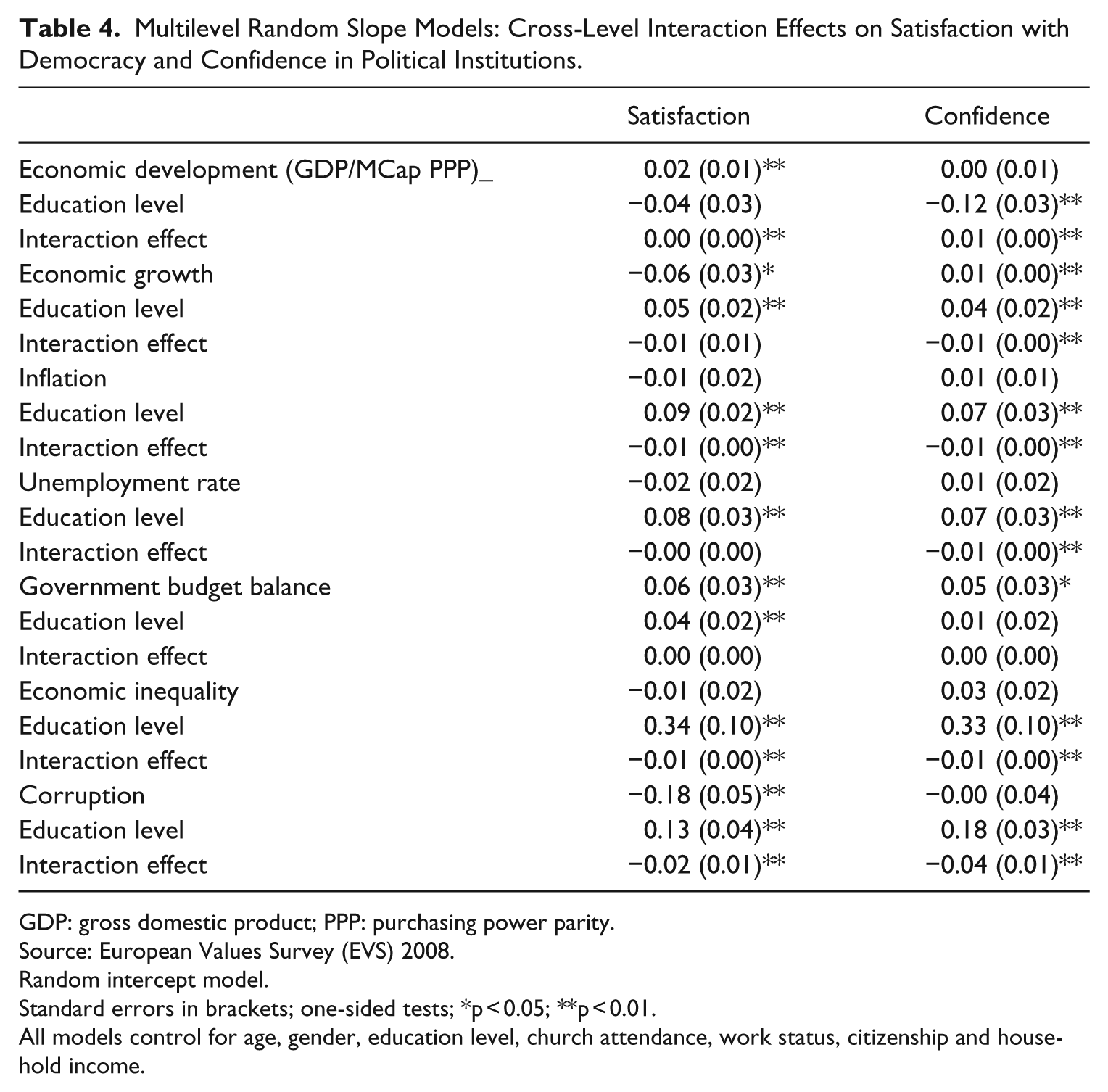
We argued that contextual characteristics are likely to affect the political trust of higher educated citizens more strongly than that of lower educated citizens because of the norm-inducing effect (for process variables like corruption) and the accuracy-inducing effect (for all contextual characteristics) of education. Table 4 shows the interaction of the economic and political context with citizens’ levels of education. Again, we modelled each interaction effect in isolation from the others. However, when we estimate the interaction term of performance and process factors simultaneously, all significant interaction terms remain significant, although the marginal effects of macro-economic performance do not.
Multilevel Random Slope Models: Cross-Level Interaction Effects on Satisfaction with Democracy and Confidence in Political Institutions.
GDP: gross domestic product; PPP: purchasing power parity.
Source: European Values Survey (EVS) 2008.
Random intercept model.
Standard errors in brackets; one-sided tests; *p < 0.05; **p < 0.01.
All models control for age, gender, education level, church attendance, work status, citizenship and household income.
We find much evidence that macro-economic performance has a stronger effect among higher educated respondents than among lower educated respondents, although this finding is not consistent across all indicators. Economic development has a significant, positive marginal effect on the satisfaction and confidence of the higher educated and a weaker (or even non-significant) effect on the lower educated. Inflation only has a significant, negative marginal effect on the satisfaction and confidence of the higher educated and non-significant effects on the lower educated. There is a similar interaction effect between unemployment rate and education level on confidence (although there is no significant interaction effect on satisfaction) and between economic inequality and educational attainment on satisfaction (although the significant interaction effect on confidence does not lead to any significant marginal effect). We find no evidence for the accuracy-inducing nature of education on the effect of government budget balance. The interaction between economic growth and education level, finally, runs counter to our expectations: it suggests that growth has a negative effect on the confidence of the higher educated. This effect, though, can be related to the slightly inverse relationship between economic development and economic growth levels.
All in all, we find some tentative support that the trust levels of the higher educated are generally more strongly affected by macro-economic performance. This is consistent with the notion that higher levels of formal education result in an ability of citizens to accurately tie economic performance to their attitudes of system support. However, the marginal effects of macro-economic performance among the higher educated lose significance once we control for corruption in our models.
Finally, Table 4 shows that the detrimental effects of corruption on trust are largest among the higher educated. We find that corruption tends to have a stronger, negative impact on both satisfaction with democracy and on confidence in political institutions as education level increases. This closely mirrors past research on this topic (Hakhverdian and Mayne, 2012; Van der Meer, 2010), but on a more diverse and larger sample of countries. Apparently, for objective state characteristics to have an impact on political trust, a degree of cognitive and/or moral sensitivity of citizens is required, both of which are better developed as one passes through higher levels of educational training.
Concurrently, the results also show that the effect of education is itself conditional on context, most notably on the degree of corruption. In non-corrupt societies, there is a robust, positive effect of education on satisfaction with democracy and on confidence in political institutions. As countries become more corrupt, the positive effect of education level decreases and even turns negative in the most corrupt societies.
Figure 3(a) and (b) illustrates the interactive effects of education and political trust graphically. We show the predicted probabilities to be satisfied with democracy and the predicted means of confidence in political institutions, respectively, set against different levels of corruption. The straight lines reflect the predicted values and the dotted lines the respective 95% confidence intervals.
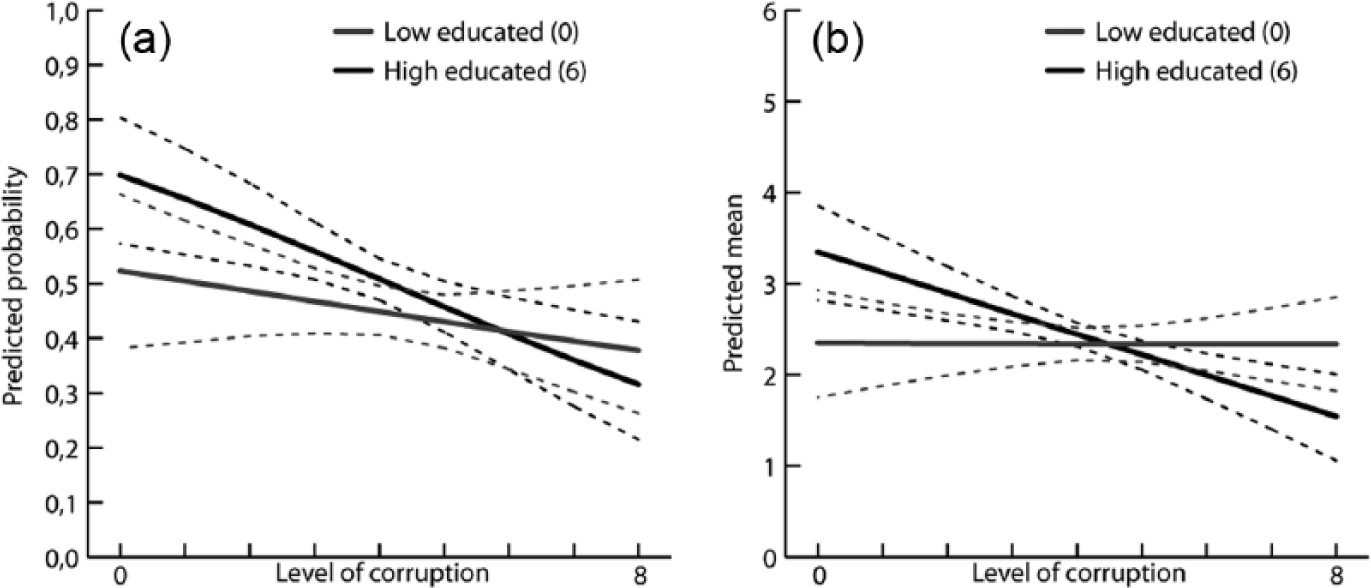
(a) Predicted Probabilities: Satisfaction with Democracy and (b) Predicted Means: Confidence in Political Institutions.
Figure 3(a) shows that the higher educated are significantly more likely to be satisfied with democracy (0.70) than the lower educated (0.52) in countries that are not corrupt. This difference decreases and drops to non-significance in more corrupt countries. For instance, in the most corrupt countries in our analysis, the higher educated (0.32) do not significantly differ from the lower educated (0.38).
Figure 3(b) shows that the differential effect of education is even stronger on confidence in political institutions. In countries that are not corrupt, education again has a positive effect: the higher educated are estimated to score 3.4 and the lower educated 2.4. This difference is significant. As corruption increases, the difference between the higher and the lower educated disappears and drops to non-significance. However, in the most corrupt societies in our analysis, we find that education even has a significant negative effect: the higher educated score 1.5, whereas the lower educated score 2.3. The interaction between education levels and corruption is remarkably robust using different measures of political trust and education and different sets of countries.
Conclusion
Cognitive perspectives on political trust often emphasise its evaluative character. Citizens grant and withhold trust based on an assessment of particular aspects of their respective political systems. This article set out to formulate the empirical implications of this trust-as-evaluation approach and to test it against cross-national evidence from more than 40 European countries.
First, our findings suggest that differences in process are able to explain cross-national differences in political trust (measured as satisfaction with democracy and confidence in national political institutions), whereas macro-economic outcomes fail to do so. We included six core macro-economic indicators (economic development, growth, unemployment, inflation, budget deficits and inequality) but hardly any of these are related to democratic satisfaction or institutional confidence – at least not once process variables were also accounted for. Rather, the degree of public level corruption matters greatly for how citizens evaluate their countries. The more widespread corrupt practices are, the less citizens trust national political institutions and the less they express satisfaction with the functioning of democracy. Process trumps performance. But although economic performance seems inconsequential, this does not refute trust-as-evaluation. Rather, it refines what is being evaluated.
Second, we further elaborated on the cognitive approach to political trust by testing the extent to which it is value-based (Anderson and Singer, 2008). Institutional performance ought to have a varying impact on citizens depending on the political values they hold dear. However, we found no support that the six economic indicators matter more depending on one’s left–right ideology. Trust among left-wing citizens does not correlate more strongly with high levels of unemployment and inequality than among right-wing citizens. In a similar vein, trust among right-wing citizens is not more strongly related to inflation and budgetary deficits than among left-wing citizens. Hence, despite our use of more precise measures of citizens’ policy preferences, we do not find support that in a cross-national setting the evaluative nature of trust is value-based.
Third, trust-as-evaluation also implies that the effects of macro-economic performance and corruption depend on the accuracy with which they are observed. The relevance of the evaluation ought to depend on educational attainment. Indeed, we find support for the interactive relationship between contexts and educational attainment. The harmful effect of high levels of corruption on political trust (and to a lesser extent: the effect of macro-economic performance) is most prevalent among the higher educated.
All in all, the evidence presented in this article seems to support some aspects of the cognitive approach to political trust while rejecting others. Trust may be fundamentally evaluative in nature, but our analyses suggest that these evaluations (at least insofar as they are based on cross-sectional benchmarks) exclusively rely on institutional quality, hence the strong direct effects of corruption as well as conditional effects depending on education. This is precisely what trust-as-evaluation entails. However, the arguments do not extend to economic performance indicators, neither in terms of direct effects nor conditionally on left–right values of citizens. Although macro-economic performance differentially affects groups that can be distinguished by educational attainment, marginal effects turn out to be non-significant.
Yet there is a remaining paradox on the issue of economic performance. In cross-national studies, countries that objectively perform better economically do not have higher trust rates. However, there seems to be a relationship between historical trends of consumer trust (in the economy) and political trust (e.g. Bovens and Wille, 2008; Dalton, 2004; Keele, 2007; Van de Walle et al., 2008). Moreover, subjective evaluations of economic performance continue to be the strongest correlates of trust (Van der Meer and Dekker, 2011). Where do these evaluations originate from, if not from the objective performance itself?
The missing link in the trust-as-evaluation approach is the role of expectations. Implicitly, the literature has assumed these to be constant among citizens. In this article, we attempted to deal with this issue by focusing on differential effects for different ideological groups. What we were unable to do, however, is assess which benchmark citizens use to evaluate their countries’ performances. Citizens may not so much be concerned with how their country’s economic performance holds up to other countries’, as is implicitly assumed in cross-national analyses. Instead, they may evaluate performance on how well it rates historically, or at least in relation to the recent past.
Differences in economic performance ultimately do not explain why trust rates are higher in some countries than in others, but this cross-national perspective may simply not be one that citizens use to evaluate politics. Within-country, longitudinal analyses are needed to assess whether citizens base their trust in politics on a historical comparison of their country’s economic performance instead (Mayne, 2010).
Footnotes
Funding
The author(s) received no financial support for the research, authorship and/or publication of this article.