







Abstract
This article analyzes the formation of lobbying coalitions in European Union legislative politics. Specifically, we investigate whether interest organizations establish coalitions and under which conditions business interests and non-business interests join a coalition. Our explanatory framework emphasizes three factors that drive coalition formation: the influence-seeking needs of interest groups, the need to ensure organizational maintenance, and policy-related contextual factors. To test our hypotheses, we analyze 72 policies initiated by the European Commission between 2008 and 2010 and 143 semi-structured interviews with representatives of European interest organizations. Our results demonstrate that non-governmental organizations that depend relatively less on membership support are strongly inclined to engage in coalitions. Moreover, the heterogeneous coalitions we identified—consisting of both business and non-business interests—are usually situated in policy areas that enjoy considerable salience among the broader public and emerge on issues that receive substantial media visibility.
Introduction
In December 2008, the European Commission (EC) proposed a directive on the collection of waste from electrical and electronic equipment (WEEE) (COM (2008) 810), arousing intense lobbying from both business interests and non-governmental organizations (NGOs). One key issue in the proposal was whether producers of electronic equipment or member-states should be held responsible for achieving waste collection targets. As a response to this proposal, the European Environmental Bureau (EEB), a prominent European environmental NGO, established a coalition together with various business associations representing producers of electronic equipment. This coalition of “strange bedfellows” was established to retain the responsibility for obtaining collection rates at the member-state level. The coalition was a success; the member-states remained responsible for waste collection targets, and collection targets were set at a reasonably high level (interview ID: 10177). In contrast, an interest organization representing electrical and electronic waste collection and recovery organizations—the WEEE Forum—sought to establish an alliance with the producers of electronic equipment because they shared many goals. However, this attempt to establish a coalition failed because some stakeholders refrained from this because, as one interviewee argued, “probably because they feared we would say something other than what they wanted” (interview ID: 70292).
This example highlights the role lobbying coalitions can play in European Union (EU) legislative politics and demonstrates that interest groups may exert considerable influence when acting in a coalition. Coalition formation is mentioned by both practitioners and academics as one of the most effective strategies to influence policy outcomes (Hojnacki, 1997; Hula, 1999; Klüver, 2013; Mahoney and Baumgartner, 2015). By working together, interest organizations share resources and costs, establish a division of labor, and send a credible signal that their policy views enjoy broad support. Although coalescing produces considerable advantages, it also entails some costs and risks (Hula, 1999). Coalescing requires coordination costs and joint position taking. Moreover, involvement in a coalition may compromise an interest group’s identity and its relation with the supportive constituency. For these reasons, not all interest organizations will become part of a lobbying coalition, and groups may prefer to lobby on their own. Obtaining more detailed insights into the conditions under which interest organizations establish coalitions or lobby alone is important to further our understanding of how interest representation works. This information also sheds light on a key component of the strategic repertoire upon which interest groups rely when seeking to achieve policy influence. For instance, a high prevalence of lobbying coalitions implies that the alliances through which organized interests act matter more than the individual capabilities of the organized interests that constitute these coalitions (Mahoney and Baumgartner, 2015).
In addition to the mere prevalence of lobbying coalitions, the internal composition of these alliances can be instructive because it reveals patterns of alignment and the structure of conflict in the representation of EU interests. Much of the literature distinguishes between business and non-business interests as key categories and expects these categories to correspond with a generic conflict pattern that characterizes most legislative lobbying (Coen, 2007; Danielian and Page, 1994; Dür and De Bièvre, 2007). The organization type (i.e. an NGO or a business interest) affects mobilization patterns, coalition behavior, and policy influence. A problem with this distinction is that it sometimes serves as an attractive and intuitive narrative shortcut rather than a theoretically informed tool to distinguish between substantively different interests. It is true that business groups and NGOs often stand against each other, but on other occasions, such as in the aforementioned example, business interests and environmental NGOs join forces and establish coalitions.
This phenomenon leads us to examine under which conditions interest groups lobby alone or join a coalition. Moreover, it invites us to analyze how coalitions are composed and whether and when business lobbyists join forces with non-business lobbyists. To answer these questions, this article is structured as follows. First, we develop a conceptual framework to explain why lobbying coalitions are formed and when business interests and NGOs join forces. Based on this framework, we specify the research hypotheses. To test these, we analyze a dataset with evidence of 72 policies initiated by the EC between 2008 and 2010 and 143 semi-structured interviews with representatives of European interest organizations. Our results demonstrate that two needs—namely, the need to influence policy outcomes and organizational maintenance—are important for understanding the formation of lobbying coalitions. Moreover, the context, specifically the extent to which some policies receive media attention and are situated in areas that are salient to the general public, mediates these needs and aids in explaining when coalitions between NGOs and business groups are established.
Lobbying for Maintenance and Influence
We define a coalition as deliberate and strategic cooperation among organized interests that defend the same political position. It is important to stress that coalitions are not just sets of interests that adopt a position on the same side of a policy debate (Baumgartner et al., 2009). Instead, coalitions involve the conscious exchange of resources and information, some division of labor, or the coordination of advocacy efforts with the aim of influencing policy outcomes (Hojnacki, 1997; Holyoke, 2009; Hula, 1999). In this article, we further differentiate between coalitions consisting of organizations from the same group type (business interests or NGOs) and coalitions that consist of at least one business group and one NGO. We label these two coalition forms homogeneous and heterogeneous coalitions, respectively. We believe that this distinction is relevant because it allows us to examine the prevalence and nature of the presumed structural division that pits business groups against groups representing broader citizen interests (Baumgartner et al., 2009; Bernhagen, 2012; Dür et al., 2015; Dür and Mateo, 2013; 952; Eising, 2007; Klüver, 2011). Importantly, heterogeneous and homogeneous coalitions may entail varying costs and benefits, implying the necessity to account for a potentially different logic of coalition formation.
Although group type is an important variable in interest group research, we go beyond the supposed distinction between NGOs and business groups by presuming that all interest organizations (both business and non-business groups) need to serve two key goals: influencing public policy and seeking organizational maintenance (Hanegraaff et al., 2016a; Lowery, 2007; Schmitter and Streeck, 1999a). We assume that both business interests and NGOs need to consider these two dimensions when establishing and joining lobbying coalitions.
First, it is obvious that coalition formation is related to influence-seeking goals. Interest groups have a political mission; they aim to defend the interests or policy views of their constituency as well as possible. For this purpose, they develop a particular advocacy strategy (Michalowitz, 2007). Several scholars have identified coalition building as one of the most powerful tactics in this regard and have argued that coalition size can be decisive in affecting the failure or success of lobbying efforts (Hojnacki, 1997; Hula, 1999; Klüver, 2011; Mahoney, 2007). By establishing coalitions with other like-minded stakeholders, interest groups give more leverage to their policy positions and increase the pressure on policymakers to concede to their demands. In addition to the mere establishment of a coalition, the composition of coalitions may affect policy influence (Nelson and Yackee, 2012). A coalition with a diverse set of organized interests potentially relies on a wide range of constituencies and therefore mobilizes a varied set of political resources and expert knowledge that enable it to address a broader set of policymakers.
Second, in addition to the incentive to influence public policy, the development of a particular political strategy might also be affected by concerns about organizational maintenance. Interest groups, like other organizations, are entities that seek to maintain themselves. To establish a well-functioning organization, they need proper resources, such as finances, members, supporters, and staff. Recent research has demonstrated that the use of inside or outside lobbying strategies is substantially affected by organizational maintenance needs (Dür and Mateo, 2013; Hanegraaff et al., 2016a). Similarly, it is expected that the formation of a coalition is related to maintenance goals (Binderkrantz, 2005; Lowery, 2007).
Importantly, the benefits of coalitions are less straightforward from an organizational maintenance perspective. Establishing a coalition can have negative consequences for the relation of the organizational leadership with its supportive constituency and may put pressure on the overall organizational identity. Many organized interests seek to nurture a specific identity (Heaney, 2004). For instance, they attempt to become experts in a policy niche or represent specific values. Some groups specialize in litigation, whereas others are good at establishing contacts with policymakers, and still others are experienced in media campaigns. Interest groups may develop an identity as defenders of radical and outspoken positions, whereas others are more moderate and tend to seek political compromises. In this respect, organizations aim to distinguish themselves on the basis of a unique selling point that may involve the nature of their policy positions or their favorable political strategy (Berry, 1977; Browne, 1990; Hula, 1995). This rationale reverberates with the way lobbying coalitions are established and composed. Generally, groups that rely on similar constituencies and share a comparable political view (e.g. being liberal, left-leaning, or conservative) tend to coalesce when the conditions (e.g. salient issues and much policy conflict) are conducive for establishing coalitions (Salisbury, 1990; Schlozman and Tierney, 1986). Nonetheless, as we will elaborate below, a maintenance perspective leads us to expect that interest groups may tend to sidestep coalition building not only because they fear direct competition from other organized interests but also because their supportive constituency potentially experiences a coalition as something that may dilute organizational identities.
These two needs—organizational maintenance and the need to influence public policy—cannot always be strictly separated. Importantly, they are contingent on the specific policy context in which lobbying processes unfold. The specific policy context refers to environmental factors that are somewhat exogenous to the organized group and that potentially affect the strategy with which lobbyists respond to a particular legislative initiative. The literature identifies two types of contextual factors: institutional and issue contexts (Klüver et al., 2015; Mahoney, 2008). The institutional context involves the way specific features of the venues in which policies are made (such as decision-making procedures) trigger the demand for lobbying. For example, a corporatist or a pluralist context imposes different demands on societal interests and affects the organizational form of collective action (for instance, a more prominent role for peak associations in the former compared to the latter; see Lang et al., 2008). Because the overall institutional context—the EU legislative process—does not vary within this project, we do not consider it a key independent variable for this article.
Characteristics related to the context of policy issues, such as media salience, public salience, organizational salience, and policy conflict, may shape strategy development and coalition formation (Baumgartner et al., 2009; Hojnacki, 1997; Hula, 1999; Mahoney, 2007). The establishment of coalitions demands organizational resources. Therefore, depending on what is at stake, interest group officials will consider whether it is worthwhile to establish a coalition and with whom. For instance, if no other interest organizations mobilize on the issue or if the issue is not a priority for the organization, coalition formation makes less sense. It might even be risky because forming a sizeable coalition could engender public visibility, which might awaken potential opponents. In contrast, if much is at stake and if an issue gains considerable media attention, then interest groups may more easily establish coalitions. Even more, under such conditions, it may be risky not to coalesce, and it may be warranted to share resources with like-minded interests. In short, the overall political context may trigger or constrain the development of lobbying coalitions. Thus, coalitions do not emerge in a void, but the unique context of particular policy cases affects whether coalitions emerge.
Under Which Conditions Do Coalitions Emerge?
This framework allows us to specify research hypotheses in relation to coalition formation. Drawing on both organizational needs—influence and maintenance—and the specific policy context, we formulate hypotheses that are connected to (a) the organizational characteristics of interest organizations (Hypotheses 1 and 2) and (b) features of the policies at stake (Hypotheses 3 and 4).
As mentioned, the establishment of coalitions involves some uncertainties, risks, and costs. For instance, it might affect organizational identities in a negative way and/or jeopardize the relationship with the supportive constituency. It might be difficult to explain to the supportive constituency that organizational representatives cooperate with groups that have a somewhat different mission (for instance, left-leaning NGOs versus neo-liberal business interests) or that defend policy positions on many issues that are at odds with the general policy view of the organization. Nonetheless, we expect that the magnitude of this constraint is conditional on specific organizational features. Some organized interests depend much more on membership support for their organizational survival. These groups need to maintain regular contacts with their members and supporters and they need to report regularly to maintain their members. Because of this strong dependence, they are less inclined to take the risk of losing face with their members. Therefore, we expect that these groups are less likely to engage in coalitions. In contrast, other groups depend less on members (for instance, because they have other key sources of income, such as state subsidies and corporate sponsors) (Mahoney and Beckstrand, 2011; Walker, 1983). Groups with a stable and secure income provided by a small array of reliable sponsors have more leeway in developing their lobbying strategy because they do not have to worry about continued support from a large number of individual members when allying with other interests. In contrast, groups that depend strongly on membership support need to invest considerable energy in keeping their members on board. Therefore, they will attempt to keep their organizational identity intact and show a lower probability of engaging in coalitions (compared to those that depend less on members).
We expect that the constraining effect of resource dependency on members is moderated by the nature of the represented constituency. NGOs typically represent a diffuse constituency and public-spirited interests. The members and supporters of NGOs are strongly driven by expressive benefits and normative views on various issues (such as the environment and animal protection), whereas direct and tangible self-interests are much less paramount (Binderkrantz, 2008; Halpin, 2006; Salisbury, 1969). To ensure continued constituency support, NGOs need to protect their image as a distinctive advocate for their cause. In this respect, it might be problematic to collaborate with other interest groups. Engaging in a coalition with NGOs that provide comparable expressive benefits is risky because it can dilute the groups’ competitive position in raising funds and attracting members. Cooperating with other interest group types (such as business) may reduce the credibility of an NGO toward its constituency as the appropriate advocate of a certain cause. This mechanism is different for business interests, which usually represent a specific constituency (such as fruit juice producers and the automobile industry). Their maintenance needs are different because the support and membership of business groups are much less driven by expressive benefits. Business lobbyists typically represent the self-interest of their constituency. Given their more utilitarian outlook, cooperating with other organizations is not necessarily problematic for their members. In contrast, especially if this cooperation positively impacts influence-seeking, business interests will be stimulated by their members to engage in coalitions. For this reason, we expect that NGOs (compared to business interests) are less likely to coalesce when they depend more on their members.
H1a: The more NGOs depend on their members for resources, the less likely they are to engage in coalitions.
H1b: The more business groups depend on their members for resources, the more likely they are to engage in coalitions.
In addition to group type and membership dependency, coalition formation may be affected by the competition interest organizations face when they seek to attract resources. Scholars of group politics have highlighted two mechanisms that could either enhance or inhibit coalition formation (Hojnacki, 1997; Holyoke, 2009).
On one hand, interest organizations that face strong resource competition with other organizations are more preoccupied with their organizational identity and distinctiveness (Hojnacki, 1997: 69). For instance, there are several EU-level interest organizations that represent the meat industry or environmental interests. The existence of multiple organizations implies that potential supporters of these organizations—meat producers, consumers, citizens—have different options for endorsing organizations that defend their policy views. These groups, such as the various meat industry organizations or all the environmental NGOs, may be political allies in the sense that they will, in many instances, defend the same or largely similar policy views. However, they might be competitors with regard to seeking membership resources and convincing potential members to choose their organization over other like-minded organizations. This is why interest organizations will be cautious when establishing coalitions with organizations of the same group type, particularly when they experience competition for members and resources. When establishing coalitions, an interest organization may draw attention to its competitors, which may tempt potential members to start supporting these competing organizations. In contrast, interest organizations that face substantial competition in fundraising might experience fewer constraints in forming coalitions with interest organizations of another group type because organizations of a different type (business associations and NGOs) are usually not competitors with regard to members.
On the other hand, groups that are strongly aligned in terms of policy preferences will show a high propensity to coalesce, regardless of the potential resource competition they face. Such groups need not overcome large political distances as their interests are already closely aligned and as they represent similar substantive interests. The need for influence, we argue, thus trumps concerns about organizational maintenance and a distinct identity. Moreover, resource competition may actually stimulate coalition formation. Abstaining from a collective advocacy campaign with “competitors” who have similar policy views may backfire as supporters may start to believe that their representatives prioritize maintaining a distinct organizational identity at the cost of defending their substantive political interests. Marie Hojnacki (1997) proposes the first mechanism (competition leads to less coalitions), but her empirical observations demonstrate that depending on the policy issue, groups competing for members and resources are relatively more likely to join coalitions. She argues that:
Competing organizations are more likely to share interests with other groups active in their policy areas than are groups that do not compete. Groups that do not compete would have fewer opportunities, and little reason, to work with other groups (Hojnacki, 1997: 83).
Following this logic, we posit that resource competition has a positive effect on coalition formation for homogeneous coalitions. This is different, however, for heterogeneous coalitions. Civil society groups and business interests rarely compete for the same resources and often defend substantively different interests. Therefore, resource competition does not trigger coalescing with organizations from another group type. In short, we propose the following hypotheses:
H2a: The more competition interest groups face in raising resources, the more likely they are to engage in homogeneous coalitions.
H2b: Facing more competition in raising resources will not affect the likelihood of interest groups to engage in heterogeneous coalitions.
In addition to organizational features, characteristics tied to the policy cases that interest organizations aim to influence affect the establishment and composition of coalitions. The overall policy context can have major implications for the way interest groups develop their lobbying strategies, specifically whether organized interests coalesce and with whom. Christine Mahoney (2007), for example, showed that the policy context matters for both EU and US lobbyists (see also Baumgartner et al., 2009; Hanegraaff et al., 2016b; Hojnacki, 1997; Holyoke, 2009). Specifically, interest groups are more likely to establish coalitions on more salient legislative cases. However, salience is a notoriously multifarious concept because it may refer to multiple features of a specific policy. We distinguish among three factors: public salience, media salience, and organizational salience.
First, salience can refer to the degree to which the public considers a particular policy area important (De Bruycker, 2017). The general idea is that policies situated in salient policy areas will gain more attention from organized interests. Although most EU policies attract no or little attention and controversy, a small number of policies stimulate high citizen awareness. However, even in the EU context, which is generally characterized as lacking a coherent public opinion, the role of public salience cannot be underestimated (Alexandrova et al., 2016; Rasmussen et al., 2014). When citizens pay substantial attention to a policy area, pressure politics prevails over opaque and technocratic decision-making (De Bruycker, 2017; Hooghe and Marks, 2009; Rauh, 2016). Under these conditions, organized interests are incentivized to signal to policymakers that their policy goals enjoy the support of a broad range of stakeholders. It is through cooperation with other like-minded organizations that advocates bundle their political weight and signal to policymakers that their views enjoy political support beyond their own organization.
Second, coalition formation might be explained by the extent to which specific policies gain media attention. Recent accounts have highlighted the importance of this factor in EU politics (De Wilde et al., 2016; Hutter and Grande, 2014; Rauh, 2016; Zürn, 2016). Specifically, when issues gain media salience, interest groups and other stakeholders are signaled that their interests are at stake, which stimulates further mobilization and strategic political action (De Bruycker and Beyers, 2015). Media attention thus increases the awareness of organized interests about what is at stake and stimulates the overall preparedness to invest in policy cases, such as by establishing coalitions. Moreover, the growing attention of a wider and more diverse set of interests requires more creative and intense lobbying efforts to cut through the noise of other mobilized interests and to attract policymakers’ attention. This can be done by coalescing with other interests. Increased media attention should also correspond with higher levels of coalition building because organizations that engage in media campaigning need resources that are usually not present within a single organization (e.g. popularity, media campaigning expertise, contacts with journalists, financial resources). Many organized interests do not possess all in-house experience or the financial resources to develop and implement successful media campaigns (Thrall, 2006). It is through building coalitions that organized interests may mobilize the required resources, networks, and skills. Cooperation with like-minded organizations allows them to bundle financial resources, networks, popularity, and expertise and to send a credible signal in media debates to draw the attention of policymakers and other relevant audiences.
These two conceptualizations of salience refer primarily to the overall environment in which policy advocates operate. However, salience can also be understood from an actor-centered perspective. Whereas public and media salience pertain to the visibility or importance of policy issues to the general public or the media, organizational salience involves the importance a specific stakeholder attributes to a policy (Leuffen et al., 2014; Warntjen, 2012). When issues enter the EU legislative realm, some will be seen as important by interest organizations, whereas others will be considered trivial. The degree of importance policy advocates attribute to an issue does not necessarily coincide with the public salience of that issue (Zürn, 2016). Issues that are understood as salient by one or a small set of stakeholders may purposefully be kept behind the scenes because too much public attention may backfire (Danielian and Page, 1994; De Bruycker and Beyers, 2015). Generally, organizational salience is expected to increase overall lobbying expenditures and, therefore, to stimulate coalition formation. In contrast, when issues show a low level of organizational salience, organized interests will eschew investing in coalitions because this would increase transaction costs and involve unnecessary risks of identity loss. In short, higher levels of salience (public, media and actor) increase the propensity to establish a coalition.
H3: Organized interests are more likely to engage in coalitions when issues are (a) publicly salient, (b) salient in the media, and/or (c) salient to the organization.
Moreover, we expect that all three forms of salience stimulate the emergence of heterogeneous coalitions. First, heterogeneous coalitions might be more useful in areas that enjoy a high level of public salience. The signal of political pressure that these heterogeneous coalitions can convey may increase in weight when organized interests cooperate with organizations from a different group type. A heterogeneous coalition consisting of both business groups and NGOs can signal to policymakers that the political support of the respective coalition rises above the ingrained controversies between business and non-business interests. Such coalitions, rare as they may be, do not only send a signal of support; they can also send a signal of consensus on behalf of a wide and diverse set of stakeholders. Second, media salience will stimulate heterogeneous coalition formation. Coalitions between NGOs and business groups bundle a diverse set of resources needed to develop media campaigns. For instance, business groups may possess the necessary financial resources and expertise to craft media campaigns, whereas NGOs might be more popular with some journalists and crucial segments of the public. Third, organizational salience is important for heterogeneous coalitions. As mentioned, organizational salience involves the importance specific stakeholders attribute to a policy. Because heterogeneous coalitions require compromise and coordination costs and may even dilute organizational identities, they are mostly established when much is at stake for the organizations involved. When organizational salience is high, a lobbyist might take the risk of losing credit with parts of the organizational constituency. The supportive constituency is prepared to accept this risk, and lobbyists will engage in heterogeneous alliances. However, when the stakes are low and policies are seen as being of little or moderate importance, groups will eschew coalitions, especially heterogeneous coalitions, because of the potential risks in terms of organizational identity.
These factors lead us to expect that all three types of salience stimulate actors to establish heterogeneous coalitions:
H4: Organized interests are more likely to engage in heterogeneous coalitions when issues are (a) publicly salient, (b) salient in the media, and/or (c) salient to the organization.
Data and Research Design
The data used to test these hypotheses are part of a larger project on EU legislative lobbying. The goal of this project is to analyze lobbying strategies and interest group influence for a sample of 125 European legislative proposals (directives and regulations) that were submitted between 2008 and 2010. The sample procedure is equivalent to the procedure Robert Thomson (2011) used in his research on EU legislative politics. Details about the precise procedure are described elsewhere (Beyers et al., 2014a, 2014b). In this article, we draw on evidence collected through 143 interviews with 111 different interest organizations active on one of the 125 sampled proposals. Interviews were not conducted for all 125 sampled proposals. Forty proposals were dropped because our systematic analysis of EU-level media, interviews conducted with EC experts, and a range of brief telephone interviews demonstrated that these cases did not stimulate lobbying activity. Seven proposals were not included in our analysis because no interest groups could be convinced to participate in an interview or no one within the contacted organization remembered enough about the specific proposal. Instead of considering the remaining set of 78 legislative proposals, our evidence refers to 72 policies because six EC proposals were highly interconnected in different ways and should be seen as part of one policy proposal consisting of two or more legislative proposals.
Some groups were interviewed twice (13) or three or more times (5) if they were identified as crucial actors for several proposals. As described elsewhere (Beyers et al., 2014b), our main goal was to interview EU-level interest organizations on each side of the issues identified for the legislative proposals. Of the 111 interviewed interest organizations, 86% were EU-level organizations. In cases in which no EU-level organizations were active, we interviewed national or international organizations. The largest part (64%) of the respondents represented business associations, another 29% were NGOs, and the remaining 8% were officials from professional organizations, firms, or labor unions. These numbers correspond to the overall population of interest groups active in EU politics (Wonka et al., 2010).
During the interviews, interest group officials were asked whether their organization participated in a coalition, and if so, with whom. The question was phrased as follows:
In order to influence EU policies, advocates may forge coalitions. We understand coalitions as explicit agreements between you and other actors, aimed at coordinating efforts to influence EU legislation, for instance, through the issuing of joint statements. If you were involved in this type of activity, can you indicate with whom you formed a coalition to influence the legislative outcome of this proposal?
These coalitions were coded as homogeneous when they consisted of only business interest or NGO and as heterogeneous when both group types were part of the identified coalition. One example of a homogeneous coalition was the coalition of different train associations (The Community of European Railway and Infrastructure Companies—CER, The European Rail Infrastructure Managers—EIM, and The Union des Industries Ferroviaires Européennes—UNIFE) in the proposal for a directive on road use charges for heavy goods vehicles (COM (2008) 436). An example of a heterogeneous coalition was the coalition between the EEB and The European Committee of Domestic Equipment Manufacturers (CECED) in lobbying on the proposal for a directive on waste electrical and electronic equipment (COM (2008) 810).
To test Hypothesis 1 (a and b), we modeled the interaction of two independent variables: group type and the extent to which interest groups were financially dependent on members (see Table 1 for an overview of all variables). More specifically, we distinguished between NGOs and business interests. NGOs included civil society groups representing a specific cause or broad societal concerns, such as environmental interests, animal right groups, and consumer interests. Business interests represented companies or a particular industry; examples are the Fruit Juice Association or Business Europe. Membership dependency was measured by the share of the organizational budget for which an organization depended on membership contributions. Modeling the interaction between these two variables tested the extent to which the effect of membership dependency on coalition formation was conditioned by whether a lobbyist represented a business organization or an NGO.
Overview of Dependent, Independent, and Control Variables.
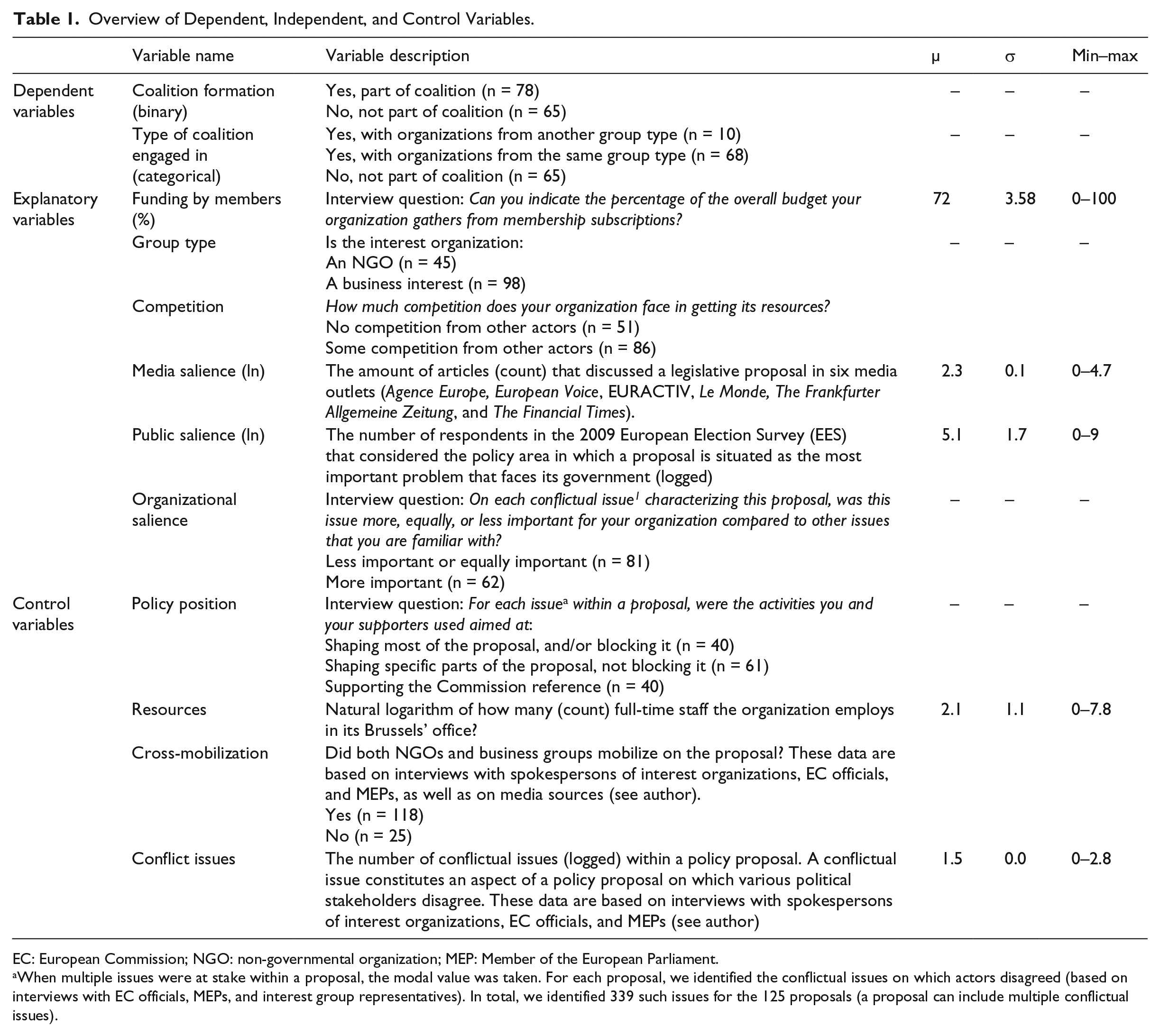
EC: European Commission; NGO: non-governmental organization; MEP: Member of the European Parliament.
When multiple issues were at stake within a proposal, the modal value was taken. For each proposal, we identified the conflictual issues on which actors disagreed (based on interviews with EC officials, MEPs, and interest group representatives). In total, we identified 339 such issues for the 125 proposals (a proposal can include multiple conflictual issues).
For Hypothesis 2 (a and b), we used a variable that captured the competition interest groups face to raise organizational funds. During the interviews, respondents were asked whether their organization faced (0) “no competition,” (1) “little competition,” (2) “moderate competition,” (3) “strong competition,” or (4) “very strong competition” in regard to finding organizational resources. We recoded this variable by collapsing all categories where some competition was perceived (0 vs 1, 2, 3, and 4). The more refined categorization led to categories with no or few observations and therefore inflated the estimates. 1
The salience variables were operationalized as follows. To test Hypotheses 3a and 4a, we relied on a measure of public salience based on an opinion poll conducted in 2009 in the context of the European Election Survey (EES) in 27 EU member-states (2009; http://eeshomepage.net/). In the survey, respondents were asked about the most important problem facing their government. The responses in the EES dataset were coded in 23 areas which correspond with the jurisdiction of the Commission Directorate-General (DG) in charge of the legislative proposals we sampled for the purpose of our project. For each policy area, we established the number of respondents in the EES survey who considered such area to be the most important problem facing their governments. The public salience of policy proposals is coded as the logged number of public opinion respondents for whom the corresponding policy area is salient (see also De Bruycker, 2017). 2 For Hypotheses 3b and 4b pertaining to the media salience of specific policies, we used a measure based on the total number of articles (logged) that discussed these proposals in six media outlets (Agence Europe, European Voice, EURACTIV, Le Monde, The Frankfurter Allgemeine Zeitung, and The Financial Times). 3 Finally, to test Hypotheses 3c and 4c, we used a measure of organizational salience that was created by asking respondents whether the lobbyists perceived the issue in question (1) “as more important,” (2) “as important,” or (3) “as less important compared to other issues she was familiar with and worked on.” We recoded this to a dichotomous variable that captured whether a proposal was considered more important than other issues on which the organized interests worked (1 vs 2 and 3).
Finally, we included four control variables that may affect coalition formation. First, we added the position interest groups adopted with respect to specific policy issues that were part of the proposal. Lobbyists were asked whether their activities in relation to a specific issue within a proposal were aimed at “blocking or shaping most of the proposal,” “shaping specific parts of the proposal but not blocking it,” or “supporting the Commission.” When multiple issues were at stake within a proposal, the modal position was taken. The idea is that a more critical stance would produce a higher propensity to seek allies. Second, we controlled for staff resources (logged) because more staff may enable an organization to cope with the transaction costs involved in coalition formation. Third, the amount of conflict that surrounds a specific policy may influence coalition formation because it stimulates antagonists to strengthen their ranks and employ more creative strategies. Conflict was measured on the basis of the interviews. For the overall purpose of this project, 95 interviews were conducted with experts in the EC (Dür et al., 2015), 38 with officials in the European Parliament (Baroni, 2014) and 143 with interest group officials (Beyers et al., 2014b). Each of these interviews was used to map and identify specific issues at stake in a particular policy. In total, we identified 339 issues. The number of conflictual issues per policy case is considered a proxy for conflict. Because each of these indicators is characterized by a strongly skewed distribution, we took the natural logarithm. Fourth, the likelihood of heterogeneous coalitions will logically depend on whether we observed cross-mobilization. It is not possible to have heterogeneous coalitions composed of business and non-business interests if only business interests (or non-business interests) are active with respect to a policy (no cross-mobilization). Based on our comprehensive mapping of mobilized interests, for each case, we could identify whether both business and NGOs actively sought to influence the policy outcomes. Cases in which both business and NGOs were present were classified as cross-mobilization.
Results
We begin with a brief descriptive account of the dependent variable, namely, the overall propensity with which coalitions are established and the occurrence of different coalition types. A large amount of EU policymaking does not involve lobbying coalitions simply because for more than 30% of the sampled policies (40 of the 125 policy cases), we could not identify substantial lobbying efforts (Beyers et al., 2014b). For the remaining cases, although most groups we interviewed (n = 78; 55%) did engage in a coalition, a substantial number of lobbyists worked on their own (n = 65; 45%). Most coalitions involved only business or NGOs and were qualified as homogeneous coalitions (n = 68; 48%). Only 7% of the interviewed groups belonged to a heterogeneous coalition (n = 10).
Figure 1 also shows that compared to business, NGOs are more inclined to act through a coalition (67% compared to 49%), although they are somewhat less likely to participate in heterogeneous coalitions. Nine percent of the NGOs (4 of the 45 NGOs) were in heterogeneous coalitions, whereas 6% of the business groups (6 of the 98 business interests) were in heterogeneous coalitions. However, it should be noted that the differences between NGOs and business are not substantial. The propensity to establish coalitions is somewhat larger for NGOs, but the bivariate association is not highly significant (χ2 = 3.89, df = 1, p = 0.049, Cramer’s V = 0.17), which suggests that there might be other explanations than group type.
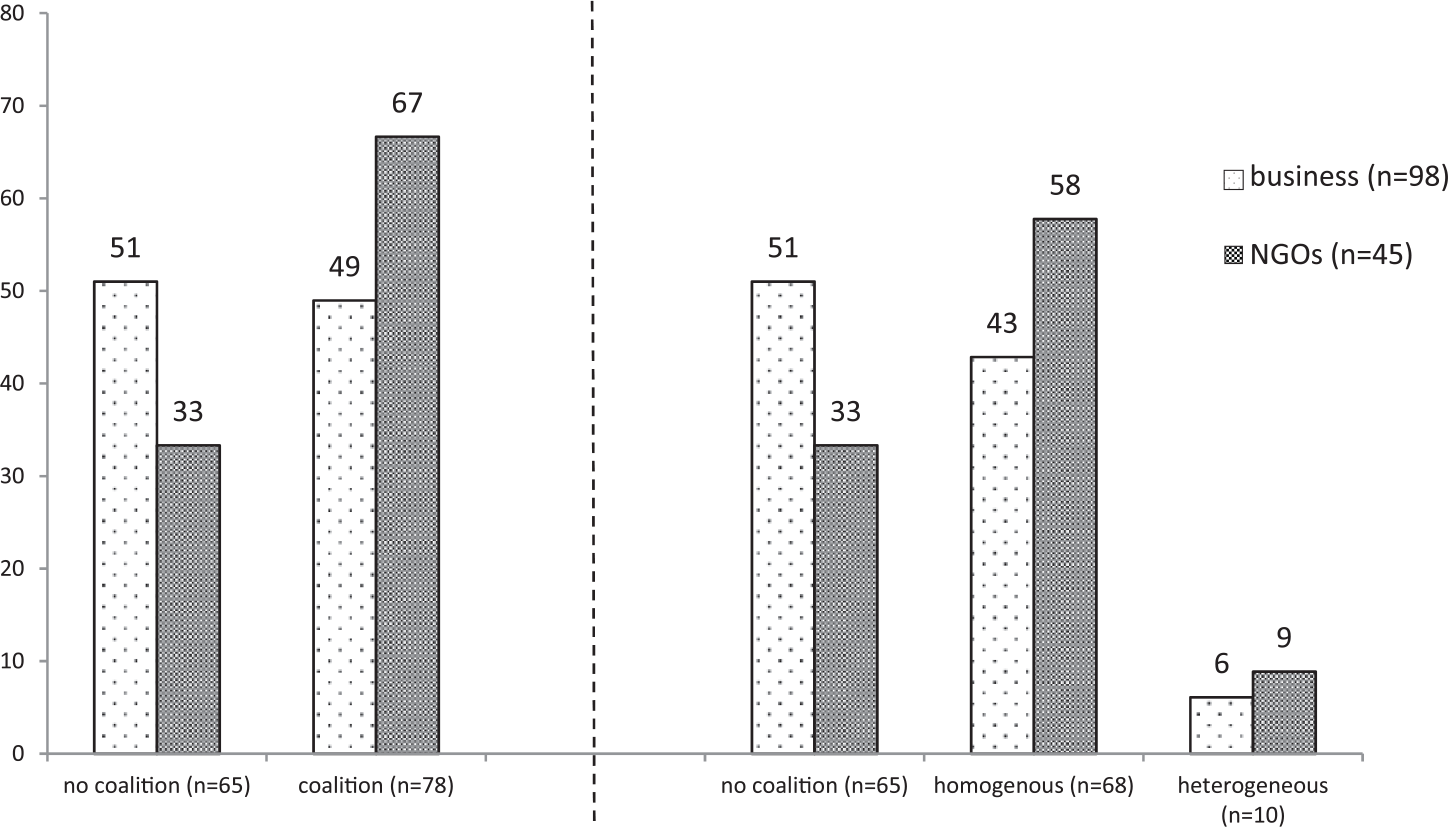
Interest Group Type and Coalition Type (Percentages).
To test our hypotheses, we present both a binary logistic regression and a multinomial logistic regression with the same explanatory variables. The dependent variable for the binary logistic regression is whether interest groups lobbied in a coalition (Model I, left side of Figure 1). The multinomial regression models whether the interest group established no coalition, a homogeneous coalition, or a heterogeneous coalition (Model II, right side of Figure 1). To address potential dependencies due to the fact that different respondents are nested in the same proposal, we estimated clustered standard errors at the policy level. Because of cross-classification of the research subjects and the multiple membership structure of the data, we did not fit a multilevel model because, given the low N, this would have resulted in a less efficient estimation.
For further robustness checks, we include an Online Appendix with three additional models. Model III is the same model as Model II but takes heterogeneous coalitions as the baseline model. It illustrates the significant differences between factors that explain engagement in heterogeneous coalitions and lobbying alone versus engagement in homogeneous coalitions. Model IV includes only cases in which cross-mobilization was identified. Because heterogeneous coalitions are only possible if we have cross-mobilization, we tested the same model with only those proposals in which cross-mobilization was identified (n = 87). One potential problem for a logistic approach is the relatively small number of observations characterized as heterogeneous coalitions, which may cause biased estimates because the estimated event probabilities are too small (King and Zeng, 2001). To account for this, we tested the same model with a rare events logistic regression. Model V presents a rare events logistic regression with the outcome variable of whether an interest group engaged in a heterogeneous coalition. We use only the cases in which cross-mobilization was identified. This approach accounts for the low number of heterogeneous coalitions, which can be classified as a “rare event.” The model provides an important robustness check because it indicates whether our statistical findings regarding heterogeneous coalitions are an artifact of the low number of cases.
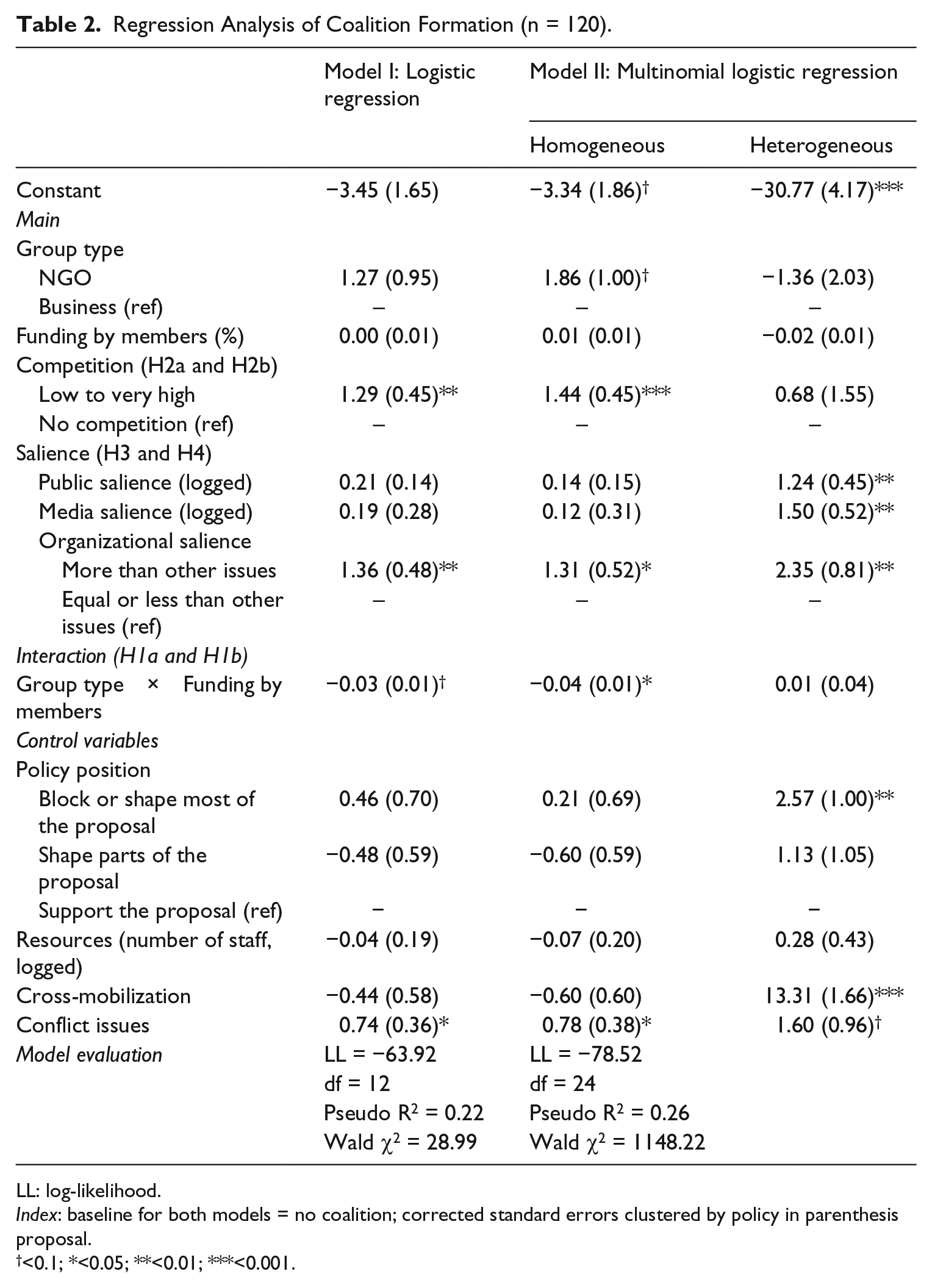
The regression results are presented in Table 2. The earlier bivariate observation that NGOs are, compared to business, somewhat more likely to engage in coalitions is not confirmed in the regression models when we control for other variables. However, we should not focus the interpretation on this insignificant main effect because we hypothesize an interaction model and presume that group type generates a stronger impact for heterogeneous coalitions. As anticipated, group type conditions the effect of membership dependency if we differentiate heterogeneous and homogeneous coalitions (Hypotheses 1a and 1b). Generally, NGOs that show a higher level of membership dependency are, compared to business groups, somewhat less likely to engage in (especially homogeneous) coalitions.
Regression Analysis of Coalition Formation (n = 120).
LL: log-likelihood.
Index: baseline for both models = no coalition; corrected standard errors clustered by policy in parenthesis proposal.
<0.1; *<0.05; **<0.01; ***<0.001.
To interpret the interaction between membership dependencies and group type, we should focus not only on the coefficient’s significance levels but also (and more so) on the marginal effects. Figure 2 portrays the marginal effects or the change in the probability (Y-axis) that an NGO engages in coalitions compared to business interests for different levels of membership dependency (X-axis). Figure 2 illustrates this separately for heterogeneous and homogeneous coalitions (based on Model II). The baseline (the red line) signifies where the difference between NGOs and business interests is statistically significant (p < 0.05). Clearly, there is no significant difference in probability for heterogeneous coalitions. For homogeneous coalitions, however, we observe a statistically significant difference between NGOs and business groups. Specifically, the difference becomes statistically significant (p < 0.05) when an organization receives less than 10% of its resources from membership contributions or when an interest group receives all its income from members (100%). Hypotheses 1a and 1b are thus confirmed for homogeneous coalitions. In short, the difference between business groups and NGOs evaporates when the (in)dependence on members does not take extremely low or high values. These results are also confirmed in the robustness checks we conducted (see Online Appendix).
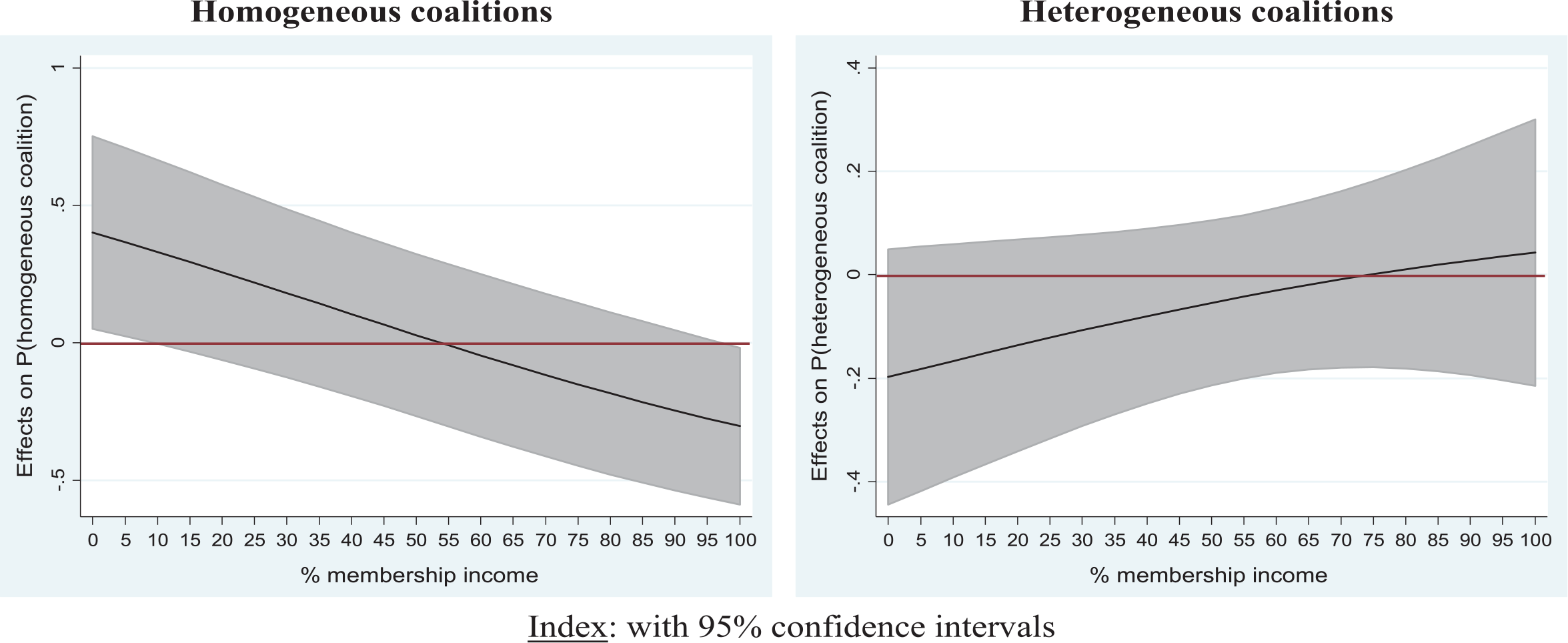
Marginal Effects of NGOs to Engage in Coalitions (Model II).
The second set of hypotheses pertains to the competition interest groups face in generating their income. Whereas previous studies hypothesized that more competition is detrimental to coalition building in general (Hojnacki, 1997; Hula, 1999), we argued that this may stimulate the establishing of homogeneous coalitions as resource competition might be typical for organizations that represent substantively similar interests and constituencies with respect to a certain policy issue. Indeed, we find that the effect of competition stimulates the formation of homogeneous coalitions positively. For heterogeneous coalitions, we argued that this logic is not applicable, as NGOs and business groups typically defend different interests and rarely compete for resources. Indeed, the analysis confirms that heterogeneous coalition formation is not significantly affected by resource competition. Therefore, both Hypotheses 2a and 2b are confirmed. Competition for resources positively affects engagement in coalition formation (Model I). Moreover, it significantly affects the likelihood of establishing homogeneous coalitions positively, but it has no impact on the creation of heterogeneous coalitions. When interest groups face some competition for resources, they are more likely to cooperate with groups of the same type. This result does not confirm the maintenance logic of coalition formation (Hula, 1999) but is akin to observations made by Hojnacki (1997: 83). Specifically, organized interests do not seek to distinguish themselves from competitors by not joining coalitions. From an influence-seeking perspective, groups that defend similar interests will be tempted to coalesce and build collaborative advocacy campaigns. The need for influence and to act as political allies trump competition for resources. Resource competition actually stimulates coalition formation. Not joining a collective campaign and staying on the sideline may backfire, making supporters believe that their representatives prioritize maintaining a distinct organizational identity over defending their substantive political interests.
Our next set of hypotheses considered public, media, and organizational salience and the way these affect coalition building. In line with Hypothesis 3a, the regression coefficient is positive and suggests that public salience stimulates coalition building (Model I), but the effect is not significant (p = 0.13). Nonetheless, in Model II, public salience positively affects the propensity of interest groups to engage in heterogeneous coalitions. Figure 3(a) portrays the predicted probabilities of engaging in no, homogeneous, and heterogeneous coalitions for different levels of public salience. Although the effect of public salience on the propensity to engage in homogeneous coalitions is insignificant, for heterogeneous coalitions, we observed a positive significant effect. For instance, for issues situated in policy areas that achieve no or little public salience, the predicted chance of an interest group engaging in a heterogeneous coalition is almost zero (standard error (SE) = 0.00), whereas this probability is 45% (SE = 0.13) for policy areas at the highest level of public salience.
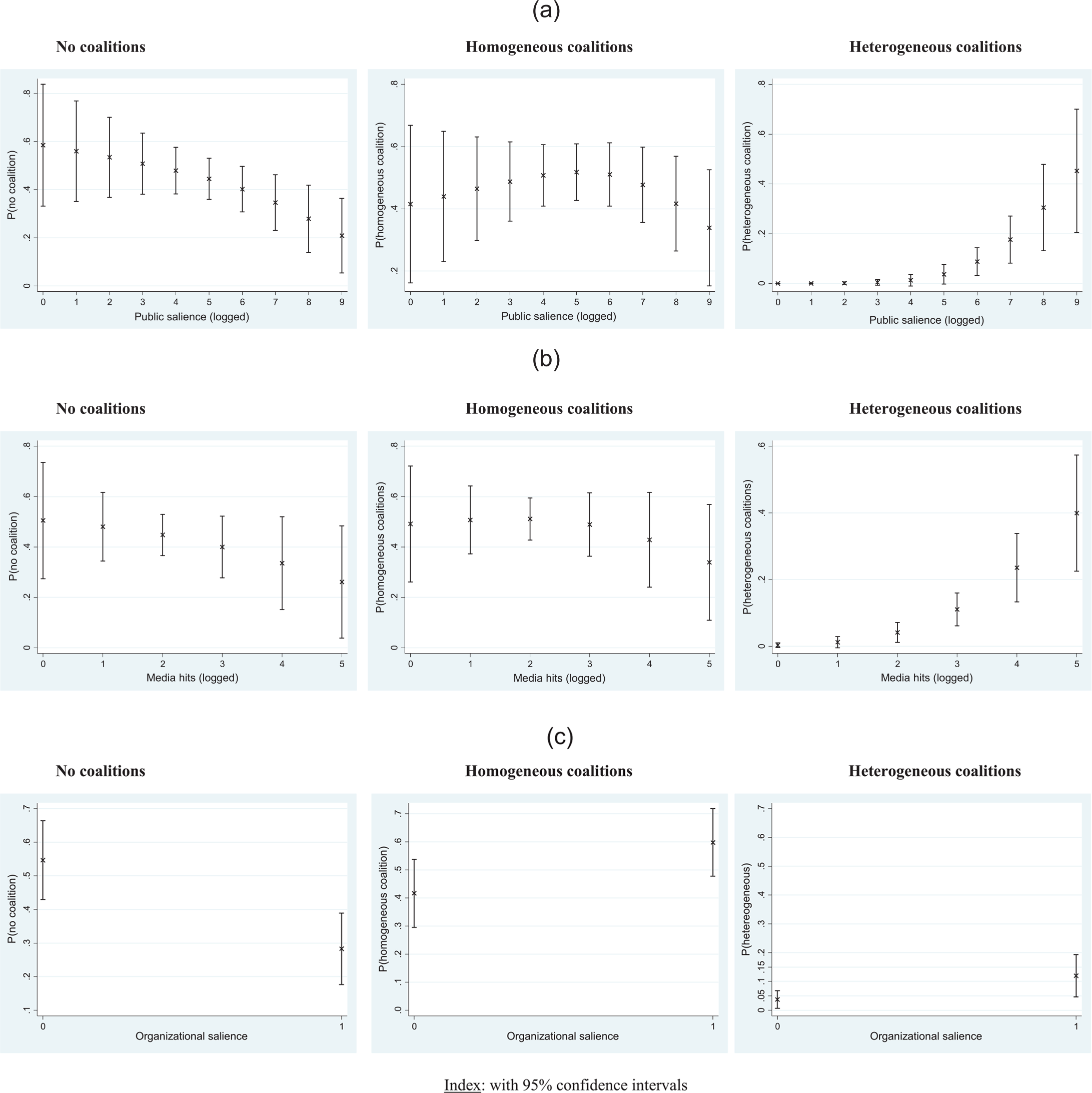
Salience and the Propensity to Engage in Coalitions: (a) Public Salience; (b) Media Salience, and (c) Organizational Salience.
Next, in contrast to Hypothesis 3a, media salience generates no significant effect on coalition formation in general. However, we again observe a significant impact for heterogeneous coalitions, which confirms Hypothesis 3b. Figure 3(b) plots the predicted probabilities for both coalition types and the varying levels of media salience. It shows that for policies that receive no media attention, the predicted chance of an interest group engaging in a heterogeneous coalition is almost zero (SE = 0.00), whereas this probability is 0.11 (SE = 0.03) for policies that were discussed in 54 media articles.
Finally, organizational salience, or the extent to which interest organizations prioritize a specific policy issue, affects the inclination to coalesce. As expected, interest organizations that lobby on an issue they deem important are more likely to coalesce (Model I). The probability that interest organizations will engage in a coalition is 70% (SE = 0.05) when they lobby on an issue that they deem more important compared to other issues on which they work, whereas this probability is only 0.46 (SE = 0.06) when the policy is seen as less important. Model II demonstrates that organizational salience has a positive effect on the inclination to lobby in homogeneous and heterogeneous coalitions. Figure 3 portrays the predicted probabilities of engaging in heterogeneous and homogeneous coalitions for two levels of organizational salience. When issues are considered important and there is much at stake, interest groups are generally more likely to coalesce.
These results regarding competition, public, media, and organizational salience were confirmed in various robustness checks (see Online Appendix). As mentioned above, coalition formation might be a function of the organization types that mobilize around a specific policy. For instance, if only businesses (or NGOs) mobilize, the chance of observing heterogeneous coalitions should be zero. Alternately, when a rather diverse set of interests lobbies (business and NGOs) mobilize, this could trigger the propensity to establish a coalition. For each proposal, we coded the cross-mobilization, namely, whether both NGOs and business were active. Figure 4 shows the percentage of cases in which a diverse set of mobilized actors resulted in heterogeneous or homogeneous coalitions. It shows that there are more coalitions (and, of course, more heterogeneous coalitions) in instances in which we have cross-mobilization (χ2 = 5.92, df = 1, p = 0.02, Cramer’s V = 0.20). Model IV (Online Appendix) replicates the multinomial model reported in Table 2, but only for the 101 observations with cross-mobilization. It shows the same results. Next, we conducted a rare events logistic regression (Model V, n = 101) modeling the heterogeneous cases versus the no or homogeneous coalitions. This analysis confirms that our results are not an artifact of the low N or the low number of instances in which heterogeneous coalitions are observed. 4
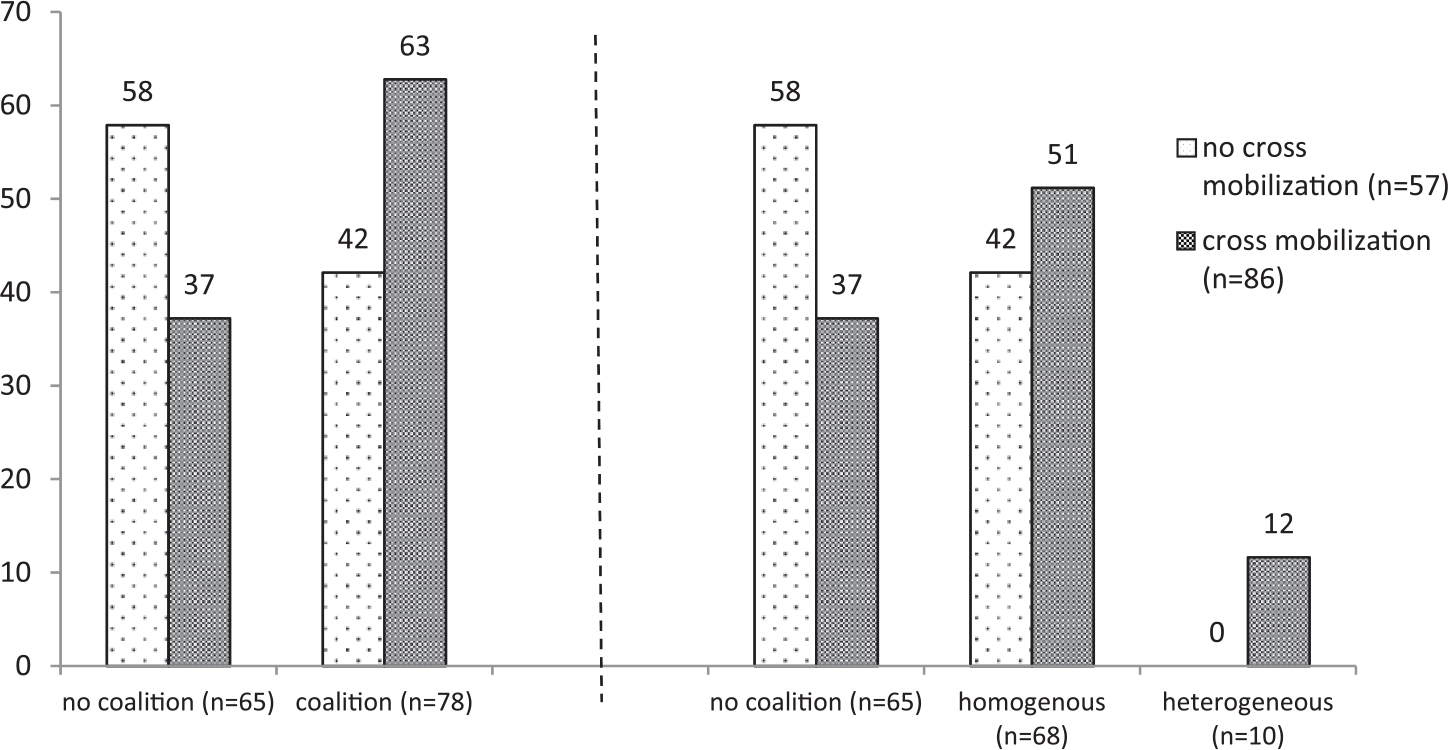
Cross-mobilization and Coalition Type (Percentages).
In short, our results demonstrate that both influence and maintenance needs are necessary but not sufficient for understanding lobbying strategies and coalition behavior. It is not organizational resources or group type that affects coalition formation. Depending on the organizational salience a specific policy issue enjoys, interest organizations may coalesce, sometimes even with strange bedfellows (see also Hojnacki, 1997; Holyoke, 2009). Specific features of a policy – specifically, its politicized nature – amplify the importance of the issue context and have a significant impact on coalition behavior. For instance, we also observe that conflict intensity (specifically, the number of conflictual issues at stake) affects coalition formation. Mobilization also matters because we have a considerable impact of cross-mobilization; when we observe cross-mobilization, there are more instances of heterogeneous coalitions. The positions interest organizations adopt, which is another control variable we included, is of little consequence for overall coalition behavior (although interest groups that seek major changes or aim to block a proposal are slightly more likely to lobby in a heterogeneous coalition). These results resonate with Tom Holyoke’s (2009: 373) observation that a more antagonistic advocacy environment with a diversity of conflicting interests and group types stimulates coalition formation.
Conclusion
This article sought to explain the conditions under which lobbyists establish coalitions instead of lobbying alone. In addition, we analyzed whether and why lobbyists engage in heterogeneous coalitions consisting of both business and non-business interests. Addressing both questions simultaneously in one paper proved relevant because the inclinations of interest organizations to form coalitions can vary depending on the type of coalition involved. For instance, we demonstrated that the media salience and public salience of legislative proposals stimulate interest groups to coalesce with strange bedfellows, whereas it has no systematic effect on the inclination to coalesce with interest groups from the same group type. By developing a differentiated research question, we were able to indicate varying conditions that affect coalition formation.
We built on classic theoretical perspectives on interest group politics to understand coalition formation. Namely, we expected coalition behavior to be driven by maintenance needs and influence (Hanegraaff et al., 2016a; Lowery, 2007; Schmitter and Streeck, 1999a). We argued that joining coalitions entails some risks in terms of organizational maintenance-related purposes. The data analysis showed that strong membership dependency constrains the development of a coalition strategy. Our findings lead us to conclude that coalition behavior is driven and constrained by the relationship between interest groups and their supportive constituency. This is an important result because it suggests potential biases in the way lobbying strategies develop. Namely, NGOs that depend strongly on their members are somewhat less prone to coalesce. Since coalescing can be important leverage to obtain policy influence, this may indirectly limit certain interests to impact policy outcomes simply because of their organizational constellation.
Whereas the establishment of a coalition may be constrained by maintenance-related purposes, it may be stimulated by the need to seek policy influence (Klüver, 2013; Mahoney and Baumgartner, 2015). The issue context is crucial in this regard. If certain conditions connected to a specific policy issue are met, interest groups will be more prone to build alliances. Namely, policies that receive considerable media attention and/or those for which many conflictual issues are at stake stimulate alliances between strange bedfellows. In addition, if policies are seen as salient by interest group representatives, these representatives are more likely to ignore the potential maintenance uncertainties that coalitions may produce and to engage in all kinds of coalitions.
These results are relevant not only for understanding individual interest group behavior but also for obtaining better insight into the structure of conflict and consensus in EU legislative politics. The depiction of EU public policymaking as a continuous struggle between business and non-business interests is far from accurate. In many legislative cases, no lobbying occurs, implying that member-states and European institutions dominate the policymaking process (De Bruycker and Beyers, 2015). On other occasions, only one interest type (usually business) lobbies. If lobbying coalitions are established, they are generally homogeneous and consist of either business interests or NGOs. Occasionally, particularly when policies are highly salient, coalitions between strange bedfellows emerge. NGOs and business interests are usually not mobilized in opposition to each other; in most instances, it is only business interests or only NGOs that mobilize.
This low prevalence of heterogeneous coalitions, the considerable number of instances in which no coalitions are established, the dominance of homogeneous coalitions, and the substantial amount of policies for which no lobbying occurs imply that we should not overstate the benefits of lobbying coalitions. Lobbying through coalitions, especially heterogeneous coalitions, can be demanding because compromise positions need to be established among organizations that are not used to collaborating intensively or whose general policy views and supportive constituencies may diverge. When alliances are forged, groups prefer partners that represent similar causes. Generally, collaborating extensively and regularly with strange bedfellows is avoided, probably because there are few occasions on which such collaboration is appropriate.
Although these findings and results refer to the case of EU policymaking, they are relevant for the study of coalition formation elsewhere. We have no reason to believe that the factors that shape coalition formation are of an entirely different nature. However, whether and how our results hold true beyond the EU remain to be explored in future studies. For instance, EU policymaking is generally not highly salient to the public or within the national media (Boomgaarden et al., 2013; De Bruycker and Beyers, 2015). The impact of public salience on coalition formation (and lobbying more generally) might thus be different in other institutional contexts or policy areas where policymaking is more subject to public scrutiny. In addition to a further analysis of the external validity of our results, a next step would be to assess whether and how different types of coalitions generate influence. Some studies have demonstrated that establishing coalitions and coalition size leads to policy influence (Klüver, 2013; Mahoney, 2008). Nonetheless, we know surprisingly little about whether and how the type of coalitions (i.e. the diversity of actors within the coalition) matters for influence.
Footnotes
Acknowledgements
We are grateful to Daniel Naurin, Sarah Arras and two anonymous reviewers for their helpful suggestions. Earlier versions of this manuscript were presented at the EUSA biennial conference, 2015, Boston, and the ECPR SGEU conference, 2014, Leiden. We are grateful to the participants of these conferences for their helpful comments. Finally, we would like to express our gratitude to all our colleagues within the larger INTEREURO project ( ), Frederik Heylen, and to the many lobbyists who participated in the interviews.
Funding
The author(s) disclosed receipt of the following financial support for the research, authorship, and/or publication of this article: The authors would like to acknowledge the financial support of the European Science Foundation grant [10-ECRP-008] and the Research Foundation-Flanders [171-11N]. Iskander De Bruycker gratefully acknowledges support of the Research Foundation Flanders - FWO [Post doc Grant Nº. 12N1417N].
Supplementary Information
Additional supplementary information may be found with the online version of this article.
Notes
Author Biographies
.
References
Supplementary Material
Please find the following supplemental material available below.
For Open Access articles published under a Creative Commons License, all supplemental material carries the same license as the article it is associated with.
For non-Open Access articles published, all supplemental material carries a non-exclusive license, and permission requests for re-use of supplemental material or any part of supplemental material shall be sent directly to the copyright owner as specified in the copyright notice associated with the article.
