







Abstract
This article adds to our understanding of the gendered impact of informal rules and norms for party leaders. Specifically, it examines the gendered nature of party leader tenures and exits. Using original data collected on party leader experiences in Canada, we test for the existence of gender differences in leader tenures and exits, and examine two potential explanations for any differences. We find that leader tenures and exits are indeed gendered but only within parties with the potential to form government, ones where the political stakes are highest. Within these major parties, women’s tenures as party leaders are significantly shorter than men’s and they are significantly more likely to be forced to resign from the position. We find clear evidence of the existence of the glass cliff phenomenon in major parties but unclear evidence of its role in women’s shorter tenures. Instead, women’s shorter tenures are explained by the harsher set of standards being applied to women party leaders.
Keywords
When men succeed, it is considered business as usual. When they stumble or fail, their gender does not bear the brunt of their defeat. Not so for women. Perched on the pinnacle of power, they realize it is built of sand. Women are not allowed to fail.
Introduction: Gender and Party Leadership
Are women leaders not allowed to fail? Or is it that they are set up to fail, more likely to be appointed to power when parties are in crisis? Or is it possibly a bit of both? An increasing number of women hold political positions that have traditionally been held by men, a phenomenon that is attracting considerable research attention. Recent studies examining women’s global experiences as political leaders (Jalalzai, 2013; Murray, 2010) and their appointment to cabinet positions (Escobar-Lemmon and Taylor-Robinson, 2016; Franceschet et al., 2017; O’Brien et al., 2015) offer an important window into when and how women access political power. Women, however, continue to remain relatively absent as political party leaders, a key stepping stone to executive leadership in parliamentary systems. Significant attention has recently been devoted to examining party leaders generally (e.g. Cross and Blais, 2012; Pilet and Cross, 2014) yet we know remarkably little about the gendered nature of women’s experiences as party leaders and how these compare with men’s (for exceptions, see Beckwith, 2015; Cross and Blais, 2012; O’Brien, 2015; O’Neill and Stewart, 2009). This relative absence might be explained by the fact that women’s numbers at this elite level remain low. With so few cases, it can be hard to render definitive conclusions. But by turning the lens to a single country – Canada – one with multiple levels of government, numerous political parties, and a significant number of women party leaders in both competitive and less-than competitive parties, we advance our understanding of how intra-party informal norms and practices gender women’s representation at the elite political level.
There is every reason to believe that women and men holding the highest offices in political parties face gendered political opportunity structures, given their experiences generally within political parties. Candidate recruitment within parties has been the subject of much investigation. As shown by Cheng and Tavits (2011), informal intra-party norms and processes play a key role in shaping the number of women running for office and thus their levels of representation (see also Cross and Pruysers, 2019). Similarly, Verge and Claveria (2018) show that men are more likely to benefit from the political resources provided by political parties – and in particular holding party office – than women, all else being equal.
Gendered norms and processes have also been identified at elite party levels. Folke and Rickne (2016) argue that glass ceilings help to explain women’s difficulties in rising to positions of political power within political parties. Beckwith (2015) offers a post-crisis model of gendered leadership opportunities within parties, one in which senior men are removed from contention and junior men defer their participation thereby opening up opportunities for senior women to challenge the leadership. And, finally, O’Brien’s (2015) recent study of 71 parties across 11 parliamentary democracies between 1965 and 2013 notes the importance of electoral performance for women’s tenures as party leaders, shorter than men’s when the party is performing poorly and longer when its performance is improving.
There is much discussion in the literature on political parties of both the growing significance of party leaders and the pre-eminent role that they play (e.g. Cross and Blais, 2012; Horiuchi et al., 2015). According to Cross and Blais (2012: 3), understanding the selection process for party leaders is ‘important not only in the general sense of understanding who has authority over a crucial aspect of democratic decision-making within a state but also in terms of understanding the allocation and use of power within parties’. Party leaders’ roles in modern liberal democracies is multi-faceted. Leaders in government determine cabinet composition (O’Brien et al., 2015) and shape the country’s policy direction. Within intra-party politics, party leaders are often involved in candidate selection and setting campaign platforms. Party leaders play a primary role in campaigns and in electoral outcomes (Banducci and Karp, 2000), especially in light of the increasing personalization of politics (Cross et al., 2018; Kosiara-Pedersen and Hansen, 2015). Poguntke and Webb (2005) have argued that leaders’ roles have become more important over time due to the ‘presidentialization’ of authority within many parliamentary democracies. Documenting women’s experiences within these powerful offices is thus important for understanding the status of gender equality within the political realm more broadly. Shedding light on how party characteristics, rules and norms shape women’s access to positions of political power is of key importance; equally important, and our goal herein, is documenting the experiences of women who hold these highest positions.
The gendered nature of women’s and men’s tenures in positions of party leadership has received relatively little focused attention. Focusing exclusively on Canadian political parties, Trimble and Arscott (2003) suggested early on that political parties turn to women party leaders as a ‘novelty’ but quickly dismiss them when they fail to deliver ‘electoral miracles’, a phenomenon identified by others. In their examination of gender and party leaders, O’Neill and Stewart (2009) found that women party leaders experience shorter tenures than men. Cross and Blais (2012) found that the emergence of party primaries has made it more difficult for women to get elected to the top partisan posts. With only 9 women among their 118 cases, however, they were properly careful in rendering definitive generalizations (Cross and Blais, 2012: 126; but also see Wauters and Pilet, 2015). As previously noted, O’Brien found that women leaders are much less likely to remain in power than men when their party faces an unfavourable electoral trajectory but more likely to retain their positions when enjoying electoral success. She concludes that, ‘these results demonstrate prospective female leaders are playing by a different (and often more demanding) set of rules than their male counterparts’ (O’Brien, 2015: 1036).
Additional examinations of gender differences in party leader experiences do exist, but unlike O’Brien’s (2015), these often do not move beyond investigating gender as a control variable in multivariate analyses of leadership tenures. Gruber et al. (2015: 138), for example, include a ‘dichotomous male/female variable of the party leader as a control, as gender may influence how leaderships come to an end’. How precisely gender might matter is not explored. They conclude, given the absence of a statistically significant coefficient on gender, that ‘the different ways in which leadership tenures come to an end do not appear to be gendered. Women, for example, are no more likely than their male counterparts to be pressured into resigning’ (Gruber et al., 2015: 146). Similarly, Horiuchi et al. (2015: 363) introduce gender as a control variable, noting that ‘although we do not have a good theory to predict the direction of its effect, female leaders have a slightly different survival rate than male leaders’. Women’s shorter tenure disappears, however, once gender is introduced as a control in the multivariate examination of tenure, leading them to conclude that ‘there is no statistically significant difference between the tenure length of female leaders and that of male leaders’ (Horiuchi et al., 2015: 364). There are, then, mixed results regarding gender differences in party leader tenure.
We move beyond an analysis of gender as a control variable and suggest that a gendered analysis of party leadership requires a more comprehensive examination of how gender power relations might matter for women’s and men’s leader experiences. Our goal is to advance our understanding of party leader tenures and exits, that is, to examine whether women’s tenures and exits as party leaders differ from men’s, and if so, how and why. To do so, we focus on the role that intra-party informal processes play in explaining women’s experience in these leadership roles. Specifically, we examine how much purchase comes from the glass cliff and post-crisis models, and in doing so we also move beyond electoral performance as an explanation for women’s shorter tenures. Briefly, we hypothesize first, that women’s shorter tenures as party leaders might stem from the glass cliff or post-crisis effect, and second, that their shorter tenures are due to their greater likelihood of being pressured to resign from their positions than men, pressure that is often divorced from the party’s electoral performance.
Using original data collected on 181 party leader exits at the federal and provincial levels in Canada between 1980 and 2018, we find clear evidence that party leader tenures and exits are gendered. With identifiable variation across major and minor parties, women’s tenures as party leaders are shorter and they are more likely to resign from the position due to party pressure than men. We suggest these findings provide compelling evidence that informal intra-party processes allow for the application of a harsher set of standards to women leaders by political parties. We also find evidence that within major parties, women are more likely to be appointed leaders during a period of crisis than is true of men. Whether this tendency helps to explain women’s shorter tenures is unclear, however, as a too small number of cases leaves us unwilling to render a definitive conclusion of its overall impact.
We offer two important contributions to the literature on gender and party leadership. O’Brien’s (2015) analysis of the conditional effects of electoral performance on gender differences in party leader tenures led her to conclude that women face a different and sometimes harsher set of rules as party leader. As suggested by O’Brien, (2015: 1036), we further the investigation by opening up the ‘black box’ of intra-party politics to examine gender differences in how and why party leaders exit their positions, rather than simply under what electoral conditions. We focus on the importance of informal party rules and norms for understanding gendered effects at the party elite level, building on literature that points to their importance for recruitment at lower levels within political parties (Bjarnegård 2013; Kenny, 2013). Second, our examination adds to the literature on political parties and leadership by contributing to the still relatively short list of offerings examining party leader exits in specific detail (Gruber et al., 2015). Ours is the first in-depth gendered examination of party leader exits.
Gender Party Leader Experiences: How and Why
The limited number of examinations of gender and party leadership leaves open the question of the degree to which and how women’s and men’s tenures and exits as party leaders might vary. An early rule, however, of ‘women do best where competition is least’ (Randall, 1987: 146) has gained support in recent investigations: the argument suggests that parties in decline are more likely to select women as their leaders because competition for the position is weaker. In their general examination of party leaders, Bynander and ‘t Hart (2008) noted that heirs apparent are less common in parties in decline; subsequent work has noted that this scenario can create opportunities for women. Beckwith (2015), for example, suggests a post-crisis model where women are likely to rise to party leadership when the party is under crisis conditions stemming from either scandal or major electoral failure. Senior party men are likely to be removed from the roles in light of the crisis, thereby opening up opportunities for senior women, and more junior yet qualified men in the party are likely to defer their attempts at gaining power within the party given the uncertainty related to the party’s electoral fortunes. Under these conditions, more senior women are likely to take strategic advantage of the opportunity afforded by the party’s tenuous position. And although not the focus of her article, Beckwith (2015: 725) does note that ‘a party, postcrisis, is likely to be poorly positioned for governing or for winning an upcoming election. Therefore, the context for a new party leader is highly unfavorable’. If women are more likely to rise to power in parties under crisis conditions, then women’s tenures ought to be shorter than men’s.
This argument has been explicitly made by others. The glass cliff phenomenon (Ryan & Haslam, 2005, 2007), developed in response to examinations of women’s experiences in the corporate world, suggests that women are more likely to rise to positions of power when the risk of failure is high. 1 They argue that women are chosen to leadership positions ahead of equally qualified men only when an organization is in a precarious position, thus increasing the likelihood that their tenures are likely to be relatively short regardless of how they happen to perform in the role. The state of the organization at the time they assume their position makes ‘women vulnerable to higher risk of blame for negative outcomes for which they are not responsible’ (Ryan et al., 2010: 57). The causal timeline is important. It is not the quality of women’s leadership that leads to their shorter tenures but rather the fact that they are more likely to come to power in organizations in peril than men.
The glass cliff phenomenon has been evaluated in the political arena for the selection of women as candidates at the district level (Ryan et al., 2010). Findings here suggest that there is reason to believe the phenomenon first identified in the corporate world also applies to the political one. An examination of 2015 UK election data by Ryan et al. (2010) noted the existence of the sacrificial lamb phenomenon, with men more likely to be selected to run in safe seats than women (see also Thomas and Bodet, 2013). Extending the investigation to the experimental setting, Ryan et al. show that women are significantly more likely to be the preferred candidates in hard-to-win scenarios, holding all else equal including qualifications and experience. For them, the latter finding questions ‘speculation that the preponderance of women in unwinnable seats can be explained solely by the fact that women themselves prefer, and actively choose, to run in seats that are less winnable’ (Ryan et al., 2010: 62). One of the few tests of the phenomenon for women’s selection to elite positions within the party, however, finds only limited support for its existence although the number of cases examined is small (Thomas, 2018).
An alternative consideration for understanding gendered party leadership processes focuses on the existence of systemic discrimination in the informal norms and practices of political parties and its consequence for recruitment. Research focussed on candidate selection and recruitment has argued that ‘informal party practices and their gendered consequences are critically important for understanding the continuity of male political dominance and female underrepresentation’ (Bjarnegård and Kenny, 2015: 748). Unlike formal rules, which are specified in writing even if not always followed, informal rules are unwritten, hidden and difficult to identify; as a result, these are also often gendered, providing clear cues as to acceptable behaviours for women and men within the party (Bjarnegård and Kenny, 2016).
Both the closed nature of clientelist party networks to women (Bjarnegård 2013) and the direct importance of gender norms for shaping both the supply of and demand for women candidates by parties (Kenny, 2013) have been identified for their roles in perpetuating men’s dominance in candidate recruitment practices. Knowing how to play the game, being well-connected, understanding local issues and a proven electoral track record are among various informal criteria applied by parties that serve to limit women’s access to candidacies.
These informal gatekeeping practices, we contend, are equally likely to shape recruitment and retention at the party leader level. Party leader tenures and exits present a prime example of the internal party processes where discriminatory practices are likely to matter given that they are often governed by informal rather than formal rules and processes (Gruber et al., 2015). The norms and practices involved in the selection of party leaders are not, however, comparable to those involved in the selection of local candidates and so our expectations ought to be altered accordingly. More specifically, the stakes are higher for the selection of party leaders, removal is more difficult, the selectorates vary and expectations are greater.
The role congruity theory of prejudice offers significant purchase in understanding how prejudice can play itself out in the informal party norms and practices surrounding leader tenures and exits. In short, the theory suggests that when there is incongruity between female gender roles and leadership roles, women will be subjected to prejudice (Eagly and Karau, 2002). Moreover, the level of prejudice to which they will be subjected will increase the more closely the leadership roles in question are associated with masculine norms. The key distinction between male and female gender roles for leadership position expectations lies in the difference between communal attributes – ones concerned largely with the welfare of others and most often associated with women – and agentic attributes – ones associated with confidence and assertiveness, more often associated with men. Prejudice stems from the lack of congruity between expectations for how women should act (i.e. the female gender role) and how leaders are expected to act (i.e. confident, assertive, self-promoting). In short, ‘People [. . .] tend to have dissimilar beliefs about leaders and women and similar beliefs about leaders and men’ (Eagly and Karau, 2002: 575). This prejudice is likely to play itself out in two ways. First, women are less likely to be seen to possess the qualities required for leadership positions, and are as a result less likely to occupy them irrespective of their actual qualifications. Second, even among the women who are able to rise to occupy leadership roles, they will be given less favourable evaluations than men when they display the leadership qualities required in the role given their failure to conform to gender role expectations.
The role of political party leader is strongly associated with agentic characteristics, including an ability to exert authority, control situations and direct people, as well as the possession of strong levels of ambition, confidence and assertiveness. Extant research underscores the masculinity embodied in perceptions of political leadership and their negative consequences for female candidates (Aaldering and Van der Pas, 2018; Bauer, 2015; Koenig et al., 2011; Wagner et al., 2018). Masculine norms dominate coverage of party leaders and cabinet ministers in the media, and male candidates are ‘more often discussed in terms of the leadership traits that are strongly linked to male politicians, political craftmanship and vigorousness’ (Aaldering and Van der Pas, 2018: 16). Similar findings for party leadership aspirants at the national level in Canada suggest that these gendered stereotypes play a role in the selection of party leaders; in particular, the evidence reveals that ‘women candidates were subjected to more negative and gendered assessments of their [. . .] communication skills and political acumen’ (Wagner et al., 2018: 15).
We add to this literature by indirectly examining the role that gender stereotypes might play in shaping party leader tenures and exits, and in particular, in the degree to which the level of pressure exerted on leaders by parties to resign from their positions is greater for women than men especially outside of the post-election window. Research on leadership selection and removal reveals that length of tenure is directly connected not only to actual electoral performance but also to expectations of a leader’s electoral performance (Cross and Blais, 2012; Gruber et al., 2015). Gender stereotypes, more negative assessments and electoral expectations are likely to come together in ways that results in harsher standards for women and an increased likelihood for being pushed to resign.
There exist, then, clear reasons for expecting that women’s and men’s tenures and exits as party leaders will differ as a result of party status at the time of the leader selections and/or given gendered expectations related to leadership traits. The glass cliff phenomenon suggests that women’s tenures as leader will be shorter overall and that they will likely be subjected to greater pressure to leave office than men because of a greater likelihood of assuming the leadership of parties in crisis. The role congruity theory of prejudice, on the other hand, suggests that prejudice stemming from the incongruity between traditional gender role and leader expectations will mean that women’s tenures as leader will be shorter overall, specifically because they are more likely to be pressured to resign than men because they are evaluated by a different, and harsher, set of standards than are men who fill these roles. Given these expectations, we test the following hypotheses:
H1: Women’s tenures as party leaders are shorter than men’s.
H2: The use of a harsher set of standards means that women party leaders are more likely than men to exit the leadership prior to ever having contested an election.
H3: Women’s shorter tenures can be explained by their coming to power in parties in crisis.
H4: The use of a harsher set of standards means that women will be more likely to exit the leadership under some form of pressure than men.
Data and Measures
The examination relies on an original data set examining all individual leaders for competitive parties at the federal and provincial levels in Canada whose terms started and ended between 1 January 1980 and 16 November 2018. 2 Competitive parties are defined as those electing at least one member to the legislature. If a party became competitive after 1980, then data were collected on the leader in place when the first seat was won. The collection of data on a particular party’s leaders was ended when the party failed to win a seat in three consecutive elections. Interim leaders are not included in the analysis given clear differences in selection processes. One party during this period, Québec Solidaire, was not included in the analysis given its unique practice of selecting one male and one female co-leader of the party.
Canada provides an important case study for gender and party leadership for a variety of reasons. First, and somewhat uniquely, there exist no formal deselection rules within parties to remove leaders (Cross and Blais, 2012). Instead, rules are in place to ensure regular leadership reviews, with some exceptions, but in only one instance since 1966 has a leader been removed through this formal review process. As such, informal party practices and norms are much more important for leader removal, ones with significant consequences for women’s experiences within parties. Second, the few studies of gender and party leadership that have been undertaken have collected cross-national data for parties at the national level. Examining a single country, on the contrary, controls for a number of factors that can be of consequence for party performance (e.g. the absence of coalition governments, the use of the single-member plurality electoral system) and party leader position (e.g. authority vested in position of party leader) and allows for a richer and deeper understanding of internal party processes, party performance and their relevance for gendered leadership experiences. Third, as a federal system with two equally important levels of government and 10 sub-national governments with varying party systems, the Canadian case offers a significant number of cases for examination, including a significant number of women party leaders. Importantly, leadership races at the two levels of government are equally competitive; provincial races are not ‘second order’ races in Canada (Pruysers and Stewart, 2018; see also Cutler, 2008). Finally, party leaders play a central role in politics in the Canadian system and thus findings here offer important insight on the presidentialization and personalization of politics generally.
The data set includes a total of 181 cases of leaders who won the position of party leader and exited the position during the 1980–2018 period (149 men and 32 women) as well as an additional 33 leaders who have yet to exit (28 men and 5 women). 3 These cases include leaders at both levels of government, including a minimum of 10 leaders from each province, and from 17 different parties. A majority of the cases come from the three dominant political parties over the period: the Liberal Party (31%), the Progressive Conservatives (25%) and the New Democratic Party (23%). Media coverage and (auto-)biographies, where available, were the primary sources of information on leadership selection races and departures. 4 Additional information on electoral performance was collected from government election agency websites (e.g. www.elections.ca and www.elections.on.ca).
Leader tenure is measured by the number of days served and the number of elections contested; the date of departure is recorded as the day on which the leader resignation was announced. The number of elections served measures the number of general elections that a leader contested while at the helm of the party.
Examining the applicability of the glass cliff explanation for women’s shorter tenures requires that we define the concept of a party in ‘crisis’. A party crisis is operationalized as a significant electoral loss, a major scandal or a serious split in the party in the period leading up to the leadership race. What constitutes a ‘significant’ electoral loss cannot be determined with an objective standard (e.g. a 20 point or greater loss in vote share) given that volatility in vote and seat shares from one election to the next is a regular feature in many parts of Canada. As such, a more subjective two-stage process was adopted where we first identified a significant electoral loss and then assessed whether these were a regular occurrence in the party system in question. If they were not, then the party was identified as one in crisis. We also carefully reviewed whether smaller electoral losses could nevertheless indicate crisis, such as the loss of official opposition status by a major party. The existence of a major scandal or serious split in the party was determined by a review of media coverage. We take it as a given that media coverage of party scandals and splits is indicative of their seriousness and as such, of the party’s crisis state. 5 The crisis variable is dichotomous with 1 indicating a party in crisis and 0 otherwise.
The key mechanism by which gendered leadership stereotypes are likely to matter for leader tenure is in the degree to which pressure is brought to bear on leaders to resign. As such, we develop a measure of exit type, following common practice in investigations of leader tenure and exits (e.g. Cross and Blais, 2012; Gruber et al., 2015), with the key comparison being between voluntary exits, when the leader independently chooses to stand down, and non-voluntary departures, ones precipitated by some external factor, such as party pressure on the leader to resign.
Identifying whether a party leader’s exit was voluntary necessarily involves subjective evaluations and makes the study of leader exits necessarily challenging (Bynander and ‘t Hart, 2008; Cross and Blais, 2012). Voluntary departures are often identified by the absence of any clear pressure to resign by the party, which are often – but not always – independent of recent electoral performance (e.g. tied to concerns related to the leader’s health). Non-voluntary departures, on the contrary, include several types. One type is a resignation in the immediate aftermath of an electoral loss, a period we define as 1 month. 6 We label this as electoral pressure to distinguish it from more direct forms of party pressure. In the Canadian system, the expectation is that failure to win an election will result in the leader’s resignation, especially when electoral expectations were not met. More direct forms of party pressure include three types. First, some party leaders are pressured to resign prior to ever having contested a single election. This is highly unusual in the Canadian case where previous research suggests that ‘leaders are all but guaranteed at least one kick at the electoral can’ (Cross and Blais, 2012: 93). Pressure to resign in these instances is highly tied to perceptions of electability given the absence of direct evidence on actual electoral performance. Second, some leaders are pressured to resign following an election loss by the party, a highly common example of leader resignation in the Canadian case. And although less likely, some leaders are pressured to resign following an election win by the party. Expectations likely play a key part in the exertion of pressure to resign in the face of an electoral win, which can nevertheless be evaluated negatively if the win was expected to be much larger. The final type of non-voluntary exit involves the party being dismantled altogether or merged with another. We treat these exits separately from others given their unique status.
We scanned media coverage of each leader’s exit for direct evidence of party pressure being exerted on the leader to resign from caucus or the wider party membership, pressure sometimes accompanied by floor crossings by party members. 7 Internal party grievances are not normally as public in Canada as they are elsewhere. As such, we set a fairly high bar for concluding party pressure was brought to bear on the leader: it requires clear and public indications that the party was unhappy with the leader. As a result, we are likely to err on the side of coding some exits as voluntary when more subtle or hidden forms of party pressure might have been in play. As such, exit mode is coded as follows: immediately after an election loss, due to party pressure after an election loss, due to party pressure after an election win, due to party pressure prior to contesting an election, voluntarily or as a result of the death of the party. In the binary logistic regression analyses, this dependent variable is recoded as 1 for exits in which some form of party pressure to resign was exerted on the leader (after election win, after election loss, prior to an election) and 0 otherwise.
Our multivariate analysis controls for a variety of factors related to the party, the contest and the party leader. In terms of party factors, we include a variable that captures party status at the time of the leadership selection: major or minor party status. Extant research has underscored the relationship between gendered leadership processes and party status (O’Brien, 2015; O’Neill and Stewart, 2009). We define a major party as one serving in government or opposition at the time of the leadership race or as one that has sufficient electoral support to serve in either role given its strength in the party system. This operationalization deviates from that adopted by O’Brien (2015) and others. She identifies a major party as one that controlled the office of Prime Minister at least once during the period under study. She also distinguishes between governing (alone or as part of a coalition) and opposition/minor parties. The high variability in party status over time in Canada and the absence of coalition governments makes these less useful measures of status than might be the case elsewhere.
We also include a set of party family dummy variables, distinguishing between liberal, conservative, right-wing populist, social democrat (NDP) and other left-wing parties (Liberal is the omitted category in the regression analyses). Party ideology has been linked to women’s electoral success, especially at the candidate level, and is therefore an important factor to consider (Caul, 1999; Pruysers et al., 2017). In the Canadian case, where no formal party quotas exist, parties on the left (NDP and other left-wing parties) almost consistently elect a greater share of women in their legislative caucuses than other parties; parties on the right (conservative and right-wing populist) consistently elect the lowest shares of women (see Trimble et al., 2013). As a result, including controls for party ideology effectively controls for variation in the presence of women in parties. Despite not being characterized as second order, we also include the party’s jurisdiction (federal vs provincial) in the analysis to control for the possibility of variation across the two levels (provincial is the omitted category).
Two variables related to the contest are also included: the selectorate and the period in which the leadership election occurred. First, many have argued that different selectorates/selection methods produce different results in terms of who gets selected, the length of their tenure and so on (Cross et al., 2016; Wauters and Pilet, 2015; see also Rahat et al., 2008). We therefore distinguish between delegated conventions on one hand and membership primaries on the other (delegated convention is the omitted category). Second, recent research suggests that leader tenures have become shorter over time (Horiuchi et al., 2015; O’Brien, 2015) and as such we include the decade in which the party leader was selected to control for such an effect on tenures.
Finally, we include two variables related to the individual party leader. For practical reasons, older leaders may simply have less time to remain in office than younger ones. As a result, we control for the age of the party leader at the time of their selection as leader. And, as the primary explanatory variable of interest in this article, we include the sex of the party leader (with female being the omitted category).
Results
Bivariate Analysis
Our examination begins by outlining leadership tenure generally, and how this varies between women and men. Both the glass cliff phenomenon and the role congruity theory of prejudice predict that women’s tenures as leaders will be shorter than men’s (H1). The clearest measure of leadership survival is days in office. And our data suggest that women’s and men’s tenures as leaders do indeed differ. As shown in Table 1, men are likely to spend 349 days longer on average, or almost a full year, as leader than women. On the second indicator of tenure, elections contested, a difference also appears: whereas men contest 1.64 elections as leader on average, women only contest 1.38. However, neither of these differences is statistically significant.
Leadership Tenure by Gender and Party Type.
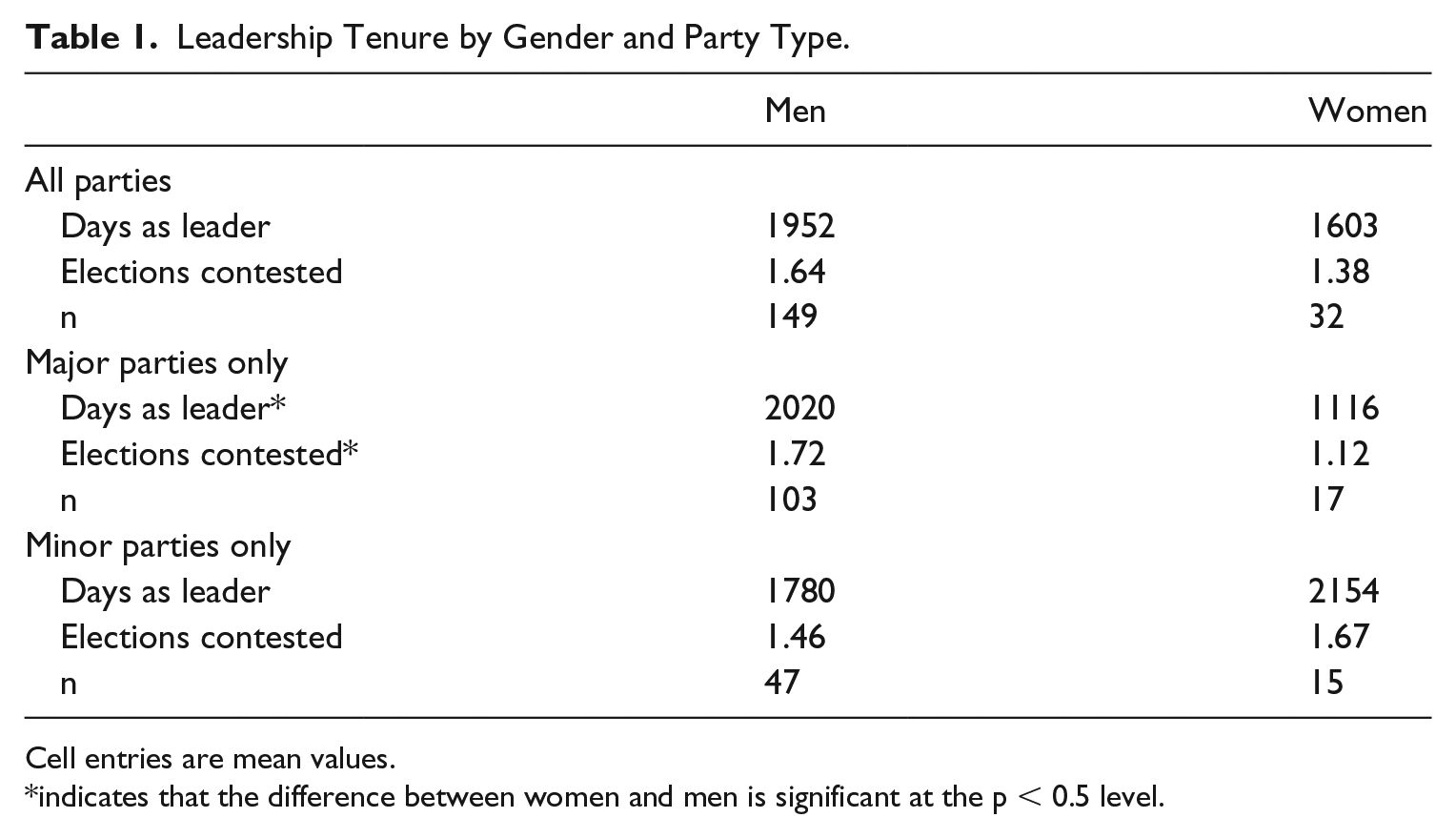
Cell entries are mean values.
indicates that the difference between women and men is significant at the p < 0.5 level.
When we split the sample by party status, however, we find significant differences between men and women. For parties with minor status, ones unlikely to form government, we find no difference in overall tenure nor in number of elections contested. When we look at major parties, on the contrary, women have significantly shorter tenures and contest fewer elections. Women chosen to lead major parties spend an average of 1116 days as leader or 3 years. Men, on the other hand, spend 2020 days or 5.5 years in the post, almost twice as long. The average number of elections contested by women who led major parties is 1.1; for men, the equivalent is 1.7 elections. As such, the bivariate data indicate that women party leaders enjoy significantly shorter tenures as party leader than men, but only within parties that are capable of forming government, ones for which the electoral stakes are higher (H1).
Table 2 offers a more detailed examination of the number of elections contested by sex. What is clearly evident is, first, the decreased likelihood for women leaders of major parties to ever be given a chance to contest a single election, and second, how unlikely it is for them to contest two or more elections compared to men. Looking exclusively at major parties, women are three times more likely to never be given a chance to contest even a single election. And the percentage of women leaders who lead major parties into two or more elections is less than half the share that we find among male leaders.
Contested Elections by Gender and Party Type.
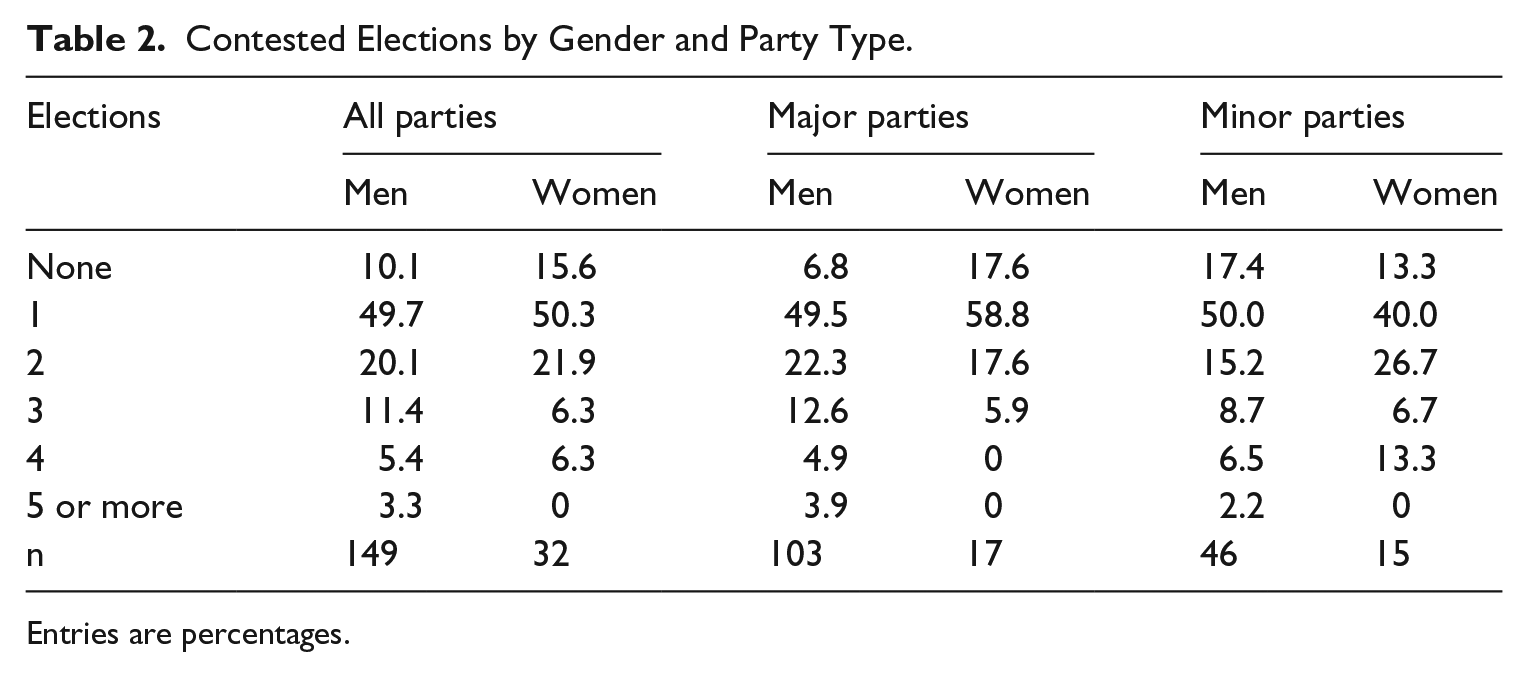
Entries are percentages.
Research has shown that leader tenures have become shorter over time, and so it might be the case that women’s shorter tenures are due to the fact that many of them came to the position when tenures where simply shorter overall. This, however, does not appear to be the case (results not shown). When the tenures of major party leaders are broken down into two even time periods, 8 two things are apparent. The first is that the selection of women party leaders in major parties is not a recent occurrence; while 11 women led major parties between 1996 and 2017, 7 women did the same between 1980 and 1995. The difference is unlikely to account for their shorter tenures. More notable, perhaps, is the finding that women’s tenures as leaders among major parties have not become shorter over time while those of men have. Men’s average tenure has dropped a full 794 days over the two periods, a full 2 years on average; the difference in women’s tenure between the two periods is an actual increase of 526 days, over a year in length, albeit one that is not statistically significant. Woman leaders’ shorter tenures in major parties are not due to when they were selected.
Our third hypothesis (H3) suggests that women’s shorter tenures could be linked to their greater likelihood of taking over parties in crisis than men, ones at increased risk of electoral failure, thus explaining their shorter tenures. To examine this, we compare the likelihood of women and men taking over the leadership of parties in crisis, and the degree to which this is connected to differences in tenure. For the glass cliff phenomenon to hold, we would expect not only to find that women are more likely than men to be selected to the leader role when parties are in crisis but also that these leaders would have significantly shorter tenures overall. As shown in Table 3, however, this is not the case. What we find is that women are more likely to be selected leader than men under conditions of crisis but that this difference is only statistically significant for major parties. In these parties, 38.9% of women come to power under crisis conditions; the equivalent share for men is significantly lower at 17.5%. When we compare the tenures of women and men elected to lead major parties under crisis conditions, however, the evidence falls short. While gender differences do appear for days served as leader and the number of elections contested, neither of these are statistically significant, due perhaps to the small number of women leaders in general and the small number of leaders selected during crisis in particular. With that said, coming to power when the party is in a precarious position does not appear to explain women’s shorter tenures as leaders, although additional data are needed to definitively rule out this possibility.
Elected Leader During Crisis and Tenure by Gender and Party Type.
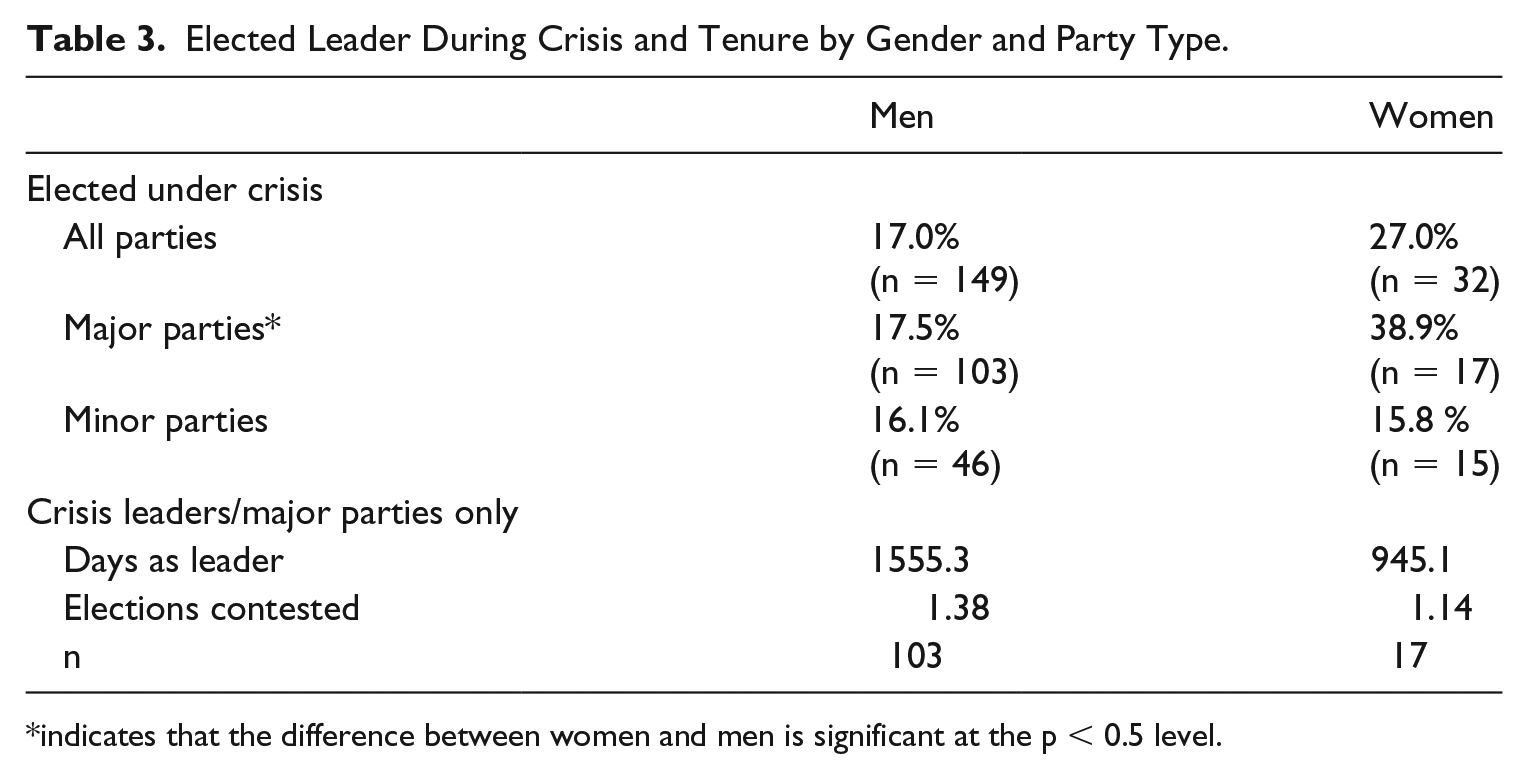
indicates that the difference between women and men is significant at the p < 0.5 level.
The final hypothesis that we test, H4, suggests that harsher evaluation standards for women party leaders means that they will be more likely to exit the leadership under some form of pressure than men. A focus on major parties in Table 4 shows this to be the case. A reminder that the key distinction for leader exit modes is whether the resignation was voluntary or the result of some form of pressure. Pressure can be electoral, occurring within a month of an election loss, or partisan, occurring prior to ever having contested an election or more than a month following an election win or loss.
Exit Mode by Gender and Party Status.
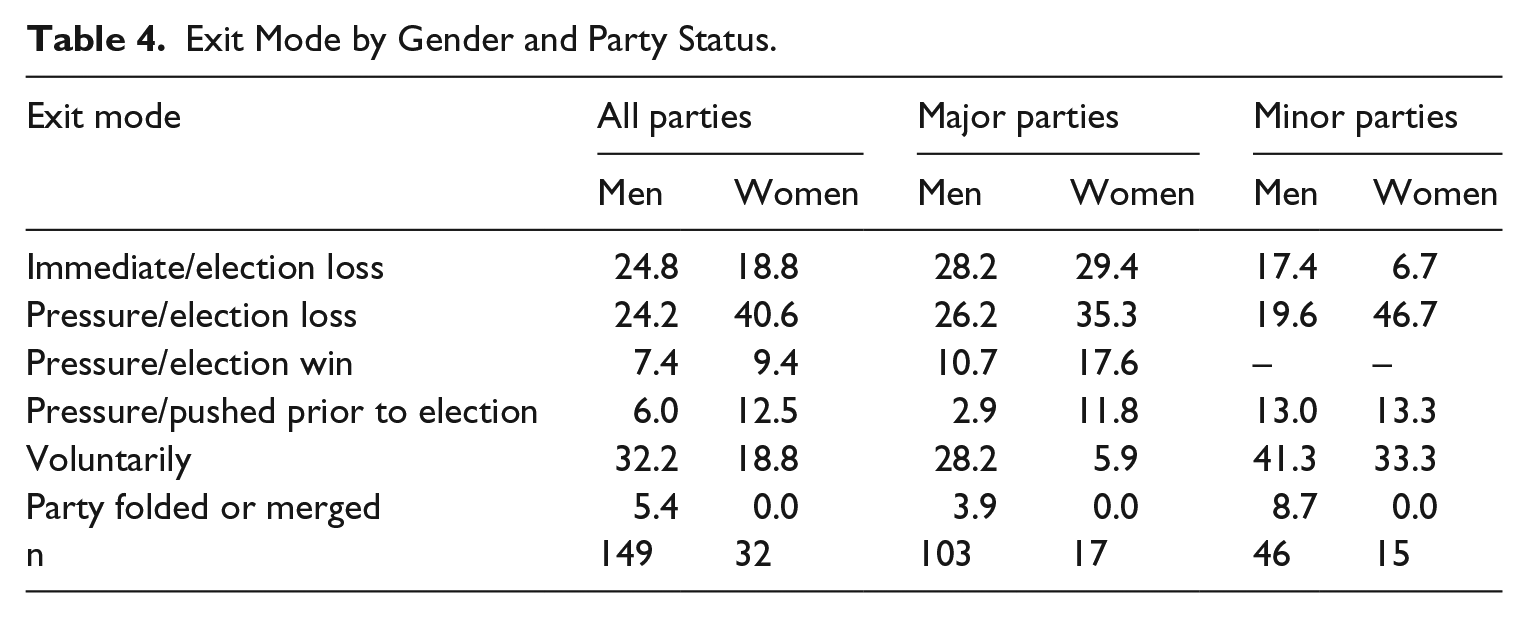
Without question, women major party leaders are far less likely than men to exit the leadership voluntarily, by a significant gap of 22.3 percentage points. The one woman who voluntarily chose the timing of her resignation, Yvonne Jones in Newfoundland, did so for health reasons. The flip side of this is that men are far less likely than women to face partisan pressure to resign. While 52.9% of women resigned due to some form of party pressure exerted on them following an election win or loss, only 36.9% of men faced similar partisan pressures. Similarly, the data reveal that women major party leaders are more likely than men to be pushed out prior to ever having contested an election. While approximately 12% of women are never given this chance, the similar share among men is significantly lower at 3%.
Multivariate Analysis
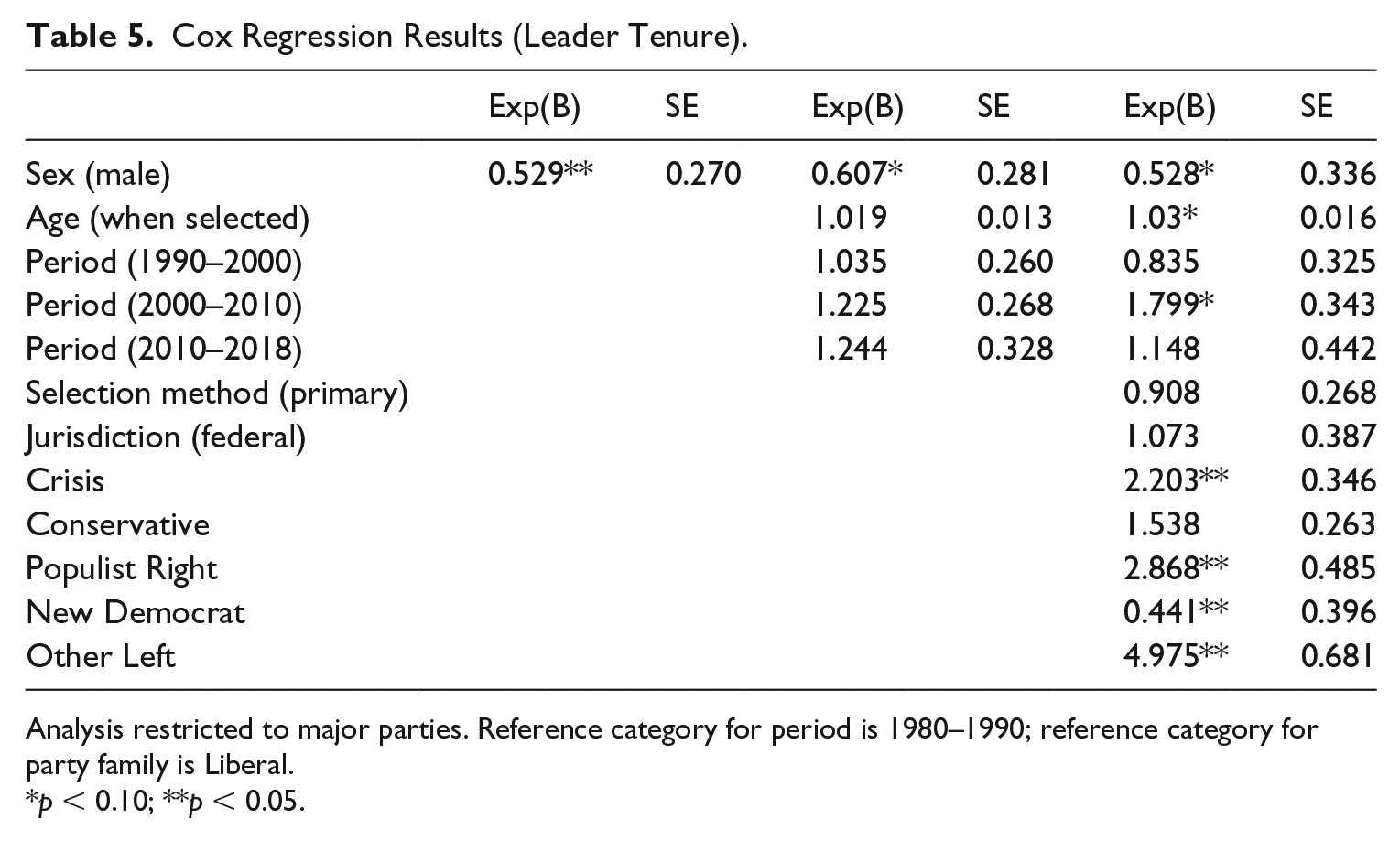
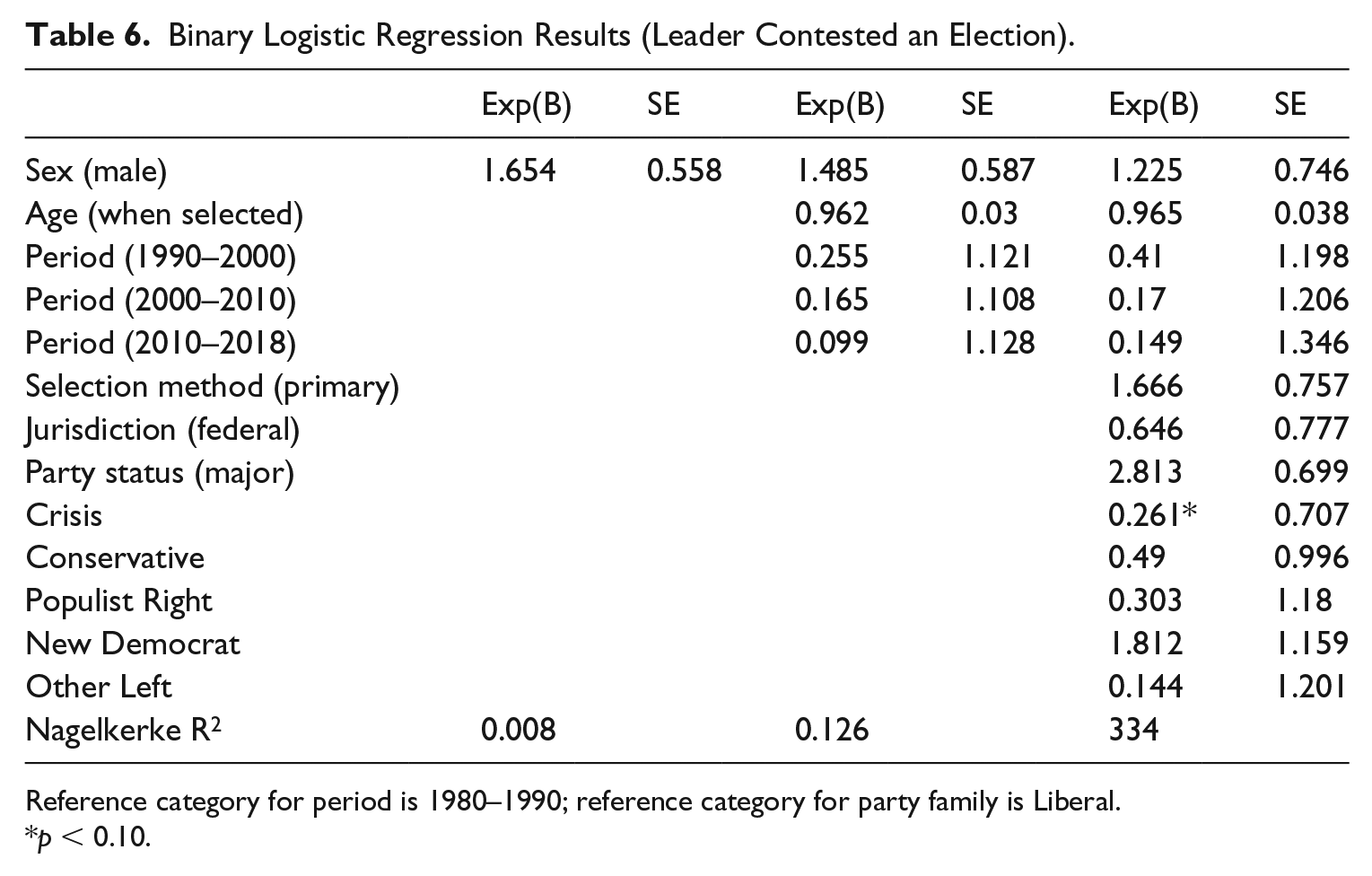
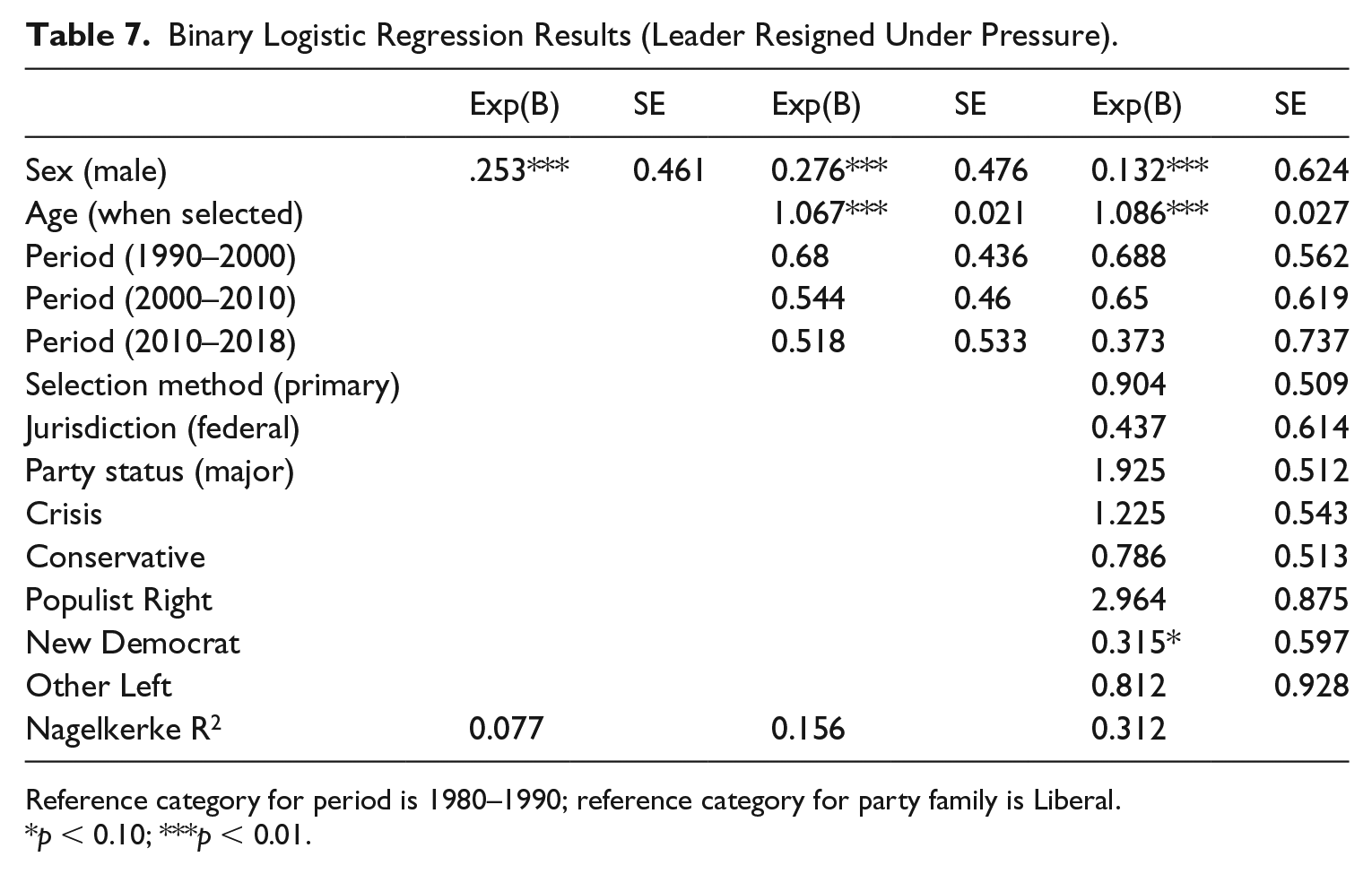
Thus far, we have examined the relationship between party leader tenures and exit modes and gender in a bivariate fashion. The bivariate analysis finds clear support for three of the four hypotheses: women party leaders have shorter tenures, are less likely to ever contest a single election, and are more likely to resign under pressure than their male counterparts. The next step is to explore these relationships further in a multivariate model that controls for factors such as the leadership selection method, party family, age of the leader, jurisdiction, crisis status and time. Tables 5–7 contain three models for each analysis. In model 1, we include only gender. In model 2, we add age, and the period the leader was selected. Finally, in model 3, we add the party factors: selection method, jurisdiction, crisis, party family (ideology) and party status. 9
Cox Regression Results (Leader Tenure).
Analysis restricted to major parties. Reference category for period is 1980–1990; reference category for party family is Liberal.
p < 0.10; **p < 0.05.
Binary Logistic Regression Results (Leader Contested an Election).
Reference category for period is 1980–1990; reference category for party family is Liberal.
p < 0.10.
Binary Logistic Regression Results (Leader Resigned Under Pressure).
Reference category for period is 1980–1990; reference category for party family is Liberal.
p < 0.10; ***p < 0.01.
Table 5 reports the results of a Cox regression where the dependent variable is the number of days spent as party leader. Given the bivariate results reported above, we limit our analysis to major parties. Unsurprisingly, those who come to the party leadership while their party is in crisis have significantly shorter tenures (see model 3), lending some support to the existence of the glass cliff phenomenon given women’s greater likelihood of coming to power in major parties during times of crisis. Liberal party leaders survive longer than many other party families, likely the result of Liberal Party electoral dominance, especially federally. We also find that men last significantly longer than women. This finding is consistent across all three models. Figure 1 plots the probability of survival by leader sex and reveals a significant gap between men and women. 10 Consistent with the bivariate results, we can therefore confirm our first hypothesis.
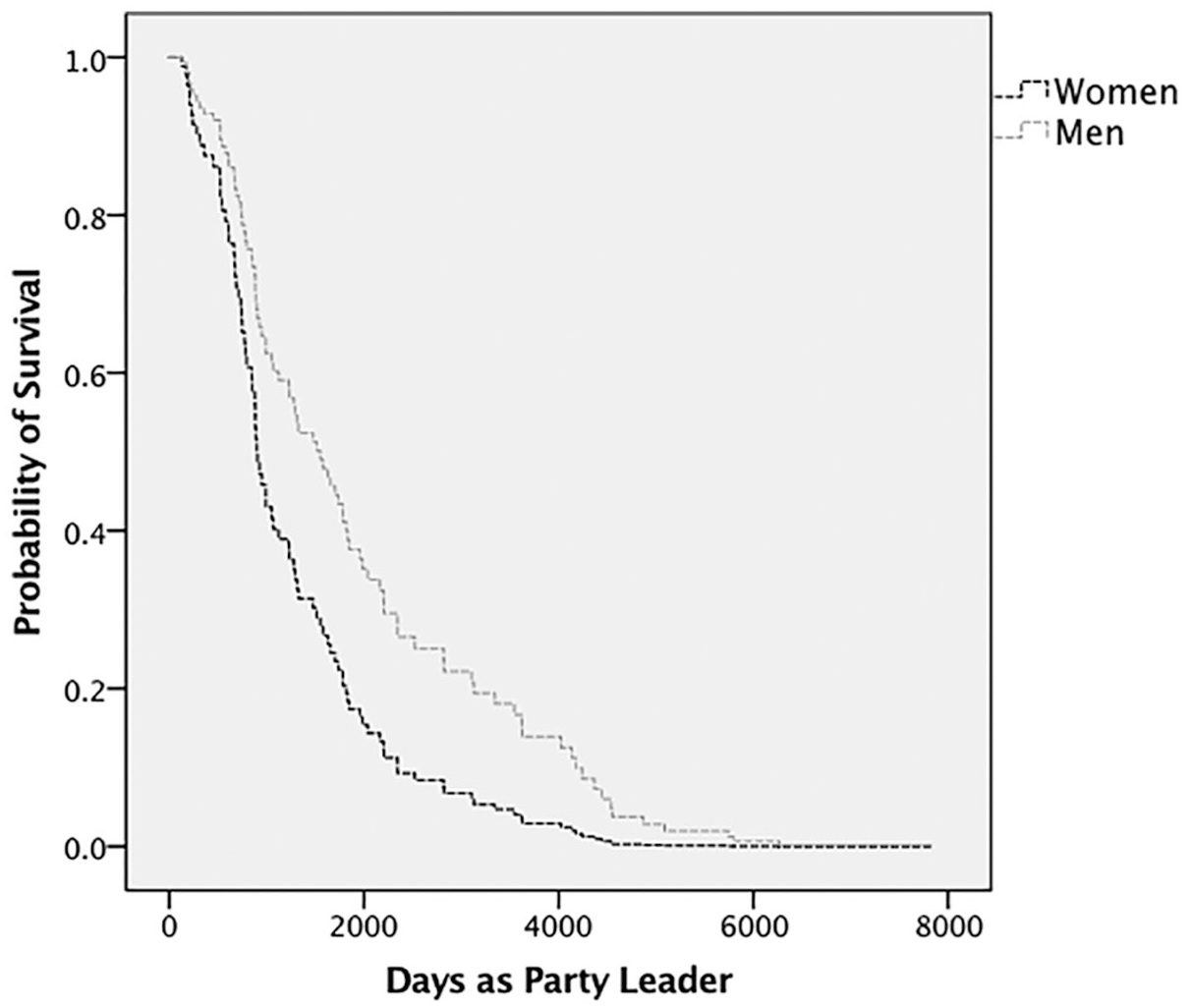
Probability of Surviving by Leader Sex.
Table 6 explores our second hypothesis and reports the results of a binary logistic regression where the dependent variable is whether or not the party leader ever contested a general election. The results demonstrate that leaders who assume leadership during crisis are significantly less likely to ever contest an election. Unlike the bivariate results, however, we find no evidence that women are less likely to contest at least one election compared to men once we include control variables in the analysis. As a result, we cannot confirm our second hypothesis.
Table 7 reports the results of a binary logistic regression where the dependent variable is whether or not the party leader resigned under some form of party pressure. Here we find a number of statistically significant relationships. First, older party leaders are significantly more likely to resign under pressure than younger ones (see models 2 and 3). Second, New Democrats are less likely to resign under pressure than their Liberal counterparts, likely the result of the different competitive dynamics between the parties (the NDP has been a perpetual third party federally and its leaders likely face less expectations regarding electoral performance). Finally, and perhaps most importantly, men are significantly less likely to resign under pressure than women (see models 1–3). In fact, women party leaders are seven times more likely than men to resign under pressure. The result is both significant and substantive. We can therefore confirm our final hypothesis: not only are women’s tenures shorter than men, but they are considerably more likely to be pressured into resigning.
Conclusion and Discussion
Our objective in this article was to determine whether harsher standards for women party leaders or the glass cliff phenomenon could help shed light on gender differences in length of tenure and exit modes from the role. And our findings are indeed illuminating. Gender differences in length of tenure and exit mode were found within major parties, ones with significant electoral support and a chance at forming government. Women leaders of major parties have significantly shorter tenures and, at least in the bivariate analysis, contest fewer elections as leader than men. They are also much less likely to resign voluntarily as leader and more likely to face party pressure to resign than are men selected to lead these parties, a finding that is consistent across the bivariate and multivariate analyses. When the stakes are highest, we find substantive and significant differences in leader tenures and exits.
Two potential explanations for gender differences in leader tenure and exits were offered and tested. The first, the glass cliff phenomenon, suggests that shorter tenures and greater pressure to resign could be explained by the fact that women are more likely to assume the leadership of parties in crisis. We found clear evidence that women are more likely to rise to power than men when the party is in crisis, but only for major parties where the electoral stakes are the greatest. We also found that leaders of parties in crisis have shorter tenures overall, both in terms of days as leader and elections contested. We were unable, however, to find significant evidence that women’s shorter tenures as leaders in major parties were linked to their coming to power when the party was in crisis, likely due in part to a small number of cases. As such, definitive conclusions regarding whether the glass cliff phenomenon accounts for women’s shorter tenures as leaders of major parties remains elusive.
The second explanation, the application of informal party norms and practices in the removal of leaders and the role congruity theory of prejudice, suggests that women party leaders would be evaluated more harshly than men given the incongruity between expectations related to the traditional female gender role and ones related to leadership roles. We suggest that evidence of these harsher evaluations is to be found in the likelihood of women being more likely to be pushed from their role as leader. And our findings reveal that women party leaders are indeed much more likely to face party pressure to resign from the position than men.
These findings shed light on the gendered nature of political opportunity structures at the leadership level in political parties. Women who are chosen to lead competitive parties with a chance at forming government have significantly shorter tenures than men in these positions. Our findings do not discount the role of the glass cliff phenomenon in shaping women’s access to the position of party leader; indeed, almost half of the women who rose to assume the position of party leader in a major Canadian party did so when the party was in some form of crisis. But the glass cliff phenomenon does not help to explain women’s shorter tenures. In line with O’Brien’s (2015) findings, women who came to the position under crisis conditions can contest two and three elections as leader if the major party’s electoral outcomes exceed expectations. What we add to this, however, is a significant finding that women are less likely to ever be allowed an opportunity to contest an election, whatever the party’s status when they assumed the role. Party pressure is far more likely to be exerted on women to exit the leadership than it is on men. The role congruity theory of prejudice offers an alternative and viable account of women’s quicker and more likely pressured exits from the role than men’s. In the relative absence of formal rules guiding party leader exits, informal and gendered norms and practices fill the void. In major parties, women are more often pressured to resign as leaders, prior to a single election, after an election loss and even after election wins. Women are more likely to be seen to have failed, and as a result, are pushed to resign.
These results advance our understanding of the gendered nature of party leadership but there remain important avenues for future examinations. One area for future research is to dig into the psychological processes that lie behind women’s and men’s decisions to step down as leader. It might be the case that our findings reflect the fact that women and men respond differently to party challenges to their leadership (Bynander and ‘t Hart, 2006). As noted by Beckwith (2015), we ought not to ignore the fact that women party leaders are strategic actors in their own right with an ability to shape their leadership experiences. A richer and deeper qualitative examination of leaders’ decision-making processes would help advance our understanding of gendered leadership process.
Another area for further inquiry is a more direct examination of prejudice towards women party leaders among leader selectorates. While studies of its application among political leaders exist (Eagly and Karau, 2002), these have focussed more generally on the assessment of politicians by the public rather than its more limited application to party leaders by those who select them, a group that necessarily differs from the general population. Studies of leadership selection processes and selectorates would help shed further light on the nature of gendered political opportunity structures within political parties.
And finally, the Canadian case has shown the limitations of cross-national studies applying objective standards to the operationalization of concepts employed to examine party processes, namely, party crisis and party status. Identifying a party in crisis and party status at the time of the leadership selection process requires a rich understanding of the nature of partisan competition and party systems within states. Large-n quantitative studies are instrumental for modelling the various factors that shape party leadership, but they do so often at the expense of the rich understanding that comes from more focused case studies. Additional in-depth studies of gender and party leadership examining different cases, alongside additional large-n studies, are required to advance our understanding of whether and how different standards are applied to the women and men who serve as party leaders.
Footnotes
Acknowledgements
Brenda O’Neill would like to thank the School of Politics and International Relations at the Australian National University for a Visiting Research Fellowship in early 2018 that provided the time, space and feedback necessary for advancing this project. David Stewart would like to thank the many graduate students over the years who assisted with data collection on this project.
Authors’ Note
Earlier versions of this paper were presented at the 2018 Canadian Political Science Association Meetings and the 2018 New York State Political Science Association Meetings. The participants and discussants at these conferences provided valuable feedback.
Funding
The author(s) received no financial support for the research, authorship and/or publication of this article.
