







Abstract
When do personal ties matter? Studies of political elite’s rise to power stress the importance of personal ties, but do not consider the possibility of differential effects depending on who one is connected to in elite struggles. We examine how ties formed among Chinese party-state officials influence their career. Our research design provides a strong proxy to account for personal ties: attendance of an exclusive and intensive training program for officials. We take advantage of the exogenous assignment to cohorts in this program to establish a causal link between informal connections and promotions. We find that the effect of personal ties depends on whether the official is connected to the leader who dominates the promotion process or to the one who only influences it through information control. Connections to the latter decrease the promotion probability, likely because these officials are closely monitored by their superiors and more powerful rivals.
Introduction
In a variety of political regimes, connections to the top leadership appear to provide substantial benefits when climbing the career ladder. Vladimir Putin’s childhood friends, judo partners, and colleagues from St Petersburg, for instance, have had stellar careers in government and state-owned corporations under his leadership (Dawisha, 2014). They are not alone: a series of rigorous quantitative studies have confirmed that connections to top leaders help political elites advance their careers, in both authoritarian and democratic regimes (Fiva and Smith, 2018; Jia et al., 2015; Shih et al., 2012; Van Gunten, 2015). These studies usually examine such ties within the framework of factional struggle, or patronage. But if scarce top-level positions are indeed a prize that several networks vie for, should we not expect that getting involved in such competition might come at a cost, and that the wrong connections can hurt one’s career? Studies have found that connections to leaders who have retired, or otherwise lost power, bring little benefits and can even be harmful (Shih and Lee, 2018), but could connections to active patrons also reduce the chances of a promotion?
This issue is particularly relevant in the case of one-party systems, as their resilience depends on their ability to provide institutionalized promotion channels for mid-level and sub-national officials, and maintain elite cohesion. Authoritarian parties allow the leader to credibly commit to sharing spoils and power with other elites, who in turn have a stake in the survival of the party (Geddes, 1999). Providing institutionalized and meritocratic promotion channels for officials, at the national and sub-national levels, is one such commitment (Magaloni, 2006; Reuter and Robertson 2012).
To study how informal ties affect promotions in an institutionalized one-party system, we focus on the Chinese case. The Chinese bureaucracy is a fruitful ground for research on informal networks and their effect on political mobility. Using an innovative research design, we improve on what we think are key weaknesses of already existing studies: the fact that patronage ties cannot be measured directly and therefore have to be inferred (Keller, 2016), and the difficulty of disentangling the effect of personal ties on promotions from other factors, such as merit. We confront these problems by relying on the exogenous assignment to different cohorts of a year-long training program for Chinese officials that encourages close interaction between members of the same cohort.
Existing studies use relatively weak proxies: they assume a personal connection between individuals who are born in the same locality, have attended the same school, or who worked at the same institution (Shih et al., 2012) or locality at the same time (Jia et al., 2015). But with such proxies, there is no evidence that the supposedly connected individuals even know each other. We argue that our proxy for personal tie is stronger. We compare pairs of alumni from different cohorts of the “Young cadres training program” (zhongqingban), a year-long training offered at the Chinese Communist Party’s (CCP) Central Party School (CPS) to about 150 promising young cadres. We hold that the intense classes, study-group, and team-building exercises of this program are more likely to create personal bonds than simply graduating from the same university or working in the same institution.
In addition, our research design can control, at least partially, for the meritocratic factor. By comparing only alumni from this program among each other, we ensure that any effect observed is due to the cohort assignment, and not due to attending this prestigious program itself, that is, the “brand name” effect. While their performance during the program or after may vary, these officials were all selected to be part of it which set them aside from others. Moreover, focusing on three adjacent cohorts allows us to argue that the received training is the same, while the assignment to each cohort is exogenous.
The results of this study bring some nuance to the way we understand the effect of personal ties on political promotions. We find that being connected to the province’s number one leader, the party secretary—who has the final say over promotions (Zeng, 2015)—is beneficial to one’s chance of promotion. However, due to the small number of observations, the estimate of this substantively large increase is also quite uncertain, that is, it is not statistically significant on conventional levels. More surprisingly, a connection to a local leader who could influence the promotion process through his control of information—the head of the Organization Department, in charge of human resources—actually lowers the probability of a promotion. This finding goes against the current literature which stresses how these officials at the center of the information flow have tremendous leverage on personnel decisions (Edin, 2003; Manion, 1985).
More broadly, we suggest that personal connections to those who only influence the recruitment process through information control instead of actual decision-making power may threaten one’s advancement in a closed and competitive bureaucracy. We argue that this is because potential patrons with unique access to information may be under particularly strong scrutiny from their superiors, and hence abstain, or be more constrained, when facilitating the promotion of those with whom they share known ties.
The article is divided into three parts: first, we review the literature on informal ties and their effect on political promotion. Then, we present our empirical strategy and introduce the data we use. Finally, we discuss the findings of the statistical analysis.
Informal Ties and Political Promotion
A rich literature underscores the importance of personal ties for career-advancement both in authoritarian and democratic regimes (Dawisha, 2014; Fiva and Smith, 2018; Shih et al., 2012; Van Gunten, 2015). Their specific effect may depend on the political system and its level of institutionalization (Baturo and Gray 2018), and on the nature of ties, be it nepotism (Fiva and Smith, 2018), patronage (Jiang, 2018; Willerton, 1992), or mentorship (Camp, 2002). However, there is little research on the interaction between these informal ties and the formal hierarchy, that is, how the effect of informal ties depends on the formal position held by the actors involved.
In the context of analyzing the mechanism through which weak ties help secure occupational opportunities, Granovetter (1973) and Lin et al. (1981) both emphasize the importance of personal ties, but come to different conclusions: the former stresses the information that can be obtained through weak ties, while the latter sees weak ties as a way to access people higher up in the hierarchy with direct influence over the recruitment process. Beyond the question of the strength of the tie, ambitious bureaucrats may thus face a dilemma: should they seek out patrons who control the information flow or—presumably even higher-level—individuals with direct decision-making power in the promotion process?
The Chinese party-state bureaucracy is a fruitful arena to study the importance of informal ties. Despite the institutionalization of the recruitment and promotion process for Chinese officials in the past 40 years, as well as the importance given to meritocratic criteria in that process (Huang, 2002; Nathan, 2003), many studies have shown that informal ties remain crucial for advancement in the party (Hillman, 2014; Jia et al., 2015; Shih et al., 2012). Despite the fact that this China-specific literature describes the Chinese bureaucracy as being rife with political struggles, almost no study considers the possibility that informal ties may have negative effects as well—except in the obvious case of ties to a patron who has already retired (Shih and Lee, 2018) or been purged (Wang, 2016). Yet, should day-to-day competition not turn certain connections into an obstacle to career advancement as well?
A re-analysis of the data on the advancement of CCP elite (the Central Committee members) from Shih et al. (2012) indicates that the effects of ties to different party leaders do indeed vary, depending on the level of the formal position the latter hold or used to hold: while a tie to a current, or former, Politburo member is not associated with an increased chance of getting appointed to the Politburo itself, a tie to one of the higher-ranked Politburo Standing Committee members does, but not as much as a tie to the party general secretary himself. As we will show, such differential effects likely exist throughout the bureaucratic system. And while the result in Figure 1 could be explained simply by differences in levels of influence, we find evidence that less powerful patrons may be prevented from helping their clients advance. The widely accepted belief that connections to all higher-ranking officials help one’s career prospect will thus have to be amended.
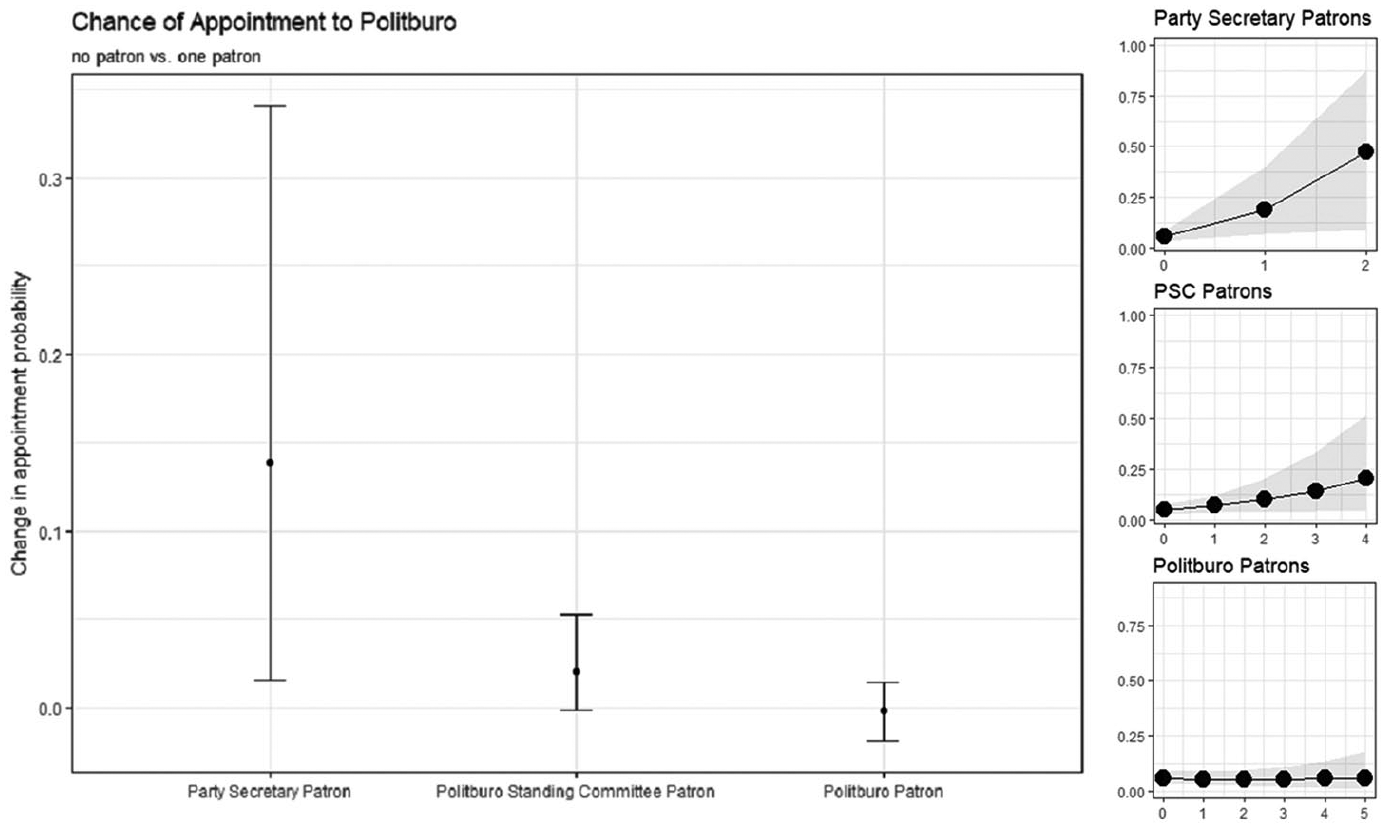
Left: Increase in Chance of Politburo Appointment Between Central Committee Member With No Patron versus One Patron. Right: Probability of Politburo Appointment as a Function of Number of Patrons. Model Used is Model 4 in Table A2 in the Online Appendix A2, and All Other Variables are Held at the Mean. Following Keller (2015), Connections are Established When Two Individuals Work at the Same Time in the Same Unit, and the Lower-Ranking Individual is Promoted During That Time.
Empirical Strategy
A Stronger Proxy
At the center of this study is an important, but largely understudied, institution, common to various single-party regimes such as China and the Soviet Union (Matthews, 2014): the Central Party School. The literature on the CPS is relatively scarce, despite its long history: Building on previous historical entities dating from the revolutionary base in Jiangxi or Yan’an in the 1930s, the then named Central Higher Party School was established in Beijing in 1955. After stopping its activities during the Cultural Revolution, it reopened in March 1977 as the CPS. Since then, it has gained influence as the main think tank of the CCP. While it is also a key training center for thousands of senior and mid-career officials, few studies actually account for what goes on behind its walls (Shambaugh, 2008). Anecdotal evidence indicates that apart from instilling Communist values and providing leadership training, the School also serves as a venue for networking (Lee, 2015; Pieke, 2009; Shambaugh, 2008; Tran, 2003). It is in that sense not much different from many institutions that aim at training the future elite in other fields, such as MBA programs (Hall, 2011).
Because attending such educational institutes entails a full-time immersion at a formative age, they are often thought to lead to particularly strong ties. Kadushin (1995) has suggested that the National School of Administration is such an important networking hub in France, while Camp (2002) has documented how Mexican politicians recruit college students into their circles. Elite Chinese universities, and in particular Tsinghua University in Beijing, have also been put forward as key networking platforms (Li, 1994; Tsai and Liao, 2019). Yet, due to their size, merely attending such elite educational institutes may not be enough to create a meaningful tie.
Building on these studies, we argue that attending the same CPS cohort is likely to be a strong proxy for a close personal relationship between two party-state officials. Similar proxies based on cohort ties have been used in different contexts. In his study about Mexico, Van Gunten focuses on educational ties between individuals who have studied the same subject at the same university in the same year (Van Gunten, 2015).
To further buttress this argument, we focus on the zhongqingban. Created in 1981 (Lee, 2015), it is an invitation-only yearly program reserved for around 150 cadres in their 30s and 40s. It has become a key tool in the overall strategy of the CCP to promote younger and better trained officials. Its success can be judged by the fact that more than 23% of the current members of the CCP’s Central Committee emerged from this CPS program. 1
Focusing on the CPS’ programs in general, and the “Young cadres training program” more specifically, Charlotte Lee shows its positive effect on career advancement. Using large-N survey data and matching methods to overcome the selection bias, she analyzes official career histories and shows that CPS enrollment increases the likelihood and speed of a cadre’s promotion in the party-state hierarchy (Lee, 2013). In addition to selecting the most promising cadres through invitation, the training itself has an effect on the cadres and their chances to be promoted, particularly because the training’s content has become less ideological and more technical and practical (Tran, 2003). According to Charlotte Lee, the CPS is used by the CCP as a way to screen and nurture political talents in order to avoid adverse selection (Lee, 2015).
Lee notes that the cadres selected to join usually have rather close contacts with their superiors, who have supported their application, but is skeptical about the future value of the personal relationships built on campus (Lee, 2013). However, the method she uses does not allow her to separate the effect on future promotion of the training itself on one side, and of its networking potential on the other side.
Evidence from qualitative studies of the training in the CPS and provincial party schools suggest that networking is an important component. This is hardly surprising, as they live the whole year in dormitories on campus, eat three meals a day in the same cafeteria, and can only go back home during weekends, even if they live in Beijing (Shambaugh, 2008). Like other CPS programs, the zhongqingban has a fixed schedule: during weekdays, the students have class together every morning, and group-study or team-building activities most afternoons. In the 1990s, this even included some kinds of fatigue duty, such as cleaning the classroom (Zhao, 2007). They also go on joint study trips. As a result, they spend most of their time together and develop rather strong personal ties (Shambaugh, 2008). As noted by Frank Pieke (2009), the party school training is often seen as a rather relaxing period, far from the stress of the cadres’ daily job. This atmosphere, together with the emphasis put on collective activities and sports, facilitates networking within cohorts. According to our interviews with former students, they maintain their network after graduation through yearly cohort reunion dinners—although this has been discontinued because of the anti-corruption campaign launched by Xi Jinping in 2013. 2
With the development of these personal ties, the networking value of the training is often mentioned by officials who went through the party school system (Pieke, 2009; Shambaugh, 2008; Tran, 2003). Citing her interviewees, Emilie Tran (2003) suggests that the secret wish of any official when going to the party school is to be in the same cohort with cadres who it might be useful to know in the future. The CPS trainings being limited in time and organized as a closed-community, trainees’ socialization is, in fact, cohort-based rather than school-based. Interaction with members of other cohorts and programs is limited. 3 While the zhongqinban has three different formats and durations—half a year, 1 year, and 2 years—we focus on the 1-year version as it allows enough time to forge strong ties among cohort members, while avoiding the possibility of contact across cohorts.
We are confident that the 150-odd members of a zhongqingban cohort have a good chance to develop personal ties among each other, compared with other proxies used in the literature on informal politics. It is fair to assume that they at least know each other, by contrast to individuals who are simply alumni from the same university, or who worked in the same province or ministry.
Case Selection: A Quasi-Experimental Design
We examine three specific, adjacent, zhongqinban cohorts: those of the years 1993/1994, 1994/1995, and 1995/1996, and assume that assignment to a specific cohort is exogenous. 4
Such cohort designs have been commonly treated as quasi-experimental when evaluating educational interventions (Cook et al., 2002). The CPS students are selected by the CCP Central Organization Department based on recommendations from their unit’s leaders, who provide a short-list of candidates. As a result, the students are probably close to the official who recommended them, but there is no evidence that they themselves, or their unit leader, can influence their assignment to a specific cohort, as this is decided at the central level (Lee, 2015). This was confirmed by the party school instructors interviewed by the authors. 5 As the future CPS students come from very different units and cannot know who will be accepted into the program in a given year, they cannot strategically self-select into a cohort. This allows us to argue that assignment to cohorts is exogenous, and that adjacent cohorts should be very similar. In addition, CPS training is standardized and does not generally change meaningfully from one year to the other (Lee, 2015). Through this original research design, we can disentangle the networking aspect from the meritocratic element of the training, and hence evaluate its effect on the cadres’ future career.
Personal Ties and Their Effect on Promotion
The independent variable of interest is whether a superior, able to affect an appointment to a higher-ranked position under his or her purview, has attended the same, or a different cohort, as the potential candidate for a promotion. The outcome of interest is the occurrence of such a promotion.
In other words, we assume that all members of a cohort have formed personal connections with each other during their year at the CPS, but that they have not formed such a connection with the cohorts attending the school in the year before or after them. At some later stage of their careers, the alumni are likely to meet again, for instance, when working in the same province. 6 At that point, previously horizontal relationships between alumni can become vertical ones between patrons and clients: if one of them is in a higher-level position, he or she may be able to help the former cohort member advance, either directly or indirectly, as the examples in the next paragraph illustrates. As a result, alumni who serve under a cohort member might have a better chance of being promoted than those who serve under an alumnus from a different cohort. As members of all cohorts have been selected according to the same criteria, and have received a similar training, any difference in the observed promotion chances should be due to the informal connections formed between the cohort members.
To illustrate how these cohort-based relationships may influence one’s career and how we decided to code the career paths of the individuals in our data set, we present here the trajectories of two members of the 1995–1996 zhongqingban cohort: Sheng Maolin and Li Sanyuan.
Born in 1960, Sheng Maolin was among the youngest members of the 1995–1996 cohort. At the time of the CPS training, he was a city party secretary in Hunan province. Moving from one administration, and one locale, to the next, he progressively rose the ranks within the province. In 2006, another member of the 1995–1996 zhongqingban cohort, Zhou Qiang, was appointed by the central party leadership as the provincial party deputy secretary and acting governor of Hunan province. Zhou found himself as Sheng’s superior, the latter being party secretary of Shaoyang city, Hunan province, at the time. The next year, Zhou Qiang became the provincial governor. At the same time, Sheng was promoted to the provincial party apparatus as deputy director of the Organization Department. While he did not have the final say in this decision, Zhou Qiang, as an important member of the provincial leadership, should have been able to influence it. In our dataset, this encounter is therefore coded as a positive influence of a “patron” on a “client’s” promotion, the two being from the same cohort. In 2010, Zhou Qiang became the provincial party secretary and Sheng Maolin was transferred to director of the provincial government general office. In that case, Zhou had the final word on the promotion. This is therefore also coded as a positive influence. Sheng was then once again promoted in 2012, to vice-governor of the province, while Zhou was still the local top leader.
In contrast with Sheng Maolin’s trajectory, Li Sanyuan’s illustrates how one’s rise in the hierarchy can be stopped, despite numerous personal ties to relevant officials. Born in 1958, Li Sanyuan was also among the young officials selected to join the 1995–1995 zhongqingban cohort. At that time, he was a county-level CCP secretary in Shaanxi province. Remaining within the province after the training, he became the Organization Department director of Xianyang city’s CCP committee in 1999, and vice-mayor of the city in 2002. Almost as highly ranked as his cohort colleague, Sheng Maolin, he appeared set for a good start toward a successful career in the CCP. But after his 44th birthday, Li Sanyuan’s career stalled. Instead of progressing toward leadership party-state positions in Shaanxi, and beyond—as Sheng did, he became the head of secondary provincial offices in charge of rural cooperatives or forestry, and ended his career in 2018 in a pre-retirement position in the Shaanxi provincial People’s Congress. Li’s career trajectory cannot be attributed to a lack of personal ties to the provincial leadership. Between 2002 and 2018, four members of his CPS cohort have alternated in positions from which they could facilitate his rise: Zhang Baoqing was deputy secretary of the province between 2002 and 2005; Yang Shiqiu (2002–2007), Li Jinbin (2007–2013), and Mao Wanchun (2013–2016) were one after the other in charge of human resources as directors of the provincial Organization Department. But while all four of these potential patrons should have had the ability to influence the promotion process, none of them had the last say, which, at that level, resides with the provincial secretary. 7
Interestingly, Li Sanyuan’s two other cohort members who were based in Shaanxi province during this period were also never appointed to high-level positions: Zhang Xiumei became head of a county level bureau in charge of rural development at the age of 46 (in 2002), and Zhao Dequan became the provincial vice-governor at the age of 55 (in 1996), but they were never promoted again and were granted pro forma pre-retirement positions in their 60s.
While many different factors could have influenced the personal trajectories of Sheng Maolin and Li Sanyuan, the two cases suggest that informal ties to higher-level leaders may have different effects depending on whether the leaders one is connected to have direct control over the promotion process or only some influence over it. It remains, however, impossible to prove decisively that Sheng Maolin profited from his connections, while Li Sanyuan was hurt by them. Even if we could interview them, they and their superiors would be unlikely to divulge their actions and motivations. Instead, we resort to statistical analysis. Based on a dataset of the career paths of three consecutive cohorts of the “Young cadres training program,” we test if CPS alumni have a higher chance of being promoted if they serve under a provincial leader from their own cohort as opposed to one from a different cohort.
Data and Summary Statistics
Our dataset completes and updates Charlotte Lee’s (2015) data on the career trajectories of zhongqingban alumni, up to the mid-2015. Sources for their career data were, whenever available, government-provided CVs. Failing that, we resorted to newspaper reports on individual appointments, although we were not able to find information for all 525 individuals (the Online Appendix describes missingness in the data in more detail).
Table 1 describes the three different cohorts and their members. They have roughly the same size of 150–200, with a very limited number of women among them. The medium age of each cohort lies between 40 and 44. By the time they attend the school, most members have been in the CCP for 15–20 years, and have climbed the several steps in their career ladder.
Summary Statistics on the Members of the 1993/1994, 1994/1995, and 1995/1996 Zhongqingban Cohorts.
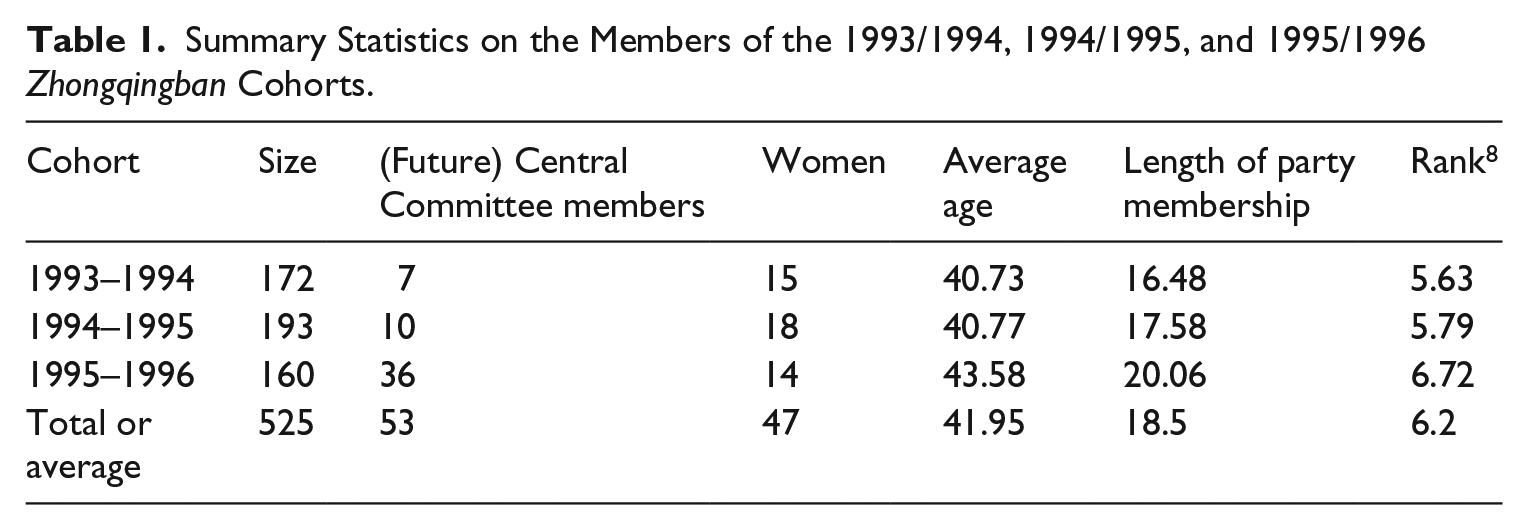
Only a few of these officials (10%) will reach the coveted position of Central Committee members. Their distribution across the three cohorts, however, is uneven: only 4.1% of the 1993–1994 and 5.2% of the 1994–1995 cohort join this Communist elite, while more than a fifth (22.5%) of the 1995–1996 cohort succeeds in that regard. This is due to the fact that the CPS tweaked its admission criteria in 1995, gearing it toward slightly higher-ranked cadres (Sina, 2012). The last cohort was thus almost 3 years older and held positions that were ranked on average one level higher than the two other cohorts. The members of the 1995–1996 cohort are therefore already one step ahead in their political career, and end up providing more of the provincial elite positions in our dataset. 9 We address this breakdown of the quasi-random assignment by controlling for cohort assignment in the main specification of our model.
Based on this career dataset of the three cohorts, we created a second “encounters” dataset. We started by identifying CPS alumni who held top provincial leadership positions during their career, that is, who served as provincial party secretary, governor, deputy party secretary, or as the head of the provincial Organization Department (responsible for human resources). These four positions include the main provincial leadership regarding personnel issues. When a position opens up at a subordinate level in this province, they will be the key members of the relevant selection committee (Zeng, 2015). In theory, these committees have direct power only over promotions one-level down, meaning in that case for city level leaders or heads of provincial departments. However, qualitative research has shown that they can also influence promotions further down in the hierarchy. For example, they could impact the promotion of a county level leader through pressuring the city level one, who is directly responsible (Hillman, 2014; Smith, 2009). Among these four types of provincial leaders, the Organization Department director has the lowest rank, but is most closely involved: his department centralizes information on cadres, and carries out the promotion and recruitment procedures (Zeng, 2015).
Among our 525 individuals, there are only five alumni, all from the 1995/1996 cohort, who manage to reach the highest provincial position—party secretary: Xia Baolong (Zhejiang, starting in 2012), Guo Gengmao (Henan, starting in 2013), Zhao Kezhi (Guizhou, 2012–2015), Zhou Qiang (Hunan, 2010–2013), and Wei Liucheng (Hainan, 2007–2011). But there are 38 individuals who reached at least one of the other three types of positions. We have hence 8.2% of the trainees who, at one point or another, become potential patrons.
We identified other alumni in the first dataset who have served in those provinces at the same time. This resulted in a second dataset of “encounters”—instances where alumni of the three “Young cadres training program” cohorts met again in the course of their careers and might have helped their fellow alumni climb the career ladder. This second dataset contains the position both individuals held, the province, and the start and end dates of their job positions, as well as the job position the lower-ranked individual moved to afterwards. In addition, it also contains the characteristics of both CPS alumni at the time they entered the zhongqingban. In order to be included in the second dataset, the former zhongqingban students needed to have started their job before or in the same year as the provincial leader in question finished his appointment, and they need to have ended their job after the potential patron began their appointment.
After manually checking all these instances, we are left with a dataset of 710 such encounters: 10 in 59 of those cases, the potential patron is the party secretary of the province; in 151 cases, it is the governor of the province; in 320, the deputy party secretary; and in 180, the head of the Organization Department. Both authors assessed all 710 encounters independently to judge if the lower-ranking individual was promoted during the encounter. Many of the encounters result in the “clients” simply remaining in their position, or retiring without further advancing in the party hierarchy. In the remaining cases, we evaluated if the career move could count as promotion, and if the “patron” might have helped the “client” advance. Criteria for this evaluation were the following: (1) the higher-ranking CPS alumni was still in their position when the move occurred; (2) the position the lower-ranking alumni moved to was a higher-ranked or more prestigious position; (3) the position he or she moved to was one for which the higher-ranking alumni had some power to determine the appointment. We identified 144 instances in which these criteria were fulfilled: 8 promotions occurred under a party secretary, 25 under a provincial governor, 70 under a deputy party secretary, and 41 under a head of the Organization Department.
In order to create an additional baseline, we also constructed a separate dataset with all known encounters between CPS alumni, in which neither alumni held such high-level positions. As it would not have been possible to manually code the over 2 million such encounters, we combined manual and automated coding (described in the Online Appendix), and found that among the related 93,058 encounters, only 495 resulted in an upward move. The chance of a promotion occurring is thus lower in these encounters (see below), presumably because these positions are qualitatively different, but maybe also because our semi-automated coding is not identical to the wholly manual coding. In order to avoid inducing bias by comparing fundamentally observations created by a different coding process, we keep the two datasets separate.
Results From the Encounter Dataset
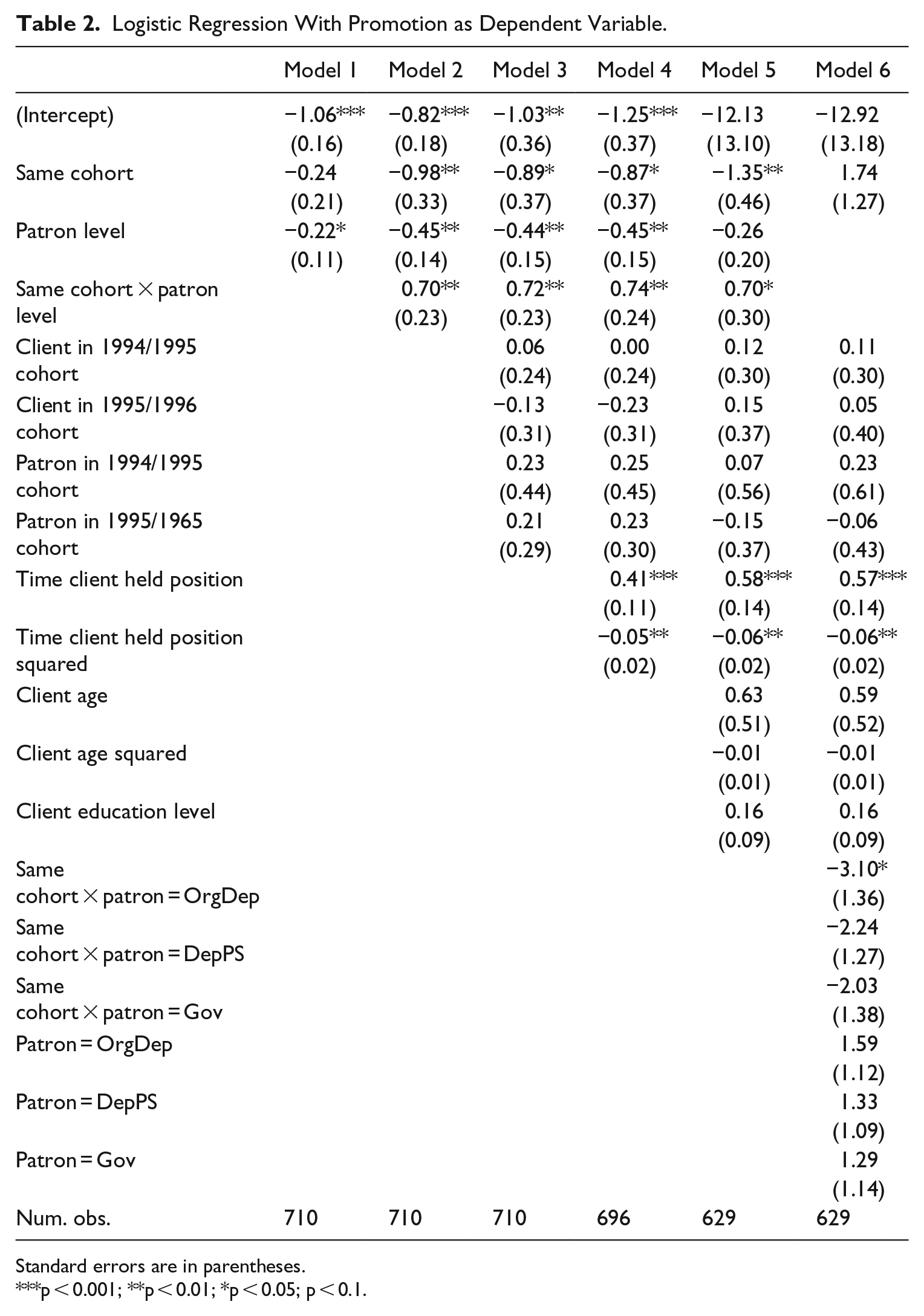
The numbers for each group of observations involving a high-level patron is not very large. When we pool the patrons of different levels and simply compare co-cohort encounters with encounters of zhongqingban alumni from different cohorts, we find a negative, but not statistically significant impact on the promotion chances (Table 2, Model 1). The result of five separate t-tests on the five groups for the different patron positions shows that this surprising null result masks a more complex finding: in the case of the party secretaries, who are best placed to help a fellow cohort member advance, we do indeed find that cohort members have a better chance of being promoted than the CPS alumni from the other cohort. A total of 25% of the encounters between alumni from the same cohort end with a promotion, while only 8.1% of the encounters between alumni from different cohorts do. In other words, it triples the chance of a promotion. However, due to the small sample size, the actual effect size (the difference) is quite uncertain, that is, not statistically significant on the 95% level. If the higher-ranking CPS alumni is a governor or a deputy party secretary, the effect is negligible (18.3% vs 14.8% for governor and 20.4% vs 22.5% for deputy secretary). In the case of Organization Departments’ heads, the effect on promotion is large and negative (11.8% vs 29.5%), with the 95% confidence interval not containing 0. For all other encounters that do not involve a possible patron in one of the above-mentioned high-ranking positions, there is a small negative effect of the counterpart being from the same cohort (0.2% vs 0.8%). Figure 2 summarizes the findings by plotting the estimated differences and confidence intervals for each t-test.
Logistic Regression With Promotion as Dependent Variable.
Standard errors are in parentheses.
p < 0.001; **p < 0.01; *p < 0.05; p < 0.1.
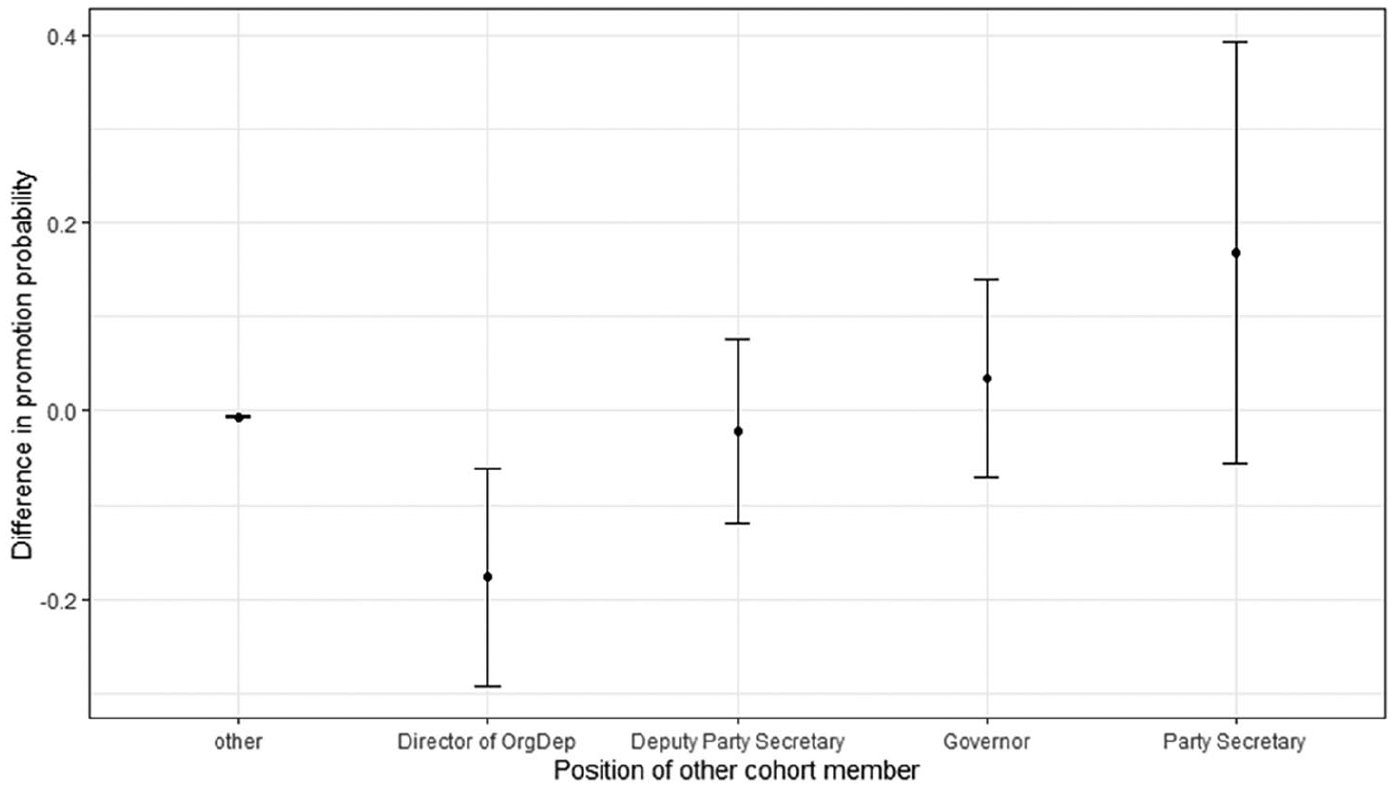
Promotion Advantage from Having a Superior of the Same Cohort (Individual t-Tests).
Figure 2 illustrates that there is a large substantial effect of ties formed during the CPS’s Young Cadres training. However, the direction of the effect depends on the position of the higher-ranked alumni: the lower his or her rank, the more such a tie becomes a liability instead of an asset: while a former cohort member of the party secretary experiences an increased promotion chance of 17% points over a non-cohort alumni, a similar situation with a cohort member as director of the Organization Department decreases the promotion chances by the same amount. And while the former result contains zero in the confidence interval, we note that it does not contain the upper bound of the estimate of the effect size for the director of the Organization Department.
Finally, if the other alumni is not in a position to specifically influence the appointment (“other”), then having attended the same cohort does not matter in substantive terms: it reduces the promotion chances by 0.6% points. 11 This result is robust to splitting the observations differently, such as combining governors and deputy party secretaries. Given the small number of cases, we also perform permutation tests as robustness checks (see Online Appendix A3), but the results remain the same.
Simple t-tests are, however, only a valid test of the hypothesis in question if the assignment to the cohorts is as good as random. This is not strictly true for the three cohorts, because the admission criteria were changed for the 1995/1996 cohort. We, therefore, would like to control for the characteristics that influence assignment to that cohort, and—as a robustness check—for other relevant covariates at the time the two alumni meet again. Unfortunately, the number of observations for some of the four subgroups is too small to run a logistic regression and control for multiple covariates. We, therefore, pool all four groups and interact the treatment—having been assigned to the same cohort—with continuous variable (patron level) indicating the rank of the higher-ranking zhongqingban graduate (the “patron”). A party secretary was assigned 3, a governor 2, deputy party secretary 1, and head of the Organization Department 0.
Table 2 presents the results of this analysis. Model 2 does not include any covariates. The coefficients are statistically significant: emerging from the same cohort as the patron decreases the chance of a promotion. But this is only true when the patron is head of the Organization Department, and the interaction term, therefore, equals zero. For any other patron, the interaction term increases the size of the combined coefficient and drives it toward and then above zero. Figure 3 provides an illustration of the change in promotion probability for each patron level. The coefficient on the patron position itself is negative, meaning that higher-ranked patrons are less likely to promote their inferiors. This is probably due to the fact that higher-ranked patrons can have higher-ranked inferiors, and promotions become increasingly rare as one rises in the party rank.
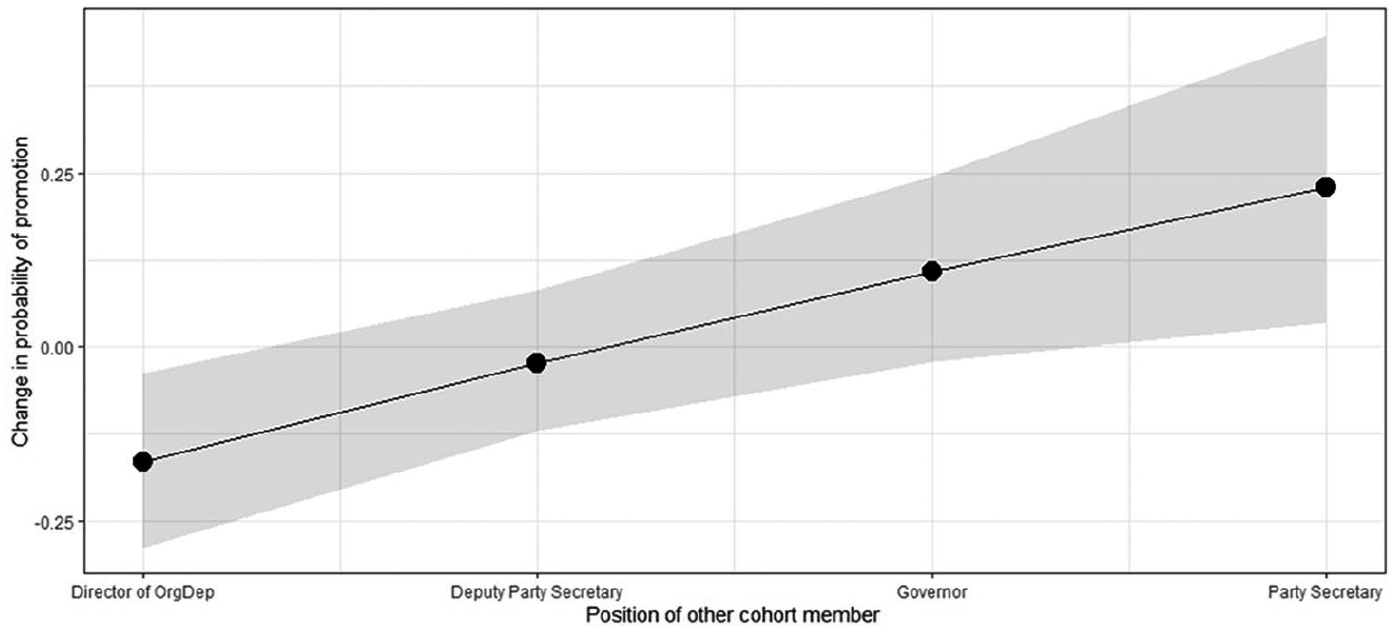
Promotion Advantage from Having a Superior of the Same Cohort (Controlling for Cohort-Assignment and Time Client Held Position).
With the change in the admission policy for the third cohort, one might worry that assignment is not as good as random, and that the final cohort may, for instance, have accumulated more promising cadres. In model 3, we therefore include dummies for the cohorts to which both alumni had been assigned to, with the 1993/1994 cohort serving as the omitted baseline category—this is numerically equivalent to a cohort-fixed effects model (Garcia, 1983). Membership in none of the three cohorts changes promotion chances, however, and the results on the informal ties remain the same. The same applies if we instead include covariates that might have determined assignment to the different cohorts at the time, such as rank, age, or length of the work or party career.
Model 4 adds time spent in a given position (and its square), while Model 5 adds the other available covariates for the candidate for promotion at the time when two alumni’s career paths cross again: age (and age squared) and level of education. All coefficients have the expected sign. “Clients” who are older and have spent more time in their position when they come across another CPS alumni are more likely to get promoted, but there is a diminishing effect, as the negative sign on the square term indicates. Bureaucrats are expected to stay in their position for a while before being promoted further, but those who have stayed too long may simply not be good promotion material, or may have hit an age ceiling (Kou and Tsai, 2014; Pieke, 2009). Education increases the chance of a promotion but its coefficient is, similarly to age, not statistically significant. The effect of informal ties remains largely unchanged in this model, and in similar models which also include the same covariates for the patron (not shown). Model 6 treats the levels of the patrons individually (leaving out the party secretary as benchmark), thereby confirming the results of the t-tests earlier.
In order to better illustrate the effect size for the different patron positions, Figure 3 plots the change in promotion probability for the different patron positions, according to the specification of Model 3. 12 The results resemble that in Figure 2: the only cohort ties that are beneficial are those to the province’s party secretary. Connections to any other provincial leadership position are either close to zero or have a large negative effect (in the case of the head of the Organization Department). This pattern goes against the general idea in the literature on informal ties in the CCP, which assumes that any personal tie to a highly ranked official not currently targeted for a purge is a boon for a cadre’s career.
How to understand these results? First, it is striking how one’s positive influence over a client’s promotion is dependent on one’s rank in the local leadership. Promotion decision in the CCP may be collective in theory, but also highly hierarchical, as has been shown in studies stressing how much leeway the party secretary has in deciding appointments (Hillman, 2014; Zeng, 2015).
Yet, why would ties to other party leaders become a liability? It is likely because the party secretary has no interest in helping to promote individuals that are connected to other provincial leaders, strengthening the latter’s position in potential future competition. Some qualitative studies on the local level, provincial and below, have highlighted that such infighting between a local leader and his subordinates can have negative effect on the career of cadres tied to a competitor of lesser rank (Hillman, 2014; Yao, 2017). This logic thus appears to permeate the system, up to the provincial level, as examined here. It is however particularly surprising that the Organization Department director has the biggest disadvantage, and not the deputy party secretaries or the governor, who are the most immediate competitor (Egorov and Sonin, 2011) to the party secretary.
The explanation may lie less in the pure struggle for power, but rather in the different types of influence the various patrons wield in the promotion process. As mentioned before, the party secretary has the last say in appointments, and the governor or deputy secretaries are key members of recruitment committees. The Organization Department heads, however, are of lesser rank and their direct influence cannot compete with the others’. At the same time, being in charge of human resources, they have access to all personnel files and organize the recruitment process itself. As underscored by Manion (1985), the “organization department power stems from its dominant role in collecting, selecting and storing the information upon which decisions are based.” Similar to human resources executive in private firms, these officials are hence able to influence the promotion process through information control (Enns and McFarlin, 2003).
The Organization Department directors are, therefore, likely to be monitored more closely by other leaders. Other leaders can easily curtail this influence: they just have to prevent them from using access to information in order to master an administrative power disproportionate to their rank. The party secretary has one more reason to closely monitor the Organization Department head: unlike other officials of that rank, the latter is appointed by the central party apparatus, which in this manner tries to maintain a strict control over human resources (Landry, 2008). As a result, local party secretaries may well perceive organization department heads as loyal to, and a possible tool of, the center, and therefore in need of increased monitoring. The Organization Department heads, conscious of the heightened scrutiny, may well restrain themselves from promoting anyone visibly associated with them, to avoid triggering any accusation of favoritism. In this configuration, the visibility of the personal tie between the patron and the client becomes important. Participation in the prestigious zhongqingban program features prominently on any candidate’s CV, which makes such cohort ties difficult to hide. The visibility of such tie hence contributes to the negative effect they may have on one’s career.
This finding further enriches Bian’s (1997) argument on how information—either relayed to the client by the patron or manipulated to influence a decision—might be less important than direct decision-making power in influencing career decisions, in a system with a centralized and opaque decision-making process. In fact, our results suggest that the mere suspicion of information control may create a backlash, and that being visibly connected to a patron seen as wielding such power may negatively affect the client’s career. Connections to leaders who master the decision-making process do not have this drawback as, similarly to what has been described in other systems (Magaloni, 2006; Reuter and Robertson, 2012), it is expected that local leaders recruit and promote their followers (Doyon, 2019).
Conclusion
This article attempts to establish a causal link between informal connections and political promotions. We have found that the effect of informal networks is more complex than what some might expect. Having a strong personal tie to the highest-ranked leader in a locality, who has the final say on the decision, may confer an advantage, but being affiliated to a lower-ranked local leader, who can mainly influence the process through access to information, may actually be detrimental to promotion prospects. We argue that patrons at the center of the information flux are under particularly strong scrutiny from their superiors. They, therefore, cannot afford to support or endorse the promotion of someone they are visibly connected to. The negative effect of informal ties is, hence, not only due to direct competition between patrons but also to the patron’s position in the decision-making process, access to information, and the visibility of the tie. This finding is important to the authoritarian politics literature as this competition between sub-national officials may affect the institution’s capacity to function as a formalized promotion channel. By keeping lower-level officials in check, local leaders appear to both favor their affiliates—potentially undermining the principle of meritocracy—and limit the extension of local patronage—potentially strengthening said principle.
We only study appointments at the provincial level, but a re-analysis of national level data, and other scholar’s work on the lower levels of the polity, suggests that differential effects based on the same mechanism of competition between informal networks may well be systemic. Finally, while we focus on specific personal ties, formed within cohorts in the Chinese CPS, we have no reason to assume that ties formed in other formal settings produce a fundamentally different dynamic. Weaker ties, such as mere alumni relationships, will likely also have positive and negative effects depending on the agents’ positions. The only clear exception could be ties than can be concealed more easily than those formed in a formal setting recorded on a CV, such as friendships formed outside work.
Supplemental Material
sj-pdf-1-psx-10.1177_0032321719888854 – Supplemental material for Knowing the Wrong Cadre? Networks and Promotions in the Chinese Party-State
Supplemental material, sj-pdf-1-psx-10.1177_0032321719888854 for Knowing the Wrong Cadre? Networks and Promotions in the Chinese Party-State by Jérôme Doyon and Franziska Barbara Keller in Political Studies
Footnotes
Acknowledgements
We would like to thank the reviewers, Kyle Jaros, Yegor Lazarev and the other participants of Columbia University’s postcommunist politics workshop, as well as MPSA conference participants for their comments, Yile Zhang for research assistance, and Charlotte Lee for sharing her data on the CPS students.
Declaration of conflicting interests
The author(s) declared no potential conflicts of interest with respect to the research, authorship, and/or publication of this article.
Funding
The author(s) disclosed receipt of the following financial support for the research, authorship, and/or publication of this article: Franziska Keller would like to thank the Center on US–China Relations at New York University and the Swiss National Science Foundation for their generous funding.

Supplementary Information
Additional supplementary information may be found with the online version of this article.
Online Appendix
A1. Missingness. Table A1. Missing Information on the Three “Young Cadres Training Program” Cohorts. A2. Tables. Table A2. Logistic Regression With Appointment to Politburo from Central Committee in the Chinese Communist Party (1982–2017). A3. Robustness checks. Figure A1. Results of Permutation Robustness Check of Model 4 in Table 2. Figure A2. Results of Permutation Robustness Check of Individual t-Tests of the Differences in Promotion Chances Between Same and Different Cohort Member Patron. A4. Coding of “Other” Encounters. A5. Additional Robustness Checks for Figure 3. Figure A3. Replicating Figure 3 Using Model 5 With All Available Covariates.