







Abstract
Candidates with local ties perform better than their rivals without such attachments. We focus on the underlying mechanism of the localness effect and hypothesise that voters prefer local candidates for instrumental reasons, expecting better representation, and for reasons of a shared place identity. To test these expectations, we rely on the unusually detailed ballot for local elections in the German state of North Rhine-Westphalia. Using multi-level regressions of the electoral results of 6503 candidates running in 21 cities in 2014, we confirm the importance of candidate localness for electoral success in low-information elections. Furthermore, we provide insights into the mechanisms behind this relationship. While instrumental motivations are independent of the composition of the electorate, a large share of elderly voters amplifies the identity effect, whereas many young voters, a high residential mobility, and a high population density diminishes this effect.
Introduction
Candidates with strong local attachments tend to perform better in elections than their rivals without local ties (Arzheimer and Evans, 2012; Evans et al., 2017; Gschwend and Zittel, 2015; Jankowski, 2016; Schulte-Cloos and Bauer, 2021). Voters are known to rely on such candidate characteristics as shortcuts when forming their electoral decisions (Bartels, 1996; Conover and Feldman, 1982, 1989; Riker and Ordeshook, 1968). Heuristics are especially important in low-information elections, where voters need to rely on easily accessible cues to inform their candidate choices (Fulton and Ondercin, 2013; Holman and Lay, 2021; McDermott, 1997). If multiple cues are available, voters will pay less attention to the more demanding ones and rely on low-effort cues (Shugart et al., 2005). We argue that the local attachment of candidates is such a low-demand cue that signals politicians’ knowledge of the locality’s needs and their local commitments. Surprisingly, though, the question of why candidates’ local attachments might inform electoral decisions has barely been addressed in existing research (but see Campbell et al., 2019; Frendreis and Tatalovich, 2021; Panagopoulos et al., 2017; Schulte-Cloos and Bauer, 2021). So far, we know that voters do not only favour candidates with local ties because they expect a better representation but that they also favour candidates who share their experiences (Childs and Cowley, 2011). Such a shared place-based identity can impact voters to the extent that they even favour candidates who do not stand a realistic chance in an election (Schulte-Cloos and Bauer, 2021).
We distinguish between two mechanisms that can explain why voters favour local candidates. The first one is instrumental. Voters expect candidates with strong local ties to have a better sense of their constituents’ needs, making them more capable of representing voters’ interests (Campbell et al., 2019; Childs and Cowley, 2011). Moreover, candidates residing where they run are personally affected by political decisions and thus have a vested interest in ensuring a good representation of their community. The second mechanism is identity-based. When candidates are born and live in the community where they run for office, this signals to voters that they share the same place-based social identity (see Schulte-Cloos and Bauer, 2021).
To disentangle the two mechanisms, we rely on the unusually detailed ballot paper for local elections in the German state of North Rhine-Westphalia, which provides voters with information on candidates’ place of birth and their place of residence. While a shared place of residence can trigger both instrumental and identity considerations, we argue that a local place of birth should have a greater impact on voters who care about a shared identity.
By studying the effect of candidate localness in 21 large German cities in the state of North Rhine-Westphalia in the 2014 local elections, the multi-level regression analyses show that candidates’ local attachments affect electoral results as expected. Living in a district and being born in the community improves candidates’ electoral outcome. Moreover, interacting our two localness indicators with the sociodemographic composition of the electoral districts demonstrates that, while all voters share instrumental motivations, the importance of a shared place identity differs depending on the composition of the electorate: whereas a large share of elderly residents amplifies the place-of-birth effect, the birthplace effect is decreased by a large share of young voters, a high level of residential mobility, and a dense population.
These findings are important for two reasons: First, the results indicate that both instrumental and identity-based considerations explain the success of local candidates. Second, the two mechanisms work differently. While instrumental reasons invariably favour local candidates, the impact of identity considerations varies by the district composition. There are strategic consequences that follow from these findings for party competition (see Berz and Jankowski, 2022): while all candidates stand to gain from local roots, parties are well advised to field locally rooted candidates in those areas where identity considerations rank high, as identified in this research. Our findings also speak to a large body of research on political representation as voters’ preferences for local candidates might reasonably translate into a more accurate representation of their and their districts’ needs by locally rooted representatives (see, for example, Mansbridge, 1999; Zittel et al., 2019).
Candidate Localness and Electoral Outcomes: Theoretical Considerations
In contrast to common conceptions of policy-centric vote choices, voters often rely on heuristics to judge candidates (Conover and Feldman, 1989; Downs, 1957; Holman and Lay, 2021; McDermott, 1997, 1998; Tversky and Kahneman, 1974). Especially in low-information elections, voters use the available information to construct narratives about the candidates by relying on stereotypes using candidates’ sociodemographic characteristics (Holman and Lay, 2021; McDermott, 1997, 1998). Local elections are typically low-information contests, where most voters know little about the candidates. They cannot weigh the alternatives in terms of policy preferences because information on party or candidate positions is difficult to attain since local elections tend to be considered less important by voters, parties, and the media. Consequently, the campaigns of most candidates receive little media attention or support from their parties, while few voters are interested in engaging with such contests (Kübler and Goodman, 2019; Rubado and Jennings, 2020).
Candidates’ local attachments are known to inform voters’ electoral calculus. Most research on the effect of candidate localness focuses on contests at the national and regional levels (Arzheimer and Evans, 2012; Evans et al., 2017; Gschwend and Zittel, 2015; Jankowski, 2016; Schulte-Cloos and Bauer, 2021), while local elections have received much less attention (Arzheimer and Evans, 2014; Górecki et al., 2022). This is remarkable, as one can expect the localness heuristic to be particularly impactful in local elections, given that the issues at stake are predominantly local and that candidate information is sparse (Bassi et al., 2011). The so-called ‘friends and neighbours voting’ should be especially common in local elections as the elected are not torn between national politics and particularistic service to their constituents (Arzheimer and Evans, 2014). Therefore, exploring candidates’ local ties in low-information elections at the local level is important as it is more likely that voters use such information as a cognitive shortcut in making electoral decisions to compensate for a lack of information on candidates and their policies.
We conceptualise local attachments as linking a candidate, a place, and the electorate. Local attachments can refer to a region, a community, or smaller geographic units (see Arzheimer and Evans, 2014). In the following, we will discuss why the local attachments of candidates are crucial for forming electoral decisions, especially in low-information elections at the local level.
Candidates’ Local Attachments
In his influential study of politics in the American South, Key (1949) found that candidates received disproportionate electoral support from their hometown and surrounding geographical areas. Since then, there have been three sets of explanations in the literature for this pattern of friends-and-neighbours voting, assessing the link between candidates’ localness and their electoral success. However, most studies address these explanations from a theoretical point of view, while hardly any study tests the underlying mechanisms empirically (but see Campbell et al., 2019; Frendreis and Tatalovich, 2021; Panagopoulos et al., 2017; Schulte-Cloos and Bauer, 2021).
The advantage of local candidates is often explained by a greater chance of interactions between candidates and voters due to geographic proximity, contributing to a greater awareness of the candidates among voters (Evans et al., 2017; Schulte-Cloos and Bauer, 2021; Stokes and Miller, 1962). For example, Gschwend and Zittel (2015) show for federal elections in Germany that contact with candidates in single-member districts and exposure to their campaign activities increases the likelihood that voters recognise and vote for a candidate (for other countries, see Arzheimer and Evans, 2012, 2014; Evans et al., 2017; Gimpel et al., 2008; Stokes and Miller, 1962). Yet, candidate activities are much more in the spotlight at the federal or state level, where parties invest more resources into campaigning. We argue that the other two explanations are more useful to account for why voters prefer candidates with local ties in municipal elections.
First, there are instrumental motivations for why voters favour local candidates (Schulte-Cloos and Bauer, 2021). Voters expect candidates with strong attachments to their communities to have a good understanding of the communities’ needs, making them better able to represent the interests of voters (Campbell et al., 2019; Childs and Cowley, 2011; Shugart et al., 2005). This applies especially to candidates who reside in the districts where they run, as they are personally affected by policy choices, so voters can assume that candidates have a personal stake in representing the needs of their districts. These instrumental motivations are applicable in any electoral contest and for any group of voters, as voters are generally expected to prefer candidates with a personal interest in being a good representative.
Instrumental motivations can be distinguished from a shared place-based social identity (see Schulte-Cloos and Bauer, 2021). According to identity-centric explanations, voters favour candidates with local ties because they assume that such candidates share their experiences (Childs and Cowley, 2011). Living in a particular local context, individuals develop an attachment to their community, which can result in sentiments of local belonging and shared place-based social identities (Cramer, 2012; Cuba and Hummon, 1993). Place identities are comparable to group-based identities. They refer to a sense of belonging to a group whose membership is defined by living in a particular place and having common psychological attachments to the place with other group members (Kal Munis, 2022). Place identities can impact individuals’ attitudes and even shape their political behaviour (Enos, 2017).
According to Schulte-Cloos and Bauer (2021), the notion of a shared place-based social identity can influence electoral decisions in a way that voters even favour candidates who do not stand a realistic chance in an election, thus overpowering instrumental motivations. Schulte-Cloos and Bauer (2021) argue that having the opportunity to vote for a candidate from the same community makes voters’ shared place-based identities salient. The extent to which such a shared identity impacts the electoral success of candidates should depend on the electoral district and the composition of the electorate, as such place identities are of varying importance to different groups of voters. Yet, the differential effect of the composition of the electorate on the link between candidate localness and electoral success has barely been tested empirically.
So far, the mechanisms behind the localness effect have rarely been investigated. Campbell et al. (2019) used vignettes and conjoint experiments in Britain to demonstrate that constituency service and constituency policy representation are attributes for which voters use localness as a cue, inferring candidates’ likely behaviour. They show that individuals reward ‘behavioral localism’ with greater satisfaction of being represented by a fictitious local member of parliament who devotes time to the constituency and who acts in line with the interests of the voters in the locality. Schulte-Cloos and Bauer (2021) use electoral returns at the municipal level and candidates’ place of residence for federal elections in Germany to demonstrate that candidates perform better in their home municipalities than in the rest of their district, even if those candidates do not have a shot at winning the district. Frendreis and Tatalovich (2021) employ pooled regressions of 101 primary and 66 general elections for Senator and Governor in Mississippi, South Carolina, Pennsylvania, and Wisconsin. They find localness effects to be most pronounced in primary elections for Democratic candidates, nonincumbents and candidates whose home counties were less well-educated.
Our article goes beyond these efforts as we analyse real-world data and focus on a low-information setting at the local level where we expect localness cues to be particularly impactful. Moreover, we use a unique dataset with information on candidates’ place of residence and place of birth to disentangle two different mechanisms behind the localness effect. Like Frendreis and Tatalovich (2021), we study the composition of the electorate but use smaller geographical units. Furthermore, we focus on indicators which directly impact the ties of individuals to a place, such as age, residential mobility and population density.
After discussing how instrumental and identity motivations can trigger the use of candidates’ local attachment as a heuristic for electoral decisions, we now introduce two pieces of information from which voters can infer these local attachments: candidates’ place of residence and their place of birth.
Place of Residence
The first indicator for candidate localness is their place of residence. We argue that candidates have an advantage when they live where they run for office (Campbell and Cowley, 2014; Herron and Lynch, 2019; Schulte-Cloos and Bauer, 2021). In the same way that a shared place identity can emerge even below the city level, we assume that voters have instrumental motives for choosing candidates who live in their electoral district over outside candidates. In the context of local politics, the allocation of resources can vary between districts, resulting in a better local infrastructure in certain districts (e.g. construction of sports facilities, playgrounds, or other leisure venues). We therefore expect:
H1: Candidates who live in the electoral district where they run for office receive more votes than candidates who live outside the electoral district.
Place of Birth
Concerning our second indicator of candidate localness, birthplace, we expect the sense of a shared place identity to outweigh instrumental motivations for favouring candidates who were born in the respective community. The birthplace does not speak of the expected representational benefits from an instrumental point of view since voters cannot infer from the birthplace that candidates would better represent their specific electoral district. Instead, birthplace captures the connection of candidates to their respective city. Therefore, while voters may consider candidates who were born in the place where they run for office to be more familiar with local conditions, this does not necessarily mean that they expect those candidates to be more responsive to their specific electoral district if they do not live in it.
Yet, being born in the same community signals to voters that candidates have lived there for a long time and thus share their local place identity. While it is possible that some candidates were born in the community and have moved elsewhere for a time, we do not expect voters to make this consideration part of their electoral decision, especially since it cannot be inferred from the ballot paper. This might encourage voters to choose locally born candidates over candidates born outside the municipality. Consequently, we hypothesise:
H2: Candidates who were born in the community where they run for office receive more votes than candidates born elsewhere.
Instrumental and Identity Motivations in Choosing Local Candidates
Having suggested how instrumental and place identity motivations can explain the advantage of local candidates, we presented two indicators that allow us to test the two sets of motives separately. We now explore whether and how the composition of the electorate may shape the motivations for preferring local candidates. Analysing the composition of the electorate has two advantages. First, it allows us to empirically test our argument that instrumental motives are key for voter inferences from candidates’ place of residence while the sense of a shared place identity prevails regarding birthplace. Moreover, examining the composition of the electorate provides a deeper insight into the specific electoral contexts where a shared identity is critical for candidates to be electorally successful. To this end, we estimate cross-level interaction effects between our localness indicators with measures of electorate composition to assess how these indicators modify the effects of birthplace and place of residence. We rely on aggregate district-level data due to a lack of individual-level data, which poses the risk of ecological fallacy. 1
Research indicates that the preference for local candidates is particularly strong among those with a strong place identity (Collignon and Sajuria, 2018; Kal Munis, 2021). Hence, we selected age, residential mobility, and population density as electorate composition characteristics as these variables are known to impact people’s place relations (Lewicka, 2011), that is, indicators which influence the extent to which different groups of voters form relationships with their local community and which affect how important they consider these local attachments. 2
Starting with instrumental motivations, we assume that these motives apply to all voters. Instrumental utility refers to the fact that a candidate residing in an electoral district is not only familiar with the district but also has a vested interest in representing it well. If instrumental motivations outweigh other considerations regarding the place of residence, such motivations should work independently of the composition of the electorate, such that the composition of the electorate should not impact the advantage of candidates living in the district. This is to say that there should be no significant cross-level interaction between the composition of the electorate and the place of residence. We therefore expect:
H3: The composition of the electorate does not affect the electoral advantage of local candidates in terms of their place of residence.
Turning to place identity motivations, we argue that the electoral success of candidates should depend on the electoral district and the composition of the electorate, as place identity is of varying importance to different voter groups. A study from Frendreis and Tatalovich (2021) provides some initial evidence for this assumption. Analysing primary and general elections for US Senators and Governors in four states, Frendreis and Tatalovich show greater localness effects for candidates whose home counties are less well educated. In the following, we consider voter characteristics that are particularly influential in forming a place identity (Lewicka, 2011). 3
Age is a key sociodemographic factor which shapes the feelings of individuals towards their communities (Belanche et al., 2021; Pretty et al., 2003). With increasing age, individuals develop greater place attachments, as a meaningful identity helps to protect the self against problems in life and to maintain a sense of continuity (Belanche et al., 2021).
In contrast, younger people place more value on people than places and are more critical of their places than older adults, especially in urban areas (Dallago et al., 2009). In urban areas, place attachments increase mainly after developing close social ties, for example, marriage, children or home ownership (Belanche et al., 2021). Consequently, the importance of a shared place identity increases with age. Therefore, we expect a less pronounced localness effect in districts with a larger share of young adults and a more substantial localness effect in districts with a larger share of elderly voters:
H4a: Shared place identity motivations for choosing local candidates are less important in electoral districts with a large share of young adults.
H4b: Shared place identity motivations for choosing local candidates are more pronounced in electoral districts with a large share of the elderly.
A common place-based identity also results from interactions between people and between people and place (Pretty et al., 2003). Spending a long time in a place amplifies the emotional bond with that place. This effect is related to the extent of significant experiences in the place of residence and the involvement in social networks, which increases with the duration of the residency (Lewicka, 2011; Pretty et al., 2003; Vidal et al., 2010). 4 Those who change their place of residence more frequently have lower levels of place attachment (Vidal et al., 2010). Therefore, it can be assumed that in communities where residents stay for a long time, the shared place identity is more pronounced than in communities with high residential mobility (Lewicka, 2011; Pretty et al., 2003; Vidal et al., 2010):
H4c: Shared place identity motivations for choosing local candidates is less important in electoral districts with higher rates of residential mobility.
Finally, we test the impact of population density. Research indicates that place attachment decreases as communities get larger (Lewicka, 2011). One possible explanation could be a more heterogeneous society in areas with a high population density, which negatively impacts social attachment to the community and the place among residents. A higher population density is also mainly found in the city centre, whereas lower density districts tend to be in peripheral areas. Central districts usually have a high population fluctuation and a relatively young population. In contrast, outlying districts often have a more rural character. Belanche et al. (2021) show stronger affective ties to the place in rural communities than in urban areas. This may be due to a greater identification with rural areas’ social and natural environment. Thus, we assume that place attachment is more important in peripheral areas than in city centres and expect the importance of a shared place identity to be less pronounced in high-density districts:
H4d: Shared place identity motivations for choosing local candidates is less important in electoral districts with higher population density.
Research Design and Data
We test our expectations by probing the effect of candidate localness in low-information elections in Germany. More specifically, we focus on local elections in the most populous German state, North Rhine-Westphalia. Focusing on local elections in one state enables a strong comparative research design, as the cities operate in varying political contexts with different party compositions in the local councils in an otherwise identical institutional context (for further information on the local institutional setting in North Rhine-Westphalia see Gross, 2023).
In Germany, parties play an important role in local elections, especially in major cities with more than 100,000 inhabitants. Many German cities with a population of at least 100,000 inhabitants (so-called Großstädte) are in the state of North Rhine-Westphalia, where roughly 40% of the population lives in such cities (see Online Appendix 1). Compared with other German states, the major cities of North Rhine-Westphalia can be considered a least likely case for the electoral effect of candidate localness. As the population increases, local politics gets more and more politicised by parties and local councils in large cities are considered as equivalents to national and regional parliaments where party competition and party polarisation plays a much larger role in the local policy-making process than is the case in smaller municipalities (Gross, 2023). Most importantly, however, analysing local elections in North Rhine-Westphalia is useful as voters are provided with unusually detailed candidate information on the ballot paper. In addition to age, gender and occupation, voters have information on candidates’ place of residence and place of birth.
Local elections in North Rhine-Westphalia are conducted using a two-tiered electoral system where the majority tier and the proportional tier are combined in a single vote. The candidate with a vote plurality in the district is elected, while the remaining seats are allocated using proportional representation. 5 Since voters only have one vote, they choose a district candidate and a party list simultaneously, leading to a greater number of district candidates than should be expected under a pure single-member district system, particularly since candidates can only be elected on the proportional tier if they run in a district. Since 1999, there is no longer an electoral threshold for local elections in North Rhine-Westphalia, increasing the chances of smaller parties to be represented in the local councils.
The unit of analysis are 6503 candidates (level 1) who ran in 656 electoral districts (level 2) in 21 cities (level 3) with a population of more than 100,000 inhabitants in North Rhine-Westphalia in the 2014 local elections (see Online Appendix 1 for a list of the cities covered in this study and Online Appendix 2 for descriptive statistics). Since observations at lower levels are nested in higher levels, the observations are not independent, thus violating the assumption of independent error terms. We use multi-level linear regressions to address this problem. Specifically, we employ three-level random intercept models without interactions. For the second part of the analysis focusing on the mechanisms for preferring local candidates, we include indicators of electorate composition at the district level and interactions with those indicators. Due to missing information for some cases, this reduces the data set to 3968 candidates in 369 electoral districts in 11 cities.
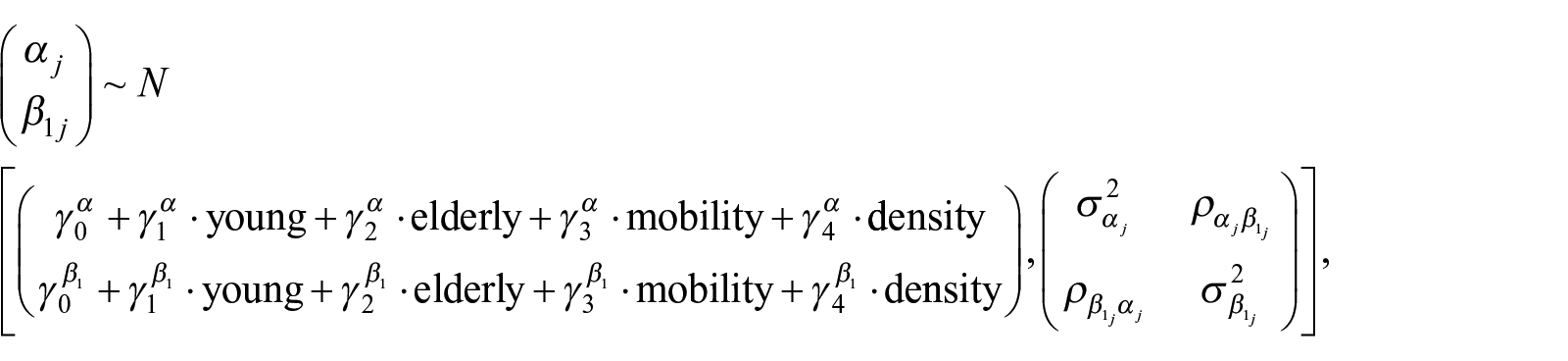
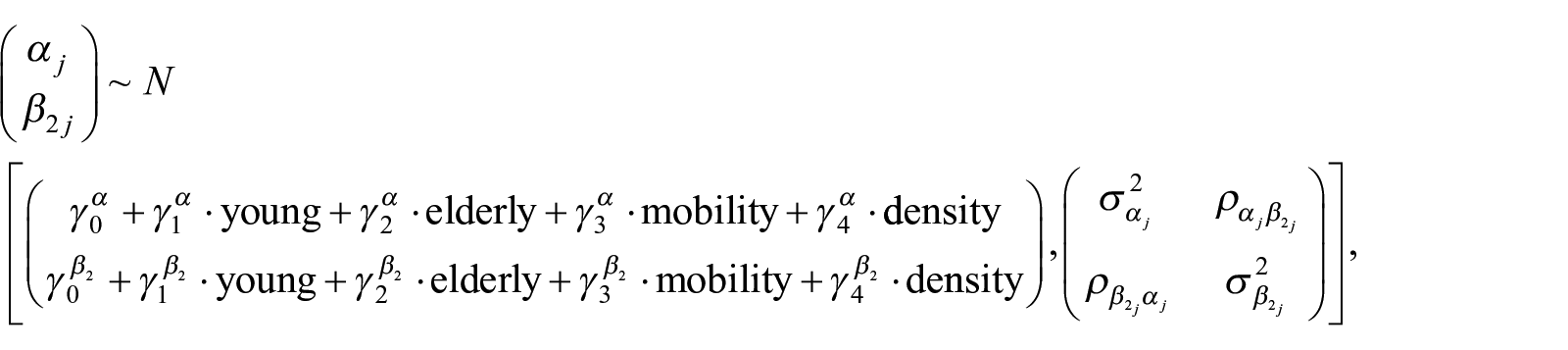
To avoid over-rejecting the null hypothesis of no cross-level interaction effects, we opt for a conservative approach of including random slopes for the lower-level components of the cross-level interactions: place of residence and place of birth (see Heisig and Schaeffer, 2019). In all models, we control for party fixed effects (β7−β13
The base model (random intercept only) is given by






where i denotes candidates, nested in electoral districts j, nested in cities k.
The Interaction Model 1 with random slope for place of residence is given by






The Interaction Model 2 with random slope for birthplace is given by






Operationalisation of the Dependent, Independent and Control Variables
To study the impact of candidate localness on electoral outcome, we analyse the vote shares that candidates receive in their districts (vote share). Level 1: living in the district indicates whether candidates live in the district where they run for office (1 = yes; 0 = no). The variable place of birth measures where the respective candidate was born. Candidates are coded as local (1) if they were born in the city region and 0 otherwise. 6
We control for several candidate characteristics commonly used as vote heuristics. We record whether a candidate is female (coded as 1). Female candidates can be confronted with stereotypes among the electorate (Bieber, 2013). Stereotypical male traits may be preferred by voters over female characteristics, resulting in negative effects of gender stereotyping for female politicians (Bieber, 2013; Huddy and Terkildsen, 1993). Studies indicate that female candidates are at an electoral disadvantage (Bieber and Wingerter, 2022; Kelley and McAllister, 1984; Rosar et al., 2007). We expect gender inequalities at the municipal level to the detriment of female candidates since gender may be particularly visible in low-information elections.
We measure age at the time of the election in years. While some research shows that older front-runners mobilise more electoral support than younger front-runners, a curvilinear effect is also conceivable, when elderly candidates are seen as frail (Eshima and Smith, 2022), while younger candidates are viewed as inexperienced (Campbell and Cowley, 2014). To assess this proposition, we split the age variable into five age groups (18–30; 31–45; 46–60; 61–75; 76+). We expect young candidates (18–30) to be viewed as insufficiently competent or experienced, whereas old candidates (76+) are perceived as not fit enough and, therefore, receive fewer votes than their middle-aged competitors (Rosar et al., 2007).
Another demographic characteristic is whether candidates hold an academic title. The variable doctoral degree is coded as 1 when a candidate holds a doctoral degree. Such candidates may be seen as more intelligent and competent (Rosar et al., 2007). Hence, many politicians holding an academic title make this information publicly available. Most studies report a positive effect of academic titles on electoral success (see, for example, Kelley and McAllister, 1984; Mechtel, 2014).
Finally, numerous studies have shown a positive effect of incumbency on electoral success (see e.g. Frendreis and Tatalovich, 2021; McElroy and Marsh, 2010; Trounstine, 2013). Incumbents are usually more visible than novices, leading to better chances of getting elected. Voters assume that incumbents are competent and more experienced simply because they have been in office before. The variable incumbent 2009–2014 measures if the candidate has been a member of the city council in the previous legislative period (1 = yes; 0 = no).
Level 2: We add further control variables at the district level to analyse the mechanisms driving localness. We include the share of young adults (18–29) and the share of elderly (65+) per district. These age categorisations are set by the municipal statistical offices and are not available for other age categories. As a robustness check, we include the mean age per electoral district for the interaction models in Online Appendix 8. For this variable, we have data on 226 electoral districts in eight cities. Residential mobility captures the rate of movement in a district, measured as the sum of in-migration and out-migration, relative to the total population in the district. The variable can also be used as a proxy variable for residence length. Finally, we test the impact of population density. The variable measures the number of inhabitants (per square kilometre) in an electoral district. All district-level data were obtained from the statistical and electoral offices of the respective cities.
Empirical Analysis
First, we provide descriptive statistics of our two localness indicators. Subsequently, we test our hypotheses about the effect of localness in low-information elections at the local level using multilevel regression analyses. Finally, we provide a more detailed examination of how instrumental and place identity motivations moderate the effects of candidate localness, testing whether the composition of the electorate impacts the importance of candidates’ local attachments. Table 1 provides an overview of our localness variables.
Descriptive Information on Candidates’ Localness.
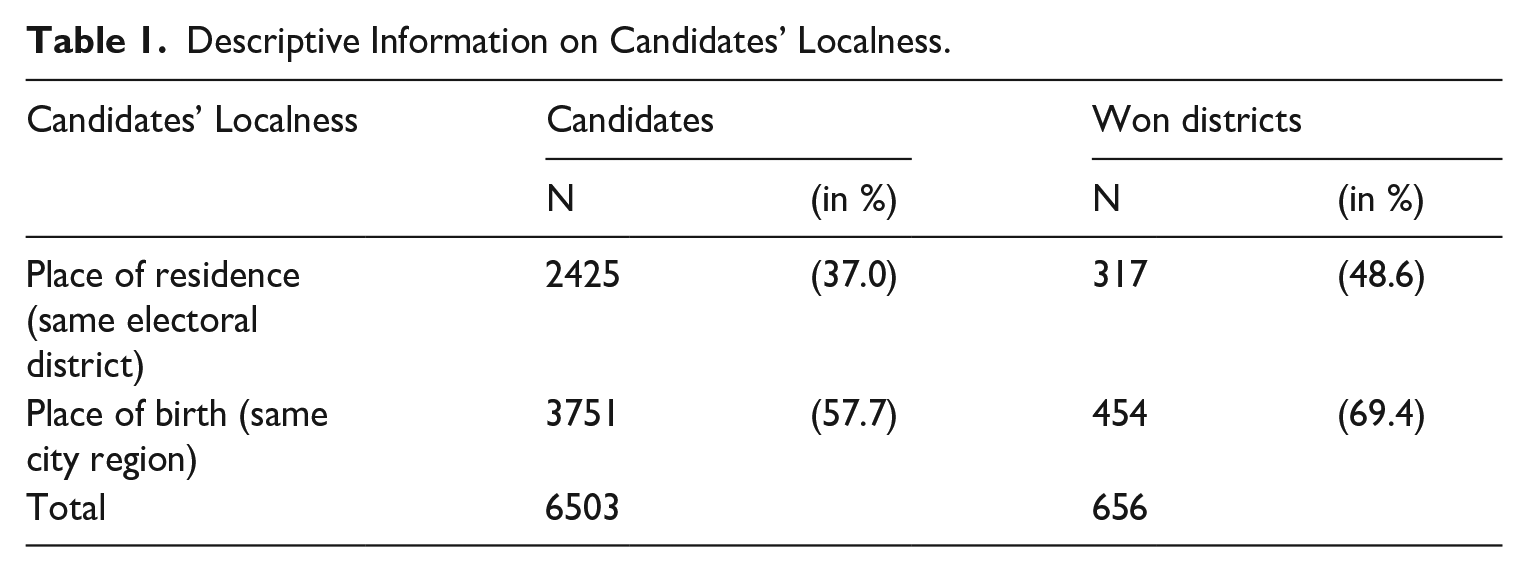
Of the candidates running in the 2014 local elections in North Rhine-Westphalia, 37% lived in the electoral district where they ran for office. These candidates won a disproportionately high number of district mandates (48.6%). In terms of birthplace, 57.7% of the candidates came from the same city region, winning 69.4% of the district mandates. The overview implies that both a local place of residence and a local birthplace positively affect the electoral outcome of candidates. We now continue with analysing the electoral advantage of local candidates.
Candidate Localness and Vote Share
The results from multi-level linear regression models explaining the vote shares of candidates are presented in Table 2. We proceed stepwise: the first model (M1) contains our two measures of candidate localness. The control variables are added in the second model (M2).
Explaining Vote Share: The Effect of Candidates’ Local Ties.
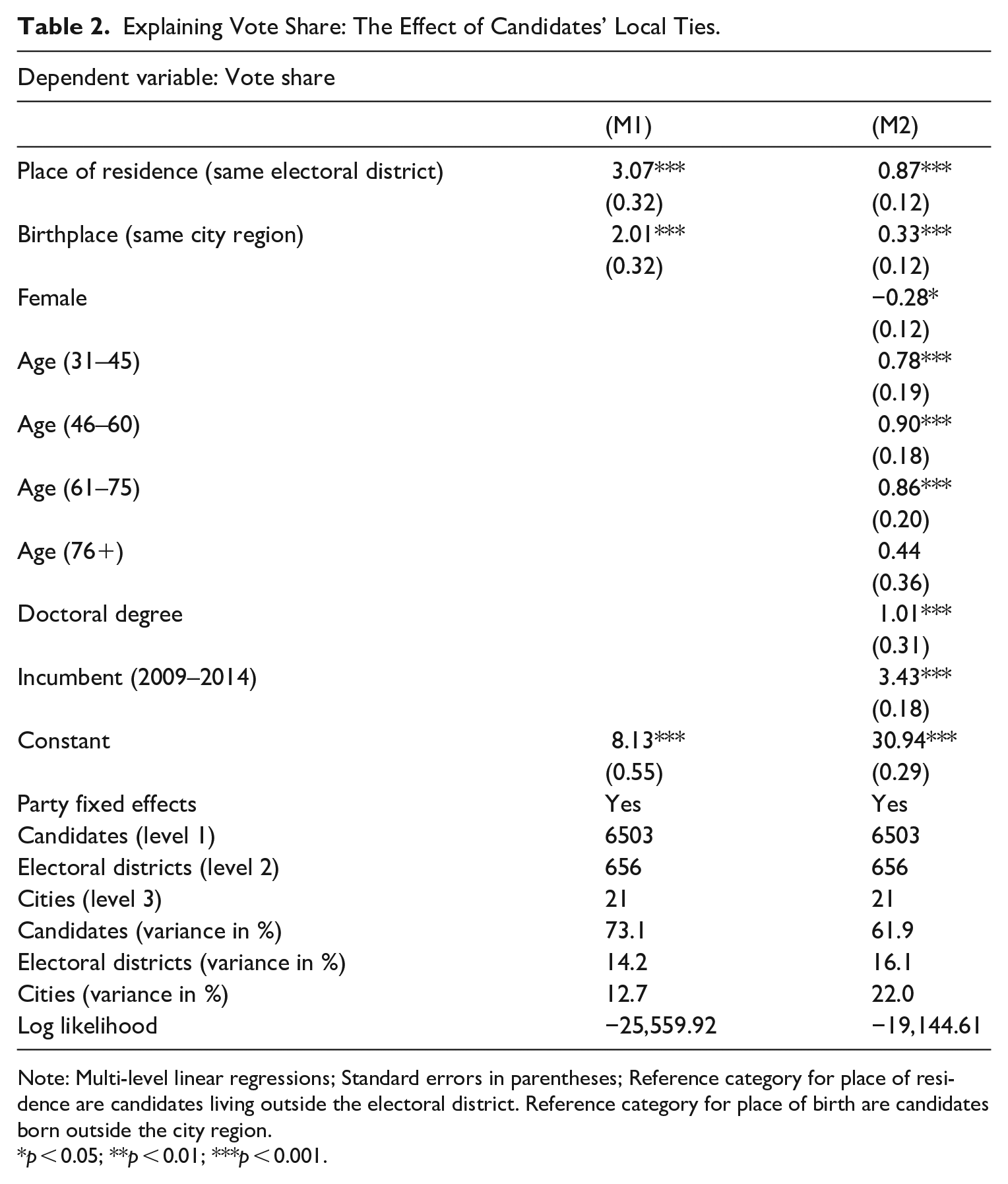
Note: Multi-level linear regressions; Standard errors in parentheses; Reference category for place of residence are candidates living outside the electoral district. Reference category for place of birth are candidates born outside the city region.
p < 0.05; **p < 0.01; ***p < 0.001.
We find empirical support for our theoretical argument that localness is an advantage for candidates in low-information elections. Living in the district where candidates run for office positively impacts their vote share, which is in line with H1, and which is indicated by the positive and statistically significant effect of place of residence in M1. The effect remains robust when including the control variables in M2, corroborating our finding that voters favour candidates living in their district. Turning to our second indicator of localness, place of birth, we find that candidates born in the city region receive more votes than outside candidates, indicated by the positive and statistically significant effect of birthplace (same city region), and thus lending support to our second hypothesis. Regarding the control variables, the results are as expected. Female candidates receive significantly fewer votes than male candidates, while doctoral degree holders and incumbents have a higher vote share than non-degree holders or novices. As expected, middle-aged candidates (31–75) perform better than young (18–30) and old candidates (76+).
For better comparability between our age categories, we present the associated marginal means in Online Appendix 3. We also repeated the analysis of model 2 using a continuous and a quadratic age measure, including its average marginal effects (see Online Appendix 4). The results remain consistent: middle-aged candidates perform better than old and young candidates. Overall, the analyses confirm that candidate localness matters in low-information elections at the local level. Living in the electoral district and being born in the respective community increases a candidate’s vote share.
Probing the Mechanisms Behind the Localness Effect
Having demonstrated that candidate localness matters in low-information elections at the local level, we now test the mechanisms that shape these effects. So far, there is little empirical evidence on what drives the advantage of local candidates (Campbell et al., 2019). This section explores whether the composition of the electorate impacts the advantage of local candidates in terms of their place of residence and place of birth.
To this end, we estimate interaction effects with the four indicators of electorate composition at the district level to assess how these indicators modify the effects of birthplace and place of residence. We expect all voters to have an instrumental interest in councillors representing their district (H3), while voters can be more or less interested in candidates who share their place-based identity (H4a–d). Therefore, as the instrumental utility of a candidate who lives in the district where they run for office is more evident than the utility of a candidate with a birthplace in the region, we expect the effect of birthplace to depend on the composition of the electorate, leading us to expect statistically significant interactions between our indicators of electorate composition and local birthplace, while we do not expect such interactions for a local place of residence.
Beginning with place of residence, the results of four models for candidate vote share containing interaction terms for the four indicators of electorate composition and candidates’ place of residence are presented in Table 3.
Explaining Vote Share: Composition of Electorate and Place of Residence.
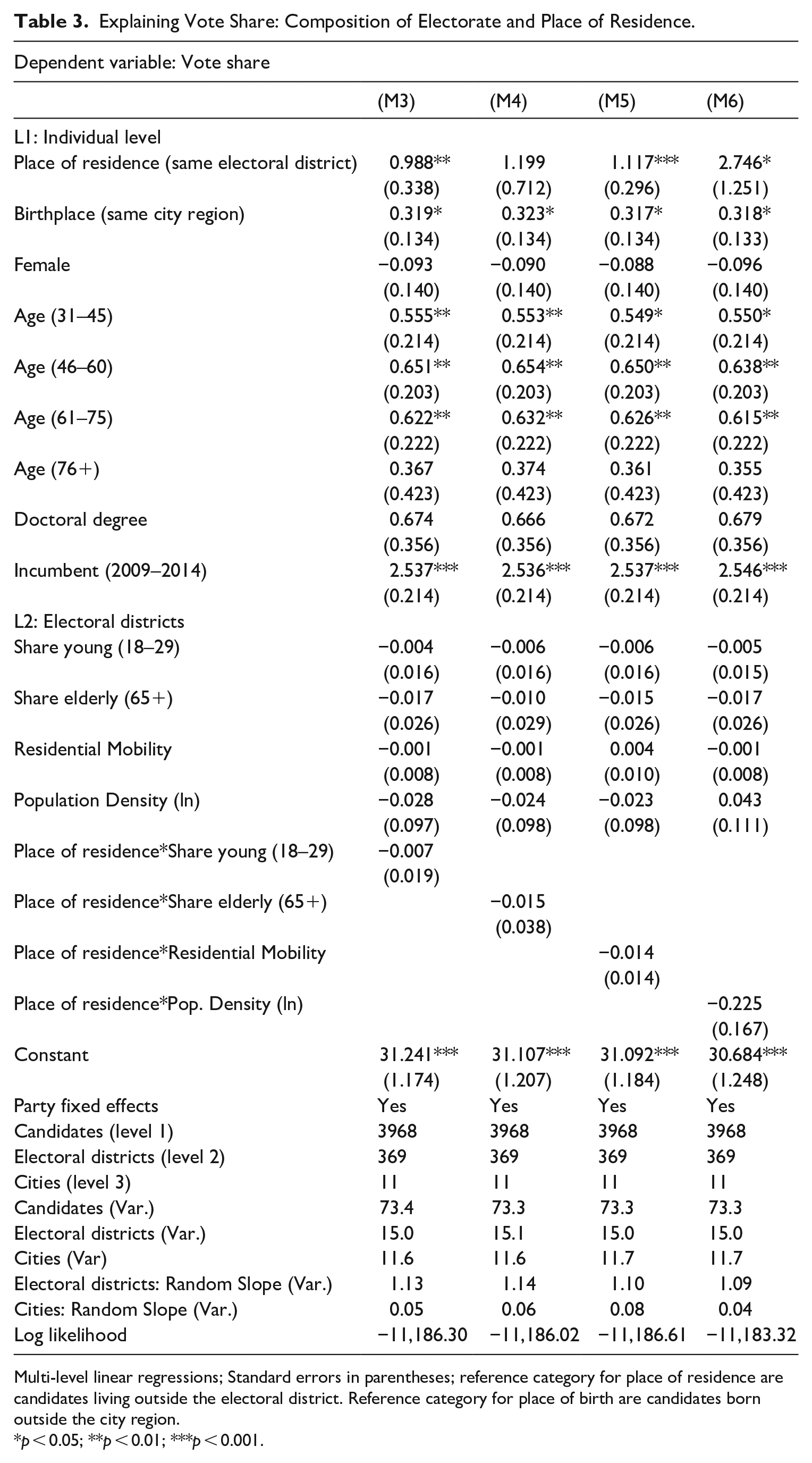
Multi-level linear regressions; Standard errors in parentheses; reference category for place of residence are candidates living outside the electoral district. Reference category for place of birth are candidates born outside the city region.
p < 0.05; **p < 0.01; ***p < 0.001.
The results show no statistically significant interaction between the four variables and the place of residence, suggesting a more instrumental motivation as the driver behind the effect of candidates’ place of residence. The preference for a candidate living in the same district is tied to the promise of better representation of personal interests, which all voter groups share in line with our third hypothesis. A different picture emerges for the effect of birthplace (see Table 4). As expected, a larger share of young residents (18–29) (H4a), a higher residential mobility (H4c), and a higher population density (H4d) diminish the effect of candidates’ birthplace on their vote share. On the other hand, a higher share of elderly residents (65+) amplifies the birthplace effect (H4b).
Explaining Vote Share: Composition of Electorate and Birthplace.
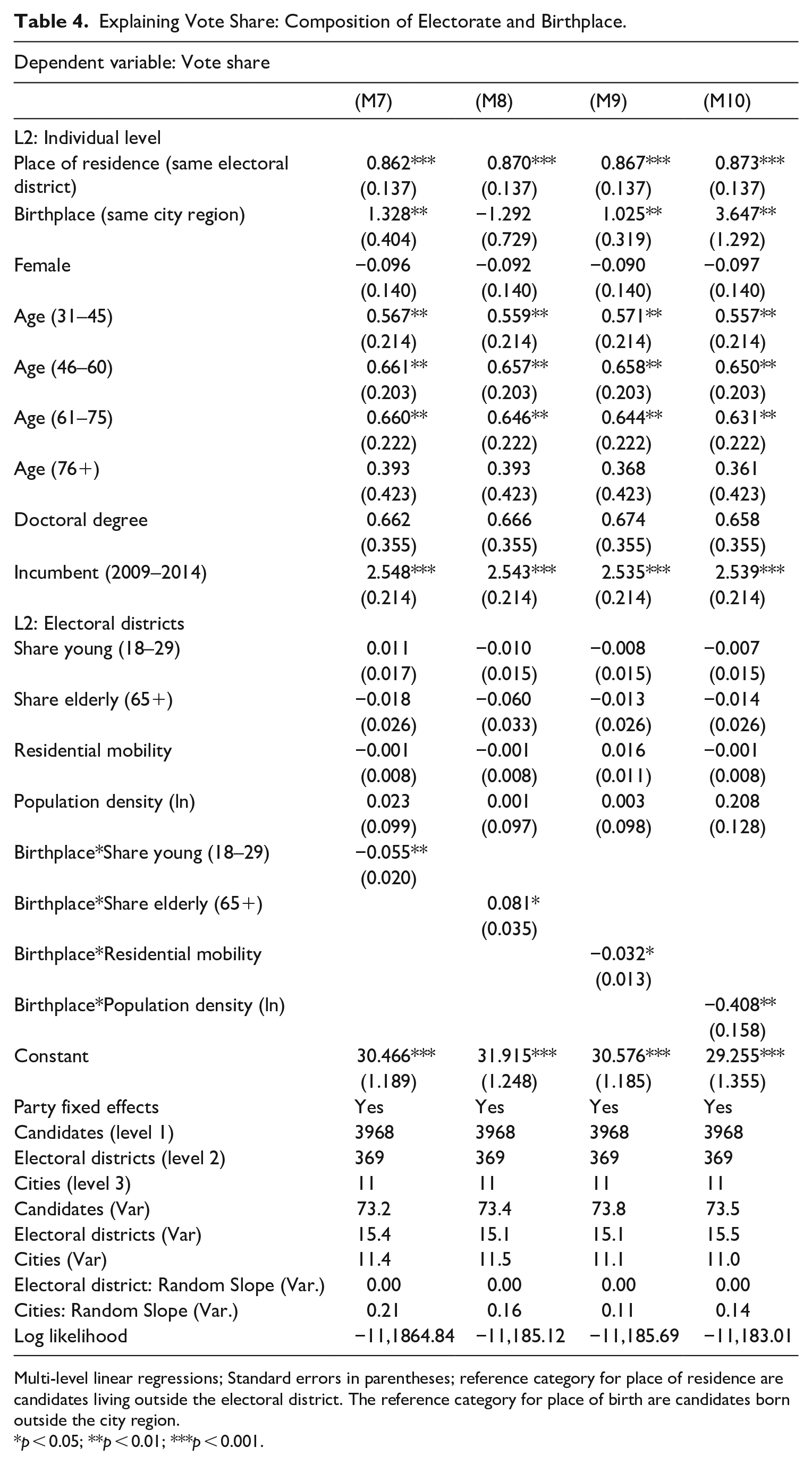
Multi-level linear regressions; Standard errors in parentheses; reference category for place of residence are candidates living outside the electoral district. The reference category for place of birth are candidates born outside the city region.
p < 0.05; **p < 0.01; ***p < 0.001.
As an additional control for our age categories, which are determined by the information given by the statistical offices, we ran interaction effects for the electoral districts’ mean age with both localness variables. The results align with our findings, indicating that age structure in the electoral district does not affect instrumental motives, while identity considerations become more important for an older electorate (see Online Appendix 8). As a further control, we included the interaction terms with both localness variables from Tables 3 and 4 in a full model (see Online Appendix 9). 7 The results remain robust. To improve comparability between both localness indicators, we also plotted the marginal effects of these interaction effects (see Online Appendix 11).
The results of these additional analyses support the finding that the importance of a shared place identity depends on the composition of the electorate. The effect of a candidate’s birthplace is thus more clearly shaped by a shared place identity, as all voters should care about a local candidate from an instrumental perspective. As a robustness check, we calculated linear regressions for all models in Tables 2 –4, including party- and city-fixed effects. Mainstream parties, such as CDU and SPD, might be able to draw from a larger candidate pool and might be more likely to field birthplace candidates. Moreover, one could expect stronger party politicisation as the city size increases. Notwithstanding these additional robustness checks, the substantive conclusions remain the same. 8
Discussion and Conclusion
This article aimed to explain a potential electoral advantage of local candidates in low-information elections at the local level. Building on the notion that voters rely on heuristics like political and social stereotypes to judge candidates and make electoral decisions (Conover and Feldman, 1989; McDermott, 1997, 1998; Tversky and Kahneman, 1974), we argued that such heuristics are of particular importance to voters in low-information elections, as they hardly have any other information on the candidates. Moreover, local elections tend to be about local issues, which is why the local ties of candidates ought to be of greater relevance.
Building on a novel dataset covering 6503 candidates in 656 electoral districts for the 2014 local elections in 21 cities with a population of more than 100,000 in the most populous German state, North Rhine-Westphalia, our results indicate that candidate localness does matter for electoral outcomes. Specifically, we found that living in the district where candidates run for office positively impacts their vote share as well as being born in the same city region.
While extensive empirical evidence confirms the advantage of local candidates, the mechanisms accounting for the ‘localness effect’ remained unclear (Campbell et al., 2019). Our findings indicate that both instrumental and place identity motivations explain the advantages of local candidates. Furthermore, we provide some initial empirical insights into how these two mechanisms operate. The preference for a candidate living in the same district is tied to the promise of better representation of personal interests. These instrumental motivations work independently of specific voter groups. In contrast, birthplace is more clearly shaped by a shared place identity that depends on the composition of the electorate as its effect differs between voters. A large share of elderly residents amplifies the place-of-birth effect, whereas a large share of younger voters, a high level of residential mobility, and a high population density diminish the importance of a shared identity for candidates’ electoral success. Consequently, our empirical findings have broader implications for research on electoral behaviour and candidate localness (Arzheimer and Evans, 2014; Campbell et al., 2019; Górecki et al., 2022; Schulte-Cloos and Bauer, 2021).
Our findings demonstrate that instrumental and identity motivations account for the electoral advantage of local candidates but for different reasons. Here, more research is needed to extend these findings to other elections, countries, and electoral systems, especially regarding additional factors shaping a place identity. Moreover, the extent to which these two mechanisms dominate in forming electoral decisions depends on the information that voters have at their disposal. This highlights that it matters what information voters are provided with, especially in low-information elections. It seems that in this context voters rely more on low-effort cues such as candidate age (Eshima and Smith, 2022), experience (incumbency), or local attachment (Shugart et al., 2005).
We can show that cues on local attachment are strong in local elections, where voters have little information on candidates and where local issues prevail. But how does this argument generalise beyond German local elections? We argue that our analyses offer a good starting point for future studies. Although we expect such cues to be less impactful in elections where candidates and their policies are more familiar to voters, such as in state or federal elections, evidence from other countries on elections at various political levels indicates an electoral advantage for local candidates as well (Arzheimer and Evans, 2012, 2014; Evans et al., 2017; Gimpel et al., 2008; Górecki et al., 2022). Using data from Lithuania’s mixed-member majoritarian electoral system, Herron and Lynch (2019) find a localness effect for place of residence and birthplace and that this effect even seems to extend beyond constituency races into the party-list ballot. Drawing on a survey experiment fielded in Hungary before the 2022 general election, Kovarek (2022) shows that respondents who were told that a candidate was born and lives in their hometown were more likely to believe that the politician is likely to obtain government funds for their municipality.
However, the analysis of how instrumental and identity considerations operate in such electoral contexts, whether there are differences between countries, or if there is variation between urban and rural areas, is a question for future research. In line with that, and although preliminary empirical evidence on both mechanisms is provided, more conclusive evidence requires individual-level data rather than aggregate voting data, as there is a risk of ecological fallacy in interpreting the results. For example, it is not clear whether the district characteristics, such as residential mobility (Lewicka, 2011), are mirrored in the participation rates of voters who have lived in a district for a long time. Studying the drivers of individual vote choices requires surveys or experimental designs. However, experimental designs with fictitious candidate profiles also tend to be characterised by low external validity.
In probing the advantage of local candidates in low-information elections at the local level and testing the mechanisms behind this effect, our study contributes to a nascent body of literature on the mechanisms behind ‘friends-and-neighbor’ voting (see Campbell et al., 2019; Frendreis and Tatalovich, 2021; Schulte-Cloos and Bauer, 2021). It also speaks to a large body of research on political representation as voters’ preferences for local candidates might reasonably translate into a more accurate representation of their individual and their districts’ needs by representatives (Mansbridge, 1999; Zittel et al., 2019). Hence, representatives may also signal their localness to their constituents in parliamentary behaviour and not just on ballots (e.g. Russo, 2011; Sällberg and Hansen, 2020). Our findings suggest that both instrumental and place identity motivations could explain this effect and that the latter depends on the composition of the electorate.
Finally, our empirical findings also speak to candidate nominations. For instance, our findings suggest that candidates from outside the city region stand the best chance in electoral districts characterised by a young electorate, high residential mobility, and high population density. In general, it would be worth examining which candidates are being nominated in the first place and why, as these decisions may impact who gets elected (see, for example, Berz and Jankowski, 2022). When it comes to the nomination of mayoral candidates, we know from the German context that the majority of candidates were born and raised in the locality where they are nominated (Holtkamp and Gehne, 2002). Moreover, approximately 70% of all mayors grew up in or near the town where they are elected (Bertelsmann Stiftung et al., 2008). Since the mayor is the most prominent position in local politics it is plausible that these findings would also apply to the nomination of local councillors. Parties prefer to nominate candidates born and raised in their respective locality. Yet, it remains unclear how the nomination proceeds when the number of potential local nominees is small and when parties need to choose in which districts to field local candidates. It may be the case that non-local candidates are more likely to be nominated when parties are weak or do not stand a chance. Nevertheless, a reverse scenario is also plausible, with parties nominating non-local candidates when they are already sure of winning the district. To the best of our knowledge, there is no empirical study testing these theoretical expectations.
Supplemental Material
sj-docx-1-psx-10.1177_00323217231173505 – Supplemental material for Probing the Effect of Candidate Localness in Low-Information Elections: Evidence from the German Local Level
Supplemental material, sj-docx-1-psx-10.1177_00323217231173505 for Probing the Effect of Candidate Localness in Low-Information Elections: Evidence from the German Local Level by Jan A Velimsky, Sebastian Block, Martin Gross and Dominic Nyhuis in Political Studies
Footnotes
Acknowledgements
Previous versions of this article have been presented at the Annual General Conference of the European Political Science Association 2021. We thank the panel participants and the two anonymous reviewers for their valuable suggestions and helpful feedback. We are also grateful to Louis Drexler, Hanna Hieronymus, Aaron Reudenbach, Janina Schindler, Sinéad Thielen, Katia Werkmeister and Annica Missy for excellent research assistance.
Declaration of Conflicting Interests
The author(s) declared no potential conflicts of interest with respect to the research, authorship and/or publication of this article.
Funding
The author(s) disclosed receipt of the following financial support for the research, authorship and/or publication of this article: Funding for this project was provided by the German Research Foundation through Grant Nos GR 5526/1-1 and NY 123/1-1.

Supplemental Material
Additional Supplementary Information may be found with the online version of this article.
A1. Data overview. A2: Descriptive statistics. A3: Marginal means for age groups. A4: Age – continuous variable and polynomial terms. A5: Explaining vote share: (OLS regressions). A6: Explaining vote share: Composition of Electorate and Place of Residence (OLS regressions). A7: Explaining vote share: Composition of Electorate and Birthplace (OLS regressions). A8: Explaining vote share: Interaction with electoral districts’ mean age. A9: Explaining vote share: Interactions between composition of electorate variables with Birthplace and Place of Residence. A10: Model specification for full model in Online Appendix 9. A11: Marginal Effects of Interaction Terms from Online Appendix 9 (predicted Values).
Notes
Author Biographies
References
Supplementary Material
Please find the following supplemental material available below.
For Open Access articles published under a Creative Commons License, all supplemental material carries the same license as the article it is associated with.
For non-Open Access articles published, all supplemental material carries a non-exclusive license, and permission requests for re-use of supplemental material or any part of supplemental material shall be sent directly to the copyright owner as specified in the copyright notice associated with the article.
