







Abstract
Do voters decide on the basis of the election pledges political parties make? Although this is a key assumption in most democratic theories and, seemingly, among parties who issue dozens of pledges during campaigns, the scientific literature does not provide a clear answer to this question. This article develops a theory of pledge-based voting and a research design that allows for studying the electoral effects of pledges in real-time as the campaign unfolds. Based on a novel experimental design embedded in panel surveys administered during and after the 2019 Danish national election campaign (N = 6233), we estimate that the most salient pledges affect vote choice by between 1.1 and 2.1 percentage points averaged across the electorate. While modest, these effects can be decisive in the often highly competitive context of modern elections. The findings have implications for our understanding of political behavior, party politics, and normative theories of democracy.
Introduction
Election pledges allow voters to select parties and candidates that match their preferences and to steer future policy-making. Accordingly, most theories of representative democracy assign pledges a central role in ensuring meaningful political representation and legitimacy (Mansbridge, 2003; Mellon et al., 2021; Pitkin, 1967). Still, we have very limited empirical evidence on whether voters actually use pledges when casting their vote in real-world elections since most research focuses on voters’ responses to parties’ retrospective performance, general ideological positions, or issue emphasis (Downs, 1957; Klingemann et al., 1994). Although it is well established that parties issue dozens, if not hundreds, of pledges about what they intend to do if they win (Naurin et al., 2019; Thomson et al., 2017; Matthiess, 2020) and that their approval ratings suffer if they break such pledges (Bagashkaet al., 2022; Matthiess, 2020; Naurin et al., 2019), we do not know to what extent voters reward parties for making popular pledges in the first place.
Although research on voters’ use of election pledges is scant, related work suggests that general campaign efforts by parties and candidates have minimal effects. A recent meta-study found that the best estimate of the effect of campaign contact on vote choice is zero (Kalla and Broockman, 2018), and, similarly, campaign advertisement and speeches have little to no discernible effects among voters (Broockman and Green, 2014; Coppock et al., 2020; Selb and Munzert, 2018). As such, there is real reason to question the assumption that voters use pledges to select parties.
To test whether the electorate engages in pledge-based voting, this article contributes to the existing literature theoretically and methodologically. At the theoretical level, we propose a theory of pledge-based voting for understanding to what extent and among whom pledges matter. Pledges appeal to voters because they enable them to pursue their policy preferences via the selection of parties advocating specific policies. Yet, voters also risk casting their vote in exchange for a policy that the party or candidate does not subsequently fulfill. This element of risk has two key implications. First, pledge-based voting requires that voters have a certain level of confidence in the sponsor of the pledge, meaning that voters should mainly rely on pledges from the party they already affiliate with and are likely to vote for. Second, pledge-based voting should mainly occur among the less politically sophisticated voters who cannot draw on less risky information about parties’ past performance. Both points imply that the effects of election pledges are real but limited in size as they mainly appeal to certain subsets of the electorate.
Methodologically, we develop a unique research design to overcome the basic challenge in studying the causal effects of pledges, namely that we cannot ask voters after an election whether certain pledges affected their vote choice. Instead, we need to track voters as they are exposed to real-life pledges and then cast their vote on Election Day—and do so in an experimental setting where we can causally identify the effect of pledges. By fielding panel surveys with embedded experiments during and after the Danish 2019 national election campaign (n = 6233), we are able to do just that. Moreover, our design circumvents ethical and methodological issues with deception, retrospective voter bias, and low ecological validity when studying campaign effects on vote choice.
We find support for the argument that pledges can affect vote intentions and actual vote choice and that these effects are generally confined to voters with low political sophistication who already affiliate with the sponsor of the pledge. Our best estimate is that the most salient, popular pledges can increase the vote share of the party sponsoring the pledge by between 1.1 and 2.1 percentage points averaged across the full electorate. These findings have two important implications. First, our findings show that the assumption in theories of democratic representation that voters use election pledges to cast their vote and steer future policy-making applies, although mainly in a subset of the electorate, namely, the less politically sophisticated partisans. Second, although pledges mainly have an effect among specific electoral subgroups, these effects can be important for the aggregate electoral outcome. Given that elections are often highly competitive and won by small margins, pledges that move the electorate by even a single percentage point can be electorally decisive. In short, the effects of election pledges are limited but real in the sense that they are confined to certain segments of the electorate, but, on the average, strong enough to make a potential difference in democratic politics.
Election Pledges in Democratic Politics
The literature contains mixed evidence on how much voters engage in prospective voting (Elinder et al., 2015; Lanoue, 1994; Norpoth, 1996). This likely reflects that prospective voting is a broad concept that refers to effects of widely different types of information such as parties’ concrete policy proposals, projections about the economy under the incumbent government, and parties’ preferences for government coalitions (Elinder et al., 2015; Norpoth, 1996: 178). We consider election pledges a distinct subtype of prospective information that may indeed be able to sway some voters.
Pledges are conventionally defined as “a statement committing a party to one specific action or outcome that can be clearly determined to have occurred or not” (Thomson et al., 2017: 532). That is, pledges are characterized by a high degree of assurance (using firm language such as “we will” or “we promise”) as well as testability (allowing voters to assess whether the pledge was kept or not).
In this sense, pledges are distinct from—and potentially more appealing to the electorate than—other forms of prospective information. One prominent line of research studies the electoral effects when parties either moderate or radicalize their position in a one-dimensional Left–Right space (e.g. Adams et al., 2006). Pledges are different from these more aggregated forms of policy signals because they allow voters to directly evaluate parties’ policy performance against a testable statement. Whether a party has defected from its centrist position toward something extreme may be hard to tell for ordinary voters because, for one thing, a party’s Left–Right position is made up of several issue dimensions. In this regard, pledges are different due to their testability. Pledges also differ from projections about how, for example, the economy will develop if the incumbent government is re-elected since such projections come with little to no assurance. Similarly, parties’ preferences for government coalitions come with little assurance since such coalitions depend on the support of the electorate. For these reasons, it makes sense that voters use pledges retrospectively to hold parties accountable for their policy performance (Naurin et al., 2019; Matthiess, 2020).
Pledges are powerful policy signals exactly because pledge breaking is electorally costly. All else equal, parties will be careful only to issue pledges that they have a reasonable chance of fulfilling if they get into office—an assumption supported by the fact that governments typically keep a substantial amount of their pledges (Thomson et al., 2017). In a nutshell, because voters use pledges to vote retrospectively (at t2), pledges also allow voters to vote prospectively (at t1). Indeed, many major theories of democratic politics consider pledges vital to the democratic process because they allow voters to choose between parties retrospectively based on pledge fulfillment and prospectively based on their pledges about the future course of policy-making (for a few of the seminal pieces building on this assumption, see Downs, 1957; Klingemann et al., 1994; Pitkin, 1967).
Yet, we have very little evidence on whether and to what extent voters actually use pledges prospectively when voting in real-life elections. One important study (Elinder et al., 2015) found that Swedish parents with young children became less likely to vote for the Social Democrats in the 1994 election after the party had promised to cut financial aid to families with young children and, vice versa, became more supportive of the party after it promised cheaper child care in 1998 (relative to parents with older children, unaffected by the promises). This certainly suggests that election pledges targeting specific electoral segments can affect vote shares among this segment, at least when strong material interests are at stake. Still, these conclusions rest on the assumption that no other factors—prospective or retrospective—systematically affected the likelihood of parents with young children voting for the Social Democrats before and between these elections. This underscores the methodological and ethical challenges involved in studying the causal effects of pledges. In essence, we need to measure and isolate the effect of voters’ actual exposure to and knowledge of pledges, which requires tracking voters and experimentally exposing them to pledges in real-time as the election campaign unfolds. Ethically, since we study effects on real-life political election outcomes, such an experimental approach cannot involve deception where voters could end up casting their vote based on pledges that are not real.
So far, experimental work on the topic has only been conducted outside of a political context in laboratory-based economic games. Research in psychology and behavioral economics has provided mixed evidence on whether “cheap talk” by one player (i.e. non-binding promises to share economic pay-offs) makes others more inclined to trust the player and cooperate for mutual benefit (Born et al., 2018; Kerr and Kaufman-Gilliland, 1994; Wilson and Sell, 1997). 1 Even if such work had been more conclusive, we would still need evidence on whether the findings travel to a political context where voters draw on numerous other considerations aside from economic pay-offs (Inglehart, 2008). In the methods section below, we outline an experimental research design to overcome these methodological and ethical challenges.
A third challenge is the lack of theorizing about whether and when citizens rely on pledges when making their prospective vote choice. The section below considers defining characteristics of pledges and lays out a theory of prospective pledge-based voting.
A Theory of Prospective Pledge-Based Voting
At first glance, the distinction between voters’ retrospective and prospective use of pledges may seem trivial. Given that voters consider pledges important after an election (Naurin et al., 2019; Matthiess, 2020), they likely also find them important before an election. However, the crux of our argument is that there is one defining characteristic of pledges that makes voters hesitant toward using pledges prospectively and that shapes when and to what extent they allow pledges to inform their vote choice. Pledges are a unique subgroup of campaign rhetoric because they ask citizens to enter into a social contract with a political actor, that is, to cast their vote on Election Day in exchange for a desired policy output after the election (cf. the definition above). Because voters need to honor their part of the social contract (voting) before the political actor honors its part (delivering policy), the voters risk getting cheated by actors who do not keep their pledge. In our argument, this entails that voters only rely on pledges under two conditions where the risk of being cheated is deemed acceptable.
First, we expect that voters will be willing to accept the risk of cheating when they have confidence in the party sponsoring the pledge. Given that voters generally hold little confidence in politicians and the political system (Bøggild, 2016, 2020b; Hetherington and Rudolph, 2015) and, in turn, believe that most parties are unlikely to fulfill their pledges (ISSP Research Group, 2018), we expect that voters will not exchange their vote for a pledge, unless it comes from a party they already identify and affiliate with. Voters exhibit higher confidence in the party they identify with (Hetherington and Rudolph, 2015; Keele, 2005) and, as a result, are more inclined to follow its recommendations or “cues” when forming opinions about political issues or the state of the economy (Campbell et al., 1960; Slothuus and Bisgaard, 2021). Moreover, two studies have found that supporters of the governing party evaluated the government’s degree of pledge fulfillment higher compared to supporters of the opposition (Pétry and Duval, 2017; Thomson, 2011). As such, voters often exhibit confirmation bias, meaning that they mainly pay attention to and accept information and arguments from the political party they identify with while ignoring and refusing information from opposing parties. Thus, partisanship both confines and enables pledge-based voting. It confines because voters only consider a select number of pledges from a specific political party that they already identify with and, in turn, are likely to vote for either way. Yet, it also enables for two reasons. First, it instills the necessary confidence in a party for voters to run the risk entailed in pledge-based voting. This is essential in most modern democracies where general trust in politicians, parties, and the political system is limited (Bøggild, 2020b; Hetherington and Rudolph, 2015; see also Thomson and Brandenburg, 2019). Second, voters’ identification with a party does not necessarily mean that they vote for the party or its candidates in a given election, which implies that a pledge may indeed persuade identifiers to actually cast their vote for the party. 2 For these reasons, partisanship should contribute to limited but real effects of election pledges on vote choice.
Second, we expect that limited but real effects also emerge due to variation in political sophistication across the electorate. Specifically, voters should be more willing to accept the risk associated with pledge-based voting when they have little or no alternative political information to draw on. Clearly, retrospective evaluations of parties’ performance do not hold the same element of risk as they build on past rather than future behavior. This may, at least in part, explain why the effects of prospective evaluations of parties sometimes get diminished or washed out when retrospective evaluations are available to the individual (Lanoue, 1994; Norpoth, 1996, but see Elinder et al., 2015). Politically sophisticated voters enter into election campaigns with more elaborate retrospective evaluations of incumbent performance (Delli Carpini and Keeter, 1996; Zaller, 1992). 3 In addition, although politically sophisticated voters are more inclined to be exposed to pledges, they are also more motivated to defend their prior evaluations against new information that challenges their evaluations compared to less sophisticated citizens (Lodge and Taber, 2013). 4 Thus, the effects of pledges are limited but real because they should primarily affect vote choice among the less politically sophisticated voters.
In sum, we expect that the effect of a pledge will be confined to voters who are both low in political sophistication and already affiliate with the sponsor of the pledge. That is, we consider low political sophistication and identification with the sponsor as two necessary conditions that, in conjunction, make voters respond to election pledges. Given that pledges should only matter for specific subgroups of the electorate, we expect the overall average effects to be limited, although still potentially important in determining competitive elections.
Case Selection and Research Design
Methodologically, our study adds to the existing literature in two ways. First, in terms of case selection, we conduct our study in the context of a real-life political election campaign and consider the effects of election pledges made by real political parties. This ensures high ecological and external validity and circumvents ethical issues with deception where voters could end up casting their vote based on fictitious pledges. Second, in terms of research design, we develop an experimental protocol embedded in a nationally representative panel survey that allows for strong causal identification. Based on random assignment, we are able to control and isolate voters’ exposure to given election pledges during the campaign. Based on follow-up interviews conducted after the election, we are able to gauge not only the short-term effects of exposure immediately after the treatment is administered but also its potentially enduring effect on vote choice through the election campaign (see, for example, Coppock, 2017). Below, we lay out our methodological choices related to case selection and research design.
Case Selection
Choice of Political Context
Our study centers on the Danish 2019 national election. Denmark is typical of the majority of Western representative democracies on at least three accounts. First, Denmark is a multiparty system. In the 2015–2019 electoral cycle, nine parties were represented in the Parliament. The two biggest parties are the Social Democrats (a mainstream left-of-center party), which won 25.9% of the vote in the 2019 election, and the Liberal Party (a mainstream right-of-center party), which won 23.4%. Equally fragmented party systems are found across Europe—from countries like Germany and Italy that used to host just a few, big parties to countries like the Netherlands and Sweden that have a long history of multiparty competition. 5
Second, electoral competition is fierce, and government power has shifted from one side of the aisle to the other frequently. In 2011, a coalition government led by the Liberal Party lost power to a coalition led by the Social Democrats, which again lost to the Liberal Party in 2015, only to see power flip back to the Social Democrats in the 2019 election. Figure 1 illustrates this point. It details the margin of victory for the incoming government and its supporting parties in Denmark since the 1950s and compares it with Great Britain and the USA, two countries known for their tumultuous politics. The winning margin of incoming governments in Denmark has only once since 1980 been more than 5 percentage points—and often the margin of victory is considerably smaller. This is the same margin of incoming American presidents in all elections but one since 1980. The margins of victory tend to be bigger in Great Britain but can still be quite tight as in 2005 and 2017.
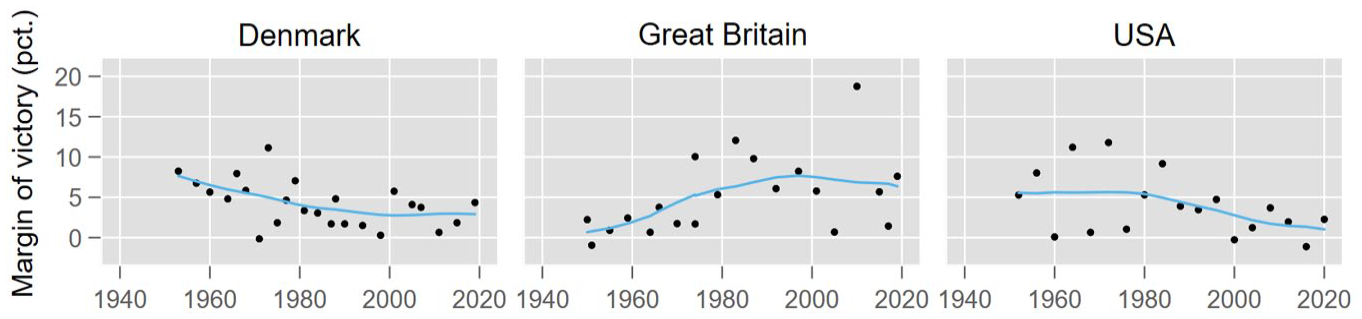
Margin of Victory in Denmark, Great Britain, and USA.
Figure 1 not only suggests that electoral competition in Denmark is tough; it also indicates what effect size pledges should have on vote choice for us to consider them substantially interesting. As we discuss below, our best estimate of the effect of a salient, popular pledge on vote choice is between 1.1 and 2.1 percentage points. In several elections over the past decades in Denmark, Great Britain, and the USA, this would be enough to change the outcome of the election, and in virtually all elections since the 1950s, the effect would be important even if not sufficient for victory.
Third, the realism of this estimated effect, of course, depends on Danish parties actually competing on pledges. Thomson et al. (2017) and Naurin et al. (2019) present data on pledge-making in 12 Western democracies (but not Denmark) across 57 elections and find that a party on average makes 105 pledges in national elections (SD = 63.9). For our study, we collected the population of pledges made by the Liberal Party and the Social Democrats in the run-up to the 2019 national election, as explained in detail below. The former made 89 and the latter 112 pledges, so clearly the Danish case here, too, conforms to the general pattern. In the discussion, we return to the question of how our results travel to other contexts.
Collection and Crowd-Coding of Election Pledges before Campaign
We collected all pledges made by the two main contenders for government—the Social Democrats and the Liberal Party—including all pledges made in the last year before the election. The media predominantly reports election pledges from main parties contending for government (Kostadinova, 2017), meaning that such pledges are most likely to reach voters and have a potential effect on vote choice outside of an experimental setting. Moreover, voters should be more attentive to pledges from contenders for government because such pledges are most likely to be fulfilled (Thomson et al., 2017). In the discussion, we return to the potential effect of pledges from fringe parties. We drew on Thomson et al.’s (2017: 532) definition of a pledge as “a statement committing a party to one specific action or outcome that can be clearly determined to have occurred or not.” 6 The homepages of the two parties served as the primary source. Party officials confirmed that all major political statements could be found here. Still, the homepages were supplemented with the parties’ Facebook accounts to ensure that we located all relevant statements. 7 Two student assistants collected the statements according to the selection criteria. The initial coding showed acceptable reliability with agreement on 73% of the included statements. Mismatches between the codings were subsequently addressed jointly. This process yielded a total of 201 pledges, 89 from the Liberal Party and 112 from the Social Democrats.
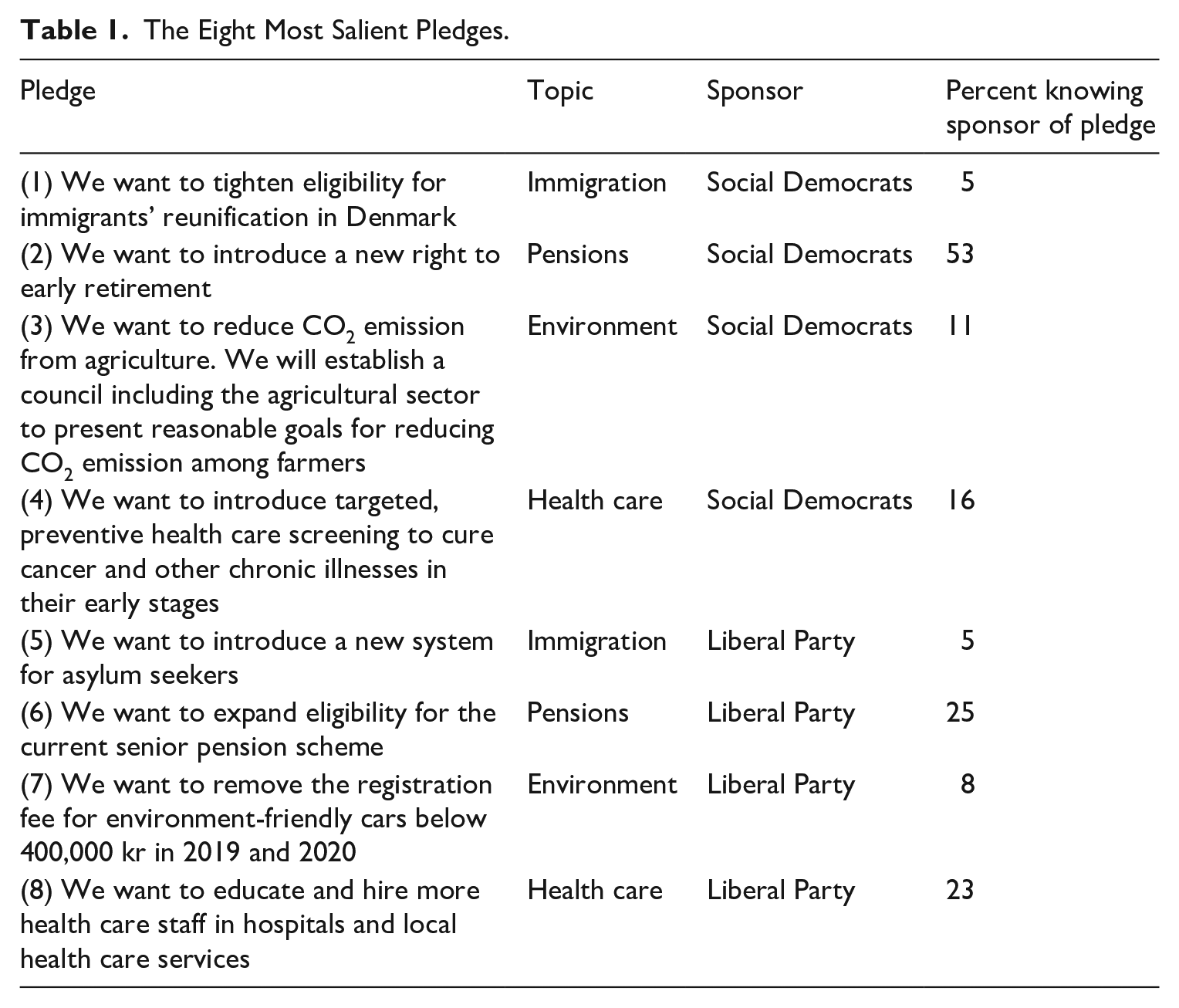
After obtaining this gross list of election pledges from the main parties, we selected eight pledges for inclusion in our experiments during the election campaign. Specifically, we embedded the 201 pledges in a large-n human crowd-coding study with a sample of adult voters recruited through the survey company Epinion (n = 2000) matching the population on age, gender, education, and geographical location. 8 Each respondent was randomly assigned five pledges, and we selected eight pledges, listed in Table 1, that respondents rated high on three dimensions. First, we only considered statements that respondents rated as pledges. Fortunately, this was the case for the vast majority of pledges, implying a substantial overlap between the scholarly and folk definitions of pledges. Second, we asked whether respondents believed each pledge might be relevant for their own vote choice. This approach allows us to estimate an effect of pledges that are salient in the eyes of the voter population. The focus on salient pledges is important because it is unsurprising and trivial that the electorate is not affected by pledges they do not care about. Unsurprisingly, the pledges rated most salient pertained to the most salient topics during the election. To ensure comparability, pledges covering the same four topics were selected for both parties, namely, health care, immigration, pensions, and the environment. These pledges match the four topic areas Danish voters reported as the most important during the 2019 election campaign (Holstein, 2019). 9 Third, respondents rated to what extent they agreed with each pledge. The respondents reported relatively broad agreement on the direction of desired policy change on the four salient topics. Specifically, most agreed with pledges of more investment in public health care, pro-environmental policies, stricter immigration requirements, and more generous early retirement schemes (see also Hansen and Stubager, 2021). As such, we select pledges that resonate with most of the electorate and, on balance, should have a net positive effect on support for the sponsoring party. This selection of pledges through the crowd-coding procedure does not focus on pledges designed to attract or maintain niche segments while distancing majority segments of the population. We acknowledge that such pledges may serve key purposes for some, especially niche, parties and return to this future research avenue in the discussion section below.
The Eight Most Salient Pledges.
Research Design
Survey and Experimental Protocol
As our main study, we fielded a well-powered panel survey that was collected during and after the election campaign in 2019 (n = 6233). Data were collected by YouGov, and respondents were representative of the Danish population in terms of age, gender, education, and geographical location. In the first wave of the study, during the election campaign, participants were randomly divided into three subsamples (n = 2000 or higher) that were launched every 8–9 days during the campaign to cover the full election campaign. This also allows us to test whether the effects vary depending on when in the campaign voters receive information on election pledges. In the second wave (n = 4936, completion rate = 79.2%), after the election, we measured participants’ actual, self-reported vote choice on Election Day.
The survey first presented respondents with a list of the eight pledges derived from the crowd-coding study and for each of them asked respondents to identify the party sponsoring the pledge from a list of all parties. We designed the question such that respondents were allowed to identify several parties behind the pledge and coded the answer as correct if they identified the correct sponsor (regardless of whether identification of additional sponsoring parties was correct or not). The results are shown in the right-hand column of Table 1. As displayed, respondents generally exhibit some, but limited, knowledge of the sponsors behind the eight pledges. Respondents’ knowledge was highest on the pension pledges (53% and 23%), which makes sense considering that it was a conflict on the pensions issue that made the Prime Minister of the Liberal party call the election. Knowledge of the sponsors behind the pledges was lower on health care pledges (16% and 23%) and very low on environment and immigration pledges (5% and 11%). 10
Our experimental design exploits this limited knowledge of the sponsors behind salient pledges to ensure strong causal identification without engaging in deception. Specifically, subjects were randomly assigned to one of the nine groups. The first eight groups were each presented with one of the eight pledges and informed which party had made the specific pledge (i.e. the Social Democrats or the Liberal Party). The ninth group served as our control group and received no information on the sponsor of any pledge. Note that all respondents prior to the experiment had been presented with the eight pledges when asked to identify the sponsor. Hence, the only difference between the control group and the experimental groups is whether subjects were able to tie the given pledge to its sponsor and, in turn, vote on it. After all, a pledge can only affect vote choice if voters can link it to the correct sponsor. In short, our experiment exploits general low pledge awareness among voters to introduce experimental variation without deceiving participants. The subjects who had correctly identified the sponsor of the pledge they were assigned (i.e. pre-treated subjects) were excluded from the analyses (this constitutes 53% of respondents for the most well-known pledge and down to 5% of respondents for some of the least-known pledges). The risk of pre-treatment is often ignored in experimental work on communication and may prevent the researcher from detecting hypothesized effects because such effects have already occurred among some subjects prior to the experiment (Druckman and Leeper, 2012: 876). As Gaines et al. (2007: 13) note, “there is inevitably some possibility that respondents enter the experiment having already participated in a similar experiment, albeit one occurring in the real world.” Although we agree that excluding pre-treated individuals is necessary to derive a precise causal estimate, Online Appendix B reports all tests presented in the analysis section below when analyzing the full sample. As expected, the effect sizes consistently become smaller when including pre-treated subjects but remain statistically significant except for two tests that surpass conventional levels of significance (p = 0.076 and 0.126).
The results of respondents’ knowledge of the sponsors of the pledges also inform us of the likelihood that voters outside our experimental setup will actually receive the information we assign. As explained in detail below, this allows us to circumvent another typical shortcoming in experimental designs as we can weigh our treatment estimates according to the probability that voters receive the treatment in a real-world setting (see Zaller, 1992, for a discussion).
This setup allows for eight experimental tests of the effects of the most salient and comprehensible election pledges on vote intention and choice by comparing each treatment group to the control group. To obtain maximum statistical power for observing limited effect sizes and ease interpretation of the results, we aggregate these eight analyses to provide a single estimate of the effect across the eight pledges. Alternatively, we could have selected only one or two pledges for our experiment, but this would have limited the generalizability of our findings across issues and pledges. In Online Appendix C, we report further results showing that the effects reported below do not vary in substantial terms when analyzing the effects across the four issues or the two sponsoring parties.
Measures
The two main outcome variables were subjects’ intention to vote for the sponsor of the pledge (measured in Wave 1 immediately after receiving the treatment) and actual vote choice (measured in Wave 2 after the election). Vote intention was measured by asking about the intention to vote for the sponsor of the given pledge: “How likely is it that you would vote for the [Social Democrats / Liberal Party] in the upcoming parliamentary election?” on a 0 (very unlikely) to 10 (very likely) scale, which we rescaled 0–1. Vote choice was measured by asking, “Which party did you vote for in the parliamentary election on 5 June 2019?” We collapsed this into a dichotomous variable with the values 0 (not sponsor of the pledge subjects were treated with) and 1 (sponsor of the pledge). This outcome variable is important because not all types of information yield persisting effects on voters over time (see, for example, Coppock, 2017). With two outcome variables measured with different instruments and at different time points, we increase the robustness of our results.
Finally, prior to the experiment in Wave 1, we also measured respondents’ political sophistication and party identification to test whether the effects are confined to inpartisans with low political sophistication as theorized above. Political sophistication was measured prior to the experiment in Wave 1. We created an index based on the two subcomponents political interest and factual political knowledge, using standard items from the Danish National Election (Bøggild, 2020a; Zaller, 1992). 11 The two subcomponents were summed into an additive index (r = 0.494) and rescaled 0–1 (M = 0.630; SD = 0.264).
To measure party identification, we used respondents’ choice of party in the previous parliamentary election in 2015. This information was collected by YouGov at an earlier time point unrelated to our data collection. Our survey also measured voting intentions, but these questions were collected post treatment, that is, were asked after exposing subjects to the experimental stimuli to test the effects of pledges (as outlined above). That party identification is measured some time before the election circumvents issues with common source bias and only risks introducing noise to our measure and thus provides a conservative test of our argument that the effects of pledges will vary by partisanship.
Results
We present our findings in three parts. First, we analyze the average causal treatment effect of receiving information on the sponsor behind a salient pledge. This is to derive an estimate of the overall effectiveness of a party exposing the electorate to a salient election pledge. Second, we analyze whether these effects are mainly driven by inpartisans with low political sophistication, as hypothesized above. Third, we adjust for the strong assumption inherent in most survey experiments that all subjects would necessarily receive the assigned treatment in the real world (in our case, a salient election pledge and its sponsor). Specifically, we weight our average causal treatment effect by the probability that voters actually hold the assigned information outside our experimental setup.
The Average Causal Treatment Effect of a Salient Election Pledge
The left-hand panel of Figure 2 displays the effect on subjects’ intentions to vote for the sponsoring party in Wave 1 (measured immediately after the treatment). In line with our expectations, the panel reveals that being able to tie a salient election pledge to its sponsor increases the intention to vote for the sponsor by 2 percentage points (p = 0.040), from 0.32 in the control group to 0.34 in the treatment groups. The kernel density plot displays this difference in more detail. The intention to vote for the sponsor of the pledge is displayed on the horizontal axis. As depicted, a larger proportion of the control group (the black line) reports no or very limited intentions to vote for the sponsor behind the pledge, while the treatment group (the blue, dashed line) reports somewhat higher likelihoods. Hence, a salient pledge may open the door for some voters who otherwise would not consider voting for the sponsoring party. Finally, we tested whether the timing of being exposed to an election pledge matters by leveraging subjects’ random assignment to the three subgroups interviewed at different time points in the campaign (full models reported in Online Appendix D). We find, at least tentative, evidence that the effect of an election pledge is largest in the first subsample interviewed during the first third of the election campaign compared to the second (p = 0.035) and third subsamples (p = 0.090), confirming existing models of primacy effects in political persuasion (e.g. Panagopoulos, 2011; Van Erkel and Thijssen, 2016).
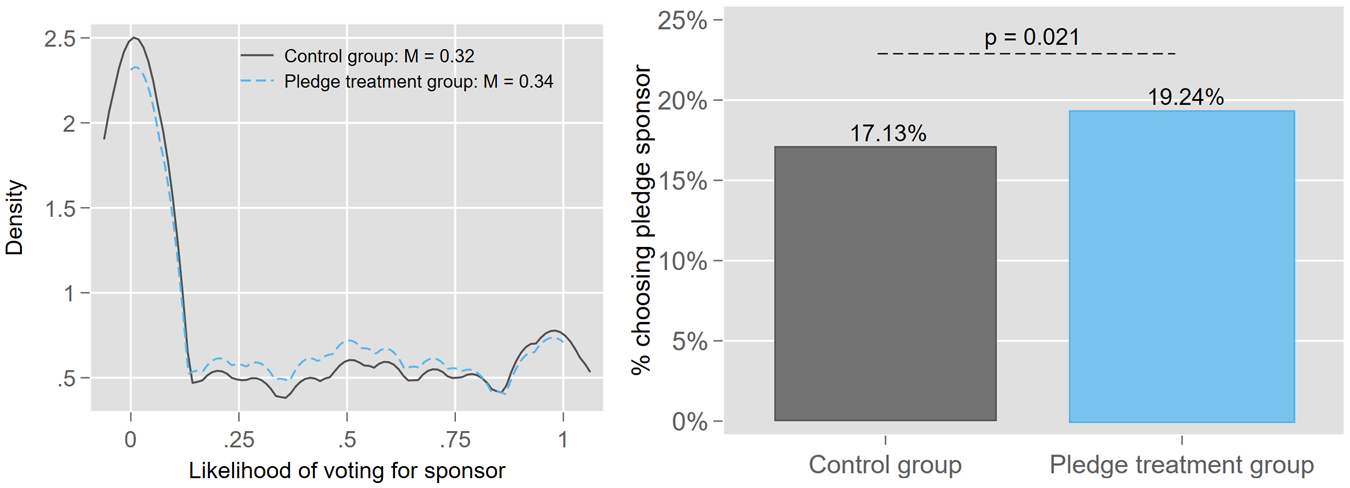
Effect of a Pledge on Intention to Vote for Sponsor Immediately after Treatment (Left-Hand Panel) and Vote Choice Reported after the Election (Right-Hand Panel).
The right-hand panel of Figure 2 shows the effect on subjects’ actual vote choice reported after the election (in Wave 2). As expected, we observe that 17.1% in the control group and 19.2% in the pledge treatment group voted for the pledge sponsor, that is, a 2.1 percentage point difference (p = 0.021). This finding not only replicates the result for subjects’ vote intentions with a different measure administered at a different time point; it also implies that pledges have an actual bearing on self-reported choice of party in a real election. Again, these effects seem, tentatively, to be larger among those who receive the information in the first subsample compared to those in the second (p = 0.058) and third (p = 0.237) subsamples (see Online Appendix D). The effects of a salient election pledge thus appear to be real but also limited given the relatively small, yet potentially decisive, effect size. Below, we analyze our expectation that this relatively small effect size reflects that pledges mainly affect a subgroup of voters with low political sophistication who identify with the sponsor behind the pledge.
Subgroup Treatment Effects
The two upper panels of Figure 3 display the marginal treatment effects on vote intentions across respondents’ political sophistication (the x-axis) split by respondents who do not identify with the sponsor of the pledge they are treated with (the left-hand panel) and those who do identify with the sponsor (the right-hand panel). The left-hand figure shows that voters do not become more inclined to vote for the sponsor of the pledge when they do not identify with the sponsor (regardless of their level of political sophistication). In line with our expectations above, voters are hesitant to vote based on pledges when they do not identify with the sponsor of the pledge. This likely reflects that voters worry that such parties will not deliver on the pledge after the election. However, turning to the upper right-hand panel, the pattern looks different when looking at respondents treated with a pledge from a party they identify with. As expected, a pledge has a positive effect on vote intentions when the respondent identifies with the sponsor, and the effect is especially pronounced among the least political sophisticated respondents. Specifically, we see that the average marginal effect is largest among those with the lowest levels of political sophistication and that the effect gradually decreases with higher levels of political sophistication (p = 0.010), hitting zero at 0.72 on the scale. This likely reflects that voters with higher political sophistication choose to rely on other less risky information than pledges (e.g. retrospective evaluations of parties)—even when the pledge comes from a trusted source in terms of a party they identify with. In short, the upper panels of Figure 3 support our main theoretical argument: Voters only engage in pledge-based voting when the pledge comes from a party they identify with and when they lack less risky, more certain evaluations of parties to inform their vote. Formally testing this pattern requires a three-way interaction between the pledge treatment, political sophistication, and party identification. This three-way interaction is significant (p = 0.041), and the full model is reported in Online Appendix A.
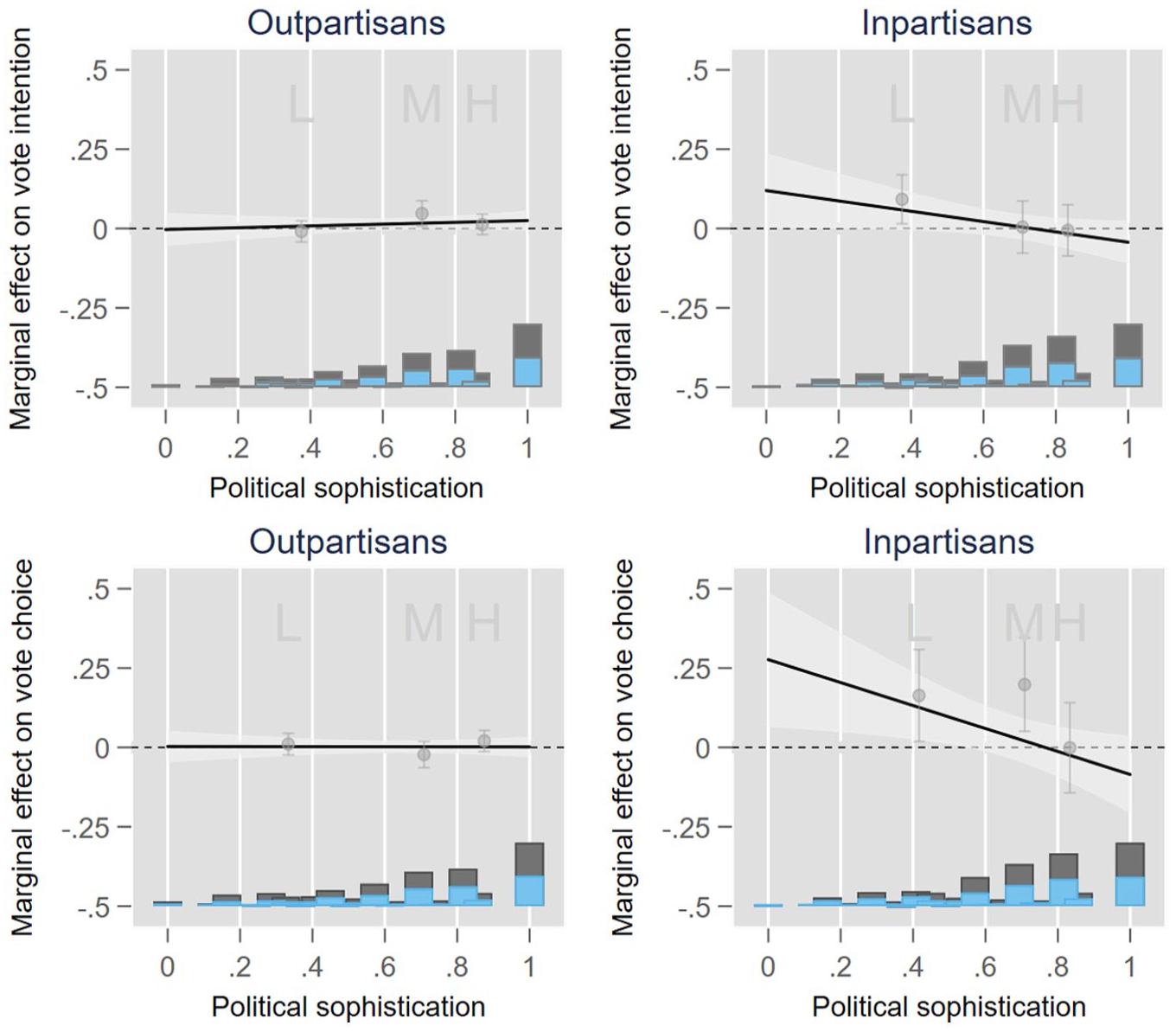
Marginal Effect of a Pledge on Vote Intention (Top Panels) and Vote Choice (Bottom Panels) Conditioned on Partisanship and Political Sophistication.
The two lower panels of Figure 3 display the same pattern when looking at actual, self-reported vote choice as the outcome variable. Being treated with information about the sponsor behind a salient pledge has no effect on vote choice when the respondent does not identify with the sponsor, as displayed in the lower left-hand panel. In contrast, and as expected, the effect manifests itself among respondents who identify with the sponsor they are treated with and is largest among less politically sophisticated respondents (the lower right-hand panel). The average marginal effect is again largest among those with the lowest level of political sophistication, and the effect decreases with higher levels of political sophistication, hitting zero at 0.79 on the scale. Again, the three-way interaction between pledge treatment, political sophistication, and party identification is significant (p = 0.025) and reported in Online Appendix A.
Treatment Effects Weighed by Voters’ Probability of Receiving the Treatment
The estimates reported above are based on a strong, and often unrealistic, assumption inherent in almost all survey experiments: that all subjects actually receive the treatment in a real-world context (Leeper, 2017; Slothuus, 2016). Particularly in a political communication context, this assumption is often not met since many voters do not pay much attention to politics and because those who do often self-select into the political content they wish to receive (Delli Carpini and Keeter, 1996; Leeper, 2017; see also Zaller, 1992). As such, estimates of treatment effects derived from survey experiments where all subjects are treated should be weighed according to the probability that voters actually receive the treatment in the real world. This also applies when it comes to estimating effects of election pledges. As Naurin (2016) has previously shown, even elected politicians have limited knowledge about how many and which pledges their own party has made. Moreover, Table 1 above showed that respondents’ pre-treatment knowledge of the sponsor behind the eight most salient pledges was low—down to 5% for some individual pledges. Indeed, we exploit this limited amount of knowledge to administer our treatment without having to engage in deception.
What is the probability that voters hold information about one salient pledge and its sponsor in the context of an election campaign? Based on our survey measures, voters are, on average, able to connect 1.48 of the eight salient pledges to the sponsoring party. Offhand, this would imply that our previous estimate of 2.11 percentage points is not much off and could even be a lower-bound estimate. However, considering that pledges mainly work among inpartisans with low political sophistication, we need to estimate the probability that voters with low political sophistication have knowledge about a pledge sponsored by their own party.
Figure 4 reports how many of the four salient pledges from the respondent’s own party (the blue line) and the four salient pledges from the other party (black line) of the respondent was able to tie to the correct sponsor across political sophistication (the x-axis). The figure reveals two important patterns. First, the two positive slopes show that less politically sophisticated respondents are generally less knowledgeable about pledges and their sponsor (p < 0.001). Hence, the voters who are most inclined to be affected by information on pledges and their sponsor are also least likely to receive such information outside an experimental setup. This implies that the average causal treatment effect reported above could overestimate the real effect (see also Slothuus, 2016). Second, the difference between the blue and black lines indicates that subjects are more knowledgeable about pledges sponsored by the party they identify with relative to other parties (p < 0.001). Hence, voters are generally more likely to receive pledges from parties they identify with, which, in turn, makes them more open to being persuaded by pledges (as demonstrated in Figure 3 above). This would imply that our estimate above could underestimate the real effect. Both findings directly underscore the need to weight treatment effects according to the probability that the relevant voter segments receive the treatment to avoid inflating or deflating real-world average causal treatment effects.
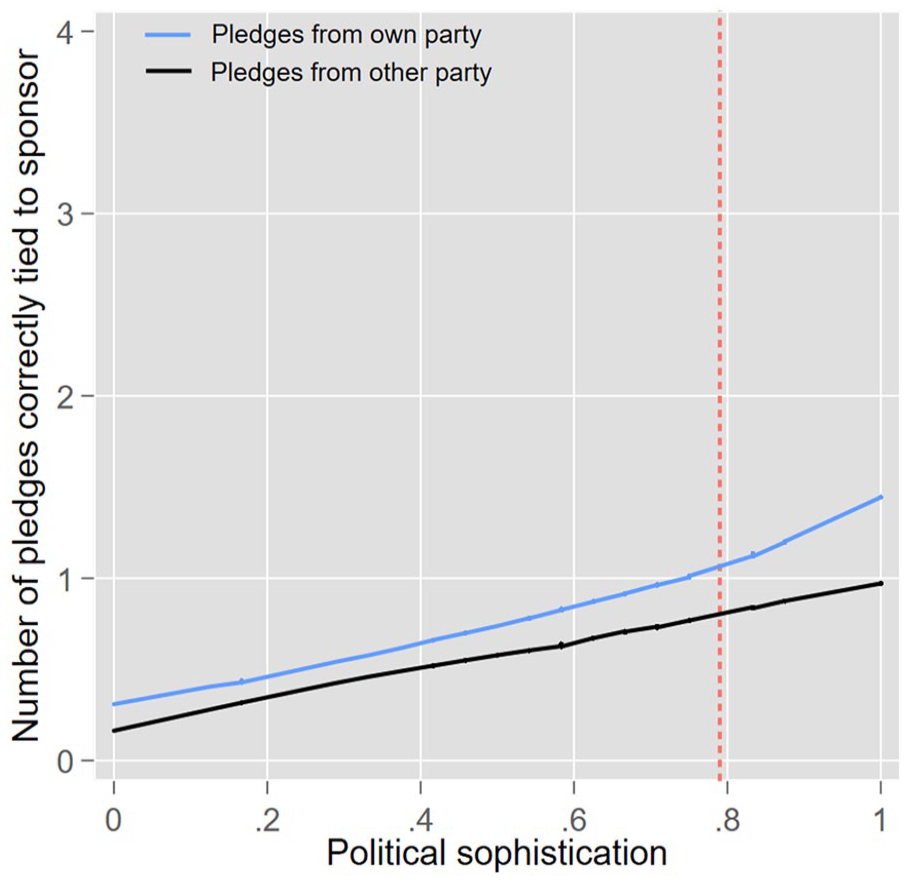
Average Number of Pledges Correctly Tied to Sponsor by Political Sophistication across Pledges from Party Respondents Identify with (Blue Line) and from Other Party (Black Line).
As mentioned above, pledges from the respondent’s own party have an estimated positive effect on actual, self-reported vote choice among respondents with political sophistication below 0.79 (at this level, the marginal effect hits zero according to the model depicted in the lower left-hand panel of Figure 3). A total of 54.04% of the subjects below this level of political sophistication can correctly connect the party they identify with to one or more of the party’s four election pledges. If we apply this simple weight to the average causal treatment effect reported above, we get an estimate of 1.14 percentage points (2.11 × 0.5404). We consider this a lower-bound estimate for two reasons: First, it assumes that voters have no knowledge about other pledges from their party beyond the salient pledges we study. Second, it does not take into account that there may be additive effects on vote choice among voters who know two (15.15% of respondents), three (2.44%), or four (0.46%) of the salient pledges from their party. Hence, if we instead take the average number of salient pledges that respondents below 0.79 on the political sophistication scale correctly tie to their own party, that is, 0.76 pledges, we get an estimate of 1.60 percentage points (2.11 × 0.76).
Finally, we leveraged the random assignment to different subsamples to test whether subjects’ knowledge of pledges coming from their own party increased over the election campaign. If voters learn more about pledges over the campaign, we should weigh the average causal treatment effect according to respondents’ knowledge as close to the election as possible (i.e. in the third subsample only). However, we consistently find that subjects do not become better at connecting the party they identify with to the party’s pledges across the three subsamples and that this pattern holds regardless of subjects’ levels of political sophistication (see Online Appendix D). The fact that we do not observe such learning effects may reflect that campaign media coverage not only focuses on parties’ future policies but also on analyzing their vote-seeking strategies and coalition prospects, which provide voters with little to no issue-relevant political knowledge
In sum, depending on the strictness of assumptions we enforce, we reach estimates of the average causal treatment effect between 1.14 and 2.11 percentage points for the eight most salient pledges analyzed in this study. Notably, this is quite consistent with Elinder et al. (2015: 189) who estimate that the election pledges targeting parents with young children would have amounted to a 1.5 or 1.6 percentage point effect on voting for the sponsoring party when averaged across the full electorate. In general, we believe that these estimates support our two main conclusions about the role of election pledges for citizens’ vote choice: Election pledges have real, discernible, and potentially decisive effects on citizens’ vote choice while they are also limited in size and scope because they mainly apply to the least politically sophisticated voters who already identify with the sponsor of the pledge.
Discussion
This article evaluates a key assumption in most theories of representative democracy: Voters select what party to vote for based on parties’ pledges. Using original experimental panel survey data from the 2019 Danish election, we find a real, discernible effect of pledges on vote choice. The effect, which appears large enough to matter for electoral outcomes in most contexts, is driven by the less politically sophisticated partisans. In our argument, voters fear being cheated by defecting parties—a highly realistic assumption about voters given that a large majority of the electorate believe parties normally do not deliver on their promises (ISSP Research group, 2018). This entails that voters only engage in pledge-based voting if the pledge is made by a party they identify with and if they have no other relevant, retrospective, information to draw on. Rather than attracting new voters from competitors, pledges appear mainly to help parties keep those who have previously voted for and, thus, already identify with the party.
Currently, we have focused on the effect of a single, salient pledge from one of the two mainstream contenders for government. We have done so to be able to isolate the causal effect of pledges. Yet our focus on a single pledge may underestimate the true effect of pledge-making in electoral politics because parties almost always make more than one pledge. Although it seems far-fetched to assume that the many pledges parties typically make are salient to voters, it is realistic that more than one pledge from each party can occasionally make it onto the public agenda. All else equal, this enhances the importance of pledges for vote choice.
Almost all parties make pledges. This raises several issues for further research. First, does abstention from pledge-making hurt parties? If promising policy action in the future is a way to signal commitment to an issue, not making such promises may be interpreted as lack of concern for the issue. This suggests that pledges may have other and more wide-ranging effects than revealed by our experimental design. Second, if all parties are able to secure and mobilize their partisans, the net effect on election outcomes may be washed out even as pledges remain a key driver of individual voters’ party choice. Such a balancing-out requires that all parties’ most important pledges have an equal chance of getting public attention. However, this is far from certain given what we know of the highly skewed distribution of mass media attention across both topics and parties (Green-Pedersen and Stubager, 2010; Kostadinova, 2017). Although parties have an easier time communicating with their own party identifiers, it seems fair to assume that different parties will have a varying degree of success highlighting their most salient pledges.
This points to a third issue, namely whether there are systematic differences across parties in their willingness and ability to use pledges to attract voters. The main contenders for power have the advantage that voters have reason to believe that if a party wins the election, it will also have the opportunity to keep its promises. Smaller parties—especially those on the fringes—might be less credible in this regard. On the other hand, fringe parties typically campaign on just a single issue on which they tend to have a strong profile because of their extreme position (Adams et al., 2006; Meguid, 2005). This suggests that pledges from fringe parties might have a higher probability of setting the agenda during election campaigns. Ultimately, it is an empirical question to settle which of these counter-acting factors dominate.
A final question pertains to our choice of Denmark as our case for studying pledges. As we argued above, Denmark shares many characteristics with other Western democracies, especially those located in Europe. It is home to a highly competitive multiparty system where the margin of victory tends to be small and the number of pledges made by parties is the same as elsewhere. However, one possibility is that pledges work differently in two-party systems. The most likely consequence of having just two parties competing for power is that pledges matter more because the winner gets a clear majority of legislative seats to enact its pledges and voters know this and will take it into account. Hence, voters may put less emphasis on pledges in countries where decision-making power is shared among many actors because the likelihood of seeing them fulfilled is lower; according to Thomson et al. (2017), countries with coalition governments or presidentialism experience less pledge fulfillment. Yet this is also the case in Denmark where minority coalition governments are the name of the game. With all these considerations in mind, it is likely that the effectiveness of pledges varies across institutional and cultural contexts and that single-country studies may not provide a full, representative picture of their role in shaping voting behavior. We hope that our theory of pledge-based voting and research design for studying the effects of pledges in real-time can help spur a comparative research agenda on the electoral effects of pledges in modern democracies.
Supplemental Material
sj-pdf-1-psx-10.1177_00323217231179010 – Supplemental material for A Theory and Test of Pledge-Based Voting: The Limited but Real Effects of Election Pledges on Citizens’ Vote Choice
Supplemental material, sj-pdf-1-psx-10.1177_00323217231179010 for A Theory and Test of Pledge-Based Voting: The Limited but Real Effects of Election Pledges on Citizens’ Vote Choice by Troels Bøggild and Carsten Jensen in Political Studies
Footnotes
Declaration of Conflicting Interests
The author(s) declared no potential conflicts of interest with respect to the research, authorship, and/or publication of this article.
Funding
The author(s) disclosed receipt of the following financial support for the research, authorship, and/or publication of this article: The research has been generously funded by the Independent Research Fund Denmark (grant no. 8019-00025B)

Supplemental Material
Additional Supplementary Information may be found with the online version of this article. Appendix A: Full statistical models reported in figures Table A1: Effect of pledge on likelihood of voting for sponsor in Wave 1 (Model I) and vote choice in Wave 2 (Model II) Table A2: Effect of pledge on likelihood of voting for sponsor in Wave 1 (Model I) and vote choice in Wave 2 (Model II) by political sophistication and party identification Appendix B: Replication of main findings without excluding pre-treated subjects Table B1: Effect of pledge on likelihood of voting for sponsor in Wave 1 (Model I) and vote choice in Wave 2 (Model II) Table B2: Effect of pledge on likelihood of voting for sponsor in Wave 1 (Model I) and vote choice in Wave 2 (Model II) by political sophistication and party identification Appendix C: Effects of pledges across pledge issue and sponsor Table C1: Effect of pledge on likelihood of voting for sponsor in Wave 1 (Model I) and vote choice in Wave 2 (Model II) by pledge issue Table C2: Effect of pledge on likelihood of voting for sponsor in Wave 1 (Model I) and vote choice in Wave 2 (Model II) by pledge sponsor Appendix D: Results across subsamples interviewed at different time points Table D1: Effect of pledge on likelihood of voting for sponsor in Wave 1 (Model I) and vote choice in Wave 2 (Model II) by subsample Table D2: Knowledge of pledges and their sponsors by subsamples across levels of political sophistication
Notes
Author Biographies
References
Supplementary Material
Please find the following supplemental material available below.
For Open Access articles published under a Creative Commons License, all supplemental material carries the same license as the article it is associated with.
For non-Open Access articles published, all supplemental material carries a non-exclusive license, and permission requests for re-use of supplemental material or any part of supplemental material shall be sent directly to the copyright owner as specified in the copyright notice associated with the article.
