






Abstract
As democracies grow more diverse through immigration, a key question arises: when should immigrants participate in political decision-making? We examine citizens’ beliefs about when immigrants should vote in national elections (before citizenship, with citizenship, or never) and whether these views depend on immigrants’ integration markers. We assess how exclusionary worldviews and psychological predispositions—authoritarianism, social dominance orientation (SDO), and ethnocentrism—shape views of democratic membership and how malleable those views are. Using 2021 survey data from Denmark, Germany, Sweden, Switzerland, the United Kingdom, and the United States, we find that integration criteria matter most to those who view citizenship as the primary gateway to political inclusion. High levels of SDO and ethnocentrism are associated with exclusionary preferences, though integration efforts reduce resistance among individuals high in SDO. Authoritarian-leaning individuals are simultaneously more willing to include immigrants pre-naturalization and more likely to support permanent exclusion. These findings highlight the conditional nature of political inclusion in diverse democracies.
Keywords
Introduction
Whether driven by necessity or opportunity, international migration is a fact of life in today’s globalized world. For democracies, this reality raises certain challenges to their legitimacy, as not everyone affected by decisions can partake in their making (Scherz, 2013) and representation of immigrants’ 1 interests and needs in host societies (Dancygier et al., 2021; Nadler, 2022) is not a given. How can democracies remain representative? Who of those with decision-making rights (citizens) would be willing to expand these rights to others (immigrants) and on which conditions?
Immigrants typically receive the full suite of political rights—including the right to vote in all elections—equal to that of citizens only after naturalizing. This process is generally tied to meeting a number of integration criteria, such as speaking a national language, passing a civic and political knowledge test, or contributing to society by working and paying taxes (Joppke, 2007), among other requirements. In other words, immigrants must “earn” their citizenship (Joppke, 2021) and their place within the national community.
Still, some 120 territories have enfranchised their noncitizen residents at the local, regional, and national level (Arrighi et al., 2019), effectively uncoupling certain political rights from citizenship acquisition. 2 Research on when governments extend political rights is well documented (e.g. Altman et al., 2023; Earnest, 2015; Kayran and Erdilmen, 2021; Piccoli, 2022), including how the framing of immigrant enfranchisement as a tool for further integration helps build necessary coalitions to pass such legislation (Goenaga, 2019). Yet questions remain about how expansive or restrictive vis-à-vis the status quo the preferences of citizens are (Blatter et al., 2022) and what influences them (e.g. Alarian and Zonszein, 2024; Hultin Rosenberg and Wejryd, 2022).
This article addresses if and when citizens are willing to include immigrants in their political community and to what extent citizens believe that immigrants’ efforts can facilitate this process or if these views stem from citizens’ own psychological predispositions. We hypothesize that immigrants engaging in integration efforts are rewarded for such behavior but also that citizens’ psychological traits influence their assessment as to when an immigrant should be allowed to vote.
We test these hypotheses with a novel battery of questions regarding immigrants’ access to national voting rights included in an original survey fielded in 2021 in Denmark, Germany, Sweden, Switzerland, the United Kingdom (UK), and the United States (US) (Gandenberger et al., 2022). All countries are liberal democracies experiencing important levels of immigration (IOM, 2024) and are thus facing the challenge of integrating and representing immigrant (origin) members of their population and their interests in democratic processes.
Using multinomial logistic regressions evaluating the conditions that citizens would enfranchise immigrants before, with citizenship, or never, we find that in all six countries, a majority of citizens are overwhelmingly in favor of national enfranchisement of immigrants with citizenship. Furthermore, some might be inclined to share political rights with immigrants before their naturalization if they can demonstrate their productivity and contributions to society (working and paying taxes). The fulfillment of enfranchisement criteria (more general) even impacts those with considerably exclusive views on who should be included in the polity, moderating their exclusivity to some degree. Interestingly, those most open toward immigrant voting rights seem to generally believe that immigrants’ inclusion should require few conditions, suggesting a divergence in society in how citizens understand democratic inclusion and norms. Importantly, general immigrant attitudes only partially explain openness to sharing political power and including immigrants in the polity.
This article makes two contributions to studying democratic inclusion. First, we further expand on existing research on citizens’ attitudes toward immigrants’ political rights (e.g. Alarian and Zonszein, 2024; Hultin Rosenberg and Wejryd, 2022; Michel and Blatter, 2021) by confronting the conditionality of this membership. We do this in three ways: (1) we assess whether citizens believe institutional structures (i.e. integration requirements) are important conditions for political inclusion; (2) we consider the extent that “status” (i.e. citizenship) matters to citizens in their definition of national polity inclusion; and (3) we tackle how malleable or fixed these views are not only for those most opposed, but also those most open. Second, we contribute to political psychology (e.g. Feldman, 2003; Kinder and Kam, 2009; Pratto et al., 1994), by examining how social dominance orientation (SDO), authoritarianism, and ethnocentrism shape views on immigrants’ political rights, which, to our knowledge, remains under-researched.
These results are of particular importance for governments of democracies with diversifying populations to ensure representativeness beyond the “imagined community” (Anderson, 1983) to reflect the actual community. Research has already pointed out that access to political rights (i.e. voting rights) positively impacts the (social) integration (Hainmueller et al., 2017) and eventual naturalization of immigrants (Slotwinski et al., 2020) and increases their national identification with the country (Alarian, 2025). While our results point to the public support for national voting rights remaining attached to citizenship, it may provide the opportunity for governments to adapt their citizenship laws to be more inclusive to ensure more cohesive societies. The openness of some parts of the citizenry to make such rights conditional on the fulfillment of certain enfranchisement criteria could also allow for a certain (in some cases further) de-coupling of voting rights from citizenship, if not at the national level, possibly at the local or regional level.
Public opinion on immigrant voting rights expansion
Research on citizens’ preferences on immigrant voting rights focuses on how citizens would define the polity and whether noncitizens should be included. In the case of Europe, there is some support for enfranchisement regimes which include resident noncitizens, though this inclusion varies by and within country (Blatter et al., 2022; Michel and Blatter, 2021). In Switzerland—where citizens can directly participate in enfranchisement policymaking via referendums and popular initiatives—the willingness to locally enfranchise noncitizens decreases in areas with large immigrant populations (Koukal et al., 2020; Stutzer and Slotwinski, 2020).
The reluctance to enfranchise noncitizens can also be mitigated when citizens believe that potential noncitizens share similar preferences regarding redistribution (i.e. on public vs. private spending (Gonnot, 2022)) and political ideology (e.g. potential co-partisans (Alarian and Zonszein, 2024)). In the US, citizenship remains a necessary condition for federal-level enfranchisement (both in peoples’ preferences and legally), but there is some support for granting voting rights at lower levels of government to long-term, tax-paying noncitizens (Hultin Rosenberg and Wejryd, 2022). Moreover, political orientation has been shown to be a driver for how different societal groups evaluate enfranchisement criteria for noncitizen voting rights (Taylor, 2025).
In addition, it is worth considering the informational context in which citizens hold opinions about these policies. Recent research indicates how poorly informed the average citizen is regarding various topics of immigration (e.g. Lutz and Bitschnau, 2023). These information gaps could impact subsequent policy feedback processes in immigration and citizenship policy, which serve as boundary-making institutions defining who is conferred membership status (Mettler and Soss, 2004; Pierson, 1993). As such, citizens may rely on democratic norms and heuristics to form their opinions about immigration (Harteveld et al., 2017) and democracy (Goodman, 2022) and thus, democratic inclusion. Empirical evidence on the link between immigration and integration policy and attitudes has shown such policies can both increase or decrease sentiments depending on context and policy (Lee, 2025; Ryo, 2017; Schwartz et al., 2021; Ziller, 2019). Even so, in communities where immigrant voting rights have been extended, research finds little evidence of a reduction in citizens’ political efficacy (Kayran and Nadler, 2024) or their national sentiments (Alarian, 2025).
Taken together, we explore whether there could be a set of enfranchisement criteria born from attitudes toward immigrants and existing institutional designs (policy) which could serve as a pathway for noncitizens to gain voting rights.
Integration as eligibility criteria
Cultural and civic criteria assess steps noncitizens take to integrate themselves into the society, the culture, and the nation as a whole (Joppke, 2017; Manatschal et al., 2020; Pap, 2021; Paxton and Mughan, 2006; Sobolewska et al., 2017). While not directly used in current enfranchisement policies, 3 two instruments borrowed from naturalization policies could be employed to “measure” noncitizens integration: country-specific knowledge exams and integration courses (Joppke, 2021; Michalowski, 2011). Ideally, noncitizens participate in integration courses from their arrival because they provide country-specific information often included in formal citizenship exams, while indirectly (or directly) testing the language ability of noncitizens. Language proficiency is a central requirement in naturalization policies, but also a central concern for citizens (Dražanová et al., 2020; Paxton and Mughan, 2006). Language has been shown to facilitate social and economic integration and mitigate anti-immigrant sentiments rooted in perceptions of linguistic and cultural barriers (Antonsich, 2012) and is considered by Europeans to be an important factor for successful integration (Dražanová et al., 2020).
Citizens who perceive noncitizens as a cultural threat may support integration courses and country-specific cultural exams, particularly for those noncitizens from regions culturally distinct from their own (Ben-Nun Bloom et al., 2015). Similarly, citizens may expect fellow voters to have sufficient political knowledge to participate, thereby proving such knowledge could reassure them that noncitizens are capable of making informed political judgments. Contemporary citizenship exams, which typically cover a country’s history, values and beliefs, and political system (Michalowski, 2011), could be adapted for enfranchisement or administered earlier, as seen in the UK’s permanent residency requirements (Home Office 2014; Kurt, 2017). If cultural-civic knowledge is considered important for the purposes of future political engagement post naturalization, testing or verifying this same knowledge would become equally important if noncitizens are to be enfranchised before naturalization. This leads to our first hypothesis:
Contributivism assesses newcomers’ contributions to society, focusing on employment, tax contributions, and overall productivity (Paxton and Mughan, 2006). 4 Contributivism has historically been a necessary condition for the right to vote and remains an indirect factor for immigrants’ access to voting rights: naturalization policies stress economic self-sufficiency as a prerequisite, and noncitizens typically receive voting rights with citizenship (Hultin Rosenberg and Sundevall, 2022). Recent research has found a desire for “contributivism” among citizens toward (non-)citizens, wherein stable employment and tax contributions are required to be considered for political rights (Hultin Rosenberg and Wejryd, 2022; Malkopoulou and Nefs, 2024). 5 Furthermore, there is some evidence in the welfare deservingness literature that immigrants can work toward reducing the “immigrant penalty” in welfare deservingness (Reeskens and van der Meer, 2019) by contributing via employment and taxes over longer periods of time (Reeskens and van Oorschot, 2012). Thus, citizens who hold that contributivism is an important condition for enfranchising noncitizens may support extending voting rights before citizenship. 6
On the reverse side of contributivism, citizens could be unwilling to offer political rights to noncitizens when they are perceived to be an economic or social burden. Fears attached to low-skilled immigrants being a financial burden to the state have been shown to drive immigration concerns (Hainmueller and Hiscox, 2010). Akin to the deservingness literature on access to the welfare state (Knotz et al., 2021; Reeskens and van der Meer, 2019; van Oorschot, 2006), which finds that noncitizens are among the least deserving of social benefits, it could be that citizens would withhold political rights from those they feel are (economically) burdening the state. This again, returns to the idea that citizens believe that immigrants need to contribute more than they benefit (Paxton and Mughan, 2006), and in particular in more universal welfare states, they especially fear that immigrants exploit the benefits (Fietkau and Hansen, 2017). In practice, we also see governments sanction noncitizens by withholding citizenship from those who use or rely on state assistance within a certain number of years prior to naturalization.
Separately, the exclusion of noncitizens from (political) rights could also be tied to perceptions of immigrants being potential criminal threats (Baranauskas and Stowell, 2025) and to overestimating immigrants’ unlawful behavior due to a discrepancy between citizens’ perceptions of crime and actual rates perpetrated by immigrants (Sohoni and Sohoni, 2014). Noncitizens can be denied citizenship based on criminal records, investigations, or even minor offenses, despite fulfilling other criteria (Jensen et al., 2021). While the disenfranchisement of citizens for criminal activity varies internationally, legal infractions are used as a justification for restricting noncitizen rights to access social rights (Borelli, 2025) and political rights (Arrighi et al., 2019). Given these policies and the documented misperception of immigrants as criminals (Adelman et al., 2017; Baranauskas and Stowell, 2025), it is plausible that citizen attitudes would mirror this logic, extending exclusionary preferences to noncitizens with criminal records as well as those perceived as economic burdens.
How much are these attitudes toward enfranchisement impacted by individual characteristics and can integration efforts moderate the effects?
Research on attitudes toward immigrants has pointed to several drivers of anti- and pro-immigrant sentiments, such as socioeconomic and cultural threats (Hainmueller and Hopkins, 2014). Yet, beyond this research, political psychology has also shown that deep-seated dispositions can also shape how citizens approach noncitizens’ access to (social) rights. There are three such dispositions—SDO, ethnocentrism, and authoritarianism—that have been evaluated in their impact on attitudes to, and specifically prejudices about, immigrants, but also their access to various rights (Cohrs and Stelzl, 2010; Duckitt and Sibley, 2010; Hellwig and Sinno, 2017; Newman et al., 2014; Peresman et al., 2023; Zhirkov, 2021). We consider how these dispositions could impact how citizens approach access to political rights of noncitizens, and how malleable these views are when such individuals consider immigrants engaging in integration.
SDO measures individuals’ preference for hierarchical societies, where their in-group dominates others, compared to a belief in societal equality (Pratto et al., 1994). It has been shown to influence attitudes toward policies that reinforce or reduce hierarchies, with high SDO linked to prejudice against marginalized groups and opposition to policies benefiting them (Danso et al., 2007; Pratto et al., 1994). It also associates economic competitiveness with opposition to the economically disadvantaged (Duckitt and Sibley, 2010). Those high in SDO favor assimilation over multiculturalism (Levin et al., 2012) and oppose groups advocating hierarchy-attenuation as such movements threaten structures that privilege certain groups (Crawford and Pilanski, 2014). The enfranchisement of noncitizens would allow diverse subgroups greater political influence, which those high in SDO would resist to maintain the status quo of greater rights for citizens (Crawford and Pilanski, 2014; Levin et al., 2012). They dislike political equalization and policies that diminish hierarchical distinctions, while those low in SDO, valuing equality, would support noncitizen voting rights despite ideological differences. Moderates may hesitate to extend voting rights before citizenship but could favor eventual enfranchisement through naturalization, balancing system preservation with gradual inclusion.
Authoritarianism is the preference for obedience and conformity to society’s already constructed rules and norms over autonomy and personal freedoms (Engelhardt et al., 2023; Feldman, 2003; Peresman et al., 2023). Recent definitions try to break the conservative ideological link to authoritarianism (right-wing authoritarianism, RWA) seen in earlier or similar research (Feldman, 2003), by also connecting it to the left-wing version (LWA) (Conway et al., 2023). Nevertheless, research that looks at authoritarianism tends to focus more on RWA as a predictor of anti-immigrant sentiments (Duckitt and Sibley, 2010; Kauff et al., 2013; Peresman et al., 2023). RWA has been found to be threat driven, where those with higher RWA tend to be more prejudiced against immigrants when they perceive them to be economic and societal threats due to their lack of conformity with societal expectations (Cohrs and Stelzl, 2010; Duckitt and Sibley, 2010). When there is exposure to policies reflecting multiculturalism, those with higher RWA exhibit less pro-diversity views, higher threat perceptions of immigrants, and more prejudice against immigrants (Kauff et al., 2013), in particular those who are seen as culturally distant (Peresman et al., 2023). Given that authoritarianism’s rigid social conformity to norms and rules produces prejudice against groups perceived to break them, those high in authoritarianism may prefer the status quo (of attributing voting rights with citizenship) because it represents the established norm. However, what counts as the status quo is country-specific and dependent on the level of government under consideration.
Ethnocentrism is the internalized belief that the world is and should be divided into an ethnic “in-group” and an “out-group.” This disposition entails seeing one’s own group as hard-working and good, while those in the “out-group” are lazy, bad, and therefore inferior (Kam and Kinder, 2012; Kinder and Kam, 2009). Importantly, it shapes how individuals position themselves toward various government policies, and from its roots other ideological or behavioral manifestations, like nativism, can develop (Kinder and Kam, 2009). When it is applied in research, ethnocentrism, as a form of cultural superiority, has been shown to play a larger role in informing positions toward immigration policy than economic fears (Miller, 2023). Ethnocentrism has also been linked to opposition toward immigrants’ social rights (Knotz et al., 2024). Ethnocentric individuals would therefore be reluctant to grant noncitizens a political voice because they are concerned with the cultural impact of immigrants.
Finally, we consider whether the fulfillment of enfranchisement eligibility criteria could moderate the impact of these three dispositions regarding individuals’ views toward noncitizen enfranchisement. At the root of SDO is the desire to retain societal hierarchies, any policies that attenuate these hierarchies would be rejected by those high in SDO. Therefore, we do not believe enfranchisement criteria could lessen the perceptions of those high in SDO that noncitizens should not be enfranchised before receiving citizenship, or maybe even not then. Similarly, there would be little impact for those low in SDO as their worldview already incorporates the importance of equality-based policies. The views of those with moderate SDO scores, who benefit from existing social structures, could be susceptible to the fulfillment of enfranchisement criteria. Those high in authoritarianism, due to their strict worldview on rules and norms, could have their views also tempered by enfranchisement criteria being fulfilled, essentially allowing some early access in exchange for integration efforts. In addition, we expect that the impact of enfranchisement criteria on authoritarianism will moderate the effect of complete exclusion of immigrants (regardless of law). Finally, because a central belief held by ethnocentric individuals is that ethnic out-groups are inherently inferior, enfranchisement criteria may not mediate this in-out group division. In fact, our expectation is that despite the enfranchisement criteria being fulfilled, ethnocentric citizens would be inclined to permanently exclude immigrants (noncitizens and naturalized alike). However, this concern may not be insurmountable, as Hopkins (2015) shows that perceived assimilation can moderate negative attitudes when culturally varying Latinx immigrants integrate in the US.
Data and methods
Survey
The data come from an original public opinion survey fielded in the summer and fall of 2021 in six countries (Denmark, Germany, Sweden, Switzerland, the UK and the US) (Gandenberger et al., 2022). This sample includes approx. 3000 citizens from Germany and the US and approx. 1500 from each remaining country (N = 11,259). The respondents were recruited by a European commercial online panel company and to ensure a representative sample as much as possible we used quotas for age, gender, education, and geographical region (rural vs urban). 7
The countries were selected for their representation of the three major welfare states (Esping-Andersen, 1990) and their different immigration policies and histories (Koopmans and Michalowski, 2017). Furthermore, these countries have adopted different naturalization regimes and enacted varying noncitizen political rights laws. This provides an indication on how these countries regulate immigrant inclusion. 8 Of the surveyed countries, only the UK grants national voting rights for UK parliamentary elections, but only to qualifying resident Commonwealth and Irish citizens. In 2020 and 2021, foreign nationals along with 16- and 17-year-olds were enfranchised on the local and regional level in Wales and Scotland (Johnston, 2025). In the US, some states have passed state constitution reforms to explicitly define the electorate as only US citizens, prohibiting municipalities to self-determine their local election polities (Ballotpedia, 2022), though a few municipalities have enfranchised their noncitizen residents (Alarian and Zonszein, 2024).
The EU Directive on the local voting rights of EU member states’ citizens living in other EU countries was passed in 1994. In addition, non-EU immigrants in Sweden and Denmark have been regionally enfranchised since the late 1970s and 1980s, respectively (Ericsson, 2020; Groenendijk, 2008); while in Germany, only EU migrants can vote locally as non-EU immigrants’ voting rights were struck down by the German Federal Constitutional Court which deemed two non-EU local enfranchisement laws unconstitutional (Groenendijk, 2008). Immigrant enfranchisement exists in Switzerland, albeit not consistently, as only eight cantons extend noncitizens voting rights and the eligibility varies (see online appendix Table A1.1 for further details).
Dependent variable
The dependent variable (DV) comes from a battery of questions asking when respondents believe noncitizens should be allowed to participate politically equal to that of citizens. The battery is based on the European Social Survey (ESS) questions regarding immigrants’ access to various social rights (ESS4 2008 and ESS8 2016). We focus on a question about the right to vote in national elections. Figure 1(a) displays the wording of the question that became our DV. To improve interpretability, the variable was condensed to three categories: “Before Citizenship”, “As Citizen,” and “Never”.
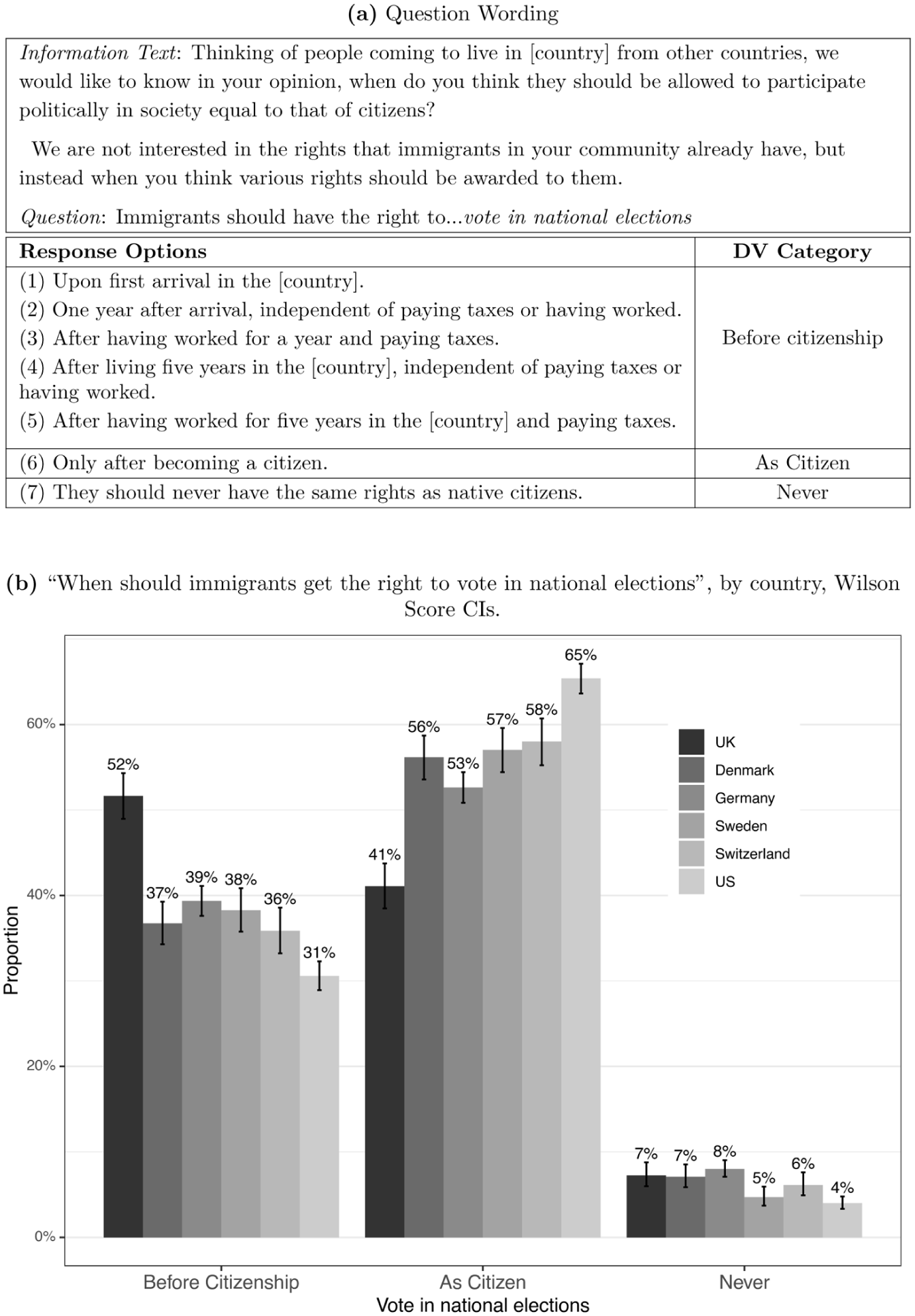
(a) Wording and (b) distribution of dependent variable.
The distribution of the DV is displayed in Figure 1(b). As citizen is by far the most selected answer category, on average 58.5% of the respondent population do not support separating voting rights from citizenship, with the US (68%) and the UK (44%) populations at the extremes. This could reflect some amount of institutional differences, for example, the expansion of immigrant enfranchisement in Scotland and Wales could be driving some of the inclusive views in the UK sample. Nevertheless, despite this range, these numbers still tell us that anywhere between nearly a third to half of the respondent pool, nearly 40% averaged, would enfranchise immigrants before citizenship. 9
Independent variables
To test the main hypotheses, we take several independent variables (IVs) from the survey data to operationalize these constructs. Distributions and descriptive statistics of the main IVs can be found in online appendix A.4. First, to capture the enfranchisement criteria, we use a novel battery of questions that specifically asks respondents to consider how important various integration requirements are on a scale of 1 (strongly disagree) to 5 (strongly agree) when considering national enfranchisement for noncitizen residents. 10 To assess Hypothesis 1a, we ask respondents to rate the importance of demonstrating knowledge of the country’s culture, demonstrating local language ability, demonstrating general knowledge of the country’s political system, and completing an accredited integration course. We measure Hypothesis 1b with paying a year of taxes and being gainfully employed for a year. For Hypothesis 1c, we ask about not having received social assistance and not having any criminal offenses. 11
Turning to the psychological dispositions, we include variables from the survey based on established methods and instruments that measure the individual’s SDO, authoritarianism, and ethnocentrism. To measure SDO, we included a four-question battery from Pratto et al. (1994). On a scale from 0 (oppose extremely) to 10 (favor extremely), respondents rated the following statements: “In setting priorities, we must consider all groups”; “We should not push for group equality”; “Group equality should be our ideal”; and “Superior groups should dominate inferior groups”. The measure is calculated as the scale mean, and higher values indicate higher SDO scores.
Authoritarianism is assessed using child-rearing questions found in the psychology literature. This combined measure has been shown even recently to correlate highly with a measure comprised of more explicitly RWA questions (Engelhardt et al., 2023), showing they measure a similar authoritarian predisposition. To create the authoritarian score, respondents answered questions about qualities they would raise their kids to have: good manners, obedience, religious faith, independence, imagination, and tolerance and respect for others. The overall score is created by taking the difference between the ratings for authoritarian mind-set (first three) and the anti-authoritarian (last three). The scale ranges from −3 (very anti-authoritarian) to 3 (very authoritarian).
Ethnocentrism is measured through a three-item battery of questions where respondents must rate different groups (native-born and immigrants from: North American/European countries, former-Soviet countries, Middle Eastern countries, and African countries) from 1 to 7 on the extent to which they are (A) “hardworking (1)” or “lazy (7)”, (B) “intelligent (1)” or “unintelligent (7)”, and (C) “trustworthy (1)” or “untrustworthy (7)” (Kam and Kinder, 2012). The final indicator was constructed by computing the differences between the ratings for native-born and the immigrant groups for each dimension and averaging them into a single score. The final scale is from −6 to 6, where 0 indicates that immigrants and natives are equally hardworking, intelligent, and trustworthy as natives, a positive score suggests natives are viewed more positively than immigrants, and a negative score suggests that immigrants are viewed more positively than natives. Distributions of these three IVs can be found in the online appendix in Figure A1.5.
Control variables
We control for the impact of socioeconomic and demographic characteristics on these preferences, including age (18–75+ in five-year groups), gender (0 = male, 1 = female), education (upper-secondary or below vs tertiary education), savings (self-reported ability to live on savings for two weeks, one month, three months, six months, one year, longer) (Dražanová et al., 2023; Hainmueller and Hopkins, 2014; Ponce, 2017). We include two geographic variables: whether they live in an urban (0) or rural (1) area, and how ethnically diverse their neighborhood is (1 = not diverse to 4 = very diverse). We measure how often respondents interact with people from different countries (1 = never to 3 = often). These last two variables capture respondents’ exposure to immigrants, which has been shown to impact attitudes to immigrants (Freitag and Rapp, 2013; Green et al., 2019; Kayran and Nadler, 2022; Uslaner, 2020). Finally, we include variables on general placement on the left-right political scale (0 = far left to 10 = far right) and whether the respondent voted in the previous national election (0 = no, 1 = yes).
In robustness checks, we test additional socioeconomic variables, such as union membership (0 = no, 1 = yes), white- or blue-collar employment, if their incomes improved or worsened during COVID, and if they are unemployed (0 = no, 1 = yes). These variables are used to proxy variables for sociotropic economic concerns and economic competition, which have been shown to impact general attitudes toward immigrants (Hainmueller and Hiscox, 2010; Haubert and Fussell, 2006; Kinder and Kiewiet, 1981; Kuntz et al., 2017; Malhotra et al., 2013; Pardos-Prado and Xena, 2019).
Methodology
While the DV has elements of an ordinal factor, we use a pooled multinomial logistic regression because the parallel lines assumption is not satisfied for running ordered logistic regressions. 12 Moreover, six higher-level clusters would be too few to be able to produce reliable estimates with multilevel models (Stegmueller, 2013); we therefore refrain from multilevel analyses. Furthermore, pooling the data became necessary to address the hypotheses regarding immigrant exclusion (never) due to the low response rate of never by country (as seen in online appendix Table A1.3). Therefore, a categorical country variable is included for the six countries in the survey, with the UK as the reference category. The country-specific regressions yield largely similar patterns, which support our decision to pool the data; in the “Results” section, we discuss the few meaningful deviations that do arise.
We present the main results of the pooled multinomial regressions in odds ratios, with robustness checks in the online appendix. Because the models use as citizen as the reference category, the logistic regressions test the likelihood of a respondent selecting the outcome before citizenship or never over as a citizen. An odds ratio above 1 indicates higher odds of selecting before citizenship or never over as a citizen; a ratio below 1 indicates lower odds, and therefore greater relative support for voting rights with citizenship.
Results and discussion
The focus of our analysis is threefold: first, to establish whether there is a relationship between the boundaries citizens draw around the polity and their beliefs about immigrants “earning” their political rights by engaging with enfranchisement criteria commonly found in integration policy (H1a–1c); second, to understand where some boundaries of opposition exist (H2a–4a) and, third, how malleable these boundaries could be (H2b–4b). In order to more easily compute the moderation effect of the enfranchisement criteria on the psychological predispositions in H2b–4b, we constructed an enfranchisement criteria index (ECI) by averaging respondents’ ratings across the eight criteria, where higher values indicate respondents place greater importance on enfranchisement criteria overall. 13 To close, we summarize our findings on the various control variables included in the analyses.
Overall, we see that those who would be most inclined to enfranchise immigrants before citizenship believe that immigrants have less to prove in order to receive said rights. In addition, we see that the three predispositions have different effects on how the polity should be constructed, with authoritarians having the most potential for inclusive preferences and those high in ethnocentrism displaying arguably the highest amount of exclusive preferences.
Finding 1: Perceived contributivism corresponds with greater openness to immigrant voting rights, whereas perceived welfare dependence corresponds with exclusion
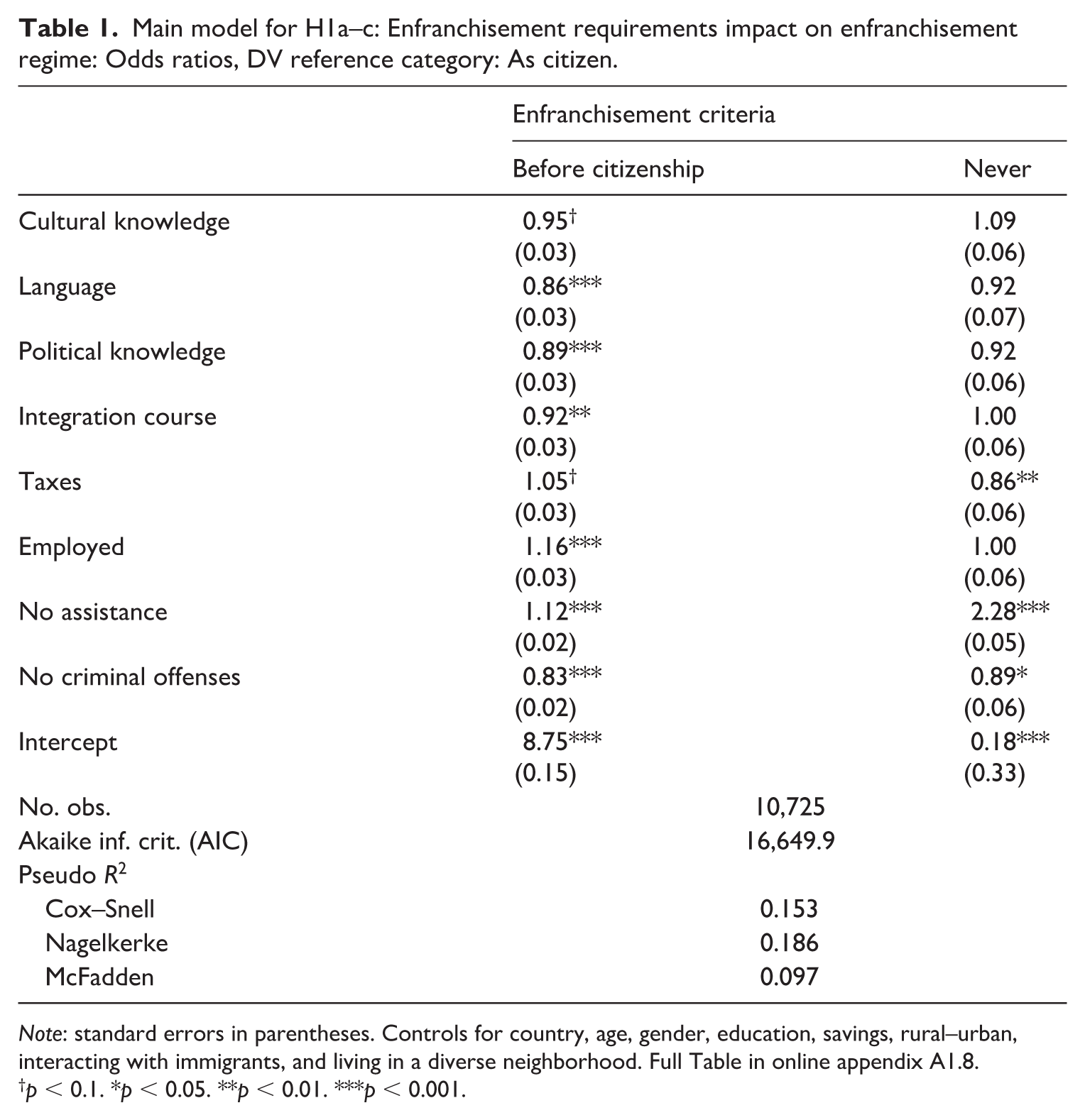
Table 1 displays the main results in odds ratios of the first hypothesis about whether immigrants’ fulfillment of enfranchisement criteria would be sufficient to expand the polity. Generally, the more important enfranchisement criteria become, the more inclined respondents are to attribute voting rights to immigrants when they naturalize (seen by the overwhelming number of odds ratio coefficients < 1). This trend is clearly visible in Figure 2, which displays the predicted probability of selecting when immigrants should have the right to vote in national elections: before citizenship (dark-gray triangle), with citizenship (black circle), or never (light-gray square) based on how important respondents rate the eight different enfranchisement criteria to be (all other variables held at their means).
Main model for H1a–c: Enfranchisement requirements impact on enfranchisement regime: Odds ratios, DV reference category: As citizen.
Note: standard errors in parentheses. Controls for country, age, gender, education, savings, rural–urban, interacting with immigrants, and living in a diverse neighborhood. Full Table in online appendix A1.8.
p < 0.1. *p < 0.05. **p < 0.01. ***p < 0.001.
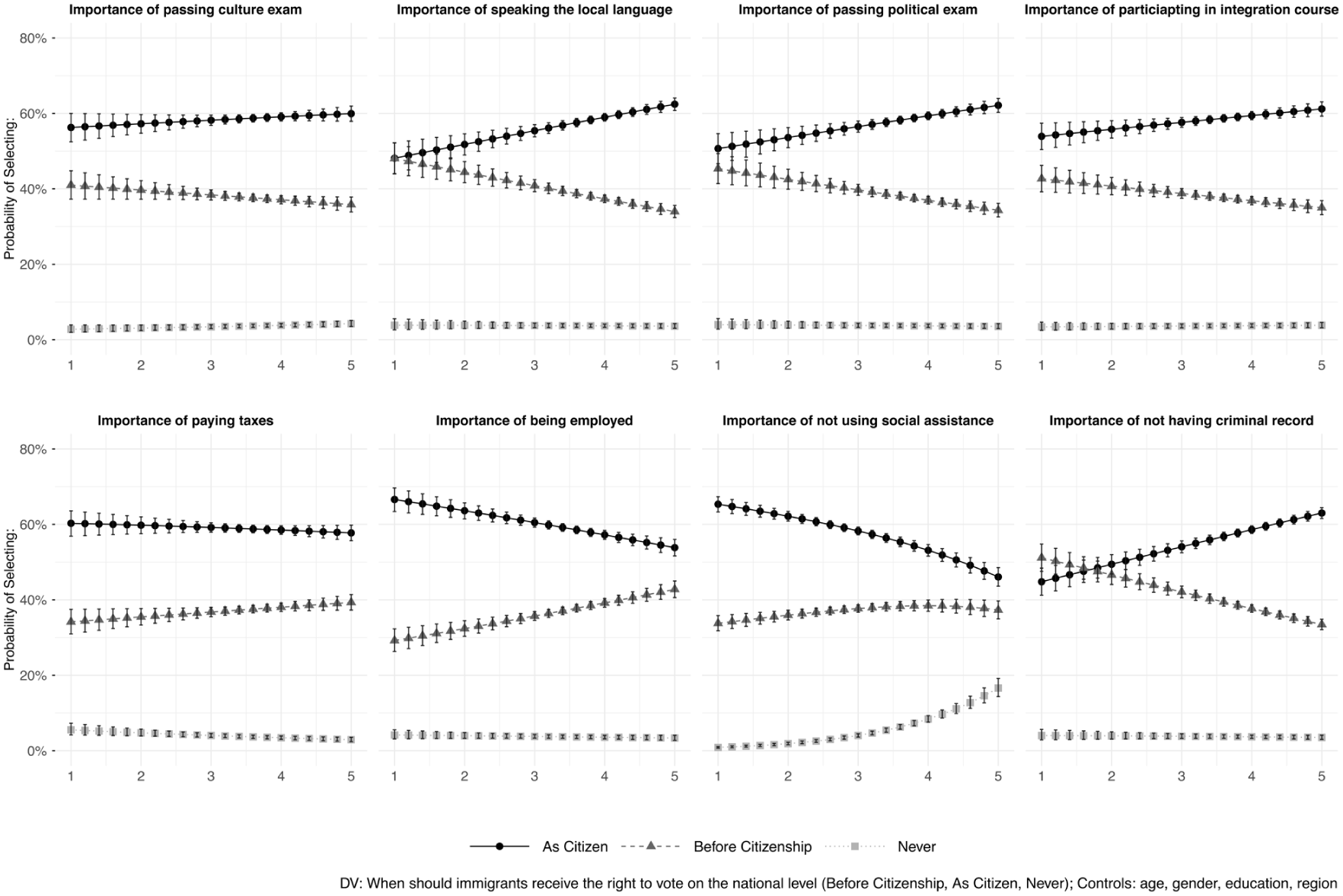
Predicted probabilities of the importance of various enfranchisement criteria on when immigrants should get voting rights (H1a–c).
H1a posits that immigrants who are able to prove their knowledge about country-specific civic and cultural norms would be able to earn earlier political rights. For this purpose, we are interested in the first four rows of the first column of Table 1: before citizenship. Immediately, we can see that across all potential cultural and civic enfranchisement criteria, the more important these conditions are to respondents, the more inclined they are to believe that inclusion of immigrants should occur with citizenship. This is particularly true for exams in cultural knowledge (6% more likely to award voting rights with citizenship over before) and political knowledge (10%) and showing aptitude for speaking the local language (16%). We also consider the case when individuals would never award immigrants the same political rights as natives (even after naturalization), specifically, that for those who place importance on demonstrating local language ability are 11% more likely to select with citizenship than to overall exclude immigrants. Taken all together, while the results are interesting, we cannot confirm Hypothesis 1a. Instead, it appears that for those who find civic and cultural integration to be very important, they place a significant importance on citizenship as the defining moment for enfranchisement.
Moving down the table, we find support for H1b, which hypothesized that citizens reward contributive behavior with earlier voting rights. Here, those who believe that paying taxes and being employed are important for receiving political rights are more likely to enfranchise immigrants before citizenship (5% and 15%, respectively). This trend remains, albeit with little statistical significance, for the never column, in that citizens who highly value contributivism share inclusive (albeit citizenship positive) views on the polity. This suggests that citizens would reward economically productive behavior.
While H1c suggests that citizens punish immigrants perceived to be social and legal burdens, the variable we use to measure this is the opposite logic (immigrants should not take out social benefits, they should not have a criminal record). Thus, those immigrants who “behave” should be rewarded. Probably most interesting is that the importance of not taking out social assistance picks up both a reward and a punishment, namely one group believes that by not being a fiscal burden to the state, immigrants could have voting rights before citizenship, while another group, who also holds that immigrants should not be a burden to the state, would nevertheless permanently exclude anyone of immigrant background from the electorate. This latter result is likely tapping into a similar mechanism that drives welfare chauvinism alluded to in our theory section, while the former could be tapping into some contributivism constructs. The high importance of a clean criminal record predicts citizenship to be the point at which immigrants are enfranchised.
These findings remain robust in the country-specific regressions in online appendix Table A1.24. Although there are a few differences in the single-country regressions in contrast to the main model in Table 1, none reach statistical significance.
To summarize, citizens generally support sharing voting rights with immigrants upon naturalization. However, many are also willing to extend such rights prior to citizenship when immigrants contribute to society by working and paying taxes.
Finding 2: Citizens high in SDO, authoritarianism, and ethnocentrism are less inclined to grant voting rights earlier
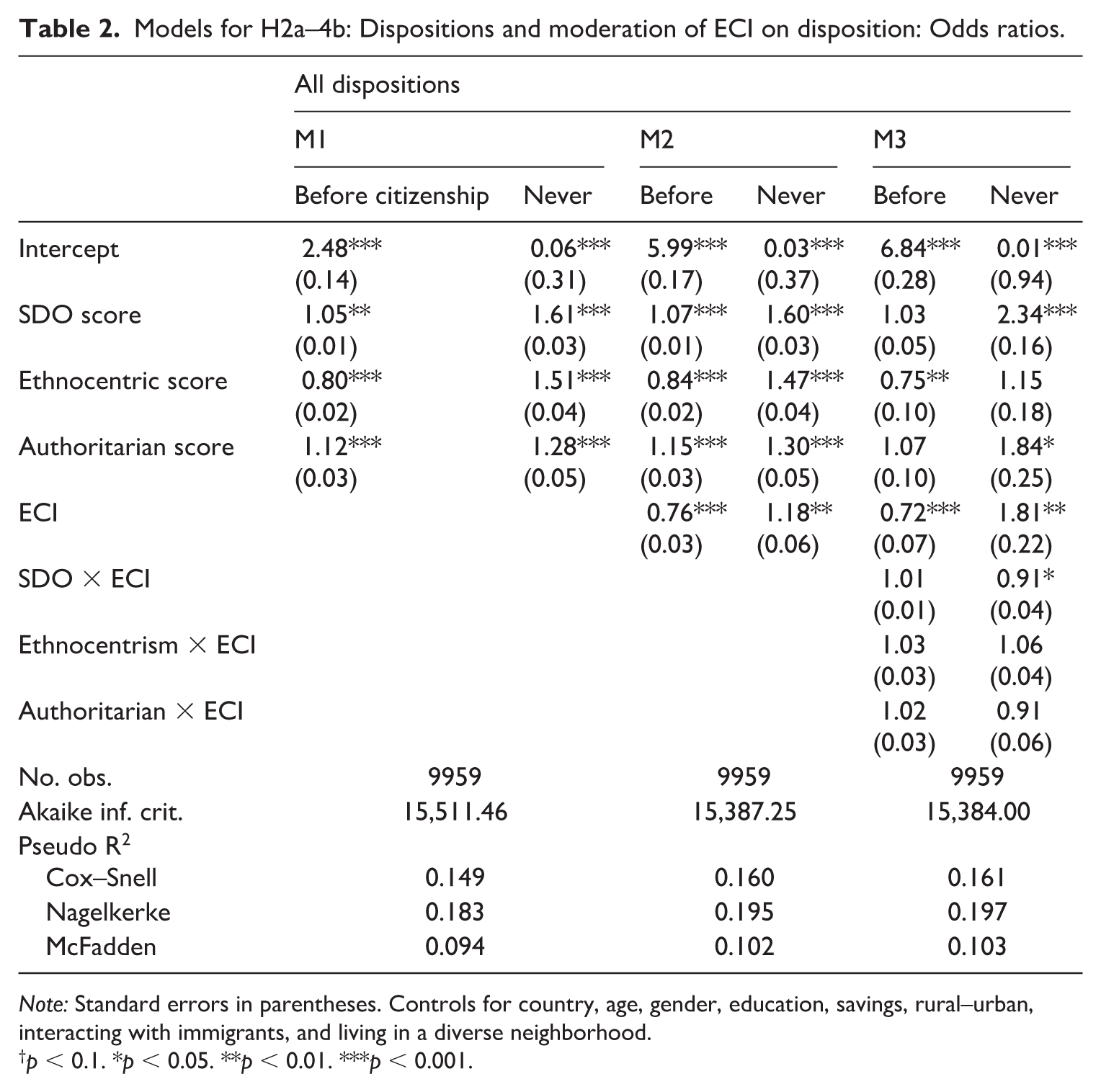
The results for the main effects of the psychological dispositions on polity construction (H2a–H4a) are found in Models 1 and 2 in Table 2. H2a posits the mechanism behind high levels of SDO—namely, the need for demarcated (and unequal) social groups with one’s own dominating all others—will constrict polity expansion. Furthermore, those high in SDO prefer “hierarchy-inducing” policies (Pratto et al., 1994), while those low in SDO are expected to support “hierarchy-attenuating” policies, including political rights. However, we can only partially confirm H2a. We find that those with higher SDO scores hold more exclusive beliefs about the polity, preferring not to attribute voting rights to immigrants even after they have become citizens (Never columns of Table 2, see also Tables A1.9 and A1.10 in the online appendix), 14 while those low in SDO do not necessarily prefer the “hierarchy-attenuating” policy of earlier national voting rights (see Model 1 in Table A1.12 and the robustness checks in Tables A1.12–A1.13 of the online appendix).
Models for H2a–4b: Dispositions and moderation of ECI on disposition: Odds ratios.
Note: Standard errors in parentheses. Controls for country, age, gender, education, savings, rural–urban, interacting with immigrants, and living in a diverse neighborhood.
p < 0.1. *p < 0.05. **p < 0.01. ***p < 0.001.
We anticipated that authoritarians will overall reject enfranchisement before citizenship (H3a) due to their strict views on following rules and adhering to the status quo, namely, the laws that only citizens vote in national elections, while those at the lower end of the spectrum would be more open to earlier access to such rights. Notably, we find some initial support that those high in authoritarianism would be exclusive of immigrant enfranchisement, but they are also inclusive (M1 and M2 in Table 2, see also online appendix Tables A1.9–A1.10). While we find support in our main effects that authoritarians have exclusive views, we do not find that anti-authoritarians/egalitarians have more inclusive, pro-immigrant rights views on the polity (online appendix Tables A1.14–A1.15), meaning only partial confirmation for H3a.
Finally, H4a measures how those high in ethnocentrism and their demarcation of “us vs them” impacts how citizens would build the polity and whether they would include immigrants. Like before, those high in ethnocentrism are very exclusive (H4a), preferring immigrants to never have the same voting rights as themselves, and those low on this ethnocentric scale (meaning having more positive views toward immigrants than toward natives) have more inclusive views (visible in online appendix Tables A1.16–A1.17), being open to immigrants having such rights earlier. Finally, those who believe natives and immigrants to be similar (falling near the middle of the scale), still overwhelmingly support the status quo. We therefore confirm H4a.
Regarding the cross-country differences in online appendix Table A1.26, which correspond to Model 2 in Table 2, only four deviations occur across the national samples, and just one reaches statistical significance. Even so, the fact that three of the deviations occur in the SDO coefficient for the before citizenship outcome is worth brief discussion. In the Swiss (statistically significant), German, and Danish samples, higher SDO is associated with more restrictive preferences, which is consistent with theoretical expectations but different from the main model found, though the latter two countries are very close to 1. However, the positive and statistically significant result in the pooled model (M2, Table 2) is likely driven by the Swedish and US samples, both of which show more inclusive tendencies. This pattern may reflect comparative lower levels of SDO in these samples compared to the others (see panels A–C in Figure A1.5 in the online appendix), which reduces the number of respondents with strong SDO preferences and shifts the pooled association in a more inclusive direction.
To summarize, those who prefer hierarchy-inducing or -maintaining policies (high in SDO), the status quo (high in authoritarianism), or their own ethnic group over others (high in ethnocentrism) are less supportive of enfranchisement before citizenship and even prefer immigrants never having the same rights.
Finding 3: Integration efforts can moderate the extent of some exclusive worldviews
Table 2 displays how the main effects we find in the previous section are impacted by the importance of immigrants engaging in integration efforts, that is, hypotheses 2b–4b. Based on the estimates in Model 3 in Table 2, Figure 3 displays the predicted probability of selecting before citizenship, as a citizen or never for when immigrants should have voting rights based on the three psychological dispositions, moderated by the enfranchisement criteria index (ECI).
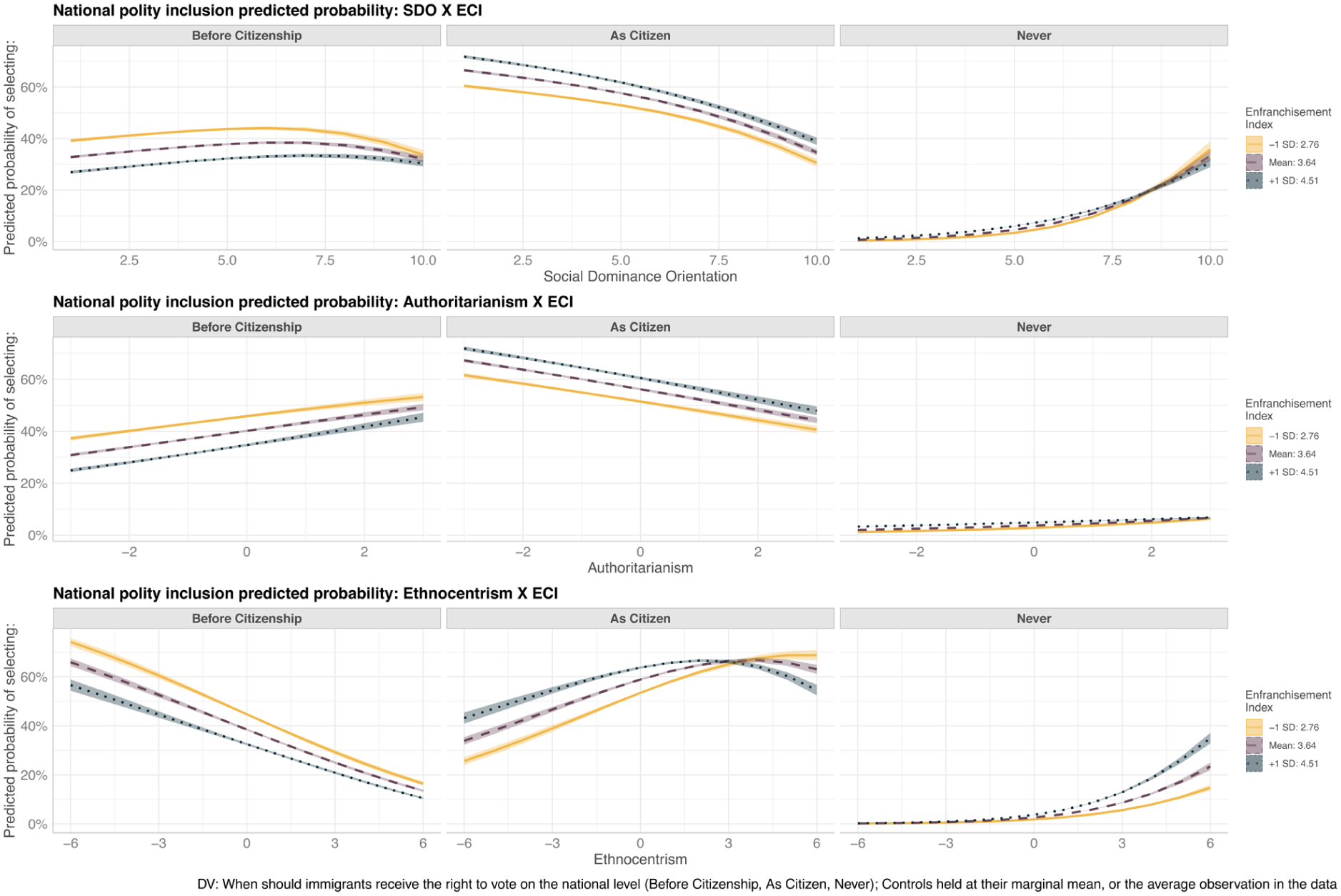
Predicted probability of moderation between SDO, authoritarianism, ethnocentrism and enfranchisement criteria index (ECI).
In the moderated model for H2b on the impact of the enfranchisement criteria on SDO, the coefficient of the moderation effect indicates a reduction of the main effect, though it does not completely reduce the effect to ⩽1 (which would indicate a complete reversal of opinion). In M3 in Table 2, we find no results for the alternative, that those low in SDO would prefer immigrants receiving earlier voting rights. Thus, we take this apart further in online appendix Tables A1.12 and A1.13 by utilizing dummies for an individual who either has a low-to-medium score or a high SDO score and another categorical variables for low, medium, high SDO. Again, those high in SDO have exclusive beliefs (preferring never) that can be moderated (dampened) by the integration criteria (ECI). We find no indication that those with low SDO scores consider voting rights before citizenship for immigrants to be within the “hierarchy-attenuating” policies they prefer; instead, the predicted probabilities in Figure 3 suggest that voting rights should be received at citizenship. This story remains consistent in direction though varies in statistical significance across the individual country regressions in Tables A1.26 and A1.27 in the online appendix.
Unlike for SDO, we believed that for those high in authoritarianism immigrants who follow all the rules and prove they have integrated well into the country’s society could be rewarded with earlier enfranchisement (H3b). As the Model 3 in Table 2 shows the main effect of authoritarianism in the before citizenship column loses its significance with the introduction of the moderation coefficient and the moderation effect is also not statistically significant. The main effect for authoritarianism in the never column increased in magnitude with the introduction of the moderation effect, while the moderation effect, despite being in the theorized direction, is not statistically significant. This relationship is visually present in the predicted probabilities in the middle row panels in Figure 3. We therefore find limited and directional support for H3b, that is, the predicted probabilities align with expectations, but the interaction effects are not significant. This pattern remains in the robustness checks in online appendix Table A1.14–A1.15.
Finally, we find no support in Table 2 nor in Figure 3 that ethnocentric individuals’ exclusive views (never column) are diminished by the proposed enfranchisement criteria, which is in line with our expectation for H4b. With the introduction of the moderation term into M3, the main effect in the never column loses its statistical significance. The predicted probabilities show that a slightly higher importance of enfranchisement criteria (ECI) appears to increase their belief that immigrants should be completely excluded, though this effect is not statistically significant (Never, Table 2). Furthermore, caring less for enfranchisement criteria is associated with a stronger belief that voting rights should come with citizenship (Figure 3). Finally, we find some evidence that those who are low to low-medium on the ethnocentric scale (again, preferring immigrants over natives) are the most inclusive, though again, the moderation effect finds no statistical significance (see Tables A1.16–A1.17 in the online appendix). In addition, Models 7 and 8 in online appendix Table A1.17 suggest that egalitarian views (represented by values occurring around 0 in this scale) translate into citizens being most desirous of the status quo. However, given the low number of respondents who fall at the low end of the ethnocentric scale, (see Figure A1.5 in online appendix), we cannot make any sound statistical conclusions.
To summarize, introducing enfranchisement criteria has differing impacts on some skeptical citizens. The impact of the enfranchisement criteria differs when looking at those high in SDO, authoritarianism, and ethnocentrism. For those high in SDO, engaging in integration efforts can have their more exclusive tendencies dampened, while we find no statistically significant moderation effect for ethnocentrism and authoritarianism. Considering that while integration could be a tool to moderate some views on social hierarchies, it has little effect on dampening the views of those with strict views on in- and out-groups.
Finding 4: Political orientation and contact with immigrants still matter
To close this discussion of results, we briefly turn to other possible individual-level characteristics that may impact citizens’ willingness to enfranchise immigrants, such as political ideology and contact theory. First, general left-right scale self-placement shows that those furthest left have more inclusive views about the polity, while the farthest right, the most exclusive (see Tables A1.18 and A1.19 in the online appendix). Those who fall between center-left and center-right have considerably similar views: enfranchisement should occur with citizenship. Generally, voters (Supplemental Figure A1.16, Panel A) are more inclined to include immigrants as citizens, while non-voters, in particular those who value enfranchisement criteria the least, would enfranchise immigrants before citizenship. Combining these findings with those of Alarian and Zonszein (2024) that potential co-partisanship matters, voters could be the largest constituency gatekeeping their polity.
Finally, throughout the analysis, be it in the main models or the robustness checks, our controls for contact theory and perceived ethnically diverse neighborhoods remained consistent. Having regular contact with immigrants is associated with greater support for rights expansion and with weaker exclusionary beliefs, while living in ethnically diverse neighborhoods shows a less consistent association (see Table A1.7 and the main robustness models in the online appendix). We find few other consistent or statistically significant results among the rest of the tested controls and the additional socio-economic and demographic variables; all tables can be found in the online appendix (Tables A1.21–A1.23).
Conclusion
In this article, we investigated when citizens are willing to extend political rights to immigrants (with or without citizenship), and if citizens believe immigrants without citizenship could do anything to expedite this process or if these views are largely the result of citizens’ psychological predispositions (SDO, authoritarianism, and ethnocentrism). We expected that by requiring enfranchisement criteria for immigrants, it could positively impact citizens’ willingness to extend the right to vote before citizenship. Furthermore, we hypothesized that fulfilling such criteria would moderate the (exclusionary) effect of psychological predispositions found in different societal groups (Knotz et al., 2024), potentially shaping the extent to which individuals high in SDO, authoritarianism, or ethnocentrism would support enfranchisement prior to citizenship.
Using a novel data set from a 2021 survey fielded in Denmark, Germany, Sweden, Switzerland, the UK, and the US, we tested these assumptions. In terms of general polity inclusion, citizens in all six democracies overwhelmingly support national enfranchisement with citizenship, meaning that the majority of citizens do not want to or cannot uncouple national voting rights from citizenship. Instead, they require immigrants to have undergone naturalization and all its necessary criteria to participate nationally. This is in line with findings from Michel and Blatter (2021) and Blatter et al. (2022) but also suggests that even in countries with more long-standing inclusive political institutions (e.g. Sweden and Denmark), citizens still have limits on the extensiveness of such policies.
Nevertheless, we see three puzzle pieces coming together. First, enfranchisement criteria in the form of immigrant integration efforts can shape preferences. Specifically, though not present in modern election and voter eligibility laws, broad contributive criteria (employment, paid taxes, refraining from social benefits, etc.) could be a plausible route toward inclusion before citizenship. This already occurs indirectly in some cases: where eligibility requirements include permanent residence, and, in turn, permanent residency requires proof of financial independence (e.g. Swiss cantons of Neuchâtel and Fribourg). Thus, contributivism could find its way into such policies, for good or for bad (Hultin Rosenberg and Sundevall, 2022).
Second, those already more inclined to include immigrants in the polity attach few strings to that inclusion: in our results, respondents who would enfranchise noncitizens before citizenship require fewer conditions. These individuals tend to be on the left of the political spectrum, score low on ethnocentrism or high on authoritarianism (perhaps left-wing authoritarians (Conway et al., 2023)), and interact regularly with immigrants. However, contrary to what we expected, being low in SDO (a worldview that supports societal equality and hierarchy-attenuating policies) and low in authoritarianism (support of liberal ideas and equality) does not translate into support for early national voting rights. This suggests that while these worldviews may be linked to more positive attitudes toward immigrants, they still maintain boundaries around the rights immigrants should receive.
Third, placing great importance on enfranchisement requirements is associated with less exclusionary preferences among those citizens who would otherwise hold considerably exclusive views on the polity. Namely, those with higher scores in SDO have some reduction in their views when confronted with immigrants earning their rights through the fulfillment of (civic) integration, if not assimilationist, criteria. Overall, those with strict authoritarian views diverge: they are simultaneously more open toward immigrant enfranchisement before citizenship and more likely to support permanent exclusion. As such, more research is needed to understand the mechanism behind this divergence.
Most importantly, while the various indicators of general anti-immigrant sentiments we also tested here account for some of the preferences around polity inclusion, they are clearly just a small part of a larger story. Preferences on the extension of political rights and polity inclusion are more than just attitudes toward immigrants, as those we anticipated to hold the most progressive views may not believe that immigrants should be included prior to citizenship. Instead, there is a different story about how citizens in democratic societies view power-sharing and decision-making responsibilities (Stutzer and Slotwinski, 2020) and display political tolerance toward immigrants (Gandenberger et al., 2025).
We contribute to the literature on immigrant voting rights (Altman, 2022; Earnest, 2015) and the research on citizens’ preferences on this issue (e.g. Alarian and Zonszein, 2024; Gonnot, 2022; Michel and Blatter, 2021). We do so by showing that citizens are willing to include immigrants in their political community under certain conditions and that immigrants could “earn” some citizens’ favor by engaging in integration efforts. We also contribute to the literature on predispositions, expanding the discussion to include the impact they have on the allocation of immigrants’ political rights.
For policymakers, our findings suggest potential avenues for adapting today’s democracies to be more representative of the diversity of their resident populations and positively influence immigrants’ social integration (Alarian, 2025; Hainmueller et al., 2017). On one hand, they could consider linking access to political rights to certain criteria, such as contributivism (though one should be mindful of classist pitfalls here). To some extent, even those who are more skeptical toward immigrants and their political rights could support such criteria. On the other hand, the public support for access to political rights with citizenship may pose an important opportunity for countries to instead adapt existing citizenship laws to be more inclusive.
However, there are still some limitations to this article. In the survey we rely on, we did not measure respondents’ beliefs on how such criteria relate to citizenship, nor were we able to measure their preferences regarding length of required residency in country to receive permanent residency or citizenship. Thus, we make the assumption that their beliefs are in line with the current state laws, which may be coincidence. We also cannot rule out the potential of simultaneity bias in our measurement of our dependent and main integration IVs, stated differently, attitudes toward immigrant political inclusion may impact the attitudes toward immigrants’ integration. Nevertheless, even if that is the case, our findings provide novel insights on immigrant enfranchisement. Unfortunately, due to the nature of the question underlying our DV, we cannot be sure of who respondents have in mind when reading “immigrant” while answering the question. This is especially relevant for cases, where discussions of “illegal” immigration are common, such as the US at the time (and at present). This perception of immigrants could obfuscate the effects if part of the sample draws on different legal categories of immigrants (Wright et al., 2016). Particularly, as Alarian and Zonszein (2024) show that the imagined partisanship of potential future co-electors matters. Research should further examine how some factors immigrants cannot overcome based on their country of origin, religion, race, and so on, but also their ideology impact views on their enfranchisement, as a way to combat such discrimination being codified into law.
This study into how citizens view the link between immigrants’ efforts and their enfranchisement marks a first step into an increasingly important aspect of maintaining democratic representativeness in diverse societies. We show a selection of potential criteria that legislatures could use to pass more inclusive legislation. Future work should work toward finding a more cohesive suite of conditions that would engage more actors to pass such laws.
Supplemental Material
sj-pdf-1-psx-10.1177_00323217261450950 – Supplemental material for (Un)conditional? The role of integration and psychological predispositions in citizens’ attitudes toward immigrant enfranchisement
Supplemental material, sj-pdf-1-psx-10.1177_00323217261450950 for (Un)conditional? The role of integration and psychological predispositions in citizens’ attitudes toward immigrant enfranchisement by Alyssa M. Taylor and Mia K. Gandenberger in Political Studies
Footnotes
Acknowledgements
The authors thank Flavia Fossati, Juliana Chueri, Eloisa Harris, Rodrigo Sanchez, Carlo Knotz, Daniel Oesch, Swen Hutter, and Thomas Bräuninger for repeated feedback on this article. For feedback on an early draft, they thank the participants of the seminar in public economics at the ZEW in 2023, the discussant Ihssane Otmani and the participants of the IDHEAP Research Forum in 2023, and the panel and participants at ECPR Annual meeting 2023. They also thank participants of a 2025 LAGAPE research seminar at the University of Lausanne for help framing the important take-aways of this article. Finally, they thank the anonymous reviewers from Political Studies for their comments on effectively reframing our contribution.

Ethical considerations
Ethics approval for the survey was provided by the Research Ethics Commission of the University of Lausanne C_FDCA_022020_00001 on 6 May 2020.
Funding
The authors disclosed receipt of the following financial support for the research, authorship, and/or publication of this article: This research was supported by the National Center of Competence in Research for Migration and Mobility studies (NCCR—on the move), which is funded by the Swiss National Science Foundation (SNSF Project No. 51NF40-182897).
Declaration of conflicting interests
The authors declared no potential conflicts of interest with respect to the research, authorship, and/or publication of this article.
Data availability statement
Supplemental material
Supplemental material for this article is available online.
Notes
Author biographies
References
Supplementary Material
Please find the following supplemental material available below.
For Open Access articles published under a Creative Commons License, all supplemental material carries the same license as the article it is associated with.
For non-Open Access articles published, all supplemental material carries a non-exclusive license, and permission requests for re-use of supplemental material or any part of supplemental material shall be sent directly to the copyright owner as specified in the copyright notice associated with the article.
