






Abstract
As Western democracies become increasingly diverse, political influence often depends on effective alliances and solidarity that cut across group boundaries. While the intergroup solidarity literature points to shared grievances as a central driver, it remains unclear exactly what kind of grievance information promotes political solidarity between which groups. To test this, we conducted a survey experiment in the United Kingdom among respondents from three distinct groups: migrants from Eastern Europe, migrants from the Middle East and North Africa (MENA), and natives. The treatments vary based on which immigrant group is described as experiencing discrimination, making potentially shared group grievances salient. We find that discrimination information increases support for prospective MENA immigrants among migrants from Eastern Europe, but not vice versa, and we find no effects among UK natives. Moreover, discrimination information is more effective among migrants without British citizenship. Importantly, discrimination information may not uniformly foster political solidarity or interest alignment across all population groups.
Keywords
Introduction
European countries are more diverse than ever. As a result, coalition building and political solidarity that transcend group boundaries are increasingly important to effectively influence and shape political agendas. That seems especially true for the issue of immigration, which is inherently about intergroup relations and is one of the most politicized contemporary issues in Europe. Alongside this politicization, considerable research has investigated the contextual factors, political frames, and individual-level factors that influence public opinion on immigration. And a more recent trend in immigration research focuses on group-specific preferences for immigration. This includes heterogeneity in openness to immigration across different population subgroups (see, e.g. Gorodzeisky and Semyonov, 2019; Just and Anderson, 2015), such as ethnic minority and majority groups (Just and Anderson, 2015; Neureiter and Schulte, 2024), but also identifying the varying degrees of openness to immigrants from different cultures, countries, or areas (Ford, 2011; Hellwig and Sinno, 2017).
This work has been important for cementing the idea that immigration attitudes are not one flat opinion dimension; they are nuanced and vary depending on the specific backgrounds of the respondents (Eidgahy and Pérez, 2023; Ford, 2011; Neureiter and Schulte, 2024), the contextualization of the measures used to capture immigration attitudes, and the explicit or implicitly assumed characteristics of the prospective immigrants (Blinder, 2015). For example, whereas residents with a migration background on average hold more positive immigration attitudes than native-born residents (Blinder, 2015), their pro-immigration attitudes decrease over time and with naturalization (Just and Anderson, 2015) and may rest on perceived similarity between oneself and the prospective immigrants (Ford, 2011).
Given the increasing diversification of European societies during the past decades, it is thus particularly interesting to test whether it is possible to influence the degree of political solidarity different groups are willing to extend to prospective immigrants. While many ethnic minorities in Europe and North America have migration or refugee backgrounds, and on average hold more positive attitudes toward immigration, political solidarity is complex and may not be uniformly mobilized across different group constellations. In other words, it is worthwhile to test whether and when solidaristic immigration attitudes go beyond one’s ingroup.
In liberal, democratic societies, where values such as egalitarianism and tolerance underpin many social and political goals, solidarity is a particularly promising social mechanism. If people do not find ways to connect and come together across divides, politics and society risk becoming increasingly fragmented and polarized. Acting in political solidarity with other groups is thus a powerful way to further one’s political agenda (Neufeld et al., 2019; Subašić et al., 2008). It is, however, also a complex and multifaceted mechanism that relies on different groups’ social, emotional, and economic ties, as well as the opportunity structures that promote or hinder solidaristic behaviors and attitudes (Tormos, 2017). In this article, we focus on one specific dimension of political solidarity, namely, the promotion of immigrant groups’ interests in residency. While solidarity is often theorized to encompass a psychological dimension (e.g. feelings of kindredness) and an expressive or political dimension (e.g. voicing or voting in alignment with another group’s interests), we zoom in on the latter dimension. We do so because this dimension is explicitly political and holds strong potential to shift the structures that either promote or limit prospective immigrants’ interests. While emotional or psychological solidarity may underpin solidaristic expressions and behaviors, it is insufficient on its own to shift political agendas and cement allyship. As such, we examine a more narrowly conceptualized dimension of political solidarity – one centered on interest promotion or alignment with another group.
To test when solidaristic immigration attitudes go beyond one’s ingroup, we focus on the effects of grievance information because research on intergroup solidarity finds that shared grievances, like marginalization or discrimination, are a promising venue for fostering solidarity (Cortland et al., 2017; Craig and Richeson, 2016; Just and Anderson, 2015). Nevertheless, perceiving or being informed of grievances may work uniquely between minority groups (Eidgahy and Pérez, 2023), as majority groups are less likely to experience and thus relate to marginalization and discriminatory treatment. This minority-contingent effect of shared grievances is substantiated by studies that find that information about discrimination against minorities updates natives or the general public about the extent of discrimination, but it does not translate into a change in pro-outgroup or pro-immigration attitudes or behaviors (Grigorieff et al., 2020; Korlyakova, 2021; Schaeffer et al., 2026). Even among minority groups, political solidarity may be limited. Neumann and Moy (2018), for instance, find that respondents from 20 different European countries who have experienced discrimination based on race, ethnicity, or religion tend to oppose immigration, whereas experiences with language-based discrimination correlate with more positive attitudes toward immigration. It thus remains ambiguous to what extent information about immigrants’ experienced discrimination causally affects native-born and immigrant residents’ immigration attitudes.
This article sheds light on this question by employing an original survey experiment among three samples: UK natives, UK residents who migrated from MENA countries, and UK residents who migrated from Eastern Europe. We test the effect of information about experienced discrimination, varying which immigrant 1 group the discrimination information is about, on willingness to accept prospective immigrants from different regions. This design enables us to causally identify whether the effect of discrimination information is contingent on who the information is about and who assesses the information. As a result, our results speak to whether information about experienced discrimination can mobilize political intergroup solidarity, and specifically among whom. In doing so, our study contributes to broader debates on how to foster social coherence and intergroup support in increasingly diverse Western democracies. Moreover, our study informs and nuances the literature on immigration attitudes and political solidarity by highlighting how grievance information may not uniformly mobilize political solidarity, or at least interest alignment, with prospective immigrants across different societal groups. From an applied perspective, our findings may also be of interest to community organizers seeking to build advocacy coalitions, as well as political parties trying to engage potential voters.
The remainder of the article proceeds as follows. First, we review the literature on intergroup solidarity and develop a theoretical framework on the relationship between discrimination information and political solidarity. From this framework, several testable hypotheses are derived. Second, we present our research design based on an original survey experiment administered to migrants from Eastern Europe, migrants from the MENA region, and native-born Brits in the United Kingdom. Third, we present the results of our analyses, revealing that discrimination information primarily mobilizes intergroup solidarity among UK residents with Eastern European backgrounds. Finally, the concluding section summarizes the main findings of our study and discusses their implications and limitations.
A theory of grievance solidarity
While there is no consensus on exactly what constitutes solidarity, it is broadly recognized as an expression of something shared, such as shared identities, interests, and political opportunity structures (Louis et al., 2019; Taylor and Whittier, 1992; Tormos, 2017). Intergroup solidarity is thus an expression or recognition of allyship or kindredness toward members of a societal group to which one does not belong, whereas intragroup solidarity concerns solidarity between members of the same societal group. Beyond a feeling of connection and allyship, solidarity is frequently conceptualized as having a political or social change dimension. When people act or stand in solidarity with a group, they often do so by socially and politically supporting or promoting the interests, voices, and goals of that group (Neufeld et al., 2019; Subašić et al., 2008). In the context of immigration, this means that a shift toward perceived shared experiences, interests, or identities between natives and immigrants, or different immigrant groups, could influence the groups’ willingness to express political support for or interest alignment with prospective immigrants. In other words, when a group recognizes that their experiences are like those of another group, that “shared fate” may motivate people to support an outgroup’s interests, for example, their interest in coming to the host country. As such, whether and to whom solidarity is mobilized can have a dramatic influence on the political and social landscape, especially when it comes to immigration attitudes and policies.
The plurality in the conceptualization of solidarity is reflected in how it is measured. Sometimes solidarity is measured as feelings or attitudes toward another group, and other times as indications of shared fate or experiences, or even behavioral expressions, such as political support, voting, or advocacy (Burson and Godfrey, 2020; Cortland et al., 2017; Craig et al., 2012; Craig and Richeson, 2012). While expressed political solidarity often stems from an underlying feeling or perception of kindredness or connection, we focus on the interest alignment and promotion dimension – namely, politically supporting (e.g. by voting in line with) the interests of the group one stands in solidarity with. We thus focus on what may be the most politically potent reflection of solidarity.
Majority-minority solidarity
Traditionally, much intergroup solidarity research has focused on the drivers and outcomes of majority-minority group solidarity (see, e.g. Louis et al., 2019; Subašić et al., 2008), particularly on when and why dominant majority groups act in solidarity with disadvantaged minority groups. Louis et al. (2019) even propose to understand intergroup solidarity as instances when [. . .] (some of) the advantaged group members perceive the disadvantaged and advantaged groups are part of a shared, common group [. . .]. This may be based on a shared superordinate identity (“we are all humans”) or a shared opinion-based group (“we all want freedom”) (p. 7).
Subašić et al. (2008) similarly argue that to have social change, majority groups must, crucially, change the way they relate to minority individuals, who are striving to challenge authorities or eradicate the grievances they face. However, this requires that “people reconcile differences at the subgroup level in a way that makes higher order goals and interests possible to achieve” (p. 337). Thus, even though different minority groups may more readily recognize shared experiences, interests, or identities – and therefore find common ground for solidarity – majority-minority solidarity may be more influential in shifting social and political outcomes.
It is unclear, however, whether discrimination information can alter the way majority individuals relate to and support the interests of minority individuals. While most groups and individuals experience grievances, discrimination is a specific type of grievance rooted in group membership differences. As such, it is not clear whether discrimination information can prompt the type of superordinate identity or higher-order goals necessary for majority-minority solidarity. Since grievance solidarity is most likely to be established between minorities, rather than between minority and majority groups, we expect that information highlighting discrimination against residents with any immigration background increases pro-immigration attitudes among residents with immigration backgrounds and not among those without (H1).
Inter-minority solidarity
Solidarity between different minority groups is also not a given, even though they often share similar struggles of marginalization and discrimination. Political structures in society may hinder cross-minority group solidarity, for instance, by promoting intra-minority competition for jobs (Meeusen et al., 2019), educational opportunities, or political resources (Burson and Godfrey, 2020). Nevertheless, minorities often recognize their shared interests and experiences qua their position in society. This is, for instance, reflected in an interview study conducted by Eidgahy and Pérez (2023), where they find that MENA individuals in the United States express several shared grievances with other People of Color (PoC), such as being disadvantaged relative to whites. Several studies further show that perceiving a shared identity, as well as historical, political, and critical thinking, fosters solidarity and positive attitudes between minority groups (see, e.g. Burson and Godfrey, 2020, for an overview).
In terms of social and political attitudes, the blurring of group boundaries has been shown to increase political solidarity between groups (Glasford and Calcagno, 2012) and highlighting shared grievances may even trump a lack of common identification (e.g. cut across racial or gender-based identities) across minorities (Cortland et al., 2017). Several experimental studies further support solidarity as a mechanism triggered by framing discrimination as a shared or similar experience, which results in an increasing support for pro-outgroup policies (Kim et al., 2026; Pérez et al., 2024; Rogbeer et al., 2025). This means that discrimination information could foster inter-minority solidarity because shared experiences, common goals, and fuzzy group boundaries are more readily available than between minority and majority groups. We thus expect that respondents with Eastern European backgrounds increase their willingness to take in MENA immigrants when receiving information about discrimination against MENA residents (compared to the control group) (H2), and that respondents with MENA backgrounds increase their willingness to take in Eastern European immigrants when receiving information about discrimination against Eastern European residents (compared to the control group) (H3).
Nevertheless, discrimination information may not increase political inter-minority solidarity among all minority groups. This is because the experiences of different minority groups vary based on several factors, such as each group’s perceived proximity to the majority (in terms of racial, cultural, and other markers), socioeconomic standing, and current elite discourse and political scapegoating (Booth et al., 2012). Differences in experiences may thus shape each group’s capacity for inter-minority solidarity, as well as the relationship between discrimination information and solidaristic attitudes. For example, based on a survey among different minority groups in 28 European countries (European Union Agency for Fundamental Rights, 2017), migrants from MENA countries report higher levels of discrimination than most other minority groups, including migrants from Eastern Europe. Due to Eastern European migrants experiencing less religious exclusion and being racially more proximate to the majority, migrants from MENA countries may find it more difficult to view them as part of the same disadvantaged ingroup (Shah, 2008), even when presented with information about discrimination faced by Eastern European migrants.
Relatedly, competition may function as a competing mechanism to solidarity (Neureiter and Schulte, 2024), such that information about an outgroup being discriminated against may highlight and reinforce boundaries between minority groups rather than foster feelings of commonality (Meeusen et al., 2019). In this competitive logic, minority groups perceive relative safety or advantage when stigma targets others (Cernat, 2019). Given the pervasive anti-Muslim bias in contemporary European societies (European Union Agency for Fundamental Rights, 2017), it is therefore conceivable that migrants from MENA countries may respond ambivalently to information about discrimination against Eastern Europeans. Even if MENA migrants oppose discrimination in principle, they may feel relieved that hostility is not directed at them for a change, and that broader anti-migrant sentiment is targeted at another group. Therefore, while H2 and H3 posit symmetric responses to discrimination information among migrants from Eastern Europe and the MENA region, it is important to note that there are certain conditions – for example, differential proximity to the majority, incommensurable discrimination experiences, competitive dynamics – under which this prediction may not hold.
As mentioned earlier, a minority individual’s willingness to extend solidarity to and support the interests of prospective immigrants from another group is likely contingent on one’s ties to the dominant majority (Neureiter and Schulte, 2024) and citizenship status (Just and Anderson, 2015). As naturalization processes often entail that immigrants explicitly or implicitly adopt majority norms and values, naturalized immigrants become more like the majority on political and social issues, including immigration. We therefore expect that citizenship status moderates the effect of discrimination information on the pro-immigration attitudes of residents with immigration backgrounds (H4).
While we have theoretical expectations of why citizenship status could moderate the prospect of solidaristic behaviors, it is worth noting that non-citizens lack formal political power (in the form of voting), which limits their direct political influence on, in our case, migration policy. As such, one may question the political relevance of studying solidarity among those who lack a formal political voice. We argue to the contrary for three reasons. First, while a significant number of migrants already possess the citizenship of the host country (around 43% in the United Kingdom; Fernandez-Reino et al., 2023), many of those who do not currently have it will eventually obtain it and thus be able to directly influence immigration policies. 2 Second, even in the absence of host country citizenship and voting power, solidaristic attitudes still shape intergroup dynamics and therefore also indirectly influence the political agenda. If naturalization dampens intergroup solidarity, this is likely to be reflected in group boundaries in social networks, integration and discrimination dynamics, and prospects for community-level political mobilization. Third, regardless of behavioral manifestations, understanding the attitudes of different migrant groups is important, as it tells us about their potential for solidarity and provides insights into processes of opinion formation and change.
In sum, inter-minority solidarity is likely more readily mobilized than majority-minority solidarity because minorities’ identities, experiences, and interests are more alike. Minorities, especially those who immigrated themselves, may thus be more sensitive to information about grievances because they are more likely to have similar experiences, which in turn may increase their pro-immigration attitudes as an expression of solidaristic interest alignment. Importantly, however, inter-minority solidarity may be limited among minority groups that perceive themselves as highly distinct from the other group, as well as among naturalized individuals who are more likely to have adopted the norms and views of the native population.
Intra-minority solidarity
Forcing emotional links between minority identities may backfire if the unique identity of each group is not taken seriously. In their in-depth interviews, Eidgahy and Pérez (2023) find that MENA interviewees also highlight the distinct grievances and experiences dissimilar to those of other PoC groups, such as Black Americans and Latinos. So, while minority individuals may be willing to extend their solidarity to other minority groups, it is crucial that doing so would not negatively impact the social standing of one’s own group. This is in line with the results of Chaney and Forbes (2023), who found that people are solidaristic when it benefits their ingroup. These nuances and limits to using shared grievances to promote solidarity are important when exploring the support for immigration among different minority groups. While society members with migration backgrounds are more likely to identify with and share the grievances of prospective immigrants, making another group’s grievances salient may inadvertently trigger feelings of social or economic threats or a desire to be recognized as having unique grievances. As a result, to promote positive feelings and solidarity between disadvantaged groups, it is important that the connecting grievances are overarching enough to transcend group boundaries but also meaningful enough to foster solidarity.
As a result of the limitations to intergroup solidarity, it is likely that an explicitly shared identity matters for how well grievance information can mobilize pro-immigration attitudes. We therefore expect that respondents are more willing to accept more immigrants if they are informed that their own ethnic group experiences widespread discrimination (than when it is not their ethnic group), and especially so if the prospective immigrants also share the respondent’s ethnicity (compared to when they do not) (H5).
Mobilizing political solidarity for prospective members of society
The upshot of the different mechanisms underlying majority-minority and inter-minority solidarity is that information about grievances, especially discrimination, could affect both minority and majority members’ inclination to welcome prospective immigrants. Importantly, the degree of willingness to welcome immigrants likely depends on the identity proximity between the respondent and the prospective immigrant group, where majority members are the least proximate, and people sharing the same area of origin are the most proximate. Furthermore, experimental studies that make discrimination grievances salient often focus on the current grievances of current minority members of society. However, information about the grievances of a current immigrant group may also prompt people to act in solidarity with a similar prospective minority group. This serves as an even harder test for how far political solidarity or interest alignment with immigrants extends since people more often view residing, individual immigrants more favorably than prospective immigrants or “immigration” broadly conceived (Margalit and Solodoch, 2022). We thus extend political solidarity research by testing whether support and interest alignment go beyond host country borders to potential residents.
Research design
Data and respondents
To test our hypotheses, we conducted an original survey experiment in the United Kingdom. The United Kingdom represents an ideal testing ground for our hypotheses for two reasons. First, migration trends and public attitudes toward migrants in the United Kingdom are similar to those in other European countries. For one, the relative size and composition of the migrant population in the United Kingdom are fairly typical for Western Europe (Alarian and Neureiter, 2021; Neureiter, 2022). Moreover, public attitudes toward migrants in the United Kingdom are similar to those in other Western European countries (Goubin et al., 2022), 3 as are recent statistics on the prevalence of discrimination (European Union Agency for Fundamental Rights, 2017). The results of our study may thus generalize to other Western European countries, but, as is central to our argument and research design, we should be very careful about assuming that different groups react similarly. Thus, we encourage future studies to examine group-specific immigration attitudes and solidarity in different countries. Second, from a feasibility standpoint, there is a bigger pool of respondents available for online surveys in the United Kingdom than in other European countries, and therefore, it constitutes the most practical case.
The survey was distributed online to 1200 participants in February 2025, 400 from each of the following three groups: migrants from Eastern Europe, 4 migrants from the Middle East and North Africa, 5 and native-born individuals. We selected migrants from Eastern Europe and the MENA region over other possible groups of migrants (such as those from Latin America) for two reasons. First, Eastern Europe and the MENA region represent two of the most common regions of origin among migrants in the United Kingdom (see Cuibus, 2024), which enables us to recruit a sizable number of respondents from a hard-to-reach population. Second, Eastern European migrants and those from the MENA region are similar in that they are both immigrant groups who face increased discrimination relative to the majority population, while they are rather dissimilar in terms of dominant religion and other cultural markers, which is a prerequisite for effectively testing our theoretical arguments. Third, other Western European countries also include sizable migrant communities from Eastern Europe and the MENA region (Neureiter, 2025), which bodes well for the applicability of our results beyond the United Kingdom.
All participants were at least 18 years old and resided in the United Kingdom at the time of the survey. We recruited respondents using Prolific, which enabled us to filter potential survey participants by country of birth. While Prolific provides convenience samples rather than nationally representative ones, replication experiments have shown that results derived from such convenience samples are very similar to those obtained from representative samples (Berinsky et al., 2012; Coppock, 2019; Peer et al., 2021). Prior to its implementation, our survey was reviewed and approved by the Research Ethics Committee of the Faculty of Social Sciences at LMU Munich (study # 24-08). The language of the survey was English for all respondents.
While 394 respondents per condition would be needed for 80% power to detect a small effect (d = 0.2) and would have been ideal for our design, our budget allowed for about 300 respondents per condition, yielding 80% power for effects of d = 0.23 or larger. For our subgroup analyses, this corresponds to 80% power to detect medium-small effects (d = 0.4). Accordingly, we will interpret potential null results with caution, as smaller effects may have gone undetected. To aid the interpretation, we will report confidence intervals for all estimated effects. Nevertheless, our estimations suggest that the study retains adequate power to detect effect sizes of substantive interest, as very small effects are less likely to have meaningful implications in real-world political contexts.
Experimental treatment
After providing consent, respondents were randomly assigned to one of four experimental groups, and each group was presented with a (fictitious) newspaper article they were asked to read carefully. The article for the first group described interviews with migrants as well as recent public opinion polls indicating that migrants in the United Kingdom are faced with widespread discrimination. The articles for the second and third experimental groups were similar but specifically talked about discrimination against migrants from Eastern Europe or MENA countries. Respondents in the fourth group, which functions as a control, read about an event unrelated to migration and discrimination, namely a cultural festival. The exact wording of the news stories for all experimental groups is provided in Supplemental Appendix A. Going forward, we refer to the different treatment conditions as the control condition, the immigrant condition, the MENA condition, and the Eastern European condition.
The treatments are, at their core, information treatments intended to instill awareness of the grievances different immigrant groups face. We expect this information to resonate differently across groups. Natives generally face less discrimination based on their origin, whereas marginalized minorities may more readily sympathize with the discrimination experiences of other groups and thus update their perceptions of how discriminatory the United Kingdom is. To assess whether the treatments shifted perceptions as intended, we included a manipulation-check question after the primary dependent variables, asking respondents how discriminatory the United Kingdom is (1 = “not at all”, 5 = “completely”).
Immigration attitudes
After having read one of the four experimental conditions, respondents were asked about their immigration attitudes toward prospective immigrants from eight different regions (North America, South America, Western Europe, Eastern Europe, Asia, Middle East and North Africa, Sub-Saharan Africa, and Oceania). Specifically, they were asked how many immigrants from these regions should be allowed to enter and live in the United Kingdom. This results in eight variables capturing attitudes toward different groups of prospective migrants, each ranging from 0 (“allow none”) to 10 (“allow many”). We regard this as an appropriate measure of immigration attitudes in the context of our study for three reasons. First, rather than leaving it up to respondents’ imagination, we specify explicitly the types of prospective migrants in question. Second, asking about different groups of prospective migrants allows us to tap into the nuances of respondents’ immigration attitudes. Third, asking respondents to choose a number between 0 and 10 creates an intuitive measure of immigration attitudes that not only aligns well with our conceptualization of political solidarity but is also more straightforward than asking about absolute numbers of prospective immigrants or figures relative to a baseline. We then average these eight variables to create an overall index reflecting respondents’ immigration attitudes, with higher values representing more positive attitudes.
As mentioned, immigration attitudes reflect a specific dimension of political solidarity, namely, interest promotion and alignment. Alternatively, we could have asked directly about feelings of solidarity or measured group attitudes via a feeling thermometer or a similar measure. However, political solidarity is of particular interest because it involves an expressive and social change dimension. While people may feel warmly about other groups, the feeling itself does not necessarily translate into political support. Moreover, while individuals may support immigration for multiple reasons, it is unlikely that respondents who feel negatively about an immigrant group will still promote that group’s interests (see, e.g. Reyna et al., 2013). Whether or not an individual has multiple reasons to support immigration, it is still a solidaristic expression to promote another group’s interests. It is further worth noting that our measure does not capture actual voting or political behaviors but rather political opinions indicative of such behaviors, as they best fit our experimental design.
Demographic variables
The survey also included a number of sociodemographic measures, namely gender, age, level of education, income, household size, political ideology, citizenship status, and religiosity. The complete questionnaire is available in Supplemental Appendix A.
Descriptive and balance statistics
After excluding a few respondents who failed to give proper consent or were not born in the region they were supposed to be from, 6 our pooled sample consists of 1178 respondents with 398 migrants from Eastern Europe, 381 migrants from the MENA region, and 399 native-born Brits (see Supplemental Appendix B for descriptive tables). The average willingness to take in immigrants is somewhat higher among Eastern European migrants (x̄ = 5.68) and those from the MENA region (x̄ = 5.54) than it is among native-born respondents (x̄ = 5.08). The same pattern holds if we only look at untreated respondents (i.e. those in the control group), meaning that at baseline, average immigration attitudes are most positive among Eastern European migrants (x̄ = 5.37), followed by MENA migrants (x̄ = 5.16), and native-born respondents exhibiting the least-favorable attitudes (x̄ = 4.92). These results are in line with previous research showing that overall, migrants exhibit more positive immigration attitudes than natives (e.g. Neureiter and Schulte, 2024). In the pooled sample, the control group’s average willingness to take in immigrants (average of all immigrant groups) (x̄ = 5.15) is higher than that for taking in immigrants from the MENA region (x̄ = 4.66), and lower than that for taking in immigrants from Eastern Europe (x̄ = 5.48).
When examining the balance on the demographic variables across the different treatment groups, there are no major differences. This indicates that randomization worked well. All balance statistics are reported in Supplemental Appendix C.
Analyses and results
To first assess whether the treatments worked as intended, we regress discrimination perceptions on discrimination information as a manipulation check. For the pooled sample, all three treatment conditions significantly increase the average discrimination perceptions. However, among MENA respondents, no treatment condition produced a significant shift, and among UK natives, only the Eastern European condition did so (see Supplemental Appendix E). Going forward, we therefore interpret results for respondents with MENA backgrounds and natives in the immigrant and MENA conditions as intention-to-treat (ITT) estimates. As the manipulation check indicates that the treatment shifted perceptions as intended for all other groups, we adopt an average treatment effect (ATE) interpretation for the remaining groups.
Next, we use OLS regression with robust standard errors to estimate the marginal effects of each treatment. This enables us to compare the average willingness to take in immigrants across experimental conditions and thus identify the effects of administering different types of discrimination information. When analyzing the effects, we regress immigration attitudes on discrimination information for the entire sample, as well as for subgroups (Eastern European, MENA, and native).
To test H1, we first examine the results of regressing the willingness to take in (any) immigrants on discrimination information. The former comprises an index of willingness toward all eight prospective immigrant groups, respectively, and thus indicates the respondent’s average immigration attitude. We begin by looking at the effects among UK residents with immigrant backgrounds versus UK natives. The results are shown in Figure 1.
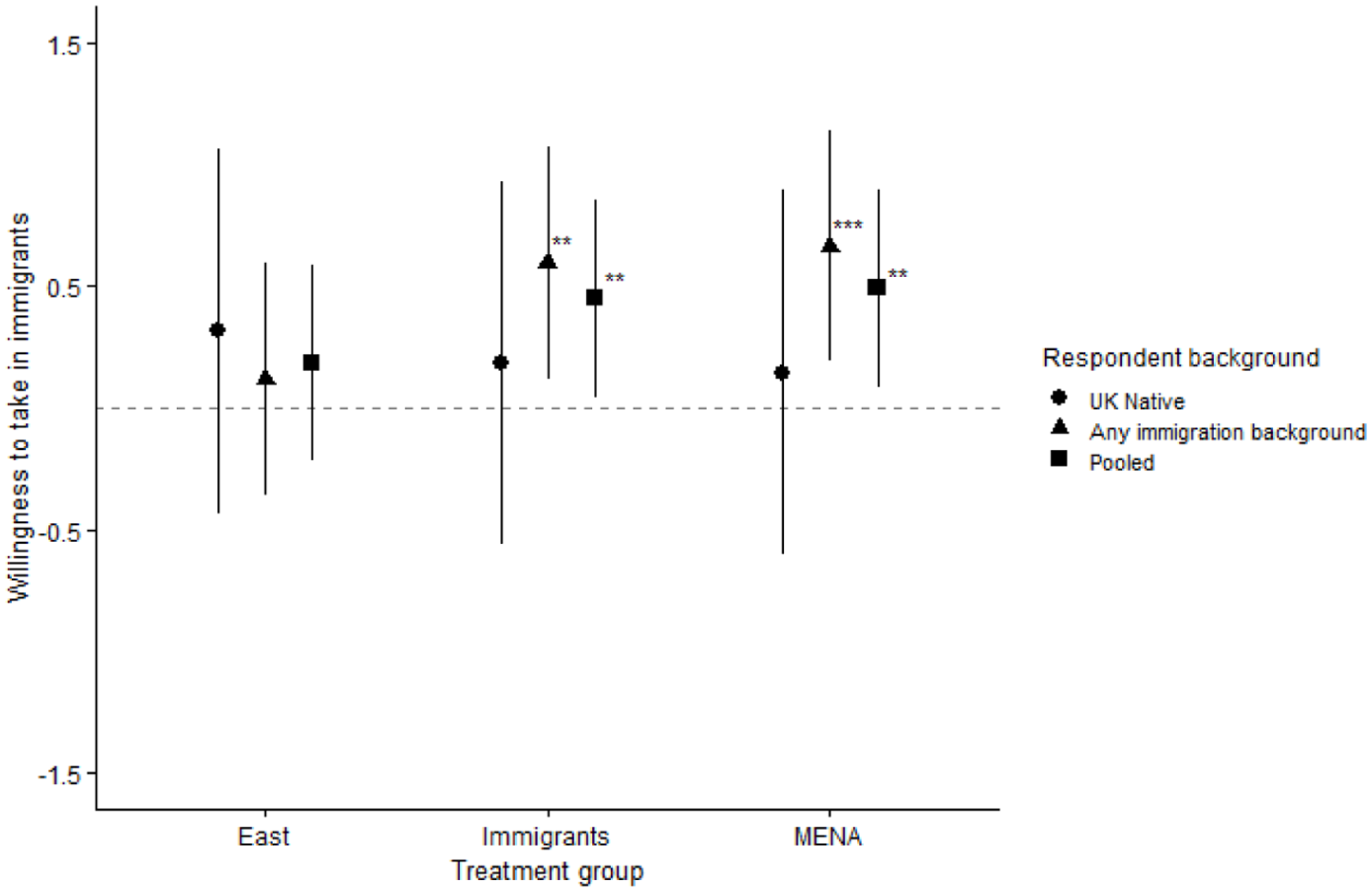
Effects of discrimination information on average immigration attitude.
If we first look at the effects for the entire sample (pooled), the immigrant (β = 0.45, p = 0.031, 95% CI [0.04, 0.87]) and MENA immigrant (β = 0.5, p = 0.01, 95% CI [0.1, 0.89]) treatments significantly increase the average willingness to welcome immigrants compared to the control group. Noticeably, we did not detect any statistically significant effect of the Eastern European treatment condition on respondents’ immigration attitudes (β = 0.19, p = 0.352, 95% CI [-0.21, 0.58]).
Among UK residents with immigration backgrounds (either Eastern European or MENA), both the immigrant (β = 0.60, p = 0.015, 95% CI [0.11, 1.08]) and MENA immigrant (β = 0.67, p = 0.004, 95% CI [0.21, 1.12]) treatment conditions significantly increase respondents’ willingness to accept immigrants. As for the entire sample, we did not detect a statistically significant effect of the Eastern European treatment condition among UK residents with immigration backgrounds (β = 0.12, p = 0.606, 95% CI [-0.34, 0.58]). Moreover, we also did not detect any statistically significant effects for any of the treatment conditions among UK natives (see Supplemental Appendix D for regression tables). We therefore find some support for H1, as information highlighting discrimination against immigrants broadly speaking or with MENA backgrounds increases pro-immigration attitudes among UK residents with immigration backgrounds, but seemingly not among UK natives. This suggests that inter-minority solidarity, or at least interest alignment, can be mobilized via discrimination information, but that majority-minority solidarity may not be.
To further test whether the identified effects among respondents with immigration backgrounds are expressions of intra- or inter-group solidarity, we conduct subgroup analyses based on the specific immigration backgrounds of the UK respondents and look at the willingness to accept either MENA or Eastern European immigrants. These results are shown in Figure 2.
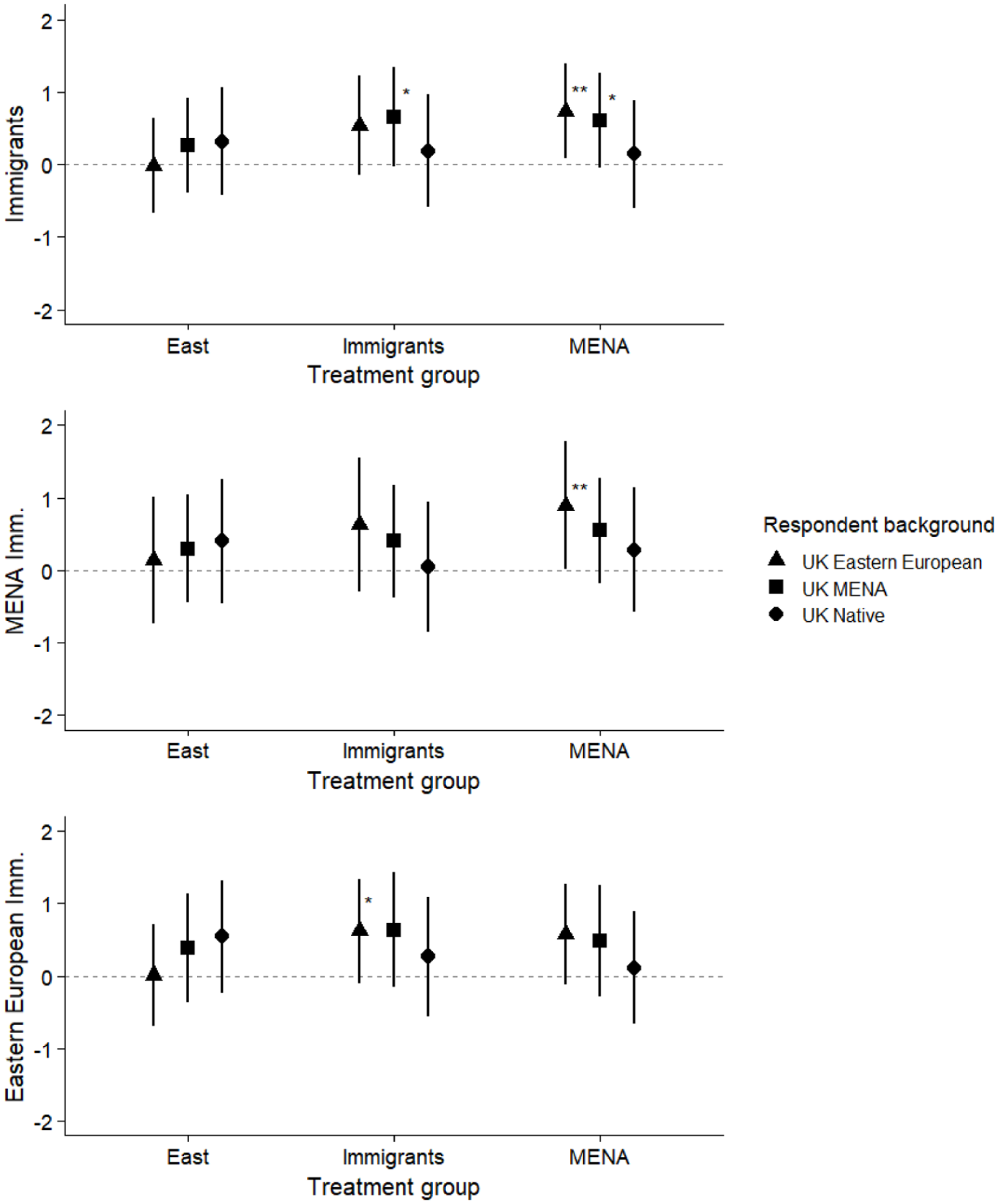
Subgroup effects of discrimination information on the attitudes toward different immigration groups.
As evidenced by Figure 2, the MENA discrimination condition increases the willingness to accept MENA immigrants among UK residents with Eastern European backgrounds by 8.9 percentage points (β = 0.89, p = 0.0464, 95% CI [0.01, 1.77]), compared to the control group. We thus find support for H2. However, we do not detect any statistically significant change among UK residents with MENA backgrounds in their willingness to take in Eastern European immigrants (see Supplemental Appendix D for the regression table) for any of the treatment conditions. We thus do not find support for H3. MENA respondents, however, appear to increase their willingness to accept immigrants (index measure) when assigned to the immigrant (β = 0.66, p = 0.059, CI [-0.02, 1.34]) or MENA treatment condition (β = 0.60, p = 0.07, CI [0.05, 1.26]), but these effects are only significant at the 0.1 level. As such, grievance information may be ineffective, or at least less effective, for mobilizing solidarity toward Eastern European immigrants, specifically, among MENA-minority individuals. That said, it may be that the effects are too small to detect given our subgroup sample size.
Contrary to our expectations, we do not find much support for intragroup solidarity (H5), neither among UK residents with Eastern European nor MENA backgrounds. After receiving discrimination information about one’s own group, respondents do not increase their willingness to take in immigrants with a similar background to themselves. Among UK residents with Eastern European backgrounds, only the immigration discrimination condition appears to increase their willingness to take in Eastern European immigrants (β = 0.62, p = 0.093, CI [-0.10, 1.34]), which is significant at the 0.1 level. While these results are surprising, as we expected that a shared identity would make feelings of connectedness and kindredness more prominent and thus strongly prompt solidaristic immigration attitudes, the lack of support for intragroup solidarity could be because discrimination information about the group to which one belongs does not provide a new perspective. Respondents may already have knowledge in the form of lived experiences and thus have been “pre-treated.”
Finally, we include citizenship status as a moderating variable to test H4. As naturalized immigrants tend to be more like the native population on a range of attitudinal and behavioral dimensions compared to non-naturalized immigrants (Just and Anderson, 2015), the effect of discrimination information may not mobilize naturalized UK immigrants to the same extent as non-naturalized UK immigrants. Figure 3 shows the effects of discrimination information on willingness to take in immigrants by citizenship status.
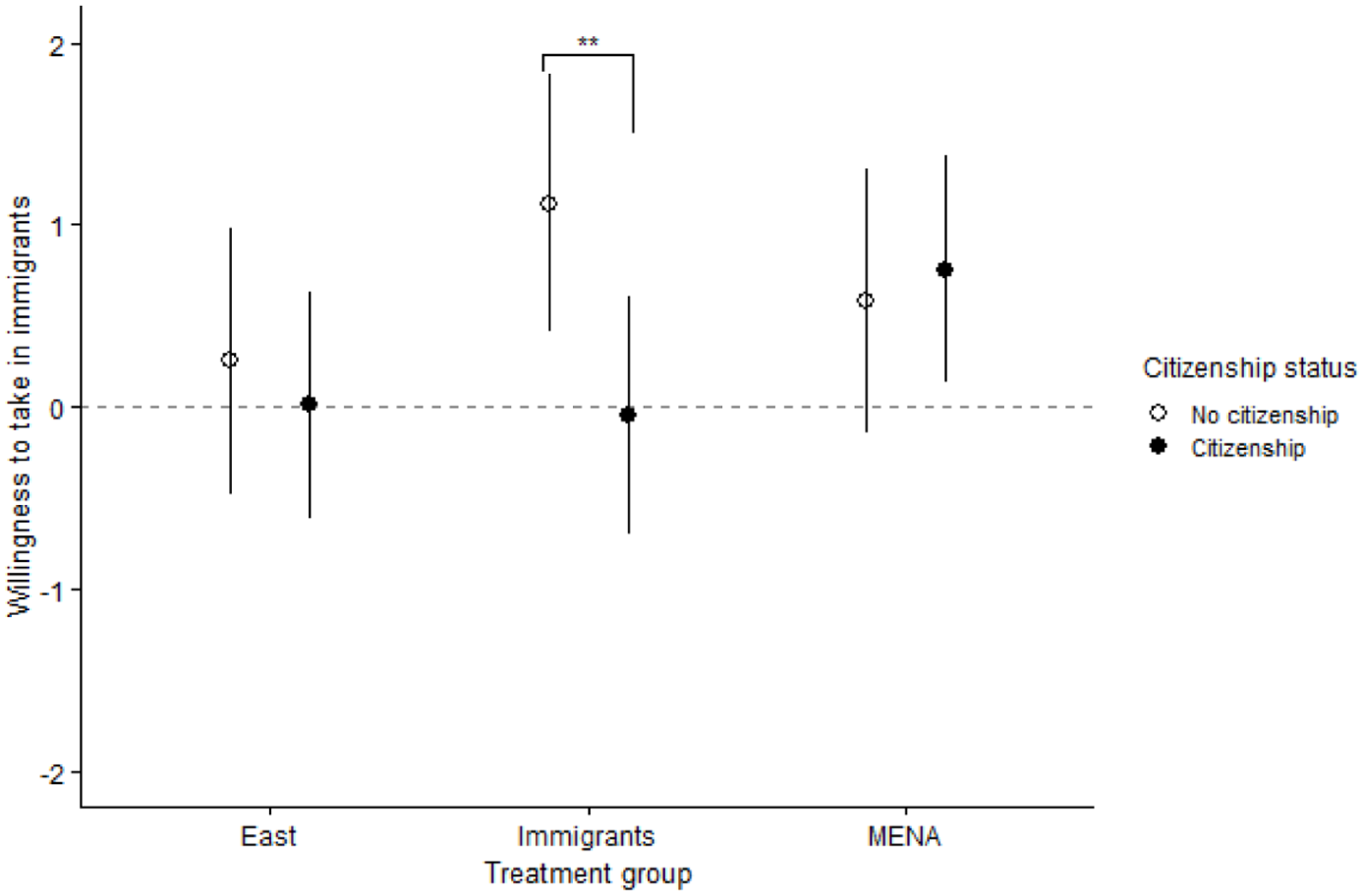
Effects of discrimination information on willingness to take in immigrants by citizenship.
The interaction results are somewhat surprising, as only the immigrant discrimination condition significantly interacts with citizenship (β = -1.17, p = 0.016, 95% CI [-2.12, -0.21]). This means that among UK residents with immigration backgrounds and citizenship, 7 receiving information about discrimination against immigrants does not increase their willingness to take in immigrants, as it does among those who do not have citizenship. When using willingness to take in either MENA immigrants or Eastern European immigrants as an outcome, the pattern remains the same (see Supplemental Appendix D). We see this as partial support for H4 because citizenship does seem to moderate the effect of discrimination information on the pro-immigration attitudes of UK residents with immigration backgrounds – but only in the case of discrimination information about immigrants broadly understood. It may be because the abstract concept of an immigrant prompts people to imagine the type of immigrant they are most concerned about, an often negative and incorrect perception of the average immigrant, according to Blinder (2015), which could be more prevalent among natives or immigrants proximate to natives.
It is worth noting that, especially for the statistically insignificant results, the confidence intervals are somewhat wide. This is likely the result of small effect sizes, large heterogeneity in the immigration outcome variables (particularly for the native subgroup), and the fact that subgroup analyses reduce the sample sizes used in the analyses. We thus cannot rule out that there may be small effects that we cannot detect. Nevertheless, in that case, they are unlikely to be of a substantial size, still suggesting that discrimination information is not effectively mobilizing solidarity among natives and, to some degree, residents with MENA backgrounds. Moreover, as the nature of our research question necessitates that we run multiple regression models, this in turn increases the risk of type I error (false positives). To account for this, we further test the robustness of the main results in the auxiliary analyses.
The identified asymmetry in the effects of discrimination information stresses the importance of research designs that can identify group nuances and heterogeneity. Intergroup dynamics are often more complex than assumed, as demonstrated by our results. Our results suggest that the solidarity-mobilizing effect of discrimination information works to establish political inter-minority solidarity, or interest alignment and promotion, among UK residents with Eastern European backgrounds. However, we do not find any support for the same mobilizing effect among UK natives. Among UK residents with MENA backgrounds, political solidarity only appears to be mobilized toward immigrants broadly speaking, and not Eastern Europeans specifically. Strikingly, and against our expectations, we find little support for discrimination information mobilizing political solidarity, or interest alignment, between minority group members with a shared identity (origin). Consistent with the findings in the literature, discrimination may better mobilize political solidarity among non-naturalized minority individuals.
Auxiliary analyses
Next, we conduct several auxiliary analyses. These include using ideology as a moderator, gender as a moderator, correcting for multiple testing (robustness check), and excluding inattentive respondents.
Including ideology as a moderator adds a bit of nuance as, among UK natives, the MENA treatment is slightly more effective in decreasing negative immigration attitudes among right-wing respondents than the control condition. This result nuances the long-held association between left-leaning ideology and pro-immigration policy support (see, e.g. Dinesen and Hjorth, 2020), as it shows that right-wing individuals are not necessarily resistant to discrimination information as a treatment, which in turn may influence their levels of immigration skepticism. However, there is also more room for increasing pro-immigration attitudes among these respondents compared to left-leaning respondents who already have more positive immigration attitudes. This interaction effect is only statistically significant at the 0.1 level (β = 0.27, p = 0.073, 95% CI [-0.02, 0.57]). When including gender (male/female 8 ) as a moderator, the immigrant discrimination condition is less likely to increase acceptance among men than among women (β = -0.83, p = 0.047, 95% CI [-1.64, -0.01]). This pattern holds when using MENA immigrants as the outcome variable. While results on gendered immigration attitudes are generally mixed (Kobayashi and Tanaka, 2025; Ponce, 2017), British men in our sample appear more skeptical about immigration. It is curious that gender only moderates the effect of the immigrant condition. It may, again, be a result of the “imagined immigrant” as previously discussed.
As mentioned, our hypotheses require multiple regression models across three treatment conditions and several subgroups, which increases the risk of type I error. To test the robustness of our results, we apply Holm-Bonferroni corrections (Holm, 1979) to our main models (see Supplemental Appendix E). Specifically, for the analyses testing H1 (native vs immigrant background), we correct for one hypothesis tested across three treatment arms and two subgroups (adjusted α ≈ 0.008). For the second set of analyses (cross-group effects of discrimination information), we correct for three treatment arms within each hypothesis H2 and H3 separately (adjusted α ≈ 0.017), and for H5, we correct for three treatment arms tested across two subgroups (adjusted α ≈ 0.008). In the final moderation analysis (H4), we correct for three interaction terms (adjusted α ≈ 0.017). Only the results of the first model and the citizen-interaction effect (immigrant condition) remain significant after the Holm-Bonferroni correction, with some adjusted p-values below 0.1, and some meeting the conventional 0.05 threshold. While several effects do not survive correction, the consistent directionality across related tests is suggestive of Eastern Europeans expressing solidarity or interest alignment with prospective MENA immigrants, but future research with larger samples is needed to assess the robustness of these patterns.
The survey included a post-treatment measure asking respondents which city the article (treatments) mentioned. This measure gauges how attentive the respondents were to the details of the information given. When excluding respondents failing to indicate the correct city name, the result pattern remains (see Supplemental Appendix E).
Discussion
Our results emphasize the importance of a nuanced understanding of what drives political solidarity, intergroup support, and interest alignment, and that solidarity should be examined carefully at the group level. In short, solidarity may not be expressed or mobilized uniformly for every single group. This is especially the case when using grievance information to mobilize support for prospective immigrants, as our results suggest that Eastern European immigrants are mobilizable upon reading about MENA individuals’ experiences with discrimination, but not vice versa. Moreover, discrimination information does not appear to mobilize natives’ solidarity. This means, in turn, that if majority-minority solidarity is most powerful in creating social and political change, discrimination information may not have as much of a political impact compared to what would be necessary to strengthen the representation of minorities’ interests. Nevertheless, inter-minority support and solidarity appear viable among certain groups, and minority allyship remains integral to fostering understanding and democratic alliances.
There are several potential explanations for our mixed results of intergroup solidarity and little evidence of intragroup solidarity. First, it may be that discrimination information makes group boundaries and identities too salient instead of creating a feeling of shared interests or identities. As such, if groups are perceived to compete against each other for social or economic opportunities, it may trigger perceptions of economic or social threats (Meeusen et al., 2019; Mustafa and Richards, 2019; Neureiter and Schulte, 2024), which could also, in return, prompt respondents to perceive discrimination as rational or justified rather than a moral transgression and grievance (see, e.g. Nørregaard, 2026 for when people accept discrimination). If this explanation holds for our results, it suggests that MENA individuals perceive incoming immigrants, especially Eastern Europeans, as an economic threat or competition, but that Eastern European individuals are less likely to hold a similar view of MENA immigrants. This explanation may be plausible, as some studies have found that MENA individuals worry about their reputation or opportunities being impacted by other immigrant groups, such as Eastern Europeans (Meeusen et al., 2019).
Second, another explanation for why MENA individuals were not mobilized to promote prospective Eastern European or MENA immigrants’ interests could simply be that MENA individuals’ experiences with discrimination (information) have pre-treated them. This explanation could also explain the manipulation check results that MENA individuals’ perceptions of how discriminatory the United Kingdom is change little after receiving the treatment. Foreign-born, culturally or religiously dissimilar immigrants, like MENA individuals and/or Muslims in the United Kingdom, are most likely to experience discrimination in Europe (Esses, 2021), so it is possible that they already had the knowledge about discrimination prior to being assigned the treatment. Thus, the mobilizing effect of learning about shared grievances, such as discrimination, may already have manifested among MENA individuals prior to the experiment. In addition, the average willingness to take in Eastern European immigrants is generally higher than the average willingness to take in MENA immigrants, including among MENA respondents. 9 It does therefore not seem to be the case that MENA individuals would never show any support for, or have an inclination to be solidaric with, prospective Eastern European immigrants. Thus, our results suggest that discrimination information may not be very effective in fostering this specific form of political solidarity with prospective Eastern European immigrants.
Third, it is curious what could explain the heterogeneous effects of the generic discrimination information treatment. This generic information increases the willingness to take in immigrants among residents with MENA background, and to take in Eastern European immigrants among residents with Eastern European background. However, it is a polarizing treatment when factoring in gender or citizenship. Such heterogeneity could be the result of how “unspecified immigrants” prompt respondents to fill in the information gaps themselves, as Blinder (2015) points out. While some individuals may imagine an immigrant that they perceive as an economic threat, others imagine a vulnerable individual in need of help. Future research could explore some of these puzzling results in more detail, for example, by diving into inter-minority group perceptions, prejudice, and allyship, specifically looking at the most prominent immigrant and minority groups in Europe. It would also be beneficial to test how group-tailored grievance information, unique to a specific minority, fares compared to overarching minority experiences.
Despite some of the mixed results, we do find that discrimination information highlighting grievances increases the support for prospective immigrants’ interests among some minority groups (similar to studies such as Kim et al., 2026; Pérez et al., 2024; Rogbeer et al., 2025). Importantly, none of the treatment conditions decrease people’s willingness to take in immigrants, which suggests that using discrimination information to promote pro-immigration attitudes may, at worst, be ineffective but is not likely to backfire and decrease support. Nevertheless, as our study tests one specific dimension or expression of political solidarity, namely, interest promotion and alignment, we should be careful generalizing the results to all other dimensions or expressions of solidarity. It would be valuable if future studies test how grievance information shapes other political behaviors, such as donations or protests, or the psychological dimensions of solidarity, such as feelings of shared fate.
The findings of this study echo similarly mixed results of using information frames to influence policy opinions. Information about immigrants or discrimination often effectively updates people’s factual knowledge but rarely influences opinions (Carnahan and Bergan, 2022; Hopkins et al., 2019; Schaeffer et al., 2026). Although our study utilizes information with statistical, anecdotal, and emotional components, our treatments are, in essence, still information frames. It would thus also be beneficial to explore other ways in which grievances foster intergroup solidarity, especially focusing on real-time interactions between different immigrant or minority groups, rather than manipulating perceptions of shared grievances through an information frame.
Our findings make important contributions to several scholarly literatures, and to debates on democratic potential and obstacles in diverse Western democracies. First, our theory and results nuance our understanding of immigration attitudes (see, e.g. Davidov and Semyonov, 2017) by demonstrating that they vary not only by respondent group but also by the origins of the prospective immigrants. They cement that the complex political relations between different immigrant groups and native populations should not be overlooked, as well as the importance of causal research designs taking heterogeneity seriously. As such, our study informs the growing body of research on inter-minority relations (e.g. Policardo et al., 2025). Second, our research adds to existing scholarship on group solidarity (e.g. Scott, 1990), as we provide causal evidence suggesting that discrimination information fosters interest alignment and promotion among some but not all groups. Finally, our theoretical arguments and empirical results are of interest to scholars working on discrimination, particularly those using experimental methods to examine its effects (e.g. Neureiter, 2025). It matters greatly how vignettes in survey experiments are worded, and so does the current political context, as it may influence which type of immigrants respondents are imagining when reading such vignettes (Blinder, 2015; Neureiter, 2022).
For those interested in fostering intergroup solidarity and pro-immigration attitudes, such as community organizers, political advocates, and elected officials, discrimination information can be an effective tool if targeting mobilization in a specific subgroup, such as Eastern European residents, but it is unlikely to mobilize all groups, especially natives. Furthermore, such actors must consider to whom solidarity is sought extended, and whether one wants to risk the potentially divisive effects of appealing to discrimination against “unspecified immigrants.”
Supplemental Material
sj-docx-1-psx-10.1177_00323217261463299 – Supplemental material for Testing political solidarity: The effect of discrimination information on groups’ immigration attitudes
Supplemental material, sj-docx-1-psx-10.1177_00323217261463299 for Testing political solidarity: The effect of discrimination information on groups’ immigration attitudes by Michael Neureiter and Ida Nørregaard in Political Studies
Footnotes
Acknowledgements
We are grateful to participants at LMU Munich’s Comparative Politics Research Seminar, as well as two anonymous reviewers for their helpful comments and suggestions.

Ethical considerations
This study was reviewed and approved by the Research Ethics Committee of the Faculty of Social Sciences at LMU Munich (study # GZ 24-08).
Consent for participation
Informed consent was obtained from all respondents prior to their participation in the survey.
Author contributions
Both authors contributed equally to this work, and their names are stated in alphabetical order.
Funding
The authors disclosed receipt of the following financial support for the research, authorship, and/or publication of this article: This research project was funded by the Deutsche Forschungsgemeinschaft (DFG, German Research Foundation) – project number 530911351.
Declaration of conflicting interests
The authors declared no potential conflicts of interest with respect to the research, authorship, and/or publication of this article.
Data availability statement
The data supporting the results of this study are available upon request to the corresponding author.
Supplemental material
Supplemental material for this article is available online.
Notes
Author biographies
References
Supplementary Material
Please find the following supplemental material available below.
For Open Access articles published under a Creative Commons License, all supplemental material carries the same license as the article it is associated with.
For non-Open Access articles published, all supplemental material carries a non-exclusive license, and permission requests for re-use of supplemental material or any part of supplemental material shall be sent directly to the copyright owner as specified in the copyright notice associated with the article.
