







Abstract
For the past half a century, Latin American scholars have been pointing toward the emergence of new social actors as agents of social and political democratization. The first wave of actors was characterized by the emergence of novel agents—mainly, new popular movements—of social transformation. At first, the second wave, epitomized by nongovernmental organizations (NGOs), was celebrated as the upsurge of a new civil society, but later on, it was the target of harsh criticism. The literature often portrays this development in Latin American civil society as a displacement trend of actors of the first wave by the second wave—“NGOization”—and even denounces new civil society as rootless, depoliticized, and functional to retrenchment. Thus, supposedly, NGOization encumbers social change. The authors argue that NGOization diagnosis is a flawed depiction of change within civil society. Rather than NGOization related to the depoliticization and neoliberalization of civil society, in Mexico City and São Paulo, there has been modernization of organizational ecologies, changes in the functional status of civil society, and interestingly, specialization aimed at shaping public agenda. The authors argue that such specialization, instead of encumbering social change, brings about different repertoires of strategies and skills purposively developed for influencing policy and politics. Their argument relies on comparative systematic evidence. Through network analysis, they examine the organizational ecology of civil society in Mexico City and São Paulo.
Keywords
Latin American scholars have been pointing toward the emergence of new social actors as agents of social and political democratization at least since the sixties. In the second half of the 1980s and throughout the 1990s, scholars celebrated the upsurge of a new civil society committed to the democratization of political regimes and to a change in the values of their own societies. This good news was preceded by no less optimistic diagnoses in the 1970s and 1980s. Those diagnoses pointed toward the emergence of other novel agents, new social movements, of social transformation that were not subordinated to the script prescribed by class struggle theories. Social movements were theoretically framed as agents of radical, although not necessarily “structural,” change, either as popular urban actors, more common in the Latin American debate, or as actors committed to the expression of postmaterial identities and issues. Meanwhile, in this region, less theoretical attention and empirical research were dedicated to traditional actors, such as service nonprofits or community associations, which have been performing relatively stable roles within the universe of civil organizations for a long time.
Despite the amount of published work and research produced on civil society in the past two decades, we still know little about its actual composition in Latin America and about the roles the new and the newest social actors play within such composition. One the one hand, popular social movements were characterized as grassroots actors and were supposed to be directly tied to people as well. On the other, after the celebratory diagnosis of a new civil society revival in the 1990s, the scholars became either more cautious, skeptical, or overtly critical. 1 Thus new civil society hardly remains immune to criticism, especially when nongovernmental organizations (NGOs) are compared to popular social movements. Somehow, often, regional literature on civil society portrays recent trends in Latin American organized collective action as a displacement of latter actors by former—“NGOization”—and even denounce new civil society as service delivery oriented, rootless, donor driven, depoliticized, and in the worst case, as simply and sadly neoliberal. 2 Ultimately, NGOization diagnosis is concerned with such trends because they encumber instead of foster social change and they are functional to privatization.
Although the increase in NGOs and, to a highly variable extent, the decline of popular movements may be identified as a trend in Latin America, this understanding is empirically and conceptually flawed. Empirically, not only is it clearly misleading to assume a substitutive trend, as if there were two successive waves of new social actors, each composed of a single type (popular movements and NGOs), but it adds little to our understanding of the actual composition of civil society in Latin America and the roles the new and the newest social actors play within such composition in posttransition scenarios. Analytically, to argue that the panorama of collective actors throughout the seventies and eighties was better when it comes to deepening democracy than that of posttransition takes for granted some assumptions that might be untenable. It is implicitly assumed that a specific composition of civil society with popular actors occupying the most important positions is better than other possible compositions. No doubt popular movements are fundamental pieces of Latin American societies for their capacity to express conflict through mobilization and protest, but by no means are they the only way of expressing systematically excluded interests, neither are they a priori more “authentic” or morally superior.
In this article, we empirically examine, through network analysis, organizational ecologies of civil society in the two largest Latin American metropolises. Mexico City and São Paulo play major economic and political roles in their countries, which share similar levels of socioeconomic development. Most importantly, some of the main actors engaged in the popular mobilization of the seventies and eighties are or used to be based in those metropolises, 3 and a host of new civil society actors pushed for democratization during the transition periods as well. 4 The cities allow for variation in one interesting dimension: civil society density. As Brazilian civil society is much denser or populated than Mexican, 5 it is possible to assess whether Latin American trends depicted by regional literature vary according to density. For instance, one might think that less dense civil societies would be more susceptible to NGOization since NGOs would face less resistance to displace other types of organizations. Of course, other comparisons are possible in Latin America. However, we did have comparable data for those two metropolises that were suitable to pursue our analytical and empirical questions. Nevertheless, we do not intend to generalize our findings to Latin America. Rather, we use our cases to empirically analyze influential propositions and/or depictions about Latin American civil society and to offer an alternative interpretation of the trends of change within Mexico City and São Paulo’s civil societies.
Our argument is threefold. We argue that rather than NGOization related to the depoliticization and neoliberalization of civil society, in both metropolises, there has been a modernization of civil society, which implies not a substitutive trend but the enlargement of the local organizational ecologies by the increase of new and newest actors—such as social movements and pastorals, in the former case, and NGOs, coordinating bodies, and fora, in the latter—alongside traditional actors, such as neighborhood associations, neighborhood committees, community associations, and service nonprofits. Modernization implies that traditional actors are not central anymore within examined civil societies regardless of their numbers; they are stable, decrease, or increase in the population of civil organizations. We argue as well that in both cities, there has been functional diversification of civil society, allowing different roles by all three sets of aforementioned actors. Traditional and new actors coexist and civil societies in both countries are engaged in traditional roles as service delivery and mutual self-help as well as in new ones as setting public agenda and shaping policy priorities. In fact, the newest types of actors have taken on unforeseen roles vis-à-vis the traditional endeavors of civil society in Latin America. The newest roles are telling about the new status of a set of actors within civil society. Finally, the newest wave of actors has been able to develop specialization, which instead of encumbering social change brings about different and complementary repertoires of strategies and skills purposely developed for influencing policy and politics. Specialization is noticeable in a cluster of nontraditional civil society organizations—NGOs, coordinating bodies, and fora—mainly engaged in advocacy and policy influencing rather than in service delivery.
Those arguments rely on a set of comparative coherent empirical findings, and in local descriptions available in Mexican and Brazilian literatures. We found that the new and the more important (relationally speaking) actors are “the same” in both metropolises: NGOs, popular organizations, and coordinating bodies (and pastorals in São Paulo). Not a single type of traditional civil organization is central: service nonprofits and neighborhood and community associations are either less important or clearly peripheral. Among more central actors, those who belong to the new civil society wave—especially NGOs, coordinating bodies—have become the main target of the repertoire of ties sent by majority of other civil organizations. Unlike other types of civil organization, NGOs present relational isomorphism in both contexts. Interestingly, coordinating bodies, organizations created to represent the interests and foster the agenda of other civil organizations within civil society and vis-à-vis the state, are relationally coupled to NGOs. The once-new actors of popular mobilization—popular organizations—in turn keep their privileged positions in both cities, but their relevance is peculiar: they have restricted protagonism, that is, an important position in the general structure of the network that has no direct correspondence in the repertoire of ties sent by other types of actors.
Data were collected during more than six months of intense fieldwork in each city in 2003 and 2002. Organizational ecologies empirically found in both contexts are analyzed by looking at the centrality patterns of the different types of actors and at the intentional ties and relational repertoire among them. Organizational ecologies are made of organizations; therefore, we do not examine informal and spontaneous expressions of collective action. For instance, in the case of popular movements, we work with their core organizations: popular organizations. By centrality patterns, we mean a set of social network analysis measures, which aim at identifying the most relevant and, in some sense, powerful actors. We keep the full organizational ecologies to calculate our network measures, but because of our analytical aims, only new civil organizations, especially those present in both contexts, will be carefully analyzed. Although the relational data examined portray a single moment in time, the characterization of actors based on local literature allows for the identification of how new they are in terms of the emerging roles they have come to perform in each context. In order to avoid tedious repetition, we use social actors and civil organizations interchangeably.
This article is organized as follows. In the next section, we characterize NGOization diagnosis and the two waves of new civil organizations. The third section briefly presents our analytical strategy and characteristics of the data. Following this, we will present the organizational ecology found in the sampling of the two cities. The fifth section focuses on the results and offers a relational diagnosis of the organizational ecologies found in Mexico City and São Paulo. Finally, we put forward an account of the changes within civil society in those cities and show the shortcomings of the civil society NGOization and depoliticization argument.
NGOization and Waves of the New and the Newest Social Actors
In the second half of the twentieth century, two successive waves of new social actors burst onto the Latin American political scene: popular urban movements and new civil society. 6 Latin American scholars noted new promising features of those two waves of actors as agents of social change. 7 Popular movements were portrayed as deeply socially rooted actors, based on the participation of ordinary citizens, and able to press for distributive public spending, thus challenging inequalities and social exclusion. New civil society expressed universalistic rights agendas voicing the cultural and political democratizations of Latin American societies. After some years of setting high expectations, scholars started to point out the limitations and depletion of both waves. Broadly speaking, social movements underwent a sort of eclipse that meant either being co-opted or defeated by party politics during or after transitions, or becoming more and more institutionalized and professionalized. The scholars grew suspicious of the increasing importance of NGOs within civil society, as NGOs increasingly took over national and subnational policy implementation and intervention projects financed by international donors.
Quite often, regional literature on civil society depicts the relation between the two waves of new actors in Latin America as a displacement or substitution: “In short: NGOs can be considered to be the ‘tamed’ successor of the ‘new’ social movements of the 1970s and 1980s.” 8 NGOs are considered to be “tamed” in comparison to “wild” social movements because of their definitional characteristics: professionalization, lack of rootedness, advocacy on behalf of third parties, and dependency on donors or state funding. Therefore, “NGO-ization . . . contributes to a weakening of the public sphere, precisely the opposite of the intent of the social movements.” 9 Moreover, NGOization could entail both the depoliticization and neoliberalization of civil society, as NGOs not only function as surrogates for civil society itself but also assume roles that are functional for privatization, social adjustment, state retrenchment, and multilateral agencies and donor agendas. This may be because “NGO-ization entailed . . . national and global neoliberalism’s active promotion and official sanctioning of particular organizational forms and practices”; 10 because, by their very nature, NGOs blur the borders between the public and private; or, in the worst case scenario, because “NGOs became the ‘community face’ of neoliberalism, intimately connected to those at the top and complementing their destructive work with local projects.” 11
NGOization diagnosis is a statement about the increasing relevance of NGOs understood as a substitutive or displacement trend because popular movements decline and grassroots mobilization diminishes. Most of all, of course, NGOization diagnosis is a warning. It uncovers and denounces two orders of supposed ongoing dangers. First, NGOs’ professionalization, institutionalization, and dependence from donors leave little room for grassroots work and radical positions, and lead to prioritizing project-driven activities, efficiency, and service delivery. Therefore, NGOs’ relevance equates with depoliticization of civil society, encumbering social change. Second, service delivery–oriented NGOs became functional to privatization and structural adjustment of state roles. Hereafter, we call these two orders of ongoing dangers civil society depoliticization and neoliberalization theses, respectively.
As will be shown, it is clearly misleading to assume a substitutive trend. Moreover, network analysis findings do not support the depoliticization thesis, and although the neoliberalization thesis cannot be properly addressed here, because other kinds of evidence would be needed, our findings do suggest that it might be overstated.
Drawing from Mexican and Brazilian literatures, mainly from civil society and social movement studies as academic fields, the following paragraphs will carefully examine the roles of the new and the newest social actors belonging to the two waves from the seventies and eighties and from the nineties onward, respectively. As national literatures tend to be particularly attentive to empirical variation, they are a good source for grasping the roles of new actors, how novel they are, and what their novelty is about in different contexts. Moreover, since network analysis evidence is structural and does not provide any insight on the content of the network, we rely on local literature for narratives about the novelty of the actors and their roles. Thus, the reading and interpretation of relational measures in the last section of this article draw heavily on extensive reading and synthesis of such literature. In some respects, local descriptions parallel the understanding of changes within civil society as a substitutive trend, but depart from it on several important aspects, and thus warrant attention.
Although popular organizations and NGOs belong to those waves, the set of novel actors examined includes coordinating bodies, fora, and pastorals as well because they were empirically found in the samples and they belong to the two new waves. The full composition of the organizational ecologies, which also includes traditional civil organizations, is described in the next section, but only the actors belonging to those two waves are analyzed in this section.
NGOs
In Brazil, NGOs correspond to civil organizations known in the Anglo-Saxon literature as advocacy NGOs, dedicated to publicly defending and promoting the demands and needs of third parties or issues considered to be of general interest. In their origin, in the years of democratic transition, and still without publicly being known by the name NGO, they were conceived as advisory and support organizations to social movements, founded by middle-class militants and practitioners. There is broad consensus in Brazilian literature regarding the fact that NGOs jettisoned this backup initial mission and gained autonomy of action through development of advocacy-oriented profiles. 12
As time went by, NGOs became prominent actors in the scenario of collective action in the 1990s and skillful at influencing public policies and public opinion. In fact, there is consensus in Brazilian literature regarding the main characteristics and novelty of NGOs, a mix of distinctive strategies, commitments, and skills. According to Landim, NGOs present “a strong vocation to act in the field of politics, investment in the mobilization of public opinion, in lobbying, in the defense of diffuse interests in the public sphere. . . . This type of action presupposes that NGOs should develop a capacity to establish interactions, partnerships, forms of communication and cooperation . . . [in order to perform] their traditional role of social multimediators.” 13 In that regard, Brazilian literature draws a clear dividing line between NGOs and service nonprofits, and tends to associate the former with a democratizing vocation and the latter with service delivery as the main line of work. 14 Thus, NGOization also has another meaning in the local literature: it is used to highlight changes in the nonprofits’ discourse in a bid to publicly appear to be NGOs.
In Mexico, the literature signals the specificity of NGOs by, first, introducing the distinction between social and civil organizations to establish the difference between popular actors whose members are also the beneficiaries of their action and actors who work for third parties defined in terms of a target public, respectively. 15 Differentiation among civil organizations, that is, between NGOs and other traditional service delivery organizations, such as service nonprofits, is less emphatic in Mexico than in Brazil. However, within civil organizations, the literature points out a subset of novel organizations that, instead of aiming at providing services, tend to politicize demands, to publicize the causes of minorities, and to advocate for rights 16 —NGOs in the terms of Brazilian debate. These NGOs gained public visibility in the 1980s and were widely acknowledged in the following decade, in a trajectory that is similar to that of their Brazilian peers. According to Lucia Álvarez, Mexican NGOs changed their raison d´être. There was a “gradual substitution of the original concept of support for popular movements as a justification for . . . [their] existence . . . growing autonomization of their action . . . professionalization and an orientation towards the definition of alternative social policies.” 17
Popular Movements
Popular mobilization and the new popular actors of the 1970s and 1980s were understood by Mexican and Brazilian scholars in similar terms. Initially they were conceived according to orthodox perspectives: the popular urban movements were regarded as new because although they were a product of the contradictions of capitalism, they also acted as bridges between labor actors and less privileged actors with little access to the state. 18 This Marxist approach soon lost out to the debate on new identities as the defining feature of these new movements. Thus, thirty years ago, popular social movements were enthusiastically welcomed as innovative and autonomous forms of collective action for their capacity to challenge the state, for their relative distance regarding the so-called macrostructural determinisms, and for their capacity to express interests excluded from institutional urban politics. In the Mexican capital, the emergence of Movimiento Urbano Popular (MUP) was also a sign of rupture with the corporatist mechanisms of the Mexican state. 19
In both contexts, in tune with the broader international literature picture of the region, it has been affirmed that these popular movements have seen their importance fade away. In Brazil, the reflux is supposed to be associated with the normalization of politics and the institutionalization of channels for processing demands. Disenchanted critical reviews became common in the late 1980s, highlighting the demobilization and co-optation of actors, combined with the naïveté and optimism of the literature. 20 Despite the diagnosis of decline, there are no strong instances in the local literature opposing new civil society or NGOs and popular movements. 21 In Mexico, the “apparent collapse of social movements in the 1980s” is supposedly due to factors of two orders: 22 the effects of the economic structural adjustment on the reduction of the role of the state, diminishing the effects of redistributive conflicts, and the democratic transition, which produced an overshadowing effect over nonelectoral conflicts. 23 On the other hand, schisms within the MUP were caused by the decision to embrace Cárdenas’s presidential campaign (1988) and the subsequent affiliation of some of the MUP’s organizations to the Democratic Revolution Party (PRD). 24
Coordinating Bodies
Coordinating bodies were empirically found within the organizational ecologies of Mexico City and São Paulo. Additionally, they play novel roles and belong to the first wave of new social actors in Mexico City and to the second wave in São Paulo. Coordinating bodies (articuladoras) are founded by other civil organizations with the purpose of coordinating and articulating the actions of the latter, leveraging their capacity to aggregate interests and performing as their representatives before the state and other social actors. 25 Taking into consideration the costs and difficulties of creating and maintaining organizations with such costly capacities, the proliferation of coordinating bodies may be considered an indication of the greater capacity for action of the sets of the civil society organizations that created them.
In Brazil, coordinating bodies are not uncommonly labeled as NGOs, characterized as having a distinctive logic of action based on networking and on the creation spaces aimed at coordinating collective action. 26 The fact that NGOs set the tone for the description of coordinating bodies in the local literature is not accidental: first, the latter have been created recently and their organizational profile has no obvious antecedents, and second, not only are NGOs frequently important actors in their foundation, but there are influential high-profile coordinating bodies that work exclusively for NGOs. For instance, ABONG (the Brazilian Association of NGOs), whose main tasks are oriented toward supporting, guiding, and articulating other left-wing civil organizations, is an indicator of a successful institution-building strategy.
In Mexico, coordinating bodies emerged as a new type of actor on the collective action scene when the MUP and its popular organizations were championing social transformation. These coordinating bodies were evidence of the strength of MUP actors. In fact, coordinating bodies (coordinadoras) and popular fronts emerged during the 1970s and 1980s as a point of confluence for popular organizations within the popular movement. Some popular coordinating bodies and popular fronts excelled in the MUP thanks to their high capacity to mobilize people as the Coordinadora Nacional del Movimiento Urbano Popular or the Frente Nacional en Defensa del Salario, contra la Austeridad y la Carestía. 27 As was the case with popular movements, Mexican literature points out that popular coordinating bodies and fronts declined in the late 1980s and early 1990s. 28 However, this does not mean that civil organizations with coordinating functions have completely disappeared. Our findings will show that Mexican coordinating bodies are now coupled with NGOs.
Fora and Pastorals
Fora and pastorals were also found in the field within the organizational ecology of São Paulo. Both belong to the waves of the newest and the new social actors. In broad strokes, fora are among the newest civil organizations, and they work as thematic spaces for coordinating agendas and consensus building between issue-oriented actors—HIV-AIDS, basic health, the elderly, waste recycling, and so on. They are an important type of civil organization for issue-oriented network building and for the definition of policy influence goals within civil society. Pastorals appeared for the first time in the sixties, when the Second Vatican Council and the Second Latin American Episcopal Conference in Medellin defined a social intervention orientation for the Catholic Church. They used to work closely with Basic Christian Communities and popular movements. On the Brazilian posttransition scene, they still stand as church-inspired issue-oriented actors.
Analytical Strategy and Characteristics of the Data
Our analysis combines basic general assumptions of the literature on organizational ecology and uses methodological techniques based on network analysis. The approach used in studies on organizational ecologies allows us to perceive the different types of organizations as populations, whose functions, survival, and reproduction—and numbers—are contingent upon disputes and complementarities with other types of organizations and upon the surrounding institutional environment. 29 It is not our aim to test such implications of the organizational ecology approach. We simply base our analysis on organizational ecology’s basic assumption to map organizations, and we use network analysis to understand the relational pattern between subpopulations of civil organizations.
The comparative analysis between civil organizations in Mexico City and São Paulo has employed three steps. The first step simply describes the sample’s overall composition. The second step explores the average centrality positions of each type of civil organization within the network of civil organizations. The third step analyzes the relational repertoire of each type of civil organization by focusing on intentional ties among pairs of actors.
The data used in this article are the results of two surveys conducted in 2002 and 2003 in the city of São Paulo (municipality), Brazil, and in Mexico City (Federal District), Mexico. Both surveys used the same methodological procedures to define the sample, which was snowball generated with the purpose of identifying the more active civil organizations working with underprivileged sectors of the population. 30
A total of 229 organizations in São Paulo and 198 in Mexico City were interviewed. In this analysis, 202 and 169 civil organizations, respectively, were taken into consideration. Data cleaning lead us to exclude interviewed entities due to two reasons: definition of the borders of the network and comparability of samplings. In São Paulo, 27 organizations could not be classified as civil organizations according to our criteria, since they were mostly market associations. In Mexico City, 29 interviewed entities could not be classified as civil organizations, and there were also sampling issues—a subset of entities had their networks and chain referrals collected differently from our standard procedure. Our final relational sample is composed of 827 civil entities in São Paulo, with 1,368 ties among them, and of 601 Mexican civil entities, with 1,031 ties among them.
The interviewed organizations (leaders or members of the board of directors) were requested to cite no more than five organizations to which they were related and that were considered to be the most important ones for their work. This is a standard way of collecting data on social network analysis. 31 Since the organizations were asked to inform only the main formal or informal relations with other organizations, it may be inferred that (1) these relations are significant and relevant for the organizations and (2) the ties indicate organizations with which interviewees effectively work or try to be associated. A final caveat: our measure of the ties among entities is multiplex (as most social ties are), which means that we are measuring more than one type of relationship in the same tie. Given our questionnaire, there is no way of distinguishing between “actual” ties and ties mentioned because of prestige of the referred organization. Nevertheless, we take this multiplexity into account when interpreting our results.
We use a variety of network measures to assess the importance of the types of organization in our sample. Centrality measures indicate how central an actor is, which means how prominent or “powerful” it is in the network, but there are different ways of determining its centrality. Active centrality refers to the ties one actor directly sends to other actors (outdegree); passive centrality refers to the ties directly received by an actor (indegree). There are also measures of indirect centrality, which refers to indirect (nonadjacent) ties. Betweenness centrality measures how one actor controls or mediates the relations between pairs of actors (dyads) that are not directly connected. Dependence centrality (Bonacich) allows us to measure one actor’s prominence weighed by the centrality of the actors to which it is connected; the less “well connected” are the actors to which it is connected, the more dependent they are on it, which means it is more prominent. By using all those centrality measures, we can evaluate one actor’s prominence through different ways, which prevents biased assessment of its position in the network. Besides that, we also use two cohesion measures. Average distance calculates the length of average shortest (geodesic) distance between two actors, and the number of shortest paths indicates the possible shortest paths that connect two actors, and thus both measures can indicate an actor’s “easiness” of access to the network.
For those not familiar with network analysis, it should be said that quite often, network measures’ absolute scores neither are very intuitive nor have a straightforward meaning (like more commonly used statistical techniques) and sometimes are contingent on the size of network or other network attributes. Still, they capture and show the differences in relational position between actors. That is why we chose to present centrality and cohesion measures’ scores in relation to the average per type, so one can see more clearly how a type’s score varies. It should be highlighted that we are concerned with the variation of each type in the network according to different measures rather than with the measures’ scores themselves. 32
More concretely, positive values indicate that the score of the measure for the specified type is greater than the average, and negative values indicate that the score of the measure is smaller than the average. For instance, a score value of 1.7 is 170 percent bigger than the measure’s average score value, and a score value of −0.60 is 60 percent smaller than the measure’s average score value. Additionally, we report, next to the score in parentheses, the ranking of the types of civil organizations in each measure, considering the entire organizational ecology, so it is easier to assess the type’s overall position in the network. So, a type ranked as first has the highest score in the entire organizational ecology (new and traditional types), and if it is ranked sixth, it means there are five types of civil organizations with better scores (even traditional types not shown here 33 ). To analyze the relational repertoires, we make use of two measures. The first measure (sent ties) shows the percentage of ties directed to each type of actor out of the total amount of sent ties of the type of actor examined. High proportions of ties sent from one type of actor to another reveal strong relational selectiveness between types of civil organizations. The second measure (integration) takes into consideration the percentage of nonisolated actors in a subnetwork composed of a pair of types (NGOs and coordinating bodies, for example). Thus it is possible to compare the percentage of nonisolated actors in the internal network of each type with the subnetworks composed of pairs of types. This means that the higher the integration percentage, the more connected these pairs of types. Finally, we analyze the overall pattern of the measures: no argument is supported by a single measure. As will be shown in the fifth section, we take into account all measures to describe and interpret a type of civil organization’s overall position in the network.
Organizational Ecologies: Density and Composition of the Sample
In addition to identifying in the field a number of actors who make up the organizational ecology of the two metropolises, it is necessary to classify those actors and make them comparable. As the labels generally used by civil organizations are usually the object of a symbolic dispute, they were classified not on the basis of their self-definitions but according to objective criteria of two orders: (1) the relation with their beneficiaries and (2) the distinctive profile of activities they typically carry out. In the first case, (i) the group of beneficiaries embodies a relatively limited or unrestricted community (for instance, the residents of the neighborhood or citizens, respectively) (ii) whose members are individuals, organizations, and collective actors, or segments of the population (iii) seen as members or partners, as target public, or as the community. In the second case, each kind of association corresponds to (i) a distinctive strategy of action and (ii) exclusive combinations of activities oriented to demand and mobilization, service provision, popular organization, or intermediation between the government and beneficiaries. 34
By applying these criteria, a classification was devised: NGOs, coordinating bodies, popular organizations, service nonprofits, community associations, neighborhood associations, neighborhood committees, pastorals, fora, and “other” organizations, as a residual category. 35 Table 1 describes each type of civil organization. We will focus on NGOs, coordinating bodies, and popular organizations.
Classification of Civil Organizations: Mexico City and São Paulo

Source: Project Rights, Representation, and the Poor: Comparing Large Developing Democracies—Brazil, India, and Mexico. IDS/CEBRAP
According to the criteria applied in our classification, NGOs usually work on behalf of beneficiaries defined in terms of a relatively unrestricted unity, composed by some sectors or segments of the population seen not as members or partners but rather as their target public, for example, children who are victims of family violence. Their distinctive strategy of action is usually the public debate of problems. They focus on distinct combinations of service provision intermediation between public authorities and society.
Coordinating bodies, different from NGOs, work on behalf of beneficiaries defined in terms of restricted units. The membership of coordinating bodies is composed of organizations or collective actors. Their distinctive set of activities is mostly based on connecting social actors and initiatives as well as representing and intermediating their members’ interests.
Since the definition of popular organizations and their relation with the concept of popular and social movements is not obvious, we must make a few remarks. It is difficult to use the concept of popular movements in empirical research when working with an organizational approach, as is the case of this article. The concept of popular movements has been used both in the definition of specific actors, with their own organizational structure, usually with capacity to challenge the state—for example, Movimento dos Sem Terra (MST-Br) or Antorcha Popular (Mx)—and in symbolically unifying dispersed sets of individual and collective initiatives because of affinities and shared meaning concerning specific subjects—for example, the black movement, the housing movement, and so on. Thus, the universe of actors defined here as popular organizations corresponds only to the first meaning of the concept: as organizations and not movements. So, popular organizations, according to our classification, similar to NGOs, work on behalf of beneficiaries defined in terms of unrestricted unit, defined by segments of the population (e.g., people claiming right to affordable housing), but different from NGOs, these beneficiaries are the communities they mobilize instead of target public. And, also different from NGOs, popular organizations’ distinctive combination of activities is mostly based on protest and mobilization.
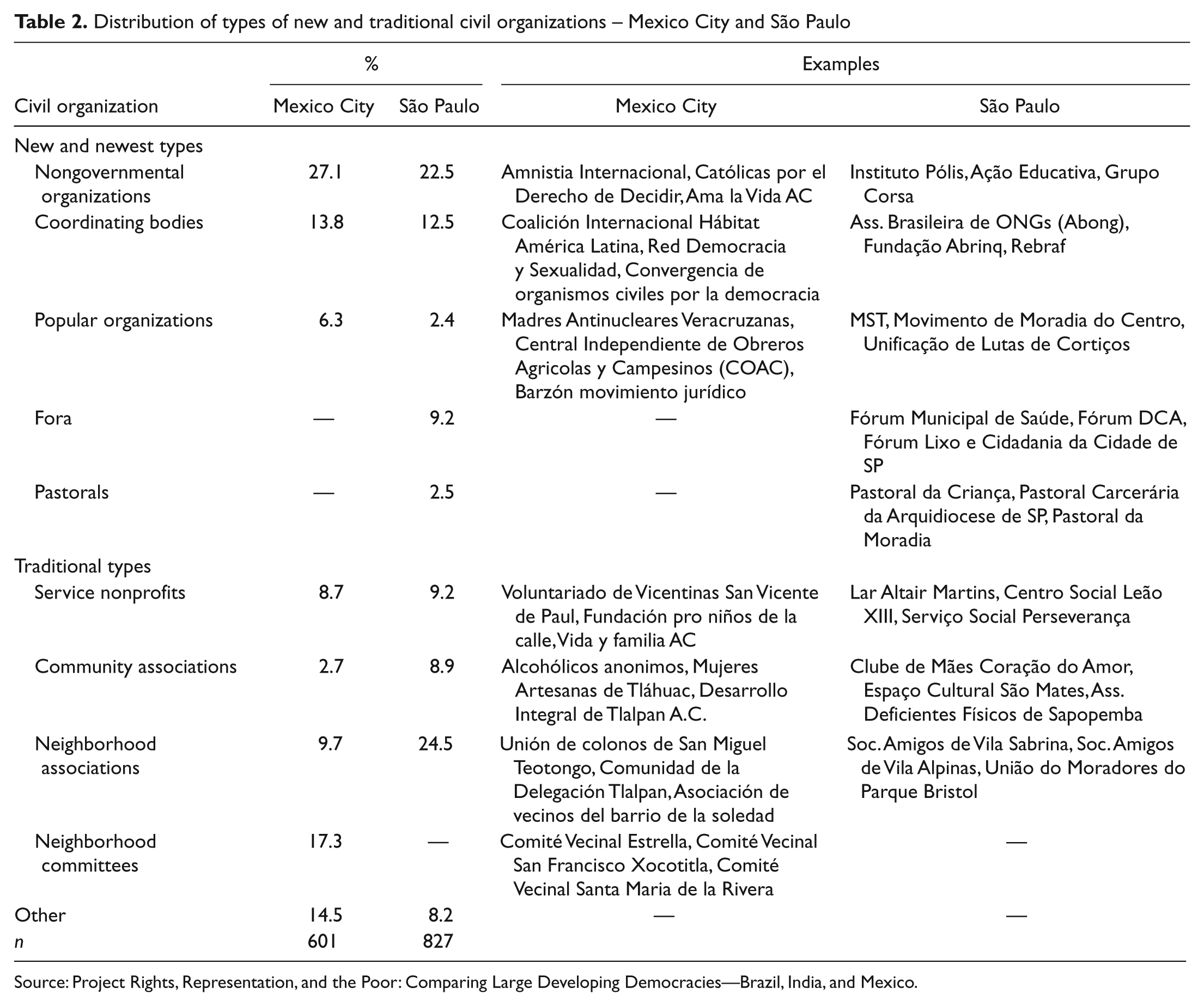
Table 2 depicts the distribution of types in our samples. The compositions of the organizational ecology in both cities converge to a great extent, but there is no perfect correspondence and there are actors who appear in only one of the contexts (neighborhood committees, in the case of the Mexican metropolis, and fora and pastoral organizations, in the case of São Paulo). It is important to stress that there are different reasons for the respective absences in either city. Neighborhood committees exist only in Mexico City because they are a by-product of the Law for Citizen Participation, whereas fora and pastorals, even though they exist in both cities, must be very few in Mexico City and were collected just in the São Paulo sample.
Distribution of types of new and traditional civil organizations – Mexico City and São Paulo
Source: Project Rights, Representation, and the Poor: Comparing Large Developing Democracies—Brazil, India, and Mexico.
Although the organizational ecologies of both cities converge, civil society density in Mexico and Brazil is quite divergent. As mentioned before, in the sample, we focus on highly active organizations, and the compositions of such active civil societies seem to be similar in both Latin American metropolises. However, the broader context is contrasting. Although there are no reliable universal lists in Mexico or in Brazil, available official figures are striking: in 2010, the official register for civil society organizations reported 12,324 organizations in Mexico, while in 2005, the Brazilian Institute for Geography and Statistics, reported 338,000. 36 Other official Mexican records present similar figures, around 10,000 civil organizations, while Brazilian figures could be higher, up to 500,000, according to nonofficial sources. 37
In fact, the sample shows more types of civil organizations belonging to the two waves in São Paulo than in Mexico City. Table 2 presents the distribution of the classification in the samples. Traditional territorially based associations are the prevalent sample type in both contexts: neighborhood associations in São Paulo and neighborhood committees and neighborhood associations combined in Mexico City. NGOs are the second most frequent type of association, closely following territorially based associations. Coordinating bodies are more frequent than popular organizations, even though they are at least 10 percentage points below the NGOs and territorially based associations. An interesting difference, among the common types, is the greater presence of popular organizations in Mexico City (it ranks fifth as the most frequent type) in comparison with São Paulo (where it ranks seventh). One should note that service nonprofits, a traditional civil organization type, are also fairly frequent, with similar proportions to the coordinating bodies. Finally, it is important to stress that the context-specific types make up over 10 percent in São Paulo and about 17 percent in Mexico City.
For the sake of clarity, it should be noted that we are unable to analyze all measures for popular organizations in Mexico City. The sampling procedure led us to interview only two entities that were later classified as popular organizations, although several of them were captured through chain referrals. This means that we cannot analyze measures that demand greater variability of interviewed organizations, even though we are able to analyze measures that rely on other organizations citing popular organizations—which, in turn, were not interviewed, but are part of the network of civil organizations.
From Organizational Ecologies to Networks of Organizations
In both contexts, the set of the most central civil organizations is composed of new actors who populated the collective action scene after the 1960s: NGOs in Mexico City, coordinating bodies, and popular organizations in both metropolises, and pastorals in São Paulo. As has been shown here, the presence of the former two is more recent, from the 1990s on, while popular organizations (and pastorals) emerged in the 1970s and 1980s. Three important caveats apply. First, although the more central organizations coincide in both cities, this does not theoretically or logically mean that relational patterns in each type of organization must be the same in both contexts. In other words, it is possible to be central for either similar or different reasons. Second, when examining differences it is worth to keep in mind that although there is variation in terms of scores within the most central types, their scores tend to be higher and closer together than the scores of noncentral types of civil organizations (most of which we do not show in this article). Third, it should be noted that we focus our analysis in the types of organizations present in both metropolises.
NGOs’ Relational Isomorphism
NGOs in both metropolises have very similar patterns concerning their relational repertoires. Although their general position in the network is not similar, it is possible to speak of relational isomorphism. This isomorphism refers to the actor that receives the most ties from all types of organization in both metropolises and holds strong relational selectiveness with coordinating bodies. It may allow conjectures about the effects of common supranational factors, such as international funding and its consequences regarding the functional profile of NGOs—the need for professionalization, thematic specialization, and the adoption of the project as a basic unit for organizing work. However, our findings dispute the diagnosis that usually accompanies the denunciation of international factors fostering NGOs, namely, that NGOs are detached from other actors of civil society, especially from those with strong connections with poor or popular sectors. In fact, if, on the one hand, NGOs excel because they favor relations among themselves (homophily) and with other highly central actors, on the other, they are also the only type of actor that establishes ties with all types of actors in addition to being the one most preferred by other types of organizations, including the microterritorial ones. 38
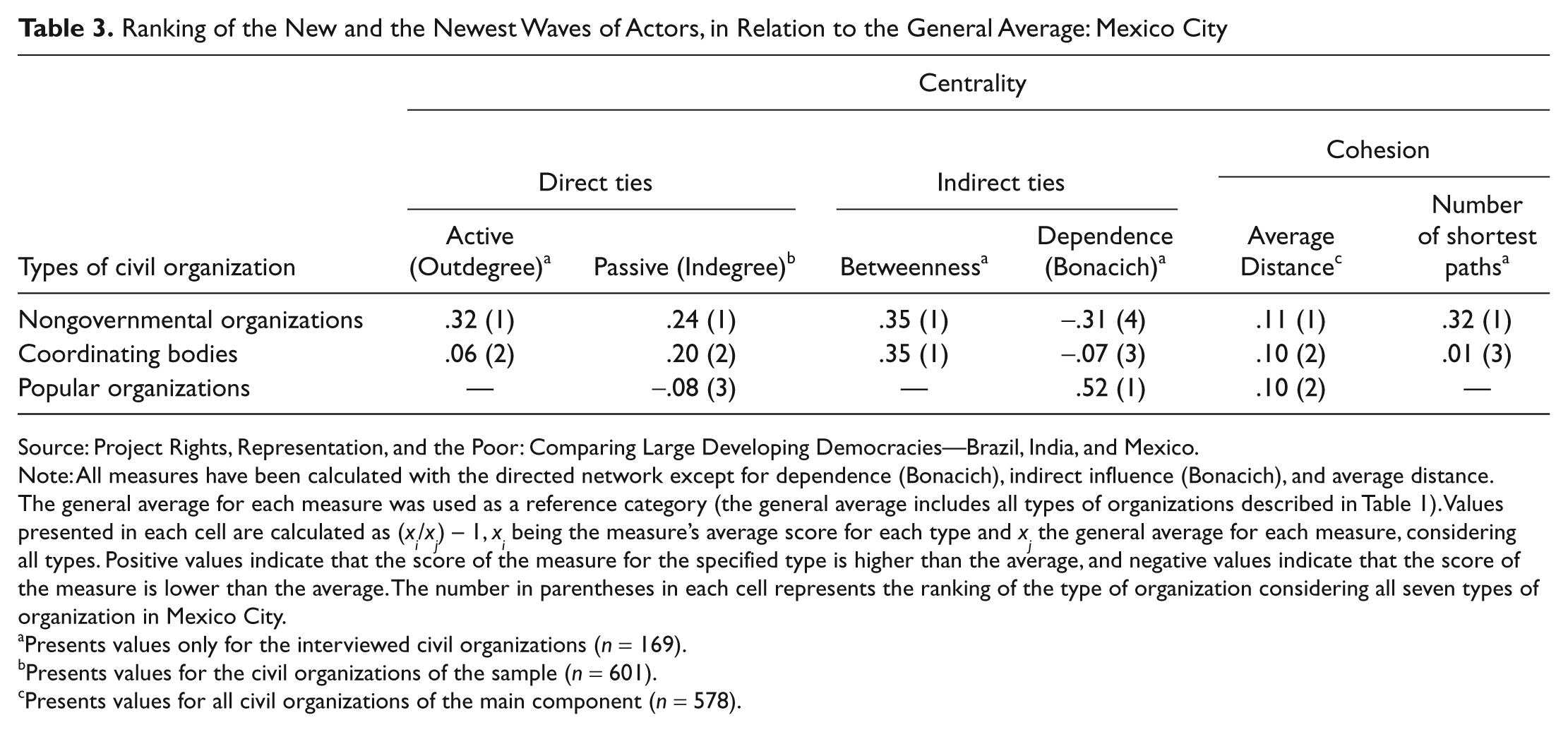
As one can see in Table 3, NGOs have a markedly prominent position in civil organizations’ networks in Mexico City. They are the most active type of organization in terms of sending ties (they rank first, with a score of 32 percent above the average) as well as the most favored type of actor in receiving ties (they also rank first in this measure, with a score 24 percent higher than the average). The privileged position of NGOs may be observed in how easily they access the network as a whole, for they have the shortest average geodesic paths (they rank first) in addition to the greater number of geodesic paths (they also rank first). NGOs also present a high capacity for mediation (sharing the first place with coordinating bodies, with a score 35 percent higher than the average) in the universe of organizations as a whole.
Ranking of the New and the Newest Waves of Actors, in Relation to the General Average: Mexico City
Source: Project Rights, Representation, and the Poor: Comparing Large Developing Democracies—Brazil, India, and Mexico.
Note: All measures have been calculated with the directed network except for dependence (Bonacich), indirect influence (Bonacich), and average distance. The general average for each measure was used as a reference category (the general average includes all types of organizations described in Table 1). Values presented in each cell are calculated as (x i /x j ) − 1, x i being the measure’s average score for each type and x j the general average for each measure, considering all types. Positive values indicate that the score of the measure for the specified type is higher than the average, and negative values indicate that the score of the measure is lower than the average. The number in parentheses in each cell represents the ranking of the type of organization considering all seven types of organization in Mexico City.
Presents values only for the interviewed civil organizations (n = 169).
Presents values for the civil organizations of the sample (n = 601).
Presents values for all civil organizations of the main component (n = 578).
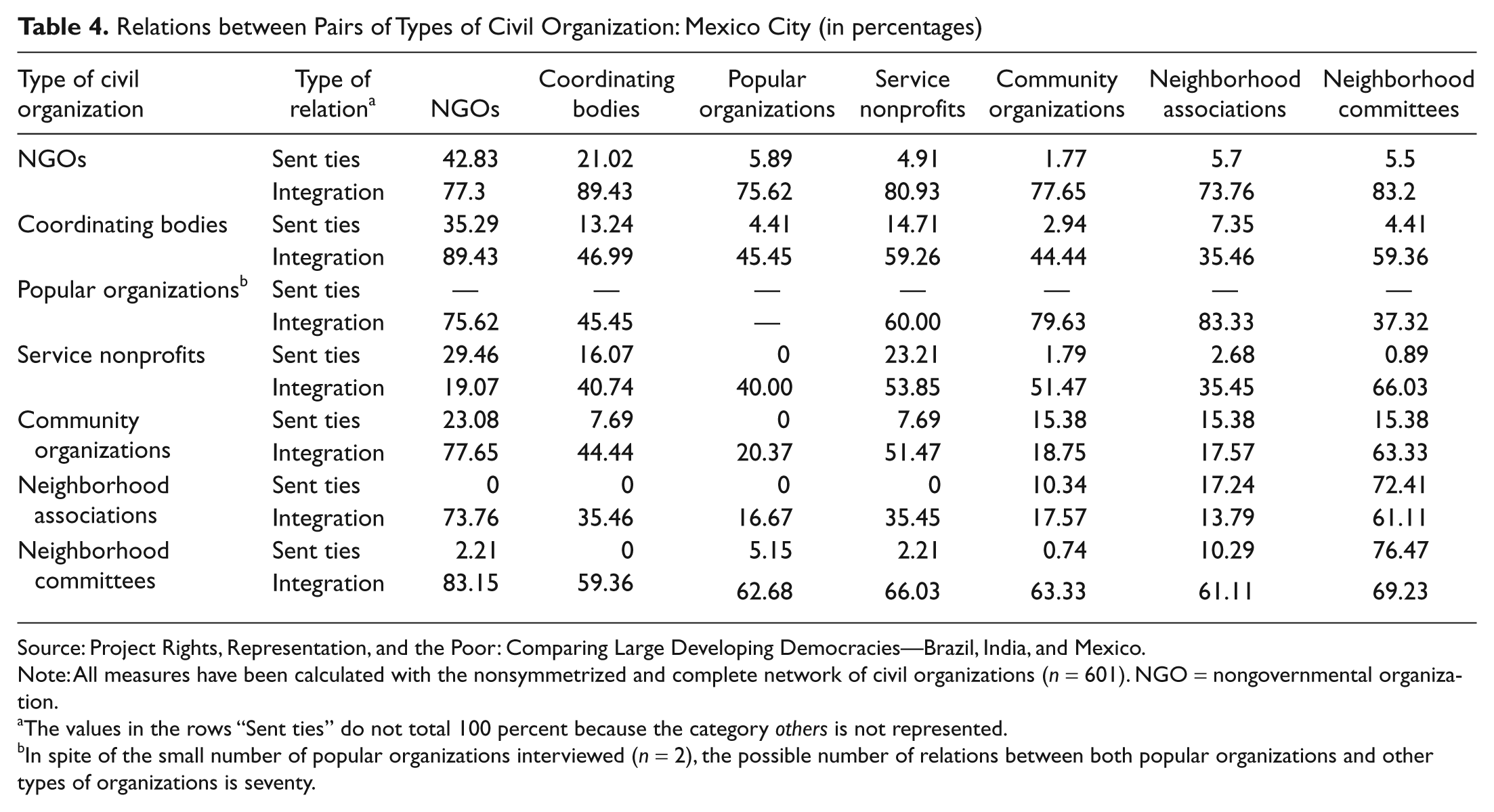
It is interesting to note the homophilic pattern of the ties established by Mexican NGOs: about 42 percent of their ties are with themselves (see Table 4). Coordinating bodies are the type with which they have the most frequent relations (and vice versa, with approximately 21 percent of NGOs’ ties sent to coordinating bodies and about 35 percent of coordinating bodies’ ties sent to NGOs), which is surprising in view of the original affinity of the former in Mexico City with popular movements. In fact, there is a clear reciprocal selectiveness between NGOs and coordinating bodies, revealing a mutual relational strategy. The importance of NGOs is reflected in their relational repertoires, for only NGOs and coordinating bodies establish ties with all other types of organizations in civil society’s networks. And there is more: in terms of receiving ties, Mexican NGOs are preferred by all actors, except for neighborhood associations, whose relational profile is markedly selective and exclusive. It should be noted that NGOs had ties with all actors and are the main recipients of ties from coordinating bodies, service nonprofits, community associations, and to a lesser degree, popular organizations.
Relations between Pairs of Types of Civil Organization: Mexico City (in percentages)
Source: Project Rights, Representation, and the Poor: Comparing Large Developing Democracies—Brazil, India, and Mexico.
Note: All measures have been calculated with the nonsymmetrized and complete network of civil organizations (n = 601). NGO = nongovernmental organization.
The values in the rows “Sent ties” do not total 100 percent because the category others is not represented.
In spite of the small number of popular organizations interviewed (n = 2), the possible number of relations between both popular organizations and other types of organizations is seventy.
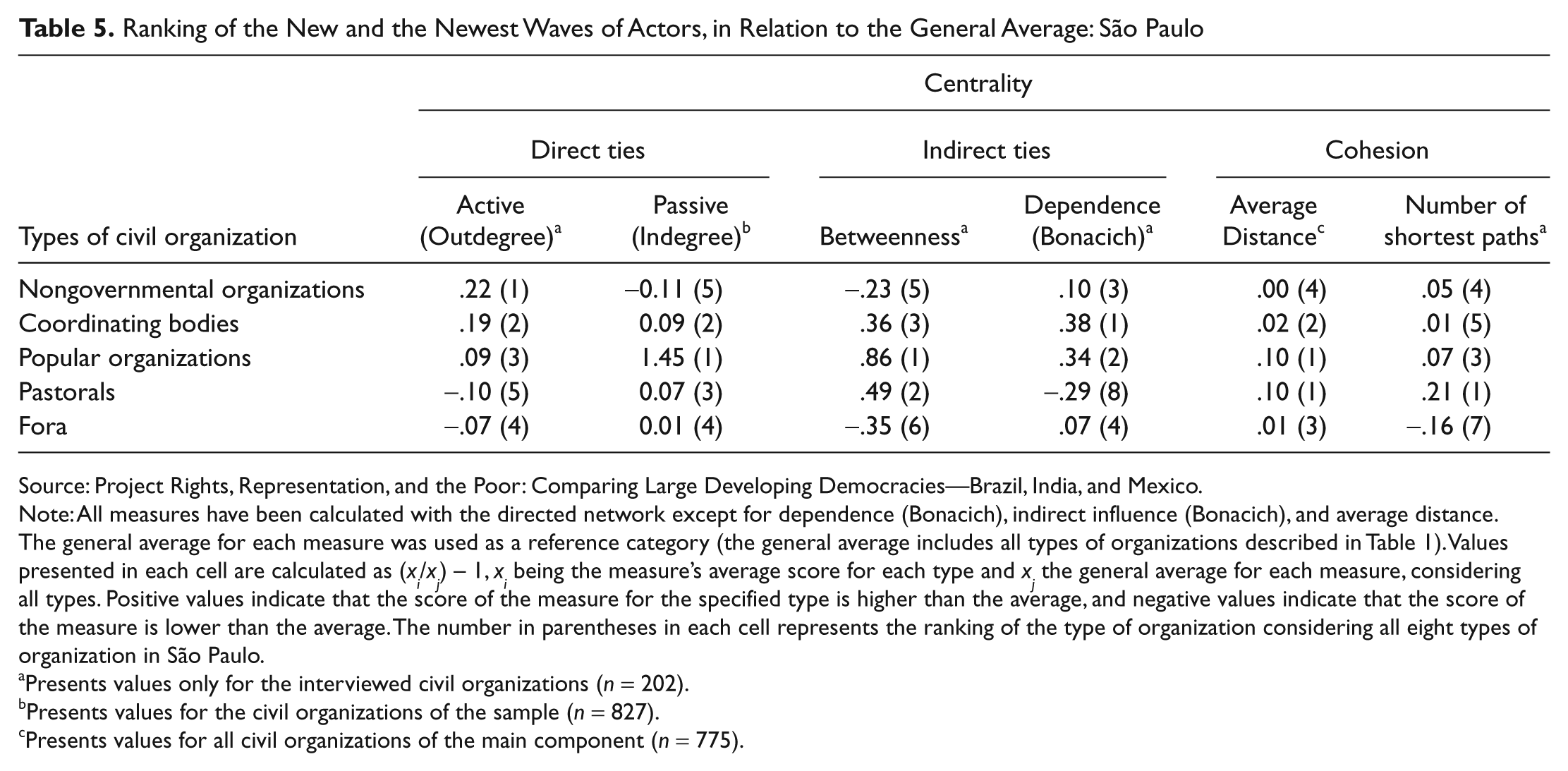
NGOs in the city of São Paulo are organizations with decidedly active centrality, with a profile of sending ties and establishing connections. In fact, they are the type of organization with the highest level of active centrality (as one can see in Table 5, NGOs rank first in active centrality, with a score 22 percent higher than the average). In terms of the reception of ties, and other indicators of centrality and cohesion in the network, Paulistana NGOs have an intermediary position (ranking fourth and fifth out of eight actors). In this sense, NGOs in São Paulo are different from NGOs in Mexico City. The only other measure in which NGOs in São Paulo excel is in their capacity to generate dependence (they rank third, with a score 10 percent higher than average).
Ranking of the New and the Newest Waves of Actors, in Relation to the General Average: São Paulo
Source: Project Rights, Representation, and the Poor: Comparing Large Developing Democracies—Brazil, India, and Mexico.
Note: All measures have been calculated with the directed network except for dependence (Bonacich), indirect influence (Bonacich), and average distance. The general average for each measure was used as a reference category (the general average includes all types of organizations described in Table 1). Values presented in each cell are calculated as (x i /x j ) − 1, x i being the measure’s average score for each type and x j the general average for each measure, considering all types. Positive values indicate that the score of the measure for the specified type is higher than the average, and negative values indicate that the score of the measure is lower than the average. The number in parentheses in each cell represents the ranking of the type of organization considering all eight types of organization in São Paulo.
Presents values only for the interviewed civil organizations (n = 202).
Presents values for the civil organizations of the sample (n = 827).
Presents values for all civil organizations of the main component (n = 775).
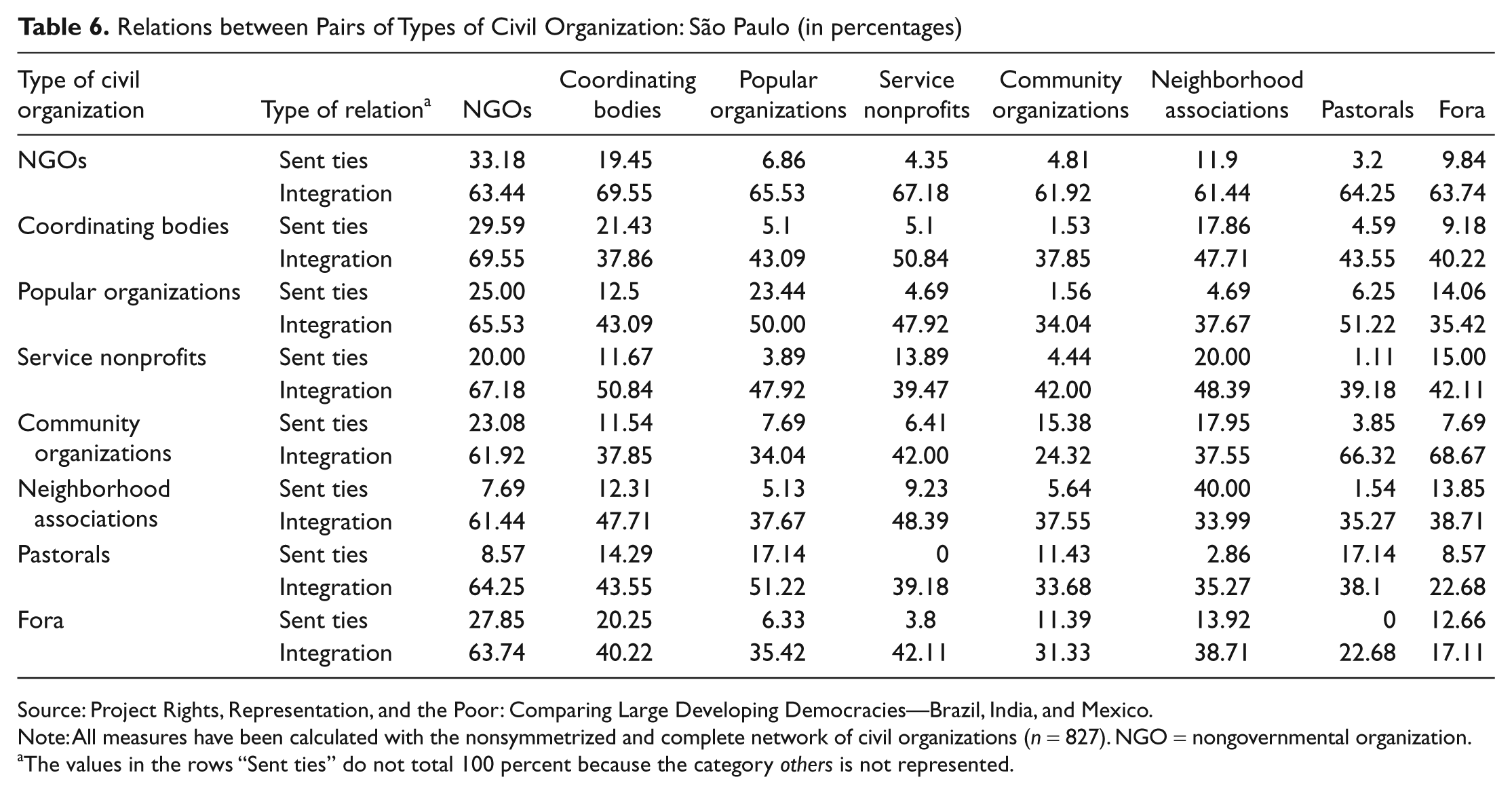
As seen in Table 6, in terms of their relational repertoires, NGOs in São Paulo present a homophilic pattern as well (approximately 33 percent of their ties are homphilic). As in Mexico City, they are the second type of civil organization with the higher degree of homophily, and they are the main destination of their sent ties (see first column of Table 6). They also hold the same relational selectiveness, favoring coordinating bodies as the most favored type of civil organization after themselves (with 19.45 percent of NGOs’ ties sent to coordinating bodies and 29.59 percent of coordinating bodies sent to NGOs), which is not surprising in view of the affinity between both types: Paulistana coordinating bodies have been created by NGOs. Even if they are not as central as Mexican NGOs due to their general position in the network, they are crucial for the relational repertoires of other types of actors in the South American metropolis.
Relations between Pairs of Types of Civil Organization: São Paulo (in percentages)
Source: Project Rights, Representation, and the Poor: Comparing Large Developing Democracies—Brazil, India, and Mexico.
Note: All measures have been calculated with the nonsymmetrized and complete network of civil organizations (n = 827). NGO = nongovernmental organization.
The values in the rows “Sent ties” do not total 100 percent because the category others is not represented.
Popular Organizations’ Restricted Protagonism
Our findings concerning popular organizations are twofold. On the one hand, according to their importance in the 1970s and 1980s, they still are highly central actors. On the other, they are only modestly relevant to the relational repertoires of other actors. More precisely, popular organizations are central, but they express a restricted protagonism, understood here as a relational prominence caused by their structural position in the network that has no proportional correspondence in the relational repertoires of the other types of civil organization.
Although the number of interviewed Mexican popular organizations in the sample does not allow us to investigate measures that require an ampler set of interviewed organizations, it should be noted that all the measures we analyze for Mexican popular organizations do not rely on the number of interviewed entities because either we use the symmetrized network or the measures are calculated on the basis of received ties by all popular organizations in the sample, which represents 6.3 percent of the Mexican sample (in São Paulo, they represent 2.45 percent).
Mexican popular organizations excel mainly in generating dependence (ranking first, with a score 52 percent higher than average). Besides that, their access to other organizations is relatively easy (low average distances, ranking second). The thirty-eight popular organizations in the sample are only modest receivers of sent ties by neighborhood committees, NGOs, and coordinating bodies (third column of Table 4).
Popular organizations are central actors in the universe of civil organizations in São Paulo. Their main characteristic is that other actors send many ties to them (ranking first, with an outlier score of 145 percent higher than average), but they are active in sending ties themselves (ranking third, with a score 9 percent higher than average). Their position in the network leads to a high capacity for mediation (ranking first) and for generating dependence (ranking second). They are positioned in the network so as to have broad access to other actors, through paths with relatively small average distances (ranking first).
The relational repertoire pattern of popular organizations in São Paulo is diversified. They favor relations with NGOs (25 percent share of their sent ties), although homophilic relations are also important (23.44 percent of ties are homophilic) as well as relations with coordinating bodies (12.50 percent share of their sent ties). Moreover, popular organizations are tightly integrated with NGOs (approximately 65 percent of the actors in their subnetwork are connected), and they also have ties with peripheral and intermediary organizations, such as community associations, service nonprofits, and neighborhood associations (third line of Table 6). As receivers, popular organizations are not favored as the main destination by any other type of actor except for pastorals, although they do receive ties from all types of organization (third column of Table 6).
Coordinating Bodies’ Relational Coupling
Coordinating bodies present surprising similarities in both contexts, confirming their profile as entities at the service of their member-organizations. In both cities, not only do they hold the same relational selectiveness, favoring NGOs as the main actor in their relational repertoire, but coordinating bodies are also the main actor in the ties sent by NGOs. In both metropolises, the pair composed of NGOs and coordinating bodies is the most integrated among the forty-plus pairs of possible combinations between two types of civil organization in each context (in Mexico City, 89.43 percent of the actors in their subnetwork are connected, and in São Paulo, 69.55 percent of the actors are connected). This relational coupling between NGOs and coordinating bodies, understood as a mutual strategy of preferred connections, becomes more evident when it is noted that popular organizations are secondary or insignificant in the relational repertoire of coordinating bodies (4.41 percent and 5.10 percent of their ties are sent to popular organizations in Mexico City and São Paulo, respectively). It is worth remembering that coordinating bodies were originally organically tied to popular organizations in Mexico City.
Mexican coordinating bodies are both senders and receivers of ties, but their passive centrality is a little more marked: theirs is actually the second highest passive centrality after NGOs (with a score 20 percent higher than average). They present high capacity for mediation (share first place with NGOs) and are inserted in very dense and clustered networks, which reduces the distance in their geodesic paths (second-best position). Their privileged position in the network as a whole is also manifested in the fact that they are among the organizations that have a greater number of shortest paths (third-best result).
Mexican coordinating bodies have developed ties beyond their original connections with popular organizations. The centrality of coordinating bodies, as would be expected due to their character as organizations working for organizations, is associated with their connectivity with other types of central organization that are not coordinating bodies (second line of Table 4). However, the fact that they are the type of organization with fewer relations among themselves (at least in Mexico City) is surprising: they present a clearly heterophilic pattern, with 13.24 percent of their ties sent to themselves. They favor NGOs, and service nonprofits rank second in terms of preferred target in their relational repertoire. And there is more: as mentioned, the affinity between NGOs and coordinating bodies makes up the most integrated subnetwork. On the other hand, entities such as popular organizations, neighborhood committees, and community associations are marginal in the relational repertoire of Mexican coordinating bodies (see the second line in Table 4). Coordinating bodies are, in turn, favored by NGOs, but they are completely irrelevant for popular organizations, neighborhood committees, and neighborhood associations, despite their centrality (see the fourth column in Table 4). Indeed, they are not connected with them at all.
Paulistana coordinating bodies are very active senders of ties, but they also occupy an important position as receivers of ties—ranking second in both active and passive centrality (Table 3). In turn, they have a high capacity for mediation (with a score 36 percent higher than average, ranking third), and unlike their Mexican counterparts, they are responsible for generating greater dependence in the network of civil organizations. Coordinating bodies are not actors that are especially close to other actors, and they do not have as short an average distance as their Mexican peers. Although their number of shortest paths is not among the worst, they have relatively limited capacity if contrasted with their position in the network.
Coordinating bodies in São Paulo also present the same relational selectiveness: they target NGOs, and the network between both types of civil organization is also the most integrated one in the South American metropolis (Table 6). Nevertheless, coordinating bodies in São Paulo are not heterophilic and target themselves in their own relational repertoire (21.43 percent of their ties are homophilic). Moreover, and different from Mexico City, coordinating bodies in São Paulo are the only types of civil organization that are relevant to the relational repertoires of all other actors: they represent over 10 percent in the repertoire of ties sent by each other type of actor.
Paulistana Fora and Pastorals
Paulistana fora are not central, and they present the most heterophilic relational repertoire of all actors in both cities (12.66 percent of their ties are homophilic), which supports their role as spaces for coordination and consensus building between other types of actors. They send almost half of their ties to the other newest civil organizations, NGOs and coordinating bodies. However, they are relevant in the relational repertoires of popular organizations, service nonprofits, and neighborhood associations. Again, this underscores their functional specialization as spaces that allow nonconnected actors with issue affinities to interact.
Pastorals in São Paulo are central in many measures (passive centrality, betweenness, average distance, and number of shortest paths), rank low in others (notably, dependence and active centrality), and present some interesting similarities with popular organizations: they are prestigious (they rank third in passive centrality) and receive ties from almost all types of actor, but they are not among the most targeted actors in the relational repertoires of any other civil organization, similar to popular organizations. Their most frequent relations are with popular organizations (17.14 percent of their ties are sent to popular organizations).
Representing Networks of Civil Organizations and Prestigious NGOs
The sociograms in Figures 1 and 2 aim to represent general connection patterns between all types of actors found in the organizational ecology of both metropolises. Each type of civil organization is represented by a single node, which collapses all the entities that compose that type of actor. For instance, the node labeled NGOs represents all NGOs in our samples, and the same is true for every type that is represented in the sociograms. The squares represent the traditional types of actors, the triangles represent the first wave of new actors, and the circles represent the second wave of actors. In addition, the thickness of the lines connecting types of civil organization represents how integrated each pair of types is, that is, the percentage of nonisolated actors when those two types are connected. This means that not all NGOs are necessarily connected to all coordinating bodies, but the thickness represents the percentage of them who are connected. Indeed, the sociograms simply are a visual representation of the integration measure already shown in Tables 4 and 6 and described in the article. It should be noted that the position of the node in the network is arbitrary, deliberately chosen to enhance the visualization of the sociograms, meaning that nodes that are closer are not more intensively connected. Finally, there is no directionality in the sociograms: the lines are used purely to denote integration of the types.

Sociogram of Mexico City civil society: Integration and waves of actors
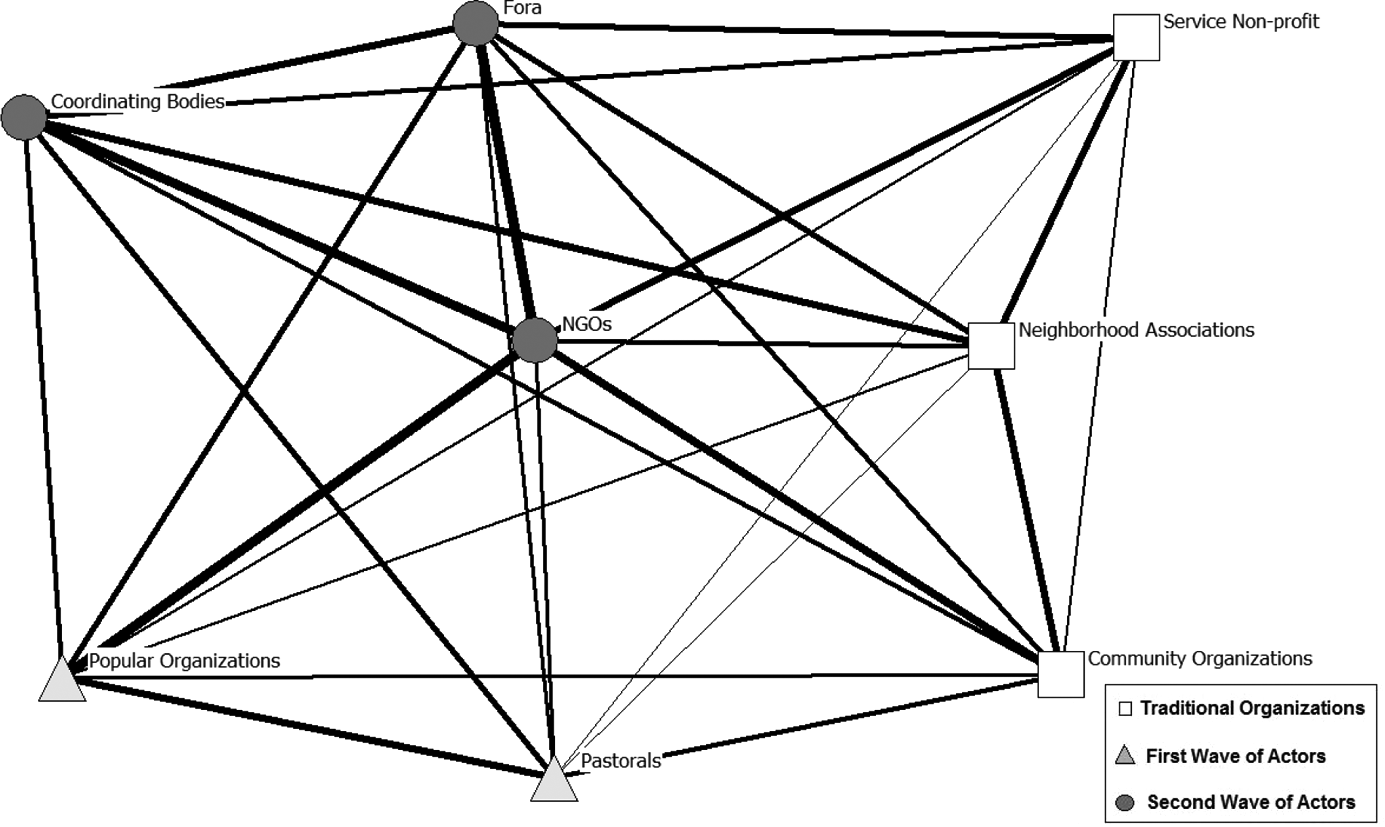
Sociogram of São Paulo civil society: Integration and waves of actors Source: Project Rights, Representation, and the Poor: Comparing Large Developing Democracies—Brazil, India, and Mexico. IDS/CEBRAP
The overview of the sociograms shows different patterns of integration for the first and second waves of actors. In both metropolises, the second wave, especially NGOs, is remarkably integrated with other types of civil organizations—not only new actors but also traditional ones. The sociograms also show that new and the newest civil organizations are more densely connected in São Paulo than in Mexico City. In the former, new civil society actors—NGOs, coordinating bodies, and fora—are strongly related among them and with popular organizations, but not with pastorals, which still hold their connections with popular organizations. Paulistana civil organizations present substantively more connectivity between them than their peers in Mexico City, suggesting plausible association between such connectivity, the diversity of organizational types within the waves of new actors, and the density of civil organizations within Mexican and Brazilian civil society. In Mexico City, although traditional and new actors are connected, one can see that popular organizations have few and not very intense connections with other types of organization, even though this results to some extent (because of sent ties), but not entirely (due to received ties), from the small number of interviewed popular organizations.
A brief description of an emblematic NGO in both metropolises is useful for allowing a more substantive interpretation of relational patterns. A skeptical reader could argue that NGOs’ connectedness may be driven merely by the fact that they are resourceful, due to donors founding donors’, and thus, they are perceived as actors to which it is worth being related (prestige effects). In brief, connectedness may or may not be related with societal rootedness. It is possible to tackle this possibility by analyzing most emblematic cases of NGOs whose centrality may rely on prestige effects. Thus we selected two among the most central NGOs with highly developed capabilities for political and policy influence: Polis in São Paulo and Centroprodh in Mexico City. 39 Both are quite prestigious NGOs, with high centrality scores in the network, and represent well the profile of the newest wave. They are selected just for those reasons.
Polis, the Institute of Studies, Political Training, and Consultancy on Social Policies, is an emblematic NGO in the Brazilian context. Polis was founded by left-wing and progressive-minded practitioners in 1987, after transition, and immediately before the momentous juncture of the National Constitutional Assembly. Initially, Polis was heavily engaged in political training of left-wing militants, unionists, and grassroots leaderships and worked to foster popular amendments to the 1988 Constitution. After 1988, Polis committed itself to the struggles for the implementation of both the universal policies defined in the Constitution and the participatory councils of strategic policies. Polis developed mechanisms for the oversight and social accountability of policies and accumulated specialized policy-related knowledge. At the same time, it invested both in the political training of popular and social movement leaderships for strengthening their role in both participatory spaces and in the creation of venues for fostering the agenda of voiceless urban collective actors (e.g., waste scavengers, homeless). The combination of support from a wide range of social actors and specialized knowledge makes it possible for Polis to push forward bills and amend legislation. In brief, during its lifetime, Polis evolved, enlarging the range and the reach of activities carried out as well as enhancing notably its direct policy influence capabilities, while keeping its commitment with popular participation and social equality.
The Centro de Derechos Humanos Miguel Augustin Pro Juares (Centroprodh) also is an emblematic NGO in Mexico. It was founded in 1988 by Society of Jesus in Mexico, together with many human rights NGOs created by religious entities. Initially, its members were associated with wings of the Catholic Church sympathetic or openly supportive of the liberation theology. Centroprodh worked in cooperation with other human rights NGOs founded by the Catholic Church, supported left-wing social movements and popular actors, and were a strong opposition to the government by denouncing, for instance, the presence of paramilitary groups in Chiapas and also by helping oppositional popular organizations. In 2001, it was conferred consultative status in the United Nations Economic and Social Council, and it also is a member of the National Network of Civil Organizations, Todos los Derechos para Todos. Centroprodh is committed to the defense of human rights, especially those of indigenous people but also of other at-risk groups. It works mostly on education and training and for oversight and accountability in the area of human rights. It works directly with individual and group victims of human rights violations, international organizations, and other Mexican organizations, such as research organizations, and also with the Mexican government by proposing public safety reforms to further the promotion and the development of human rights policies. In summary, Centroprodh notably increased policy-influence capacities during its lifetime, but kept strong attachments with left-wing and popular actors.
Concluding Remarks
This article addressed the NGOization depiction of Latin American civil society. We explored through network analysis the organizational ecologies of civil society from the two largest metropolises in the region. Findings reported here show that NGOization diagnosis loosely corresponds with some features of Mexico City and São Paulo organizational ecologies’ composition and networks, but clearly challenge the idea of a substitutive trend, the depoliticization thesis, and to a lesser extent, the neoliberalization thesis. The NGOization diagnosis seems to overemphasize an interpretation of those features that is flawed.
There is indeed a growing relevance of a new civil society made not only of NGOs but also of coordination bodies and (in São Paulo) fora and, to a highly variable extent, a loss of prominence of social movements. Both trends are stronger in Mexico City than in São Paulo, but are present in both contexts. NGOs are among the most central types of actor in Mexico City, and they are the most favored type in terms of relational repertoires in both metropolitan organizational ecologies, whereas popular organizations, although among the most central actors, were not privileged in the relational repertoires of other types of actor. Our interpretation of the broader range of findings presented in this article, building on the characterization of civil organizations’ roles available in local literatures, puts forward a different depiction of changes within civil society. In both metropolises, there have been a modernization and a functional diversification of civil society, and a subset of civil organizations has specialized itself in developing a division of labor that enhances their capacity for disputing public agenda and influencing policy.
Civil society in Mexico and Brazil underwent a modernization that encompassed not substitutive trends—at least not of the kind portrayed by the NGOization diagnosis—but the enlargement of the local organizational ecologies, as one can see by the simple depiction of our samples. Existing civil societies in those cities are not made mainly of popular organizations or NGOs, none of which overshadows the other. In addition to popular organizations and NGOs, which are part of the new and the newest types of civil organizations, respectively, there are pastorals, fora, and coordinating bodies that make up those two waves. Actors of those waves coexist alongside traditional actors. Moreover, the role popular organizations and NGOs perform depends on the presence and strength of different types of actors, and on the interactions among them.
To suggest that, in those metropolises, the rise of NGOs displaced social movements misunderstands the implications of the modernization of organizational ecologies. The new and the newest waves of actors occupy both most central and structurally advantageous positions and some intermediate positions in the Mexican and Paulistana civil society (as the rankings in Tables 3 and 5 have shown). There is not even one traditional type of actor that occupies central positions, not even service nonprofits, which have a long and well-established tradition. Thus, the supposedly substitutive trend might have happened across the past forty years by displacing once-dominant traditional social actors with a diverse set of new actors.
Civil society in both metropolises is now more functionally diversified than it used to be. Traditional actors coexist with those of the new waves, and thus, there is a wider range of roles played by civil society: traditional roles, of which legitimacy was taken for granted at least since the nineteenth century—mutual self-help, philanthropy, assistance to the poor—alongside new roles, some of which are not fully institutionalized and still raise some suspicion about their legitimacy—namely, policy making, political representation by advocacy, and policy implementation, as empirically found in our classification of civil organizations, especially when noting their diversification of activities and beneficiaries. The diversification of roles played by civil society is not an automatic consequence of modernization itself but a contingent feature empirically founded. Local literatures are emphatic about those new roles as a criteria dividing social or popular actors from civil actors in Mexico and service delivery roles from advocacy roles of NGOs in Brazil. Interestingly, the novelty points at a new status of civil society—or a subset of civil organizations, such as fora, coordinating bodies, and NGOs—as skillful and to some degree effective actor for policy influence.
Of course, it is possible to accept functional diversification as an empirical trend and yet criticize the roles embraced by one or several types of civil organization because of its undesirable implications. NGOization diagnosis denounces donor-driven and rootless NGOs leading to the depoliticization of civil society. The rising prominence of NGOs and their roles are portrayed as associated to supranational and homogenizing factors. In fact, we do find that the relational repertoires of NGOs show relational isomorphism in both contexts, arguably related to such variables. However, it does not mean that the association between NGOs’ prominence and supranational factors necessarily implies that NGOs are depoliticized agents, service delivery oriented, or even socially detached.
Local literatures and our findings suggest that NGOs are engaged in disputing public policy priorities, although is hard to know whether they do so because of, against, or independently of their funders’ agenda—and it does not seem very useful to look out for “right” motifs. Specifically regarding “rootlessness” of NGOs, our analysis showed that the fact that NGOs are relationally relevant did not lead them to become socially detached. In fact, it is possible to show that the opposite is true: domestic relations are positively associated with relations with international donors and agencies. 40 Mexican and Paulistana NGOs are receivers of ties sent by almost all types of organization, including community and neighborhood associations, both of which also receive ties sent by NGOs, as shown in Tables 4 and 6. Although this connectedness may be a product of resourceful NGOs’ prestige, our brief account of highly prestigious and central NGOs in both metropolises shows that it is possible to find historically rooted and politically engaged NGOs that are widening their activities and increasing their policy influence while keeping their political and social embeddedness.
In fact, in both metropolises, a subset of civil organizations belonging to the new waves (NGOs, coordinating bodies, and fora) has been able to develop specialization aimed at policy influence and at shaping public agenda, which is clearly at odds with the depoliticization thesis. Specialization implies the complementary development of roles—including a set of specific strategies and skills—between types of civil organizations for enhancing synergy and effectiveness to achieve common goals. First, coordinating bodies and NGOs are relationally coupled in both metropolises. Given that coordinating bodies are actors responsible for setting common agendas and representing the interests of the entities that either create them or are affiliated with them, such relational coupling is associated to a complementary division of labor. Second, in São Paulo, there is a cluster of actors belonging to the new civil society: NGOs, coordinating bodies, and fora. Fora work for producing issue-oriented common agendas within civil society and, accordingly, are the most heterophilic civil organization actors analyzed in both cities. The functional complementary role of fora, NGOs, and coordinating bodies makes it possible to agree on common agendas among a wider set of actors, to foster those agendas through NGOs advocacy skills, and to follow up and represent the same agendas by coordinating bodies. This division of labor would not make sense for a set of civil organizations mainly working with service delivery, and it hardly seems to imply encumbering social change, as supposed by the depoliticization thesis. Indeed, it was purposely developed by new civil organizations actively engaged in setting and advocating for priorities in public policy, and not only in carrying out service delivery activities.
The evidence presented in this article does not allow us to properly address the neoliberalization thesis. However, it is plausible to assume that this thesis supposes a host of service delivery–oriented NGOs, performing functionally to state retrenchment. As already discussed, this does not seem to be the role of NGOs within Mexican and Paulistana organizational ecologies.
Finally, this article reported extensively about common trends in Mexico City and São Paulo, but there is variation between both national and local civil societies, that is, portraying, on the one hand, a more diversified, specialized, and well-connected Brazilian civil society and, on the other, a sparse, loosely connected, less diverse, more NGO-laden Mexican civil society (as the sociograms aim to represent). Contemporary Mexican literature on civil society is notoriously more pessimistic than Brazilian, pointing at Mexico’s incomplete political transition and the survival of social corporatism as causes of the weakening of civil society. However, explaining such variation is out of the scope of this article and would require a different analytical strategy for dealing with independent variables.
Yet, still, it would be possible to interpret that the lower the density of civil society (the Mexican case), the more prone to the dangers of NGOization. We already show both that NGOs correspond to the profile portrayed by the NGOization diagnosis, and the idea of a substitutive trend is flawed. However, one should still be concerned with popular movements. Thus the loss of prominence of popular organizations deserves a comment. Instead of having simply disappeared or being displaced by other actors, our analysis allows us to characterize popular organizations’ loss of prominence as a peculiar form of restricted protagonism. Popular organizations are still prestigious and are often cited by other actors (as shown in the sociograms), but they are a type of actor that is not crucial to any other type of civil organization. It is clearly possible to interpret restricted protagonism as a sign of weakness, and it may be so in certain contexts, as Mexican relational data suggest, but it is also plausible to interpret it as evidence that popular organizations have acquired a relatively stable position in the scene of a modern and diversified civil society, which no longer faces the challenges of being embedded in an authoritarian state and which has developed a number of different channels to influence the state, as the Brazilian findings suggest. Therefore, the loss of prominence of social movements varies to a high extent, and its meaning should not be equated to weakness of civil society.
NGOization diagnosis implicitly assumed that due to certain definitional features of popular movements, a dense and robust population of popular organizations indicates a civil society that is more vibrant and possessed of greater potential for change than civil society with other possible compositions. However, different types of civil organizations perform different roles and have different ways of influencing policy decision making and of shaping the public agenda. Moreover, democratic governance implies that a wide constellation of different social actors is able to influence policy and politics through distinct mechanisms and channels.
Footnotes
Acknowledgements
Previous versions of this article were presented at the International Seminar Metropolis and Inequalities, held at the Center of Metropolitan Studies (March 2010), at the Research Group Democracy and Collective Action based at the Brazilian Center for Analysis and Planning (May 2010 and March 2011), and at the Brown International Advanced Research Institutes (BIARI), Development and Inequality in the Global South, June 2010). We thank all participants of those events, especially Patrick Heller, for their thoughtful comments. Finally, we thank FAPESP and INCT/CNPq for funding the writing of this article.
The author(s) declared no potential conflicts of interest with respect to the research, authorship, and/or publication of this article.
The author(s) disclosed receipt of the following financial support for the research and/or authorship of this article: FAPESP/CEM (São Paulo Research Foundation/Centre for Metropolitan Studies) and CNPq/INCT-CEM (National Council for Scientific and Technological Development/National Institute of Science and Technology - Centre for Metropolitan Studies).