







Abstract
This paper looks at the prehistory of the foreclosure crisis in Cleveland, Ohio, in order to understand the effectiveness of civil society organizations in mitigating its impact on the city’s neighborhoods. Social theorists and movement activists have often postulated civil society as an authentic and voluntaristic realm in which we constitute and act on shared values. The voluntary nature of civil society organizations also, it is argued, make them more responsive, adaptable, and effective in meeting the needs of the communities they operate in. The question is whether or not this has held true in the contemporary crisis. I find that in the 1970s, Cleveland’s community-based organizations were instrumental in securing resources from government and private philanthropies to deal with the urban crisis. The unintended result of this success was a general rationalization of Cleveland’s civil society around narrow practices and market-based conceptions of value. In the process, civil society was transformed into a political technology that solved various dilemmas of rule, but at the same time it was transformed into a civic monoculture that made the city especially vulnerable to foreclosure. A key implication of this analysis is that civil society has been transformed into an object and stake of urban politics and, as a result, it should not be expected to protect society against neoliberal institutional transformations.
In the 1970s, many cities in the Northeast and the Midwest were confronted with a crisis. Redlining, neighborhood transition, and suburban growth interacted with the decline of US manufacturing to produce a general neighborhood crisis. Faced with vacancies, foreclosures, arson, and diminished city services, neighborhoods revolted. Unlike the riots of the 1960s, the revolt was nonviolent and transcended race. Community organizing groups were active in helping spur the creation of a movement to secure greater investment in urban neighborhoods. A related goal of the movement was to re-embed markets in society, to borrow Polanyi’s construction, that is, subordinate market logics to social ones. 1 One prominent result of this activism was the passage of the Community Reinvestment Act in 1977 (CRA), a rare piece of legislation that limits the mobility of capital. Also indicative of the prominence of neighborhood issues at the time, President Carter organized a “neighborhood summit” to develop a more responsive neighborhood policy. Communities across the United States learned to organize for improvements in neighborhood well-being, an explosion in activism that the political scientist Harry Boyte called the “Backyard Revolution.” 2
The passage of the CRA and a renewed interest in neighborhood policy were not the only effects of the urban crisis. Government functions were shifted from state bureaucracies to neighborhood-based nonprofit organizations, transforming the organizational structure of urban governance. 3 Central to the process was a new breed of community organization focused on physical redevelopment, the community development corporation (CDC). Although CDCs initially emerged in the 1960s, they were given a tremendous boost in the 1970s as vehicles for neighborhood self-determination in land-use decisions and as recipients of Community Development Block Grant (CDBG) and philanthropic funds. 4 For neighborhood activists, politicians, and philanthropists, CDCs became useful tools for protecting neighborhoods from the depredations of the market. However, rather than limit the negative effects of markets in neighborhoods, I argue that these organizations helped pave the way for the foreclosure crisis that began in 2007. This role suggests that we must overcome the romanticization of civil society if we are to effectively analyze neoliberal institutions. 5 To understand this dynamic, it is necessary to look at the transformation of urban civil society and community-based organizations (CBOs) between the Backyard Revolution and the foreclosure crisis.
Between 1975 and 2007, CDCs proliferated across the urban landscape. According to censuses taken by the National Congress for Community Economic Development, the nationwide population of CDCs more than tripled from 1,500 to 4,600 between 1988 and 2005. 6 Alongside this prolific growth new intermediary and support organizations have emerged as well as a variety of policy tools that make use of these now-prevalent organizations. CDCs are cornerstones of many public-private partnerships. They are often components of career trajectories in local politics and they have the backing of many local and national foundations.
The rise of CDCs as necessary components of neighborhood voice and governance has been celebrated as a Tocquevillian renaissance in which noninstrumental social relations produce social capital, a crucial ingredient in promoting collective action for the common good. 7 These collective investments in neighborhood-based organizations have expanded local “civic capacity,” according to Sirianni and Friedland. Community developers have created innovative and adaptive housing interventions while facilitating and empowering neighborhood voices. 8 Indeed, some have characterized community development as a unified “movement” that manages to integrate the logics of state, market, and civil society while empowering neighborhoods and facilitating “social repair.” 9
Based on much of the relevant literature, the explosion in CBOs would suggest that urban neighborhoods would be far better prepared to cope with the foreclosure crisis of 2007 than they were in 1973 to cope with the earlier urban crisis. However, that has not been the case. The experience of Cleveland, Ohio, is suggestive on this point. Cleveland is a city that is armed with a large number of CBOs as well as an effective and well-supported community development system, and yet it was one of the hardest-hit cities in the foreclosure crisis. This begs the question: do CBOs actually arm neighborhoods with the resources, tools, and expertise needed to cope with foreclosures? This is a counterfactual question and, therefore, it is a difficult question to address directly. However, it is possible to establish a tendential argument by looking at the structure and trajectory of the city’s civil society in the period between the Backyard Revolution and the foreclosure crisis. This approach makes visible the changing organization of opportunity and constraint in the city’s civil society. Based on this, and running against the grain of many contemporary celebrations of the emancipatory and policy potential of civil society organizations, 10 I argue that these organizations have come to weigh on neighborhoods rather than empower them. This, in turn, produces a second question: how did this set of circumstances come to pass? Why has the privileging of civil society organizations in urban governance proven to be ineffective in confronting the contemporary crisis?
By focusing on the case of Cleveland, a city that was a “bellwether” 11 of the foreclosure crisis and also possesses a nationally recognized community development “industry system,” 12 I demonstrate how the genesis of this field of nonprofit organizations has hampered the city’s response to the crisis. In order to excavate the causes of this outcome it is necessary to look at the transformation of Cleveland’s civil society between 1970 and 2008. Central to this story is the increasing “instrumentalization” of these organizations, by which I mean organized urban interests used them to achieve their ends. As CBOs are transformed in order to realize narrow instrumental goals, their ability to be responsive to the communities they ostensibly represent is compromised. In terms of civil society writ large, instrumentalization undermines the diversity of civil society as a result of selection processes and, in a few cases, of overt channeling efforts by funders. What had been a diverse field of civil society organizations in the 1970s eventually became a civic monoculture. Like crop monocultures in agriculture, a civic monoculture undermines the ability of the city to respond to an environmental shock, in this case, the foreclosure crisis. 13
Despite the ecological framing of this analysis, this is not merely a story of passive selection processes. 14 Philanthropies, institutional entrepreneurs, and CBOs themselves attempted to secure their own authority by devaluing alternative organizational and programmatic models. By 2000, the effectiveness of organizations was being measured largely in terms of the production or facilitation of new housing and other physical development. This did not simply mean that organizations were using the wrong tools for an emerging problem; it also meant that other programmatic muscles were allowed to atrophy. When mass foreclosures struck the city, the abilities of the city’s civil society organizations were poorly calibrated to the problem.
Analytically and theoretically, this process reveals the risks of treating civil society as a sector with inherent characteristics to be unproblematically harnessed by policy makers and philanthropies. Rather than being a diverse and voluntaristic expression of noninstrumental values and altruism, over the past forty years Cleveland’s civil society was transformed into a political technology. 15 By political technology I mean a bundling of practices, discourses, metrics, and tools which serve to bridge rigid political divisions. Establishing such a technology was a goal with very high stakes in Cleveland in the 1970s and 1980s. In order to govern the city at all it had become necessary to construct new accommodations and new practices of governance. The political technology of community development accomplished the former by shifting governance functions to CBOs and constructing institutions to facilitate physical redevelopment. It accomplished the latter by using real estate values as the most important metric for assessing neighborhood well-being. This technology managed to bridge the divisions that had emerged between elected politicians, corporate leaders, and neighborhood activists. Because of its service as a political technology, community development became a “morally-magnetic mission,” to borrow from Nina Eliasoph, or a cause that was indisputably attractive and good to a variety of urban interests. 16 At the same time, the use of CBOs as a political technology prompted funders, politicians, and community developers to rationalize the city’s civil society around a narrow set of practices and goals. Organizations, programs, and practices that did not contribute to the political technology were starved of resources and, over time, marginalized or eliminated from the city’s civil society.
This analysis of the relationship between Cleveland’s CBOs and the foreclosure crisis is a component of a broader study of the structure and genesis of the field of community-based organizations in Cleveland. I analyze these shifts using a variety of sources, including interviews with the leaders of every CBO in the city between 2000 and 2008, and archival research on the city’s CBOs dating back to 1966. The focus was on CBOs that claim to represent a geographically defined community or neighborhood, that receive funding from one of a variety of sources, and/or that are members of the local community development trade association. Overall, the analysis is based on seventy-one organizations that were extant in the city between 1970 and 2008. I also conducted dozens of interviews with politicians, bureaucrats, program officers, strategic business organizations, and economic development organizations to understand the institutional context. Cleveland is not a representative case, but a revelatory one. In particular, the presence of a large and professionalized population of CBOs alongside an exceptionally devastating foreclosure crisis makes Cleveland a case that places these dynamics into unusually sharp relief even as it reveals how the instrumentalization of civil society can produce unresponsive and ineffective civic monocultures.
The analysis here opens with a discussion of the construction of the political technology of community development in the wake of the Backyard Revolution. I then turn to a description of the community development “industry system” that had emerged by the mid-1990s with the support of a variety of urban constituencies. In section three I answer the question of what went wrong and describe the rationalization of the city’s civil society into a civic monoculture disconnected from neighborhood residents and problems. Finally, I turn to the paralysis of Cleveland’s civic monoculture in the face of the city’s worst crisis in forty years.
1. Contention and Accommodation in the Neighborhood Crisis of the 1970s
The instrumentalization of civil society and the construction of a new political technology based on community-based organizations was an outcome of a general collapse of political authority in the city. A combination of fiscal crisis, populist politics, capital strikes, recall elections, and protest movements has made Cleveland a paradigmatic case of the “crisis of growth politics.” 17 In this political boiling cauldron the primary mobilized constituencies—neighborhood organizations, growth-oriented elites, and elected politicians—were each fighting with the other two. While contentious politics was the most visible effect of the crisis, a less visible outcome was that it became evident to philanthropies, bureaucrats, and a cohort of community organizers that community-based housing production could be the basis of a new political accommodation. Though assisted by others, many community organizers became the “institutional entrepreneurs” 18 that fashioned a new community-development industry system based on community development corporations (CDCs). They altered the meaning of community development to meet a variety of goals, invented new policy tools, and created a new regulatory apparatus to facilitate community-based real estate development. The system that was created bridged the particular interests of all the contending constituencies in the 1970s. However, the political technology of community development was not imposed by one interest on others, nor was it a simple appropriation of a model that had been developed elsewhere. Instead, early community developers made use of their knowledge of varying institutional logics to adopt policy tools and development practices to the specific needs of community-based housing production in Cleveland. In doing so they helped realize the interests of politicians, growth-oriented elites, and neighborhoods. The value of the emerging system was its ability to secure political peace in the context of urban decline.
There were three key events that resolved the crisis of growth politics in Cleveland. First was the election of the business-friendly Republican, George Voinovich (1979–1988). Unlike his predecessor, Dennis Kucinich (1977–1979), a self-styled urban populist, Voinovich was happy to devolve authority and governance functions onto new civil society organizations. The resulting accommodation between elected politicians and the neighborhood-based movement enabled Voinovich to recommit to the politics of growth. Some city resources would be allocated to neighborhoods and funneled through CBOs, but the bulk would go for economic development in support of existing concentrated real estate investments in University Circle and the central business district. These priorities in allocating resources rebuilt the relationship between politicians and growth-oriented elites; every mayor since has supported the accommodation. Mike White’s administration (1990–2001) built much of the institutional apparatus necessary for nonprofit physical redevelopment to thrive. Although she did little to alter the arrangements ceded by the White administration, Jane Campbell’s (2002–2006) trajectory to the mayoralty went through an East Side CDC. Finally, Frank Jackson, the city’s current mayor, is perhaps the least enthusiastic supporter of the system, but there were few alternative outlets for funding by the time he became mayor in 2006 and he has historically given generous support to the CDC in the ward that launched his political career.
The second relevant factor that resulted in community-based physical redevelopment becoming a new political technology was the emergence of a more interventionist and proactive corporate leadership. Corporate elites needed to reestablish their civic credentials after staging a destructive capital strike against Kucinich in 1977. They formed Cleveland Tomorrow, a dues-financed strategic business organization, to implement institutional reforms necessary to restart economic growth, an agenda that included nonprofit-based neighborhood redevelopment. 19 This commitment acknowledged the role of CBOs in governance and committed private resources to physical redevelopment in neighborhoods as well as downtown. In general, the turn to community-based development was the basis of a new political accommodation while simultaneously producing a turn to “public-private partnerships” and other forms of collaboration in governance. This transformation effectively enrolled, or “channeled,” neighborhood-based nonprofits into an effort to revalorize local real estate. 20 While the effects were not immediate, this reorganization of opportunities and constraints initiated tendencies in the city’s civil society that would continue until the foreclosure crisis.
Third, the neighborhood movement was defeated. In 1982 an umbrella group for Cleveland’s neighborhood organizations disrupted a spring gala of the social elite of the city in an effort to force a dialogue with the CEO of a locally based oil company. Known as the “Hunt Club” action, the protest managed to offend enough people that philanthropies informed the community organizations that they were cutting off all funding for community organizing and, henceforth, would only fund “bricks and mortar” development. This response divided the movement. Some viewed it as a coercive repression of neighborhood voices, while others took advantage of new resources and collaborative possibilities to rebuild neighborhoods. After all, some parts of the movement had already come to view abandoned homes, not corporate elites, as “Public Enemy Number One,” and were coming to view their own organizations as “developers of last resort.” 21 As early as 1981, the Cleveland Housing Network had been formed as a cooperative that would facilitate housing production in partnership with member CBOs. 22 The Network, in turn, would be instrumental in the institutional transformation that would enable community-based housing production. Neighborhood investment and recovery was always a goal of the movement and it had basically been acknowledged as a priority by philanthropic funders and the city. Finally, building out the new community development industry system presented the opportunity to make significant institutional reforms in the city. Indeed, today, many positions of leadership in the city are occupied by one-time leaders of the neighborhood movement.
Chris Warren is probably the most notable example. As an organizer with the Tremont West Development Corporation in the 1970s, Warren had led fights against arsonists and slumlords. In 1982, he became CHN’s second director and oversaw its growth as a key node in the emerging community development industry system. In 1989, he joined Mike White’s administration as director of community development. In that capacity he worked to develop government support for nonprofit physical redevelopment by helping create a land bank, a housing trust fund, tax abatements for new housing, and local CRA agreements with area banks. After a stint directing the Cleveland office of a Chicago-based development bank, Warren joined Frank Jackson’s administration in 2006 in the cabinet-level post of director of regional development. Warren’s trajectory is not unusual. His partner, Linda Hudecek, had a similar trajectory from organizing, to city government in the White administration, to another development intermediary, NPI. Mark McDermott went from organizing, to Cleveland State, to director of CHN, to the Enterprise Foundation, a national development intermediary and financing organization. Today, he is the Midwest regional director of Enterprise. These are just a few examples of a larger cohort of institutional entrepreneurs that has reshaped local institutions to facilitate community-based, nonprofit physical redevelopment.
Contentious politics disappeared from Cleveland in the wake of the city’s crisis of authority. A new accommodation had been reached, one that valorized the role of nonprofit community-based organizations. While many neighborhood activists felt that the new generation of CDCs represented a cooptation of movement organizations, it is also true that they realized some goals of the movement, especially the rescaling of governance to the neighborhood scale and new investment in neighborhood physical capital. For politicians and bureaucrats, community-based nonprofit organizations helped govern neighborhoods in a tight fiscal environment while also providing a closer connection to neighborhood stakeholders. For politicians, the CDCs provided an opportunity to secure organizational adherents that sustain a neighborhood electoral operation—a process facilitated by City Council’s control over much of the Community Development Block Grant budget. 23 For the city’s corporate elites physical redevelopment helped realize the goal of revalorizing the city’s real estate generally, while also making the city more attractive for corporate managers and professionals. When combined with new legislative (CRA, various tax credit and homeownership programs) and philanthropic innovation (including program-related investments, new professionalizing intermediary organizations, lease-purchase housing rehabilitation programs, and tax-credit syndication), neighborhood-based housing production became a tool for a general political accommodation.
In the wake of the Backyard Revolution community development was transformed into a political technology. This was accomplished by institutional entrepreneurs, philanthropic funders, intermediary organizations and bureaucrats who managed to equate community development with capital-intensive physical redevelopment designed to raise real estate values. This technology was valued because it enabled the construction of a civic agenda out of disparate interests and priorities—a task that was especially important in Cleveland after the crisis of the 1970s. In the hands of CBOs, intermediary organizations, city agencies, and philanthropic funders, the technology organizes the identities and commitments of Clevelanders by presenting itself as an elegant technical solution to a host of governance problems in neighborhoods. Politically, this was an important basis of accommodation because it reversed the anti-market critique of the Backyard Revolution that had produced the CRA; indeed, the valorization of real estate had been resituated as the solution to neighborhood problems and metric of neighborhood well-being.
This configuration is notably “neoliberal” in that markets, in this case real estate markets, are used to disrupt and reconfigure basic lines of political division while reconstituting ideas of the civic around ownership, participation, and individual responsibility, in opposition to dependence, transience, and tolerance. It clarifies and rationalizes interests around physical redevelopment. Of course, in many ways this was anticipated by the growth politics described by Logan and Molotch. 24 What is new here is the work being done by real estate values to meet everyone’s collective interests and how civil society organizations, rather than private developers and corporate elites, lead the pursuit of real estate values in a context of decline. Where once city bureaucracies and nonprofits had defined needs and then responded to them, the only needs that were generally acknowledged in the years before the foreclosure crisis were those that could be met through higher real estate values. This tendential shift enabled and justified the collective investment in CDCs as a cure-all solution to urban problems, securing for it moral authority that was difficult to contest, even at the height of the foreclosure crisis.
Growth was not restarted, despite the resources and reforms that were directed to community-based physical redevelopment. While many and frequent announcements of Cleveland’s recovery have been trumpeted since the 1970s, the city has continued to lose jobs, corporate headquarters, and population (from nearly a million in 1970 down to 380,000 today). However, authority had been reestablished: since the early 1980s, decline has not been associated with political polarization. Growth-oriented elites have acknowledged that neighborhood stabilization is important for economic development, politicians have learned to coexist with CBOs that claim to be more authentic representatives of community, and bureaucrats are happy to fund CDCs to provide governance functions that were once performed by government agencies. The population of CDCs rode a wave of legitimacy and funding to a peak of fifty-one in 1996, even as community-organizing groups died. This expansion did not happen because CDCs were instrumental in spurring growth, nor was it because they were effective representatives of neighborhoods—after all, many neighborhood activists felt betrayed by the turn to physical development. The reason is that CBOs became necessary components of a political technology that enabled both a compromise among competing urban interests as well as a proactive mode of governance on behalf of those interests. CBOs had been instrumentalized as the key nodes of a new political technology; at the same time, this role provided the center of gravity for the expansion of a new community development industry system and for the rationalization of the city’s civil society.
2. The Community Development Industry System
Neighborhood-based institutional entrepreneurs accomplished a nifty inversion in the early 1980s. Faced with the defeat of their movement, they not only managed to ensure the survival of many CBOs, but also transformed them into important nodes of urban governance and a necessary political technology for grounding urban political authority in a context of decline. The task for CBOs went from being one of securing recognition for neighborhoods and their needs to reforming institutions and developing tools that would enable the city’s CBOs to continue to function as a political technology. This problem was not solved through consensus; instead, many of the battles that had been waged publicly in the 1970s shifted indoors and were waged to define the meaning and practice of community development.
In this context, it is not surprising that the population of CBOs grew rapidly. When the Cleveland Housing Network was formed in 1981 there were nineteen CBOs active in the city. In 1996, the year the CBO population peaked, there were fifty-one (see Figure 1). What were these organizations? Most basically, they were relatively small, professionally run organizations receiving funding from some mix of developer’s fees, philanthropic funding, government funding (from the city and the councilor), and member dues. Their budgets averaged around $700,000, though the largest had operating budgets in the millions. On average, they employed nine staff persons, most of whom were involved in either ward programs or physical redevelopment. Almost all of the organizations were doing physical development, though in a variety of different ways depending on organizational culture, interorganizational connections and neighborhood circumstances. Many CDCs work collaboratively with CHN, strike deals with private developers, or use programs sponsored by the Department of Housing and Urban Development (mostly low-income housing tax credit projects or HOPE VI). Some have developed shopping centers, greenways, ecologically innovative green developments, and cultural amenities.
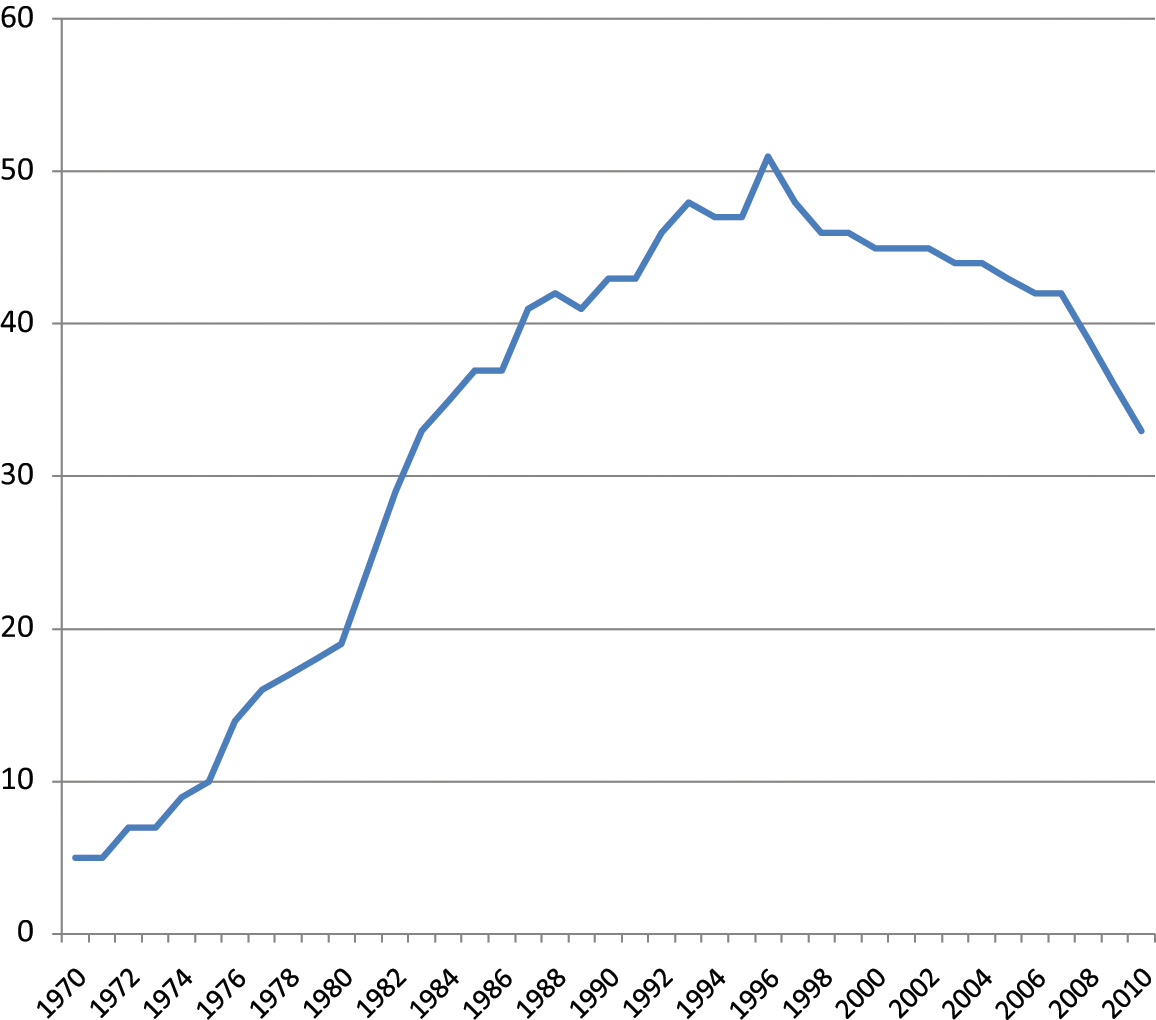
Cleveland CDC Population, 1970–2010.
The CDC is an organizational form that began to receive attention from policy makers in the 1960s as a tool for neighborhoods to bootstrap themselves out of decline. In the wake of civil rights victories, they were sometimes used to funnel resources to African-American communities. However, they were probably most significant as an organizational tool of urban recovery that was heavily touted and supported by the Ford Foundation and its community development financing arm, Local Initiatives Support Corporation (LISC), between 1964 and 2000. Ford developed many early tools to aid community-based physical redevelopment, including program-related investments, which allowed philanthropies to invest in nonprofit-sponsored developments. Philanthropies generally considered CDCs as a positive and civil way of achieving neighborhood renewal and empowerment, which also provided an alternative to the sort of contentious organizing that had been prominent in Cleveland in the 1970s. This approach to community-based physical redevelopment is encapsulated in the book Comeback Cities, by Paul Grogan, a former director of LISC, and Tony Proscio, a consultant and former LISC staffer. Situating themselves in a long tradition of thinking on community development, Grogan and Proscio argue that attempting to eliminate poverty is a bad way to improve neighborhoods. What is needed is “a careful restoration of order—in the built environment, in public spaces, and in people’s lives.” 25 For Grogan and Proscio, the role of the CDC is not so much to represent the community, but to “steer clear of the … us-versus-them ideology that mired grassroots groups for decades,” and to prime the pump of real estate markets through supply-side interventions.
The Community Development Block Grant (CDBG), passed by the Nixon Administration as the primary tool for federal funds to reach poor urban communities, introduced its own public-sector logic into the rise of the CDC. The block grant mechanism was designed to outflank municipal politicians who might divert federal funds to support their own electoral operations, rather than meet real urban needs. In order to make this happen, CDBG funds are distributed to nonprofit organizations that aim to help neighborhoods. The idea was to put distance between elected officials and the expenditure of funds. However, the effect has often been that municipal politicians establish their own CBOs to receive CDBG funds while still pursuing electoral goals.; 26 In Cleveland, the city’s Department of Community Development controlled some of the city’s CDBG allocation (much of it distributed to CDCs on an equitable basis), but the rest was allocated equally to city councilors to distribute in their wards. In some cases, councilors established CDCs in order to retain control over their allocation.
The varying circumstances around the founding and funding of CDCs do produce variations in practice. Politicized organizations make heavy use of a variety of government programs and contracts and have close relationships with ward political clubs. CDCs that grew out of merchants’ associations are heavily involved in street beautification, infrastructure issues, and commercial development. The CDCs that are the legacies of the Congresses are often closely tied to street clubs, privilege neighborhood input, and are heavily focused on housing development. Notably, in 1990, even though community organizing groups had been eliminated from the city’s civil society, there was still considerable diversity among CDCs, a diversity that might have helped the population adapt to environmental shocks like mass foreclosure. However, the diversity also produced conflicts over the definition of authoritative practices and organizational identities, which often determined funding.
These conflicts were often most visible within wards, simply because the most direct competition over deals and funding took place there. In 2000, in the African-American neighborhood of Hough, for example, there was a CDC that was an extension of the councilor’s ward operation, another that was a legacy of the Congresses and still represented neighborhood residents against politicians and developers, a large-scale housing producer founded by a Catholic nun, and a large organization working on infrastructure and economic development issues that was founded by one of the city’s wealthiest industrialists. While there was not competition among them for all sources of funds, there was for some, namely for private philanthropic funds and for the councilor’s CDBG allocation. Moreover, with the councilor in a position to approve or deny many projects, rent-seeking behavior is common. However, rather than bribes being the lubricant of deal making, developer’s fees are. The councilor in Hough, for example, has required that organizations give the CDC she was allied with a cut of the developer’s fees they earn in exchange for project approval. Political rent, indeed politicization writ large, is severely frowned upon by more “professional” development organizations and by the institutional entrepreneurs that came out of the neighborhood movement. These tensions motivate efforts to establish authoritative criteria of sound community development, criteria which are then used to distribute resources. Over the last thirty years, this process has produced a growing consensus that has even come to include most city councilors. As a result, funding for CBOs has become tied to a monochrome programmatic palette. Recalcitrant organizations have been starved of resources and died off or have been merged into other organizations.
Despite diverse origins and distinct organizational logics and practices, by the late 1990s most CDCs were moving towards relatively common programmatic practices. For example, most CBOs administer a host of ward programs funded by city government, including loans for improving storefronts or weatherizing homes and subsidies for heating costs or home repainting. Far more notable, however, is the fact that almost all CBOs are involved in physical redevelopment, even if they do not always pursue it for the same reasons. While all CBOs emphasize the importance of improving real estate values—after all, disinvestment was the primary cause of neighborhood decline in the first place—for some CDCs, which I call technocratic, housing production is the primary marker of skill and capacity vis-à-vis their funders. Other CDCs, which I call clientelist, use housing production to demonstrate the effectiveness of the councilor or as a tool for providing jobs and favors to potential political supporters. Nonetheless, despite these differences, when Cleveland’s CBOs are compared to those in cities like Atlanta and Seattle, where research was also conducted for this study, Cleveland’s CDC population is unusual in its broad-based focus on housing. But this commonality should not cause us to overlook the mutability of physical redevelopment, which makes it amenable to organizations that pursue very different goals. The prominent role of physical redevelopment in CDC programming was easily coupled to the adoption of real estate values as a metric for assessing CDCs and neighborhoods.
Programmatically, the use of real estate values for measuring neighborhood health implies that physical redevelopment will be the privileged programmatic activity for CDCs. While physical development can meet the need for new housing, improve real estate values, and “prime the pump” of real estate markets to attract private investment, many argue that it serves a variety of other purposes as well, such as the reduction of crime and pulling people out of poverty. Depending on who is asked, it can secure community development, racial empowerment, individual affluence, and neighborhood quality of life. Physical redevelopment is a blank policy canvas on which any number of actors and organizations can paint their vision of a revitalized Cleveland. This fungibility is why physical redevelopment is the ideal basis for the political technology of community development.
While useful to many politicians and neighborhood advocates, Cleveland’s community development industry system generally empowered technocrats as the representatives of community interests. 27 In terms of a worldview, technocracy implies a faith in professional management, technical problem solving and it assumes that the application of rationality will yield politically unimpeachable solutions. 28 The vibrant counterpublic that had been activated as neighborhoods mobilized in the 1970s was replaced by experts who manipulate the relevant measure of neighborhood well-being: real estate values. Development can be used as a way of strategically introducing market dynamics in order to make the hold of blight more tenuous—it is, then, a rationalist application of the market to solve a particular problem. This becomes evident when CDC directors speak of using different tools, such as LIHTC-funded housing or market-rate developments, to target a variety of different populations or to deal with the particular problems of different land parcels. The strategic deployment of development tools is enabled by an objectifying gaze that is manifested in land use maps and strategic plans. Cleveland’s CDCs are able to tactically deploy solutions to problems, not at the scale of the city or the neighborhood, but at the scale of the individual lot in order to revalorize urban real estate. This fine-grained manipulation of real estate markets in difficult and diverse settings is the central contribution of CDCs to broader redevelopment agendas. Community developers argue that these efforts are an important cause of the jump in median sales prices of houses from $30,000 in 1980 to $72,000 in 2004. On the other hand, this increase barely outpaced inflation and it is difficult to see any relationship between CDC capacity and changes in real estate values at the neighborhood level. Critics argue that to the extent real estate values have been revived, it is mostly because of public subsidies and risk sharing. 29
Market-rate development, rather than low-income housing, is particularly attractive for technocratic developers. For one thing, the CDCs already have the necessary skills in-house from years of hands-on experience doing tax-credit developments, either on their own or in partnership with CHN. They have established relationships with banks (who chase these deals for Community Reinvestment Act credit) as well as private developers (who chase these deals because if they are not allied with a CDC, they can have difficulty getting their projects past city council). There are many advantages of market-rate development for CDCs, including credentialing as a real estate developer, simpler deal structure, the collection of larger developer fees (as much as $10,000/unit whereas LIHTC rehab units yield $2,000–$4,000/unit), and perhaps an accelerated bump in local real estate values which, in turn, is used as evidence to justify future funding.
The market-driven logic of technocratic CDCs has little to say about existing populations, which, too often, are viewed as barriers to a development that is meant to attract more affluent suburbanites. Existing residents need education and jobs more than amusement parks and townhouses. Staff and directors of technocratic CDCs often use the same language of community development that has been around since the 1960s. However, the meaning of these terms has experienced a drastic slippage from that time. Neither the term “community” nor the term “development” refers any longer to identifiable social relations or a concrete group of people that conceive of themselves as a part of a common community. The understanding of these terms is rooted in the objectifying gaze of the planner rather than the living social relations of the pastor or the organizer. The notion of “community” in technocratic community development is tied to a geographic territory, but one imagines that territory as being filled with professional knowledge workers. “Development” of the “community” entails the physical improvement of the geographic place, a goal measured by growing real estate values. To the extent that such CDCs have a conception of community that includes people, it refers to the future residents that are being targeted by the development strategy, not the existing residents of the neighborhood. This attitude is somewhat glaringly revealed by a CDC director who is a good deal more blunt than many in discussing those who feel CDCs should serve the existing population of the neighborhood. The comment also reveals the emphasis on priming the real estate market:
One thing … I find striking … is that there is some small segment in each of these communities, an indigenous population, they fear change, they don’t necessarily like the investment that is coming in … Investment needs to be welcomed. There are those that think private-sector investment will come into an area of its own accord. No. Private-sector money has an ego too… And part of our job is throwing the door wide open to investment.
30
This is not to say that all existing neighborhood residents are ignored. Residents that positively contribute to the marketability of the neighborhood or its real estate values are understood to have a lot of clout. On the other hand, such people rarely need assistance from nonprofits. As for other residents, they are treated not unlike old housing stock that can be rehabilitated and marketed to outsiders. They are not “renters” or “people in need”; they are potential homeowners. And indeed, both development intermediaries and banks work hard to strip neighborhood residents of dispositions that are of little use in maximizing real estate values, and to inculcate new ones that can underpin the sale of a mortgage and create another home-owning “stakeholder.” This is accomplished in settings like street club meetings, which are usually organized by CDCs to encourage residents to work to improve and maintain neighborhoods. “Financial education” serves a similar purpose. Rather than teach people to understand credit, income, debt, and risk, these ubiquitous classes train people to improve their credit scores in order to qualify for mortgages.
By the time of the foreclosure crisis, Cleveland’s community development industry system had produced thousands of houses. Long-abandoned neighborhoods suddenly saw a bumper crop of new, tasteful, spacious housing emerge—apparently magically—from the ground. Typical is the case of Central, an impoverished African American neighborhood on the city’s Near East Side. Devastated by urban renewal in the 1960s, and seemingly capable of repelling any hint of investment ever since, between 2000 and 2004 the neighborhood was suddenly anchored by several hundred new homes designed for middle-class residents. The CDC that built the housing—Burten, Bell, Carr (BBC)—had become one of the most proficient technocratic developers in the city (BBC’s ratio of production to budget and staff size indicate it was the most efficient community-based housing producer in the city). Suddenly, the neighborhood was no longer simply a sink for the city’s poverty. At the same time, even one of BBC’s most important supporters, Mayor Frank Jackson, questions whether the focus on capital-intensive redevelopment to raise real estate values has only changed the “aesthetics” of neighborhoods without actually helping most of his ward’s impoverished residents. 31 Nonetheless, the example is instructive. CDC activity was reshaping and rebuilding neighborhoods in ways that went beyond simply improving real estate values or putting up large production numbers. CDCs were making the city attractive to affluent suburbanites and professionals, and shaping the city itself in the process.
At the same time, these very successes had important costs. The most important one was that CDCs increasingly focused on larger and more complicated development deals. The deals increased the legitimacy of organizations in the eyes of funders, potentially realized a diversity of policy goals, secured unrestricted funds in the form of developer’s fees, and, not least, rebuilt neighborhoods in a context of general urban decline. At the same time, these practices became so authoritative that organizations that resisted the isomorphic pressures of the field suffered, as technocratic organizations became larger and more numerous. The diversity of the city’s civil society was declining as the population of organizations came to revolve ever more tightly around technocratic practices. It is to this process that I now turn.
3. The Creation of a Civic Monoculture
In 1990 there were some obvious fault lines among Cleveland’s CBOs, despite the core values that most of them held in common. Nonetheless, by the time of the foreclosure crisis, this variety was in decline and technocratic CDCs were ascendant. Early in the formation of the community development industry system, a wide variety of organizations were able to thrive. In the 1980s and 1990s many CDCs were still led by veteran neighborhood activists or by allies of city councilors. However, as funding was increasingly tied to a narrow set of programs and goals, leaders whose primary skill was in developing neighborhood and political social capital were replaced by executive directors who were trained in planning, finance, or real estate development. As the essential terms and functions of community development as a political technology were defined, the organizations that sustained it were rationalized around the single goal of physical redevelopment. Some organizations died because they were starved of resources, others lost the institutional cover necessary to sustain a divergent course; some chose to imitate technocratic developers, and funders sometimes used resources to reward or punish organizations for their conformity with technocratic physical redevelopment practices. As organizational diversity declined, this single focus was increasingly refined even as it became obviously disconnected from any identifiable urban problem. Organizations were losing their diversity and losing their connection to the neighborhoods in which they operated, preventing them from being accountable to neighborhood residents who were experiencing changing conditions. 32
The most active agent furthering the rationalization of Cleveland’s civil society was the funding and professionalizing intermediary organization, Neighborhood Progress Inc. (NPI). NPI was started by the strategic business organization, Cleveland Tomorrow, in order to retail philanthropic funding from the city’s philanthropies while simultaneously using that funding to professionalize CDCs. Professionalization here meant training CDC staff in physical redevelopment, real estate market dynamics, and organizational management. NPI funding is distributed competitively according to a variety of criteria. In the 1990s and early 2000s when the professionalization effort was in full swing, the most important criteria for NPI funding were housing production and the development of strategic plans designed to increase the competitiveness of the city vis-à-vis the suburbs. For many organizations, NPI funding is the most stable source of operational funding available. Prior to the foreclosure crisis most CDC executive directors took it as an article of faith that good production numbers would result in support from NPI. 33 The importance of NPI was magnified by the fact that, by 2000, the city Department of Community Development had accepted most of NPI’s criteria for its own funding. NPI was the most important factor in transforming a bunch of disparate community-based organizations with a variety of interests and programs into organized engines of physical redevelopment. At the same time, NPI defined authoritative community development practices that, in turn, defined the norms against which organizations would be evaluated. Of course, NPI was not the only source of the rationalization of the CBO population. Early community developers with more diverse skills and conceptions of community development were replaced, some organizations attempted to mimic the CBOs that were celebrated by funders, and others were merged into organizations that were viewed as models by councilors or NPI. Some organizations were starved of resources if they attempted to maintain a divergent path, or were otherwise coerced into changing. 34 The case of St. Clair Superior illustrates some of these processes.
In 2000, the St. Clair Superior Coalition was the last legacy of the Backyard Revolution. It survived by cobbling together funding from a variety of sources to stay alive while preserving its core goal of providing a venue for neighborhood deliberation and voice. The organization did some work on environmental and public safety issues and managed to secure a revolving-door fund from a longtime ally to do some housing rehabilitation. At the same time, the organization preserved its hostility to NPI’s development agenda, businesses, and local politicians—feeling, as many CBOs did in the 1970s, that they were not legitimate voices of the neighborhood. The coalition was encouraged by its funders to merge with the neighborhood business association, even though the two organizations had been openly hostile in the 1970s and 1980s. Ominously for neighborhood activists, the merger diluted the power of the veterans of the Congresses on the organization’s board. As a neighborhood organization, rather than a ward organization, the footprint of St. Clair Superior intersected with three wards, but the organization only received support from one councilor, Joe Cimperman, a pro-business, pro-development Democrat. Around the time of the problematic merger with the business association, Cimperman told the organization he was withdrawing support if the coalition did not change tack. Leaders of the organization felt it was a typical story of the councilor being resentful of the organization’s lack of deference to his authority; however, Cimperman was also part of a new generation of councilors who supported the technocratic approach to community development. With the blessing and support of NPI and of a board that now had a number of pro-development members thanks to the merger with the business association, a new executive director, Diane Swander, was installed to pursue that agenda. A veteran of development banking, Swander equated “wealth with power” and wanted to pursue an agenda to attract investment to the neighborhood. Swander was apparently baffled by the idea that deliberation could yield anything productive. Apparently unaware that she was dealing with a board that equated “people with power,” the organization experienced a civil war between 2003 and 2005. Ultimately, the outcome was that Swander and many veterans of the Congresses resigned their positions. In the aftermath the organization was taken over by another executive director who pursued a business- and real estate-development agenda and had little use for making the organization a forum and tool for neighborhood residents. The organization was renamed the St. Clair Superior Development Corporation. 35 In a pitch to tourists and local foodies, it has succeeded in renaming the neighborhood “Little Asia.”
By 2000, technocratic CDCs were noticeably larger in terms of staff size and budget than other CDCs and were less likely to die in any given year. More importantly, most funders and even most CDCs recognized their practices as the industry standard. Because the stakeholders in the community development industry system thought that physical redevelopment was necessary to solve neighborhood problems beyond housing, these organizations increasingly captured private- and public-sector funding for a host of neighborhood issues even as their programmatic activities narrowed. At the same time, they became increasingly disconnected from the neighborhoods in which they operated. Organizations were run by experts; and the assumption that physical redevelopment was the cure-all for neighborhood problems meant there was little need to consult with neighborhood residents.
Of course, if many different types of CBOs had been around, the elimination of such deliberation from technocratic CDCs would not have been significant. But as technocratic CDCs have come to dominate the landscape of the city’s civil society, their narrow, instrumental practices have more far-reaching implications. Community-based organizations that had taken a holistic and participatory approach to neighborhood issues were supplanted by narrower, more rationalized, organizations of experts. In the process, the adaptability, diversity, and flexibility of Cleveland’s civil society were drained out of it.
The foreclosure crisis in Cleveland was more of a slowly deteriorating situation than the sudden popping of a bubble. In 1999, before the dot-com bubble burst, Cuyahoga experienced 5,000 foreclosures (see Figure 2). In 2004, the year that Cleveland was declared the poorest big city in the United States by the Census Bureau, Cuyahoga County experienced nearly 10,000 foreclosures. The issue was put starkly by the Cleveland State professor and housing expert, Tom Bier, who noted in a 2002 interview that Cleveland had more than 4,000 foreclosures that year. 36 In such a context, he estimated that the community development industry would have to multiply its production tenfold (to 6,000) to have a positive impact on real estate values.
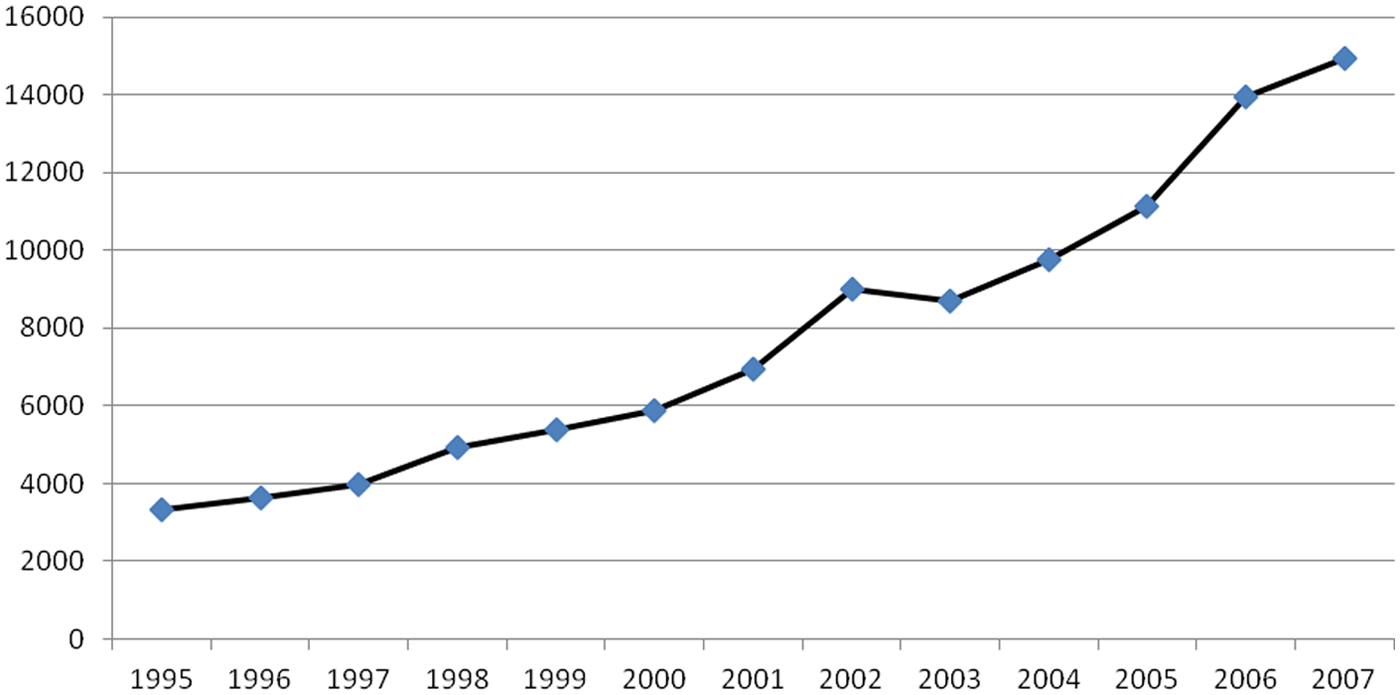
Cuyahoga County Foreclosures.
CDCs were not just becoming less connected to neighborhood residents; they were increasingly disconnected from neighborhood problems as well. Even as foreclosures accelerated in the late 1990s and early 2000s, many community developers were optimistic about the possibility of reversing the city’s decline through physical redevelopment. Perhaps most starkly, an intermediary organization official, who had actually been a community organizer in the 1970s, was asked point blank in 2004 if real estate market valorization through housing production was still a viable strategy. The response was an unequivocal “yes.” 37 The optimism of community developers increasingly resembled blind faith.
This is not to say that community developers were merely imitating a static set of practices. Perhaps recognizing this essential problem, NPI began modifying its funding criteria as foreclosures worsened. CDCs and NPI began concentrating investments in strategic investment areas. Like the Strategic Hamlets in the Vietnam War, which moved villagers into fortified compounds to cut them off from insurgents, these strategic investment areas would be fortified by concentrated investment against broader processes of decline. Eventually they became a launching pad for expanding the territory of revalorization. But this and other innovations made by the city’s community developers did not solve the basic problem of CBOs’ disconnection from neighborhood residents and problems.
Both growing disconnection and the ongoing obsession with keeping the housing production pipeline full were on display in 2003. Cleveland’s foreclosure crisis was already real: there had been nearly 9,000 foreclosures in Cuyahoga County in 2002. In response, the President of the City Council, Frank Jackson, sponsored legislation that spent a small portion of the city’s CDBG allocation on foreclosure counseling as part of an initial effort to aid distressed homeowners. Apparently outraged by this effort to spend community development dollars on something other than physical redevelopment, staff from numerous CDCs showed up at a committee hearing to protest the legislation. According to a city councilor allied with Jackson, CDC staff argued that such counseling, coming at the expense of CDC funding for physical redevelopment, was a misallocation of resources. 38 The event was a dramatic demonstration of how Cleveland’s civil society had been reorganized over the previous thirty years, but the attitude it revealed was not unusual; in fact, it was prevalent.
The resistance of CDC staff to foreclosure counseling in 2003 is a startling indicator of how invested they were in community development as a political technology rather than as a solution to neighborhood problems. It is even more surprising when we consider that the very activity of CDCs helped lay the groundwork for predatory practices, a dynamic that would seem to call for more regulation to protect well-intended efforts from exploitation by predators. As community developers built more expensive housing in the name of inflating all-important real estate values, they also attracted speculators and flippers who did minimal work before selling properties. More extreme predators were also attracted to the equity of the city’s neighborhoods. Inflated loans with high interest rates were marketed to the poor and to people of color. A predatory practice more characteristic of Cleveland arises from the fact that the city is home to many retirees who live in older and deteriorating housing stock. Faced with diminished pensions and more expensive upkeep, the elderly often have difficulty maintaining their properties. Despite being cash-poor, however, elderly Clevelanders were equity-rich, and were becoming more so due to CDC activity, a circumstance that enabled the refinancing scam. Home equity loans were sold to equity-rich Clevelanders on highly unfavorable terms. Often this scam would be paired with charging residents up front for maintenance work that was never completed. The activity of Cleveland’s community development political technology effectively created or uncovered valuable veins of equity that could be mined by the unscrupulous. The effect was to drain hundreds of millions of dollars in equity out of Cleveland’s neighborhoods. CDCs were not the culprits, but they helped create the conditions that enabled predatory practices and they did little to mitigate the problem, blinded as they were by their faith in their ability to build their way out of any difficulty.
The emphasis on physical redevelopment ensured that CBOs with very different orientations and goals could participate in the city’s political technology. However, it ultimately privileged the technocratic developers who were most efficient and most proficient at production. These organizations became the model organizations for the population. Funding and authority in the field increasingly reflected the particularity of this subset of CBOs and defined the center of gravity around which isomorphic processes would narrow the overall population. Technocratic CDCs are not always the largest organizations in the field, but they are the most likely to survive and by 2000 they were the most numerous. This expansion came at the expense of CDCs that had a more holistic approach to community development, a more diverse programmatic agenda, or, as with clientelist CDCs, less attachment to the idea that real estate values are both the appropriate metric of community development and its desired outcome. Some of the most sophisticated and programmatically diverse CBOs continued to grow, but at the same time, by the time of the foreclosure crisis, clientelist CDCs had been eliminated from the field.
There were conscious efforts to rationalize the field around capital-intensive real estate development, and the persistent assumption that physical redevelopment could solve neighborhood problems seems cynical in light of what was going on in Cleveland’s neighborhoods. However, such overt and intentional efforts do not by themselves explain the rationalization of the field. Not all organizations were eliminated by intentional effort and even well-meaning organizations fell victim to the trap of physical redevelopment due to enticing developers’ fees and the dramatic successes that development can sometimes yield. The problems ran deeper and were often of a more passive nature. As CBOs became increasingly invested in physical redevelopment they also tended to become disconnected from the stakeholders in the neighborhoods in which they operated. This was not always the case, but it was a tendency.
The problem was magnified by the fact that physical redevelopment was, over time, becoming a solution in search of a problem. By 2007, it was clear that much CDC development activity actually contributed to the problems that were emerging in neighborhoods, not solving them. This could have been corrected if organizations remained accountable to neighborhoods, but by 2000 few such organizations remained. Indeed, clientelist CDCs would be wiped out by the foreclosure crisis itself. Finally, this problem could have plausibly been averted if Cleveland’s CBOs had sustained a diversity of organizational models and practices. In that case, when the crisis hit, previously marginalized organizations and practices could have reemerged in the new environment. Unfortunately, most of the diversity had been rationalized out of the population by a combination of incentives, imitation, and coercion. The fact that the uses of physical redevelopment had become an unchallenged matter of faith among community developers ensured that Cleveland’s CBOs would be paralyzed by foreclosures. By 2007, Cleveland’s civil society had become a civic monoculture well adapted to a fictional environment.
4. Rationalized Civil Society and the Foreclosure Crisis
When asked about the ability of Cleveland’s community development industry to deal with the city’s problems, many practitioners cite an industry shibboleth, the “but-for” argument: without community developers actively working to revalorize real estate, the situation in Cleveland would be much worse. 39 The image that is conjured is of community developers sticking their fingers in dikes in order to hold back a wave of disinvestment threatening Cleveland’s neighborhoods. But it would take the context of a diverse civil society to make this a valid argument. However, the process described here is not simply one of the growth and professionalization of Cleveland’s community development system; it is the transformation of that system into a political technology that dissolves conflicts and sucks up resources from other activities. Cleveland’s community development industry system has come to define all problems in terms of physical redevelopment and real estate valorization, leaving little discursive room, much less material resources, for other solutions to the crisis. Not only was the adaptability of individual CDCs undermined in this process; the adaptability of the city’s civil society as a whole was undermined.
Unlike the hurricane that hit New Orleans, the one that hit Cleveland brought a wave of paper devalorization that had effects strikingly similar to the wind and rain of Katrina. Just as the poorly maintained dikes and pumps of New Orleans made that city vulnerable, terrible public policy—combined with a community development field that understood real estate markets to be a solution to neighborhood problems—made Cleveland especially vulnerable to foreclosure. Attending real estate auctions as the crisis peaked, one would see chipper and enthusiastic auctioneers, all seemingly of wholesome Midwestern stock, become slowly overwhelmed by the sheer human tragedy entailed in their work as they attempted to sell inner-city houses for $5,000 and suburban ranch houses for $35,000, houses that had sold for $70,000 and $125,000 a few short years before. In 2009, the city estimated that 10,000 houses, or one in thirteen, were vacant. The county treasurer, Jim Rokakis, told a journalist the number was more likely 15,000. 40 Rather than continue to invest in maintaining this physical capital in the hopes of an urban renaissance, the city has waved the white flag and is now engaged in a program of mass housing demolitions, though the need for demolitions far outstrips the resources available to meet it.
In June 2008, the moment when the crisis was becoming a national issue, Cleveland had the eleventh-highest foreclosure rate of all Community Development Block Grant jurisdictions (see Table 1). Among large cities with diverse economies, Cleveland only ranked behind Newark, NJ. Cleveland was riding the initial wave of foreclosures even as cities that would later become associated with the crisis, such as Las Vegas and Stockton, were barely registering half of Cleveland’s rate. In the forefront of the foreclosure crisis, Cleveland was keeping company with Florida communities that had seen the most excessive real estate speculation, a few declining manufacturing cities, and some highly segregated and poor suburbs like East Cleveland, East St. Louis, and Camden. With the exception of the cities in Florida, the early victims of the foreclosure crisis were cities with large minority populations and cities that had seen their heyday when manufacturing was central to the US economy. In other words, in the early months of the crisis, mass foreclosures were a symptom of ongoing economic decline, although that alone does not account for the depth of the crisis in Cleveland: Cleveland’s foreclosure rate was far higher than cities like Memphis and Detroit. Later, many cities would overtake Cleveland’s foreclosure rate, particularly cities that came late to the speculative boom, but the crisis in those latecomer cities was usually related to urban growth, sprawl, and speculation more than to urban decline.
Foreclosure Rates by CDBG Jurisdiction at the Beginning of the Foreclosure Crisis.
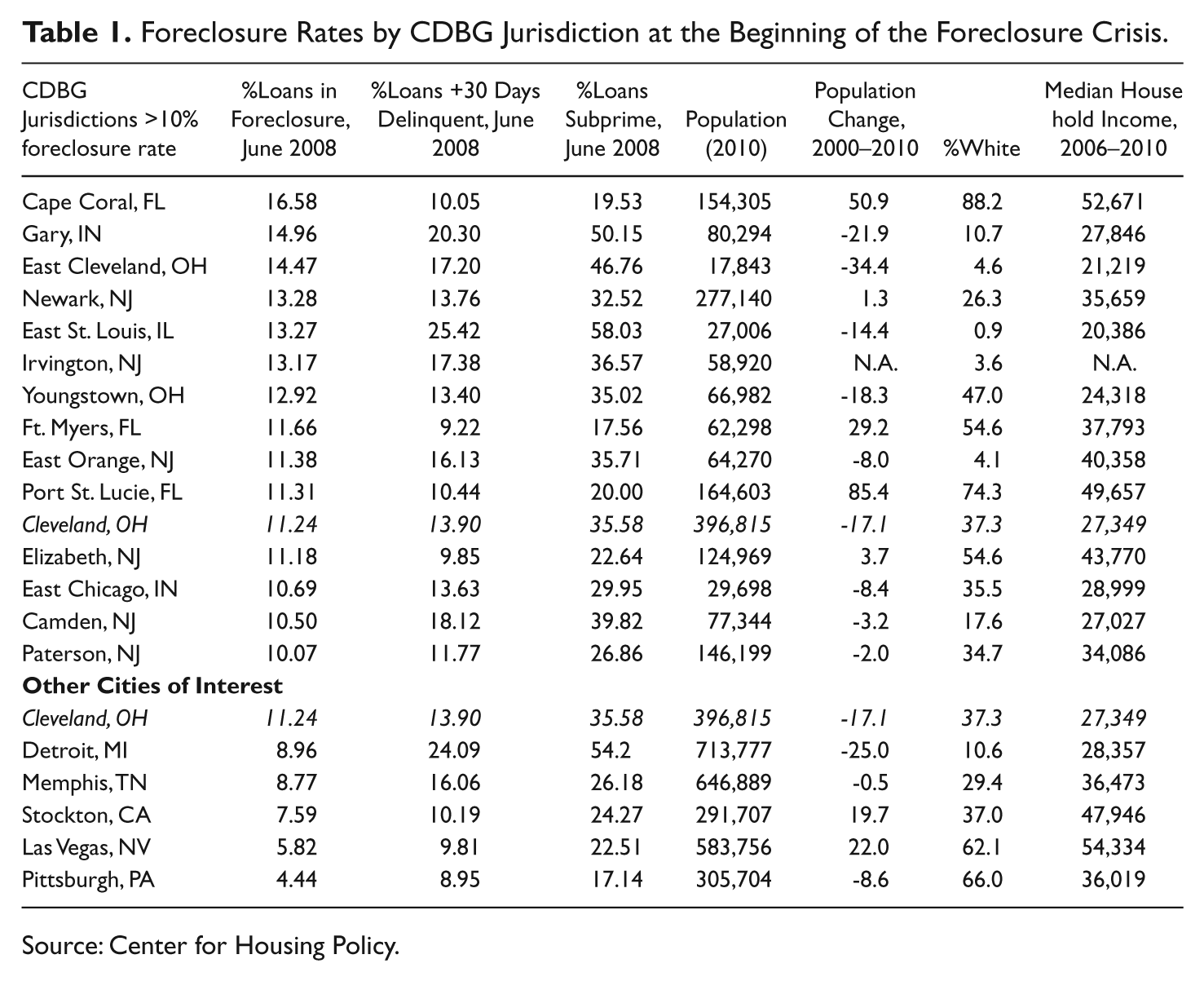
Source: Center for Housing Policy.
What is surprising is the extreme nature of the foreclosure crisis in Cleveland. It is certainly true that the city’s decline accelerated over the last decade (using population as the measure). Nonetheless, compared to many other Midwestern cities, Cleveland appeared to be much better prepared to handle the crisis. Most obviously, Cleveland possessed a community development industry system that was one of the most innovative and sophisticated in the country. 41 According to an Urban Institute study, the system in Cleveland had capacity equivalent to systems in much larger cities such as Boston, Chicago, and Washington, D.C., and was ranked the seventh-best in the country in 1991. Cleveland’s community developers could boast a track record of innovative practices, extensive support from national intermediaries and wealthy philanthropies, and excellent local policy tools. Cleveland has a long history of public-private partnerships to facilitate economic and community development and, according to some, it is a city distinguished by its active and interventionist civic culture. 42 Cleveland’s civil society appeared on paper to be exceptionally well-prepared to deal with any crisis that originated in housing markets.
Yet, by June 2008, Cleveland’s community development industry system was paralyzed. CDCs could not produce housing that recovered the costs of production and some CDCs were dependent upon city-subsidized development to stay afloat. One of Cleveland’s most notable and celebrated innovations was to develop an elaborate information-gathering and processing system to keep track of distressed properties, so that as soon as foreclosure happened the property could be transferred to community developers. This process entailed developing a large data warehousing system and negotiating deals with banks to turn over property in bulk to the city’s land bank. Nonetheless, while these successes are significant demonstrations of the adaptive capacity of community developers, they also tell us much about the nature of community development in Cleveland. Most obviously, the focus of community developers’ attention is on the preservation of physical capital. Despite sophisticated tools such as new data-gathering and warehousing systems, an increasing mastery and sophistication about the foreclosure process itself, 43 and extensive support from local politicians, community developers had no tools that were able to effectively keep people in their homes.
This paralysis is indicated by one of the more celebrated responses to the contemporary foreclosure crisis, the “blue man” project, in which one of the city’s best CDCs organized neighborhood residents to paint window sashes and planters on boarded windows and a waving “blue man” in boarded doorways. While certainly a nice demonstration of community spirit in the face of the foreclosure hurricane, when that is one of the only programmatic responses to mass foreclosure, things are pretty bleak. Moreover, while the threat to the investments CDCs were making in neighborhood physical capital was real, the lack of attention to the occupants of the houses is notable. It is not simply a failure to see human capital as a resource necessary to sustain functioning communities; it is that this blindness persists, despite the fact that the most effective way to preserve physical capital is to keep people in their homes. The inattention of CDCs to neighborhood residents and their needs is a studied avoidance, not an absent-minded oversight.
At the same time, Cleveland’s civil society has been stirring. There are occasional efforts to revive community organizing in the city, though almost all have been unsuccessful. An exception is the East Side Organizing Project (ESOP). Led by Mark Seifert and Inez Killingsworth, the former a professional organizer and the latter a longtime neighborhood activist who is a veteran of the 1970s protests, ESOP utilizes confrontational tactics to force banks to modify loans. Combining protest with a variety of policy tools, ESOP achieves 80 percent loan workout rates even while federal programs have a success rate of 20 percent. In contrast to community developers, the organization actually assists homeowners who are victimized in the foreclosure crisis. Despite its successes, ESOP has consistently been a marginalized organization ignored by funders and politicians. After a protest at the home of then-mayor Mike White’s girlfriend, ESOP lost its funding and it has remained in the doghouse of the city’s philanthropies and politicians ever since. The fortunes of the organization changed with the foreclosure crisis. ESOP managed to fund itself and expand statewide by using memorandums of understanding with targeted banks and mortgage servicers, limiting the organization’s reliance on hostile community foundations. The organization now boasts ten offices around the state and a multimillion dollar budget. Seifert argues that ESOP is not really any different than it was in 1999 when he was the only staffer, and a poorly paid one at that. The environment has changed, not the organization. 44
If Cleveland’s CDCs are poorly adapted to an environment of mass foreclosures, ESOP is built to thrive in such a context, just as the reverse was true in an environment of loose credit and growing real estate values. Yet to other organizations, ESOP is not an example of successful response to foreclosure, but of the dangers and incivility of confrontational approaches to solving problems. Seifert thinks that in the midst of a crisis his organization’s confrontational tactics should be considered “mainstream.” 45 ESOP can be understood as an example of the vibrancy of Cleveland’s civil society, but it is really the exception that proves the rule. The fact that ESOP continues to be starved of philanthropic resources, while community developers garner not just funding but subsidies, indicates just how radically the city’s civil society has been distorted by the political technology of community development. In 2011, recognition of this fact apparently emerged among the city’s community developers. NPI has begun developing strategies and tools that do not rely upon capital-intensive physical redevelopment. Ten years too late, NPI has acknowledged that its model has failed, yet it still receives the bulk of local philanthropic funding for community development.
While ESOP was thriving, Cleveland’s CDCs were on life support. Housing production had become the engine that sustained the organizations by justifying funding, delivering developer’s fees, and enabling other programmatic activities. CDC staff had come to understand neighborhood problems and solutions through the lens of real estate values and capital-intensive physical redevelopment. Yet when the city’s real estate market collapsed, many CDCs were stuck with unsold housing stock, presenting a threat to the cash flow of the organizations. More importantly, many were unable to produce housing that could actually be sold profitably. For decades, community developers had been shifting their product up-market, partially because it was more profitable, partially to take advantage of policies that supported homeownership, and partially because the effect on real estate values was understood to be greater. As a consequence, they were inexpert in less capital-intensive interventions. It was in this context that the “blue-man project” could be seen as a helpful program while it analytically revealed the paralysis of the community development political technology.
It appeared that a number of CDCs would die as a result of the foreclosure crisis and indeed a number did. Interestingly, it was not the organizations that were most invested in technocratic approaches to community development that were dying, but the remaining clientelist CDCs that were closely tied to the electoral operations of ward-based politicians. How did the technocratic CDCs survive? The city subsidized them. Perhaps in the name of receiving less bang for more buck, the city paid the growing difference between costs of production and the sales price of CDC product in order to enable the organizations to live to fight another day. This occurred despite the fact that the city did not have enough money to meet the need for housing demolitions—a policy with a recognized impact on neighborhood well-being. Rather than offering a new, more responsive, more efficient mode of providing housing that was less reliant on taxpayer financing, nonprofit housing producers in Cleveland had become wards of the state. The roles of civic patient and doctor have been reversed. The rationalization of Cleveland’s civil society around the imperatives of the political technology of community development created a civic monoculture that was disconnected from neighborhood needs and poorly adapted to deal with the foreclosure crisis. Despite this, the CDCs continue to garner resources from taxpayers and philanthropies.
5. Conclusion
The idea that civil society can act as an important counterweight to states and economic organizations is prominent among thinkers as diverse as Tocqueville, Polanyi, and Putnam. 46 Since the 1960s thinkers on both the left and the right have proposed that civil society could play a larger role in governance, thus bringing decision making and programmatic implementation closer to citizens. 47 Civil society was valorized in many movements as a source of democratic authenticity, an idea that was prominent in Cleveland’s Backyard Revolution. Although these ideas have a great deal of validity, they are burdened by an excess of optimism. Most importantly, civil society has been revalorized in politics because of the success of movements like the Backyard Revolution, and state and economic actors have turned to the sector to achieve their goals. As a result, civil society organizations are increasingly shaped by political and economic institutional logics that organize competition among them and drive isomorphic and rationalizing processes in their populations. Although fields of organizations mediate these logics and open space for more authentic values and goals, rationalizing processes can undermine this mediation over time. This undermining process occurred in Cleveland as the city’s civil society went from being the basis of a neighborhood protest movement to being the basis for the creation of a community development political technology that left the city vulnerable to its biggest challenge in forty years. When the foreclosure crisis struck with full force in 2007, Cleveland’s community developers built on their expertise with transforming unoccupied and dilapidated properties into new physical capital, but this response was poorly geared to actually meeting the most pressing needs of neighborhoods; it ignored the needs of neighborhood residents, and it had an unrealistic understanding of the potential of nonprofit physical redevelopment to be successful in a context of mass foreclosures.
The polite question that this outcome raises is how Cleveland’s community-based organizations could be so completely ineffective in their response. The impolite question is whether the structure and organization of the city’s civil society actually contributed to making the foreclosure crisis in Cleveland worse than it otherwise might have been. Analytically, the case suggests, first, that the romanticization of civil society is counterproductive and that instead we should pay more attention to the institutional logics that are shaping fields of civil society organizations. Moreover, it suggests that civil society organizations can facilitate neoliberal institutional transformations as much as mitigate or protest them. Finally, it suggests that the specific utility of civil society organizations, their authenticity, their diversity, and their value-driven missions make them valuable not just in opposition to states and firms, but as a tool for them. Governments and firms in Cleveland used civil society organizations to solve dilemmas of governance and authority that emerged in the 1970s. In this context, struggles that had been waged in the streets and in newspapers moved indoors and became struggles to define the meaning and practices of civil society itself. In Cleveland, both state and private actors instrumentalized civil society, altering the basic logic of organizational growth and survival. The effect was not immediately noticeable, although some neighborhood activists certainly suspected this outcome at the time. Eventually instrumentalization rationalized the city’s civil society around the need to sustain a political technology that secured political peace in the context of decline. By 2008, isomorphic processes had produced a civic monoculture of well-meaning CDCs that were disconnected from the city’s citizens and neighborhood problems. In the crisis of the 1970s, Cleveland’s combative CBOs had challenged political and corporate leaders both locally and nationally. They had sustained a neighborhood-based counterpublic and, in conjunction with a broader neighborhood movement, prompted the passage of national legislation to limit the mobility of capital and prevent neighborhood disinvestment. By 2008, the city’s civil society had become an anchor weighing on neighborhoods as they weathered the foreclosure storm.
Footnotes
Acknowledgements
I would like to thank the editors of Politics & Society for their many helpful comments on this paper. I would also like to thank the Social Science Research Council Program on Nonprofits and Philanthropy for supporting this project.
Declaration of Conflicting Interests
The author(s) declared no potential conflicts of interest with respect to the research, authorship, and/or publication of this article.
Funding
The author declared the following financial support for the research, authorship, and/or publication of this article: Financial support was provided by the Social Science Research Council Program on Nonprofits and Philanthropy.