







Abstract
Contemporary political economy debates tend to assume that an increase in productivity automatically leads to an equal increase in workers’ wages. This assumption shapes the way that many scholars think about economic globalization, as well as domestic policy reforms. This assumption is particularly widespread in the field of international political economy, where it is implicitly incorporated through the use of neoclassical economic models. Rather than explore the distributional struggle between capital and labor, these models use the assumption of full employment to predict that policies that increases worker productivity automatically leads to an equal increase in workers’ wages. In contrast, this article argues that the degree to which wages increase along with productivity depends on the domestic institutions that protect workers’ rights to act collectively. This article tests the relationship between worker productivity and wages by analyzing data from twenty-eight manufacturing industries, in 117 countries, from 1986 to 2002. The results demonstrate that the degree to which an increase in worker productivity leads to an increase in wages depends on a country’s level of protection for labor rights.
Contemporary political economy debates tend to assume that an increase in productivity automatically leads to an equal increase in workers’ wages. This assumption pervades the study of economic globalization and shapes the way many scholars understand the politics of everything from international trade to foreign direct investment, and from exchange rate policy to immigration. 1 This assumption is equally present in domestic policy debates concerning issues as diverse as education reform and the privatization of industry. 2 In short, both domestic and international political economy debates often assume that workers will automatically benefit from any development that increases worker productivity. This article challenges that common assumption and demonstrates that the degree to which workers benefit from productivity growth depends on the protection of basic labor rights, such as the rights to organize, bargain collectively, and strike. When a country does not protect such labor rights, productivity growth is more likely to translate into increased profits for capital than into increased wages for workers.
Such inequitable distributional outcomes are difficult to explain with the neoclassical models traditionally used in political economy research. According to these models, an increase in worker productivity leads to an increase in labor demand, competition among firms for scarce workers, and an automatic bidding up of workers’ wages. However, the predicted connection between an increase in worker productivity and workers’ wages relies on the assumption of full employment, which John Maynard Keynes referred to as the “strange supposition” that underlies neoclassical economics. 3 In contrast, my article draws on insights from labor economics to argue that the degree to which an increase in worker productivity leads to an increase in wages depends on the protection of workers’ rights. 4
When productivity increases without an equal increase in wages, capital captures an ever-larger share of revenue, and profits increase at the expense of workers’ incomes. 5 I therefore refer to the relationship between productivity and wages as the “profit-sharing rate” between capital and labor. I analyze data from twenty-eight manufacturing industries, in 117 countries, from 1986 to 2002, to demonstrate that the profit-sharing rate is positively related to the protection of labor rights. In other words, when labor rights are not protected, the neoclassical approach systematically exaggerates the benefits that workers receive from various policy reforms. The implications for how international political economists understand class conflict are particularly important, as low profit-sharing rates are likely to create political cleavages between workers and their employers. By relying on neoclassical models, scholars have effectively assumed away the possibility of policy disagreements between capital and labor. 6
This article proceeds by first reviewing the use of neoclassical models in the political economy literature. Second, it presents a theory of how the domestic protection of labor rights affects the profit-sharing rate. Third, it will present the results of a cross-national, quantitative analysis of the relationship between the protection of labor rights and the profit-sharing rate. Last, it concludes with a brief summary of the article’s main findings.
Neoclassical Models and Political Economy
The assumption that wages automatically increase with productivity gains is prevalent throughout the study of both international and domestic political economy issues. It is particularly important in the field of international political economy, where it is implicitly incorporated through the use of neoclassical economic models. I begin this section by reviewing the widespread use of neoclassical models in international political economy. I then show that a similar approach is common in the study of domestic policies, such as privatization and education reform. Last, a review of comparative political economy research on labor market institutions points the way forward for studying the determinants of the profit-sharing rate.
Neoclassical economic models have dominated the field of international political economy since Rogowski and Frieden’s early work on domestic policy coalitions. 7 Their innovative use of the Ricardo-Viner and Heckscher-Ohlin models inspired a generation of scholars to apply these models to the study of various issues, including international trade, monetary policy, foreign direct investment, exchange rate politics, and immigration. 8 According to the Ricardo-Viner model, an economic policy that benefits a specific industry automatically leads to a wage increase for that industry’s workers. 9 For example, a high tariff that benefits an import-competing industry is predicted to increase wages, as well as profits, automatically. According to the Heckscher-Ohlin model, whether or not a given economic policy increases wages depends on a country’s factor endowments of land, labor, and capital. 10 When workers are a scarce factor of production, they automatically benefit from economic policies that restrict imports, such as high tariffs or foreign exchange controls. When workers are an abundant factor of production, they automatically benefit from economic policies that encourage exports, such as free trade or a stable exchange rate.
According to many scholars, the distributional predictions of the Ricardo-Viner and Heckscher-Ohlin models can be used to predict the policy preferences of societal actors. In short, actors are predicted to hold a preference for the economic policy that benefits them materially. The Ricardo-Viner approach therefore predicts that actors employed in export-oriented industries will prefer policies that promote exports, whereas actors employed in import-competing industries prefer policies that limit imports. The Heckscher-Ohlin approach predicts that scarce factors of production will favor policies that protect the domestic economy, while abundant factors of production will favor policies that increase integration with the global economy. For Hiscox, the applicability of these two models depends on an economy’s level of inter-industry factor mobility. 11 When factor mobility is high, the predictions of the Heckscher-Ohlin model are more likely to be accurate, whereas the predictions of the Ricardo-Viner model are more likely to be accurate when factor mobility is low.
Although the recent literature on individual policy preferences challenges the applicability of these neoclassical models, international political economy scholars have not examined the causal logic that links international economic policy to workers’ wages. 12 Instead, the literature tends to accept the Heckscher-Ohlin and Ricardo-Viner models as accurate portrayals of how policy reforms affect wages, 13 and then identifies additional variables that influence economic policy preferences, such as home ownership, 14 patriotism, 15 education, 16 consumer prices, 17 risk tolerance, 18 as well as concerns for national economic performance, 19 fairness, 20 and cultural “Westernization.” 21 In contrast, I suggest that before we rule out an economic basis for workers’ policy preferences, we should study the domestic institutional conditions under which the Heckscher-Ohlin and Ricardo-Viner predictions are likely to hold. 22
The neoclassical approach is also common in debates concerning various domestic policy reforms. At least since Thatcher’s Britain, politicians and scholars have regularly argued that privatization of industry would increase worker productivity, and therefore, workers’ wages. 23 These arguments were commonly applied to post-socialist economies in the 1990s and continue to dominate debate on the ownership of industry in developing countries. 24 For example, consider the ongoing debate in Mexico concerning the privatization of PEMEX, the state-owned oil enterprise. According to Mexican President Enrique Peña Nieto, “This is the final goal . . . that our economic policies are pushing for: That families can earn more, have better incomes, by being more productive.” 25
The assumption that an increase in productivity will automatically increase wages can also be found in debates surrounding education reform and income inequality. In general, the argument holds that increased education spending will increase the productivity of low-skilled workers, automatically increase their wages, and therefore reduce income inequality. This argument shapes the World Bank’s proposals for reducing income inequality in Latin America, where they advocate education reform but make no reference to improving the protection of workers’ rights. 26 Similarly, President Obama’s new “middle-class economics” proposes to reduce income inequality through increased education spending, and other measures, without attention to protecting the rights of American workers. 27 Although increased education spending is likely part of the solution to income inequality, increasing productivity without attention to workers’ rights threatens to increase profits without increasing wages.
In contrast to the neoclassical approach discussed above, my article follows Schumpeter’s insight that “economic laws . . . work out differently under different institutional conditions.” 28 In this vein, comparative political economists have argued that certain labor market institutions are associated with political and economic outcomes that favor labor. Esping-Andersen’s path-breaking work linked high union density, centralized wage bargaining, and the success of left-wing political parties to the development of the welfare state. 29 Subsequent scholarship in the tradition of power resource theory and the varieties of capitalism argues that such pro-labor institutions promote high employment, low inflation, economic growth, and income equality in coordinated market economies, such as Sweden and Germany. 30 Others have found that the structure of domestic labor market institutions can help labor unions maintain their membership despite the economic pressures of globalization. 31 Similarly, I argue that the protection of labor rights increases labor power and therefore increases the ability of workers to bargain for a share of increased productivity in the form of wages.
As explained above, two different neoclassical models provide the underlying foundations for much of the international political economy literature. Despite the central importance of the profit-sharing rate, international political economy scholars have not explored the conditions under which an economic policy that increases productivity translates to an increase in wages. Various labor market institutions have been studied, but domestic labor rights remain an omitted variable in how international political economists think about income distribution, policy preferences, and domestic policy coalitions.
A Theory of Domestic Labor Market Institutions
This article draws on insights from labor economics to examine how labor rights affect the connection between international economic policies and wages. Economic research on wage bargaining, 32 union wage effects, 33 and labor’s share of national income, 34 suggests that bargaining power is a key determinant in the division of productivity gains and profits between capital and labor. This section argues that labor bargaining power has a positive effect on the degree to which an increase in productivity leads to an increase in wages. When wage growth lags behind productivity growth, profits increase at the expense of labor, as capital captures an ever-larger share of the pie. 35
The relationship between productivity and wages is referred to as the “profit-sharing rate,” as it measures the ability of workers to capture a share of increased profits in the form of higher wages. 36 The profit-sharing rate is expected to increase along with increases in workers’ bargaining power. 37 However, since bargaining power is a latent variable that is difficult to measure independently of its observed effects, it is preferable to focus on the antecedent conditions that increase worker bargaining power. Since workers can often increase their bargaining power through collective action, there are few factors more important than a country’s protection of workers’ rights, such as the right to organize and collectively bargain. 38 In this way, domestic institutions that protect labor rights increase worker bargaining power, which then increases the profit-sharing rate.
This distributional struggle between capital and labor is assumed away in the neoclassical approach. As we saw above, debates about privatization and education policy regularly assume that an increase in productivity is sufficient, on its own, to lead to an increase in wages. In international political economy, this struggle is overlooked because of the field’s traditional reliance on the Heckscher-Ohlin and Ricardo-Viner models. These neoclassical models use the assumption of full employment to derive an automatic connection between various economic policies and wages. 39 Although these two models differ in their assumptions concerning the degree to which the factors of production (i.e., capital, labor, and land) can move between industries, 40 both derive an automatic connection between economic policy reform and wages in four separate steps:
An economic policy change alters the relative price of an industry’s output.
If the relative output price increases, then the total value of goods produced by the average worker in that industry increases, thus representing an increase in average worker productivity and the marginal product of labor. 41
Since perfectly competitive firms will hire workers until the marginal product of labor is equal to the marginal cost of an extra worker, this increase in worker productivity provides incentive for firms in the industry to hire more workers. That is, it increases demand for labor.
Under the assumption of full employment, hiring more workers requires these firms to offer higher wages in order to attract workers that are currently employed elsewhere. 42
In these ways, an economic policy that increases an industry’s relative output price leads to an increase in worker productivity, which automatically leads to an equal increase in wages.
The underlying causal logic is the same whether we use the Heckscher-Ohlin model’s assumption of perfect inter-industry factor mobility, or the Ricardo-Viner model’s assumption of zero inter-industry factor mobility. In addition, the same causal logic explains how policy reforms, even in opposite directions, affect wages. Since these models were originally intended to explain the effects of international trade, consider the causal logic of how different trade policies affect workers’ wages. According to the Ricardo-Viner model, trade protection increases wages for workers in import-competing industries, because trade protection increases the relative price of such industries’ output, which increases worker productivity, and therefore automatically increases wages. According to the Heckscher-Ohlin model, trade protection increases wages for workers throughout the economy in labor-scarce countries, because trade protection increases the relative price of labor-intensive industries’ output, which increases worker productivity, and therefore automatically increases wages. The causal logic of how trade liberalization increases wages is analogous, but for workers in export-oriented industries and workers in labor-abundant countries, respectively.
The causal logic is similar for many policies studied by international political economists. Exchange rate policy alters relative prices—perhaps by making imports relatively more expensive than domestically produced goods—and then follows the same logic to increase wages for workers in import-competing industries. Foreign direct investment increases worker productivity through introducing new technology and may also directly increase labor demand by opening new establishments. Either way, the causal logic connects foreign direct investment to workers’ wages with the “strange supposition” of full employment. Similar logic underpins many debates about domestic economic policy, as well. Education increases workers’ skills, which increases worker productivity, which leads perfectly competitive firms to increase workers’ wages. Privatization is thought to increase wages by introducing more efficient techniques that boost workers’ productivity. In general, the neoclassical approach holds that any policy or technological development that increases workers’ wages will automatically lead to an increase in wages.
However, once the assumption of full employment is relaxed we can parsimoniously illustrate that the relationship between wages and productivity is conditional on the supply of labor. Large numbers of surplus workers, whether laid off by nearby firms or migrating from rural areas or foreign countries, create competition in the labor market that allows employers to hire additional workers without increasing wages. 43 That is, the fourth step of the causal logic of the neoclassical models (Figure 1, above) is disrupted, as firms can increase employment without increasing wages. In more technical terms, the presence of surplus workers in the labor market results in a labor supply curve that is highly elastic.

Causal Logic of Neoclassical Models.
As can be seen in Figure 2, the elasticity of the labor supply curve conditions the degree to which an increase in productivity leads to higher wages.
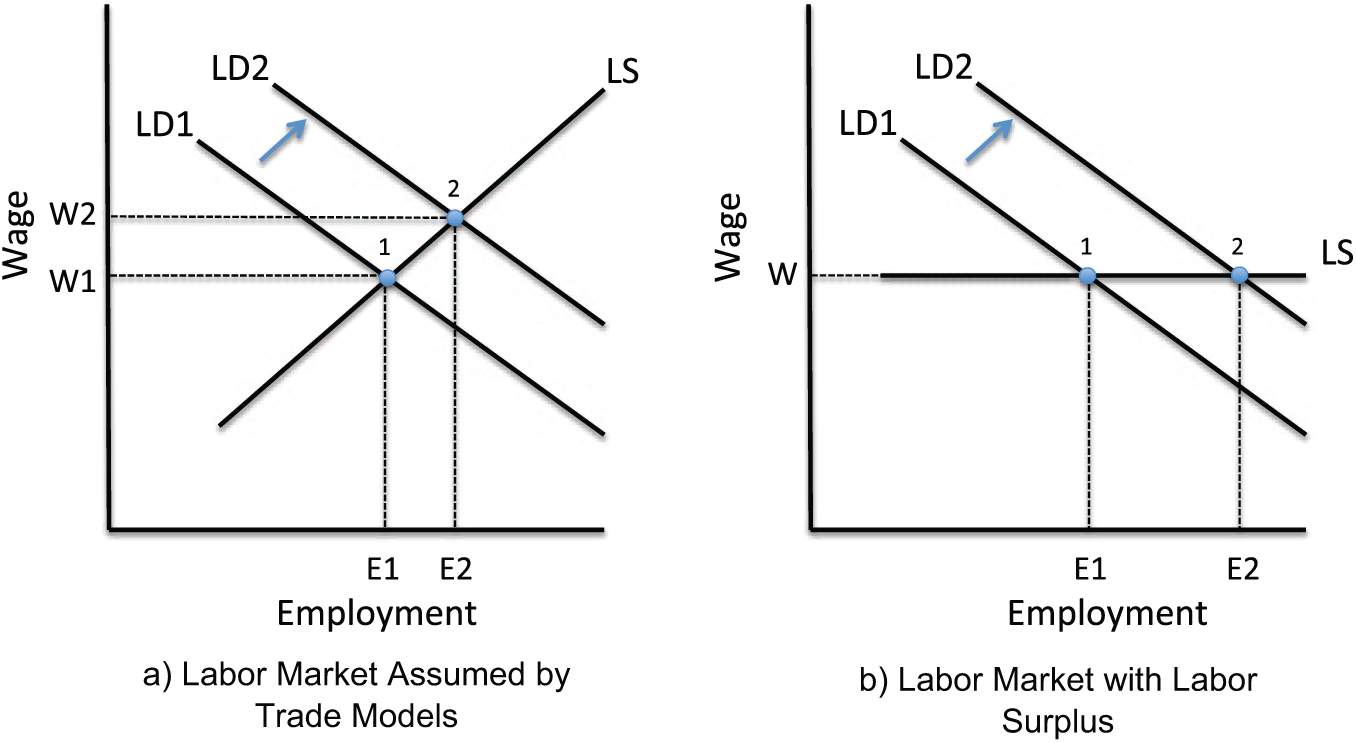
Labor Demand, Labor Supply, and Wages.
As mentioned above, an increase in relative output price leads firms to hire more workers and thus increases the demand for labor, shown graphically in Figure 2a as an outward shift in the labor demand curve from LD1 to LD2. With an upward-sloping labor supply curve, the increased labor demand leads to an increase in both employment and wages, as the firm’s labor market equilibrium moves from point 1 to point 2. In contrast, the effect of trade policy on wages is very different in Figure 2b, where a labor surplus results in a perfectly elastic (flat) labor supply curve. As the firm’s labor market equilibrium moves from point 1 to point 2, the firm increases employment but does not increase wages. The trade policy change will lead the firm to employ more workers, but the workers previously employed by the firm will not receive wage increases.
This gap between worker productivity and workers’ wages can be attenuated through the collective action of workers in two different ways. 44 First, workers can restrict the supply of labor for the firm or industry. Such “closed shops” decrease the elasticity of the labor supply and assure that an increase in worker productivity is translated into an increase in wages. 45 Second, workers can bargain with their employers to agree on wage and employment levels that surpass the logic of market forces, or where labor demand meets labor supply. In such bargaining scenarios, an increase in worker productivity signals an increase in the ability of employers to pay higher wages, and therefore an increase in the wages demanded by organized workers. 46 While there are important differences between the various bargaining models used in labor economics, all agree that wages will increase along with the bargaining power of workers. 47 As Olson explains, “if a union has any real bargaining strength, it can force the unusually prosperous firm to raise wages well above the market level.” 48
In turn, the balance of bargaining power between capital and labor depends crucially on the institutions that regulate what actions each side can employ to “convince” the other party to accept its offer. 49 When employers are able to call in the state military to break a labor strike, the balance of bargaining power leans toward capital. When domestic institutions protect the right of workers to strike peacefully for higher wages, the balance of bargaining power tilts a little more toward labor. Although workers can potentially bargain for wages that increase along with productivity, a growing literature in labor economics has repeatedly found that wages often lag behind productivity growth. 50 However, these studies tend to focus on the simple question of whether or not wages increase equally along with productivity growth, rather than explain variation in the relationship across countries or over time. Building on such empirical studies, this article argues that the degree to which an increase in worker productivity leads to an increase in workers’ wages depends on the level of protection for labor rights. As explained above, this suggests that domestic labor market institutions moderate the relationship between economic policy reforms and workers’ wages.
Cross-National Quantitative Analysis
In this section I use quantitative data to test my argument that the effect of productivity gains on workers’ wages is moderated by the domestic protection of labor rights. There are two main advantages to this focus on the determinants of the profit-sharing rate. First, it allows for a parsimonious test of the causal logic of a broad range of political economy theories. If an increase in productivity does not generally lead to an increase in wages, then it is unclear why a specific policy—whether related to international trade, foreign exchange rates, or foreign direct investment—that increases productivity should be expected to increase wages. Second, it allows for a simultaneous test of how policy reforms in opposite directions might influence wages. Consider, for example, how international trade policies are predicted to affect wages. According to the Ricardo-Viner model, free trade policies increase productivity and wages in export-oriented industries, while protectionist trade policies do the same in import-competing industries. Focusing on the wage-productivity relationship—the profit-sharing rate—therefore has implications for how liberalization, as well as protectionism, affect wages.
Since the Ricardo-Viner and Heckscher-Ohlin models make different assumptions about inter-industry factor mobility, each model makes different predictions about the level at which productivity and wages will be related. The Ricardo-Viner model predicts that wage growth and productivity growth will be related at the industry level because of the assumption of zero inter-industry factor mobility. In contrast, the Heckscher-Ohlin model predicts that wage growth and productivity growth are related at the country level because of the assumption of perfect inter-industry factor mobility.
The first hypothesis tests the relationship between the profit-sharing rate and labor rights at the industry level. Therefore, this hypothesis tests the causal logic of the Ricardo-Viner model as well as the causal logic of theories based on the Ricardo-Viner model.
The second hypothesis tests the relationship between the profit-sharing rate and labor rights at the country level. It therefore tests the causal logic of the Heckscher- Ohlin model as well as the causal logic of theories based on the Heckscher-Ohlin model.
Data Sources
In order to test these hypotheses, this article uses data from twenty-eight manufacturing industries, in 117 developed and developing countries, from 1986 to 2002. The twenty-eight industries cover all manufacturing sectors, and the data set includes countries from every region of the world. Although data are not available for the complete universe of countries, the 117 countries included in the data set accounted for approximately 96 percent of global GDP in 2000. 51 Testing these hypotheses on such a large and diverse set of countries is ideal, as the relationship between labor rights and the profit-sharing rate is theorized to be generalizable across all countries. 52 The range of years covered by the data is recent and thus any conclusions drawn from the analysis should be applicable to contemporary political economy. These data are available from the United Nations Industrial Development Organization, the World Bank, the Penn World Tables, Polity IV, and Mosley. 53
Dependent and Independent Variables
The main focus of this study is to examine the degree to which an increase in productivity is associated with an increase in wages, or what we have called the profit-sharing rate. Following the standard approach in the labor economics literature, this elasticity of wages with respect to productivity can be calculated by regressing the wage growth rate onto the productivity growth rate. 54 Thus, the dependent variable in this analysis is the real wage growth rate, measured at the industry-country-year level. This variable is calculated by taking the first difference in the natural logarithm of real average wages in the following way: 55

Where i represents industry, j represents country, and t represents year. A similar calculation is also used to calculate the real productivity growth rate at the industry-country-year level:

While the primary reason for this data transformation is to focus the analysis on the elasticity of wages with respect to productivity, it also reduces autocorrelation and the non-normal distributions that characterize wages and productivity in their level form. 56 Following this transformation, the coefficient on Productivity* represents the degree to which an increase in average worker productivity is associated with an increase in average wages.
Unfortunately, the data available do not include worker benefits, and therefore represent less than total worker compensation. However, estimating the model on workers’ wages, rather than total compensation, likely biases the results against my hypothesis by underestimating the effect of labor rights on the profit-sharing rate. This is because workers regularly use their bargaining power to increase benefits, and not just wages. As Freeman and Medoff explain, “The conclusion is inescapable: unionization is a major determinant of fringe-benefit programs and expenditures.” 57 Therefore, it should be more difficult to find a positive relationship between labor rights and the profit-sharing rate, which only captures the degree to which productivity gains are translated into wage gains. 58
The main independent variable of interest in this analysis is the interaction between Productivity* and LaborRights, where LaborRights measures the protection of labor rights at the country-year level. The coefficient on this interaction term represents the effect of a one-point increase in LaborRights on the profit-sharing rate. We therefore expect the coefficient on the interaction term to be positive because the more a country protects labor rights, the more an increase in productivity is expected to lead to an increase in wages.
The cross-sectional time-series data on labor rights measure the legal rights of workers to organize, associate freely, bargain collectively, and strike, as well as the observation of these rights in practice. 59 The LaborRights index is based on recorded violations of thirty-seven specific labor rights in six broad categories: freedom of association and collective bargaining-related liberties; the right to establish and join worker and union organizations; other union activities; the right to bargain collectively; the right to strike; and rights in export processing zones. These thirty-seven violations are based on “core” labor rights as promulgated by the International Labour Organization and encompass the absence of legal rights, the limitation of legal rights, and the violation of legal rights by the government or employers. After documenting labor rights violations, the scale is reversed so that higher values now represent fewer violations of labor rights, or greater protection of labor rights.
The dual focus on labor rights in law, as well as practice, assures that a country cannot receive a high LaborRights score by simply withholding legal protections for workers, and then not having any domestic labor laws to violate. 60 In these ways, LaborRights measures the degree to which domestic institutions provide the antecedent conditions for worker collective action and bargaining power. Significantly, LaborRights varies across time within countries. This enables us to estimate the effect of LaborRights on the profit-sharing rate while including country fixed effects that control for omitted time-invariant variables. 61 The hypothesized relationship between labor rights and profit-sharing is asymmetrical, depending on whether productivity growth is positive or negative. When productivity growth is positive, the protection of labor rights is expected to increase the ability of workers to raise their wages along with productivity. In contrast, when productivity growth is negative, the protection of labor rights is expected to increase the ability of workers to decouple their wages from productivity. Such “sticky wages,” which result from workers’ ability to increase their wages during good times, but then resist wage cuts during bad times, are a well-documented phenomenon. 62 Failure to control for this asymmetrical effect would result in sample bias that would skew the estimated effect of LaborRights downward.
This asymmetry can be addressed through two methodologically equivalent techniques. First, the model can be estimated on the subset of the data for which Productivity* is positive. 63 Second, the asymmetry can be addressed by constructing a dummy variable that distinguishes between positive and negative productivity growth and interacting it with the interaction term between Productivity* and LaborRights, as well as to each control variable and the fixed effects at the industry, country, and year levels. The coefficient on this three-way interaction term then estimates the effect of LaborRights on profit-sharing, conditional on productivity growth being positive. Both of these approaches produce identical coefficient estimates. For presentation purposely only, the regression results reported below are based on the former approach and the relatively easy to interpret two-way interaction term between Productivity* and LaborRights.
Control Variables
In addition to these independent variables of interest, I include several control variables that address alternative explanations. First, the model includes controls for a country’s level of democracy (Polity) and economic development (GDPpc), both of which likely influence a country’s protection of labor rights. Second, the model includes two measures of the tightness of the labor market: Unemployment measures economy-wide unemployment at the country-year level and Employment measures the number of people employed at the industry-country-year level. 64 To control for additional labor market dynamics, the model includes industry-country-year controls for the percentage of the population employed (PopEmployed), the capital-labor ratio (Capital/Labor), as well as fixed effects at the industry level.
Third, the model controls for a country’s exposure to the global economy by including measures of trade openness (Openness), and foreign direct investment (FDI). 65 Last, the profit-sharing rate may be influenced by other labor market institutions and variables associated with labor power. As robustness checks, the model includes Union, which measures the percentage of the labor force that belongs to a labor union, Bargain, which measures the level of wage bargaining centralization, and Left, which measures the percentage of cabinet seats held by left-wing political parties. 66 For descriptive statistics and Pearson correlations for all variables, please refer to Tables A1–A3 in the online Appendix. 67
Model and Method
In order to address all of these alternative explanations, the full regression model includes the control variables discussed above. The baseline model can be specified in the following way:

Where i identifies industry, j identifies country, t identifies year. The γi, ηj, and μ t therefore represent fixed effects at the industry, country, and year levels, respectively. 68 The εijt are independent and identically distributed errors with variance σ2. As described above, Wage* and Productivity* represent the growth rates of wages and productivity, respectively. Wage*, Productivity*, and LaborRights have all been centered at their means to ease the substantive interpretation of the coefficients. 69
The country fixed effects control for all time-invariant characteristics of each country, such as colonial legacy, religion, geography, and unchanging policymaking institutions. 70 The inclusion of country fixed effects also focuses the analysis on variation within each country, rather than pooling observations across countries at vastly different levels of economic development. The industry fixed effects control for any global economic shocks that equally affect the same industry in different countries, such as a sudden change in commodity prices. Last, the year fixed effects control for trends that simply occur overtime. The inclusion of these fixed effects helps to control for omitted variables that may be endogenously associated with both the dependent and independent variables, and thus lead to a spurious correlation between labor rights and the profit-sharing rate. 71
Wages and productivity vary from year to year within each industry and therefore the industry-country-year is the basic unit of analysis. Although labor rights only vary at the country-year level, the hypotheses above suggest that such variation should be associated with variation in the profit-sharing rate in each industry within the respective country. The data set in this analysis has 2,734 units (industry-countries), from 117 countries, and a maximum of seventeen time periods (years). Because observations for some industry-countries are missing, the data set is an unbalanced panel. 72 In order to control for the panel heteroskedasticity and contemporaneously correlated errors associated with panel data, all models are estimated using OLS with fixed effects and panel corrected standard errors. 73
Main Results
The regression results presented below provide strong evidence that the protection of labor rights is positively associated with the profit-sharing rate. The findings are not only statistically significant, but also suggest that the effect is large and substantively important. When labor rights are in the top 10 percent of the global distribution, the profit-sharing rate is predicted to be 71 percent higher than when labor rights are in the bottom 10 percent. The substantive importance of labor rights can be seen clearly in Figure 3, where the slope of each line represents the profit-sharing rate at different levels of LaborRights. 74
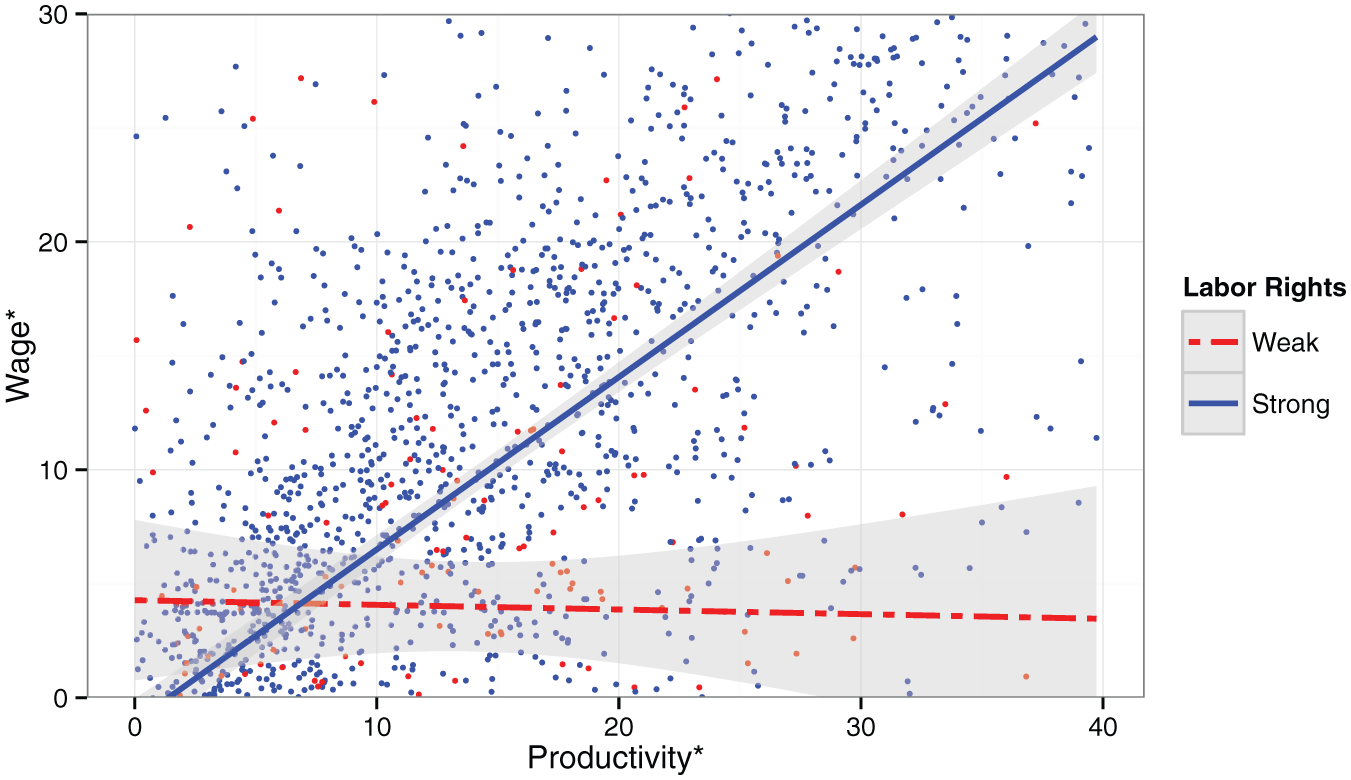
The Effect of Labor Rights on Profit Sharing. With Wage* on the Y-Axis and Productivity* on the X-axis, the slope of these two regression lines represent the profit-sharing rates at extreme ends of the global LaborRights spectrum.
Table 1 presents the results of five regression models that establish this article’s baseline results. Model 1 starts by including the main effects of Productivity* and LaborRights, without the interaction between the two terms. According to this model, LaborRights is positively correlated with wage growth, even when Productivity* is controlled for. Although the relationship just misses the standard cutoff for statistical significance (p = .078), these initial results suggest that labor rights may permit workers to bid up their wages beyond the level “justified” by their productivity. However, this preliminary conclusion is quickly overturned by the introduction of the interaction term between Productivity* and LaborRights in the next model. Model 2 establishes that labor rights merely permit workers to capture a share of their increased productivity in the form of wages. In other words, in the absence of productivity growth, an increase in labor rights does not increase workers’ wages. 75
Baseline OLS Regression Results. Dependent Variable = Wage*.
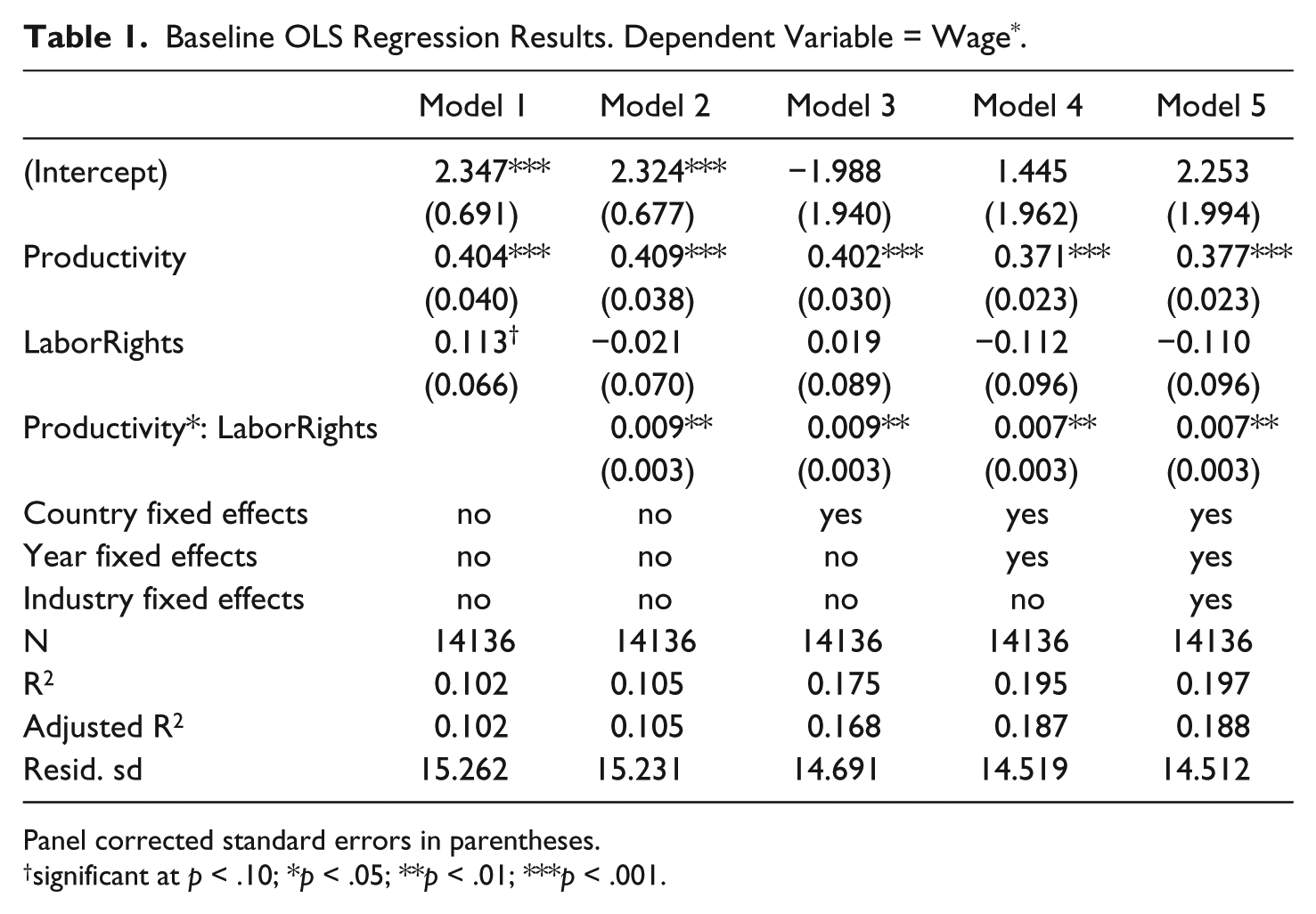
Panel corrected standard errors in parentheses.
significant at p < .10; *p < .05; **p < .01; ***p < .001.
The positive association between labor rights and the profit-sharing rate can be seen in the positive coefficient of the interaction term between Productivity* and LaborRights. The positive (.009) and statistically significant (p < .01) interaction term means that an increase in productivity is associated with a larger increase in wages when LaborRights is high, compared to when LaborRights is low. Specifically, the coefficient on the interaction term represents the effect of a one-point increase in LaborRights on the profit-sharing rate. 76 The coefficient on LaborRights is neither positive nor anywhere near statistical significance. This suggests that, holding productivity growth constant at its mean, an increase in labor rights does not have a direct effect on workers’ wages. In order to increase the robustness of the analysis, Models 3 through 5 successively add fixed effects at the country, year, and industry levels.
The regression models reported in Table 2 further increase the robustness of the analysis by including additional control variables. Model 1 replicates the baseline model (Model 5 of Table 1) by including only the Productivity*:LaborRights interaction term, its main effects, and fixed effects at the country, year, and industry levels. Model 2 starts with the baseline model and adds control variables that vary at the industry-country-year level. These include Employment, which measures total employment in the industry; Capital/Labor, which measures the relative capital or labor-intensiveness of the industry; and PopEmployed, which measures the percentage of the total population employed in the industry. The coefficient on the interaction between Productivity* and LaborRights increases slightly (.009) and remains statistically significant (p < .05). Model 3 starts with the baseline model and adds control variables that vary at the country-year level. These include FDI, which measures a country’s net flow of foreign direct investment; Polity, which measures a country’s level of democracy; Openness, which measures a country’s openness to international trade; GDPpc, which measures a country’s GDP per capita; and Unemployment, which measures a country’s economy-wide unemployment rate. The coefficient on the interaction between Productivity* and LaborRights does not change and remains statistically significant (p < .05).
OLS Regression Results with Controls. Dependent Variable = Wage*.
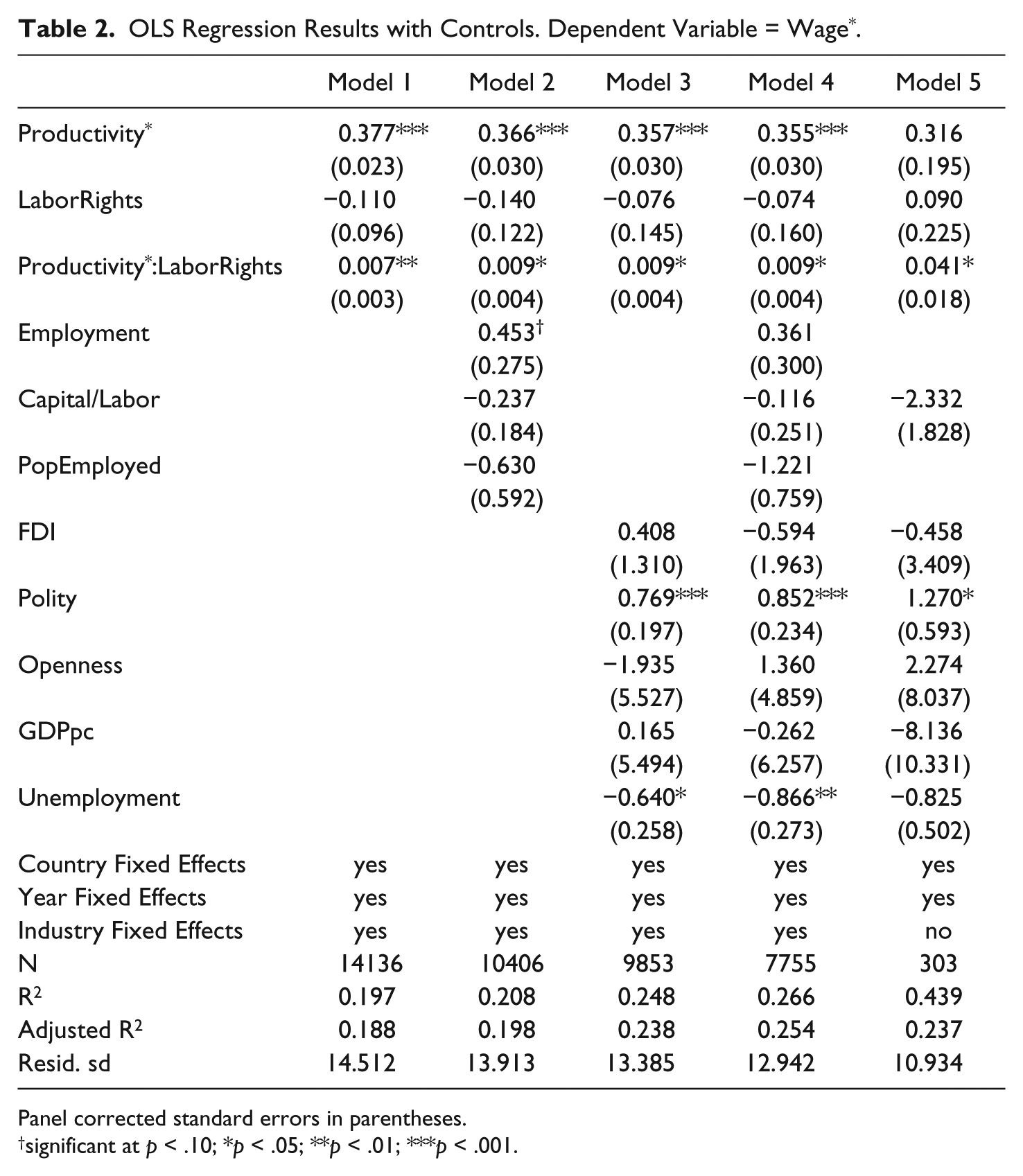
Panel corrected standard errors in parentheses.
significant at p < .10; *p < .05; **p < .01; ***p < .001.
Model 4 starts with the baseline model and then adds both sets of control variables—the controls that vary at the industry-country-year, as well as the controls that vary at the country-year level. When all control variables, as well as the fixed effects at the country, industry, and year levels, are included, the coefficient on the interaction between Productivity* and LaborRights does not change and remains statistically significant (p < .05). Because there are relatively limited data for many of the controls, the inclusion of these variables decreases the number of observations from 14,136 to 7,755. 77
To substantively interpret this interaction coefficient, consider the difference in the protection of labor rights between Sweden and Colombia in the year 2000, a year in which Sweden received a perfect LaborRights score of 37 and Colombia received a score of 7.25. By holding all other variables at their mean, we can estimate how the profit-sharing rate would vary in an average country that changed its level of protection for labor rights. According to the interaction coefficient estimate of .009, an increase in labor rights from Colombia’s to Sweden’s LaborRights score would be associated with a 152 percent increase in the profit-sharing rate. That is, given the same increase in worker productivity, workers with the high level of protection for labor rights would receive approximately 2.5 times the wage increase of workers with the low level of labor rights. Although workers’ wages do still increase along with productivity, even when the protection of labor rights is very low, it is clear that domestic protection for labor rights moderates the profit-sharing rate in a substantively important way.
The average relationship between productivity growth and wage growth is estimated by the coefficient on Productivity*. Substantively speaking, the .355 coefficient on Productivity* in Model 4 of Table 2 means that a 10 percent increase in productivity is associated with a 3.55 percent increase in wages when LaborRights and all other variables are held constant. 78 Figure A1 in the online Appendix (http://pas.sagepub.com/content/by/supplemental-data) graphs the marginal effect of productivity growth on wage growth, or the profit-sharing rate, as a function of the protection of labor rights. 79 At low levels of labor rights, productivity growth has a very weak effect on wage growth. At increasingly high levels of labor rights, productivity growth has an increasingly positive effect on wage growth. Although productivity growth is still associated with a small wage increase when labor rights are poorly protected, this finding suggests that the neoclassical trade models tend to overestimate the wage increases that workers receive from various economic policy reforms. In this way, the article does not reject the predictions of the neoclassical models, but rather seeks to demonstrate how a previously omitted variable can further our understanding of the distributional consequences of economic policies.
Caution is needed in interpreting the coefficient on LaborRights, which represents the effect of an increase in labor rights on wage growth when productivity growth is held constant at its mean. Although the coefficient for LaborRights is statistically insignificant in the models reported below, this is only a remnant of centering Productivity* at its mean. Figure A2 of the online Appendix (http://pas.sagepub.com/content/by/supplemental-data) shows that the marginal effect of LaborRights on Wage* is statistically significant at higher values of productivity growth. 80 The figure demonstrates that the association between labor rights and wage growth is increasingly positive as productivity growth increases. Although the effect of labor rights on wage growth is an important question, this article is focused on testing the causal logic of the neoclassical trade model and therefore on how labor rights affects the profit-sharing rate. Therefore, the most important estimate is of the coefficient of the interaction term between Productivity* and LaborRights, which remains positive and statistically significant in all regression models.
As mentioned above, testing the profit-sharing implications of the Heckscher-Ohlin model and Hypothesis 2 requires us to examine the relationship between worker productivity and wages at the country level. Therefore, Model 5 in Table 2 examines the effect of average productivity growth on average wage growth throughout the manufacturing sector. Estimating the model on such average values changes the unit of analysis from the industry-country-year to the country-year and decreases the number of observations from 7,755 to only 303. Despite this much reduced sample size, the coefficient on the interaction between Productivity* and LaborRights is still positive and statistically significant (p > .05). The magnitude of the coefficient (.041) is larger than the estimates from previous models, but the overall interpretation is substantively similar. According to this estimate, starting with the protection of labor rights at its mean, a one standard deviation increase in labor rights is associated with a 100 percent increase in the profit-sharing rate. Alternatively, according to the previous estimate in Model 4, the same one standard deviation increase in the protection of labor rights is associated with a 20 percent increase in the profit-sharing rate. This finding provides support for Hypothesis 2 and is robust to the same controls and fixed effects used in the previous models.
The regression results also contain two additional statistically significant findings. First, holding productivity growth and all other variables constant, Unemployment is negatively associated with wage growth. This finding is consistent with the theoretical discussion above, which argued that unemployment and labor surpluses dampen wage growth. Second, Polity is positively associated with wage growth, which is consistent with the common argument that democracy is positively correlated with economic growth. 81
In summary, the fixed-effects regression results demonstrate that the protection of labor rights is positively associated with the profit-sharing rate, and therefore support both Hypothesis 1 and Hypothesis 2. These findings are robust to the inclusion of controls for economic development, globalization, democratization, various industry characteristics, fixed effects at the industry, country, and year levels, and panel corrected standard errors. These controls should give us confidence that the results are not due to an omitted variable that causes both labor rights and profit-sharing. Any time-invariant, idiosyncratic characteristic of countries that might be associated with labor rights and profit sharing is controlled for by the inclusion of country-level fixed effects.
Note on Endogenous Labor Rights and Productivity
Does the protection of labor rights increase profit-sharing, or does profit-sharing increase the protection of labor rights? Although the empirical analysis presented above is unable to identify the direction of causality, there are reasons to believe that an increase in labor rights causes an increase in the profit-sharing rate. First, this article presents a direct causal mechanism through which we expect the protection of labor rights to increase the bargaining power of workers and thereby increase the profit-sharing rate. As discussed above, a basic tenet of labor economics holds that an increase in labor rights and worker bargaining power directly increases wages. 82 Second, the sign of the reverse causal mechanism is not clear, a priori. On one hand, an increase in profit-sharing increases the resources available to workers and may facilitate their ability to organize and lobby the government for better legal protections for workers. If this were the case, the estimated effect of labor rights on profit-sharing would be biased upward. On the other hand, a decrease in profit-sharing may frustrate workers, thus leading to increased organization and demands for legal protections. If this were the case, the estimated effect of labor rights on profit-sharing would be biased downward. In these ways, the biases introduced by the possibility of reverse causality may partially cancel each other out.
There is also potential endogeneity in the wage-productivity relationship. According to the efficiency wage literature, above-market wages may increase productivity by deterring workers from shirking, decreasing turnover, and attracting more efficient workers. 83 That does not, however, create serious problems for this article’s findings concerning labor rights and the profit-sharing rate. There is no theoretical reason to expect the efficacy of efficiency wages—the degree to which an increase in wages spurs workers on to higher levels of productivity—to increase along with respect for labor rights. Therefore, the positive relationship between the profit-sharing rate and labor rights should be interpreted in the following way: respect for labor rights increases workers’ ability to capture a share of productivity growth in the form of wages.
Methodologically, this article addresses possible endogeneity by carefully controlling for variables that may simultaneously influence productivity, wages, and labor rights. Trade liberalization, for instance, may dynamically spur innovation and efficiency over time, thus increasing productivity, but potentially undercutting workers’ bargaining power and wages. Alternatively, economic policy changes may affect resource allocation, which alters productivity levels as well as the labor-intensiveness of production. These concerns are addressed by the inclusion of numerous control variables. Openness and FDI control for relevant policy changes related to trade and investment, fixed effects at the industry-year level control for technological change and innovation, and Capital/Labor controls for changes in resource allocation and level of capital investment. Future research could further address these concerns by controlling for additional variables, especially at the level of individual firms. However, this article’s broad scope—covering twenty-eight industries in over 100 countries—unfortunately does not allow for more detailed controls.
Even without completely solving the complicated relationship between labor rights and the profit-sharing rate, this article has important implications for comparative and international political economy. Regardless of the direction of causality, attention to labor rights helps identify countries in which the distributional predictions of the neoclassical models may be less accurate. In countries with low protection for labor rights and low profit-sharing rates, these models appear to overstate the benefits that workers receive from economic policy reforms. Although future research should focus on identifying the direction of causality, this article nonetheless identifies domestic labor market institutions as an important omitted variable in the political economy literature.
Robustness Checks
The results reported above are robust to a number of additional model specifications and controls. First, the results are robust to the inclusion of additional variables that are traditionally used to proxy for labor power, such as union density, left-government, and the level of wage bargaining. Second, the results are robust to dropping rarely changing variables, such as GDPpc and Openness, which may be collinear with the country-level fixed effects. 84 Third, the results are robust to the estimation of cluster-robust standard errors, rather than the panel corrected standard errors reported above. Fourth, the results are robust to the inclusion of fixed effects at the industry-year and industry-country levels, which control for the possibility that technological change systematically affects the profit-sharing rate in different industries or countries. Fifth, the results are robust to disaggregating the measure of labor rights into its component parts based on labor rights in law and labor rights in practice. Sixth, the results are robust to the inclusion of additional interaction terms between each independent variable and Productivity*, so as to control for the relationship between each variable and the profit-sharing rate. Last, the results are robust to estimating the model separately for OECD and non-OECD countries.
These robustness checks, as well as the inclusion of various control variables and fixed effects at the country, year, and industry levels, should increase our confidence that labor rights are positively associated with the profit-sharing rate. In all of these alternative specifications, the interaction term between Productivity* and LaborRights remains positive and statistically significant. This means that when labor rights are not well protected, an increase in productivity does not automatically lead to the equal wage increase predicted by the neoclassical trade models. Additional information on these robustness checks is available in the online Appendix (http://pas.sagepub.com/content/by/supplemental-data).
Conclusion
This article argued that when the protection of labor rights is low, the neoclassical trade models overestimate the benefits that workers receive from various economic policy reforms. These neoclassical models use the assumption of full employment to predict that an economic policy that increases worker productivity automatically leads to an equal increase in workers’ wages. This article identified the relationship between worker productivity and wages as a key causal mechanism of the neoclassical models and provided both a theoretical and empirical critique of the models’ causal logic. Using data from twenty-eight manufacturing industries, in 117 countries, from 1986 to 2002, this article demonstrated that the degree to which an increase in worker productivity is associated with an increase in wages, or the profit-sharing rate, depends on the degree to which a country protects labor rights.
These findings have three broad implications for future research. First, the neoclassical models traditionally used in the field are inappropriate for the study of political economy whenever labor rights are poorly protected. This critique applies to the study of contemporary developing countries, as well as to historical periods for many developed countries. After all, the plight of today’s Bangladeshi workers has its precedent in earlier periods of industrialization throughout Europe and North America. 85 Second, when the profit-sharing rate is low, workers are unlikely to join their employers in support of the same economic policy reforms. This casts doubt on canonical works by Gourevitch, Rogowski, Frieden, and Hiscox, all of which argue that economic policy reform is often driven by a harmonious coalition of capital and labor in favor of the same policy. 86 Rather, understanding the creation of such cross-class coalitions requires closer attention to domestic labor markets and what I have elsewhere called “profit-sharing institutions.” 87
Last, this article has implications for recent debates concerning income inequality. When workers’ wages do not increase along with gains in worker productivity, profits increase at the expense of workers’ incomes. In other words, a low profit-sharing rate contributes to worsening income inequality. While many scholars argue that income inequality is driven by a decline in workers’ rights and unionization, extant scholarship tends to focus on the experience of individual countries. 88 This article’s analysis of data from over one hundred countries presents rigorous evidence that the protection of labor rights could increase wages and potentially decrease income inequality in countries around the world. In general, scholars must think differently about domestic labor market institutions to understand how economic policies shape the distribution of income and the very foundation of political economy.
Footnotes
Acknowledgements
I would like to thank the editors of Politics & Society, especially Andrew Schrank, for their help in preparing this article for publication. I also thank Faisal Ahmed, Jeffry Frieden, Gene Gerzhoy, Milena Ang Collan Granillo, Will Howell, Morgan Kaplan, Daniel Kono, Robert LaLonde, Walter Mattli, Jonathan Obert, Kevin O‘Rourke, Jong Hee Park, David Rueda, Alberto Simpser, Betsy Sinclair, Dan Slater, Duncan Snidal and Felicity Vabulas for comments and suggestions.
Declaration of Conflicting Interests
The author declared no potential conflicts of interest with respect to the research, authorship, and/or publication of this article.
Funding
The author received no financial support for the research, authorship, and/or publication of this article.
Notes
Author Biography
Supplementary Material
Please find the following supplemental material available below.
For Open Access articles published under a Creative Commons License, all supplemental material carries the same license as the article it is associated with.
For non-Open Access articles published, all supplemental material carries a non-exclusive license, and permission requests for re-use of supplemental material or any part of supplemental material shall be sent directly to the copyright owner as specified in the copyright notice associated with the article.
