







Abstract
Conditional cash transfers (CCTs) represent an innovation in social assistance policy by conditioning welfare benefits on recipients’ behaviors associated with human capital development. Although social assistance has expanded throughout the developing world in the 21st century, the political logic guiding CCT adoption differs sharply from that of unconditional cash transfers, and from the politics of social insurance development. Striking spatial and temporal correlations in their adoption also raise the specter of policy interdependence. A dynamic logit analysis of social assistance reforms in developing nations from 1990 to 2011 reveals that although CCTs have been impelled by democratization in developing countries, the model is not embraced systematically by the left or the right of the political spectrum. Rather, CCTs are more likely to be adopted in contexts of divided government and where regional neighbors, and more democratic countries in the region, have previously adopted them.
Around the world, systems of social protection are undergoing profound transformations in their form and function. Nowhere have such changes been more dramatic than in the developing world, where social policy reforms have followed two sharply opposing trajectories in recent decades. Whereas the 1990s and 2000s brought the widespread retrenchment and restructuring of middle-class social insurance programs, the mid-2000s have seen a countervailing trend toward the expansion of social assistance benefits for the poorest citizens. 1 Most notable in the latter trend has been the adoption of conditional cash transfers (CCTs), which offer cash benefits to poor families who meet certain behavioral conditions such as children’s school attendance and health checkups. The rise of CCTs in developing countries marks a striking departure from both the long-standing tendency in social policy development to privilege middle- and upper-class formal-sector workers, and from the budget-cutting tendencies of the post–debt crisis era, which took aim at precisely those more generous and often regressive social insurance programs. Much like the earlier wave of pension privatization, cash transfer innovations have won the vigorous support of international financial institutions and development agencies that have invested heavily in their promotion across developing nations. By 2011, CCTs had been adopted in thirty-three middle- and low-income nations throughout the Global South, alongside new or expanded noncontributory pensions, in-kind social assistance benefits, and unconditional cash transfers (UCTs) for the most vulnerable citizens. 2 Understanding how and when such pro-poor transfers have been adopted across nations, and whether they indicate continuity or change in the politics of social protection reform, is the aim of this study.
The expansion of redistributive programs such as CCTs raises important questions for research on social and economic development. Among them is to discern whether such a “return to the state” 3 represents an achievement in democratic deepening—and thus a programmatic response to demands for redistribution by the poor—or whether they are merely the latest top-down initiative by global social policy advocates or a vote-buying effort on the part of emerging democratic governments. For, despite having long constituted the largest social class in most developing nations, the poor have rarely been the most powerful political constituency, despite transitions to democracy since the 1980s. Instead, rising levels of inequality attended democratic transitions in many developing nations, challenging the predictions of scholarly research that democratization would permit the (poor) “median voter” to use her pivotal position to impose redistribution on the rich. 4 Even if we were to find the recent trend toward redistributive transfers to be an expression of enhanced political accountability, it is difficult to explain either the timing—in many cases two or more decades after democratization—or the spatial and temporal clustering of recent CCT programs as a function of democratic pressure alone (see Figures 1 and 2). Rather, such patterns suggest the possibility of interdependence in social policy reforms and thus raise the question of the source and channels of policy transfer across nations.
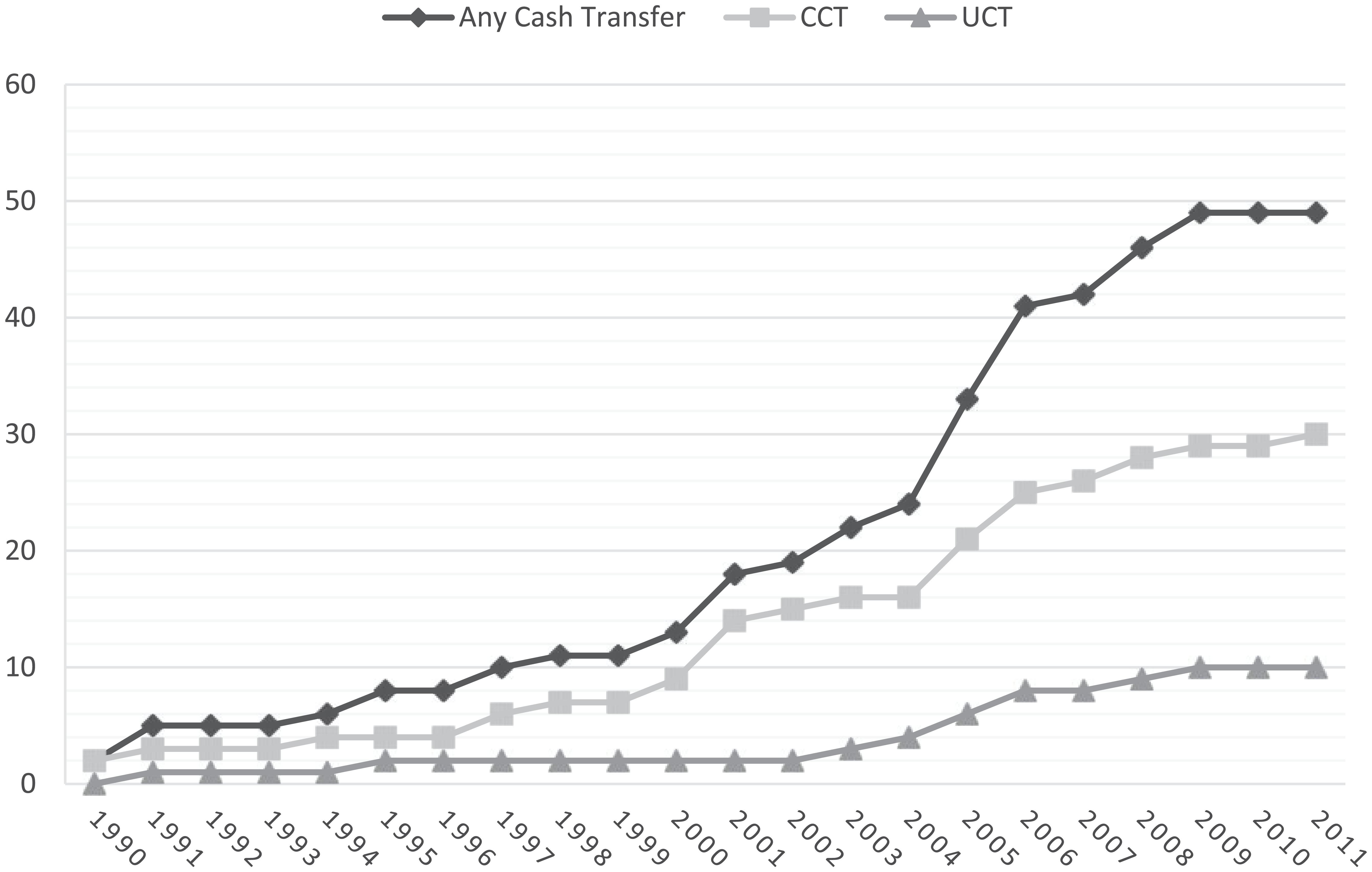
The Expansion of Social Assistance in Developing Countries: 1990–2011.
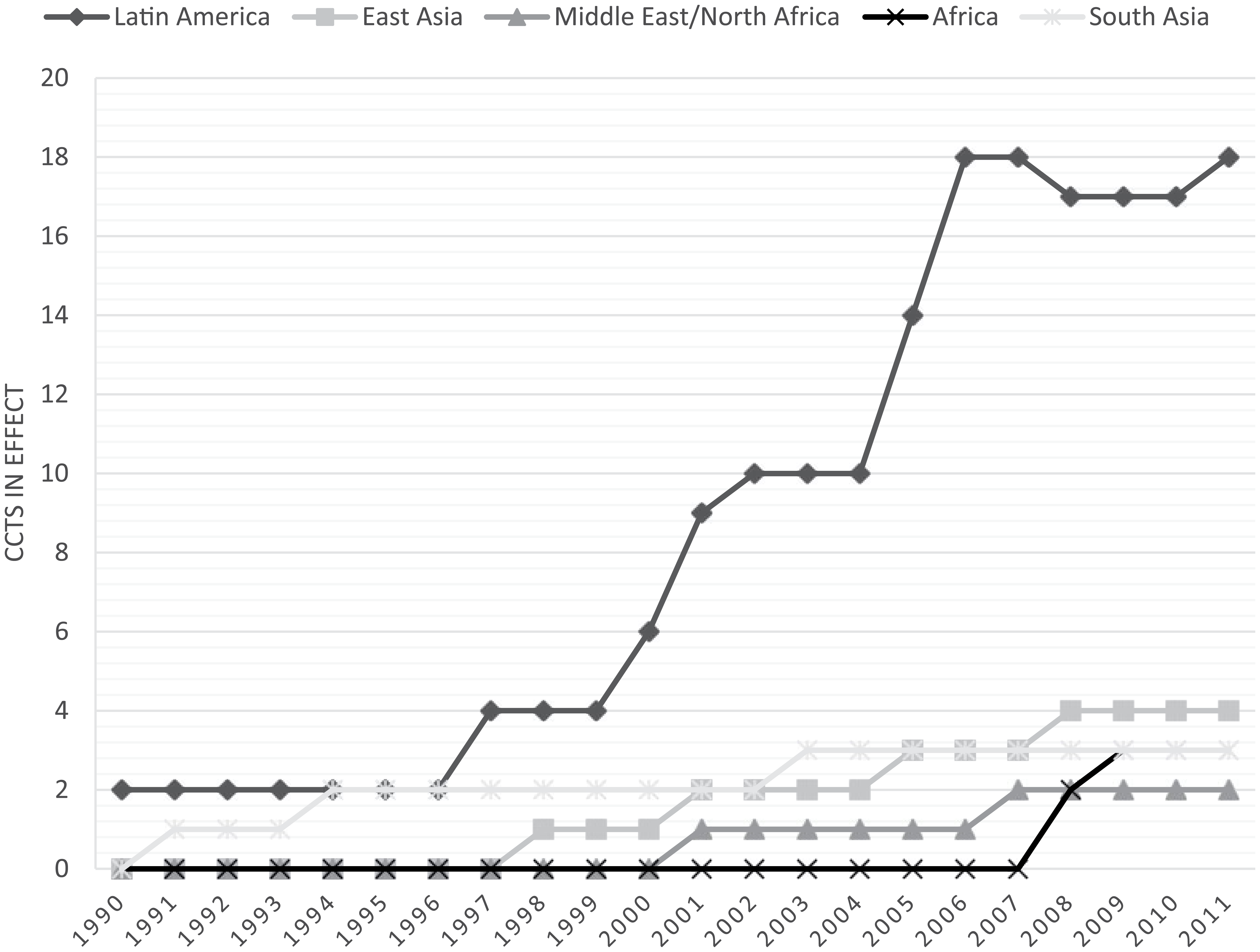
CCT Implementation by Region.
The rapid spread of social assistance in the form of CCTs is striking, moreover, because they impose a considerable technical, financial, and bureaucratic toll on governments to design, target, and enforce the conditionalities of the program. To make CCTs effective in achieving the long-term human capital objectives, moreover, there must be adequate educational and health care facilities in place, or established, alongside these programs in order to absorb the influx of new beneficiaries. For low- and middle-income countries beset with fragmented and underfunded social services and weak governance capacity, such an endeavor is unlikely to be undertaken effortlessly. The high costs and significant administrative capabilities required to implement CCT programs thus suggest an important role for information and ideas from abroad, including the promotion of CCT models by international development institutions. Such forces can influence policy choices across nations by raising the salience of this model and by lowering the technical hurdles and uncertainty associated with this policy shift.
But national social policies are ultimately legislated and implemented by domestic governments, and thus the political economy of social policy reform obliges us to examine closely the domestic politics of redistribution. On this dimension, CCTs present a crucial partisan dilemma: Even though they are progressive and redistributive in nature and thus appeal to the partisan left, the conditional nature of cash benefits holds greater appeal to conservative politicians who resist handing out cash to the poor without strings attached. The consequence is that CCTs may occupy ambiguous political terrain, fully embraced by neither the left nor the right of the political spectrum. Rather, such policies may emerge as a compromise in countries riven by ideological splits between competing parties, marking a critical departure from previous politics of social insurance expansion or retrenchment.
This paper takes a preliminary step toward understanding the domestic and international foundations of the adoption of CCT programs. Using a dynamic logit model of CCT adoption in 114 developing nations between 1990 and 2011, I find a powerful role for democratic politics, and for interdependence in the decision to adopt. The likelihood of implementing a CCT program increases with the prevalence of CCTs among countries in the same region and among more democratic countries. In the domestic political arena, democratization increases the likelihood of implementing a CCT, and governments with greater ideological divisions among officeholders are likewise more likely to adopt this policy design, all else being equal. The partisan dynamic also distinguishes CCT politics from that of unconditional social assistance transfers, where divided government is not a relevant consideration. Together, the domestic and interdependent foundations of CCT adoption diverge sharply from those of social insurance development, and from the broader patterns of unconditional social assistance programs for the poor.
Changing Contours of Social Protection
The rise and expansion of noncontributory social assistance marks a significant departure from the broad trend in social protection reform in the last quarter of the 20th century. In advanced industrial nations, such changes typically took the shape of cuts to the generosity of old age pensions and labor market benefits, while also restructuring those designs to transfer a greater share of the risk and cost of income protection to individuals. 5 Among middle-income and developing countries, such reforms were pursued most vigorously through the privatization of social security systems in Latin America and Central and Eastern Europe. 6 Although the privatization trend stalled by mid-2000s and was even reversed in some countries, the forces of population aging, slowing growth, and tightening government budgets have impelled governments throughout the world to undertake cost-cutting reforms of social insurance programs such as pensions and unemployment insurance. 7
Social protection in middle-income countries often emerged as part of a broader development strategy and took the form of contributory insurance programs tied to employment in strategic, industrial, and public sectors. Social insurance in developing countries thus tended to privilege middle- and upper-income formal-sector workers who often constitute less than half of the economically active population. 8 The retrenchment and restructuring of those programs therefore primarily affected middle- to upper-income formal-sector workers, while the population laboring outside the formal sector had access to considerably less generous benefits or to ad hoc emergency aid, or relied on informal means of risk protection. 9 Low-income workers left out of formal social insurance programs thus bore the brunt of economic crisis in the form of high livelihood risks, low and unstable income, and an elevated risk of poverty.
That is not to say that the poorest workers were left solely to their own devices since transitions to democracy in the 1980s and 1990s. 10 Informal and nonmonetized risk-pooling among neighbors, family, or tribe enable the poor to cope with the pervasive risks to their livelihoods. 11 In addition, governments in developing countries have typically provided modest, if not ad hoc, social assistance in the form of emergency aid or in-kind vouchers for food, gas, or other basic necessities in response to rising deprivation during recession or economic crisis. In Africa, food aid and subsidies for commodities and services were more prevalent than categorical or antipoverty cash transfers. 12 Yet rarely have such means-tested programs claimed a significant role in social protection ministries or government budgets; nor were they typically part of a longer-term strategy for poverty reduction. For some scholars, moreover, the social investment programs that existed before the emergence of CCTs were better understood as vote-buying efforts than as components of broad antipoverty strategies. 13 Social assistance strategies thus took a secondary place in structural adjustment, growth, and development planning in the 1980s and 1990s. 14 Instead, international development agencies focused social policy lending on reforms to social security programs, which were seen as a means to achieve macroeconomic objectives such as growth and deficit reduction.
This international policy focus shifted dramatically in the early 2000s, when the World Bank’s social protection unit turned its attention from social security privatization toward the concept of social risk management. 15 Conterminous with the embrace of the Millennium Development Goals among multilateral development agencies, the World Bank’s policy and operational focus pivoted toward assessing the vulnerability of the most destitute members of society, such as children, and toward coping strategies—such as withdrawing children from school in response to shocks—that tend to perpetuate intergenerational poverty. Social safety nets soon rose to the top of a “child-centered” policy agenda, with an array of international conferences sponsored by the World Bank and other international development institutions aimed at producing new research on social investments to break the intergenerational transmission of poverty. 16 It was in this context that the CCT model made its way into social protection strategy papers that laid out governments’ plans to achieve Millennium Development Goals and tackle entrenched poverty.
Translating a policy innovation from international and technocratic circles to real-world implementation is far from straightforward, however, especially in countries beset with underfunded bureaucracies and low institutional capacity. Although organizations such as the United Nations, World Bank, regional development banks, and bilateral development agencies played a significant role in the promotion of antipoverty programs, domestic political economy concerns ultimately decide and shape national policy changes. In the next section, I examine the characteristics of CCTs and the early experiences that shaped their dissemination across the developing world. I then contrast CCT programs with the alternative, unconditional, cash transfer model in order to explain where and when these distinct policies have been adopted throughout the Global South.
The Rise of CCTs as a Policy Model
The scope and design of CCT programs vary markedly across nations. But in each case the fundamental policy goal is the same—to break the intergenerational transmission of poverty through long-term human capital investment while providing cash benefits to meet the short-term needs of the most vulnerable citizens for food and economic security. To that end, CCTs provide direct cash transfers, typically to the mother of the household, on the condition that beneficiaries fulfill certain behavioral conditions such as school attendance and medical check-ups. 17 In principle, such behaviors should contribute to the reduction of income poverty in the short term, while building human capital to promote the ascent from poverty in the long. While extensive program assessments have supported the achievement of the near-term goals of CCTs, their novelty means that little evidence has yet been accumulated to test the longer-term implications. 18
CCT Innovators
Contemporary CCT programs trace their lineage to two foundational programs: Brazil’s Bolsa Escola, now Bolsa Família, and Mexico’s Progresa, later called Oportunidades (and now, Prospera). Although CCTs were adopted on smaller scales before these programs, Bolsa Escola and Progresa were the first nationwide programs of their kind. Mexico’s Progresa was launched in 1997, providing cash, food, and health care benefits to very poor rural families on the condition that they commit to specific education and health care investments. 19 Progresa was designed as a three-pronged strategy to address the sharp rise in poverty following the 1995 peso crisis. The cash transfer component was intended principally to subsidize food consumption; it was given directly to the mothers in poor rural households, along with a stipend intended to compensate the poorest families for the opportunity cost of child labor as children were attending school. Progresa also provided basic health care for all members of beneficiary households, emphasizing attending meetings and preventative care. 20 After rigorous program evaluation found positive effects from Progresa, it was expanded from rural to urban areas and renamed Oportunidades (now, Prospera). 21
In Brazil, the Bolsa Escola (“school grant”) program began in 1995 in the municipalities of Campinas (São Paulo) and Brasília (Federal District), and became a national policy in 2001 under President Fernando Henrique Cardoso. The parameters of Bolsa Escola were narrower at first than those of Progresa, with cash transfers conditioned solely on school attendance. 22 The municipal programs were regarded as successful, and were adopted widely and rapidly across Brazil—a trend that is striking for the nearly identical policy implemented across municipalities that varied dramatically in their population, poverty rates, wealth, and political orientation. 23 Under Cardoso’s successor, Luiz Inácio Lula da Silva, Bolsa Escola was expanded and renamed Bolsa Família (“family grant”) and incorporated into President Lula’s broader “Zero Hunger” program. 24 Bolsa Família likewise yielded positive results from early program evaluations, although as Barrientos and Villa observe, the program expansion was impelled more by its widespread political backing than by evidence of effectiveness. 25 By the end of the 2000s, a majority of countries in Latin America had adopted some form of CCT, which by 2012 covered approximately a quarter of the region’s population. 26
Beyond Latin America
Although antipoverty cash transfers such as CCTs were most prevalent in Latin America, the expansion of social assistance was not restricted to the Western Hemisphere. Indeed, new cash transfer programs spread throughout Sub-Saharan Africa and Asia as well in the early 21st century. In most African countries, noncontributory social assistance programs have typically taken the form of unconditional cash transfers and categorical (old age and disability) grants. However, Ghana implemented a CCT in 2007 called Livelihood Empowerment Against Poverty (LEAP), which was regarded as the “flagship” of the Kuofuor government’s social protection strategy. 27 As in other developing nations, Ghana’s CCT program was rooted in the poverty-reduction targets of the Millennium Development Goals and was piloted with the support of the World Bank, among other donors. Yet technocrats in Ghana also have argued that it was also a desire to emulate the Brazilian CCT, along with the direct ties between the presidents of Ghana (Kufuor) and Brazil (Lula da Silva) that guided the choice of the CCT model in Ghana. 28 Although LEAP does not match the ambitions of Bolsa Família in its scope or benefits, it incorporates many of the same conditionalities and technical criteria in its design, thus revealing the influence of Brazil’s program. And the explicit reference to Brazil by government actors further suggests an important “horizontal” diffusion of policy ideas across nations, rather than solely an international or “vertical” transfer from international institutions. 29
Indonesia also implemented a CCT, the Program Keluarga Harapan (PKH; “Family Hope Program”). Piloted in 2007, this program also was linked explicitly to Indonesia’s Millennium Development Goals and relied on technical and financial support from the World Bank, among others. Consistent with CCTs elsewhere, PKH conditions receipt of cash benefits on the achievement of health and educational objectives. As in Ghana, this program is narrower in scope than the Latin American archetypes, targeting just the bottom third of the extreme poor in Indonesia. Nevertheless, the influence of the Latin American models is evident in the frequent reference to the earlier experiences in that region to justify the simulated cost and impact of the Indonesian program. And like the LEAP program in Ghana, Indonesia’s CCT is remarkable for its departure from the legacy of minimal state involvement in social protection. Even as CCTs in Asia and Africa pale in size compared to the Latin American programs, the latter drew on a rich legacy of extensive state spending in social protection, whereas the non-Western CCTs represent a striking departure from the legacy of a minimal state fiscal role in social protection.
Political and Economic Impacts
A rich literature has emerged to evaluate the efficacy of various CCT designs and their impact on consumption, labor market participation, and health and educational outcomes. 30 For the most part, the various results are positive in terms of short-term poverty reduction, improved nutritional status and even labor market participation. 31 However, the longer-term poverty and human capital impacts are less apparent and will depend on the quality of existing educational institutions, among other factors. Beyond the economic impacts, scholars also have begun to examine the political consequences of such programs, including the influence of CCTs on recipient and nonrecipient voter turnout and voting behavior. 32 This research has examined whether such programs represent a departure from clientelistic benefit provision, and whether investments in CCTs yield political rewards for incumbents or not. 33 The broad conclusion of this research is that although there is evidence of an electoral payoff for incumbent governments among CCT beneficiaries, the permanence of that payoff remains in question. 34 And such programs have failed in notable instances to stanch the declining popularity of incumbent governments, as in the cases of Ghana and Nicaragua. On balance, the political payoff of adopting CCT programs may be more expectation than actual fact. Such ambiguity, along with the high technical and administrative costs of implementing this program, should raise the value of information drawn from earlier CCT experiences for governments considering whether to implement this costly and difficult policy innovation. 35
Analysis of CCT impacts has raised the question whether CCT programs are appropriate, or even viable, as an antipoverty strategy for many of the poorest developing countries. As Handa and Davis point out, the appropriateness of a CCT may depend on whether the cause of poverty is in the lack of demand for education and health care, or whether there are broader weaknesses in the supply of these services, inter alia. 36 Such concerns matter because of the financial and administrative costs imposed by CCT programs to target beneficiaries accurately, implement the program, and enforce the conditionalities of the transfers. For such programs to achieve the goal of human capital accumulation, moreover, there must be high-quality educational opportunities and health care services available for the poorest citizens. For countries with historically low state capacity and a predominantly rural poor population, as in many Sub-Saharan African countries, these requirements may have proved to be prohibitive, as few pilot CCT programs were scaled up to the national level with the conditionalities in place.
Indeed, development agencies such as the United Kingdom’s Department for International Development (DfID) have promoted the unconditional cash transfer (UCT) model among its bilateral aid recipients, which are concentrated in sub-Saharan Africa and South Asia. 37 Advocates of UCTs consider the lack of benefit conditionality to be more appropriate for countries with lower administrative capacity in rural areas, given the financial and administrative costs of such programs. In addition, the fragility of educational and social service institutions in less developed countries means that conditioning aid on the utilization of these services is not well justified. 38 Given the appreciable institutional and administrative costs of the CCT model, therefore, we should not expect the scale of poverty alone to predict when and where CCTs are adopted. Rather, domestic institutional contexts should matter, such as the capacity of educational and health systems to absorb the number of families that would be required to utilize them, and the ability of state bureaucracies to implement the program. Thus we may expect to find UCTs, rather than CCTs, in poorer developing countries, especially in the later 2000s as awareness of the administrative costs increased—and as institutions such as DfID began to promote unconditional cash transfers through its bilateral aid programs.
Domestic and International Foundations of CCT Adoption
A growing body of research suggests that social policy reforms in one country may be conditioned systematically by the policy choices undertaken in other countries. 39 Such processes of diffusion, or policy interdependence, are said to exist where a policy adoption in one country systematically alters the probability of a similar adoption in another country. 40 For Rogers, diffusion simply entails the communication of an innovation through a social system. 41 In research in political economy, the concept of diffusion seeks to account for the spatial and temporal clustering of similar policy shifts across nations. 42 This literature has yielded broad evidence of interdependence in the likelihood and design of policy shifts around the world in areas such as health care, capital account liberalization, and pension reform, among others. 43
Understanding when and where government actors choose to implement policy innovations such as conditional cash transfers requires that we first understand the international sources of information about this program—including other countries or international development institutions—along with the domestic factors conditioning the ultimate adoption of this policy design. The focus on international policy models is justified in the case of CCTs because the costs of implementing them are quite high, while evidence about the efficacy of the program design has largely been opaque and preliminary. To the extent that the decision to implement a CCT is likely to involve both considerable uncertainty and meaningful financial and administrative costs for developing country governments, it is reasonable to expect that government actors would seek some assurance from abroad of the appropriateness and (political and economic) payoff of this measure before its adoption. Such assurance can be gained by waiting to observe the patterns and impacts of reforms in previous instances of adoption. Indeed, for policies with high up-front costs and uncertain benefits, interdependence has been found to be a significant factor predicting the adoption of social policy innovations, particularly in less affluent countries. 44 This heavier influence of international trends may be due in part to resource constraints that make it difficult for government bureaucracies independently to assess the viability of a new policy model. 45 A significant degree of interdependence thus is expected to explain the adoption of costly, uncertain, and administratively complex programs such as CCTs.
The crucial analytical task, however, is to discern the mechanisms through which such decisions may be tied across nations. Within the growing stream of diffusion research, the process of emulation, which involves the social construction of appropriate behavior, is likely to weigh heavily in this dynamic. Emulation involves following the lead of prominent or higher-status countries, even where they may be inappropriate for the home context. 46 In this sense, emulation of policy models abroad is understood not as a process that seeks to connect the best means to a given end, but rather as a way to achieve higher status by modeling behavior on a putatively exemplary model. More democratic, or high-profile, countries thus may become models for policy emulation, whether or not they are appropriate comparison states for the reference government, as may nearby governments whose policies may seem appropriate because of geographic proximity or shared development and institutional contexts.
Alternatively, advocacy of the CCT model by powerful international financial institutions may be a source of the cross-national spread of this measure. Favorable evaluations of the economic impacts of pioneering CCT programs in Brazil and Mexico led international agencies such as the Inter-American Development Bank (IDB) and World Bank to support CCT implementation vigorously elsewhere in Latin America—and beyond. In the case of the World Bank, which tied this effort to the broader agenda of the Millennium Development Goals, support for CCT implementation included extensive technical and financial assistance to ensure efficient targeting of recipients, administration of the grants, and enforcement of the conditionalities. 47 As part of the World Bank’s promotion of the CCT model, it hosted international conferences in Mexico (2002), Brazil (2004), and Istanbul (2006), as well as an array of country-specific conferences in Washington to disseminate information about the design and previous experiences with CCTs, policy research, and operational guidance for implementation among potential adopters of the model. 48 An explicit objective of these events was to learn from past experiences, as they featured case studies from early adoptions of a variety of CCT designs. In this sense, it is most likely that the role of the World Bank in the diffusion of CCTs across nations centered primarily on its transmission of information, rather than its use of development aid as an instrument of “coercion.” 49
Domestic Politics
Even if international financial institutions (IFIs) can heighten the salience and attractiveness of CCTs as a policy innovation, they have very limited, if any, authority to impel sovereign governments to implement new spending programs. Rather, we should expect that even as IFIs bring the issue of CCTs on the policy agenda and lower the technical and administrative barriers to implementation, domestic politics should ultimately determine the outcome of social policy change across nations.
Indeed, democratic transitions throughout the developing world raised expectations that the poor could use their newly expanded rights to political participation to exact meaningful redistribution and demand accountability of elected leaders. In the study of redistribution, therefore, prominent research built on the “median voter” model to predict that such transitions should bring the credible promise of redistribution. 50 Such models rest on a Downsian view of democratic politics, in which political leaders compete for the support of the median voter, whose income determines her preference for taxation (and redistribution, as in the Meltzer and Richard model). 51 In countries characterized by a positively skewed income distribution, wherein the mean is greater than the median income—as in much of the developing world—the median voter will be poor. Thus, the broad implication of such models is that democratic elections should produce a mandate for progressive taxation and redistribution from high- to low-income citizens in unequal nations.
Yet, as democratic transitions often coincided with economic crises, structural adjustment, and economic liberalization in the 1980s and 1990s, little in the way of pro-poor fiscal policy was evident. Rather, yawning inequalities of income distribution in many young democracies stood in sharp relief against the Meltzer-Richard-type expectations. The recent turn toward the expansion of CCTs, however, has countervailed the trend of the first decades of democracy in regions such as Latin America. Although far from a sufficient condition, there is reason to believe that the deepening of democracy—if not regime change itself—may help to explain the expansion of social assistance transfers to the poor in recent decades. For not only was Mexico’s CCT implemented along with democratization, 52 but Coêlho also finds that the diffusion of CCTs among municipalities in Brazil is predicted by the competitiveness of local politics. 53 In the early CCT adopters Brazil and Mexico, Zucco and de la O also find significant electoral benefits at the national level to the adopting governments. 54 Social spending, moreover, has been found to be higher in more democratic Latin American countries, although social assistance plays only a minor part in these data. 55 To the extent that economic crises and reform have begun to give way to growth, and hence the fiscal leeway to effect redistribution, we may anticipate that governments will face electoral incentives to expand social protection in increasingly competitive democracies of the Global South.
Social welfare policy has long been shaped by the ideological positions of government leaders, even though reform dynamics often have defied conventional partisan associations. For instance, Huber and colleagues find that, by contrast to the OECD, partisanship is not a predictor of social spending in Latin America. 56 And left governments have played against partisan type by implementing social security privatization at a higher likelihood than their conservative rivals. 57 Yet CCTs may not follow the same partisan script as other social policy programs such as pensions, or even unconditional social assistance transfers. For even though CCTs involve redistribution to the poor, which should appeal to leftist governments, these programs also require behavioral compliance of beneficiaries with human capital investments that should raise the appeal of this design to conservative interests that might oppose the “welfarist” principle of offering cash to the poor. Indeed, the earliest adopters of CCT programs were from centrist parties, which also may contribute to the lack of a clear partisan or ideological signal associated with the program.
The politics of CCTs thus pose a unique set of challenges from the perspective of conventional partisan theory. The case of Nicaragua may be illustrative of these dilemmas. The country has swung in recent decades between the leftist Sandinista government, which sought to universalize social welfare benefits in the 1980s, and pro-market governments in the 1990s that opposed asistencialista (“welfarist”) programs that appeared to perpetuate dependence on government assistance. 58 A CCT program, Red de Protección Social (RPS; “social protection network”), was implemented in 1998 with the support of the IDB, and modeled on the Mexican CCT Progresa. A pro-market government implemented the program, despite its concerns about the program’s welfarist features, and designed it with a very strong human capital component. Although the RPS was regarded as highly effective, Nicaragua’s CCT was discontinued in 2006 by the conservative Bolaños government. Despite its short-term positive impacts on poverty, the CCT was rather costly and it was decided that the program could not be sustained on the domestic government budget alone. 59 At the same time, the leftist Sandinista opposition was gaining influence in Nicaragua, and took over the government in the next election. The rising threat from the left suggests at once the possibility that the Bolaños government may have implemented the program as a way to fend off the rise of the left, while at the same time its closure could prevent further expansion of the costly program under its partisan rivals. Ultimately, even if the IDB was pivotal in bringing this program to life, it was neither the efficacy of the program, nor the need for poverty alleviation that ultimately determined its fate. Rather, we see a powerful effect of domestic political competition between ideological rivals, which along with the high costs of the program, weighed into the adoption and termination of Nicaragua’s CCT program. The case of Ghana also reveals the ambiguous partisan moorings of the CCT model, as the LEAP program was initiated by a (nominally) leftist government, Kufuor’s New Patriotic Party, but expanded considerably by the conservative government (Mills’s National Democratic Party) that won the national election only months after the implementation of LEAP. The next section turns to the empirical analysis to test whether such dynamics are systematic or exceptional features of the adoption of CCTs—and their alternative UCTs—across nations.
Empirical Analysis
In order to examine the principal domestic and international foundations of social policy change, we must first define the feasible set of potential adopters of cash transfers. I focus this analysis on middle and low income countries—the so-called developing world, or Global South. This choice of domain is based in part on the fact that in practice, only developing countries have implemented programs such as CCTs. 60 Moreover, most high-income countries with established welfare states typically already include some form of social assistance programs, and thus those nations may not be at risk of implementing program innovations such as CCTs. Accordingly, the universe of countries taken to be “at risk” of CCT adoption are defined by the World Bank categories for low-income, lower-middle-income and upper-middle-income countries. These countries span the globe, from East Asia and the Pacific, to Latin America and the Caribbean, Middle East and North Africa (MENA), South Asia and Sub-Saharan Africa. Those regional categories are used to define the geographic diffusion peer groups in the analysis. 61 The data set covers the years 1990–2011 in order to accommodate the earliest adopters of CCTs, as well as recent data on the implementation of these policies and the relevant explanatory variables.
Empirical Strategy and Model
My approach to predicting the likelihood of CCT adoption is to estimate a likelihood function that takes the value Y = 1 if a country has adopted a CCT; 0 otherwise. Given the binary nature of the dependent variable, I use a dynamic logit model to estimate the likelihood that in any given year a country has implemented a CCT program. The model specification reflects the empirical reality that countries have implemented CCTs and later terminated these programs, meaning that they can enter and exit the set of reformers (and thus exit and reenter the countries at risk of adoption). This data structure suggests that an event history (failure time) framework is inappropriate for analysis of a policy change such as CCT adoption. 62 Like in Nicaragua, Uruguay temporarily (2005–7) implemented a CCT in the context of recession and economic crisis. With the closure of that stand-alone program, the Uruguayan government was once again at risk of CCT adoption in the event of a return of the crisis conditions that earlier prompted the enactment of the policy. 63 The dynamic logistic regression model accounts for this potentially impermanent aspect of CCT implementation.
In addition to the country-specific factors associated with cash transfer adoption, I model the probability of enacting a cash transfer program as a function of decisions made abroad, in order to capture the potential interdependencies associated with the spread of this policy innovation. The modeling strategy permits interdependencies in the adoption of a CCT in a given country (i) and year (t) to be estimated as probability function Пit taking the form: logit(Пit) =
Dependent Variables
Conditional cash transfers are part of a broader family of social assistance measures that may be provided on conditional or unconditional terms. Within the data examined here, thirty-three countries had adopted a CCT at least on a pilot level by 2011; and fourteen had adopted UCTs, at least as a pilot program. In very few cases (Indonesia and Pakistan), both types of cash transfers have been implemented; typically, however, countries opt either for the CCT or UCT model. In order to discern whether CCTs are merely a species of the broader category of cash transfers to the working-age population, or whether they represent a distinct political and economic dynamic, I measure the outcome variable in three ways. I first measure the adoption of CCT policies as a binary variable (CCT), based on a variety of sources on the spread of this program around the world. Countries are coded 1 for the year in which a CCT program was adopted and 0 otherwise. As mentioned above, there are countries that implemented CCT programs and later terminated the policy. In those cases the country score on the dependent variable returns to 0 the following year.
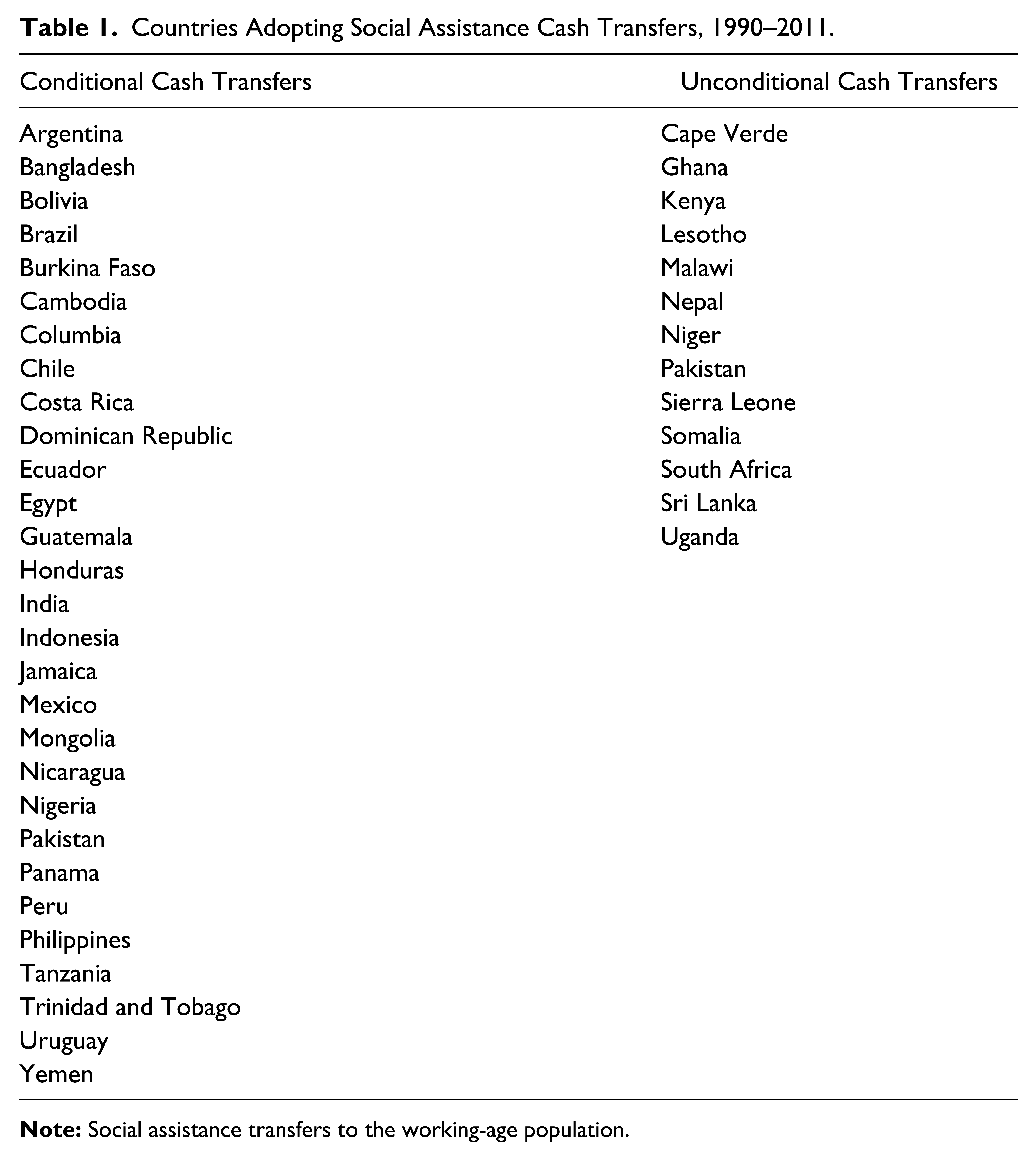
I next code social assistance innovations for countries that have adopted an unconditional cash transfer (UCT) in order to discern whether CCT politics follow a distinct political and economic logic from other social assistance programs. As argued above, unconditional programs should appeal in lower-income countries with less bureaucratic capacity and fewer support services such as education and health care that are typically associated with CCT conditions. The UCT variable takes the value 1 when an unconditional cash transfer program is implemented and 0 otherwise. This variable excludes pension systems in order to focus solely on benefits for the working-age population. Finally, I code a binary variable (Cash Transfer) that is coded 1 for any country year in which either a CCT or UCT had been implemented. A full list of CCT and UCT adopters is included in Table 1.
Countries Adopting Social Assistance Cash Transfers, 1990–2011.
Independent Variables
To capture the potential effect of democratic political pressures on CCT adoption, I include a variable, Democracy, measured as the Polity2 score of political freedom. 64 Partisanship also should play a role in the adoption of conditional cash transfers, although this effect should not be straightforward. I include two variables, Left Executive (coded 1 for left executives, 0 otherwise) and Right Executive (coded 1 for right executives, 0 otherwise). Centrist executives are the reference category. As argued above, I do not expect either left or right executives to be more likely to enact a CCT. The argument does suggest, however, that the unique political tensions embedded in the design of CCTs could emerge in governments riven by deep partisan cleavages. Such contexts may be ripe for CCTs either as a compromise between divided governments, or because such polarization has prevented centrist coalitions from emerging in support of more substantial or conventional forms of redistribution. To test for this possibility, I include a variable, Divided Government, which is calculated as maximum ideological distance between the executive party and the principle parties of the legislature according to the Database of Political Institutions. 65 I expect divided government to increase the chance of CCT adoption, but not to be associated with the UCT policy design.
Consistent with recent approaches to the study of international diffusion, I treat interdependence in the policy process as a type of spatial autocorrelation. Such an approach models interdependence in theoretically relevant ways, rather than as an econometric nuisance that must be accounted for to prevent bias in point estimates. Interdependence thus is measured as the weighted average of the outcome variable—here, the adoption of a cash transfer—in each government’s “neighborhood,” where neighbors are defined not simply in geographic terms but also by conceptual proximity, such as common regional ties among governments, or through emulation via political status differences. At the foundation of this approach is the construction of a matrix of weights that specifies the influence of each sending country on the prospective recipient of the innovation diffusion. Measuring these spatial weights in different ways, depending on the mechanism of interdependence being studied, permits examination of how policy decisions among innovators affect policy choices in the reference country. Thus the construction of the spatial weight matrix must take seriously the question who is a “model” and through what mechanisms those sources of policy transfer may affect other governments’ decisions.
Crucial to addressing those two concerns is the specification of the spatial lag, and thus the content of the W matrix. As a starting point, we must consider which are the nations that government actors look to as a model or source of information about the policy. Is it the entire social system, or a subset of relevant nations that possess certain political or economic characteristics? For sociologists, processes of “mimetic isomorphism” are said to be strongest where there is more extensive social contact, and among actors that share common cultural ties. 66 These features make regions a useful unit of analysis in the transmission of policy models. Not only do they share common cultural, religious, and economic ties, but regional peers also have extensive contact among government actors in regional development banks (e.g., IDB, African Development Bank), trade organizations (e.g., MERCOSUR, Southern African Development Community), and transnational political organizations (e.g., African Union, Organization of American States). Accordingly, the variable Regional Diffusion is included based on a matrix that is constant over time, where all off-diagonal entries are equal to one, with the diagonal being zero. The variable that results when this W matrix is multiplied by the dependent variable tests the first hypothesis, that prior decisions made elsewhere within the geographic region should influence subsequent social assistance reform decisions in the reference country.
If learning from abroad is a more selective process than simply following the lead of regional peers, then we must first discern what is the relevant metric that technocrats use when evaluating previous policy adoptions. In the case of CCTs, the evidence of program efficacy in breaking the intergenerational transmission of poverty is not easily observed from abroad. Performance assessments of CCTs have involved highly technical analyses of behavioral minutiae such as consumption trends, school attendance, and labor market participation that do not appear in macroeconomic data. Less is known about the efficacy of CCTs for other objectives that governments might have, including determining whether the use of conditionalities associated with school attendance is effective, or whether the behavioral changes result from shifts in the supply of social services or the demand of those services among the poor. Thus, the mechanism of learning will be a challenging one to evaluate and test, and indeed it may be quite difficult for government actors to sort through competing data about the viability and efficacy of the CCT design.
An alternative mechanism of policy transfer may be emulation, which involves the social construction of appropriate behavior, including following the lead of more prominent states. 67 In this sense, the emulation process does not seek to discern the most appropriate or successful policy; rather, it advances the goal of achieving of higher status and international acceptance. 68 Emulation in this case may operate at the level of regime, wherein if a policy innovation were associated with less democratic countries, a potential adopter may be deterred from implementing it by the negative association with dictatorship. Conversely, I test the possibility that policy innovations are more likely to be adopted if more democratic countries have implemented the measure. I do so by including a variable (Democratic Diffusion) that weights the influence of earlier CCT adopters by the extent to which they are more democratic than the reference country. Governments that are less or equally democratic, measured as the Polity2 score, are assumed to not be a source of policy transmission in this variable.
In addition, IFIs such as the World Bank played a prominent role in the advocacy and provision of technical and financial assistance for CCT adoption within social protection strategies in developing nations. As experts in international development, program officers in international development agencies may be expected to provide information that diminishes uncertainty, a significant barrier to policy change, while presenting such measures as feasible, attractive, and appropriate—rightly or wrongly—in countries where these IFIs have a financial presence and established relationship. Indeed, the World Bank has committed hundreds of millions of dollars in development loans and assistance to the goal of ending poverty. Yet, even where the World Bank took the lead in providing development assistance, financial flows may not be the principal mechanism through which international institutions exert influence on policy choices. Rather, IFIs may serve more effectively as conduits of information, such as through regional and international conferences that showcase an innovative policy model in similar nations, while also providing technical support for implementation.
In order to capture the potential influence brought to bear in the transmission of CCT policies by IFIs such as the World Bank, I include a variable calculated as the value of World Bank loans as a percentage of GDP in a country, lagged one year (World Bank). Although the Bank held a series of international conferences and actively supported the dissemination of CCTs, development loans and assistance provide a very rough test of the hypothesis that IFIs have been responsible for the cross-national adoption of the CCT model of social assistance reform. Moreover, the World Bank is not the only institution that has actively promoted the adoption of innovative social assistance programs. As discussed above, the British Department for International Development (DfID)—among others—vigorously promoted alternative models of social assistance expansion, such as unconditional cash transfers, noncontributory pensions, and food aid, and they have done so in regions such as Africa, where the World Bank social protection models have been less influential. Although comprehensive time-series data are not available for DfID loans, the regional categories of Africa and South Asia may serve as rough proxies for the influence of DfID in the propensity to adopt UCTs.
Control Variables
I include several control variables in the statistical models to capture basic macroeconomic conditions that may foster or inhibit the adoption of different cash transfer programs. Because a certain level of institutional and economic development may be required to implement, enforce, and finance a CCT, I include two measures of country wealth or development: GDP per Capita, and its square. Income per capita may also serve as proxy for the poverty level (which is not available in time-series data for the global sample) as well as for the basic capacity of the economy to support a CCT program. In order to capture the macroeconomic status of the economy, which may generate the fiscal revenue to finance the expansion of social assistance, I include a measure Growth (annual percentage change in GDP), which should be positively associated with CCT program adoption, and Inflation (change in the annual consumer price index), which should be negatively associated with such expansionary programs.
Finally, the age profile of the population should affect the patterns of social assistance development in a country, as well as the infrastructure needs associated with CCT implementation, including educational services and health care facilities. Capturing the youth composition of the population is particularly important for this study because CCTs represent a “child-focused” development strategy, with interventions focused primarily on behaviors of the children. The ability of the working-age population to support such transfers thus should be affected directly by the size of the (young) dependent population. Accordingly, I include a measure of the share of the youth population in the demographic profile of the country, Age Dependency, measured as the ratio of younger dependents (children younger than fifteen) to the working-age population, or those between the ages of fifteen and sixty-four.
Empirical Result and Discussion
The results of the empirical analysis are reported in Table 2. The analysis reveals a powerful role for democratic politics in the adoption of CCT programs since 1990, while also demonstrating the presence and key channels through which such decisions are interdependent across nations. As democratic competition increases, including through partisan splits within government, the likelihood of implementing a CCT rises, all else being equal. As this policy innovation becomes more prevalent among regional peers, as well as among more democratic governments, the likelihood of subsequent CCT adoption increases as well. Evidence that more democratic countries are more likely to adopt any form of cash transfer lends confidence to the notion that expanding social assistance measures are impelled to some degree by a growing political influence of the poor as the franchise is extended, and by the return to growth following the economic crises of early transition years. Where CCTs part company most prominently from the politics of social assistance in the form of UCTs, however, is in the partisan realm. The unique and contradictory partisan implications of CCTs reveal greater appeal to right in divided governments that face ideological competition from the left, and vice-versa. These results suggest indeed that CCTs represent a different type of politics from either the earlier politics of welfare state development or social policy restructuring and reform.
Cash Transfer Adoption in the Developing World: 1990–2011.
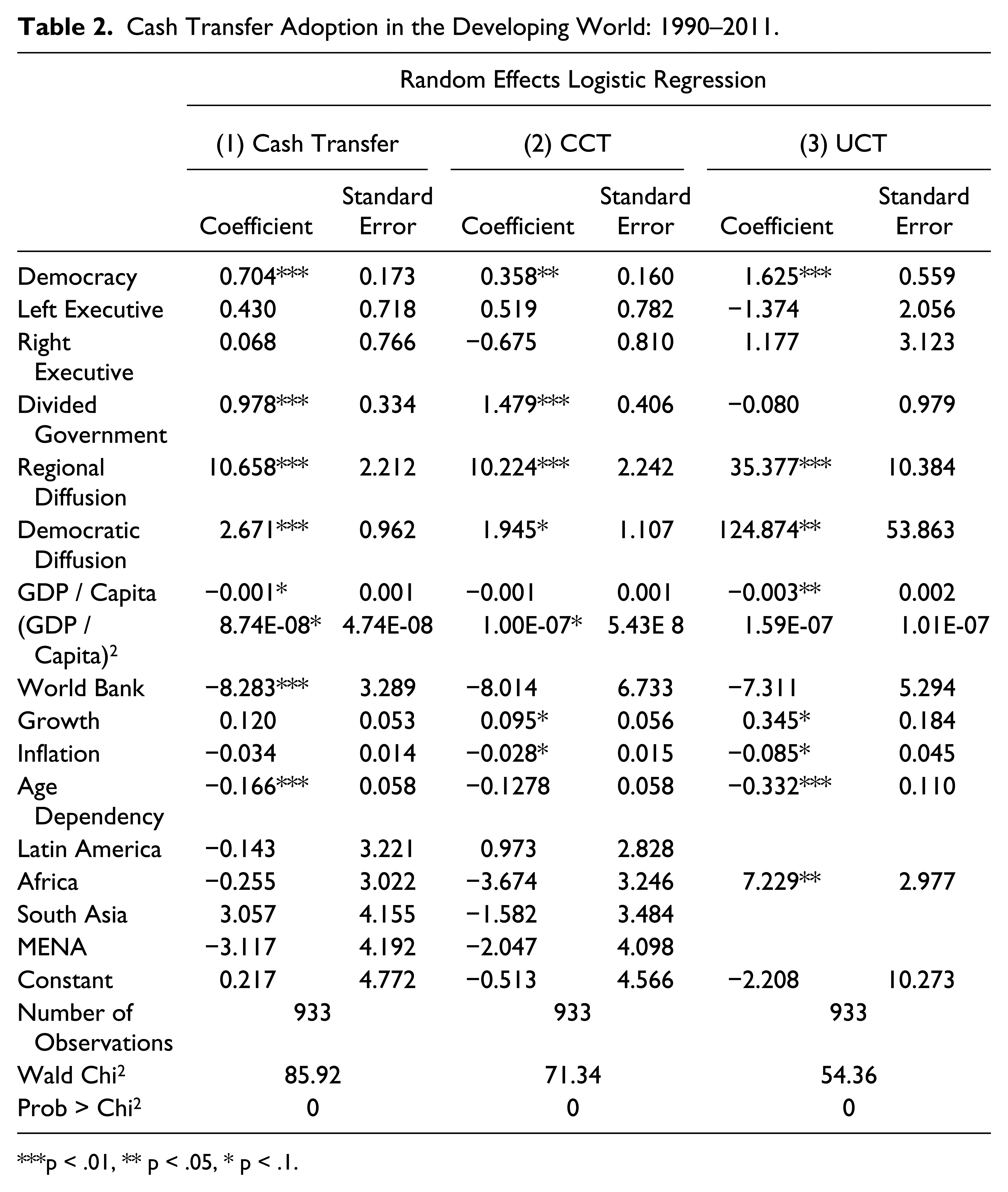
p < .01, ** p < .05, * p < .1.
Looking across the three model specifications in Table 2, we observe first a close correspondence between the predictors of CCT adoption and those of any type of cash transfers (Model 1). This is most likely because CCTs dominate this aggregate category, with thirty-three CCT adoptions, compared to fourteen UCT adoptions. Nevertheless, important differences are apparent in Models 2 and 3, including that the higher-income countries of the global south are more likely to enact CCTs, compared to UCTs. This distinction is likely due to the high fiscal and administrative toll imposed by CCTs on governments that implement them, which make such measures less viable in low-income nations of the developing world. The second key distinction between CCTs and UCTs is found in partisan and democratic politics, where we see a greater role for diffusion from more democratic countries in UCT adoption, compared to CCT implementation, and that divided governments are more likely to enact CCTs, whereas such partisan dynamics play no systematic part in UCT adoption.
Looking more closely at the second model specification in Table 2, we see a strong and statistically significant role for democratic deepening in the likelihood of CCT adoption. The substantive significance of the coefficient is meaningful as well, as illustrated in Figure 3. The Democracy variable ranges from −10 to 10 on the Polity2 index (see Table 3 for full summary statistics.) Holding all continuous variables to their mean values, a one-standard-deviation increase from 0 to 5 implies a more than 200 percent increase in the probability of CCT adoption, from 3 percent to 10 percent, while an increase from the minimum (−10) to 5, which is just below the mean Polity score for a government in Latin America, raises the probability of adopting a CCT from .3 percent to 10.4 percent—a more than tenfold increase. 69 Thus, we see a very powerful result with increasing consolidation of democracy, which suggests that CCTs may indeed emerge from the capacity of poor citizens to hold elected governments accountable for the insecurity and deprivation besetting their societies.
Summary Statistics and Sources.
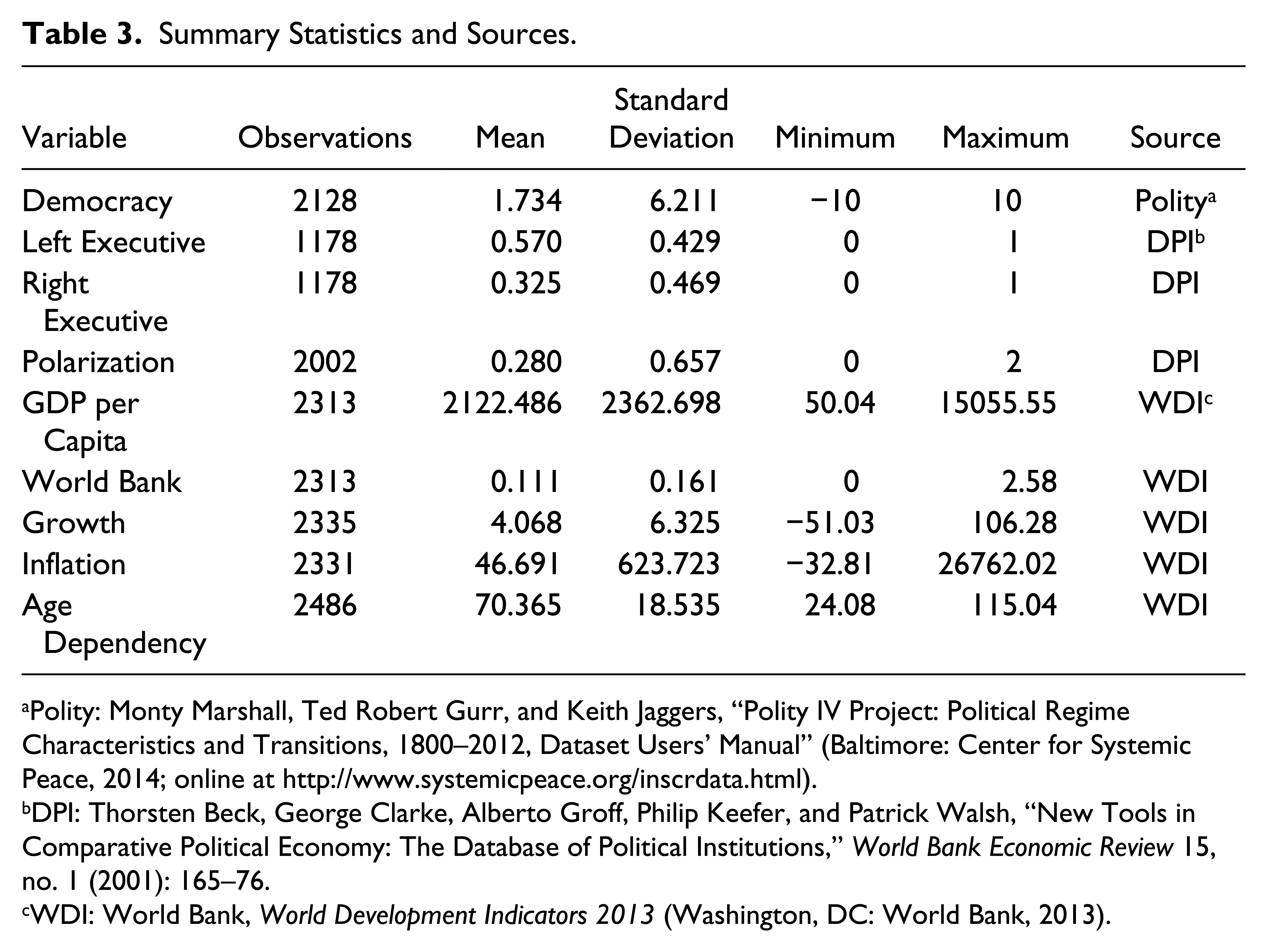
Polity: Monty Marshall, Ted Robert Gurr, and Keith Jaggers, “Polity IV Project: Political Regime Characteristics and Transitions, 1800–2012, Dataset Users’ Manual” (Baltimore: Center for Systemic Peace, 2014; online at http://www.systemicpeace.org/inscrdata.html).
DPI: Thorsten Beck, George Clarke, Alberto Groff, Philip Keefer, and Patrick Walsh, “New Tools in Comparative Political Economy: The Database of Political Institutions,” World Bank Economic Review 15, no. 1 (2001): 165–76.
WDI: World Bank, World Development Indicators 2013 (Washington, DC: World Bank, 2013).
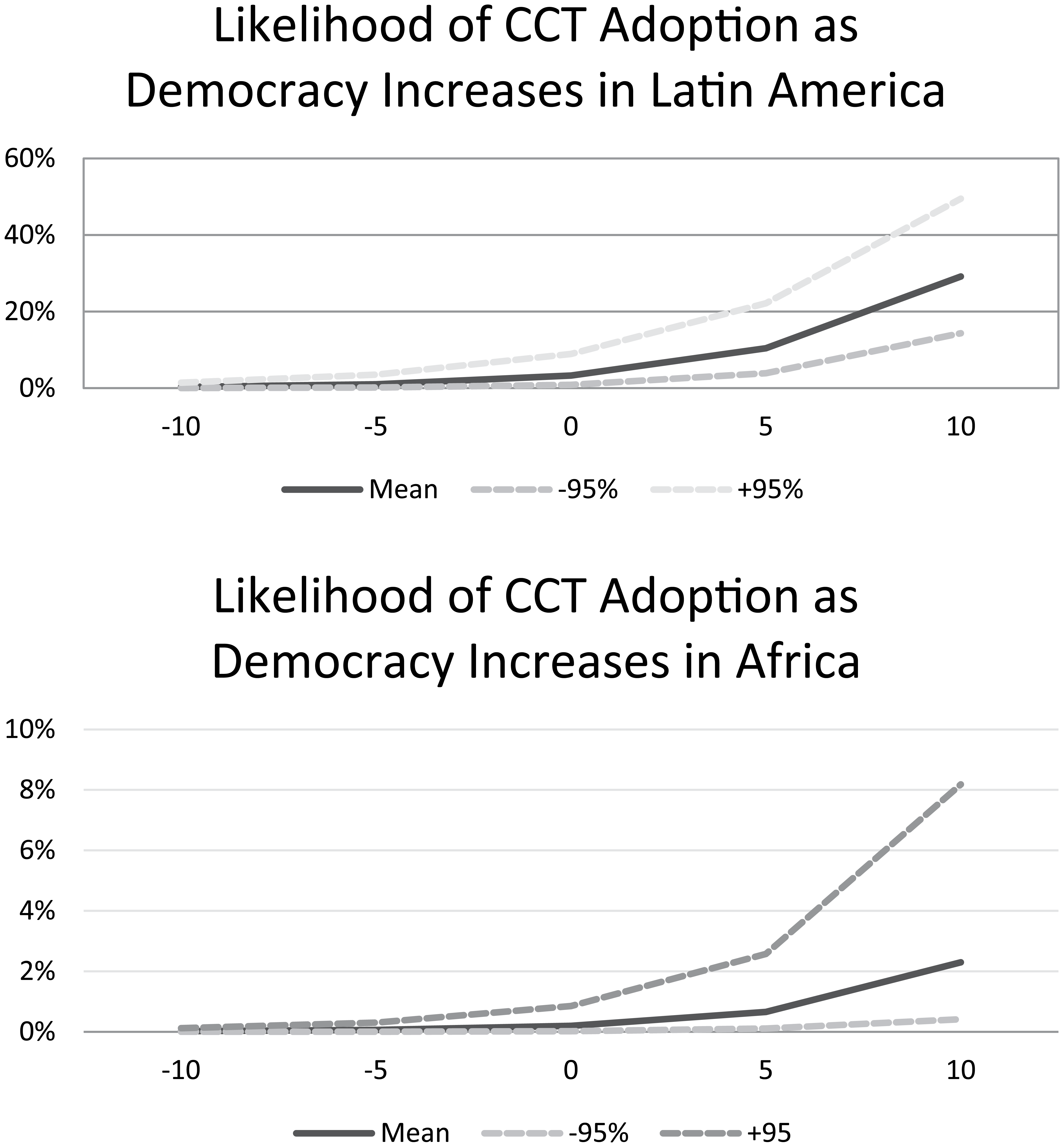
Counterfactual Probabilities of CCT Adoption.
The effect of democratic politics is also evident in the positive and statistically significant coefficient on Divided Government, which indicates that CCT adoption is more likely where governing power of the executive and legislature is more deeply cleft between ideological rivals. In this instance, the substantive contribution of divided government is quite modest compared to that of democratic deepening. Using the same simulation parameters as above, an increase from the minimum level of ideological division, to the maximum, increases the likelihood of CCT adoption by 26 percent in Latin America, and 38 percent in Africa. In the latter region, moreover, a shift from the lowest (0), to the middle (1) score on this index increases the likelihood of CCT adoption by 16 percent in Africa. This finding, along with the lack of significance for the Left and Right Executive variables, points to a fertile agenda for future research to understand how ideological divisions may incline governments in the direction of CCT adoption as a compromise between the ideal policy design for opposing partisan officeholders. Such research with time may also probe whether such ideological polarization attending the adoption of CCTs portends favorably or not for the longer-term durability of the policy model.
Along with evidence that government actors are keeping an eye on their ideological rivals, the analysis indicates that social welfare technocrats are likely to look abroad for information about the viability and appropriateness of—if not the potential status boost associated with—CCT adoption. The argument sketched above posited that interdependence is likely to play a significant role in social protection reforms to the extent that governments are constrained in the human and financial resources that can be devoted to conducting independent analyses of the viability of alternative social assistance measures. The analysis confirms the importance of interdependence in CCT adoption, and indicates that such processes operate through geographic peer channels and, somewhat less powerfully, from more to less democratic countries.
The coefficient on the Regional Diffusion variable, for instance, indicates that as more countries of the same geographic region implement a CCT, the likelihood of subsequent adoptions among regional peers increases. Figure 4 illustrates moreover that the sharpest effect of peer diffusion occurs above the mean in Latin America, and particularly in the standard deviation above the mean value for that region. The influence of regional peers slows down for this region, however, at the highest levels. Whereas moving from the minimum to the mean weight of peer diffusion increases the probability of CCT adoption by more than 100 percent, an increase from the mean to the maximum value on the spatial weight for peer adoption of CCTs raises the likelihood of adoption among subsequent regional peers by 124 percent in Latin America. In Africa, however, this effect is more dramatic, and more pronounced as the presence of CCT models increases in the region, with a more than 400 percent increase in the (admittedly low) probability of CCT adoption when the regional diffusion variable increases from the mean to maximum level.
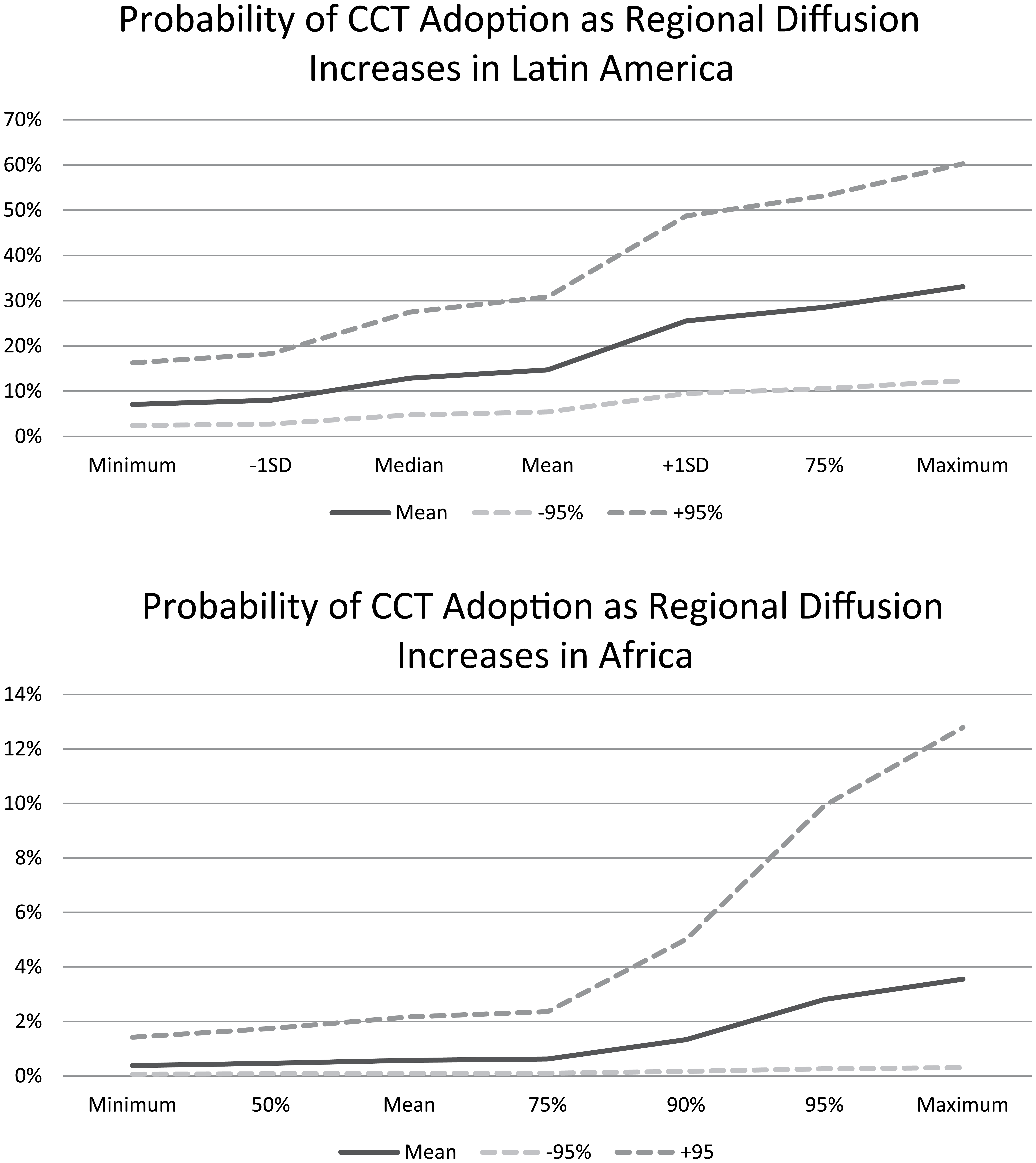
Counterfactual Probabilities of CCT Adoption with Regional Diffusion.
Thus we see that when very few countries have enacted this measure, the uncertainty and high costs associated with the innovation may raise the value of waiting for additional information from abroad before assuming the costs of implementation. Later in the diffusion process, however, as more countries adopt this measure in the region, sharing both institutional ties and roughly similar levels of development, government actors should be increasingly confident in the appropriateness and viability of the measure to move toward implementation. The results for UCT adoption indicate, moreover, that both mechanisms of interdependence hold even more powerful sway in the less developed countries that have been drawn to the UCT model, compared to CCT dynamics. 70
There is no statistical evidence that World Bank lending predicts the location or timing of CCT adoption, even though the institution was a forceful advocate of such measures. This is consistent with expectations that financial resources are not the principal means of influence on social assistance policies. Nevertheless, further research and more data for institutions beyond the World Bank are required to understand how the transmission of ideas and potential exercise of “soft power” by international development institutions have made CCTs attractive to some governments, but not others.
The significance of the coefficients on the domestic macroeconomic variables—Inflation and Growth—suggest that the expansion of social assistance programs since the 1990s have followed the recovery of economies from the debt crisis and recessions that plagued many governments in the developing world in the 1980s and early 1990s. The two wealth variables, GDP per Capita and its square, moreover, show an important trend across the three dependent variables: Whereas social assistance innovations have been adopted in both the least and most developed countries of the Global South, those groups have diverged systematically in the type of policy model embraced at divergent ends of the income spectrum. This distinction makes sense if we assume that, on average, the institutional and financial capacity of a government rises with income, which facilitates the implementation of a CCT, whereas, on average, less developed countries that may lack the capacity to implement and sustain a CCT have been more likely to adopt the unconditional cash transfer design. Indeed, in countries like Brazil and Mexico where well-established health and educational systems were in place at the time of CCT adoption, and social welfare bureaucracies were highly capable of targeting and enforcing the conditions of these transfers, barriers to national implementation of a CCT were substantially lower than we might anticipate from less developed nations. Further analysis through closer research on the cases of CCT adoption may advance our understanding of these bureaucratic capabilities and their impact on the likelihood of adopting and sustaining a CCT program.
Finally, the coefficient on Age Dependency indicates that where the size of the youth population is relatively small compared to the working-age population, the likelihood of adopting all types of cash transfers increases. This is understandable given that a smaller youth population relative to the working-age population reduces the burden imposed on taxpayers of providing the educational and health services associated with CCTs, not to mention the financial benefits for children, who also are typically beneficiaries of UCT programs.
Conclusion
Conditional cash transfer programs are an innovative approach to the perennial challenge of alleviating chronic poverty in the developing world. They are not, however, a typical social welfare program. For along with the progressive redistributive objectives of poverty alleviation, CCTs impose behavioral conditions on beneficiaries that have been criticized by feminists and embraced by more conservative critics of welfare. They are also quite costly and institutionally intensive to design, implement, and enforce, particularly in a developing country context with weak bureaucratic capacity. Although external program evaluations in early adopters have yielded generally positive evidence of the efficacy of the model, the data are highly fragmented and often inconclusive because adequate control conditions to allocate causality in CCT outcomes are scarce. Adopting a CCT in the developing world thus involves both significant costs and a considerable level of uncertainty about the appropriateness and efficacy of the model as a way to build human capital and reduce poverty, given its costs. Its ambiguous partisan orientation, moreover, distinguishes this innovation from social assistance and social insurance programs more generally, and raises important questions for understanding its broad and rapid adoption around the world.
This analysis has provided evidence that the recent shift toward cash transfers for the poorest citizens in the developing world has emerged through the deepening of democracy, improvement in macroeconomic conditions, and horizontal channels of communication across nations that enable government actors to discern whether such design is a reasonable investment of financial and institutional resources for their country. These results suggest that as we move from broad cross-national variables-driven analyses to research more grounded in the domestic politics of CCT adoption, we must pay close attention, not only to the conventional political economics of redistribution, but also to issues such as the dilemmas of implementation and administration. Crucial as well is to discern the more precise role of international actors in the advocacy and implementation of social protection reforms, as the turn toward cash transfers has sharply divided prominent international development institutions. Finally, while social welfare politics in developing countries have more often than not defied the conventional partisan predictions of the European welfare state literature, the politics of CCTs may diverge even further because of the behavioral conditions and human capital objectives associated with this design. Such features locate CCTs in the ideal policy position of neither the left nor the right of the ideological spectrum, but position them instead as a potential compromise between ideological polarities and, further, between the conventional fault lines of class and income that have long defined welfare politics. In these respects, CCTs may chart a new course in welfare politics, opening a fruitful agenda for research into the political as well as social and economic consequences of this policy innovation.
Footnotes
Acknowledgements
I am grateful for comments on an earlier draft from Armando Barrientos, Achim Kemmerling, Marcus Kurtz, Hanna Lierse, Carina Schmitt, Andrew Schrank, Jeremy Seekings, Laura Seelkopf, and the editors of Politics & Society. I am indebted to Bryanna C. Dickson for research assistance. All errors remain my own.
Declaration of Conflicting Interests
The author declares no potential conflicts of interest with respect to the research, authorship and/or publication of this article.
Funding
The author received no financial support for the research, authorship, and/or publication of this article.