







Abstract
Syria’s descent into conflict is receiving growing scholarly attention. On their own, the sectarian and geopolitical interpretations of the Syrian conflict provide us with little understanding of the roots of the conflict. Recent studies have started to unpack the political economic and socioeconomics aspects of the conflict, highlighting issues such as the economic reforms in the 2000s, rising inequality, and climate change. This article aims to contribute to this growing literature by placing these issues in a broader analysis of Syria’s political and economic institutions. It argues that the movement of 2011 should be seen as an unorganized protest movement driven by the consolidation and institutionalization of multisectarian elite rule through the economic reform process that started in the 2000s, following the expiration of the “developmental rentier fix” that had ensured authoritarian stability in Syria in earlier decades.
Keywords
The roots of the protest movements that swept the Arab world In 2011 are still attracting scholarly attention, with recent studies highlighting the role of socioeconomic factors such as population growth, climate change, and unemployment in driving these events. 1 Syria stands out as one of the more complex cases in the region. The outbreak of protests in the southern Syrian province of Dara’a, the expansion of this movement to other regions, and the subsequent transformation of this uprising into one of the bloodiest conflicts in the history of the region have raised important questions about the very rapid shift in a country that was perceived to be one of the “quietest” in the region. 2 The dominant narrative on the conflict has moved quickly into a rather convenient story of sectarian hatred or “artificial colonial borders.” The cornerstone of this argument is that the nation states created in the Middle East in the first half of the twentieth century reflected the decisions of the colonial powers, Britain and France, rather than the identities of people living in these states. These decisions resulted in nation states with multiple religious and ethnic identities and, thus, an inability to build national identities. Syria was seen as a good example of this as an ethnically and religiously mixed country with a majority Sunni population but ruled by what was seen as an “Alawite regime.” 3
Nonetheless, although important in understanding the descent of Syria from a protest movement to a conflict in 2011 and the longevity of this conflict, the sectarian narrative as a primary explanatory factor is flawed theoretically and empirically. Theoretically, the “artificial borders” argument has been challenged in different research disciplines. 4 As Mamdani argues, 5 all borders are artificial, and the idea that a “sorting out” will take place until some sort of “real” borders are reached has no historical basis. Furthermore, this line of argument sees societies in an ahistorical fashion through which decades of post-independence political, economic, and cultural interaction have done nothing to alter old ethnic or religious identities. Third, from a research perspective, this argument is of little explanatory value as it can explain any conflict at any point in time by “digging up” old, real or imagined, religious or ethnic tensions. More specific to Syria, I will argue that it is inaccurate to portray Syria in the 2000s as a majority Sunni country ruled by an “Alawite regime.”
Upon assuming power in 1970, Hafez Al-Assad faced two key interlinked differences with the urban mostly Sunni elite that had ruled Syria earlier. The first was economic, as he and most of the Ba’ath Party came from a poor rural background; the second was sociocultural, as most of this regime came from religious minority groups. These differences created a huge survival challenge for Assad, who aimed to deal with them by providing reassurances to the traditional elite groups on both the economic and the cultural-religious fronts. He also built linkages to certain figures and families within the traditional Sunni business community, although banning the collective independent organization of this community and thus depriving it of political power. This situation slowly developed into what Haddad called a low-trust alliance between the Alawite-dominated state-elite and certain Sunni capital holders. 6 The state-elite, as Haddad argues, needed the entrepreneurship and capital of the business class, while the business class needed state protection to operate. Furthermore, the regime needed the support of certain Sunni business and religious figures to counter accusations by Islamists, particularly the Muslim Brotherhood, that it was an Alawite regime oppressing the Sunnis. The relationship between the state elite and the Sunni business community, however, remained strongly antagonistic, with the state-elite dominant in shaping the terms of this alliance. This relationship also remained largely illegitimate from the perspective of the wider society, with the wealth accumulated through these networks seen as an outcome of corruption. Although this model can explain Syrian political economy until the early 2000s, it is insufficient to explain the shifts of the 2000s, particularly 2005–10, when, under the pressure of the looming end of oil and growing distributional commitments, Bashar Al-Assad launched an economic reforms program aimed at consolidating, institutionalizing, and ultimately legitimizing multisectarian elite rule. The new ruling elite would consist of both the more recent statist, mostly minoritarian, elite and the Sunni elite. The statist elite had controlled political power in the previous regime, but economic reforms and changes to state-business relations after 2005 meant that the new economic elite was en route to controlling economic wealth and military force and to gaining institutionalized collective political power.
It is in this context that the Syrian protest movement of 2011 and the elite response to this protest movement should be analyzed. As has been observed, the movement had a clear class nature; because it has taken place predominantly in poorer rural and rural-urban areas, some researchers call it a “rural and rurban Intifada.” 7 This protest, I argue, should be seen as an unorganized movement against the establishment of an authoritarian elite rule that was leading to socioeconomic decline in major parts of the country, especially rural areas that benefited from earlier Ba’ath policies. Until today, despite some defections, the economic elite in Syria, including the largest part of the Sunni elite, remain supportive of the regime in the conflict. The movement has also been largely Sunni, with the addition of liberals or some leftists from the non-Sunni community. Understanding the dual nature of the movement—rural and semiurban poor on the one hand, Sunni on the other hand—requires viewing the sectarian issue in the historical socioeconomic framework of state formation and evolution in Syria. The rest of the paper unfolds as follows. The second section discusses the political-economic model that underpinned the stable authoritarian rule in Syria in the 1970s, 1980s, up till the 1990s. The next section discusses the challenges to this model beginning in the 1990s, the adjustment process the regime implemented in the 2000s. A discussion of the protest movement and its subsequent transformation into a civil conflict follows, and the last section concludes. A note on methodology is warranted here. In addition to published English and Arabic literature, I draw on more than ten years’ closely following Syrian economic developments, from my study of economics at the University of Damascus 2000–2005, to my work as a part-time journalist on a semi-independent weekly economic newspaper in Damascus, Al-Iqtisady, as an economic assistant at the European Commission Delegation in Damascus, and as a consultant to a leading economic consultancy office in Damascus. All these jobs required close engagement in discussions and debates around economic policy in Syria, particularly the economic reforms process of 2005–10, which I followed very closely. These roles entailed visits to economic sectors in Syria such as factories, smaller enterprises, government officials, and economic analysts. Afterward, throughout my academic studies in the United Kingdom, I continued to follow Syrian political and economic developments. I build on these experiences and a number of more recent discussions on specific issues related to this paper with a number of people familiar with these issues.
Authoritarian Stability in Post-Independence Syria: The “Developmental Rentier Fix”
Following independence in 1946, Syria passed through a rocky period that made it one of the most unstable countries in the Middle East. 8 Similar to many newly independent developing countries, post-independence instability was driven by multiple internal and external factors. A key factor was the developmental-distributional challenge-conflict that emerged. Political power in Syria at independence was controlled by land-owning feudal elites, many of them Sunnis with Turkish roots living in the larger cities, and by an urban elite composed of traditional families, merchants, a few industrialists, and a small professional class, in addition to tribal chiefs. Independence created a huge challenge to such a political system as a result of the pressure to build state institutions and infrastructure on the one hand and to redistribute wealth on the other. The pressure was intensified by regional politics and by the Arab-Israeli conflict, which created a strong institution-building demand on the new Syrian state, including military spending. Following independence, distributional conflicts, particularly between traditional landed elites, new industrialist elites, and a range of new political movements, dominated the political scene. 9 These conflicts were manifested in the contentiousness of such issues as land reform, labor reform, nationalization of private enterprises, and the role of the state in the economy. 10 The landed elites wanted to maintain a largely feudal system, whereas the rising industrial elite wanted to create more modern capitalist institutions and a capitalist working class, which would lead to a boost of domestic consumption. 11
In the face of this divided economic elite, a range of “antiestablishment” pro-redistribution movements were gaining popularity, including Arab nationalist, socialists, communists, and later Nasserites, challenging the political power of the economic elite. Further, these class conflicts were intertwined with a religious and cultural conflict. The land-owning and urban elites that dominated political power in Syria during this period were largely Sunni Muslim, in addition to Christians mainly from Damascus and Aleppo, and other cities such as Hama. The poorer rural population, on the other hand, consisted of both Sunni Muslims (in areas such as Dara’a in the south, Deir Ezzor and Al-Hassakeh in the north, in addition to rural Damascus and rural Aleppo) and non-Sunnis, mainly Alawites, in the coastal mountains areas in Lattakia and Tartous and Druze in the southern province of Al-Swieda. Both groups are offshoots of Islam with unique religious and cultural identities due in part to their geographical concentration. Although the two groups are minorities in a national sense, in both the coastal mountain (not the coastal cities) and Al-Swieda, they represent dominant majorities. Historically, these groups were deprived of political and economic power, which was concentrated in urban, mostly Sunni, centers. Their generally antagonistic relationships with the urban Sunni community reflected both class and sectarian factors; and their relationship with the state, hostile and often violent under the (Sunni) Ottomans, changed during the French mandate as they were widely recruited into the military, a fact with important implications in subsequent decades. 12 Overall, the Alawites and Druze communities were marginalized both socioeconomically (similar to rural Sunnis) and also religiously and culturally. The new socialist-leaning political movements gained strong support in those communities, through both the appeal of the economic redistribution message and the focus on building a secular nationalist identity in which all citizens were equal. Support was particularly strong for the Ba’ath Party, which called for socialism and Arab nationalism. 13
As the socialist movements entered into the nominally democratic political process, key elements within these groups saw little hope of reversing their position through the political process, since the ruling elites controlled the political arena. Alternatively, many within the socialist movements focused on the military, dominated by recruits from rural backgrounds, with significant percentage from minoritarian backgrounds as well. 14 After a period of instability and a number of military coups, Nasser’s rise in Egypt on a similar socialist platform strengthened the position of the socialist parties in Syria and was translated into a push by these parties and the military for a union with Egypt under Nasser to create the United Arab Republic (UAR) in 1958. 15 Despite its short life, the union with Egypt had important ramifications for the future of political and economic institutions in Syria. During the union, widespread land reforms and nationalization of private enterprises were carried out in Syria. Moreover, the union with Egypt was a turning point for Syrian political institutions, which transitioned from a parliamentary system to a highly centralized presidential system in which wide-ranging legislative and executive powers were given to the president, Nasser. Political parties, with the exception of the Communist party, self-dissolved as Nasser’s precondition for the union. Following the breakup of the UAR in 1961, debates around the key economic issues in Syria returned to the forefront. The old elite attempted to reverse policies implemented during the union, 16 which triggered political instability, intervention by the military, and a new government that attempted to restore nationalization and land reforms in part. This political instability lasted until 1963 when he Ba’ath Party used its power in the military to mount a coup and assume power. The new regime introduced a one-party constitution and reimplemented and expanded the nationalization policies. Reaction from the urban elite included a number of strikers in the large cities. In addition, unity within the new regime was weakened as different factions competed for power. Factions formed along sectarian or regional identities often due to the role of family and clan networks in maintaining trust. As Van Dam details, successive purges took place through which a group of Alawite officers managed to take control of the military and the party. 17 Initially, the strongman of the this group was Salah Jadid, who led the period known as the “radical Ba’ath,” during which the regime adopted more radical socialist economic policies in Syria and stronger rhetoric against “reactionary” Arab regimes. Jadid derived his position mainly from the party apparatus, whereas the military wing was largely controlled by the minister of defense, Hafiz Al-Assad. The economic pressure that emerged from the radical Ba’ath policies, the impact of deteriorating relations with neighboring Arab countries, and the 1967 defeat by Israel, weakened Jadid’s position and allowed Assad to oust him in 1970.
Assad started consolidating his position at once. 18 A new constitution affirmed the role of the Ba’ath Party as the “leading party in state and society” and gave the president very wide legislative and executive powers. Overall, Assad aimed at representing a more moderate face of the Ba’ath both internally and externally. 19 He did not reverse earlier economic and social policies, including land reform and nationalization. However, he underplayed the “class struggle” rhetoric by providing reassurances to the older elites and promoting a “pluralist” economic model in which the state and the private sector would drive development jointly. 20 Externally, although he maintained Syria’s overall position, he adopted a more cautious approach to foreign policy, generally respecting the rules of the game of regional politics. Assad swiftly restored relations with Arab countries, including the oil states in the Gulf. 21
Nonetheless, to maintain the stability of the new regime, Assad had to deliver on the socioeconomic front, especially in rural areas that were the main constituency of the Ba’ath party. During the 1970s in particular, Assad expanded the state-led developmental model in Syria. This included large investment in state-owned enterprises; large public infrastructure projects such as dams, roads, and energy projects; investments in agriculture; a large expansion in spending on health and education; and a large electrification program in rural areas. 22 It also included the gradual expansion of a large subsidies system that covered basic food products, energy, agricultural inputs, fertilizers, and machinery. These changes ushered in a rapid expansion in agricultural production (see Figure 1).
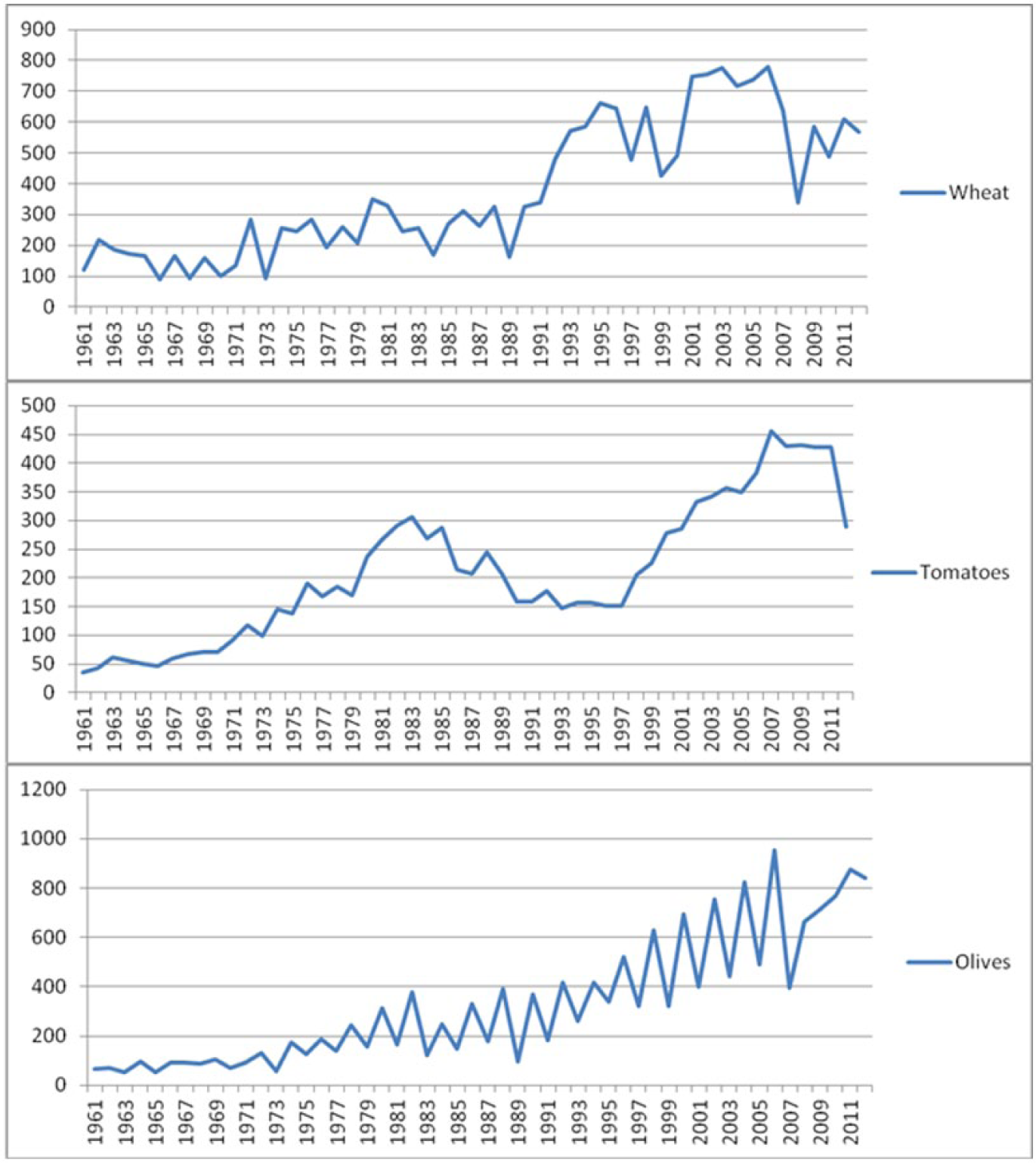
Gross Production Value of Selected Agricultural Products (Constant 2004–6 US$ Millions).
Although these investments were geographically uneven and favored areas seen as more important for the regime, 23 they did create a unified internal market and had important positive impacts. Through this expansion of the state, the regime started to address the developmental challenge facing Syria, particularly in the historically impoverished rural areas. The investments also strengthened the political control of the regime. New civilian and military public sector jobs were largely given to people from rural areas, with a high percentage from Assad’s Alawite community. The state became an important avenue for social upward mobility and a number of “luxury” goods, especially cars, became attainable mainly through the state system. The state also became an avenue for a range of illegal activities that generated rents for military and security officers and government officials, most of whom were from poor backgrounds. Areas of illegal activity included government procurement, smuggling networks of protected goods such as electronics and cigarettes, and selective business permits in some sectors. Gradually, individual members of the Sunni middle class were incorporated into this system as partners or front men to regime elite, although, as Haddad points out, without granting political or economic power to the non-state business community as an organized group. 24
A crucial factor enabling Assad to address developmental challenges with little political cost was his ability to disconnect such policies from the redistributional conflict that had dominated Syria’s political economy in earlier decades. Starting in 1968, following the completion of the pipeline that connected producing regions in northeast Syria to the port of Tartous on the Mediterranean, Syria became an oil exporter, and growth in oil rents was subsequently rapid (Figure 2).
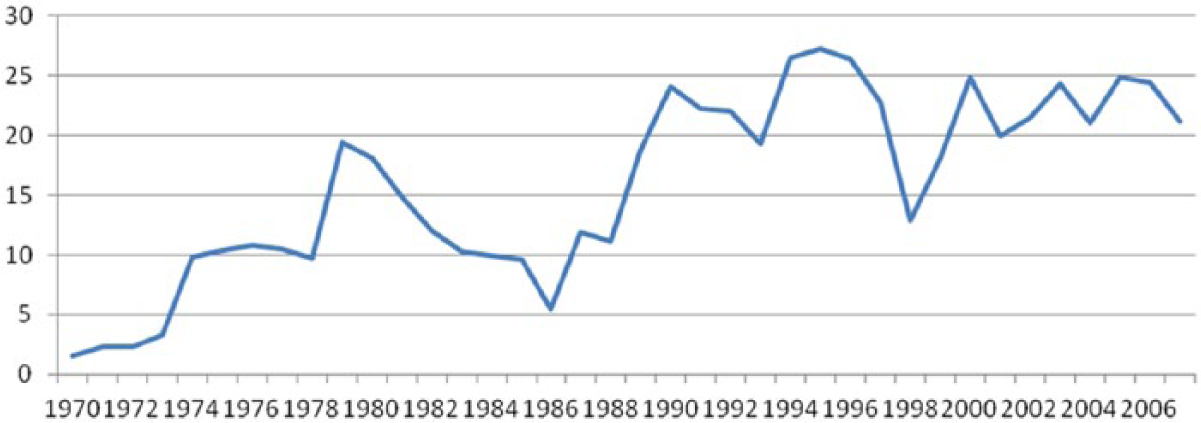
Oil Rents as a Percentage of GDP.
A second source of external rents to the Syrian state in this period was official assistance aid. Assad’s rapprochement with the oil-exporting Arab states was translated into an aid dividend during the 1970s, with annual aid inflows increasing from tiny amounts in the 1960s to US$ 3.4 billion in 1974 and US$ 5.6 billion in 1979. Aid started to decline from the beginning of the 1980s but remained a relatively important source of funding until the later years of the decade (Figure 3). In addition to oil and aid, debt represented a third source of funding to the state, especially loans from the Eastern bloc (Figure 4).
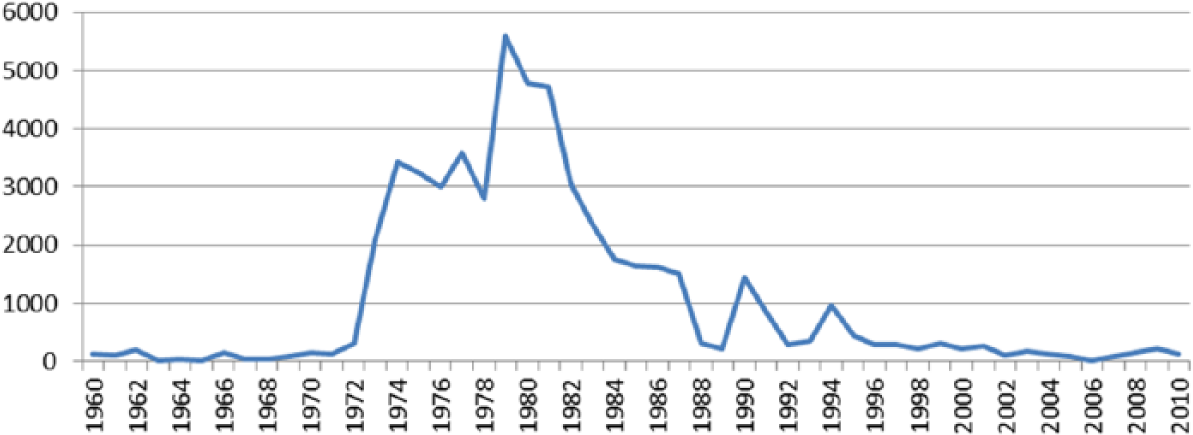
Official Development Assistance and Aid (Constant 2011 US$ Millions).
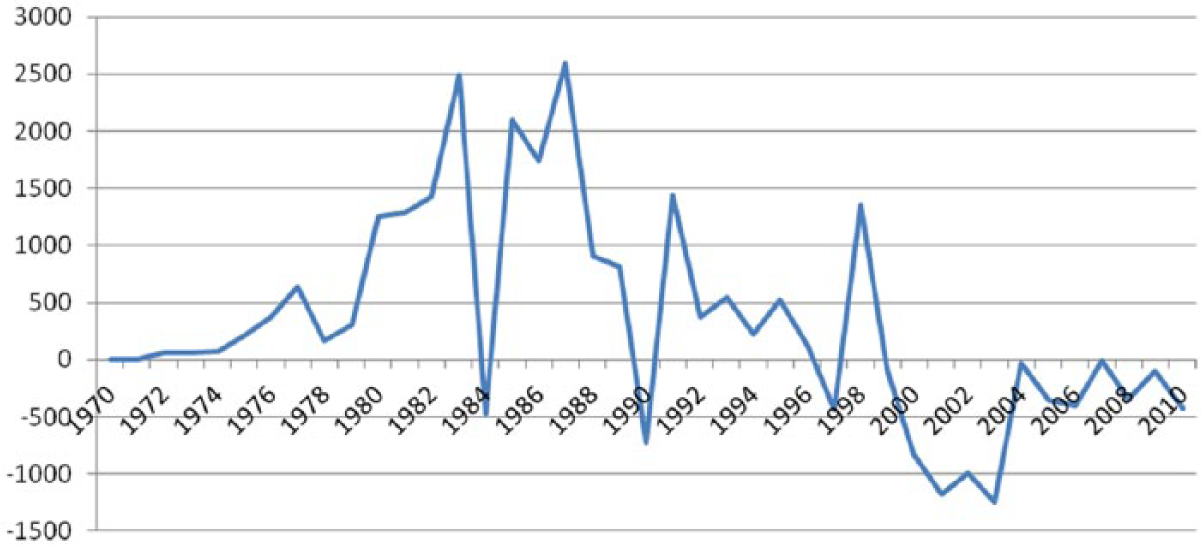
Net Annual Flows of External Debt (US$ Millions).
Through this process, Syria shifted toward rentier economic institutions that funded a relatively large distributive system based on extractive internal sources (oil and other extractive industries), in addition to foreign aid and, to a less extent, debt. On the distributive side, the government’s current and investment spending played an important role in the economy as state institutions expanded, including public sector employment, absorbing a relatively large part of the labor force. 25 Health services were provided at no charge and public health centers expanded in rural areas. Education was free including university education; the state guaranteed university or college admission to anyone who completed high school (Table 1). Furthermore, a relatively generous energy and food subsides system was put in place. The agricultural sector received state support through guaranteed purchasing of “strategic” crops; subsidies for fertilizers, energy, and machinery; and exemption from taxes. The growing military and security apparatus provided jobs and profiteering opportunities. While surpluses from state-owned extractive enterprises, oil in particular, were the chief source of state funding, some state manufacturing enterprises also provided surpluses as a result of trade protections, although the nonextractive state sector generally failed to become a substantial source of state revenues. 26 Overall, it can be argued that the expansion of the Syrian state under Assad coincided with a decline in the taxation capacity of the state. 27 Low effective taxation became part of the social contract with the economically well-off and the middle class, 28 with the difference between nominal tax rates and effective tax rates becoming a tool used by the regime for political control. 29
Selected Indicators of Health and Education.
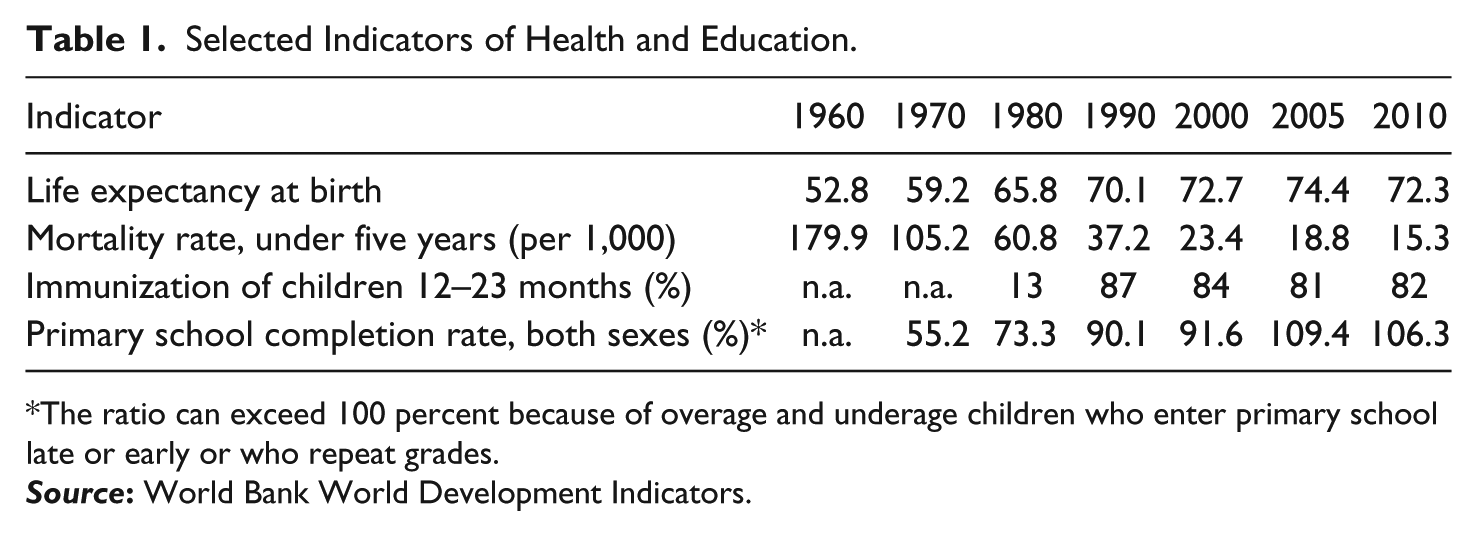
The ratio can exceed 100 percent because of overage and underage children who enter primary school late or early or who repeat grades.
These changes placed the Syrian economy on a low-taxation path that continued in subsequent decades. Figure 5 shows that Syria had a lower share of tax revenues to GDP than non-oil-exporting countries in the region. However, by excluding oil taxes from the Syrian budget (shown as the upright square on the graph), Syria moves significantly closer to the oil-exporting countries in the region when oil rents and tax revenues are compared to GDP. Syria is closer to countries such as Iran, Bahrain, and Oman than to non-oil-exporting countries such as Lebanon, Tunisia, Morocco, Jordan, and Israel.
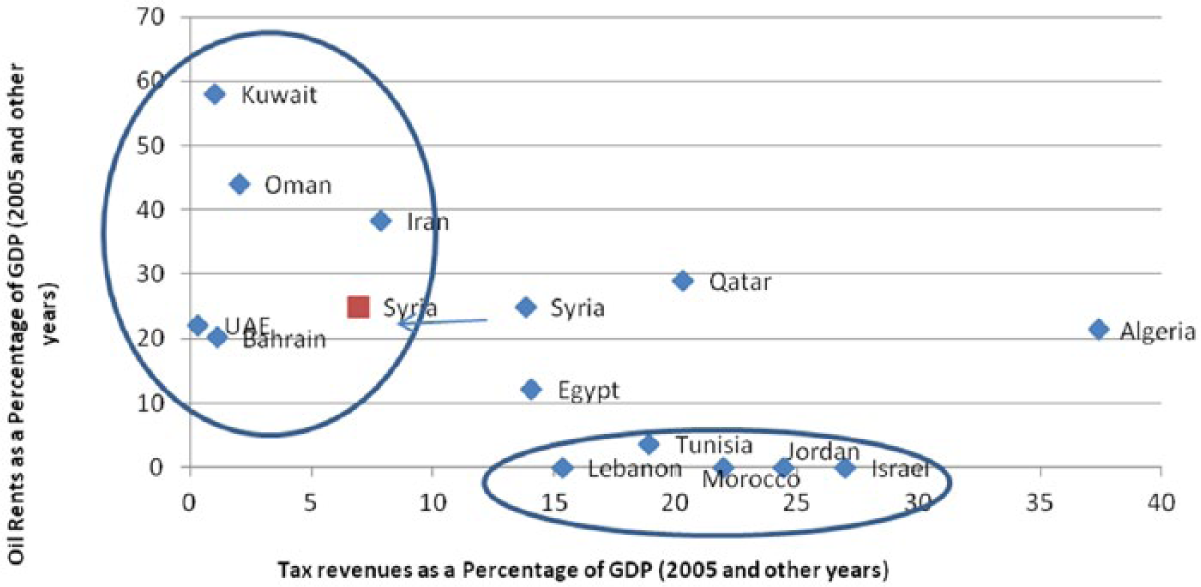
Syria’s Tax Revenues and Oil Rents, Middle East and North Africa Countries.
This low taxation/high distribution system, combined with strong repression on dissent, enabled Assad to achieve what can be described as temporary societal demobilization. 30 Political parties were completely banned earlier, but Assad allowed some operate through the Ba’ath-led “progressive national front,” although the role of this front or the parties within it was largely to allocate public sector jobs, including ministers and members of parliament, and other related benefits, such as cars. These parties had very little, if any, grassroots-level political activity. Trade unions, student unions, women’s organization, and other groups, were similarly depoliticized by attaching them to the ruling party and by having their top leaders selected by the party and the security apparatus. Most of the old large-scale economic elite had already left the country by the time Assad reached power. Some smaller Sunni businessmen entered relationships with the state elite that allowed new opportunities to accumulate capital and benefits from the gradual economic liberalization that began in the late 1980s. The small private sector was not allowed to organize outside state control. 31 A stable economic elite was yet to appear during this period. 32 That individual wealth, especially among the state elite, was generally seen as illegitimate and a result of corruption limited consumerism and display of wealth.
This system, however, was unsustainable politically and economically. Politically, societal demobilization was temporary, a result of the unstable recent history of Syria. It was also “natural” in a regional context only when other Arab republics (particularly Iraq and Egypt) had similar regimes. Economically, without new oil discoveries and with rapid growth in population (between 1970 and 2011, the population of Syria increased from 6.1 million to 22 million) and rising consumption of domestic energy (at subsidized prices), Syria’s fiscal position was deteriorating fast (Figure 6). By the 2000s, Syria had one of the highest rations of food and energy subsidies to GDP in the Middle East and North Africa. 33 Further, the end of the Cold War represented a major challenge to this system with regard not only to aid and debt but also to manufactured exports to East European markets.
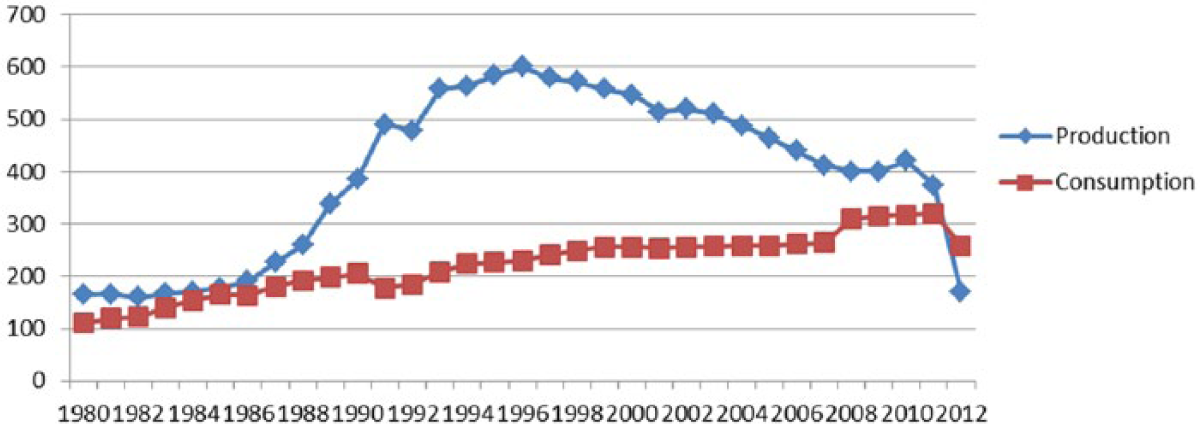
Syria’s Production and Consumption of Oil (Barrels/Day).
These factors led to the economic reforms Hafez Al-Assad adopted in the 1990s, particularly an investment law that allowed and encouraged private investments. 34 The reforms, however, were not very effective given their small scale, the lack of political trust from the private sector, and the limited contribution of new investments to the budget due to tax incentives. More important, perhaps, the issues that dominated the agenda of the regime in this period were the peace negotiations with Israel and the succession to Assad as his health deteriorated.
Life after Oil: The Failed Attempt of Adjustment in the 2000s and the Consolidation of a New Economic Elite
When Bashar replaced his father in 2000, it was clear that economic changes were needed if the regime was to maintain its power. By 2005 and 2006, Syria’s non-oil budget deficit stood at 22.7 percent and 27.4 percent, respectively, of GDP and Syria was expected to become a net oil importer by the end of the decade.
35
Reflecting that most of the agricultural production was for domestic consumption, Syria had a highly undiversified exports structure with minerals, mostly oil, accounting for almost 70 percent of exports (Figure 7). With declining oil reserves, Syria was becoming an oil-based political, economic, and social system but without the oil. Parts of the regime were aware of these trends. In 2004, Nibras Al-Fadel, an economic adviser to Assad, told the Arabic newspaper Al-Hayat:
The factors that make economic reforms in Syria inevitable are mainly internal. . . . the first issue is the pressure on the labour market which is not going to subside for the next ten years at least. Absorbing this pressure will require a growth rate of 6 percent at least which is double the current rate. At the same time, the exhaustion of oil reserves and Syria becoming a net oil importer will mean, with other factors remaining equal, a drop in GDP, living standards, and in the revenues of the state. Thus, the current economic trends are going in a direction that is opposite to what is needed and this is a time-bomb in the heart of the Syrian economy and society. We only have few years to dismantle this bomb.
36
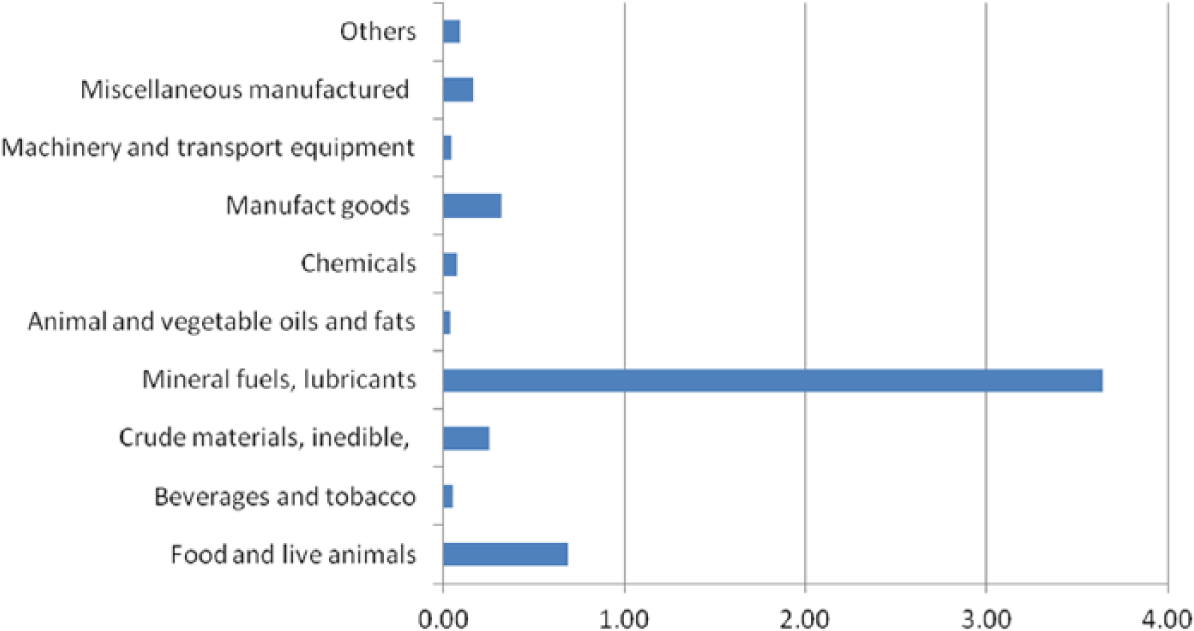
Syria’s Exports by Commodity Group, 2004 (US$ Billions).
For a short period in the early 2000s, the regime allowed “political forums” in houses of independent society figures and promoted, in Syria and abroad, the image of Bashar as a reformer who was being hindered by the “old guard” of the regime. This very small political space was, however, closed quickly. The regime decided to focus on administrative and economic reforms instead with Assad highlighting in an interview with Der Spiegel in 2005 that “poverty is a far greater concern than the outlook for a democratic constitution” and that “freedom and democracy are nothing but instruments, just like stability. The goal is called progress and growth. Anyone who puts freedom ahead of stability is hurting growth,” 37 In 2005, at the Ba’ath Party conference, Bashar consolidated his political power and launched a new economic vision for Syria. The country was to undergo a transition process into a “social market economy.” 38 To lead this transition, Assad promoted Abdullah Al-Dardari, a technocrat appointed in 2003 as head of the State Planning Commission, to the position of Deputy Prime Minister for Economic Affairs. Over the second half of the 2000s, Al-Dardari became the key economic figure in Syria both in policymaking and in promoting the process of economic reform in Syria and abroad. The appointment of Al-Dardari is revealing in terms of his personal background: he was not a member in the Ba’ath party and comes from a Sunni upper-middle-income family from Damascus.
The transition to a social market economy consisted of a number of key macro policies: limiting the socioeconomic role of the state, triggering economic growth through promoting private investments, attracting foreign direct investments, and liberalizing trade. The government began to adopt measures to limit the overall socioeconomic role of the state. Energy subsidies, fertilizer subsidies, food subsidies, crops prices guarantee, guaranteed employment for some university graduates, were all either eliminated or reformed. Other areas of state spending were also brought into the public debate with the aim of changing them eventually. For instance, free university education remained in place, but the government introduced alternative fees-based mechanisms and encouraged the opening of private universities. Similar trends were seen in healthcare, with a push to charge fees for services. The government also became far more vocal about the state-owned sector, especially companies that were making losses but were kept mainly because of their role in employment. The growth in public employment was restricted, and “surplus” public sector workers surfaced as an issue of debate. Privatization, an absolute taboo earlier, was also brought into the public discussion, not by the government directly but by economists and experts close to elements of the ruling elite.
At the same time, the government implemented a range of policies that aimed to boost private investments and to integrate Syria into the global economy. These policies included a comprehensive trade liberalization process and a free trade agreement with Turkey in 2004 in addition to negotiating with the European Union for a free trade agreement. As a result, Syrian non-oil imports increased from US$ 4.3 billion in 2001 to US$ 14 billion in 2010 (Figure 8) with a rapid increase in garments and textiles, simple electronics, food products, shoes and leather products especially from Turkey, China, and Arab countries. Although the war in Iraq played an important role in maintaining some degree of overall trade balance, as Syrian exports to Iraq increased dramatically following the war, but the impact of this boon was short-lived. Syria’s non-oil trade deficit increased to US$ 8.4 billion by 2010, around 15–20 percent of Syria’s GDP.
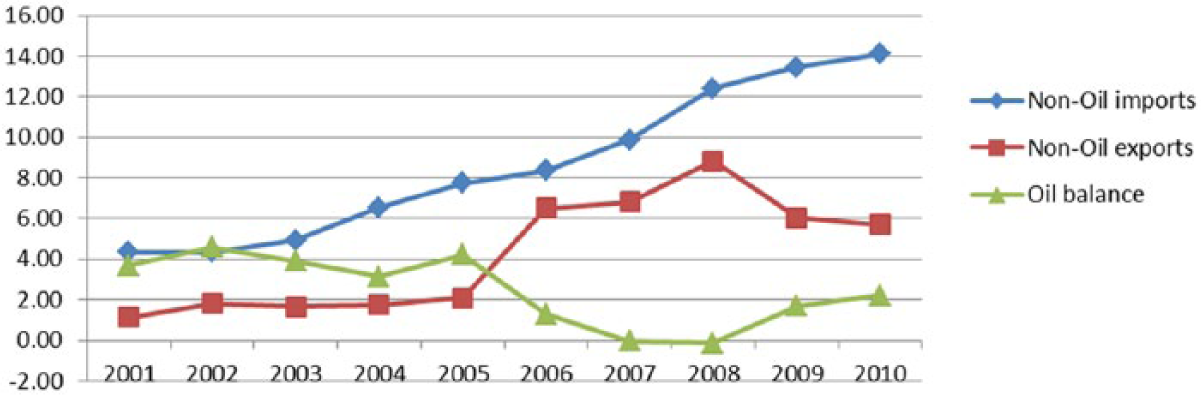
Syria’s Non-Oil Exports and Imports and Oil Trade Balance (US$ Billions).
These economic policies opened up more opportunities to private investors. New laws opened sectors such as telecommunications, banking, insurance, real estate development, and education to private investment, followed by the launch of the Damascus Stock Exchange in 2009. The government made a strong attempt to attract foreign investors, particularly from the oil-rich Gulf States. The dramatic increase in oil prices in the 2000s (up to 2008) meant that these countries had capital surpluses and foreign direct investment to Syria did indeed increase in the 2000s. The majority of these investments went into tourism, real estate development, leisure activities, and financial services. These investments often included providing state-owned land at very low prices or help from the authorities to move residents. An example of this pattern was the “Eighth Gate” project by the Dubai-based real estate developer Emmar and a Dubai-based group of Syrian businessmen called Invest Group Overseas. The US$ 1.3 billion project on the outskirts of Damascus was supposed to transform 300,000 square meters into luxury residential and retail area that would become, according to the company, a “thriving commercial hub that promotes entrepreneurship, a financial nerve centre that supports growth, a tourist destination that powers the economy and a residential getaway for connoisseurs.” 39 The area where the Eighth Gate was planned (Old Damascus has seven gates; hence the name) was located, an area called Yaafour, on the highway connecting Damascus to Beirut, emerged as a preferred area for the wealthy residents of Damascus particularly the regime elite who built huge gated villas with tight security measures in the area. A more politically controversial project was announced in the central city of Homs. “Homs Dream,” sponsored by the governor of the city, a personal friend of the president, was a joint venture with the Qatari company Addiyar and called for the complete rebuilding of the city center to transform it into a Dubai-style “modern” center. 40 One of the unbuilt areas in the city would have been transformed into “golf courses, tennis complexes, basketball and football pitches, commercial and residential towers, hotels, and restaurants,” as it was announced. 41 Similar projects often with partners from Qatar, the UAE, Kuwait, and Saudi Arabia, were announced by the government in Damascus, Aleppo, Homs, and Lattakia. Government spending on infrastructure reflected the bias toward the areas where such projects will be located. In Damascus, investments increased in the rich areas of the city such as Mazzeh, Dummar, Kafar Souseh, Malki, and Yafour, including traffic tunnels, improvements to roads and pavements, “beautification” projects including tree-lined streets, green lawns (highly unsuitable to hot summers in the semiarid climate of Damascus), new multicolor night lighting systems, among other accessories. In the absence of investments in public transportation, such spending favored car owners. Whereas cars were a state-controlled “luxury” good in earlier periods, the liberalization of imports led, between 2003 and 2007, to a 122 percent increase in the number of private cars in Syria—although from a low base—almost half in the city of Damascus. At the same time, the number of public transport buses did not increase. 42 Controlling the exclusive dealership rights for key car companies became an important area of competition for the new economic elite.
Trade liberalization, growing foreign investments, in addition to rapid increase in remittances from Syrians living in the Gulf, 43 led to rapid transformation in Syria’s urban centers and middle-income areas. New “Western” brands of clothing and electronics popped up in different parts of the main cities while new very expensive cars became a normal sight in the affluent parts of these cities. “Syria no longer looks like Cuba or North Korea,” the Syrian journalist Ibrahim H’medi wrote in 2005 highlighting the new lifestyle in Damascus and the growing contradictions with the rest of Syria. 44 This liberalization process also led to a rapid expansion of a new young professionals class in middle income and urban areas with consumerist lifestyle not seen before in Syria. Most of my cohorts at the University of Damascus were hired by new private banks and financial companies, telecommunication companies, or real estate development firms. While not all of them were from middle income background (as education was free), family name and connections played an important role in most cases, with these jobs going to well-educated people mostly from urban middle-income backgrounds. Their salaries were significantly higher than those of the public sector or other “traditional sectors” and were sometimes comparable to salaries in the Gulf States. The social norm of young people staying in their family homes until marriage meant that this new group had sizable disposable income for leisure and shopping.
Political control over the new urban economic boom remained a concern to the regime both for self-enrichment and to prevent the emergence of an elite that is not linked to the regime. 45 As a result, regime insiders were at the heart of the new business boom and the first to benefit from these opportunities. The key figure in this process was Assad’s cousin, Rami Makhlouf, who became a symbol for Syria’s economy in the 2000s. Rami emerged onto the business scene in the early 2000s, with his company Syriatel, which was granted one of only two licenses to operate the mobile phone network in Syria, and subsequently through a duty-free company. Throughout the 2000s, Rami expanded his business interests, with investments in wide range of sectors, to become the business face of the regime. Although Rami and similar regime figure were the key beneficiaries of the new economic opportunities, the regime worked to attract members of the Sunni elite and middle class, including those who left Syria during the Ba’ath era. To consolidate the new economic elite under the political control of the regime, Assad supported the creation of holding companies that would bring Syrian investors into joint projects. Two companies, Syria Holding and Cham Holding, were created. The larger of the two was Cham Holding, which brought together seventy of the most prominent businessmen and businesswomen in the country. The list of owners almost reads like a “who’s who” list for the new economic elite in Syria. Makhlouf’s share in the company was 51 percent and the other investors controlled 49 percent. Makhlouf promised that all his future investments would be through the holding company. 46
It is important to note that this new economic elite and the young professional class created by economic liberalization was largely multisectarian and included Sunnis, Alawites, and Christians. Whereas earlier periods of the regime had been characterized by a very low level of trust between the minoritarian, mostly Alawite, state power holders and the urban, mostly Sunnis, holders of capital, 47 Bashar worked to bridge the two elements together. The appointment of Al-Dardari and the courting of Syrian expatriates, many of whom are Sunni, also reflect this effort. In addition, many businessmen who were earlier used as “fronts” by regime insiders had built independent portfolio of investments. By the 2000s, the list of leading businesses in the country included Sunnis such as Emad Ghraiwati, Mohammad Hamsho, Nabeel Kuzbari, Tarif Akhras, Fares Chehabi, Khalid Hboubati, Mohamad Al-Shaer, Kamel Sharabati, Mortada Dandashi, Zuhair Sahloul, the Shallah family, the Tlass family, the Joud family, the Anzrouti family, Daa’boul family, Christians such as Essam Anbouba, the Yakoubian family, Hani Azzouz, Omar Karkour, and the Alawite families Assad, Makhlouf, Shalish, and Suleiman. Similarly, the managerial class in these enterprises were religiously mixed. Some of the statist elite of the Ba’ath era were incorporated in the new elite while others disappeared from the scene. Nonetheless, within the economic elite, a narrower group consisting of the president’s family network had stronger power because of its control of the military and security apparatus, through which it was capable of shaping the economic map, reconfiguring the economic elite, and extracting rents from the rest of the economic elite. Other businesses loathed the idea that they had to play by rules designed by what they considered to be nouveau riche families (a number of WikiLeaks letters show that some businessmen complained to US embassy staffs 48 ). There is little evidence, however, that such criticisms led them to withdraw from this new elite, considering the opportunities and protection an alliance with the ruling families in a highly authoritarian regime can bring, especially in the context of economic liberalization.
Furthermore, sectarian identities within the elite were becoming increasingly blurry. Unlike the old generation of the regime, the new generation, including Bashar, went to the same schools as the Damascus elite and spoke with an accent closer to that of the Damascus elite than of the coastal mountains. By the 2000s, the children of the second generation went to new international English-speaking schools, and interfaith marriages were becoming more common. The new elite had a clearly “globalized” life style and aspirations. In the second half of the 2000s, bars and dance clubs opened all over Damascus. The government also relaxed the rules around alcohol sales and in 2010 granted a permit for the first gambling club in Damascus to offer games such as blackjack, roulette, in addition to slot machines. The new elite were also very keen on joining the personal and financial networks of the global elite. Many of Makhlouf’s companies, including his flagship mobile operator, Syriatel, were owned through companies registered in tax havens, particularly the British Virgin Islands. In 2009, a delegation of mainly Wall Street investors that included money managers from Citigroup, Morgan Stanley, Legg Mason Capital Management, Traxis Partners, and Maverick Capital traveled to Syria and met with Assad, who “blew the group away,” as Barton Biggs, managing partner of the New York hedge fund Traxis Partners and the main organizer of the trip, told the Wall Street Journal. 49 The picture was enhanced by growing numbers of Western tourists visiting Syria. The presidential couple aimed to represent the image of this new globalist multisectarian elite and middle-income class to both the domestic and the international audience. Assad’s marriage to Asma Al Akhras, from a Sunni upper-middleclass family, born and raised in London, was an important part of this identity. During the 2000s, departing from the very limited public role of presidential spouses in Syria earlier, Bashar and Asma were actively promoted in the country as the face of a new modern secular multisectarian Syria. Bashar downplayed his military image and promoted a “Westernized” image instead. Unannounced, alongside his wife, Bashar would visit the Damascus Opera House, opened in 2004, to watch the Syrian Philharmonic Orchestra and guest musicians. Pictures were published of Bashar and Asma cycling in casual wear with their children. The couple frequented high-end restaurants in Damascus without the usual intimidating security presence people had come to expect from the regime. Bashar was sometimes seen driving his car on these occasions. Western public relations firms were hired to promote a similar image abroad. 50 Asma played an active role in sponsoring a new NGOs scene that was promoted in part as an alternative to the state. The combination of these economic and sociocultural factors led to the rise of a group that is best described as the “Basharites.” Those are young somehow socially liberal, globally oriented members of the economic elite and middle class who like neither the regime and its “rough military image” nor the Ba’ath party, but do like Bashar and his wife.
Overall, the trajectory of these economic reforms was to establish an institutionalized market economy dominated by a new economic elite that shares values, life style, and cultural characteristics and is confident enough to enjoy and display wealth at home (rather than go to Beirut or Europe as in earlier decades). While earlier phases of economic reforms included dealing with individual members of the business community, the economic reforms of the 2000s were, albeit slowly, allowing the collective organization of the business sector. Plans to reform business associations and to create a new business council were put forward. Contrary to the state’s earlier fear of direct foreign relations in the business community, joint-business councils with different countries were encouraged: more than fifty business councils were established (and were dissolved in 2013). Furthermore, following a new media law, licenses to publications representing the private sector were given. Through this process, and for the first time in more than half a century, the Syrian private sector was starting to organize and to gain political power. In the absence of any reforms to the state-controlled labor, student, women, or peasant organizations, the business community was the only sector enjoying growing organization and political power during this period.
While urban middle income Syria was experiencing a consumerist boom, the picture looked very different in rural, semiurban, and poor urban parts of the country. The key economic activities in those areas were agriculture and labor-intensive manufacturing in small and medium, often informal, enterprises. Rapid trade liberalization following decades of protectionism represented a major shock to small and informal manufacturing sector in labor-intensive activities. The impact of this change was mostly felt in semiurban areas on the outskirts of the cities, especially Damascus and Aleppo, where industries making textiles and garments, food products, furniture, shoes, and leather products were concentrated. As part of research for a newspaper article in 2007, I interviewed a number of textile and garments small enterprises in the Zablatani area near Damascus. Many were facing serious difficulties and some were closing down. Similar negative effects were seen on industries such as furniture, footwear, and food products. The impact was not limited to small companies; a number of large textile producers also went out of business in 2008 and 2009, particularly in Aleppo. 51 In addition to depressing existing industries, the higher capital returns in trade and services led to declining investments in manufacturing. These shifts limited the growth in labor-intensive manufacturing that a country with rapidly growing labor force needed resulting in higher level of overall and youth unemployment. 52
The agricultural sector, meanwhile, faced disastrous prospects in parts of the country in the 2000s. This fate was a result of a combination of economic policies, particularly the 250 percent increase in the price of diesel in May 2008, which increased the costs of irrigation and transportation on the one hand, and drought conditions that affected large parts of Syria particularly in the northeast of the country in this period on the other hand.
53
As de Châtel argues, these two factors cannot be separated:
I will argue that it was not the drought per se, but rather the government’s failure to respond to the ensuing humanitarian crisis that formed one of the triggers of the uprising, feeding a discontent that had long been simmering in rural areas. Drought forms an integral part of Syria’s (semi-)arid climate and is not an exceptional phenomenon. Countries in the region such as Iraq, Israel, Jordan, Lebanon and Palestine were also affected by drought in 2007/8, but only Syria experienced a humanitarian crisis. . . . I will argue that this can be explained by the fact that the humanitarian crisis in fact predated the drought.
54
The combined impact of the drought and government policy led to large internal migration out of the agricultural areas in the northeast with tens of thousands heading to poor areas on the outskirts of the large cities and also many becoming seasonal agriculture workers in in other parts of the country and in neighboring countries.
55
A number of observers have highlighted the negative impacts of the drought and the subsidies reduction. In 2008, the US Embassy in Damascus briefed Washington on a meeting with the United Nations Food and Agricultural Organization (UNFAO) resident representative in Syria
UNFAO Syria Representative Abdullah bin Yehia briefed econoff [sic] and USDA Regional Minister-Counselor for Agriculture on what he terms the “perfect storm,” a confluence of drought conditions with other economic and social pressures that Yehia believes could undermine stability in Syria. What the UN is trying to combat through this appeal, Yehia says, is the potential for “social destruction” that would accompany erosion of the agricultural industry in rural Syria. This social destruction would lead to political instability, Yehia told us. Another factor at play, according to Yehia, is the rising cost of diesel fuel in Syria, as the Syrian Government continues to reduce subsidies. This translates into rising production costs, providing an additional disincentive for small farmers to maintain their holdings.
56
Through the process of urban boom and “rurban” decline, the old rural socioeconomic base of the regime was being eroded while a small new support base in urban and middle income areas was being created. The decline was not limited to Sunni rural areas; it included the predominantly Alawite coastal mountain region, which was highly dependent on public employment. Although reduction in public employment and the relative decline in public wages have affected this region, it should be noted that the effect was less than in other parts of the country, a fact that contributed to the perception that the state favors the Alawites, especially in mixed areas such as Homs and Banias. In 2009, an internal advisory committee to the president warned Assad in an unpublished document that people perceived the state to be “abandoning the poor for the sake of the rich.” 57 Although government economic policies led to faster rates of growth in the 2000s, they failed to address the key structural challenges facing the economy. Tax contributions to the state budget increased but were nowhere near enough to replace oil revenues. The decline in the non-oil budget deficit, from 27.4 percent of GDP in 2006 to 19.8 percent in 2010, was not sufficient to deal with the post-oil economy. 58 Export diversification was limited worsening the non-oil trade deficit by the end of the decade. Meanwhile, the cost-reduction policies contributed to economic and social decline for large parts of the country and to growing inequality. A 2013 report by the Damascus-based Syrian Center for Policy Research showed a significant decline in labor force participation throughout the 2000s, a decline in real wages in the period 2006–10 and a drop in household expenditures in the period 2004–9, in addition to higher levels of poverty and inequality. 59
The Protest Movement of 2011 and Syria’s Descent into Conflict
The economic and social trajectories of the affluent parts of large cities, on the one hand, and rural and poor urban areas, on the other, diverged in the 2000s. As the new economic elite consolidated its power and grew confident in showcasing its wealth, resentment grew in the poorer parts of Syria, amplified by the absence of any political reforms or parties or independent trade unions or civil society organizations that might allow people to influence and resist these policies. The highly centralized system, in which most powers resided with the president, and the closer association between Assad the son and the new economic elite, also fueled the political marginalization of the rest of the population. Resentment existed in all areas that had lost out in the reforms of the 2000s, including Alawite areas. But it was particularly strong among poor Sunnis, who were less able to benefit from new economic opportunities (legal or otherwise) either through the state or through linkages to members of the new elite, and who found the life styles of the new elite less acceptable from a religious perspective.
This pattern was reflected in the map of protests in 2011. The first widespread protests in Syria took place in the southern province of Dara’a, an agricultural area historically considered a stronghold of the Ba’ath Party. From Dara’a, the protest movement spread into poor rural, semiurban, and poor urban, mostly Sunni, areas in provinces such as Homs, Idleb, rural Aleppo, and rural Damascus. Symbols of the new political-economic elite were targeted, such as, early on, Rami Makhlouf and his flagship mobile phone company Syriatel: Makhlouf held a press conference to announce that he would leave business. 60 Although economic and social dynamics drove the protest movement in 2011 and factored into its geography, the movement was dominated by political demand. Any socioeconomic reforms the regime could offer at that point had little credibility. It was believed, largely accurately, that failing to achieve political change at a rare moment of empowerment would be followed by retaliation from the regime once that moment passed. Above all, the government crackdown on the protests—including mass shooting by security personnel and systemic torture of people arrested for taking part in antigovernment activities—made issues such as stopping violence and torture and maintaining basic political freedoms the key priorities. The dominance of political demand reflected the wider Arab movements at the time, which did not develop a clear alternative socioeconomic vision of society in part because the liberal elite played a stronger role in shaping the overall agenda ( although less so in Syria). Furthermore, unlike in to Egypt and Tunisia, where the shift to a neoliberal economic model was older and more institutionalized, the fact that the Ba’ath regime had yet to dismantle its old rhetoric fully (it was undertaking this process in the 2000s in education and media) further confused the socioeconomic dimension of the protests in Syria.
The absence of socioeconomic vision, in Syria and elsewhere in the region, limited the demands of the protests to “the fall of the regime,” interpreted mostly as the departure of the president. This narrow interpretation of change enabled the ruling elite in Egypt and Tunisia to sacrifice the president and to maintain their positions either through joining the political process or through the military. A similar trajectory proved to be more difficult in Syria because the “narrow ruling elite,” mainly the Assad/Makhlouf family, maintained strong control of the military and security apparatus and also because of the different sectarian makeup of the country. The top priority for the ruling elite in the face of protest was to prevent its expansion to non-Sunni, especially Alawite, areas that the elite saw as its last line of defense, because of their dominance in the military and security services. The way Alawites came to dominate in the military and security apparatus had made them “class vanguards” for the ruling elite, as Hinnebusch notes.
61
This vanguard, however, had still to be mobilized, particularly as most members in the military and security come from poor Alawite backgrounds. An interview with the business face of the new elite, Rami Makhlouf, by Anthony Shadid of the New York Times two months after the start of protests captured this outlook. Shadid writes:
Troubled by the greatest threat to its four decades of rule, the ruling family, he (Rami) suggested, has conflated its survival with the existence of the minority sect that views the protests not as legitimate demands for change but rather as the seeds of civil war . . . He warned the alternative—led by what he described as Salafists, the government’s name for Islamists—would mean war at home and perhaps abroad. “We won’t accept it,” he said. “People will fight against them. Do you know what this means? It means catastrophe. And we have a lot of fighters.
62
Considering the history of Alawites in Syria and the discrimination against them in pre-Ba’ath (and pre-Assad) Syria, it is not surprising that mobilizing them was relatively easy. Calling protesters Islamist radicals who wanted to establish Islamic rule was a major element of this mobilization. The decision to use excessive force to crush the protest movement was another crucial factor in effectively locking Alawites behind the regime. In a country in which a minority group, for historical reasons, dominates the security apparatus and military, it is easy to predict that a decision to use excessive force against a movement by the majority group will lead to wider sectarian tensions. The more killings and torture Alawite security forces commit, the more protestors become anti-Alawite, and the more Alawites feel threatened and committed to the fight. A number of incidents intensified this trajectory, including leaked videos of Sunni protestors being tortured by Alawite security personnel. The result was a huge cost to the Alawite community in casualties in the military and security militias over the last few years, with very little compensation or support from the state, in addition to the destruction of relations between Alawites and Sunnis inside Syria and in the region for decades to come. Notwithstanding five years of supposedly sectarian-based conflict, the Sunni business elite remain overwhelmingly on the side of the regime. An important question early in the crisis was to what extent the new elite would hold together or break along sectarian lines, with Sunni businesses abandoning the regime. 63 Overall, despite some defections and many businesses distancing themselves from the regime, the elite has largely remained loyal, and many Sunni businessmen have contributed to the regime in different ways, including funding militias.
Conclusions
The roots of the protest movements that swept the Arab World in 2011 are receiving growing scholarly attention. The Syrian case has emerged as one of the more complex in this story, with sectarian issues often presented as key explanatory factors for Syria’s descent into conflict. In this article, I argued that sectarian variables must be analyzed within a broader historical understanding of Syrian political economy and state institutions. To recap briefly my argument: following independence, Syria faced an intertwined distributional conflict and developmental challenge, manifested in the need to fund state institutions, developmental expenditures, and the military, on the one hand, and on the other to redistribute political and economic power dominated by rural landlords and urban elites. This socioeconomic conflict was further intertwined with a cultural-religious conflict: the old economic elite was largely Sunni (and Christian) while the non-Sunni Muslim groups (especially Alawites) were mostly poorer rural farmers. The interconnected sectarian and socioeconomic conflicts were translated into the pro-distribution, secular Ba’ath Party‘s rise to power, with the military providing the main avenue for this rise. Hafez Al-Assad captured power through an internal coup and managed to establish a stable authoritarian regime that lasted for four decades. A key factor in his ability to achieve this, I argue, was his ability to solve the earlier distributional-developmental conflict-challenge and to demobilize different societal groups. The solution, which I call a “developmental rentier fix,” relied heavily on funding social and economic developmental projects through the newly accrued oil revenues and also through aid and debt rather than internal redistributive policies. The taxation capacity of the state during the Assad period generally declined. By the late 1990s and early 2000s, the developmental rentier fix was becoming unsustainable because of rising distributive commitments, growing developmental needs, declining oil rents, little foreign aid, and highly undiversified economy. Bashar’s solution, on assuming power, was to adopt standard neoliberal policies aimed at limiting the socioeconomic role of the state, reducing its distributive commitments, liberalizing trade, and opening new sectors to domestic and foreign investments. Another key element of Bashar’s policy was to consolidate the weak and low-trust alliance between the urban business elite and regime personnel that emerged in the second half of his father’s rule into a consolidated economic elite, allowed to organize and increase its political power, while a core role was reserved for regime insiders. This effort included attempts to reconcile with the old business elite that left Syria in the 1960s and the 1970s. Assad actively courted business elite groups, provided assurances about the regime, and appointed an economist from a Sunni urban upper-middle-income family to lead economic reforms in Syria. To the non-regime business elite, concerns about the regime were often outweighed by new capital accumulations opportunities in the newly opened financial services, telecommunication, real estate, tourism, and leisure sectors. The new economic elite was multisectarian, with Alawites, Sunnis, and Christian families benefitting from new economic policies that led to a consumerist boom in “urban Syria” and to growing confidence and display of wealth by the new elite. Nevertheless, the economic liberalization program failed to address the structural challenges facing the economy and had negative socioeconomic effects on large segments of the population, particularly rural and poor rural-urban areas. Socioeconomic marginalization was deepened by political marginalization and by the state’s shift toward alignment with rich parts of the country. Frustration with the political regime increased in rural, rural-urban, and poor urban areas, including those seen as historical strongholds of the Ba’ath Party, for socioeconomic reasons (e.g., the southern province of Dara’a) or for both socioeconomic and sectarian reasons (the coastal mountains). Erosion of the regime’s social base was, however, deeper in poor Sunni areas, which became hotspots of the protest movement in 2011: areas less able to benefit from new economic opportunities either through the state or through social networks. The dominance of religious minorities, especially Alawites, in the security forces and the military transformed these arenas from spaces of social and economic revolutionary thought, as they were in the post-independence period, into a class vanguard of the new elite. The multisectarian ruling elite’s decision to activate this vanguard role by invoking historical discrimination (the return of a Sunni-dominated state) and by raising fears of revenge for use of excessive force, drove the descent of a protest movement into a sectarian conflict. This decision not only has led to the ongoing disaster in Syria but will also make maintaining the unity of the country and normal relations between different groups extremely challenging in the future.
Footnotes
Acknowledgements
I would like to thank the editors of Politics & Society for very helpful comments on an earlier version of the article. I would also like to thank the Middle East Centre at the London School of Economics and Political Science (LSE) for publishing a working paper from which this paper was developed and for organizing a public lecture in which that paper was presented. I am also grateful to Laura Mann at the LSE for useful comments on the paper.
Declaration of Conflicting Interests
The author declared no potential conflicts of interest with respect to the research, authorship, and/or publication of this article.
Funding
The author received no financial support for the research, authorship, and/or publication of this article.