







Abstract
When rape by an armed organization occurs frequently, it is often said to be a strategy of war. But some cases of conflict-related rape are better understood as a practice, violence that has not been explicitly adopted as organization policy but is nonetheless tolerated by commanders. The typology of conflict-related rape in this article emphasizes not only vertical relationships between commanders (principals) and combatants (agents) but also the horizontal social interactions among combatants. It analyzes when rape is likely to be prevalent as a practice, emphasizing not only gendered norms and beliefs of the society from which combatants come but also how those might be transformed by the organization’s socialization processes. In the conclusion, I suggest that the typology is relevant for analysts of all forms of of political violence and also for prosecutors, policy advocates, and policymakers concerned with conflict-related rape.
In 1968, US troops killed hundreds of civilians and raped at least twenty women and girls in the village of Son My, Vietnam, including the hamlet of My Lai 4. 1 In an internal investigation, soldiers claimed that they understood that they had been ordered or at least authorized to kill civilians; 2 not one made the same claim for rape. Indeed, the commander on the ground ordered one soldier not to commit an incipient rape even as he ordered his men to kill.
My Lai was no exception: subsequent internal investigations documented scores of acts of rape, sexual torture and mutilation, and other sexual abuse. 3 Those investigations implicated every division of the US Army, but many platoons had no record of rape. 4 Veterans who testified at the Winter Soldier Investigation, a public event organized by activists to publicize US atrocities in Vietnam, similarly stated that they were authorized to kill civilians 5 but did not make the same claim (with a single exception) for the many incidents of rape they described. Several, however, mentioned social pressure from their peers to participate. Very few soldiers were prosecuted for rape, as peers rarely reported their colleagues, and commanders almost always failed to pursue charges.
In contrast to patterns of rape by those state militaries, rebel groups, and militias that order or authorize rape (or other forms of sexual violence) as organizational policy, rape in Vietnam was frequent because it was tolerated by US commanders and driven by peer social dynamics.
Rape by combatants during armed conflict is now explicitly recognized as an international war crime and, in some settings, as genocide or a crime against humanity. The global recognition of rape and other forms of sexual violence as crimes of war rather than unavoidable by-products of war is a remarkable achievement of the international women’s movement. 6 That achievement was largely driven by the narrative that, when frequent, rape during war is a strategy on the part of armed actors. The narrative has been phenomenally successful, for several reasons. It is sometimes true. It emphasizes that rape is part of warfare, not a private matter. It suggests that not only those who commit rape but also commanders should be prosecuted. And if rape is a strategy, then commanders might be persuaded to end it, an appealing prospect.
Yet the strategic nature of rape by armed organizations is often presumed rather than demonstrated. 7 Conventional usage suggests that when rape is a “strategy” (or “weapon,” “tactic,” or “tool”), the armed organization (at some level of command) has purposefully adopted it in pursuit of military objectives. However, adoption for military objectives is sometimes inferred from its effects, as when widespread rape is followed by the exodus of a people from a region, and those consequences are presumed, without supporting evidence, to have been its purpose. Such presumptions run the risk of conflating distinct mechanisms that contribute to a high incidence of rape. To be sure, mass rape is sometimes adopted precisely for some objective such as ethnic cleansing, but to warrant the term “strategy,” its purposeful adoption for military objectives should be shown, not presumed. Moreover, rape may be adopted as organizational policy for other than military objectives.
To address these concerns, I build on recent literature to advance the view that rape by armed actors—even when it is frequent—may occur as a practice, by which I mean a form of violence that is driven from “below” and tolerated from “above,” rather than purposefully adopted as policy. When rape is a practice, commanders do not order, authorize, or otherwise promote it—but neither do they effectively prohibit it. The category includes not only opportunistic rape (for private, individual motives) but also rape driven by social interactions among combatants.
In what follows, I develop a typology of conflict-related rape and a theory of rape as a practice. The typology summarizes how the commander’s stance toward rape—to promote as policy, to tolerate, or effectively to prohibit through punishment or inculcation of norms—and the combatant’s varied motives for engaging in it combine to identify three types: rape as policy (including in some settings as a strategy), rape as a practice, and rape as absent. In analyzing when rape is likely to be prevalent as a practice, my theory emphasizes not only the gendered norms and beliefs of the society from which combatants come but also those of combatants and commanders as reshaped by both vertical and horizontal socialization processes within the organization.
Whether rape occurs as a practice or an organizational policy matters for our understanding of wartime rape. Scholars will be better able to explain the variation in patterns of rape across and within armed organizations if we distinguish between the conditions for its occurrence as a practice and as a policy. Identifying rape as a practice helps explain particular puzzles about wartime rape, including that rape by an armed organization may be frequent when it is not policy—and sometimes even when counterproductive. Moreover, the typology facilitates the analysis of unordered violence of all kinds.
The distinction also matters for policy, as I suggest in the conclusion, for several reasons. Prosecutors often find it difficult to prove the claim that rape was an organizational policy. Recognition that rape may be frequent as a practice may contribute to justice by shifting prosecutorial emphasis to other forms of accountability.
Second, the mission of truth commissions and other historical memory organizations to document human rights violations will be furthered by accurate description and analysis of why and how rape occurred.
Third, by identifying the different mechanisms driving conflict-related rape, the distinction may enable effective interventions during war to prevent or at least mitigate its occurrence in real time. Moreover, recognizing the dynamics underlying rape as a practice may help efforts to address sexual abuse by peacekeepers.
Rape as a Practice
Explicit definitions may be helpful given the contested nature of some relevant terms. By conflict-related rape I mean rape of men as well as women by members of armed organizations during armed conflict (but not necessarily combat). 8 By armed organizations or armed actors (I use them interchangeably), I include both state forces (military, police, and paramilitary organizations under the direct command of state actors) and nonstate forces (rebel and militia organizations); both may be more or less hierarchical. By sexual violence, I mean rape; sexual slavery and forced marriage; forced prostitution, pregnancy, and sterilization; sexual mutilation; and sexual torture. 9 Although I focus on the rape of civilians in this article, I occasionally analyze other forms (and sometimes against fellow combatants not civilians) to illustrate a particular point.
Significant confusion surrounds the term “strategic” (not only in this literature). I refer to rape purposefully adopted by an armed organization in pursuit of military objectives as rape as a strategy. As we will see below, organizations may purposefully adopt rape for other reasons, so rape as a strategy is a subcategory of rape as organizational policy.
Recent literature has documented sharp variation in sexual violence—in form, targeting, and frequency—across states, militias, and rebel organizations during conflict. 10 There is of course severe underreporting of sexual violence in many contexts; however, the documented differences are too sharp to reflect only differences in reporting. 11 The frequency of rape in particular varies sharply, including well after human rights and women’s organizations began actively to document conflict-related rape. Some armed organizations target only women and girls, whereas others target males as well, a recent theme. 12 Armed organizations that were not reported to have engaged in even moderate levels of rape include some state militaries, some leftist insurgent organizations, and some secessionist organizations. Some armed organizations engage in ethnic cleansing—often presumed to be a setting for widespread rape—without engaging in rape. 13 In some conflict settings, the frequency of rape by armed actors is significantly less than by intimate partners, acquaintances, or strangers. 14
The observed variation in rape is not well captured by the usual distinction between opportunistic rape and rape as a strategy. Let us consider opportunistic rape to be rape carried out for private, individual reasons, not group objectives. The distinction between opportunistic rape and rape as organizational policy (purposefully adopted in pursuit of group objectives, perhaps as a strategy) mixes two different concepts: the motives of individual combatants, on the one hand, and the organization’s choice of violence, on the other. (I below take them as the two axes of the typology.) And it raises the question, What should we conclude when commanders do not order or authorize rape but tolerate it? Let us term such violence a practice. 15
As noted above, when rape is frequent on the part of an armed organization, analysts often infer, rather than show, that it is therefore a strategy or other form of organizational policy. The contrast between a practice and an organizational policy is particularly stark when commanders consistently fail to curtail such violence despite its being against the organization’s norms, rules, and interests.
The best documented example of rape as a practice is the pattern of frequent and persistent sexual assault of both female and male members of the US military by their colleagues (almost always male). Rape of fellow combatants is not the topic of this essay (see below for examples of rape as a practice against civilians); I discuss it here as a particularly clear example of how rape can be driven by horizontal social dynamics despite its formal prohibition. 16 In the year beginning September 1, 2013, almost 5 percent of active duty servicewomen and almost 1 percent of men experienced a sexual assault; 2.1 percent of servicewomen and 0.3 percent of servicemen suffered rape. 17 The fraction of rapes that are carried out by multiple perpetrators is much higher than among civilians. 18 Retaliation for reporting sexual assault or rape is frequent, not only by the perpetrator but by the victim’s peers and unit leaders. 19 Similar fractions of female and male cadets at the elite service academies (officer-training tertiary institutions) reported an unwanted sexual assault in 2014; more than 60 percent of both categories were attacked by a cadet in the same cohort. 20
No one claims that such intraforce violence is organizational policy, yet it has persisted despite two decades of “zero tolerance” policies. 21 The frequency of gang rape and retaliation by peers suggests that rape as a practice occurs in social settings and that it may be driven by social dynamics.
A Typology of Political Violence
To clarify the conditions in which rape as a practice would be likely to occur, I begin with a principal-agent model of violence but soon depart from that approach by emphasizing horizontal as well as vertical influences on combatant behavior. I initially assume that the armed organization is made up of a single commander and a group of combatants.
To field an armed organization, the commander must both produce and control combatants who wield violence, the “commander’s dilemma.” 22 He must control them at least to the extent that they not turn weapons against him and effectively enough to ensure the organization’s survival. 23 Even if the commander decides to terrorize civilians, there are decisions to be made about targeting and timing. Combatants (the agents) in general differ from the commander (the principal) in their preferences, preferring more or less violence, different forms, or different targets. And the commander does not know with certainty what the combatants are doing on the ground, a problem particularly acute in irregular and counterinsurgency warfare. Commanders thus face a principal-agent problem due to asymmetries in preferences and in information. 24
Rejecting the untenable unitary-actor assumption that combatants simply implement the commander’s choices, scholars increasingly focus on variation in the ideologies and institutions through which organizations attempt to mitigate the dilemma. They do so through four types of institutions: recruitment, training and socialization, discipline, and internal intelligence (needed because the other institutions are highly unlikely to function perfectly).
The commander may address the dilemma by recruiting only those whose preexisting preferences over violence already closely match his own, drawing from certain populations, for example, a specific ethnic group. Some organizations recruit members who are already committed to the organization’s ideology, whereas others attract opportunistic recruits. 25 Or, to match his own preference for terrorizing civilians, he may recruit from criminal populations. 26
Inevitably, however, recruits enter the organization with cultural norms and beliefs—including gender norms, to which I return below—about the appropriateness of different forms of violence and their targets that do not perfectly match those of the commander. Unless the organization recruits from highly criminal populations or veterans, recruits must be taught why and how to kill. They must be socialized to obey the commander and to coordinate with fellow combatants, at least to the minimal degree of vertical and horizontal cohesion necessary for organizational survival. 27 The commander thus develops institutions to transform their norms, beliefs, or at least their behavior, corresponding to distinct levels of socialization: compliance, role-playing, and internalization. 28 Most armed organizations engage in initial socialization during a period of intense basic training (“boot camp”) that weakens individual identity and inculcates identification with the organization. Some organizations attempt to indoctrinate their members much more thoroughly, such that each combatant internalizes group ideology and norms. 29
The commander must also develop institutions to identify and discipline combatants who engage in violence that is neither ordered nor authorized—if he views the transgression as serious. Disciplinary institutions range from sophisticated bureaucracies of military justice with highly differentiated roles and strongly codified procedures, to leftist insurgent “war councils,” to sham trials intended to promote merely the appearance of justice, to arbitrary discipline by the individual commander. The commander may also design incentives to reward those who do not engage in unordered or unauthorized violence. As the other institutions rarely function perfectly, organizations also build internal intelligence institutions to convey orders, commendations, and punishment down the chain of command and to send operation reports upward.
This simple model does not of course capture the many ways state militaries differ from militias and rebel groups, or how rebel groups differ from each other. In particular, organizations differ in their overarching structure, whether a hierarchy, a network, or something in between. 30 Nonetheless, commanders share this fundamental dilemma. Moreover, an organization faces a principal-agent problem in each link of its chain of command, and social interactions among agents are also present at each level. So the relevant commander, the one who determines policy for a particular set of combatants, may be local or at the apex of a hierarchy. I return to these issues below.
Combatant Motivations
Even in the simple version of the model, horizontal influences—social dynamics not captured by principal-agent models—may undermine vertical cohesion and commander control. In many armed organizations, unit subcultures exert strong influence on combatant behavior through horizontal socialization processes such as hazing. (By “unit,” I mean the group that interacts face-to-face on a daily basis, such as the platoon in state militaries.) Such social pressures are usually very intense during both training and combat, as is evident in combatant memoirs as well as the military sociology and history literature. 31 In the face of loneliness and fear, combatants have strong incentives to conform to the expectations and behavior of their peers even if doing so violates the organization’s policies. Such horizontal socialization may override the organization’s formal institutions, as in the pattern of persistent sexual assault within the US military. It may take the form of participation in rape and particularly gang rape, as discussed below.
Moreover, a combatant’s preferences may evolve dramatically during active deployment as the suffering, witnessing, and wielding of violence may bring profound changes to the combatant’s own norms, preferences, and beliefs about violence. Powerful social processes of moral disengagement—desensitization of combatants to violence, dehumanizing of victims, anxiety and uncertainty of combat, threat of violence against oneself, feelings of shame and guilt over particular acts carried out, displacement of responsibility not only onto the organization (“everyone else was firing”) but also onto the enemy who “deserve what they get”—tend to widen the combatant’s repertoire, targeting, and frequency of violence. 32 Indeed, some combatants may even come to experience violence against civilians, sometimes including rape, as pleasurable and may develop a “need” to be increasingly cruel. For example, according to one study of demobilized combatants in the eastern Democratic Republic of the Congo (DRC), 44 percent agreed “a bit” or strongly that it can be satisfying to harm others, 40 percent that they found it difficult to stop once they began beating someone, and 8 percent that attacking others was sexually arousing. 33 So participation may endogenously change preferences such that combatants come to prefer violence they would earlier have abhorred.
To understand the violence combatants actually wield, we must therefore consider unit social dynamics as well as the organization’s formal institutions (Figure 1). The horizontal social influences are shown in italics to dramatize the model’s departure from principal-agent models. The recruit enters with preferences P0 about rape and other violence. Under the initial influence of the organization’s formal institutions of training and socialization but also the unit’s informal socialization processes, those preferences evolve to P1. 34 Once deployed, particularly in combat, the combatant’s preferences continue to evolve in response to formal institutions (positive and negative incentives as well as ongoing formal socialization), unit social processes, and the social-psychological processes of war to P2. To be sure, not all combatants undergo a transformation profound enough to be represented as changes in preferences, but many do, particularly those who experience long or repeated deployments.
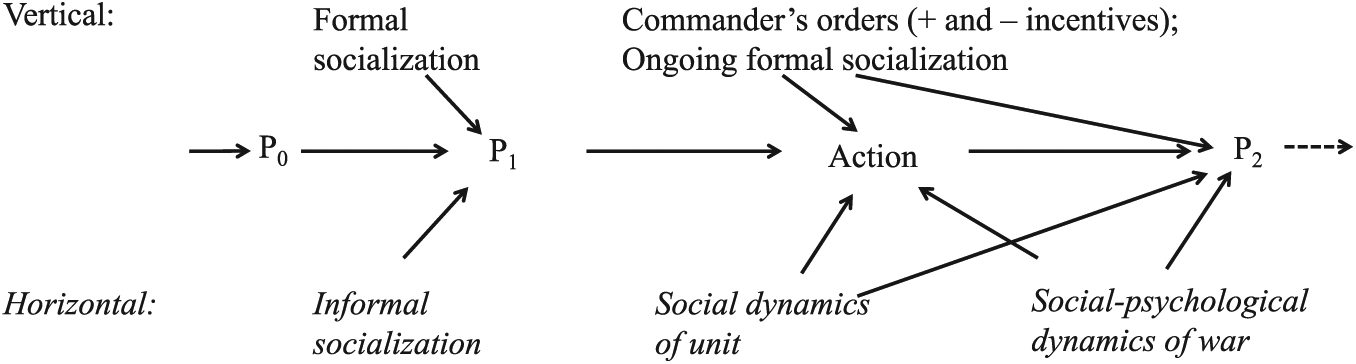
Influences on Combatant Behavior.
These considerations suggest that individual motivations can be categorized into three types: the individual’s private preferences, which may evolve endogenously through socialization and the experience of conflict; his or her responses to unit social dynamics (especially the pressure to conform); and compliance and obedience to the commander’s authority. These categories make up one axis of the typology; the other reflects commander choices, to which I now turn.
The Commander’s Stance
The commander must decide for each type of violence in which combatants engage (or might engage) whether to promote that violent act as organization policy, to tolerate its occurrence (the default, passive decision), or effectively to prohibit it through punishment or the inculcation of norms against it. If the commander’s preferences are strong, he will seek to build institutions to ensure they prevail, but at a cost to organizational resources.
The commander must effectively prohibit at least some acts, for example, violence toward himself. Such prohibition occurs either through effective, consistent punishment or through the inculcation of norms sufficient that combatants themselves find it unacceptable. The range of acts punished and the effectiveness of punishment vary widely across organizations. Some organizations effectively enforce an elaborate code of conduct toward civilians and punish any occurrence of violence, including rape, that breaks that code—if commanders know of it, which they must often do if punishment is to be an effective deterrent. They may do so out of concern that such violence would undermine their control of troops, alienate civilians (or donors) they depend on or aspire to govern, or because they take seriously ideological reasons not to abuse civilians. 35 Other organizations emphasize the inculcation of norms against the rape and other abuse of civilians, but must do so repeatedly to counter the social-psychological dynamics discussed above. 36 Examples of organizations that effectively prohibited the rape of civilians include the Salvadoran and Sri Lankan insurgencies; more generally, communist rebels appear less likely to rape civilians. 37
In contrast, the commander purposely adopts and promotes some patterns of violence—lethal violence against enemy forces in at least some settings, for example—as organization policy. Some organizations adopt rape as a policy for military objectives, that is, as a strategy, including many but not all organizations that carry out ethnic cleansing or genocide and many that carry out sexual torture. Examples include the Bosnian Serb militias in the former Yugoslavia, the Janjaweed militias of Sudan, and the Guatemalan military during that country’s civil war. 38 Cases in which rape or other forms of sexual violence is not explicitly ordered but is authorized, by slogans such as “we are engaged in total war” or other rhetoric promoting sexual violence, appear to be more common. Convictions by the International War Crimes Tribunal against Rwanda for instigating, aiding, or abetting the crime of rape were significantly more frequent than for ordering. 39 A further example is the US “war on terror”: leaders appear to have authorized but not directly ordered sexual humiliation of detainees as a form of so-called enhanced interrogation (i.e., torture). 40
But the commander may promote a pattern of sexual violence as policy for other than military reasons. 41 For example, some organizations adopt policies of sexual slavery, forced prostitution, or forced marriage as a way to regulate the sexual and reproductive lives of combatants, thereby serving an organizational and sometimes a political purpose but not an immediately strategic one. The Japanese military, for example, forced so-called comfort women to serve as prostitutes in military brothels during World War II as a way to avoid the widespread rape of civilians. 42 The Colombian insurgency (FARC) enforced a policy of forced contraception and forced abortion within its ranks. 43 The Lord’s Resistance Army of northern Uganda engaged in forced marriage of abducted girls as organizational policy. 44 ISIS issued regulations specifying the conditions under which sexual slavery of Yazidi girls and women is allowed, 45 a strong indication that it is an institutionalized policy. ISIS also engages in child marriage as organizational policy (and the forced marriage of Sunni women in some areas as a practice). 46 Let us term such reasons “internal” (in contrast to “strategic”) purposes.
Finally, why might the commander tolerate violence that is not organizational policy? There are two cases: the commander either will not or cannot effectively prohibit it. 47 Tolerating a prohibited form of violence may be instrumental for an individual commander, even if he recognizes that it may pose overarching costs to the organization. He may think its effective prohibition would be too costly because it would require disciplining or dismissing otherwise effective subordinates, might divert scarce resources to an issue—such as the rape of civilians—he sees as unimportant, might lessen the respect of subordinates for him and thereby undermine vertical cohesion, or because it is simply too much trouble. (I assess the conditions under which the commander is likely to hold such norms and beliefs about rape below.) Or the commander cannot impose his prohibition, even if he would prefer to, because he has no control over his subordinates (does not in fact “command”), cannot control rape in particular, or has some control but dedicates those resources to other issues. 48
Combining the Commander’s Stance and the Combatant’s Motives
The conditions under which only violence adopted as policy occurs are extremely narrow: if indoctrination of combatants is complete (not undermined by unit dynamics) or punishment so precisely targeted that it deters (despite those dynamics), violence that is neither ordered nor authorized will never occur. Armed organizations rarely if ever invest sufficient resources to ensure this outcome. More often, the institutions for recruitment, socialization, discipline, and internal intelligence are not so strong and the result is some unordered or unauthorized violence. In such settings, rape (and other violence that is not organization policy) may occur as a practice: violence that is tolerated but not promoted as policy by the organization.
These considerations are summarized in Figure 2, a typology of rape by armed organizations. 49 Whether a particular form of violence occurs depends on both combatant motivations and the commander’s stance; its frequency also depends on the strength of the organization’s institutions. In particular, rape as a practice (the shaded area) is motivated by private preferences (the first row) or unit social dynamics (the second), and it is tolerated by the commander. When the organization promotes rape as policy by ordering, authorizing, or institutionalizing it for strategic or other purposes (the right-hand column), combatant motivations may vary but will likely include all three types (for this reason, the third column is not divided into cells).
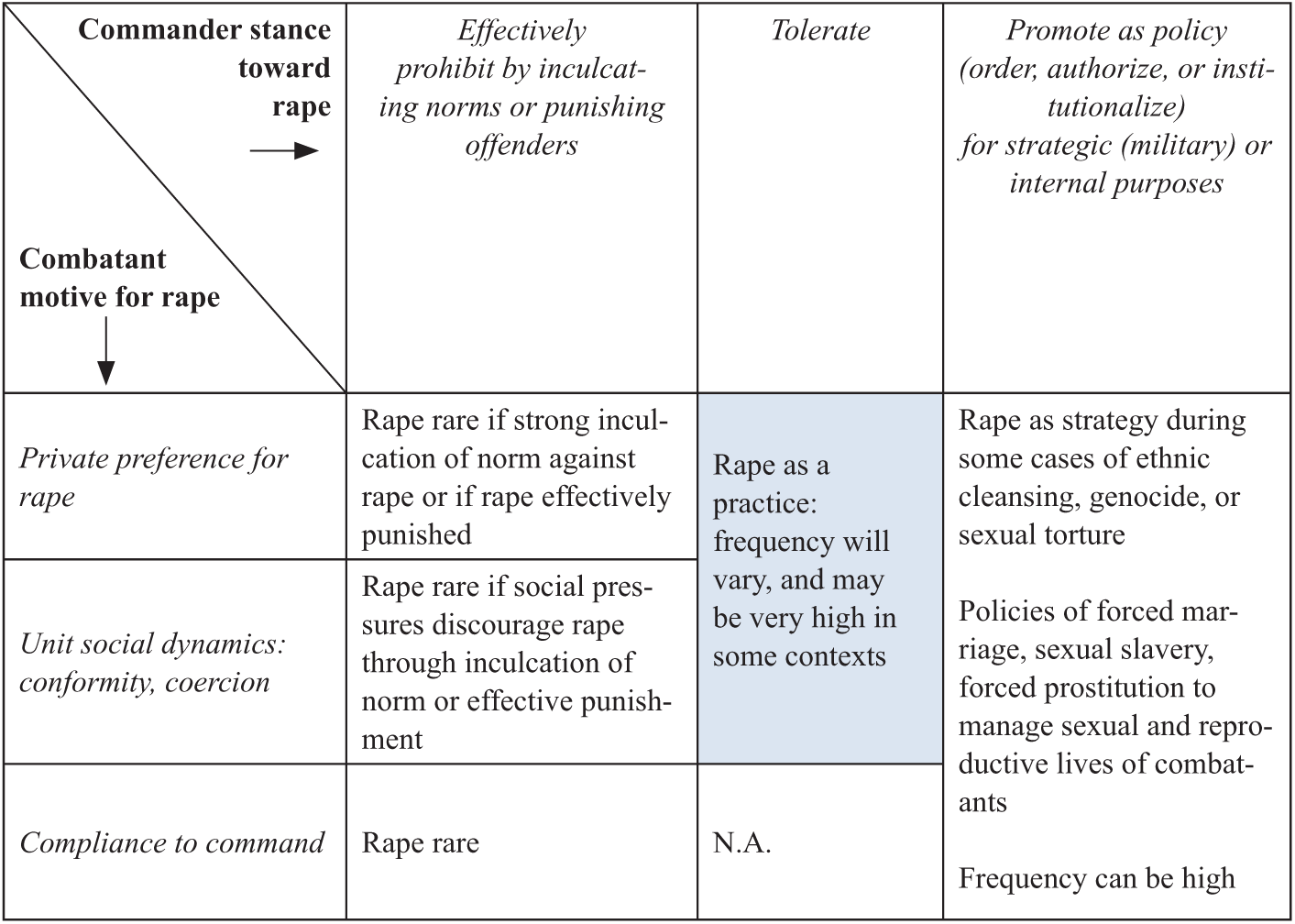
A Typology of Rape by Armed Organizations during Conflict.
Patterns of rape and their underlying mechanisms in several contexts have been analyzed in recent literature and are well characterized as a practice. Dara Kay Cohen argues that members of armed organizations that rely on abducting and press-ganging recruits (insurgents and state militaries, respectively) engage in gang rape to build cohesion among hostile and bewildered recruits. 50 Rape in these cases is not purposefully adopted by commanders, she argues; rather, senior members of small units participate and insist that all members—including women—also do so. Cross-national data confirm that wartime rape is more likely on the part of groups that abduct or press-gang their recruits, and interviews with former combatants in Sierra Leone and Timor-Leste confirm the underlying mechanism.
Maria Eriksson Baaz and Maria Stern analyze how soldiers of the DRC state military—an organization with such weak vertical cohesion that commanders fear revolt by their subordinates—understand its widespread rape of civilians. 51 They found no evidence that rape is organizational policy: none of the 200 soldiers interviewed stated that rape had been ordered (or authorized). 52 In this context, rape as a practice appears to be an informal form of compensation (i.e., self-pay) that is broadly tolerated by commanders. In the context of sharply inadequate salaries that often go unpaid for extended periods, many of the soldiers linked the military’s high rates of rape to the frustration and anxiety occasioned by their failure to live up to masculine ideals of establishing and providing for a family. Other scholars also emphasize the role of rape in affirming masculinity and reclaiming social status in other contexts where perpetrators are marginalized from labor markets and other sources of a livelihood. 53
Jelke Boesten identifies distinct patterns of rape by state forces during Peru’s civil war. 54 Although she argues that some patterns were organizational policy (mass public rape during incursions into communities thought to be supportive of insurgents, sexual torture of detainees, and institutionalized distribution of women as “war booty”), she also identifies two patterns of rape for “consumption.” 55 The first was forced prostitution around military bases: girls and women were forced to perform sexual services, while held by soldiers for weeks, or to attend parties where they were sexually abused. When a family denounced the kidnapping or seduction of a daughter, base commanders sometimes forced the soldier to marry the victim or, more frequently, to promise to marry her. This abuse was thus not organizational policy but was nonetheless generally tolerated by commanders. The second was the acting out of violent spectacles including gang rape by groups of soldiers who watched pornography together.
As mentioned at the beginning of this article, US troops in Vietnam appear to have understood that the killing of civilians had been ordered, or at least authorized, but that rape had not been. Moreover, rape was rarely prosecuted. Rape during operations is therefore best understood as a practice. 56
Conditions for Rape as a Practice to Be Frequent
Under what conditions is rape as a practice likely to occur with significant frequency? In addition to its necessary toleration by one or more commanders, at least one of two conditions must be present: (1) a preference for rape among at least some combatants or (2) unit social dynamics that generate participation through pressure to conform or coercion. Whether these conditions are met depends on the preferences, beliefs, and norms concerning aggression, sexuality, and gender held by combatants and also those held by the commander.
There are two conditions under which combatants “willing” to rape may emerge. 57 (I put “willing” in quotes to emphasize that participation may reflect social pressure or coercion.) First, a practice of rape may occur because the organization recruits from a society in which rape or other sexual abuse is already frequent (or at least not normatively proscribed), against civilians in general or some targeted group in particular, and the armed group does not suppress that proclivity through discipline or socialization. Rape may not be understood as criminal; rather recruits may enter the organizations with beliefs and norms that construct sexual aggression toward specific types of girls and women (and some boys and men) as appropriate demonstrations of masculinity.
In this case—where recruits share their social group’s peacetime gender hierarchy, the gendered order in which some masculinities and femininities dominate others—rape by combatants is well understood as part of a continuum of sexual violence from peace to war. 58 Because gender hierarchies and relations during peacetime vary significantly across societies, the particular pattern of rape as a practice will vary across settings. 59 Scholars drawing on the intersectional approach, for example, show how gender norms and relations—what counts as appropriate masculinity and femininity—depend not just on gender roles but on other hierarchies such as race or ethnicity and class. 60 The dominant—“hegemonic”—masculinity, though an ideal for many, may be realized by only a few members of society and may be contested by “protest masculinities” that respond either to the inability to achieve the ideal or against its normative imposition. 61 Moreover, in some societies, sexual violence against those lower in the hierarchy is understood as feminizing the victim and affirming the perpetrator’s masculinity—whatever their sex. 62
However, gender norms and hierarchies are malleable, a fact that leads to the second condition for rape as a practice to emerge. 63 The combatant’s gender norms and hierarchies may change as a result of vertical or horizontal socialization within organizations, particularly those that are “total” in the sense of immersive, which includes most armed organizations. The power of socialization within armed organizations explains an important feature of civil wars: in 38 percent of those in which rape is moderately or highly frequent, the incidence of rape varies sharply across the parties to the war. 64 In these conflicts, societal peacetime gender relations cannot explain the variation across organizations.
In the case of rape as a practice, the relevant socialization is horizontal. In some organizations, social interactions within the unit transform the initial norms and beliefs of recruits toward ones that support a significantly higher frequency of rape than in civilian society, including in some cases exceptionally brutal forms of rape. 65 Such socialization by peers, which may itself be violent, into new norms, beliefs, and perhaps a new gender hierarchy facilitates new forms of sexual aggression to subordinate, humiliate, or harm social groups through rape, sexual assault, or sexual torture. Individuals who violate heterosexual norms may be among those targeted, an emerging theme in the literature. Because rape as a practice is largely driven by social dynamics within units, gang rape is likely to be particularly frequent, a pattern common in civil wars. 66 And female combatants may come to engage in behavior reflecting the dominant masculinity in their organizations, sometimes including participation in rape. 67 In such cases, wartime patterns are better understood as a rupture with, rather than as on a continuum with, peacetime gender relations.
What then are the conditions under which unit social dynamics are likely to support rape as a frequent practice? First, the particular gender norms and beliefs—the particular masculinities—that dominate those unit dynamics must support the exercise of rape as a social activity endorsed by the unit. Rape is more likely to occur as a practice if combatants are not paid and so cannot realize their ideal masculinity (and rape as compensation is not institutionalized by the organization), if the organization recruits forcibly by abduction, or if violent pornography and sex are seen as essential to leisure time. It is more likely to occur in units that are unsupervised, deployed far from their home base, or that have been deployed for a long period. More research is needed to identify other conditions that give rise to unit dynamics supportive of rape.
Second, under what conditions would the commander tolerate rape? As discussed above, he may tolerate rape despite its prohibition because he is little troubled by the suffering of those targeted, because it would be too costly to enforce the prohibition in terms of his status or resources, or simply because it would be too much trouble. His understanding of the benefits and costs of tolerating rape reflect his own gender norms, perhaps as transformed through socialization as a commander in the organization. The socialization of commanders may be distinct from that of combatants when they graduate from elite academies or specialized training courses and thereby undergo different patterns of formal and peer socialization. Such socialization may nonetheless support toleration of rape, including within the ranks, as in the case of the US military. 68 And a rogue commander may himself engage in or promote rape in defiance of the organization’s formal norms and rules.
Thus rape as a practice reflects a particular gender hierarchy on the part of at least some units, and the social construction of the costs to the commander of tolerating its occurrence. Such norms and behavior can be remarkably resilient despite attempts by the organization’s hierarchy to reshape them, as in the case of sexual assault within the US military.
Whether combatant norms and beliefs reflect the norms of peacetime society, the formal policies of the armed organization, or those of particular units is a contingent fact that varies across organizations. Because gender hierarchies vary across societies in peacetime and because organizations vary in their degree of socialization into new norms (either through horizontal processes or formal institutions), gender hierarchies also vary across organizations (and sometimes units), sometimes exhibiting continuity with peacetime norms and sometimes exhibiting sharp contrasts. 69 Indeed, some highly effective armed organizations socialize their combatants into new norms and beliefs that effectively proscribe the rape of civilians. 70
The Challenges of Applying the Typology
As in measuring other aspects of violence during war, it is challenging to assess whether an armed organization that rapes frequently has adopted rape as policy or merely tolerates its occurrence. The discussion above shows that there are organizations in each category, but it is difficult to estimate their relative frequency. I first discuss patterns that help distinguish between the two, beginning with straightforward observations and then turning to examples in the gray zone between policy and practice, including deliberately ambiguous and clandestine policies. I then briefly discuss the challenge of identifying combatant motivations.
Whether or not the organization punishes combatants for rape is key to determining whether it occurs as a policy or a practice (or if it effectively prohibits it). If a combatant is punished for not engaging in rape, rape is a policy. Note that this is a sufficient but not necessary condition: where rape is authorized but not ordered, the organization would not punish combatants who do not rape. If the organization formally prohibits rape yet does not punish it (or punishes it only occasionally), it is a practice. If combatants are punished consistently for rape, it is not a policy. If it nonetheless continues, it is a practice so deeply entrenched (most probably after a period of toleration) that it occurs despite (ineffective) punishment. Patterns of punishment may vary in additional ways, with some commanders punishing some combatants but not others for the rape of victims in some but not all categories targeted.
Evidence that an organization has ordered, authorized, or institutionalized forced marriage, sexual slavery, forced prostitution, or rape indicates that it has purposefully adopted that form of sexual violence as a policy. Evidence for institutionalization includes the organization’s medical inspection of victims and its regulation of combatant engagement in these forms of violence, perhaps by formally rewarding valor or loyalty with access to victims. Evidence that combatants engage in rape along narrow lines—for example, against political detainees but not criminal detainees, or only against “enemy” civilians—offers some support for the interpretation that it is policy. It is not sufficient, however, as commanders may tolerate the rape of some but not all civilians.
Evidence that rape is a practice stems most immediately from the absence of evidence that it is a policy and evidence that it is tolerated by at least some commanders. If combatants engage in rape that does not follow a strategic logic, for example, raping loyal or neutral co-ethnics, and are not punished, it is more likely a practice rather than policy. A pattern of uneven engagement in rape across units that does not follow a strategic logic is suggestive of its toleration by some commanders but not others.
The latter is one way the single-commander model fails to capture empirical patterns, as noted previously. Whether a hierarchy, a network, or a hybrid of the two, an armed organization almost always has at least a few levels of command and a few functionally differentiated units. Both principal-agent problems and social interactions among peers are present at each link in the chain of command. Only in organizations with very strong institutions does the presumption that “the commander” stands in for its leadership make sense. In other cases, the commander who effectively determines the observed pattern of violence is somewhere down the chain of command. A specific commander may adopt rape as a military tactic in an operation, while those commanding elsewhere may not; or he may tolerate rape while others do not. In the first case, he has purposefully adopted rape as a strategy; in the second, it occurs as a practice in his units. For example, Sara Meger argues that although the leadership of the DRC military does not order or condone sexual violence, battalion-level commanders engage in abuses for strategic purposes. 71 In organizations with very weak institutions, the combatant may not even know what the organization’s policy is; the relevant commander is her immediate superior or one a few levels above. In organizations with strong institutions, field commanders may not have much choice about patterns of violence but are constrained by choices made at higher levels. More fundamentally, this focus on organizational determinants of violence neglects the dynamics of conflict (e.g., that patterns of rape may vary depending on commander or combatant time horizons, which often vary with combat dynamics).
Cases of deliberate ambiguity are particularly challenging. A commander may promote rape but in ways that obscure that fact, thereby protecting himself from a record of having ordered or authorized it. In such “atrocity by connivance . . . [t]he intended result of such connivance is that the subordinate can claim to have acted pursuant to what he believed to be orders, while the superior can claim never to have issued them.” 72 He may do so because he understands it as normatively proscribed or criminal, or because he believes the orders may be more effectively carried out if combatants feel they can choose to rape. 73 Moreover, what Richardot terms “partial orders” (stating an objective without further instructions, a form of ambiguous authorization) invites combatants to innovate the means, as in the case of the treatment of those detained by US forces since 9/11. 74
Authorizing, as opposed to ordering, combatants to rape is therefore important to recognize as a form of policy adoption. Commanders license rape (and often other violence against civilians) by combining motivating rhetoric (“the gloves must come off,” “total war,” “war without limits,” etc.) with permissive connotations. In Syria, the director of political security in Homs told someone who later defected, “The men have orders to take revenge on those vandals and to avenge their community. As long as those terrorists are against the State, everything is allowed to punish them.” 75 That commanders intended to license rape may be hard to demonstrate, but the sustained combination of motivating, permissive rhetoric with no attempt to discipline combatants is strongly suggestive of authorization and therefore policy.
It would of course be foolhardy to expect a simple typology easily to categorize every case; some cases fall in a gray zone between these ideal types of practice and policy. After rape occurs as a practice, commanders may come to tolerate it because they come to see its benefits to the organization. For example, UN investigators found that government-allied militia groups in South Sudan were being “allowed to rape women in lieu of wages,” raising the specter that rape might evolve from a practice to a policy. 76 Or they may explicitly adopt toleration of rape as a policy, authorizing, ordering, or institutionalizing a policy of no punishment. That appears to have been the case of rape by soldiers of the Soviet Army as they moved westward toward Berlin: to concerns expressed by intelligence officers that widespread rape would undermine Soviet postwar policy, Stalin replied, “We lecture our soldiers too much. Let them have some initiative.” 77 Arguably, the first case falls more on the practice and the second on the policy side of the gray zone, an interpretation strengthened by the Soviet rhetoric condemning the German people for Soviet suffering, not just German combatants. 78 Similarly, during the first intifada, the Israeli Defense Forces appeared to have a policy of tolerating violence by soldiers against Palestinians that went beyond formal policy, as long as it was not lethal. 79
In any approach to the analysis of political violence, evaluating the perceptions and motivations of combatants is a difficult task. However, some implications of the typology are straightforward. If combatants perceive that rape is authorized, not “merely” tolerated, they are more likely to participate. Of course, a combatant who raped has a motive later to claim to have understood it as authorized or ordered. To assess combatant motivations, scholars increasingly engage with combatants (often former combatants) through interviews, surveys, focus groups, and oral histories. Rather than take self-reported motivations at face value, they evaluate such evidence against other sources, consider motivations to lie and mislead, and test interpretations against other possibilities. For example, if former combatants admit that they raped but do not also claim that they were ordered or authorized to do so, absence of the latter claim is evidence that rape was a practice, particularly if they claimed authorization for other forms of violence (e.g., homicide), as in the case of the United States in Vietnam. Discerning combatant motivation is nevertheless difficult, particularly where combatants reason that claiming that the organization raped as a strategy of war may get them off the hook. 80 The challenge is complicated by the possibility that combatant motivations change over time, as emphasized in Figure 1.
Nonetheless, the literature increasingly shows that analysis of combatant motivations for rape as well as for other wartime actions is sometimes possible and suggests that at least some of the time it occurs as a practice.
Conclusion
Despite the challenges in applying the typology in difficult cases—a problem not unique to conflict-related rape—the typology captures important distinctions that are often conflated. During conflict, rape need not be organizational policy to be frequent; some patterns of rape during conflict are better understood as a practice. In such cases, unit social dynamics supporting rape are more powerful than its formal prohibition, as in the case of rape within the ranks of the US military. When an organization does adopt rape as a policy, it may do so for internal rather than strategic reasons, and it may promote its occurrence through authorization or institutionalization rather than explicit orders.
The typology suggests a research agenda focused on identifying organizations that engage in rape as a practice and analyzing the conditions under which it arises. In particular, the socialization of commanders merits more research. The recognition that rape may occur as a practice should prompt recognition that other forms of sexual violence, such as sexual torture of detainees and forced abortion of female combatants, occur frequently as organizational policy, thereby increasing scholarly attention to the full repertoire of wartime sexual violence. The typology’s third column suggests the need for scholars to analyze the social interactions driving rape that occurs as organizational policy as well as those driving it as a practice.
The typology’s distinctions are also important for prosecutors, policymakers, and human rights advocates who seek to address conflicted-related rape. First, the typology has implications for the prosecution of rape as a war crime, a crime against humanity, or genocide. It has often been difficult for prosecutors to prove that organization leaders ordered or authorized rape (i.e., to establish evidence of both the specific actions and the requisite intent beyond a reasonable doubt). 81 For example, the International Criminal Tribunal for the former Yugoslavia (ICTY) convicted few commanders or leaders for planning, ordering, or instigating rape or other crimes of sexual violence. 82 In that context, establishing the accused’s state of mind (mens rea) was particularly challenging. The typology developed here suggests that when rape occurs as organizational policy, it should suffice to show that it had been institutionalized or authorized, which may be easier than showing that it was explicitly ordered. In particular, prosecutors may find it easier to establish the accused’s mens rea when rape was institutionalized or authorized rather than explicitly ordered.
Moreover, in a book-length review of its two decades of prosecuting alleged war criminals, attorneys for the Office of the Prosecutor of the ICTY emphasize the pitfalls of undue emphasis on the perceived strategic use of sexual violence. The authors stress as a “key insight” the office’s move away from that emphasis to one focusing on the context in which crimes occurred and their connection to the organization’s leadership—including as “part of a ‘practice’ tolerated by superiors.” 83 This focus on patterns of crimes and their contexts may make it easier for judges to set aside or dismiss a commander’s defense based on ignorance of the crimes.
Increased recognition that rape may be frequent without having been promoted as organizational policy may contribute to justice by shifting prosecutorial emphasis to other modes of liability, including forms of omission liability. An added benefit would be increasing the number of potential victims who would be recognized as such and would therefore become relevant for the prosecution’s case. Under the doctrine of command liability, for example, if a commander or leader knew or had reason to know that subordinates over whom he had effective control had engaged, or were soon to engage, in sexual crimes and failed to take all necessary and reasonable measures in his power to punish the subordinates or prevent the crime, he may be liable for those crimes under international law—even in the absence of their being organizational policy. 84 Although their record is mixed, prosecutors at the International Criminal Court have secured convictions for wartime rape on the basis of command responsibility, as in the case of Jean-Pierre Bemba Gombo’s conviction for rape as a crime against humanity and a war crime, based on his failure to prevent rape (though knowing of its occurrence) and not on his affirmative promotion of rape in some form. 85
Rape as a practice is relevant for other modes of liability as well. To convict commanders for rape (or another sexual crime) as a war crime or as a crime against humanity, ICTY prosecutors did not have to show that rape itself was part of the organization’s policy or that rape itself was widespread or systematic, respectively. 86 They worked with three forms of joint criminal enterprise (JCE) as key modes of liability under the tribunal’s governing statutes. In two of the three (JCEs 1 and 2), prosecutors have to show that leaders intended that sexual crimes be part of their common criminal purpose. Under the third, extended form, prosecutors have to show that sexual crimes were a natural and foreseeable consequence of implementing the common purpose (e.g., the common purpose of forcible displacement). 87 Foreseeability is critical for prosecution of senior officials under international criminal law, though the degree of foreseen risk necessary for conviction differs depending on tribunal and jurisdiction. 88
Although the International Criminal Court does not include any form of JCE as a mode of liability, the ICTY prosecutors note the relevance of foreseeability for prosecution under Article 30 of the ICC’s governing Statute of Rome that establishes the mental elements necessary for prosecution—that is, intent and knowledge. Awareness that sexual crimes will occur as a consequence “in the ordinary course of events” may comprise intent and knowledge sufficient for liability. 89 The ICC’s Office of the Prosecutor concurs: after noting that there is often no evidence of orders, “evidence such as patterns of prior or subsequent conduct or specific notice may be adduced to prove an awareness on the part of the accused that such crimes would occur in the ordinary course of events.” 90
Second, the mission of truth commissions and similar bodies to describe and account for human rights violations will be furthered by accurate descriptions of the organizational dynamics driving violence as a practice as well as organizational policy.
Third, by identifying distinct mechanisms underlying conflict-related rape, the typology may facilitate effective interventions during war to prevent or at least mitigate its occurrence in real time, as well as prosecution afterward. Measures to address rape that occurs as organizational policy will in general differ from those addressing rape that occurs as a practice. Organizations such as the International Committee of the Red Cross and Geneva Call that attempt to persuade commanders to adopt and enforce rules and norms against rape may be more effective after assessing whether it occurs more as a policy or a practice so that their efforts are tailored to the organizational dynamics driving its occurrence. However, persuading commanders to prohibit hitherto tolerated violence will be effective only if the organization has institutions capable of enforcing such a turnaround, as the sustained exercise of unauthorized violence may have undermined the necessary conditions for command and control.
Finally, understanding how rape as a practice may be sustained by horizontal social dynamics and commander tolerance should further the goals of international humanitarian law in strengthening military training against its occurrence. It should also fortify efforts to address the sustained pattern of sexual abuse by UN peacekeepers (one long tolerated by commanders).
The distinctions in the typology between practice and policy, and between policy for strategic and for internal purposes, should be useful for analysis of all types of political violence. I hope it will be a source of insight for scholars, policy advocates, prosecutors, judges, and policymakers working to end torture, extrajudicial execution, disappearances, forced displacement, and other types of illegal violence against civilians, as well as wartime rape.
Footnotes
Acknowledgements
For research assistance, I thank Julia Bleckner, Maria Gargiulo, Mara Revkin, and Nathaniel Toppelberg. For comments on earlier versions, I thank Mayesha Alam, Kate Baldwin, Samuel Bowles, Lorenzo Bozi, Anna Callis, Dara Kay Cohen, Christian Davenport, Maria Eriksson Baaz, Francisco Gutiérrez Sanín, Stathis Kalyvas, Helen Kinsella, Michele Leiby, Julieta Lemaitre, Summer Lindsey, Juan Masullo, Guenael Mettraux, Alice Miller, Kieran Mitton, Stephen Moncrief, Ragnhild Nordås, Christopher Price, Michael Reed Hurtado, Francoise Roth, María Paula Saffon, Philippe Schmitter, Rachel Schwartz, Kim Thuy Seelinger, Niloufer Siddiqi, Irina Soboleva, Scott Straus, Nils Weidmann, and Richard Wood.
Declaration of Conflicting Interests
The author declared no potential conflicts of interest with respect to the research, authorship, and/or publication of this article.
Funding
The author disclosed receipt of the following financial support for the research, authorship, and/or publication of this article: I am grateful to Yale University, the United States Institute of Peace, and the Harry Frank Guggenheim Foundation for funding this project.