







Abstract
There is relatively little literature examining risk factors associated with sexual victimization among youth in custody. The current study explored whether risk of forced sexual victimization among youth in custody differs by gender or perpetrator. Using data from a sample of 8,659 youth who participated in the National Survey of Youth in Custody, multivariate logistic regression models were employed to investigate gender differences in risk factors associated with overall forced sexual victimization and staff-on-inmate and inmate-on-inmate forced sexual victimization. Findings suggest that gender differences are more pronounced when perpetrator type is considered.
Introduction
More than 10 years ago, Jones and Pratt (2008) called for broadening the scope of prison sexual assault research to include “more diverse inmate populations” such as juveniles and females (p. 291). Like other scholars, they also suggested more work was necessary to explore staff-on-inmate victimizations (see Alaird, 2000; Hensley et al., 2003; Thomas et al., 1996). One large-scale multiwave effort to collect such data among juvenile detainees is managed by the Bureau of Justice Statistics (BJS) and mandated by the Prison Rape Elimination Act (PREA) passed in 2003. According to BJS, the rate of sexual victimization among youth detained in state facilities increased substantially from 19 to 47 per 1,000 between 2005 and 2012 (Beck & Rantala, 2016) despite a 48% decrease in the number of juveniles in custody between 1997 and 2013 (Hockenberry, 2016). Specifically, data from the 2012 National Youth in Custody Survey (NSYC-2) estimate that 9.5% of youth detained in juvenile facilities experience any sexual victimization (e.g., unwanted touching), not only forced victimization (Beck, 2014; Heaton et al., 2016). 1 In comparison, Beck (2014) estimates that among adult inmates, 4% housed in state and federal prisons and 3.2% detained in jails experience sexual assault while under institutional supervision (see also Beck & Stroop, 2017; English et al., 2010), whereas less than 2% of youth housed in adult jails and prisons are sexually victimized (Ahlin & Hummer, 2019).
Although the BJS data demonstrate that sexual assault and victimization are more prevalent among youth in custody than among adult inmates, there are few studies that explore risk factors of sexual assault among youth in custody (see Ahlin, 2018; Beck, Cantor, et al., 2013; Heaton et al., 2016; U.S. Department of Justice, 2010). Furthermore, despite the PREA mandate to make prison rape prevention a priority in institutional corrections, scholarly research has yet to address the topic areas highlighted by Jones and Pratt (2008): juveniles, females, and staff as perpetrators. It has been more than 15 years since the passage of PREA, and we still know very little about youths’ risk of sexual assault in custody and how these characteristics of victims and perpetrators influence inmate safety. To begin to fill the void in the literature and address the need for research in this area, this study presents a preliminary analysis assessing whether risk of forced sexual victimization among youth in custody differs by gender or perpetrator type.
Literature Review
What we know about sexual victimization in carceral settings is largely based upon empirical studies on adult inmate risk factors. Although the literature on sexual victimization among youth in custody is still in its nascent period, there is a growing body of literature recognizing that risk factors associated with sexual victimization among youth in custody may be different from those identified for adult inmates. Recently, scholars have shown that the number of characteristics and demographic traits that increase youths’ likelihood of such violence is quite small compared with risk factors among adult inmate populations, and only two consistencies emerged. First, prior sexual assault places youth in custody at higher risk of sexual victimization (Ahlin, 2018; Heaton et al., 2016), indicating a cycle of victimization that is also evident among adult inmates (B. Steiner et al., 2017; Wolff et al., 2007). The second similarity is sexual orientation. Youth who self-identify as nonheterosexual face increased risk of sexual victimization while in custody (Ahlin, 2018; Wilson et al., 2017). This is analogous to the elevated risk experienced in jails and prisons by adults who are homosexual (Hensley et al., 2003, 2005; Man & Cronan, 2001; Struckman-Johnson et al., 1996) or transgender (Jenness et al., 2010).
This is where the similarities between youth in custody and adults in jails and prisons cease according to the extant research. Although some of the characteristics that increase adult inmate risk of sexual victimization directly describe youth, such as younger age (Wolff et al., 2007) and small physical stature (Man & Cronan, 2001; Tewksbury, 1989), they have not been shown to be significant predictors of risk among youth in custody (Ahlin, 2018). Similarly, several lines of evidence suggest that being female (see Beck, Berzofsky, et al., 2013; Teasdale et al., 2016) and new to prison (Felson et al., 2012; Hensley et al., 2005; Man & Cronan, 2001; Morash et al., 2012) are predictors of sexual victimization among adult inmates. However, recent research failed to find a correlation between youths’ gender and sexual victimization, suggesting equal risk among boys and girls. Importantly, a longer length of stay increased youths’ risk of forced sexual assault (Ahlin, 2018). Few studies have investigated the risk of sexual victimization among youth in custody in any systematic way, although the literature that does exist demonstrates fundamental differences in whether juveniles experience sexual victimization within carceral settings compared with adults (but see Ahlin, 2019).
Gender and Sexual Victimization
Little attention has been paid to the role of gender in sexual victimization among youth in custody, and what we know about sexual victimization among youth is largely based on community samples. A large body of work has established that, in general, females are at greater risk of sexual assault than males. For example, in a large-scale national study, Finkelhor and colleagues (2013) examined sexual victimization of youth, aged 14 to 17 years, and found that 22.8% of females compared with 10.3% of males experienced such violence in the past year. Lifetime rates were 20.2% among males and 34.9% among females (Finkelhor et al., 2013). In correctional settings, much of the research addressing sexual victimization has been conducted among adult male inmates (e.g., Hensley et al., 2003; Jenness et al., 2010; Morash et al., 2010, 2012; Stemple & Meyer, 2014; Struckman-Johnson & Struckman-Johnson, 2000; Wolff & Shi, 2009). The scholarly focus on adult males may be linked to their status as the majority of the carceral population. Similarly, youth in custody are primarily male, with females comprising between 10% and 15% of detainees (Sickmund et al., 2015).
During the past 20 years, more information has become available on the experiences of women in prison (e.g., Alaird, 2000; Baro, 1997; Blackburn et al., 2008; Hensley et al., 2003; Struckman-Johnson et al., 1996; Struckman-Johnson & Struckman-Johnson, 2002, 2006). A number of studies have established that rates of victimization among adult inmates are higher among females than males (Beck, Berzofsky, et al., 2013; Hensley et al., 2003; Struckman-Johnson & Struckman-Johnson, 2000, 2002; Wolff et al., 2006). This disproportionate abuse is mirrored among girls in juvenile custody, who are more than 35% of abusive sexual assault victims (Beck & Rantala, 2016) and significantly more likely to be victims of inmate-on-inmate sexual assault (Heaton et al., 2016). To date, there is little discussion beyond prevalence estimates and scant work exploring whether risk factors among youth in custody differ by gender or perpetrator.
Staff and Peers as Perpetrators
In institutional settings, perpetrators of sexual victimization can be fellow inmates or detainees as well as professional staff members, such as correctional officers. Data from the National Inmate Survey (NIS-3) demonstrate that the prevalence of inmate-on-inmate sexual victimization is 1.7% among male adult prison inmates and 6.9% for females (Beck & Rantala, 2016). The gap between males and females is smaller for jail inmates, with 1.4% of males and 3.6% of females reporting inmate-on-inmate sexual victimization (Beck & Rantala, 2016). There is evidence that a substantial proportion of adult inmate sexual assaults are perpetrated by staff (Beck, 2015; Beck & Hughes, 2005; Struckman-Johnson & Struckman-Johnson, 2000, 2006; Wolff et al., 2006), and such offenses are more likely to involve inmates who are casual acquaintances of the perpetrator (Wolff & Shi, 2009). Staff-on-inmate victimization crosses the power boundary between correctional officer and inmate/detainee and is considered corruption of authority (Armstrong et al., 2014; Government Accountability Office, 1999). There is also an increasing awareness that staff-on-inmate sexual misconduct is especially prevalent in women’s prisons (Armstrong et al., 2014) despite prior research suggesting an absence of gender differences in sexual victimization when staff members are the perpetrators (Wolff et al., 2006).
There is substantial evidence that risk of victimization among adult inmates varies if the perpetrator is a fellow inmate or staff member (Armstrong et al., 2014; Beck, 2015; Moss, 2015; Wolff, Shi, et al., 2007). In a comparison of the two types of perpetrators, Stemple and colleagues (2017) found that female inmates were more likely to be abused by other female inmates than male staff (see Beck & Johnson, 2012), indicating potential intersectionality between inmate gender and type of perpetrator. Building on this literature, Heaton and colleagues (2016) examined whether such variations are also evident among youth in custody. Their work shows that youth at risk of sexual victimization perpetrated by another youth are higher among lesbian, gay, and bisexual detainees and among those being held for a violent sexual assault. These factors, however, are not significant predictors of sexual victimization perpetrated by staff. Interestingly, separate circumstances such as being Black, male, prior detainment, and gang affiliation place youth at risk of sexual misconduct perpetrated by staff, although they do not influence sexual victimization by peers. Previous studies of sexual victimization among youth in custody have not dealt with the intersection of juvenile status, gender, and perpetrator.
Staff-on-inmate victimization is an important consideration for youth in custody given the oversight of youth by staff members who present a dual-edged sword of authority as adults and detainers. Beck, Cantor, et al. (2013) note that self-reported forced sexual victimization of youth in custody more frequently involves staff (3.5%) than another youth detainee (1.7%). In comparison, youth self-reports of staff-on-youth sexual misconduct—a broader category of victimization—ranges between 8.2% and 10.7%. In comparison, reports by juvenile correctional administrators highlight a much larger proportion of victimizations perpetrated by staff, with estimates as high as 45% (Beck & Rantala, 2016). Although discrepancies by informant are apparent, what is less clear is the nature of sexual victimization across gender and type of perpetrator.
Current Study
The present study aims to contribute to this growing area of research by exploring whether risk factors of forced sexual victimization among youth in custody differ by gender and perpetrator. This study fills a major gap in the literature by examining three lesser researched areas of sexual victimization in carceral settings: juveniles, females, and staff as perpetrators. Specifically, this research examines the characteristics of female and male youth detainees who reported experiencing forced sexual victimization by youth and staff during a 12-month retrospective period of residential placement.
Method
Data
This study drew on the prior data collected during the second iteration of the National Survey of Youth in Custody (NSYC-2), a nationally representative cross-sectional detainee survey funded in response to PREA (see Beck, Cantor, et al., 2013). NSYC-2 and other data collections mandated under PREA are housed at the data enclave facility of the Inter-University Consortium for Political and Social Research (ICPSR) at the University of Michigan. Researcher access to these data was approved by the Department of Justice and limited to on-site analysis. The study was authorized by the Pennsylvania State University’s Institutional Review Board (IRB).
Participants
The participants consist of the 8,659 NSYC-2 respondents. NSYC-2 gathered self-report data from youth housed in 273 state-owned or operated detention centers and 53 locally owned or privately operated facilities (Beck, Cantor, et al., 2013). Sampling procedures ensured at least one facility from each state and the District of Columbia was included in the sampling frame. Respondents were randomly selected from residents of those facilities. A combination of juvenile assent and parental/facility consent procedures was used prior to collecting data using audio computer-assisted self-interviewing (ACASI) methods (Beck, Cantor, et al., 2013).
Measures
Dependent Variables
Forced sexual victimization
The dependent variable is forced sexual victimization, and this outcome is measured in three ways. NSYC respondents were asked whether they experienced any forced sexual victimization while in custody during the past 12 months or since arriving at the detention facility (any forced, 0 = no/1 = yes), as an overall measure of victimization regardless of perpetrator. Respondents were also asked to identify whether the perpetrator was a staff member (staff perpetrated, 0 = no/1 = yes) or another youth (youth perpetrated, 0 = no/1 = yes).
In line with the work by Cowling and Reynolds (2004), the focus in this study is on any forced sexual assault, regardless of degree of coercion, to account for the fact that all sexual victimization of youth by adults is coercive and nonconsensual. Some research uses a broader definition of staff misconduct that includes forced sexual victimization as well as coercive behaviors (see Heaton et al., 2016). Although such a definition recognizes the power differential between adults and juveniles, using two different definitions for the dependent variable may dilute the comparisons between staff and youth perpetrators.
Independent Variables
Potential risk factors of forced sexual victimization among youth in custody were drawn from the literature on adult inmates and recent analyses of the NSYC-2 data (see Ahlin, 2018; Beck et al., 2013; Heaton et al., 2016; U.S. Department of Justice, 2010). Unless noted, the independent variables were precoded in the NSYC-2 data.
Age
Respondent’s age was coded as a binary variable where “0” was used for youth who were 16 years or older and “1” identified youth who were younger than 16 years.
Race/ethnicity
Youth’s race and ethnicity were a series of binary (0 = no/1 = yes) variables, whereby African American (0 = no/1 = yes) and Hispanic ethnicity (0 = no/1 = yes) were entered into the model. White served as the referent category.
Sexual orientation
Respondents were asked to identify their sexual orientation using one of the following categories: totally straight (heterosexual), mostly straight, bisexual, mostly gay, totally gay, or not sexually attracted to either males or females. Responses to this question were available in the data as a binary variable where 0 = heterosexual and 1 = nonheterosexual. 2
Gang membership
Gang membership was a self-reported measure where 0 = not affiliated with a gang and 1 = gang member. The NSYC-2 only asked about current gang membership within the facility and not prior gang involvement before the period of detention.
Physical characteristics
Two ordinal variables in the NSYC-2 data captured information on youths’ physical stature. Height was measured as 1 ≤ 65 inches, 2 = 66 to 70 inches, and 3 ≥ 71 inches. Respondents’ weight was categorized in the data set as 1 = 140 lbs or less, 2 = 141 lbs to 160 lbs, and 3 ≥ 160 lbs.
Time in facility
The length of time each youth spent in their current juvenile detention facility prior to the survey administration was a categorical variable captured by NSYC-2, where 1 ≤ 1 month, 2 = at least 1 month but less than 6 months, 3 = at least 6 months but less than 12 months, and 4 = 12 months or more.
Analytic Strategy
To assess correlates of forced sexual victimization by victim gender and across perpetrator type, a series of multivariate logistic regression models were employed. All analyses were conducted using Stata version 13 (Stata Corp LP, College Station, TX, USA). To control for possible clustering within the sample, where respondents may be more likely to be similar to detainees from their facility than detainees in another facility, 3 robust standard errors are reported. Responses to the three outcome variables, any forced sexual victimization and that perpetrated by other youth and staff, were captured as “yes” and “no” responses, and results are presented as exp(βm) to exhibit the odds ratio (OR) of a one-unit increase in Xm. Confidence intervals (CIs) are calculated as a measure of estimate precision.
Results
Table 1 describes the sample characteristics by gender and the prevalence estimates of the dependent variable, forced sexual victimization, by perpetrator type. Approximately 10% of respondents (N = 865) were female. Forced sexual victimization, regardless of perpetrator type, was experienced by 7% of female detainees and about 6% of male detainees. Forced sexual victimization perpetrated by a staff member was higher among males (4.0%) compared with females (2.7%), with the opposite being true for youth-on-youth victimization. Females (6.1%) experienced more forced sexual victimization at the hands of other youth than males (2.6%).
Descriptive Statistics.
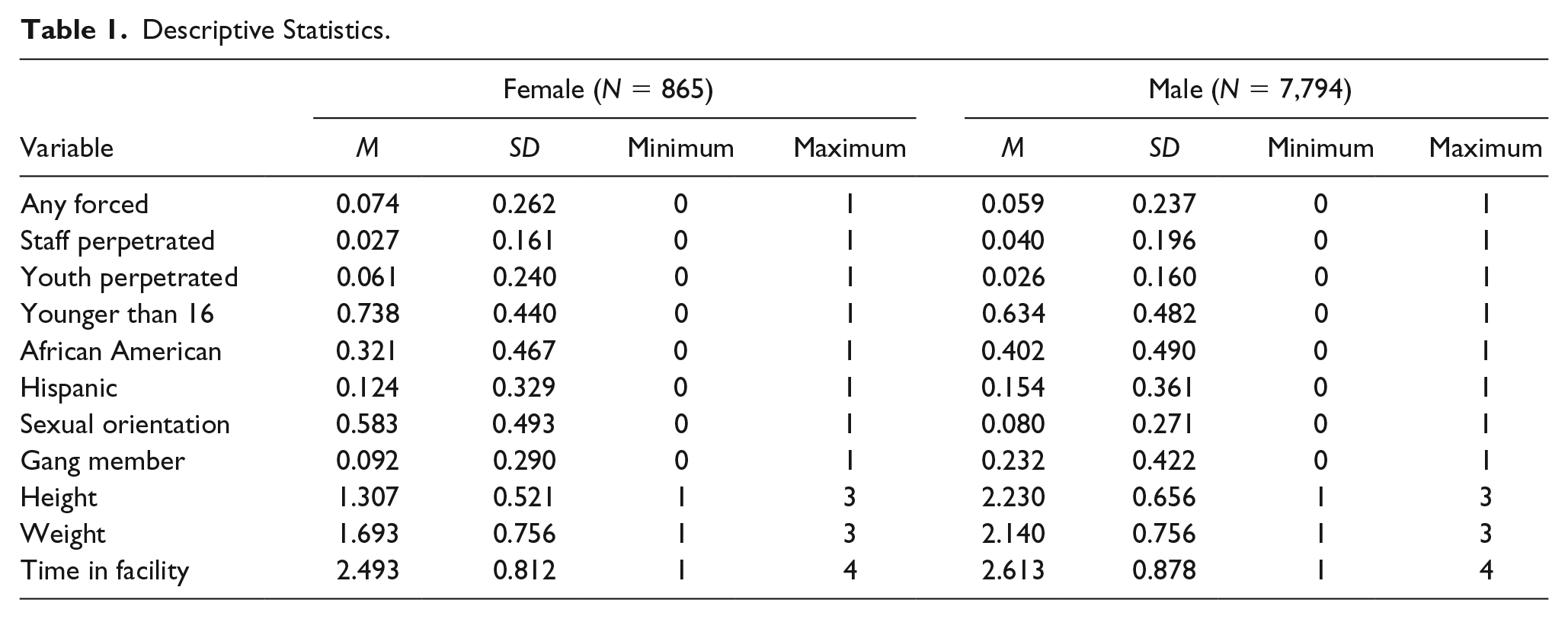
About 32% of respondents were African American and 12% identified as Hispanic. Compared with females, males were more likely to be African American (40.2%) or Hispanic (15.4%). The majority of females (73.8%) and males (63.4%) were younger than 16 years. More than half of the female respondents (58.3%) were nonheterosexual compared with 8.01% of males. Almost a quarter of males (23.2%) were affiliated with a gang in their current facility. Fewer than 10% of females (9.2%) self-identified as a gang member.
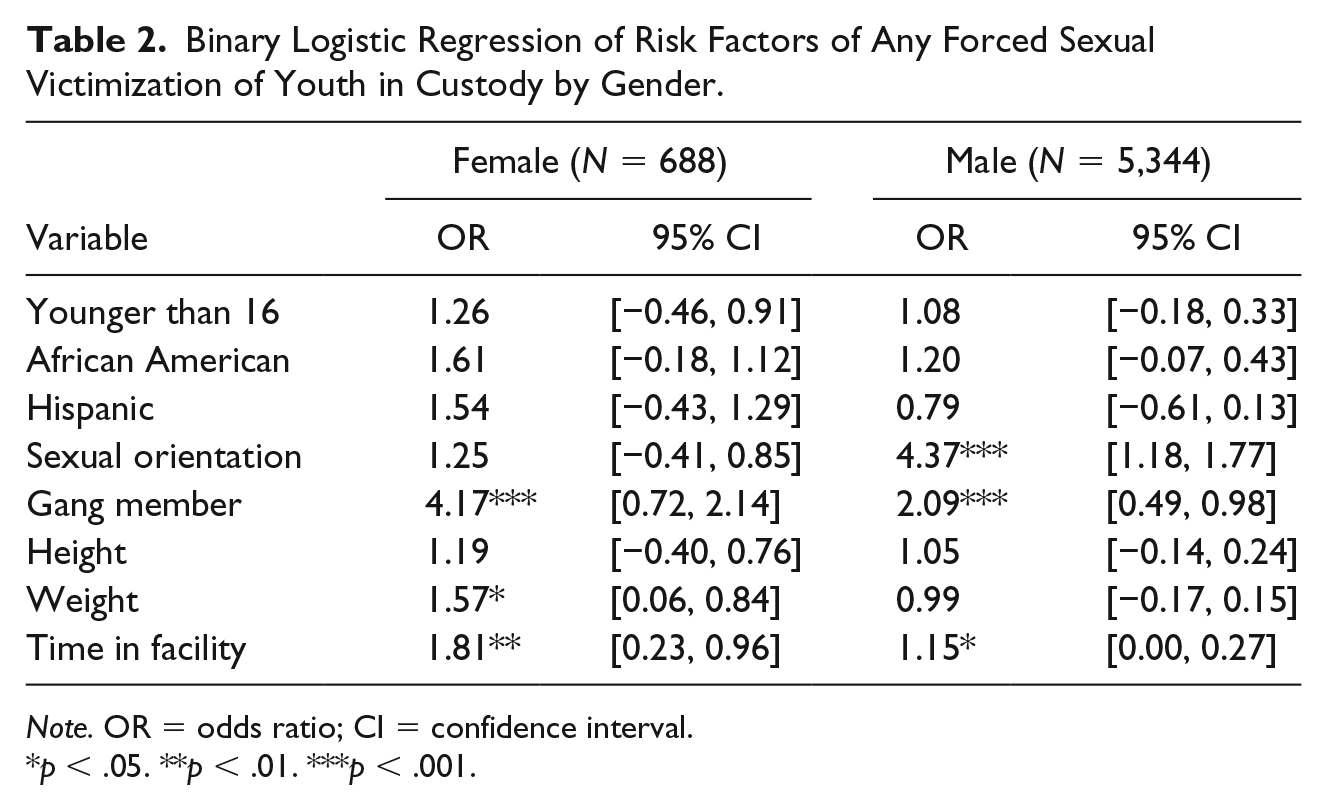
A series of binary multivariate logistic regression models were performed to assess the influence of potential risk factors on the likelihood of forced sexual victimization overall and by perpetrator. Table 2 shows results of the model for any forced sexual victimization by gender regardless of perpetrator type. Two variables, gang membership and time in the facility, are positively associated with any forced sexual victimization for males and females. A female detainee involved with a gang has a 4 times greater odds of experiencing forced sexual victimization by any perpetrator compared with females not in a gang (OR = 4.17, 95% CI = [0.72, 2.14]). Similarly, the odds of sexual victimization by any perpetrator increases by a factor of 2 (OR = 2.09, 95% CI = [0.49, 0.98]) when male detainees have a gang affiliation.
Binary Logistic Regression of Risk Factors of Any Forced Sexual Victimization of Youth in Custody by Gender.
Note. OR = odds ratio; CI = confidence interval.
p < .05. **p < .01. ***p < .001.
The amount of time youth spent in custody is also a significant predictor of forced sexual victimization irrespective of gender though it is greater in magnitude for females. Risk of forced sexual victimization among youth detained for longer periods of time is 81% higher for females (OR = 1.81, 95% CI = [0.23, 0.96]) and 15% higher for males (OR = 1.15, 95% CI = [0.001, 0.27]). Two additional characteristics, weight and sexual orientation, are associated with an increased risk of forced sexual victimization regardless of perpetrator. Interestingly, these variables are not consistent across gender. For a unit change in youth’s weight, the odds of forced sexual assault among females is expected to change by a factor of 1.56 (OR = 1.56, 95% CI = [0.06, 0.84]), whereas identifying as nonheterosexual increases risk among males by a factor of 4 (OR = 4.36, 95% CI = [1.18, 1.77]).
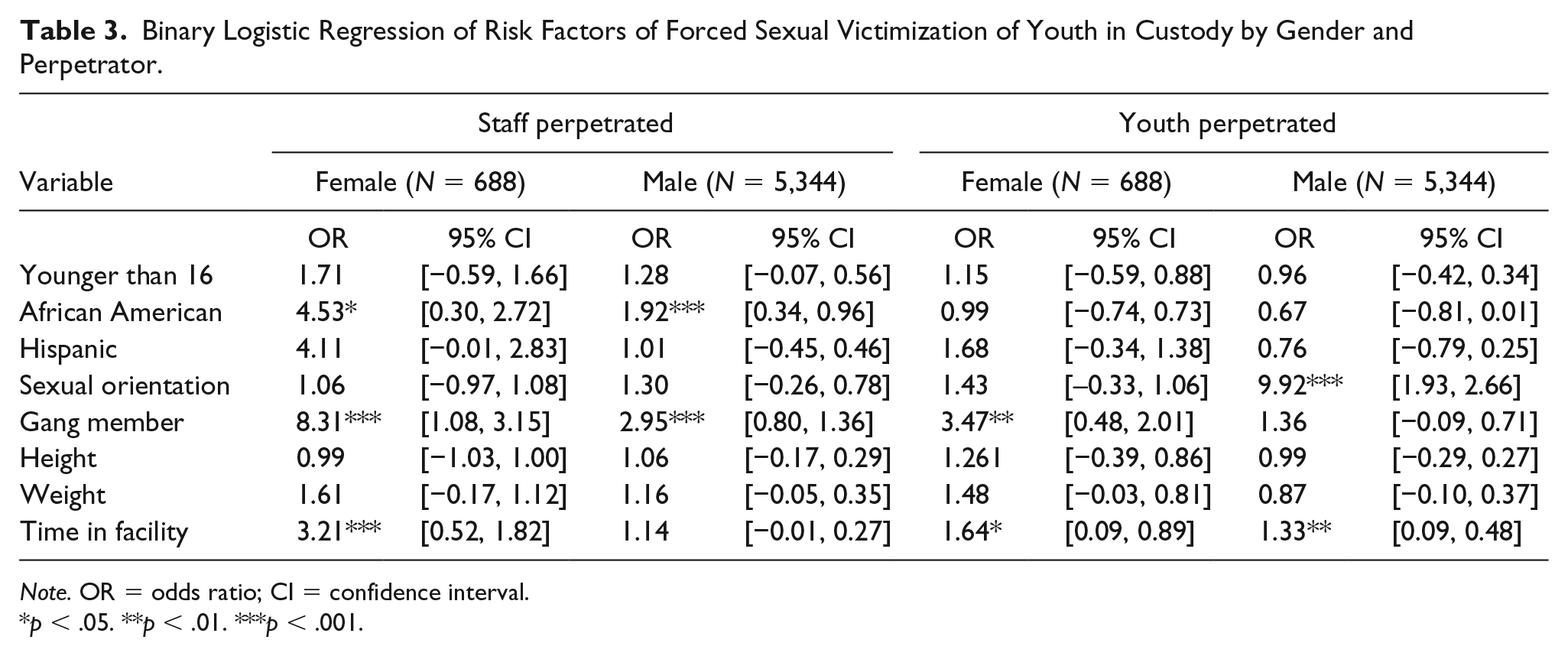
The next analysis shows that risk factors of forced sexual victimization differ when considering only staff perpetrators (Table 3). Compared with White female detainees, African American females have 4.5 times greater odds of experiencing forced sexual victimization by staff members (OR = 4.53, 95% CI = [0.30, 2.72]), and African American males have almost double the odds of staff-perpetrated forced victimization (OR = 1.92, 95% CI = [0.29, 0.92]). Race and ethnicity were not a significant risk factor in the any forced victimization models. Gang membership remains a risk factor for both females and males when considering only staff-perpetrated forced sexual victimization. For a female gang member, the odds of experiencing forced sexual victimization by a staff member are 8.31 times higher than non–gang members (OR = 8.31, 95% CI = [1.08, 3.15]), whereas male gang members have almost 3 times greater odds of experiencing such victimization (OR = 2.95, 95% CI = [0.80, 1.36]). Amount of time in the facility also places females at 3 times greater odds of staff-forced sexual victimization (OR = 3.21, 95% CI = [0.52, 1.82]), whereas length of time detained is no longer a significant predictor of victimization among males.
Binary Logistic Regression of Risk Factors of Forced Sexual Victimization of Youth in Custody by Gender and Perpetrator.
Note. OR = odds ratio; CI = confidence interval.
p < .05. **p < .01. ***p < .001.
The final set of models considers youth-perpetrated forced sexual victimization. Data presented in Table 3 show that sexual orientation is again a predictor of victimization among males in the any forced victimization models demonstrating differences across perpetrator type. For a male identifying as nonheterosexual, the odds of experiencing forced sexual victimization by another youth is 9.92 greater than heterosexual males (OR = 9.92, 95% CI = [1.93, 2.66]). Gang membership among females remains a significant predictor, increasing risk of forced sexual victimization by a factor of 3.5 (OR = 3.47, 95% CI = [0.48, 2.01]). The odds of forced sexual victimization by another youth were 64% higher for females (OR = 1.64, 95% CI = [0.09, 0.89]) and 33% greater for males (OR = 1.33, 95% CI = [0.09, 0.48]) detained for longer periods of time.
Discussion
This exploratory study offers some important insights into risk factors of forced sexual victimization among juveniles in custody. First, the variations in odds of forced sexual victimization across models suggest risk assessment and prevention precautions need to be approached through the lens of gender. This is important because although girls comprise about 15% of the population in residential placement settings, there is a lack of gender-responsive programming both in content and context in custody settings (see Bloom & Covington, 2001; Day et al., 2015). As such, females in custody often do not receive adequate treatment because programming is geared toward the majority (see Child Trends, 2015). The self-report data gathered from the NSYC-2 youth as discussed above lend support to the findings of Beck and Rantala (2016) who note that, according to correctional facility reports, female detainees represent a disproportionate subset (38%) of staff-on-youth victimizations. Further complicating the issue, girls who come into the juvenile justice system are more likely than males to have a history of sexual victimization (Dembo et al., 1993; Lambie & Randell, 2013) and other trauma (Abram et al., 2004; Cauffman et al., 1998; H. Steiner et al., 1997; see Ford et al., 2012, for a review). Although it is difficult to disentangle gender from prior trauma, including sexual assault, there is a clear need to address the cycle of victimization among girls in custody and associated trauma.
Second, it is also necessary to focus attention on staff–youth interactions. The increased risk of staff-perpetrated forced sexual assault among males compared with youth-on-youth victimizations identified in this study raises important questions about the nature of supervision of youth in custody. In other analyses of the NSYC-2 data, staff sexual misconduct was primarily perpetrated by women (Beck, 2016), and cross-gender differences were evident for staff–inmate sexual victimization, with female inmates more likely to be abused by male staff and male inmates abused primarily by female staff (Beck, Cantor, et al., 2013; Stemple et al., 2017). According to Beck, Cantor, et al. (2013), approximately 90% of male victims were victimized by female staff members; most of those incidents involved force.
Several reports have shown that limiting cross-gender contact including searches is an important step in protecting youth in custody (Beck, 2015; English et al., 2010; Marquart et al., 2001; Worley et al., 2010; Worley & Worley, 2011, 2016). Correctional facilities are often not segregated by gender, and although males outnumber female correctional officers, women are increasingly becoming a larger proportion of correctional staff (Stephan, 2008); there is a strong relationship between correctional officer gender and youth sexual victimization. Worley et al. (2018) note that cross-gender supervision “has unfortunately resulted in the creation of new opportunities for male inmates to have sexual relationships with staff” (p. 333; see also Marquart et al., 2001; Ross, 2013; Worley, 2011). The same may also be true for female inmates, though additional research is necessary to determine the incidence and prevalence of each possible victim–perpetrator gender dyad.
More generally, this study identifies several differences in risk of sexual victimization across youth gender and perpetrator type, adding support to recent research that suggests there are different risks for youth in custody compared with adult inmates. There were two unexpected points of diversion, reinforcing the need to examine sexual victimization among youth in custody independently from the adult carceral population. First, female gang members were at increased risk of forced sexual assault perpetrated by another youth. This differs from the adult literature that suggests gang membership is a protective factor against such assaults. However, it is consistent with research that identifies a strong reciprocal relationship between adolescent female gang membership and peer victimization (Gilman et al., 2017). It was interesting to note that youth gang membership increased the likelihood of staff-on-youth forced sexual victimization regardless of gender but only elevated the odds of such abuse among females in the youth-on-youth analysis. This is an important area for future research; more than half of youth perpetrators were in a gang at the time of the assault (see Beck, Cantor, et al., 2013).
The second departure from studies among adult inmates was the positive relationship between time spent in detention and risk of forced sexual assault perpetrated by another youth. Studies conducted among adults suggest that inmates who are new to the prison and have little to no prison experience are at higher risk of forced sexual assault. The opposite is seen among youth in custody where youth who are detained for longer periods of time experience greater risk; increased duration places female detainees at particular risk of victimization at the hands of staff. This perhaps suggests that youth are more closely supervised and protected by staff during the initial phases of intake. Or, it may also indicate a more nuanced relationship between length of time and other factors shown to increase forced sexual victimization such as gang participation. Heaton et al. (2016) suggest staff sexual misconduct is higher in facilities with greater gang membership. Perhaps, forced sexual victimization by staff reflects a poor response to gang behavior or a desire by staff to punish youth involved in gangs while in custody.
Not surprisingly, the odds of youth-on-youth victimization were increased among nonheterosexual males. Although this comports with the findings among the adult prison rape literature, further study should be undertaken to explore the potential intersection of time in the facility with sexual orientation and whether interaction of these variables further amplifies risk. The present study suggests that detainees are at greater risk of forced sexual victimization with tenure in the facility, whereas Wilson et al. (2017) found that sexual minorities spend more time in custody. Predictive modeling is required to expand our understanding of the relationship between these risk factors.
Consistent with the literature, this research aligns with extant research placing Black youth housed in adult jails and prison at greater risk of staff-perpetrated sexual victimization than Whites (see Beck, Berzofsky, et al., 2013). It would be interesting to further untangle the characteristics of staff perpetrators, such as race and gender, to explore whether there are any intraracial or gender power dynamics operating among this sample. The NSYC-2 data available at ICPSR and used for this study, however, do not include perpetrator race/ethnicity or gender (but see Beck, 2015). Future studies on the current topic are, therefore, recommended.
Policy Implications
There are clear policy implications directly tied to these findings, and the challenge now is to improve supervision to ensure the safety of youth housed in detention facilities. A key policy priority should take a threefold approach to training of correctional officers. First, it should address increased direct supervision to protect youth in custody from sexual assault by other youth (see National Prison Rape Elimination Commission [NPREC], 2009), with special attention afforded to the protection of sexual minorities (see Wilson et al., 2017). Such supervision evidenced by continuous direct contact and observation of residents “enables officers to directly observe behavior and to intervene and prevent sexual abuse” (NPREC, 2009).
Second, there are a number of important changes that need to be made to prevent staff–youth forced sexual assault. Improving standards aimed at correctional staff should include in-depth screening prior to hire and substantial training to reinforce expectations surrounding staff-youth boundaries. Moreover, additional support should be provided to correctional officers as correctional institutions can be extremely stressful environments. Worley et al. (2018) suggest that such stress may “push some employees toward engaging in inappropriate behaviors with inmates” (p. 335). It is possible to hypothesize that such conditions influence poor coping mechanisms. A step in the right direction would be to address staff culture in organizations that serve youth, particularly in supervisory capacities (see Wurtele, 2012). The thin gray line culture of supporting fellow correctional officers, as well as mistrust of each other (see Worley et al., 2018), may reinforce the staff code of silence, which limits willingness to intervene on behalf of youth or report staff wrongdoing.
Third, greater efforts are needed to ensure that forced sexual assaults are reported to the appropriate authorities. In the NSYC-2, 3.5% of detained youth reported their experiences with coerced sexual contact with staff, whereas 4.7% of youth who had sexual contact with staff did not file a report (Beck, Cantor, et al., 2013). Sexual victimization is underreported in carceral settings (English et al., 2010) due to factors such as fear of reprisal, stigma, and possible adherence to the no-snitch mentality prevalent in adult prisons. There is also a definite need to address reporting by correctional officers. The custodial environment needs to support and encourage reporting and view it as valuable. Promoting increased collective efficacy across correctional staff could create “a strong community of correctional staff who mutually trust and support one another” (Worley et al., 2018, p. 342). Development of such an environment could also reduce staff misconduct, as there is literature that suggests that correctional employees who view their supervisors as unsupportive are more likely than their coworkers to engage in acts of deviance, including behaving inappropriately with inmates (Worley & Worley, 2013).
Limitations
This study is meant to explore differences in risk of forced sexual assault across gender and perpetrator type, although there is the need to provide a cautionary remark about data limitations. The study makes use of self-report data from the NSYC-2 data set. The potential for differences in self- and official reports of victimizations is well-established in the criminal justice literature and documented among reports of sexual victimization in correctional settings (see Beck et al., 2013; Beck & Rantala, 2016). Data from official reports may provide a contrasting narrative than the one presented in this study, as there may be substantial differences in reporting by correctional administrators compared with detainees. For example, Beck and Harrison (2007) identify a 15-fold increase for inmate self-reports compared with administrative records, and youth may be more likely to report forced acts than those that they considered consensual. Similar concerns have been expressed among adult inmate populations (see Rantala, 2018).
Another consideration is the definition of forced sexual victimization used in the present study. This operationalization does not include broader coercive acts such as special privileges, favors, and attention received in connection with inappropriate relationships with youth. Such behavior is often labeled staff misconduct. The violent nature of forced sexual victimization limits the number of behaviors the study results can address, though this definition allows for a clear comparison across perpetrator type. Relatedly, it is important to note that perpetrator characteristics (e.g., gender, age, race/ethnicity) were not available in the NSYC-2 data set. According to Beck’s (2015) analysis of the NSYC-2 data, the majority (91%) of perpetrators were females when males were the victims, although sexual victimization included forced assaults as well as staff misconduct and coercion. Additional study is necessary to determine whether the predominance of this female perpetrator–male victim dyad is constant when victimization is restricted to forced sexual victimization.
In addition, Wolff, Shi, et al. (2007) highlight the need to examine the context of custodial settings (see also Wolff & Shi, 2009). However, due to privacy concerns surrounding the NSYC-2, data were aggregated and not linked to a facility identifier, which prevents multilevel modeling. It is expected that youth housed within the same facility would experience similarities in risk and exposure to power differentials present in custodial settings. Understanding how, and why, this power differential operates across facilities could influence practices and policies to reduce forced sexual victimization. Scholars have identified a need to apply an ecological framework to addressing the various levels of risk associated with sexual victimization in carceral settings (Ahlin, 2019; Kubiak et al., 2018) and varied responses to victimization among youth (Pittenger et al., 2016). This study was limited by the unavailability of facility-level data.
Conclusion
This study set out to further explore forced sexual assault in custodial settings by widening the scope of extant prison sexual assault research to include juveniles and females, while assessing differences across type of perpetrator. The findings reported here shed new light on risk factors associated with sexual victimization among youth and underscore the need for continued efforts to protect youth against forced sexual victimization perpetrated by other youth and staff. This is where a catch-22 is apparent. To reduce youth-on-youth victimizations, it would make sense to increase staff supervision. However, staff were also identified as perpetrators, thereby complicating the puzzle. Several questions pertaining to staff-perpetrated victimizations remain unanswered, and considerably more work is needed to better understand the dynamics of sexual assault among youth in custody across gender and perpetrator type to aid in the development of appropriate and effective prevention policies and practices.
Footnotes
Acknowledgements
The author thanks Arun Mathur and Tom Zelnock for facilitating access to the data enclave at ICPSR and to the Department of Justice for granting permissions to analyze the data.
Declaration of Conflicting Interests
The author(s) declared no potential conflicts of interest with respect to the research, authorship, and/or publication of this article.
Funding
The author(s) disclosed receipt of the following financial support for the research, authorship, and/or publication of this article: This project was funded, in part, by a grant from the Office of Research and Outreach at Penn State Harrisburg.