







Abstract
This article presents a mixed-methods evaluation of the Finding Rhythms (FR) charity music program in U.K. prisons. Results across two studies indicate that FR group activities and the development of a shared FR identity lead to a positive well-being outcome. Furthermore, FR involvement dissolves rivalries between prisoners and provides them with a sense of purpose that extends into prison life and beyond. We provide evidence for the social cure properties of the FR group and the music program that promotes social engagement and psychological well-being among inmates.
Introduction
Inmates, for whom mental health problems are very common (National Audit Office [NAO], 2017), are at high risk of social isolation and suffer as a result of minimal social contacts and supports. To empower vulnerable individuals, it has been argued that it is important to increase their social connectedness because one’s social life can have a profound impact upon mental health and well-being. Research known collectively as the social cure has found that group-based activities can profoundly benefit members’ well-being (Cruwys et al., 2015; Haslam et al., 2009). Importantly, however, these benefits are only found if group members come to personally value or identify with the group, partly because this can satisfy psychological needs (Greenaway et al., 2016).
In this article, we adopt a mixed-methods approach to evaluate the social cure properties of the activities of Finding Rhythms (FR), a charity that runs music projects over a 6-week period in U.K. prisons. We designed questionnaires and interview schedules based on existing research (outlined in the following) to evaluate the social and well-being aspects of the FR program and provide a robust and comprehensive evaluation of the impact of FR activities that include a quantitative analysis and a parallel qualitative component.
Social Disconnection and Ill-Being Among Inmates in the United Kingdom
Social disconnection arises for many reasons but, arguably, the most extreme reason is imprisonment. Threats to social connectedness have been shown to be detrimental to survival, and reduced social contact has negative effects on physical and mental health, raising the risk of ill-health and mortality (Holt-Lunstad et al., 2010). Governmental research on prisons in the United Kingdom has shown that the negative mental health effects of social isolation are particularly pronounced for individuals who are incarcerated (e.g., NAO, 2017). Notably, social isolation is often coupled with complex personal issues, such as substance misuse or trauma and social issues, such as a history of unemployment, which are common among the prison population (NAO, 2017).
In contrast, there is considerable evidence that highlights the range of positive consequences for health that stem from social interaction and engagement (for a review, see Holt-Lunstad et al., 2010). In particular, the association between perceived social support and better physical and psychological health is one of the most robust in health psychology (Beals et al., 2009). Findings from the few (qualitative) studies that have been conducted with people in prison show that social interaction and relations has positive effects on well-being. Although it is clear that prison social life is complex, with negative aspects such as bullying and coercion (Liebling & Arnold, 2012), research in this area points to the importance of supportive interpersonal ties—inside and outside the prison—in maintaining inmates’ well-being by facilitating survival and adaptation to life inside (Crewe, 2012; Harvey, 2007).
Seeking to develop this line of research, this study considers the role of the third sector and, in particular, the FR charity, in promoting social engagement and psychological well-being among inmates. The role of the third sector in the resettlement of offenders has become a prominent one (Ministry of Justice [MOJ], 2008), especially in light of the recent challenging operational context of significant staff reductions and unremitting pressure on the prison estate as a whole (NAO, 2017). However, the Third Sector Research Center (TSRC, 2018) has identified an evidence gap regarding the role and impact of third sector organizations in the resettlement of offenders. We address this gap by offering a theoretical framework to understand—and an evaluation of—the psychological impact for prisoners of engaging in the group activities organized by third sector organizations, such as FR.
This is an important area of investigation because 83,618 people are currently incarcerated in the United Kingdom alone (Official Statistics, 2018), all of whom are at risk of poor mental health (NAO, 2017). We therefore need to better understand what services are capable of promoting the well-being of incarcerees, and the processes through which these efforts affect their well-being.
The Social Identity Approach
Although the above evidence shows a positive association between social engagement and well-being, it says very little about the mechanisms through which prisoners gain social support. We believe that the social identity approach (Tajfel & Turner, 1979), and, more specifically, the social identity approach to health (see Haslam et al., 2009), offers the theoretical framework needed to address this gap in the inmate well-being literature. The key premise is that social group memberships become internalized into the self-concept as social identities that, when salient, serve as a basis for self-construal—shaping people’s attitudes, beliefs, and behaviors—and for connecting with others who share the identity—laying the foundation for health-enhancing social support.
Research has found that group-based activities, similar to those run by FR, which provide group members with a positive social identity, can help tackle social isolation and enhance adjustment, coping, and well-being. The benefits of social identification and group memberships—dubbed the social cure—are well established (for a review, see Jetten et al., 2014); they suggest that the beneficial consequences of groups are especially strong for those who are stigmatized or suffering. Two studies demonstrate that disadvantaged adults—participants living with a chronic mental illness or disability (Dingle et al., 2013)—and adults at risk of homelessness (Dingle et al., 2014), a similar population to inmates who tend to participate less frequently in social interactions and to have fewer social contacts and supports, benefit from engaging in group activities. Forming a new and valued group identity as a choir member (Dingle et al., 2013) and participation in recreational group activities (Dingle et al., 2014) presented those engaged with an opportunity for meaningful activity to build their social connectedness, facilitating the development of a shared identity. This, in turn, was associated with well-being benefits—much like we anticipate the FR program will do for individuals in U.K. prisons.
Only very recently has one study (Kyprianides & Easterbrook, 2019) investigated whether the social cure properties of groups are present in inmate groups. It found that multiple group memberships benefit inmate well-being through the satisfaction of psychological needs. Psychological need satisfaction is the proposed mechanism through which social identification positively affects well-being (Jetten et al., 2014). For example, Greenaway et al. (2016) reported that social identities promote well-being among non-offender populations (students and adults) because they satisfy global psychological needs. Kyprianides and Easterbrook (2019) found that inmates’ multiple group memberships were beneficial because they satisfied the psychological needs of connectedness (relatedness and support), self-worth (self-esteem and competence), and volitional agency (control, autonomy, and meaning).
Research has thus found that group-based activities, such as FR, can profoundly benefit group members’ well-being. Importantly, however, these benefits are only found if the group members come to personally value or identify with the group, which satisfies particular psychological needs. We base our FR evaluation design on this existing line of research as outlined in the following.
The Present Studies
FR is a charity that runs intensive 36-hr music projects over a 6-week period in prisons, led by some of the United Kingdom’s top touring artists. Groups of inmates work closely with the FR team to create a professionally produced album of new music. FR graduates earn the Edexcel accredited Business and Technology Education Council (BTEC) certificate, “Supporting Employability and Personal Effectiveness” (SEPE), which demonstrates that the skills used in the context of writing, producing, and delivering a project such as this are transferrable to many areas of work and life (FR, 2018).
We adopted a mixed-methods approach to evaluate the FR program, using interviews and questionnaire data. Following best practices for mixed-methods research, we employed a “simultaneous” combination of quantitative and qualitative approaches (Whitehead & Schneider, 2012) because there is a quantitative foundation to our research—testing the social cure hypothesis in our evaluation of FR. We used qualitative methods to provide complementary information that explores these processes and capture inmates’ experiences of the FR program.
Study 1, informed by the social identity approach to health, aimed to determine how FR affects FR group identification, psychological need satisfaction, and well-being among prisoners who took part in the program, as well as the relationships between these variables. Data were collected in 13 U.K. prisons through a pre-FR program and post-FR program questionnaire. Following best practice techniques (Sackett & Mullen, 1993), given our lack of access to a relevant control group, we used a pre-post design to effectively assess change. We predict that prisoners will report increased FR group identification, psychological need satisfaction, and well-being upon completion of the program compared with the commencement of the program (Hypothesis 1 [H1]). In addition, we predict that FR identification will benefit inmate well-being by satisfying psychological needs over time (Hypothesis 2 [H2]). Study 2 aimed to gain insight into the role of emergent social identities and group processes during the FR workshops by capturing inmates’ experiences of the program. Data were collected in two U.K. prisons through semi-structured interviews upon completion of the program. We disclose the existence of all variables that were part of the studies by placing the raw data file, full questionnaire/interview schedule, and analysis outline on a restricted Open Science Framework (OSF) site.
Study 1
Method
Participants and Design
The study employed a pre- and post-intervention repeated measures within-subject design. Two questionnaires were completed by FR participants (N = 104, 13 prisons). The questionnaires were distributed by FR staff to all participants at the very beginning of the program, during the first workshop in Week 1 (Time 1 [T1]), and, later, upon completion during the final workshop in Week 6 (Time 2 [T2]). These included measures of identification with the FR group, psychological need satisfaction, and well-being. Each questionnaire took approximately 5 min to complete. We were somewhat restricted in the number of items we could use not only because we wanted to reduce the burden on participants and avoid overload, but also because the FR team required a one-page questionnaire. Informed consent was obtained from all participants.
Measures
All items used a 5-point scale ranging from 1 (strongly disagree) to 5 (strongly agree).
FR Group Identification
Participants responded to three items: “I feel a bond with FR,” “I feel committed to FR,” and “I identify with FR” (adapted from Doosje et al., 1995). We combined all the items into a highly reliable composite measure of FR group identification with all items contributing to the reliability of the scales (T1: α = .97, T2: α = .88).
Psychological Need Satisfaction
Seven psychological needs were measured at both T1 and T2, using single items to reduce participant load: social support (“I have the support I need from other people”; adapted from items used in Haslam et al., 2012), self-esteem (“I have high self-esteem”; Single-Item Self-Esteem Scale; Robins et al., 2001), competence (“I am good at the things that I do”; adapted from the Basic Psychological Needs Scale [BPNS]; Deci & Ryan, 2000), relatedness (“I am close and connected to other people”; adapted from the BPNS), autonomy (“How I spend my time is my own choice”; adapted from the BPNS), control (“I have control over my life”; Greenaway et al., 2016), and meaning (“My life has meaning”; adapted from items used in Baumeister et al., 2013). As an exploratory factor analysis indicated that all items loaded onto one factor, we combined all the items into a highly reliable composite measure of psychological need satisfaction with all items contributing to the reliability of the scales (T1: α = .96, T2: α = .84).
Well-being
Well-being was assessed using two distinct, albeit overlapping, constructs: psychological distress—measured at both T1 (α = .85) and T2 (α = .89), and positive experience—also measured at both T1 (α = .93) and T2 (α = .86). Psychological distress was measured using three items from the Screening Tool for Psychological Distress (STOP-D; Young et al., 2007). Participants rated their levels of depression, anxiety, and stress over the last month: “. . . feeling down, sad, or uninterested in life” (depression), “. . . feeling anxious or nervous” (anxiety), and “. . . feeling stressed” (stress). Positive experience was measured using three items from the Scale of Positive and Negative Experience (SPANE; Diener et al., 2010). Participants rated to what extent in the past month they have felt “happy,” “positive,” and “good.” We reverse coded the STOP-D items and then combined the items from the two well-being measures into a highly reliable composite measure of well-being, with all items contributing to the reliability of the scales (T1: α = .92, T2: α = .86).
Questionnaire Results
Assessment of members’ engagement and appreciation of the FR program
Summary statistics pertaining to participants’ personal development in the FR workshops are presented in Table 1. Although these measures do not directly relate to our hypotheses, they do shed light on the effectiveness of the FR program, and they quantify participants’ interview responses about their overall FR experience. One-sample t tests showed that, on every measure, responses were above the scale midpoint of 3, and in all cases significantly so, indicating that participants had positive responses to both the learning and practical components of FR.
Participants’ Mean Self-Reported Experience of the FR Program.
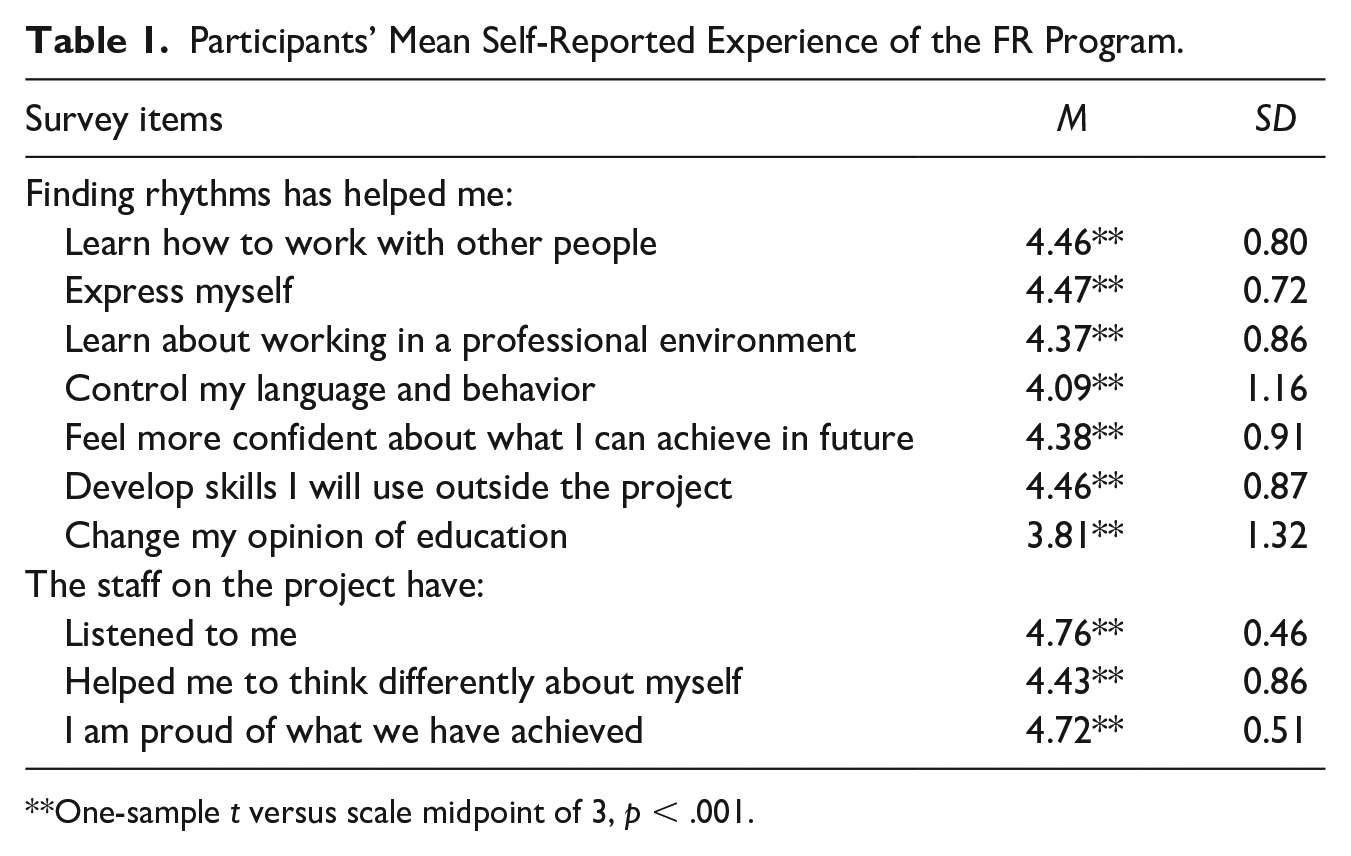
One-sample t versus scale midpoint of 3, p < .001.
Correlations between measures
Table 2 presents the intercorrelations between variables at T1 and T2. In line with our hypothesizing about the relationship between FR group identification, psychological need satisfaction, and well-being, these variables were all highly correlated, in the hypothesized directions.
Intercorrelations Between Variables at T1 and T2.
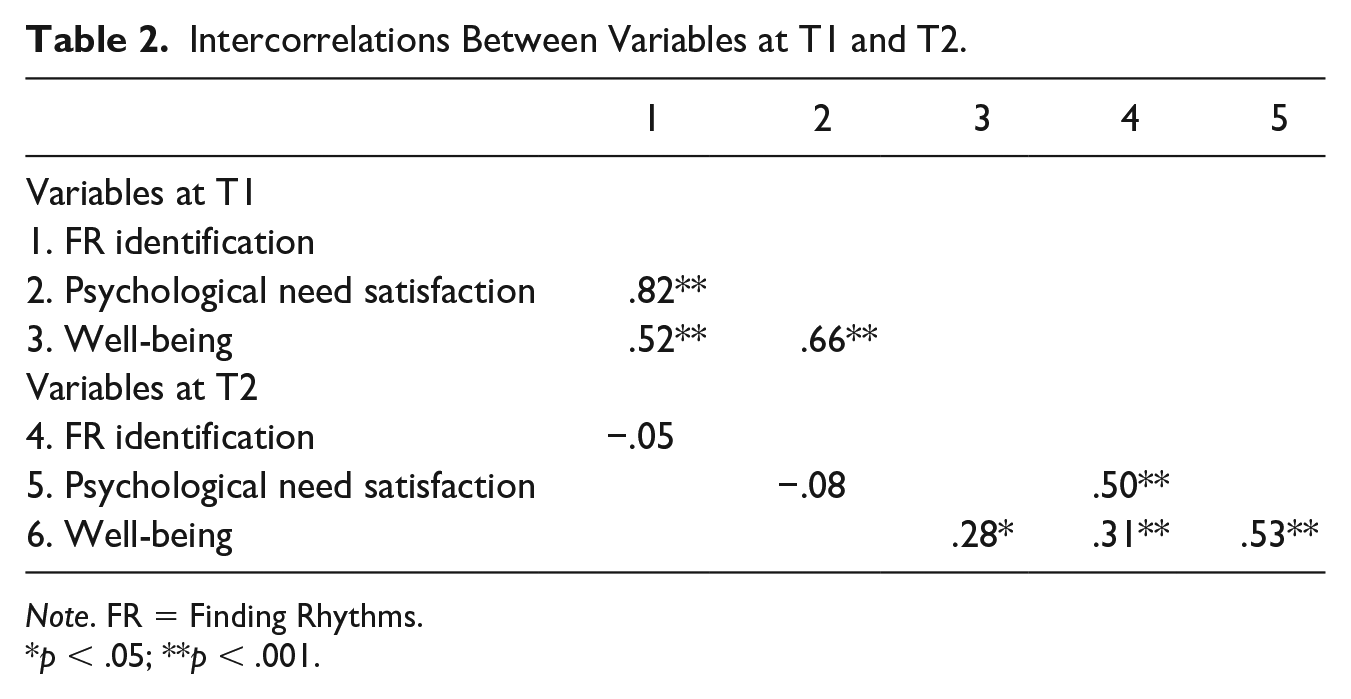
Note. FR = Finding Rhythms.
p < .05; ** p < .001.
Assessment of the impact of participation in the FR program
We conducted within-subjects t tests to compare participants’ FR group identification, psychological need satisfaction, and well-being before and after participation in FR. A Bonferroni correction was applied to account for multiple tests (changing the probability threshold to p < .01). Results are presented in Figure 1. From these results, it can be seen that participants’ self-reported FR identification, T1 M (SD) = 3.38 (1.56), T2 M (SD) = 4.54 (.58), t = −5.99**, Cohen’s d = .99; psychological need satisfaction, T1 M (SD) = 3.31 (1.46), T2 M (SD) = 4.36 (.59), t = −5.78**, Cohen’s d = .94; and well-being, T1 M (SD) = 3.28 (1.20), T2 M (SD) = 3.78 (.91), t = −3.46**, Cohen’s d = .47; were higher after participation in the program than before and all effects were large.
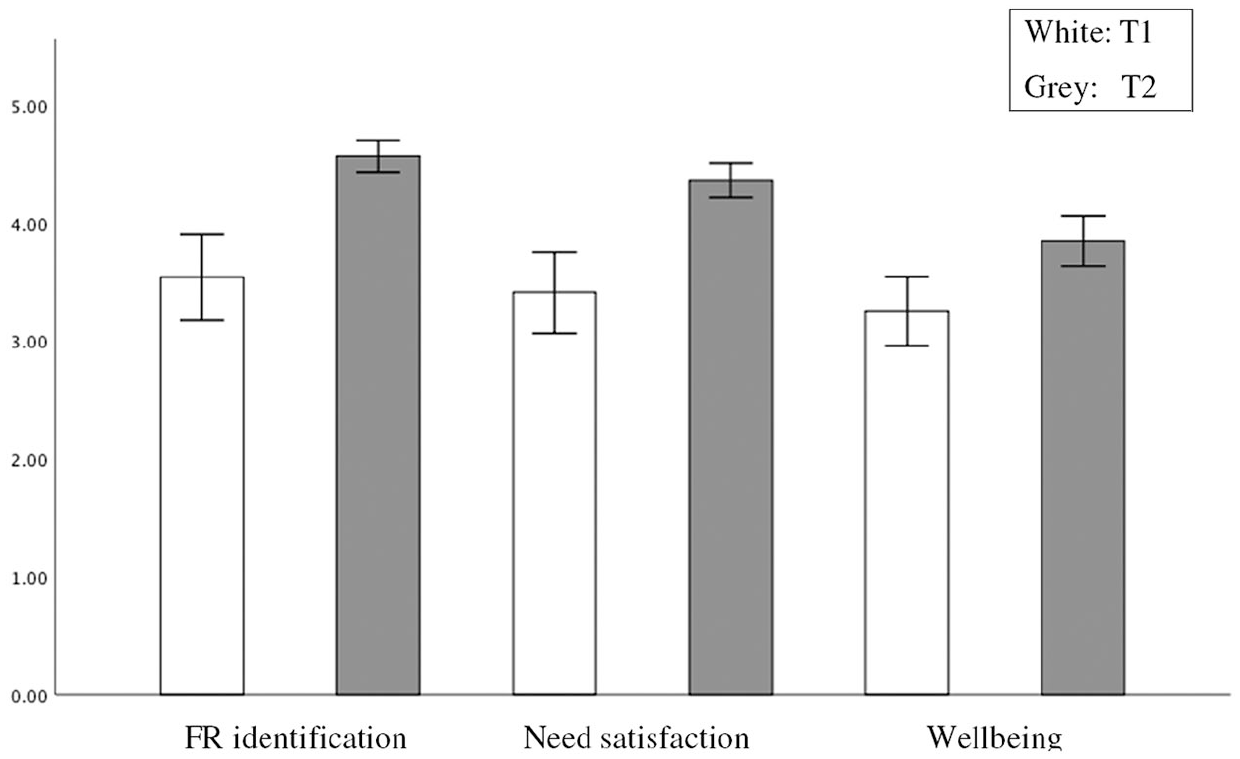
Longitudinal tests of FR impact.
Assessment of how FR program participation positively impacts prisoner well-being
Tests for evidence of mediation were conducted using path analysis in Mplus (Version 8; Muthén & Muthén, 2015). We created pre- versus post-FR program difference scores to keep the number of variables to a minimum, considering our low sample size for path analysis and to investigate change directly for the following variables: FR identification, psychological need satisfaction, and well-being. We first calculated the reliability of each difference score used in the analysis because difference scores allegedly suffer from reliability problems (Trafimow, 2015), using the standalone Macintosh program Reliability of Difference Scores (Version 2.0). The program yielded the following difference score reliability values: .92 for FR identification, .89 for psychological need satisfaction, and .85 for well-being. This indicates that all measures used in our mediation analysis are reliable. The model thus included the difference in FR identification scores across the two time points as the predictor variable, the difference in psychological need satisfaction scores as the mediating variable, and the difference in well-being scores as the outcome variable.
The data are multilevel, with inmates (N = 104) nested within prisons (N = 13). We examined whether we needed to take account of this multilevel structure by computing intra-class correlations (ICC) to assess the variance of the variables between prisons. The ICCs (Δ FR identification ρ = .50, Δ psychological need satisfaction ρ = .50, and Δ well-being ρ = .33; thus all ρ > .08) indicate that there is significant variation in all three measures both between and within prisons, so we controlled for this clustering using a common approach to the analysis of complex survey data in Mplus (Asparouhov, 2006): We specified TYPE = COMPLEX in the ANALYSIS command in conjunction with the CLUSTER option of the VARIABLE command. First, the model was estimated using maximum likelihood robust (MLR) estimation to account for non-normality in variable distributions. Second, the standard errors and bias-corrected confidence intervals for indirect effects were estimated using bootstrapping with 5,000 sample replicates and maximum likelihood (ML) estimation.
The quantitative results are summarized in Figure 2. Each of the individual paths was significant, in the hypothesized directions: Δ FR identification was positively associated with Δ psychological need satisfaction b = .85, p < .001, 95% CI = [.78, .92], and Δ psychological need satisfaction positively predicted Δ well-being b = .54, p < .001, 95% CI = [.38, .71]. Finally, there was a significant indirect effect of Δ FR identification on Δ well-being through Δ psychological need satisfaction, indirect = .46, p < .001, 95% bias corrected CI = [.32, .60], but the direct effect of Δ FR identification on Δ well-being was not significant (direct = .07, p = .393, 95% CI = [−.06, .19]). These results suggest that FR identification benefits prisoner well-being by satisfying psychological needs.

Standardized regression coefficients for the relationship between Δ FR identification and Δ well-being as mediated by Δ psychological need satisfaction.
Study 1 Discussion
Study 1 supported our hypotheses using a pre-post design that allowed us to effectively evaluate the impact of the FR program longitudinally despite the absence of a control group. Inmates reported increased FR group identification, psychological need satisfaction, and well-being upon completion of the program compared with the commencement of the program (H1); in addition, an increase in FR identification led to an increase in prisoner well-being through an increase in psychological need satisfaction over time (H2).
Study 2
In Study 2, we conducted interviews to capture inmates’ program experiences to gain insight into the role of emergent social identities and group processes during the FR workshops.
Method
Interviews
We carried out 15 interviews with 15 FR members upon completion of the program in two prisons. Participants were an opportunity sample, interviewed on the basis of their willingness to share their FR experiences. The same interviewees also took part in two group discussions, one at each prison, respectively. Informed consent was obtained from all participants.
In line with the aims and scope of thematic analysis (see the following “Analytic procedure” section), the interview questions were partly exploratory but also theoretically driven, reflecting our interest in the role of emergent social identities and group processes during the FR workshops. Participants were asked about (Question [Q]1) their experience of the FR program, (Q2) support and well-being, (Q3) continuity of the skills learned and feelings experienced during FR upon completion of the program, (Q4, Q5) shared identity and intergroup relations, and (Q6) their prisoner identity. (Q7) At the end of the interview, respondents were asked whether there is anything else that they would like to say about FR.
Our sample consisted of eight female and seven male inmates who took part in the FR program and were above 18 years of age. Each interview lasted between 4 and 10 min. The interviews were fully transcribed, and their mean duration was 5.5 min (total = 68.01 min). A group discussion, guided by an FR staff member, also took place at the end of the program in which FR participants discussed their perception of the program experience. The two group discussions, one at each of the two establishments, were also recorded and fully transcribed. Informed consent was obtained from all participants, and their mean duration was 14.22 min (total = 28.44 min).
Analytic Procedure
We employed thematic analysis (Braun & Clarke, 2006) using NVivo (Version 11.4.3). First, we read and reread the interview transcripts. Second, we created and assigned codes to extract portions with similar content (e.g., references to the program’s impact on well-being). Third, we organized them into distinct and coherent themes that formed a rough thematic structure. Finally, we returned to our data to check that the themes were appropriate across individual responses. All themes were amended to incorporate any instances that did not fit the general pattern observed across the data and a final thematic structure was produced. Our analysis was not only guided by theoretically driven questions (e.g., Was there reference to shared identity?), but we were also open to and identified unexpected themes (e.g., prisoner rivalries dissolve). Thematic analysis thus enabled us to investigate our theoretical research questions while being flexible enough to enable new insights.
Interview Results
In line with our quantitative findings, our qualitative results show that FR creates a shared identity, satisfies psychological needs, and benefits well-being. However, our interview findings indicate that the benefits of the FR group occur not only during and within the group itself. The results are organized into two sections—based on FR group activities and a shared FR identity (Section 1) and positive outcomes that transcend the FR group boundaries (Section 2)—that tell a temporal story: FR group activities and the development of a shared FR identity lead to positive well-being outcomes, which later transcend into prison life.
Section 1: FR Group and FR Identity
A first set of themes discernible in the data pertain to psychological processes that occur within the FR group workshops. Inmates seemed to become absorbed in FR activities, which created an identity that dissolved differences and promoted positive intergroup relations.
Prisoners described how the FR activities encouraged the participants to become engaged in the shared goal of creating music, which appeared to be a key factor that led to the emergence of a shared identity (in line with social identity theorizing; Hogg & Reid, 2006). The following extract is typical of accounts of how the focus on the process of making music was absorbing: P6B: It is a very comfortable environment—and you know that obviously that when you have to go back, you have to go back to your cells and that—but while we’re here—it’s just here—there is just nothing else that is going on, it’s just thinking about making music.
P6B describes her deep involvement in the group’s activities, and that the process of making music was so absorbing that it made her feel that “there is just nothing else that is going on.” The activities were behaviorally and cognitively absorbing, suggesting that the group was highly salient (Reicher, 2000) and informing participants’ interactions and behavior. Indeed, P7B explains how the FR activities brought together and bonded the diverse group of people by providing a shared purpose and collective identity: P7B: It’s been a really really great experience of bringing people together—people who you wouldn’t usually really chat to or associate with, it just brought us together. . . We’ve all got a bond now. . . I think we’re all different, I think we’re all unique in our own way, we’ve all got our talents, but obviously the one thing that joins us is the music so yeah we’re sort of one loud speaker. . .
P7B discusses how the previous boundaries between prisoners were dissolved (“people who you wouldn’t usually really chat to or associate with”) and that they become united (“a really really great experience of bringing people together”) through the FR experience (“it just brought us together”). These perceptions of similarity are based on prisoners’ shared interests and their feelings of relatedness through music, which strengthens the shared FR identity.
This is further explained by P5F, who explains that, although there is usually tension between prisoners, this seems to dissipate within the FR group. The positivity, shared goals and work, and the evidence of the group’s effectiveness and efficacy bridge the differences between people. The following is an illustrative quote of the ways in which FR helps to bridge differences between prisoners: P5F: It’s crazy cos obviously there’s people from other wings in it. . . Just to bond with them so quickly it was just like “wow” cos usually there would be tension in the room like say what area are you from or whatever, but it wasn’t even like that it was like let’s all make music. Yeah its wicked. . . regardless if you’re from that end or that end yeah like it’s always all about making music forget about the post code war let’s just make music and do something with ourselves. Interviewer: What’s the post-code war? P5F: Yeah like the post code beef. There was none of that it was strictly to make music. Cos I’m not here for that, I didn’t come here to do that, I came here to make music. . .
In the above account, P5F describes how FR bridges social identity boundaries between groups of people with different backgrounds, using the example of area. P5F is shocked (“crazy,” “wow”) by the power of FR to affect the intergroup relations between prisoners who come from different areas. The “post-code” identity, a preexisting source of potential conflict, is set aside, and, instead, the FR identity is made salient, with strong norms of collaboration and music-making (“forget about the post code war . . . I didn’t come here to do that, I came here to make music”). FR seems to build a bridge between prisoners by creating a foundation for collaboration (music) and a common, shared identity.
Some prisoners attributed the shared collective identity among the prisoners to the goals the participants of the FR program shared: creating a high-quality music album. In the following, a female prisoner at HMP Bronzefield talks about her experience of contributing to the FR group CD: P2B: You know what it is. . . We just come together. . . you see how different we are from each other, but at the same time we work and we mix and blend very well. . . so we have some nice tracks we have made that show that just because we are different doesn’t mean that our music is not tight. . . It’s the bouncing in and out of certain things, like certain songs or tracks, you’ve got something very tropical. . . a tropical sort of vibe. . . and then you have something very funky. . . it’s that drastic difference but. . . that’s how I can explain it. . . so different yet we come together very well.
P2B explains that to achieve the shared goal of producing the tracks for the CD, FR participants embraced the group’s differences—indicated here by metaphors such as “tropical” versus “funky”—and came together to work effectively as a group. Indeed, P2B talks of the FR group CD as the material embodiment of the groupness (. . . nice tracks we have made that show. . .), and that this brings the diverse group of people together into a successful group (“we mix and blend very well”), which is described using collective terms (we, us). Thus, the goal shared by the participants helped to develop a collective identity among them, which in turn helped the group effectively collaborate.
The FR experience also produced positive emotions among members, which were directed at themselves, the group as a whole, and the other members. P4B describes her experience as follows: P4B: I’m really really proud of the girls. . . and I’m really proud of myself as well because at one stage I thought you know what maybe it is not good enough or maybe people won’t be interested. But the reaction I got from everyone like it gave me the confidence to work more. . . And these guys—Ben and their team—have made us feel really really comfortable. . . I feel like when you have like a good team that you’re working with, people that are good are coming together, and it all goes to plan. It runs smoothly. We have fun but we respect one another at the same time. So yeah, it worked well.
P4B explains how the experience of being part of a constructive team (“a good team”), a comforting atmosphere, and having positive interactions with the members (“We have fun but we respect one another at the same time”) produced a positive working environment (“it worked well”) and feelings of pride directed at herself and her fellow group members. Like P4B, most participants were inspired by the group’s talent and said that they were proud of other members and what they have achieved as a group. This is in line with social identity theory, which suggests that positive social identities provide their members with self-esteem (Tajfel & Turner, 1979).
Section 2: Positive Outcomes That Transcend Into Prison Life
A second set of themes discernible in the data pertain to the positive outcomes associated with the FR group that transcend into prison life.
Participants referred to FR’s capability to increase their confidence, not only within the FR group boundaries but also in prison more generally. The following is an illustrative example of this: P4B: It’s given me the confidence to go back and write more and perform more to people as well because I remember the first time I read my spoken word actually was to Tania, one of the people here. . . and I was so nervous at the time doing it but now it’s just like jump on the mic and get on with it. . . and it’s been fun especially like in this environment, in a prison, you don’t have a lot of opportunities to do things that are different, so for the girls in here having these types of courses it really helps them build their confidence in here. Because your confidence is kind of put down a little bit you know?
P4B explains that FR group members’ encouragement increased her confidence and commitment to perform in front of other people. Critically, however, P4B goes on to talk about the ways in which FR increased participants’ confidence beyond the FR group. P4B describes how FR helped prisoners become more resilient to the prison’s restricting environment (“your confidence is kind of put down”) by providing prisoners with a purposeful and meaningful collective activity to engage in, which builds up their confidence in prison (“it really helps them build their confidence in here”).
Others prisoners also described how FR provided a sense of purpose within prison, which seemed to have a powerful positive effect on their well-being. One female prisoner at HMP Bronzefield described FR as a substantial part of prison life: P3B: It makes it, seem, a little easier because I have something to focus on—something on my mind all the time—because when I am not here I am in my room writing and thinking about what I am going to do when I am here. So it is a big part of my life here. . . It’s given me something to look forward to on the weekends, it’s actually boosted moral I think with everyone like—I think coming here has actually given us something to remind us of our talent and, so I think, yeah, it’s been great.
We can see that it is not just FR activities, but also the associated FR identity that engages prisoners outside of the group (“I have something to focus on—something on my mind all the time”). This finding ties to social cure theorizing that posits that a shared social identity focuses members’ energies and imbues them with a sense of meaning, purpose, and worth (Jetten et al., 2017). These effects appear to buffer the threatened well-being of prisoners and also help prisoners cope with the negative consequences of being a member of the devalued prisoner group, and so prison life becomes easier (“it makes it a little easier”).
Participants also talked about the ways in which FR has helped them manage their emotions and deal with their prison-related depression and anxiety. Here are two notable examples: P7F: It’s definitely a bit of a healer, you know going through a bit of a rough time a bit of depression or just the whole world of being in prison, I think this is a great way to take you out of your mind and to take you out of that state of mind in it and put you in a good one . . . Cos it helps man. It does, it does. And music is a good feeling. Just a stress reliever as well and well, it works man. P4B: It definitely takes your mind off of where you are and the environment that you are in. You kind of zone out for like the sessions, and you don’t have to think about what’s going on in the house—blocks or you know the stress that you’re going through elsewhere in life . . . or you know the stresses at home—like—you tend to miss your family a lot in here so when you have opportunities like this it kind of gives you time away from stressing about the lonely anxiety that you feel so like—yeah—it helped a lot.
Both participants describe prison life as depressing, but, in line with research showing that social identity reduces depression by fostering positive attributions (Cruwys et al., 2015), FR alleviated feelings of depression and low mood by acting as a “a healer” and “a stress reliever” that helped inmates manage their emotions. Specifically, FR helped to buffer against the main factors that lead to anxiety and depression in prison: It allowed incarcerees to escape the confined prison space (“the whole world of being in prison,” “the environment that you are in”), it helped them to deal with the loneliness that stems from isolation from their loved ones (“you tend to miss your family a lot in here”), and it permitted them to distance themselves from other situations that may arouse feelings of insecurity and fear (“you don’t have to think about what’s going on in the house-blocks”).
Inmates also indicated that FR gives people an identity that enables them to connect with others who they otherwise would not, which makes prison life more manageable. For example, P2F: Finding Rhythms has helped me because I didn’t really chat to anyone, and now I chat to everyone, so yeah it’s helped me a lot. Like before, obviously before this I was just sitting in my cell all day being bored and that, and not really chatting to no one and that but like now—obviously I’m gonna hate prison everyone hates prison—because of Finding Rhythms it’s made me get to know people, so when I’m out on the wing, I can chat to other people because I know them. So if it weren’t for that—if it weren’t for Finding Rhythms—I would probably still be sitting in my cell not chatting to no one, so they have brought out the confidence in me.
P2F explains that, before FR, prison life was characterized by social isolation (“sitting in my cell all day not chatting to no one”) and that he perceived the inmates on his prison wing as strangers. However, the shared identity created by participating in FR shifted his perception of the other FR members, who then became supportive in-group members (“if it weren’t for Finding Rhythms”). This was echoed by others: “. . . [the FR members who] live on my house block—we’ve known each other and that but we didn’t really talk much but now we talk like every day” (P5B). The shared FR experience and identity thus appears to facilitate positive social interactions among the FR members in prison. This finding coheres with research demonstrating that people who share a social identity are more likely to be positively orientated toward each other (Jetten et al., 2017).
FR also seems to reduce the salience of the negative “prisoner identity.” Participants do not think of themselves as inmates during these workshops, which fosters a sense of autonomy in this otherwise restricting environment. All 15 reported that FR changes the way they feel about being a prisoner. The following is an illustrative quote explaining how FR functions to conceal the prisoner identity: P5F: From when Finding Rhythms came here like, I didn’t feel like I was in jail for a second I actually thought I was in a studio. Like even though when I go back to my cell I feel like I’m in jail, I realize when I go back to my cell like I’m always rapping I’m not forgetting about what happened in Finding Rhythms cos I always have little flashbacks of what happened. Like say for instance I’ll make a tune here, but I’ll take the music to my cell and start listening to what I was listening to but all in my head in it, but like I feel like I’m on the actual outside world, I don’t feel like I’m in jail no more, I feel like I’m with a group of guys making music, and even after this I’m gonna feel like I’m still making music in my cell and like I’m a free man and it makes my sentence go quicker. . . yeah I feel like I’m not a prisoner when I’m in Finding Rhythms, I feel alive, I feel open.
P5F explains that his emerging FR identity functioned to overshadow his prisoner identity (“from when Finding Rhythms came here, I didn’t feel like I was in jail for a second”). In other words, inmates experienced a shift in identity salience whereby the FR identity became the more prominent, significant, and important identity to them. Although P5F says that the feeling of imprisonment returns when they go back to their cells, the FR identity does not remain situationally bounded because there is a sense of continuity and transcendence that softens the negative effect of leaving FR (“I’m not forgetting about what happened in Finding Rhythms”). In the above account, we can see the effect that FR has on one’s sense of autonomy: Individuals are bereft of autonomy back on the prison wing, but not during the FR workshops where they are provided with a stronger self-definition that strengthens the experience of their decisions as autonomous (“I’m a free man. . . I feel like I’m not a prisoner when I’m in Finding Rhythms, I feel alive, I feel open”), and a platform to interact with fellow group members, making them aware of the ways in which they can uniquely contribute to the group (“I’m with a group of guys making music”).
The (wider) musician identity that FR reinforces resulted in additional positive outcomes. All 15 participants reported that they will carry on with music once FR finishes and/or upon release.
For some participants, FR reinforced a positive musician identity by providing them with the opportunity to continue their preexisting musician identity. The following are two examples: P6B: I was working towards music on the outside and music was literally everything in terms of opening like a studio. So when I did come in here I felt like everything I was working towards was sort of gone downhill—but yeah they’ve actually helped me they’ve allowed me to—I am happy that I can put music out there, from in here, and people will still be able to hear me. P7B: It’s given me more confidence to make me then get back into pursuing the music career. . . I put a lot of energy into music and I lost it all, I lost touch with my musical side and it just reminded me actually, everyone, with everyone’s help, they reminded me how talented I actually am and I do need to get into it, whether I make money of it or to just make myself happy in general.
In the above extracts, FR can be interpreted as a means of reaffirming a positive identity that was being eroded through prison life. Music used to be a big part of their lives but was lost upon imprisonment (“everything I was working toward gone downhill,” “I lost touch with my musical side”). Those with preexisting music identities experience FR as affirming and as strengthening their musician identity (“I can put music out there, from in here, and people will still be able to hear me”). This leads to positive feelings and reignites their passion and confidence in their music ability (“I am happy,” “how talented I actually am”).
For others, FR created a new musician identity that they wanted to continue after the FR program: P5F: I won’t lie, I don’t want it to stop. Like literally I want Finding Rhythms to keep continuing. . . Yeah cos like, do you know what it is, it’s a bit crazy being in your cell all the time just doing nothing just watching TV, but as soon as I found out about Finding Rhythms I was like “I wanna go like I wanna go.” I feel more energetic, cos in my cell I’m not myself but when I’m here I’m just like a whole different person, like more open so it’s like Finding Rhythms made me find my rhythms. Like yeaaaah, it made me find my rhythms. . . I’m making music, I’m doing my thing right now—this is me now you know. When I get released or whatever, when I’m free, I wanna get involved properly. I didn’t used to want to do music, I used to see it as a hobby, but now like I wanna take it as a career.
In the above extract, we can see that FR allows members to cling to the positive FR identity and move away from the negative one of prisoner (’cos in my cell I’m not myself but when I’m here I’m just like a whole different person “this is me now”) to feel a sense of purpose that transcends prison walls and reconnects them to the outside world (“When I get released I wanna take it as a career”). P5F explains that FR helped him to find himself underneath all of his anger, conditionings, frustrations, and insecurities that come hand in hand with prison life, and taught him how to have a stronger and more positive sense of self (“Finding Rhythms made me find my rhythms”). Here P5F uses the metaphor “rhythm” to highlight the impact that FR has had on his life and how he will use the FR experience to guide how he acts in the future.
In sum, FR created a shared identity among the members that dissolved the boundaries between them and facilitated supportive and positive interactions among them. This led to a range of positive emotional and well-being outcomes experienced both within and outside FR. The FR workshops reduced the salience of the negative prisoner identity and created or reinforced a positive musician identity that inspired individuals to pursue music in and outside of prison.
Discussion
The present studies were designed to investigate the potential benefits of well-being from participating in FR for inmates residing in U.K. prisons. Longitudinal questionnaire findings (Study 1) and interview findings (Study 2) provided evidence for the social cure properties of the FR group. Both studies demonstrated that FR creates a shared identity among members that satisfies psychological needs and benefits well-being. Study 2 also showed that these positive well-being outcomes later permeates into prison life, making it easier and more manageable. We show that while decreasing well-being tends to be the norm in prison, building new social group memberships can counteract this decline.
This study provides the much-needed quantitative evidence to demonstrate that social interaction and engagement positively impacts the well-being of prisoners. We found that participation in FR made members feel good and also helped to resolve negative emotional states and problems associated with being imprisoned. These findings are consistent with previous research on the emotional function of music (Hunter & Schellenberg, 2010).
We also add to the social cure literature by applying the social identity approach to health to inmates, and demonstrating the curative properties of the FR group. Of the most prominent findings across Studies 1 and 2 was that the FR group fosters social support. This finding is in line with social cure theorizing (Jetten et al., 2017) that posits that when people define themselves in terms of a shared identity, they expect to give each other support, actually give each other support, and construe the support they receive more positively. Our qualitative results also highlighted the importance of behavioral involvement, a finding also in line with social cure theorizing (Jetten et al., 2017) that posits that people who define themselves in terms of a given social identity will enact—or at least strive to enact—the norms and values associated with that identity. The novelty in our findings lies in the population being studied as existing research has found these patterns to exist only among non-offender populations.
Our qualitative findings also revealed that the shared FR identity was capable of eroding intergroup hostilities within prison wings. This finding extends research on prejudice reduction that has found that, among non-offender populations, emphasizing shared identity and sameness may result in positive intergroup attitudes (Brown et al., 1999). Finally, our qualitative work illustrated that, beyond affording an FR identity, the FR group developed or strengthened a musician identity among members that transcends prison walls. These much-needed positive identities are capable of helping this population maintain continuity and avoid the negative effects of stigma (as has been the case for stigmatized individuals, see Shih, 2004), which are important for successful community reintegration.
Future research should address the limitations associated with this study. First, although our analyses capture change over time and qualitative research methods can be used to identify causal relationships and develop causal explanations (Maxwell, 2004), we provided correlational data in our quantitative analysis and therefore we cannot claim causality. Second, we were somewhat restricted in the number of items we could use in our quantitative enquiry, given our concern to reduce burden on participants, and given the strict space limits set by FR. Finally, future avenues for research would be to follow up some of our novel qualitative findings quantitatively.
Despite these limitations, our findings have important practical implications. Our results suggest that third sector organizations can provide social programs, like FR, that can benefit the lives of offenders, informing decisions about which prisoner services receive funding. Commissioning processes that ensure that small- and medium-sized charities such as FR are able to compete for tenders and contracts (argued not to be the case currently; Lloyds Bank Foundation, 2015) may benefit inmate well-being.
There is currently a great emphasis on managing the well-being and rehabilitation of prisoners residing in U.K. establishments. This work encourages practitioners to welcome creative projects that improve social life in prison and opportunities upon release, but more research on activities for prisoners and their effects on psychological well-being is warranted.
Footnotes
Editor’s Note

Declaration of Conflicting Interests
The author(s) declared no potential conflicts of interest with respect to the research, authorship, and/or publication of this article.
Funding
The author(s) received no financial support for the research, authorship, and/or publication of this article.