







Abstract
Drawing from organizational justice theory, this study examined the mediating effects of organizational trust on the association between organizational justice (i.e. in the forms of distributive and procedural justice) and the job attitudes of job satisfaction and organizational commitment in a sample of 220 correctional staff employed full-time at a high-security prison in the U.S. Midwest. Ordinary least squares regression results indicated that participant perceptions of organizational trust fully mediated the association between procedural justice and job satisfaction, but only partially mediated the association between distributive justice and job satisfaction. Further, organizational trust fully mediated the association between both distributive and procedural organizational justice and staff commitment toward the organization.
Keywords
Introduction
Correctional staff are a critical resource for the operation of correctional institutions. Staff are responsible for a myriad of duties and tasks necessary for the running of a humane, safe, and secure correctional facility (Lambert & Hogan 2009a, 2009b). Staff also account for the bulk of correctional budgets, as staffing is estimated to account for 70% to 80% of correctional organizations’ operating expenses (Camp & Gaes, 2002; Tewksbury & Higgins, 2006). As an expensive and valuable resource, research has been conducted on correctional staff for more than four decades, including how workplace variables affect staff.
One research area has explored how different workplace variables are related to the two work attitudes of job satisfaction and organizational commitment. Job satisfaction is the degree a person likes their job (Lambert et al., 2021b; Spector, 1997). Organizational commitment refers to the bond between a worker and the employing organization (Griffin et al., 2010; Meyer & Allen, 1997). Among correctional staff, job satisfaction and organizational commitment have been associated with lower levels of job burnout, absences, and turnover/turnover intent and higher levels of following regulations, support for organizational change, support for treatment of offenders, organizational citizenship behaviors (i.e. going beyond what is expected at work), and life satisfaction (Byrd et al., 2000; Griffin et al., 2010, 2014; Lambert & Hogan, 2009a; Lambert et al., 2005a, 2005b, 2019; Matz et al., 2013). In light of their importance, research has explored how various workplace variables are related to correctional staff job satisfaction and organizational commitment. The workplace variables of organizational justice and organizational trust have both been studied separately.
Organizational justice refers to employee views that the organization treats them in a fair and just manner, with distributive justice and procedural justice being the two major forms of organizational justice (Greenberg, 1990; Lambert et al., 2007). Organizational trust refers to the degree of trust a staff member has in the organization (Lambert et al., 2017). Limited past research indicates that organizational justice is linked to the work attitudes of job satisfaction and organizational commitment (Lambert et al., 2020, 2021b). Organizational justice and organizational trust, however, have not been included in the same analysis in terms of their association with job satisfaction and organizational commitment.
The literature finds that organizational justice and organizational trust views may be related to one another (Colquitt et al., 2001; Korsgaard et al., 1995). Specifically, organizational justice is postulated to influence the level of organizational trust (Colquitt et al., 2001). In other words, if the organization's efforts are seen as fair, a person is more likely to trust the organization. As justice and trust views may be interrelated, and this could result in mediation effects that either reduce or eliminate the effects of one of these variables. Without analyses that specifically examine mediation effects, erroneous conclusions could be drawn. These variables, however, may be related to one another through a mediating mechanism, whereby the effect of an independent variable on a dependent variable operates through a mediation variable (Baron & Kenny, 1986; Preacher & Hayes, 2004). Pardo and Roman (2013) indicated that “the term statistical mediation or simply mediation refers to a causal chain in which it is assumed that the effect of one or more independent variables is transmitted to one or more dependent variables through third variables” (p. 614). The current study explores whether organizational trust mediates the effects of distributive and procedural justice on the work attitudes of job satisfaction and organizational commitment among correctional staff using data from staff at a state-run high-security U.S. prison. The mediation analysis follows the steps developed by Baron and Kenny (1986).
Literature Review
Job Satisfaction
Locke (1976) defined job satisfaction as “a pleasurable or positive emotional state resulting from the appraisal of one's job or job experiences” (p. 1300). Milburne and Francis (1981) noted that job satisfaction referred to how a person felt about their job based on their expectations of what was sought from the job and what is actually received from the job. According to Spector (1997), job satisfaction is “the extent to which people like or dislike their jobs” (p. 2). Simply, job satisfaction is a positive affective (i.e. emotional) work attitude that relates to workers’ perceptions that the job meets their wants and needs (Lambert, 2003; Lambert et al., 2018). Global job satisfaction refers to employees’ perceptions of overall satisfaction with the job rather than from specific facets of the job (Camp, 1994). The current study used a measure of global job satisfaction.
Organizational Commitment
Organizational commitment refers to the bond between the staff member and correctional organization (Allen & Meyer, 1990; Lambert et al., 2020; Mowday et al., 1982). There are different types of organizational commitment based on how the bond is formed, with continuance commitment and affective commitment being two major types (Allen & Meyer, 1990; Lambert et al., 2021d). Investments in the organization, such as pay, benefits, retirement, nontransferable job skills, promotions, and social relationships, develop the strength of the bond between the staff member and the correctional organization (Lambert et al., 2020; Meyer & Allen, 1997). A staff member may commit to the organization, put forth efforts for the organization, and elect to stay with the organization in order to protect their investments (Allen & Meyer, 1990). As such, continuance commitment forms because of the necessity principle. Becker (1960) referred to these investments as sunken costs that bind a person to an organization and the potential loss of the investments makes it too costly to leave the organization or to let the organization fail.
The bond for affective commitment represents a psychological attachment to the organization (Lambert et al., 2007; Meyer & Allen, 1997; Mowday et al., 1982). Affective commitment is based on the reciprocity principle because the bond forms as a result of positive experiences and treatment by the organization (Allen & Meyer, 1990; Lambert et al., 2007). This type of commitment is voluntary and includes identification with the organization, internalization of organizational goals, acceptance of organizational core values, and willingness to put forth effort to help the organization be successful (Lambert et al., 2020; Mowday et al., 1982). As noted by Allen and Meyer (1990), “employees with strong affective commitment remain because they want to and those with strong continuance commitment because they need to” (p. 3). There is evidence that some correctional staff with high continuance commitment may feel trapped in the job, resulting in negative effects on staff and the correctional organization, such as job stress and job burnout (Lambert et al., 2013, 2015). Conversely, affective commitment has been linked with a wide array of positive outcomes, and it is the most common form of organizational commitment studied among correctional staff (Lambert et al., 2021c). A measure of affective commitment was used in the current study.
Organizational Justice
Organizational justice refers to the perception that the employing organization treats employees in a fair and just manner (Colquitt & Greenberg, 2005; Lambert, 2003). Distributive and procedural justice are major dimensions of organizational justice (Greenberg, 1990; Lambert et al., 2007). Distributive justice refers to the perception that salient organizational outcomes, such as pay, benefits, job evaluations, promotions, and workplace discipline are fair and just (Greenberg, 1990; Lambert et al., 2018). Distributive justice is based on equity and not equality (Greenberg, 1990; Lambert, 2003). Equality implies that all staff are treated the same without considering their efforts or the impact they have from their efforts. Equity refers to situations when outcomes are decided based on the inputs of the staff member (Greenberg, 1990; Lambert et al., 2007). Additionally, staff members consider the fairness of organizational rewards based upon inputs and in comparison with what other staff have received in similar situations (Greenberg, 1990; Lambert et al., 2020).
Procedural justice refers to the perceptions that the processes and procedures used to reach distributive justice outcomes are fair and just (Colquitt & Greenberg, 2005; Greenberg, 1990). Most staff want the processes and procedures used to determine distributive outcomes to be consistent, open, and fair, regardless of the result (Lambert et al., 2007). For example, Landy et al. (1980) found that the perceived fairness of employee evaluation procedures was important for employees, regardless of whether their performance appraisals were negative or positive. In sum, distributive justice is concerned with the ends, while procedural justice is concerned with the means the organization uses to reach those ends (Lambert, 2003; Lambert et al., 2007).
Organizational Trust
Robinson (1996) saw trust as the “expectations, assumptions, or beliefs about the likelihood that another's future actions will be beneficial, favorable, or at least not detrimental to one's interests” (p. 576). Whitener et al. (1998) defined trust as the belief by one person that actions carried out by another would be honest and benevolent to the person. As noted by Zhang et al. (2008), trust “is a fundamental ingredient in any positive and productive social process” (p. 111). Trust in the employing organization is referred to as organizational trust (Lambert et al., 2008; Schoorman et al., 2007). Organizations are represented by supervisors and managers (Lambert et al., 2017, 2020). Organizational trust is trust in the supervisors and managers of a correctional organization (Lambert et al., 2017).
Past Relevant Correctional Staff Studies
The limited research to date indicates that distributive and procedural justice are associated with correctional staff job satisfaction and organizational commitment. Among staff working at a U.S. prison, both distributive and procedural justice had significant positive effects on job satisfaction; however, only procedural justice had a significant positive relationship with affective commitment (Lambert, 2003). In another study involving staff at a private U.S. prison, both distributive and procedural justice had significant effects on affective commitment, but only procedural justice was a predictor of job satisfaction (Lambert et al., 2007). Among staff at a large Southern U.S. prison, both forms of justice were associated with job satisfaction, but only procedural justice had a significant relationship with organizational commitment (Lambert et al., 2020).In a correctional study conducted in China, staff views of both distributive and procedural justice were associated with organizational commitment, but only distributive justice was related to job satisfaction (Lambert et al., 2018). In an investigation of correctional staff in Ghana, staff views of both distributive and procedural justice had positive effects on job satisfaction, but only procedural justice had a positive effect on organizational commitment (Boateng & Hsieh, 2019). Finally, both distributive and procedural justice were significant positive predictors of organizational commitment in research of correctional staff in Nigeria, but only procedural justice had a significant association with job satisfaction (Lambert et al., 2021d).
Past research has also found that organizational trust is linked to both correctional staff job satisfaction and organizational commitment. Organizational trust has been found to be positively related to the organizational commitment of U.S. correctional staff (Kane et al., 1983; Lambert et al., 2008, 2021b; Lambert& Hogan 2009b). Similarly, organizational trust has been observed to be positively associated with U.S. corrections staff job satisfaction (Lambert & Hogan, 2009b; Lambert et al., 2008, 2021b). Organizational trust has also been observed to be linked to job satisfaction and organizational commitment among correctional staff in Nigeria (Lambert et al., 2022).
The limited research on organizational justice and trust in correction indicates that both organizational justice and organizational trust are associated with correctional staff job satisfaction and organizational commitment. It is, however, unclear how correctional staff organizational justice and organizational trust are related to one another, and if organizational trust mediates the effects of organizational justice on job satisfaction and organizational commitment among correctional staff. No published study could be located that examined whether and how organizational trust mediates the association of distributive and procedural justice with job satisfaction and organizational commitment for correctional staff. The current study was conducted to address this void in the literature.
Current Study
Moderator variables and mediating variables differ from one another (Baron & Kenny, 1986). A moderator variable affects the strength and direction of the relationship, but the independent variables do not need to be related to the moderator variable (Baron & Kenny, 1986; Namazi & Namazi, 2016). For example, the effects of work-family conflict (the domains of work and home spillover into one another causing problems) may be related to job stress for female correctional staff but less so for male correctional staff (Triplett et al., 1999). Moderator variable studies are illustrated by the gendered studies of how workplace variables differ in their effects between female and male correctional staff (Griffin et al., 2020). A mediator variable explains how two variables are related to one another. In the current study, organizational trust is the mediating variable. For the current study, the effects of distributive and procedural justice on correctional staff job satisfaction and organizational commitment were postulated to be mediated by organizational trust.
Mediation analysis examines influence of a given independent variable on a given dependent variable when the dependent variable is mediated either partially or fully by a third variable, which is termed a mediation variable (Pardo & Roman, 2013). The connection between the variables can be represented as: X→ M → Y, where X is an independent variable, M is the mediation variable, and Y is the dependent variable. In 1986, Baron and Kenny proposed testing mediation effects in four steps. First, test that there is an association between the independent variable(s) and the dependent variable. Second, test that the mediation variable is related to the dependent variable. Third, test that the independent variable is related to the mediation variable. The fourth step is to test the relationship of the independent variable(s) and the mediation variable with the dependent variable in the same analysis. Complete mediation is when the independent variable(s) are no longer related to the dependent variable once the mediation variable is included in the analysis. Partial mediation occurs when the independent variable(s) continue to show a significant association with the dependent variable but with a smaller effect size after the inclusion of the mediation variable in the analysis (Baron & Kenny, 1986; Iacobucci, 2008).
In the current study, the effects of distributive and procedural justice views on job satisfaction and organizational commitment among correctional staff are proposed to be mediated by the level of organizational trust. The current study used the steps proposed by Baron and Kenny (1986), which are followed by the vast majority of studies using mediation analysis (Pardo & Roman, 2013; Preacher & Hayes, 2004). In fact, as of 2023, Baron and Kenny (1986) have over 124,000 citations listed on Google Scholar. In addition to using the steps proposed by Baron and Kenny (1986), the present study also used the analyses of Sobel, Goodman, and Aroian (Aroian, 1947; Goodman, 1960; Sobel, 1982) to estimate the significance of a mediation effect (MacKinnon et al., 2002). These are different tests for the significance of the indirect effects of the independent variable on the dependent variable through the mediating variable (Aroian, 1947; Goodman, 1960; MacKinnon et al., 2002; Sobel, 1982). The paths from the independent variable (distributive and procedural justice in the present study) to the mediator variable (organizational trust in the present study), and then the mediator variable (job satisfaction and organizational commitment in the study), are often referred to the indirect effects (Baron & Kenny, 1986; Preacher & Hayes, 2004). The Sobel test is a specialized t-test that estimates whether the reduction in independent variable(s) after the introduction of the mediating variable on the dependent variable(s) is statistically significant, which means the mediation effect is significant (Sobel, 1982; Preacher & Hayes, 2004). The Aroian and Goodman tests are modifications of the Sobel test by including the product of the variance estimates of the coefficients for the effects of the independent variable on the mediating variable and the effects of the mediating variable on the dependent variable, but each using different approaches (MacKinnon et al., 2002). 1 As there can be differences between the tests, Sobel, Goodman, and Aroian tests were each estimated for the indirect effects of distributive and procedural justice on job satisfaction and organizational commitment through organizational trust.
Method
Participants
The study received human subject approval from a university institutional review board. All available full-time staff at a high-security prison in the Midwest of the U.S. were asked to engage in a research survey. The prison was near capacity, with 440 incarcerated sentenced individuals and employed 220 full-time staff. Staff were provided with a packet that consisted of a consent form, a cover letter, a questionnaire, and a return envelope. The cover letter explained the study's purpose, that participation was voluntary, that all responses would be anonymous, and how to return the questionnaire. A total of 158 usable surveys were included in the current study, representing 80% of the targeted population.
Approximately 62% of the respondents were correctional officers, and 59% identified as men. The median age was 33 years, ranging from 19 to 68 years old. The mean tenure in corrections was 3.18 years, with a standard deviation of 4.49, ranging from 0 to 34 years. In terms of educational level, 6% of the participants had earned a high school diploma or GED, 47% had some college but had not earned a college degree, 24% had earned an associate degree, 16% had earned a bachelor's degree, and 8% had earned a graduate degree. As to race/ethnicity, 79% of the participants identified as White, and 21% identified as people of color. According to the prison's Office of Human Resources, the responding staff were similar to the overall staff complement in terms of position, gender, age, tenure, and race/ethnicity. Specifically, the overall staff at the prison were 65% correctional officers, 61% male, median age 35, mean tenure in corrections slightly over three years, and 81% identifying as White. The human resources office could not provide information concerning participants’ educational attainment.
Variables
Dependent Variables
Job satisfaction and organizational commitment were the two dependent variables. Job satisfaction was measured using five items from Brayfield & Rothe (1951) (e.g. “I like my job better than the average worker does” and “I feel fairly well satisfied with my job”). Using six items from Mowday et al. (1982), organizational commitment was measured (e.g. “I am proud to tell people that I work at this prison” and “I really care about the fate of this prison). The satisfaction and commitment items were answered using a 5-point Likert scale ranging from strongly disagree (1) to strongly agree (5). The satisfaction items had a Cronbach alpha of .95, and responses were summed together to form an index. The commitment items had a Cronbach's alpha of .88, and an index was formed by summing the items.
Independent Variables
Distributive and procedural justice were the independent variables. Distributive justice used six items adapted from Price and Mueller (1986) (“I am fairly rewarded at this prison based upon my education level and job skills” and “My last annual performance rating presented a fair and accurate picture of my actual job performance”) and the Cronbach alpha for the items was .95. Based on items from Lambert et al. (2007), seven items were used to measure procedural justice (e.g. “Promotions are more related to whom you know rather than the quality of your work (reverse coded)” and “The standards used to evaluate my performance at this prison have been fair and objective”) and these items had a Cronbach's alpha of .87. The justice items were answered using a 5-point Likert scale ranging from strongly disagree (1) to strongly agree (5) and were summed together to form an index for procedural justice and another index for distributive justice.
Mediating Variable
Organizational trust was the mediating variable. Organizational trust was measured using four items based on Hoy and Tschannen-Moran (2003) and used by Lambert et al. (2012) (i.e. “You cannot trust management at this facility (reverse coded for index)” and “I have little trust in my supervisor (reverse coded for index)). The trust items were answered using a 5-point Likert scale ranging from strongly disagree (1) to strongly agree (5). The four trust items had a Cronbach's alpha value of .85 and were summed together to form an index.
Results
Ordinary least squares (OLS) regression was used for the four steps indicated by Baron and Kenny (1986), and the results for these four steps are reported in Table 1. Multicollinearity occurs when the independent variables are highly correlated with one another and affects the estimate of the effects of independent variables on the dependent variable (Tabachnick & Fidell, 2013). Multicollinearity is seen as a problem when the variance inflation factor (VIF) statistic value for an independent variable is above 5.0 (Tabachnick & Fidell, 2013). As indicated in Table 1, no VIF value was above 3.38 for any of the OLS multivariate regression equations, so there appeared to be no issue with multicollinearity. In addition, the issues of outliers, influential cases, normality, linearity and homoscedasticity of residuals, and independence of errors in the regression analysis were tested and addressed (Berry, 1993; Tabachnick & Fidell, 2013).
Ordinary Least Squares Regression Results.
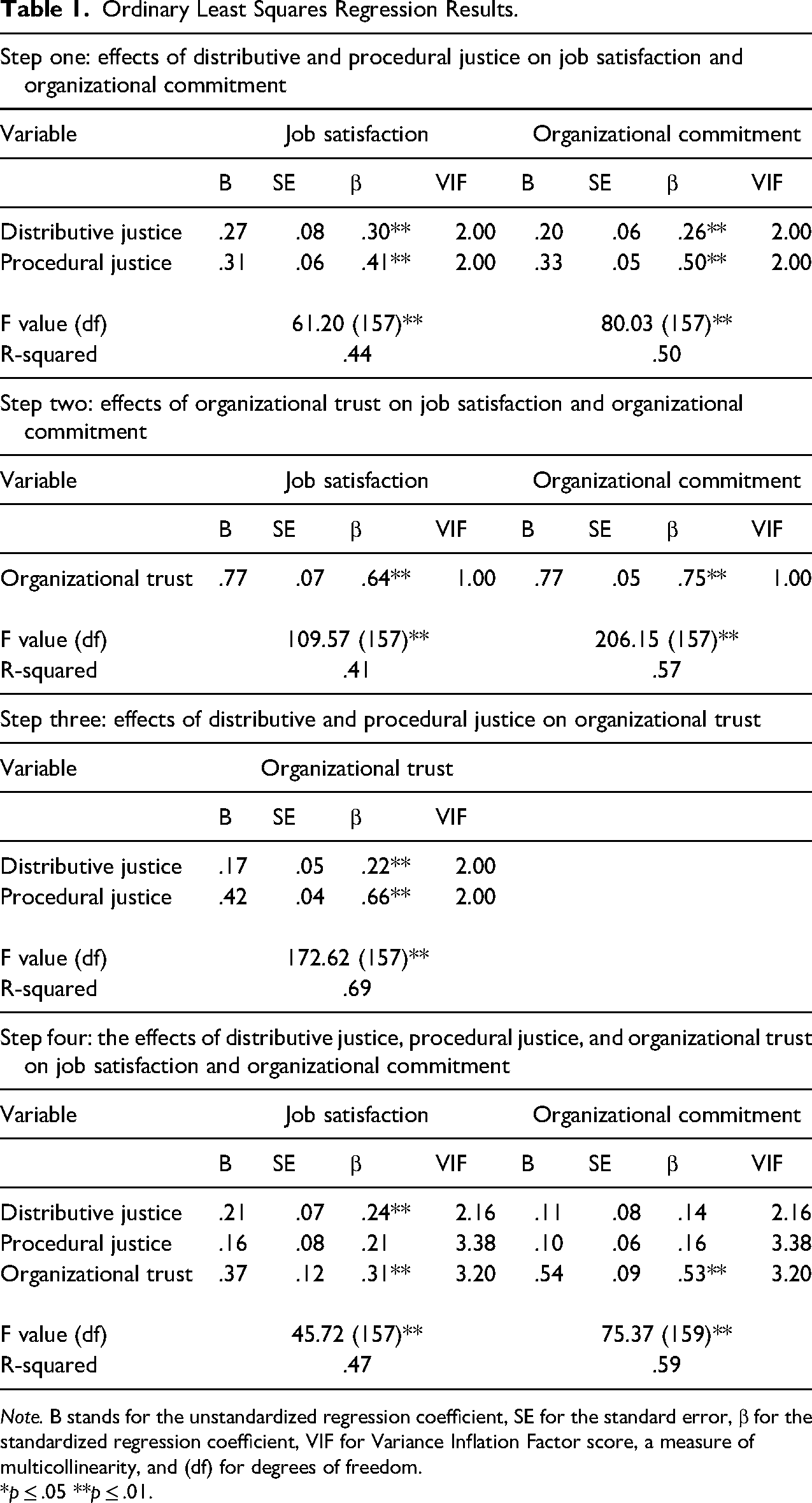
Note. B stands for the unstandardized regression coefficient, SE for the standard error, β for the standardized regression coefficient, VIF for Variance Inflation Factor score, a measure of multicollinearity, and (df) for degrees of freedom.
*p ≤ .05 **p ≤ .01.
For step 1, two regression equations were run to determine the effects of the independent variables of distributive and procedural justice on the dependent variables of job satisfaction and organizational commitment. Both distributive and procedural justice had significant effects on both job satisfaction and organizational commitment. The R-squared for job satisfaction was .44, which means the two justice variables explained about 44% of observed variance in the satisfaction index. Distributive and procedural justice accounted for about 50% of the observed variance for the commitment index (R-Squared = .50).
For step 2, organizational trust was regressed on job satisfaction and organizational commitment. Trust had significant effects for both work attitudes and explained about 41% of the observed satisfaction variance and 57% of the observed commitment variance.
For step 3, a regression equation was run with organizational trust as the dependent variable and distributive and procedural trust as the independent variables. Both forms of organizational justice were significant predictors of organizational trust, with procedural justice having a much larger effect on trust, three times as large as the effect of distributive justice on trust. The justice variables accounted for 69% of the observed variance in the trust index.
For step 4, two regression equations were run, one with job satisfaction as the dependent variable and the other with organizational commitment as the dependent variable. For both equations, distributive justice, procedural justice, and organizational trust were the independent variables. For job satisfaction, organizational trust had significant positive effects. Distributive justice had significant positive effects, but the size of the effect was reduced from what was observed in step 1. Procedural justice did not have a significant effect in step 4 but did in step 1. For organizational commitment, neither distributive nor procedural justice had significant effects as they did in step 1. Organizational trust had a significant effect on commitment. The results indicate that organizational trust partially mediated the association between distributive justice with job satisfaction and fully mediated the association between procedural justice and job satisfaction. Organizational trust fully mediated the effects of both forms of justice on organizational commitment.
In order to test the mediation effects of organizational trust on the work attitudes for the two forms of justice, the Sobel, Goodman, and Aroian tests were computed. The results for the mediation effects of distributive justice on job satisfaction through organizational trust were: (a) Sobel Test statistic = 3.25, SE = .04, p ≤ .001; (b) Aroian Test statistic = 3.24, SE = .04, p ≤ .001; (c) Goodman Test statistic = 3.26, SE = .04, p ≤ .001. The results for the mediation effects of procedural justice on job satisfaction through organizational trust were (a) Sobel Test statistic = 7.60, SE = .04, p ≤ .0001; (b) Aroian Test statistic = 7.58, SE = .04, p ≤ .0001; (c) Goodman Test statistic = 7.61, SE = .04, p ≤ .0001. The results for the mediation effects of distributive justice on organizational commitment through organizational trust were (a) Sobel Test statistic = 3.32, SE = .04, p ≤ .001; (b) Aroian Test statistic = 3.31, SE = .04, p ≤ .001; (c) Goodman Test statistic = 3.33, SE = .04, p ≤ .001. The results for the mediation effects of procedural justice on organizational commitment through organizational trust were (a) Sobel Test statistic = 7.37, SE = .04, p ≤ .0001; (b) Aroian Test statistic = 7.36, SE = .04, p ≤ .0001; (c) Goodman Test statistic = 7.39, SE = .04, p ≤ .0001. The results indicate that the mediation effects of organizational trust for distributive and procedural justice on the work attitudes of job satisfaction and organizational commitment are statistically significant.
Discussion and Conclusion
Using a sample of 220 full-time correctional staff employed at a high-security facility in the U.S. Midwest, the study examined the mediation effect of organizational trust between participant views of organizational justice—distributive and procedural justice—and job attitudes of job satisfaction and job commitment. The empirical mediation models employed for the analyses (Baron & Kenny, 1986) indicated that participant trust in organization leadership—managers and supervisors jointly—fully mediated the association between procedural justice views and satisfaction with one's job, but only partially mediated the association between distributive justice and job satisfaction. Moreover, the analysis indicated that participant trust in the organization fully mediated the association between organizational justice views—both distributive and procedural—and commitment toward the organization. These findings contribute to the empirical and theoretical understanding of the role of organizational trust in social and behavioral research (De Cremer & Tyler, 2007; Lind, 2001; Tyler & Lind, 1992) which prioritize the role of trust as a mediator between procedural justice and social behaviors. In addition, the study's findings generate new knowledge on the relationship between views of organizational trust and organizational justice in correctional settings. In social and behavioral research, scientists have also included trust as an element of organizational justice—interactional and informational justice (Lind & Tyler, 1988); but the findings of the present study confirm that trust is its own construct (Rousseau et al., 1998), and its effect must be carefully measured—as including trust within organizational justice instruments may contribute to confound the effect of organizational trust on specific outcomes of interest.
The study's findings cannot be compared to previous studies in corrections for two reasons. First, no other investigation has focused on the mediating effect of trust on the association between organizational justice and job attitudes. Second, no other published study has focused on the direct association between organizational justice and job satisfaction and commitment to the organization in correctional settings; however, management research found that participant views of procedural justice tend to have a stronger influence on job satisfaction than perceptions of distributive justice (Masterson et al., 2000). This might be explained by the fact that organizations, including correctional organizations, tend to use standardized systems of rewards, such as pay, holidays, and promotions—making distributive justice a less volatile and more predictable outcome; however, staff tend to pay closer attention to the fairness of procedures used to determine those rewards, or procedural justice. This study's findings suggest that staff views of procedural justice only matter when staff sees management/supervisors as trustworthy, further confirming the theoretical proposition that trust matters in the explanation of views of organizational justice (Colquitt et al., 2001), but adding that trust is also its own construct (Colquitt, 2001) and must be examined separately from measures of organizational justice.
Social exchange theory may offer some insight into the nexus between the variables examined in this study. As Lambert and Hogan (2013) assert, “Social exchange theory states that social interactions at work influence the attitudes and behaviors of employees” (p. 318). The foundation of social exchange theory is premised on the principle of reciprocity, whereby positively treated employees feel an inclination to reciprocate positive treatment in various ways and negative treatment results in negative outcomes (Kamdar et al., 2006; Walumbwa et al., 2010). In the context of the current findings, the principle of reciprocity seems to be mediated by organizational trust. In other words, the extent to which correctional staff reciprocate the positive and/or negative effects of distributive and procedural justice in the form of job satisfaction and organizational commitment is contingent upon organizational trust. Future research is needed to further investigate these findings in the context of theory.
These findings have practical implications as well. Organizations should pay close attention to establishing trustworthy relationships with their employees, especially when it comes to consistency in the implementation of policies and procedure, as trust mediates the association between fairness of procedures and both job satisfaction and commitment to the organization. Building trust takes time, requires reciprocal relationships, and cannot be demanded of staff; it must be earned (Lambert et al., 2012). According to Lambert et al. (2021b), “to improve trust, leaders need to be consistent, engage in fairness, exhibit integrity, and act in a benevolent manner while making sure the organizational structure supports rather than hampers staff” (p. 208). The role of managers and supervisors is integral to the formation of trust. Correctional institutions must ensure that managers and supervisors receive ongoing training concerning fostering trust among staff. This study indicates that acting in a just manner will increase organizational trust.
In the current study, justice and trust views have a significant association with one another. In addition, as a group they provide a good deal of job satisfaction and organizational commitment. This means that both organizational justice and organizational trust are salient variables for work attitudes of job satisfaction and organizational commitment. Correctional organizations need to be aware that raising distributive and procedural justice views of staff will not only raise organizational trust but ultimately the level of job satisfaction and organizational commitment of staff. The findings indicate that efforts to raise perceptions of distributive and procedural justice should be undertaken. Staff need to be asked why they feel procedures and outcomes are perceived as fair and suggestions of how to increase views of fairness among staff. Supervisors and managers need to be made aware of the need to importance of engaging in organizational justice and be evaluated and rewarded for engaging in fairness in their actions. Instrumental communication, formalization, and input into decision-making were reported to raise distributive and procedural justice views of correctional staff (Lambert et al., 2021a). This means explaining procedures and outcomes and answering questions should increase views of distributive and procedural justice. In addition, formalization means that there is codification of rules and regulations and they are consistently followed and there is no favoritism of supervisors and managers with line staff. Allowing input does not mean that suggestions must be followed but there must be a discussion of why some suggestions were instituted and not others (Lambert et al., 2021a).
The findings also point for the need to do more mediation research on how workplace variables affect correctional staff. There have been numerous studies on the direct effects of workplace variables. What is needed is more research on how the workplace variables (as well as other variables) and the indirect effects of variables to provide a more comprehensive view of how the correctional work environment affects staff.
Limitations and Recommendations for Future Studies
As with any study, the research findings must be interpreted within the context of several limitations. First, data came from a single high-security prison in the U.S. Midwest Future research should include multiple prisons with various levels of security to strengthen the representativeness of the findings. Second, the sample size was 158 full-time staff. Although there was an 80% response rate, future research should seek out large sample sizes. Third, this study was unable to account for interactional justice (explaining justice decisions and treating staff with respect), which is a form of organizational justice. The inclusion of inteactional justice should be included in future research to test its strength in the presence of organizational trust. Fourth, the current study relied on Baron and Kenny's (1986) four-step process to examine mediation variables. Even though this is a valid analytic strategy for testing mediation effects, future research may want to rely on structural equation modeling because it provides an effect size, including direct and indirect effects. Finally, future empirical models may want to include separate measures of supervisor trust and management trust.
It is important to note that while Baron and Kenny (1986) indicated that a relationship between the independent and dependent variable must exist that this relationship may not be clearly visible in all cases due to several reasons, including a suppressing effect by other variables or that the mediation variable has the opposite effect on the dependent variable as compared to the independent variable (Pardo & Roman, 2013). This supports the need to explore direct associations between the independent and dependent variables first identified as nonsignificant, as there may be a mediating variable which is either suppressing the effects or has effects similar but opposite with the dependent variable. As such, it has been argued that the first step of a significant relationship between the independent variable(s) and the dependent variable(s) is not always necessary for a mediation analysis (MacKinnon et al., 2002).
In closing, research examining the relationship between organizational justice, trust views, and outcomes such as job satisfaction and organizational commitment has exclusively focused on direct effects. Given that past literature indicates that organizational justice and trust views may be related to one another (Colquitt et al., 2001; Korsgaard et al., 1995), the current study investigated how organizational trust mediates the effect of organizational justice on job satisfaction and organizational commitment. Such research is important to fully understand how workplace variables affect correctional staff and the institution. Future research should not only build on this study but other areas in corrections where there may be plausible, theoretically driven indirect effects. The outcome of such research may be a more comprehensive understanding of workplace variables, and therefore, more comprehensive policy implications and suggestions for correctional administration.
Footnotes
Acknowledgements
The authors thank the reviewers and editor for their comments which improved the paper. The authors thank Janet Lambert for proofreading the paper.
Declaration of Conflicting Interests
The authors declared no potential conflicts of interest with respect to the research, authorship, and/or publication of this article.
Funding
The authors received no financial support for the research, authorship, and/or publication of this article.