







Abstract
The predictive validity of the Psychological Inventory of Criminal Thinking Styles (PICTS) Fear-of-Change (FOC) scale was evaluated in 1,101 male prison inmates following their released from custody. The predictive validity of the FOC was tested using a Cox proportional-hazards regression analysis. Results revealed a small but significant predictive effect, implying that fear of change may serve as a barrier to change in correctional populations. The theoretical and practical implications of these results include shifting attention away from an exclusive focus on risk factors in favor of barriers and obstructions to change, while targeting fear of change for intervention.
Introduction
Fear of change is a complex construct that has been described as anything from a minor adjustment problem to a serious anxiety disorder, and which has been ascribed to a range of factors, including but not limited to a fear of the unknown, a fear of nonexistence, a fear of failure, a fear of success, and a fear of losing control. Some mental health professionals even classify it as a psychiatric or psychological disorder under the heading of metathesiophobia (Practical Psychology, 2022), a term derived from the Greek words for change (meta) and fear (phobos). In the current article, I conceptualize fear of change as a state of mind that interferes with a person's ability to change in the short-term when change in the long-term would be of benefit to the individual. I next examine the theoretical foundations of this construct and describe the manner in which it will be assessed in the current investigation.
Fear of Change as a Theoretical Construct
Existentialism is a theoretical/philosophical perspective that would appear to be of particular value in explaining fear of change. Bugental and Bugental (1984), in taking up the existential argument, contend that change threatens a person's sense of reality. That is because it challenges the very structure of a person's existence, including their identity, their meaning in life, and their social relationships. In many ways, it signals the death of old identities, meanings, and relationships, and their replacement by new identities, meanings, and relationships. As a matter of rebirth, this new life can be intimidating, lending itself to negative emotional reactions based on the fact that the ultimate outcome is unknown (Carleton, 2016). Even before change occurs, its prospect engenders apprehension, worry, and even more powerful emotions like dread and terror (Heidegger, 1962). Hence, it is the anticipation of change rather than its actual presence that gives birth to a range of fears that are collectively known as the fear of change, and it is the fear of change that keeps people locked into old self-destructive patterns like criminal offending and drug use. As a case in point, fear of change was associated with a high rate of dropout for patients enrolled in an opioid substitution treatment program (Kondoni & Kouimtsidis, 2017).
In the criminal lifestyle model, which falls within the larger umbrella of social-cognitive-developmental theory (Walters, 2022), fear of change is considered an expression of existential fear. Although the criminal lifestyle model and wider social-cognitive-developmental theory operate primarily on social learning/cognitive-behavioral principles, the motivation for behavior is based on the humanistic notion of existential fear. According to this model, all living organisms are born with a life instinct, which, through a process of evolution, gives rise to a survival strain whenever the organism's existence is threatened (Walters, 1998). Thus, a living organism, whether a plant growing in the direction of sunlight or an animal finding a new source of food, strives to survive in a constantly changing environment. In humans, this striving develops into a fear of nonexistence as the child begins to differentiate themselves from the surrounding environment and gains awareness of their existence as both finite and separate from their environment (Walters, 1998, 2022). One of the principal features of existential fear is a fear of change based on the realization that change threatens the organism's existence. This leads to the uniquely human quality social scientists refer to as fear of change (Hollander, 2004).
The Fear-of-Change Scale
In the 2001 revision of the Psychological Inventory of Criminal Thinking Styles (PICTS: Walters, 1995), eight of the original 16 PICTS validity items (confusion and defensiveness scales) were removed from the PICTS because of weak internal consistency and lack of discriminant validity (Walters, 2001). The eight deleted items were subsequently replaced by eight items from a newly formed Fear-of-Change (FOC) scale. Although the FOC, unlike the rest of the PICTS, is designed to assess a motivational construct and not a cognitive construct like criminal thinking, it was deemed an important addition to the PICTS for both clinical and research purposes. After some deliberation, it was decided that the eight FOC items should be subsumed within the PICTS instead of being treated as a stand-alone procedure. Research subsequently demonstrated that despite the fact that the FOC was assessing a motivational construct rather than a cognitive construct, it correlated surprisingly well with the general criminal thinking scale of the PICTS (r = .69). This is consistent with the assumption that fears of change are the principal motive behind the development of the criminal thinking styles assessed with the remaining PICTS items (Walters, 2022).
According to the results of the original reliability and validity study performed on the FOC, the measure displayed good internal consistency (Cronbach α = .79) and mean inter-item scale correlations (r = .32) in 200 male and female inmates, while demonstrating strong test-retest reliability over two (r = .79) and twelve (r = .76) weeks in separate groups of 25 male inmates each (Walters, 2001). In that same study, a concurrent validity analysis showed that the FOC correlated significantly with a fear checklist (r = .40). The next major step in validating the FOC was a study by Walters and Geyer (2007) in which the construct and predictive validity of the FOC were assessed in several groups of male medium security inmates. In one of the analyses, the FOC correlated positively with the Personality Assessment Inventory (PAI) Anxiety (ANX) scale in 136 male federal prisoners. Further analysis revealed that the cognitive component of the ANX correlated significantly better with the FOC than either the affective or physiological components. In a survey of 239 male inmates, Walters and Geyer (2007) also determined that the FOC rose significantly in inmates dropping out of treatment but not in inmates persisting in treatment. All of these findings were consistent with a priori predictions. More recently, Todd-Fritz (2023) observed a significant correlation (r = .56) between the FOC and retrospective accounts of adverse childhood and adolescent experiences in a sample of 22 adult probationers.
Present Study
The purpose of the current study was to test whether the FOC is capable of predicting recidivism above and beyond easily available demographic and criminal and drug history indicators. Although prior studies have found that the FOC possesses good reliability, preliminary concurrent and construct validity, and has the ability to predict persistence in programming, it has yet to be determined whether the FOC is capable of predicting recidivism in offenders following their release from custody. In order to establish whether the FOC is capable of predicting release outcomes independent of easily obtainable demographic and historical/background variables – age, race, education, instant offense, sentence, prior criminal history, and past substance abuse – were all controlled as part of a survival analysis in which time until new offense served as the outcome measure.
Method
Participants
The sample for this study consisted of 1,101 male inmates who completed an intake assessment at a medium security federal prison located in the northeastern United States. All participants were then subsequently released from federal custody sometime between November 2003 and December 2009, and follow-ups were conducted starting in November 2003 and ending in January 2010. Participants ranged in age from 18 to 76 years at the time of intake (M = 36.64, SD = 9.79), whereas the mean educational level was 11.33 years (SD = 1.94). The racial/ethnic breakdown of the sample was 68.1% Black, 19.6% White, 11.5% Hispanic, and 0.8% Asian/Native American. A little more than a quarter of participants were serving time for drug offenses (27.5%), another quarter were incarcerated for parole/supervised release violations (27.1%); the remainder were serving time for weapons violations (16.3%), robbery (9.3%), violent crimes (5.3%), property crimes (4.3%), and miscellaneous offenses (10.2%). Sentence length ranged from 2 to 708 months (M = 44.94, SD = 59.52). One participant was serving a life sentence (coded as 999 months).
The current sample of participants was derived from a subset of 3,039 inmates who had been psychologically evaluated as part of a routine intake procedure occurring at the medium security federal prison where this study took place. A subgroup of 1,435 inmates was eventually released back into the community sometime between November 2003 and January 2010. Participants released more than 41 months after the intake evaluation (n = 132) were removed from the sample based on the results of a prior analysis showing that psychological measures administered this far from release achieved significantly weaker predictive validity than those released 1 to 41 months after intake (Walters, 2009). Participants with no evidence of recidivism who spent less than 12 months in the community (n = 140) were dropped from the sample, as were 62 individuals who produced invalid PICTS profiles (20 or more unanswered items, confusion-revised ≥ t score of 95, or defensiveness-revised ≥t score of 68). This resulted in a final sample of 1,101inmate participants.
Measures
Recidivism
Any new charges or a parole/supervised release violation leading to reincarceration were scored positive for recidivism (1). Censored cases in which the inmate was still in the community by the end of the follow-up period were coded negative for recidivism (0). Two-thirds of the sample (65.8%) recidivated at some point during the follow-up, while the remaining one-third (34.2%) did not. Also calculated was time (in months) until a new charge, parole/supervised release violation or end of follow-up, a figure that ranged from 1 to 68 months (M = 18.51, SD = 15.75).
Fear-of-Change
The FOC scale is part of the larger Psychological Inventory of Criminal Thinking Styles (PICTS: Walters, 1995), but its eight items are separate and distinct from the thinking style items that dominate the PICTS, having been added to later versions of the overall instrument as replacements for eight response style items that were found to be ineffective in assessing test-taking attitude. Each item on the FOC (i.e., “change can be scary;” “its unsettling not knowing what the future holds;” “new challenges and situations make me nervous;” “I have often not tried something out of fear that I might fail;” “I find it difficult to commit myself to something that I am not sure of because of fear;” “there is nothing more frightening than change;” “fear of change has made it difficult for me to be successful in life;” “there have been times when I tried to change but was prevented from doing so because of fear”) is rated on a four-point Likert-type scale (1 = disagree, 2 = uncertain, 3 = agree, 4 = strongly agree), and the results summed to produce a score that can range from 8 to 32. The internal consistency of the FOC scale in the current sample of participants was good (α = .80).
Control Variables
Age (in years), race/ethnicity (dummy coded as White and Black, with “other” serving as the reference category), education (in years), instant offense (1 = violent, 2 = non-violent), and sentence (in months) were the demographic/background variables that served as controls in this study. The violation (V) score from the Lifestyle Criminality Screening Form (LCSF: Walters et al., 1991) served as a criminal history control variable. Five of the six items from the LCSF-V were available in the files of inmates included in the present study. The LCSF-V produced a comprehensive criminal history score based on the following five items: interpersonally intrusive instant offense (no = 0, yes = 1), total number of prior intrusive offenses (none = 0, one or two = 1, three or more = 2), evidence of domestic violence (no = 0, yes = 1), total number of prior offenses (none to one = 0, two to four = 1, five or more = 2), and age at time of first conviction (19 years or older = 0, under 19 years of age but over 14 years = 1, 14 years or younger = 2). The LCSF-V score ranged from 0 to 7 in the current sample of participants. A final control variable inquired as to whether the inmate had a documented substance (alcohol and/or drug) abuse history (no = 0, yes = 1).
Procedure and Statistical Analyses
Age, race (White and Black dummy variables), education, instant offense, current sentence, LCSF-V, past substance abuse, and FOC served as covariates in a survival analysis based on a Cox proportional-hazards regression model. The outcome variable in this study was recidivism as assessed with a dichotomous outcome (recidivism yes = 1, recidivism no = 0), with time until event (recidivism) or end of follow-up factored in. Recidivism encompassed arrests on new charges and parole/supervised release violations leading to revocation. Data for this study were obtained from a review of electronic files maintained at the Federal Bureau of Investigation (FBI) National Crime Information Center and Federal Bureau of Prisons (BOP) federal inmate database. The time span between release from prison and recidivism (uncensored cases) or end of follow-up (censored cases) ranged from 1 to 76 months (M = 29.33, SD = 16.23). Although the data employed in this study were collected originally for clinical purposes, they were approved for research by the BOP's Institutional Review Board (IRB). The IRB at Kutztown University likewise approved these data for research purposes. None of the variables included in the current investigation had any missing data.
Results
Table 1 lists the study's descriptive statistics for the eight control variables and one independent variable included in this study, as well as all 36 inter-variable correlations. As the results from Table 1 indicate, the FOC scale, which served as the independent variable, correlated with just one of the control variables—namely, education—after a Bonferrroni-corrected alpha was employed as a means of controlling for the rise in experiment-wise error that occurs when multiple correlations or comparisons are made.
Descriptive Statistics and Correlations for the Eight Control Variables and One Independent Variable Included in This Study.
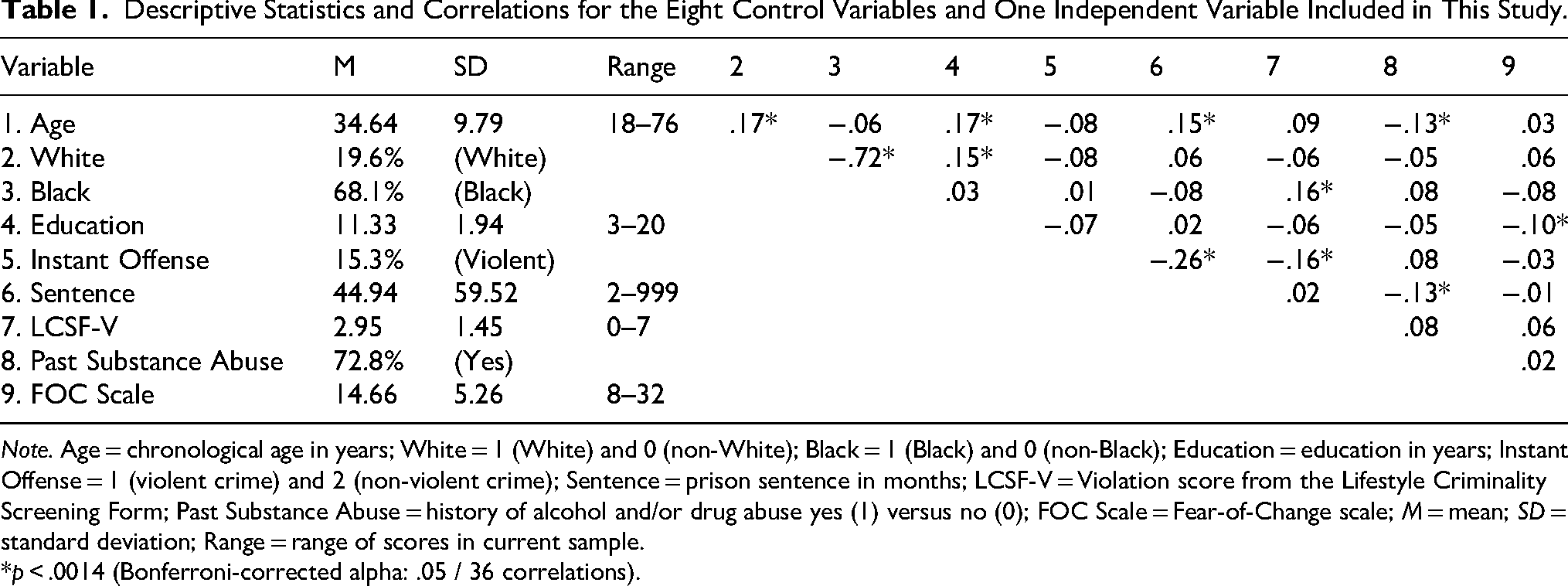
Note. Age = chronological age in years; White = 1 (White) and 0 (non-White); Black = 1 (Black) and 0 (non-Black); Education = education in years; Instant Offense = 1 (violent crime) and 2 (non-violent crime); Sentence = prison sentence in months; LCSF-V = Violation score from the Lifestyle Criminality Screening Form; Past Substance Abuse = history of alcohol and/or drug abuse yes (1) versus no (0); FOC Scale = Fear-of-Change scale; M = mean; SD = standard deviation; Range = range of scores in current sample.
*p < .0014 (Bonferroni-corrected alpha: .05 / 36 correlations).
The average time-at-risk (release until reincarceration or end of follow-up) was 29.33 months. A survival plot calculated on all current study participants is reproduced in Figure 1. According to the results of this plot, the median (50th percentile) survival time for participants in the current study was 16.00 months, with a 95% confidence interval of 14.21 to 17.78 months. This indicates that half the sample reoffended within 16 months. The mean survival time, by comparison, was nearly twice the size of the median survival time, coming in at 27.29 months, with a 95% confidence interval of 25.63 to 28.95 months.
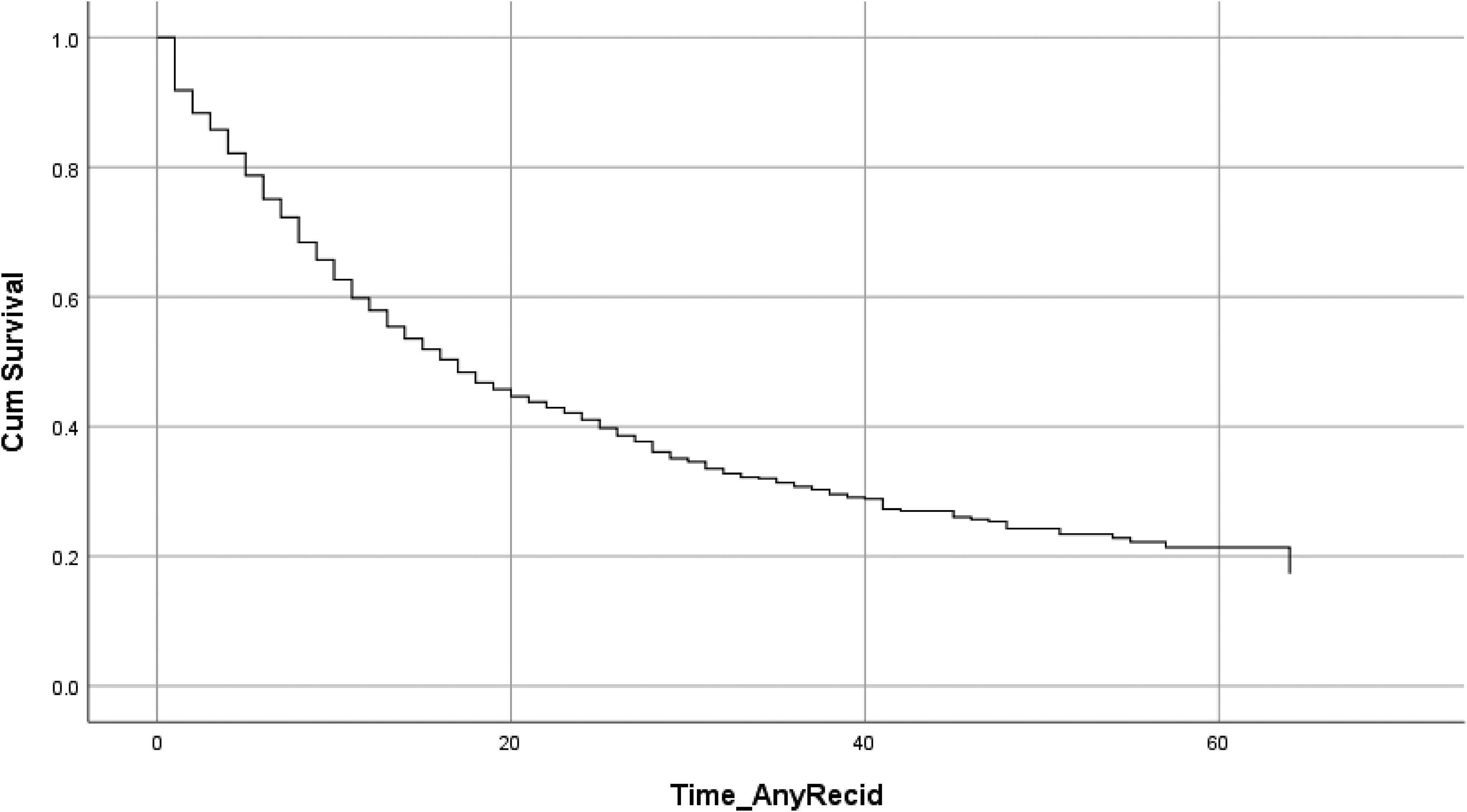
Survival plot calculated at the mean of all covariates. Note. Time_AnyRecid = time in months until recidivism
The results of a Cox proportional-hazards regression analysis can be found in Table 2. Of the covariates in the equation, the control variables of age, Black, LCSF-V score, and past substance abuse were all significant, as was the independent variable, FOC. A hazard ratio of 1.021 for the FOC indicates that the probability of recidivism increased 2.1% for every point increase on the FOC after controlling for all of the other variables in the equation. The significant FOC Wald statistic denotes that the scale successfully predicted recidivism above and beyond the demographic and criminal/drug history variables included in the equation.
Cox Regression Survival Analysis of Demographics, Criminal and Substance Abuse History, and the Fear-of-Change Scale as Predictors of Time to Recidivism.
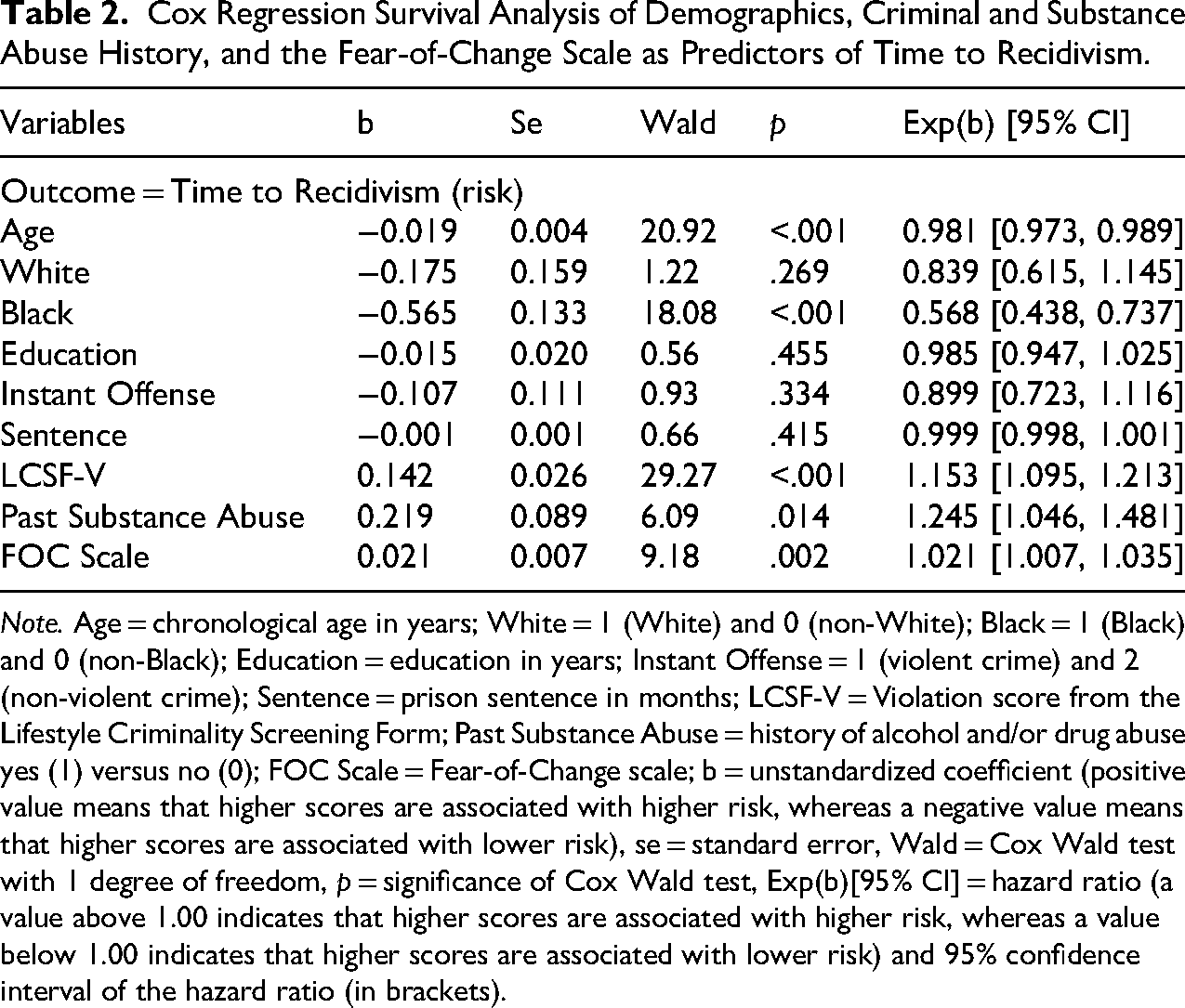
Note. Age = chronological age in years; White = 1 (White) and 0 (non-White); Black = 1 (Black) and 0 (non-Black); Education = education in years; Instant Offense = 1 (violent crime) and 2 (non-violent crime); Sentence = prison sentence in months; LCSF-V = Violation score from the Lifestyle Criminality Screening Form; Past Substance Abuse = history of alcohol and/or drug abuse yes (1) versus no (0); FOC Scale = Fear-of-Change scale; b = unstandardized coefficient (positive value means that higher scores are associated with higher risk, whereas a negative value means that higher scores are associated with lower risk), se = standard error, Wald = Cox Wald test with 1 degree of freedom, p = significance of Cox Wald test, Exp(b)[95% CI] = hazard ratio (a value above 1.00 indicates that higher scores are associated with higher risk, whereas a value below 1.00 indicates that higher scores are associated with lower risk) and 95% confidence interval of the hazard ratio (in brackets).
Discussion
The purpose of this study was to evaluate the ability of the PICTS FOC scale to predict recidivism in a sample of 1,101 male inmates released from federal custody. All releases occurred between 2003 and 2010, and the average follow-up across participants was 29 months. After implementing controls for age, race, education, instant offense, sentence, LCSF-V score, and past substance abuse, the FOC was tested as a predictor of recidivism. The results revealed that the FOC predicted recidivism above and beyond the control variables in the regression equation with a significant but modest degree of accuracy. Based on a hazard ratio of 1.012, it can be estimated with a reasonable degree of certainty that with a one-point increase on the FOC (range = 8 to 32), the probability of recidivism goes up 2.1%, keeping all other variables in the equation constant. Hence, with a one standard deviation elevation on the FOC (SD = 5.26), we should expect to see an 11% increase in the likelihood of recidivism. This compares to a 15% rise in recidivism with a one-point increase on the LCSF-V (range = 0 to 6) and a 24% increase in recidivism in someone with a history positive for substance abuse.
Theoretical Implications
One of the more popular psychological theories of crime is the General Personality and Cognitive Social Learning (GPCSL) model in which risk factors are used to predict and manage a person's future likelihood of criminal involvement (Bonta & Andrews, 2017). In order to accomplish the dual goals of prediction and management, psychologists not only focus on risk factors; they also investigate promotive and protective factors. Farrington and colleagues (2016), as a case in point, employ a developmental life-course model to explain how risk, promotive, and protective factors increase or decrease the likelihood of future offending. Hence, risk factors increase the probability of future offending, whereas promotive factors decrease the probability of future offending. Protective factors, for their part, reduce the probability of future offending in high-risk individuals, either by interacting with and neutralizing a specific risk factor or by reducing general risk in offender populations. Just as promotive factors sometimes counter the effect of risk factors by serving as an opposing force on a bipolar continuum with the risk factor at one end (e.g., weak family support) and the promotive factor at the other (e.g., strong family support), so too may protective factors counterbalance the effect of risk factors by creating an opposing force.
An opposing force may have also been at work in the present study, although in this case, a promotive factor rather than a risk factor was the likely target of the opposing force. We might refer to the opposing force in this instance as a vulnerability factor. Thus, instead of interfacing with a risk factor to reduce risk, as would be the case with a protective factor, a vulnerability factor interfaces with a promotive factor to increase risk. Like the protective–risk relationship, the vulnerability–promotive relationship can be interactive or general, with the vulnerability factor increasing risk by interacting with and counteracting a specific promotive factor or by reducing general promotion in offender populations. In the current study, there was no specific promotive effect identified, although this does not mean that there was not a specific promotive effect operating. According to the conceptual model proposed here, fear of change heightens risk by either neutralizing the effect of a specific promotive factor or reducing a person's general promotive status in a manner similar to how a protective factor lowers risk by neutralizing a specific risk factor or reducing general risk. There is a need for more research on these admittedly speculative variable functions and relationships, but if future research supports these preliminary assertions, it could open the door to expanding the traditional risk-promotive-protective model to include vulnerability factors.
Practical Implications
From a practical standpoint, the current results suggest that fear of change may play a significant role in maintaining a criminal lifestyle. As such, it may need to be addressed before the start of formal programming and intervention, least it disrupt the treatment process and diminish the likelihood of future desistance. Incentives, both positive and negative (i.e., the “carrot and stick” approach), have the capacity to help clients stay focused on and engaged in treatment (Jakubowski et al., 2023). As has been demonstrated empirically in several prior studies, the longer someone remains in treatment, particularly if they complete the program, the stronger the effect (Bouffard & Muftic, 2006; Messina et al., 2002). Research also indicates that there is little, if any difference in outcome between those legally coerced into attending a program and those classified as volunteers (Gordon et al., 2008; Hall & Lucke, 2010). With this in mind, some type of preparatory intervention along the lines of motivational interviewing (Miller & Rollnick, 2002) may be helpful in addressing issues like fear of the unknown and related concerns that may underpin and drive fear of change (Carleton, 2016). In the absence of such a preparatory intervention, the individual may not be in a position to benefit from a formal intervention designed to change their criminal thinking and behavior (McMurran, 2009).
The next question that needs to be answered is what works best to remove the barriers to change that may arise from a client's fear of change. Interventions targeting fear of change have been devised for those who are mired in an unsatisfactory relationship (George et al., 2020), struggling with an eating disorder (Griffiths et al., 2018), or recovering from intimate partner abuse (Leal et al., 2021). In each case, the individual finds themselves in the unenviable position of feeling powerless to alter their circumstances because of their fear of change. Techniques designed to alter a person's perspective and improve their readiness for change include learning to manage emotions, anxiety-related emotions in particular (Leal et al., 2021), developing positive outcome expectancies for treatment (Schulte, 2008), and removing barriers to change that lie at the heart of their fear of change such as the ubiquitous fear of losing control (Griffiths et al., 2018). Although one study found no relationship between readiness for change and desistance in justice-involved youth (Liu & Orrick, 2022), another determined that a brief course of motivational intervening led to an upsurge in readiness for change that eventually culminated in reduced recidivism (Anstiss et al., 2011).
Policy Implications
A major policy implication of these results is that they are a further indication that society needs to make greater use of community corrections in response to law-breaking behavior. While incarceration is necessary in some cases, certain countries, most notably the United States, have been accused of over-incarcerating its citizens (Budd et al., 2023). Mass incarceration creates a number of problems, from providing less criminally oriented individuals with the opportunity to learn criminal attitudes and techniques from more criminally sophisticated citizens (Archer & Flexon, 2022) to the growing fiscal and social cost of incarceration compared to community-based alternatives (O’Hear, 2018). With respect to fear of change, prison provides people with a structured environment that changes very little and demands very little of them. As a result, fear of change is not really dealt with and in many cases it may not even be recognized. It has been said that some offenders do not mind prison because it provides them with a structured and familiar environment to which they adapt relatively quickly and with minimal effort (Haney, 2002). The environment outside of prison is much more challenging because things change more frequently and more quickly in the community than they do in prison. Prison may simply mask a person's fear of change so that they do not have to think about it because the environment is so structured and not nearly as unpredictable as the streets. Even so, it also does not teach them how to deal effectively with change and their fear of it. Community corrections are in a much better position to do that.
Limitations
Despite a large sample and the use of an FOC scale that showed adequate to good reliability and validity in previous research (Walters, 2001; Walters & Geyer, 2007), the current investigation is not without certain limitations. First, the generalizability of results may be an issue given that all participants were male federal prison inmates housed in a single medium security federal prison located in the northeastern United States. One could accordingly question how well the results generalize to female offenders, state prisoners, and inmates from prisons located outside the United States. Second, recidivism was operationalized in this study using convictions instead of arrests and an official source (FBI's National Crime Information Center records) instead of offender self-report. It is a well-established fact that official arrest records underestimate a person's criminal history compared to a person's self-report of criminal arrests (Thornberry & Krohn, 2000). Research nevertheless indicates that the two measurement approaches (i.e., official records and self-report) demonstrate 80% concordance and their relationship does not appear to vary as a function of crime severity (Pollock et al., 2015). Even so, the current study's reliance on conviction data could be viewed as a limitation in that greater racial and other types of bias can occur with convictions than with arrests because of the larger number of criminal justice steps that are required for a conviction compared to an arrest (Shaffer, 2023).
Conclusion
The present results, viewed alongside outcomes obtained in an earlier investigation by Walters and Geyer (2007), suggest that fear of change may not only interfere with assisted change programs by encouraging offenders to drop out of treatment in the short-run (Walters & Geyer, 2007), but that it may also interfere with the unassisted change process by discouraging offenders from achieving desistance in the long-run (current study). Additional research is required to determine whether fear of change represents a component of the risk assessment model that has remained largely uninvestigated up to this point (i.e., vulnerability factors) and whether these factors impact on behavior by reducing or neutralizing the effect of promotive factors. The current results also suggest that to the extent fear of change impedes desistance, it may be wise to implement preparatory interventions designed to effectively manage this fear by buttressing offenders’ readiness for change and improving their ability to fully participate and benefit from a formal program of intervention.
Footnotes
Funding
The author received no financial support for the research, authorship, and/or publication of this article.
Declaration of Conflicting Interests
The author declared no potential conflicts of interest with respect to the research, authorship, and/or publication of this article.