







Abstract
Organizational citizenship behaviors are not directly rewarded by organizations. However, they seem to contribute to excellent performance at work. The aim of this study is to test quality of working life’s (QoWL) mediating role in the relationship between emotional intelligence (EI) and organizational citizenship behaviors (OCB). 203 French adults working regularly in teams completed validated self-report measures corresponding to each construct. The collected data showed that in the studied sample, a high quality of working life was associated with Sportsmanship behaviors. However, mediation was not observed for the other OCB subscales: Altruism, Helping, or Civic virtues. These behaviors tend to occur in individuals with high emotional intelligence scores, unrelated to their quality of working life. Theoretical background, practical implications, and limitations of the study are discussed.
Keywords
Introduction
In recent years, there has been a growing investigative interest in positive organizational scholarship (Spreitzer & Sonenshein, 2004; Gilbert, Laschinger, & Leiter, 2010) and thus an increasing number of studies have studied organizational citizenship behaviors. Organizational citizenship behaviors (OCB) refers to employees’ positive discretionary behaviors not directly rewarded by superiors since they are partly considered as out-of-role behaviors. They favor collaboration and performance at work (Podsakoff, MacKenzie, Paine, & Bachrach, 2000). As for the antecedents of OCB, a few studies have identified dispositional predictors. But, in spite of the emerging literature, no research has yet considered how emotional intelligence affects OCB, and how they both might interact with work-related quality of life. The aim of this study is to test the mediating effect of quality of work life in the relationship between emotional intelligence and organizational citizenship.
Emotional intelligence is defined as a set of traits or abilities that help to deal with emotions and/or emotional information (Petrides, Pita, & Kokkinaki, 2009). Historically, there have been two main approaches to emotional intelligence: the ability approach and the trait approach. Specialists consider that emotional intelligence can be measured as a trait using self-assessment questionnaires, like personality traits (Mikolajczak, Quoidbach, Kotsou, & Nélis, 2009). In an organizational context, the way that people experience their relationships to work and receive its benefits depends in part on their emotional intelligence (Carmeli & Josman, 2006; Binbin & Jian'an, 2008; Mikolajczak et al., 2009; Winkel, Wyland, Schaffer, & Clason, 2011). As in every social context, emotional intelligence seem to allow individuals to learn from others, to adapt, and to be more easily accepted (Schutte, Malouff, Bobik, Coston, Greeson, Jedlicka et al., 2001).
Organizational citizenship behaviors are self-willed behaviors that go beyond job requirements and are therefore not directly rewarded by the organization (Organ, 1988). Thus, this literature review of OCB excludes contextual performance studies. Although these constructs are similar, there is an important distinction: the contextual performance framework includes work contributions that may be requested and formally rewarded by the organization, which is not the case for citizenship behaviors.
A few studies examining the link between OCB and organizational performance revealed positive and significant links between employees’ citizenship behaviors—such as helping, sportsmanship and civic virtues—and some objective indicators such as client satisfaction (Podsakoff et al., 2000). In addition to these valuable effects on organizations, citizenship behaviors can also act in the employees’ favor during performance evaluations, being at least as important as in-role behaviors (Allen & Rush, 1998; Podsakoff et al., 2000).
Research about citizenship behaviors in organizations has been developed by several authors without a precise theoretical framework, and with a multiplicity of behaviors described. Thus, in their literature review, Podsakoff et al. (2000) described 30 citizenship behaviors grouped in seven themes: helping, sportsmanship, organizational loyalty, organizational compliance, individual initiative, civic virtues, and self-development. Moreover, Organ originally defined five dimensions of organizational citizenship (1988): altruism, or providing support to colleagues on an individual task; courtesy, consisting in updating colleagues about changes that may affect their work; conscientiousness, which means performing duties beyond the minimum required; sportsmanship, or abstaining from complaining about trivial problems in the organization; and civic virtue, consisting in voluntarily participating in the governance and public image of the organization. Later, Podsakoff and MacKenzie (1994) combined altruism with courtesy and called it helping. In addition, conscientiousness was removed in 1994 since from the managers’ point of view it was an expected behavior at work. As a result, Podsakoff and MacKenzie designed what is now the most common measure of OCB, which captures three dimensions: helping, civic virtue, and sportsmanship. However, Williams and Anderson (1991) distinguished only two OCB categories: behaviors directed toward individuals (OCB–I) and behaviors directed toward the organization (OCB–O). For example, OCB–I manifestations include helping colleagues who have been absent or taking a personal interest in other employees. On the other hand, OCB–O involves, for instance, giving one’s employer good publicity.
Contrary to organizational variables, the effects of dispositional variables on citizenship at work have been less studied, and their effects seem to be limited (Wegge, Van Dick, Fisher, Wecking, & Moltzen, 2006). Organ and Ryan (1995) showed that, except for conscientiousness from the Big Five personality model, dispositional variables are poorly correlated with citizenship. The high correlations found between several types of citizenship led these authors to think that there was one overall moral factor (m) behind them. Contrary to these findings, Podsakoff et al. (2000) found that employees’ altruism and obedience to rules are linked to personality traits like conscientiousness, agreeableness, and positive affectivity. The latter may be related to employees’ ability to manage their emotions at work, especially the negative ones. Moreover, this may indicate that an individual’s tendency to be altruistic or obedient at work may depend partly on emotional abilities such as empathy and emotion regulation.
Emotional Intelligence and Organizational Citizenship Behaviors
Several studies have examined the relationship between emotional intelligence and organizational citizenship. Even though most of them seem to indicate a positive link between these two variables (Carmeli & Josman, 2006; Binbin & Jian’an, 2008; Solan, 2009; James, Velayudhan, & Gayatridevi, 2010; Turnipseed & Vandewaa, 2012), some of them are inconsistent.
Solan (2009) showed that 19% of the variance of an organizational citizenship overall score was predicted by emotional intelligence. In the same line, Carmeli and Josman (2006) showed that emotional intelligence significantly predicted altruism (ß = 0.27, p < .001) and compliance (ß = 0.20, p < .05), while Binbin and Jian'an (2008) observed that emotional intelligence (EI) predicted OCB, moderating the relationship between perceptions of fairness and OCB. Consistent with these results, James, et al. (2010) found a positive relation between emotional intelligence and overall citizenship behaviors among corporate executives (r = .56, p < .05). Finally, two studies made by Turnipseed and Vandewaa (2012) showed that 16.5% of OCB–I and 25.3% of OCB–O variance were exclusively explained by the dimension “managing emotions.”
Some studies contain clues to explain a positive link between emotional intelligence and citizenship: these clues involve empathy, pro-social attitudes, positive emotions, and ethical perceptions. For example, the experiments carried out by Isen, Shalker, Clark, and Karp (1978) showed that empathy, a component of emotional intelligence, allowed individuals to adopt the organizations’ point of view more easily. This sympathetic perspective could facilitate or enhance citizenship behaviors toward the organization (OCB–O). Schutte et al. (2001) found that in social situations, participants with the highest emotional intelligence scored better in empathic perspective and self-awareness, and evaluated themselves as more cooperative with their partner. The authors proposed that these pro-social attitudes sustained by EI might favor an understanding of others and helping, thus leading to conflict resolution and a friendly environment at work. Moreover, a recent study (Mesmer-Magnus et al., 2010) found that employees with high emotional intelligence scores had a finer perception of ethical actions and reported to a lesser extent that unethical actions facilitate success. Hypothesis 1. Emotional intelligence will be positively related to organizational citizenship behaviors.
Quality of Work Life and Organizational Citizenship Behaviors
In order to give organizations a wider view of the factors that influence the working experience, the concept of “work-related quality of life” was created (Warr, Cook & Wall, 1979; Bruchon-Schweitzer, 2002). It involves factors such as working conditions, but also broader non-work factors that affect the employees’ relationship with work, including general life satisfaction and work–home interface (Van Laar, Edwards, & Easton, 2007). A positive evaluation of the job environment and opportunities will bring a feeling of psychological well-being at work, while a negative evaluation creates dissatisfaction.
Beyond the intrinsic motivation aroused by dispositional variables (personality, self-esteem, emotional intelligence, etc.), environmental variables can influence the appearance of citizenship behavior in the workplace. For example, if an individual perceives that his company pays special attention to employees’ quality of working life and “cares” about him, the probability of performing beyond requirements may increase. As Organ, Podsakoff, and MacKenzie (2006, p. 94) stated: “employees might feel that they owe OCB to others (their leader or coworkers), to the organization, that they have a moral obligation and/or that it is expected of them based on social norms.”
Regarding the links between quality of working life and citizenship behaviors, the most commonly supported idea is that quality of working life, and more specifically job satisfaction, may affect citizenship rather than the reverse. For example, a study by Lowery, Beadles, and Krilowicz (2002) showed that blue collar workers’ citizenship behaviors were predicted by several dimensions of job satisfaction, such as satisfaction with coworkers, with supervision, and with pay, but not satisfaction with opportunities for advancement, with the work itself, or even organizational commitment. Shoenfelt and Battista’s experiments (2004) showed that participants playing a “job satisfaction role” reported better mood, more intentions of citizenship behaviors, less absenteeism and fewer intentions to quit the job at the end of the experiment. Furthermore, Levesque, Blais and Hess (2004) observed not only that well-being predicted altruism and conscientious behaviors, but that this variable also moderated the effect of a manager’s supervision style on an employee’s citizenship. Recently, Paillé (2008) found that job satisfaction predicted sportsmanship (β = 0.21). Hypothesis 2. Quality of work life is positively related to organizational citizenship behaviors.
Relationship Between Emotional Intelligence, Quality of Work Life, and Organizational Citizenship Behaviors
A large number of studies have shown that emotional intelligence is positively linked to general satisfaction at work across groups with different sex, age, culture, and different organizational contexts such as education (Avsec, Masnec, & Komidar, 2009), health (Extremera, Duran, & Rey, 2005), business (Kulshrestha & Sen, 2006) and public services (Williams, Wissing, Rothmann, & Temane, 2009). The literature mostly supports that emotion regulation is associated with greater well-being at work (Schutte, Manes, & Malouff, 2009; Côté, Gyurak, & Levenson, 2010). Thus, being able to regulate and to make use of emotions in the work environment may help individuals to cope with different conflicts, leading to a favorable quality of work life.
However, Day and Carroll (2004) observed that emotional intelligence was not related to citizenship toward individuals and was only weakly related to citizenship toward the organization. Consistent with their predictions, but contrary to most literature, Winkel et al. (2011) found that individuals with high emotional intelligence were likely to engage in deviant behaviors toward the organizations, e.g., their emotional intelligence did not predict citizenship behavior. Therefore, EI would not be intrinsically good: its beneficial power being dependent on the worker’s intentions toward the organization. Thus, the dark side of emotional intelligence would be used as a resource to understand relational mechanisms, build alliances, and act to meet goals not necessarily beneficial to the organization. Winkel and his team (2011) suggested that their findings could be explained by the potential influence of a mediating or moderating variable and recommended exploring different possible explanations. Work-related quality of life might play this role. In fact, although the link between emotional intelligence and organizational citizenship is not completely clear, a wide literature indicates that both variables are positively related to quality of working life (Lowery et al., 2002; Levesque et al., 2004; Shoenfelt & Battista, 2004; Paillé, 2008).
Since the goal of this work is to explore the relationship between these three variables in a process, it involves a hypothetical order. With this in mind, the study of Levesque, et al. (2004) about types of motivation provides ways to support a model in which well-being is a prior condition to OCB: when workers evaluate their work situation as satisfactory, they will seek to “balance” their relationship to the organization by performing well beyond what is expected of them. By contrast, if they is not satisfied, they will seek to reconsider their self-requirements and do the minimum necessary for the position. This can be particularly true for OCB toward the organization. Hypothesis 3. Quality of work life level will mediate the relationship between emotional intelligence and citizenship behaviors. Hypothesis 4. Quality of work life will moderate the relationship between emotional intelligence and citizenship behaviors.
The aim of this study is to test the relationships between emotional intelligence, organizational citizenship behaviors, and quality of work life considering two patterns and the four hypotheses indicated above. Emotional intelligence is expected to directly and positively affect citizenship behaviors. Quality of work life is an intermediate variable between emotional intelligence and citizenship behaviors: emotional intelligence will favor the increase of OCB through increased quality of work life.
Method
Participants
The participants were recruited through a professional online network to collaborate with university research. Participants were selected from adults aged from 20 to 65 years with an employed status during the present investigation, and having regular work interaction with supervisors, subordinates, colleagues, and/or clients. The final sample consisted of 203 adults from 20 to 62 years old (M age = 33.6, SD = 9.9), living and working in France. There were 128 women and 75 men: 142 were employees, 38 were team leaders and 23 were senior managers. Regarding education, 72 participants had a master’s or a higher degree, and the remainder had a bachelor's degree or less. The sample included a wide range of professional activities, including commerce, services, public sector, and self-employment. Most of the participants (n = 187) reported having daily work interactions with colleagues, 130 with managers and 132 with clients.
Material
Organizational citizenship
Goodness-of-fit Statistics For Three Models of OCB Factors.

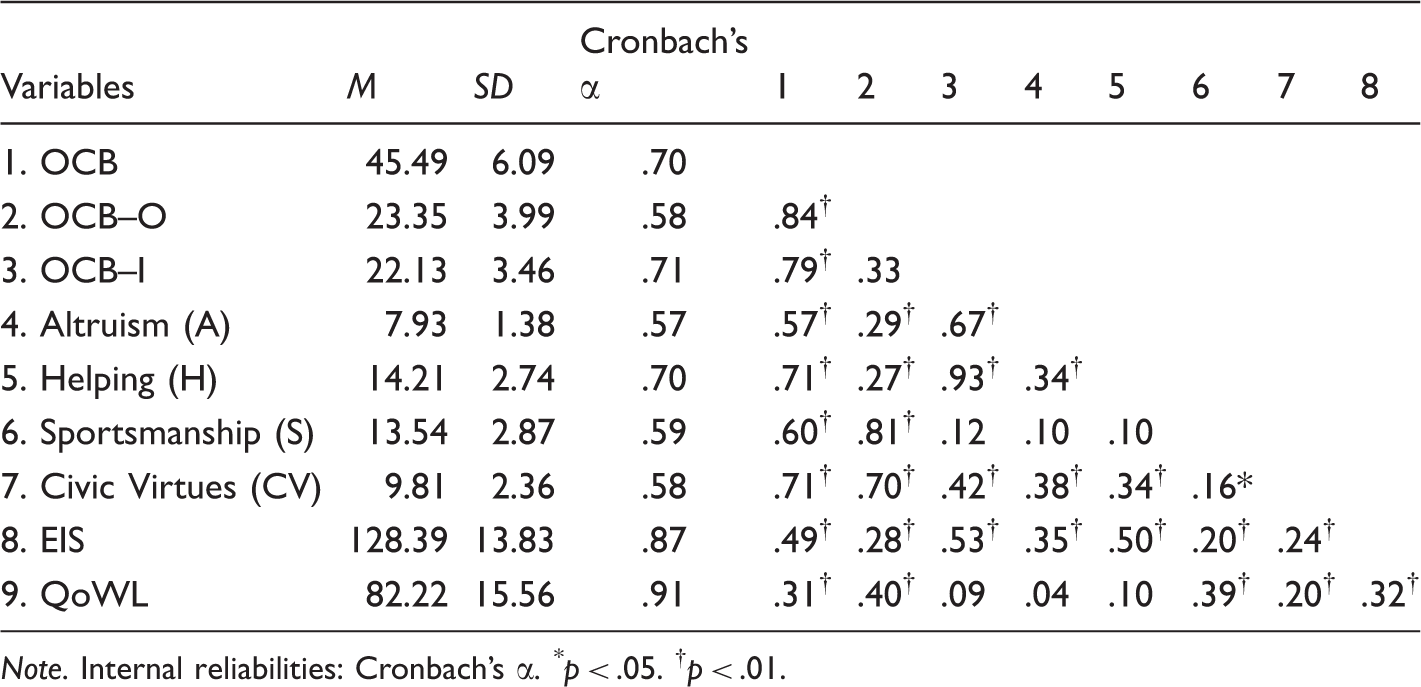
Means, Standard Deviations, Correlations, and Internal Reliability of All Variables.
Note. Internal reliabilities: Cronbach’s α. *p < .05. †p < .01.
Emotional intelligence
Emotional intelligence was assessed using the French adaptation (Zenasni, Lubart, Pahlavan, Jacob, Jacquet, & Lemoine, 2003) of the Emotional Intelligence Scale (EIS; Schutte, Malouff, Hall, Haggerty, Cooper, Golden, et al., 1998). This measure contains 33 items evaluating emotional intelligence traits on a Likert scale with anchors 1: Strongly disagree and 5: Strongly agree, and provides a single global emotional intelligence score. Some EIS items are “It is difficult for me to understand why people feel the way they do” (reverse scored) or “When I am faced with obstacles, I remember times I faced similar obstacles and overcame them.” Several studies showed that the French version presented good psychometric qualities (Jacob, Lubart & Getz, 1999; Zenasni et al., 2003; Dejoux, Ansian Bergery, Dherment & Wechtler, 2011). Exploratory factorial analyses indicated that the one factor solution is more relevant in French samples, with the single factor explaining more than 45% of the total variance. The internal consistency is good, with Cronbach's α for the whole scale higher than .83 in all mentioned studies. For the present sample, a Cronbach’s α of .87 was observed.
Quality of working life
For measuring Quality of Working Life, the French version of the Work-Related Quality of Life questionnaire (Van Laar et al., 2007) was used. The original 5-point Likert scale with anchors 1: Strongly agree and 5: Strongly disagree was designed to be used in all kinds of professions (Edwards, Van Laar, Easton, & Kinman, 2009). It includes 24 items representing six different dimensions of this construct, such as job and career satisfaction (e.g., “I am satisfied with the career opportunities available to me at the organization”) and control at work (e.g., “I am involved in decisions that affect me in my own area of work”). A global quality of working life score was calculated for each participant. The French version of the scale (Hodzic, Alfonso & Zenasni, in preparation) showed good psychometric qualities according to the guidelines for assessing the model validity by Hair, Black, Babin, and Anderson (2010). Considering 548 individuals from the general population, the scale showed good fit indices 1 for the one single factor model (RMSEA = .09, SRMR = .08, NFI = .92, NNFI = .93, CFI = .93) and the six factors model (RMSEA = .06, SRMR = .07, NFI = .96; NNFI = .97; CFI = .98). Reported internal consistencies were good: internal reliability with a Cronbach α of .89 and Cronbach α for the subscales varying from .61 to .81. For the present sample, the internal reliability was satisfactory, with a Cronbach α of .91 and subscale reliabilities ranging from .76 to .91.
To avoid common method variance bias, the Harman’s one-factor test was run. Since the explained common variance was only 16% (<50%), this bias does not seem a threat in the study and therefore there is no need to control it.
Procedure
Participants completed electronic versions of the three questionnaires after receiving a prompting e-mail and a covering message presenting the research as a general study concerning activities at work. Participants completed all the measures in the following fixed order: quality of work life, emotional intelligence, and OCB scales. The participation took place on voluntary basis, with control for inclusion variables described above.
Data Analysis
Descriptive statistics (means and standard deviations), Pearson correlations and alpha coefficients were calculated. To explore the mediating effect of quality of working life in the relationship between emotional intelligence and organizational citizenship behaviors, a series of moderator regression analyses were performed for each specific citizenship score [citizenship toward individuals (OCB–I), citizenship toward the organization (OCB–O), helping (H), altruism (A), sportsmanship (S), and civic virtues (CV)] using SPSS 21.0. The F test of statistical significance was used to assess the change in R2 resulting from the addition of interactions between stress and EI dimensions.
Results
Table 2 shows the mean scores, standard deviations, correlations between the variables measured and alpha coefficients. The significant correlations between variables related to the hypotheses ranged from .16 (p < .05) to .93 (p < .01). As expected, all OCB scores were positively and strongly related to emotional intelligence, with scores ranging from .20 to .53, supporting Hypothesis 1. However, only OCB-O (.40), Sportsmanship (.39) and Civic virtues (.20) were strongly related to quality of working life (QoWL), partially supporting Hypothesis 2.
Mediating and Moderating Effect of Quality of Work Life
Baron and Kenny’s (1986) recommendations were followed to test the mediating effect of quality of working life in the relationship between emotional intelligence and organizational citizenship behaviors.
Emotional intelligence and quality of working life scores were considered predictors or independent variables, while citizenship dimensions represented the dependent variables. Sociodemographic variables were controlled by entering them first in the hierarchical regression. In the second step, the emotional intelligence score was added. The quality of work life score was entered in the third step (mediation effect), and finally the interaction between the last two variables (moderation). Before computing the product term, the independent variables were mean-centered. Six models were tested to predict each specific citizenship score at a time: citizenship toward individuals (OCB–I), citizenship toward the organization (OCB–O), helping (H), altruism (A), sportsmanship (S), and civic virtues (CV).
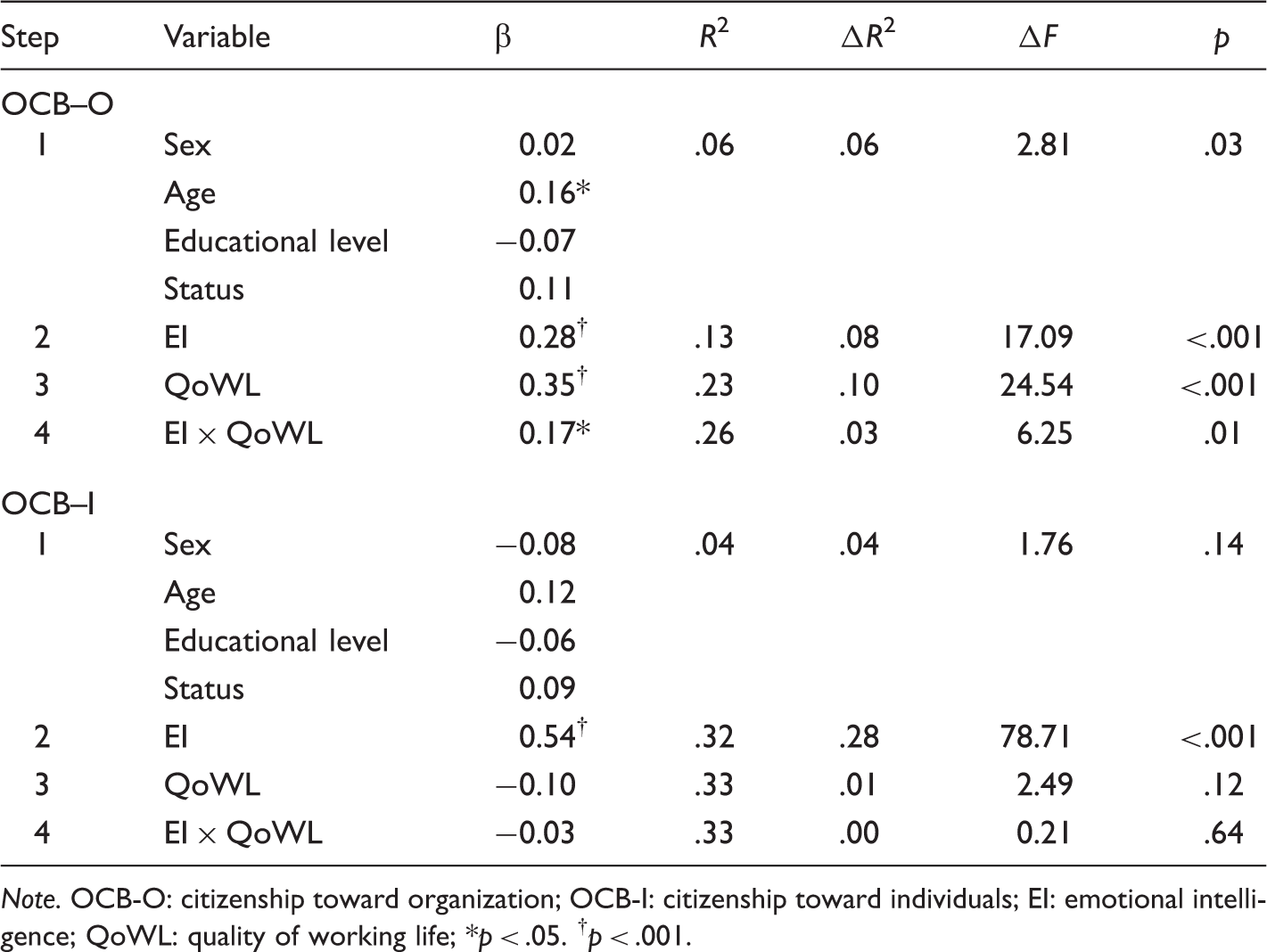
Results of Moderated Hierarchical Regression Analysis For OCB–O and OCB–I.
Note. OCB-O: citizenship toward organization; OCB-I: citizenship toward individuals; EI: emotional intelligence; QoWL: quality of working life; *p < .05. †p < .001.
A small amount of variance in OCB–O (Civic virtue and Sportsmanship) was explained by age (R2 = 6%, F1,191 = 2.81, p = .03; β = 0.16, t191 = 2.17, p = .03). The results of Steps 2, 3, and 4 indicated that about 8% to 10% of the variance in OCB–O was explained by emotional intelligence (R2 = 8%, F1,190 = 5.86, p < .01; β = 0.28, t190 = 4.13, p < .01) and quality of work life (R2 = 10%, F1,189 = 9.57, p < .01; β = 0.35, t189 = 4.95 p < .01). After including the quality of work life score, the effect of emotional intelligence was less important but still significant, i.e., a partial mediation effect (R2 = 3%, F1,189 = 9.33, p < .01; β = 0.16, t190 = 2.5, p < .05).
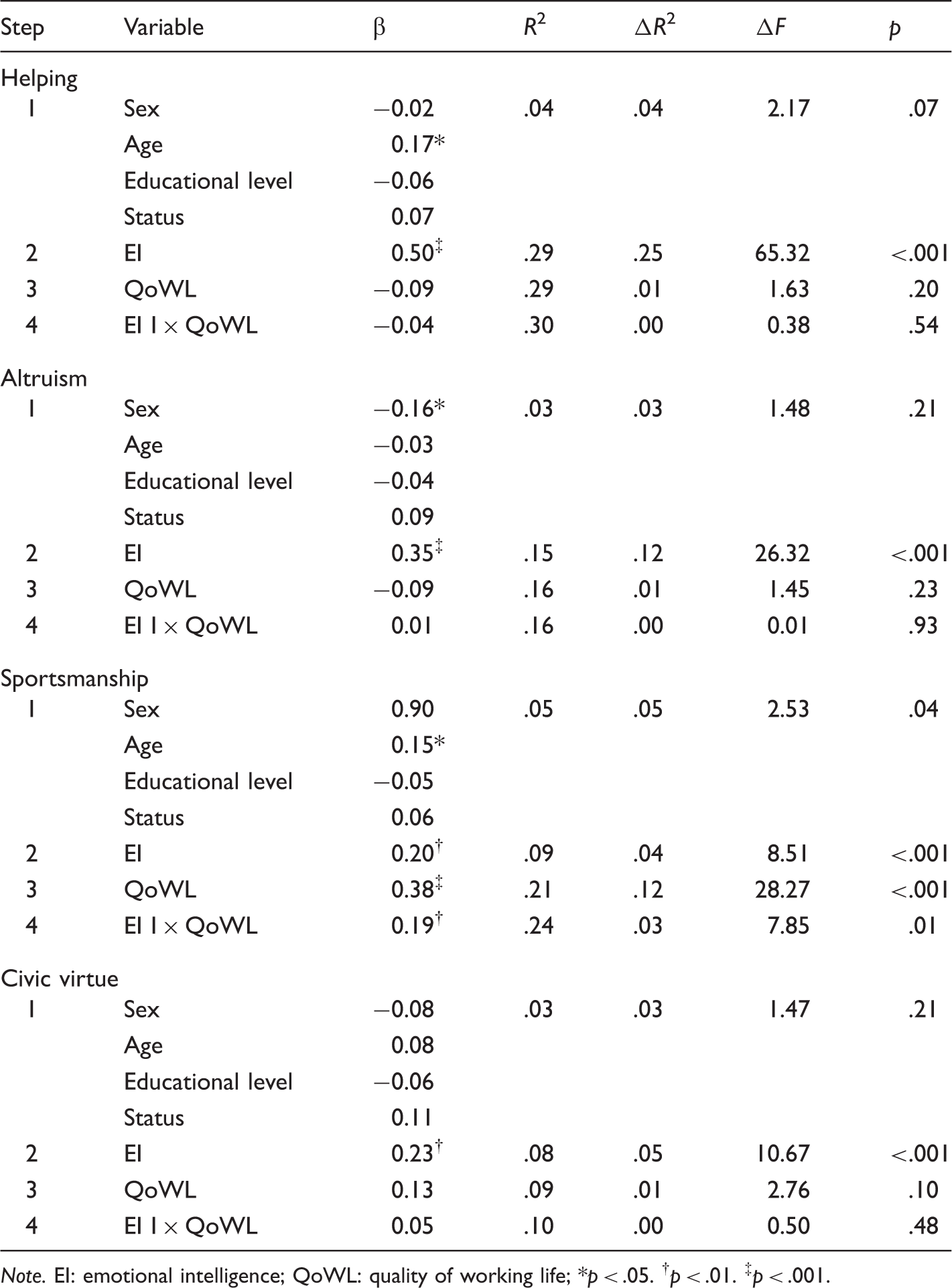
Results of Moderated Hierarchical Regression Analysis For Specific OCB Scores.
Note. EI: emotional intelligence; QoWL: quality of working life; *p < .05. †p < .01. ‡p < .001.
Sportsmanship variance was weakly explained by age (R2 = 5%, F1,191 = 2.53, p = .04; β = 0.15, t191 = 2.09, p = .04) and emotional intelligence (R2 = 4%, F1,190 = 3.80, p < .01; β = 0.20, t190 = 2.91, p < .01). Yet, this effect disappeared in the hierarchical regression when quality of work life (QoWL) was introduced (R2 = 12%, F1,189 = 8.34, p < .01; β = 0.38, t189 = 5.32, p < .01), indicating that QoWL was a mediating variable. Moreover, a moderating effect of quality of work life in the relationship between emotional intelligence and Sportsmanship was shown (R2 = 3%, F1,188 = 8.53, p < .01; β = 0.19, t188 = 2.80, p < .01). As seen in Table 3, the same effect was observed for Sportsmanship as for OCB–O. Quality of work life did not seem to have a significant role for participants who reported lower emotional intelligence. However, Sportsmanship increased with EI for participants with higher quality of work life scores.
Finally, a small amount of variance in Civic virtue was explained by emotional intelligence (R2 = 5.0%, F1,190 = 3.37, p < .01, β = 0.23; t190 = 3.26, p < .01).
Thus, all OCB scores were related to emotional intelligence (supporting Hypothesis 1); only behaviors towards the organization (OCB–O) as Sportsmanship and Civic virtues were related to quality of working life (partial support for Hypothesis 2); mediation and moderation only occurred for OCB–O and more specifically for Sportsmanship (partial support for Hypotheses 3 and 4).
Discussion
The goal of this study was to explain the links between self-rated emotional intelligence traits, quality of working life, and citizenship behaviors in organizations.
Effect of Emotional Intelligence on Organizational Citizenship Behaviors
Self-rated high scores on emotional intelligence significantly predicted OCB, particularly OCB–I such as Altruism, Helping, and the OCB–O, such as Civic virtues. These results support previous studies using a self-report measure of emotional intelligence (Binbin & Jian'an, 2008; Solan, 2009). According to the results, this relationship seems to vary according to the specific OCB considered: emotional intelligence was more strongly related to inter-individual citizenship behaviors, although it partially explained behaviors toward the organization. A possible explanation could be that workers who deal with emotional information more easily, who understand and manage their own and others’ emotions better, are able to create a positive atmosphere and to have better relationships with their co-workers by helping them with individual tasks (Jung & Yoon, 2012).
Quality of Working Life and Organizational Citizenship Behaviors: Direct and Mediation Effect
Quality of working life also seems to have a positive effect on citizenship at work. The results from this study confirm that the better their quality of work life, the more the workers tend to express citizenship behaviors toward the organization. At this point, and following the recommendations of Podsakoff, et al. (2000), it seems that the OCB classification proposed by Williams and Anderson (1991) is particularly accurate, since it distinguishes between different behaviors depending on their antecedents and consequences. More specifically, it appears that OCB–O depend significantly on perceptions of the quality of work life, whereas OCB–I do not. This differential effect is due to the Sportsmanship dimension, which appears to be affected by quality of work life score and not by emotional intelligence (a mediation effect), in contrast to other dimensions. The results are in line with Paillé’s study (2008), which showed that among the four OCBs, job satisfaction predicted only Sportsmanship.
To interpret these findings, it is interesting to consider a motivational approach of organization-related citizenship: if employees perceive that their quality of work life is low, they might not feel so committed to the company and might not avoid complaining anymore (low Sportsmanship); probably they will not engage in actions and behaviors beyond their normal duties and obligations. Considering the Motivational Model of Burnout (Blais, Lachance, & Richer, 1992; MMEP), a lack of citizenship behaviors toward the organization can be interpreted as the result of a search for a balance between their perceived work environment, their motivations, and their inner resources. Individuals with poor perceived work conditions seem to partially “penalize” the organization but not their colleagues (OCB–I), thus saving psychological resources in order to preserve their mental health.
Moderation effects for sportsmanship were also interesting: it was found that the moderating role of employees’ quality of work life was important only for individuals with high emotional intelligence scores. In other words, workers with higher emotional intelligence seem to make use of complaints more than others when they perceive their QoWL as low. Inversely, they seem to avoid unnecessary criticism much more if they perceive their quality of work life as satisfying. These results support the idea that emotional intelligence may not always increase OCB: its benefits would depend on the worker’s intentions toward the organization (Winkel, et al., 2011). Thus, in the case of a poor quality of work life, a developed emotional intelligence could be used to influence others, build alliances, and push through individual or group claims. To test this hypothesis, one interesting direction would be to examine interactions between emotional intelligence and the OCBs Sportsmanship and Voice (Van Dyne & LePine, 1998) with respect to working life situations.
However, one must be careful about employees’ intentions in this study: workers may behave differently toward individuals and toward the organization in an intuitively (MMEP model) or rather conscious process, as proposed by the Social Exchange Theory (Wat & Schaffer, 2003).
Moreover, complaining about work and “overinvesting” in interindividual citizenship behaviors when perceptions of the work environment are poor may also be a way for those with high emotional intelligence to cope by finding social support. This is interesting to consider that in the French work environment, complaining can be seen as an honest and courageous action: generally, workers are quick to denounce the excesses of management and make use of employee representative bodies. The right to strike is considered an inalienable social right (Groux & Pernot, 2008). Sportsmanship OCB implies not only staying positive in difficult moments, but also avoiding complaint. In the French work context, this behavior could be interpreted as servitude, and so not very socially desirable: instead, a “social desirable” behavior in poor working conditions may be to revindicate workers rights in order to improve quality of working life. Thus, it is possible that, in comparison to other cultures, French history and popular culture do not especially enhance Sportsmanship organizational behaviors (Seale & McConville, 1968).
Limitations and Future Directions
The present results should be considered in light of certain limitations. First, concerning theoretical analysis of OCB, certain variability was found in the results depending on the type and level of OCB scores taken into account. This implies that it is important for researchers to focus on each specific citizenship behavior before considering global scores, as OCB–O and OCB–I, for example.
A practical implication of this research involves the role of emotional intelligence in the organizational context. As predicted only by a dispositional variable (EI), OCBs like helping, altruism, and civic virtues appear to be more difficult to enhance through a pleasant working environment (QoWL). Nevertheless, practitioners should be aware that these behaviors might be facilitated by other variables, such as affective commitment to the organization, to the working group, and to the supervisor, or by cohesion in group factors, like relational trust between its members, clarification, and complementarity of tasks and roles, etc. Some evidence of the importance of emotional intelligence is provided for personnel selection, for positions where helping colleagues, altruism, and civic virtue lead to excellent team performance: activities requiring coaching and supervision (management, the education and health sectors), services and teamwork in general.
Limitations of this study related to theory and methodology should be mentioned. The first concerns the use of self-administered measures, which may limit the validity of the results. Nevertheless, no source seems to perfectly embrace the veracity of citizenship behaviors: e.g., it was found that employees' own perceptions of fairness within the organization were related to their ratings of their peers’ organizational citizenship behavior (Tansky, 1993; Ascigil, Magner, & Sönmez, 2005). Also, Cropanzano, Howes, Grandey, & Toth (1997) sustained that supervisors do not have a precise knowledge of their employees’ OCB performance. There is evidence indicating that self-reporting is an acceptable way to measure citizenship behavior assessment (Vandenberg, Lance, & Taylor, 2005).
A second limitation would be the cross-sectional design, which does not allow interpretation of causality. For future research, it will be interesting to adopt an experimental or a longitudinal design that allows studying the variations between perceptions of the work environment and different citizenship behaviors. As Organ et al. (2007) recommended, this kind of study would need a thoughtful design allowing at the same time manipulation of independent variables without affecting the nature and emergence of OCB.
The Quality of Working Life questionnaire used in this study lacks a “social support” factor, identified as important for QoWL scores variability in several studies (Standsfeld & Candy, 2006; Nieuwenhuijsen, Frings-Dresen, & Bruinvels, 2010). For future research, this kind of alternative scale would enable individual emotional intelligence differences in coping to be studied, as well as the interaction between the quality of social interaction at work and inter-individual citizenship behaviors.
With this perspective, one way to continue the present work could be to conduct prospective research with repeated measurements in order to clearly identify the causality path between emotional intelligence, quality of work life, and organizational citizenship behaviors. Furthermore, it would be advisable to contrast two citizenship measures based on dissimilar constructs.
Research in the field of psychology has often focused on atypical and “deviant” behaviors and individuals. This focus has moved toward positive aspects and behaviors, and one of the current topics emerging is “Emotionally Intelligent Organizational Citizens” (Jain, 2009) who help organizations develop and cope with change by creating stronger social networks and a more caring working environment. Thus, skills and pro-social behaviors such as emotional intelligence and OCB prove to be useful to individuals, to interpersonal relationships, and to organizations.