







Abstract
An experiment involving 115 undergraduate students (74.8% females; mean age = 20.5 years, SD = 4.3) was conducted to explore effects of meditation on social connectedness, nature connectedness, and affect. Participants listened to one of three brief guided meditation Mp3 recordings via the internet, which involved mindfulness meditation (MM), loving-kindness meditation (LKM), or progressive muscle relaxation (active control group). Participants in the MM and LKM groups reported greater social and nature connectedness at post-test than those in the control group. There were no significant differences in connectedness between the MM and LKM groups, suggesting they are both effective for enhancing connectedness. There were no significant changes in negative or positive affect at post-test due to the interventions. Recommendations for future research are provided.
Keywords
Introduction
Social connectedness refers to a subjective sense of connection and oneness with humanity that does not necessarily involve human interaction (Lee & Robbins, 1995; see also Townsend & McWhirter, 2005). Research has shown that social connectedness is a powerful psychological need linked to many indices of well-being (e.g., Buchholz & Catton, 1999; Malone, Pillow, & Osman, 2012; Ryan & Deci, 2000). In contrast, social isolation has been described as a stronger predictor of physical disease and death than traditional risk factors including blood pressure, smoking, and physical activity (House, Landis, & Umberson, 1988; see also Hawkley & Cacioppo, 2010; Uchino, 2009) and is one of the primary reasons why people seek psychological counseling (Baumeister & Leary, 1995).
Having a subjective sense of connectedness to nature, or “the natural world,” is also considered an important predictor of well-being (Wilson, 1984, see also Gullone, 2000). In correlational research by Nisbet and Zelenski (2013), nature connectedness showed positive correlations with positive affect ranging from r = .21 to r = .42 over four separate studies. Nature connectedness also predicted lower negative affect (although the correlations tended to be smaller). Similar correlations were reported by Zelenski and Nisbet (2014) between two different measures of nature connectedness and positive affect, negative affect, satisfaction with life, and subjective happiness, and Mayer and Frantz (2004) found that nature connectedness was a significant predictor of life satisfaction (r = .17). In a series of three experiments by Mayer, Frantz, Bruehlman-Senecal, and Dolliver (2009), nature connectedness correlated strongly with positive affect (r = .54, .46, and .41 for experiments 1, 2, and 3) following exposure to either natural or busy urban environments. Similarly, Cervinka, Röderer, and Hefler (2012) found that a single-item measure of nature connectedness predicted psychological well-being (r = .30), vitality (r = .23), and meaning in life (r = .21). More recently, a meta-analysis conducted by Capaldi, Dopko, and Zelenski (2014) found that nature connectedness was a significant predictor of vitality (r = .24), positive affect (r = .22), and satisfaction with life (r = .17).
Most studies involving interventions for enhancing nature or social connectedness have focused on enhancing the frequency or quality of one’s contact with nature or other people (see Hogan, Linden, & Najarian, 2002; Seppala, 2010). However, for some people low connectedness may be primarily due to cognitive factors such as pessimistic beliefs or attitudes about people and nature. In such cases, enhancing contact might not enhance connectedness. Another issue is that increased social contact is sometimes impractical, e.g., in remote areas or for sufferers of debilitating illnesses. Similarly, enhanced contact with nature may be difficult in highly urbanized environments or for those with hectic lifestyles. Thus, research into interventions that enhance one’s subjective sense of social and nature connectedness without requiring enhanced contact is warranted.
Enhancing connectedness through mindfulness meditation
Traditional Buddhist literature emphasizes the importance of connectedness and describes techniques for enhancing it (Davidson & Harrington, 2002; Hofmann, Grossman, & Hinton, 2011; Tirch, 2010). One such technique is mindfulness meditation (MM), which has attracted a surge of Western research interest in recent decades due to its many beneficial effects (Holzel et al., 2011; Shonin, Van Gordon, & Griffiths, 2014). MM is used to cultivate mindfulness, which can be understood as a state of nonjudgmental awareness and immersion in the present moment devoid of the constant thinking, planning, reminiscing, and other “mental chatter” that we often experience (Kabat-Zinn, 1990). MM can be practiced in formal sitting postures, while walking or while engaged in other activities. It often involves focusing and maintaining attention on a constant stimulus such as one’s own breathing or other bodily sensations (Holzel et al., 2011).
Consistent with Buddhist literature, contemporary Western researchers have also theorized that mindfulness may promote connectedness (e.g., Amel, Manning, & Scott, 2009; Kabat-Zinn, 1993; Welwood, 1996). In support of this, Gootjes and Rassin (2014) found a correlation of r = .32 between measures of mindfulness and social connectedness. Brown and Ryan (2003) found correlations of r = .28 and r = .31 between relatedness (see Johnston & Finney, 2010) and mindfulness, with similar results by Carson, Carson, Gil, and Beaucom (2004). Tipsord (2009) found that mindfulness predicted felt connection to other people (r = .21) and felt connection to the natural world (r = .20) as measured by the Allo-Inclusive Identity Scale (Leary, Tipsord, & Tate, 2008). Furthermore, Howell, Dopko, Passmore, and Buro (2011) found several statistically significant correlations between two measures of mindfulness and three measures of nature connectedness. Other variables closely related to mindfulness have also been shown to predict nature connectedness, including attentional capacity (Mayer et al., 2009) and internal state awareness (Leary et al., 2008).
Enhancing connectedness through loving-kindness meditation
In Buddhist traditions, mindfulness is often considered a basic skill that facilitates more advanced meditative practices (Mingyur, 2007). In accordance with this, Kristeller and Johnson (2005) have proposed a two-stage model explaining how meditation can promote connectedness. MM promotes connectedness through increased awareness of the world around us and decreased preoccupation with habitual, self-indulgent thoughts that disconnect us from our surroundings. Then, to maximally cultivate connectedness, more focused meditation techniques are required. One of the most commonly practiced meditation techniques of this type is loving-kindness meditation (LKM), which is a Buddhist technique for cultivating unconditional kindness towards all living things (Gyatso, 2001; Hofmann et al., 2011; Tirch, 2010). It typically involves repeating phrases such as “may you be happy” while thinking of the self, then a close friend, a neutral acquaintance, a difficult person, or enemy and finally all living things including plants and animals (Buddharakkhita, 1995; The Dalai Lama, 2001).
Despite being an ancient and widely practiced technique, LKM has only recently attracted the attention of Western researchers (May et al., 2011). Although no studies of LKM have explored its relationship to nature connectedness, several suggest that it can enhance social connectedness. Fredrickson, Cohn, Coffey, Pek, and Finkel (2008) observed significantly increased positive relations with others over time (b = 0.03) among participants who attended seven weekly 60-minute group sessions involving 15–20 minutes of LKM, a group discussion, and a didactic presentation about meditation. Participants also practiced a substantial amount of LKM at home (M = 80 minutes per week). Similarly, Kok et al. (2013) observed a significant increase in daily social connectedness among participants who attended six weekly LKM workshops and practiced LKM at home. In a study by Weibel (2008), significantly increased scores were observed on the Compassionate Love Scale, Humanity Version (d = .83)—which is conceptually very similar to social connectedness (see Sprecher & Fehr, 2005)—among participants who attended four weekly meditation sessions that involved both MM and LKM (greater time was spent on LKM as the weeks progressed).
Unfortunately, the eclectic nature of the above studies makes the causal role of LKM unclear. The most compelling evidence comes from experimental research by Hutcherson, Seppala, and Gross (2008). Participants in an LKM condition imagined two loved-ones standing beside them and directing love and kindness towards them for 4 minutes. They then redirected these feelings towards a series of pictures by repeating phrases typical of LKM for 3 minutes. The pictures were of the participant, one of the participant’s friends, three strangers, and a lamp. Participants in a neutral imagery control condition were told to simply imagine two acquaintances standing beside them, then to focus on the visual details of the same pictures. At pre-test and post-test, participants rated how positive, similar, and connected they felt towards the pictures, with LKM participants reporting significantly greater connectedness to the three strangers (and the lamp) at post-test. These results were replicated in a series of very similar follow-up experiments (Seppala, 2010). However, one limitation of these studies and also the studies of Kok et al. (2013), Fredrickson et al. (2008), and Weibel (2008) is that connectedness was assessed at both pre-test and post-test. This would have likely made the hypotheses of these studies obvious to participants. Furthermore, because the LKM exercises used by Hutcherson et al. (2008) and Seppala (2010) involved participants directing love and kindness toward the series of pictures presented to them, the demand characteristics would have been substantially stronger and more obvious in the LKM condition than in the neutral imagery condition. This constitutes a substantial threat to validity and may have confounded the results. To date, the problems associated with administering connectedness measures at both pre-test and post-test have not been addressed in any published experimental studies of the effects of meditation on connectedness.
The present research
The primary aim of the present research was to compare the effects of MM and LKM on social and nature connectedness. Because meditation can induce a relaxation response (Carson et al., 2004; Kristeller & Johnson, 2005), an active control group involving progressive muscle relaxation (PMR) was used. Due to their well-established psychological benefits, it was hypothesized that both forms of connectedness would be positively correlated with positive affect and negatively correlated with negative affect at post-test. Regarding the effects of meditation, it was hypothesized that the MM and LKM groups would show greater social and nature connectedness than the PMR group. Because LKM is specifically designed to influence interpersonal variables, it was hypothesized that LKM participants would show greater social and nature connectedness than MM participants.
A secondary aim was to explore the effects of LKM and MM on positive and negative affect. MM has been shown to reduce negative affect but not influence positive affect by Tipsord (2009). Similarly, in a study by Wanbeh et al. (2014) that involved six weekly MM meditation sessions (that involved several other activities including group discussions and didactic presentations), a significant decline in negative affect was observed over time with positive affect remaining stable. However, Alberts and Thewissen (2011) failed to find any changes in affect following MM. LKM has been shown to decrease negative affect and increase positive affect in studies by Hutcherson et al. (2008), Seppala (2010), and Kok et al. (2013). The authors are aware of two studies where the effects of MM and LKM on affect variables were compared. Feldman, Greeson, and Senville (2010) found that both forms of meditation, as well as PMR, decreased negative affect but had no influence on positive affect. In contrast, May, Weyker, Spengel, Finkler, and Hendrix (2014) observed a significant increase in positive affect over time for participants who practiced either MM or LKM for 5 weeks. A significant decline in negative affect was found in the LKM group only, and this was not significantly different from the MM group. Due to these mixed findings regarding the effects of MM and LKM on positive and negative affect, no specific hypotheses were made and analyses were exploratory.
Method
Participants
Participants were undergraduate psychology students who participated in exchange for course credit. Participants who responded incorrectly to an objective compliance measure (n = 35) were excluded from analyses, leaving 115 participants randomly allocated to groups involving MM (n = 41), LKM (n = 42), and PMR (n = 32). There were 86 females (74.8 %) and age ranged from 17 to 41 years (M = 20.5, SD = 4.3). Participants had been practicing meditation no more than once per week, with most (94.8%) reporting once per month or less. For ethical reasons, participants experiencing mental health issues were asked not to participate (see Dobkin, Irving, & Amar, 2011).
Materials
Three guided meditation Mp3 recordings were created by the first author. They were all of equal duration (14:20), began with a 2-minute breathing exercise and did not include background music. The PMR recording instructed participants to systematically release muscular tension in various areas. Unlike traditional PMR (see Bernstein & Borkovec, 1973), there was no tensing of muscles or movement involved. The MM recording instructed participants to focus awareness on their breath, sensations on their skin, other physical sensations and then as many different sensations as possible. Participants were instructed to maintain awareness during regular silent periods. The LKM recording instructed participants to first recall a happy childhood memory, then to repeat the following phrases: “may I be happy,” “may I be safe and secure,” “may I be healthy and strong,” and “may I be fulfilled.” Following, participants repeated these phrases again, but directed towards a close friend, then a respected person, an acquaintance, a difficult person and finally, all living things. Near the end of each recording, participants were asked to maintain awareness (MM), continue directing kindness towards all living things (LKM), or continue relaxing (PMR) during a 60-second silent period. Finally, participants were told the name of their meditation (“calm mind,” “kindness meditation,” or “simple relaxation”).
A battery of questionnaires was also used. The Positive and Negative Affect Schedule (PANAS) is a well-validated measure that involves 10 adjectives each for positive affect (e.g., “enthusiastic”) and negative affect (e.g., “scared”; Watson, Clark, & Tellegen, 1988). Participants indicate how well these adjectives describe their mood on a scale of 1 (very slightly or not at all) to 5 (extremely). Responses are summed and the range of possible scores for both subscales is between 10 and 50 (higher scores indicate greater positive or negative affect). Internal consistency was favorable for both the positive and negative affect subscales at both pre-test (Cronbach’s alpha = .87 and .93, respectively) and at post-test (Cronbach’s alpha = .86 and .92, respectively).
A subjective compliance measure involved answering the following question: “to what extent did you follow the instructions during the guided meditation” (1 = not at all, 5 = completely). An objective compliance measure was also used to ensure that participants listened to the entirety of the meditation recording—participants were asked to write the name of the guided meditation they had listened to (provided at the end of each recording). Incorrect responses (most of which involved words from the start of the recordings) indicated that participants probably stopped listening before reaching the end.
Social connectedness was measured using a state-based scale that Pavey, Greitemeyer, and Sparks (2011) adapted from an unpublished nature connectedness scale. Participants indicate their agreement with six statements, such as “at the present moment I feel a bond with other people” on a scale of 1 (strongly disagree) to 7 (strongly agree). Responses are averaged, resulting in a score ranging from 1 to 7 (higher scores indicate greater social connectedness). Internal consistency in the present study was favorable (Cronbach’s alpha = .91).
The Connectedness to Nature Scale (state version) involves 13 statements such as “right now, I’m feeling a sense of oneness with the natural world around me” (Frantz, Mayer, Norton, & Rock, 2005). Participants indicate their level of agreement with each statement on a scale ranging from 1 (strongly disagree) to 7 (strongly agree). Two of the scale’s items are reverse scored and then all items are summed and averaged, resulting in a score ranging from 1 to 7 (higher scores indicate greater nature connectedness). This scale demonstrated good internal consistency in the present research (Cronbach’s alpha = .90).
Procedure
The present study was conducted entirely online. Participants first completed demographic measures and the PANAS on the survey management website Survey Monkey. They were then instructed to copy and paste a URL into a new web-browser window while still keeping the Survey Monkey window open. This webpage (created specifically for the present study) instructed participants to eliminate any potential distractions and listen to the meditation Mp3 in its entirety with headphones and closed eyes while sitting or lying comfortably. Participants then clicked a button at the bottom of this webpage, which randomly redirected them to one of the three guided meditation Mp3 recordings. Participants then returned to Survey Monkey and completed the compliance measures, PANAS (again), Social Connectedness Scale, and the Connectedness to Nature Scale. The Social Connectedness and Connectedness to Nature scales were included only at post-test due to concerns that including them at pre-test would introduce demand characteristics.
Results
Preliminary analyses
Means and standard deviations for, self-report compliance with meditation instructions (Comply), pre-test negative affect (NA pre), pre-test positive affect (PA pre), post-test negative affect (NA post), post-test positive affect (PA post), change in negative affect (NA change), change in positive affect (PA change), nature connectedness (Nature), and social connectedness (Social).
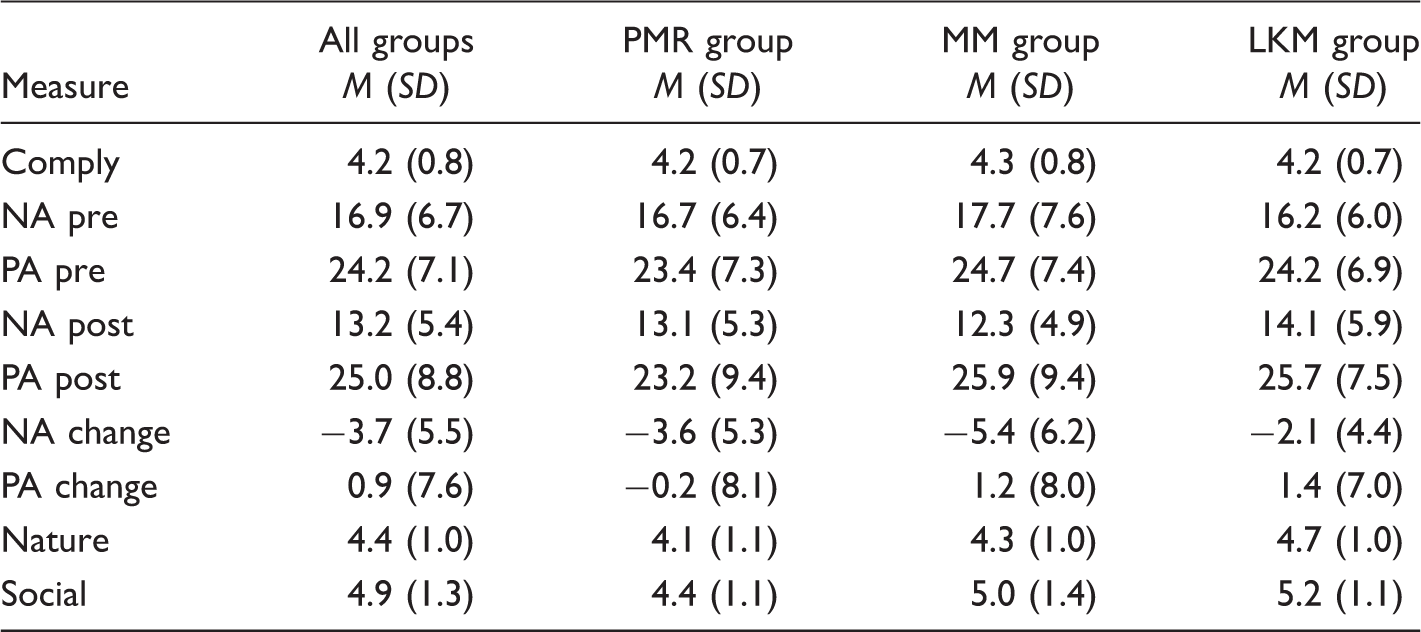
Note. PMR: progressive muscle relaxation; MM: mindfulness meditation; LKM: loving-kindness meditation.
Hypothesis testing
Pearson correlations (N = 115) between self-report compliance with meditation instructions (Comply), pre-test negative affect (NApre), pre-test positive affect (PApre), post-test negative affect (NApost), post-test positive affect (PApost), change in negative affect (NAchg), change in positive affect (PAchg), nature connectedness (Nature), and social connectedness (Social).
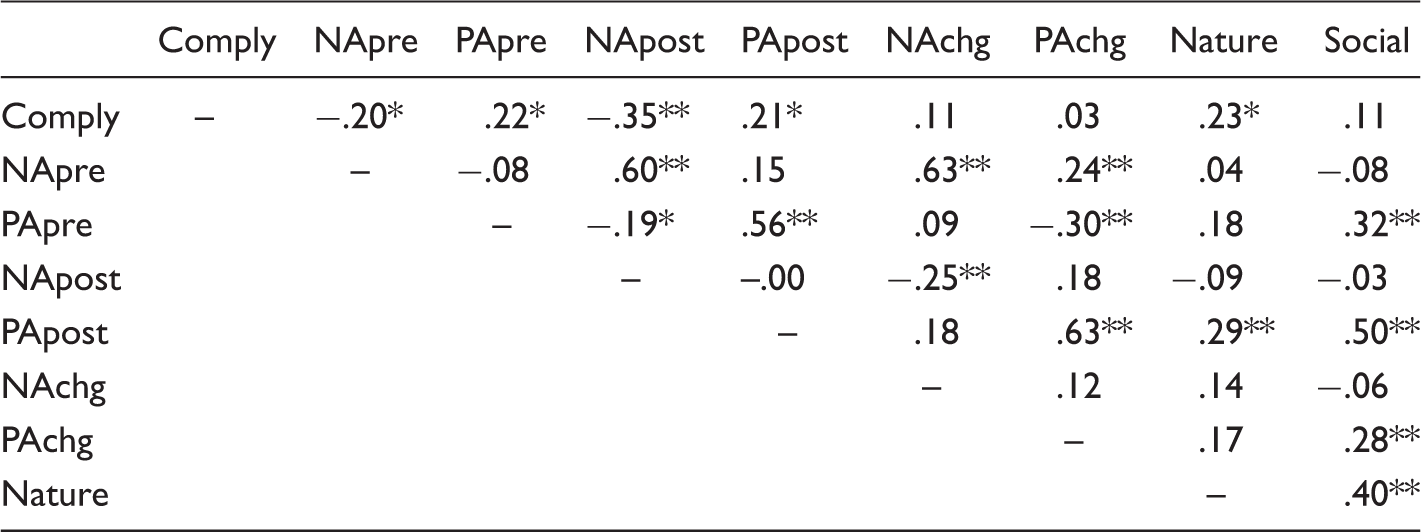
Note. *p ≤ .05, **p ≤ .01.
Planned contrasts for group differences in social and nature connectedness.
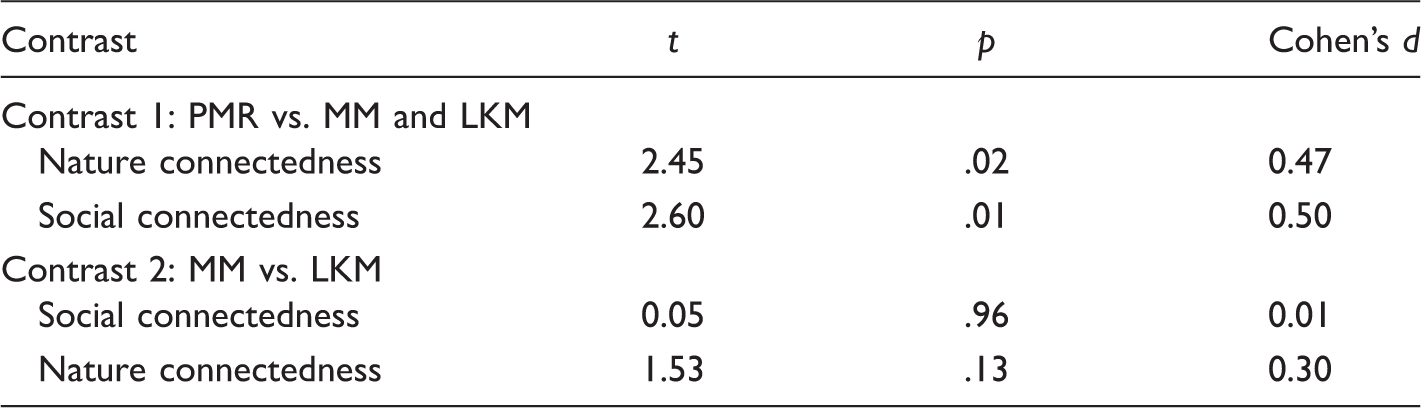
Note. Degrees of freedom = 107 in all comparisons. PMR: progressive muscle relaxation; MM: mindfulness meditation; LKM: loving-kindness meditation.
Exploratory analyses
The effects of MM, LKM, and PMR on post-test positive and negative affect were explored by conducting separate hierarchical multiple regression, controlling for pre-test affect at the first step and two dummy variables representing the experimental conditions at the second step. Pre-test positive affect explained 36.9% of the variance at step 1. At step 2, the two intervention condition variables explained an additional 1.3% of the variance in post-test positive affect, which was not statistically significant, F change (2, 146) = 1.56, p = .213. The total variance explained by the model as a whole was 38.3%, F (3, 146) = 30.17, p < .001.
For negative affect, pre-test affect explained 35.3% of the variance at step 1. At step 2, the two intervention condition variables explained an additional 3.0% of the variance in post-test negative affect, F change (2, 146) = 3.61, p = .03. The total variance explained by the model as a whole was 38.4%, F (3, 146) = 30.31, p < .001. However, in the final model the contribution of the two intervention condition variables was not statistically significant, β = −.10, p = .201, and β = .10, p = .208. However, standardized residuals were not normally distributed, so that these results should be considered with caution. Repeating hierarchical regressions with various transformations of the positively skewed negative affect pre-test and post-test variables did not change the results.
Discussion
The present research explored the effects of MM and LKM compared to PMR on participants’ subjective sense of social and nature connectedness. Participants in both meditation groups showed significantly higher social and nature connectedness than the PMR control group. However, contrary to expectations, there were no significant differences between the MM and LKM groups for either form of connectedness. Both forms of connectedness were correlated with positive affect and the relationship was stronger for social connectedness. Neither form of connectedness was significantly related to negative affect.
The finding that social and nature connectedness was significantly higher in the MM and LKM groups compared to the PMR group suggests that MM and LKM enhanced feelings of connectedness. However, because connectedness measures were not administered at pre-test (in order to minimize the confounding influence of practice effects and demand characteristics), the alternative explanation for the observed group differences—that PMR decreased connectedness while MM and LKM had no effect—must be addressed. One possibility is that PMR reduced connectedness by reducing awareness of people and nature in participants’ immediate surroundings. However, this seems unlikely because all participants were asked to practice in a distraction-free place with headphones and closed eyes—there should have been no people or elements of nature to be less aware of. Alternatively, PMR could have decreased connectedness by preventing participants from thinking about people and nature. However, if this was the case then MM would be expected to have the same effect, as it involved clearing one’s mind of all thoughts and focusing on the present moment. Furthermore, LKM participants should have demonstrated greater connectedness than MM participants because the LKM condition involved thinking about people and nature. The fact that this pattern of results was not observed indicates that group differences in connectedness were probably not simply due to the extent to which participants were thinking about people and nature.
Another possibility is that there were pre-existing group differences in connectedness. Although this possibility cannot be ruled out, it is unlikely given the sample sizes used and the use of random allocation to experimental groups. The most likely explanation is that the observed group differences were due to MM and LKM increasing connectedness. The present study provides the first experimental support that MM can enhance social and nature connectedness and that LKM can enhance nature connectedness. Regarding the effects of LKM on social connectedness, results support the findings of Hutcherson et al. (2008) and Seppala (2010), who found that exercises based on LKM enhanced feelings of connectedness to photographs of various people. The present study used a more comprehensive social connectedness measure than these studies and is the first study to date that has addressed the problem of demand characteristics that may occur when administering connectedness measures at both pre-test and post-test. Thus, the findings of the present study bolster the conclusions of Hutcherson et al. (2008) and Seppala (2010) that LKM can enhance social connectedness. The present study also builds on findings by Kok et al. (2013) who found that social connectedness increased over a period of six weeks of practicing LKM and attending group sessions.
When controlling for pre-test levels of positive and negative affect, MM, LKM, and PMR did not have statistically significant effects on post-test positive and negative affect, although the findings with regard to negative affect should be treated with caution. These findings are at odds with studies in which MM or LKM resulted in changes in affect (May et al., 2014; Feldman et al., 2010; Hutcherson et al., 2008; Kok et al., 2013; Seppala, 2010; Tipsord, 2009; Wanbeh et al., 2014). The explanation for these findings is unclear and does not seem to be related to whether meditation is practiced over several weeks or only in a single session.
Although LKM is sometimes considered more challenging than MM (Trungpa, 1993), the present study replicates Feldman et al. (2010) in that there were no significant group differences in either subjective or objective measures of compliance between MM, LKM, and PMR. Findings of the present study suggest that LKM may be a viable intervention for enhancing well-being through enhanced connectedness. Further research into the therapeutic potential of LKM is certainly warranted.
The present study is the first to compare relationships between well-being indices and both social and nature connectedness within the same sample and provides evidence suggesting that social connectedness is more strongly related to well-being than nature connectedness. Post-test positive affect correlated more strongly with social connectedness (r = .50) than with nature connectedness (r = .29). Furthermore, only social connectedness was also significantly correlated with pre-test positive affect. Given that human beings are such deeply social creatures, these findings are unsurprising. It is also consistent with the connectedness literature reviewed above—most studies into social connectedness have found stronger correlations with various indices of well-being than have studies involving nature connectedness.
Limitations and future directions
The present study is limited by the fact that it involved only a single meditation session, which is not representative of how meditation is traditionally taught. The present findings may not apply to long term meditation practice and further research is needed to address this. The argument that MM enhanced nature and social connectedness and that LKM enhanced nature connectedness in the present study could be supported by future studies with minor design modifications. Although it introduces potential problems such as practice effects and demand characteristics, one strategy would be to administer connectedness measures at both pre- and post-test. This would permit investigation as to whether group differences were due to MM and LKM enhancing connectedness or PMR decreasing it. Another strategy would be to include measures of mechanisms through which meditation might enhance connectedness. For MM this is mindfulness, which could perhaps be measured using a suitable state-based measure such as the Toronto Mindfulness Scale (Lau et al., 2006). Regarding LKM, interpersonal variables such as empathy, compassion, and attitudes towards humanity and nature could be measured.