







Abstract
In a work context, employees tend to gravitate toward situations that are most conducive to meeting their needs. The purpose of this research is threefold. First, we define and specify the psychological needs under investigation, briefly highlight extant research, and differentiate needs from other individual difference variables. Second, we demonstrate the limitations of one of the most highly cited psychological needs instruments and introduce a new needs model. Third, we develop and evaluate a multi-dimensional needs inventory using a multi-study design. The strengths and limitations of the proposed and tested model are discussed, as are implications for future research.
Introduction
Individual differences in needs serve as the impetus for all manner of volitional functioning, subsequently driving disparate cognitions, attitudes, and behaviors for individuals across a wide variety of work and non-work situations (Milyavskaya & Koestner, 2011; Ryan, 1995; Weinstein, Przybylski, & Ryan, 2012). Self-Determination Theory posits that humans possess innate psychological needs to experience autonomy, competence, and relatedness, for example, and that the fulfillment of these needs is essential for personal growth and emotional well-being (Ryan & Deci, 2000). Additionally, recent research has shown that that the satisfaction of psychological needs is associated with positive outcomes such as task persistence, improved work performance (Baard, Deci, & Ryan, 2004; Bipp & van Dam, 2014), positive work attitudes, job satisfaction, and organizational commitment (Vansteenkiste & Ryan, 2013); conversely, decreased need fulfillment can significantly diminish employee, and subsequently organizational functioning (Gagné & Deci, 2005). Therefore, the accurate assessment of individual needs is essential to understanding and managing individual behavior in organizations.
It is axiomatic to suggest that human behavior in organizations is goal directed (Reis, Sheldon, Gable, Roscoe, & Ryan, 2000). In a work context, employees tend to gravitate toward situations that are most conducive to meeting their needs (Baard et al., 2004). For example, Steers and Braunstein (1976) found that persons high in need for affiliation (nAff) preferred situations with high task interdependence, whereas persons high in need for dominance (nDom) preferred situations where they could be in control. Given that the satisfaction of individual psychological needs is associated with positive outcomes, it only makes sense that managers could and should spend productive time working toward the identification and subsequent fulfillment of employee needs. Alas, if only it was that easy. The clear and unequivocal identification of the specific needs that are manifest in even the simplest exhibitions of human behavior is elusive. Complexities in causal relationships arise because of the subtle and not-so-subtle interference of innumerable moderating influences. And the effort suffers most when the measures we use to identify and gauge psychological needs induce confusion and distortion in that which we purport to measure. It makes sense, therefore, to take a step back, to review and refine that which we know about the identification and measurement of psychological needs, and to “get clear” before we proceed to address the promise of understanding goal-directed behavior in organizations.
Although personality differences are clearly relevant and important to the advancement of our understanding of human behavior in the workplace, we argue that needs may be more easily identifiable than other dispositional or trait-like manifestations. We purport that management can assign tasks more easily and can and should consider promotional opportunities that are tailored to individual employee needs. For example, a high nAff can be fulfilled by assigning individuals to more intimate working groups, whereas a high nDom can be fulfilled by providing these individuals opportunities to take on leadership, mentoring, and other highly visible roles. Furthermore, relatively speaking, organizations can control the goal structure that is most appropriate for a person high in need for achievement (nAch), the contextual environment desirable for a person high in nAff, or the career advancement opportunities attractive to a person high in nDom. Organizations need to be cognizant of these separate and distinct needs, and their potential to impact organizational functioning and outcomes.
Therefore, the purpose of this research is threefold. First, we define and specify the psychological needs under investigation, briefly highlighting the extant research on these needs, and differentiate needs from other individual difference variables. Second, we demonstrate the limitations of one of the most highly cited psychological needs instruments (Steers & Braunstein, 1976) and introduce the development of a new needs construct. Third, we develop and empirically evaluate a multi-dimensional needs inventory representing the full construct domain. Evidence of the constructs’ factor structure is tested in Study 2, and convergent and discriminant validity is tested in Study 3.
Theoretical development
Definition and specification of the construct domain
Organizations are dynamic, transformative institutions made up of individuals with diverse needs and motivations. Individuals differ not only in the level of motivation they have to work towards organizational goals, but also in their orientation, or the type of motivation that gives rise to action (Ryan & Deci, 2000). Needs are purported to affect the level, direction, and persistence of effort. Specifically, as so eloquently stated by Ryan and Deci (2000), “to be motivated means to be moved to do something” (p. 54). Clearly, understanding the drivers of motivation is important for understanding goal-directed behavior (Weinstein et al., 2012). Needs are an important component of motivation theory, are believed to effect attitudes and behaviors (Steers & Braunstein, 1976), and subsequent affective consequences (Landy & Becker, 1987). The current research focuses on individual differences in four basic categories of needs—nAch, nAff, need for autonomy (nAut), and nDom.
Needs-based theories of motivation (i.e., Self-Determination Theory; Deci & Ryan, 2000) posit that the interaction of basic needs interact with the social environment, and this interaction results in the need being either thwarted or satisfied. Indeed, recent theory suggests that the satisfaction of needs through striving occurs at the interaction of individual differences and congruent task/social characteristics (Barrick, Mount, & Li, 2013), and the impetus for this interaction is the drive to satisfy our psychological needs. This outcome yields experiences that create and shape the individual differences that we observe across subjects. Thus, we take the perspective that, although personality is an important aspect of predicting human behavior, needs are the more foundational construct, and thus require separate scholarly investigation. Although personality traits are known to drive behaviors and affect the manner in which individuals interact in an organization, practicing managers may find it difficult to control the environmental conditions that appropriately match personality with situation. For example, what is a good fit for a person who is conscientious? One could argue, that based on the data with regard to conscientiousness, all organizations desire this characteristic since it is related to performance across occupations (Barrick & Mount, 1991).
Furthermore, the popular five-factor model has been criticized because all five dimensions are positively correlated (when neuroticism is reverse scored) and may be more representative of a classification scheme of behaviors rather than a measure of underlying personality traits (Perrewé & Spector, 2002). As such, we argue that needs are easier to identify within a working individual. Hence, managers can more readily tailor assignments to specific workers in order to individually motivate. For instance, some individuals are motivated by the goal of moving up in an organization into positions of authority (e.g., nDom), for others it is the desire to enhance their work environment and intrinsic job satisfaction through a large network of friends and trusted colleagues based on a desire to be liked (e.g., nAff) (Steers & Braunstein, 1976), while others strive to achieve (e.g., nAch), attain goals, and have an interest in excellence for its own sake (Ward, 1994). Given that needs are stable over time, and predictors of future behaviors based on early parenting (McClelland, 1991; McClelland & Franz, 1992), we argue that needs are foundational drivers or motivators of behaviors and are vital mechanism by which personality attributes are created. It is for this reason that a reliable and valid needs-assessment is warranted.
Need and rationale: Limitations of the Manifest Needs Questionnaire
One of the first comprehensive operational measures of individual needs was the Manifest Needs Questionnaire (MNQ) (Steers & Braunstein, 1976). The MNQ includes scales to measure four distinct sub-categories of needs: nAff, nAch, nDom, and nAut. The Steers and Braunstein measure is based on the theoretical work of Murray (1938) and further developed by McClelland, Atkinson, Clark, and Lowell (1953).
Although Steers and Braunstein contributed immensely to our understanding of the complexities of individual needs, scholars have criticized the MNQ for its unsatisfactory psychometric properties. Specifically, in a review of 12 separate samples, only nDom demonstrated a satisfactory alpha level (Dreher & Mai-Dalton, 1983). This finding may explain why so little research has been conducted with regard to nAff and nAut utilizing the Steers and Braunstein (1976) measure. In addition, one of the more popular needs measures used by Bretz Ash, and Dreher (1989) requires payment of a fee for usage of the measure (Jackson, 1984) which further contributes to the paucity of research which includes all four needs dimensions.
Moreover, the existing needs measures capture behaviors that are purported to reflect an individual’s needs, as opposed to capturing actual workplace preferences or needs. For example, the Steers and Braunstein (1976) nAff dimension included an item “I pay a good deal of attention to the feelings of others at work.” This item clearly describes a behavior, and though that behavior may be influenced by a need, it could also be the result of the psychological calculus of a politically skillful actor (Ferris et al., 2005). To illustrate this concept further, another sample item from Steers and Braunstein (1976) is “When I have a choice, I try to work in a group instead of by myself.” Again, rather than a deep, innate desire or motivation to work with others, it may be a strategic choice based on conscious political skill (Ferris et al., 2005).
In sum, a comprehensive, psychometrically sound, and non-proprietary needs measure is vital for continuing research, given that one’s needs, and hence, their deeper motivations, are relevant to individual and organizational outcomes. Therefore, in the following sections, we develop and empirically evaluate a new, psychometrically sound measure of nAff, nAch, nDom, and nAut.
Content validity and dimensionality
Need for achievement
Achievement motivation is “a subjective, internal, and psychological drive, enabling individuals to pursue work they perceive to be valuable” in order to achieve their organizational goals, including increased job performance (Lee, 2010, p. 10). Achievement-oriented individuals are characterized as “striving to do well, desiring to fully utilize one's capacities to succeed and to be judged by oneself and others on this success” (Fineman, 1977, p. 2). This characterization, as explained by Eisenberger, Jones, Stinglhamber, Shanock, and Randall (2005), supports the theoretical contentions of McClelland (1991) and is described as a primary reason why achievement-oriented individuals endeavor to maximize their full range of knowledge and skills in order to reach or exceed personal goals. Persons who score high in nAch prefer difficult yet achievable tasks, seek challenges in the workplace (Steers & Braunstein, 1976), strive for excellence, respond well to competition (Jackson, 1989), and take responsibility for their own performance (Chung Hee & Scullion, 2013). Based on Cherrington’s (1989) review of nAch, these individuals set moderate, achievable goals for themselves, and choose coworkers based primarily on competence rather than friendship in efforts to support their motivations. Furthermore, persons high in nAch work hard to improve on past performance and try to outperform their coworkers, often using competitive strategies rather than cooperative strategies (Ward, 1995).
Need for affiliation
Persons high in nAff have a strong desire for approval and reassurance from others, often conform to the wishes of others, and have a sincere interest in the feelings of others (Cherrington, 1989). Affiliation is based on the natural desire to be with other people and provides a sense of involvement and belongingness though communal social groups (Chung Hee & Scullion, 2013; McClelland, 1961). In organizational environments, individuals who are high in nAff seek opportunities to satisfy this need, preferring to work with others rather than to work alone. They discuss non-business-related matters with their colleagues, prefer to work in groups or teams, and rarely express disagreements publicly (Steers & Braunstein, 1976).
Need for autonomy
Persons high in nAut have a strong desire to work alone, will often “go their own way,” and do not consider themselves to be team players (Steers & Braunstein, 1976; Weinstein et al., 2012). Reis et al. (2000) discussed nAut in relation to self-determinism and stated that this need is based on being “intrinsically” versus “extrinsically” motivated. Individual nAut is an important individual difference variable for managers in organizations to understand, since it has been shown to be a major factor related to hiring and turnover. Increased autonomy is cited as one reason why employees prefer to remain in positions or organizations (e.g., when this need is fulfilled, it is a strong individual motivator) (Mathieu & Zajac, 1990). Thus, those high in nAut often seek out job environments that are conductive to their needs for autonomy. This type of self-determining individual is more likely to desire additional free time at work and personal knowledge for career advancement; however, they are less likely to desire companionship and involvement (Steers & Braunstein, 1976).
Need for dominance
Persons high in need for power (i.e., dominance), as originally described by McClelland et al. (1953), have a desire to control others, to influence their behavior and to be responsible for others (Cherrington, 1989). An individual with a high nDom is more likely to enter an organization or a profession where he or she will be able to manage and direct other individuals and act as a leader, while avoiding work environments where positions of power and authority are less obtainable (Prottas, 2011). nDom has often been described as being similar to Machiavellianism, which has been used to describe persons who are manipulative, power seeking, and low on altruism (Schlenker, 1980). Anderson and Kilduff (2009) described individuals with a high need for power or nDom as the “hunter-gatherers” of groups, those who are valued in organizations, (particularly as decision makers), and are often placed in group settings to help to achieve performance goals.
Convergent and discriminant validity
An instrument which purports to measure a construct should measure that construct and nothing else; otherwise, the information obtained from the instrument would be confounded. Convergent and discriminant validity refers to the degree to which a measure relates to similar constructs and does not relate to constructs from which it should differ. In the following section, we develop hypotheses to help illustrate logical and empirical relationships with established measures. The constructs of interest included for the purposes of establishing convergent and discriminant validity are negative and positive affect (NA and PA, respectively), as well as organizational citizenship behaviors (OCBs).
Needs and NA/PA
In order to highlight the relationship of our measure with personality traits, we collected data regarding individual NA and PA (Watson, Clark, & Tellegen, 1988). NA is defined as an affective, stable individual trait involving negative mood states such as contempt, nervousness, guilt, and fear and involves subjective personal feelings of distress (Watson et al., 1988). Individuals high in NA are less calm than individuals with low NA and tend to feel stress and negative emotions more frequently. PA is exemplified when individuals feel aware, engaged, and enthusiastic (Watson et al., 1988). Individuals high in PA generally have higher energy levels, typically feel happy, and have pleasurable feelings related to their interactions with others. Research has shown that the four dimensions of needs correlate differentially with affect.
Need for achievement
Goal orientation and striving have been related to nAch, with Grandey (2001) noting that persons who are high in striving are more likely to be high in PA. Emmons (1986) also utilized the Watson and Clark (1984) stable trait measure and found that striving (and past fulfillment) was positively related to PA and negatively related to NA. Furthermore, Spence, Ferris, Brown, and Heller (2011) found that achievement striving individuals also score high on PA. Therefore, we posit the following:
Hypothesis 1a: High Need for Achievement is positively related to PA.
Hypothesis 1b: High Need for Achievement is negatively related to NA.
Need for affiliation
Schüler, Job, Fröhlich, and Brandstätter (2008) studied relationships between NA and PA and affiliation and found that individuals who had high affiliation needs or motives and who also showed a large amount of affiliation behavior self-reported the lowest negative affectivity. The research also found that affiliation needs or motives were significantly negatively correlated with NA. In contrast, Brown, Silvia, Myin-Germeys, and Kwapil (2007) studied social anhedonia, which involves a decreased desire to be around others and a preference for solitude. The authors’ multi-level research study found that higher levels of social anhedonia or nAff with others was associated with lower positive affect. Therefore we posit the following:
Hypothesis 2a: High Need for Affiliation is positively related to PA.
Hypothesis 2b: High Need for Affiliation is negatively related to NA.
Need for autonomy
Fox, Spector, and Miles (2001) called for research on the construct of autonomy, as it relates to organizations and job designs. They found a significant inverse relationship between the nAut and organizational counterproductive work behaviors and found that all counterproductive work behaviors were also significantly correlated with negative emotions. Other researchers had similar results, including Spector and Jex (1998) and Skarlicki and Folger (1997). Hence, we propose the following:
Hypothesis 3a: High Need for Autonomy is positively related to PA.
Hypothesis 3b: High Need for Autonomy is negatively related to NA.
Need for dominance
The need for interpersonal control or dominance has been shown to be related to affect. Specifically, Anderson and Berdahl (2002) found a significant positive relationship between nDom and PA, and no significant relationship between dominance and NA. Participants who were higher in personality dominance had increased control over personal resources, expressed their true attitudes, and experienced more positive and less negative emotions. Therefore, we predict the following:
Hypothesis 4a: High Need for Dominance is positively related to PA.
Hypothesis 4b: High Need for Dominance is negatively related to NA.
Needs and OCBs
Stable traits have also been shown to correlate with specific workplace behaviors, such as OCBs. OCBs are individual “extra-role” behaviors performed that are not directly or explicitly recognized by institutions, and that promote effective functioning of an organization (Organ, 1988, 1994). OCBs can include behaviors such as personal assistance to other employees, altruism, and courtesy and are discretionary acts of personal choice that can benefit organizational goals either directly or indirectly (Organ, 1988). In previous literature, OCBs have been broken down into citizenship behaviors directed towards organizations (OCBOs) and those directed towards individuals (OCBIs). Though previous literature has discussed both OCBOs and OCBIs, the survey used in Study 3 focused primarily on OCBIs (Williams & Anderson, 1991); hence, when we discuss OCBs we are exclusively referring to OCBIs.
Need for achievement
Chung Hee and Scullion (2013) found that nAch is related to the increased use of OCBs. Similarly, Duffy and Lilly (2013) found a significant relationship between the nAch and OCBOs. In another study, Spence et al. (2011) found that downward social comparisons of achievement-oriented individuals were related to daily OCBs. The authors mention “sizing up competition” for inspiration and self-improvement. Hence, we hypothesize the following:
Hypothesis 5: High Need for Achievement is positively related to OCBs.
Need for affiliation
Persons who are highly agreeable are similar to those who have a high nAff in that they are also more trusting, caring, gentle, and even compliant (Perrewé & Spector, 2002) and have been found to engage in more OCBs (Borman, Penner, Allen, & Motowidlo, 2001). Furthermore, highly agreeable persons are more likely to engage in non-job-related conversations showing positive and empathic emotional social support (Zellars & Perrewé, 2001) and are more likely to build relationships, encourage cooperation, and show consideration of others (Witt, Kacmar, Carlson, & Zivnuska, 2002). Johnson (2008) found a positive relationship between nAff and OCBs and found that nAff was more positively related to internal dimensions of OCBs such as individual initiative and interpersonal helping than to external dimensions. Duffy and Lilly (2013) also found a positive relationship between nAff and OCBs. Finally, Choi (2006) discussed high nAff and the collective identity of followers that can lead to increased OCBs. Hence, we believe that individuals with high nAff will more motivated to engage in OCBs to meet their personal needs for belonging.
Hypothesis 6: High Need for Affiliation is positively related to OCBs.
Need for autonomy
Persons high in nAut have a strong desire to control their own workplace and show low levels of organizational commitment compared to other cohorts (Steers & Braunstein, 1976). Although some research has been done using the Steers and Braunstein measures, most current research seems to have neglected the nAut dimension, with more scholars focusing on nAch and nAff. A closely related concept—internal locus of control (LOC)—is conceptually linked to the construct nAut. Perrewé and Spector (2002) suggested that persons with a high internal LOC believe that they control their own destiny and perceive higher levels of autonomy and control over their work. In previous research on the relationship between LOC and OCBs, internal LOC has been associated with only moderate levels of OCBs (Borman et al., 2001). Therefore, we hypothesize the following:
Hypothesis 7: High Need for Autonomy is negatively related to OCBs.
Need for dominance
Persons high in nDom have a tendency to make suggestions, give opinions, attempt to persuade, seek active leadership roles, and strive to gain control over events (Steers & Braunstein, 1976). Results of a study by Duffy and Lilly (2013) revealed a significant relationship between the need for power and OCBs. Duffy and Lilly (2013) stated that “high power needs redirect employees away from organizational citizenship behaviors even when the employee believes that the organization is supportive or trustworthy” (p. 192). Thus, we believe that the nDom will be related to OCBs. Hypothesis 8: High Need for Dominance is negatively related to OCBs.
Methods
Study 1: Test of Steers and Braunstein’s MNQ
Participants and procedure
Our sample was acquired with the assistance of graduate and undergraduate students attending a private university in the Southeast region of the United States. Students were asked to email a survey link to family and friends (snowball sampling) who were working full-time (i.e., 35 hours or more per week). In exchange, students received a nominal amount of course credit for their assistance. Typically employed to access hard-to-reach or hidden populations (e.g., Magnani, Sabin, Saidel, & Heckathorn, 2005; Sadler, Lee, Lim, & Fullerton, 2010), snowball sampling provides access to study participants who are either too difficult to contact/recruit or for whom study participation is personally and/or psychologically costly. There is ample evidence reported in the psychological and organizational behavior literature of studies which have employed this sampling technique to reach organizational participants who might otherwise decline to participate in a research study (e.g., Liu, Perrewé, Hochwarter, & Kacmar, 2004; Treadway, Hochwarter, Kacmar, & Ferris, 2005).
A total of 160 full-time working adults completed the survey online. However, due to missing data, the final useable sample size consisted of 134 respondents. Our sample consisted of 52% males and 48% females, who were, on average, 45 years old (M = 44.72, SD = 10.33) and primarily Caucasian (92%) or African American (5%). With regard to education, 17% had high school degrees or less, 16% had at least some college, 49% had graduated from college, and the remaining 27% attended graduate school. Finally, the average organizational tenure was around 9.5 years (M = 9.60, SD = 8.63) and over 90% of respondents reported working 35 or more hours per week.
Measures
Needs
Needs were measured using the 20-item MNQ instrument developed by Steers and Braunstein (1976). Each of the needs dimensions (i.e., nAff, nDom, nAut, and nAch) were measured using five items. “When I have a choice, I try to work in a group instead of by myself” represents a sample nAff item, whereas “I seek an active role in the leadership of a group” represents a sample nDom item. Finally, “In my work assignments, I try to be my own boss” represents a sample nAut item, whereas “I try very hard to improve on my past performance at work” represents a sample nAch item. Respondents were presented with 20 statements that described various things that employees do, or try to do, at work, and were asked to indicate the frequency with which they did, or tried to do, each of the behaviors. Responses were selected using a seven-point scale, where 1 indicated “never,” 4 indicated “sometimes,” and 7 indicated “always.”
Results for Study 1
Means, descriptives, and inter-item correlations among needs scales (N = 146).
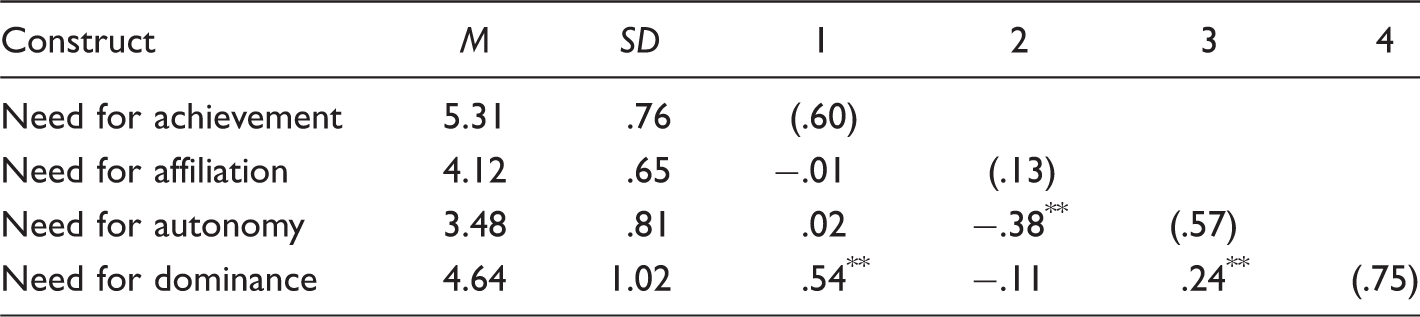
Note: Cronbach’s alpha included in parentheses along the diagonal. *p < .05; **p < .001.
Confirmatory factor analyses (sample 1).
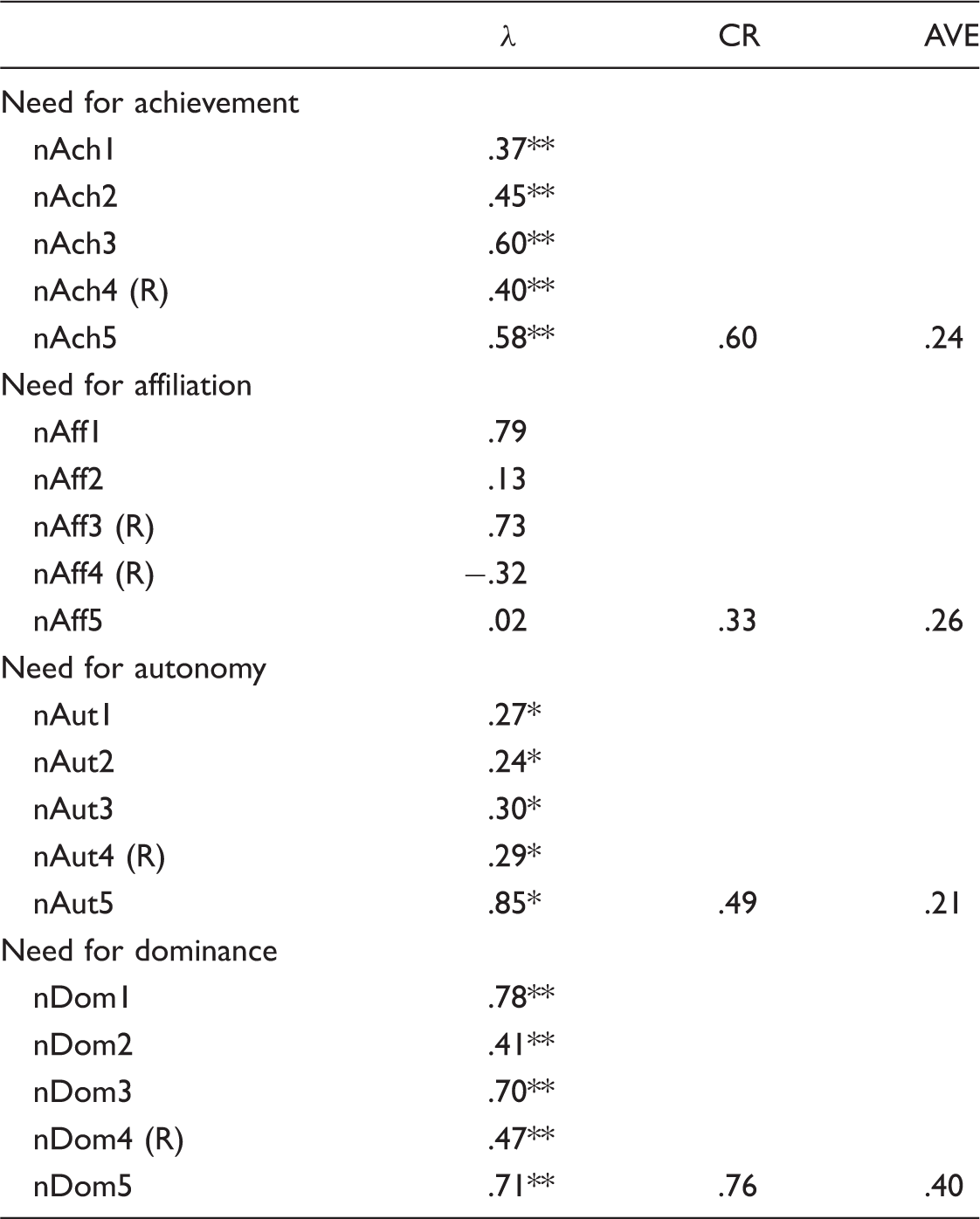
Note: CR: construct reliability; AVE: average variance extracted; R: the item was originally reverse-worded.
Model fit: χ2 = 499.74, df = 164, p < .01; CFI = .57; TLI = .50; RMSEA = .12.
p < .05; **p < .001.
Study 2: Needs development and initial scale validation
Participants and procedure
A sample of 113 undergraduate students from a large university in the Southeastern United States completed the questionnaire as part of a class project. In order to encourage honesty and minimize social desirability, no identifying information was obtained—only responses to the draft needs measure were included in this preliminary data collection.
Measures
Needs item pool
After a careful review of the literature (McClelland, 1991; McClelland et al., 1953; Steers & Braunstein, 1976) and an exploration of existing measures, 43 items (see Appendix A) tapping the four needs dimensions were developed based on the inductive methods recommended by Hinkin (1995). Items were designed in efforts to measure attitudes and preferences for work environments, rather than like the MNQ (Steers & Braunstein, 1976) which measures behaviors within work environments. When designing the new needs-based measure, reverse-scored items from the MNQ were eliminated, because at least two of these constructs seem to be polar opposites (e.g., nAut and nAff). Finally, attitudinal or motivator phrases such as “I enjoy,” “is important,” “get satisfaction,” and “is interesting to me” were included in most of the items.
Social desirability
The extent to which individuals’ responses were plagued by social desirability bias was estimated using Crowne and Marlowe’s (1964) eight-item scale. Individuals were asked to indicate whether a number of statements were generally true or false. Sample items include “Are you always willing to admit when you make a mistake?” and “Are you always courteous, even to people who are disagreeable?” Responses took the form of 1 (yes), 2 (not sure), or 3 (no).
Results for Study 2
Because our goal was to reliably and parsimoniously measure individual needs preferences, items were only retained if they were deemed to adequately tap the specific need in question. Therefore, items were subjected to a rigorous set of inclusion criteria. First, items from the individual scales were analyzed in turn; only items with item-to-correlations greater than .30 were retained. This resulted in the removal of four nAff items (i.e., affiliation items 1, 8, 11, and 12 in Appendix A), three nAch items (i.e., achievement items 8, 9, and 10 in Appendix A), and one nAut item (i.e., autonomy item 6 in Appendix A). Next, individual items were deleted if they correlated significantly (p < .05) with the composite of Crowne and Marlowe’s (1964) eight-item social desirability scale. This resulted in the elimination of one item from the nAff (i.e., affiliation item 4), achievement (i.e., achievement item 2), and dominance scales (i.e., dominance item 8).
After these problematic items were removed, we employed principal axis factoring with oblique (i.e., direct oblimin) rotation to assess the adequacy and factor structure of the remaining items. Oblique factor rotation was used as a priori theory indicated that the four factors were related to some degree. The factor loadings revealed that a number of items loaded on more than their intended factor at levels considered to be undesirable (i.e., greater than .40). Specifically, dominance item 4 cross-loaded on the nAch factor (.45), achievement item 3 cross-loaded on the nDom factor (.52), and affiliation items 6 and 9 as well as autonomy item 6 cross-loaded on the nAch factor (.45, .40, and .59, respectively). After removing these items, the resulting items were re-subjected to principal axis factoring with oblique rotation.
Factor analysis results (Study 2).

nAff: need for affiliation; nAch: need for achievement; nDom: need for dominance; nAut: need for autonomy. Bold values indicate factor loadings.
Means, descriptives, and correlations among needs scales (Study 2; N = 113).
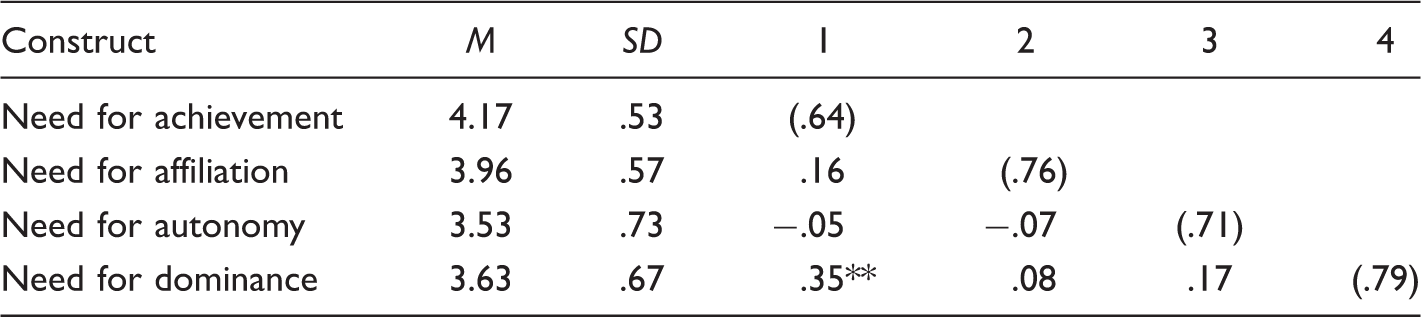
Note: Cronbach’s alpha included in parentheses along the diagonal. *p < .05; **p < .001.
Study 3: Factor structure—Confirmation of factor structure and construct validity
This study had two purposes; first, to ensure that the factor study derived in Study 2 in the United States. was not an artifact of the study design and limited to a student sample, and second, to test for convergent and discriminant validity.
Participants and procedure
Respondents were recruited with the assistance of undergraduates attending a university in the Southeastern United States. Students emailed links to family/friends working full-time. Typically employed to access hard-to-reach or hidden populations (e.g., Magnani et al., 2005; Sadler et al., 2010), snowball sampling provides access to study participants who are either too difficult to contact/recruit or for whom study participation is personally and/or psychologically costly. This method of data collection (Treadway et al., 2005) attempts to increase generalizability across multiple contexts (Hochwarter, Perrewé, Meurs, & Kacmar, 2007). A total of 213 adults responded to all survey items. Most of the sample (90%) were working full-time for their current organization for approximately 7.5 years (M = 7.55, SD = 8.93). Participants were predominantly female (57%) and averaged 40 years of age (M = 39.63, SD = 13.45). Further, respondents were primarily Caucasian (78%), with 8% of the respondents reporting Hispanic ethnicity, and 7% African American ethnicity. Most had at least some college education (37%) or had graduated with undergraduate degrees (34%).
Measures
Negative and positive affectivity
Negative and positive affectivity were measured using Watson et al.’s (1988) 20-item measure. Respondents were asked to indicate how they felt on average to adjectives such as excited, determined, and inspired for positive affectivity and irritable, jittery, and afraid for negative affectivity. Responses ranged from 1 (very slightly or not at all) to 5 (extremely). The reliabilities of the negative (α = .88) and positive affectivity scales (α = .91) were adequate.
Organizational citizenship behaviors
OCB was measured using Williams and Anderson’s (1991) seven-item scale. Respondents were asked to indicate the frequency with which they performed behaviors such as “help others who have been absent” and “help others who have heavy workloads.” Responses ranged from 1 (rarely) to 5 (very often). The reliability estimate of this scale was adequate (α = .72).
Results for Study 3
Comparison of model fit among models (Study 3).
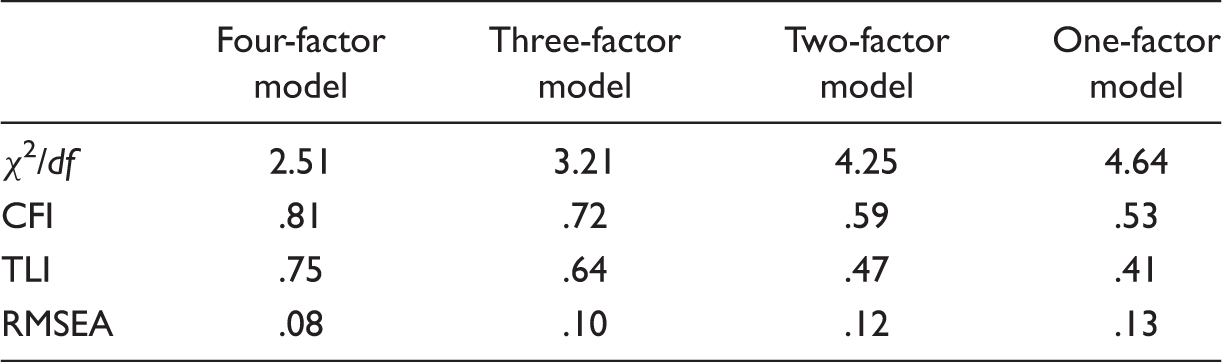
CFI: comparative fit index; TLI: Tucker-Lewis index, RMSEA: root mean square error of approximation.
Descriptives and inter-correlations among variables (Study 3; N = 213).
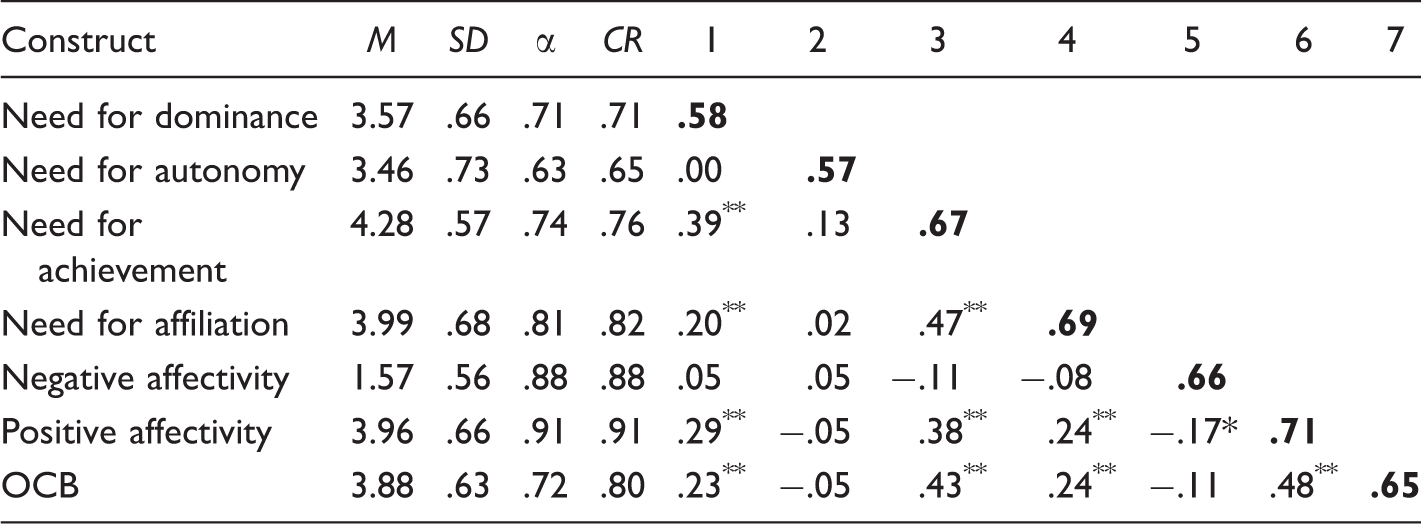
Note: CR: construct reliability; OCB: organizational citizenship behavior.
The square root of the average variance extracted (AVE) is included in bold along the diagonal.
p < .05; **p < .01.
Finally, as can be seen in Table 5, negative affectivity was not significantly related to nDom (r = .05, p = .43), autonomy (r = .05, p = .46), achievement (r = −.11, p = .10), or affiliation (r = −.08, p = .25). Therefore, no support was found for Hypotheses 1b, 2b, 3b, and 4b. Conversely, positive affectivity was significantly related to nDom (r = .29, p < .01), achievement (r = .38, p < .01), and affiliation (r = .24, p < .01) but not significantly related to nAut (r = −.05, p = .47); thus, support was found for Hypotheses 1a, 2a, and 4a but not Hypothesis 3a.
OCB was significantly related to nDom (r = .23, p < .01) (yet in the opposite direction predicted) and significantly and positively related to achievement (r = .43, p < .01) and affiliation (r = .24, p < .01). OCB was not significantly related to nAut (r = −.05, p = .49) but was negative and in the expected direction. As such, support was found for Hypotheses H5 and H6, not for Hypothesis H7, and in the opposite direction predicted for H8.
Discussion
Study 1 demonstrated that criticism of the MNQ (Steers & Braunstein, 1976) is justified. We found, similar to other studies (Dreher & Mai-Dalton, 1983), that the psychometric properties of the MNQ were fair at best. For instance, only the nDom subscale of the MNQ demonstrated adequate reliability (i.e., above .70; Nunnally, 1978). Further, the nAch and nDom subscales of the MNQ were not found to be empirically distinct. Conceptually, the MNQ captures behaviors thought to reflect manifestations of individuals’ needs rather than actual workplace preferences. Therefore, on both empirical and conceptual grounds, we felt that the development of a comprehensive, psychometrically sound, and non-proprietary needs measure was necessary given that individuals’ needs have wide-reaching effects on individual behavior and organizational outcomes. Our measure was carefully designed to utilize language that includes attitudes and feelings (rather than behaviors), including words such as “I enjoy,” “I prefer,” “I strive,” “is interesting,” and “is satisfying.” As noted earlier, answers to behaviorally based questions may be based on strategic calculations rather than innate or intrinsically motivating needs.
In Study 2, we developed items for the new needs measure utilizing the inductive method of scale development articulated by Hinkin (1995). The removal of items that had low item-to-total correlations, items that correlated significantly with the aggregate social desirability scale, and/or items that cross-loaded on more than one factor resulted in the removal of 25 items. The resulting nAff, nAch, nDom, and nDom scales consisted of five items, four items, five items, and four items, respectively. The psychometric properties of these remaining items were relatively strong in Study 2 but were less than desirable in Study 3. Nevertheless, our new measure of needs is markedly improved from the psychometric properties characteristic of the MNQ evidenced in Study 1.
In Study 3, it was interesting that none of the needs dimensions correlated with NA, particularly given that each of our constructs had been previously studied in relation to affect. A closer examination of the constructs used in prior research relative to the precise measures of affect used is necessary. However, support was found for the hypotheses that nAch, nAff, and nDom were positively related to PA. Finally, the most curious finding is that of our hypothesized relationship between individuals high in the nAut and OCBs. Although we predicted that high nAut individuals should be less likely to engage in OCBs, the relationship was found to be positive. Future research is needed to explore this counterintuitive finding.
With regard to the new measure itself, a review of the remaining items demonstrates strong face validity as well as parsimony. As can be seen with the items dropped from the nAff scale, for example, item 8 referred to group work rather than close personal ties. Furthermore, item 4 related to approval and liking, which may be more indicative of low self-esteem rather than nAff. With regard to nAch, items 8, 9, and 10 may have represented more Machiavellian concepts or strategic choices about friendship rather than accomplishment. For the nDom sub-scale, items 3 and 7 were more related to power and influence rather than managing others, both less socially desirable and perhaps unrelated. Finally, the nAut items dropped referred to not needing friends (item 6) or not being a team player (item 8), representing concepts that may be too extreme for most.
Strengths and limitations
The strengths of this study warrant mention. First, we employed one study to demonstrate the inadequacy of the MNQ scale, followed by two separate studies to evaluate the adequacy of the newly developed needs scales. Researchers (e.g., Hochwarter, Ferris, & Hanes, 2011; Lindsay & Ehrenberg, 1993) have advocated the use of multi-study research designs, as such designs allow greater confidence to be placed in study findings than would otherwise be provided by single-study designs.
The limitations of the study involve the use of entirely self-reported data. Nonetheless, we felt that the use of self-reported data was warranted given that individuals are most adequately suited to report on their own needs and preferences. Another limitation is that we used a convenience sample generated using snowball data collection techniques (Sadler et al., 2010). Given that our initial contacts in our sampling plan were students at a private university in the southeast United States with limited ethnic diversity, it could be that the composition of the sample was not sufficiently representative of the general population; as such, the generalizability of results is a concern. Furthermore, the most notable limitation involves low reliability of the nAch scale in Study 2 (α = .64).and the nAut scale (α = .65) in Study 3. In addition, due to the inadequacy of the Steers and Braunstein (1976) measure and the low alpha reliabilities specifically, we did not include it in our second and third studies; however, one could argue that a comparative study could provide divergent validity. Additional studies (with larger sample sizes and more diverse samples) are needed to confirm the factor structure and psychometric properties of the new needs scales. Our working assumption was that PA and NA were orthogonal constructs. The scale used in our study (Watson et al., 1988) is a potentially useful means of assessing PA and NA; however, recent conflicting results from factor analytic studies of the positive and negative affect schedule indicate that questions concerning the underlying structure of this measure and the constructs it assesses have not been resolved (e.g., Ebesutani et al., 2011; Leue & Beauducel, 2011). This might explain why we did not find support for Hypotheses 1b, 2b, 3b, and 4b. Finally, we only analyzed three constructs for convergent and discriminant validity (NA, PA, and OCBs).
Future research
Future research should analyze convergent and discriminant validity relative to other constructs and demographics. For example, what are the differences between men and women with regard to their degree of nAff versus their nAch? Do persons with longer tenure have higher nDom and a stronger desire to manage others? With regard to impression management techniques and influence strategies, do persons high in nDom use more assertive tactics (such as intimidation) and do persons high in nAff use softer tactics (such as ingratiation)? Prior research would suggest that there are clear differences in tactics chosen based on needs (e.g., Benson & Hornsby, 1988; Caldwell & Burger, 1997; Mowday, 1978). Finally, the construct of envy may be related to one or more of our needs dimensions. For example, Van de Ven, Zeelenberg, and Pieters (2011) illustrated that persons high in nAch have a motivation to “do better” and that envy may be a related construct that would be a “catalyst” to assist in achievement motivation. Future research should explore these additional relationships.
Our research, and the constructs tested in this research, are based on the premise that needs are internal individual differences that drive behavior. However, we do indeed believe that situations can be strong predictors of behaviors. As noted over 30 years ago by Salancik and Pfeffer (1978), “few studies have tested whether individuals’ affective responses to work were related to their social context rather than their individual needs” (p. 238). Some have argued that needs are not constant but aroused by cues in the environment (Murray, 1938). Perhaps, through social information processing, employees are adaptive and may indeed “adapt attitudes, behavior, and beliefs to their social context and to the reality of their own past and present behavior and situation” (Salancik & Pfeffer, 1978, p. 226). For example, perhaps an organization that rewards and nurtures teamwork would create higher nAff within those who are not necessarily disposed to group affiliation. Similarly, a highly competitive culture could foster competitive or political behaviors that are perhaps counter to one’s typical nature.
As such, future research should also investigate the interaction between perceived needs and situational conditions. For example, situational conditions may exacerbate the general behavioral tendencies of individuals within an organization, not unlike the experience of trait activation theory (Tett & Gutterman, 2000). For example, perhaps persons high in nAff desire social support in times of stress (e.g., the tend-and-befriend phenomenon). Hence, individuals may increase their ingratiation tendencies or OCBs in times of ambiguity, conflict, or overload. On the other hand, under situations where a particular behavior is not inherently part of the organizational culture, needs-based behaviors are likely to be reduced in accord. It could be argued that in conditions of ambiguity, employees rely on social comparisons to determine appropriate behaviors (Salancik & Pfeffer, 1978). Hence, when role ambiguity is high, organizational conditions, patterns of OCBs, and corporate culture (rather than individual differences) may drive behaviors to a greater degree. These tendencies could also be tested in future longitudinal research to illustrate if the culture alters or impacts the behaviors of newcomers.
Finally, future research should strive to compare measures developed in the United States to other cultures. Individuals from different nations vary in motivational needs (Baum et al., 1993; Gannon, 1994), which ultimately guides their choices, commitments, and standards of behaviors (Erez & Earley, 1993). A number of international studies have utilized the MNQ, and in a comparison of Israeli and U.S. entrepreneurs, Baum et al. (1993) reported reliabilities of under .75 for all four dimensions. Similarly, in a sample of 156 Chinese employees using the MNQ, Taormina (2009) reported low reliabilities that required items to be dropped, and Carraher Buchanan, and Pia (2010) reported on only nAch among Chinese, Latvian, and U.S. respondents. Little research has explored the differences between cultures with regard to needs. “Each culture develops and reinforces different profiles in individuals occupying distinct work roles. Over time, these profiles attract different types of individuals into these roles” (Baum et al., 1993, p. 507). The implications are that the management practices of U.S. institutions, as well as multinational organizations, must be modified in order to reward and develop managers of various cultures. A new comprehensive measure of needs is an important start in the advancement of theory and practice for organizations in the United States and abroad.