







Abstract
Although audio-visual stimuli are among the most frequently used methods to elicit emotional reactions in experimental conditions, real-life manipulations have increasingly been used in different countries. However, the applicability of such protocols has not yet been tested in Brazilian Portuguese speakers. Thus, we conducted two experiments to investigate the effectiveness of both methods. In the first experiment, we used film clips to induce negative emotions (i.e., anger, fear, or sadness) or an emotionally neutral condition in 321 undergraduate students. After watching one of the online videos, volunteers completed an emotional assessment. As expected, there were significant differences in all groups. Our results corroborate the relatively discrete patterns in emotion elicitation using films. In the second experiment, anger was elicited in 18 male undergraduates through a hostile social interaction with a confederate and measured by the corrugator muscle activity and cortisol responses. Indeed, there was an increase in corrugator activity in the group exposed to anger induction, even after a few minutes from the end of the experimental manipulation. Implications for experiments on the negative emotions are discussed.
Keywords
Introduction
Emotions have several adaptive functions for human social life (Shariff & Tracy, 2011). These affects differ from moods in that they are relatively discrete, rapid and transient, more intense, and directed at a stimulus (Moors, Ellsworth, Scherer, & Frijda, 2013; Russell & Barrett, 1999). Accordingly, emotions can be defined as reactions that predispose an individual for a certain behavioral pattern, producing a cascade of physiological and cognitive changes, which are synchronized in response to a given stimulus (Mendl, Burman, & Paul, 2010; Scherer, 2005; Shariff & Tracy, 2011). Therefore, emotions are determining factors for human social interaction, as well as being a central concern for different lines of research on behavior and health. Thus, researchers have dealt with methodological and ethical challenges of eliciting emotions under controlled and replicable conditions. Indeed, several protocols have been used to induce emotional states in laboratory; however, empirical validation of such methods is still scarce for some cultures, which can lead to an inability to replicate findings observed in different countries.
Although emotion expressions have universal components (Ekman, 1992; Ekman et al., 1987), they also vary depending on individual and population attributes. In general terms, emotion expressions may vary depending on the culture (Marsh, Elfenbein, & Ambady, 2003) and intergroup contexts (Elfenbein & Ambady, 2002). For example, individualistic cultures may encourage emotional expressions, but collectivistic cultures give support to the moderation of these expressions (Matsumoto et al., 2008; Park et al., 2013). Indeed, people in collectivistic cultures may feel less comfortable expressing negative emotions when compared to people in individualistic cultures (Stephan, Stephan, & De Vargas, 1996). In the individualism–collectivism dimension, some countries may have both orientations, such as Brazil, either by an intermediate level or by differences between the regions of the country (Hofstede, Garibaldi de Hilal, Malvezzi, Tanure, & Vinken, 2010). In addition, cultural differences can also influence the disposition of a group or population to certain emotional responses, depending on the triggering stimulus or context (Cole, Bruschi, & Tamang, 2002; Scherer & Wallbott, 1994). Thus, to know the effectiveness of experimental protocols of emotional manipulations in certain cultures is of fundamental importance for a successful emotional induction. Among the various methods used to induce emotions in a laboratory, the film clip and real-life manipulations have found relative success in different cultures (e.g., Fabiansson & Denson, 2012; Fernández et al., 2012; Harmon-Jones & Sigelman, 2001; Sato, Noguchi, & Yoshikawa, 2007; Schaefer, Nils, Sanchez, & Philippot, 2010; Uhrig et al., 2016).
Film clips have been extensively used and recognized as relevant stimuli for affective induction in a standardized manner (e.g., Rottenberg, Ray, & Gross, 2007; Schaefer et al., 2010; Uhrig et al., 2016). Among countries that have successfully validated audio-visual stimuli to induce emotions are the United States (Gross & Levenson, 1995; McHugo, Smith, & Lanzetta, 1982), Belgium (Philippot, 1993), Spain (Fernández et al., 2012; Megías, Pascual Mateos, Ribaudi, & Fernández-Abascal, 2011), and Germany (Hagemann et al., 1999; Hewig et al., 2005). Gross and Levenson (1995) evaluated over 250 films, showing the film clips to almost 500 ethnically diverse English-speaking subjects and developing a set of 16 films that reliably induce emotional states, both negative (anger, disgust, fear, and sadness) and positive (amusement, contentment, and surprise), as well as neutral conditions. This set of films showed relatively discrete patterns of emotional activation, which can be used in experimental conditions and laboratory tasks. Such protocol was subsequently used in and adapted to many countries, suggesting a universal capacity of these films to induce the target emotions, although they can also present some specificities for each population (e.g., Hazer et al., 2015; Megías et al., 2011; Michelini, Acuña, & Godoy, 2015; Sato et al., 2007). The effectiveness of audio-visual methods for affective manipulation is confirmed by meta-analysis (Lench, Flores, & Bench, 2011; Westermann, Spies, Stahl, & Hesse, 1996) and the applications of emotion-induction protocols through online experiments have been growing recently (Samson, Kreibig, Soderstrom, Wade, & Gross, 2016), extending, therefore, its applicability beyond the laboratory environment.
Until now, emotion-inducing films are one of the most often used methods to elicit affective states (Kreibig, 2010). Even though this technique has a number of advantages over other methods, it still has some limitations, especially with respect to demand effects. Real-life emotion induction has been increasingly used, aiming at an emotion elicitation of greater ecological validity, since emotions are primarily triggered by social interactions (Harmon-Jones, Amodio, & Zinner, 2007; Roberts, Tsai, & Coan, 2007). Thus, protocols that use an emotionally relevant social interaction context, although being logistically more difficult, come even closer to an emotional reaction seen in natural environments (Eckhardt & Cohen, 1997; Fabiansson & Denson, 2012; Stemmler, Heldmann, Pauls, & Scherer, 2001). Even though the protocols are empirically tested for inducing specific target emotions in English speakers, only a few studies validated these methods in different cultures.
Different protocols have been used to induce emotions in the laboratory; however, given the impact of cultural differences, such protocols should be adapted and validated for its applicability in specific populations. With this in mind, we conducted two studies (which are part of a larger project on the effects of anger in human behavior) to assess the effects of two protocols of negative emotion induction and test their applicability to Brazilian Portuguese speakers. In the first study, we assessed the effect of negative emotion elicitation through three film clips (for anger, fear, and sadness) and one film clip for a neutral state. In the second study, we tested the effects of an anger induction protocol through a real-life manipulation.
Experiment 1
Participants
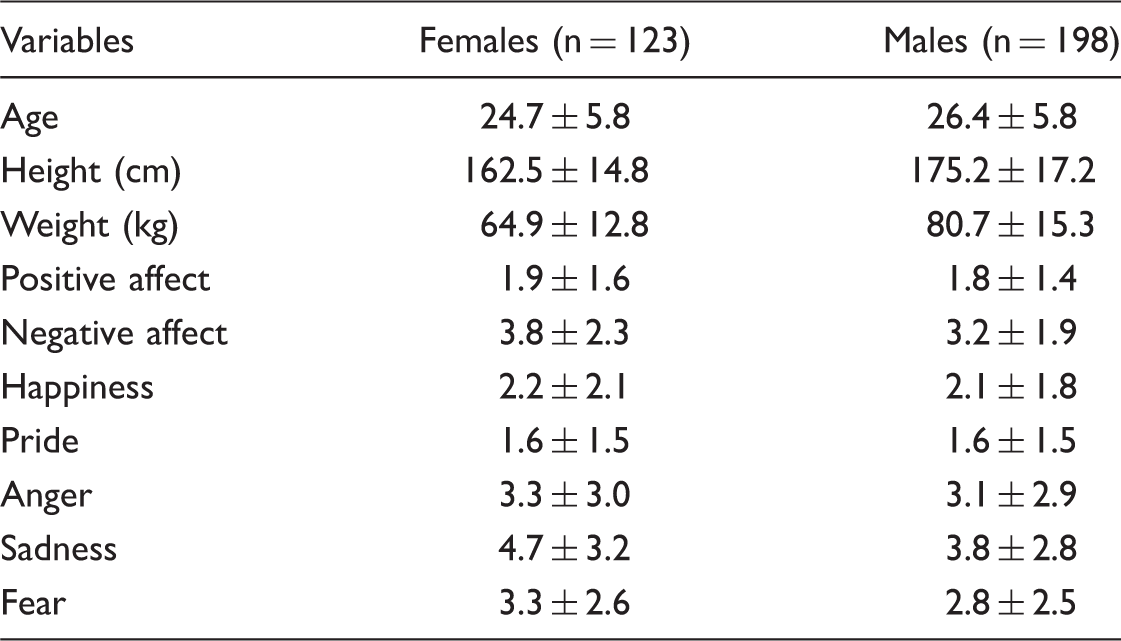
A total of 339 ethnically diverse students (♀ = 39.5%), ranging from 18 to 40 years (M = 25.7 ± 5.8; ♀: M = 24.7 ± 5.7; ♂: M = 26.3 ± 5.7), from two universities of Rio Grande do Sul State (Federal University of Rio Grande do Sul – UFRGS and Federal University of Rio Grande – FURG), Brazil, voluntarily completed the online experiment. Eighteen participants were excluded from the analysis for one or more of the following reasons: not watching the film clip until the end, taking more or less time than two standard deviations to complete the whole experiment (total time), or failing to respond adequately to checkpoints throughout the experiment (three obvious questions to check if volunteers were responding with attention). Although participants were blind to study aims, they were previously informed about the procedure and its possible effects, confirming consent to participate by proceeding to the next section of the online experiment. Additionally, a digital copy of the signed informed consent form was available to download. The study was approved by both ethics committees of the universities in which the research was conducted (the Research Ethics Committee at the Institute of Psychology of the Federal University of Rio Grande do Sul and the Research Ethics Committee in the Health Area of the Federal University of Rio Grande).
Stimuli
Based on a previous pilot study (unpublished observations), a film for each one of the negative emotions was selected. The chosen films were as follows. My Bodyguard was used for anger, from a film set developed by Gross and Levenson (1995); in this excerpt, a male adolescent is bullied and assaulted by a group of boys (duration: 246 seconds). The Champ was used for sadness, also from the film set of Gross and Levenson (1995), which shows a young boy who saw his father die after a fight; the boy is crying while men look at him with consternation (duration: 171 seconds). More detailed descriptions of anger and sadness films can be found in the original study of Gross and Levenson (1995) and in Rottenberg et al. (2007). Lights Out was used for fear. We selected and tested this Swedish supernatural horror short film with a narrative without dialogue (this short film was directed and written by David Sandberg and was released in video sharing websites): In it, a woman sees a silhouette of a humanoid shape in a hallway of her apartment every time she turns out the lights; she also started hearing footsteps in the hallway, which makes her hide in the bed, while the lights start blinking, and then, when she uncovers her head to see what has happened there is a humanoid being looking her (duration: 155 seconds). The neutral condition (control) consisted of film clips of landscapes, natural environments, and everyday scenes (e.g., running water, passing clouds, river scenes), totalling 1 minute of film clip (62 seconds); however, we did not use the documentary scenes with narration, as used in the original protocol (Gross and Levenson, 1995), to avoid additional cross-cultural issues. Thus, when necessary, we adapted and translated the film clips to achieve a successful elicitation of each emotion.
Dependent variables assessment
After the film, participants were asked to complete an emotion assessment, indicating how each volunteer was feeling right after experimental manipulation, regarding the following emotions: happiness, anger, fear, pride, and sadness. In this 9-point scale, participants were asked to assess the intensity that they felt each emotion, from “nothing” (0) to “extremely” (8). Following what was recommended by Gross and Levenson (1995) and was widely used by other researchers (e.g., Hewig et al., 2005; Sato et al., 2007), we sought to use a protocol for measuring emotions in a way that was comparable to other studies in the field. However, we adapted the scale, leaving only the emotions of interest.
Further, in order to control possible demand effects, we verified whether emotion manipulation caused some alteration in the social desirability of the volunteers. For this, we applied the Marlowe–Crowne’s Social Desirability Scale (MC-SDS; Crowne & Marlowe, 1960; Ribas, Moura, & Hutz, 2004). In its brief version adapted to the Brazilian population, MC-SDS used 13 statements to evaluate the tendency of the participants to answer the questions in a socially acceptable way. Volunteers read each statement and decided whether it describes them or not at the moment, answering “true”or “false” for each item. This scale shows a strong correlation (0.9) with its long version (Ribas et al., 2004), which has an index of reliability and internal consistency of 0.89 and 0.88, respectively (Crowne & Marlowe, 1960).
In addition, we collected sociodemographic and general health data for controlling confounding variables, with items such as age; sex; education level; height; weight; current occupation; and occurrence of any neurological, psychiatric, or psychological condition. Moreover, we collected if participants already watched the film before the experiment and if they closed their eyes or avoided looking at the stimulus at any time of the experiment.
Procedure
Participants completed the online experiment through a link provided to them at the time of recruitment. Before the experiment, all participants received more information about the research by email. Although the study’s precise aims and hypotheses were not revealed until the end, all risks and possible benefits of research, as well as the detailed procedures were previously described to the participants. Volunteers were informed that the study would assess the effects of audio-visual content (e.g., movie fragment, short films, television news, and television advertisements) and that researchers would ensure absolute anonymity and confidentiality to participants. They were also informed that the contents of some films could be moderately emotionally disturbing for some people and that if participants do not usually feel comfortable watching suspense (supernatural), violence (bullying), or dying (grief) scenes, they should stop participating in the study. Participants were also asked to avoid outside interferences and distractions (to respond when alone), to use personal computers (laptops or desktops, avoiding mobile devices), and to use a pair of earphones. Volunteers were instructed to continue the experiment only if they had at least 30 minutes to participate. Then, after completing a brief sociodemographic and general health questionnaire, participants, in the absence of any clinical or sociodemographic complication that would make them especially susceptible to emotional manipulation (e.g., mood/anxiety disorders, schizophrenia, borderline personality disorder, intermittent explosive disorder, etc.), proceeded to the stage of experimental manipulation. Volunteers were allocated randomly to each condition. Each participant was exposed to only one film clip, inducing a discrete emotional manipulation of the fear (Fear Group), sadness (Sadness Group), anger (Anger Group), or neutral (Control Group (CG)). After watching the film clip, the participants filled out the emotional state assessment and, then, the MC-SDS. Soon after, there was a debriefing session, when the effectiveness of experimental manipulation and suspicions were verified, as well as the objectives of the study were clarified. The entire online experiment was developed through the German company SoSci Survey.
Analysis
After conducting the exploratory and descriptive analyses of the data, we developed scores for positive (by computing the mean of the variables: happiness and pride) and negative affects (by computing the mean of the variables: anger, fear, and sadness). Assumptions were checked and both normality and homogeneity of variance were violated for all dependent variables, as assessed by Shapiro–Wilk (p values < 0.001) and Levene’s tests (p values < 0.001), respectively. Given the nature of the data and the inefficiency of the log transformation used, we chose to use nonparametric tests. Thus, Spearman’s and rank-biserial correlation coefficients were used to test the association between dependent and control variables. Then, we tested the hypothesis of the effectiveness of emotional manipulation by the Kruskal–Wallis test followed by the Mann–Whitney test for planned comparisons using the target emotion of each group (i.e., for Anger Group was used the anger measure for the contrast analysis) compared to the non-target emotions; with the exception of the CG that was compared to the other groups by positive and negative affect measures. In all cases, we used two-tailed statistics, an α value of 0.05 and the Monte Carlo permutation test with 10,000 iterations.
Results and discussion for Experiment 1
Means (±SD) deviations for sociodemographic variables, target emotions, and positive and negative affects.
SD = Standard deviation.
There were significant differences between groups for all self-reported emotion measures used, as well as for measures of general positive affect and negative affect (Figure 1). More precisely, the Kruskal–Wallis test showed p < 0.001 for all analyses. Planned comparisons indicated that the Anger Group showed higher levels of self-reported anger when compared to the sadness (U = 190.5; p < 0.001), fear (U = 218.5, p < 0.001), and CGs (U = 190.5, p < 0.001). In turn, the Fear Group showed higher levels of self-reported fear, as compared to all other groups (Anger Group: U = 1169.5, p < 0.001; Sadness Group: U = 351.5, p < 0.001; CG: U = 304.5, p < 0.001). The Sadness Group presented higher levels of self-reported sadness compared to the fear (U = 503.5, p < 0.001) and CGs (U = 603.5, p < 0.001), but, surprisingly, lower levels of sadness when compared to the Anger Group (U = 1831, p = 0.007). Finally, the CG was significantly higher than other groups in positive affect measurements (Anger Group: U = 721, p < 0.001; Sadness Group: U = 818, p < 0.001; and Fear Group: U = 1210, p < 0.001) and lower than the other groups in negative affect measurements (Anger Group: U = 318.5, p < 0.001; Sadness Group: U = 851, p < 0.001; Fear Group: U = 885.5, p < 0.001). This corroborates the discrete responses for emotion induction using film clips, with the exception of the anger stimulus, as seen by Gross and Levenson (1995), which also induced sadness. It confirms the finding that conscious induction of anger is usually associated with other negative affects, and thus, it is one of the most challenging emotions to be experimentally observed (Harmon-Jones et al., 2007).
The mean of intensity of emotional experience for five emotions (happiness, anger, fear, pride, and sadness) and for general positive and negative affects, evaluated after negative emotion induction (anger, sadness, or fear) or neutral state induction (control), in 321 undergraduate volunteers (Experiment 1). Kruskal–Wallis tests indicated differences between groups for all emotions assessed, including positive and negative affects. Planned contrast analysis indicated that the target emotion from the induced emotion (used as a comparison group for planned contrasts and marked with a black triangle: ▾) was significantly different from all other non-target emotions, including the CG. For the CG, general positive and negative affects were used as a comparison measure in the contrasts. Error bars represent the standard error of the mean (*p < 0.05; **p < 0.01; ***p < 0.001).
Experiment 2
Anger is considered one of the most difficult emotions to be authentically induced in laboratory conditions, being difficult to evoke using traditional methods, such as pictures and films (Cabral et al., 2016; Gross & Levenson, 1995; Kory & D’Mello, 2015), which can lead to the establishment of a controversy over the effects of anger in human behavior. However, it can be elicited using social interaction methods, which allows an interpretation of the data in terms of greater ecological validity, since emotions are often evoked in social contexts (Fabiansson & Denson, 2012; Harmon-Jones et al., 2007; Stemmler et al., 2001). Accordingly, in the present experiment, we sought to verify whether conflicting social interactions are an effective protocol for anger induction. To this end, we conducted a pilot study using physiological methods that are not influenced by demand characteristics, that is, corrugator electromyography (EMG) to detect typical facial expressions of anger and salivary cortisol measurement and to register reactions related to other affective states, such as anxiety and sadness. Cortisol is positively related to stress, fear, and sadness (and other avoidance emotions); however, the association between anger (an approach emotion) and cortisol is not so evident, since studies on this topic can be found reporting positive, negative, or no relationship (Herrero, Gadea, Rodríguez-Alarcón, Espert, & Salvador, 2010; Kazén, Kuenne, Frankenberg, & Quirin, 2012). The conflicting results are probably due to inefficient control of the confounding variables, to use of correlational measures of cortisol, and/or to the unsuccessful anger induction, which can trigger fear, stress, anxiety, or sadness, depending on the task used.
Participants
Eighteen healthy male and ethnically diverse undergraduate volunteers (mean age: 22.2 ± 1.3 years) were recruited randomly from the Federal University of Rio Grande’s undergraduate database, based on student identification numbers, by sending individual messages. As mentioned in Experiment 1, the study was approved by the ethics committees of both universities involved in the study: the Research Ethics Committee at the Institute of Psychology of the Federal University of Rio Grande do Sul and the Research Ethics Committee in the Health Area of the Federal University of Rio Grande.
Design and procedure
After a participant arrived in the laboratory at the previously scheduled time, he received information about the study, instructions for collecting saliva for hormone analysis (baseline) and had electrodes placed for electromyographic records. Then, the participant was informed that he could start the computerized experiment when the experimenter authorized it. In order to minimize the unexplained variance (error), all samples were collected individually (between 9 am and 6 pm) by just one uniformed researcher, in a room with reduced environmental stimulation (i.e., a room with a computer and material needed for the experiment) and without the presence of the experimenter during the data collection. Participants were randomly assigned to a CG or an experimental group (EG) by computer generated numbers at the beginning of the experiment. Both the volunteers and the experimenter were blind to the group to which the volunteers were assigned. Experimental manipulation was conducted by a supposed virtual interaction with another (alleged) participant, with two conditions: one in which the volunteer was provoked (EG) and another that had an emotionally neutral condition (CG). After being informed that they would participate using an online debate system, the volunteers completed a brief sociodemographic questionnaire with questions related to the subject of the discussion topic. After the experimental manipulation, volunteers completed some questions about the debate experience, while the electromyographic recording was maintained for a few minutes after the experimental manipulation. With the end of computerized data acquisition, the experimenter was called to the room, and the final saliva sampling was carried out. The experimenter then conducted the post-experimental interview, clarifying the deception.
Experimental manipulation
Cover story
In order to conceal the experimental manipulation, volunteers were informed that they would test an online debate system, which allowed the context of an exchange of text messages and the occurrence of a video call (at the end of the debate and to conclude it). The volunteers were informed that the experiment would be conducted through dyadic interaction to discuss a random subject, as well as that the other participant (called of “Participant 2” during the experiment; but for the purpose of distinction, here we will refer to him as “actor”) was in another room in the same building.
Anger induction
After the volunteers, supposedly “randomly,” sorted the area of knowledge to be discussed (predetermined result, i.e., biology), they were led to believe that the actor chose the topic of the online debate. Although the participants were not aware of this, the results were predetermined, the topic “chosen” by the actor (i.e., a previously programmed routine) was “teaching creationism in public schools.” After the stage of choosing the topic to be debated, participants answered a brief multiple-choice questionnaire on the debated topic; afterward, they wrote their initial arguments in text message format, sent it to the actor and then, awaited receipt of the actor’s initial arguments. That is, the participant started the argument and the actor made a reply. The actor’s argument indirectly attacked the participant’s personal belief or disbelief in God (as informed in the multiple-choice questionnaire), that is, the opinions attributed to their membership group (i.e., people that belief or disbelief in God) were grossly criticized, but the criticisms were not directly against the participant. Thus, after the first exchange of text messages, the volunteers could write another text message as a reply and receive a video call from the actor, as a final rejoinder (supposedly for completion of the debate). The video call, previously recorded with an actor, followed the initial arguments, criticizing the opinions and personal beliefs of the participants, with coarse statements against their membership group. Participants were informed that the Participant 2 (actor) would receive neither the video nor the audio of the video call, because it could lead to interruption and disturbance during rejoinder. However, in fact, this was used to reduce the anxiety of the participants with the video call.
Control condition
The CG participants were exposed to the same conditions of EG, but the text messages and arguments in the video call did not disagree with the participants’ opinions (as informed in the questionnaire). Participant 2, through text messages and the actor’s argument, informed CG participants that he did not have a formed opinion because the debated topic is not his area of study, and he does not have much in-depth knowledge about this. Conversely, Participant 2 also highlighted the importance of the topic and the debate, emphasizing secondary issues (e.g., teachers’ didactic). The actor kept a monotone speech, avoiding staring directly at the camera and contained exaggerated body gestures.
Surface EMG
Corrugator supercilii muscle surface EMG (sEMG) activities show good construct reliability when assessing reactions to facial expressions of anger (Hess et al., 2017). Thus, activity of the left corrugator muscle was recorded using sEMG, whereas raw signals (µV) were amplified through the MyoScan-Pro sensor, and transmitted to an A/D converter (FlexComp Infiniti encoder; Thought Technology Ltd, Canada). The bipolar Ag-AgCl electrodes with conductive gel were placed in a 2-cm interelectrode distance, as recommended by Fridlund and Cacioppo (1986). The reference electrode was placed in the upper central portion of the forehead, following the hairline. Fibre optic cables and a 60 Hz notch filter were used to reduce noise interference. The sEMG raw signals were rectified (root mean square) and a 20 Hz high-pass filter was used to minimize the effect of motion artifacts, including the signals from other muscle groups, heartbeats, and movement of the cables. All sEMG data were sampled at 2048 samples per second. The baseline measure (sEMGBaseline) refers to the first 5 minutes of the experiment (experiment instruction period and the choice of discussion topic). Experimental manipulation measure (sEMGManipulation) refers to the period from text message exchange to the end of the video call. The post-experimental measure (sEMGFinal) refers to the 5 minutes following the end of the experimental period.
Saliva collection and cortisol analysis
In order to measure the changes in the biologically active (unbound) fraction of cortisol, saliva samples were collected at two times: baseline measure, immediately after signing the informed consent form and final measure, after the post-experimental interview (i.e., approximately 15 minutes after the experimental induction). Participants were instructed to deposit an amount equal to 2 ml of saliva (at each collection) into a polypropylene test tube. All samples were immediately stored and frozen at −20℃ until assayed. Each analysis was performed in duplicate using an enzyme immunoassay (ELISA), based on the principle of competitive binding (Cortisol Saliva ELISA Kit; Diagnostics Biochem Canada Inc., Ontario, Canada). After thawing, the samples were centrifuged at 2500 r/min for 5 minutes at room temperature, and samples supernatant fractions were transferred to polypropylene microtubes. For each assay, we used 50 µL of supernatant fractions. The procedures were performed according to the manufacturer’s instructions. We used a microplate reader and measured the absorbance at 450 nm.
Data analysis
After descriptive and exploratory analyses, statistical assumptions were checked before statistical analysis, and the results indicated that the normality and homogeneity of variance were violated for the main variable of interest, with p ranging from 0.082 to 0.007, as assessed by Shapiro–Wilk’s test, and with p ranging from 0.031 to 0.013, as assessed by Levene’s test, respectively. Thus, we conducted all analyses using nonparametric tests. The effects of anger induction were tested by Mann–Whitney U test. In general, the analyses were performed with two-sided tests, except when there was a clear theoretical prediction, as reported in the results section. We used a significance level (α) of 0.05 for all testing.
Results and discussion for Experiment 2
In this study, we used two physiological measures as dependent variables: corrugator EMG activity to test if the EG elicited facial expressions of anger in participants and salivary cortisol measurements (before (CBaseline) and after (CFinal) the experimental procedure) to verify a possible induction of anxiety or sadness (discriminant validity), which can be inferred by an increase in cortisol levels. Thus, as can be seen in Figure 2, the sEMGBaseline did not show significant differences between groups (GC: M = 3.6 ± 2.9; GE: M = 4.5 ± 3.3; U = 28.0, p = 0.536). On the other hand, in the sEMGManipulation, the EG showed a significant increase in sEMG activity, when compared to the CG (GC: M = 2.98 ± 1.2; GE: M = 6.0 ± 4.5; U = 10.0, p = 0.008, one-sided test). Finally, the sEMGFinal, the difference between the groups decreased slightly, but remained significant (GC = 3.2 ± 1.5; GE = 6.0 ± 3.9; U = 17.0, p = 0.046, one-sided test). That is, even after a few minutes from the end of the experimental manipulation, there was a maintenance of contraction of the corrugator muscle in the group exposed to anger induction (EG). This effect could be observed even with the small sample size of this pilot study. As expected, there were no significant differences between groups in CFinal measures, nor for the cortisol responses (ΔC; difference between CFinal and CBaseline) (ps > 0.31). These results may indicate that the experimental manipulation induced anger at moderate levels and that the CG does not show considerable emotional changes throughout the experiment.
Mean of corrugator muscle activity for control (CG) and anger-induced (EG) groups in three periods (Experiment 2): baseline (measured before experimental period), manipulation (measured during experimental period), and final (measured after experimental period). Error bars represent the standard error of the mean (*p < 0.05).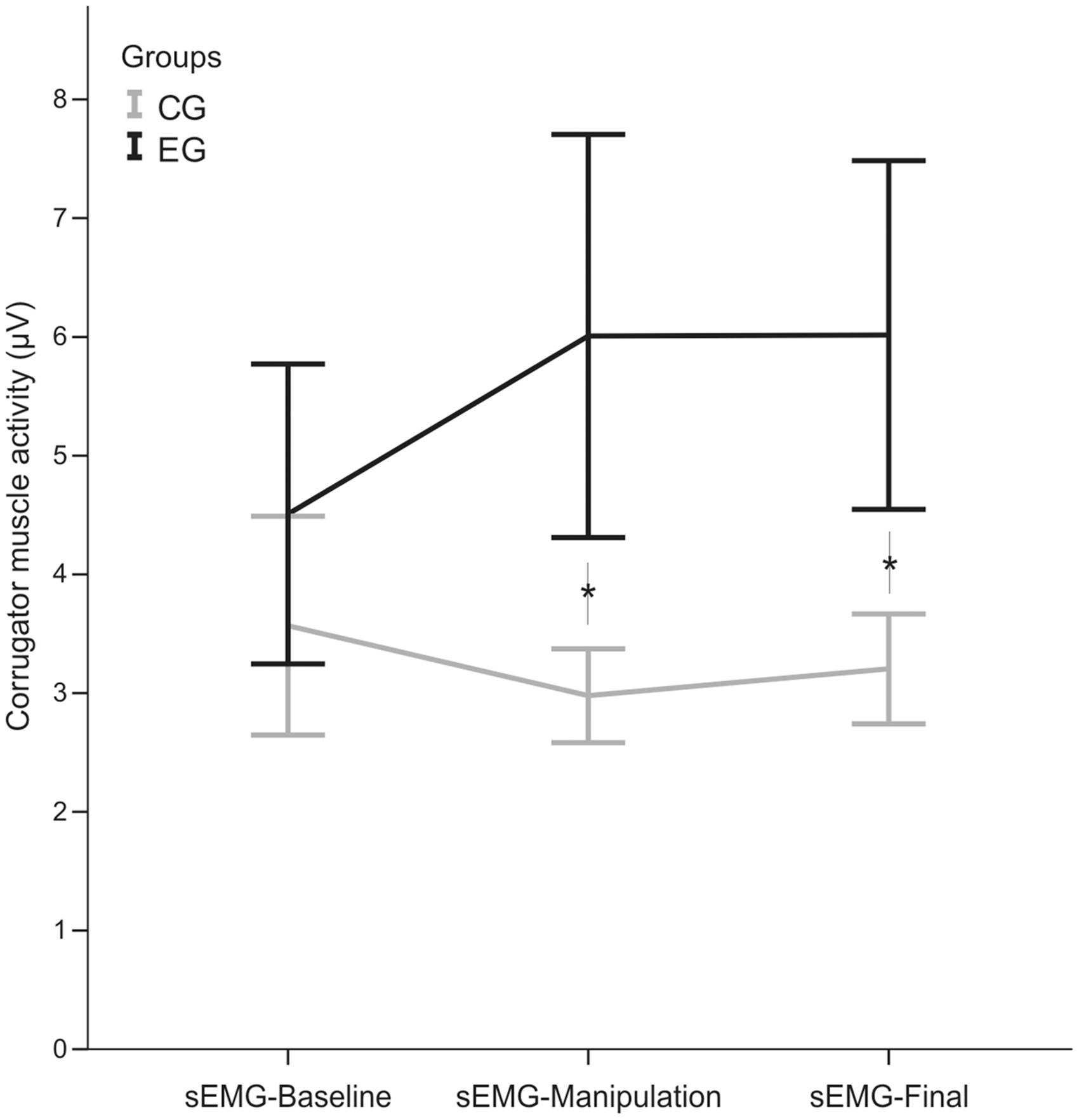
General discussion
Emotion elicitation has been progressively used more by researchers seeking to understand the behavioral effects and the neurobiological determinants of human emotions, regardless of the country and culture of the study population. In this sense, the protocols tested here, conducted with a Brazilian Portuguese-speaking population, can be considered viable alternatives for both the laboratory and online environments. Indeed, our data allowed us to corroborate, albeit in a preliminary way, that both protocols are valid to induce the target emotions in Brazilian subjects, with an intensity and a discrete pattern similar to the emotional states reported in previous studies conducted in other countries (e.g., Fabiansson & Denson, 2012; Gross & Levenson, 1995; Hagemann et al., 1999; Harmon-Jones & Sigelman, 2001; Lench et al., 2011; Samson et al., 2016). As expected, the first experiment showed robust results, corroborating that the induction of fear and sadness follow a discrete pattern, differing significantly from all other non-target emotions. This could also mean a step forward for fear induction by film clips, which did not get the expected success in the original study, where authors reported that they did not find any successful films for fear induction (Gross & Levenson, 1995). In contrast, the anger induction by the film clip that we used did not only provoke a feeling of anger, it also caused sadness, confirming that anger is one of the most difficult emotions to induce through controlled experimental conditions (Lench et al., 2011; Rottenberg et al., 2007). Nevertheless, although there was no significant difference between anger and sadness scores, the anger induction group reported higher levels of its target emotion when compared with reports of sadness.
However, it is worth noting that the use of less effective techniques to genuinely elicit anger (such as the use of pictures, autobiographical recall and imagination of emotionally relevant events) can lead to the establishment of a controversy over the role of anger in human behavior. Therefore, further studies on anger induction using film clips should be performed seeking even more effective stimuli and the elicitation of a discrete pattern for this emotion. Having this difficulty in mind, we conducted a pilot test of a protocol of anger induction through planned conflictual social interactions. Although we tested the dependent variables by physiological measures (which are less subject to demand effects and to social desirability of participants), the data of the corrugator activity, typically contracted in angry facial expressions (Matsumoto, Yoo, & Chung, 2010), indicated a validity of the anger induction by real-life protocols. Such an effect was possible to be observed even with the small sample size of this experiment. Moreover, this effect was significant even with an indirect provocation, since the participant was not criticized by the actor, but rather the social group that has religious beliefs (or disbeliefs) similar to that of the participant. Besides, this anger expression was maintained for a few minutes, as expected for a successful elicitation of anger (Cabral et al., 2016; Schaefer et al., 2010).
The data from both experiments, besides adding evidence for the effectiveness of emotion induction in the laboratory and in the virtual environment, also demonstrated their applicability to Brazilian subjects. Indeed, it is expected that there will be cultural differences for emotional reactions, and this may be especially relevant for anger (Cabral et al., 2016). According to Park et al. (2013), collectivistic cultures tend to understand that not all people are implicitly authorized (through social norms) to express anger, for example. Whereas people in individualistic countries tend to understand the expression of anger as a way to relieve frustration (McLinton & Dollard, 2014; Park et al., 2013). In other words, although emotional reactions show strong universality in emotional experiences, these emotions also vary according to cultural contexts (Sato et al., 2007; Scherer & Wallbott, 1994). Our results help to generalize the findings of the studies on the validity of such protocols conducted in different countries, for the Brazilian Portuguese speakers. Nevertheless, the cultural differences between regions of Brazil must be taken into account.
Other limitations related to both experiments should be noted. The film clips used are scripted commercial productions, which can be a factor adding unexplained variance to the data, since participants may be exposed to such audio-visual contents previously (Samson et al., 2016). Furthermore, the film clips used were adapted from audio-visual materials originally in English (except for fear and neutral conditions), being necessary the use of subtitles (sadness condition) or dubbing (anger condition). Therefore, although our results were significant, films with subtitles may be of limited application to people with low education, as well as dubbed versions of films can alter the intensity of the emotion evoked by original films. For fear elicitation, in turn, we used a thriller/horror short film without dialogue, which may have facilitated the successful induction of fear, in contrast to what was seen in the original study (Gross & Levenson, 1995). This evoked fear may reflect both the suspense in the film and the complete narrative of the story (and not just an excerpt). Therefore, the use of short films with a complete narrative can be adequate to induce other negative emotions, such as anger and sadness, because it allows greater personal involvement of the spectators.
In conclusion, both protocols showed patterns in the data similar to those seen in other countries, suggesting a degree of universality in induced negative affects (Ekman, 1992; Ekman et al., 1987; Sato et al., 2007). Emotion induction by social psychological methods (real life) can be characterized by higher ecological validity and lower demand effects. However, this type of protocol is logistically complex and difficult to conduct in uncontrolled environments (i.e., it requires high control of intervening variables). Such methods that use emotionally relevant social interaction are even closer to an emotional reaction seen in natural environments, allowing the study of more naturalistic reactions (Eckhardt & Cohen, 1997; Harmon-Jones et al., 2007; Stemmler et al., 2001). In contrast, the use of the film clip method also showed an effective and useful approach, but it is simpler than other methods. Moreover, contrary to the findings of Gross and Levenson (1995), our results indicated a high intensity of fear, similar to the levels of anger and sadness induced by their respective film clips. In fact, the improvement of scientific knowledge about affects depends of the capacity of experimentally manipulated emotions in laboratories and virtual environments. In summary, we found evidence that the film clips and the planned hostile social interactions used in this study successfully elicited the target emotions in Brazilian subjects. Confirmation of the applicability of these protocols reinforces the demand for validation of a large and diverse database of emotion-eliciting films and of real-life methods for Portuguese speakers.
Footnotes
Acknowledgment
We thank Dr Elton Colares (Universidade Federal do Rio Grande) for technical assistance in the biochemical analysis.