







Abstract
One of the most thoroughly studied aspects of prosocial workplace behavior is organizational citizenship behavior (OCB). Yet, the definition of OCB seems to overlook the fact that help-giving acts may be of different types with different consequences for both giver and recipient. The present research explores workplace help-giving behavior by investigating the importance of gender as a factor that facilitates or inhibits specific types of help that empower and disempower independent coping: autonomy- and dependency-oriented help, respectively. A pilot and two following studies were conducted. The pilot study empirically assessed which acts would be clearly perceived by participants as representing both types of help. Then, using the descriptions of these acts, Study 1 examined which type of help would be perceived as most likely to be given by a male or female employee to a male or female colleague in a sample of 226 participants (78% women). Study 2 explored which type of help participants perceived as one they would rather receive from a male or female helper in a sample of 170 participants (65% women). Our findings indicate that male and female respondents who rated men giving help were more likely to expect them to give autonomy-oriented help, especially to women. There were no significant differences in dependency-oriented help. Further, women preferred to receive more autonomy-oriented help than men did, regardless of the help-giver’s gender; no significant results were found for men. Implications for OCB and workplace power relations are discussed.
Keywords
Introduction
Organizational behaviors have been extensively studied to reveal various antecedents of pro- and antisocial acts that reflect employees' traits, emotions, motives, perceptions, and interpersonal relations. Specifically, prosocial organizational behavior has been recognized as important for organizations to encourage. One of the most thoroughly studied aspects of such employee behavior is organizational citizenship behavior (OCB). OCB benefits the organization by contributing to its environment and functioning beyond formal job requirements (Organ, 1988, 1997; Organ, Podsakoff, & MacKenzie, 2006; Podsakoff, MacKenzie, Paine, & Bachrach, 2000; Rotundo & Sackett, 2002) and it has been associated with overall positive outcomes for the organization and for the employees who exhibit them (see Deery, Rayton, Walsh, & Kinnie, 2017). Specifically, these behaviors are said to facilitate organizational functioning and productivity by promoting efficient resources allocation and problem solving (e.g., Koys, 2001; Organ et al., 2006; Podsakoff, Whiting, Podsakoff, & Blume, 2009), as well as loyalty and identification with organizational goals (Chahal & Mehta, 2010). OCBs include preventing conflicts at the workplace and respecting others’ rights, compliance with rules and regulations even if not overseen by supervisors, not complaining about trivial issues, and altruistic help to others with high workloads (Srivastava & Saldanha, 2008).
Although all OCBs may be interpreted broadly as implying altruism, recent studies in social psychology suggest that they may be motivated by factors that represent distinct types of help (e.g., Chernyak-Hai, Halabi, & Nadler, 2017; Nadler & Chernyak-Hai, 2014). Specifically, research has indicated that interpersonal and intergroup helping relations are affected by different factors related to the characteristics of the helper, the helpee, and the help situation, and in turn also have different social and psychological implications (e.g., Chernyak-Hai et al., 2017; Nadler, 2015a; Nadler & Chernyak-Hai, 2014).
Building on recent findings from social psychological research of helping relations and gender stereotypes, the present research seeks to advance the understanding of prosocial workplace behaviors by exploring help-giving acts as affected by the gender of the helper and helpee in the context of workplace relationships. Previous research has indicated the relevance of gender to different aspects of career and employment. Although much has changed through the years, women still enjoy less career advancement and employment prestige compared to men (Timberlake, 2005) and are perceived as more suitable for support rather than leadership roles (Eagly & Karau, 2002; Eagly & Sczesny, 2009). For example, most economic and political leaders in most countries are men (Eagly & Karau, 2002; Heilman, 2001; Kawakami, White, & Langer, 2000). Similarly, there is strong evidence that STEM (science, technology, engineering, and mathematics) domains are still perceived as masculine not just by men but also by women, and that these perceptions eventually undermine women's actual performance (e.g., Else-Quest, Hyde, & Linn, 2010; Major & O’Brien, 2005; Schmader, Johns, & Forbes, 2008; Walton, Murphy, & Ryan, 2015).
The importance of gender stereotypes for understanding interpersonal behavior stems from the fact that these stereotypes not only describe what we may expect from men and women but also prescript certain gendered behaviors (Babcock, Recalde, Vesterlund, & Weingart, 2017; Ellemers, 2018; Heilman & Chen, 2005; Rand, Brescoll, Everett, Capraro, & Barcelo, 2016). Accordingly, Von Hippel, Sekaquaptewa, and McFarlane (2015) found that women experiencing stereotype threat in their work environment reported less well-being and were less likely to recommend their domain of employment to other women (stereotype threat is defined as awareness of a negative stereotype about the ingroup as an interpretation for something one is doing; Steele, 1997). Spencer, Steele, and Quinn (1999) addressed stereotype threat as impairing women's performance even if they have high potential to succeed in a stereotypically masculine field and personally reject gender stereotypes.
Beyond such differences, women are judged differently compared to men by their coworkers. Exhibiting workplace behaviors that are stereotypically perceived as masculine, such as directive leadership styles or self-promotion and even being a successful manager, caused others to evaluate women engaged in these behaviors unfavorably (see Bono et al., 2017; Heilman & Chen, 2005; Kark, Waismel-Manor, & Shamir, 2012). Even emotions such as anger were judged differently when the employee was a woman: whereas women's anger was attributed to internal factors such as character or self-control, men's anger was attributed to external factors (Brescoll & Uhlmann, 2008).
The present research followed the assumption that gender differences would also be found in workplace help-giving behavior (Kark & Waismel-Manor, 2005; Ng, Lam, & Feldman, 2016). Previous research has shown that gender plays a significant role in offering and seeking help. One of the most common findings is a tendency to associate females with helplessness and give more help to women (see Eagly & Crowley, 1986; FeldmanHall et al., 2016; Liebler & Sandefur, 2002; Moss-Racusin, Dovidio, Brescoll, Graham, & Handelsman, 2012). These differences may be explained by differential inferences and feelings aroused in potential helpers by women and men in need due to internalized gender roles. While men are traditionally and stereotypically perceived as cold, competitive, self-relying, and authoritarian, women are commonly believed to be warm, nurturing, caring, and dependent (e.g., Fiske, Cuddy, Glick, & Xu, 2002; Kawakami et al., 2000; Rivera & Tilcsik, 2016). The assumption that women are socially dependent is considered a cornerstone of benevolent sexism or protective paternalism (Barreto & Ellemers, 2005; Glick & Fiske, 1996; Sarlet, Dumont, Delacollette, & Dardenne, 2012; Shnabel, Bar-Anan, Kende, Bareket, & Lazar, 2016; Wakefield, Hopkins, & Greenwood, 2012). Despite the positive feelings related to such “benevolent” perceptions, these concepts intensify stereotypic perceptions of women as less competent and more “needy” than men (Glick & Fiske, 1996) and has been shown to undermine women’s autonomous coping (Viki, Abrams, & Hutchison, 2003). Accordingly, being offered benevolently sexist help (more than being provided with unsolicited help) undermined women's performance in a subsequent math test (Dardenne, Dumont, & Bollier, 2007). Heilman and Chen (2005) found that providing work-related help resulted in favorable reactions toward male but not female helpers, whereas failing to act altruistically was penalized more in the case of women.
These are important findings as research indicates that helping relations convey messages of social power (Anderson, Hildreth, & Howland, 2015; Hays & Blader, 2017; Nadler, 2015a). Specifically, whereas autonomy is a marker of strength and competence, dependency implies weakness and inability (e.g., Chernyak-Hai, Halabi, & Nadler, 2014; Chernyak-Hai et al., 2017; Halabi, Dovidio, & Nadler, 2008; Nadler & Chernyak-Hai, 2014). Accordingly, in organizational contexts, employees who frequently ask for help are assigned lower status (Blau, 1963; Flynn, 2003; Lee, 1997).
An important feature of help-giving acts that follows a-priori perceptions of the person in need and has social implications for both helper and helpee is autonomy versus dependency orientation. Whereas autonomy-oriented help involves providing the means to solve a problem rather than the solution itself, dependency-oriented help constitutes giving that solution and therefore hinders independent coping. Dependency-oriented help implies that the needy have inherent difficulties in coping and are therefore habitually dependent. Their perceived inferiority is amplified when they receive dependency-oriented help. In contrast, autonomy-oriented assistance reflects the belief that the person in need has an active approach to coping with difficulties, that the need for help is transient, and that given the appropriate tools they would manage on their own (e.g., Nadler, 2002, 2012, 2015a; Nadler & Chernyak-Hai, 2014). Accordingly, it was found that individuals perceive those who seek advice as more competent than those who do not (Brooks, Gino, & Schweitzer, 2015).
Therefore, both the help giver and the recipient’s characteristics are relevant in predicting help-giving choices. Different help-giving expectations based on the gender of the person who gives or receives help may have important organizational implications. Whereas help giving is perceived as positive social behavior, the type of help given may serve to (re)produce gender stereotype-based power differences between employees independently of their qualifications or rank (Kark & Waismel-Manor, 2005). Accordingly, we hypothesize as follows: H1: Women would be expected to receive more dependency-oriented and less autonomy-oriented help than men (Study 1). H2: Men would be expected to give dependency-oriented help more than women would (Study 1). H3: Women and men would be expected to give autonomy-oriented help to members of the same gender, but dependency-oriented help to members of the other gender (Study 1).
In the present research, we predicted that women and men would be unwilling to receive dependency-oriented help especially if that help came from a male colleague. This prediction is consistent with the model of helping relations as power and status relations in two ways. First, women and men are expected to object to dependency-oriented help as receiving such help would imply relatively lower social status. Moreover, given social comparison motives (Festinger, 1954) that are more easily evoked when the comparison is made to similar others (Fredrickson, Davis-Blake, & Sanders, 2010; Kilduff, Elfenbein, & Staw, 2010), such unwillingness would be more prominent in same-gender than opposite-gender helping relations. Second, given the claim that following gender stereotypes ascribing help-giving intentions to women, male help in the workplace tends to be acknowledged more than female help (Heilman & Chen, 2005), both genders are expected to reject dependency-oriented help especially when it is offered by their male colleagues. Thus, we hypothesize as follows: H4: Women and men would equally prefer to receive autonomy-oriented help (Study 2). H5: Willingness to receive dependency-oriented help would be lower in the case of an opposite-gender than a same-gender help giver (Study 2).
The present research
The present research aims to explore participants' beliefs on types of help given by male and female employees to their colleagues and those they would prefer to receive from male and female colleagues. In other words, we sought to access participants' perceptions of helping acts in the context of workplace and gender relationships, either as third-party observers, indicating their beliefs on help given (Study 1), or as ostensible recipients of help, indicating the help they would prefer in similar contexts (Study 2). Specifically, in Study 2, we followed the notion that examining employees' preferences to receive a specific type of help would be indicative of their beliefs, since preferences are the results of beliefs and values but not vice versa (e.g., Carver & Scheier, 2000; Lindenberg & Steg, 2007; Rohan, 2000).
A pilot study and two experiments were conducted. The purpose of the pilot study was to assess which types of workplace help-giving behavior would be perceived as promoting autonomy- and which would be perceived as dependency-oriented help (see Appendix for the description of pilot study methodology and results). Then, using the descriptions of the acts of help that were clearly recognized by most pilot participants as autonomy- or dependency-oriented help, Study 1 examined, with a different sample, what types of help would be perceived as most likely to be given by a male or female employee to a male or female colleague. Finally, Study 2 explored, again with a different sample, what types of help the participants would rather receive from male or female helpers using the same types of help and scenarios. Note that all studies referred deliberately to workplace situations where no cues were presented for relations of authority or any other direct work relations (e.g., being part of the same team) between the helper and helpee. This way, we created a context of “unconditional helping”, i.e., helping that would not be perceived as implying differences in wage level, rank, etc. 1
Study 1
Study 1 examined what types of help would be judged most likely to be given by a male or female employee to a male or female colleague, using the descriptions of the helping acts recognized in the pilot study as autonomy- or dependency-oriented help. Specifically, the following items were selected from the pilot study Scenario 1: “design a marketing newsletter” for dependency and “teach a simple design program” and “instruction on how to present the new software graphic features” for autonomy. The items from Scenario 2 were “teach tricks” and “propose brainstorming” for autonomy. An additional dependency-oriented item from Scenario 1 and two dependency-oriented items from Scenario 2 were slightly reformulated (see the Method section below) to emphasize further their dependency orientation. Given the results of the pilot study, we felt that contrary to autonomy-oriented helping that was more readily perceived as such given the embedded terms “teaching” or “instructing,” dependency-oriented helping needed additional clarification that it meant being helped by being having the problem completely solved.
Method
Design
The study had a 2 (gender of help giver) × 2 (gender of the help recipient) between-subjects experimental design. The participants were equally and randomly assigned to four experimental conditions.
Participants
Study 1: Participants demographics (N = 226).
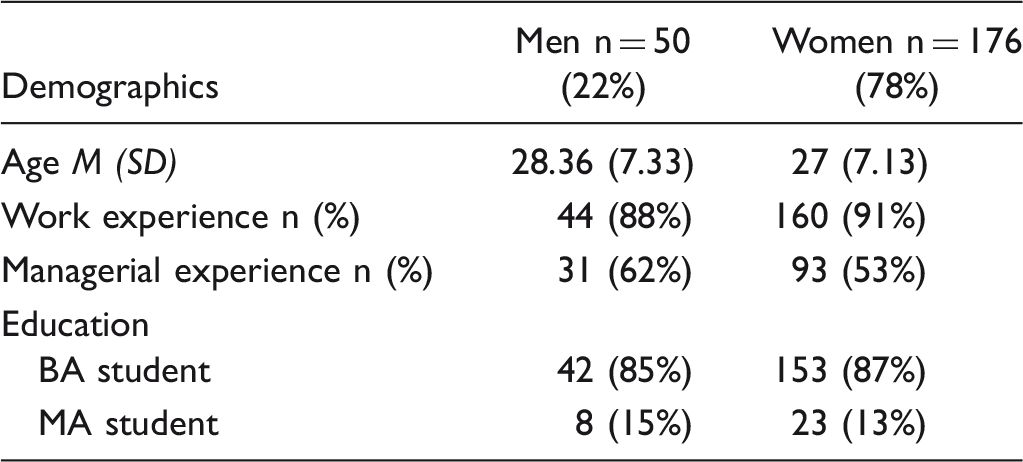
Note: Three participants (two women and one man) did not indicate their academic degree status.
Procedure and measures
The participants signed up for a study examining “issues regarding workplaces.” An experimenter explained that the study would involve reading a short text and answering questions, and that the participants were expected to give honest answers representing their actual feelings and thoughts. After completing the measures, all participants were debriefed. The study used the two scenarios presented in the pilot study, with four items in each.
Manipulation checks and help-giving items
All the participants read the two scenarios. After reading each, the participants were asked to indicate the domain of employment, the gender of the two employees, and which one of them needed help. Subsequently, four help-giving items were presented: two each representing autonomy- and dependency-oriented help. One dependency-oriented help item from Scenario 1 and two dependency-oriented help items from Scenario 2 were reformulated so that the words “on behalf” and “implement” were included (the initial items attained relatively lower acknowledgment in the pilot study as help-giving behavior; 52%–63%) as follows: “The colleague will call the customer in order to highlight the benefits of the new software graphic features” (Scenario 1) was reformulated as “Assaf/Keren will call the customer on behalf of Gilad/Galit in order highlight the benefits of the new software graphic features”; “The colleague will design an improved version of the new toy for Yael and Hillel” and “The colleague will provide Yael and Hillel with some design ideas successfully used in the past” (Scenario 2) were reformulated as “Hillel/Noa will design an improved version of the new toy on a behalf of Roy/Galit” and “Hillel/Noa will enable Roy/Galit to implement some design ideas that he/she successfully applied in the past.”
For each of the four items in each of the two scenarios, the participants were asked to rate—on a 1 (not likely at all) to 5 (very likely) Likert scale—the probability that the potential help giver would provide either autonomy- or dependency-oriented help to the employee in need (the potential help recipient).
Results
Manipulation checks
All participants correctly identified the employees' gender and state of need.
Dependent measures
The analyses were 2 × 2 analyses of variance with participants' gender as a covariate ANCOVA. Note that we made no specific hypotheses regarding the influence of the participants’ gender. Rather we expected that following socially internalized gender stereotypes, both male and female participants would express similar judgments of help-giving behavior. Therefore, we followed a previous study on the influences of the other person’s status on preferences of dependency- and autonomy-oriented help where the participants’ own status was entered as a covariate (Nadler & Chernyak-Hai, 2014) and entered participants’ gender as a covariate in both Study 1 and Study 2. Further support for both genders' adherence to the same-gender stereotypes in the context of helping relations was obtained in a recent study (Chernyak-Hai et al., 2017).
Spearman’s r correlations were computed between the pairs of dependency/autonomy-oriented items. Since the correlations were relatively low (autonomy items: r = .38, p < .01 in Scenario 1 and r = .41, p < .01 in Scenario 2; dependency items: r = .19, p < .01 in Scenario 1 and r = .13, p < .01 in Scenario 2), we decided to examine each help-giving behavior item as a separate dependent variable.
Scenario 1
Autonomy-oriented help
(a) “Teaching a simple design program”: The analysis revealed a nearly significant main effect of help-giver’s gender, F(1, 222) = 3.70, p = .05, η2 = .09, indicating that contrary to Hypothesis 2, participants believed that this type of help would be given more by a male than by a female helper (M = 3.18; SD = 1.22 and M = 2.86; SD = 1.23, respectively). The main effect of help-recipient’s gender was non-significant, F(1, 222) = .73, p = .39.
Further, a significant Genderhelp giver × Genderhelp recipient interaction was found, F(1, 222) = 7.07, p = .01, η2 = .30. Simple effects analysis indicated that contrary to Hypothesis 3, in the case of a male help giver, the participants thought that more autonomy-oriented help would be given to a woman than to a man, F(222) = 2.30, p = .05, d = .48 (M = 3.51; SD = 1.09 and M = 2.94; SD = 1.27, respectively), while there were non-significant differences in the case of a female help giver, F(222) = 1.31, p = .70, d = .23 (M = 2.70; SD = 1.26 and M = 2.98; SD = 1.19, respectively).
(b) “Instructing how to present the new software graphic features”: The analysis revealed a significant main effect of help-giver’s gender, F(1, 222) = 4.34, p = .04, η2 = .42, again indicating that participants believed that this type of help would be given more by a male than by a female helper (M = 3.75; SD = 1.04 and M = 3.38; SD = 1.19, respectively). The effect of help-recipient’s gender was non-significant, F(1, 222) = .43, p = .51, as was the Genderhelp giver × Genderhelp recipient interaction, F(1, 222) = .08, p = .75.
Dependency-oriented help
(a) “Call the customer”: The analysis did not reveal significant main effects of help-giver’s gender, F(1, 222) = .07, p = .79, or of help-recipient’s gender, F(1, 222) = .03, p = 86. The Genderhelp giver × Genderhelp recipient interaction was also non-significant, F(1, 222) = .43, p = .41.
(b) “Designing a marketing newsletter”: The analysis did not reveal significant main effects of help-giver’s gender, F(1, 222) = .18, p = .73, or of help-recipient’s gender, F(1, 222) = .78, p = .38. The Gender help giver × Gender help recipient interaction was also non-significant, F(1, 222) = .13, p = .68.
Scenario 2
Autonomy-oriented help
(a) “Teach tricks”: The analysis did not reveal significant main effect of help-giver’s gender, F(1, 222) = 2.30, p = .13, or of help-recipient’s gender, F(1, 222) = 2.08, p = .15. Yet, a nearly significant Genderhelp giver × Genderhelp recipient interaction was obtained, F(1, 222) = 3.25, p = .07, η2 = .22. Simple effects analysis indicated that contrary to Hypothesis 3, in the case of a male help giver, the participants thought that more autonomy-oriented help would be given to a woman than to a man in need, F(222) = 2.65, p = .40, d = 3.96 (M = 4.28; SD = .16 and M = 3.54; SD = .21, respectively), while there were non-significant differences in the case of a female help giver, F(222) = .07, p = .80, d = .11 (M = 3.52; SD = .28 and M = 3.55; SD = .28).
(b) “Propose brainstorming”: The analysis revealed a nearly significant main effect of help-recipient’s gender, F(1, 222) = 3.41, p = .07, η2 = .20, indicating again that participants believed that this type of help would be given more to a woman than to a man in need (M = 4.15; SD = .82 and M = 3.86; SD = .73, respectively). The main effect of help-giver’s gender was non-significant, F(1, 222) = .01, p = .99. Further, a significant Genderhelp giver × Genderhelp recipient interaction was found, F(1, 222) = 7.70, p = .01, η2 = .30. Simple effects analysis indicated that in the case of a male help giver, the participants thought that more autonomy-oriented help would be given to woman than to man, F(222) = 3.10, p = .01, d = 1.61 (M = 4.39; SD = .61 and M = 3.67; SD = .17, respectively), while there were non-significant differences in the case of a female help giver, F(222) = .62, p = .68, d = .94 (M = 3.95; SD = .19 and M = 4.10; SD = .12).
Dependency-oriented help
(a) “Design an improved version of the new toy”: The analysis did not reveal significant main effects of help-giver’s gender, F(1, 222) = .12, p = .73, or of help-recipient’s gender, F(1, 222) = .78, p = .38. The Genderhelp giver × Genderhelp recipient interaction was also non-significant, F(1, 222) = .91, p = .43.
Study 1: Judgements of type of help likely to be given by a male or female employee to a male or female colleague.

Note: The responses were given on a Likert scale of 1 to 5, with higher scores indicating greater judgments of the probability that the potential help giver would provide either type of help. Bold indicates mean scores where significant differences were found.
Discussion
Study 1 examined which types of help would be believed most likely to be given by a male or female employee to a male or female colleague. In both scenarios, non-significant results were obtained with dependency-oriented help items (Hypotheses 1 and 2). The results obtained with autonomy-oriented items were contrary to our predictions. Three out of four items of autonomy-oriented help yielded a Genderhelp giver × Genderhelp recipient interaction, indicating that contrary to Hypothesis 3, men were expected to give women more autonomy- rather than dependency-oriented help.
These findings may have important implications for understanding inter-gender helping relations in workplaces. Following recent research on help-giving relations as status and power relations (e.g., Nadler, 2002; Nadler & Halabi, 2006; Nadler et al., 2009), and research on gender stereotypes (e.g., Eagly & Karau, 2002; Eagly & Sczesny, 2009; Heilman & Chen, 2005; Rand et al., 2016), we predicted that women would be expected to be given dependency-oriented help and men would be expected to give women such help to retain their social advantage. Yet, the present findings indicate expectations for autonomy-oriented helping. Moreover, since these results were obtained also for female participants, we assume that they do not imply hidden agendas. Rather, it may be that contrary to our predictions, women's social dependency stereotype does not result in dependency-oriented helping in the context of inter-gender workplace helping relations but in paternalistic help reminiscent of “teacher-student” relations. Accordingly, a review of the autonomy-oriented items that yielded significant results indicates that help-giving behaviors consisting of “teaching,” “instructing,” and “proposing brainstorming” were those expected of men in general and of men helping women in particular. We elaborate on this point further in the General Discussion section.
An additional question examined in the present research was what types of help women and men would prefer to receive. Accordingly, Study 2 aimed to examine participants' preferences when receiving help from male or female helpers.
Study 2
Study 2 examined participants' preferences to receive autonomy- versus dependency-oriented help from male or female colleagues.
Method
Participants
Study 2: Participants demographics (N = 170).
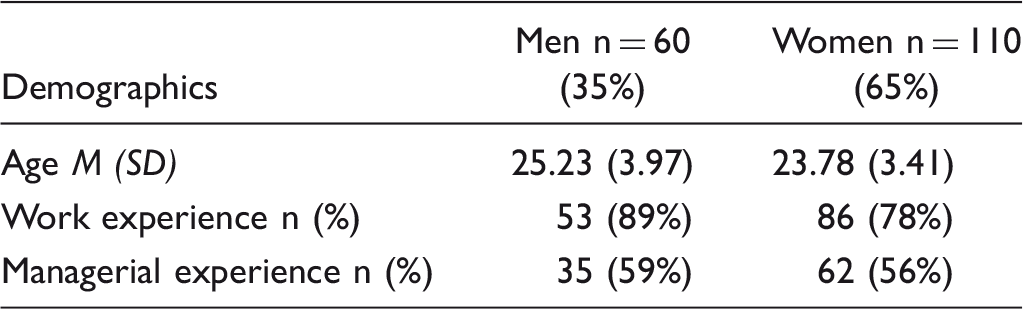
Note: One male participant did not indicate his academic degree status.
Procedure and measures
The participants signed up for a study examining “issues regarding workplaces.” A female experimenter explained that the study would involve reading a short text and answering questions, and that the participants were expected to give honest answers representing their actual feelings and thoughts. After completing the measures, all participants were debriefed.
Scenarios
The two scenarios used in Study 1 were also the scenarios presented in Study 2, with the difference that the participants were asked to imagine themselves working in the company (company specializing in accountancy software development in Scenario 1, and company specializing in toy manufacturing and marketing in Scenario 2) and ask help from a colleague. Following the manipulation on the gender of the described help giver, half of the participants were asked to assume receiving help from a female helper and the other half were asked to assume receiving help from a male helper (the participants were equally and randomly assigned to the two experimental conditions).
Manipulation checks and help-giving items
Following the reading of each scenario, the participants were asked to indicate the domain of employment and gender of the help giver. Next, four help-giving items were presented, two each representing autonomy- and dependency-oriented help. The items following the scenarios were similar to those used in Study 1, this time addressing help the participants would like to receive on a 1 (definitely not) to 7 (definitely) Likert scale.
Results
Manipulation checks
All participants correctly identified the domain of employment and the gender of the help giver.
Dependent measures
The analyses were 2 (participant/help-receiver’s gender)× 2 (help-giver’s gender) analyses of ANOVA’s variance.
Scenario 1
Autonomy-oriented help
(a) “Teaching a simple design program”: The analysis revealed a significant main effect of participants' gender, F(1, 165) = 4.04, p< .05, η2 = .09, showing that in line with Hypothesis 4, women, more than men, indicated that they would rather receive this type of help (M = 3.85; SD = .95 and M = 3.52; SD = 1.19, respectively). The main effect of help-giver’s gender was non-significant, F(1, 165) = .25, p = .62. The Genderhelp recipient× Genderhelp giver interaction was also non-significant, F(1, 165) = 2.40, p = .12.
(b) “Instructing how to present the new software graphic features”: The analysis did not reveal significant main effects of the participant's gender, F(1, 165) = 1.5, p = .22, or the help-giver’s gender, F(1, 165) = .36, p = .55, nor a significant Genderhelp recipient× Gender help giver interaction, F(1, 165) = .75, p = .39.
Dependency-oriented help
(a) “Call the customer”: The analysis did not reveal any significant main effects of the participants' gender, F(1, 165) = .46, p = .50, or the help-giver’s gender, F(1, 165) = .94, p = .33, nor a significant Genderhelp recipient× Gender help giver interaction, F(1, 165) = .09, p = .76.
(b) “Designing a marketing newsletter”: The analysis revealed a marginally significant effect of participants' gender, F(1, 165) = 3.10, p = .08, η2 = .02, implying that contrary to Hypothesis 4, men preferred to receive this type of help more than women (M = 2.71; SD = 1.52 and M = 2.33; SD = 1.28, respectively). There were non-significant effects of the help-giver’s gender, F(1, 165) = 2.15, p = .14, nor a significant Genderhelp recipient× Genderhelp giver interaction, F(1, 165) = 2.65, p = .10.
Scenario 2
Autonomy-oriented help
(a) “Teach tricks”: The analysis did not reveal any significant main effects of participant’s gender, F(1, 165) = .09, p = .76, or help-giver’s gender, F(1, 165) = .72, p = .40, nor a significant Genderhelp recipient × Gender help giver interaction, F(1, 165) = 1.78, p = .18.
(b) “Propose brainstorming”: The analysis did not reveal any significant main effects of participant's gender, F(1, 165) = 1.89, p = .17, or help-giver’s gender, F(1, 165) = .11, p = .74, nor a significant Genderhelp recipient × Gender help giver interaction, F(1, 165) = .02, p = .90.
Dependency-oriented help
(a) “Design an improved version of the new toy”: The analysis did not reveal any significant main effects of participant's gender, F(1, 165) = 1.60, p = .21, or help-giver’s gender, F(1, 165) = 2.15, p = .14, nor a significant Genderhelp recipient × Genderhelp giver interaction, F(1, 165) = 2.65, p = .10.
Study 2: Preferred type of help to be received from male or female colleague by male and female respondents.
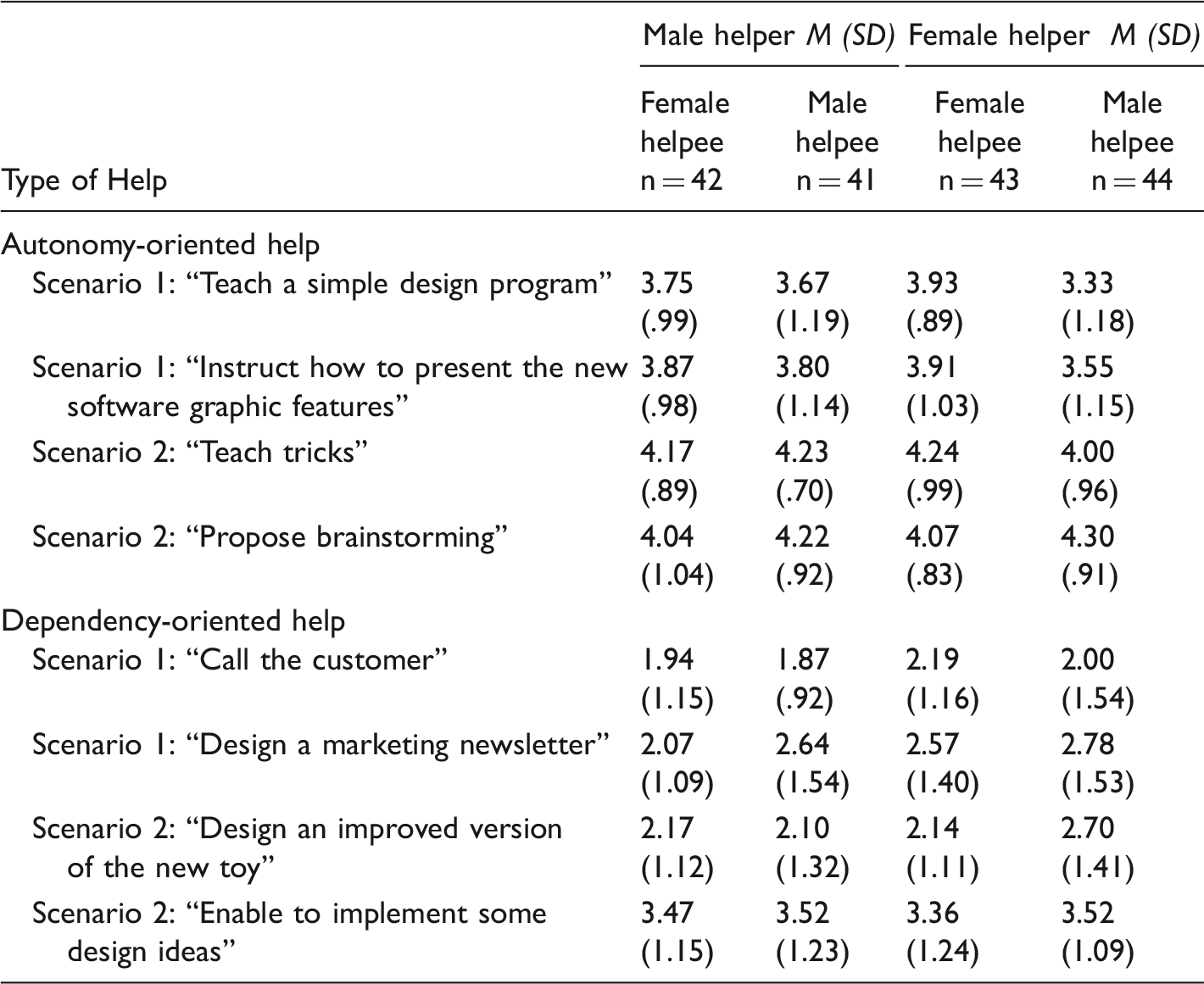
Note: The responses were given on a Likert scale of 1 to 7, with higher scores indicating greater preference of each type of help to be received from male or female colleague.
Discussion
Study 2 examined men and women's preferences of receiving autonomy- and dependency-oriented help from a male or female colleague. Our prediction that both women and men would prefer autonomy-oriented help, independently of help-giver's gender, was partly supported. The hypothesis that readiness to receive dependency-oriented help would be lower in the case of an opposite-gender help giver was not supported.
In line with Hypothesis 4, the results indicate that women, but not men, showed greater readiness to receive autonomy-oriented help, specifically to learn how to solve a problem (Scenario 1). However, contrary to Hypothesis 5, we did not obtain similar results for female participants with other descriptions of autonomy-oriented helping, or with dependency-oriented items. In contrast, we found that men stated they would like to have the help giver design a marketing newsletter on their behalf, i.e., dependency-oriented help (Scenario 1). It may be that this specific type of help was perceived as less threatening to the receiver’s autonomy relatively to other dependency-oriented items, such as “call the customer,” “designing an improved version of the new toy,” or “enable to implement some design ideas”—all clearly implying taking part in the work task directly on behalf of the help recipient. Yet, future research is needed to explore further the differences in the interpretations of different versions of dependency-oriented help items.
General Discussion
The present research sought to examine the perceptions of specific types of help believed to be given by men and women in different organizational contexts to their female and male colleagues. In addition, we examined readiness to receive the same types of help under same- and opposite-gender workplace helping relations. Overall, our hypotheses were partly supported with some unexpected findings.
Specifically, contrary to the predictions based on the notion of power and status relations as attained and maintained by providing dependency-oriented help (e.g., Chernyak-Hai et al., 2014; Nadler, 2015b), Study 1 indicated that participants did not perceive significant differences in the prevalence of dependency-oriented help giving between employees of the same or different gender. On the other hand, the results indicated higher expectations of autonomy-oriented helping by men, especially to their female colleagues. We interpreted these unexpected findings by suggesting that in the workplace context, status and power relations may be attained via helping that indicates the help-giver's professional maturity and expertise. Such help includes acts of teaching and instructing, which were conceptualized in our research as autonomy-oriented helping. Accordingly, a review of the autonomy-oriented items that yielded significant results indicates that help-giving behaviors consisting of “teaching,” “instructing,” and “proposing brainstorming” were those expected of men in general and of men helping women in particular. It may be that in the context of daily workplace relations between colleagues where the help givers do not perceive a concrete threat to their employment position (e.g., no implication of competition for promotion), employees signal privileged social status by a form of help that exhibits the help-giver’s professional maturity and expertise (i.e., autonomy-oriented help). Assuming that men are perceived to have privileged status compared to women, people expect men but not women to give this type of help.
A complementary explanation would be that people perceive autonomy-oriented help in workplaces as “more” help compared to dependency-oriented help. The reason for that may be the understanding that employees giving help invest the time and energy to teach their colleagues rather than just give them a solution. In such a case, even though men are expected to give their female colleagues help that promotes autonomous coping (and may even raise women's employment status), this still implies men's higher prestige. In other words, the present-day organizational context may involve a paradox whereby one's high social status is not necessarily projected by giving others solutions but by teaching them to deal with their predicament. Accordingly, future research would benefit from exploring the amount of help that employees associate with descriptions of the two types of help and how autonomy- and dependency-oriented help givers are perceived by their colleagues.
The findings should also be interpreted in light of the participants’ age. The age ranges in the two studies were 20–55 and 20–40, respectively, representing mostly Millennials. These tend to prefer high autonomy: They seek challenging tasks and want to gain knowledge by working with others (Meier & Crocker, 2010). Millennials are also described as narcissistic and individualistic, confident in their future, motivated, goal-oriented and assertive (VanMeter, Grisaffe, Chonko, & Roberts, 2013), and have relatively more psychological career resources (Coetzee, Ferreira, & Shunmugum, 2017). Therefore, it could be speculated that contrary to more mature individuals, Millennials would primarily view the help to be given in the workplace as autonomy oriented. Indeed, in Study 1, participants expected men to give women more autonomy- than dependency-oriented help, while in Study 2, we found partial support for both women and men preferring autonomy-oriented help (independently of the help-giver's gender).
Furthermore, considering the respondents' young age, another way of interpreting the results is by way of different internalized gender norms of workplace behavior. Two possibilities may be suggested here. First, it may be that in the modern workplace, men are aware of the negative image of explicit paternalistic behaviors toward women (e.g., exhibiting “benevolent sexism”; Glick & Fiske, 1996) and therefore avoid displaying them; Barreto and Ellemers (2005) addressed such political correctness as a form of modern sexism. Second, following the fear of being labeled discriminative, men may prefer to refrain from helping their female coworkers even when such help is necessary. When they do decide to help, their help decisions may not follow the nature of the predicament but their willingness to give help in a way which does not suggest that women are dependent on external assistance. Thus, further research is required to explore these explanations by directly accounting for generational differences.
In addition to judgments of help giving between employees, Study 2 examined participants' readiness to receive help from female and male colleagues. Past research suggests that women tend to avoid seeking help when the help receiving context brings into awareness the stereotype that they are socially dependent (Wakefield et al., 2012). Accordingly, and in line with our predictions, in the present research, women preferred receiving help that implied independent coping. Note, however, that this result was obtained only for the “teaching” item but not for the “instructing” or “mutual brainstorming” items. Following the notion of social independence inherent in autonomous helping, it may be that “instructing” or “brainstorming” were perceived as less indicative of promoting autonomous coping compared to “teaching.” To explore this possibility, future research should examine more thoroughly the perceived differences among various autonomy- and dependency-oriented helping acts.
Unexpectedly, the results indicated higher preferences to receive dependency-oriented help among men, yet only on a single item in one of the two scenarios. It seems that future research is needed to examine further men and women's willingness to receive dependency-oriented help in workplace contexts. As proposed in Study 1’s Discussion section, it may be that some forms of dependency-oriented helping are less threatening of social status relatively to other acts of dependency-oriented help that more clearly imply providing a complete solution. Yet, as noted and similarly to Study 1, there were no additional significant results with dependency-oriented findings. The latter is important, as recent studies have emphasized the functions of dependency-oriented helping in both interpersonal and intergroup relations (e.g., Chernyak-Hai et al., 2014; Nadler & Chernyak-Hai, 2014; Nadler & Halabi, 2006; Nadler et al., 2009). Nevertheless, to the best of our knowledge, no past research has explored autonomy- and dependency-oriented helping in organizations.
It is also possible that the workplace context, which consists of professional norms and expectations as well as a greater emphasis on results, has additional implications for helping behavior. In other words, a possible explanation for the non-significant findings on dependency-oriented helping when assuming either giving or receiving help may be that in organizations such help is generally unexpected, if not inappropriate. One reason is that such help implies doubting another's expertise, especially when the help giver has different qualifications. Another, as suggested earlier, may be the political correctness. A third is pragmatic thinking focused on organizational efficiency that leads to help preferences that promote other employees' knowledge and independent coping.
Finally, it could be argued that the distinction between autonomy- and dependency-oriented help might be irrelevant to organizational contexts and future work should focus on the amount of help as a dependent variable. Yet, the present research did not indicate the same results for both types of help. Overall, the proposed explanations represent directions for future studies that would compare actual help-giving/-receiving behavior among employees with the same or a different expertise, measure employees' perceptions of what is required for successful organizational functioning, and compare these perceptions in various organizational contexts. Specifically, some types of organizational environments may be less or more representative of the findings in our research. For instance, the results may be more significant in organizational cultures that cultivate autonomy-oriented helping behavior than in others that discourage it. Organizations dominated by women may encourage more dependency-oriented help behaviors. Similarly, political and especially military organizations may encourage giving women more dependency- than autonomy-oriented help.
In sum, the present findings paint a complex picture of inter-gender helping expectations in organizations. Female employees, representative of relatively lower social status, seem to believe that they would prefer help that provides them with tools to solve the problem, potentially promoting their future independence when encountering a similar predicament. On the other hand, we also found that male employees are expected to give such type of help, especially to their female colleagues. Future studies are needed in order to explore further the psychological mechanisms that account for these expectations as well as for insignificant findings on dependency-oriented helping. Specifically, note that the overall percentage of female participants in the two studies was higher than the percentage of male participants (78% in Study 1 and 65% in Study 2). Although we predicted that following socially internalized gender stereotypes, men and women would show similar judgments of expected help-giving behavior, future research should include a more balanced gender representation.
Finally, the participants were asked to address workplace situations although all were higher education students. While most had some work experience (90% in Study 1 and 82% in Study 2), and many indicated managerial experience (55% in Study 1 and 57% in Study 2), we assumed their answers to be reliable indicators for exploring workplace help relations perceptions. Yet, future research may benefit from replicating the studies with employed individuals only, preferably more experienced than the present samples and asking them about their actual work experiences rather than about fictional scenarios.
Implications
The present research has several theoretical and practical implications.
We started our work by conducting a pilot study examining what types of specific helping behaviors would be recognized as autonomy- and dependency-oriented help in the workplace context, rather than assuming this categorization. These perceptions next served to examine preferences for each type of help in inter-gender organizational interactions, addressing the prevalent assumption that women are perceived as socially dependent (e.g., Sarlet et al., 2012; Wakefield et al., 2012).
Although sociopsychological research in the past decade explored the functions of the two types of help (e.g., Chernyak-Hai et al., 2017; Halabi et al., 2008; Nadler, Harpaz-Gorodeisky, & Ben-David, 2009), to the best of our knowledge, no previous studies examined giving and receiving autonomy- and dependency-oriented help in organizations. The latter is also apparent in organizational research, where helping and receiving help are typically acknowledged as part of prosocial organizational behavior or OCB (e.g., Srivastava & Saldanha, 2008). Yet, this conceptualization overlooks some help-giving acts. While both types of help are prosocial and have the potential to contribute to organizational efficacy and productivity, their orientations may also have important implications for creating and maintaining workplace power and status discrepancies. Whereas past research indicated the role of dependency-oriented help in upholding such discrepancies in broader social contexts (e.g., Chernyak-Hai et al., 2014; Nadler 2015a, 2015b), the present work points to a possibility of giving—intentionally or not but with potentially the same result—”politically correct” autonomy-oriented help to women in organizational context. While helping behaviors in organizations can enhance retention, behaviors that promote or do not address unequal gender relations may lead to lower retention rates of women.
Despite the fact that according to the results of Study 2, women themselves prefer to receive this type of help, such help may not be truly motivated by willingness to promote their independence and even result in the opposite, as long as it implies help-givers' professionalism. Moreover, the present findings raise an interesting question: Can helping construed as “much help” (and thus as undermining the perceived qualifications of the help recipient) be essentially inconsistent with OCB? That is, we should be aware of the possibility that certain helping acts do not advance organizational goals and are incompatible with citizenship behavior (e.g., Kark & Waismel-Manor, 2005). Accordingly, we should consider the role of such help in promoting employees' independent development, a prevalent aspiration of modern organizations (e.g., Davenport, 2013; Meier & Crocker, 2010).
Another, more general issue, is whether in the long run, organizations should endorse employees' independence at the expense of solving their immediate predicaments and whether autonomy-oriented help meets this aspiration. These general issues have even more important implications when there is a double standard for the employees, dictated by their sociodemographic characteristics. As long as workplace help-giving and -receiving decisions are influenced by sociodemographic characteristics of the two parties in helping interactions, we may not speak of these relations as OCB per se, but seek to understand their effects on the workplace relationships and environment beyond the need to maximize productivity.
Empirical implications and recommended best practices.
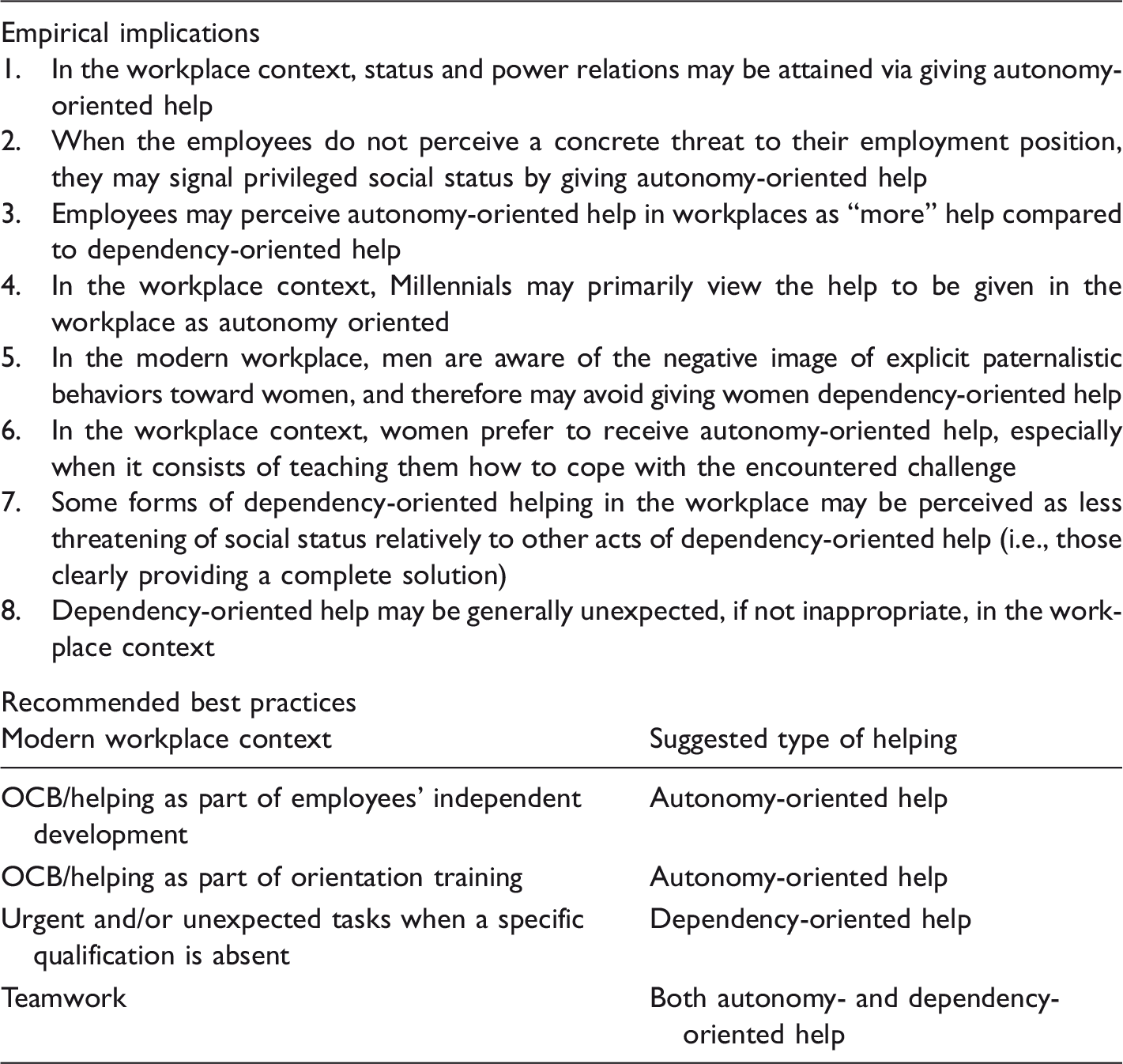
While underscoring the importance of processes underlying workplace help-giving behaviors, our findings indicate that organizations should be aware of employees' personal characteristics that may facilitate the offering of a specific kind of help, in this case—gender.