







Abstract
Extant literature links higher levels of resilience to overall well-being; however, the underlying mechanisms explaining this relation are unclear. Replicating and extending the study of Mak, Ng, and Wong, the present study investigated the “positive cognitive triad” of hope, world-view, and self-esteem as a possible mediator between resilience and well-being for the first time in an American sample. Participants (n = 198) completed online surveys of self-esteem, hope, view of the world, and resilience. Consistent with expectations, the triad was a significant mediator of the relation between resilience and well-being. These findings underscore the importance of developing interventions targeting the positive cognitive triad and examining the triad within the context of mental illness. Limitations and areas for future research are discussed.
Introduction
Resilience can be defined as the ability to face and recover from adversity (Steinhardt & Dolbier, 2008). Research on stress and resilience in adults suggests that individuals with higher levels of resilience perceive difficult situations as within their ability to cope and rely on positive adaptive behaviors in the face of negative events (Avey, Wernsing, & Mhatre, 2011; Burns, Anstey, & Windsor, 2011). Resilience has been negatively associated with stress and positively related to a person’s well-being. Through different pathways, including optimism, positive self-image, increased positive affect, and decreased negative affect, resilience leads to increased feelings of psychological and subjective well-being (Avey et al., 2011; Burns et al., 2011; Burton, Pakenham, & Brown, 2010). Resilience is linked to reductions in stress and even stress prevention. Resilience appears to cultivate other positive factors and emotions that lead to increased overall well-being (Lai & Mak, 2009; Steinhardt & Dolbier, 2008). Resilience allows people not only to reduce the negative outcomes resulting from stress but also potentially prevent those consequences from occurring in the first place. Buffering against these negative effects allows people not just to bounce back but also to flourish when facing distressing conditions (Peterson, 2006).
To clarify the relationship between resilience and well-being, research has shifted to examining the factors mediating the two constructs. Mak, Ng, and Wong (2011) proposed a positive cognitive triad, composed of positive views about oneself, one’s world, and the future, to help explain this link. These authors conceptualized hope as a representation of the positive view of the future and self-esteem as a positive view of the self (Mak et al., 2011). They reported positive correlations between resilience and the aspects of the positive cognitive triad represented through self-esteem or view of the self, hope or view of the future, and view of the world. Resilience and well-being were then mediated by this positive cognitive triad. Although Mak et al.’s (2011) study clarifies the possible mechanisms that mediate resilience and well-being, the study included a participant sample of graduate and undergraduate students in Hong Kong, thus whether the positive triad mediates the relation between stress and well-being in other samples is unknown. Indeed, researchers focusing on cross-cultural differences recommend “casting a wider net” beyond the usual variables compared across cultures (e.g., individualism vs. collectivism; Saucier et al., 2015). As such, this study aims to test Mak et al.’s study in a United States sample.
Although there has been little research on the positive cognitive triad as a set of beliefs, existing literature appears to support relationships between each individual construct, resilience, and well-being. Findings support a positive correlation between levels of resilience and self-esteem (Amstadter, Moscati, Maes, Myers, & Kendler, 2016; Benetti & Kambouropoulos, 2006; Davey, Eaker, & Walters, 2003). Resilience may help individuals cope with stress and adversity and lead to increased self-esteem, and positive self-concept may be a protective factor in children and adolescents (Tugade, Fredrickson, & Barrett, 2004; Werner, 1995). High self-esteem also appears to be strongly correlated with happiness and negatively correlated with depression (Diener & Diener, 1995; Dumont & Provost, 1999). Though high levels of self-esteem are also linked to negative outcomes like narcissism, it has been proposed that cultivating this construct alongside other positive factors may help to promote positive outcomes, including well-being (Baumeister, Campbell, Krueger, & Vohs, 2003). Thus, higher levels of self-esteem may be one factor that results from resilience and leads to a greater sense of well-being.
In addition, research suggests that individuals who are more resilient also have a more positive outlook on life (Buikstra et al., 2010; Jacelon, 1997; Parr, Montgomery, & DeBell, 1998). Greene, Galambos, and Lee (2003) suggest that for children to develop resilience, they must first develop a sense that the world is a good place. A positive outlook also appears to be related to maintenance of resilience throughout adulthood (Greene et al., 2003). Based upon these findings, a positive outlook on life seems to be an essential component of building resilience, and resilience continues to foster a positive view of the world. Resilient individuals may also attempt to place themselves in positive and healthier contexts due to this positive outlook, which then increases their opportunities for success and well-being (Masten, 2001). Other studies have supported the finding that a positive evaluation of life and positive world assumptions are related to well-being (Feist, Bodner, Jacobs, Miles, & Tan, 1995; Ryff, 1995). Thus, a positive outlook may be a link between resilience and well-being.
There also appears to be a connection between resilience and a positive view of the future, or a sense of hope. Resilient adolescents appear to have higher levels of hope, which are in turn associated with better outcomes when encountering stressors (Short & Russell-Mayhew, 2009; Snyder, 2002). The extant literature suggests that hope is related to positive psychological adjustment, the ability to cope with negative life events in an adaptive manner, and overall life satisfaction (Bailey, Eng, Frisch, & Snyder; 2007; Snyder, 2002; Visser, Loess, Jeglic, & Hirsch, 2013). In both younger and older populations, hope is linked to several facets of well-being, indicating that an individual’s positive view of the future may influence overall well-being. Resilient individuals may have a more positive, or hopeful, view of the future. This in turn may help them when coping with stressors and lead to a greater sense of well-being.
The current study provides a closer look at the positive cognitive triad in the context of resilience and well-being, building upon the initial findings of Mak et al. (2011). The initial study utilized a sample of individuals from Hong Kong. Considering cross-cultural differences in values and beliefs (Guo & Hanley, 2015), it is essential to examine whether these relationships remain significant when examined in an American sample. Moreover, previous studies tend to examine cross-cultural mean differences; however, the current study aims to replicate the mediation model in a different cultural sample. Therefore, in an effort to examine the underlying mechanisms at work in the link between resilience and well-being, this study is designed to assess the relation between the two concepts and test the mediating role of the three components of the positive cognitive triad in a sample of graduate students in the United States.
Method
Participants
Participants were current graduate students at a Mid-Atlantic comprehensive Catholic university. Students were recruited from a wide range of graduate programs, including business and management, education, psychology, speech-language pathology, liberal studies, computer science, and software engineering. Valid data were collected from 198 participants (141 women), and the mean age of participants was 30.70 (SD = 8.80). Most participants identified as White (88.4%, n = 175), while 4% identified as African-American (n = 8), 4% identified as Asian or Pacific Islander (n = 8), and 3% as Hispanic (n = 6). With regard to their programs of study, 93.9% of participants were enrolled in a master’s level program (n = 186), 3.5% were enrolled in a doctoral level program (n = 7), and 2.5% identified as students in advanced studies programs, not working toward a degree (n = 5). The majority of participants indicated that they worked full-time (65.7%) and were part-time students (60.1%). Additionally, 44.4% of participants were single (n = 88), while 14.6% were married without children (n = 29), 14.1% were cohabiting (n = 28), 1.5% were divorced (n = 3), and 0.5% were widowed (n = 1).
Materials
Measures were administered online. Demographic questions were presented first, and the well-being questionnaire presented last. All other scales were presented in random order for counterbalancing purposes.
Resilience
Resilience was assessed using the Connor-Davidson Resilience Scale (CD-RISC; Connor & Davidson, 2003). Items are scored on Likert-type response scales, with answers of Not at All True, Rarely True, Sometimes True, Often True, and True Nearly All of the Time. Higher scores indicate higher levels of resilience. Internal consistency is acceptable at .89 (Connor & Davidson, 2003). A comparison of six different resilience scales (Ahern, Kiehl, Sole, & Byers, 2006) revealed that the CD-RISC measures resilience in terms of stress-coping ability, as opposed to other measures, which examine protective factors that can lead to resilience or measures that classify resilience specifically as a personality characteristic. For this reason, the CD-RISC was chosen as the measure of resilience in this study. The widespread use of this scale, as well as its translation into other languages, speaks to its validity (Ahern et al., 2006; Connor & Davidson, 2003; Karairmak, 2010; Yu et al., 2011). Cronbach’s alpha internal consistency was .90 in the current study.
Rosenberg Self-Esteem Scale
The Rosenberg Self-Esteem Scale was used to assess beliefs about the self, with higher scores reflecting higher self-esteem (Rosenberg, 1989). Overall, the Rosenberg Self-Esteem Scale is a measure with sound psychometric properties for both adults and adolescents (Dobson, Goudy, Keith, & Powers, 1989; Robins, Hendin, & Trzesniewski, 2001). It is one of the most widely used self-esteem scales. In the current study, Cronbach’s alpha was .89.
View of the World Scale
This construct was assessed using the View of the World Scale (Beckham, Leber, Watkins, Boyer, & Cook, 1986). The scale is a sub-section of the larger Cognitive Triad Inventory. Content validity and convergent validity were assessed and found to be satisfactory (Beckham et al., 1986). Internal consistency for this subscale is acceptable (α = .79) (Anderson & Skidmore, 1995). Items are scored on a Likert-type scale, with answers ranging from 1 (totally agree) to 7 (totally disagree). Lower scores indicate a more positive view. In this study, all negatively worded items were reverse coded, such that higher scores indicated more positive views of the world. Cronbach’s alpha for this sample was .77.
State Hope Scale
The State Hope Scale assesses positive views of the future, specifically measuring hope. It is grounded in the theory that hope is made up of two different factors: pathway and agency (Snyder et al., 1996). The State Hope Scale self-report measure is composed of six items, which are measured using an eight-point Likert-type scale following a continuum from Definitely False to Definitely True. Higher total scores indicate greater hope. Snyder et al. (1996) found results supporting convergent validity, and additional studies by the same authors yielded high internal reliability and convergent validity of the scale items. In this sample, Cronbach’s alpha was .88.
Satisfaction With Life Scale
Well-being was assessed via the Satisfaction With Life Scale (Diener, Emmons, Larsen, & Griffin, 1985). The scale is a five-item self-report measure that uses a seven-point Likert-type scale. Higher scores indicate greater well-being. The scale has been used in various populations and translated into several languages and is positively related to other measures of well-being, speaking to this scale’s convergent validity (Pavot & Diener, 1993). An investigation of temporal stability yielded a correlation of .54 over 4 years (Pavot & Diener, 1993). In the current sample, Cronbach’s alpha was .87.
Procedures
Department chairs or administrators were contacted and asked to distribute an e-mail invitation to participate in the study to current graduate students. The e-mail invitation explained the nature and purpose of the study and provided information about informed consent. Interested students followed a link at the end of the e-mail message as indication of consent to participate. At the end of the survey, participants were directed to a separate, unconnected, website where they could enter to win a $50 gift card to Amazon.com. The study was reviewed and approved by the onsite Human Subjects Review Board.
Results
Correlations among study variables.
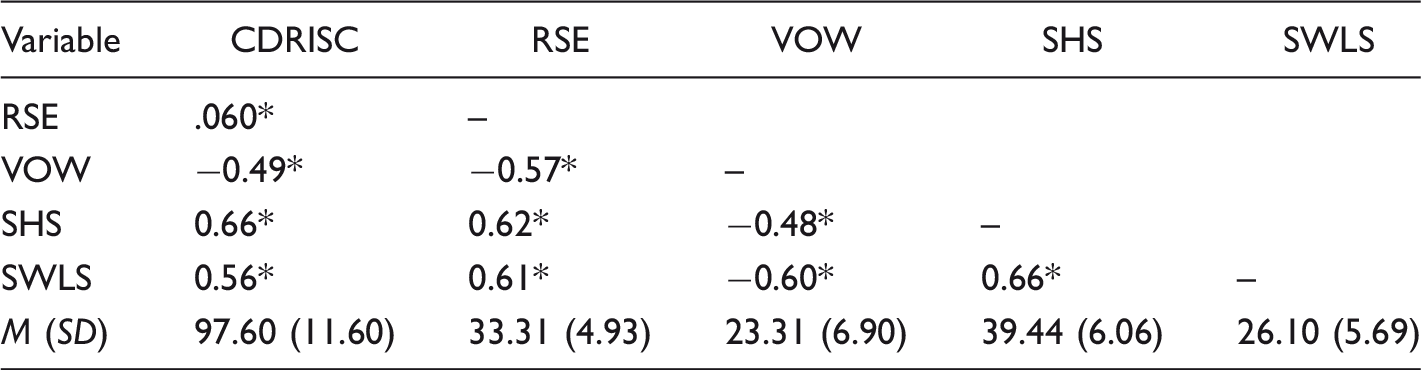
Note: CDRISC: Connor-Davidson resilience scale; RSE: Rosenberg self-esteem scale; VOW: view of the world subscale; SHS: state hope scale; SWLS: satisfaction with life scale.
*p < .001.
Since both resilience and well-being were not normally distributed, non-parametric bootstrapping analyses, based upon 10,000 samples, were used to test this mediational model ((Preacher & Hayes, 2004). In this analysis, well-being is the dependent variable, and the three constructs within the positive cognitive triad were mediators. The unstandardized coefficients for all the paths in this model appear in Figure 1. The total R2 for prediction of well-being from resilience and all three constructs was .55, and the overall model was significant, F(4, 170) = 51.5, p < .001. Significance tests from the complete model and each of the mediated effects of resilience on well-being were obtained using estimation methods and bootstrapped estimates for confidence intervals as described in Preacher and Hayes (2004, 2008). Using these analyses, mediation is considered significant if, for the indirect effect, the 95% bias corrected and accelerated confidence intervals do not include zero.
Visual depiction of the mediational model. The standardized regression coefficient between resilience and well-being when controlling for all constructs in the triad is in parentheses. *p < .001.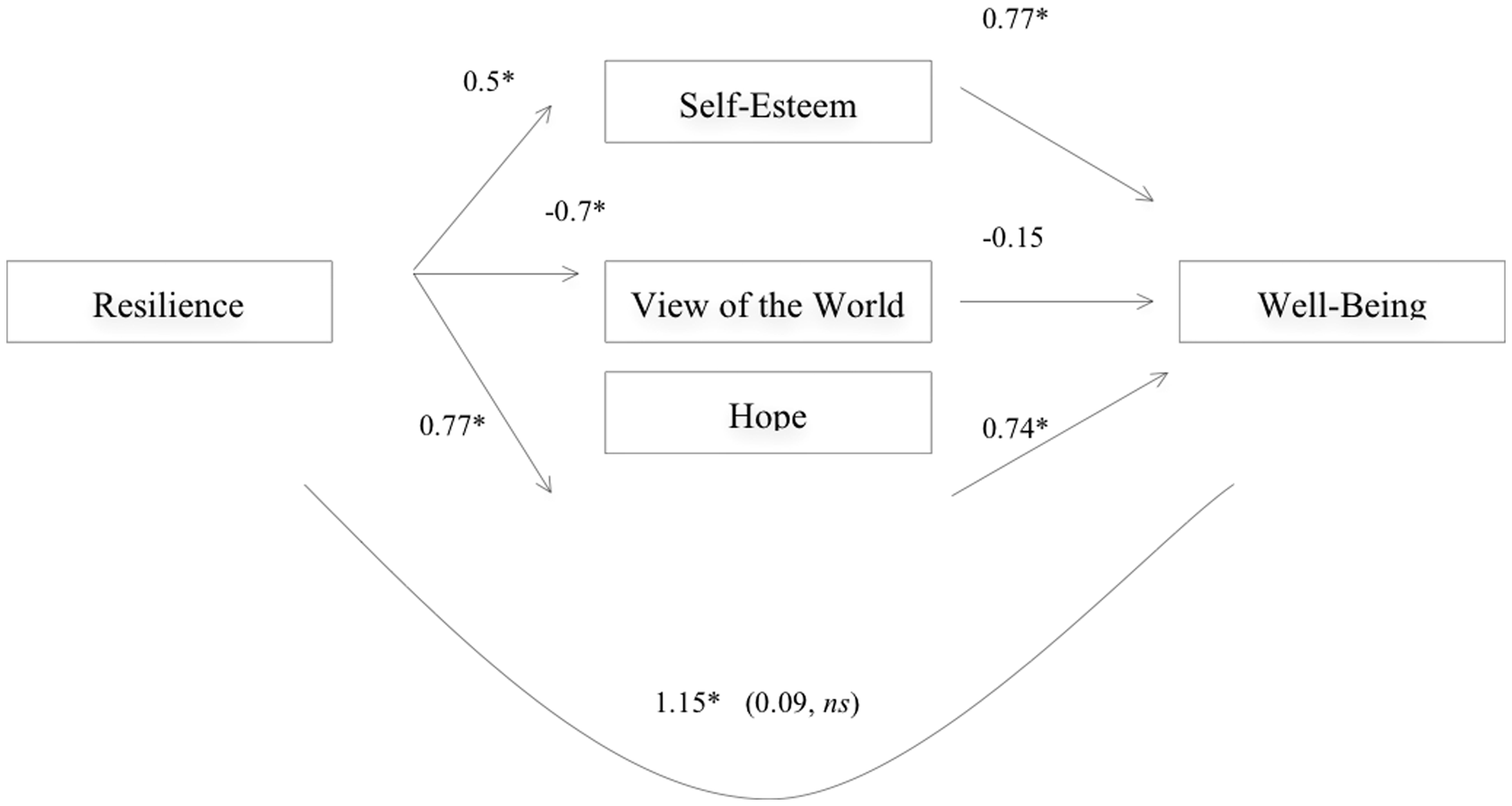
The total effect of resilience on well-being, not controlling for the positive cognitive triad, was 1.15 (t = 9.24, p < .001). The direct effect of resilience on well-being when controlling for mediation by the three constructs was .09 (t = .561, p > .05). Thus, when all three variables in the positive cognitive triad were entered, they fully mediated the relation between resilience and well-being, 95% CI (.75, 1.41). Because zero does not fall into the confidence interval, the total indirect effect is significant, (point estimate = 1.06, SE = .145, Z = 7.35, p < .001).
The mediated effect of resilience on well-being through self-esteem was estimated at .385, and this indirect effect was statistically significant using the normal theory based test (z = 4.09, p < .001). In addition, the 95% confidence interval obtained for this value by bootstrapping did not include 0 (CI = .203, .629). The mediated effect of resilience on well-being through hope was also significant (.568, z = 4.69, p < .001; CI = .265, .872). However, the mediated path through view of the world was not significant (.109, z = 1.31, p > .05; CI = − .056, .270).
Discussion
The primary goal of this study was to further explore a proposed pathway between resilience and well-being. This pathway was composed of three components: view of the self, view of the world, and view of the future, which together make up the positive cognitive triad. The current study extended prior findings across cultures to an American population. Our results indicate that resilience and well-being are positively associated in an American sample and support the hypothesis that the relationship between these constructs is mediated by the positive cognitive triad.
These results are consistent with past literature that shows links between each of the three positive cognitive triad constructs, resilience, and well-being. While the results of the current study provide evidence of the correlation between resilience and self-esteem, correlational research allows for the possibility of different directional paths. As such, resilience might lead to self-esteem, and building resilience may help build self-esteem. The resulting increase in positive feelings about the self might then lead to increased well-being, even within a high stress environment. As noted earlier, building self-esteem alone may result in negative outcomes. It is possible that when high self-esteem is combined with other positive factors, this combination may be what leads to well-being. This may be an explanation for the significance of the overall model, with all three predictors entered together.
Hope may be one such positive factor that, when combined with self-esteem, links resilience and well-being. The results of the current study provide some evidence for this. In line with prior research, resilience appears to play a role in the development of future orientation, and individuals with higher levels of resilience have a more positive orientation to the future, or are more hopeful (Seginer, 2008). If more resilient individuals are also more hopeful, then they may have a better sense of goal-directed energy and a better sense of planning to meet those goals (Snyder et al., 1996). These factors may help individuals feel more confident in their own abilities to cope with stressful situations and become better at planning for successful outcomes. Anticipating ways to achieve goals and feel secure about oneself and one’s abilities then may help when facing both major and minor stressors.
Surprisingly, our results indicate that a more positive view of the world does not account for a significant portion of the relationship between resilience and well-being. This result is inconsistent with previous literature, which suggests that a sense that the world is a good place may be a prerequisite for developing resilience (Greene et al., 2003). Being resilient may connect with individuals’ ability to view the world overall in a positive light, despite difficult circumstances or stressful situations. However, it might be that a positive view of the world alone is insufficient for individuals to allow for effective coping in difficult situations. The interaction between a positive view of the world and other constructs that are more closely linked to the individual, such as self-esteem, might be required to impact an individual’s well-being. This may explain why the overall model is significant when all three mediators are entered.
Future directions
Results of the current study have implications for both research and clinical practice. Considering the tested model’s significance when all three factors were entered, positive evaluations of oneself, one’s life, and one’s future may all be encompassed under a common viewpoint, termed positive orientation (Alessandri, Caprara, & Tisak, 2012; Caprara, Steca, Alessandri, Abela, & McWhinnie, 2010). A positive orientation may lead to greater resilience, which in turn affects an individual’s well-being. If these constructs are all indicators of positive orientation, this may speak to a cognitive component of this psychological orientation. Considering the current significant findings, future research could examine not only the individual cognitive pathways leading to resilience and well-being but also relationships between these underlying constructs.
Additionally, while resilience-building interventions exist, the information gained from this study may help improve and guide future interventions. Knowledge of these factors can help address cognitive components of resilience building, such as changing existing cognitive schema and restructuring negative thoughts. Interventions utilizing a more general positive cognitive style have been tested, and more specific information about the cognitive factors that increase resilience could help to improve these initial attempts (Shatkin et al., 2016). The importance of these cognitive components in the relationship between resilience and well-being highlights the necessity of addressing negative, unhelpful, or ineffective patterns of thinking. Working to improve each of these psychological constructs could lead to a sense of well-being signified by more than a simple lack of illness. The results of this study can also be used to promote a focus on strengths, moving away from a deficit-based model, and to examine why some individuals are naturally more prone to positive cognitions and how to help individuals who are not.
Limitations
The authors acknowledge several limitations to this study. The sample obtained for the study was relatively homogenous, with most participants indicating they were females and identifying as White. Also, most participants were enrolled in master’s degree programs and were working full-time. Accordingly, these results may not be valid for a more general population. Additionally, the use of a correlational design does not allow for a test of causal paths among the original variables, resilience and well-being, nor between the variables involved in mediation. Consequently, our results cannot speak to causality.
In conclusion, the results of the current study extend earlier findings by Mak et al. (2011), which suggest that higher resilience is related to increased well-being and that this relation exists through the presence of a triad of constructs: high self-esteem, a positive view of the world, and a high sense of hope. The significant findings warrant further research to better understand the relations among these five variables, as well as to explore how these results could relate to other developmental factors, to mental illness, and its treatment.