







Abstract
In this study, 60 university students were selected as research participants based on the Chinese Student Adjustment Scale. Participants were divided into two groups: high level of social adjustment and low level of social adjustment. Then using the Go/No-go Association Task as the implicit association experimental paradigm, implicit emotions were evaluated by having participants respond to different facial expressions as quickly as possible. The group of participants with higher levels of social adjustment performed better when responding to self-concepts with positive facial expressions, compared to responding to non-self-concepts with either positive or negative facial expressions. Thus, they showed an implicit preference for processing information about self with positive emotions. The group of participants with lower levels of social adjustment did not show the same benefit when responding to self-concepts. Instead, they performed better when responding to other-related concepts with different facial expressions, irrespective of the emotional content. Thus, they manifested an implicit preference for processing information about others with different emotions, suggesting a deficiency in processing their own emotions. In addition, the results validated the objectivity of the Chinese Student Adjustment Scale as an assessment tool.
Keywords
Introduction
University students are in the late stage of puberty. They have a deeper understanding of the society compared to secondary and primary school students. Their self-understanding is more complex, and they have certain experiences in understanding the contradictions between ideals and reality, as well as between individuals and society (Yu, 2005). However, their self-regulation and self-control are not fully developed, and they often lack accurate judgment in facing different complex social phenomena (Thibodeaux, Deutsch, Kitsantas, & Winsler, 2017). They need to face reselection of values and rebuilding of personality. They also face enormous pressures related to social selection and possible social elimination (Mei, Chai, Li, & Wang, 2017; Pedersen, Swenberger, & Moes, 2017; Tupler, Hong, Gibori, Blitchington, & Krishnan, 2015).
How university students deal with this challenging stage of life and its pressures depends on a combination of factors, including conceptions of self and a variety of socioeconomic factors—family, neighborhood, academia, and so forth. Specifically, several studies have described how social demands can contribute to a student's emotional well-being and their subsequent success in life (Lightsey, Maxwell, Nash, Rarey, & McKinney, 2011; Yang, 2002; Tao, 2015). But a university student's emotional well-being and subsequent success is also influenced by their self-concept and how they envision themselves in new situations. For example, students who consistently envision themselves as having success in new situations, especially social situations, tend to experience positive emotions (Lightsey et al., 2011). In contrast, students who consistently envision themselves as having difficulty in new situations tend to experience negative emotions. And such pessimism can contribute to a variety of psychological disorders (Henriksen, Ranøyen, Indredavik, & Stenseng, 2017; Sheldon, 2010; Yang & Lu, 2007; Xin, Zhang, & He, 2012).
Thus, emotional well-being helps students adapt to surrounding environments and plays an important role in social adjustment (Tully, Lincoln, & Hooker, 2012; Samson, Huber, & Gross, 2012). Its regulation is also important and plays a role in a person's adjustment throughout life (Meng, 2005). Surveys of university students found that the higher the ability of emotion regulation, the stronger the level of social adjustment (Jiao, 2008), and the lower the ability for emotion recognition, the higher the level of social maladjustment (Zhao et al., 2013).
As the core of personality, self-concept influences the way individuals see themselves. Individuals with positive self-concept have a correct understanding of their own strengths and weaknesses and are more capable of adapting to unfamiliar environments. Previous studies of various groups have shown that self-concept plays a significant role in positively predicting the social adaptability of individuals (Wang, 2010; Xie, 2014, 2017; Xue, 2012). Moreover, there is always an automatic association between self-concept and positive emotions due to a positive bias effect (Mezulis, Abramson, Hyde, & Hankin, 2004; Pahl & Eiser, 2005). The positive bias effect is widely reflected by individuals with a healthy self-concept and strong social adaptability compared to individuals with a negative self-concept and weak social adaptability (Watson, Dritschel, Jentzsch, & Obonsawin, 2008).
Many of the studies that addressed the emotional well-being of university students have used surveys and focused on the explicit concepts, structures, and features related to social-adjustment (Fang, Wo, & Lin, 2003; Huo & Yang, 2009; Jiang & Xu, 2010; Song, Yang, & Chi, 2010; Wu, 2014; Zou & Fan, 2013). But over the past 30 years, many researchers have argued that survey results are not always trustworthy because participants can respond in overly favorable ways (Wenger & Brown, 2014). Thus, implicit strategies are becoming more and more prominent. The environment can only exert effects on social adjustment through internalized and perhaps unconscious mechanisms (Yang, 2010; Wang, 2016). And one of these internalized mechanisms is the recognition of facial expressions. Thus, evaluating how a person responds to various facial expressions can be an objective and very useful measure for studying emotions (Ge, Zhong, & Luo, 2017).
With the development of cognitive neuroscience, research on emotions has expanded from the level of consciousness to the level of unconsciousness. The study of implicit emotion, which contrasts with the study of explicit emotion, has gained more attention and development. Implicit emotion has also become a new focal point in the study of emotions. Implicit emotion, in simple terms, refers to a kind of emotional state which leads to a change in individual experience, thought or behavior, and this emotional state is subliminally unconscious, and the individual is not aware of it (Kihlstrom, 1999). A series of studies conducted by Chinese and foreign scholars has confirmed the existence of implicit emotions and the activation of the corresponding processing regions in the brain (Denkova, Botzung, Scheiber, & Manning, 2006; Tamir, John, Srivastava, & Gross, 2007; Liu & Wang, 2000; Winkielman, Berridge, & Wilbarger, 2005; Scheuerecker et al., 2007; Zhang, Chen, & Sang, 2009).
The American psychologists Greenwald and Banaji (1995) have pioneered a new research field, referred to as implicit social cognition. The implicit association test (IAT) is a popular methodology developed by Greenwald and Banaji. The IAT can often reveal the unconscious elements involved in the processing of conscious social cognition, and it has initiated further research in the field of implicit studies, including the rapid development of the study of implicit emotion (Greenwald & Banaji, 1995). The IAT uses reaction time as an indicator to measure the degree to which two types of words (target category word and attribute word) are automatically linked via a computerized classification task (Greenwald, McGhee, & Schwarz, 1998; Greenwald, Nosek, & Banaji, 2003). It can measure the implicit attitude and feeling of individuals towards a certain thing or behavior, such as drug addiction based on the consistency of an attitude, feeling, or behavior. And in the same way, it can measure the degree of connection between individuals and joy or anxiety based on corresponding consistency. The target category in the first case includes specific things and behaviors, while the target category in the second case includes “self” and “non-self.”
Despite its popularity, the IAT has been challenged. Fielder, Messner, and Bluemke (2006) argued that experimental results are not always trustworthy because participants can alter their responses with conscious effort, interpreting results is not reliable, and its theoretical support is weak. In a comprehensive review, Nosek, Greenwald, and Banaji (2007) provide counterarguments but also acknowledge that the IAT is limited. Its methodology tends to be sensitive, so researchers must be careful in how the IAT is used and how results are interpreted. Also, several researchers have been critical of the validity of the IAT, especially in predicting corresponding behavior (Blanton et al., 2009; Oswald, Mitchell, Blanton, Jaccard, & Tetlock, 2013). But several recent studies have provided support for the IAT's validity in a variety of domains using children participants (Rae & Olson, 2018), evaluating college participants in laboratory settings (Glashouwer & Smulders, 2013), evaluating personality traits (Dentale, Vecchione, & Barbaranelli, 2016), and evaluating depressive tendencies (Dentale et al., 2016).
Perhaps the IAT's primary limitation, and one that Nosek et al. (2007) acknowledge, is that it always requires a belief about some category to be evaluated in comparison to another category. For example, an attitude toward any racial group must be evaluated in comparison to another racial group. Thus, researchers can never be sure if the results indicate more implicit negativity to one group or more favorability toward the other. Two corrective paradigms are the Extrinsic Affective Simon Task and the task used in the current experiment, the GNAT—Go/No-go Association Task (Nosek et al., 2007; Zhang & Zhang, 2009; Zhang et al., 2009).
The primary advantage of the GNAT is it allows researchers to evaluate implicit attitudes for a single category by itself (Nosek & Banaji, 2001). Participants simply need to respond affirmatively (Go) whenever a target word fits an appropriate category or not respond (No go) whenever the target does not fit. This allows the GNAT to be more flexible than the IAT. Many studies have demonstrated its effectiveness and supported its reliability and validity (Ge, Zhang, & Hu, 2014; Rudolph, Schröder-Abé, Schütz, Gregg, & Sedikides, 2008; Williams & Kaufmann, 2012). Furthermore, a recent study has demonstrated a connection between a person's implicit self-esteem and the underlying neural activity related to emotions (Izuma, Kennedy, Fitzjohn, Sedikides, & Shibata, 2018).
In summary, university students often face complex social environments, and if they cannot readily adjust to corresponding expectations or requirements, they will probably experience explicit emotional problems and perhaps psychological disorders. However, changes in their implicit emotion still need to be explored. Therefore, this study adopted the GNAT, a variant of the IAT, to evaluate the processing of implicit emotions using university students with different levels of social adjustment. As a secondary purpose, this study also evaluated the validity of an explicit assessment tool called the “Chinese Students Adjustment Scale” (CSAS).
Methods
Participants
One hundred ten participants of all Year 1 to Year 4 Chinese university students were recruited for this study. The CSAS was used as the selection measure. It consists of 60 questions with responses given via 5-point rating scales, “1 = completely disagree to 5 = completely agree.” Thus, overall scores can range between 60 and 300. The higher the score, the stronger the level of social adjustment. The internal consistency coefficient of the questionnaire was 0.930, and the retest reliability was 0.996 (Fang et al., 2003).
For participants in this study, the range in scores was between 70 and 270. Using a psychometric procedure to assess item difficulty (Aiken & Groth-Marnat, 2005), the top 27% of the respondents were grouped under high level of social adjustment (score range was between 70 and 125), while the bottom 27% of the respondents were grouped under low level of social adjustment (score range was between 205 and 270). Thirty students were selected as participants in each group. In total, 30 male participants and 30 female participants were selected, with 14 males and 16 females classified in the higher score group and 16 males and 14 females in the lower score group. There was no statistical significance between the two groups in terms of gender composition (Fisher's exact test, p > .05). All participants had normal vision or corrected vision, were physically fit, and had never participated in any study related to implicit emotion. An independent-samples t-test showed that there was a significant difference in the adjustment levels of the two experimental groups (t = 3.73, p < .01), and this confirmed that the method of division of the two groups was effective. The study was conducted in accordance with the Declaration of Helsinki and was approved by the Ethics Committee of Chongqing University of Arts and Sciences.
Research method
This study adopted the GNAT as the research method. It is a variant to the IAT used to measure implicit social cognition by evaluating the target category and bipolar attribute categories to reflect implicit preferences (Nosek & Banaji, 2001). This study also used a classical indicator in emotion studies—identifying different facial emotions via pictures—as a research method. The GNAT uses the principle of signal detection theory, asking participants to respond (Go) to the experimental target stimulus (signal), and not to respond (No-Go) to any distraction stimulus (noise). When the signal appears, a response made by participants would be counted as a hit. If no response is made by the participants, data would be omitted. When noise appears, the response made by participants would be counted as a false hit, while no reaction would be counted as a confirmed hit. The hit rate and the false hit rate are then converted into Z-scores. The difference between the two Z-scores is the discrimination index d′, which indicates the ability to distinguish signal from noise. If the value is less than 0, this indicates that participants could not distinguish signal from noise. If the value is greater than 0, it means that participants can identify signal from noise, and it reflects their implicit preference for certain emotions.
Research purpose and design
Procedures for the GNAT.
Note: GNAT: Go/No-go Association Task.
Experimental materials
A total of 20 pictures (10 males and 10 females) showing different emotions (positive and negative) were selected from the Chinese Facial Affective Picture System as the experimental attribute category (Bai et al., 2005). The target category consisted of either the words to describe self or words to describe non-self (also others). Words to describe self included I, my, me, mine, myself, oneself, my own, one's own, self, and owner; non-self words included he, his, him, herself, they, them, theirs, themselves, others, and outsider. There were 20 such words. The E-prime professional software was then used to carry out programming according to the requirements of the IAT.
Experimental procedures
Preparation and pre-test
During the study, the experimental rooms were kept quiet. Individual experiments were conducted in tiny, soundproofed rooms. Experimental contents were displayed on a 19-inch flat panel monitor. The screen refresh rate was 85 Hz and the resolution of the screen was 1,024 × 758 pixels. After participants were introduced to the basic task, they were asked to always respond as quickly as possible by pressing appropriate computer keys as stated on the computer's monitor.
Four university students were selected randomly to conduct a pre-test to make sure all procedures were working appropriately.
Experimental stage
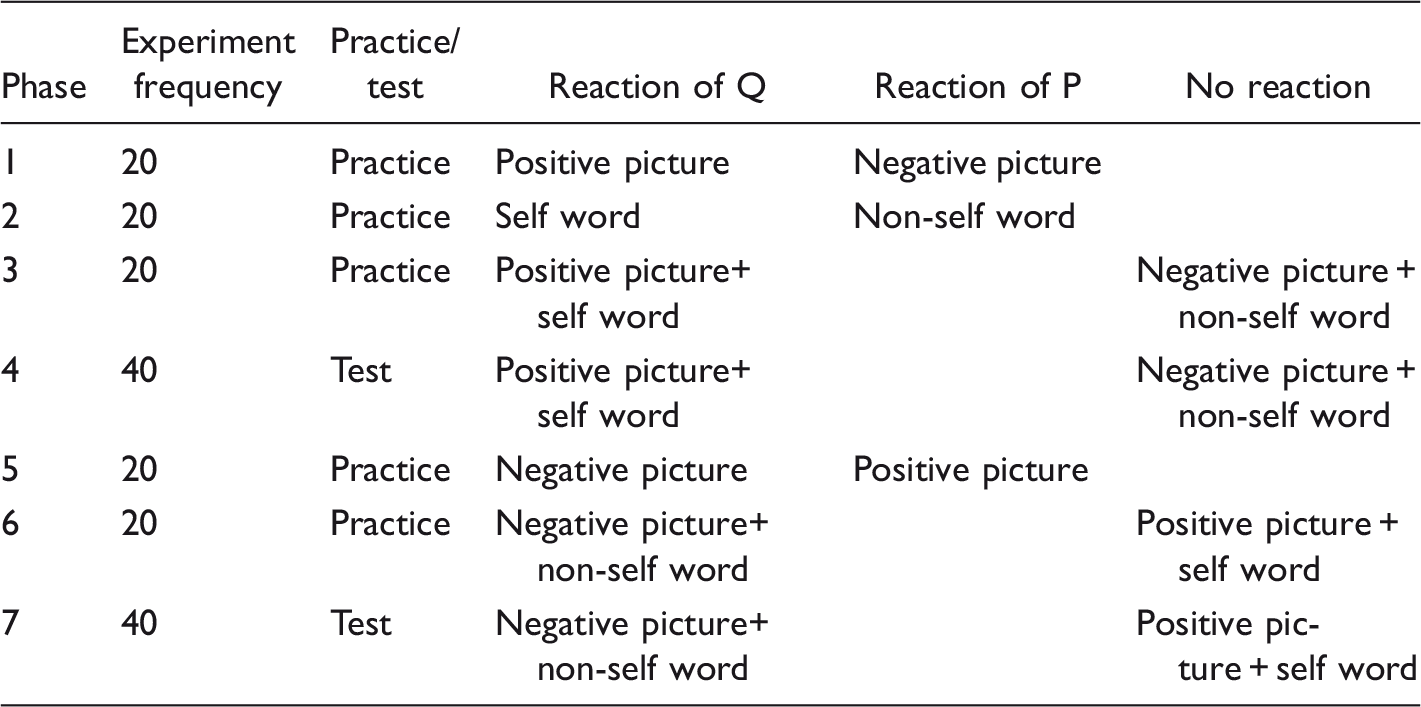
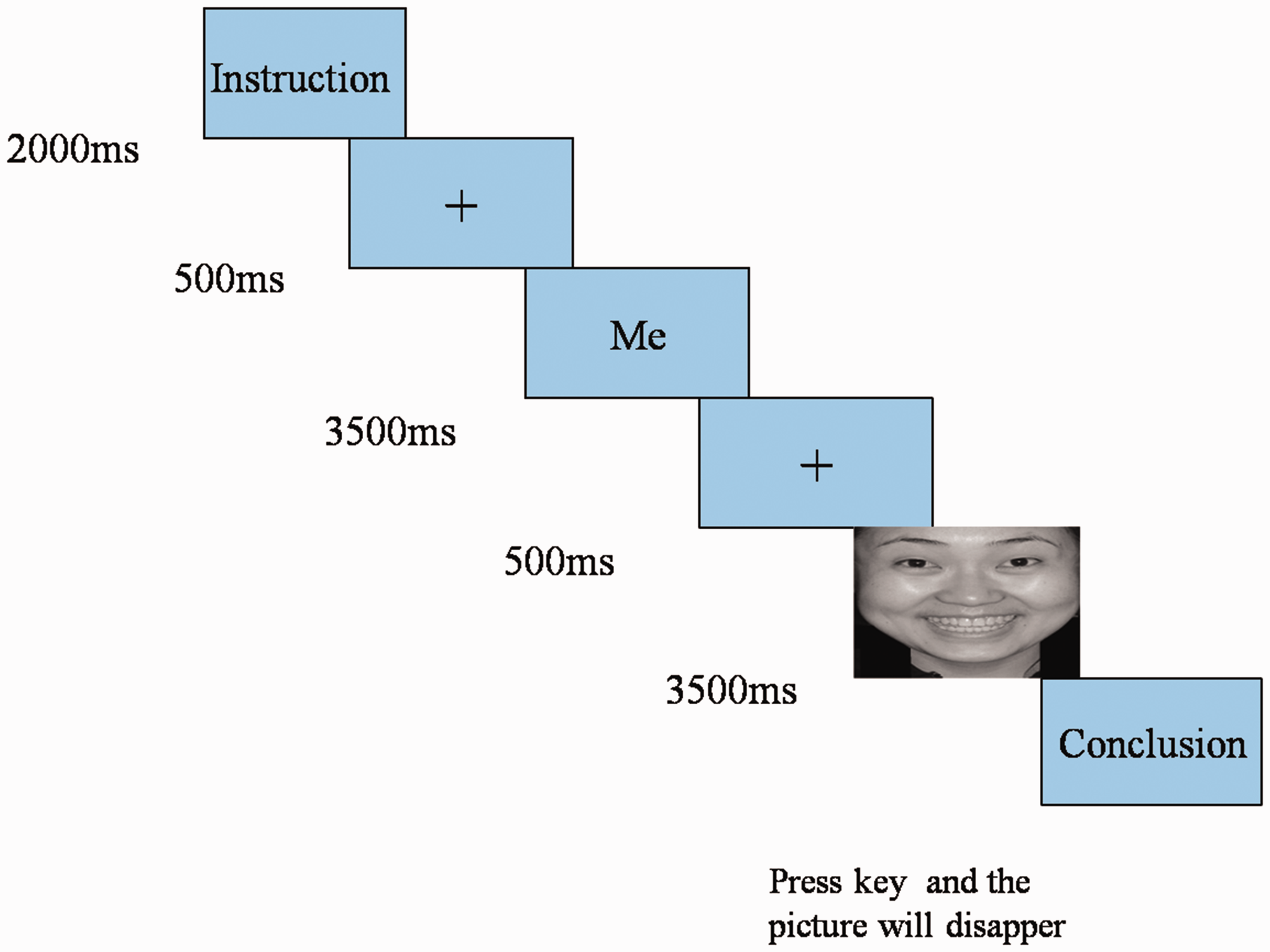
The basic version of the IAT contains seven phases as shown in Table 1. Phases 4 and 7 represent the test phases, and each of those phases contains 40 trials. All other phases represent practice phases, and they contain 20 trials for each. Figure 1 shows a flow chart for the steps involved in each trial. Here are the corresponding phases for the current GNAT experiment:
Formal experiment flow chart.
Data processing
According to the recommended method for processing GNAT data (Nosek & Banaji, 2001), Emerge was used to combine the data, and SPSS16.0 was used to analyze the data. G*Power3.1.6 was applied to the effect size and the statistical power analysis. Unnecessary data were deleted, leaving only the data from correct responses during Phases 4 and 7. The correct number of responses and incorrect number of responses of each participant for different stimuli in Phases 4 and 7 were counted to obtain the reaction matrix for the test phases. The detection signal d′ was obtained by the following method. Finally, comparisons of values of d′ for Phases 4 and 7 were calculated.
Analysis of the two matrices: Self-positive d′ and non-self-negative d′ were obtained from Phase 4. The method to obtain self-positive d′ was the number of false hits equaled the number of incorrect responses (self + negative), while the number of hits equaled the number of correct responses (self + positive). Both values were then divided by 40 to calculate the false hit rate and hit rate. Then the false hit rate and hit rate were converted to Z-scores, with Z-scores of hits—Z-score of false hits = self-positive d′. The method to obtain non-self-negative d′ was the number of false hits equaled the number of incorrect responses (non-self + positive), while the number of hits equaled the number of correct responses (non-self + negative). Both values were then divided by 40 to calculate the false hit rate and hit rate. Then the false hit rate and hit rate were converted to Z-scores, with Z-scores of hits − Z-score of false hits = non-self-negative d′. Self-negative d′ and non-self-positive d′ were obtained from Phase 7. First, the number of false hits (self + positive) and number of hits (self + negative) of self-negative d′, as well as the number of false hits (non-self + negative) and number of hits (non-self + positive) of non-self-positive d′ were obtained. Following the calculation in Phase 4, the final values of non-self-negative d′ and non-self-positive d′ could be obtained. A one-way analysis of variance (ANOVA) was conducted to evaluate the differences of the d′ scores among the four experimental test phases for the two groups with different levels of social adjustment.
Results
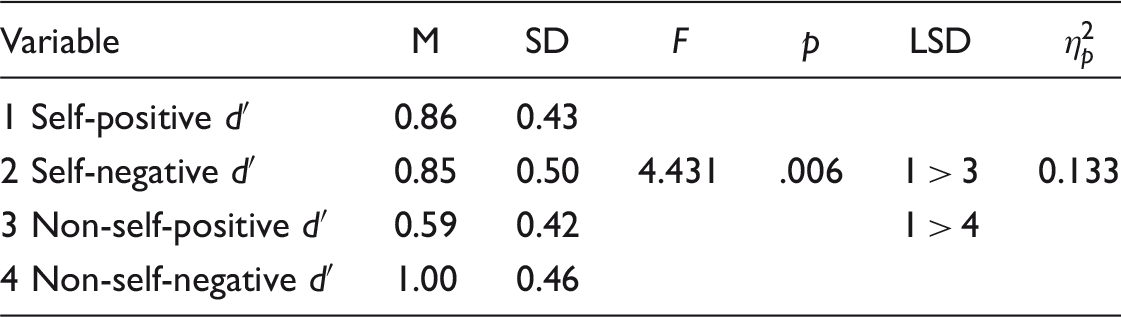
ANOVA results for the group with a higher level of social adjustment.
Note: ANOVA: analysis of variance; LSD: least significant difference.
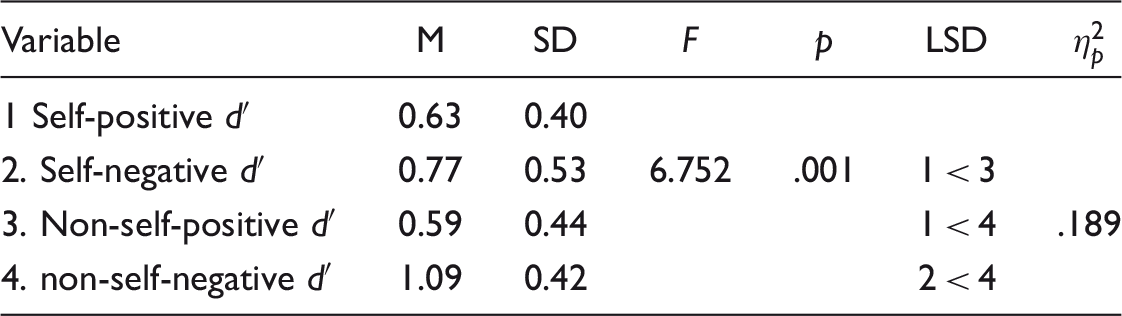
ANOVA results for the group with a lower level of social adjustment.
Note: ANOVA: analysis of variance; LSD: least significant difference.
Discussion
The group of participants with higher levels of social adjustment performed better when responding to self-concepts with positive facial expressions compared to responding to non-self-concepts with either positive or negative facial expressions. Thus, they manifested an implicit preference for processing information about self with positive emotions.
Social adjustment is a positive interaction process between an individual and the external environment. During this process, the individual will continuously access information from the outside world and actively adjust their emotional state (Vispoel, 1995). Social adjustment and self-concept show a significant positive correlation, while a clear self-awareness and self-expression are important predictors of good mental health (Lightsey et al., 2011; Yao, 2003a, 2003b).
Studies have shown that positive emotions can reduce individuals' psychological vulnerability. Positive emotions can also enable individuals to better cope with stressful life events and increase the capacity to adapt to the environment (Dong et al., 2012). Meanwhile, the positive bias effect is more likely to be reflected by individuals with psychological health and strong social adaptability (Mezulis et al., 2004; Pahl & Eiser, 2005). The implicit emotion preference of the group with a higher level of social adjustment confirms once again the conclusion from the implicit level of conscious awareness.
In contrast, the group of participants with lower levels of social adjustment did not show the same benefit when responding to self-concepts. Instead, they performed better when responding to non-self-concepts with different facial expressions, irrespective of the emotional content. Thus, they manifested a link between non-self and the different types of emotion. This shows that the self-schema of these participants preferentially processed information of non-self-emotions first. The results also show that there was not a significant preference for positive or negative emotions in this group of participants, reflecting a lack of self-emotional processing. Fei (2013) pointed out that individuals under a “structure of grade” of society start from self, before extending out to explore different relationships with others. The self is always more important in the core area. Preferentially processing non-self-information reflects maladaptation to society, and individuals with low self-esteem tend to have more psychological problems (Henriksen et al., 2017; Liu & Shi, 2000).
An emotional self-schema is the summary and characterization of an individual's emotion-related information. It is also the basis of self-awareness and self-evaluation (Izard, 2009). When the self-schema of an individual with low social adjustment is not constructed well, then the individual will be unable to preferentially process self-related emotional information first; on the other hand, this will also cause difficulty in processing and judging emotional information in an in-depth method. This causes an insufficiency in forming a clear point of emotional ability (Shao & Gao, 2009).
There is one additional benefit of the current research. Since the experimental results showed that the difference among the participants with various levels of social adjustment corresponded with the selection criteria of the CSAS, then to some degree, this provides evidence for the validity of the CSAS questionnaire.
Conclusion
Chinese university students with different levels of social adjustment showed different implicit emotional preferences. The group with a higher level of social adjustment preferentially processed information about emotions with self-concepts at the implicit level of awareness. They also manifested an implicit preference for their own positive emotions. The group with a lower level of social adjustment preferentially processed information about different emotions with other-related concepts at the implicit level of awareness. This suggests they had a deficiency in processing their own emotions. In short, the experimental results revealed a consistency between explicit emotions indicated by the CSAS and implicit ones manifested by the GNAT.
Research limitations and future research
There are two considerations from the current study that suggest future research. First, this study was conducted with university students from China, students who experience extraordinary pressures to succeed in academia (Mei et al., 2017). Thus, the results might not generalize to other populations. Second, there are potential moderating variables that were not considered in the current study, variables that might have altered the pattern of results. Variables that seem particularly important to consider are participants' levels of emotional intelligence and their levels of pre-existing anxiety or depressive tendencies.
Footnotes
Acknowledgments
The authors thank the university students as the participants in our work. And the authors appreciate the anonymous reviewers for their thoughtful comments.