







Abstract
This study examines how type of instructor feedback influences cognitive processes conducive to participants’ health behavior, using a new theoretical approach based on self-affirmation and construal level theory. In Study 1, feasibility self-affirmed feedback (FSF) and desirability self-affirmed feedback (DSF) were qualitatively explored with Vinyasa Yoga instructors, and four FSF and DSF feedback scenarios were developed. In Study 2, 55 (FSF group: 28 and DSF group: 27) women in their twenties participating in a Vinyasa Yoga program were randomly assigned to two experimental self-affirmation feedback groups (FSF and DSF) and exposed to FSF and DSF, respectively, for four weeks based on the scenarios developed in Study 1. The analysis of changes in exercise intention triggered by the participants’ exposure to self-affirmation feedback showed that participants exposed to DSF experienced a more positive influence than those exposed to FSF in their continuation intentions of success.
Keywords
Introduction
Studies on the effects of instructor feedback on participants’ health behavior and cognitive processes in sports or exercise have been carried out based on a variety of theoretical concepts such as caring climate (Magyar et al., 2007), motivation climate (Hodge & Gucciardi, 2015), and the hierarchical model of intrinsic and extrinsic motivation (HMIEM) (Vallerand, 2007). Furthermore, positive reinforcement was reported to be a more efficient way to increase behavior than negative reinforcement (Daniels & Daniels, 2004). Positive feedback given to participants by an instructor not only induces desired behavior through positive reinforcement but also increases the likelihood of individuals viewing threatening information more objectively and systematically by helping them reaffirm their own values.
Self-affirmation and health behavior change
Self-affirmation theory posits that people have an innate motivation to maintain self-worth and self-integrity and, when self-integrity is threatened, resort to various actions to reestablish it through self-affirmation (Harris, 2011; Steele, 1988). Earlier studies on self-affirmation revolved around the concepts of defensiveness and relevance. For example, one study showed that heavy smokers are more likely to disregard the message that smoking causes cancer than nonheavy smokers (Berkowitz & Cottingham, 1960). Furthermore, Kunda (1987) reported that participants with higher consumption of caffeine were less likely to link caffeine consumption to breast cancer; A. Liberman and Chaiken (1992) derived similar results.
These studies suggest that when participants with high relevance to a threatening message read the information, their defensiveness is triggered as a means of maintaining a positive self-image, and their agreement with and risk perception of the threatening information are lowered. However, when an individual’s self-image is affirmed by another source, the desire for defensiveness triggered by the threatening information becomes weaker (Steele, 1988). That is, individuals with better-functioning self-affirmation are better able to buffer against perceived threats, mobilize psychological resources that can effectively shield them from threats (Steele, Spencer, & Lynch, 1993), and systematically check threatening information or stimuli for the possibility of acceptance instead of blindingly avoiding it (Correll, Spencer, & Zanna, 2004).
Sherman, Nelson, and Steele (2000) reported that, when presented with a reliable study result that heavy coffee drinkers were more likely to develop breast cancer, participants who completed a self-affirmation exercise were more accepting of the article than the control group. In a study of women with excessive alcohol consumption, participants exposed to self-affirmation were more open to information on the negative health effects of alcohol and showed reduced alcohol dependence (Harris & Napper, 2005). Recent meta-analyses of self-affirmation studies showed a positive influence of self-affirmation on intention and behavior change, with a small or moderate effect size (Epton, Harris, Kane, Van Koningsbruggen, & Sheeran, 2015; Sweeney & Moyer, 2015).
Construal level theory and the cognitive decision process
Construal level theory (CLT), proposed by Trope and Liberman (2003, 2010), predicts and explains human behavior when interpreting events or objects depending on self-perceived psychological distance when receiving a message conveyed by an event or object. CLT divides construal level into high-level construal and low-level construal. High-level construal is an abstract, schematic, and decontextualized representation of the gist of given information. In contrast, low-level construal is a concrete, unstructured, and contextualized representation of the subordinate and incidental features of an object or event (Trope & Liberman, 2010). The key point of this theory is that individuals use high-level construal to represent events with short psychological distance and low-level construal to represent events with long psychological distance; thus, the congruency between psychological distance and construal level has a strong influence on behavior prediction. For instance, if people want to enroll in a fitness center the next day (i.e., proximal psychological distance), they are interested in concrete information associated with low-level construal (e.g., equipment, fees, and trainer); however, without any concrete plan to enroll (i.e., distal psychological distance), they are more interested in abstract information associated with high-level construal (e.g., healthy living).
The main topic of earlier studies on construal level was the congruency between psychological distance of a message and construal level (Liberman & Trope, 1998; Liberman, Trope, McCrea, & Sheman, 2007; Trope & Liberman, 2000). Later studies examined the effects of message appeal (messages with emphasis on desirability or feasibility) on construal level (Kim, Rao, & Lee, 2009; Kim, Zhang, & Li, 2008). These researchers presented messages emphasizing “desirability” or “why” aspects to manipulate individuals toward high-level construal and “feasibility” or “how” aspects to manipulate individuals toward low-level construal. Trope and Liberman (2000) noted that desirability has a great influence on high-level construal through temporal distance manipulation and that feasibility plays an important role with respect to low-level construal.
Associations between FSF or DSF and intention to participate in health-related exercise
Intention is one of the most important predictors of behavior (Ajzen, 1991). Chatzisarantis and Hagger (2008) categorized intentions into continuation intentions of success and continuation intentions of failure. They argued that intention measurement thus far had considered only the decisional phase (motivational), failing to address intentions in the postdecisional phase or postactional phase. Intentions can change depending on whether an individual has achieved or failed to achieve a goal. Thus, continuation intentions of success and continuation intentions of failure may result, reflecting the decisional phase and actional phase of motivation.
Given that continuation intentions of failure begin with the failure to achieve a goal, these intentions can be regarded as reflecting a certain time delay necessary for achieving the goal while continuing to engage in a task. Time delay is a situation that forces a consumer to wait for consumption to occur (Loewenstçein & Prelec, 1993). When faced with a time delay situation, people generally have unpleasant feelings while waiting to purchase a product. However, a time delay situation can sometimes enhance the pleasure of consumption (Chan & Mukhopadhyay, 2010; Nowlis, Mandel, & McCabe, 2004). For instance, when people arrive at a popular restaurant and have to wait for 2–3 hours (a time delay situation), those who think about their expectations of eating delicious satisfying food (high-level construal) will have a more pleasant experience than those who think about the restaurant being outdated, the price of the meal, and the inconvenience of travelling a long distance (low-level construal). In fact, in a previous study on the association between time delay and construal level, participants steered toward high-level construal were found to endure a time delay situation better (Fujita, Henderson, Eng, Trope, & Liberman, 2006). Accordingly, it is expected that the DSF group will show a greater extent of change in continuation intentions of failure than will the FSF group.
A decision to continue exercising even after having reached a goal (e.g., losing weight) may be made because a different goal has been set (e.g., participating in a fitness competition) or because a person has newly discovered the value of exercise (e.g., feelings of pleasure or having fun when exercising). In both cases, when importance is attached to a future-oriented goal and the value of exercise, the exercise intention is closer to a high-level construal than a low-level construal. Recent empirical studies have shown that abstract (or high-level) construal had a more positive effect on future preferences than did the concrete mind-set condition (or low-level construal) (Vilches-Montero & Spence, 2015), and as the tendency to consider future consequences became salient at the abstract construal level, preference for utilitarian foods products also increased (van Beek, Handgraaf, & Antonides, 2017). Therefore, participants’ continuation intentions of success can be enhanced more efficiently by providing them with DSF (emphasizing desirability) compared to FSF (emphasizing feasibility).
Synopsis of the study
In this study, two types of self-affirmation feedback with focus on feasibility and desirability, respectively, are presented to manipulate participants’ construal level. The first type of feedback is about exercise performance and movement, and the second type is positive feedback on personal health and happiness through exercise. In view of CLT, the former is feedback containing feasibility-related self-affirmation information, termed feasibility self-affirmed feedback (FSF) in this study; the latter is feedback containing desirability-related self-affirmation information, termed desirability self-affirmed feedback (DSF). Both FSF and DSF are positive feedback scenarios affirming self-values. Participants continuously exposed to FSF will likely be steered toward low-level construal, while those exposed to DSF are expected to move toward high-level construal. Furthermore, continuation intentions of failure and success will likely be improved to a greater extent in participants exposed to DSF (high-level construal) than those exposed to FSF (low-level construal).
To systematically test this research hypothesis, two substudies were conducted. In Study 1, FSF and DSF relevant to Vinyasa Yoga were formulated; qualitative methodology was employed. In Study 2, the FSF and DSF scenarios developed in Study 1 were empirically applied to investigate the effects of FSF and DSF on participants’ construal levels. To this end, intention to continue, continuation intentions of success, and continuation intentions of failure were measured at baseline and after four-week exposure to FSF and DSF, for comparison and analysis purposes. Five research hypotheses were formulated as follows: Hypothesis 1: There will be no statistically significant differences in the extent of values affirmation between FSF and DSF. Hypothesis 2. FSF and DSF will induce low- and high-level construal, respectively. Hypothesis 3. There will be no statistically significant pre–post differences in the intention to continue depending on self-affirmation feedback. Hypothesis 4. Continuation intentions of success will increase more, or the width of the decrease in continuation intentions of success will be narrower for participants in the DSF group, compared to those in the FSF group. Hypothesis 5. Continuation intentions of failure will increase more, or the width of the decrease in continuation intentions of failure will be narrower for participants in the DSF group, compared to those in the FSF group.
Study 1
Methods
Subjects
In-depth interviews were conducted with four Vinyasa Yoga 1 instructors over one week to formulate FSF and DSF. The interviewees were all women with a mean age of 33.75 (SD = 3.59) years and a mean number of years of experience of 8.25 (SD = 0.96) years. The interviews were recorded after obtaining consent from each interviewee. The interviewees were encouraged to freely relate their experiences. Interviews were conducted in a neutral place (café), and each interview session lasted 1.5 to 2 hours.
Research questions and interview questions
Table 1 presents the interview questions formulated for the in-depth interviews based on the research questions. In-depth interviews were carried out based on these six interview questions. The first and second sets of three questions were used to explore FSF and DSF, respectively.
In-depth interview questions based on the research questions.

FSF: feasibility self-affirmed feedback; DSF: desirability self-affirmed feedback.
Data analysis
The data derived from the interviews were categorized in an inductive content analysis. The reliability and validity of the analyzed data were verified through peer debriefing and member checks. The interviewees were asked to check whether the interview data transcribed by the researcher correctly reflected their views. Categorization of the interview raw data was conducted by the researcher and two PhD-level sports psychologists, and the final categorization factors were defined through consensus.
Results
Table 2 presents the results of the inductive content analysis (raw data → first-order theme → higher order theme) of the qualitative data drawn from the in-depth interviews with the four Vinyasa Yoga instructors to explore the FSF and DSF used by them. Vinyasa Yoga instructors were providing participants a variety of feedback; from the raw data, eight first-order themes (flexibility, breathing, balance, strength, concentration, endurance, mental toughness, and sincerity) were derived. These eight first-order themes were regrouped into two higher order themes: feedback focusing on Vinyasa Yoga movements and performance and feedback related to general values, termed FSF and DSF, respectively. FSF was categorized into factors related to Vinyasa Yoga movements and performance (e.g., flexibility, breathing, balance, and strength). This is positive feedback given immediately after exercise or for short-term improvements (e.g., rapid performance improvement and reenrollment). DSF consists of factors related to inner attitudes not directly associated with exercise performance (e.g., concentration, endurance, mental toughness, and sincerity). It is positive feedback given for long-term improvements (e.g., exercise participation for over 10 years).
Categorization of the raw interview data.

FSF: feasibility self-affirmed feedback; DSF: desirability self-affirmed feedback.
Appendix contains a list of the FSF and DSF scenarios for Study 2 constructed based on the eight first-order themes. When constructing the FSF and DSF scenarios, care was taken to reproduce the language and atmosphere of actual Vinyasa Yoga classes. The final versions of the feedback scenarios were produced after multiple rounds of correction and supplementation until all four instructors judged them to be suitable for Vinyasa Yoga class situations.
Study 2
Method
Subjects
Fifty-five women participating in Vinyasa Yoga classes were randomly assigned to two experimental groups (FST group, n = 28, Myears = 22.96, SDyears = 1.99); DSF group, n = 27, Myears = 23.11, SDyears = 2.59). The participants’ mean age was 23.04 (SD = 2.28) years and they had been attending Vinyasa Yoga for five months or longer on average.
Measurement instruments
Self-determination motivation
Based on the assumption that instructor feedback would vary according to the degree of participants’ involvement in exercise, self-determination motivation was measured with the Korean version of the Behavioral Regulation on Exercise Questionnaire 2 (BREQ 2) developed by Markland and Tobin (2004). The K-BREQ 2 is composed of 18 items, grouped into 5 factors: amotivation (4 items), external regulation (4 items), introjected regulation (3 items), identified regulation (3 items), and intrinsic regulation (4 items). Each item is rated on a five-point Likert scale (1 = not at all, 5 = very much so). The reliability coefficient (α) of each factor was as follows: amotivation = .67, external regulation = .73, introjected regulation = .77, identified regulation = .76, and intrinsic regulation = .88.
Self-affirmation of FSF and DSF
To check whether participants were exposed to FSF and DSF for four weeks to the same extent in terms of the impact on individual positive qualities and values affirmation, the five-item questionnaire developed by Napper, Harris, and Epton (2009) was used after replacing “writing task” with “feedback”: 1. The feedback reminded me to think about positive aspects of myself; 2. The feedback helped me focus my attention on who I am; 3. The feedback made me aware of things I value about myself; 4. The feedback helped me think about things personally important to me; 5. The feedback reminded me to think about my values. Each item was rated on a five-point Likert scale (1 = strongly disagree, 5 = strongly agree). The reliability coefficient was .84.
Psychological distance of FSF and DSF
The psychological distances of FSF and DSF provided for four weeks were measured with a question requiring a binary answer (Yes/No) to five-word pairs. Participants were instructed, “Choose one of the word pairs provided below that reflects your impression about the feedback provided” and given the pairs “1. Happy vs. Unhappy, 2. Short-term vs. Long-term, 3. Vigorous vs Languid, 4. Present vs. Future, 5. Success vs. Failure.” Items 1, 3, and 5 were filler items without relevance to the content of this study, and items 2 and 4 measured the psychological distances of FSF and DSF. The three filler items were added to avoid measurement bias due to context effects. In the word pairs of items 2 and 4, “short-term” and “present” mean short temporal psychological distance, and “long-term” and “future” mean long temporal psychological distance. These two options were coded as one point (“short-term” and “present”) or two points (“long-term” and “future”). Consequently, the higher the sum, the longer the psychological distance perceived by the participants with respect to the feedback provided, and the lower the sum, the shorter the psychological distance.
Construal levels of FSF and DSF
The construal levels of FSF and DSF were measured with a four-item questionnaire (two high-level construal items and two low-level construal items) on a seven-point Likert scale (−3 = not at all, 3 = very much so). The two high-level construal measurement items were as follows: “1. The four types of feedback helped me look back on my life and reflect on life in general; 2. The four types of feedback seemed to emphasize the abstract aspect of Vinyasa Yoga.” The two low-level construal measurement items were as follows: “1. The four types of feedback contained information about how to better perform Vinyasa Yoga; 2. The four types of feedback seemed to emphasize the concrete aspects of Vinyasa Yoga.” The reliability coefficients (α) of the high-level and low-level construal measurement items were .85 and .79, respectively.
Intention to continue, continuation intentions of success, and continuation intentions of failure
Intention to continue, continuation intentions of success, and continuation intentions of failure were measured with the questionnaire developed by Armitage and Sprigg (2003) after adjusting it for this study (the subject and verb of the questionnaire items were altered to fit this study). Intention to continue was measured by the following four items: “1. I will attend classes as often as possible during the rest of the program; 2. I will attend classes as regularly as possible during the rest of the program; 3. I will attend classes as continuously as possible during the rest of the program; 4. I will attend classes as much as possible during the rest of the program.” Each item was rated on a five-point Likert scale (1 = not at all, 5 = very much so). The reliability coefficients (α) of Time 1 and Time 2 intention to continue were .74 and .78, respectively. Continuation intentions of both success and failure were measured using the same items after presenting their respective scenarios to the participants. For continuation intentions of success, participants were asked to formulate three goals they wanted to reach by attending Vinyasa Yoga classes, imagining a success case for 10 seconds, and answering the questionnaire items. For continuation intentions of failure, participants were asked to imagine a failure case. The reliability coefficients (α) of continuation intentions of success were .85 (Time 1) and .88 (Time 2) and those of continuation intentions of failure were .79 (Time 1) and .88 (Time 2).
Research procedure
Study 2 was conducted with female students in their twenties among the participants in a four-week Vinyasa Yoga program at the Ewha Woman’s University Whitney Center. They voluntarily enrolled in the study after attending the first class given by the instructor. The 1-hour Vinyasa Yoga class was provided twice a week. The baseline questionnaire survey was conducted in the first class, and self-affirmation feedback was provided every Friday. In the baseline measurement, participants’ self-determination motivation, intention to continue, continuation intentions of success, and continuation intentions of failure were measured. The participants were then randomly assigned to the FSF and DSF groups. Each group was provided with one feedback script each week for four weeks (see Appendix) by SMS with a request to send a short answer. Two respondents were excluded from the final analysis because they did not respond at least once. Participants were notified in advance that the researcher would send feedback by SMS as formulated by the instructor in charge. Accordingly, the FSF group provides the FSF scenario and DSF group presented the DSF scenario, and when the participants submitted the final questionnaire, they were told that they had received the same feedback scenarios for research purposes.
When administering the postintervention measurement, participants were asked to briefly summarize the contents of the feedback they had received for the past four weeks, upon which they responded to the extent of self-affirmation, psychological distance, and construal level of FSF and DSF. Lastly, postintervention intentions to continue, continuation intentions of success, and continuation intentions of failure were measured, and each participant was given a Starbucks coupon worth 10$.
Statistical analysis
Independent sample t-tests were performed to test the randomization and self-affirmation and construal level differences between the FSF and DSF groups. To test the group-dependent effects of intention to continue, continuation intentions of success, and continuation intentions of failure, a two-way mixed-design repeated measures analysis of variance (ANOVA) was used. Statistical significance was set at .05 and SPSS 18.0 version was used to conduct all statistical analyses.
Results
Randomization test
A randomization test was performed to check whether the random allocation of the participants to the FSF and DSF groups yielded two homogeneous experimental groups. Independent sample t-tests were performed on the participants’ age, exercise participation duration, and motivation level. As a result, no statistically significant differences were observed between the FSF and DSF groups in age and exercise participation duration (t (53) = 0.24, p = .814; t (53) = 0.06, p = .951). As for motivation level, no statistical significance was found for differences in amotivation (t (53) = 0.87, p = .396), external regulation (t (53) = 0.68, p = .500), identified regulation (t (53) = 1.26, p = .214), introjected regulation (t (53) = 0.81, p = .420), and intrinsic motivation (t (53) = 0.16, p = .875). Therefore, the FSF and DSF groups could be considered homogeneous in terms of age, exercise participation duration, and motivation level.
Differences in self-affirmation, psychological distance, and construal level between FSF and DSF
In Table 3, because the skewness and kurtosis of the dependent variables did not exceed ±2, all four dependent variables used in the independent-samples t-tests could be considered to have a normal distribution (George & Mallery, 2010). A comparison of the effects of the four-week FSF and DSF on the participants’ value affirmation revealed that there existed no statistically significant intergroup differences (t (53) = 1.15, p = .255), as shown in Table 3. In terms of mean psychological distance, DSF scored significantly higher than FSF (t (53) = 2.59, p < .05). From this finding, it can be inferred that although DSF and FSF were provided with the same extent of positive feedback for self-affirmation, DSF involved longer psychological distance (Hypothesis 1 was supported).
Independent sample t-test on differences in self-affirmation and construal level.

DSF: desirability self-affirmed feedback; FSF: feasibility self-affirmed feedback; M: mean; SD: standard deviation.
*p < .05; ***p < .001.
In terms of the analysis of participants’ construal level with respect to the four-week exposure to FSF and DSF, the DSF group scored significantly higher in high-level construal than the FSF group (t (53) = 3.84, p < .001), and the FSF group scored significantly higher in low-level construal than the DSF group (t (53) = 4.18, p < .001). From these results, it can be inferred that the four-week exposure to FSF and DSF steered the participants to low- and high-level construals, respectively (Hypothesis 2 was supported).
Differences in the effects of FSF and DSF on intention to continue, continuation intentions of success, and continuation intentions of failure
To examine group-dependent changes in the intention to continue, continuation intentions of success and continuation intentions of failure, a mixed-design 2 (FSF vs. DSF)
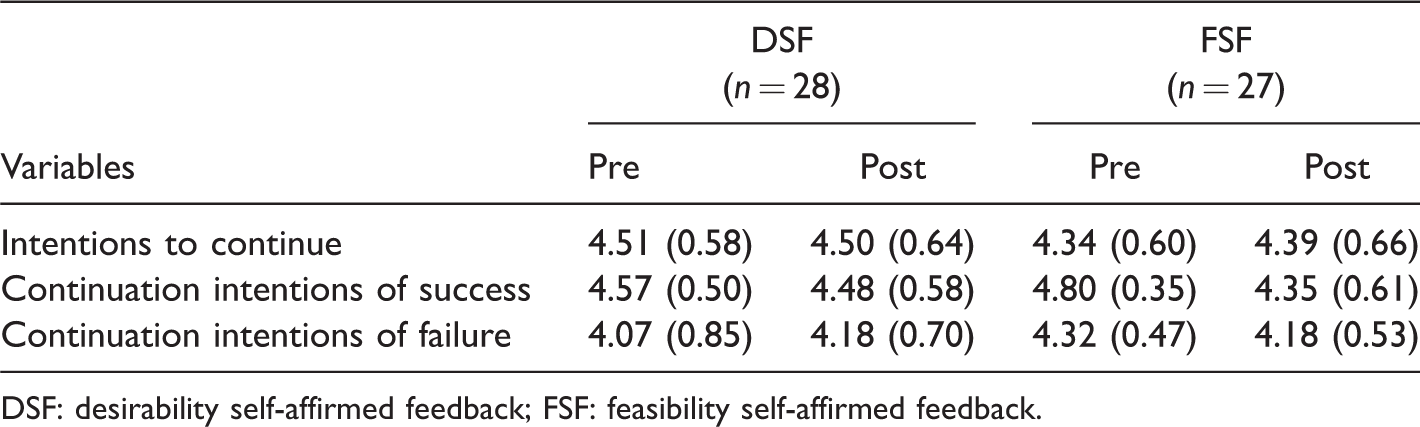
Mean values for intention to continue, continuation intentions of success, and continuation intentions of failure (including SDs) at pre and post.
DSF: desirability self-affirmed feedback; FSF: feasibility self-affirmed feedback.
Although there was no statistically significant difference in continuation intentions of failure between the measurement times (pre- vs. post-) (F (1, 53) = 0.01, p = .921) and between the groups (FSF vs. DSF) (F (1, 53) = 0.51, p = .479), an interaction effect (pre- vs. post-
The measurement time-dependent main effect of time on continuation intentions of success was statistically significant (F (1, 53) = 12.83, p < .001); no statistically significant differences were observed in the group-dependent main effect (F (1, 53) = .82, p = .670). Furthermore, the interaction effect of measurement time and group were found to be statistically significant (F (1, 53) = 6.23, p < .05). Table 4 shows that, whereas DSF yielded no significant pre-/postchanges in continuation intentions of success, FSF yielded a greater decrease from pre- to postlevel (Hypothesis 5 was supported).
Discussion
This study examined the effects of positive feedback related to exercise movement and performance (e.g., FSF) and positive feedback related to value and significance of exercise (e.g., DSF) on exercise participants’ health behavior. As a result, it was found that the latter type of feedback was more efficient than the former type of feedback in inducing significant changes in health-related exercise behavior.
Randomization test and validity of study results
No significant differences were found between the FSF and DSF groups for participants’ age, exercise participation duration, and motivation level, thus satisfying the randomization requirements in terms of basic background variables. Nor were any significant intergroup differences observed in all five motivations proposed in the self-determination theory (Deci & Ryan, 1985), thus demonstrating the homogeneity of the two experimental groups in terms of participants’ motivation level for exercise. Given that the predisposing factor for consequences was motivation in the HMIEM proposed by Vallerand (2007), the fact that motivation level of the FSF and DSF groups was controlled in this study of changes in health-related exercise intension can be regarded as enhancing the reliability of the results.
Existing self-affirmation manipulation task versus new self-affirmation manipulation task
Previous studies have reported that self-affirmation manipulations positively influence health-related health behavior (Harris & Napper, 2005; Harris, Mayle, Mabbott, & Napper, 2007; Sherman et al., 2000; Shin, Kim, & Park, 2019) and meta-analyses (Epton et al., 2015; Sweeney & Moyer, 2015) have derived similar findings. Furthermore, in a self-affirmation study (Cooke, Trebaczyk, Harris, & Wright, 2014) conducted on health-related exercise, the experimental group showed increased physical activities and exercise intention after a one-week exposure to a self-affirmation manipulation.
The typical self-affirmation manipulation administered in self-affirmation studies is a writing task. A writing task aims to manipulate self-affirmation by having participants describe events in which they felt pride, experiences during which they personally felt valuable, or positive self-values (Klein, Blier, & Janze, 2001), or concretely formulate their experiences of achievement such as in terms of exam scores at school, awards, and promotions, or their special talents and competencies (Schimel, Amdt, Banko, & Cook, 2004). This study applied a manipulation methodology different from those used in previous studies by manipulating self-affirmation with positive feedback given by an instructor to steer participants toward boosting their self-value and self-efficacy.
Napper et al. (2009) measured the reliability of a self-affirmation manipulation task by measuring the degree of self-affirmation using the same items and scales used in this study. The higher scores obtained in the present study by both DSF and FSF groups, 3.61 (SD = 0.98) and 3.38 (SD = 0.84), respectively (see Table 3), compared with the self-affirmation group in the study by Napper et al. (2009), confirms that participants of this study were helped by FSF and DSF.
Both FSF and DSF were found to be as efficient as the self-affirmation manipulation tasks presented in previous studies. As shown in Table 3, the FSF and DSF groups showed similarly high levels of self-affirmation. This allows the conclusion that the novel self-affirmation manipulation method used in this study was as efficient as conventional self-affirmation manipulation methods. Given the absence of any intergroup differences in the extent of self-worth, the influence of self-worth manipulation through FSF and DSF on the study results can be considered negligible.
Relationship between psychological distance and exercise intention of FSF and DSF
Trope and Liberman (2000, 2003) noted that whereas the focus of a distant-future event at a long psychological distance is on desirability, emphasizing the value of outcomes of activities and messages with high-level construal characteristics highlighting the purpose of activities (abstract context), the focus of a near-future event is on feasibility, in view of concrete means and messages with low-level construal characteristics emphasizing the methodological aspect of activities. As shown in Table 3, FSF was perceived to have a shorter psychological distance than DSF, and a high low-level construal score, whereas DSF was perceived to have a longer psychological distance than FSF and a high high-level construal score, thus supporting the results of earlier research.
Carrera et al. (2014) studied whether the effects of affective and cognitive attitudes toward health-promoting and health-risk behaviors on intention to continue vary according to construal level. The results showed a relationship between affective attitude and intention to continue at the abstract construal level, whereas cognitive attitude predicted intention to continue at the concrete construal level. Existing studies tested the interaction effects of independent variables directly affecting intention to continue (e.g., attitude, based on Ajzen’s (1991) theory of planned behavior or “TPB”) and construal level. This study did not consider independent variables influencing intention to continue and, instead, examined the effect that construal level had on changes in intention to continue. For this reason, it is assumed that there was no statistical influence on difference in pre-/postchanges of intention to continue between DSF and FSF.
Although this study did not consider variables affecting intention to continue, the pre–post changes in continuation intentions of success and continuation intentions of failure differed between DSF and FSF. Continuation intentions of failure are intentions of participating in exercise again to achieve a goal when the goal is not achieved and can be viewed as intentions to reflect a type of time delay or self-control ability. Although, in this study, significance was at .15 or lower, the pre–post changes in continuation intentions of failure increased in DSF, but decreased in FSF. These results support the findings of previous studies indicating that individuals tolerate a time delay situation when they are induced to high-level construal (Fujita et al., 2006), and that they are aware that high-level relative to low-level construal promotes self-control in the dieting domain (MacGregor, Carnevale, Dusthimer, & Fujita, 2017).
Continuation intentions of success are the intentions to continue participating in exercise even after achieving a goal. In this study, the pre–post changes in continuation intentions of success were not high in DSF, but the posttest continuation intentions of success lower than those in the pretest in FSF. Because participants with high continuation intentions of success place high value on, and enjoy exercise while achieving their goals, their intentions can be seen as those reflecting abstract construal. In empirical studies, abstract construal had a more positive effect on future preferences than did the concrete mind-set condition (Vilches-Montero & Spence, 2015), and the tendency to consider future consequence also increased (van Beek et al., 2017). Therefore, it can be concluded that, because participants who received FSF were induced to low-level construal, their continuation intentions of success reflecting an abstract mind-set decreased more in the posttest than in the pretest.
Significance of the study
Most previous studies on self-affirmation (Mays & Zhao, 2016; Van Koningsbruggen, Das, & Roskos-Ewoldsen, 2009) and construal level (Armitage, Harris, Hepton, & Napper, 2008; Belding, Naufel, & Fujita, 2015) examined changes in variables related to health behavior inducing temporary manipulation tasks. In this study, a manipulation task was continuously provided in a real-life setting for four weeks to examine the effects of self-affirmation and construal level on participants’ health behavior-related cognitive processes. Thus, this study differentiates itself from previous studies in that it is an evidentiary and pragmatic study.
The internal validity of this study’s results was established through measures taken to control aspects of the dependent variables likely to be contaminated and variables to the maximum possible degree. First, participants were randomized to the FSF and DSF groups. Next, motivation and exercise participation duration, which can influence the intention to continue, were controlled. In addition, bias due to acquaintance with the instructor was avoided by selecting participants who met the instructor for the first time. Finally, participants who did not send a confirmation message after reading feedback sent by SMS were excluded from the final analysis, as it was considered that they may not have read the self-affirmation feedback.
Limitations and implications of the study
Prior studies (Calderon, Mac Giolla, Granhag, & Ask, 2017; Carrera et al., 2014) which examined the effect of construal level on intention, using an experimental design, had higher sample sizes (e.g., 125 participants in Calderon et al., 2017 and 87 in Carrera et al., 2014) than that in this study. Although the sample size in this study was smaller, compared to those in prior studies, it was appropriate because the suitable sample size for a moderate effect size (f = .20) with alpha set at .05 and power at .80 through G*Power software (Faul, Erdfelder, Buchner, & Lang, 2009) was 52. However, to increase the reliability and validity of the research results, relevant studies should be conducted using larger samples.
The exercise type used in this study was limited to Vinyasa Yoga, and participants were all women. Given the exercise type and gender skew of this study, it would not be appropriate to generalize the results to other exercise types and male participants. In follow-up research, there is a need to diversify exercise type, gender, and age. Furthermore, while conducting instructor interviews, we found that they were using information-centered feedback related to exercise movements and performance more frequently, that is, more FSF than DSF. However, this aspect was not investigated in this study. Therefore, a follow-up study should examine empirically whether FSF and DSF is used more frequently by instructors.
Lastly, considering that this study demonstrated that DSF can influence participants exercise intention, instructors should consider offering feedback about future-oriented goals or values that can be achieved through exercise, in addition to that on performance and movements.
