







Abstract
Based on persuasion theory, this study examines the influence of peer work performance on the focal employee’s voice-taking relationship. Our study purposes that peer work performance contributes to the focal employee’s cognition-based trust and that their interdependent self-construal moderates this relationship. Our study suggests that cognition-based trust mediates the relationship between peer work performance and the focal employee’s voice taking. Finally, we intend to show that the focal employee’s interdependent self-construal moderates the mediating role of cognition-based trust in transmitting the effect of peer work performance on the focal employee’s voice taking. Analyses of the data collected from China support these hypotheses.
Introduction
One potential benefit of team context is that members can share knowledge and ideas to help one another solve problems (e.g., advice—giving), thereby enhancing their performance potential (Li, Li, Guo, & Harris, 2018). In this regard, team members’ voice, which can facilitate knowledge sharing and idea exchange, represent an enticing proposition for boosting individual performance and solve problems (Reyt, Wiesenfeld, & Trope, 2016; Sosa, 2011). However, the conditions under which the team members actually take the voice from others are still unknown. The persuasion theory, which explains how persuasive messages from different sources are processed and internalized (Jones, Sinclair, Rhodes, & Courneya, 2004; O’Keefe, 1990), provides a helpful theoretical framework for understanding how multiple antecedents may contribute to the enactment of voice taking. For example, Bator and Cialdini (2000) provided specific guidelines to help create effective pro-environmental public service announcements, so that the messages could be liked and agreed with by the public. Similarly, Jones, Sinclair, and Courneya (2003) investigated the effects of source credibility and message framing on college students’ intentions to engage in physical exercise, because research on persuasion theory addresses the factors that cause attitude and corresponding behavior change. In line with this theory, voice taking can be understood as a persuasive process in which people persuade others to pay attention to, recognize, support, or carry out their ideas, advice, or suggestions.
While the important role that leaders (e.g., supervisors, middle managers, and top managers) play in eliciting voice from subordinates has been highlighted and extensively examined in prior voice literature (Bai, Lin, & Liu, 2019; Detert & Treviño, 2010; De Wit, Scheepers, Ellemers, Sassenberg, & Scholl, 2017; Liu, Tangirala, & Ramanujam, 2013; Tangirala & Ramanujam, 2012), the role of colleagues/peers in the focal employee’s voice taking has not been systematically investigated in the literature. As organizations have flatted and increasingly rely on team work (Jungert, Van de Broeck, Schreurs, & Osterman, 2018), there has been a recent call to explore multiple sources of voice expectations such as from other team members, subordinates, customers, and family (Duan, Li, Xu, & Wu, 2017). Along with this, there has also been a suggestion to determine how these different expectations may influence or interact with each other to impact an individual’s intention to voice taking (Carmeli & Schaubroeck, 2007). Given these circumstances, this article argues that besides the decision-maker’s subjective sense of power (Tost, Gino, & Larrick, 2012), work performance acts as a critical antecedent in influencing voice taking. Research has shown that the social context within work teams has an effect on which subsequent behaviors will be considered acceptable (Frazier & Bowler, 2015). To date, however, prior studies have not sufficiently explored the acceptance of voice within the team (Morrison, 2014), thus it remains unclear how those who speak up are actually evaluated by their peers in the workplace (McClean, Martin, & Emich, 2018). As a result, the relationship between an employee’s work performance and the likelihood of their voice being taken by their peers has not been adequately discussed in extant literature. In addition, this study aims to explore why and when employees’ work performances are more apt to influence voice taking from the focal employee. Specifically, we focus on cognition-based trust to explain the underlying mechanism of this relationship, which explains a person’s trustworthiness was often argued to depend on trustors’ cognition of the person’s characteristics, his/her perceived ability, integrity, and benevolence (Byun, Dai, Lee, & Kang, 2017; Mayer, Davis, & Schoorman, 1995). Given that self-construal consists of one’s unique traits, abilities, preferences, interests, goals, and experiences (Cross, Bacon, & Mirrors, 2000), this may influence the focal employee’s attitude and behavior. We also explore the moderating effect of self-construal in the process of employees’ work performance and cognition-based trust to discuss the conditions under which the recipients are more likely to trust the advisor.
Our article makes several important contributions to the literature. First, while most previous studies are focused on the antecedents of voice, for example, Morrison (2014) provided a framework that placed voice antecedents into one of five functionally similar categories. These categories include (a) individual dispositions, (b) job and organizational attitudes and perceptions, (c) emotions, beliefs, and schemas, (d) supervisor and leader behavior, and (e) contextual factors. Many of these variables, particularly within each antecedent category, are correlated with one another, making it difficult to discern the unique associations between each antecedent and voice (Chamberlin, Newton, & LePine, 2017). However, why the focal person endorses ideas raised by others is not clear. We argue that one especially important factor for understanding the recipient’s voice taking is the advice giver’s work performance. Second, a judge–advisor system (JAS) distinguishes between one or more people who provide recommendations and information (the advisors) and the person with the responsibility to make decisions (the judge; Sniezek & Van Swol, 2001; Yaniv, 2004). We contribute to the literature by extending the concept of JAS to work teams where all of the members of a team can give and take voice from peers, and the judge’s final decision can often be evaluated in terms of accuracy or effectiveness (Bonaccio & Dalal, 2006). As such, the focus on team members, colleagues, or peers also allows us to broaden the scope of JAS and team members rather than leaders are more likely to be able to make a change (Grant, Gino, & Hofmann, 2011). Finally, this study strengthens our understanding of the relationship between peer work performance and voice taking. We investigate both the mediating mechanism (cognition-based trust) connecting employees’ performance to voice taking and the boundary effect of self-construal between those relationships. In this regard, the extent to which the recipient’s interdependent self-construal is likely to accentuate the positive effect of the advisor’s work performance on the recipient’s cognition-based trust.
Theory and hypotheses
Peer work performance and voice taking
Work performance contributes to the prediction of an employee’s job-related outcome (Van Scotter, Motowidlo, & Cross, 2000), which can be considered an important factor that impacts whether their colleagues will take voice from them. Moreover, the magnitude of the persuasion effect is influenced and restricted by various factors, among which source credibility plays an essential role (Whiting, Maynes, Podsakoff, & Podsakoff, 2012). The dimensions of source credibility have commonly been identified as expertise and trustworthiness. Expertise refers to the extent to which a person is perceived as being capable of making a correct judgment; trustworthiness refers to the degree to which an audience perceives the judgment made by the person as valid (Pornpitakpan, 2004). Research shows that decision-makers are more likely to take voice from advisors who are accurate, trustworthy, and accessible than from those who are not (Hofmann, Lei, & Grant, 2009). In addition, individuals are more likely to take voice when they have limited information, uncertain about their initial decision, and when the problem is complex (Belogolovsky, Bamberger, Alterman, & Wagner, 2016; Schrah, Dalal, & Sniezek, 2006). Therefore, voice from more credible sources, such as high-performing employees, is more likely to be taken because it has a better likelihood of being accurate and of leading to improvements in organizational functioning. Based on the above reasoning, the following hypothesis can be established: Hypothesis 1: Peer work performance is positively related to the focal employee’s voice taking.
The mediating effect of cognition-based trust
Trust is an important lubricant of the social system and a facilitator of coordinated action among individuals, several important benefits for teams and organizations have been associated with trust (Costa, 2003). Indeed, individuals often rely on the advice of trusted sources under the conditions of high-perceived risk (Barnett White, 2005). Interpersonal trust can be based on either cognitive or affective foundations. The former refers to beliefs about a trustee’s competence or ability to carry out his or her obligations, while the latter refers to a belief that the trustee will act unselfishly toward others and show care and concern for their welfare (Conchie, Taylor, & Donald, 2012; McAllister, 1995). This study mainly focuses on the cognition-based trust as it may develop from knowledge of an employee’s role in the organization, or their personal ability to carry out obligations (Burke, Sims, Lazzara, & Salas, 2007), which provides reasonable cues in the decision-making process.
By referring to a peer’s track records of work-related duties, team members can evaluate whether and to which extent this peer is reliable. Researchers have accumulated extensive knowledge on the antecedents of trust. For example, the reliable role performance and the professional credentials of the evaluated person are the antecedents of cognition-based trust (McAllister, 1995). If a person being evaluated exhibits high reliability in his/her work behaviors, it is also likely that the others will develop a high level of trust in their evaluation of this person (Chowdhury, 2005). As work performance are directly involved in or directly support the accomplishments of core job tasks (LePine, Zhang, Crawford, & Rich, 2016), such cues can lead the focal employee tends to build a high level of cognition-based trust in peers whose work performance is better.
Prior research has tested the importance of trust in voice taking. For instance, Van Swol and Sniezek (2005) examined the five factors that can increase the utilization of expert voice: the recipient’s trust in the advisor, advisor confidence, advisor accuracy, the recipient’s prior relationship with the advisor, and the recipient’s power to set payment to the advisor. Besides, research on team transactive memory suggests that in stable teams, veteran members learn about one another’s relative competencies and areas of expertise from experience, and by drawing from multiple cues overtime (Ren & Argote, 2011). Similarity, Whiting et al. (2012) found that employees are more likely to receive positive outcomes from their reviewers when these employees are perceived to be trustworthy. Since cognition-based trust provides cues on how to process, interpret, and act upon the information. Employees with increasing levels of this trust will feel more comfortable in doing so despite the inherent risks associated with it (Ng & Feldman, 2012). This is because cognition-based trust depends on the context and success of past interactions, which provide significant clues about the competence of the members. Context considerations specify the members on whom cognition-based trust is bestowed (Parayitam & Dooley, 2007). As the trust beliefs relate to the individual’s task-specific skills (e.g., specialized knowledge; Conchie et al., 2012), the recipient is likely to take voice from those who perform well. Based on the above arguments, the following hypothesis can be established: Hypothesis 2: The focal employee’s cognition-based trust mediates the positive effect between peer work performance and the focal employee’s voice taking.
The moderating effect of self-construal
All people have varying levels of independent/interdependent self-construals and the relative strength of each depends on personal social/cultural experiences and situations (Lu & Gilmour, 2007; Wu, Parker, Wu, & Lee, 2018). These differences in self-construals raise many issues with regard to self-related processes (i.e., cognitive processes; Cross et al., 2000). For example, individuals with independent self-construal tend to express themselves directly as well as to say what they think. In contrast, individuals with interdependent self-construal tend to communicate indirectly and be attentive to others’ feelings and unexpressed thoughts—that is, to “read others’ minds” (Markus & Kitayama, 1991; Singelis, 1994). As one of the important individual differences, self-construal not only influences the process of cognition but also influences the attitude one takes toward a peer’s voice. The recipient interacts with a peer’s voice using their own learning and information processing, which helps the recipient to decide whether to take the voice. We predict that a person’s response to a peer’s speaking up depends on the type of self-construal. Specifically, individuals with interdependent self-construal tend to place a heavy emphasis on the collective realization of individual value and keep a harmonious relationship with important relationships (e.g., family, friends, and coworkers) or group memberships (Cross, Hardin, & Gercek-Swing, 2011). Conversely, regardless of peer work performance, individuals with independent self-construal have internal traits that are stable across situations, demonstrating one’s uniqueness, while focusing on their own opinions, which are less affected by the external work environment (Markus & Kitayama, 1991). Accordingly, individuals with interdependent self-construal are more easily affected by peers’ voice and hold high level of trust toward their peers. Based on the above-mentioned information, the following hypothesis can be formulated: Hypothesis 3: The positive relationship between peer work performance and cognition-based trust is moderated by the focal employee’s self-construal. Compared to independent self-construal, interdependent self-construal is more likely to strengthen the positive effect of peer work performance on the focal employee’s cognition-based trust. Hypothesis 4: The joint effect of self-construal and peer work performance can encourage the focal employee’s cognitive trust and then influence voice taking, such that when the recipient is interdependent self-construal, the mediation effect of cognition-based trust will be stronger.
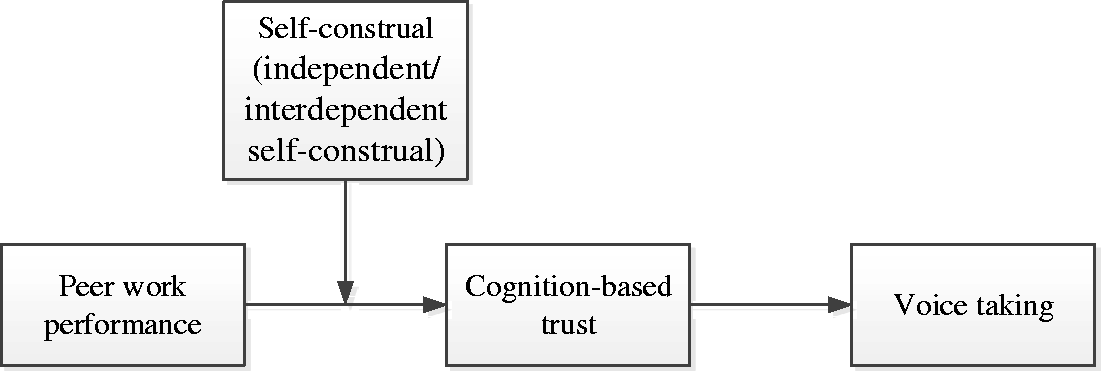
Research model.
Method
Sample and procedures
We selected 12 private companies in mainland China via stratified random sampling and invited them to participate in a survey-based research. There are 42 work teams from the electric power, transportation, communication, and chemical industries in Hubei, Yunan, Zhejiang, Shanghai, Shenzhen, and Guangxi provinces. With help of the human resources department of each company, this survey was conducted with a round-robin design (Warner, Kenny, & Stoto, 1979) in which every member in the same team evaluates others and is also evaluated by all of their peers. Each member acts as both advisor and recipient, and they received a cover letter outlining the study; two separated questionnaires in envelopes went directly to the researchers. From teams with six or more team members, we randomly selected five to take our survey (De Jong, Van der Vegt, & Molleman, 2007).
To reduce potential common method bias, we adopted the multisource reporting strategy to ask questions suggested by Podsakoff, MacKenzie, Lee, and Podsakoff (2003). Specifically, our questionnaires included two parts: one for an employee and one for their colleague. At Time 1, an employee, acting as a recipient, provides demographic information, rates both his/her own performance and peer performance, and rates his/her own level of cognition-based trust and self-construal. Three months later, at Time 2, the peer, acting as the advisor, rates to what extent his/her voice will be taken by the recipient. However, those who had changed organizations in the interim were eventually excluded from further participation because they would have used different employers as references in their survey responses (Ng & Lucianetti, 2016). To verify the clarity and consistency of the sample, every participant was assigned to only one unique number and then we matched the questionnaires of the recipients and the advisors. In total, 380 questionnaires were provided to the participants, with 256 of them ultimately being completed and returned. After rejecting incomplete questionnaires, 204 were finally considered reliable, constituting 79.69% of the total returned sample. Among the 204 respondents, 42.65% were males; 70.59% of respondents were greater than 24 years old; 64.71% of respondents had a bachelor's degree; 75% of respondents had worked for one to five years.
Measures
Questionnaires were administered in Chinese using Brislin’s (1980) back-translation procedure to translate the original English-language version. We subsequently pilot-tested the Chinese version using 10 employees of one of the participating companies who were not involved in the study. On the basis of the feedback from the pilot study, we reworded a few items to ensure clarity (Aryee, Walumbwa, Mondejar, & Chu, 2017).
Peer work performance
We used items from the previous research of Van Scotter and Motowidlo (1996) who measured work performance as task performance and context performance using 14 items. The former involves patterns of behavior that are directly involved in producing goods or services, or activities that provide indirect support for the organization’s core technical processes. The latter involves behavioral patterns that support the psychological and social context in which task activities are performed (Van Scotter et al., 2000). Sample items included “Inspecting, testing, and detecting problems with equipment,” “Performing routine maintenance,” “Put in extra hours to get work done on time,” and “Pay close attention to important details.” The participants answered two questionnaires to test their own work performance and their peers’ work performance (from one = strongly disagree to five = strongly agree). The Cronbach’s α of peer work performance (rated by the recipients) was .90, and the Cronbach’s α of peer work performance (rated by the advisors) was .91. Then, we used a dummy variable to measure peer work performance (0 = an individual thinks peer work performance below him/herself; one = an individual thinks peer work performance above him/herself).
Cognition-based trust
Cognition-based trust was measured by the recipients at the Time 1 sessions; items developed by McAllister (1995) were used. Six items were used to assess the cognition-based trust of recipients: for example, “This person approaches his/her job with professionalism and dedication,” and “Given this person’s track record, I see no reason to doubt his/her competence and preparation for the job.” The scale ratings ranged from one (strongly disagree) to seven (strongly agree). Cronbach’s α of cognition-based trust was .91.
Self-construal
We used the 24-item status scale developed by Markus and Kitayama (1991) to measure the self-construal of the recipients. Items used to measure independent self-construal included “I am expressing my unique configuration of needs, rights, and capacities” and “I am developing my distinct potential.” Items used to measure interdependent self-construal include “I am agreeable even under difficult circumstances, sensitive to what others are feeling, and willing to adjust my behavior accordingly.” All ratings were made on a seven-point Likert-type scale ranging from one (strongly disagree) to seven (strongly agree). The sample was divided into an independent group and an interdependent group according to the difference between scores along these two dimensions. If the difference between independent self-construal and interdependent self-construal was positive, the data were placed in the independent group; if the difference between independent self-construal and independent self-construal was negative, the data were placed in the interdependent group. After all the groupings had been completed, 79 respondents belonged to the independent group and 125 respondents belonged to the interdependent group. The Cronbach’s α of independent self-construal was .73; the Cronbach’s α of interdependent self-construal was .74.
Voice taking
Four items of voice taking from Fast, Burris, and Bartel (2014) were measured by the advisors using a 5-point scale (one = strongly disagree; five = strongly agree). Sample items included the following: “Asks me personally to tell him/her about things that I think would be helpful for improving this organization” and “Asks me personally to tell him/her about how things have been done in my previous job(s).” The Cronbach’s α of voice taking was .90.
Control variable
We assessed a number of control variables that allowed us to account for possible alternative explanations of our results. We assessed demographic variables because some studies have found that certain demographic categories such as gender, age, education, and employment tenure can influence the individual’s decision-making process (Detert & Burris, 2007; Stamper & Van Dyne, 2001). Specifically, all the control variables were dummy-coded as follows: gender (0 = “female” and one =“male”), age (0 = “less than or equal to 24 years of age” and one = “greater than 24 years of age”), education (0 = “below bachelor’s degree,” one = “bachelor’s degree,” and two = “graduate degree or above”), employment tenure (0 = “less than 1 year,” one = “one–five years,” two = “six–nine years,” and three = “10 years or more”).
Confirmatory factor analyses
To verify the distinctiveness of the variables in our model, we conducted confirmatory factor analyses. As shown in Table 1, the results indicated that the proposed four-factor model fit the data better than other alternative models: Chi Square to degrees of Freedom ratio (χ2/df) = 1.66, root mean square error of approximation (RMSEA) = .06, Tucker–Lewis index (TLI) = .96, the goodness-of-fit index (GFI) = .91, and comparative fit index (CFI) = .97. We concluded that the scales were measuring distinctive constructs, and moved on to test the proposed hypotheses.
Confirmatory factor analysis.
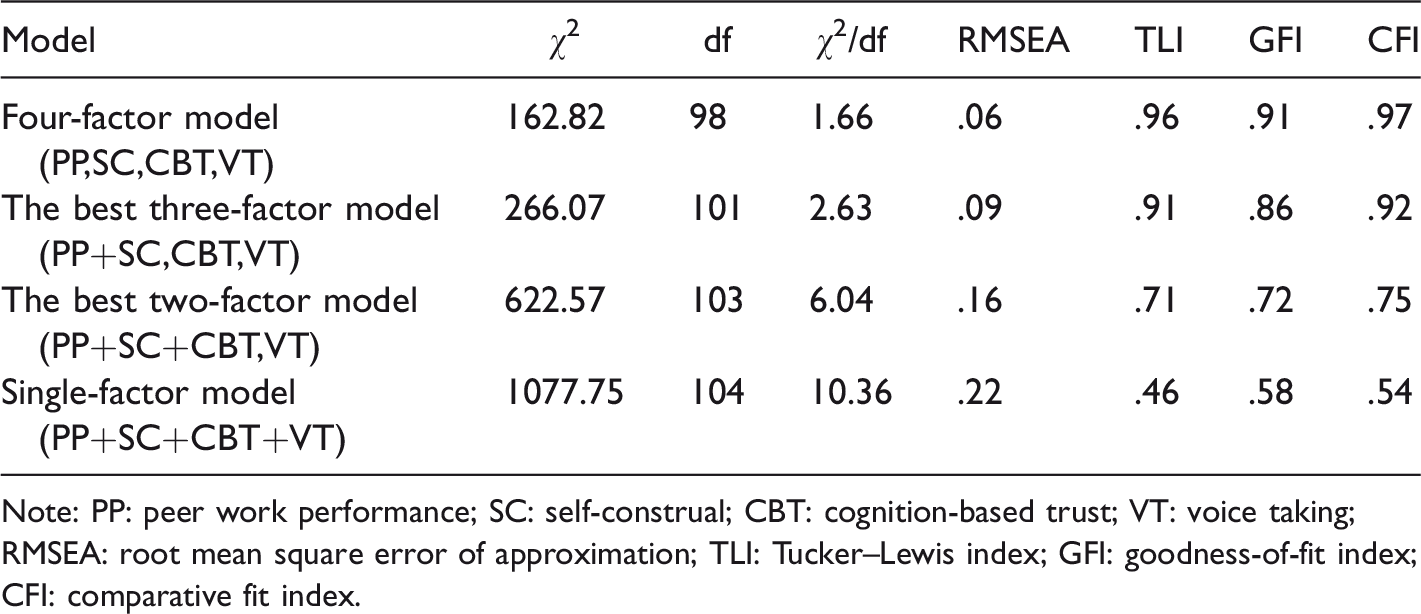
Note: PP: peer work performance; SC: self-construal; CBT: cognition-based trust; VT: voice taking; RMSEA: root mean square error of approximation; TLI: Tucker–Lewis index; GFI: goodness-of-fit index; CFI: comparative fit index.
Descriptive statistics
Table 2 shows the means, standard deviations (SDs), and correlations among the focal variables. The relationship between cognition-based trust and voice taking is positive (β = .34**, p < .01); the relationship between self-construal and voice taking is positive (β = .24**, p < .01); the relationship between cognition-based trust and self-construal is positive (β = .25**, p < .01); the relationship between peer work performance and cognition-based trust is positive (β = .40**, p < .01).
Descriptive statistics and correlations.
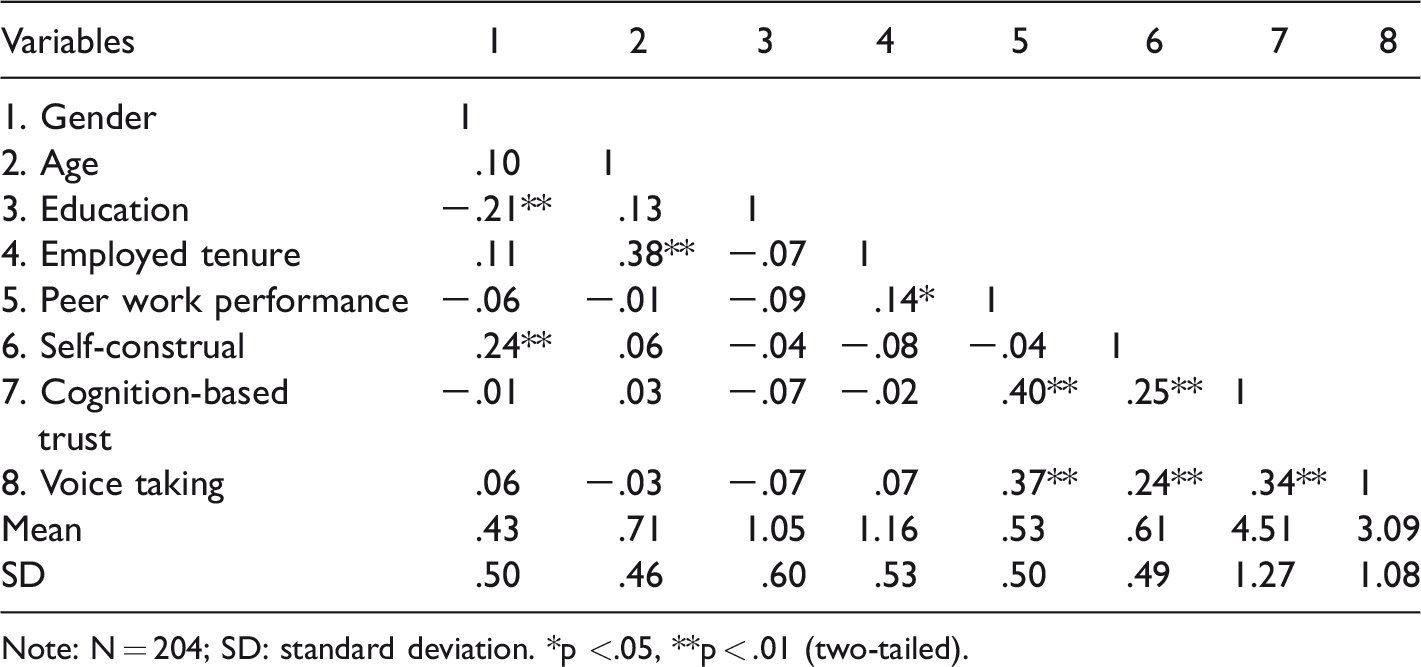
Note: N = 204; SD: standard deviation. *p <.05, **p < .01 (two-tailed).
Hypotheses tested
A hierarchical regression analysis was conducted to test our hypotheses, and the results are shown in Table 3. We first tested Hypothesis 1, which is relevant to the effect of peer work performance on voice taking. In this analysis, the measurement of voice taking was first entered as a dependent variable, which was followed by the four control variables: gender, age, education, and employment tenure (Model 1); peer work performance was entered next (Model 2). The results indicate that peer work performance has a positive effect on voice taking (unstandardized coefficient = .80, p < .001), which supports Hypothesis 1.
Hierarchical regression results.
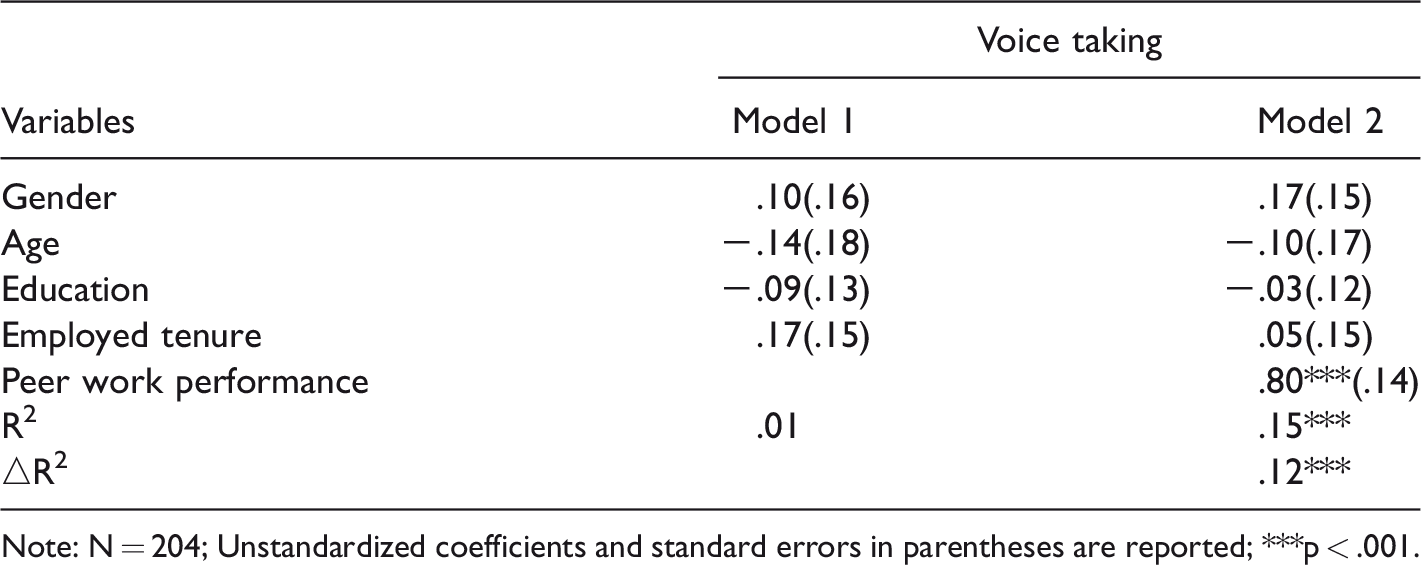
Note: N = 204; Unstandardized coefficients and standard errors in parentheses are reported; ***p < .001.
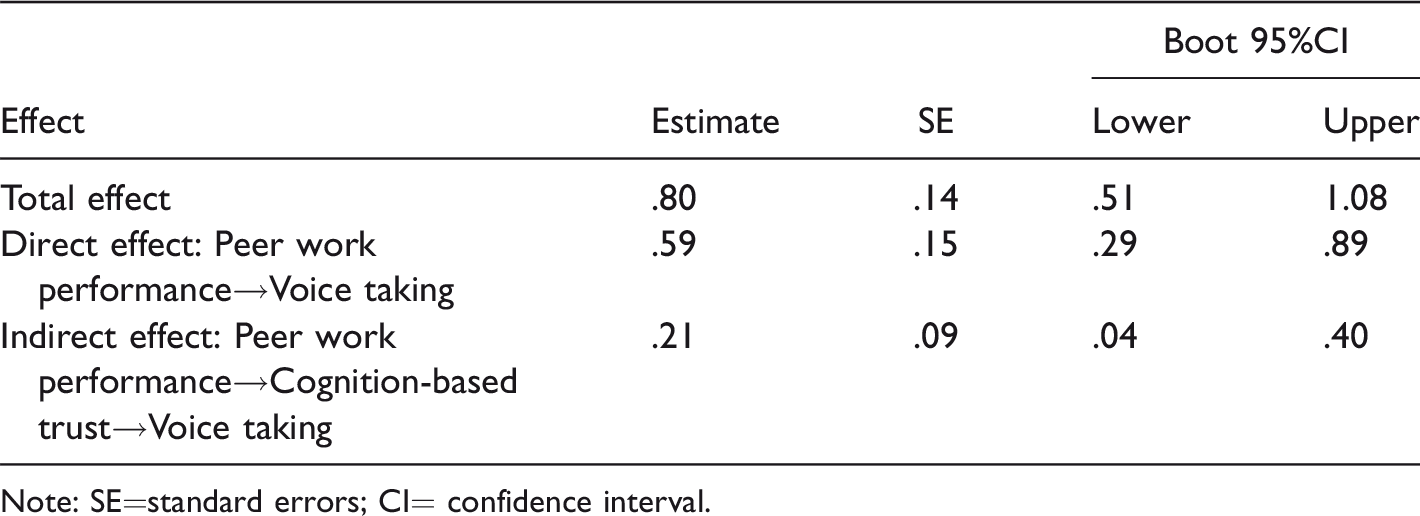
Hypothesis 2 states that cognition-based trust has a mediating effect between peer work performance and voice taking. We used a bootstrapping procedure to test the mediating effect of cognition-based trust between peer work performance and voice taking. Based on Hayes (2013)’s rule, we obtained estimates for the conditional indirect relationships in 2000 bootstrapped replications. The results in Tables 4 show that the indirect effect of peer work performance on voice taking through cognition-based trust was significantly (indirect effect = .21, SE = .09, 95% CI = [.04, .40]). Additionally, the direct effect of peer work performance on voice taking was also significantly (direct effect =.59, SE=.15, 95% CI= [.29, .89]), indicating that cognition-based trust plays a partial mediating role in the relationship between peer work performance and voice taking. Thus, these results support Hypothesis 2.
Direct and indirect effect.
Note: SE=standard errors; CI= confidence interval.
Moderated mediation results.
Note: CI= confidence interval.
Hypothesis 3 predicts that the relationship between peer work performance and cognition-based trust is moderated by self-construal. We used regression to estimate this hypothesis. The interaction term (peer work performance × self-construal) was significantly related to cognition-based trust (unstandardized coefficient = .47, p < .001), indicating that Hypothesis 3 is supported. A plot of this relationship is presented in Figure 2, as expected, the relationship between peer work performance and cognition-based trust for those with interdependent self-construal is stronger than independent self-construal.
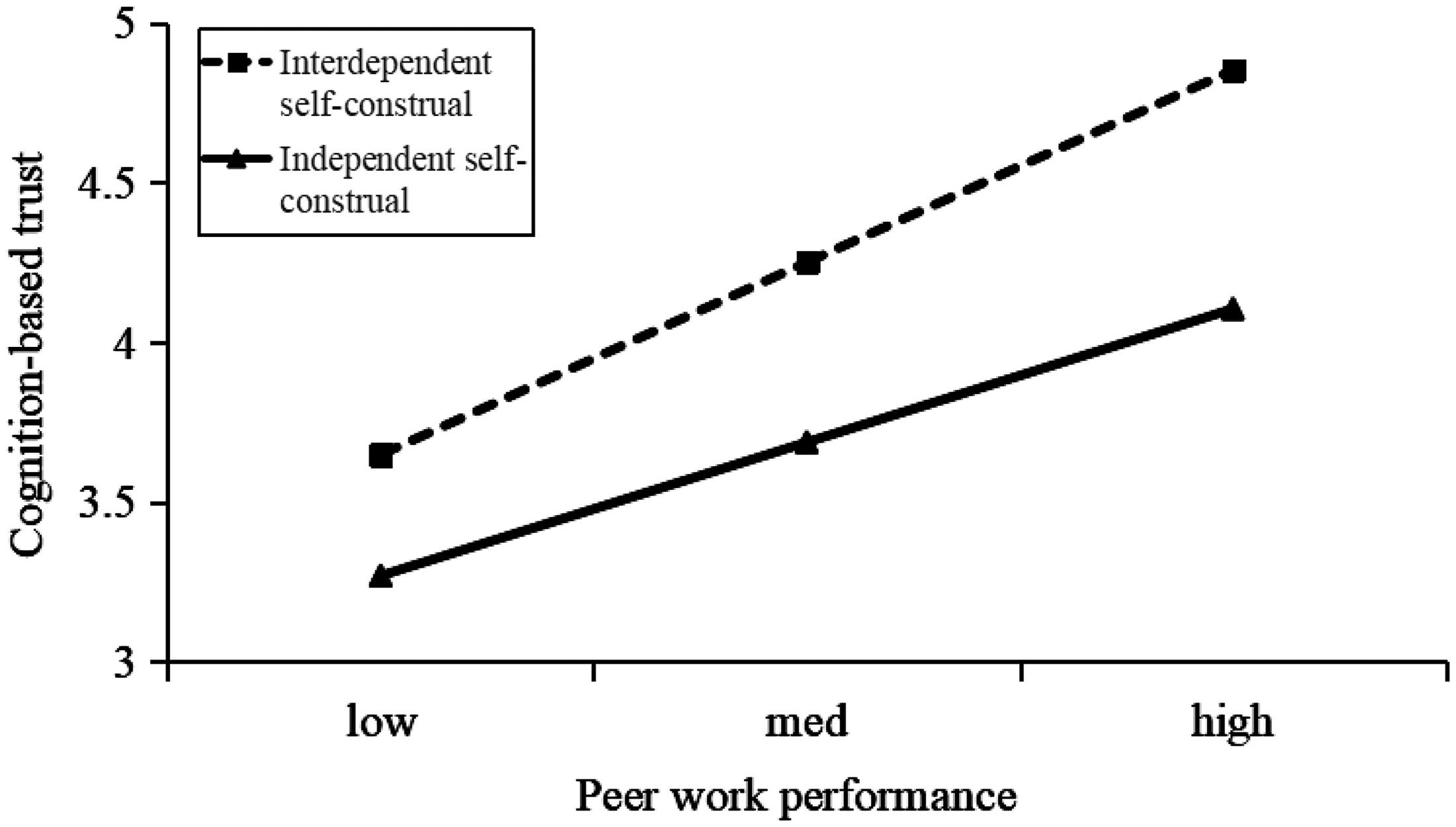
The moderating role of self-construal in peer work performance to cognition-based trust.
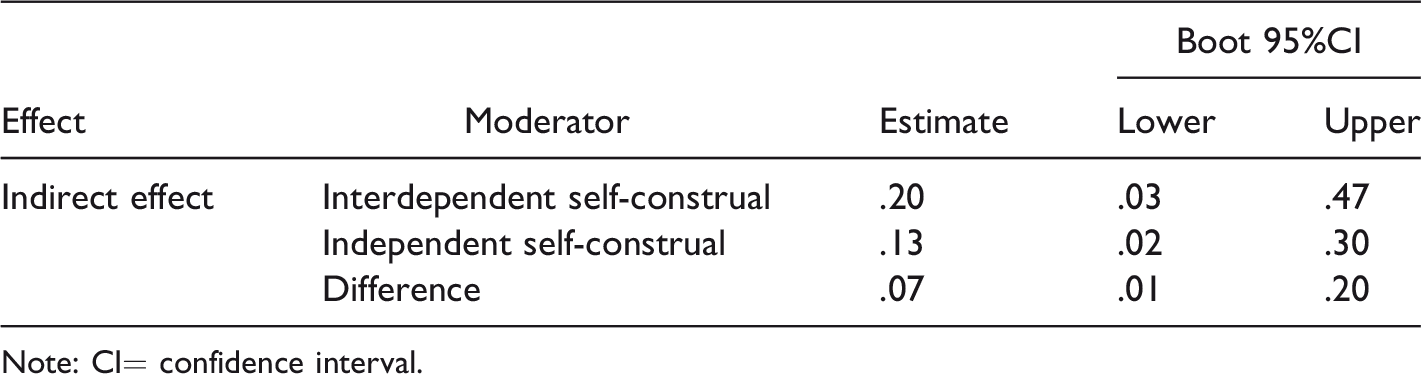
To further validate the findings on the moderated mediation model in our research, we set the interdependent and independent levels of self-construal to examine the varying magnitude of the conditional indirect effect of peer work performance on voice taking via cognition-based trust across different levels of the self-construal. Table 5 shows that, for the interdependent self-construal, peer work performance has a relatively high indirect effect on voice taking through cognition-based trust (indirect effect = .20, 95% CI= [.03, .47]); for the independent self-construal, indirect effect is relatively low (indirect effect = .13, 95%CI= [.02, .30]). Besides, the difference is significant (indirect effect = .07, 95%CI= [.01, .20]). It can be seen that self-construal moderates the indirect effect of peer work performance on voice taking through cognition-based trust. This pattern of results supports Hypothesis 4.
Discussion and conclusions
As modern work environments are becoming increasingly complex and uncertain (Xiong, Lin, Li, & Wang, 2016), important judgments and decisions are often left to the teams rather than to individuals under the assumption that teams can achieve better results by considering the multiple perspectives of their members (Larson, Tindale, & Yoon, 2019). Drawing from persuasion theory, we considered voice taking to be a process where the advisor persuades the recipient to take his/her voice within a team. As hypothesized, peer work performance was positively associated with the focal employee’s voice taking, and this relationship is mediated by cognition-based trust. Furthermore, as expected, interdependent self-construal acted as a moderator, enhancing the effects of peer work performance on cognition-based trust, which then encouraged voice taking.
Theoretical implications
In this section, we present how our study contributes to extant research on voice. First, in today’s hypercompetitive business environment, many organizations seek to break down traditional hierarchies and encourage flexible interactions among peers when they work on empowered tasks or project teams (Cordery, Morrison, Wright, & Wall, 2010). Under these circumstances, free and unhindered peer-to-peer flows of information, opinions, and suggestions are critical, and employee voice targeted at one’s peers represents a potential promising research focus. In fact, research has found that voice can have different targets such as top management, supervisors, or peers (Liu et al., 2013, 2015; Liu, Zhu, & Yang, 2010). The current research extends this line of study by examining voice taking within the team and suggested that team members play an essential role in stimulating peers’ motivation. Our findings highlight the importance of peer work performance in creating a favorable reaction for their voice.
Second, this study reveals a mechanism transmitting the effect of peer work performance to the focal employee’s voice taking. Specifically, we found that the cognition-based trust mediates the process. This study helps to enrich the existing persuasion theory literature by exploring the effect of the credibility of the message source on persuasion. It also aligns with the research on the interactions between source credibility and information reliability (Pornpitakpan, 2004). Since subjective attributions of competence (i.e., cognition-based trust) provide clues about the perceptions of team member trustworthiness (Parayitam & Dooley, 2007), our findings help to advance recent attempts to look more thoroughly at the relationship between peer work performance and voice taking triggered by the psychological states such as cognition-based trust. Also, this research responds to a call for understanding the role of trust in a decision setting (Parayitam & Dooley, 2007).
Finally, we explored one of the important boundary conditions of voice taking. This research addresses the consistency by showing that the recipient’s reaction to voice depends on their characteristics regarding self-construal. Existing research on self-construal has found that members of East Asian collectivist cultures tend to construct an interdependent self-construal (as termed by Markus & Kitayama, 1991), in which important relationships, group memberships, and social roles define the self (Cross, Gore, & Morris, 2003). However, little research has focused on the effects of differing self-construals for social behavior, close relationships, and other phenomena related to interactions with others or teams (Cross et al., 2011). This study aligns with this appeal and provides evidence that whether a person considers himself or herself to be independent of others or fundamentally interdependent with others in a situation can importantly affect the persuasion process such as the interdependent self-construal strengthens the effect of peer work performance on the focal employee’s cognition-based trust. Also, the joint effect of interdependent self-construal and peer work performance encourages the focal employee’s cognitive trust and subsequently influences voice taking.
Practical implications
First, the influence of source variables has been researched extensively (Jungermann & Fischer, 2005; Van Swol & Sniezek, 2005), and this work shows, for example, that recipients attach more weight to voice when advisors are more trustworthy—that is, they perform well. Under this circumstance, on the one hand, the employee should achieve tasks in a better manner compared with others and improve their performance before expressing factual advice in order to enhance the message’s credibility. Nevertheless, the team leader should decentralize decisions because it allows the people with the best work performance to make key organizational decisions. In addition, the team leader should develop strategies that make the employees feel safe in expressing their concerns as well as in speaking up about factors that may be risky to the organization. For example, the team leader should create a psychologically safe environment that enables employees to speak up, treat employees with respect, and encourage cooperation between high-performance and low-performance employees.
Second, the mediating role of cognition-based trust in the model suggests that employees may use intervening mechanisms to enhance cognition-based trust of recipients, which can increase the chance of their voice being taken. As trust can be formulated by displaying ability, benevolence, and integrity (Mayer et al., 1995), the employee should appear to be professional and skillful in the task-relevant knowledge and show consistency in their words and deeds to develop accuracy. In so doing, the employee may enhance their peers’ perceptions of their competence and integrity (Zhu & Akhtar, 2014). When the recipient perceives that their peers are becoming more trustworthy, they may become even less reluctant and hesitant to assume the risks associated with exercising voice. Similar to the foot-in-the-door approach, if the recipient agrees to take voice, this may increase his/her willingness to utilize it and make improvements (Van Swol, MacGeorge, & Prahl, 2017).
Limitations and future research
Despite the implications, several limitations remain, some of which may motivate efforts for future studies. First, as the data were collected exclusively in China, its national culture could have affected the hypothesized relationship (Xiong et al., 2016). Cultural background may be an important factor that may influence voice taking. For example, a collectivistic cultural value should help enhance employees’ cognitive attachment to their organization (Tang, Cai, Liu, Zhu, Yang, & Li, 2015), which then may enhance their trust of their peers and managers. Besides, when researchers seek to demonstrate that a particular cultural difference in behavior is associated with self-construals, they would be wise to focus on the specific dimension of the self-construals that account for the behavior and to consider the specific contexts in which the behavior develops (Cross et al., 2011). In short, the implications for culture and for the distribution of team member cultural identities in the context of “peer work performance–voice taking” relationships are unknown and should be addressed in future research.
Second, our research method did not allow us to build a causal relationship among peer work performance, trust, and voice taking. An experimental or longitudinal study to further examine the causal link of peer work performance–voice taking relationships is needed. Moreover, the sample in this study includes industries such as electric power, transportation, communication, and chemical—but not the manufacturing industry. It is reasonable to assume that the relationship between team members could change according to the type of occupation. Thus, the more industries (i.e., the manufacturing industry) in the sample, the level of stress and the relationship between the peers within the team should be controlled in the future research.
Finally, we did not include affect-based trust in our model. We argue that performance should be more significantly related to cognition-based trust, which originates from logical reasoning. However, researchers have found that emotional states influence how receptive people are to voice (De Hooge, Verlegh, & Tzioti, 2014). Accordingly, future studies can collect data on both cognition-based and affect-based trust and analyze the performance effect on both of them as well as compare their influence on voice taking.
