







Abstract
In the recent decade, increased severity of Internet addiction has been the focus of considerable attention. This research aimed to explore the relationships between neuroticism and Internet addiction. A total of 459 undergraduate students in China participating in this study completed self-report measures of neuroticism, impulsivity, and Internet addiction. The results showed that neuroticism, impulsivity, and Internet addiction were significantly and positively correlated with one other. The structural equation modeling approach indicated that impulsivity, in part, mediated the effect of neuroticism on Internet addiction. An important indirect path from neuroticism to Internet addiction through impulsivity was exposed using the bootstrap method. The outcomes of previous studies were expounded on to define how neuroticism affects Internet addiction.
Keywords
Introduction
The number of netizens, who regularly use the Internet, in China reached 0.802 billion in June 2018. The largest group ranged in age from 20 years to 29 years (27.9%), and the proportion of Internet users in junior college and above exceeded 90%, according to the China Data Report on Internet Development issued by the Internet Network Information Center in China (Jiang et al., 2019). Because of the Internet’s growing popularity, some teenagers have developed Internet addiction (Lei et al., 2018; Xin et al., 2018). Internet addiction, also called pathological Internet use, involves the phenomenon of evident social and mental damages resulting from Internet overuse (Choi et al., 2015; Griffiths et al., 2016). Typical negative effects of Internet addiction include depression, sleep disorder, loss of interest in normal activities, biological clock chaos, weight loss, loss of appetite, anergia, retarded motion, self-evaluation decline, retardation of thinking, fear of communication, reduction of social communication, idea of suicide, heavy smoking or drinking, and drug abuse (Chou et al., 2015; Ko et al., 2013; Lee et al., 2013; Ostovar et al., 2016; Stieger et al., 2013; M. W. Zhang et al., 2017). Epidemiological research suggests that Internet addiction has become a severe public health problem and afflicts 8% to 13% of college students and 1.4% to 17.9% of teenagers (Kaltiala-Heino et al., 2004; Ko et al., 2010;Kuss et al., 2014).
Relationship between Internet addiction and neuroticism
Internet addiction can occur because of many causes including biological and psychosociological factors (Cao et al., 2017; Kayiş et al., 2016; Kuss et al., 2013). According to substantial evidence, Internet addiction is a response of internal traits embedded in one’s personality (Dalbudak et al., 2015).
Neuroticism, a personality variable that reflects individual emotional instability, exhibits a close relationship to psychosocial adaptation and directly affects the experience of many negative emotions including worry, depression, anxiety, and hostility (Mehroof & Griffiths, 2010; Muris et al., 2005). According to the literature, neuroticism can predict Internet addiction (Evren, Evren, et al., 2019; Hettema et al., 2006; Mehroof & Griffiths, 2010). For instance, Mehroof and Griffiths (2010)found that neuroticism was highly correlated with Internet game addiction (regression coefficient up to 0.24). A large-sample online investigation from Kuss et al. (2013)showed that the neuroticism level of Internet addicts was remarkably higher than that of people without Internet addiction. Mok et al. (2014)explored the relationships of Internet addiction and smartphone addiction with personality traits and anxiety among Korean college students. According to their investigation, anxiety and neuroticism positively predicted both smartphone addiction and Internet addiction (Floros et al., 2014). Although these studies documented the relationship between neuroticism and Internet addiction, the underlying mechanism remains unclear. By considering the commonly established significance of neuroticism in determining Internet addiction, this current study hypothesized that neuroticism has a predominant effect on Internet addiction with a mediating effect of impulsivity.
Relationship between Internet addiction and impulsivity
Impulsivity, which is a stable variable of individual difference, can be briefly defined as “a behavior disposition of over-hasty behaving without careful thinking” (Rochat et al., 2018, pp. 45).Impulsivity reflects the lack of effective self-regulation or self-control in individuals and is correlated with general addictive behaviors (Di Nicola et al., 2010, 2015; Grant & Chamberlain, 2014; Mitchell & Potenza, 2014). For instance, groups of substance abusers including users of stimulants (e.g., cocaine and Benzedrine), opiates (e.g., heroin and morphine), and alcohol all exhibit high impulsivity (Belin et al., 2008; Coskunpinar et al., 2013; Moazen et al., 2018; Perry & Carroll, 2008).
Impulsivity, which is one of the best-known personality factors, affects the Internet addiction of individuals, and some researchers believe that Internet addiction is essentially an impulsivity disorder (Dell’Osso et al., 2006; Kiepek & Magalhaes, 2011). Saville et al. (2010)found that Internet addicts discounted delayed rewards more quickly than those who were not addicts, suggesting that the Internet addicts are more impulsive. Cao et al. (2007)found that teenagers with Internet addiction had remarkably higher scores on the Barratt Impulsivity Scale compared to teenagers without Internet addiction. Several studies using cognitive neuroscience techniques, such as event-related potentials and functional magnetic resonance imaging, have documented the cognitive and neutral mechanisms of impulsivity in Internet addiction (Dong et al., 2010; Gou et al., 2013).
Mediating role of impulsivity in the relationship between neuroticism and Internet addiction
Of the two personality traits, neuroticism reflects the instability of emotions, whereas impulsivity indicates the lack of emotion control (Brunault et al., 2018; Lee-Winn et al., 2016). For example, Mao et al. (2018)found that neuroticism can significantly predict impulsivity, and that the effect of neuroticism on impulsivity can be, in part, mediated by the lack of self-control. Brunault et al. (2018)and Lee-Winn et al. (2016)reported that there was a significant positive correlation between neuroticism and impulsivity, and that both traits were correlated with binge eating. Neuroticism and impulsivity in individuals usually manifest as emotional instability, lack of control, anxiety, depression, binge eating, suicide attempts, and other maladaptive psychological behaviors (Bi et al., 2017; Lee-Winn et al., 2016). Individuals with high neuroticism demonstrate the tendency to show intense emotional responses (Brunault et al., 2018). Impulsivity can be regarded as a behavior that is more controlled by emotions rather than rationality (Peng, Feng, et al., 2019), so learning the predictive effect of neuroticism on impulsivity is not surprising (Chen et al., 2020; Shehzadi et al., 2016).
Individuals with high neuroticism can experience intense emotions when they are challenged by negative life events; hence, they may feel impelled to purge their negative emotions on the Internet (Muris et al., 2005). Moreover, they are more likely to feel comfort and pleasant sensations within the Internet space, as they are more immersed in and cannot free themselves from the virtual world. Such emotional experience further drives individuals to feel immediate pleasure and ignore long-term interests, which lower self-control and intensify impulsivity (Mao et al., 2018). Hirschi and Gottfredson (2000)thought that the generation of all problem behaviors was induced by the pursuit of immediate gratification and the lack of self-control. Altogether, the evidence shown above indicated that people with high neuroticism who experience irritability, moodiness, and emotional instability are more apt to exhibit impulsivity that leads to Internet addiction. In other words, impulsivity may play a mediating role in the relationship between neuroticism and Internet addiction.
These previous studies strongly suggest that both neuroticism and impulsivity are correlated with Internet addiction, and that neuroticism can significantly predict impulsivity; however, so far, few researchers have considered impulsivity as a mechanism that mediates the impact of neuroticism on Internet addiction. Thus, in this study, we aimed to explore the impact of neuroticism and impulsivity on Internet addiction in college students, and we aimed to especially validate the mediation of impulsivity and the impact of neuroticism on Internet addiction.
Methods
Participants
The participants in the current study were recruited from a psychology class in a general university in China. A total of 459 undergraduate students (238 males and 221 females) volunteered to participate in the study. They ranged in age from 19 years to 20 years (mean, 19.42 years; standard deviation, 1.58). The participants completed the questionnaires in a classroom and received ballpoint pens as their reward; four unfinished scales were excluded from 459 scales after the distribution and the collection of questionnaires. All of the participants provided their written informed consent before enrollment in the study.
Instruments
Neuroticism scale
The neuroticism subscale of the Neuroticism-Extraversion-Openness (NEO) Five-Factor Inventory, which is a well-recognized brief measure of the big five personality factors, was used to measure neuroticism.The subscale has 12 questions. For each question, the participants achieved a self-score using a five-point Likert-type scale ranging from 1 (“strongly disagree”) to 5 (“strongly agree”). The overall neuroticism score was calculated by summing all items with high scores denoting higher levels of neuroticism. In the current research, a Chinese version of the inventory translated from English displayed good reliability and validity (Yang et al., 1999). The Cronbach alpha coefficient was 0.83.
Barratt Impulsiveness Scale—11th version
To measure impulsivity, we adopted the widely used Barratt Impulsiveness Scale—11th version (BIS-11), a questionnaire for participants to self-rate the frequency of common impulsive or nonimpulsive behaviors using a scale from 1 (“rarely”) to 4 (“almost always”; Stanford et al., 2009). The questionnaire comprises 30 items, including 3 dimensions—motor impulsiveness, cognitive impulsiveness, and nonplanning impulsiveness. The subscale scores in the current study consisted of the sum of self-rate scores for the corresponding items, with higher scores indicating higher levels of the subscale impulsiveness. BIS-11, which was translated into Chinese, showed good reliability and validity (You et al., 2012). In this research, the Cronbach alpha coefficients for the three subscales were 0.85, 0.82, and 0.79, respectively.
Internet Addiction Diagnostic Questionnaire
Internet addiction was assessed by adopting the Internet Addiction Diagnostic Questionnaire (YDQ). The YDQ, developed by Young (1998), consists of eight “yes” or “no” items and was, in part, adapted from the 5th edition of Diagnostic and Statistical Manual of Mental Disorders (DSM-V) criteria for pathological gambling and is suitable for all types of online activities and without limits.The participants achieved scores ranging from 0 (no) to 1 (yes), and the total scores were determined by following Young’s method (Young, 1998), with scores ranging from 0 to 8. The higher total scores were considered as an index for higher Internet addiction. The YDQ was deemed as valid and reliable in previous research reports (Ouyang et al., 2017; Sussman et al., 2011).
Data analysis
A correlation analysis was initially used to explore the relationships among neuroticism, impulsiveness, and Internet addiction. The mean and standard deviation values of all the variables were reported using SPSS for Windows 20.0.
The two-step structural equation analysis developed by Anderson and Gerbing (1988)was adopted to investigate the impact of impulsiveness on the relationship between neuroticism and Internet addiction.First, the variables that can be represented by its indicators were assessed by estimating the measurement models. If the measurement model satisfied the fitting indices requirement, the maximum likelihood estimation was used to test the structural model employing the AMOS 17.0 software package. The following fitting indices recommended by Hu and Bentler (1999) were calculated to assess the overall fit of the model to the data: χ2/df, SRMR < 0.08, RMSEA < 0.06, CFI and GFI > 0.95.
The deviation correction bootstrap method employing AMOS 17.0 tested the significance of the mediating effect. To overcome the problem that the mediating effect estimates are usually not normally distributed, MacKinnon et al. (2004)suggested applying the percentile bootstrap method, which affords a confidence interval (CI) and has been proven to afford both reasonable controls of type I error and better statistical testing ability. A total of 2000 bootstrap samples were selected using Amos 17.0. If the 95% bootstrap CIs do not contain 0, the parameter estimate is significant. Conversely, it indicates that the parameter estimate is not significant.
In the present study, two item parcels were created for neuroticism and Internet addiction by adopting the factorial algorithm method (Rogers & Schmitt, 2004), and scores of the parcel were treated as the indicator in structural equation modeling, which was the mean value of several conceptually alike items.
Results
Descriptive statistics
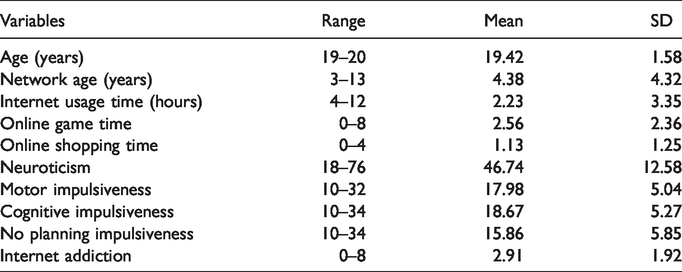
Table 1shows the profiles of the respondents. As shown in Table 2, neuroticism, all dimensions of impulsiveness, and Internet addiction demonstrated a mutual and close correlation.
Descriptive statistics among the variables (N = 455).
Intercorrelations between variables.
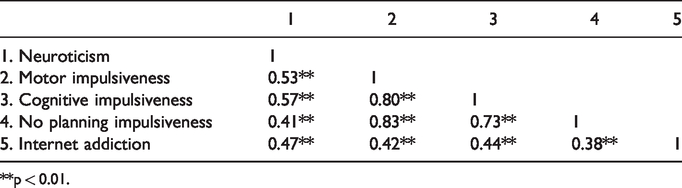
**p < 0.01.
Measurement model
The measurement model contained three latent constructs (neuroticism, impulsiveness, and Internet addiction) and seven observed variables (two item parcels for neuroticism, motor impulsiveness, cognitive impulsiveness, nonplanning impulsiveness, and two item parcels for Internet addiction). A preliminary test of the measurement model was very consistent with the data: χ2/df = 3.17, p < 0.01; RMSEA = 0.07; SRMR = 0.03; and CFI = 0.99. The results were significant for all of the factor loadings for the indexes on the latent variables (p < 0.01), which indicated that the total latent constructs were well demonstrated by their indexes (Figure 1).
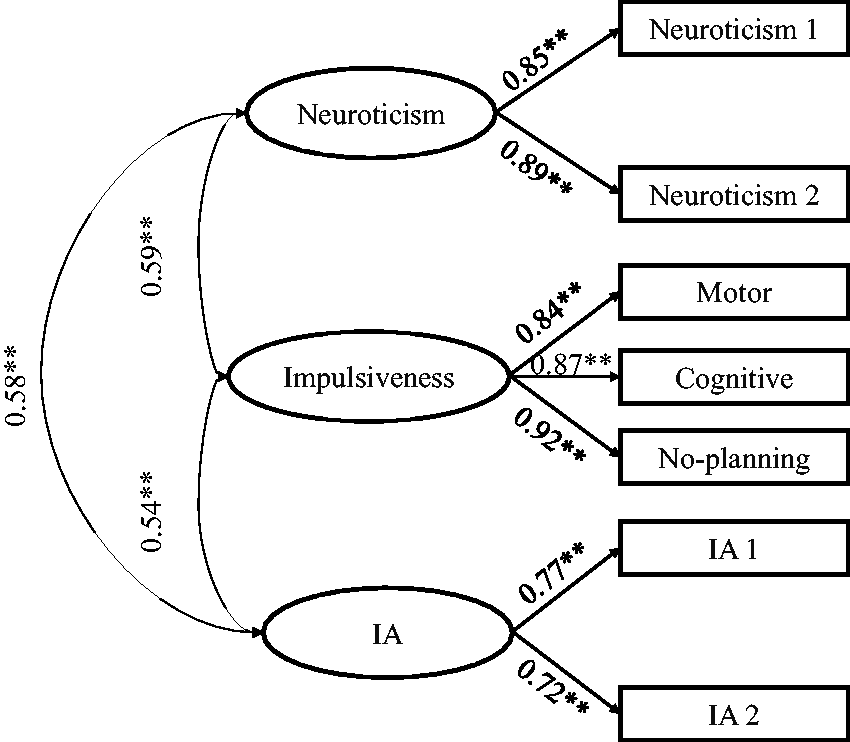
The measurement model. **p<0.01; Neuroticism 1 and Neuroticism 2 were item parcels for neuroticism; IA 1 and IA 2 were item parcels for Internet addiction. IA: Internet addiction.
Structural model
The structural models were tested in the following manner. Initially, the direct impact of the predictor variable (neuroticism) on the dependent variable (Internet addiction) was tested, and the standardized path coefficient was significant (β = 0.60, p < 0.01). A partially mediated structural model was tested, which covered the mediator (impulsiveness), and a direct path from neuroticism to Internet addiction, the outcomes showed a very good fit to the data: χ2/df = 2.76, p < 0.01; RMSEA = 0.06; SRMR = 0.02; and CFI = 0.99 (Figure 2).
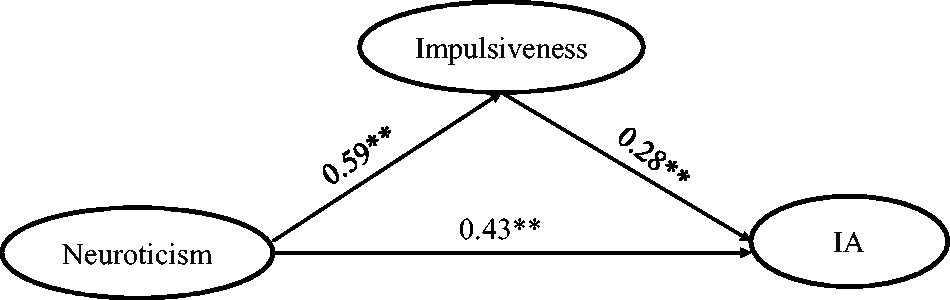
The structure model. **p < 0.01; IA: Internet addiction.
Mediating effect testing
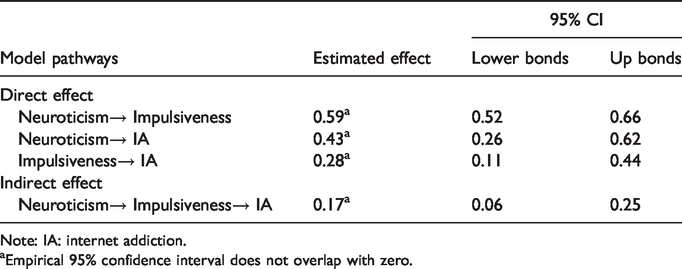
The mediating effect of impulsiveness between neuroticism and Internet addiction was examined to determine statistical significance using the Bootstrap assessment procedure and AMOS (a bootstrap sample of 1000 was specified). Table 3shows the indirect effects and relevant 95% CIs, as well as neuroticism that had a remarkably direct effect on Internet addiction, although impulsiveness was also prominent. The indirect effect of neuroticism on Internet addiction accounted for 27.76% of the total effect.
Direct and indirect effects and 95% confidence intervals for the final model.
Note: IA: internet addiction.
aEmpirical 95% confidence interval does not overlap with zero.
Discussion
In the current study, neuroticism was significantly and positively correlated with impulsivity among college students; both neuroticism and impulsivity significantly predicted Internet addiction, and impulsivity can, in part, mediate the effect of neuroticism on Internet addiction. In earlier studies, the mediating effect of impulsivity on the effect of neuroticism on Internet addiction had not been considered.
The present study found that neuroticism has a positive correlation with Internet addiction—that is, those with higher neuroticism scores were more prone to Internet addiction, which is consistent with the results of previous studies (Evren, Evren, et al., 2019; Evren, Dalbudak, et al., 2019; Hettema et al., 2006; Mehroof & Griffiths, 2010). The catharsis theory of Internet addiction holds that Internet addicts rely on Internet activities in order to release their negative emotions (Bryce & Rutter, 2003). Individuals with higher neuroticism behaved with more intense emotional response and weaker emotional regulation (Peng, Cao, et al., 2019).In response to exciting events, they tended to adopt negative cognition and negative coping strategies (e.g., escape, worry, and rumination) and, furthermore, had more negative emotions such as anxiety and depression, so they had to continually seek ways to address these negative emotions (Muris et al., 2005). For example, when handling fury in reality, those with high neuroticism adopted, for the most part, a hostile or even violent approach, but such an approach raised the costs of social adventures owing to the violation of rules or laws (Walters, 2018; Wang & Peng, 2017; Zhang et al., 2014). Because of the Internet’s entertainment, accessibility, and pluralization, the Internet offers more options for them to handle their negative emotions and requires lower costs for activities (such as Internet games and online shopping). Moreover, individuals with higher neuroticism are more emotionally unstable; they can experience more intense emotions and can unconsciously spend more time during Internet games or shopping, which leads to Internet addiction (Charlton & Danforth, 2010).
Our results suggest that all dimensions of impulsivity are significantly and positively correlated with Internet addiction, which is consistent with the findings of previous studies (Antons & Brand, 2018; Cao et al., 2007; Evren, Dalbudak, et al., 2019; Mottram & Fleming, 2009). Impulsivity manifests as the lack of planning (especially long-term planning), the focus on immediate interests, and the lack of delayed satisfaction (Antons & Brand, 2018). Internet addicts immerse themselves in the Internet for short-term pleasant sensations and ignore the long-term damages of the Internet with regard to learning, work, health, and social ability. Self-immersion in the Internet to the detriment of other aspects of life can be considered an impulsive behavior. Moreover, impulsivity is usually related to low self-control; the occurrence of Internet addiction is essentially the lack of control over Internet impulsivity behaviors (Li et al., 2019). Individuals with higher impulsivity are unable to resist Internet seduction or overcome the difficulty of Internet addiction rehabilitation, which leads to further Internet addiction.
Our results indicate that neuroticism is significantly and positively correlated with impulsivity and that impulsivity, in part, mediates the effect of neuroticism on Internet addiction, which are the major innovations and theoretical contributions of our study. Neuroticism and impulsivity are two stable personality traits that share much in common, especially because they demonstrate similar emotional characteristics. In particular, neurotic individuals are usually impulsive, so the two traits are closely related. Thus, it seems reasonable that impulsivity mediates the effect of neuroticism on Internet addiction. Our study shows that neuroticism has direct and indirect effects on Internet addiction, which suggest that neuroticism may affect Internet addiction through other mechanisms. For instance, according to the theory of social demand compensation, individuals with higher neuroticism are more likely to face various interpersonal troubles, which complicate the satisfaction of the social intercourse demand. The Internet offers them an appropriate compensation environment and lowers their social intercourse anxiety. Furthermore, neuroticism can also affect Internet addiction through other mediating variables such as social anxiety and loneliness (Caplan, 2006; Mehroof & Griffiths, 2010; Peng et al., 2013).
In this study, we particularly validated the mediating effect of impulsivity between neuroticism and Internet addiction, which contributes to the theory and knowledge of the causes of Internet addiction. Yet, this research has several limitations. First, this cross-sectional research did not uncover the causality between the variables. In particular, to determine whether the relationship between neuroticism and impulsivity is a parallel or sequence relation warrants additional investigation. We believe that neuroticism is more stable than impulsivity and makes individuals experience more positive–negative emotions inside and outside cyberspace. Such intense emotional experience may be related to impulsivity that is expressed by low self-control and the pursuit of immediate enjoyment (Gardiner et al., 2015; Mao et al., 2018). Thus, we suggest that neuroticism and impulsivity exist in an ordered relationship; yet, this does not explain the causality between them. Second, we treated Internet addiction as a continuous variable and regarded individuals with high scores in this variable as real “addicts”; however, the majority of subjects did not fall within the official definition of physiological abuse of the Internet or Internet addiction. Thus, although we selected Internet addiction as a variable and used Internet addiction evaluation tools, we actually investigated the degrees of problematic Internet use with college students. Third, we targeted only college students. Whether our findings can be extended to other groups warrants additional validation.
