







Abstract
This study evaluates a hypothesized model describing the cognitive and emotional processes of childhood abuse and its influence on life satisfaction and explores the moderating effect of emotional expressivity in Korean young adults. The mediating roles of early maladaptive schema and state anxiety are explored, and the level of life satisfaction is compared according to the emotional expressivity level. A total of 550 young adults completed self-reported questionnaires, including Childhood Trauma Questionnaire (CTQ-SF), Young Schema Questionnaire (YSQ-SF), State-Trait Anxiety Inventory (STAI-Y), Satisfaction With Life Scale (SWLS), and Emotional Expressivity Scale (EES). The mediating roles of early maladaptive schema and state anxiety between childhood abuse and life satisfaction are confirmed. In the low emotional expressivity group, the double-mediation effect of early maladaptive schema and state anxiety is confirmed, whereas for the high emotional expressivity group, the mediating roles of each early maladaptive schema and state anxiety are confirmed, as well as the double-mediation effect. Moreover, the high emotional expressivity group showed higher life satisfaction. The study results imply that even though expressing emotions does not result in immediate mood elevation, but eventually leads to higher life satisfaction. The implications, limitations, and suggestions are discussed.
Introduction
Recent studies indicate that the number of child abuse victims is continuously increasing worldwide (Nurius et al., 2015). The South Korean Ministry of Health and Welfare found 10,027 child abuse cases in 2014 and 24,604 in 2018, a staggering 2.4 times increase for the past five years (Ministry of Health and Welfare, 2019). According to the meta-analysis with a worldwide non-clinical sample, the prevalence rate was 16.3% for physical neglect, 22.6% for physical abuse, and 18.4% for emotional neglect in 2011 (Stoltenborgh et al., 2012, 2013a, 2013b). With the advent of in-depth literature on the intricate mechanisms of child abuse inherited over generations (Ertem et al., 2000; Greene et al., 2020), child abuse became a responsibility of both society and country that requires intervention.
Childhood trauma or adversity should be dealt with as early as possible so that the survivors could healthily go through developmental tasks in later lives. Especially important is early adulthood in human development. As early adulthood marks the first step of being physically, emotionally, and economically independent from their parents and becoming a whole individual, internal factors like personality, values, and external factors like physical separation and economic independence cause major changes in one’s life. Erikson (1963) called the psychosocial crisis people experience in early adulthood ‘intimacy versus isolation.’ That is, people are granted the task of forming intimate relations with others, but they develop the feeling of isolation if they fail to do so. In adolescence, teenagers are faced with a task to form their self-identity. If self-identity is not well established in adolescence, it becomes difficult to build a positive self-identity in early adulthood, rendering it challenging to create genuine intimacy with others (Erikson, 1963). This implies unsuccessfully dealt developmental stages are unlikely to lead to positive stages later on, which can be witnessed in empirical research. Adults who were unsuccessful in dealing with developmental crisis due to experiences of trauma or adversity in childhood are likely to exhibit higher levels of depression (Heim et al., 2008), panic disorder severity (Zou et al., 2016), anxiety sensitivity (Martin et al., 2014), somatization (Güleç et al., 2013), more early maladaptive schema (Gay et al., 2013), and lower life satisfaction (Mosley-Johnson et al., 2019). Along the same line of thought, research about the influence of childhood abuse on adulthood began to flourish since the 2000s. According to previous research, childhood abuse committed by adults or significant others could result in lasting effects into adulthood, including depression, anxiety (Scott et al., 2012), emotional dysregulation (Heleniak et al., 2016), suicidal tendencies (Bertule et al., 2021), physical disorders like diabetes and lung cancer (Goodwin & Stein, 2004), mood disorder (Ratanatharathorn et al., 2021), substance abuse (Green et al., 2010), and other psychological disorders (McLaughlin et al., 2012), which makes it difficult for them to grow into healthy functioning adults (Kong et al., 2019; Labella et al., 2018).
According to Foa and Cahill (2001), immediately after traumatic experiences like abuse, survivors develop maladaptive perception and cognition toward themselves for not coping well with the stress, called early maladaptive schema, which sustains their post-traumatic stress disorder. Early maladaptive schema is formed and developed by repeated discouragement and dissatisfaction of core emotional desires and painful, traumatic experiences such as abandonment, abuse, neglect, and refusal (Young et al., 2003). Young et al.’s (2003) theory suggests that maladaptive schema developed due to childhood trauma and adversity causes personality issues and various other psychological disorders. Furthermore, early maladaptive schema plays a paradoxical role in leading a person to repeat harmful childhood situations even in adulthood (Kwon, 2009), and the perception of self, internalized in childhood, has a critical influence on psychological adaptation in adolescence and adulthood (Çelik & Odacı, 2012; Hymowitz et al., 2017). According to the previous research, negative self-concept triggered by maladaptive schema resulted from a traumatic childhood experience is related to aggression, depression, anxiety, and interpersonal problems (Crawford & Wright, 2007; Gong & Chan, 2018; MacDonald et al., 2015).
In psychology, knowing and expressing one’s emotions is considered essential to individual adaptation (Eldeleklioglu, & Yildiz, 2020; Peralta et al., 2020). However, survivors of childhood trauma have difficulty expressing their emotions (Pi
As mentioned earlier, childhood abuse hinders one’s psychological functioning even in adulthood. Being abused as a child triggers early maladaptive schema, which results in high anxiety in adulthood, eventually undermining one’s life satisfaction. To confirm the protective effect of emotional expressivity on the cognitive and emotional processing of childhood trauma, the present study investigated the relationship between childhood abuse, early maladaptive schema, state anxiety, life satisfaction, and the role of emotional expressivity in young adults. We hypothesized that childhood abuse and life satisfaction would be mediated by early maladaptive schema and state anxiety sequentially, and emotional expressivity would work as a protective factor.
Method
Participants
632 Korean young adults from undergraduate courses offered at large urban universities participated in online and offline surveys. Of these, 23 packets were excluded for extensive missing data, and 59 packets were excluded from analysis because of the violation of normality by two standard deviations. The final sample of participants (N = 550) ranged in age from 18–30, with a mean age of 21.9 (SD = 2.63). Half of the participants were females (N = 275), and the other half were males (N = 275).
Measures
Childhood Trauma Questionnaire-Short Form
The Childhood Trauma Questionnaire-Short Form (CTQ-SF) was developed by Bernstein and Fink (1998) to measure early stressors and was adapted by Y. K. Lee (2006) and validated by E. J. Kim and Kim (2010) for Koreans. CTQ-SF is a 20-item, consists of 4 subscales: physical abuse (e.g., “I was physically abused”), physical neglect (e.g., “My family did not take me to the hospital when I was sick”), emotional abuse (e.g., “I was emotionally abused”), and emotional neglect (e.g., “My family felt close to each other”-reverse coded). Respondents evaluate statements in a 7-point Likert-type scale, ranging from ‘never’ to ‘often’. A higher total score indicates the more severe level of abuse or neglect. In E. J. Kim and Kim’s (2010) study, which only used abuse questionnaires like this study, the internal consistency (Cronbach’s alpha) was .89. In this study, the internal consistency (Cronbach’s alpha) was .80.
Young Schema Questionnaire-Short Form
The Young Schema Questionnaire-Short Form (YSQ-SF) was developed by Young (1990) to measure the extent of early maladaptive schemas and was validated and adapted by Baranoff et al. (2006). YSQ-SF consists of 75 items with a total of 15 maladaptive schema domains, but in this study, 6 domains (emotional deprivation, Abandonment, Mistrust/Abuse, Social Isolation, Defectiveness/Shame, and Vulnerability to harm or illness) that are related to childhood trauma (M. Y. Cha, 2010). A total of 30 questionnaires with 5 items in each domain were measured in a 6-point Likert-type scale, ranging from ‘completely disagree’ to ‘completely agree.’ Examples of the items are “I feel isolated from others,” “I am worried that someone will attack me,” and “Someone will betray me.” A higher score indicates having more early maladaptive schemas. Item parceling (Little et al.,2002) was conducted by the content-based approach (S. Y. Kim, 2016). In M. Y. Cha’s (2010) study, the internal consistency (Cronbach’s alpha) was .96, and in this study, the internal consistency (Cronbach’s alpha) was .94.
State-Trait Anxiety Inventory-Y
The State-Trait Anxiety Inventory-Y (STAI-Y) was developed by Spielberger(1983) to measure the anxiety that is related to the adverse circumstances in a specific time and was adapted and validated by D. W. Han et al. (1996). STAI-Y consists of two subscales, trait anxiety and state anxiety. In this study, the state anxiety subscale was used (e.g., “I am nervous,” “I am confused,” and “I am worried”). It consists of 20 items, measured by 4-point Likert-type scale, ranging from ‘Not at all’ to ‘Very much so.’ Item parceling (Little et al., 2002) was conducted by the factorial algorithm method (Landis et al., 2000), resulting in two highly correlated parcels. The two parcels were divided into two parcels each, resulting in four parcels. In D. W. Han et al.’s (1996) study, the internal consistency (Cronbach’s alpha) was .91, and in this study, the internal consistency (Cronbach’s alpha) was .94.
Satisfaction with Life Scale
The Satisfaction with Life Scale (SWLS) was developed by Diener (1984) to measure the level of satisfaction with life and adapted and validated by Cho and Cha (1998). SWLS consists of 5 items (e.g., “I am satisfied with my life,” “So far, I have gotten the important things in my life,” and “In most ways my life is close to my ideal”) with 7-point Likert-type scale, ranging from ‘Strongly disagree’ to ‘Strongly Agree.’ A higher total score indicates better life satisfaction. In G. H. Cha’s (2004) study, the internal consistency (Cronbach’s alpha) was .77, and in this study, the internal consistency (Cronbach’s alpha) was .86.
Emotional Expressivity Scale
The Emotional Expressivity Scale (EES) was developed by Kring et al. (1994) to measure the extent of how much people outwardly display their emotions and was adapted and validated by J. W. Han (1997). EES consists of 17 items (e.g., “I think of myself as emotionally expressive,” “People can read my emotions,” and “I am able to cry in front of other people”) with 6-point Likert-type scale, ranging from ‘Never true of me’ to ‘Always true of me.’ In this study, two groups were divided by the median as ‘high emotional expressivity group’ and ‘low emotional expressivity group.’ In Lim’s (2004) study, the internal consistency (Cronbach’s alpha) was .89, and in this study, the internal consistency (Cronbach’s alpha) was .92.
Procedure
This study was approved by the Institutional Review Board of the Catholic University of Korea. Participants were informed about the survey beforehand by their professors and were given choices regarding whether or not to participate in the survey. Before distributing the papers, participants were informed of the purpose of the survey, confidentiality, and voluntary participation. Those who agreed were asked to fill out the survey at the beginning or end of the lectures, which took 10 to 15 minutes. Two master’s students who were trained in research distributed the papers and collected them as participants were finished. Confidentiality Agreement Forms and Individual Information Forms were also distributed for demographic information and were destroyed after completing the research. Participants received small prizes for participation.
Data analysis
In this study, SPSS 21.0 and AMOS 22.0 were used for statistical analysis, and the hypotheses were verified by the following steps. First, participants’ descriptive statistics were computed for demographic information. Second, to secure the data’s objectivity, internal consistencies (Cronbach’s alpha) of each variable were calculated. Third, to explore the relationships between CTQ-SF, YSQ-SF, STAI-Y, SWLS, and EES, Pearson’s correlation coefficients were calculated. Fourth, indicators for latent variables were constructed through item parceling. Fifth, verified the fit of the measurement model through confirmatory factor analysis. Sixth, structural equational modeling (SEM) was used to confirm the research model to explore the structural relationships between the variables and verified the model fit and the individual parameter estimates. Seventh, using Bootstrapping (Shrout & Bolger, 2002), significances of the indirect effects were explored to confirm the mediational effect of the variables in the structural model. Eighth, multi-group analysis was conducted to examine the differences in YSQ-SF, STAI-Y, and SWLS according to EES level. For the analysis, after confirming the satisfaction of the configural invariance and metric invariance, the difference of the path coefficients between the groups was verified. Lastly, a t-test was conducted to explore the difference in SWLS according to the EES level.
Results
Preliminary analysis
The mean scores for the CTQ-SF, YSQ-SF, STAI-Y, SWLS, and EES were 1.35 (SD = .38), 1.80 (SD = .62), 2.00 (SD = .53), 4.36 (SD = 1.18), and 3.78 (SD = .85), respectively. According to the descriptive statistics of the variables, all the variables’ absolute values of skewness were lower than 2 and the absolute values of kurtosis were lower than 3, meeting the criterion of Curran et al. (1996)’s multivariate normality.
Correlation analysis
Correlation analyses were conducted to explore the relationships of the variables. According to the result, CTQ-SF was positively correlated with YSQ-SF, STAI-Y, and EES and negatively correlated with SWLS. YSQ-SF was positively correlated with STAI-Y and negatively correlated with SWLS and EES. SWLS was positively correlated with EES (Table 1).
Mean, standard deviation, and the correlation between main variables (N = 550).
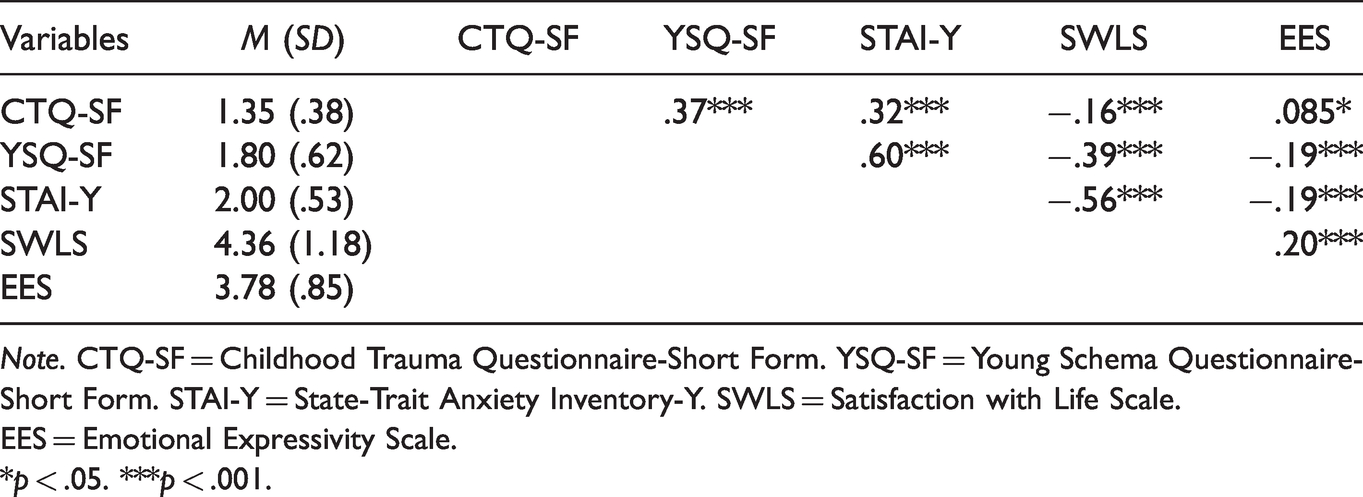
Note. CTQ-SF = Childhood Trauma Questionnaire-Short Form. YSQ-SF = Young Schema Questionnaire-Short Form. STAI-Y = State-Trait Anxiety Inventory-Y. SWLS = Satisfaction with Life Scale. EES = Emotional Expressivity Scale.
*p < .05. ***p < .001.
Measurement model
The measurement model consists of three latent factors (YSQ-SF, STAI-Y, and SWLS) and 16 observed variables. The preliminary analysis provided a good fit to the data.
Structural model
To test the structural relationships of the variables, SEM was conducted. The hypothesized model showed a good fit to the data:
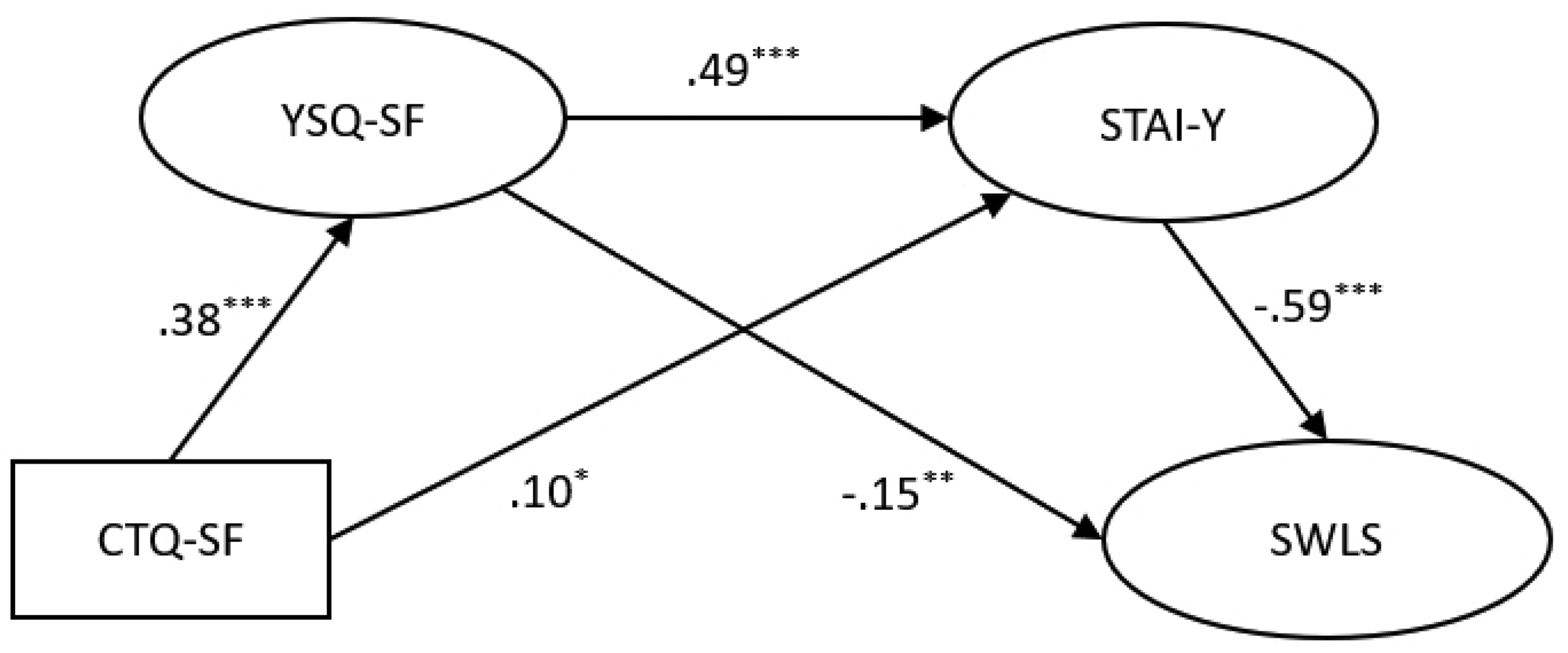
Structural model of the total group (N = 550). Note. CTQ-SF = Childhood Trauma Questionnaire-Short Form. YSQ-SF = Young Schema Questionnaire-Short Form. STAI-Y = State-Trait Anxiety Inventory-Y. SWLS = Satisfaction with Life Scale. EES = Emotional Expressivity Scale. *p < .05. **p < .01. ***p < .001.
Assessment of mediation
The significance of indirect effects was explored to test the hypothesis that YSQ-SF and STAI-Y would partially mediate the childhood abuse and life satisfaction relationship with bootstrapping (5,000 replications; Shrout & Bolger, 2002). CTQ-SF was found to have a significant indirect effect on SWLS through YSQ-SF (B = −.17,995% CI = −.303, −.072) and STAI-Y (B = −.17,895% CI = −.340, −.030). CTQ-SF also found to have a significant indirect effect on SWLS through both YSQ-SF and STAI-Y (B = −.34,495% CI = −.476, −.246) successively (Table 2).
Results of multiple mediation analyses.
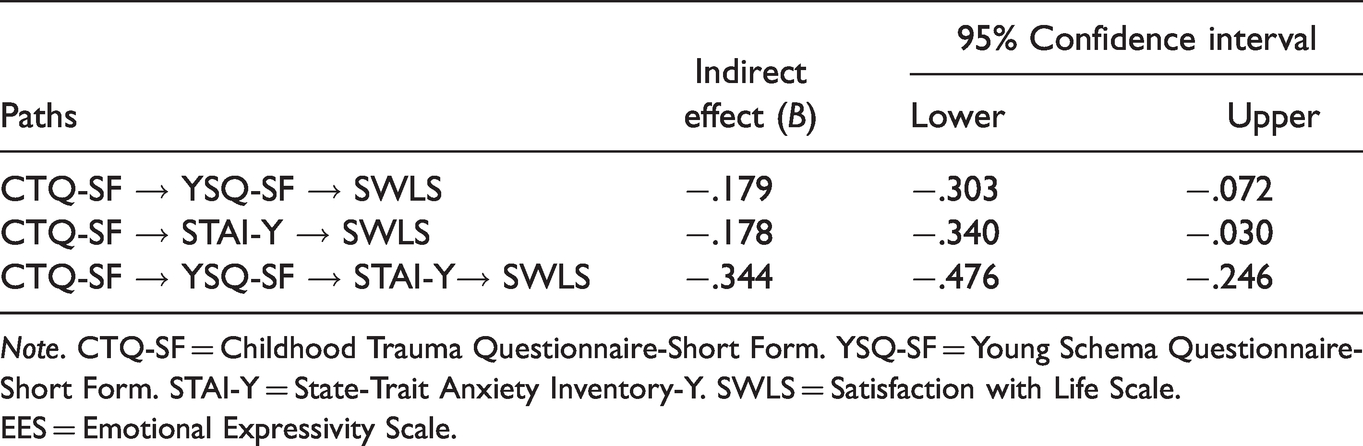
Note. CTQ-SF = Childhood Trauma Questionnaire-Short Form. YSQ-SF = Young Schema Questionnaire-Short Form. STAI-Y = State-Trait Anxiety Inventory-Y. SWLS = Satisfaction with Life Scale. EES = Emotional Expressivity Scale.
Multi-group analysis
First, high-EES and low-EES groups were examined to test the metric invariance’s configural invariance. An unconstrained model that allows all the parameters to vary across both groups freely and a fully constrained model that constrains all the parameters equally across both groups were compared. Both models showed a good fit for the data,
Therefore, as it is indicated that the two groups are different in the model, path differences were further examined (Table 3). The exploration of model difference indicated that EES moderated the path of CTQ-SF to SWLS. Furthermore, t-test was conducted to compare CTQ-SF, YSQ-SF, STAI-Y, and SWLS according to the level of EES (Table 4). The result indicated significant differences in YSQ-SF, STAI-Y, and SWLS levels between the low-EES and high-EES groups.
Results of multi-group analysis (high-EES vs. low-EES).
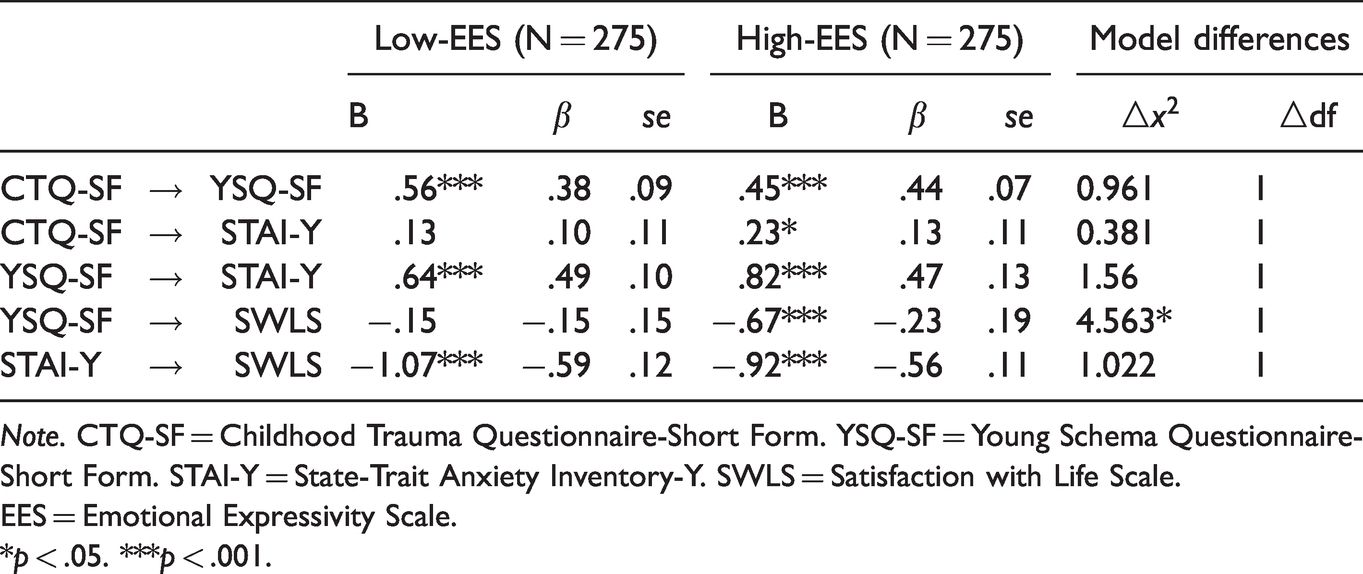
Note. CTQ-SF = Childhood Trauma Questionnaire-Short Form. YSQ-SF = Young Schema Questionnaire-Short Form. STAI-Y = State-Trait Anxiety Inventory-Y. SWLS = Satisfaction with Life Scale. EES = Emotional Expressivity Scale.
*p < .05. ***p < .001.
Group comparisons of variables according to the level of EES.
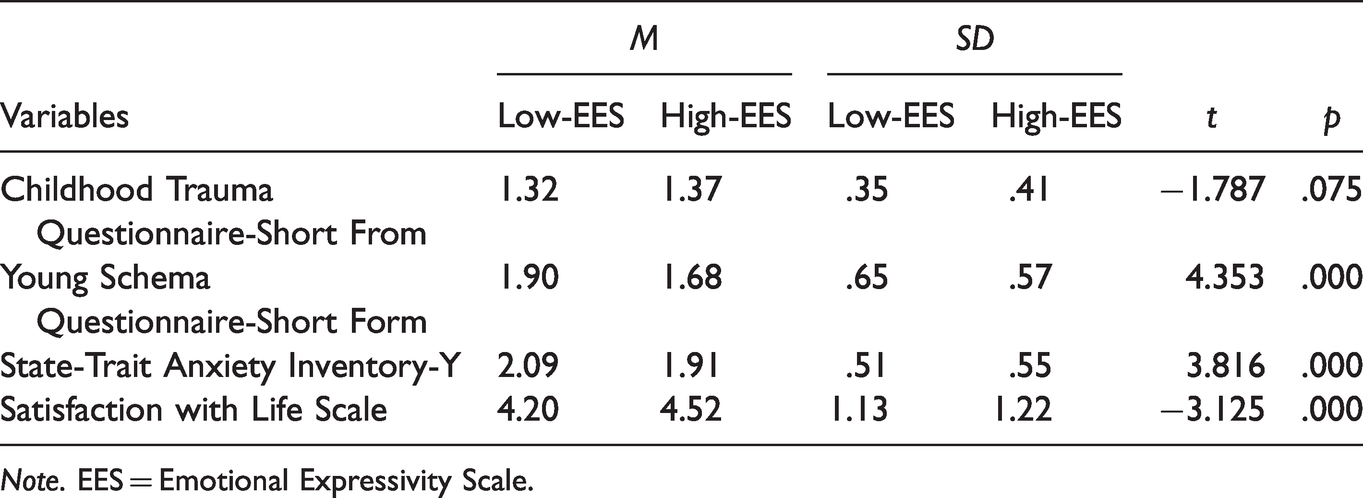
Note. EES = Emotional Expressivity Scale.
Finally, the indirect effects of YSQ-SF and STAI-Y between CTQ-SF and SWLS were assessed once again according to the level of EES (Table 5). Phantom variables were used for bootstrapping (5,000 replications; Shrout & Bolger, 2002). The results indicated that in low-EES group, the double mediation effect of YSQ-SF and STAI-Y between CTQ-SF and SWLS was confirmed. In high-EES group, YSQ-SF and STAI-Y each mediated relationship between CTQ-SF and SWSL, and the double mediation effect was also established (Figure 2).
Mediation analysis according to the level of EES.
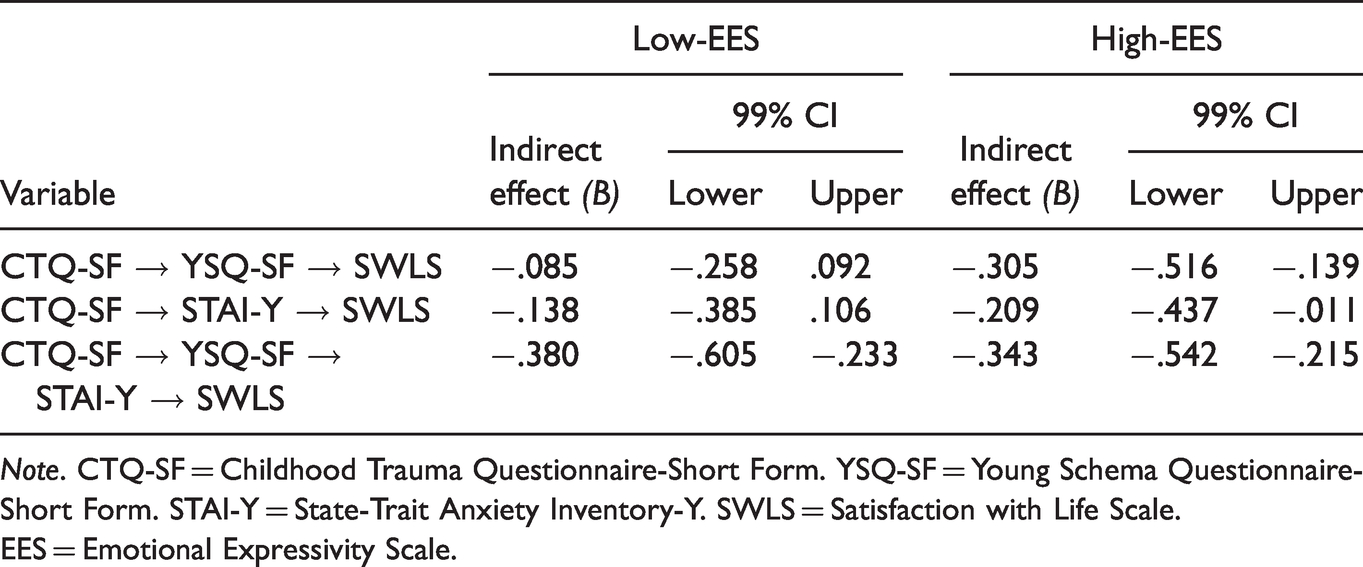
Note. CTQ-SF = Childhood Trauma Questionnaire-Short Form. YSQ-SF = Young Schema Questionnaire-Short Form. STAI-Y = State-Trait Anxiety Inventory-Y. SWLS = Satisfaction with Life Scale. EES = Emotional Expressivity Scale.
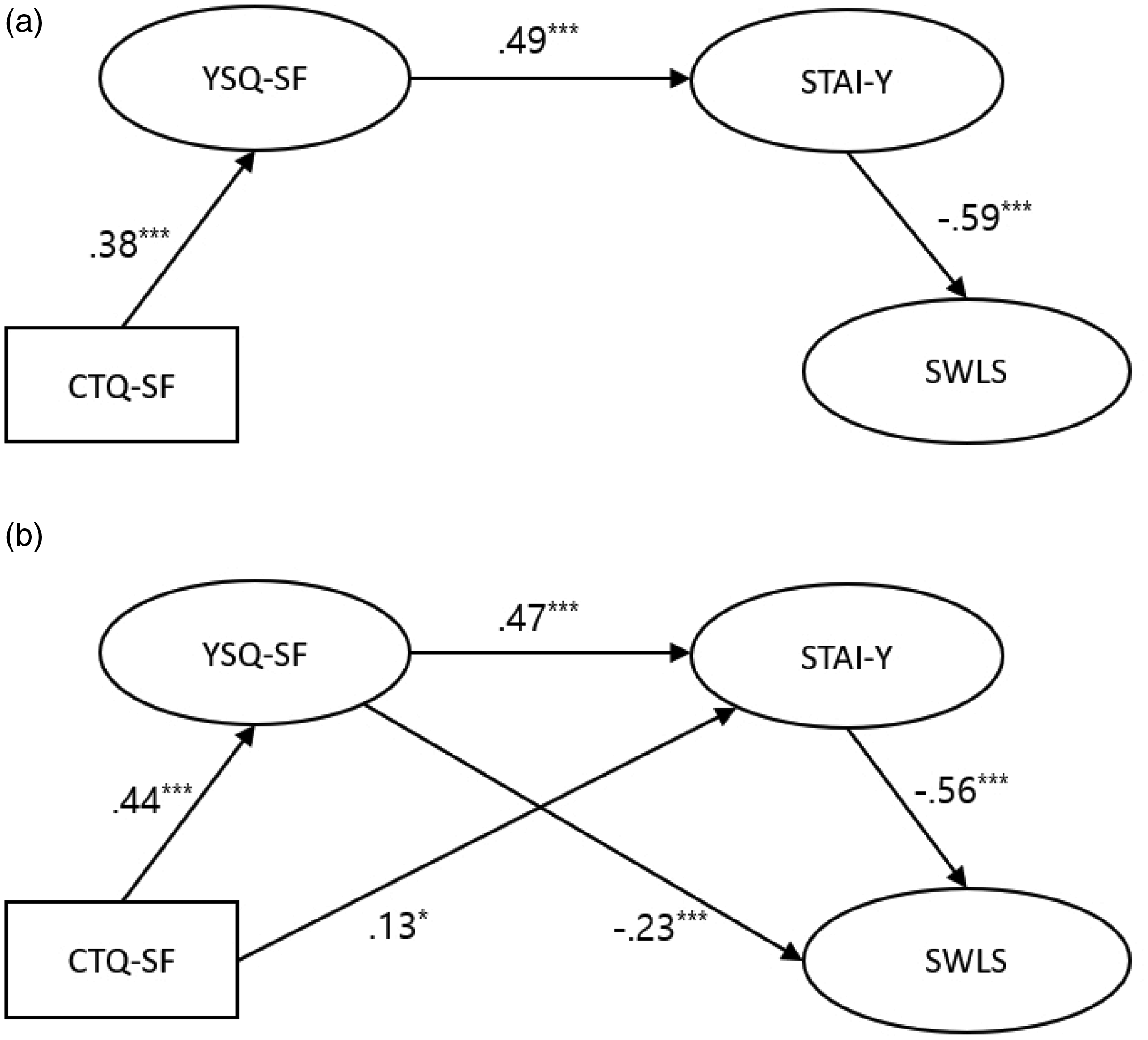
Structural model according to the level of EES (N = 2,75,275). Note. CTQ-SF = Childhood Trauma Questionnaire-Short Form. YSQ-SF = Young Schema Questionnaire-Short Form. STAI-Y = State-Trait Anxiety Inventory-Y. SWLS = Satisfaction with Life Scale. EES = Emotional Expressivity Scale. (a) Model: low-EES. (b) Model: high-EES. *p < .05. **p < .01. ***p < .001.
Discussion
The primary purposes of this study were to investigate the mediational effect of early maladaptive schema and state anxiety between childhood abuse and life satisfaction and the moderating effect of emotional expressivity in young adults. The results confirmed the mediational effect of early maladaptive schema and state anxiety and the protective effect of emotional expressivity. The study results align with the previous research and indicate that the cognitive and emotional variables play an essential role between childhood abuse and life satisfaction (Fagundes et al., 2012; Simon et al., 2009; Skarupski et al., 2016; Xiang et al., 2020). The life satisfaction level of those who have experienced childhood abuse is dependent on how the individuals process their experience of trauma (Pierce et al., 2018; Xiang et al., 2020). The early maladaptive schema formed as a result of childhood abuse prompts individuals to negatively perceive the events or circumstances, which in turn degrades their quality of life. Furthermore, anxiety, the dysfunctional emotion triggered by childhood abuse, hinders functioning throughout various areas in one’s life, eventually reducing the quality of life (Rehan et al., 2017). Moreover, maladaptive schema created by childhood trauma triggers negative thoughts toward self, others, and the world, threatening one’s stability (Rezaei et al., 2016). This causes anxiety, which again degrades the quality of life (Beutel, 2009; Mahmoud et al., 2012; Serin et al., 2010). As such, the consecutive cognitive and emotional processes of childhood abuse survivors influence their quality of life.
The results of the T-test and multi-group analyses showed no significant difference in childhood abuse experience according to the level of emotional expressivity. However, the group with higher emotional expressivity exhibited meaningfully less early maladaptive schema, lower state anxiety, and higher life satisfaction. In the low emotional expressivity group, early maladaptive schema did not influence life satisfaction, but early maladaptive schema showed a negative impact on life satisfaction in the high emotional expressivity group. The influence childhood abuse had on state anxiety was not significant in the low emotional expressivity group and was meaningful in the high emotional expressivity group, although the difference between the two paths was not statistically significant. The result implies that regardless of the emotions’ positivity or negativity, expressing emotions does not always have an unconditionally positive influence. Expressing more negative emotions prompts deeper and more frequent awareness of negative emotions, which triggers negative thoughts and consecutively lowers individuals’ quality of life (Lü & Wang, 2012; Sahraee et al., 2011). Also, the low emotional expressivity group may not have experienced a direct influence on their life satisfaction despite having more maladaptive schemes than the high emotional expressivity group because their awareness is focused on things other than emotions as they express their negative emotions less frequently. However, the high emotional expressivity group exhibited higher life satisfaction compared to the low emotional expressivity group. This implies that expressing emotions, though it may be uncomfortable at the time and makes one digest the negative feelings directly, ultimately poses a positive effect on life satisfaction levels. The result is in line with the previous research that shows people with high emotional expressivity having a more heightened sense of well-being (Burgin et al., 2012; Saxena & Mehrotra, 2010). That is, expressing emotions prompts individuals to directly face them without avoiding, helping them not be overwhelmed by emotions. Despite the emotional pain it may cause, expressing emotions help individuals resolve feelings through catharsis, seek problem-solving solutions, and pursue social support, eventually leading them to live a healthy and adaptive life (Gohm, 2003; Kopp, 1989).
Mediation analysis of the two groups indicates that for the low emotional expressivity group, rather than childhood abuse experiences directly influencing anxiety, early maladaptive schema triggers anxiety, lowering their quality of life. The fact that there was no direct influence of childhood abuse on anxiety in the low emotional expressivity group even though they feel more anxious than those with high emotional expressivity implies that early maladaptive schema has a powerful impact on those with low emotional expressivity. The maladaptive schema, formed by childhood abuse, triggers cognitive errors and automatic thoughts, causing anxiety (Boyda et al., 2018; Lumley & Harkness, 2007). The unresolved emotion of anxiety that was not expressed reduces their quality of life. For the high emotional expressivity group, expressing emotions did not always greatly alleviate the early maladaptive schema and anxiety, but ironically, those with higher emotional expressivity demonstrated higher satisfaction in life. The result is in line with the previous research. Choi’s (2009) study, which analyzes the mediational effect of early maladaptive schema in the relationship between childhood abuse and depression, states that the structural model fully mediating the relationship between childhood abuse and depression is more suitable than the model that partially mediates it. That is, early maladaptive schema plays a decisive role in the relationship between childhood abuse and subjective well-being. Also, according to the research on females with self-injury experience, those with childhood abuse experience did not express their emotions, despite having experienced positive and negative emotions at higher intensities (Gratz, 2006). It can be presumed that suppressed negative emotions like anxiety due to inexpressivity are being manifested as self-injury. Moreover, according to a study conducted with Korean participants, people with high emotional intensity but lower inclination to express emotions received less social support and had more physical illnesses (J. I. Lee et al., 1997). Such research concludes that expressing emotions may incur negative emotions at the time but ultimately poses a positive impact on individuals’ sense of well-being.
The implications of this study are as follows. First of all, this research targets people in early adulthood who have experienced childhood abuse, highlighting the importance of childhood experiences for patients and clients who overlook their childhood experiences by overly focusing on the current issues. Even when the survivors currently experiencing anxiety due to early maladaptive schema do not categorize their experiences like abuse or trauma, the professionals may consider the possibility of childhood abuse experiences, look deeper into the childhood, to eventually track down the source and treat them efficiently. Second, Young (1990) claimed that emotions and thoughts are triggered by one’s judgment about the situation, not induced by external circumstances. The claim shares the same view with Beck (1991)’s Cognitive Therapy, which is commonly utilized in clinical settings. This study has empirically proved Young (1990)’s assertion that the early maladaptive schema caused by childhood trauma triggers anxiety, thereby empirically proving the efficacy of the Cognitive Therapy.
The limitations for this study and suggestions for future research are as follows. First, since more than 80% of the research subjects were college students, there may be barriers to generalizing the results to ordinary adults or clinical populations. Secondly, this research asked the subjects to reminisce about their childhood trauma, focusing on the influence childhood abuse has on the early adult stage. Furthermore, asking about the emotional expressivity after age 18, this research focused on the current life satisfaction levels and based the causality in temporal order. However, inter-correlation among variables is commonly high in social science, and the causality in this research cannot be guaranteed as it is based on a reminiscent and cross-sectional design. Thirdly, this study’s participants were South Koreans, which implies that the results may be attributable to the unique culture of collectivism found in Korea. The results may not be universally applicable to other countries since Koreans traditionally consider containing emotions rather than expressing them is a virtue.
Based on the limitations of this study, the researchers’ suggestions for future studies are as follows. First, further research should be conducted targeting various groups, including non-clinical populations with different nationalities and racial groups, different age groups, and clinical populations, to consider the possibility of generalization and reverify the results. Second, longitudinal studies should be conducted to verify the long-term impact of childhood abuse. Lastly, as each country and race has different cultural values regarding emotional expressivity, its protective effect should be explored with diverse populations.
Footnotes
Declaration of Conflicting Interests
The author(s) declared no potential conflicts of interest with respect to the research, authorship, and/or publication of this article.
Funding
The author(s) received no financial support for the research, authorship, and/or publication of this article.
