







Abstract
The Basic Psychological Needs Scale (BPNS) is still being used but validation studies that applied confirmatory factor analysis (CFA) revealed that the scale has inadequate psychometric properties. CFA is based upon restrictive statistical assumptions that may result in biased parameter estimates. There are statistical developments that overcome these limitations. This study explored the factorial validity of the scale in three South African student samples who completed the English (n = 326), Afrikaans (n = 478), or Setswana (n = 260) version of the BPNS. CFA, bifactor CFA, exploratory structural equation modelling (ESEM) and bifactor ESEM were applied to the data. The three-factor bifactor ESEM model yielded the best fit, but model fit was inadequate for the English and Setswana versions, and almost adequate for the Afrikaans version. After removal of problematic items based on substantive reasons, high modification indices, and high expected parameter change values, reduced bifactor ESEM models displayed adequate fit. The general factor showed sufficient reliability scores for all language versions. Subscales exhibited insufficient reliability scores, except for the Competence and Relatedness subscales of the BPNS-Afrikaans. A reduced three-factor bifactor ESEM model was partially metric invariant for the English and Afrikaans groups. The BPNS-Afrikaans showed potential for use, but alternative measures of basic psychological needs should be considered for the English and Setswana groups in the current context. The cross-cultural application of basic psychological needs in a South African context is questioned. An emic approach to exploring and conceptualising basic psychological needs in African contexts is recommended.
Keywords
Introduction
Basic psychological needs theory (BPNT), a subtheory of self-determination theory (SDT, Deci & Ryan, 2000), proposes that a person will experience well-being and optimal functioning to the extent that the environment supports the satisfaction of three innate psychological needs. Autonomy refers to the need for volition and to experience integration, freedom, and self-determination. When the need for autonomy is satisfied, a person will experience a sense of authenticity and self-endorsement, but when the need is frustrated a person may experience conflict and feel pressured to act in a certain way (Rigby & Ryan, 2018; Vansteenkiste et al., 2020). Competence refers to the need to feel competent when performing or mastering tasks and to be successful at environmental interaction. This need is satisfied when a person feels capable to engage in activities and can apply and develop skills when performing tasks. When this need is frustrated a person may experience feelings of failure and ineffectiveness (Rigby & Ryan, 2018; Vansteenkiste et al., 2020). Relatedness refers to the need for connectedness and belongingness (Deci & Ryan, 2000; Deci et al., 2017; Rigby & Ryan, 2018). When the need for relatedness is satisfied a person will have a sense of connectendess and significance, but a sence of social exclusion and loneliness may ensue when the need is frustrated (Rigby & Ryan, 2018, Vansteenkiste et al., 2020). These three needs are the essential psychological nutriments for continuing “psychological growth, integrity, and well-being” (Deci & Ryan, 2000, p. 229; see also Vansteenkiste et al., 2020); and for these to ensue, all three psychological needs must be satisfied since thwarting of these needs, as indicated above, will lead to compromised levels of well-being and nonoptimal functioning (Deci & Ryan, 2000; Olafsen et al., 2017; Vansteenkiste et al., 2020).
Universality of basic psychological needs
According to SDT, basic psychological needs apply universally and the effects of psychological need satisfaction versus thwarting will be seen in all people, regardless of cultural background (Deci & Ryan, 2000; Rigby & Ryan, 2018). However, Deci and Ryan (2000) acknowledged that there may be individual differences in the degree of psychological need satisfaction, and in the outcomes associated with the degree of psychological need satisfaction, in various social contexts. They further indicated that, due to cultural differences, there may be variations in the pathways to psychological need satisfaction.
Findings from some studies that explored associations between psychological need satisfaction/thwarting and indicators of well-being/ill-being suggested that at least the outcomes associated with basic psychological need satisfaction/thwarting replicate across social contexts (e.g., Chen et al., 2015; Church et al., 2012).
A scale validation study by Schutte et al. (2018) suggested that the three basic psychological needs may not necessarily be discerned in some cultures, that the needs may manifest in a different way in different cultures, or that the Basic Psychological Needs Scale (BPNS; Centre for SDT, n.d.; Gagné, 2003) does not capture the distinction between the three needs. It is therefore important that measures of basic psychological needs are validated across different cultural contexts. The Basic Psychological Needs Scale (BPNS; Centre for SDT, n.d.; Gagné, 2003) is one such measure and will be introduced in the next paragraph.
The Basic Psychological Needs Scale: Psychometric properties and factor structure
The Basic Psychological Needs Scale (BPNS; Centre for SDT, n.d.; Gagné, 2003) is a 21-item measure with an a priori three-factor structure (Autonomy, Competence, Relatedness) that measures basic psychological need satisfaction in a general context. The BPNS was adapted by Gagné (2003) from a measure of basic psychological need satisfaction in the work domain that was developed by Ilardi et al. (1993) to be applicable to a general context. Despite the existence of alternative measures of basic psychological needs in specific contexts (e.g., the Basic Psychological Needs in Exercise Scale, Liu et al., 2013; the Basic Psychological Needs at Work Scale, Brien et al., 2012) or measures of domain-general need satisfaction and dissatisfaction (e.g., the Balanced Measure of Psychological Needs, Sheldon & Hilpert, 2012; and the Basic Psychological Need Satisfaction and Frustration Scale, Chen et al., 2015), the BPNS has recently been applied in several studies (e.g., Akbağ & Ümmet, 2017; Butkovic et al., 2019; Chang et al., 2018; Schutte & Malouff, 2018; Wang et al., 2019).
The psychometric properties of the English version of the BPNS have been found inadequate in several studies and reduced models were supported instead: Johnston and Finney (2010) found that a reduced three-factor, 16-item (items 16, 14, 11, 20, 4 removed) model with a negatively-worded method effect fitted the data best in three American student samples. Only the Relatedness subscale had sufficient reliability scores across the three samples. Sheldon and Hilpert (2012) found that the BPNS did not perform optimally in an American student sample. Cromhout et al. (2018) found that a reduced three-factor, 17-item (items 16, 14, 4, 5 removed) scale with a negatively-worded method effect best fitted the data for a multicultural South African student group. Reliability indices were insufficient with Cronbach’s alpha values below .70. Schutte et al. (2018) found in three South-African student groups, who respectively completed different language versions of the scale, that a reduced three-factor, 14-item (items 3, 4, 5, 11, 12, 14, 16 removed) scale with a negatively-worded method effect fitted the English and Afrikaans versions of the BPNS best, and a reduced one-factor, 15-item (items 3, 9, 11, 15, 16, 17 removed) scale with a negatively-worded method effect fitted the Setswana version best. Reliability coefficients were insufficient with Cronbach’s alpha values below .70.
The psychometric properties of the BPNS may have been influenced by the limitations inherent to the statistical method (confirmatory factor analysis) that was applied. Statistical developments that address these limitations will be discussed in the next paragraph.
Measurement: Traditional and recent approaches to factor analysis
Exploratory factor analysis (EFA) and confirmatory factor analysis (CFA, Byrne, 2012) are commonly applied to determine the factor structure of psychological measures. With EFA there is no a priori hypothesis about the relationship between the observed and latent variables (Byrne, 2012) and the associations among all observed and latent variables are freely estimated (Howard et al., 2018), in such a way that each indicator (observed variable) is regressed on each factor (latent variable; Kline, 2013). With CFA there is an a priori hypothesis about the relationship between the observed and latent variables (Byrne, 2012), but the cross-loadings of indicators on nontarget factors are constrained to be zero, so that each indicator regresses on the target factor only (Howard et al., 2018).
The application of CFA to multidimensional measures may be problematic as the following two sources of construct-relevant multidimensionality may not be accounted for in CFA and can result in biased parameter estimates (Morin, Arens, & Marsh, 2016). There are statistical developments that address these limitations. Firstly, when constructs are conceptually related the indicators will almost always have some construct-relevant associations with the nontarget factors (cross-loadings), in addition to their associations with the target factor (Howard et al., 2018; Morin, Arens, & Marsh, 2016). When these cross-loadings are not accounted for (which is the case in CFA models), the potential true influence of the nontarget factor on the indicator will be ignored. This is because CFA is based on the independent cluster model (ICM) which assumes that cross-loadings of indicators on nontarget factors are exactly zero (Howard et al., 2018). This may result in reduced goodness-of-fit indices and may also impact on the discriminant validity of the factors, since biased estimates of factor correlations may generate artificial multicollinearity when these factors are used for prediction (Howard et al., 2018). In order to account for the associations of items with target and nontarget factors, exploratory structural equation modelling (ESEM; Asparouhov & Muthén, 2009) can be applied, which allows for CFA model specifications, while also allowing cross-loadings of items on nontarget factors (Howard et al., 2018).
Secondly, when constructs are hierarchically-ordered, models that explicitly model this hierarchy may be superior to standard CFA models. However, standard higher-order factor models assume that first-order factors fully mediate the association between the item and the higher-order factor. This implies that the variance explained by the higher-order factor and the unique variance explained by each first-order factor is reflected in the first-order factor (Morin, Arens, Tran, & Caci, 2016). To address this issue, bifactor modelling hypothesises that a unitary global factor coexists with some specific factors, with the global factor directly influencing all the indicators. The variance shared by all the items is forced to be absorbed into the global factor, while the specific factors are represented by the variance shared by a specific subset of indicators. As such, the variance that is attributable to the global factor can be separated from the variance that is attributable to the specific factors, while also estimating the direct relations between the items and the global and specific factors (Howard et al., 2018; Morin, Arens, Tran, & Caci, 2016).
Morin, Arens, and Marsh (2016) suggested that, when a model represents constructs that are conceptually related and hierarchically ordered, a model that allows for the specification of both cross-loadings and a general factor should be applied (e.g., bifactor ESEM, Jennrich & Bentler, 2011). This is because unmodelled cross-loadings in bifactor CFA models may result in inflated estimates of the global factor, while an unmodelled global factor may result in inflated estimates of the cross-loadings in EFA models (Howard et al., 2018).
The present study
While validation studies indicated that the original BPNS (Centre for SDT, n.d.; Gagné, 2003) had inadequate psychometric properties and that reduced versions of the scale produced better fit (Cromhout et al., 2018; Johnston & Finney, 2010; Schutte et al., 2018; Sheldon & Hilpert, 2012), the BPNS (Gagné, 2003) is still being used as a measure of basic psychological need satisfaction (e.g., Akbağ & Ümmet, 2017; Butkovic et al., 2019; Chang et al., 2018; Schutte & Malouff, 2018; Wang et al., 2019). Previous validation studies applied CFA which is based on statistical assumptions that may not hold for the assessment of basic psychological needs. There are new statistical developments that address these limitations. The present study will evaluate the psychometric properties and measurement invariance of the BPNS by applying CFA, bifactor CFA, ESEM, and bifactor ESEM to three language versions (English, Afrikaans, Setswana) of the BPNS in three South African student samples. As far as it could be established, this study is the first to apply these analytical techniques to the BPNS.
Method
Research design and participants
A quantitative, cross-sectional survey design was used. A nonprobability student sample (n = 1064) from multiple campuses of a South African university was used. Participants had to be 18 years or older and have at least a Grade 12 level of education to participate. Participants completed the research battery in English, Afrikaans, or Setswana, whichever was their home language, or the language they felt most comfortable with (Setswana is the major African language in the region of the above-mentioned campuses). Participants reported their home language as English, Afrikaans, Setswana, or Other. The “Other” option likely referred to one of the other eight official languages of South Africa (see Table 1), which are all native African languages. The language of tuition at the respective campuses of the university were English or Afrikaans. We therefore deemed it safe to assume that participants who did not speak any of the three languages natively would be sufficiently fluent in the language of tuition and therefore proficient in the language of the selected battery.
Socio-demographic profile of participants.
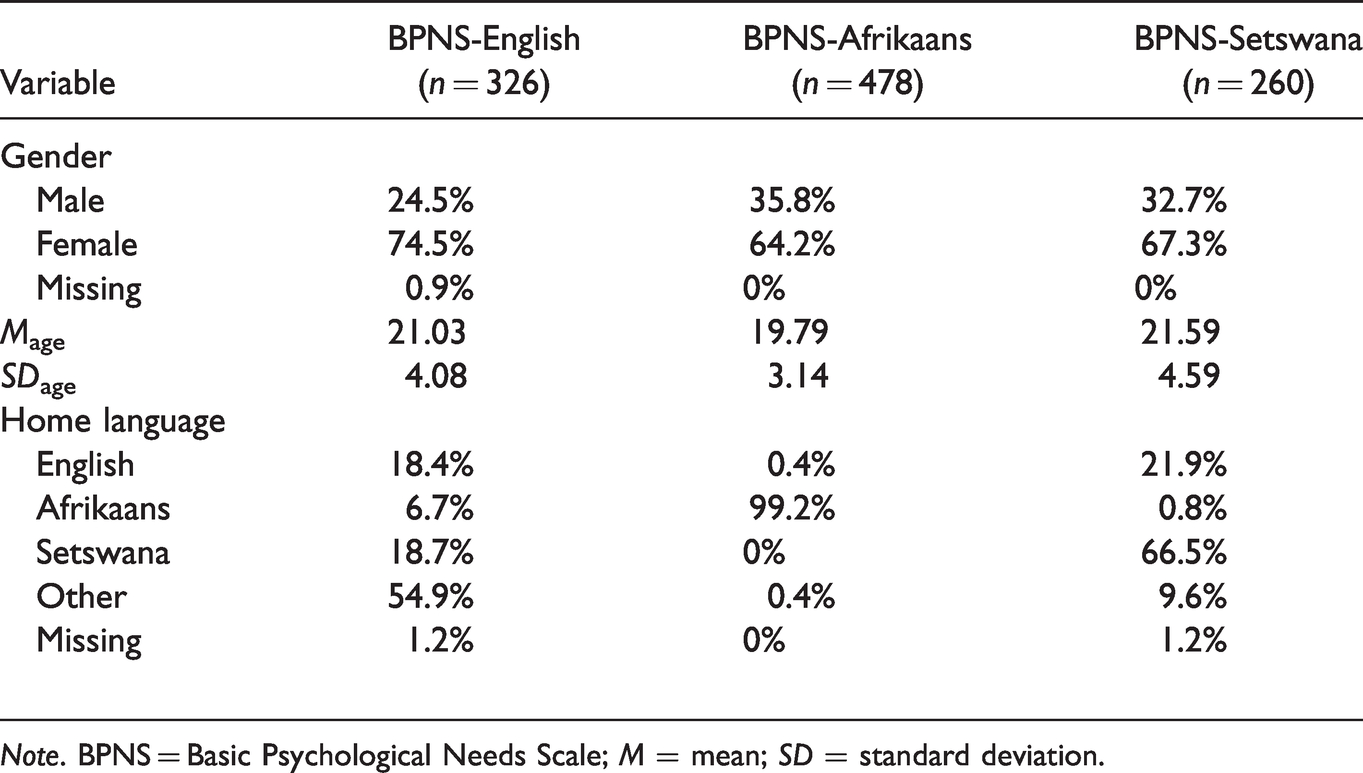
Note. BPNS = Basic Psychological Needs Scale; M = mean; SD = standard deviation.
Measures
The Basic Psychological Needs Scale
The Basic Psychological Needs Scale (BPNS, Centre for SDT, n.d.; Gagné, 2003) is a 21-item measure of basic psychological need satisfaction consisting of three subscales namely, Autonomy (item 1, “I feel like I am free to decide for myself how to live my life”), Competence (item 19, “I often do not feel very capable” [reversed-phrased]), and Relatedness (item 2, “I really like the people I interact with”). Participants must rate a series of statements on a 7-point Likert scale ranging from 1 (not very true at all) to 7 (very true). A total score for all items (e.g., Schutte & Malouff, 2018), and/or separate scores for each subscale (e.g., Butkovic et al., 2019; Chang et al., 2018) can be calculated.
Socio-demographic Questionnaire
Socio-demographic data on, inter alia, age, gender, and home language were collected.
Ethical considerations and procedure
Ethics approval was obtained from the Health Research Ethics Committee of the North-West University, South Africa, ethics approval number: NWU 00002-07-A2. Written informed consent was obtained, participation was voluntary with no incentives offered for participation, debriefing was available after participation if needed, and data were collected anonymously. Data collection took place in 2012.
While the original English version was administered, the Afrikaans and Setswana versions were translated and adapted from the English scale to express the meaning of the scale items in a culturally appropriate way. Independent translators back-translated the scales into English (Brislin, 1980). A research committee, that included academics who spoke Afrikaans or Setswana as their native language and were fluent in English, compared the back-translated English versions with the original English version (Van de Vijver & Humbleton, 1996; Van de Vijver & Leung, 1997). The translated versions were tested in small pilot samples to determine if the scale items were comprehensible and culturally appropriate.
Data analysis
Data analysis was done in four stages.
Stage 1: Descriptive statistics of individual scale items
The mean, standard deviation, skewness, and kurtosis werecalculated for each item using IBM SPSS Statistics 25.
Stage 2: Factorial validity
The factor structure of the BPNS-English, BPNS-Afrikaans, and BPNS-Setswana was determined using CFA, bifactor CFA, ESEM, and bifactor ESEM. Mplus 8.3 (Muthén & Muthén, 1998–2019) was used. Missing data were handled with full information likelihood estimation, and the robust maximum likelihood estimator (MLR) was applied. For the CFA and bifactor CFA models the cross-loadings were fixed to zero. Target and orthogonal rotation were applied to ESEM and bifactor ESEM models, respectively. Cross-loadings were estimated to be close to, but not exactly zero (Asparouhov & Muthén, 2009).
To evaluate model fit, we report the χ2-statistic, comparative fit index (CFI, Bentler, 1990), Tucker-Lewis index (TLI, Tucker & Lewis, 1973), root mean square error of approximation (RMSEA, Steiger & Lind, 1980), and the standardised root mean square residual (SRMR). For the χ2-statistic, large p-values (e.g., p > 0.05) suggest that the model fits well (Byrne, 2012). However, the value of the χ2-statistic is largely dependent on sample size (Byrne, 2012), therefore the CFI, TLI, RMSEA, and SRMR were mainly used to interpret model fit in the current study. Previously, CFI and TLI values higher than .90 were deemed indicative of good model fit, but more recently a minimum value of .95 has been proposed as a guideline (Byrne, 2012; Hu & Bentler, 1999). RMSEA and SRMR values less than 0.08 indicate reasonable model fit, and values less than 0.05 good fit (Byrne, 2012).
While higher modification indices (MI) and the expected parameter change (EPC) values (Byrne, 2012; Whittaker, 2012) aided in identifying problematic scale items, decisions on removal of items were strongly based on substantive, theoretical reasoning (Byrne, 2012; Whittaker, 2012). The factor loadings of the best-fitting models were inspected for peculiar cross-loadings on nontarget factors.
Stage 3: Internal consistency reliability
We calculated omega coefficients following the formula used by Sánchez-Oliva et al. (2017). Perreira et al. (2018) suggested that omega coefficients larger than .50 indicate sufficient reliability scores for bifactor models.
Stage 4: Measurement invariance
Invariance across the different language versions of the BPNS was determined using Mplus 8.3 (Muthén & Muthén, 1998–2019). Configural, metric, and scalar invariance were determined (Putnick & Bornstein, 2017; Morin, Arens, & Marsh, 2016). For configural invariance no equality constraints across groups were applied (Byrne, 2012). Configural invariance was established if the same pattern of free and fixed loadings held across groups (Putnick & Bornstein, 2017). To determine metric invariance, factor loadings were set to be invariant across the groups. If metric invariance was not supported, nonequivalent factor loadings were released to yield partial metric invariance. For scalar invariance factor loadings and intercepts were constrained to be equivalent across the groups. If scalar invariance was not supported, nonequivalent intercepts were released to yield partial scalar invariance (Putnick & Bornstein, 2017). To determine which constraints needed to be released to obtain partial invariance at any level, high MI’s and EPC’s were considered (Byrne, 2012). Measurement invariance is supported when the differences in the CFI and RMSEA values of the nested models are smaller than .01 and .015, respectively. The likelihood ratio test is reported but not used for decision-making as it is sensitive to sample size (Chen, 2007; Cheung & Rensvold, 2002).
Results
Stage 1: Descriptive statistics of individual scale items of the BPNS-English, BPNS-Afrikaans, and BPNS-Setswana
Descriptive statistics for all individual items are presented in Table 2. The deviation from normality for the BPNS-English and the BPNS-Setswana was not significant as indicated by skewness and kurtosis values of less than ǀ2ǀ (Bandalos & Finney, 2010). For the BPNS-Afrikaans the skewness values were less than ǀ2ǀ, but the kurtosis values for items 9 and 12 deviated from normality, with values larger than ǀ2ǀ (Bandalos & Finney, 2010).
Descriptive statistics of the individual items of the BPNS-English, BPNS-Afrikaans, and BPNS-Setswana.
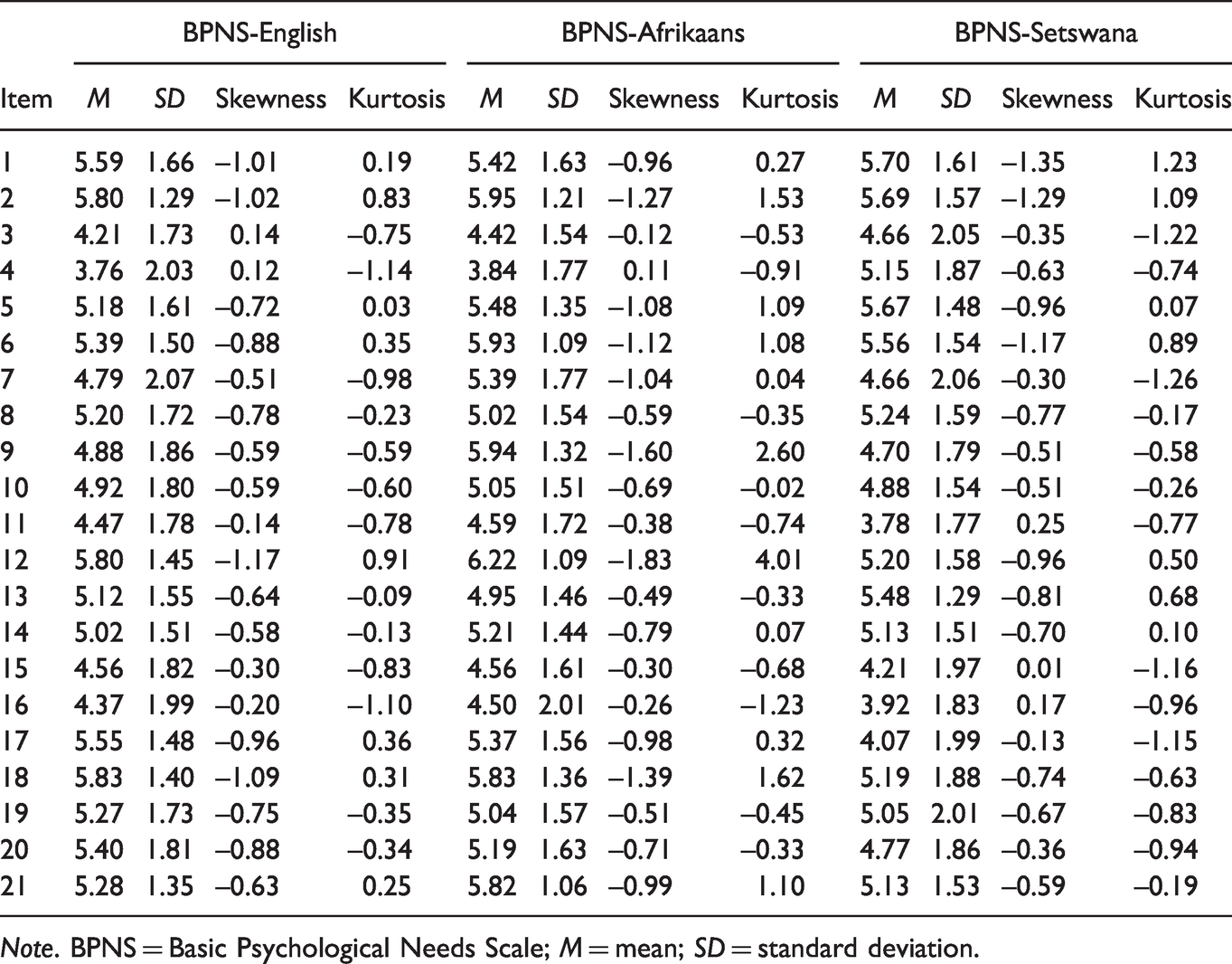
Note. BPNS = Basic Psychological Needs Scale; M = mean; SD = standard deviation.
Stage 2A: Factorial validity of the BPNS-English, BPNS-Afrikaans, and BPNS-Setswana
Figure 1 represents the models that were tested to examine the factor structure of the BPNS: one-factor CFA (Model 1), three-factor CFA (Model 2), three-factor bifactor CFA (Model 3), three-factor ESEM (Model 4), and three-factor bifactor ESEM (Model 5). The fit indices are presented in Table 3.
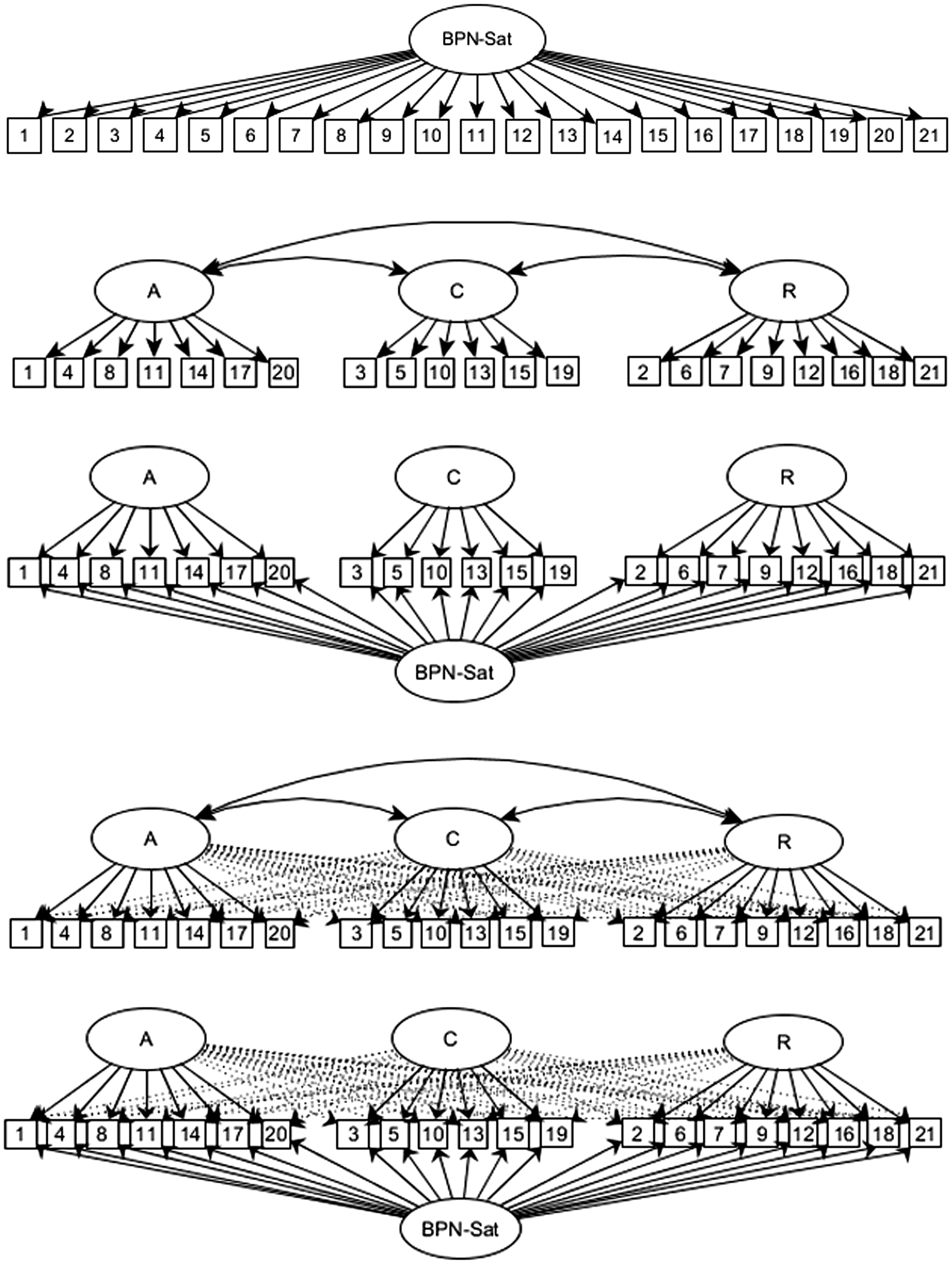
The various models fitted to the BPNS-English, BPNS-Afrikaans, and BPNS-Setswana. Model 1: One-factor CFA. Model 2: Three-factor CFA. Model 3: Three-factor bifactor CFA. Model 4: Three-factor ESEM. Model 5: Three-factor bifactor ESEM. BPN-Sat = Basic psychological need satisfaction factor; A = Autonomy factor; C = Competence factor; R = Relatedness factor.
Fit indices for the one-factor and three-factor models.
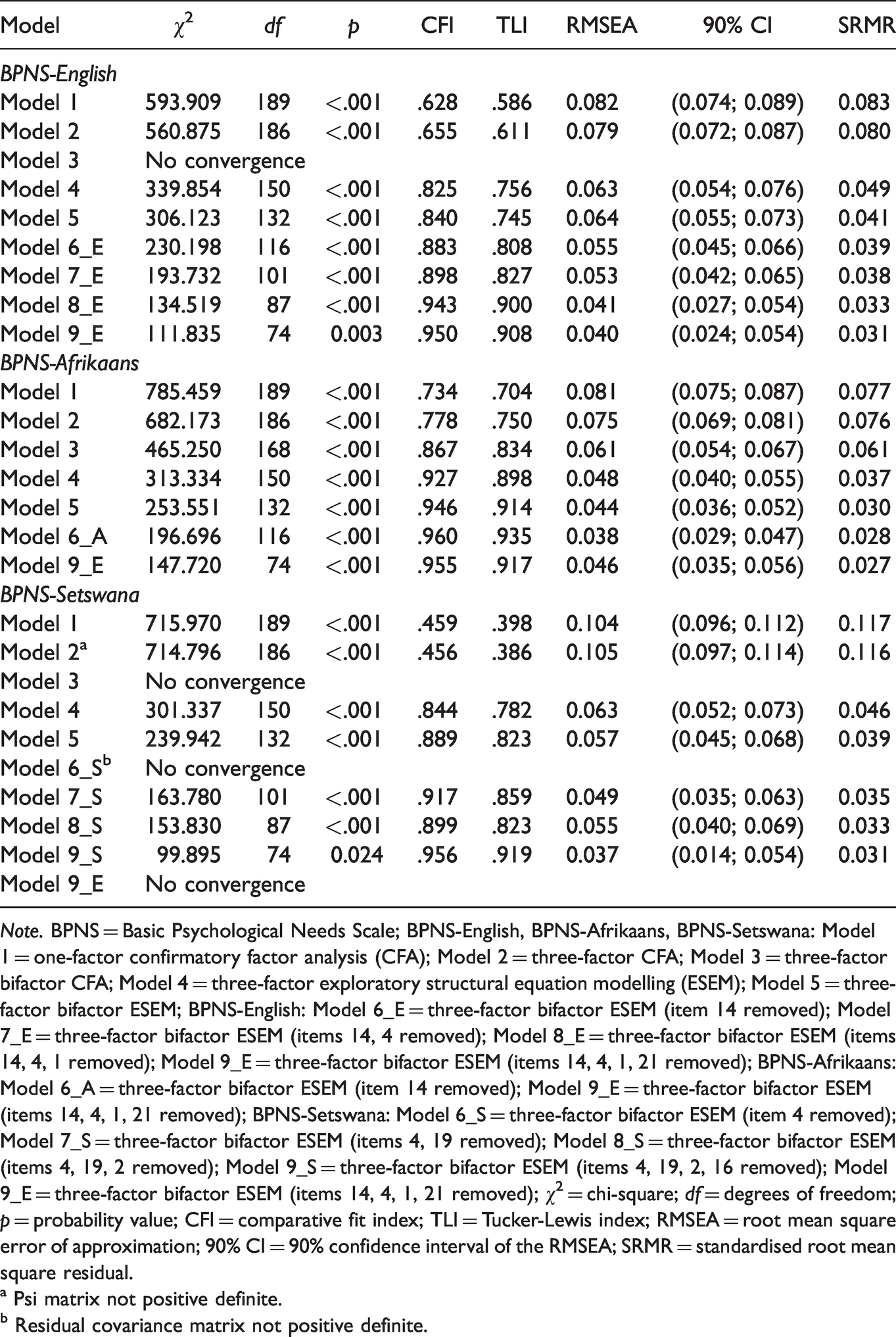
Note. BPNS = Basic Psychological Needs Scale; BPNS-English, BPNS-Afrikaans, BPNS-Setswana: Model 1 = one-factor confirmatory factor analysis (CFA); Model 2 = three-factor CFA; Model 3 = three-factor bifactor CFA; Model 4 = three-factor exploratory structural equation modelling (ESEM); Model 5 = three-factor bifactor ESEM; BPNS-English: Model 6_E = three-factor bifactor ESEM (item 14 removed); Model 7_E = three-factor bifactor ESEM (items 14, 4 removed); Model 8_E = three-factor bifactor ESEM (items 14, 4, 1 removed); Model 9_E = three-factor bifactor ESEM (items 14, 4, 1, 21 removed); BPNS-Afrikaans: Model 6_A = three-factor bifactor ESEM (item 14 removed); Model 9_E = three-factor bifactor ESEM (items 14, 4, 1, 21 removed); BPNS-Setswana: Model 6_S = three-factor bifactor ESEM (item 4 removed); Model 7_S = three-factor bifactor ESEM (items 4, 19 removed); Model 8_S = three-factor bifactor ESEM (items 4, 19, 2 removed); Model 9_S = three-factor bifactor ESEM (items 4, 19, 2, 16 removed); Model 9_E = three-factor bifactor ESEM (items 14, 4, 1, 21 removed); χ2 = chi-square; df = degrees of freedom; p = probability value; CFI = comparative fit index; TLI = Tucker-Lewis index; RMSEA = root mean square error of approximation; 90% CI = 90% confidence interval of the RMSEA; SRMR = standardised root mean square residual.
a Psi matrix not positive definite.
b Residual covariance matrix not positive definite.
Model 1 revealed poor fit for all language versions of the BPNS. Except for Model 3 that did not converge for the BPNS-English and the BPNS-Setswana, model fit improved significantly for all language versions when cross-loadings and/or a general factor were incorporated in the three-factor models (Models 3, 4, and 5). Model 5 displayed superior fit in all cases. While global fit indices suggested reasonable fit for the BPNS-Afrikaans, the fit was still inadequate for the BPNS-English and the BPNS-Setswana.
Stage 2B: Fitting alternative models to the BPNS-English, BPNS-Afrikaans, BPNS-Setswana
Since the global fit of even the superior-fitting Model 5 was not convincingly good for any of the language versions, high MI’s and EPC’s were used to identify problematic items that were then removed if such removal was substantively supported. Fit indices of the subsequent models are presented in Table 3. In the next paragraphs we discuss the model fit of the alternative models. Item wording is available online (Centre for SDT, n.d.).
Fitting alternative models to the BPNS-English
First, a high residual correlation (MI = 30.587, EPC = 0.542) between Relatedness item 12 (“People in my life care about me”) and Autonomy item 14 (“People I interact with on a daily basis tend to take my feelings into consideration”) was indicated. Although item 14 was intended to measure Autonomy, it refers to interaction with others which could be associated with the need for relatedness. Although item 14 (R2 = .353) explained more variance than item 12 (R2 = .323), the former was removed in Model 6_E due to its conceptual ambiguity. Model 6_E had insufficient fit (CFI = .883, RMSEA = 0.055).
Second, a high residual correlation (MI = 15.486, EPC = –0.564) between Autonomy item 4 (“I feel pressured in my life”) and Relatedness item 18 (“The people I interact with regularly do not seem to like me much”) was indicated. Conceptually, an experience of feeling pressured (item 4) seems to be associated with all three the basic psychological needs, and not with autonomy per se. Item 4 (R2 = .218) also explained less variance than item 18 (R2 = .270) and was removed in Model 7_E. Model 7_E had insufficient fit (CFI = .898, RMSEA = 0.053).
Third, a high residual correlation (MI = 11.864, EPC = 0.423) between Autonomy item 1 (“I feel like I am free to decide for myself how to live my life”) and Autonomy item 8 (“I generally feel free to express my ideas and opinions”) was indicated. Item 1 is an inverse duplicate of item 20 (“There is not much opportunity for me to decide for myself how to do things in my daily life”) and therefore redundant (Johnston & Finney, 2010). In addition, item 1 explained less variance (R2 = .214) than item 8 (R2 = .409) and was removed in Model 8_E. This model displayed reasonable model fit (CFI = .943, RMSEA = 0.041).
Fourth, a high residual correlation (MI = 10.742, EPC = 0.303) between Relatedness item 12 (“People in my life care about me”) and Relatedness item 21 (“People are generally pretty friendly towards me”) was indicated. Item 12 refers to intimacy in relationships as intended by SDT (Deci & Ryan, 2000, Deci et al., 2017; Rigby & Ryan, 2018), while item 21 refers to pleasant interaction instead (Sheldon & Hilpert, 2012). Item 12 (R2 = .250) and item 21 (R2 = .251) explained almost the same amount of variance. Since item 21 was not an optimal operationalisation of relatedness as conceptualized in SDT, this item was removed in Model 9_E. This model displayed sufficient fit (CFI = 0.950, RMSEA = 0.040).
Fitting alternative models to the BPNS-Afrikaans
A high residual correlation (MI = 24.515, EPC = 0.250) between Relatedness item 12 (“People in my life care about me”) and Autonomy item 14 (“People I interact with on a daily basis tend to take my feelings into consideration”) was indicated. Although item 14 (R2 = .449) explained more of the variance than item 12 (R2 = .377), item 14 was removed in Model 6_A on substantive grounds using similar reasoning as for the English version. This model displayed good fit (CFI = .960, RMSEA = 0.038).
Fitting alternative models to the BPNS-Setswana
First, a high residual correlation (MI = 12.675, EPC = –0.705) between Autonomy item 4 (“I feel pressured in my life”) and Competence item 19 (“I often do not feel very capable”) was indicated. Item 4 was removed in Model 6_S for the same reason that it was removed from the BPNS-English. However, this model did not converge with item 19 having a negative residual invariance. Item 19 was consequently also removed in Model 7_S, which displayed reasonable model fit (CFI = .917; RMSEA = 0.049).
Next, a high residual correlation (MI = 11.198, EPC = 0.504) between Autonomy item 1 (“I feel like I am free to decide for myself how to live my life”) and Relatedness item 2 (“I really like the people I interact with”) was indicated. Item 2 refers to enjoyable interaction (Cromhout et al., 2018) rather than intimacy in relationships as intended by SDT (Deci & Ryan, 2000, Deci et al., 2017; Rigby & Ryan, 2018) and was removed in Model 8_S for substantive reasons, even though item 2 (R2 = .535) explained more variance than item 1 (R2 = .425). Model 8_S displayed insufficient model fit (CFI = .899; RMSEA = 0.55).
Lastly, a high residual correlation (MI = 11.519, EPC = –0.587) between Relatedness item 16 (“There are not many people that I am close to”) and Autonomy item 20 (“There is not much opportunity for me to decide for myself how to do things in my daily life”) was indicated. When item 20, an inverse duplicate of item 1, was removed, model fit remained insufficient and removal of several further problematic items lead to a model that did not converge. Instead, item 16 (R2 = .438) that explained less variance than item 20 (R2 = .451) was removed in Model 9_S, which displayed good model fit (CFI = .956; RMSEA = 0.037). We next explored the factor loadings of the best-fitting models.
Stage 2C: Exploring factor loadings of the best-fitting models for the BPNS-English, BPNS-Afrikaans, and BPNS-Setswana
The factor loadings of the best-fitting models for the BPNS-English, BPNS-Afrikaans, and BPNS-Setswana are presented in Table 4. Some important aspects of these findings are described in the next paragraphs.
Standardised factor loadings and omega coefficients for the best-fitting models of the BPNS-English, BPNS-Afrikaans, and BPNS-Setswana.
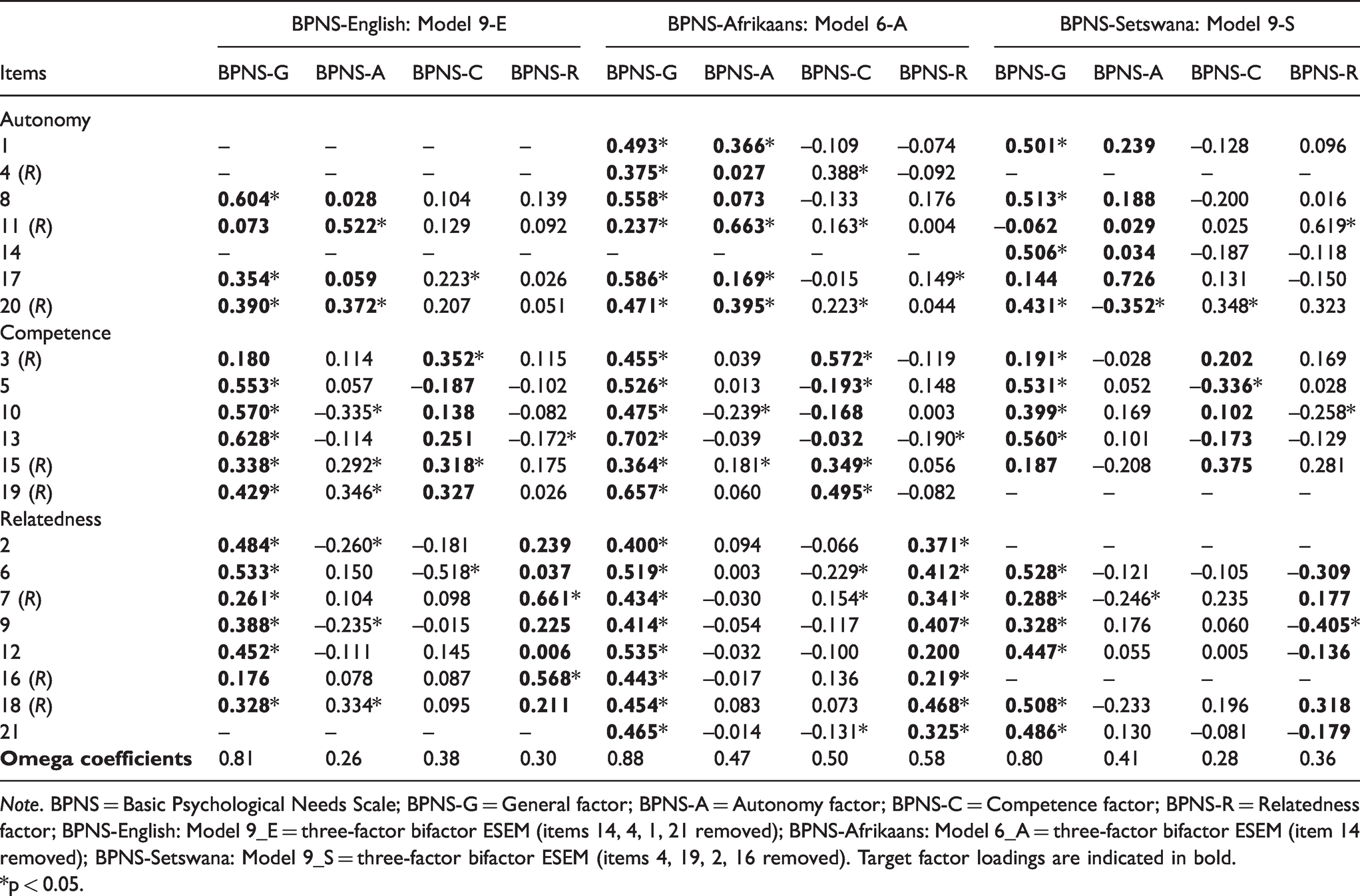
Note. BPNS = Basic Psychological Needs Scale; BPNS-G = General factor; BPNS-A = Autonomy factor; BPNS-C = Competence factor; BPNS-R = Relatedness factor; BPNS-English: Model 9_E = three-factor bifactor ESEM (items 14, 4, 1, 21 removed); BPNS-Afrikaans: Model 6_A = three-factor bifactor ESEM (item 14 removed); BPNS-Setswana: Model 9_S = three-factor bifactor ESEM (items 4, 19, 2, 16 removed). Target factor loadings are indicated in bold.
*p < 0.05.
Factor loadings of the BPNS-English: Model 9_E
Except for items 3, 11, and 16 all items had statistically significant loadings on the general factor. The only statistically significant loadings on the specific target factors were items 11 and 20 loading on the Autonomy factor, items 3 and 15 loading on the Competence factor, and items 7 and 16 loading on the Relatedness factor. Loadings on the general factor were generally larger than the loadings on the specific factors. Several items had larger cross-loadings than target factor loadings, but not all cross-loadings were statistically significant.
Factor loadings of the BPNS-Afrikaans: Model 6_A
All items had statistically significant loadings on the general factor. Except for items 4 and 8 loading on the Autonomy factor, items 10 and 13 loading on the Competence factor, and item 12 loading on the Relatedness factor, all other items had statistically significant loadings on the specific target factors. Loadings on the general factor were generally larger than the loadings on the specific factors. Target factor loadings were generally larger than cross-loadings. Where cross-loadings were statistically significant, they were mostly smaller than target factor loadings.
Factor loadings of the BPNS-Setswana: Model 9_S
Except for items 11, 15, and 17, all items had statistically significant loadings on the general factor. Except for item 20 loading on the Autonomy factor, item 5 loading on the Competence factor, and item 9 loading on the Relatedness factor, there were no other statistically significant loadings on the specific target factors. Loadings on the general factor were generally larger than the loadings on the specific factors. Several items had larger cross-loadings than target factor loadings, but not all cross-loadings were statistically significant.
Stage 3: Internal consistency reliability scores of the best-fitting models of the BPNS-English, BPNS-Afrikaans, and BPNS-Setswana
The omega coefficients for the best-fitting models of the BPNS-English, BPNS-Afrikaans, and BPNS-Setswana are presented in Table 4. The general factors had sufficient reliability scores. Subscale reliability scores were insufficient (i.e., below .5), except for the Competence and Relatedness factors of the BPNS-Afrikaans.
Stage 4: Measurement invariance
To arrive at a model for which invariance can be tested, the best-fitting model for each language version of the BPNS was fitted to the other two language versions in order to find a baseline model that would fit across the groups. This model would then serve as the baseline for invariance testing.
Model 6_A did not fit the BPNS-English (CFI = .883, RMSEA = 0.055) or the BPNS-Setswana (CFI = .879, RMSEA = 0.061). Since the model did not produce an adequately fitting baseline model across the groups, no further invariance testing could be done for this model. Model 9_S fitted the BPNS-Afrikaans (CFI = .963, RMSEA = 0.040), but not the BPNS-English (CFI = .877, RMSEA = 0.063). We tested for measurement invariance between the Setswana and Afrikaans groups for Model 9_S, but neither full nor partial metric invariance was supported. Specifically, as factor loadings were freed to test for partial metric invariance, several items presented with negative residual variances for the BPNS-Setswana. As these items were removed one at a time, it resulted in a model that did not converge for the BPNS-Setswana. We concluded that Model 9_S could not be used as a baseline model to test for invariance.
Model 9_E fitted the BPNS-Afrikaans (CFI = .955, RMSEA = 0.046), but did not converge for the BPNS-Setswana. Measurement invariance between the English and Afrikaans groups was tested for Model 9_E. The results are presented in Table 5. The configural invariance model (Invariance Model 1) adequately fitted the data. A ǀΔCFIǀ value above ǀ.01ǀ indicated insufficient metric invariance (Invariance Model 2A). Based on high MI’s and EPC’s, the factor loadings of item 17 on the general factor (Invariance Model 2B; MI = 10.967, EPC = –0.245 [BPNS-English]; MI = 10.964, EPC = 0.168 [BPNS-Afrikaans]) and item 18 on the Relatedness factor (Invariance Model 2C; MI = 23.371, EPC = 0.2406 [BPNS-English]; MI = 23.367, EPC = –0.241 [BPNS-Afrikaans]) were freed one at a time in both groups to yield partial metric invariance. When testing for partial scalar invariance, the residual covariance matrix was not positive definite because item 7 of the BPNS-English had a negative residual variance. When item 7 was removed, item 5 was problematic in the BPNS-English. Although removal of these items yielded models with adequate global fit for the BPNS-English and the BPNS-Afrikaans, several further items were indicated to be problematic in the BPNS-Afrikaans when the model was tested for invariance. Removal of further items did not yield a model that fitted the BPNS-English and the BPNS-Afrikaans. We concluded that the scale did not display scalar or partially scalar invariance.
Measurement invariance of Model 9_E for the BPNS-English and the BPNS-Afrikaans.
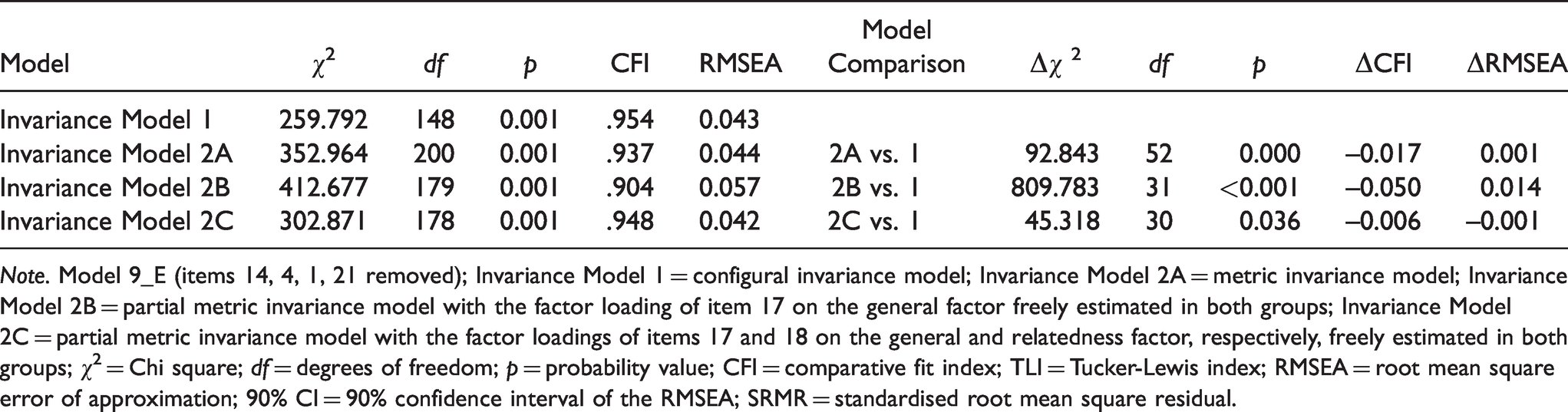
Note. Model 9_E (items 14, 4, 1, 21 removed); Invariance Model 1 = configural invariance model; Invariance Model 2A = metric invariance model; Invariance Model 2B = partial metric invariance model with the factor loading of item 17 on the general factor freely estimated in both groups; Invariance Model 2C = partial metric invariance model with the factor loadings of items 17 and 18 on the general and relatedness factor, respectively, freely estimated in both groups; χ2 = Chi square; df = degrees of freedom; p = probability value; CFI = comparative fit index; TLI = Tucker-Lewis index; RMSEA = root mean square error of approximation; 90% CI = 90% confidence interval of the RMSEA; SRMR = standardised root mean square residual.
Discussion
The aim of this study was to explore the psychometric properties and measurement invariance of the BPNS by applying statistical developments that overcome the limitations inherent to CFA with a view to gain a better understanding of the dimensionality of basic psychological needs. CFA, bifactor CFA, ESEM, and bifactor ESEM were applied to the data from three South African student samples. As far as it could be established, this study was the first to apply bifactor CFA, ESEM, and bifactor ESEM to the BPNS developed by Gagné (2003). The three-factor bifactor ESEM model (Model 5) outperformed the other models for all three groups, indicating that the data are better represented when cross-loadings are allowed, and a general factor is accounted for. Reduced bifactor ESEM models yielded adequate fit for the BPNS-English (Model 9_E, items 14, 4, 1, 21 removed), BPNS-Afrikaans (Model 6_A, item 14 removed), and BPNS-Setswana (Model 9_S, items 4, 19, 2, 16 removed). The general basic psychological need satisfaction factor had sufficient reliability scores for all language versions, but subscale reliability scores were generally insufficient, except for the Competence and Relatedness factors of the BPNS-Afrikaans. Model 9_E was partially metric invariant for the English and Afrikaans groups. Some specific findings warrant discussion.
Factorial validity, reliability, and dimensionality of the BPNS
Reduced three-factor bifactor ESEM models displayed acceptable fit for all language versions of the BPNS. The general factor of the BPNS-English, BPNS-Afrikaans, and BPNS-Setswana had sufficient reliability scores. Subscale reliability scores remained insufficient, except for the BPNS-Afrikaans where the Competence and Relatedness factors had sufficient reliability scores. The existence of a general factor was further indicated by high factor loadings on the general factor for all language versions of the BPNS. The results indicate that scores on the general basic psychological need satisfaction factor can be used and interpreted, but caution should be applied when interpreting the subscale scores, except for the BPNS-Afrikaans where scores on the Competence and Relatedness factors can also be interpreted. This does not mean that the specific factors do not exist but rather that most of the variance was absorbed by the general factor, indicating that the items measure the general factor more than they measure the specific factors (e.g., Tóth-Király et al., 2019).
Our results support a continuum of basic psychological need satisfaction with low and high levels of need satisfaction at the opposite ends of the continuum for all versions of the BPNS, with only the Competence and Relatedness factors of the BPNS-Afrikaans that had meaningful specificity once the general factor was extracted. The findings are in line with other studies where the application of bifactor ESEM supported a continuum structure of the general factor. For example, Tóth-Király et al. (2019) and Tóth-Király et al. (2018) investigated the dimensionality of basic psycholgocal needs using the Basic Psychological Need Satisfaction and Frustration Scale (Chen et al., 2015). A bifactor ESEM model with a single general factor and six specific factors fitted the scale best. The general factor was well-defined, indicating a continuum of basic psychological need fulfilment with need satisfaction and need thwarting at the opposite ends of the continuum, and some specific factors had sufficient specificity once the general factor was extracted (Tóth-Király et al., 2019).
Problematic scale items in baseline models and cross-loadings on nontarget factors
In this study, we removed items for reasons that included the seeming misplacement of items in a specific subscale, items that potentially tap more than one construct, items with very similar content leading to redundancy, and items that do not tap the intended meaning of the target construct. These findings are consistent with previous research that related the inadequate performance of the BPNS to problems with scale construction and item formulation (Cromhout et al., 2018; Johnston & Finney, 2010; Schutte et al., 2018; Sheldon & Hilpert, 2012).
Considering the conceptual-relatedness between the three basic psychological needs, we expected that items would cross-load on nontarget factors. Some cross-loadings were small and in line with theoretical expectations and could be regarded as the influence of the nontarget factor on the construct-relevant part of the indicator (Morin, Arens, & Marsh, 2016). There were also a few larger, statistically significant cross-loadings on nontarget factors. When cross-loadings are large and unexplainable, or are larger than the target loading, Morin, Arens, and Marsh (2016) indicated that the assignment of the indicators to the specific factors should be reconsidered. The following larger, statistically significant cross-loadings are some examples. The cross-loading of Relatedness item 6 (“I get along with people I come into contact with”) on the Competence factor of the BPNS-English is explainable as item 6 could also relate to social competence. Autonomy item 4 (“I feel pressured in my life”) cross-loaded on the Competence factor of the BPNS-Afrikaans. As indicated earlier, item 4 could potentially tap all three basic psychological needs. Items such as items 6 and 4 may be regarded as potentially tapping multiple basic psychological needs and moving the items to other subscales may be unfruitful. Where larger, statistically significant cross-loadings in the current samples were unexplainable, the items were better indicators of the target factors than the nontarget factors. For example, Competence item 10 (“I have been able to learn interesting new skills recently”) of the BPNS-Setswana may be a better indicator of the intended Competence factor than the Relatedness factor on which it cross-loaded. It would therefore not be substantively justified to move the item to a different subscale. These cross-loadings may point towards problems with scale construction or the formulation of the items, or alternatively challenges with the interpretation of the items by participants in specific contexts.
Although problematic items were removed based on substantive grounds, one should be cognisant that removal of items and/or moving items to different subscales where their placement makes more sense, may result in overfitted models with good model fit (Byrne, 2012), but without necessarily all issues resolved or even presenting with new issues. It may then be best rather to consider using alternative measures of basic psychological needs.
Measurement invariance
Model 9_E displayed configural invariance for the English and Afrikaans groups. This means that the structure of Model 9_E fits these groups well (Lee, 2018). Partial metric invariance was established. Specifically, the two groups differed in terms of the loadings of item 17 on the general factor and item 18 on the Relatedness factor. Metric invariance is established when scale items load with similar strength on the specified latent factors across the groups, meaning that the groups responded to the items in the same way (Milfont & Fischer, 2010). Groups can then be compared on factor variances and covariances (Lee, 2018). As (partial) scalar invariance was not supported, the factor mean scores for the groups cannot be compared (Byrne et al., 1989; Lee, 2018).
Basic psychological needs and the African context
In the current study the BPNS-Afrikaans and the BPNS-Setswana were completed by samples that mainly reported Afrikaans (99.2%) and Setswana (66.5%) as their home languages respectively, while the BPNS-English was completed by a multicultural sample where the majority of participants (80.3%) did not report English as their first language. In this study we did not collect data on ethnicity, but home language was used as proxy for culture. The Afrikaans language is related to Dutch and Afrikaans-speaking individuals in South Africa often have a Western heritage. In contrast, the English and Setswana versions of the BPNS were mostly completed by participants who indicated Setswana, a native African language, or another African language (as indicated by the “other” option described at the Participants section) as their home language, probably suggesting an African heritage. The participants who completed the BPNS-Afrikaans were therefore considered to be a mainly Western sample, while the the participants who completed the BPNS-English and the BPNS-Setswana were considered to be mainly African samples.
The three-factor bifactor ESEM model exhibited inadequate model fit with several items needing removal to obtain good fit for both the BPNS-English and the BPNS-Setswana, that were presumably completed by mainly African samples. In contrast, the three-factor bifactor ESEM model revealed reasonable fit before problematic items were removed for the BPNS-Afrikaans, that was probably completed by a mainly Western sample. Only a single item had to be removed to obtain a model with good fit.
These findings place question marks over the cross-cultural application of BPNT, or at least the operationalisation thereof, in a South African context. Previous studies that applied CFA to the same dataset posed similar questions. Cromhout et al. (2018) applied CFA with a negatively-worded method effect to the English version of the scale and found that the BPNS showed inadequate psychometric properties and several problematic items had to be removed to obtain a reduced three-factor model with adequate fit. The authors suggested that the BPNS might not have operationalised the needs for autonomy, competence, and relatedness in a culturally sensitive way that applies to the mainly African sample. Schutte et al. (2018) applied CFA a negatively-worded method effect to data on all three language versions and found that a reduced three-factor structure best fitted the BPNS-English and the BPNS-Afrikaans, and a reduced one-factor structure best fitted the BPNS-Setswana. They suggested that their findings may indicate that the needs for autonomy, competence, and relatedness may either not be clearly distinguished in an African context or that the BPNS possibly does not capture this distinction adequately. They suggested that a clear distinction between the three psychological needs may possibly be more applicable to Western cultures than African cultures in a South African context (Schutte et al., 2018). Although the application of bifactor ESEM in the current study supported the three-factor rather than a one-factor structure for all language versions of the BPNS, the number of items that had to be removed from the BPNS-English and the BPNS-Setswana to obtain models with adequate fit may further support previous findings that BPNT may be more applicable in Western than African samples.
It is possible that, for different cultures, what is regarded as basic psychological needs may differ. Alternatively, basic psychological needs may be the same across cultures, but they may be understood and expressed differently across cultures. Furthermore, different cultures may value or prioritise certain psychological needs more than others. For example, people from collectivistic cultures, like the samples that completed the BPNS-English and the BPNS-Setswana, may experience autonomy when they comply with internalised group/cultural norms, while people from individualistic cultures, like the sample that completed the BPNS-Afrikaans, may experience compliance with group norms as a threat to their autonomy. Instead, the last group may experience autonomy when allowed to decide if they want to comply with group norms or not (Chen et al., 2015; Deci & Ryan, 2000).
Although the needs for autonomy, competence, and relatedness are proposed as the three psychological needs that are essential for individuals’ growth and well-being, irrespective of cultural, individual, or socio-economic context (Deci & Ryan, 2000; Vansteenkiste et al., 2020), Vansteenkiste et al. (2020) indicated that the “list of psychological needs is and has always been open for additions…” (p. 3). They further indicated that, instead of extending the current list of psychological needs as future directions in basic psychological needs theory research, another option may be to refine basic psychological needs theory by discerning between different aspects within a specific need. They argue that such differentiation would result in retaining parsimony but gaining in nuance. For example, a giving and receiving facet can potentially be discerned within the need for relatedness with beneficence as a facet of the giving element (Vansteenkiste et al., 2020). Further investigations on basic psychological needs may be especially fruitful in an African context. It is common that theories and practices that are based on Western conceptualisations are used to explain psychological phenomena in African contexts (Nwoye, 2015). In this regard, Nwoye (2015) proposed that psychology from an African perspective should aim to develop theories that generate conceptual frameworks for understanding phenomena in African contexts. Although cross-cultural research (Chen et al., 2015; Church et al., 2012) supported the notion that the outcomes associated with the satisfaction or frustration of the current three psychological needs would replicate irrespective of cultural orientation (e.g., individualistic versus collectivistic) none of these studies were done with African samples or taking African philosophical perspectives into consideration. Considering the uniqueness of the African context, that differs in many respects from the Western and also Asian collectivistic contexts (see Nwoye, 2015), future research should explore how psychological needs are conceptualised and expressed in African contexts.
Limitations and recommendations
Although this study contributes to understanding and measuring basic psychological needs in different cultural contexts, it has limitations. A nonprobability sample was used and the results cannot be generalised to other populations. The use of student samples enabled us to study the psychometric properties and measurement invariance of the scale using samples comparable to those used in other studies (Cromhout et al., 2018; Johnston & Finney, 2010; Schutte et al., 2018; Sheldon & Hilpert, 2012), but the psychometric properties of the scale should also be studied in other age and culturally diverse groups as psychological need satisfaction may be experienced differently by individuals in various stages of life and who belong to different cultural groups. Another limitation is that the discriminant validity of the BPNS was not investigated. Future research may investigate how scores on the BPNS relates to scores on measures of conceptually similar and conceptually different constructs. The BPNS in its current form presented with various problems with regard to item formulation and scale construction and these items should be adapted in further studies. Alternatively, other measures of basic psychological needs should be developed or used and the psychometric properties of these measures in diverse cultural contexts investigated. As constructs may have different meanings in different cultures, an emic approach to exploring basic psychological needs is recommended to ensure that measures capture the cultural meaning of relevant constructs.
Conclusions
The three-factor bifactor ESEM model outperformed the other statistical models that were applied for all three groups in this study. Although the application of more sophisticated statistical analyses resulted in improved model fit, several items had to be removed from the BPNS-English and the BPNS-Setswana. Considering the reasons why items were removed, it is clear that the BPNS presents with several issues related to scale construction and problematic item formulation. Nonetheless, a bifactor ESEM model with one item removed showed good fit for the BPNS-Afrikaans, which points towards the potential for use of the Afrikaans version of the scale in the current sample. Basic psychological needs theory seems to be more applicable to Western contexts than African contexts in South Africa. However, considering the diversity of cultures in (South) Africa, future research should focus on exploring the conceptualisation and manifestation of basic psychological needs in various cultural, particularly African, contexts.
Footnotes
Acknowledgements
The authors wish to thank I. P. Khumalo and L. Temane for their assistance with the gathering of the data.
Declaration of Conflicting Interests
The author(s) declared no potential conflicts of interest with respect to the research, authorship, and/or publication of this article.
Funding
The author(s) disclosed receipt of the following financial support for the research, authorship, and/or publication of this article: This work is based on the research supported in part by the National Research Foundation of South Africa (Grant Numbers: 91557,106050, 123266, 120060, 121948). The Grant holders acknowledge that opinions, findings and conclusions or recommendations expressed in any publication generated by the NRF-supported research are that of the authors, and that the NRF accepts no liability whatsoever in this regard. Funding was also provided to the first author in the form of a Doctoral degree scholarship and a bursary from the Faculty of Health Sciences of the North-West University, South Africa.
