







Abstract
Using the frameworks of creativity as problem solving and Integrated Constraints in Creativity (IConIC), this article develops the proposal that creativity is best understood in terms of a cycle of constraint exploration and exploitation. This general thesis, which applies to varied domains and levels of creativity, is supported by three specific proposals about the role of constraints in creativity, each of which is developed and illustrated with examples. First, constraints provide the criteria for the evaluation of creative outcomes, which can vary as a function of the emphasis on novel usefulness or useful novelty. Second, constraints are critical in each step of the creative process: problem finding, problem construction, and problem solving. Third, constraints play a key role in both open-ended and closed-ended creative problems. These arguments are supported by specific predictions, concerning: (a) task differences in whether novelty or usefulness are emphasized more; (b) individual differences in the processing of constraints (some may favor flexible constraint exploration, while others may favor persistent constraint exploitation), which I hypothesize also correlate with (c) engagement in different types of creative problem-solving (more open-ended, of the sort encountered in art, vs. more closed-ended, of the sort encountered in science, business, and engineering).
Constraints are an integral aspect of creativity, as documented both anecdotally by many accomplished artists, such as composer Igor Stravinsky (1956), architect Frank Lloyd Wright (1953), and painter Georges Braque (1947), and empirically by an increasing number of studies. Research across different domains has shown that constraints can benefit creativity. This empirical support includes findings from studies on product development (Finke, 1990; Finke et al., 1992), language production (Haught, 2015; Haught-Tromp, 2016), consumer creativity (Moreau & Dahl, 2005), creative development in athletic activities (Hristovski et al., 2014; Torrents Martín et al., 2015; Vaughan et al., 2019), creative ideation (Medeiros et al., 2014; Rietzschel et al., 2014), design innovation (Allen & Sriram, 2000), and patent filings (Calel & Dechezlepretre, 2016; Horbach et al., 2012).
At the same time, the study of constraints is fraught with challenges and inconsistencies, even within a specific disciplinary framework, as highlighted, for example, by a recent meta-analytic overview, with a distinct focus on constraints and innovation in an organizational setting (Acar et al., 2019): while some studies found that constraints enhanced creativity, others found they inhibited it. One way in which these conflicting findings could be explained is via an inverted U-shaped relationship between creativity and constraints, where too many or too few constraints are not ideal for creativity (Acar et al., 2019; Biskjaer et al., 2020). Another way to explain the equivocal results to date is to view the relationship between constraints and creativity as an interaction rather than a main effect (Tromp & Sternberg, 2022b). This latter framework aligns with a broader paradigm that views creativity as dynamic rather than static (Corazza & Lubart, 2020) and as resulting from the interaction of persons, tasks, and situations (Tromp & Sternberg, 2022a).
The Integrated Constraints in Creativity (IConIC) model (Tromp, 2022) represents a recent effort aimed at both unifying extant findings and providing a framework to guide future inquiries. It proposes a distinction between creativity maximizers and satisficers that may help explain differences between higher and lower levels of creativity as a function of a willingness to capitalize on the potential of focusing constraints with both positive/neutral and negative valences as sources of inspiration, via vantage sensitivity and accommodation power, respectively. It also distinguishes among different types of constraints, including based on their functions and referents.
The functional taxonomy highlights two complementary frames, namely, exclusionary and focusing (Stokes, 2006; Tromp, 2022). Exclusionary constraints direct the search away from something (avoid x), but not toward anything in particular. They are illustrated, for example, by the Taboo board game, in which the challenge consists of describing common words, such as pillow, without using frequently associated clue words, such as sleep, head, soft, bed, or blanket. By contrast, focusing constraints direct the search for a creative outcome toward a specific concept (use y) or category (search within Y). For example, a focusing counterpart for the word description task may be the requirement to include a particular clue word, such as red, perhaps prompting novel associations and creative descriptions, such as red lipstick leaving a mark on this object as a woman rests at night.
The referent taxonomy highlights a distinction between so-called channels and anchors (Tromp, 2022). Constraints that refer to categories, such as the color red, are labeled channels, and promote search within them. For example, more creative outcomes emerge when participants focus on a particular category, such as nutrition or exercise than when they tackle the broad task of generating ideas for health improvement (Rietzschel et al., 2014). Constraints that refer to concepts, such as lipstick, are anchors, which promote associations with other anchors. For example, participants who had to include a given word in a rhyming message generated more creative outcomes than those who did not have this constraint (Haught-Tromp, 2016). Anchor combinations are more likely to facilitate creativity when the focusing concepts have high semantic distance (that is, are not closely related), and are incongruent, non-prototypical, and self-relevant (Tromp, 2022).
The present article expands the IConIC model, building on the foundational premise that constraints are critical for creative thinking. It addresses three outstanding theoretical questions that have remained understudied, and for which proposals are advanced below and elaborated in the rest of the article.
The first theoretical question concerns the way in which the two generally agreed-upon creativity criteria of novelty and usefulness constrain creative thinking: Do they hold similar or different weights, especially at the start of the creative process? While novelty and usefulness are integral to the very definition of creativity and provide the criteria for the production and evaluation of creative outcomes, little theoretical or empirical work to date has investigated how an emphasis on one of the two criteria might shape creativity. I argue that whether the creative process is initially or primarily guided by one criterion or the other affects both creative outcomes and the underlying processes, and I describe the two paths as novel usefulness and useful novelty.
The second theoretical question concerns the specifics of the interplay between constraints and creativity, namely, how are constraints processed? Building on research on foraging, I propose that creativity is highly dependent on leveraging different constraints and is best conceptualized as a cycle of constraint exploration and exploitation. To develop this proposal, which contributes to efforts aimed at elucidating the complexity of the processes associated with creativity, I show how constraints play a role in each step of the creative process: problem finding, problem construction, and problem solving.
The third, related, theoretical question concerns the role that constraints play in two distinct creative instantiations, namely open- and closed-ended creative problems. To date, no analysis has distinguished between these two types of problems vis-à-vis their relationship with constraints. In addressing this gap in the creativity literature, I advance the following novel proposal: While open-ended problems are more likely to be characterized by a sequence of the exploration followed by the exploitation of a constraint, closed-ended problems are more likely to display a sequence that starts with the exploitation of the problem constraints that, when leading to impasse, is followed by the exploration of alternate problem representations that may encompass the solution.
After an overview of the creativity as problem-solving framework in the next section, the structure of the article follows the outline of the three main proposals previewed above. It ends with implications for future research and conclusions.
Creativity as Problem Solving
When faced with a problem, regardless of whether it requires creativity or not, individuals form ad-hoc mental representations of the problem space (Holyoak, 1984), which consists of three components: an initial state (the problem itself), a goal state (the solution or product), and solution paths (the cognitive processes and strategies that yield the solutions) (Kulkarni & Simon, 1988; Runco, 2007; Simon & Newell, 1971). Problems differ widely in the extent to which each of the three components of the problem space is well-defined.
At one end of the continuum are fully well-defined problems in which a particular solution path, in the form of an algorithm, yields a correct answer (Simon, 1973). Follow the clearly structured steps of a recipe or a mathematical equation closely, and you will end up with the desired, correct outcome. Constraints play such an obvious role in the case of well-defined problems that one could even accurately re-label them well-constrained problems. The constraints limit the problem, the solution, and the search, in a deterministic fashion.
Ill-defined problems, which occupy most of the continuum, differ in the extent to which one, two or all three aspects of the problem space are clearly specified (Reitman, 1965). Fewer constraints on some if not all of the elements allow more choice and idiosyncratic inferences from the part of the individual. The associated uncertainty and complexity translate into more challenge inherent in the problem solving – but also more opportunities for creative solutions, compared to well-defined problems (Dillon, 1982). Initial states can consist of problem descriptions that are open to different interpretations, contain seemingly contradictory elements or are so ill-specified that there may not be an apparent problem to solve, as is the case in many artistic domains. End-states, too, can differ greatly in the extent to which they are well-defined. Insight (e.g., Duncker, 1945), remote associate (Mednick, 1962), and mathematical problems in need of proofs have one solution, whether known a priori or not, that can objectively be deemed correct. Divergent thinking problems such as the Unusual Uses Test (Guilford, 1967), innovation and art problems have many possible solutions, some known and others unknown, that are evaluated for creativity based on more or less subjective criteria. Solution paths are notoriously ill-defined for most creative tasks. If a comprehensive algorithm for the creative process existed, computers could solve creativity problems (Johnson-Laird, 2009).
Creative tasks are often viewed as ill-defined problems (e.g., Hélie & Sun, 2010; Stokes, 2006). Unlike well-defined problems, whose structure does not allow for multiple solutions and where the path from problem to solution is specified, ill-defined problems present unique challenges and opportunities. Contrary to the myth of freedom to create, constraints are often not the problem, but they are part of the solution. To build this case, this article shows how constraints shape the creative process, beginning with an outline of the constraining role of the creativity criteria of novelty and usefulness.
The Constraints of the Creativity Criteria: Novel Usefulness versus Useful Novelty
Novelty and usefulness are the generally agreed-upon criteria for creativity (Runco & Jaeger, 2012). The novelty criterion has an exclusionary function, that is, it only communicates that the creative outcome must be different from existing ones, without pointing to a particular area of the search space where the new outcomes may be found. By contrast, the usefulness criterion has a focusing function, that is, it communicates what is considered useful and valuable. Although this criterion may appear to be more ambiguous, it is in fact more constraining and informative than the novelty criterion. The seeming ambiguity stems from the domain-specificity of the usefulness definition, as illustrated by alternate versions of the criterion that define it as meaningfulness, effectiveness, or appropriateness for the task at hand. In other words, the specifications of usefulness are dictated by the task. Indeed, experts display high inter-rater reliability when it comes to judging the creativity of outcomes in their respective fields of expertise. The exceptions are instances of transformative, historic creativity that are so radical that their value may not be appreciated by the creators’ contemporaries and can take longer to be recognized.
Because both criteria are necessary, creativity can be viewed either as a constrained derivative of novelty (N) or as a constrained derivative of usefulness (U). This equivalence can be expressed in Bayesian terms, where P denotes a probability distribution:

An implication of this null hypothesis is that both starting points can yield equally creative outcomes. However, while both criteria are necessary for an outcome to be deemed creative, one can play a more important initial role than the other. Certain types of creative problems, such as open-ended and artistic creativity, likely promote an exploratory process that starts with novelty, whereas others, such as closed-ended and scientific creativity, likely promote a process that starts with usefulness. Therefore, a top-down, exploitative initial processing approach may be preferentially employed when the usefulness criterion of creativity is the most salient, and a bottom-up approach may be preferentially employed when the novelty criterion of creativity is the most salient. Bottom-up, category-building from anchors, such as asking participants to combine exemplars from different categories and identify a common category, appears to facilitate originality (novelty), but not necessarily overall quality (usefulness) (Baughman & Mumford, 1995).
Moreover, dispositional and situational differences affect how creative tasks are approached, and may also affect the efficiency of finding creative outcomes. For example, culture has been shown to differentially predict preferences for the novelty versus usefulness criteria of creativity, a relationship that was mediated by uncertainty avoidance (Adair & Xiong, 2018). Similarly, low need for structure and need for autonomy moderate the effects of cognitive stimulation during brainstorming as a result of novel versus familiar input (De Jonge et al., 2018). Effort toward exploration of new strategies has been shown to correlate positively with product novelty, whereas effort toward exploitation of existing strategies has been shown to corelate with product usefulness (Steele et al., 2021). Furthermore, a so-called “practicality effect,” corresponding to a focus on usefulness, was observed when individuals worked in groups instead of alone (Glăveanu et al., 2019). An emphasis on usefulness may have an adaptive function in the form of an increased probability of small wins that promote incremental creativity, but with diminishing returns (Dar-Nimrod et al., 2009).
The emerging creative products may also be valued more or less for different domains and types of problem as a function of whether they emphasize novelty or usefulness. For example, research in organizational behavior shows a tradeoff between novelty and usefulness as a function of whether ideas are built on initial novelty, to which familiar elements are added, or on initial familiar elements, to which novel ones are added (Berg, 2014).
Useful Novelty
When novelty is the starting constraint, novel potential solutions are first sought out and then screened for usefulness: Which of them meet the functional constraints of a given or other problem? Novel solutions are either abandoned when they do not solve a problem or kept and elaborated on when they do. Brainstorming and trial-and-error (for example, Edison’s search for the right filament for his invention of the lightbulb) are examples of solving a creativity problem via the useful novelty approach. More generally, artistic creativity and other open-ended creative problem-solving tasks, which are less constrained than scientific and closed-ended creative tasks, often rely on this approach, in line with the characterization of the novelty criterion as an exclusionary constraint.
This process can be characterized as bottom-up, and is more exploratory, flexible and experimental in nature than the novel usefulness approach, which is discussed below. It consists of identifying different, novel exemplars that may, alone or in combination with others, fit a useful, task-relevant category. Consistent with this description, in a task that required participants to combine exemplars belonging to different categories and to identify a separate category to which they can belong, originality, i.e., novelty, was enhanced, but quality was not (Baughman & Mumford, 1995).
Novel Usefulness
When usefulness is the first constraint, the starting point is the identification of existing, effective solutions to given problems, which represent members of categories known to be useful (e.g., gasoline for sources of energy in cars). The novelty emerges from asking: (a) Are there other, novel solutions for the existing problem? Or (b) Does a useful solution meet the constraints of other, novel problems, within or across domains? In other words, creative outcomes under this approach come from: a) finding new, presently low-probability exemplars for a given category (e.g., source of energy in cars), be it by identifying new exemplars altogether (e.g., electric batteries) or by modifying or combining elements of existing exemplars with each other or others (hybrid electricity and gasoline); or b) finding new categories to which an existing useful exemplar can belong by transferring its membership to a new category, that is, recognizing the usefulness potential of an existing solution (e.g., wine presses for vintners) for another problem (e.g., wine presses for printing – Gutenberg’s transformative invention). Examples of the novel usefulness approach are closed-ended problems such mathematical proofs, the Remote Associates Test (Mednick, 1962), and insight problems, but also open-ended creativity such as the transformative DNA double helix model and Picasso’s iconic Guernica painting, which have been described as “the building of the new upon the foundation of the old” (Weisberg, 2010, pp. 241).
This process can be characterized as top-down, and is more constrained and exploitative in nature than the useful novelty approach, in line with the focusing function of the starting, usefulness constraint. This description aligns with Sun and Zhang’s (2004) observation that externally provided fixed rules, such as instructions, enable top-down processes, including learning. Closed-ended problems embed the usefulness criterion in their description, by providing a clear goal and a category to which the solution should belong. Some also provide further constraints in the form of clues for the identification of the new, low-probability category member that constitutes the solution. For example, in a classic insight problem where a prisoner must escape from a prison tower with a rope that is only half the needed length, the usefulness is already established, and both the ad-hoc category (ways to come down from a tall tower) and the critical element for a novel category member (rope) are given.
As argued in this section, the two creativity criteria not only constrain the evaluation of creative products, but may also affect the underlying creative processes. The next section develops the proposal that the creative process is best understood as a cycle of constraint exploration and exploitation, by outlining the role of constraints in each step: problem-finding, problem construction, and problem solving.
The Constraints of the Creative Process: Creativity from Constraint Exploration and Exploitation
How do creative ideas emerge? Although this complex question is yet to receive a definitive, comprehensive answer, progress has been made in elucidating important pieces of the creativity puzzle, including the steps involved in the creative process: problem-finding, problem construction, and problem solving. Constraints play a critical role in each of these steps. As shown in Figure 1, they represent the basis for an iterative exploration-exploitation cycle from which creative ideas emerge and develop. Framework of creativity as an iterative cycle of constraint exploration and exploitation.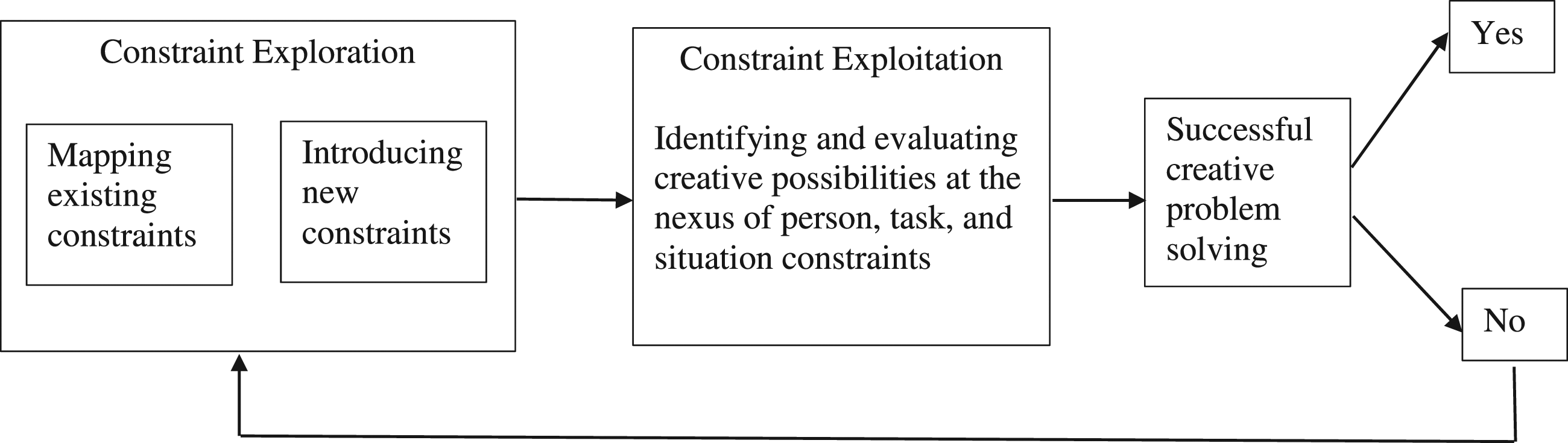
The longstanding view of the exploration and exploitation constructs as opposite, even paradoxical, both at the individual and the organizational culture levels, was replaced by a dialectic framework (March, 1991), which yielded the new construct of ambidexterity (Bledow et al., 2009; Liu et al., 2019). At the organizational level, it is viewed as an antecedent of innovation, which emerges from the ability to exploit existing competencies while also engaging in exploration of new capabilities (Gupta et al., 2006). At the individual level, research on creative hot streaks in different domains (art, film directing, and science) points to a domain-general sequence of exploration followed by exploitation: After experimentation with different constraints, the selection of one focusing constraint is followed by in-depth exploitation of the creative possibilities within it, and this pattern appears to yield clusters or bursts of highly creative and impactful outcomes (Liu et al., 2018).
At a broad level of analysis, too, the interplay and trade-off between exploration and exploitation, which forms the basis of decision-making (Cohen et al., 2007) captures the development of domain-specific creativity, which is preceded by competence. First, individuals engage in the exploration of different domains, often during childhood and young adulthood. This exploratory period yields the selection of a domain that best aligns with individual strengths and interests, and is followed by a period of exploitation, that is, working within the domain constraints and focusing on the acquisition of skills and knowledge depth within it. Only after the acquisition of domain expertise can creative contributions be made within that domain, at the Pro-C or Big C levels. The mere identification of domain-specific creative problems to solve requires competence, as does solving those problems. Moreover, as individuals progress in their careers, operant conditioning and cognitive entrenchment may contribute to the use of similar strategies in an attempt to replicate past creative successes. In order to overcome this creative impasse, a new cycle of exploration and exploitation beings with the willing experimentation of new anchoring constraints from across knowledge domains, followed by in-depth search for creative outcomes within a selected constraint.
Similarly, at a task level of analysis, the creative process is also best described by a cycle of constraint exploration followed by exploitation. This proposal is developed below, by considering the role of constraints at each step of the creative problem-solving process.
Problem Finding
Individuals engage in deliberate creative problem-solving in response to ill-defined problems they: (a) are presented with; (b) discover; or (c) create (Getzels, 1987), which correspond roughly to a related taxonomy of potential, emergent, and existent problem situations (Dillon, 1982). Presented problems are defined by others, and often require the problem-solver to recognize and acknowledge rather than find them. Discovered and created problems, however, do not start with a clear problem statement, and must instead be identified, defined, and mentally represented (Pretz et al., 2003). Discovered problems must be inferred and derived based on information given to the problem-solver. Created or invented problems are, as the name suggests, entirely defined and generated by the problem-solver.
This distinction among the different sources of initial problem states is important because it brings to the forefront the often-overlooked problem-finding step (Abdulla et al., 2020). Einstein was not explicitly assigned the problem of the general relativity theory any more than Picasso was given the task of generating a novel, iconic painting style. Both were actively engaged in problem-finding within their respectively chosen problem domains.
Problem-finding is effectively constraint-finding, applied to the search for a particular, often domain-specific problem, out of the infinite array of such ill-defined problems toward which the problem-solver’s creativity could be deployed. After an exploratory period, a domain is selected. Its exploitation for creative possibilities begins with the acquisition of increasing domain-specific knowledge, which is itself constraining, in a good way: it eliminates problems that have already been solved and identifies outstanding ones (Firestein, 2012). Paradoxically, more knowledge acts as a useful constraint for the problem-finding phase, guiding the search for worthwhile problems to consider.
Classic models of problem-solving acknowledge the importance of this first, problem-finding, step (Runco, 1994) and incorporate it, albeit using varied terminology, as a prerequisite before advancing to the subsequent problem-solving steps. Different terms for this step include: preparation (Wallas, 1926); problem formulation (Rossman, 1931); and problem understanding (Polya, 1957). The problem finding process is such a critical and complex step that it may represent a distinctive creative act in and of itself (Dillon, 1982), whose value may be at least as great as finding a solution (Getzels & Csikszentmibalyi, 1975; Reiter-Palmon et al., 1998), an argument advanced also by several eminent scientists (Einstein & Infeld, 1938; Kuhn, 1962; Popper, 1999). Both discovered and created problems, which require significant effort to be expended toward problem finding, are significantly less structured a priori than presented problems (Mumford et al., 1994).
Often it is not even apparent that a problem exists (Dillon, 1982). The statement attributed to Henry Ford captures the critical role of problem construction, ahead of creative problem solving: “If I had asked people what they wanted, they would have said faster horses.” In artistic creativity especially, a generally under-constrained domain, problems are so ill-defined that they appear to be non-existent. Indeed, most artists and writers would hesitate to call themselves creative problem-solvers. The problem they often face is, paradoxically, the lack of a specific problem to solve. An empty Word document or a blank canvas are representative of the issue of the open, unbounded field of possibilities. Constraints can be used to impose some needed structure and, indeed, to create a problem to solve. Contemporary artist Lynn Taetzsch (Fine Art America, n.d.) describes how these initial constraints can help: “In the early stages of a painting […] I’m creating a mess or a problem that I then have to solve in order to make the painting work.” Indeed, artists who are adept at problem-finding produce artwork that is rated as more original, and many become more successful (Csikszentmihalyi & Getzels, 1988).
Even for problems that do not require domain-specific expertise, problem-finding is considered an important prerequisite for problem-solving. In the Osborn-Parnes (Parnes, 1966) model of creative problem solving, a widely taught, brainstorm-based (Osborn, 1953) creativity-training model, the first two steps, that precede problem-defining, are “mess finding” and “data finding.” During these two prerequisite exploratory steps the problem-solver identifies constraints that narrow down the many possible problem statements to a more manageable set, from which the actual problem will be selected and defined and which can then be exploited for creative solutions.
Modern-day design thinkers, who approach creative problem-solving based on a variation of the Osborn-Parnes model (Parnes, 1966), also identify the early stage of problem construction as critical. The “Empathize” phase is followed by “Define”, and only then by “Ideate” (Brown & Kātz, 2009). The Empathizing phase includes observations and direct engagement with people, in the spirit of the human-centered ethos of design thinking, and this customer input becomes a driver of successful creative ideation. The wealth of data gathered to understand people’s experiences and motivations, beyond those that are explicitly stated, is used to constrain and construct the identification and definition of the problem.
Problem Construction
Ill-defined problems need structure in the early stages, to facilitate and guide the later problem-solving process (Schraw et al., 1995). Problem construction depends heavily on the questions the problem-solver asks before even attempting to find a solution. For example, the problem of a flat tire on a remote country road without a jack available in the car (Getzels, 1987) can yield different initial representations. When the problem is framed around the missing jack, the problem-solver attempts to find one, by walking many miles to the closest village. However, when the problem is framed around how to lift the car, an alternative solution is found faster, in a nearby barn. The classic slow elevator problem illustrates a similar point. When tenants complain of slow elevator service, their problem representation has faster elevator service as the goal, in which case solutions such as installing a new elevator or upgrading the existing one to a newer model, are fairly elaborate and expensive. However, when the problem is defined and represented differently, as elevator-users being unhappy with their elevator wait times, a simpler and efficient solution can emerge: installing mirrors adjacent to the elevators, since people lose track of time when they can look at their reflected image.
What does it take to solve these two open-ended problems successfully? A critical attitudinal variable may be constraint leveraging power (Tromp, 2022). This construct refers to a willingness to work with, rather than against, the given constraints and to explore possibilities within them. In the case of the flat tire problem, an additional time constraint may in fact have helped to facilitate the solution-finding. Without the option of walking to a nearby village as a solution possibility, the problem-solver would likely be forced to re-define the problem and to undertake a judicious exploration of the available opportunities in the more immediate environment, including a jack-substituting tool in a neighboring abandoned barn. Similarly, in the slow elevator problem, more expensive and less creative solutions emerge when the cost constraint is ignored. The mirror solution emerges only as a result of preserving the cost constraint, as well as the constraint of alleviating the tenants’ concerns. The nexus of these two limitations forces the construction of a mental representation that contains a winning creative solution. Of course, this is not the case for all intersecting constraints. However, the exploitation of creative possibilities within them has the potential to yield remarkably novel and useful outcomes.
Prize-winning author Hervé Le Tellier describes how “the constraint causes something unforeseen, unanticipated, to happen” (Cohen, 2021, para. 15), yielding low-probability, unexpected, and potentially useful outcomes. He expands on the process of working with constraints: I like when a constraint leads me away from an expected path. […] I’m led to write chapters imposed by constraint, and what fascinates me isn’t so much that I manage to find my way out, but rather the new narrative richness that the constraint gives birth to. I’m confronted with a text that astonishes me, even though it’s my own. It’s a rare pleasure. (Hatcher, 2011, para. 11)
Examples of constraints – even unwanted ones – leveraged to re-define and re-construct problems in order to uncover new creative opportunities also abound in the art domain. Pointillist artist Phil Hansen, who developed a hand tremor as a result of his particular type of artistic endeavor, “embraced the shake”, and used his physical constraint as an anchor and a source of inspiration that yielded a new art form based on fragmented images (Hansen, 2013). Agoraphobic photographer Jacqui Kenny also used the constraint of her debilitating phobia as the impetus to explore Google’s Street View, which in turn further constrained and guided her photography toward uniquely creative outcomes: instead of traveling to remote locations, she chose to photograph compelling street scenes from the existing footage provided by Google: “She has the ability to parachute into anywhere in the world, but her views and angles and lighting are in Google’s hands” (Den Hoed, 2017).
Constraint-based problem construction and re-construction are the initiating steps in all the examples above. Constraint sources can differ: they can stem from the person, the task, and the situation (Tromp & Sternberg, 2022b). For both Hansen and Kenny, their specific person constraints incorporated into the problem representation opened the door to new creative possibilities. For the flat tire and slow elevator problem-solvers, it was situation and task constraints, related to the physical environment and cost, respectively.
Problem construction relies on using existing knowledge structures to create ad hoc mental representations that reduce ambiguity, constraining and guiding the subsequent idea generation (e.g., Reiter-Palmon et al., 1997; Simon & Newell, 1971). Problem construction can be highly variable as it integrates individual-specific interpretations based on different past experiences, personal and social identities, and existing knowledge. These different perspectives may, in turn, lead to solutions that are more varied and more creative (Harms et al., 2020). One can easily imagine many alternative representations and outcomes stemming from the sort of interactive place and person constraints faced by Hansen and Kenny. This variability is a chief reason why we now have such extraordinary and varied art, food, scientific and technological advances, and solutions to problems big and small.
Moreover, problem construction is interactive and iterative, playing an important role both at the start and during problem solving (Dudek & Cote, 1994; Getzels & Csikszentmibalyi, 1975; Runco, 1994). If no solutions are found in the search space framed by the initial problem representation, as often happens during impasses (Ohlsson, 1992), modifications or restructuring of the representation are needed so the search can unfold in a different space. Indeed, both Hansen and Kenny were established artists before their particular challenges constrained their options.
Individual differences exist in the extent to which people are adept at problem construction (e.g., Getzels & Csikszentmibalyi, 1975). A key reason why some individuals are more adept at problem construction is that they can frame ill-defined problems in ways that are most easily relatable to them and that match their personality type – in other words, they are very good at working with their own person constraints. More creative solutions emerge as a result because the problems become more familiar and more directly related to their own expertise, therefore easier to scaffold (Reiter-Palmon et al., 1998). Regardless of baseline levels of skill, active engagement in problem construction can be inculcated in participants, and this intervention has been shown to stimulate the development of different problem representations, which facilitate creativity (Redmond et al., 1993; Reiter-Palmon et al., 1997).
Moreover, constraint integration does not only work when applied to the same problem. Combining the constraints of separate problems, challenging as it may seem, can also yield creative solutions, as evidenced, for example, by intergenerational shared sites (e.g., Ruggiano, 2012), which solve the two previously distinct problems of providing daycare for elderly adults and young children.
Problem Solving
Research on the processes that underlie creativity has been framed by different dual-process models, with varying degrees of overlap (Sowden et al., 2015). One such dualism is represented by the constructs of divergent and convergent thinking. While the specifics of the interplay of these two processes is still a debated topic (for a review, see Cropley, 2006; Sowden et al., 2015), both are acknowledged to play a role in creative thinking. Divergent thinking, assessed by measures such as the Alternate Uses Test (Guilford, 1967), involves “zooming out” to explore and generate many different ideas, the latter involves “zooming in” to integrate different ideas, sometimes in order to deduce a single, concrete, accurate, and effective solution, as is the case with the Remote Associates Test (Mednick, 1962). In a similar vein, Finke et al. (1992) distinguished between generative and exploratory processes, the former being responsible for idea generation, and the latter for idea evaluation. I propose that constraints play a critical role in both processes. Idea generation benefits from the introduction of constraints, which provide multiple, varied anchors in a dauntingly large search space. Idea evaluation imposes constraints on the generated ideas and selects those that have the most potential to meet the problem-specific goal.
The distinction and interaction between explicit and implicit processes (Hélie & Sun, 2010) also showcases how creative problem solving depends on constraints. Implicit processing, like implicit learning, takes place in a bottom-up fashion, and is based on the satisfaction of soft constraints, whereas explicit processing, like explicit learning, takes place in a top-down fashion, and is based on the satisfaction of hard constraints, i.e., rules (Hélie & Sun, 2010). Similarly, I have argued that creative problem solving can be initiated by way of a bottom-up, associative, anchor-based, category-building approach or by way of a top-down, rule- and category-based, exemplar-finding approach (Tromp, 2022).
Another dual-process model that has valuable applications to creativity research and that was originally proposed as a comprehensive framework in reasoning and decision-making, distinguishes between associative, automatic, Type 1 processes, and analytic, deliberate, Type 2 ones (Evans & Stanovich, 2013; Kahneman, 2011). Fast, heuristics-based Type 1 processes, which are generally responsible for a host of cognitive errors in the domains of reasoning and decision-making, are in fact valuable for creative problem solving, to which they contribute novel solutions that may be unlikely or harder to find through controlled, analytical, Type 2 processes (Gilhooly et al., 2015). For example, when memory load is increased, affecting resource-limited Type 2 processes, insight problem solving is impaired, while divergent thinking is enhanced (Lin & Lien, 2013). Although both types of processes appear to play a role across creativity tasks, the extent of their involvement may differ as a function of the specific creative problem, including whether the task is open- or closed-ended. Open-ended, under-constrained problems may rely more on effortless, spontaneous, Type 1 processing, while closed-ended problems with multiple constraints require executive functions to monitor more actively whether possible solution paths are plausible in meeting the specified criteria or whether search should be redirected.
A fourth framework, the Dual Process Creativity Model (Nijstad et al., 2010) proposes two routes to creative outcomes, corresponding to different processes: a flexibility pathway and a persistence pathway. The former relies on flexible switching among many diverse categories and associations that are distant, rather than close. The latter relies on deliberate, systematic exploitation of fewer categories and associations that are close rather than distant. While cognitive flexibility is correlated with a global processing mode (De Dreu et al., 2008), cognitive persistence relies on more local, yet systematic processing. Consistent with the persistence pathway, responses to the Alternate Uses Test (Guilford, 1967) have been shown to increase in originality and flexibility, with more unusual ideas being produced in the second half of the test (e.g., Runco, 1986). I argue that constraints can facilitate both pathways. Cognitive flexibility is enhanced most by experimentation with many different constraints. Individuals who score high on measures of cognitive flexibility are likely already adept at spontaneously introducing and experimenting with various anchors that limit the exploratory search space. Cognitive persistence benefits most from experimentation with fewer constraints, within which a more focused, in-depth search can take place. Interestingly, personality traits constrain the use of these pathways. Individuals with approach-related traits such as openness to experience, extraversion, and positive affectivity may display greater creativity because their traits predispose them toward cognitive flexibility, while individuals with avoidance-related traits such as neuroticism and negative affectivity may also display more creativity under some conditions because of cognitive persistence (Baas et al., 2013). Expertise and time are also likely to constrain the use of these pathways: the highest quality ideas are thought to emerge when narrow specialists use the perseverance pathway and broad specialists use the flexibility pathway (Cummiskey & Baer, 2018).
The proposal outlined in this article, that creativity emerges from a cycle of constraint exploration and exploitation, has the potential to unify and build on the strengths of the different dualistic models reviewed above. Its main thesis is informed by research on foraging behavior (Stephens & Krebs, 1986), which has promising applications to creativity. The cycle of exploratory and exploitative behavior that forms the basis of foraging behavior research has been proposed to underlie decision-making in humans as well as other animals, and has provided especially fertile empirical ground for neuroscience (e.g., Kolling et al., 2012; McClure et al., 2006) and organizational (e.g., Rosing & Zacher, 2016) studies.
In classic ecological models, foraging refers to a three-stage process: visiting a patch, consuming the food, and quitting (Mella et al., 2018). Whether applied to animal food-finding behavior or more complex human behaviors, each stage represents a decision. In the context of creativity, the “patches” are defined by constraints, patch visits correspond to exploration, and the food consumption corresponds to exploitation. Two decisions in particular contribute to the foraging behavior, and, by extension, to the search for creative solutions. The first, accept-reject, decision is to either (a) engage with an option and exploit it, or (b) ignore it and explore further, in search of better options. In animal foraging models, this accept-reject choice is often referred to as diet-selection (Stephens, 2008). In the context of creativity, it corresponds to searching exhaustively within a particular constraint (“patch”) or exploring creative possibilities within other constraints. The second, stay-switch (or, in classic ecological models of foraging, “patch-leaving”) decision reflects a choice between (a) persisting and continuing to exploit an option with diminishing returns and (b) leaving that option to explore others that may provide better returns. Indeed, research on creative foraging that pioneered an innovative experimental paradigm showed that individuals ended the exploitation of a category in favor of exploring other, new ones, before depleting it (Hart et al., 2017).
The cycle of exploration and exploitation is therefore characterized by a universally applicable trade-off: at different time-scales and levels of behavior, exploration of new options appears to be riskier but possibly more advantageous, whereas exploitation of familiar sources of reward appears to be safer, yet possibly less profitable (Cohen et al., 2007). Even in so-called stationary environments, that are known and predictable – which is certainly not the case for creative tasks – the factors that lead humans and other animals (e.g., Viswanathan et al., 1999) to engage in exploratory versus exploitative behavior are still not fully understood. For example, some findings suggest that when subjective estimates of rewards diminish, actions that are perceived to have decreasing value are abandoned in favor of others that are deemed to be more rewarding (Daw et al., 2006). Other findings suggest an opposite pattern: more rather than less effort allocated toward the same action when the perceived rewards diminish (Gratton et al., 1992).
Unlike food foraging or other decision-making, where diminishing returns can be evaluated objectively, in the context of creativity, the assessment of the foraging value is subjective. It depends on a number of factors, including expertise, past creative experiences, creativity goals, motivation to create, and a possible constraint-leveraging mindset (Tromp, 2022). Such factors, combined, may explain the individual differences documented in creative searches, that appear to range from quick-to-discover/quick-to-drop approach at one end of the continuum to slow-to-discover/slow-to drop at the other end (Hart et al., 2017).
Constraints in open-ended and closed-ended creative problems
Across foci of processing differences, the metaphor of “out-of-the-box” creativity, as appealing and liberating as it may sound, appears both uninformative and misleading. Creative solutions are found precisely inside the “box” defined by an individual’s active construction of the problem representation (e.g., Stacey & Eckert, 2010).
For problems that are open-ended, of the sort encountered during group brainstorming sessions or, at the individual level, by authors paralyzed by writer’s block and artists facing a blank canvas, the key is to think in new boxes (e.g., De Brabandere & Iny, 2013). Constraints must be identified or introduced, externally or internally, by the problem-solver. Indeed, creating something ex nihilo is not possible. Instead, creative outcomes are based on combinations of existing elements (e.g., Cropley & Cropley, 2015; Haught-Tromp, 2016; Johnson-Laird, 1988). As the number of component ideas in a set increases, so does the number of possible combinations of those initial ideas, in an exponential manner. This phenomenon, known as combinatorial explosion (e.g., Boden, 2004; Simonton, 2011), presents a problem for open-ended creativity. Constraints provide a solution to this problem (Sternberg & Kaufman, 2010; Tromp, 2022), by helping to turn ill-structured, constraint-hungry problems into better-structured ones.
For ill-defined problems that are closed-ended, the key is to find and think inside the right box. Here, constraints also guide solution-finding, and they are typically provided by the problem statement. Classic insight problems such as the matchsticks (Scheerer, 1963) or the candle problem (Duncker, 1945) have both initial and end states that are adequately constrained: the problem-solver knows what the specific problem and goal are. However, they are challenging because common cognitive biases such as assumption blindness and functional fixedness lead individuals to mistakenly over-constrain the initial problem representation (e.g., Kershaw & Ohlsson, 2004; Patrick et al., 2015). For example, in the matchsticks problem, which requires the arrangement of six matches such that they form four equilateral triangles, an over-constrained two-dimensional problem representation, which is initially constructed, does not include the solution. The ensuing state of impasse signals to the problem-solver to engage in divergent exploration of different problem representations, among which will also be the one that contains the solution.
Although problem-solving for open-ended and closed-ended creative problems may implicate different levels of involvement of cognitive processes that are convergent and divergent, explicit and implicit, top-down and bottom-up, System I and System II (Lin & Lien, 2013; Sowden et al., 2015), the two types of problems share many similarities with respect to the exploration and exploitation of constraints. Creativity in both types of problems: (a) requires divergent exploration of different paths within constraints – that are either specified by the problem (for closed-ended problems) or imposed, externally or by the problem-solver (for open-ended problems); and (b) depends on precluding clichéd, high-probability problem representations and promoting creative, low-probability ones. Two notable differences are that: (a) open-ended problems require the imposition of new constraints to facilitate problem construction, while closed-ended ones do not, because they are already multiple constraint problems (Smith et al., 2013); and (b) in open-ended problems the search for creative solutions is iterative because constraints can and often do propagate, yielding further sources of creative solutions, whereas in closed-ended problems the search of the problem space ends when the right problem representation is found that meets all the specified criteria and contains the creative solution(s).
Implications and Future Directions
Applications of research on foraging behavior to creativity that are beginning to emerge (e.g., Martín-Brufau & Berná, 2021) should be explicitly connected with investigations of the role of constraints in creativity. “Patches” correspond conceptually to “channels,” a particular type of constraint formed by a category, within which creative possibilities can be exploited (Tromp, 2022). Promising avenues of research have begun to document these patterns of exploration (longer, meandering paths) and exploitation (shorter, more direct paths) (Hart et al., 2017) and to identify which strategy yields the most successful creative outcomes for which tasks. For example, in a science contest, exploitation – a focused search characterized by low cognitive-search variation – benefited creativity when the semantic distance between an individual’s expertise and the exploited domain was large; however, when the semantic distance was low, the opposite effect was found: exploration of different knowledge elements – a flexible search characterized by high cognitive-search variation – benefited creativity (Acar & van den Ende, 2016).
Additionally, constraints on the search space should be dissociated from constraints on the search time (Corazza & Lubart, 2020; Tromp, 2022), and the implications of varied amounts of available time for the search of creative outcomes warrants empirical scrutiny. For example, when more time is available, evidence appears to point in the direction of a tendency to explore (Carstensen et al., 1999). To what extent does this finding hold in the context of a creative task, and how does it interact with individual differences, such as a preference for flexible and brief explorations versus persistent and longer exploitation (e.g., Hart et al., 2017; Nijstad et al., 2010)? Moreover, studies of the effect of time constraints on creativity suggest an inverted-U-shaped relationship, whereby too much and too little time appear to inhibit creative performance (Baer & Oldham, 2006). How do the strategies deployed in the creative search and the choice of exploration versus exploitation change as a function of available time? Increased time availability is predicted to promote more exploration, whereas limited time is predicted to promote exploitation. At the same time, I predict this hypothesized difference to interact with individual differences in processing styles (flexibility vs. persistence, Nijstad et al., 2010), and the type of creative task (open-ended vs. closed-ended).
Predicted Correlations Among Types of Creative Problems, Domains, Emphasized Creativity Criteria and Their Respective Functions, Type of Processing, and Individual Differences Regarding Constraints.
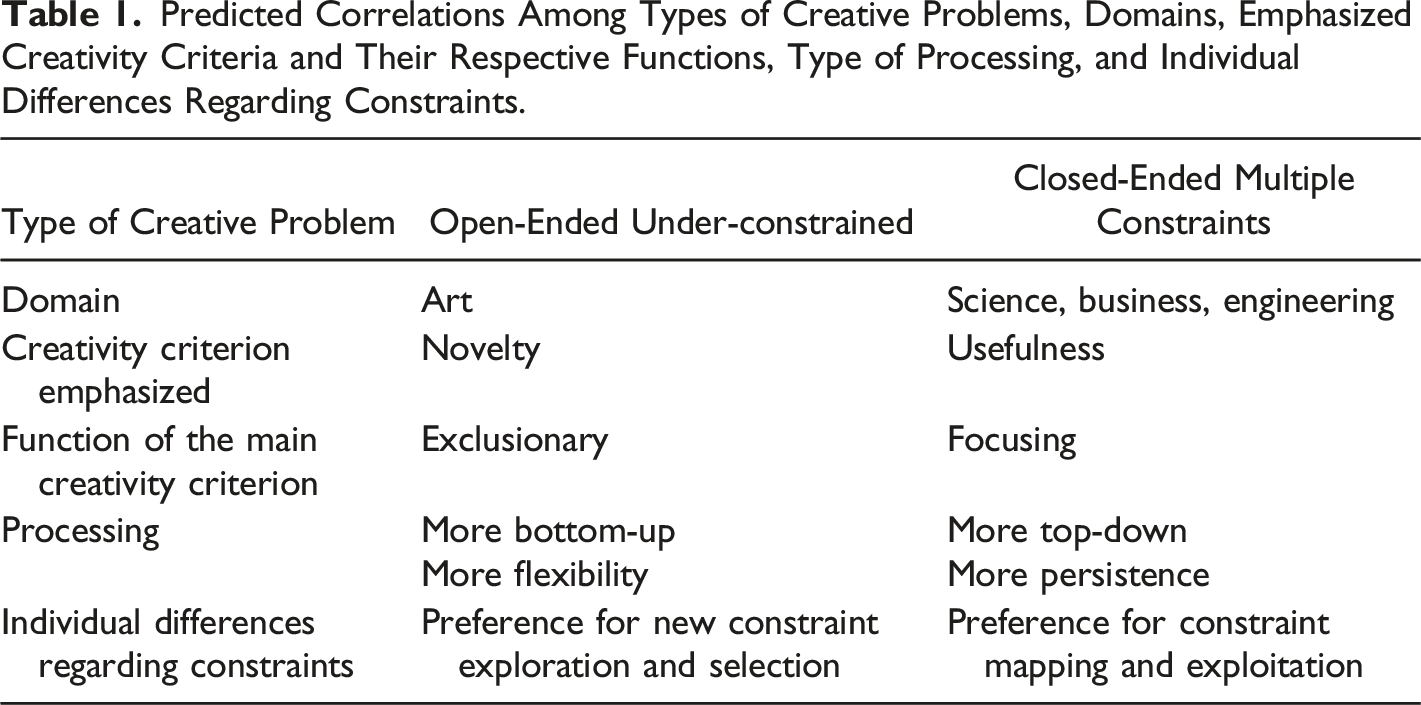
Future inquiries should test these predicted individual differences regarding the processing of constraints. For example, people who are more adept at constraint mapping may display more skill at solving insight problems, may prefer more constrained creative tasks, such as those in the domains of science, engineering, and business, and may favor an initial focus on the usefulness criterion of creativity. By contrast, people who are more adept at constraint exploration may display more skill at solving more open-ended creative problems, may prefer less constrained creative tasks, such as those in the domain of art, and may favor an initial focus on the novelty criterion of creativity.
The practical implications of the proposals developed in this article are relevant for both individuals and teams who are engaged in creative problem solving. The first implication concerns raising awareness of the important role of constraints in creativity. Within this awareness, one can identify both existing dispositional preferences and skills, such as constraint mapping versus constraint introduction, and areas of improvement. For example, some individuals who may be adept at exploring and introducing new constraints while others may have stronger constraint mapping skills, which allow them to uncover implicit assumptions. The second implication concerns the leveraging of constraints for creative problem solving, which is a skill that can be improved by practice. At the individual level, one can aim to strengthen particular constraint skills, such as mapping and aiming to exploit existing constraints (for example, cooking only with ingredients available in the refrigerator), and introducing new ones (for example, excluding some ingredients or focusing a meal around a new, unfamiliar ingredient). At the group level, managers can aim to leverage individuals’ specific constraint-related skills to assemble successful teams, and to develop interventions and training programs aimed at cultivating constraint exploration and exploitation skills for creative problem solving.
Conclusion
Using the frameworks of creativity as problem solving and Integrated Constraints in Creativity (IConIC), this article developed the proposal that creativity is best understood in terms of a cycle of constraint exploration and exploitation. To advance this argument, research on foraging behavior was connected with findings about the role of constraints in the creative process, and evidence was integrated from social, cognitive, and organizational psychology, neuroscience, computational studies, and the design literature. This synthesis supported the argument that constraints: (1) provide the criteria for the evaluation of creative outcomes; (2) are critical in each step of the creative process: problem finding, problem construction, and problem solving; and (3) play a key role in all creative instantiations, including open-ended and closed-ended creative problems. Therefore, investigations into creative exploration and exploitation should focus on the role of constraints, that are predicted to differ as a function of individual differences, the specific creative problem and domain, and the broader context.
Footnotes
Declaration of conflicting interests
The author(s) declared no potential conflicts of interest with respect to the research, authorship, and/or publication of this article.
Funding
The author(s) received no financial support for the research, authorship, and/or publication of this article.
