







Abstract
Previous research has found that a negative life event is a main risk factor for hopelessness, which in turn is considered to be a proximal cause of major depression disorder and a suicide risk factor. Unfortunately, very little attention has been paid to the role of decision-making constructs between negative life events and hopelessness. To fill this gap, the present study aims to test the moderation role of sunk cost propensity in this relationship, which is an over-generalized tendency to persist, based on past investment. A total of 495 university students completed assessment of their resistance to sunk cost propensity, whereas the negative life events, hopelessness, mental health state (depression, anxiety) and big-five personality traits were measured by various questionnaires. Participants’ tendency to resist sunk cost propensity moderated the relationship between negative life events and hopelessness. Individuals who tended to resist sunk cost bias are more vulnerable to the adverse effects of negative life events. This effect is still significant, even after controlling for individuals’ psychological well-being (depression, anxiety) and big-five personality traits. The current findings provide preliminary evidence that resistance to sunk cost propensity may be an important characteristic associated with an individual’s hopelessness when exposed to a negative life event.
Introduction
Individuals are sometimes exposed to negative life events (NLE), which are also known as “events that can lead to maladjustment and disturbances that most likely result in readjustment, requiring changes in one’s daily life” (Holmes & Rahe, 1967). Such events can evoke strong, aversive emotions, such as hopelessness, which in turn is defined as a series of cognitive schema, including negative expectations associated with oneself and the future. Hopelessness is supposed to be a proximal cause of major depression disorder and also characterized by hopelessness depression, which is a specific subtype of depression (Abramson et al., 1989). Moreover, a substantial number of prior studies have demonstrated that hopelessness is a pre-eminent risk cognitive factor for suicide and non-fatal self-harm (Beck et al., 1975,1993; Christensen et al., 2013; Romens et al., 2009). Based on these converging findings, the ‘hopelessness theory’ was developed and focuses largely on hopelessness as the key factor in suicide risk (Abramson et al., 1989). Although recent research has indicated that additional variables are extremely and importantly related to suicide risk, hopelessness remains a primary component (O’Connor, 2011).
University students are at higher risk of hopelessness, particularly since they are enduring a critical transition period from adolescence to adulthood. During this period, they may confront stress, including interpersonal relationships and loss (Barnett & Gotlib, 1988), as well as financial, academic or job search related difficulties (Hudson, 2005; Kendler et al., 1999). According to the American College Health Association’s survey, 48% of college students report they had experienced hopeless feelings in the last 12 months. This finding clearly indicates that this group may be more vulnerable to hopelessness. The general pattern of stressful college events is similar to that found in Chinese studies. Investigations have shown that approximately 8% of Chinese students have reported that attending the university is a stressor (Li et al., 2005). Therefore, intervention may be an important way to target hopelessness. Interestingly, not all college students exposed to NLEs experience poor psychological well-being, such as hopelessness (Giollabhui et al., 2018). Indeed, some previous research has found association between negative life events and hopelessness (Haatainenet et al., 2003). Other researches have demonstrated that negative life events are not associated with hopelessness, unless those events also interact with certain other vulnerability factors linked to hopelessness (Liu et al., 2015), such as loneliness and negative coping styles (Chang et al., 2008; Giollabhui et al., 2018). Given the inconsistent findings of these previous researches, further exploration of the relationship between negative life events and hopelessness in the context of the eastern cultural background is needed. It may also be beneficial to investigate alternative decision-making frameworks that might assist us in better understanding negative life events and hopelessness. This is because previous research has indicated that hopelessness may be due to – or characterized by – cognitive or decision biases (Bauer et al., 2022; Karvelis & Diaconescu, 2022).
The sunk cost bias is a sort of maladaptive persistence based on previous time, effort, or financial expenditures when negative outcomes become apparent (Siniver et al., 2013; Arkes & Ayton, 1999; Sweis et al., 2018). In other words, people tended to “throw good money after bad” (i.e., to waste money by spending more money on something you have already spent money on that is no good. See Lin et al., 2014). Thus individuals find it difficult to ignore prior investment while making decision about future circumstances. For instance, people tend to stay in unhappy relationships or dissatisfying jobs, even if they are tortured by them (Rego et al., 2018; Nunes-Costa et al., 2019). As such, sunk cost bias may be a useful candidate in terms of being a decision bias associated with hopelessness (Stanovic & West, 2000).
The psychological underpinnings of susceptibility to sunk cost may be attributable to the inflexible use of two normally adaptive rules: namely, “loss aversion” and “persevere” (Arkes & Ayton, 1999; Bruine et al., 2007; Stanovich & West, 2000). Loss aversion is a psychological tendency that describes a higher sensitivity to losses than to gains and impacts decisions (Sokol-Hessner & Rutledge, 2019). Loss aversion is considered to be an adaptive bias that, in ancestral challenge domains, enhanced survival chances (Chen et al., 2006). Namely, it seems adaptive that humans evolved with a predisposition to be attentive to the threat of a loss, as loss of any resource in ancestral environments would have likely been particularly devastating, which could result in starvation and death (Li et al., 2012). Similarly, perseverance is essential for survival in human foraging behavior (Wilke et al., 2009). Thus sunk cost bias may drive by evolution and be adaptive when people must live on the verge of survival. However, in an irrecoverable cost situation, an overgeneralized form of these two rules may lead to sunk cost bias (Haita-Falah, 2017; Bruine et al., 2007). This may be seen in our unwillingness to quit a failing relationship (emotional expenses) merely because of the time and energy put in that relationship (i.e., sunk costs). This happens despite the fact that ending the relationship would alleviate psychological discomfort (Rego et al., 2018; Nunes-Costa et al., 2019). Because ending the relationship might trigger a feeling of loss aversion, then leading to anticipated regret (Wong & Kwong, 2007), which could make people more likely to continue the relationship ultimately (Nunes-Costa et al., 2019). Additionally, failing to end up the doomed relationship have been characterized an inability to demonstrate cognitive flexibility (Emich & Pyone, 2018).
From this point of view, the trait-like sunk cost tendency has been associated with undesirable outcomes (Jarmolowicz et al., 2016; Rego et al., 2018; Siniver et al., 2013; Stiegler & Ruskin, 2012). Examples include people who are more vulnerable to sunk cost bias showed greater regret and avoidance when they make decision. Beside this, recent research shows that sunk cost propensity is linked with cannabis use, which in turn is a maladaptive coping style associated with substance-related disorders and adverse health effects of potentially immense public health significance (Sofis et al., 2020). More importantly, researchers have assumed that cognitive bias could influence suicide, in terms of modulating the response to stress in suicide attempters (Jollant et al., 2007; Turecki & Brent, 2016). Indeed, previous research has found high and low lethality suicide attempters (the latter being a group that was associated to poorer/shorter planning) were more susceptible to sunk cost bias than those with suicidal ideas. Also, depressed individuals are more likely to exhibit sunk cost bias than healthy controls. This finding indicates that sunk cost bias may be playing an important role in suicide-related decisions. As hopelessness plays a significant role in suicide risk among a number of populations, this study infers that sunk cost bias might also be associated with hopelessness. Different from previous studies, the current study aims to test the moderating role of sunk cost bias propensity in the association between NLEs and hopelessness.
Even though negative life events may be crucial to the generation of hopelessness, not all people who encounter NLEs feel hopelessness. In line with the diathesis-stress model of psychopathology (Chang et al., 2010), individual differences in personality and coping styles could interact with NLEs in affecting a variety of adverse psychological outcomes, such as hopelessness. However, whether decision-related sunk cost bias interacts with negative life events on hopelessness is unclear. Previous research has found that sunk cost bias has been linked to facets of emotional dyscontrol, such as anger, rumination and impulsivity (Coleman, 2010). Taken together, the combined evidence suggests that resistance to sunk cost propensity may act as a moderator on the appraisal of a potentially threatening situation when individuals confront with negative life events.
Furthermore, according to the goal disengagement theory (Klinger, 1975), sunk cost bias may be interpreted as a failure to disengage from an unattainable goal and reengagement. Previous studies have found that goal disengagement ability is negatively associated with negative emotions when encountering setbacks (Wrosch et al., 2003). Thus, resistance to sunk cost bias may act as a potential protective role in the relationship between NLEs and hopelessness, for the ability to disengage from hopeless situations is critical to adaptive self-regulation.
Although extensive research has been carried out on the relationship between NLEs and hopelessness, little attention has been paid to the role of individual differences in the resistance to sunk cost propensity. Therefore, the current study examines the relationship between the NLEs and hopelessness, as well as whether this relationship is moderated by individuals’ propensity for resists sunk cost. We measured young adults’ self-reports of negative life events, and their resistance to sunk cost propensity and hopelessness. Based on the diathesis-stress model of psychopathology, we expected that high levels of life stress would be related with heightened levels of hopelessness. Moreover, inspired by previous research, which found that decision-related biases moderate the psychopath syndrome when people are confronted with stress (Pot-Kolder et al., 2018), we further hypothesize that resistance to sunk cost propensity would moderate the association between NLEs and hopelessness, such that the link between NLEs and hopelessness will be stronger among individuals with a lower (vs. higher) resistance to sunk cost propensity. Specifically, people who are less susceptive to sunk cost will show a lower level of hopelessness than people who are more susceptive to sunk cost. The present research also evaluates the relevant individual’s personality traits, depression and anxiety level, in order to rule out alternative explanations.
Method
Participants and Procedure
A convenience sampling method was adopted to collect the data. 495 undergraduates (Mage = 20.6, SD = 1.8, 206 female) were recruited from two large universities in northwestern China and participated in this study. The participants attended the research voluntary in their introductory psychology classes by members of the research team. Informed consent forms were completed by the participants in order to explain the purposes and procedures of the study. The survey was depicted as assessing their attitudes toward life and mental health status. The questionnaires were administered to the participants by electronic questionnaire and they completed by cell phone in the classroom. The questionnaire included measurements of negative life events, hopelessness, anxiety, depression and resistance to sunk cost propensity. The participants were thanked and debriefed after they completed the questionnaires. The entire survey procedure was finished in about 30 minutes. Two weeks later, participants completed a big-five personality trait questionnaire after class. The procedure was approved by the university review board.
Materials
Negative Life Events
The participants’ NLEs were evaluated with a 27-item Adolescent Self-Rating Life Events Checklist (ASLEC) questionnaire. The checklist consist of 27 stress life events from multiple social-stress domains, including family (e.g., “Parental physical punishment”), college (e.g., “Fail to pass the exam”), interpersonal (e.g., “Break up with someone”), and physical illness, which were chosen based on the frequency with which they occurred in Chinese teenagers (Liu, Oda, et al., 1997; Liu et al., 1997). Each item is rated from 1 to 5, with one indicating “the negative life event does not occur, or occurs but has no impact”; 2, “the negative life event occurs but has a minor impact”; 3, “the negative life event occurs but has a moderate impact”; 4, “the negative life event occurs but has a severe impact”; and 5, “the negative life event occurs but has an extremely severe impact.” Cronbach’s alpha for this scale was.87 in the present research.
Hopelessness
Hopelessness was measured by the validated Chinese version of Beck Hopelessness Scale (BHS) (Beck & Steer, 1989; Becket al., 1974; Kong et al., 2007). BHS is a 20-item questionnaire that includes 11 negatively phrased statements (for example, “my future appears bleak to me”) and nine favorably worded items (for example, “I look forward to the future with hope and optimism”). A true-false answer structure allows for a score range of zero to twenty. The Cronbach’ coefficient for this scale was .82 in this investigation.
Resistance to Sunk Cost Propensity
Participants filled out the Chinese version of ‘Resistance to Sunk Cost’ section of the performance-based adult decision making competence (ADMC) index (Bruine et al., 2007; Feng et al., 2015). The sunk cost resistance subtest consisted of ten tasks that assessed the capacity to disregard earlier unsuccessful investments in real-world circumstances. On a scale of 1–6, for example, participants were asked if they were more inclined to practice playing an expensive cello that they had bought but no longer wanted to play, or playing a guitar that they wanted but had been given for free. The reliability of this scale in this sample was acceptable (Cronbach’s α = .73).
Control Variables
Given that past research has linked personality and emotional state to hopelessness (Chioqueta & Stiles, 2005; Duberstein et al., 2001; Starr & Davila, 2012; Thompson et al., 2005), we controlled these variables in our statistical analyses. Personality was measured by a validated version of NEO-FFI (Yao & Liang, 2010). Depression and anxiety were measure by Chinese version of Symptom-Checklist 90 (Tang & Cheng, 1999). The score for reliability of personality was .76, .78, .81, .76, .79 for Openness, Extraversion, Neuroticism, Agreeableness and Conscientiousness, respectively; for depression and anxiety, the scores were .85 and .81 respectively.
Results
Participant Characteristics
Ultimately, data from 475 undergraduates were analyzed (Mage = 21.6, SD = 1.6, 236 female). The data of eight individuals were omitted because they did not sign the participant permission form. Furthermore, seven individuals' data were discarded because more than half of the forms were left blank, and five participants' data were discarded due to outlier values. The majority of the participants were Han Chinese (53.1%).
Descriptive Statistics (Test of Relationship of Negative Life Experiences, Hopelessness, Anxiety, and Depression and Big Five Personality)
Correlations between Observed Variables, n = 475.
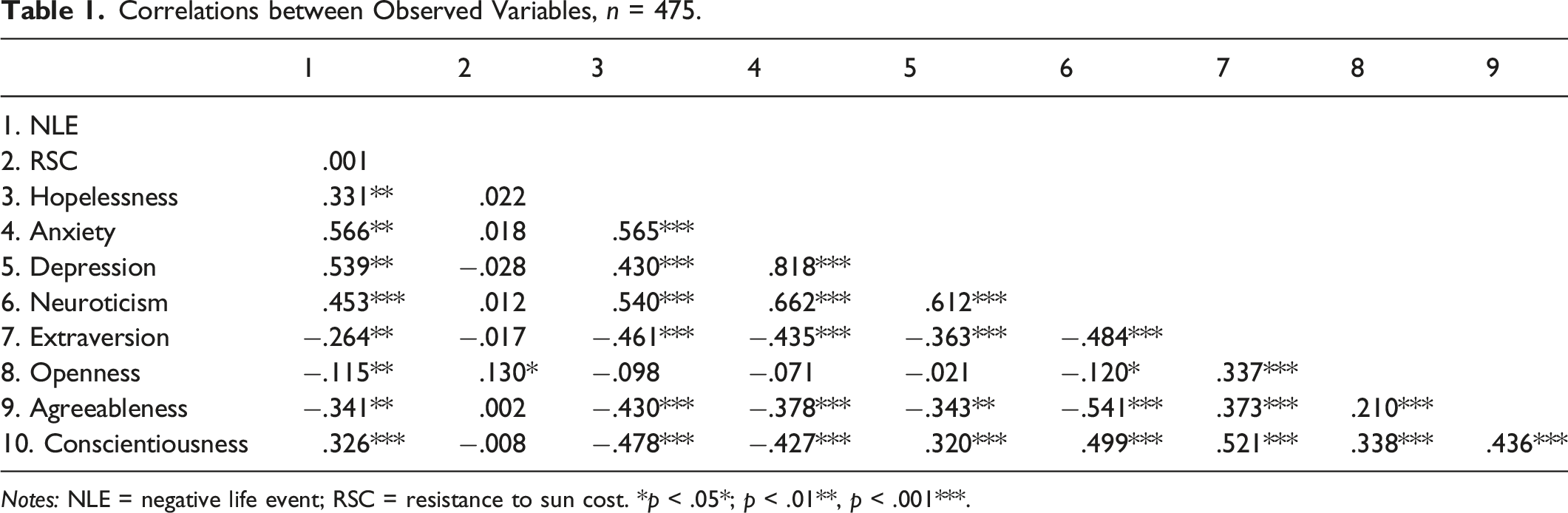
Notes: NLE = negative life event; RSC = resistance to sun cost. *p < .05*; p < .01**, p < .001***.
Test of the Moderation Role of Resistance to Sunk Cost Propensity
Using centered variables, a hierarchical regression analysis was conducted in Jamovi 1.6.23.0 to test the hypothesis that tendency for sunk cost bias resistance would mitigate the connection between a negative life experience and hopelessness. Block 1 included the propensity for sunk cost bias resistance and negative life event ratings, whereas Block 2 contained the interaction between these two factors.
The main effect of negative life event is significant: β = 0.34, t (472) = 7.91, and p < .01, with people who experience more severe negative life events tending to report more elevated feelings of hopelessness. The main effect of propensity to resistance sunk cost was not significant: β = 0.02, t (472) = 0.49, and p = .62. The interaction effect reached significant level, with β = 0.11, t (472) = 7.91, p < .05, R
2
= .12, ΔF = 6.17, ΔR2 = .01, and p = .01. This interaction effect was graphed using simple slope analyses, with a range of ±1 SD for both predictor variables. The t-test for simple slope demonstrated that there is a positive link between negative life events and hopelessness among participants with higher (+1 SD) levels of resistance to sunk cost bias (simple slope = 0.09, standard error (SE) = 0.01, t (472) = 6.90, β = 0.45, and p < .01). As shown in Figure 1, people who have a lower-level propensity of resistance to sunk cost bias tended to have lower levels of hopelessness when confronted with low-level negative life events. However, as the severity of the negative life event increased, the results of the t-test for simple slope revealed that a positive relationship exists between negative life events and hopelessness among participants with a low (−1 SD) level of resistance to sunk cost bias (simple slope = 0.05, standard error (SE) = 0.01, t (472) = 4.14, β = 0.24, and p < .01). Interaction Effect Plot.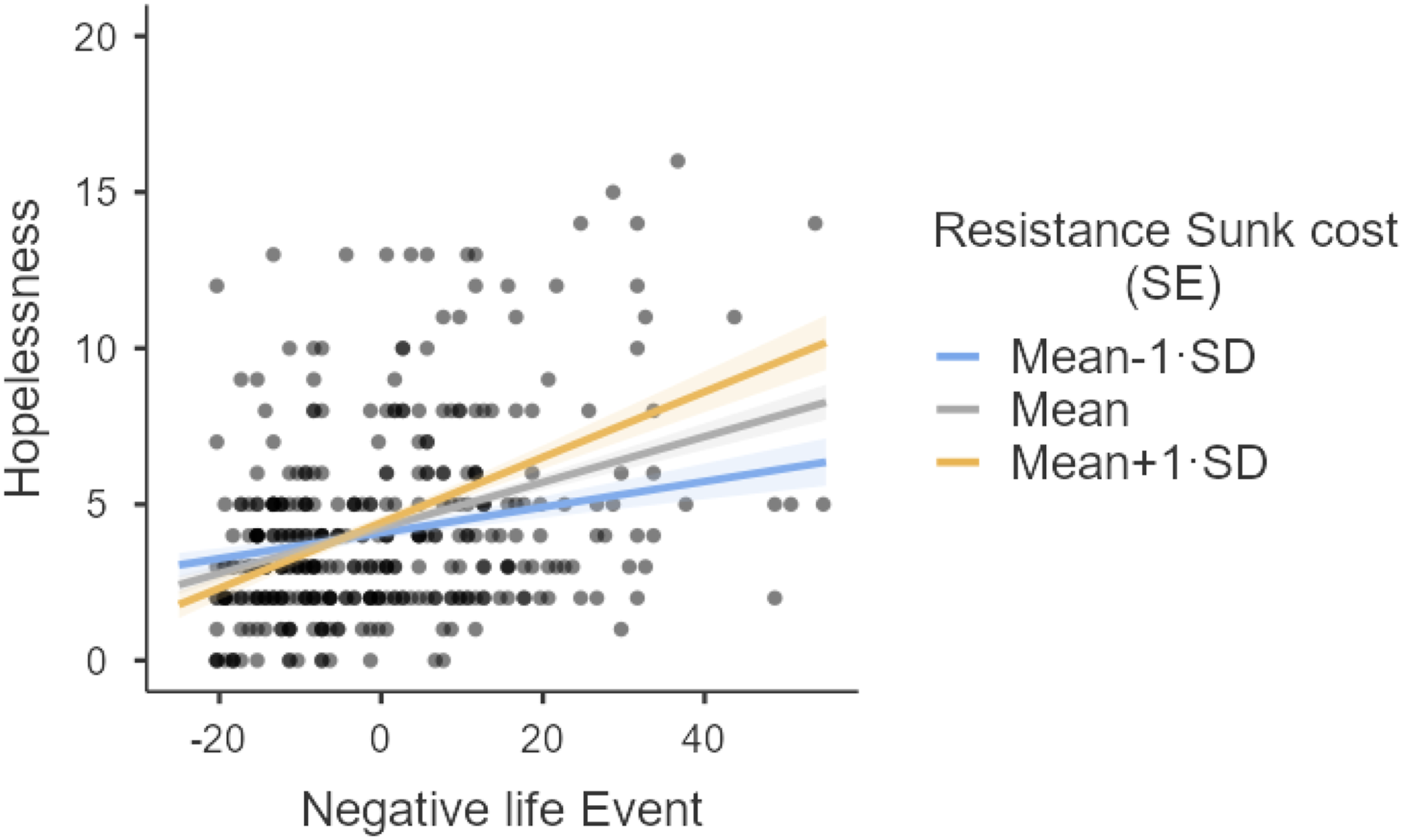
Additionally, the present study also involved the participants’ big-five personality traits and current mental health state as control variable. After control the personality, depression and anxiety, the interaction was still robust (β = 0.11, t (366) = 7.10, and p < .01).
Discussion
The current study investigates for whom and how negative life events impact university students’ hopelessness feelings. The results show that negative life events are positively associated with an individual’s feelings of hopelessness, indicating that stressful life events are an important source of hopelessness for university students. This research supports the diathesis-stress model, which states that when people are subjected to stressful life situations, they may become hopelessness (Chang et al., 2010; Haatainen et al., 2003).
More importantly, as expected, the results also show that propensity of resistance sunk cost bias moderates the relationship between negative life events and hopelessness. Specifically, lower levels of propensity of resistance to sunk cost bias significantly weaken the impact of negative life events on hopelessness than do higher levels of propensity of resistance to sunk cost bias. This finding indicates that lower levels of propensity of resistance to sunk cost bias may buffer the negative effect of negative life events. What is surprising is that this result contradicts our prior hypothesis. As previous research on sunk cost bias has shown that this propensity is typically associated with undesired outcomes (Jarmolowicz et al., 2016; Rego et al., 2018; Siniver et al., 2013; Stiegler & Ruskin, 2012), we hypothesized that the role of resistance of sunk cost bias in this study would be similar to studies that found that immunity to bias might buffer the associations between stressful live events and stress. However, the current result indicates that people who tend to persist in a futile project are less vulnerable to a negative life event’s effect on hopelessness. As mentioned before, loss aversion might be the other important influence factor in the sunk-cost fallacy (Sokol-Hessner & Rutledge, 2019). Previous research showed that individuals with a strong loss aversion are deterred from attempting suicide (Hadlaczky et al., 2018). Because hopelessness is closely associated with suicide behavior (O’Connor, 2011), bringing these lines together, the current results are also in line with the perspective that sunk cost bias may also act as a protective role in the face of negative life event. The other possible explanation for this finding might be that persistence in a sunk cost situation might reflect people’s beliefs when faced with setbacks and frustration. Their beliefs might help an individual to reduce the negative effect of an adverse life event. Indeed, as goal regulation and frustration theory assumes that, when people encounter inevitable failure, those who have a feeling of personal importance are more inclined to persevere in their passion for life and their pursuit of life objectives, despite failure feedback being salient (Hayes et al., 2016; Jonas et al., 2014; McGregor et al., 2007).
Another possible explanation is that persistence in the sunk cost situation is a type of adaptive behavior. Generally, people tend to reduce or avoid uncertainty. Recent studies have found that persistence in a sunk cost situation might help resolve uncertainty about future outcomes (Watzek & Brosnan, 2020). This indicates that persistence in a sunk cost situation might actually be functional. More importantly, a negative life event will increase people’s feelings of uncertainty. Indeed, negative life experiences, physical disease, depression and stress were shown to predict levels of causal ambiguity 2 weeks later, according to McConnell et al. (2005). Stahl and Jacobson (2007) found that stressful life events predicted causal uncertainty a year later. Moreover, frequently experiencing uncertainty has also been associated with adverse mental health status, such as hopelessness (Haatainen et al., 2003; McConnell et al., 2005). Bringing these lines together, it is plausible that people who are unable to resist sunk cost bias might buffer the uncertainty caused by negative life events, because they tend to persist. It is this persistence that reduces the negative impact of uncertainty. This indicates that sunk cost bias may be similar to other bias in self-judgment, such as “positive illusions” and “unrealistic optimism”, which might be functional features that are designed and created by the wisdom of natural selection. For instance, depressed people have less “positive illusions” and “unrealistic optimism” (Taylor & Armor, 1996; Taylor & Brown, 1994; Taylor et al., 2000).
Several limitations of this study should be addressed. First, the study sample consisted of university students, which may limit the generalizability of findings to a wider context. Further studies are required to test whether the findings can be generalized to clinical populations. Second, a cross-sectional design was adopted in the current research, meaning the casual relationship interpretations were avoided. In future studies, longitudinal data or experimental design could be used to test causal relationships between negative life events and feeling of hopelessness that are moderated by sunk cost bias propensity. For instance, sunk cost bias could be measured by a validated behavioral task.
Despite these limitations, the results from the current study have important practical implications for the efforts to prevent university students’ mental health risk factors. Considering sunk cost bias propensity can weaken the association between negative life events and hopelessness, this finding is useful in terms of helping mental health professionals to understand the decisions made to persist or quit in failure situations. For example, being persistent might be viewed as adopting a strategy to relieve feelings of uncertainty after people are confronted with a negative life event. Moreover, the current findings indicate that some seemingly irrational cognitive bias might have protective effects on our mental health.
Conclusions
This study offers an empirical examination of potential moderators of the relationship between negative life events and hopelessness. Our findings suggest that individuals who tend to resist sunk cost propensity are more vulnerable to the adverse effect of negative life events. Further, this effect is still significant, even after controlling for the individual’s mental health state (depression, anxiety) and big-five personality traits. These results might indicate that a proclivity to resist the sunk cost bias is a key trait related with hopelessness in the face of a negative life event.
Footnotes
Declaration of Conflicting Interests
The author(s) declared no potential conflicts of interest with respect to the research, authorship, and/or publication of this article.
Funding
The author(s) disclosed receipt of the following financial support for the research, authorship, and/or publication of this article: This research was supported by the National Natural Science Foundation of China Grant No. 72001174 (Awarded to Rui Shi), Grant No. 17XJC190009 (Awarded to Shilei Zhang), 17YJC840030 from MOE (Ministry of Education in China) Project of Humanities and Social Sciences (Awarded to Rui Shi), Grant 2016M592739 (Awarded to Shilei Zhang) from China Postdoctoral Science Foundation, Grant 310850170325, 300102508660, 300102509609 (Awarded to Shilei Zhang) and 2452019125 (Awarded to Rui Shi) from Fundamental Research Funds for the Central Universities.
Ethical Approval
All data were collected in accordance with ethical standards for human subjects and the study was approved by the ethics committee of the Northwest A&F University.
Informed Consent
All procedures followed were in accordance with the ethical standards of the responsible committee on human experimentation (institutional and national) and with the Helsinki Declaration of 1975, as revised in 2000 (5). Informed consent was obtained from all participants for being included in the study. Written informed consent which included the purposes and procedures of the current research was obtained from all participants.
