







Abstract
The aim of the study was to examine the effect of parents’ life position on the prediction of behavioral problems of preschool children. The sample of the study consisted of 364 children enrolled in independent kindergartens and preschools of primary schools affiliated to Altındağ District Directorate of National Education in Turkey and their parents (290 mothers and 97 fathers). In the study, the survey model, which aims to determine the current situation among quantitative research methods, and the relational model, which aims to reveal the link between two or more variables and the strength of the link, were used (Frankel et al., 2011). The data obtained from the study in which “Family Information Form, Preschool and Kindergarten Behavior Scale and Life Positions Scale” were used as data collection tools were analyzed with Pearson Correlation Coefficient and Multiple Regression analysis methods. When the findings of the research were examined, it was found that as the “I am Okey, You are Okey” life position of the parents increased, the children’s total behavior problems, which consisted of internalizing, externalizing and a combination of internalizing and externalizing behavior problems, decreased whereas “I am not Okey, You are Okey” and “I am not Okey, You are not Okey” life positions increased, the children’s internalizing, externalizing and total behavior problems increased. Moreover, the regression analysis results of the study showed that parents’ life positions had a statistically significant effect in predicting their children’s behavior problems.
Highlights
• According to parents’ life position quality, children’s internalizing, externalizing, and total behavioral problems can also increase and decrease. • When literature is examined about the topic, it is seen that there is no direct study on the effect of parents’ life positions on children’s behavioral problems. • This study is a pioneering study examining the relationship between transactional analysis and behavioral problems.
Introduction
From past to present, the impact of family on early childhood has been the focus of many researches and the researches emphasize that the family has an undeniable impact on children’s holistic development and shaping their future lives as an individual. (Alkış, 2015; Gülseven et al., 2018). At this point, the quality of the care provided by the family, the relationship and the quality of adults’ perceptions of parenting are among the factors that come to the fore in terms of developing healthy attitudes and behaviors in children. As a matter of fact, literature studies on the subject suggest that children who cannot develop healthy relationships with their parents tend to show more problem behaviors, including behavior patterns that are harmful both to themselves and to the individuals around them (Alisinanoğlu & Kesicioğlu, 2010; Aunola & Nurmi, 2005). There are many definitions and classifications for behavioral problems in the literature (Austin et al., 2017; Bartan & Tezel Şahin, 2012). These dysfunctional behavioral patterns that negatively affect children’s adaptation to their environment may consist of a wide range of adaptation and behavioral problems ranging from behavioral disorders such as tantrums, stealing, defiance, aggression, emotional disorders such as anxiety, fear, obsessive thoughts, insomnia, stuttering, habit disorders such as finger, lip sucking, nail biting, bedwetting, fecal incontinence to severe mental disorders such as schizophrenia, bipolar disorder, post-traumatic stress disorder (American Psychiatric Association, 2013; Yörükoğlu, 1998). In addition to this classification, behavioral problems seen in children can also be examined under two sub-headings: internalizing behavioral problems including fear, anxiety, embarrassment, introversion, attention problems and externalizing behavioral problems including aggression, temper tantrums, defiance, jealousy, hyperactivity etc. Which have the risk of negatively affecting the individuals around them (Memetali, 2014). In the course of these behavioral problems, which can be caused by many factors such as biological, demographic, psycho-social, or a combination of all factors, parents who meet the primary needs of their children have a very important place, too (Braza et al., 2015). At this point, understanding the nature of parents’ relationships with their own existence values, their spouses and their environment will be very useful in terms of making sense of their parenting attitudes towards their children and evaluating the process in a multidimensional way. The concept of life positions, which is handled in line with the Transactional Analysis (TA) concept, stands out as an important theory in terms of shedding light on the aforementioned issues. This theory, developed by Eric Berne, is a psychotherapy and personality theory that aims to strengthen the existing potential of individuals and systematically increase their control over the difficulties they face (Berne, 1996a). The theory, which is based on the philosophy that each individual is “Good (OK),” is based on respect and unconditional acceptance of people’s own existence values (Berne, 1996b). In this context, Life Positions, one of the sub-branches of the theory, are used to explain the feelings, thoughts, attitudes and behaviours of individuals about their own selves and the individuals around them. These life positions, which start to be shaped from the moment we are born and consist of value judgements based on being good or not being good, consist of four steps: “I am OK, You are OK (+,+), I am OK, You are not OK (+,−), I am not OK, You are OK (−,+) and I am not OK, You are not OK (−,−) (Akkoyun, 2011). I am OK, You are OK life position is a healthy life position that includes positive, constructive attitudes and behaviors regarding the existence values of the individuals themselves and the individuals around them (Demircioğlu,Tercan, Serin, Yüksel, Gökbayrak, Gürevin & İpek, 2019). Individuals with the I’m OK, You’re Not OK life position may see themselves as superior to other individuals and develop mistrust towards other individuals (White, 1994). In the I am not OK, You are OK life position, individuals see themselves as vulnerable and powerless compared to other individuals (Sundah, 2018). Finally, there is the I am not OK, You are not OK life position, which is determined as the most unhealthy and risky situation in the theory. People in this position come to the fore with a depressive mood and believe that neither they nor anyone else has the capacity to solve the problems that negatively affect the course of their lives (Solomon, 2003). These life positions can change according to the situation and time. Also, it is thought that they affect the mental health of their children in a positive or negative way, depending on the life position adopted by the parents in the child-rearing process (Stewart & Joines, 2017). In the literature, there is no direct study on the effect of parents’ life positions on children’s behavioural problems. In addition to this information, when the scientific studies on Transactional Analysis (TA) are examined, it is observed that the researchers mostly conducted studies on the ego states subheading of Transactional Analysis, and the studies on life position are relatively limited (Demircioğlu et al., 2019; Karababa and Dilmaç, 2016; Sundah, 2018). Therefore, with this study, it is aimed to contribute to the literature by filling this gap in the literature on life positions. It is thought that being the first research to examine these issues will make the research important and will inspire further research on this subject. Considering all this information, this study aims to provide a different perspective to the literature by examining the effect of parents’ life position on the prediction of behavior problems of preschool children.
In line with the determined objective, answers to the following problems were sought: • Is there a significant relationship between behavioral problems of preschool children and parents’ life positions? • Do parents’ life positions explain behavioral problems of preschool children at a significant level?
Method
Design
This study, aiming to examine the predictive effect of preschool children on behavioral problems, was designed with a relational model, one of the quantitative research methods. In the relational model, it is aimed to examine the link between two or more than two variables. In this context, within the scope of this research, it was aimed to reveal the relationships between existing variables and the predictive effects of these variables on each other (Frankel et al., 2011).
Study Group
In order to determine the population of the research, the poverty criterion was used in Ankara Development Agency’s 2014-2023 Ankara Regional Plan reports. There are two important reasons for choosing the poverty criterion. The first is that studies emphasize that poverty causes various psychosocial problems as well as behavioral problems such as aggression, hyperactivity and restlessness in children more frequently (Karababa, 2019; Yörükoğlu, 1998). Secondly, it is thought that poverty has the potential to affect the life positions of the parents due to the negative impact of the living standards of the family members. As a result of the analysis, Altındağ has the highest poverty rate in Ankara with 17.9%. In this context, 4109 children and their parents enrolled in independent kindergartens and kindergarten classes of primary schools affiliated to Altındağ District Directorate of National Education constituted the population of the study. In the stage of determining the sample of the research, simple random sampling method was used. Israel’s table used to determine the sample size was utilised in order to increase the power to represent the universe (Israel, 1992). As a result of the calculations made, 364 children and their parents constituted the sample of the study with a 5% margin of error, and 430 children aged 3–6 years and their parents in a total of 15 schools, four of which were kindergarten classes affiliated with primary schools and 11 independent kindergartens, who agreed to participate in the study were included in the study. Forty-three of the collected data were excluded from the study due to incomplete or incorrect information. As a result, 387 children and their parents (290 mothers and 97 fathers) constituted the sample of the study.
Data Collection Tools
All of the scales below were filled in by the families forming the study group.
Family Information Form
In the Family Information Form, a form was created to determine the demographic characteristics of the family in general terms with questions such as age, marital status, education level, occupational status, income level, number of children, age, gender, etc. for the families participating in the study, and the parents were asked to fill out the form after the necessary information was given at the top of the form about the content of the study.
Life Positions Scale
This scale, which was developed by Boholts in 2002 and revised into Turkish by Özpolat et al., in 2012, is used to determine which life position people use more frequently in their daily lives. The scale, which has four sub-dimensions as “I am OK, You are OK,” “I am OK, You are not OK,” “I am not OK, You are OK and “I am not OK, You are not OK,” consists of 20 5-point Likert-type items. (Özpolat et al., 2013). In this research, the internal consistency coefficient was found as .88 for the whole scale, .91 for the I am not OK sub-dimension, .92 for the You are not OK sub-dimension, .93 for the I am OK sub-dimension, and .96 for the You are OK sub-dimension.
Preschool and Kindergarten Behavior Scale
The norm study of this scale developed by Kenneth W. Merrell in 1994, was conducted in 2003, and Fazlıoğlu et al. repeated the validity and reliability study of the scale in 2011. The scale has two sub-dimensions, Social Skills Scale and Problem Behavior Scale, and only the Problem Behavior sub-dimension was included in the study. The Problem Behavior Scale consists of two sub-dimensions, namely Internalizing Behavior Problem and Externalizing Behavior Problem The scale is 3-point Likert type and participants are expected to answer 42 items in total (Fazlıoğlu et al., 2011). In this research the total Cronbach Alpha value of the scale was found .92.
Data Analysis
The data obtained in the study were analysed using SPSS 20.00 package programme. Pearson correlation coefficient and multiple regression were used to analyse the data.
Findings
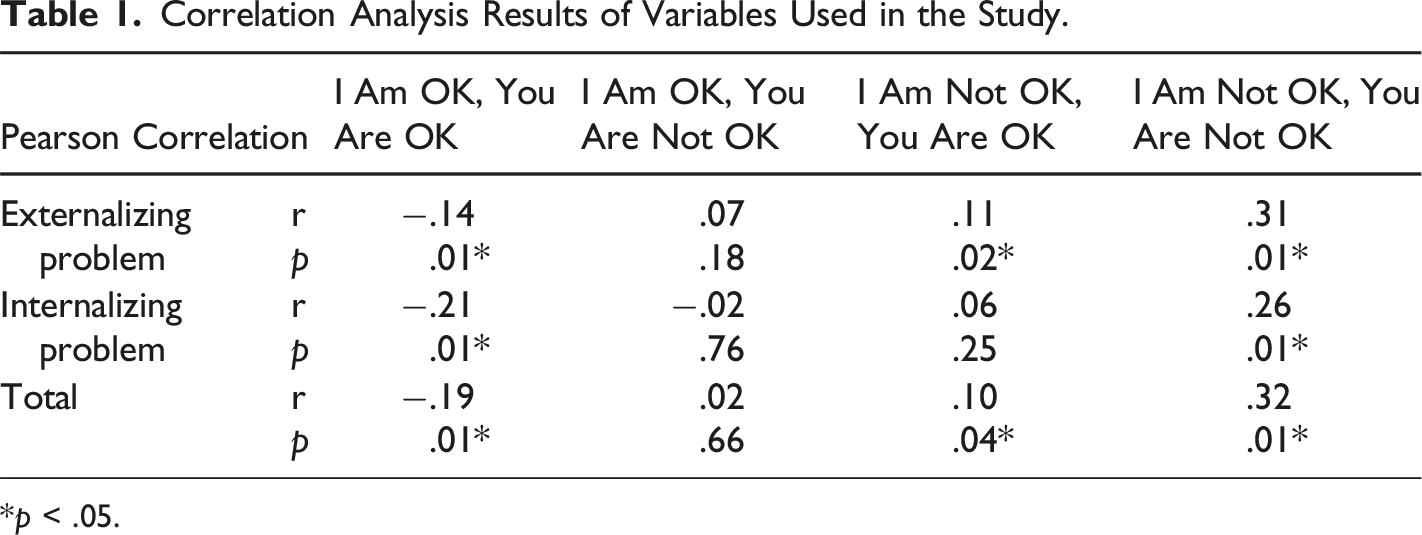
Correlation Analysis Results of Variables Used in the Study.
*p < .05.
When Table 1 was examined, the following results were found in the relationship between children’s behavioral problems and their parents’ life positions. According to this; There is a statistically significant negative weak correlation between the scores of Externalizing Problems, one of the sub-dimensions of the Preschool and Kindergarten Behavior Scale, and the scores of I am OK, You are OK, one of the sub-dimensions of the Life Positions Scale (r: −.14, r2: .019, p < .05).
There is a statistically significant positive weak correlation between the Externalizing Problems, one of the sub-dimensions of the Preschool and Kindergarten Behaviour Scale, and I am not OK, You are OK scores of the Life Positions Scale (r: .11, r2: .011, p < .05).
There is a statistically significant positive and moderate relationship between the scores of the Preschool and Kindergarten Behavior Scale sub-dimensions of the Externalizing Problems and the Life Positions Scale sub-dimensions of the I am not OK and You are not OK (r: .31, r2: .09, p < .05).
There is a statistically negative and weak relationship between the Internalizing Problems sub-dimensions scores of the Preschool and Kindergarten Behavior Scale and I am OK, You are OK sub-dimensions scores of the Life Positions Scale (r: −.21, r2: .04, p < .05).
There is a statistically significant positive and moderate relationship between the scores of the Preschool and Kindergarten Behavior Scale sub-dimensions of Internalizing Problems and Life Positions Scale sub-dimensions of I am not OK, You are not OK (r: .26, r2: .06, p < .05).
There is a statistically significant and negative and weak relationship between the total behavioral problems scores of the Preschool and Kindergarten Behavior Scale and the scores of the sub-dimensions of the Life Positions Scale, I am OK, You are OK (r: −.19, r2: .03, p < .05).
There is a statistically significant positive weak relationship between the total behavioral problems scores of the Preschool and Kindergarten Behavior Scale and I am not OK, You are OK sub-dimensions scores of the Life Positions Scale (r: .1, r2: .01, p < .05).
There is a statistically significant positive moderate relationship between the total behavioral problems scores of the Preschool and Kindergarten Behavior Scale and I am not OK, You are not OK scores from sub-dimensions of Life Positions Scale (r: .32, r2: .10, p < .05).
Multiple Regression Analysis Results Related to the Prediction of Life Positions Scale Subscale Scores on Preschool and Kindergarten Behaviour Scale Scores.
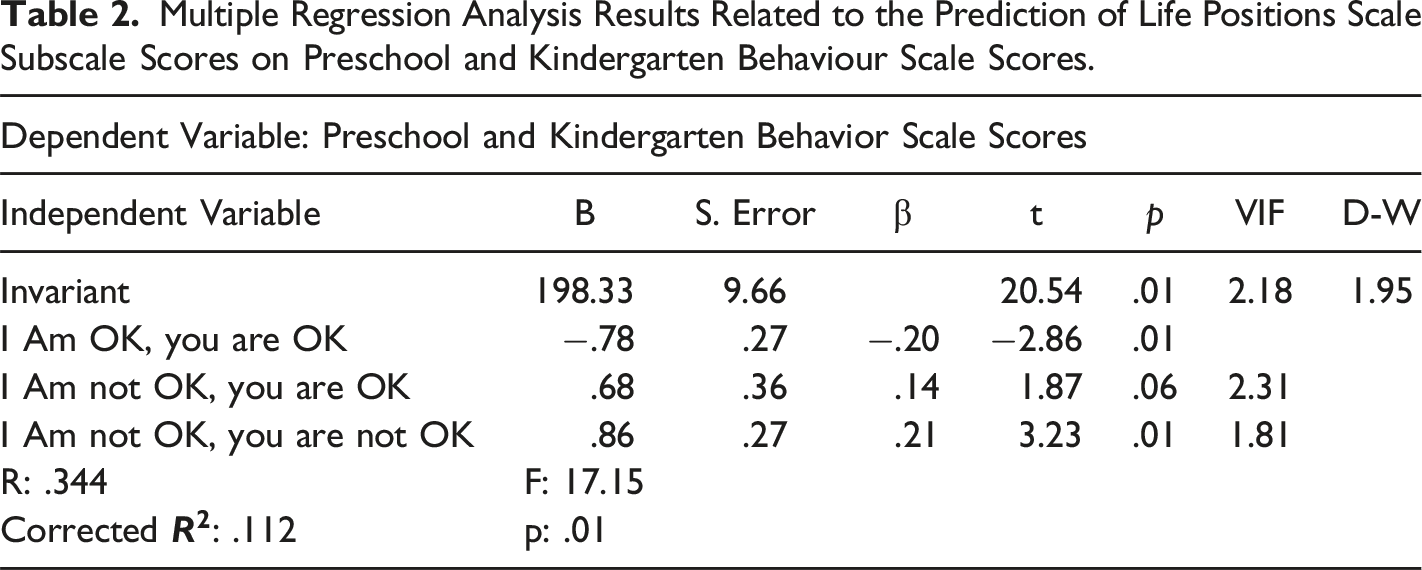
When Table 2 is examined, it is seen that the model established for the parents’ life positions to predict children’s behavioral problems is significant [F (3.386) = 17.15 p < .05]. The infromation that I am OK, You are OK life position has a negative effect on predicting the behavioral problems of children, and the life position I am not OK and You are not OK has a positive effect comes to the fore (p < .05,
Discussion and Conclusion
When the research findings were examined, it was found that as the life positions of the parents are positive, internalizing and externalizing behavioral problems of their children decreased. In this context, it is thought that the ability of parents to stay in the I’m OK, You’re OK life position in their relations with their children can help children create more realistic expectations in line with their age and development against the problems they experience, and they can support the process of developing constructive, solution-oriented healthy results in the face of negative behaviors. Depending on this life position adopted by the parents, adopting the attitudes and behaviors that are at peace with their own selves and their environment will also have an important place in terms of setting a positive example for their children (Akçınar & Baydar, 2018). Therefore, it is thought that internalizing problems and externalizing behavior problems seen in children will decrease, as the use of this life position in their communication with their children provides a safe and peaceful growth environment in the developmental process of children. There is no study in the literature about the variables in this study, but studies examining the effect of parental attitudes on children’s behavior problems underline that children who grow up in a positive family climate develop more desirable attitudes and behavior patterns compared to children who grow up under criticism and pressure (Akkoyun, 2011). As a result of the study examining the relationship between life positions and attachment styles, a positive and significant relationship was found between the I am OK, You are OK life position and secure attachment (Boholts et al., 2005).
In the study, it was found that as the scores obtained by the parents from the life positions “I’m Not OK, You’re OK” increased, their children’s internalizing and externalizing behavior problems also increased. At this point, parents who direct the child-rearing process with the I’m Not OK, You’re OK life position may see themselves as inadequate in managing their children’s negative behaviors in cases of conflict with their children, and they may feel guilty thinking that they do not have enough control over their development and needs (Hine, 1982). In this context, parents who adopt the “I’m Not OK, You’re OK” life position may also run the risk of developing negative thought patterns by comparing themselves with other parents, seeing themselves as inadequate and powerless in the process of gaining the right values and judgments for their children. I am not OK, You are OK life position can cause people to construct dysfunctional thinking structures such as withdrawing themselves, feeling worthless and despairing not only in their parenting attitudes but also in their relationships with their private and social environments. Therefore, all these negative thought patterns of parents about their own self and parenting perception can affect their children negatively in this direction and cause them to develop behavioral problems. At this point, studies on the effects of family functions and parenting styles on their children’s behavior problems also emphasize that if parents cannot provide effective behavioral control skills in the process of raising their children, children may be affected by this inconsistency and exhibit externalizing behavior problems (Braza et al., 2015; Gross et al., 2008; White, 1994).
Among the other findings obtained within the scope of the research, as the scores obtained by the parents from the “I’m Not OK, You Are Not OK” life positions increase, their children’s internalizing and externalizing behavior problems also increase. I am Not OK, You Are Not OK life position is the most risky life position that parents can adopt in their private lives and parenting relationships, and it includes depressive emotions and behaviors that push individuals to hopelessness and helplessness about their lives (Stewart & Joines, 2017). People in the I’m Not OK, You’re Not OK life position may exhibit indifferent and apathetic attitudes and behaviors in their parenting attitudes due to losing their motivation towards life, and in this direction, they may have unhealthy communication with their children. In addition to not seeing themselves as competent in the process of child education, they may think that their children are not competent to gain the right behaviors, they may believe that no one can help them enough about the subject because the most important features of this life position are that people base their lives on the fictions of losing their lives, being victims and being rejected (White, 1994). In this context, it is thought that it is possible to see serious internalized and externalized behavioral problems in children who cannot receive contact messages such as adequate attention and love from their parents. The study, which examines the relationship between life positions and attachment styles by Boholts, emphasizes that I am Not OK, You Are Not OK life position can cause fearful attachment in individuals (Boholts et al., 2005). Therefore, children who adopt this attachment style may think that people are dangerous and unreliable, and may have long-term negative judgments about people that are difficult to overcome and that permanently damage relationships. In the literature, a positive and significant relationship was found between negative psychiatric symptoms of mental disorder in parents and behavioral problems of children. It has been determined that children whose parents are not mentally healthy have higher and more destructive levels of internalizing and externalizing behavior problems than the children of parents who exhibit psychologically healthy attitudes and behaviors (Mccarty etl al., 2005; Reising et al., 2013).
When the findings obtained from the regression analysis of the research are examined, the information that I’m OK, You’re OK and I’m Not OK, You’re Not OK life positions have a significant effect on predicting children’s behavior problems comes to the fore. When all this information obtained within the scope of the research is evaluated, the positive and rational perspectives developed by parents towards their own existence values, lives and the problems they encounter are helpful in reducing the possible behavioral problems of children whereas negative role models such as neglecting the value of their own existence, not trusting themselves and other individuals, and not seeing life worthy cause to increase the behavioral problems of children emphasizes once again the importance of the life positions that parents apply in the child-rearing process. Another finding reached within the scope of the research is that 11% of the change in the behavioral problems of preschool children is caused by the life position of the parents. In this context, conducting different studies on other factors that cause behavioral problems in children will be a guide in terms of examining the subject from different perspectives and in-depth.
Suggestions
The following recommendations can be given in line with the results obtained within the scope of the study: • Since behavioral problems are a multifaceted factor that should be evaluated as a result of a combination of individual, familial, environmental and cultural factors, different studies can be carried out on other factors that may cause problem behaviors in children. • Trainings and seminars on Transactional Analysis can be given by experts in the field in order to raise parents’ awareness in understanding their behavior. By opening continuous training centers on Transactional Analysis, the number of people who gain expertise on the subject can be also increased. • Since the number of domestic and international studies on the subject is limited, the number of studies on the life positions of the parents and the behavioral problems of their children can be increased. • Longitudinal studies can be carried out on the subject in order to observe the effects of parents’ life positions on their children’s behavioral problems in the long term and to conduct an in-depth investigation. • Comparative studies can be conducted in different provinces and sample groups in order to examine the results of the research according to different demographic characteristics.
Limitations of the Study
This study: • It is limited to children aged 3–6 years and their parents enrolled in independent kindergartens and kindergarten classes of primary schools affiliated to Altındağ District Directorate of National Education. • The “Life Positions Scale” used in the study is limited to what the “Preschool and Kindergarten Behaviour Scale” measures. • It is limited to the answers given by the parents to the data collection tools.
Footnotes
Author Notes
This study was carried out by Ceren Yoldaş Örs under the supervision of Assoc. Prof Dr Haktan Demircioğlu as a part of her master thesis entitled “Investigation of the relationship between behavior problems of preschool children and parents’ life positions” at Hacettepe University’s Institute of Health Sciences. (The permissions were obtained with the following information: Hacettepe University Health Sciences Ethics Committee, Issue: 35853172-000 Date: 25.02.2020; Ankara Provincial Directorate of National Education No: 14588481- 605.99- E. 14267742 Date: 31.07.2019).
Declaration of Conflicting Interests
The author(s) declared no potential conflicts of interest with respect to the research, authorship, and/or publication of this article.
Funding
The author(s) received no financial support for the research, authorship, and/or publication of this article.
Data Availability
The datasets generated during and/or analyzed during the current study are available from the corresponding author on reasonable request.
Informed Consent
Informed consent was obtained from all the individual participants that were included in the study.
