







Abstract
Previous research has shown that state awe will decrease aggressive behavior in individuals and reduce implicit trait aggression. However, hardly any studies have been conducted to show the relationship between individual dispositional awe and reactive aggression as well as the underlying psychological mechanisms. Based on the broaden-and-build theory of positive emotion and the expanded model of awe, this study explored the effects of trait anger and self-control on the relationship between dispositional awe predicting reactive aggression. The trait anger, self-control, dispositional awe, and reactive aggression scales were completed by a total of 611 college students who were recruited from universities. The findings demonstrated a negative correlation between dispositional awe and reactive aggression (r = −.35, p < .01). The link between dispositional awe and reactive aggression is mediated by trait anger (β = −.201, 95% CI [−.25, −.15]) and self-control (β = −.038, 95% CI [−.07, −.01]). Additionally, a serial mediation effect of trait anger and self-control was observed between dispositional awe and reactive aggression (β = −.022, 95% CI [−.04, −.01]). This study reveals the relationship between dispositional awe and reactive aggression and its mechanism of effect which has some practical implications for the prevention and reduction of reactive aggression among college students.
Introduction
Any action that is taken with the intent to hurt another person is considered to be an act of aggression (Anderson & Bushman, 2002). Aggression has previously been classified into two subtypes: reactive aggression and proactive aggression, depending on the motivation (Wang, et al., 2020; Li, & Xia, 2021; Quan et al., 2022). Among them, reactive aggression refers to the action or propensity to respond to perceived provocation from others by participating in destructive activities with negative emotions (such as hostility, rage, or fear) in an effort to lessen the tension of the threat or to eliminate the threat (Blair, 2012; Cen et al., 2022; Dodge & Coie, 1987). Typical examples of reactive aggression include impulsive crime, road rage, and self-defense behavior (Li, & Xia, 2021), which bring great damage and serious effects to attackers and victims (Babcock et al., 2014; Martinelli et al., 2018). Meanwhile, there are significant differences in the psychological formation mechanisms, neurological and brain mechanisms between reactive and proactive aggression (Dambacher et al., 2015; Hubbard et al., 2010; Moore et al., 2019; Wranghama, 2017). As a result, research into the specific factors that can lessen reactive aggression is highly motivated from both a theoretical and practical standpoint.
Personality is considered to be an important factor in aggression (Tackett et al., 2014). However, Dispositional awe—a personality trait—has not been fully explored in predicting aggression. Previous research has shown that people with higher levels of disposition awe have lower levels of daily stress (Bai et al., 2021) and more pro-social behavior (Piff et al., 2015; Prade & Saroglou, 2016), while there are also empirical studies that have explored the relationship between the experience of awe and aggression (Yang et al., 2016). But, to date, hardly any studies have been conducted on the relationship between trait awe and reactive aggression in adult samples. The present study aimed to explore the relationship between dispositional awe and reactive aggression in real-life situations among college students to enrich the ecological validity of research in this area.
Dispositional Awe and Reactive Aggression
Awe can be either state or dispositional. State awe (Keltner & Haidt, 2003) is the emotional experience of wonder that arises when an individual is confronted with something vast and beyond his or her current understanding (such as viewing a natural landscape). Dispositional awe is an individual’s tendency to feel awe in daily life with stability across time and situations, reflecting individual differences in awe perception, implying that people with high dispositional awe are more inclined to experience awe than people with low dispositional awe (Dong & Ni, 2020; Shiota et al., 2006). Awe is considered to be a positive emotion and self-transcendent emotion (Tee & Shah, 2022) that can bring various benefits to life (Chen & Mongrain, 2021). Research has shown that individuals who experience feelings of awe tend to exhibit more generous behavior (Piff et al., 2015), display greater humility (Stellar et al., 2018), and are more inclined to offer their time to assist others (Rudd et al., 2012). Additionally, these individuals are motivated to look beyond worldly concerns (Chirico & Yaden, 2018). According to the broaden-and-build theory of positive emotions (Fredrickson, 2001), accumulated experience and knowledge builds our personal resources, buffers future threats, and mitigates potential negative effects. Broadening one’s perspective can cultivate enduring personal resources that serve as a reserve for coping with future challenges. In contrast, reactive aggression represents an impulsive and thoughtless response aimed primarily at reducing the immediate tension associated with a perceived threat, often with little regard for long-term consequences. When sufficient cognitive resources exist, reactive aggressors may engage in more complex reassessments and transcend any activated aggressive impulses, resulting in less aggressive behavior (Bluemke & Teige-Mocigemba, 2015). Also, stress and negative emotions, regardless of their source, are thought to be factors that increase the likelihood of aggressive behavior and aggression-related phenomena (Anderson & Bushman, 2002). In contrast, awe-inspiring experiences expand people’s perception of time, make them feel less stressed (Bai et al., 2021)and more patient (Rudd et al., 2012), reduce negative emotions (Sun et al., 2023), decrease people’s aggression (Yang et al., 2016), and can weaken the relationship between rejection and aggression (Poon et al., 2016). Individuals with higher dispositional awe have a greater propensity to receive cognitive conditioning and new knowledge (Guan et al., 2018), resulting in richer cognitive resources that provide individuals with the cognitive and emotional space needed to reassess situations in a more deliberate and thoughtful manner (Sun et al., 2023; Yang et al., 2016). Therefore, we hypothesized that dispositional awe can negatively predict reactive aggression (H1).
However, most of the potential mediating mechanisms of this relationship remain largely unknown. Answers to these questions are critical in order to reduce reactive aggression and create a targeted intervention strategy. Therefore, we used a sample of young adults to examine the mediating role of trait anger and self-control.
The Mediating Role of Trait Anger
An easy tendency to feel angry in daily life is referred to as trait anger (Anderson & Bushman, 2002; Deffenbacher et al., 1996). One of the main factors influencing an individual’s propensity to attack others is their propensity to become angry in response to perceived danger (Quan et al., 2022). According to the Integrative Cognitive Model (ICM; Wilkowski & Robinson, 2008), people who exhibit high levels of anger traits are more prone to experience frequent triggers for their state of rage and reactive aggression. It has been shown that the trait anger and reactive aggression are significantly correlated (Bondü & Richter, 2016; Li, & Xia, 2021; Quan et al., 2022). One experimental study also found that trait anger was a significant predictor of reactive aggression in Taylor’s aggression paradigm under low excitation conditions of alcohol exposure (Giancola, 2002). In summary, trait anger can positively predict reactive aggression.
At the same time, dispositional awe may negatively predict trait anger. The concept of personality can be defined as a person’s way of life. Just as culture reflects the way of life of a society, personality represents the way of life of a person (Özyeşi̇l & Arel Üniversitesi, 2012). The relationship between awe and personality traits is also an important topic (Dong & Ni, 2020). It has been shown that openness to experiences and extraversion are significantly and positively related to dispositional awe and negatively related to trait anger (Özyeşi̇l & Arel Üniversitesi, 2012; Dong & Ni, 2020). However, no study tested the association between awe and anger at the trait level. According to the approach-withdrawal model, the approach system competes with the avoidance system (Veenstra et al., 2018). Trait anger has been shown to link to physiological indicators of proximity motivation, such as increased testosterone (Yildirim & Derksen, 2012), and increased cardiovascular activity in reaction to challenge and stress (Suls, 2013). The opposite is found for physiological indicators of awe, such as freezing (Griskevicius et al., 2010), paralysis (Solomon, 2002), slower response rate (Joye & Dewitte, 2016), prolonged cardiac pre-emergent period, and concomitant parasympathetic activation (Shiota et al., 2011). That is, awe may reduce the arising of anger. Meanwhile, in accordance with the broaden-and-build theory of positive emotions (Fredrickson, 2001), Positive emotions broaden attention and cognition, making flexible and creative thinking possible, and because they broaden thinking, they increase the likelihood of finding positive meaning in bad events. People can cope with negative emotions through the experience of positive emotions, thereby improving their mental health and reducing the development of aggressive behaviors. Awe also has a clear cognitive advantage (Richesin & Baldwin, 2023), can influence cognitive processes and behaviors, responds to the need to reconstruct cognition, and plays an important role in alleviating negative emotions (Sun et al., 2023). From a cognitive perspective of treatment, people have been able to effectively reduce trait anger (Dua & Swinden, 1992; McIntyre et al., 2019). In terms of short-term experience of awe, a large body of empirical research has shown that awe significantly reduces negative emotions compared to other positive emotions in a variety of life scenarios (e.g., loss of possessions, self-threat, failure to serve, etc.,) (Koh et al., 2019; Sun et al., 2023; Yang & Hu, 2021). In terms of long-term experience of awe, awe is associated with lower levels of daily stress in the present moment, and in the process leads to increased life satisfaction (Bai et al., 2021). Over time, daily pro-social positive emotions increased more and daily distress decreased more (Sturm et al., 2022). At the same time, it has been shown that awe is negatively correlated with socially disengaging (e.g., anger) and that awe is a negative predictor of negative emotions (e.g., anger) (Lopes et al., 2020; Vishkin et al., 2020). Thus, when individuals feel the experience of awe over time, it broadens their thinking and cognition, making flexible and creative thinking possible, resulting in less experience of anger over time as they grow up, leading to lower levels of trait anger in individuals, making behavior less impulsive and so less prone to aggressive behavior when faced with threats in their lives. Therefore, we hypothesized that the relationship between dispositional awe and reactive aggression would be mediated by trait anger (H2).
The Mediating Role of Self-Control
Self-control is the ability to self-regulate behavior by performing or inhibiting behavior in a manner that is consistent with social norms behavior, such as inhibiting impulsive behavior (Tangney et al., 2004). According to the I3 model (Finkel, 2014), it is argued that all behavior is a combination of three factors: instigation, impellance, and inhibition, any one of which can vary independently of the other two, with inhibition including the influence of situational or stabilizing factors (such as self-control) that can increase the likelihood (or degree) that people will go beyond this behavioral tendency, thereby reducing or eliminating the implementation of the behavior. At the same time, there is growing evidence that a lack of self-control increases aggressive responses to situational stimuli, whereas increased self-control decreases individuals’ aggressive impulses (DeWall et al., 2011; Finkel et al., 2012; Li et al., 2014). Thus, self-control may negatively predict reactive aggression.
At the same time, dispositional awe may positively predict self-control. According to the expanded model of awe (Lopez, 2009; Sundararajan, 2002), individuals who are rich in awe experiences have more cognitive and emotional resources and are better at self-reflection and meditation. It has been shown that awe experiences can increase individuals’ self-regulatory behaviors and self-monitoring (Han et al., 2017), and higher ratings of personal control situations (Guan et al., 2019), along with the ability to increase perceived time availability (Rudd et al., 2012). In addition, brain mechanism studies have found that individuals’ awe experience is associated with attention, self-awareness, and cognitive control in the anterior cingulate gyrus, which is primarily responsible for conscious self-regulation (Guan et al., 2018). According to a recent study conducted on Chinese college students, dispositional awe positively predicted self-control (Xin and Liu, 2020). Therefore, we hypothesized that the relationship between dispositional awe and reactive aggression would be mediated by self-control (H3).
The Serial Mediating Role of Trait Anger and Self-Control
Some studies showed that higher levels of self-control were found to be negatively associated with trait anger (Hamarta et al., 2015; Kong et al., 2020; Tangney et al., 2004). According to the Integrative Cognitive Model theory (ICM, Wilkowski & Robinson, 2010), the variation in aspects like anger meditation and effortful control processes among people with different levels of trait anger is thought to contribute to the effect of trait anger on reactive aggressive behavior. This variation results in different behaviors, like self-control, which may overwhelm the automatic tendency to engage in aggression. Thus, our last hypothesis is that trait anger and self-control serve as sequential mediators between dispositional awe and reactive aggression (H4).
The Present Study
The potential relationships between dispositional awe, trait anger, self-control, and reactive aggression were described and analyzed. However, these hypotheses need to be further tested in real-life situations with a sample of college students. Therefore, we sought to uncover the relationship between dispositional awe and reactive aggression and their underlying mechanisms. A hypothetical model regarding the mediating role of trait anger and self-control between dispositional awe and reactive aggression is shown in Figure 1. The Stated Mediation Model.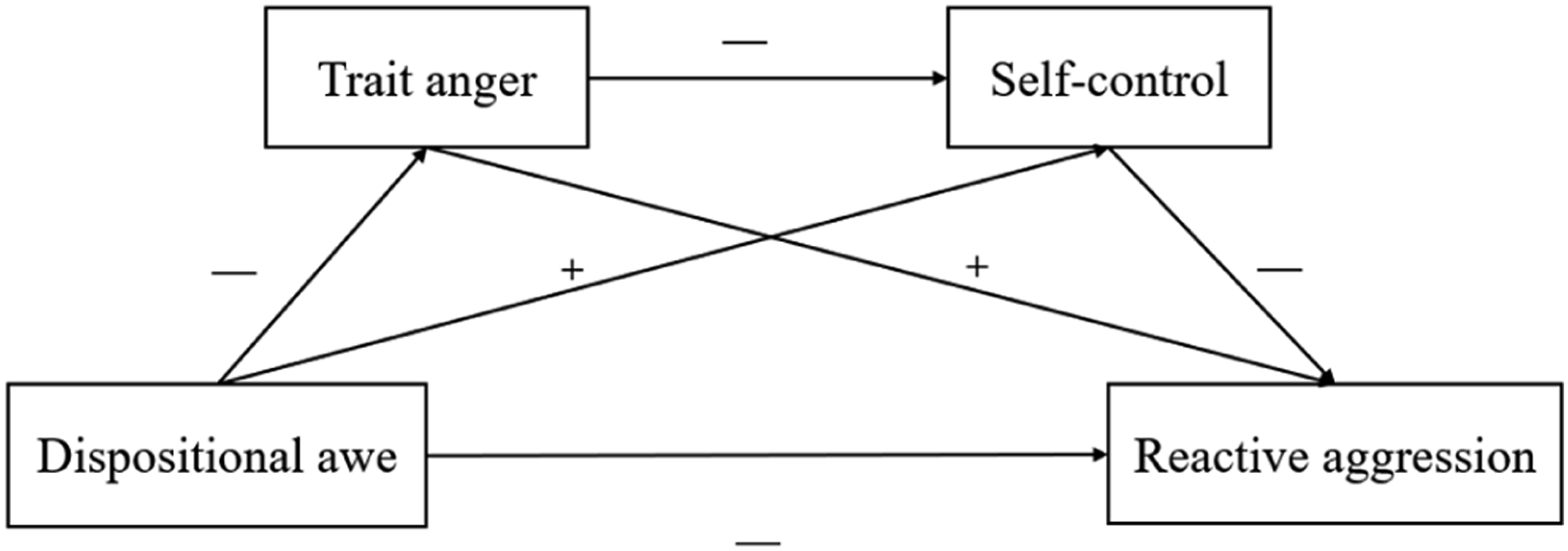
Method
Participants
Subjects were recruited from two universities in Hunan Province and one university in Xinjiang Uyghur Autonomous Region, China, to explore the mechanisms linking dispositional awe and reactive aggression. A total of 611 valid questionnaires were returned after excluding 52 questionnaires that were incomplete, attention deficit, and duplicate. The sample was 59.9% female, with a mean age of 20.16 (SD = 2.38) and a range of 17–28 years. Of these, 546 were Han Chinese and 65 were from other ethnic groups. Ethical approval was provided by the ethics committee of the investigator’s university.
Measures
Dispositional Awe Scale
The Dispositional Positive Emotion Scales’ 6-item awe subscale was used to measure dispositional awe (Shiota et al., 2006). A representative item was: “I often feel awe.” Each item is scored from 1 (strongly disagree) to 7 (strongly agree). College students in China have demonstrated the validity and reliability of the Chinese form of dispositional awe, Cronbach’s α was found to be .76 in a previous study (Sun et al., 2023). Item scores are summed to provide a score of dispositional awe. Cronbach’s α was found to be 0.86 for this study.
Trait Anger Scale
Spielberger (1999) created the 10-item Trait Anger Subscale (TAS) of the State-Trait Anger Expression Inventory-2 (STAXI-2). From 1 (“nearly never”) to 4 (“usually frequently”), items are rated. The Chinese version of TAS has shown good validity and reliability among Chinese college students, Cronbach’s α was found to be .86 in a previous study (Quan et al., 2022). Item scores are summed to provide scores of trait anger. Higher scores reveal a stronger propensity for frequent and severe anger. In this research, Cronbach’s α was .82.
Self-Control Scale
A 19-item scale that was updated from Tan and Guo’s Chinese samples were used to measure self-control, Cronbach’s α was found to be .86 in a previous study (Tan & Guo, 2008). Items are rated on a 5-point scale (e.g., ‘People believe I can stick to the plan of action; 1 = strongly disagree, 5 = strongly agree). Five categories make up the scale: impulse control, good habits, avoiding temptation, concentration, and no entertainment. Scores range from 19 to 95 overall, and higher scores indicate greater self-control. College students in China have demonstrated the validity and reliability of the Chinese form of self-control. (Kong et al., 2020; Zhang et al., 2022). Cronbach’s α was found to be .82 for this study.
Reactive Aggression Scale
This scale was a component of the Reactive-Proactive Aggressiveness Questionnaire (RPQ; Raine et al., 2006), which was used to assess reactive aggression. The Chinese version of the sub-scale was revised by Zhang (2014), which included 10 items, Cronbach’s α was found to be .80 in a previous study. A six-point scale, ranging from 1 (completely disagree) to 6, was used to score each item (completely agree). The Chinese version of RPQ has demonstrated satisfactory reliability and validity and is suitable to assess the reactive aggression and proactive aggression of Chinese college students. Item scores are summed to provide scores of reactive aggression. Cronbach’s α was found to be .83 for this study.
Procedure
We surveyed Chinese participants via an online platform such as Sojump to collect the series of questionnaires (Ma et al., 2022). Then, with the help of local teachers, the link was sent to the group. The survey included no right or wrong answers, so participants were told to be as honest as they could in their responses. Participants completed questionnaires regarding trait anger, self-control, dispositional awe, and reactive aggression. All participants volunteered to take the survey. They checked the box for voluntary participation in this study. Also, the instructions had a statement that the experimental data were for scientific research and would not be divulged to the faculty. The questions used to be completed in around 5 minutes.
Data Analysis
Using SPSS24.0, common-method bias tests, descriptive statistics, and correlations analyses were carried out before a mediation analysis. First, structural equation models were constructed using Mplus 8.0, and second, we tested for mediating effects using Hayes’ PROCESS macro (Model 6, Hayes, 2017). By repeating the sample 5000 times, the bias-corrected nonparametric percentile Bootstrap method was used to determine 95% confidence intervals (Hayes, 2017). Additionally, we included gender as the control variable because prior research has demonstrated a strong relationship between the variable and reactive aggression (Martinelli et al., 2018; Wang, et al., 2018). At the same time, we found significant differences between men and women in scores of reactive aggression.
Results
Preliminary Analyses
Harman’s single-factor test was used to conduct an unrotated principal component factor analysis on a total of 45 items for all variables. The findings demonstrated that 10 variables in all had feature root values greater than 1, and the variance explained by the first factor was 23.96%, which was less than the critical criterion of 40%, demonstrating that this study has no detectable common approach bias (Aguirre-Urreta & Hu, 2019; Podsakoff et al., 2003).
Descriptive Statistics for Each Variable
Descriptive Statistics and Correlations Among Variables.
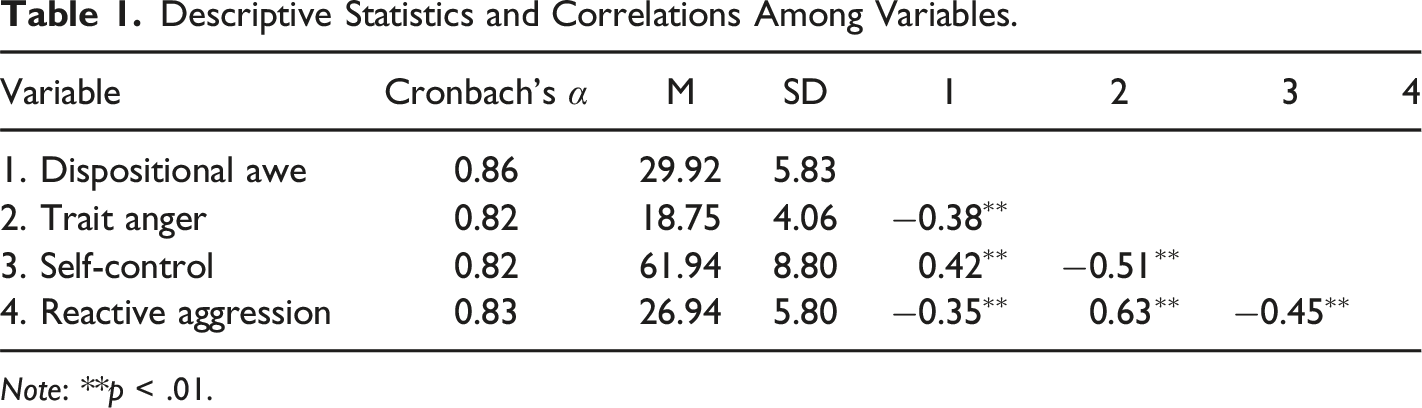
Note: **p < .01.
A Test of the Chain Mediation Model of Trait Anger and Self-Control
First, validated factor analysis was developed to test the measurement model. All variables were treated as latent variables, the packing technique for dispositional awe, trait anger, and reactive aggression was a balancing technique, and the internal consistency method was used for self-control. The measurement models had good fit indices: χ 2 /df = 4.0, RMSEA = .07, CFI = .93, TLI = .91, SRMR = .05. Structural equation modeling was then used to assess the mediating effects of anger and self-control between awe and reactive aggression. The result was found: the observed data fit the hypothesized model data well (χ 2 /df = 4.9, RMSEA = .08, CFI = .94, TLI = .91, SRMR = .05).
Results of the Mediation Model.
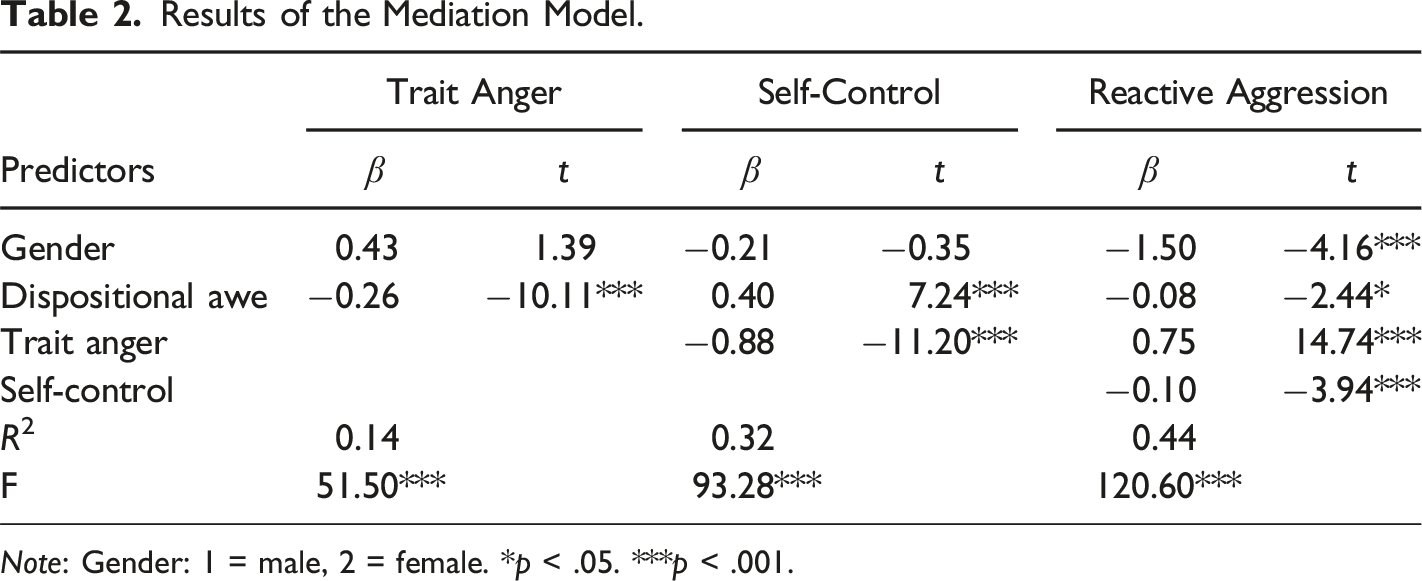
Note: Gender: 1 = male, 2 = female. *p < .05. ***p < .001.
Bootstrap Analyses of Mediating Effects.
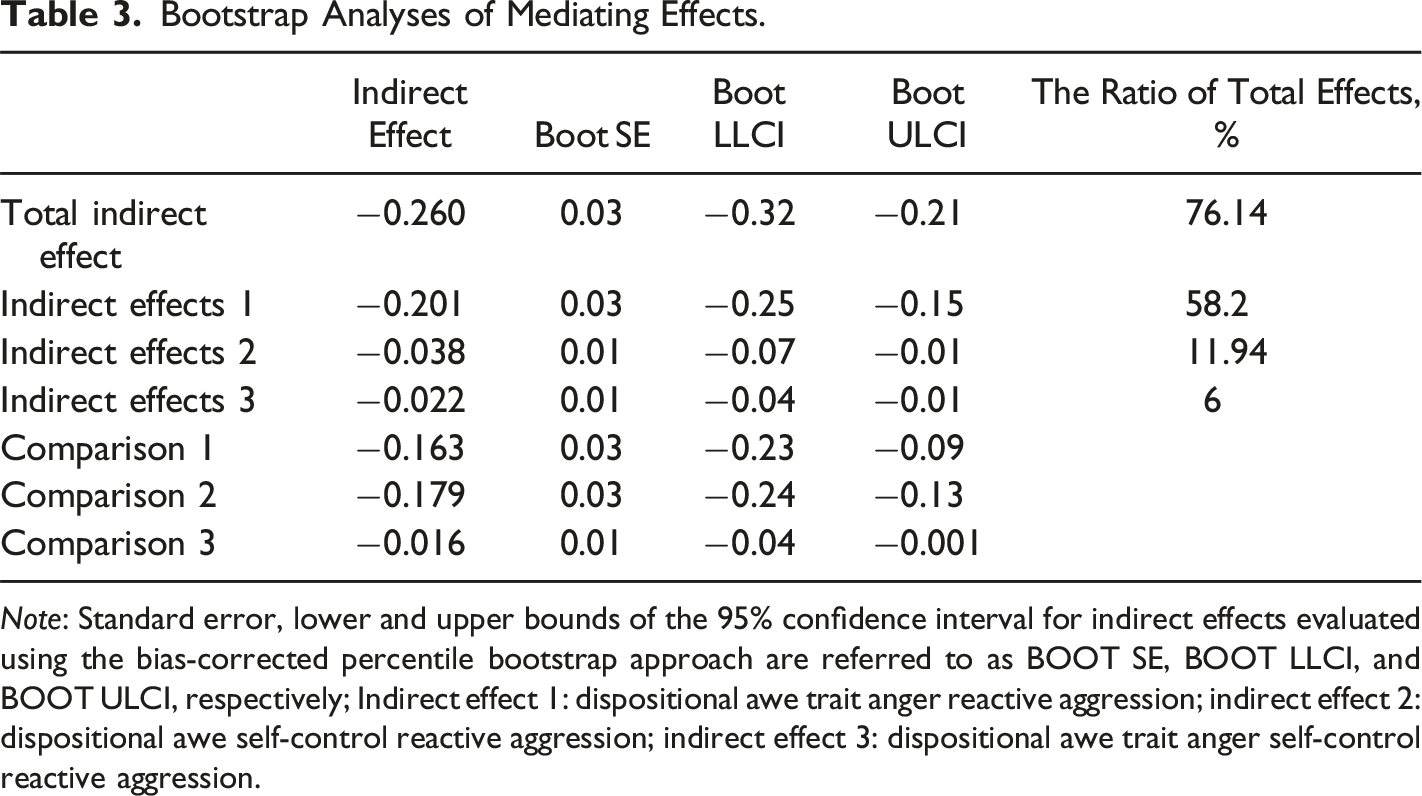
Note: Standard error, lower and upper bounds of the 95% confidence interval for indirect effects evaluated using the bias-corrected percentile bootstrap approach are referred to as BOOT SE, BOOT LLCI, and BOOT ULCI, respectively; Indirect effect 1: dispositional awe trait anger reactive aggression; indirect effect 2: dispositional awe self-control reactive aggression; indirect effect 3: dispositional awe trait anger self-control reactive aggression.
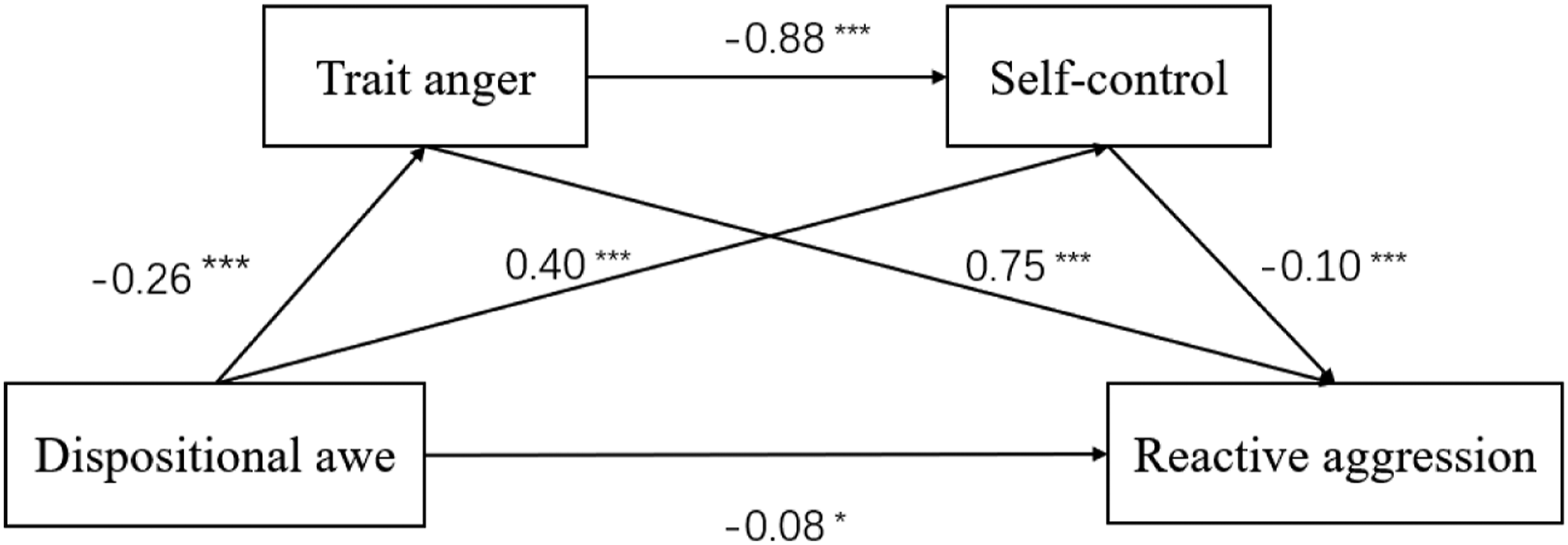
The Mediating Effects Model. Note: *p < .05; ***p < .001.
Discussion
The present study examined the relationship between dispositional awe and reactive aggression by using trait anger and self-control as mediators. Our findings are consistent with the broaden-and-build theory of positive emotions, suggesting that dispositional awe negatively predicts reactive aggression, as well as adequately enhancing this negative association by decreasing trait anger and increasing self-control. These results enrich our understanding of reactive aggression in adults with chronic awe experiences and identify underlying psychological mechanisms.
Dispositional Awe and Reactive Aggression
The findings indicated that dispositional awe significantly and negatively predicted reactive aggression, validating hypothesis 1. This finding is consistent with a laboratory study (Yang et al., 2016). According to the broaden-and-build theory of positive emotions (Fredrickson, 2001), people who have long-term experiences of awe build personal resources that mitigate their negative impact when confronted with potential threats and may engage in more complex reassessments thereby reducing aggressive behavior. That is, evidence from theory and research suggests that dispositional awe may be an important personality factor in the prevention of reactive aggression.
The Mediating Role of Trait Anger and Self-Control
This study also explored the mechanisms underlying the role of dispositional awe on reactive aggression, finding a chain mediating role for trait anger and self-control, with hypotheses 2, 3, and four being tested. The mediating effect of trait anger can be explained in several ways. On the one hand, empirical studies have shown that the more awe experienced, the greater the reduction in negative emotions (Koh et al., 2019; Lopes et al., 2020). According to the broaden-and-build theory of positive emotions, positive emotions expand an individual’s sequence of momentary thought activity, develop mental resilience and build personal resources to effectively cope with threatening life situations, alleviate negative emotions, and enhance an individual’s subjective well-being (Fredrickson, 2001; Guo et al., 2007). People with high dispositional awe tend to experience a sense of awe more than those with low dispositional awe, thus reducing the tendency to feel anger easily in daily life. On the other hand, it has been suggested that reactive aggression is characterized by significant emotionality at the everyday level, whereas proactive aggression is characterized by a lack of emotionality, and that higher levels of reactive aggression are associated with greater levels of everyday anger (Moore et al., 2019). Also, according to the Integrative Cognitive Model (ICM; Wilkowski & Robinson, 2008), individuals who exhibit low levels of anger traits are less likely to experience frequent triggers of their anger states and reactive aggression. Thus, when individuals feel the experience of awe over time, it alleviates the negative emotions in their lives and leads to a reduction in the experience of anger as they grow up, resulting in lower levels of trait anger in the individual, leading to less impulsive behavior and consequently less reactive aggressive behavior.
Self-control was another variable that mediated the relationship between dispositional awe and reactive aggression. Its mediating role can be explained in the following aspects: on one hand, individuals who are rich in awe experiences are better able to self-reflect with contemplation and discipline their behavior (Xin and Liu, 2020) and are more self-disciplined in their daily lives (Han et al., 2017). Thus, the experience of awe enhances individual self-control. Individuals with high self-control show more positive psychological behavior patterns, are better able to regulate negative emotions, control negative thoughts and think rationally, and reduce interpersonal conflicts (Briki, 2018). On the other hand, according to the I3 model (Finkel, 2014), people with high levels of self-control are more likely to suppress their aggressive tendencies and ignore verbal abuse from others. Therefore, dispositional awe reduces reactive aggression by increasing the level of self-control.
Furthermore, dispositional awe influences reactive aggression through the multiple mediating effects of trait anger and self-control. According to the Integrative Cognitive Model (ICM; Wilkowski & Robinson, 2008), the association between trait anger and reactive aggression is explained by factors such as self-control mechanisms. Therefore, individuals with high levels of dispositional awe have less anger, leading to increased levels of self-control and ultimately reducing individual reactive aggression.
Research Significance and Limitations
To our knowledge, this study is the first to investigate the relationship between temperament awe and reactive aggression in a sample of adults. Furthermore, the potential mechanisms by which temperament awe reduces reactive aggression are innovatively explored. Our findings further enrich Fredrickson’s broaden-and-build theory. From a practical perspective, our study may contribute to the development of effective psychological therapies to prevent and reduce reactive aggression. Given the link between dispositional awe and reactive aggression, and the relationship with self-control, interventions that increase people’s experience of awe should be developed, as they may be a less time-consuming alternative to cognitive behavioral therapy and positive thinking training for anger reduction.
At the same time, this study also has some limitations. First, because this study utilized a cross-sectional research strategy, the results could not establish a causal relationship. Future studies should use longitudinal designs to provide stronger evidence for the causal direction. Second, this study examined only the dispositional states of aggression, awe, self-control, and anger, and did not control for other dispositional positive emotions, which could be further explored in future studies. Third, although the dispositional positive emotion scale has been the most widely used in research on dispositional awe, the scale does not consider the negative component of awe in an explicit way. Future research should continue to explore the effects of negative awe on reactive aggression, anger and self-control. Finally, this study used a convenience sample of a young college student population, making it difficult to apply the results of this study to a broader population. In the future, replication of this study with larger sample size and increased sampling across age groups could address generalizability issues.
Footnotes
Declaration of Conflicting Interests
The author(s) declared no potential conflicts of interest with respect to the research, authorship, and/or publication of this article.
Funding
The author(s) received no financial support for the research, authorship, and/or publication of this article.
Data Availability
Data supporting the results of this study can be obtained from the corresponding authors upon reasonable request.
