







Abstract
The present study aimed to observe the impact of self-esteem and FOMO on online trolling, investigating the mediating role of antisocial online content exposure. A total of 300 social media users (27.68 years, SD = 7.15, SE = .41) participated in the study. Data analysis showed statistically significant model-fit indices (CFI = .99, GFI = .98, TLI = .98, RMSEA = .02 | 90% CI .01–.03|, SRMR = .04) to the mediation model: both self-esteem (direct effects: λ = −0.17, p < .01, indirect effects: λ = −.06, p < .05) and FOMO (direct effects: λ = .19, p < .01, indirect effects: λ = .07, p < .01) were related to online trolling, both directly and indirectly, trough antisocial online content exposure. It is possible to conclude that the objective was achieved, highlighting the importance of both personal factors and contextual characteristics of the internet in the perpetuation of online aggression.
Introduction
Technological growth and people’s need to be continuously connected, added to the investment of time and energy in virtual relationships, make cyberspace a fertile ground for the expression of deviant behaviors (Anastasiadis et al., 2018; Lampropoulos et al., 2022). Among them is online trolling, defined as an intentional attempt to cause conflict and stress on the internet through malicious situations and provocative actions (e.g., comments, photos, videos) (Buckels et al., 2014; March, 2019).
Although trolling is often confused with cyberbullying due to their apparent similarities, Buckels et al. (2018) differentiate these forms of aggression through two characteristics: victimology (in trolling, victims are almost always strangers), and the perpetrator’s goal (causing conflict and chaos). Despite this, it is important to note that previous studies indicate positive associations between these two constructs, as well as other forms of online violence, such as cyberstalking (e.g. Kircaburun et al., 2018).
Other central aspects of this antisocial behavior are: deception (trolls disguise their true intentions), aggression (use of provocation until the victim shows a reaction), disruption (the troll mainly wants to disturb and get attention), and success (the greatest motivation is the success of the attack) (Hardaker, 2010). Furthermore, the anonymity provided by the internet makes any user a potential victim (Hong & Cheng, 2018; Santos et al., 2022b).
Early research on trolling focused primarily on its relationship with personality and related processes, indicating that psychopathy, sadism, impulsivity, and low empathy are predictors of this behavior (e.g. Buckels et al., 2018; March, 2019; Sest & March, 2017). Characteristics of users’ online experience also impact trolling: Liu et al. (2022), for example, observed that online disinhibition is positively related to this variable.
Considering this information, the present study sought to investigate two variables that have not yet been addressed in the study of trolling: self-esteem and fear of missing out (FOMO). For this, the General Aggression Model (GAM, Anderson & Bushman, 2002) will be used as a theoretical basis. GAM postulates that personal variables (established and stable individual characteristics, such as personality traits and those mentioned above) have short and long-term impacts on aggressive behavior, affecting the way we feel, think, interpret and handle daily situations (Anderson & Bushman, 2018; Bushman & Anderson, 2020).
Self-Esteem and FOMO’s Impacts on Trolling
Self-esteem is defined as the positive or negative attitude of each individual towards themselves (Rosenberg, 1989). Given the impacts of technological advances and social media have on the way we evaluate ourselves, researchers have been dedicated to investigating the relationship between this construct and online actions, in particular, deviant behaviors (Burnasheva & Suh, 2020). In general, it is observed that people with high self-esteem tend to use technologies in a balanced way, dealing positively with stressful situations (Servidio et al., 2018). On the other hand, low self-esteem is associated with internet addiction, compulsive use of social media (Mathew & Krishnan, 2020), internet gaming disorder (Ropovik et al., 2023), and aggressive online behaviors such as cyberbullying (Handono et al., 2019; Pascual-Sanchez et al., 2021).
Specifically investigating online trolling, Zezulka and Seigfried-Spellar (2016) found similar results, indicating a negative correlation between this behavior and self-esteem. Furthermore, March and Steele (2020) observed that the relationship between self-esteem and trolling was moderated by sadism, only being significant in individuals with high levels of this personality trait. These results demonstrate the need for additional studies on this theme.
Another construct related to problematic behaviors on the internet is Fear of Missing Out (FOMO), understood as the experience of anxious feelings associated to the idea that other people are having rewarding experiences in which the individual is not present (Przybylski et al., 2013). This fear results in the persistent desire to remain connected to social media (Hattingh et al., 2022). FOMO is also negatively related to self-esteem (Sekścińska & Jaworska, 2022; Uram & Skalski, 2020).
Although no investigations regarding the relationship between FOMO and trolling were found, FOMO-related anxiety is a risk factor for other inappropriate internet behaviors, such as cyberstalking (Alutaybi et al., 2020). Abell et al. (2019) also indicate indirect impacts of FOMO on relational aggression during Facebook use, mediated by wishing to avoid inferiority and subsequent manipulation. Similarly, FOMO predicted social media stalking on Tandon et al. (2021) investigation. Furthermore, Howard et al. (2019) point out that trolls tend to use social media more intensively, a feature also present in FOMO (although the trolling x FOMO relationship wasn’t investigated in this particular study).
The studies previously presented corroborate the hypotheses that self-esteem and FOMO may be related to online trolling. But what could mediate these relationships? Taking into account that situational aspects of the online environment impact troll behavior (Seigfried-Spellar & Lankford, 2018), antisocial online content exposure is a possibility.
The Mediating Role of Antisocial Online Content Exposure
Considering that anyone who uses a social media or other online platforms (e.g., YouTube, online games), is a potential victim for trolls (Aydin et al., 2021), the present study set out to explore antisocial online content exposure as a possible mediator of the relationships already presented. This variable is defined as any media (e.g. images, videos) or communication format (such as messages and comments) available online that aims to attack, harm and/or annoy both the direct target and the indirect consumers of that content (Santos et al., 2021).
But how does this variable relate to the previous discussion? Self-esteem, for example, can be a protective factor regarding the type of content we consume on the internet. Despite this being a topic still underexplored, previous studies have already observed a negative impact of high self-esteem in phenomena such as problematic internet use (Mamun et al., 2020; Sekścińska & Jaworska, 2022), which increase the user’s vulnerability to be exposed to negative content (Jackson et al., 2010).
On the other hand, FOMO can be a risk factor for exposure, given that the behaviors associated to this phenomenon increase the possibility of online attacks. In the study by Buglass et al. (2017), for example, the results indicated a relationship between high levels of FOMO and a propensity to disclose more personal information online, thus increasing the potential online vulnerability of those who show this characteristic. The impact of stable individual characteristics on specific media consumption is also corroborated by the GAM: changes in personal variables can alter the situations in which the person chooses to get involved, in this case, the online contexts that are accessed by the user (Anderson & Bushman, 2018).
Finally, it is important to point out that exposure to violent media on the internet is an already consolidated risk factor for the perpetuation of aggression in this environment. Specifically speaking about trolling, in a recent study, Santos et al. (2022b) observed that antisocial online content exposure impacted these behaviors directly and indirectly (mediated by the use of social networks). Thus, it is possible to verify that the previous literature supports the possibility of a mediating role of the exposure to aggressive content frequency.
The Present Study
The previously presented studies point to existing information in the literature, as well as existing gaps: studies on online trolling usually focus on the relationships with antisocial traits (e.g. dark tetrad) or on the impacts caused on victims (Santos et al., 2022b). However, it is necessary to understand the impacts of other psychological variables on this behavior, in order to comprehend the psychological mechanisms that support it or function as protective factors against it. Furthermore, investigating the mediating role of the content consumed online is necessary, given that trolling is a consequence of the characteristics of the virtual environment (Tayade et al., 2017). Finally, research on the topic outside the North American context is needed, especially considering the fact that Brazil has the fifth-largest number of social media users worldwide (Dixon, 2023).
From these limitations, it is possible to highlight the importance of investigating these variables together: In the contemporary connected world, it is not only necessary to understand that individual characteristics are risk factors for online aggression, but how previous exposure to negative content can impact these effects. Thus, considering the previous discussion and the need for studies involving the aforementioned variables, this exploratory study aims to observe the impact of self-esteem and FOMO on online trolling, investigating the mediating role of antisocial online content exposure.
These effects are also theoretically supported by GAM: according to the model, different personal variables (e.g. low self-esteem, high FOMO) impact long-term aggressive behavior by affecting and relating to the development of knowledge structures, the way that individuals interpret the environment (Groves & Anderson, 2019). Furthermore, studies with GAM demonstrate that exposure to violent media is a relevant risk factor for aggressive behavior (e.g. Anderson et al., 2017; Miles-Novelo et al., 2022). Therefore, based on the previous exposition, the following hypotheses were elaborated (Figure 1). Study’s hypotheses summary. Notes: Aoc exposure = antisocial online content exposure.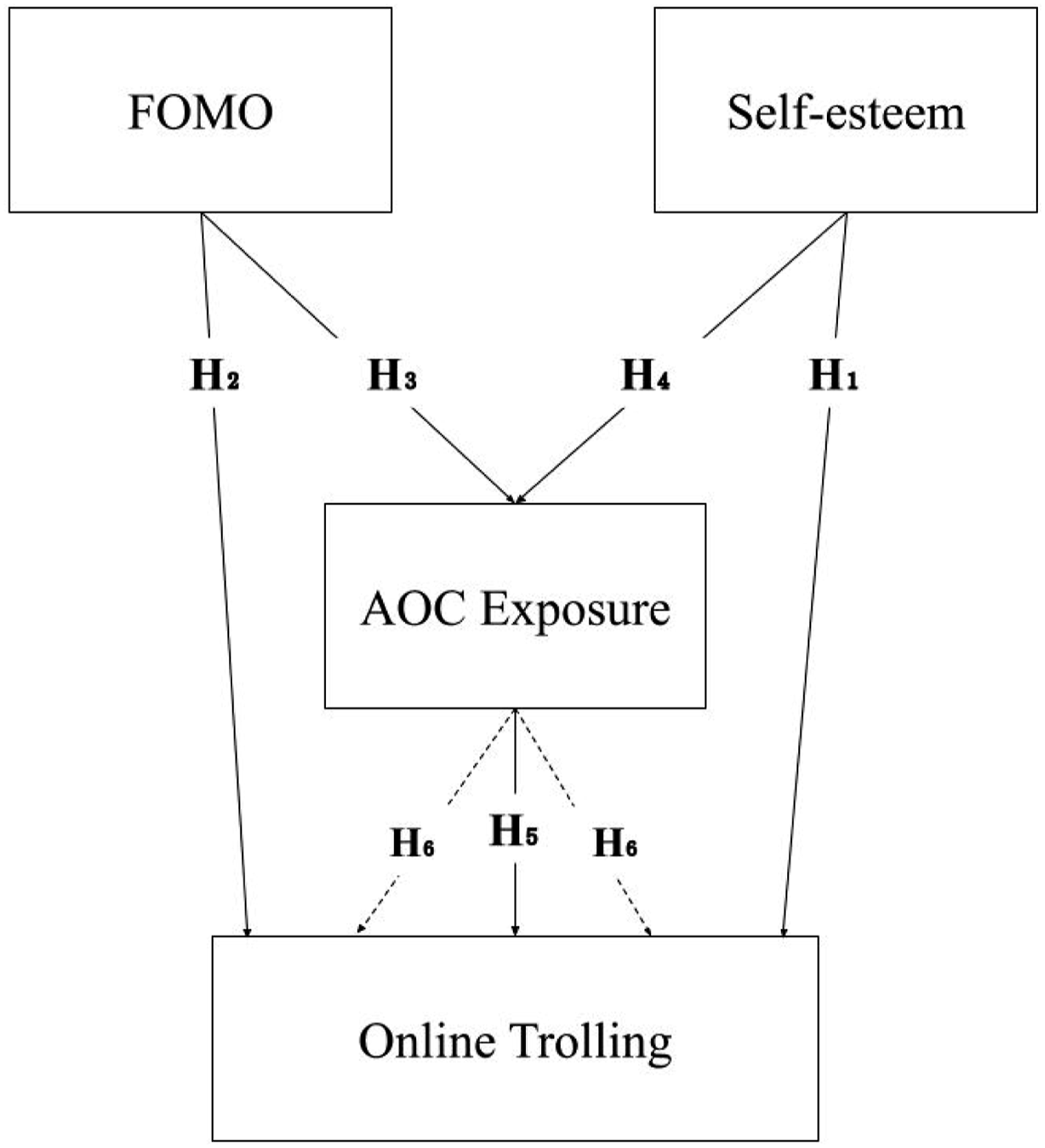
Self-esteem will have a negative relationship with online trolling.
FOMO will have a positive relationship with online trolling.
FOMO will have a positive relationship with antisocial online content exposure.
Self-esteem will have a negative relationship with antisocial online content exposure.
Antisocial online content exposure will have a positive relationship with online trolling.
Antisocial online content exposure will mediate the effects of FOMO and self-esteem on online trolling.
Methods
This was a cross-sectional study, that took place in Brazil in 2022.
Sample
The sample consisted of 300 Brazilian social media users from all Brazilian regions, mainly the Southeast (44.7%) and the Northeast (31.7%). The city with most participants was João Pessoa (11%). Participants were mostly single (50%), women (63%), and college students (18.7%), with a mean age of 27.68 years (SD = 7.15, SE = .41). A non-probabilistic convenience sampling was used.
Instruments
Global Assessment of Internet Trolling-Revised (Sest & March, 2017, Brazilian Adaptation by Santos, 2022)
This version of the measure has seven items that measure behaviors and acceptance of online trolling (e.g., “although some people think my posts/comments are offensive, I think they are funny”) using a Likert scale (from “Strongly Disagree” to “Strongly Agree”). The scale is scored by adding up all the items. We observed an ⍺ = .75 in this study.
Rosenberg Self-Esteem Scale (Rosenberg, 1989, Brazilian adaptation by Hutz & Zanon, 2011)
Measures the individual’s global self-esteem using 10 items (e.g., “I am able to do things as well as most other people”) on a 4-points scale (from “Strongly Disagree” to “Strongly Agree”). For this study, the scale had an ⍺ = .89.
Fear of Missing Out Scale (Przybylski et al., 2013, Brazilian adaptation by Mariano et al., in Press)
A one-factor measure composed by 10 items that measure FOMO (e.g., When I have a good time it is important for me to share the details online (e.g. updating status). It is answered using a Likert scale (from “Not at all true of me” to “Extremely true of me”). The instrument presented an ⍺ = .82, and is scored by summing the items’ answers.
Antisocial Online Content Exposure Scale (Santos et al., 2021)
A seven-item instrument that measures the exposure frequency to antisocial online content (e.g., aggressive comments, violent videos). Uses a six-point Likert-type scale (from “never” to “several times a day”), where participants must answer the frequency that they are exposed to this type of content on the internet. We found an ⍺ = .88 for this measure.
Sociodemographic Questionnaire
At the end of the questionnaire, we asked participants about information such as gender (men, women or other, where the participant could specify their gender), age, city, and main occupation (those being open-ended questions) in order to characterize the sample.
Procedures
Data collection was carried out in the virtual environment, through a form developed in Google Forms and shared on social media (Instagram, Facebook, and WhatsApp), under the premise of being a study about online behavior. The questionnaire was organized in sections, those being: the consent form, the aforementioned psychological instruments, and the sociodemographic questions. The form also contained information for contacting the responsible researchers, in case of doubts or technical problems.
It is important to point out that the study followed national and international ethical recommendations for research with human beings, being approved by the Research Ethics Committee of the Universidade Federal da Paraiba. Participation only took place upon agreement with the Consent Form, and volunteers could leave the study at any moment.
Data Analysis
Data was analyzed through the Jasp statistical software (JASP Team, 2022). Descriptive analyzes (to characterize the sample), bivariate correlations and structural equation modeling (SEM) were performed, aiming to observe whether antisocial online content exposure mediated FOMO and self-esteem effects on online trolling. Specifically for this analysis, the Maximum-Likelihood (ML) estimator and 1000 bootstrapped samples were used, observing the following model-fit indices: the goodness-of-fit index (GFI), the Tucker-Lewis index (TLI), and the comparative fit-index (CFI) (that accept values above .90), the root-mean-square error of approximation (RMSEA, considers values up to .08), and the root-mean-square of-residuals (SRMR, where values up to .10 are significant) (Byrne, 2012; Kline, 2016; Marôco, 2010).
Results
Bivariate Correlations
Means, Standard Deviations and Bivariate Correlations.
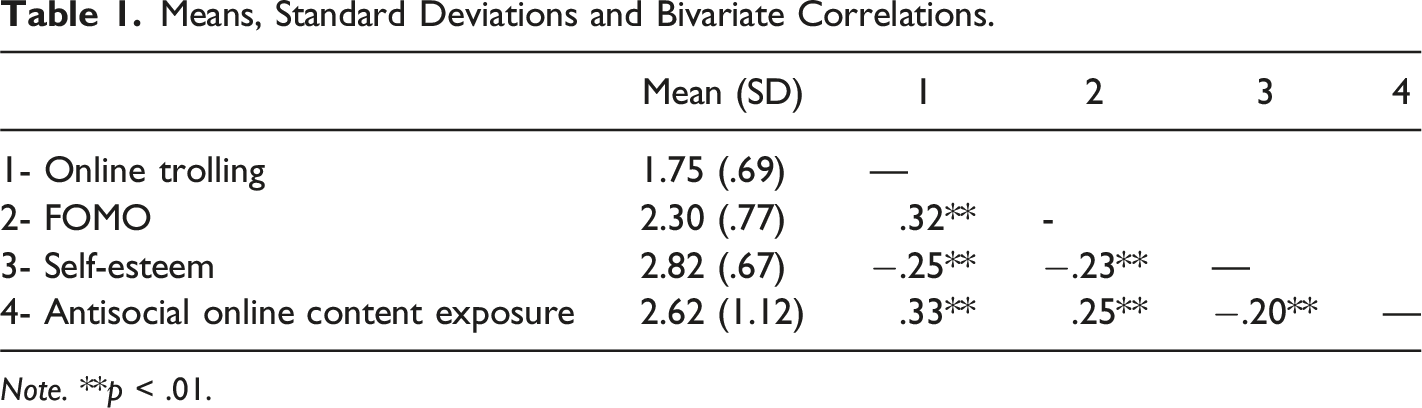
Note. **p < .01.
Structural Equation Modeling
Finally, a model was tested including self-esteem and FOMO as predictors, antisocial online content exposure as a mediator and online trolling as an outcome. This model showed appropriate significant model-fit indices (CFI = .99, GFI = .98, TLI = .98, RMSEA = .02 | 90% CI .01–.03|, SRMR = .04). In summary, both self-esteem (direct effects: λ = −.17, p < .01, indirect effects: λ = −0.06, p < .05) and FOMO (direct effects: λ = .19, p < .01, indirect effects: λ = .07, p < .01) were related to online trolling directly and through the consumption of antisocial online content. Figure 2 details the model. Online Trolling Explanatory Model. Notes: *p < .05, **p < .01, SE = Self-esteem, FOMO = Fear of Missing Out, AOC = Antisocial Online Content Exposure, TR = Online Trolling.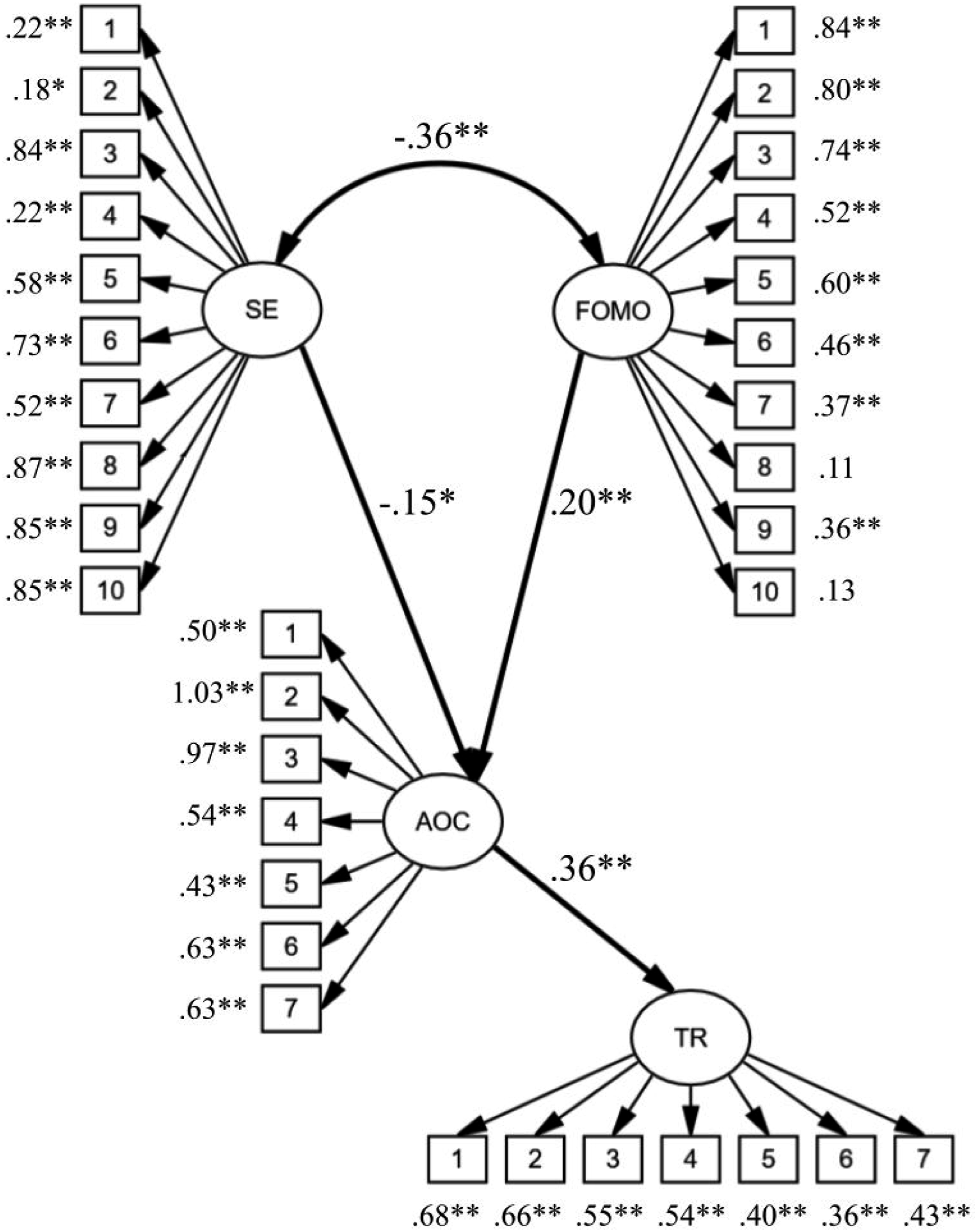
Discussion
The present study aimed to observe the relationships between trolling, self-esteem, FOMO, and antisocial online content exposure. We generally observed that low self-esteem and high FOMO have direct and indirect impacts (mediated by the consumption of antisocial online content) on online trolling. Thus, the objective was accomplished, and the results will be discussed below.
According to the H1, a negative relationship was observed between trolling and self-esteem. The present study goes partially against the results of March and Steele (2020): although their results also found a negative relationship, this relation was moderated by trait sadism. Despite this, the results presented here corroborate other studies on cyberbullying and trolling, which found similar data (e.g. Patchin & Hinduja, 2010; Zezulka & Seigfried-Spellar, 2016). Thus, despite the significant results presented in the present study, further research is necessary to resolve this disparity in the literature concerning this topic.
But why would low self-esteem be related to online trolling? One possibility is the use of this behavior as a form of self-protection against negative feelings, using the externalization of aggression to regulate the individual’s affective state (Bushman et al., 2001; Ostrowsky, 2010). In addition, more aggressive people may use violent action (e.g., trolling) as a way to feel better about themselves (Garofalo et al., 2016).
These statements agree with the study by Santos et al. (2022b), who in their experiment on online aggression observed that experiencing positive affect was a mediating route for personality impacts on aggression. Therefore, the online environment and its relative anonymity provide the person with a possibility to use aggression as a tool for emotional regulation relatively without consequences. Even so, it is important to emphasize that the relationship between self-esteem and aggression remains a topic of scientific debate (Teng et al., 2015).
FOMO, on the other hand, demonstrated a positive relationship with online trolling (H2). Together with the previous results, this information corroborates the idea defended by Abell et al. (2019), where online aggression is a way to avoid negative emotions and inferiority beliefs caused by a high FOMO. The data obtained in the present study demonstrate that this aggression is not only relational (as the authors point out), but can take more direct forms in trolling.
The notion that FOMO is associated with negative feelings about oneself is also supported by the observed negative correlation with self-esteem, which is consistent with previous studies (Gori et al., 2023; Sekścińska & Jaworska, 2022; Uram & Skalski, 2020). Thus, future studies may investigate the moderating role of self-esteem in the relationship between FOMO and other negative online behaviors, such as cyberstalking and cyberbullying.
Following the same relational patterns, high FOMO and low self-esteem impacted greater exposure to antisocial online content exposure (H3 and H4). As discussed by Anderson et al., (2008), in the same way that long term situational variables impact individual differences, the opposite process also occurs: personal characteristics can, for example, influence which media are used/consumed. Also considering that FOMO (+) and self-esteem (−) are associated with excessive use of both internet and social media (e.g., Hawi & Samaha, 2016; Metin-Orta, 2020), the results suggest that these variables increase the likelihood of exposure to aggressive online content, requiring further studies on the topic.
Online trolling was also positively correlated with the consumption of antisocial online content (H5), corroborating recent results by Santos et al. (2022b), who observed the same relationship. As pointed out by Brewer and Kerslake (2015), being exposed to aggressive content increases the probability of perpetuating similar behaviors. This statement finds support from social learning theory, where observing aggression promotes both the learning of these actions, and the expansion of the individual’s behavioral repertoire (Bandura, 1973).
The General Aggression Model, a more recent theory on the subject, also argues that long-term exposure to violent media leads to an increase in violent attitudes and beliefs, desensitization to witnessing violence, and the development of hostility biases (Plante et al., 2020). In other words, a person who is constantly exposed to violent videos and posts may start to believe that on the internet that behavior is normal, that there are no consequences for acting that way and that online aggression is less serious than aggression “in real life”. The fact that trolling is cyclical (Cook et al., 2018) also leaves perpetrators vulnerable to greater exposure to such content. Future studies can experimentally test this hypothesis, measuring cognitive variables related to online violence after the person interacts with an aggressive post, for example.
Finally, we observed by SEM that the antisocial online content exposure mediated indirect impacts of FOMO and self-esteem in trolling (H6), contributing to the argument presented above: relatively stable individual characteristics impact the situations experienced by them (Anderson et al., 2008). Thus, people with low self-esteem and high FOMO may have patterns of internet use (e.g. excessive use) that increase their vulnerability to aggressive content exposure (Hattingh et al., 2022; Mathew & Krishnan, 2020). This long-term exposure, in turn, increases the likelihood of violent behavior on the internet, impacting cognitive and affective aspects of the consumer (Anderson & Bushman, 2018). Future studies can further investigate how self-esteem and FOMO impact internet and social media use (e.g. commonly visited websites, most used platforms) and how, in turn, this use impacts exposure, and subsequently, online trolling.
Thus, in summary, the present study contributed to the understanding of how individual and situational characteristics impact online trolling. The relevance of this contribution is highlighted, given that there are still few studies regarding the perpetrators of trolling (Santos et al., 2022a). Even so, the study is not free of limitations, with the use of correlational data being the main one, given that this prevents the inference of causal relationships. Another issue is that trolling was measured through a brief measure that accesses this behavior in a general way, being necessary that future studies investigate how the frequency of specific trolling behaviors or in different virtual environments (e.g. social media vs. games) is related to the traits presented.
Despite these limitations, we hope that the results presented will contribute to the literature on the different forms of online aggression, an emerging problem in our society connected through technology. What drives a person to bother unknown people on the internet as a form of entertainment? Understanding the psychological mechanisms that support this behavior is a starting point for dealing with it.
Supplemental Material
Supplemental Material - Low Self-Esteem, High FOMO? The Other Side of the Internet Troll
Supplemental Material for Low Self-Esteem, High FOMO? The Other Side of the Internet Troll by Isabella Leandra Silva Santos, Débora Cristina Nascimento Lima, Ericarla Verônica Almeida Dias, Thais Emanuele Galdino Pessoa, Tamyres Tomaz Paiva, and Carlos Eduardo Pimentel in Psychological Reports.
Footnotes
Declaration of Conflicting Interests
The author(s) declared no potential conflicts of interest with respect to the research, authorship, and/or publication of this article.
Funding
The author(s) disclosed receipt of the following financial support for the research, authorship, and/or publication of this article: This work was supported by the Coordenação de Aperfeiçoamento de Pessoal de Nível Superior with a grant provided to Isabella Leandra Silva Santos, and by the Conselho Nacional de Desenvolvimento Científico e Tecnológico (CNPq) with a grant provided to Carlos Eduardo Pimentel.

Data Availability Statement
Data for this article can be obtained by messaging the authors, upon reasonable request.
Supplemental Material
Supplemental material for this article is available online.
Author Biographies
References
Supplementary Material
Please find the following supplemental material available below.
For Open Access articles published under a Creative Commons License, all supplemental material carries the same license as the article it is associated with.
For non-Open Access articles published, all supplemental material carries a non-exclusive license, and permission requests for re-use of supplemental material or any part of supplemental material shall be sent directly to the copyright owner as specified in the copyright notice associated with the article.
