







Abstract
Previous research found that performing an initial self-control task impairs subsequent self-control performance, which is referred to as ego depletion. However, recent meta-analyses and replication studies have led to controversies over whether the ego depletion effect is as reliable as previously assumed. The present study aimed to shed more light on these controversies by combining depletion measurement task type and personality as moderators. Study 1 investigated trait self-control and action orientation’s moderation role for depletion effects on stop-signal task (inhibitory control). Study 2 examined the trait self-control and action orientation’s moderation role for depletion effects on a majority congruent Stroop task (goal maintenance). Results showed that trait self-control moderated the ego depletion effect on stop-signal reaction time (SSRT). High trait self-control people were less vulnerable to the ego depletion effect on the reactive inhibitory control task, whereas the moderating role of trait self-control for ego depletion was not found in the goal maintenance task. More particularly, high action-oriented people were less susceptible to the ego depletion effect on the goal maintenance task, but there was no moderation effect of action orientation for ego depletion in the stop-signal task. We discuss types of task for depletion measurement and individual differences in ego depletion, and we suggest possible avenues for future research.
Keywords
Introduction
Self-control can be defined as the process of individuals’ effortful attempts to change or inhibit automatic, habitual, or innate behavioral tendencies, urges, emotions, or desires that would otherwise undermine goal directed behavior (Barkley, 1997; Baumeister, 2002; Baumeister et al., 1994; Muraven et al., 2005). According to the strength model of self-control, prior engagement in self-control (e.g., emotional control) can impede later self-control task performance (Baumeister et al., 1998; Muraven et al., 1998),which is termed “ego-depletion” (Baumeister et al., 1998). Researchers reckon that ego depletion may partially account for a wide range of daily self-regulation failure behaviors such as resisting temptations, inappropriate sexual behaviors, aggressive behaviors, unhealthy eating, and impulsive consumption (Baumeister et al., 2006; Baumeister & Tierney, 2011; Hofmann et al., 2012; Vohs & Heatherton, 2000).
In recent years, the replication crisis in psychology has casted doubt on the ego depletion effect. Meta-analyses and replications for the ego depletion effect revealed heterogeneous and inconsistent results. While some studies indicated that the ego-depletion effect size was not distinguishable from zero (Carter et al., 2015; Friese et al., 2019; Vohs et al., 2021), other research supported the ego-depletion effect (Dang et al., 2017; Garrison et al., 2019; Lin et al., 2020; Singh & Göritz, 2019). Forestier et al. (2022) summarized criticisms and provided new perspectives for the investigation of ego depletion as a multicomponent phenomenon. Specifically, they speculated that controversies on the ego depletion effect may be due to the “absence of a comprehensive, integrative, and falsifiable definition of self-control.” Forestier et al. listed self-control resources, self-control willingness, self-control capacity, and self-control tasks as multicomponent phenomena in the ego depletion effect. To this end, heterogeneous definitions of self-control lead to different types of operationalized tasks when measuring the ego depletion effect. For instance, a self-reported questionnaire was usually adopted as a measurement for self-control resources and self-control willingness. Reaction time (RT) and errors in cognitive tasks were treated as measurements for self-control capacity (Baumeister et al., 1998; Dang, 2017; Hagger et al., 2010; Muraven et al., 2005). Forestier et al. propose that it is important to investigate the interaction between multicomponent phenomena in the ego depletion effect. They also point out the “relationship between individual differences in self-control (e.g., trait self-control) and situational differences in self-control (e.g., ego depletion) is not well articulated”. Bringing these two lines together, the current study focused on self-control capacity, which was also a multicomponent could be measured by different types of cognitive tasks, and its interaction with individual differences in the ego depletion effect. By investigating this interaction, we sought to extend prior research findings, which may help us understand the controversial results of the ego depletion effect.
(Reactive) Inhibitory Control, Proactive Goal Maintenance, and Ego Depletion
The cognitive control perspective of ego depletion theorizes that the taxing of self-control resources may temporarily impair aspects of cognitive control function involved in self-control, such as inhibitory control, which controls undesired, prepotent, or habitual responses (Baumeister et al., 2007). As most daily self-control behaviors consist of inhibitory control, they are vulnerable when this control is impaired (Baumeister, 2014; Schmeichel, 2007). Notwithstanding this perspective that emphasizes self-control as inhibition, the literature also agreed on the notion that self-control includes the initiation and maintenance of desired behavior (Baumeister et al., 1994; de Boer et al., 2011; De Ridder et al., 2011; De Ridder & Gillebaart, 2017; De Ridder, Kroese, & Gillebaart, 2017; Ein-Gar & Sagiv, 2014). For instance, exercising is just as important to one’s health as reducing unhealthy food consumption. Thus, the initiation and maintenance of goal-pursuing activities could be defined as another facet of self-control capacity. However, whether these two facets of self-control capacity could be impaired by depletion has not been the subject of empirical scrutiny yet.
According to the dual framework of cognitive control, reactive inhibitory control can be viewed as a type of cognitive control strategy with the engagement of inhibition after the occurrence of specific imperative events, such as impulses, habitual responses, or prepotent responses (Braver, 2012; Braver et al., 2007). It operates as a late correction mechanism. In stop-signal tasks, subjects perform a go task, and occasionally, the go stimulus is followed by a stop-signal. The subject needed to withhold the “go” response in reaction to a “stop” cue (Verbruggen & Logan, 2008). In contrast, goal maintenance is a proactive control strategy that requires the goal information to be actively sustained according to the task goals (Braver, 2012; Gonthier et al., 2016; Kane & Engle, 2003). For instance, in Stroop color-word tasks (Stroop, 1935), when people perform a block in which the majority of the trials are incongruent, Stroop interference is significantly reduced as compared to a block in which the majority of the trials are congruent. In the latter condition, when people encounter a high number of congruent trials, there are no external cues available to maintain the current task goal (the color naming). Thus, people are more likely to show impaired goal maintenance ability even though they are able to correctly remember and state a task rule in this situation, which is manifests as goal neglect (Duncan et al., 1996; Kane & Engle, 2003). In contrast, in the mostly incongruent blocks, it is easy for participants to maintain and initiate task goals.
A temporary reduction in cognitive control can be the result of prior high intensity engagement of cognitive control, which is at the heart of ego depletion (Muraven et al., 1998; Schmeichel, 2007). Previous studies found inhibitory control is impaired after engaging in tasks that require cognitive control (Muraven et al., 1998; Schmeichel, 2007). Beside the finding that inhibition control was influenced by depletion, research also found that the maintenance and update of information in memory were both impaired after exerting self-control tasks (Schmeichel, 2007). Even though previous studies indicated that ego depletion had detrimental effects on cognitive control, the extent to which reactive inhibition and proactive goal maintenance are impaired by prior cognitive control has yet to be established. Exploring whether there are dissociations in the depletion effect on two types of cognitive control tasks may shed light on ego depletion through the dual framework of cognitive control. Moreover, the current research investigated whether the depletion effect on cognitive control task performance would be moderated by people who are adept at inhibitory control and goal maintenance, respectively.
Trait Self-Control and Action Orientation as Moderators
As mentioned before, reactive inhibitory control and proactive active goal maintenance may be relevant to the way in which self-control styles are manifested in two personalities. Namely, reactive inhibitory control is a type of self-control process that includes responses to temptation impulses. Thus, impaired reactive inhibitory control may result in impulsive behavior, such as the inability to resist temptation or overcome urges, which largely fits the description of low trait self-control. Trait self-control can be defined as the trait-like ability to override dominant responses (De Ridder et al., 2012; Tangney et al., 2004). Previous studies found that individuals who score low on trait self-control also score worse on behavior tests of self-control (Schmeichel & Zell, 2007). This might be explained by the low trait self-control individuals do not have enough self-control capacity. Thus, low trait self-control individuals are more vulnerable to self-control failures after initial self-control exertions. However, evidence also suggested that high trait self-control people may less frequently inhibit dominant responses than low trait self-control people because they adopted a smart strategy by avoiding temptation situations in advance (Ent et al., 2015; Imhoff et al., 2014). This would lead to the opposite prediction that people high trait self-control are more susceptible to ego depletion as they are less likely confront inhibition to begin with. Additionally, other studies failed to find a significant interaction between trait self-control and the depletion effect (Gailliot & Baumeister, 2007; Solberg Nes et al., 2011). In summary, the moderating role of trait self-control on depletion is unclear. Inspired by the dual framework of cognitive control theory, the current study adopted reactive and proactive control tasks to test whether trait self-control can moderate the ego depletion effect. Because trait self-control is more associated with the capacity to inhibit, we predicted that individuals with high trait self-control would be less vulnerable in reactive inhibition control tasks, whereas this moderation effect would be absent in proactive control tasks. This is theorized to be due to the fact that the proactive control task mainly reflected the ability to initiate and maintain a goal even when there are no external cues to remind the individual.
In contrast, proactive goal maintenance may be related to action orientation, a personality trait that reflects how people initiate and maintain intentions and goals when confronted with demanding situations in daily life (e.g., depletion) (Koole et al., 2012; Kuhl, 1984, 1994). High-action-oriented people facilitate the goal striving process by taking initiative and translating intentions into action, whereas low-action-oriented (also known as state-oriented) people are prone to respond passively to demanding situations due to preoccupation or hesitation. This was confirmed by empirical evidence showing that action-state orientation can moderate the ego depletion effect (Dang et al., 2015; Gröpel et al., 2014). However, more recent findings suggested that action orientation could not moderate the depletion effect (Dang et al., 2017). The contradictory findings on the moderating role of action state orientation may be associated with different types of self-control tasks adopted in second tasks. More particularly, Gröpel et al. (2014) employed selective attention tasks as dependent variables to investigate the moderating role of action-state orientation on depletion and found that high action oriented people are less likely to be influenced by ego depletion effects than low action oriented (state-oriented) people. Dang utilized antisaccade tasks as dependent variables to test individual differences on depletion effects and found no moderation effects of action orientation and trait self-control (Dang et al., 2017). In the antisaccade task, the participant not only needed to actively maintain the goal of shifting attention, but also had to overcome the reflexive prosaccade to the cue (Guitton et al., 1985; Kane et al., 2001). Therefore, this task may encompass both types of proactive control (goal activation and maintenance) and reactive control (inhibition mechanisms). However, trait self-control and action orientation might be associated with proactive and reactive control, respectively. Although it might be difficult to disentangle two types of control, previous studies indicated that it might be possible to explore individual differences in proactive and reactive cognitive control by different types of tasks. In the current study, we adopted a stop-signal task to measure the reactive inhibition abilities after depletion, and we also used a 75% congruent (major-congruent) Stroop task to measure goal maintenance abilities after depletion. These two tasks were widely used in previous research to measure reactive and proactive control (Bartholdy et al., 2016; Bartholdy et al., 2017; Gonthier et al., 2016; Kane & Engle, 2003). Stop-signal tasks can not only provide a cognitive control functioning index (Stop signal reaction time, SSRT) but also yield an index of more basic processes (go RT and percentage of errors) (Verbruggen & Logan, 2008). Thus, it is possible to assess whether ego depletion affects more basic cognitive processes. Taken together, the current study aims to investigate whether these personality traits can moderate depletion effects on reactive and proactive control tasks. Because action orientation is associated with goal initiation and maintenance, we predicted that action orientation would have a moderate depletion effect on proactive control tasks but not on reactive inhibition control tasks.
Moreover, the current study tested performance differences as a function of trait self-control and action orientation in the initial depletion task and after the non-depletion task. We predicted that high-trait self-control individuals performed better in depletion tasks than low trait self-control individuals. Previous studies showed that people with high trait self-control perform better in behavior inhibition tasks. However, high and low-action-oriented people had comparable performance in the depletion tasks. For previous studies indicated that high- and low-action oriented people’s performance differed only in the second task, namely in demanding situations but not in non-depleting contexts. It is important to replicate results of relationship between personality type and behavioral performance of self-control. For previous research findings related to self-control and inhibition are mixed. Saunders et al. (2018) discovered no association between trait self-control and inhibition. Thus, the current study would gather more evidence concerning inhibition and initiation in self-control process.
The Present Study
Although previous work found individual differences and task type could moderate the ego depletion effect respectively, far too little attention has been paid to the interaction effect of these two moderators on the ego depletion effect. To acquire additional empirical support regarding the presence of the ego-depletion phenomenon, the overarching goal of the present research was to extend previous findings on the relationship between individual difference and the ego depletion effect in two types of cognitive control tasks by evaluating and taking into consideration the relevant cognitive processes more directly. To this end, we employed the stop signal task and the majority congruent Stroop task to measure the reactive inhibition (Study 1) and goal maintenance ability (Study 2) after ego depletion, respectively. We hypothesized that depletion would impair performance in both tasks. Two studies also examined the moderating roles of trait self-control and action orientation. We predicted that trait self-control would moderate the ego depletion effect in the stop signal task, but not in the majority congruent Stroop task. By contrast, action orientation would moderate the ego depletion effect in the majority congruent Stroop task but not in the stop signal task. This should ultimately increase our a priori knowledge of when to expect ego depletion effect and collect additional empirical evidence regarding the role of inhibition and initiation in the process of self-control.
Study 1
Method
Participants and procedure
G*Power was adopted to determine the required sample size. The results indicated that a sample of 150 participants would be able to detect a comparable effect size with a power of.80 for the moderation effect. 160 participants were recruited from the university (Mage = 18.5; 128 women). Ethical approval for the current studies was obtained from the scientific and ethical review board of this university. All participants had normal or corrected-to-normal vision and hearing. Participants were seated in a quiet lab cell. All participants first completed the trait self-control and action orientation questionnaires. Then they were randomly assigned to the depletion and control groups. They were told that the experiment consisted of two unrelated tasks. Then participants in the experimental group complete a non-congruent Stroop task as a depletion task. In the control group, participants complete a congruent Stroop task. After performing (non-) depletion task, all participants completed the stop-signal task as a reactive inhibition measurement. Then the participants were thanked and debriefed.
Measures
Trait self-control
Trait self-control is assessed with the Chinese version of Trait self-control scale (Tan & Guo, 2009). Higher scores on this measure indicate a lower TSC. This scale is composed of 19 items from Trait-self-control Scale (TSC) (Tangney et al., 2004). It has four dimensions, including impulse control, healthy habits, resisting temptation by focusing on work, and abstinence from entertainment. Previous research established the high test-retest reliability (.85) and internal consistency (α = .86) of the Chinese version of the TSC. The cutoffs for low (25th percentile), medium (50th percentile), and high (75th percentile) trait self-control total score are 48, 54, and 61, respectively.
Action Orientation
Individual differences in action and state orientation were assessed by the Action Control Scale (ACS-90) (Song et al., 2006) in Chinese. The ACS-90 showed good validity and reliability in previous studies (Diefendorff et al., 2000; Kuhl & Beckmann, 1994). The ACS-90 has three subscales (12 items each). The three subscales were the preoccupation (AOF, Failure-related action orientation vs. preoccupation) scale, assessing the disengagement ability from thoughts elicited by past self-threatening experience; the AOD (Decision-related action orientation vs. hesitation) scale, assessing difficulties in initiating self-regulation action towards a goal, and the volatility (AOP, Performance-related Action Orientation) scale, assessing the ability of perseverance (cf. Kuhl, 1994). For the purposes of the study, we adopted the AOD subscale (Diefendorff et al., 2000). The AOD subscale assesses individuals' hesitation or willingness to initiates actions to start activities in demanding situations (Kuhl, 1994) (Cronbach’s alpha of AOD = .74).
Depletion Versus Non-Depletion Manipulation
Participants were randomly assigned to the depletion and control groups. According to Hagger et al., (2010) ’s meta-analysis, adding a depletion check manipulation questionnaire between the depletion task and the second task would reduce the depletion effect because the interim period between the two tasks would allow participants to recover from depletion. Thus, the current study did not include the depletion questionnaire check between the two tasks. However, in order to test the effectiveness of two depletion manipulations in the present study, we ran two pilot studies to investigate the effectiveness of the Stroop depletion task (Pilot Study 1) and the Non-dominant handwriting task’s depletion effect (Pilot Study 2) (the details are described in Supplement Material 1). The depletion was manipulated by performing the Stroop color-naming task. The Stroop task was widely used as ego depletion manipulation (Hagger et al., 2010). In this task, participants need to inhibit their natural tendency to read the word by naming the font color. However, there are some trials where is the word and font color are incongruent (Stroop, 1935). In contrast, as a control group, the non-depletion manipulation also required the participants read the word color, but there were no incongruent trials in this manipulation. In the current study, depletion manipulation control’s Stroop task contains 144 trials, which are neutral trials, congruent trials, and incongruent trials (the ratio is 1:2:3). The experimental task was programmed using E-prime® software. In the Stroop task, there was a fixation “+” presented in the center of the 19″computer monitor for 300 ms. Each trial was present for 1000 ms. If participant did not respond in 3000 ms, the next trial would begin automatically. The participant needed to respond to the red color fonts yellow (incongruent trial), Blue (incongruent trial), Red (congruent trial), and HHH (unrelated neutral trial) by using the left arrow key, the blue color font by using the down arrow key, and yellow color font by using the right arrow key. The experiment consisted of practice and a formal section. The participants first completed the practice section before starting the formal experiment.
Reactive Inhibitory Control Task
In the current study, we adopted an auditory stop-signal task to assess the depletion effect on the reactive inhibitory control task (Logan & Cowan, 1984; Verbruggen & Logan, 2008). The subject performed a stop signal task, followed by a depletion task. In this task, they make a choice according to the shape and discriminate between a square and a circle, as shown in Figure 1 (i.e., the primary task). The response keys for square are “Z” and for circle are “/”. Moreover, Subjects would also respond between a Go-trial and Stop-trial which were followed by the presentation of the go stimulus and the auditory stop signal, respectively. In some trials, an auditory stop signal instructs subjects to withhold their response for the primary task. There are 75% of the trials that are no-stop trials, so the participants only performed the primary task. For the rest 25% of the trials (40 trials, 160 trials total in two blocks), an auditory stop signal is presented after the primary-task stimulus, thus subjects need to withhold their responses. Experimental procedure for reactive inhibition in the stop-signal paradigm.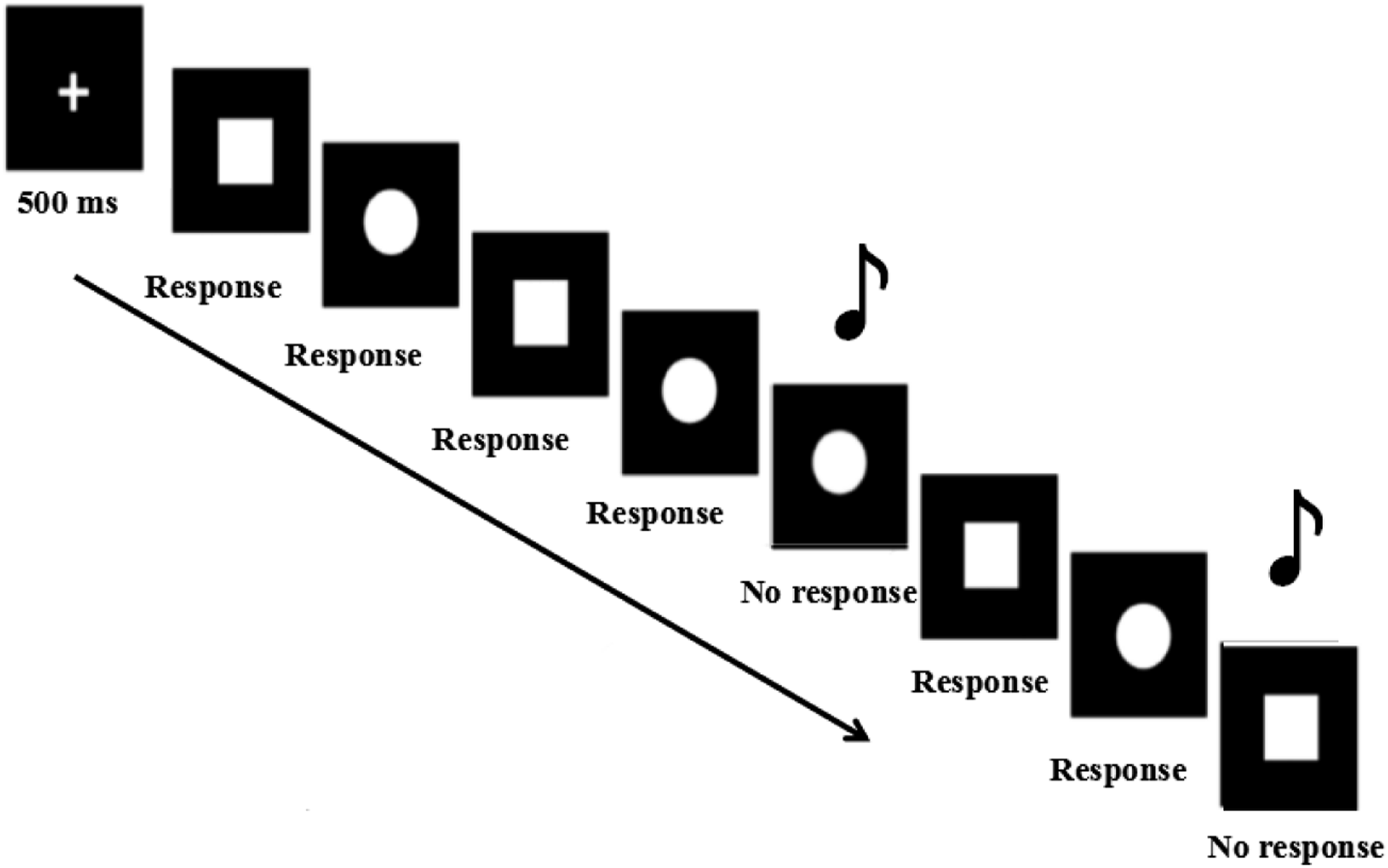
According to the horse-race model proposed by Logan and colleagues, the stop-signal reaction times (SSRT) are determined by the race between a Go-trial and Stop-signal, which could be reflected by the stop-signal delay (SSD) between go-trial and stop-signal trial (Logan et al., 1997; Williams et al., 1999). A longer SSD would make it more difficult to inhibit. Therefore the current study adopted tracking algorithm to set the start SSD as 250 ms, then SSD would either increased or decreased by 50 ms for the next Stop-signal trial depending on whether the participants make successful inhibition (delay increased) or not (delay decreased) to the Go stimulus.
Results
Two participants did not take part in the formal experiment because they had a high error rate in the practice block. We used SPSS 22 to analyze the data.
Manipulation Check
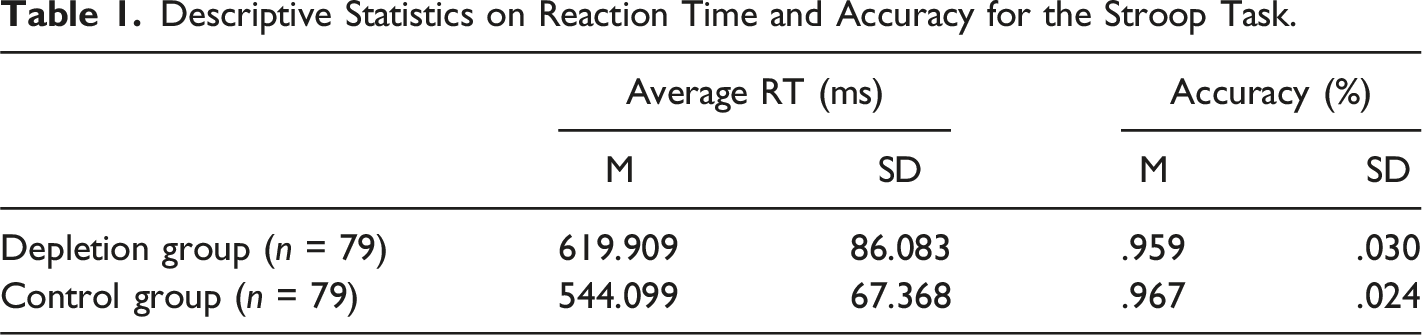
Descriptive Statistics on Reaction Time and Accuracy for the Stroop Task.
Stop Signal Task Performance
Descriptive Analysis on Go RT, Accuracy, and SSRT for the Stop Signal Task.

Moderation Role of Trait Self-Control and Action Orientation on Stop Signal Task Performance
Interaction of Depletion and Trait Self-Control on SSRT.
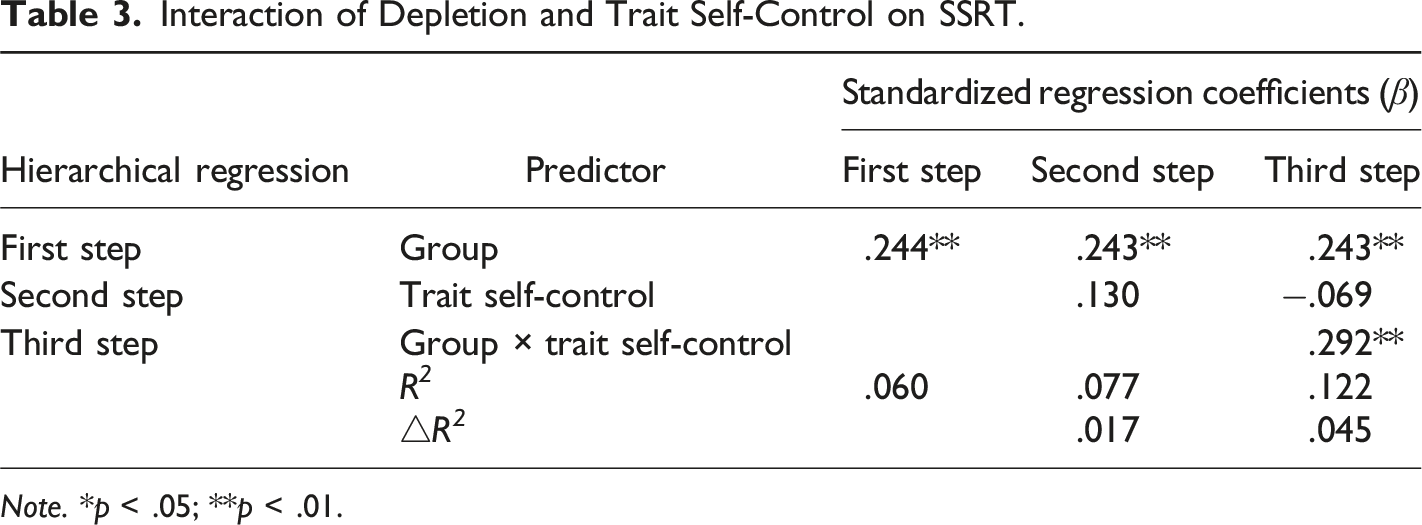
Note. *p < .05; **p < .01.
To explore the moderation effect, unstandardized regression weights conducted with a range of ±1 SD for both predictor variables were adopted (Simple slope analysis). As shown in Figure 2, the relationship between group and SSRT varied as a function of trait self-control. The results showed that group predicted SSRT in the low trait self-control group, β = 44.986, t (157) = 4.267, p < .01,but not for the high trait self–control group, β = 2.813, t (157) = .267, p > .05. Simple Slope for depletion effect on SSRT at high or low trait self-control.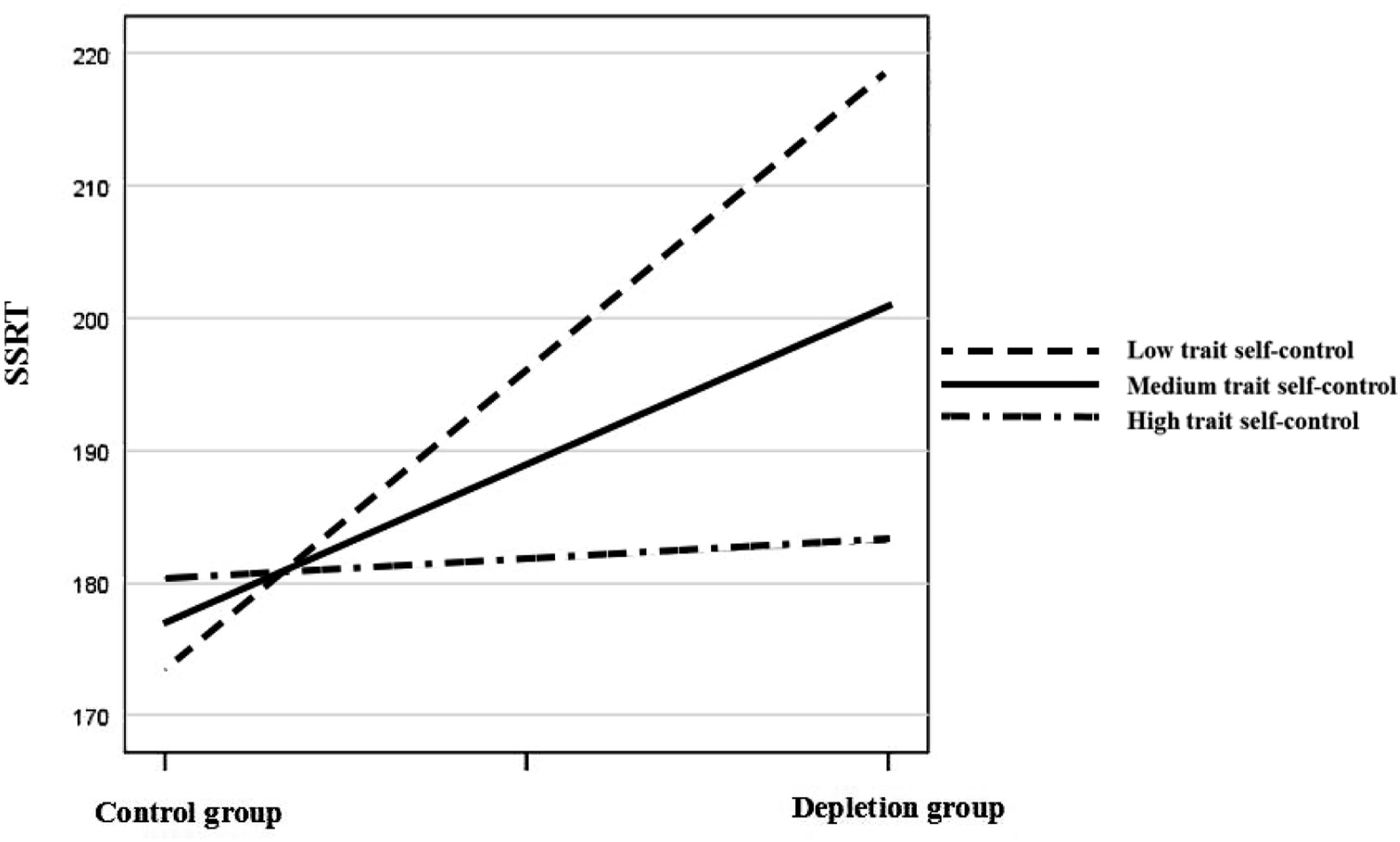
For action orientation’s moderation role, a hierarchical regression analysis was conducted on SSRT, with group and action orientation entered in the first and second blocks, and their interaction term entered in the third. There was a significant main effect of group, t (154) = 3.213, B = 12.050, 95% CI = [4.442, 19.658], p < .01, but not for action orientation, t (154) = 3.855, B = 1.383, 95% CI = [-6.232, 8.999], p > .05, the interaction effect is also not significant, t (154) = -.766, B = -2.964, 95% CI = [-10.604, 4.676], p > .05.
In order to test whether trait self-control’s moderation effect was due to different performance on depletion task, we compared high and low trait self-control’s performance on the Stroop task, however, there was no significant difference between high and low trait self-control people in accuracy rate (ps> .05).
Discussion
Study one examined whether trait self-control and action orientation would moderate the ego depletion effect on the reactive inhibition (stop signal) task. Replicating previous findings, after exerting self-control in an initial task (the Stroop task), participants exhibited decreased performance in a second task requiring self-control (stop signal task). Also, the depletion effect did not extend to the basic “go” response processes, which are more related to response execution, which is in line with previous findings (Baumeister et al., 1998; Huizenga et al., 2012). More importantly, consistent with our hypotheses, high trait self-control people are less vulnerable to depletion than low trait self-control people, as indicated by shorter SSRT in the depletion condition but not in the control condition, while action orientation showed no moderation effect. It is important to note that the ego depletion manipulation check revealed marginally difference between the depletion and the control group for error rate. The effect size estimates exhibited smaller magnitudes (d = .29) compared to the initial meta-analysis conducted on the depletion effect (d = .62; Hagger et al., 2010), but are larger in comparison to the subsequent meta-analysis that employed bias correction to yield an effect size of zero (Carter et al., 2015).
The present moderating effect of trait self-control is in line with those studies that found that people with high trait self-control people may be immune to the effects of ego depletion (DeWall et al., 2007; Dvorak & Simons, 2009; Gailliot et al., 2006). In these studies, high trait self-control acted as a protective factor for depletion in predicting behavioral outcomes, such as that high trait self-control individuals are less likely to express intentions of responding aggressively after depletion (DeWall et al., 2007), less motivated to conserve remaining resources (Buczny et al., 2015), have less death anxiety after priming the death concept, which can be viewed as another form of ego depletion manipulation, and more personal optimism (Gailliot et al., 2006; Kelley & Schmeichel, 2015; Kelley et al., 2014). These findings are mainly focused on the depletion effect exerted on behavioral intentions or attitudes. In contrast, the current study explored the aftereffect of depletion on the reactive inhibition task, which is a form of cognitive control related to trait self-control. Specifically, the experimental effect of depletion was diminished in high-trait self-control people. This indicated that people with abundant self-control capacity, as reflected by a positive history of inhibiting impulses, also exhibit better performance in reactive inhibition tasks after depletion. However, there was also evidence that interactions between trait self-control and ego depletion acted in the opposite direction, i.e. high trait self–control people are more susceptible to depletion (Imhoff et al., 2014). A possible explanation for this might be that the measurement of trait self-control and depletion outcomes is different between previous and current studies. In Imhoff et al.’s (2014) study, they utilized a multifaceted measure of trait self-control, while the current study adopted a standard measurement of trait self-control. As a dependent variable, this study focused on behavioral tendencies after ego depletion, such as candy consumption, achievement motivation, and risk taking tendency. These dependent variables might mainly reflect “hot” cognitions of self-control, which focus more on motivational, affect-laden processes, whereas the current study focused on “cold” cognitions of self-control, which are cognitive control and mainly involve information-driven processes (David & Szentagotai, 2006; Kunda, 1999; Prencipe et al., 2011). Although hot and cold cognitions of self-control are closely related, the moderation effect on these two tasks may exhibit different patterns. Specifically, people skilled at resisting temptation in daily life might be susceptible to depletion in hot cognitions of self-control tasks because they usually avoid temptation (Ent et al., 2015; Imhoff et al., 2014). It might be possible that avoidance of temptation also requires conflict monitoring to remain aware of temptation and plan to avoid temptation in advance. These two components are integral parts of cognitive control processes. Thus, high-trait self-control people may also excel in cold cognitions of self-control tasks but show poor performances in hot cognitions of self-control tasks.
It is notable that high and low trait self-control individuals showed no differences in depletion task performance. This indicated that they were similarly depleted. Thus, it is possible that trait self-control is associated with the individual’s ability to allocate cognitive resources in two sequential cognitive tasks because high trait self-control individuals scored better than low trait self-control individuals only in the stop signal task.
Although previous studies found that action orientation could moderate the depletion effect, the results of Study 1 showed there was neither a main effect nor a moderation effect. This result is in contrast to previous studies, which found action orientation is less vulnerable to ego depletion effects (Dang et al., 2015; Gröpel et al., 2014). The discrepancy might be attributed to the different experimental paradigms for depletion tasks. In previous studies finding a moderation effect of action orientation, they employed an attention concentration task, the d2 test of attention task, and critical fusion frequency measurement (this task evaluated visual temporal processing by measuring the frequency at which a flickering light was perceived as continuous) (Gröpel et al., 2014). Although these tasks may also be associated with the ability to inhibit attention, they may not reflect the ability to reactively inhibit attention. Instead, they were more likely to be associated with attentional vigilance. The current study adopted the reactive stop-signal task as a measurement for reactive inhibition control. Thus, individual differences in action orientation mainly lie in initiating and maintaining a goal, but not in reactive inhibition control. Therefore, the results indicated that the moderation effects of action orientation may also depend on task types. In order to further test this assumption, study 2 adopted a majority-congruent Stroop task as its dependent variable, as this task is associated with proactive control ability to initiate and maintain goals. Therefore, we expected that the moderation effect for depletion would exhibit a reverse pattern for action orientation and trait self-control in study 2.
Study 2
Participants and Procedure
G*Power was adopted to determine the required sample size. The results indicated that a sample of 150 participants would be able to detect a comparable effect size with a power of.80 for the moderation effect. 160 participants were recruited from the university (Mage = 18.5, 133 women). Ethical approval for the current studies was obtained from the scientific and ethical review board of this university. All participants had normal or corrected-to-normal vision and hearing. Participants were seated in a quiet lab cell. All participants first completed the trait self-control and action orientation questionnaires. Then they were randomly assigned to the depletion and control groups. Then participants in the experimental group complete a non-dominant hand essay writing task as a depletion task. In the control group, participants complete a dominant hand essay writing task. After the (non-) depletion task, all participants completed the goal maintenance task as a proactive control measurement. Then the participants were thanked and debriefed.
Measures
Trait self-control
Trait self-control was measured identically for studies 2 and 1. The cutoffs for low (25th percentile), medium (50th percentile), and high (75th percentile) trait self-control total score are 48, 56, and 61, respectively.
Action orientation
Action orientation was measured identically for studies 2 and 1.
Depletion and Non-Depletion Tasks
In study 2, we adopted another depletion manipulation in which the subjects needed to write an essay with their non-dominant hand. This task had been used in several previous studies and was found to impair subsequent self-regulatory performance (e.g., Janssen & Fennis, 2017; Schmeichel, 2007; Uziel & Baumeister, 2017; Jian & Li, 2014). Participants were instructed to write an essay about the advantages and disadvantages of smart mobile phones. Word limits are 100–120 words. In the depletion condition, participants are instructed to use anon-dominate hand, while in the non-depletion condition, participants use a dominant hand to complete the essay writing.
Goal Maintenance Task
Goal maintenance was assessed with a majority-congruent Stroop task (Kane & Engle, 2003), Subjects were instructed to read the color of a word or letter string. There were 128 trials in all, and 75% of the trials are congruent trials, while 25% are incongruent trials and neutral trials (16 trial incongruent and 16 congruent trials). Neutral trials presented the letter string “HHHH” in red, blue, or green. Previous studies adopted this task to test individuals’ ability to initiate, and act on the goal of indicating ink color even when the task environment did not reinforce the goal of ignoring the semantic meaning of the word (Kane & Engle, 2003). Previous research adopted relative accuracy as an index of goal maintenance, which is computed by subtracting the average number of accuracy on incongruent trials from average number of accuracy on congruent trials.
Results
For 7 participants did not complete the task, data were collected from 153 participants. We used SPSS 22 to analyze the data.
Manipulation Check
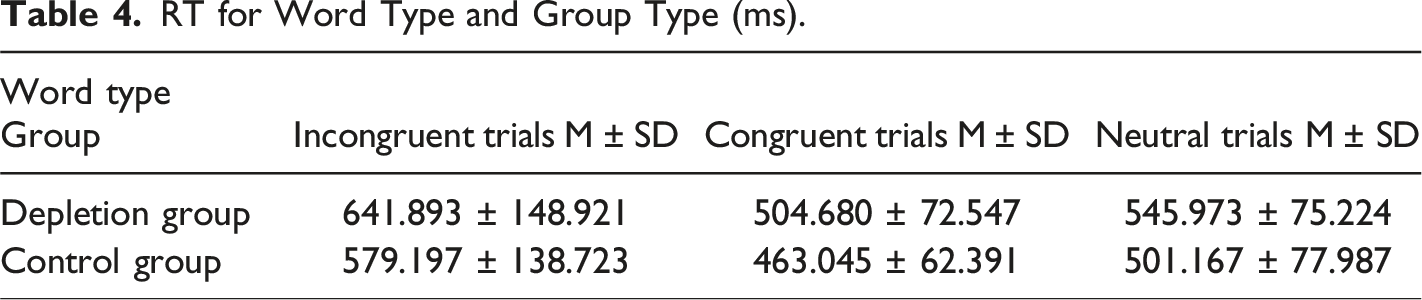
Reaction Time for the Goal Maintenance Task
RT for Word Type and Group Type (ms).
Accuracy Rate for the Goal Maintenance Task
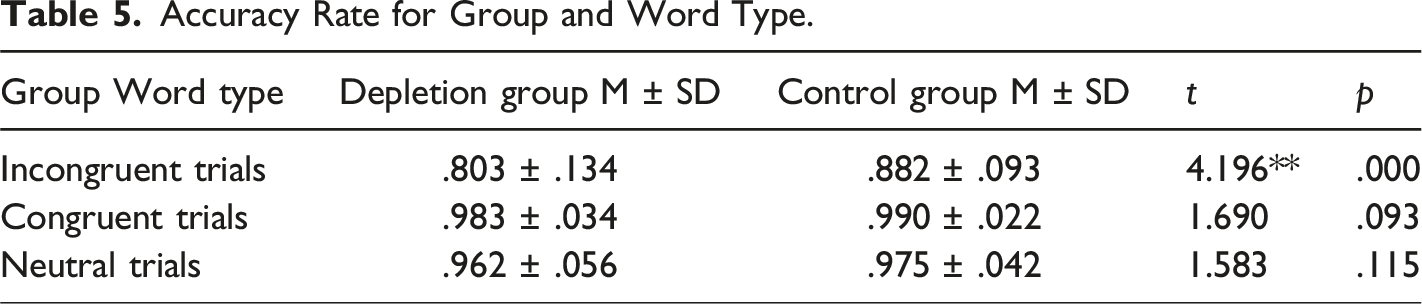
The accuracy rate for the majority-congruent Stroop task (dependent variable) was investigated in a 2 (Group: depletion vs. control group) × 3 (Word type: congruent vs. incongruent vs. neutral) repeated measures ANOVA; group as between and word type as within-subject variables. The analysis of accuracy yielded a significant main effect of group, F (1, 152) = 20.09, p < .01, η
p
2
= .117, 95%CI = [.04, .22] and word type F (1, 152) = 178.49, p < .01, η
p
2
= .542, 95% CI = [.44, .62]. Moreover, the interaction effect of group and word type was significant as shown in Figure 3, F (1, 152) = 11.365, p < .01, η
p
2
= .07, 95% CI = [.01, .16]. Simple effect analysis showed that the depletion group had a lower accuracy rate only in incongruent trials (p < .01, Cohen’s d = .55), but no difference in congruent or neutral trials (p > .05). Accuracy rate for word type and group.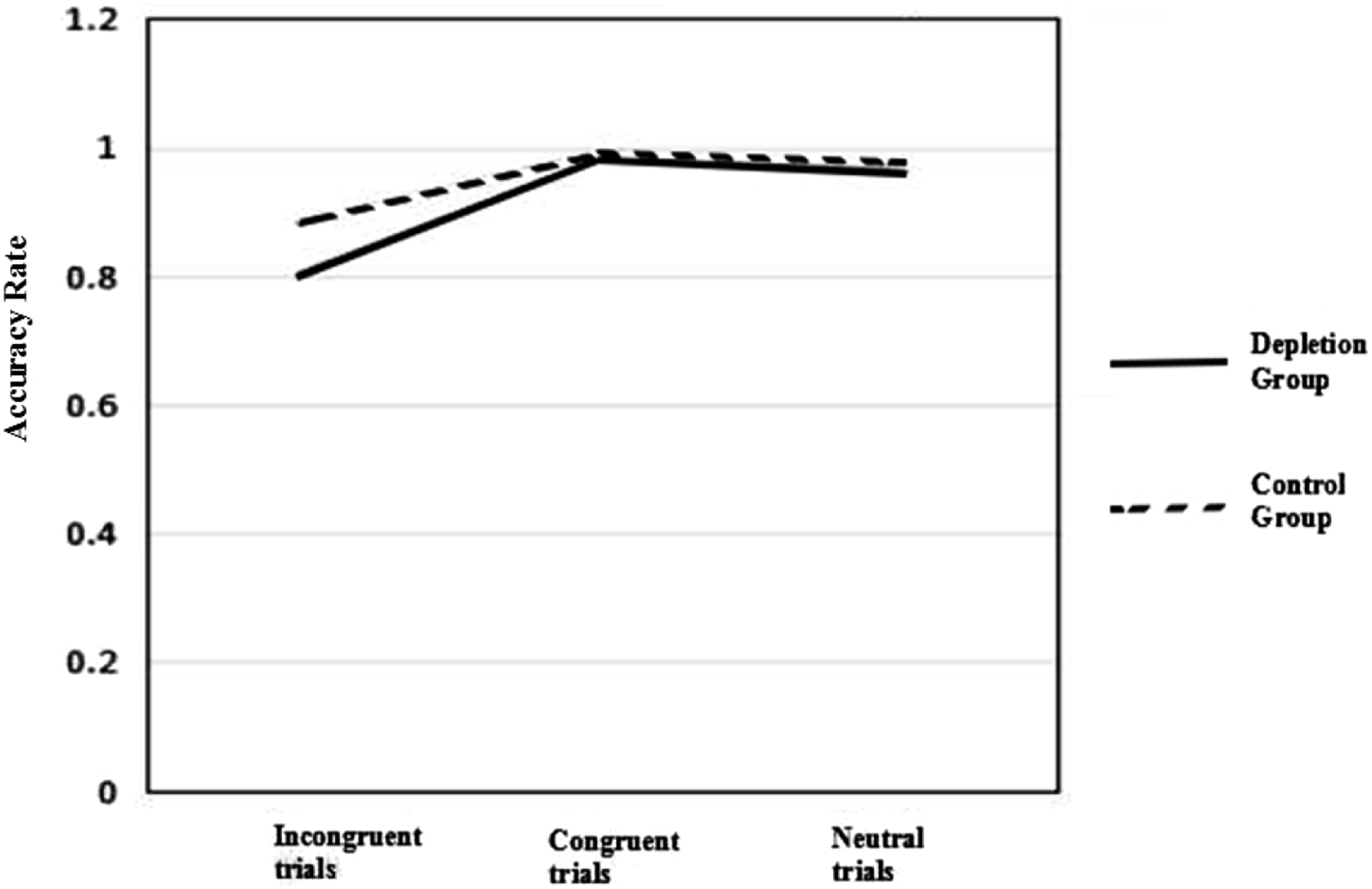
Moderation Role of Action Orientation and Trait Self-Control on Goal Maintenance Task Performance
Accuracy Rate for Group and Word Type.
For trait self-control’s moderation role, a hierarchical regression analysis was conducted on accuracy rate, with group and trait self-control entered as the first and second blocks, and their interaction term entered as the third. There was a significant main effect of group, t (148) = −3.395, B = −.03, p < .01, 95% CI = [-.053, −.014], but not for trait self-control, t (148) = .272, B = .00, p > .05, 95%CI = [-.017, .022] and the interaction effect is also not significant, t (148) = −.291, B = -.003, p > .05, 95% CI = [-.023, .017].
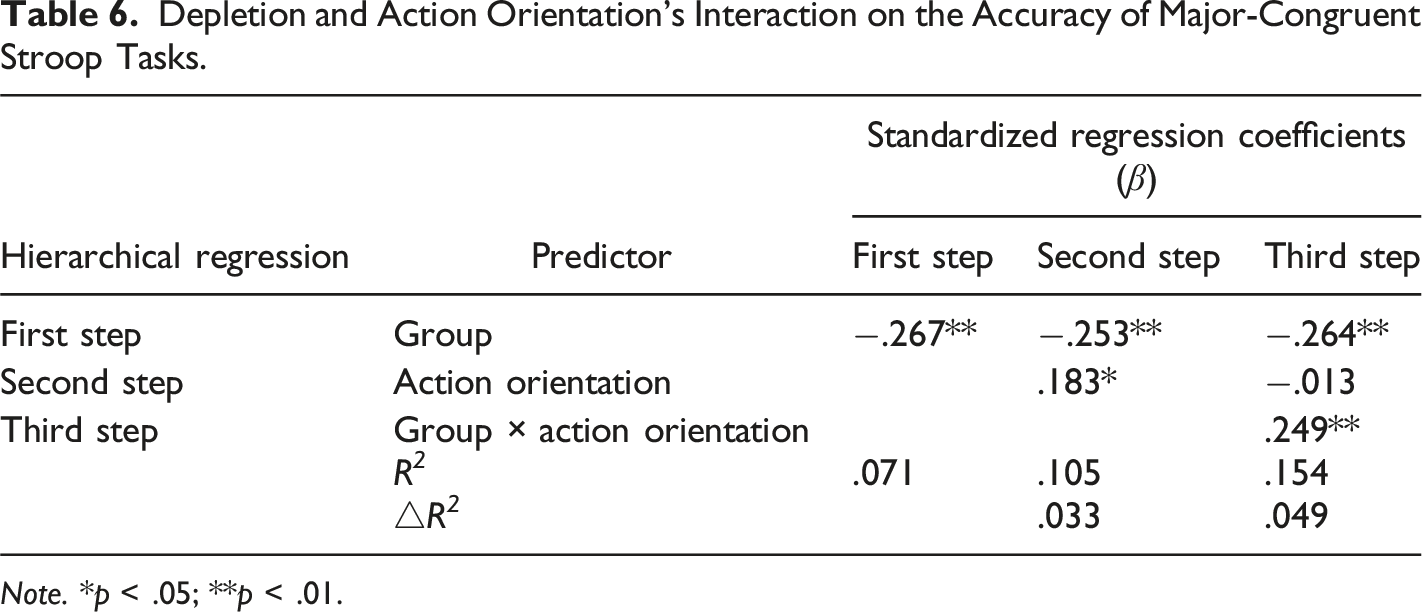
Depletion and Action Orientation’s Interaction on the Accuracy of Major-Congruent Stroop Tasks.
Note. *p < .05; **p < .01.
To further investigate the moderation effect, unstandardized regression weights conducted with a range of ±1 SD for both predictor variables were adopted (Simple slope analysis) (Figure 4). The relationship between group and accuracy rate varied as a function of action orientation. The results showed that the group predicted accuracy rate in the low action-oriented group, β = −.118, t (152) = −4.453, p < .01,but not for the high action oriented group, β = −.007, t (152) = −.253, p > .05. Relative accuracy rate for incongruent trials as a function of group and action orientation.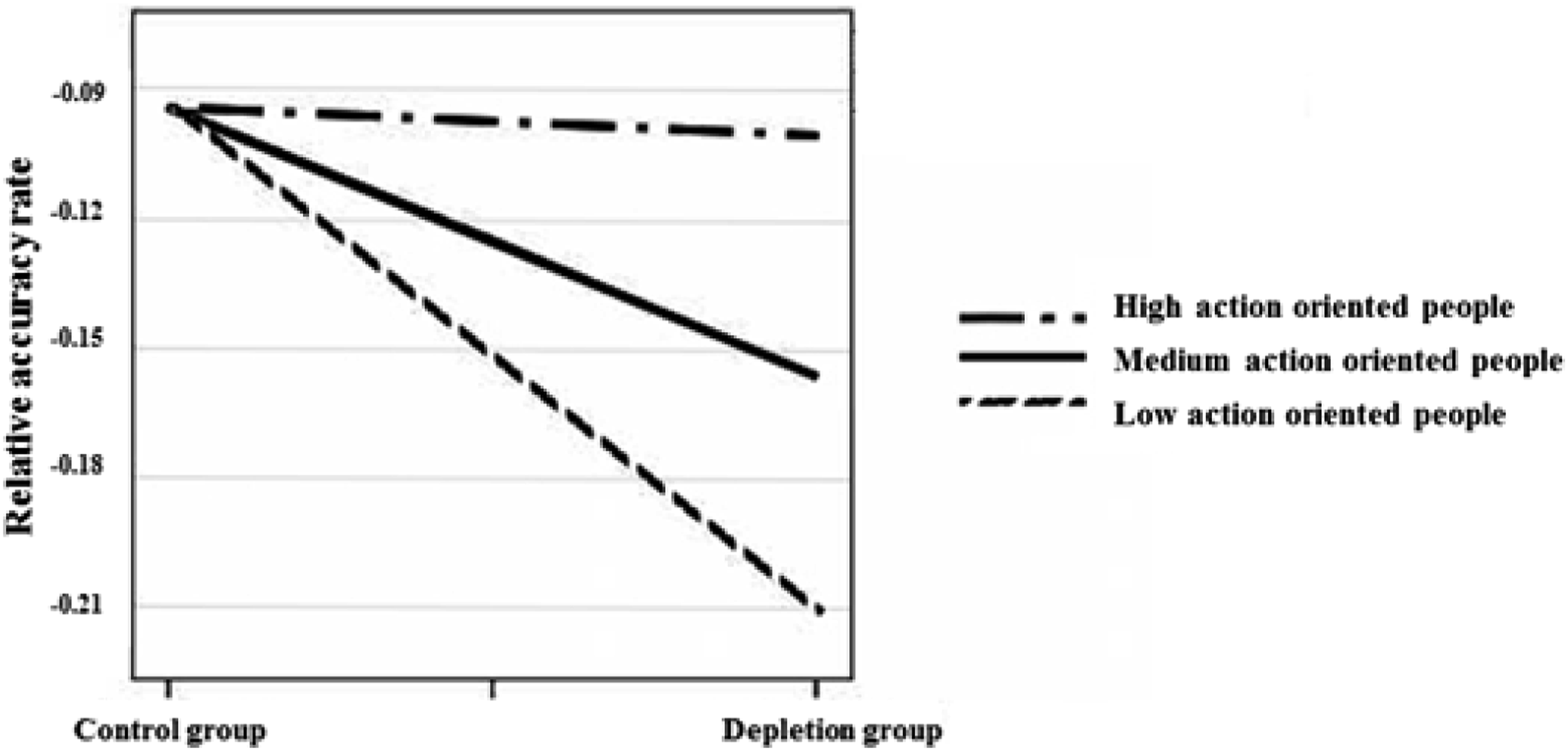
Discussion
Study two aimed to further test the depletion effect on proactive control tasks, and its boundary conditions for trait self-control and action orientation. The results are in line with previous studies that found depletion exerts a significant main effect on proactive control tasks (Schmeichel, 2007). Moreover, the results are consistent with the proposal that trait self-control would not moderate the depletion effect on proactive control tasks and action orientation would moderate the depletion effect.
For the depletion effect, results of the majority-congruent Stroop task showed that there were no differences in Stroop interference between the depletion and control groups. However, the accuracy rate showed a significant difference between the two groups. This is consistent with most previous findings, which indicated that depletion effects are more evident in error rates, but not in RT Stroop interference. Thus, the depletion group showed goal neglect effects, which suggested that ego depletion may impair goal maintenance ability (Kane & Engle, 2003). More importantly, although study one found trait self-control could moderate the depletion effect on stop signal tasks (which is a type of reactive inhibition control task), study two did not observe the moderation effect on majority-congruent Stroop tasks (which is a type of proactive control task). This indicated that people with high trait self-control are also vulnerable to the depletion effect by showing goal neglect. This finding, seems to be contrary to previous studies that have suggested that the moderation effect of trait self-control for the depletion effect (DeWall et al., 2007; Gailliot et al., 2006; Kelley & Schmeichel, 2015). However, in these studies, the dependent variables mainly reflected another aspect of self-control (the reactive inhibition ability after depletion), and therefore, this ability is different from initiating and maintaining goal intentions after depletion, which could be reflected by the proactive control task.
For the action orientation, results not only showed significant main effects, but also moderation effects. This is consistent with the proposal that high action-oriented people are immune to depletion effects on proactive control tasks by showing no significant difference between the depletion and control groups. Conversely, the low action-oriented individuals showed a lower accuracy rate in the depletion group than in the control group. Also, there were no differences in response latencies. Because accuracy rates are the most sensitive index of goal neglect processes (Kane & Engle, 2003), the results indicated that depletion could influence the low action-oriented individuals by impairing their goal maintenance ability when the environment did not reinforce goal representations. It seems possible that people who are able to initiate goals when confronted with demanding conditions in daily life may also show better cognitive performance in proactive tasks. This is in accordance with previous research suggesting that action orientation could moderate the depletion effect in attention tasks and other behavior outcomes (Dang et al., 2015; Gröpel et al., 2014), and self-regulatory performance in demanding or non-demanding task conditions (Jostmann & Koole, 2007). Moreover, high and low action-oriented people’s baselines of self-regulatory abilities were comparable, as there were no differences in the control condition for action orientation. Thus, depletion escalated the difference of self-regulatory performance in action orientation.
General Discussion
Two studies investigated the ego depletion effect on reactive inhibition and proactive control tasks and the two personalities’ moderating roles in depletion effect. The results showed that the ego depletion could impair both reactive and proactive control tasks, leading to decreased performance in stop signal reaction time and goal maintenance. More importantly, study one found high trait self-control individuals performed better on stop signal tasks after they completed a Stroop task containing incongruent trials, and this effect did exist when they completed the Stroop task without incongruent trials, while the action orientation did not show a moderation effect on this task. In study two, ego depletion was manipulated by a non-dominant handwriting or dominant writing task. After the depletion task, there was no difference between high and low trait self-control on major congruent Stroop tasks. However, high action oriented individuals showed fewer errors than low action oriented individuals. This difference did not emerge in the non-depletion group. Taken together, these results indicate that ego depletion could interact with personality traits related to goal striving on different types of cognitive control tasks.
These findings add to the growing body of literature on strength models of self-control by extending the understanding of ego depletion effects from the reactive inhibition control and proactive control frame works in light of the controversy surrounding ego depletion (Carter et al., 2015; Hagger et al., 2016). Previous broad literature on ego depletion mainly focused on behavioral outcomes of the depletion effect; however, only few studies explored cognitive control outcomes (Huizenga et al., 2012). The current results were consistent with strength models of self-control by showing that performing cognitive self-control tasks impaired two types of subsequent cognitive control tasks, i.e., not only reactive control ability, but also proactive control ability was undermined by depletion. This corroborates recent findings that indicate that depletion not only impairs impulse control (Baumeister, 2014), which could be reflected by decreased performance in stop signal tasks (study one), but also leaves the person responding passively to environmental cues (Vonasch et al., 2017). In this study, researchers found depletion led hungry people to eat more peanuts without shells but less peanuts with shells. The authors indicated that depletion may cause individuals to engage in impulsive behavior when doing so is easy or in passive behavior when action requires initiative. Because depletion reduced top-down control, responses were dominated by automatic processes and external cues (Hofmann et al., 2009). This explanation is in line with the current findings, which showed that depletion impaired goal maintenance ability when there was no environmental cue to remind the individual of goal information, therefore leading to goal neglect (De Jong et al., 1999; Duncan et al., 1996; Kane & Engle, 2003).
The current study also systematically examined the moderating role of two personality traits concerned with self-control in the ego depletion effect. Results revealed the same personality could play a moderating role in the depletion effect or not, depending on the type of task. This adds further evidence that individuals differ in susceptibility to ego depletion. There is sparse evidence regarding the moderating role of trait self-control and action orientation. Previous studies rarely found the moderation role for trait self-control for depletion, and only two studies found the moderating effect for action orientation. The current findings indicate that due to the multifaceted nature of self-control, it might be important to consider the type of dependent measurement for depletion in a cognitive control framework, e.g., proactive versus reactive control. This is also in line with recent findings that self-control encompasses both inhibition and initiation components (de Boer et al., 2011; De Ridder et al., 2011, 2017; De Ridder & Gillebaart, 2017). Inhibition components mean overriding impulses and behavioral tendencies that may hamper goal achievement. In contrast, initiation components include the initiation (start-up) of goal-striving facilitation behavior in spite of difficulties, which is closely related to strategies in goal maintenance processes (Kane & Engle, 2003). In current studies, these two components could be reflected by two moderators: trait self-control versus action orientation, and two dependent tasks: reaction inhibition versus proactive goal maintenance task, respectively. This may help to understand why the extant literature is mixed regarding trait self-control and action orientation, sometimes moderating the ego depletion effect or not. Because self-control capacity is multicomponent, the depletion effect may depend on both the measurement type of the task and individual differences. It is worth to mention that effect size of moderation effect in two studies is medium (f 2 = .05 and .06) (Aguinis et al., 2005). Taken together, the current results might shed light on the task type and personality fit in ego depletion effects. However, speculation on the moderation of trait self-control for the depletion effect was only found in the stop signal task but not the Stroop task, which should be treated prudently. Moreover, neither the stop signal task nor the Stroop task is process pure. Nevertheless, it is impossible to separate pure cognitive processes from each other. Therefore, the conclusion is rather tentative and speculative, which are still preliminary.
Previous research found that trait self-control was associated with good habits and avoiding temptations (see meta-analysis by de Ridder et al., 2012). The current results indicated that this self-control strategy (avoiding temptations) might be useful in the depletion situation required inhibition but less useful in the situation required goal maintenance. Similarly, keeping eye on the goal (goal maintenance) might be only useful in the depletion situation required goal initiation. Because ego depletion is a key factor in self-control failure, one potential practical implication of these findings is that the promotion of reactive inhibition and proactive goal maintenance in goal striving is both important in the improvement of self-control. Successful self-control not only includes the inhibition of undesired behavior tendencies, but also the initiation and maintenance of goal relevant representation, even when environment does not reinforce it. Thus providing goal relevant positive reinforcement may also be beneficial to self-control. Moving beyond resisting temptation, the present study offers preliminary evidence suggesting that ego depletion may not only result in decreased inhibition but also lead to poorer performance in goal neglect tasks, and this may be moderated by individual differences. These findings might indicate that the depletion of self-control may give rise to both impulsive behaviors (disinhibition) and passive behavior (inaction), depending on the specific circumstances and individual difference.
Limitations and Future Perspectives
Although the current studies found no moderation effect of trait self-control and action orientation on proactive and reactive control tasks, null findings should always be interpreted with caution. It is less likely that the current null findings is due to the small sample size because G*Power’s results indicated that a sample of 150 participants would be able to detect a comparable effect size with a power of.80 for the moderation effect. In current research, the effect of depletion on SSRT is medium in Study one (Cohen’s d = .50) and Study two (Cohen’s d = .55). The effect size estimates presented in this study exhibit similarity to the initial meta-analysis conducted on the depletion effect, which reported an effect size of .62 (Hagger et al., 2010). Large samples and other proactive-reactive control tasks should also be employed to further test the assumption. Because the depletion effect is thought to be smaller than the initial meta-analysis by Hagger et al. suggested, there is growing awareness of need to conduct high-powered studies to adequately test the depletion effect.
Otherwise, it remains unclear why trait self-control and action orientation are vulnerable or less vulnerable to depletion tasks, though the current study showed high or low trait self-control and action orientation are similarly depleted in depletion tasks. Future research may examine whether this is due to the proactive and reactive strategy differences within the participant’s personality.
Conclusion
In summary, the current study found that ego depletion impaired individuals’ reactive inhibitory control and proactive goal maintenance. The personality dispositions of trait self-control and action orientation moderated the depletion effect. High trait self-control people showed intact inhibition performance after depletion, while high action-oriented people were less vulnerable to the goal neglect effect after depletion. The moderation pattern of depletion indicated personality and task type could both contribute to the ego depletion effect.
Footnotes
Declaration of Conflicting Interests
The author(s) declared no potential conflicts of interest with respect to the research, authorship, and/or publication of this article.
Funding
The author(s) disclosed receipt of the following financial support for the research, authorship, and/or publication of this article: This research was supported by the National Natural Science Foundation of China (Grant No. 72001174, Awarded to Rui Shi), Grant No.17XJC190009 (Awarded to Shilei Zhang), 17YJC840030 from MOE (Ministry of Education in China) Project of Humanities and Social Sciences (Awarded to Rui Shi), Grant 2016M592739 (Awarded to Shilei Zhang) from China Postdoctoral Science Foundation, Grant 310850170325, 300102508660, 300102509609 (Awarded to Shilei Zhang) and 2452019125 (Awarded to Rui Shi)from Fundamental Research Funds for the Central Universities.
