







Abstract
The “bad-begets-bad” phenomenon describes how witnessed or perceived misconduct in an organization promotes mental states and behavior that encourage further misconduct. Based in two perspectives on how the Dark Triad (DT) constructs (narcissism, Machiavellianism, psychopathy) differentiate, we proposed their roles in contributing to the bad-begets-bad phenomenon. A convenience sample of college students (N = 454) completed an online study in which they read vignettes depicting workplace misconduct wherein a reporting incentive was (incentive condition) or was not (no-incentive condition) offered. Subsequently, they reported their likelihood of possessing mental states (e.g., goals) and engaging in behavior broadly reflective of the bad-begets-bad phenomenon. Lastly, they completed the Short Dark Triad (SD3) questionnaire to assess narcissism, Machiavellianism, and psychopathy. We used a series of step-wise regression models to analyze the data. Consistent with the “malicious two” perspective on the DT, only Machiavellianism and psychopathy consistently predicted mental states and behavior reflective of the bad-begets-bad phenomenon. Also, consistent with the “cautious and adaptable Machiavellian perspective,” only Machiavellianism interacted with the incentive condition to influence people’s willingness to report misconduct (i.e., not further promote misconduct). Broadly, the data contribute to understanding the role of the DT in organizational settings and support two perspectives on how the DT should operate in the context of witnessing workplace misconduct.
Introduction
Workplace misconduct cost U.S. businesses $20 billion in 2021 (Segal, 2021). One may recall the “Enron Scandal” in which several executives of the massive energy corporation engaged in corrupt financial activities costing shareholders over $74 billion in the four years leading to bankruptcy (Segal, 2023). Extensive research has focused on identifying situational and individual factors that contribute to misconduct within organizations to understand and alleviate this costly problem. Some of these studies illustrate the “bad-begets-bad” phenomenon, which, based partly in the “Monkey See, Monkey Do” perspective (see O’Fallon & Butterfield, 2011; also, Robinson & O’Leary-Kelly, 1998), describes how witnessing or perceiving misconduct in an organization increases one’s own likelihood of engaging in misconduct. For example, increased aggressive modeling by employees increases antisocial behavior among co-workers (e.g., criticism, arguments; Aquino & Douglas, 2003), high exposure to workplace aggression increases employee engagement in aggressive acts (Douglas & Martinko, 2001; Robinson & O’Leary-Kelly, 1998), indirect knowledge of co-worker deviance significantly predicts individual deviance (Ferguson & Barry, 2011), and perceived social loafing among co-workers increases counterproductive workplace behavior (Hung et al., 2009). It is also known that organizations with perceived ethical climates (i.e., an environment that is fair, honest, and lacking in deviant behavior) experience less misconduct among employees (Mayer et al., 2010; Vardi, 2001). This is due, in part, to positive behavior being considered normative and improper misconduct being considered aberrant and unacceptable.
Not only does an understanding of the bad-begets-bad phenomenon help serve the practical goal of reducing the costly problem of workplace misconduct, but it is also theoretically interesting. For example, the phenomenon aligns with multiple theories in psychology discussing how increased salience of and focus on bad behavior creates states in the perceiver (e.g., perceptions of descriptive norms) that may facilitate bad behavior (Cialdini et al., 1991; Gino et al., 2009; Kelly & Wilson, 1982; see also Anderson & Bushman, 2001). The bad-begets-bad phenomenon is often conceptualized and studied as a general principle, but, here, we sought to contribute some novel understanding to this phenomenon by studying how certain personality constructs may influence it.
The bad-begets-bad phenomenon suggests that witnessing or perceiving misconduct can have a “snowball effect” (i.e., one act of witnessed misconduct promotes mental states and behaviors that only further promote a bad work environment). This bad-begets-bad phenomenon, therefore, is conceptualized as multi-faceted, involving both mental states and behavior. Essentially, regarding mental states, the phenomenon can encompass enhanced adoption of selfish, anti-company goals at work along with beliefs that workplace misconduct is acceptable/normative (Hung et al., 2009; Mayer et al., 2010; Robison & O’Leary-Kelly, 1998; Vardi, 2001). Behavioral manifestations of the bad-begets-bad phenomenon can be complex, but they may often involve using one’s knowledge of the offense for self-gain (e.g., blackmailing the offender; Kessler et al., 2010), joining in on the misconduct (i.e., copying it; Ferguson & Barry, 2011; Hung et al., 2009; O’Fallon & Butterfield, 2011; Robinson & O’Leary-Kelly, 1998), or being more likely to “look the other way” (e.g., not reporting misconduct or trying to intervene).
To our knowledge, it remains unexplored whether individual differences may be critical to anticipating these outcomes of witnessing misconduct, such that perhaps some individuals are more prone to bad-begets-bad outcomes. Organizational research has focused on how individual differences influence the likelihood of being the perpetrator of misconduct, and on the bad-begets-bad phenomena in general (i.e., showing that bad typically begets bad), but not on how individual differences influence people’s reactions to witnessed misconduct (e.g., are some personalities more likely to beget further bad?). For example, individual differences related to aggression propensity such as trait anger, negative affectivity, and attitudes towards revenge account for a great deal of initiated workplace aggression (Douglas & Martinko, 2001), and similar aggressive traits influence the frequency of engaging in aggressive acts more so than situational factors (Glomb, 2010). Other research has examined the role of personality in promoting bad behavior at work, finding that differences such as low agreeableness and low conscientiousness positively relate to engaging in counterproductive workplace behavior (Hafidz, 2012; Helle et al., 2018). However, there is a dearth of evidence on how individual differences predict responses to others’ organizational misconduct, which is central to understanding the role of personality in bad begetting bad.
If the bad-begets-bad phenomenon depends, to some extent, on individuals tolerating misconduct and viewing it as useful vis-à-vis their goals (e.g., Anderson & Bushman, 2001), then individual differences that influence these mechanisms would be important to consider. Presumably, these individual differences would be important to identify in research so they could be examined during employment screening. Such screening would be particularly necessary if an organization already suffers from a toxic or unethical work environment (replete with misconduct available to witness) and employers want to reduce the chances of these counterproductive behaviors proliferating further.
Here, based in prior theory, we propose ideas for how the “Dark Triad” (DT; Jones & Paulhus, 2014) influence some of the various outcomes related to the bad-begets-bad phenomenon in the workplace. The DT distinguishes the malevolent personality constructs of grandiose narcissism (“narcissism,” for short), Machiavellianism, and psychopathy, which are constructs commonly examined in the context of counterproductive workplace behavior (for a review, see O’Boyle et al., 2012). Narcissism is defined by feelings of superiority and entitlement; Machiavellianism is defined by strategic manipulation, power striving, and cynicism; and psychopathy is defined by thrill-seeking, impulsivity, and reduced empathy (Jones & Paulhus, 2014). The three constructs represent continuous levels of personality features that can be studied in the general population (e.g., using convenience samples) as opposed to discrete clinical categories (e.g., “narcissist vs. non-narcissist;” Jones & Paulhus, 2014). Although most nonclinical samples tend to show variance at the low end of DT scales (i.e., absolutely high psychopathy scores will be rare), this variance is still of practical importance because it relates to various forms of antagonist behavior (e.g., lying, aggression, cheating; Furnham et al., 2013; Paulhus, 2014). As such, the present study focuses on the DT in a nonclinical sample.
Although the DT constructs have been connected to numerous organizational behaviors, they have yet to be studied in relation to bad-begets-bad outcomes. The present work seeks to address this gap, thereby providing important new insights on the role of the DT in organizational settings. Essentially, we propose that Machiavellianism and psychopathy represent distinct risk factors for creating the bad-begets-bad phenomenon and its outcomes in the workplace (e.g., tolerance of misconduct, joining in on the misconduct), albeit people higher in Machiavellianism may navigate the situation with more social caution and be more responsive to external incentives to report misconduct. Our predictions were largely generated based in two broad theoretical perspectives on how the DT differentiate: the “Malicious Two” perspective and the “Cautious and Adaptable Machiavellian” perspective. Our predictions are illustrated in Figure 1 and expanded upon below. Conceptual model of proposed perspectives and hypotheses. Note. This figure illustrates the relationship between DT traits and bad-begets-bad outcomes. Solid-arrowed lines represent positive hypothesized relationships; dotted-arrowed lines represent negative hypothesized relationships; the intersecting line from the box labeled “External Incentive” represents a predicted interaction.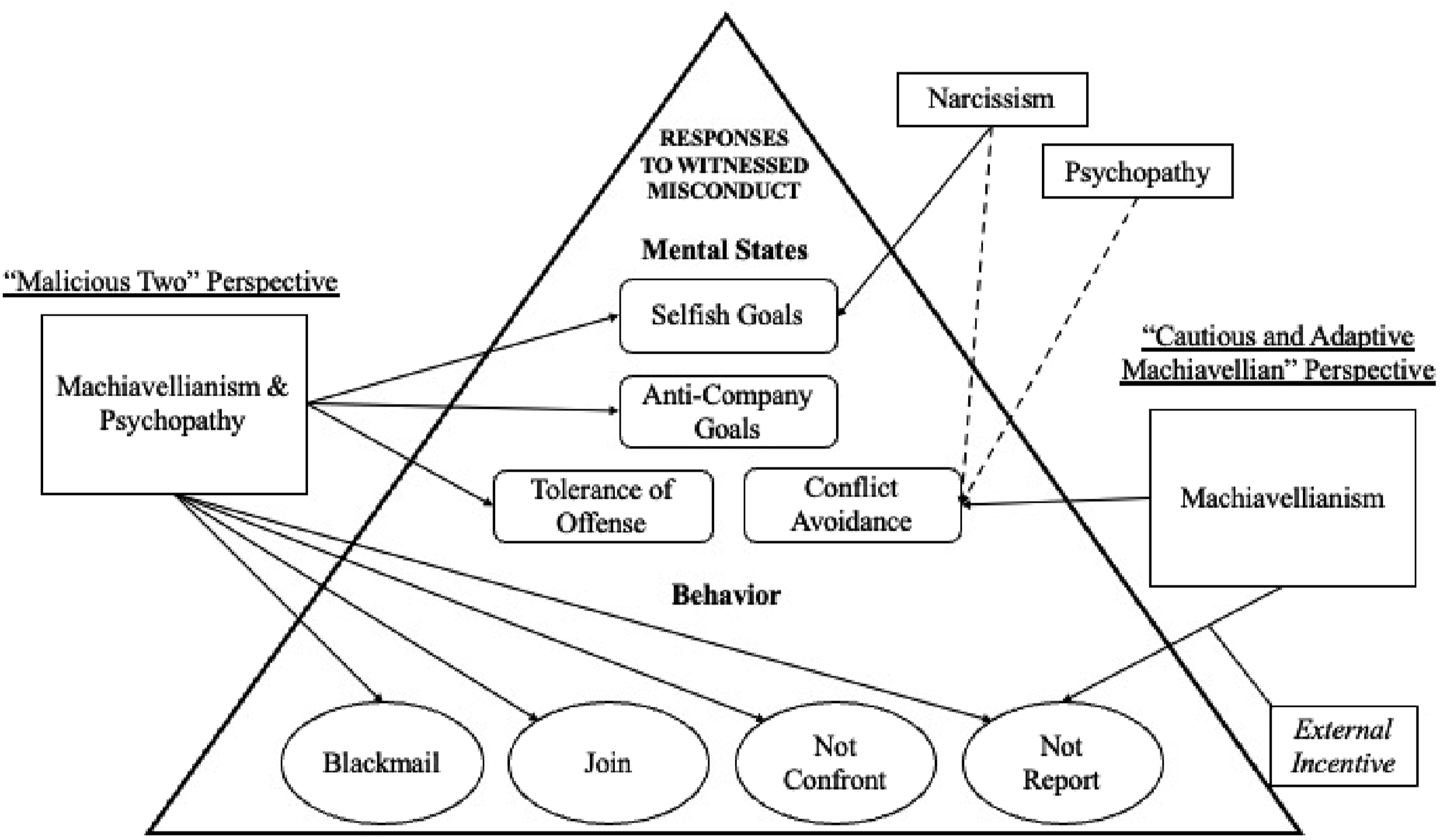
The “Malicious Two” Perspective
The Malicious Two perspective on the DT suggests that Machiavellianism and psychopathy tend to relate more closely to antagonistic outcomes than narcissism, which can take on some “bright” qualities (Rauthmann & Kolar, 2012; see also Back, 2018; Hart et al., 2019; Muris et al., 2017; Papageorgious et al., 2019; Trahair et al., 2020). For example, although narcissism has some antagonistic properties (e.g., entitlement, selfishness), it correlates with some adaptive features and socially desirable behavior (e.g., high self-esteem, extraversion, conscientiousness, seeking positive attention; some prosociality; Back, 2018; Hart et al., 2019; Muris et al., 2017; Papageorgiou et al., 2019; Zuo et al., 2016) and wanting to be seen as rather moral and respectable (Hart et al., 2019). On the other hand, people higher in Machiavellianism and psychopathy show less interest in being seen as moral or respectable (Hart et al., 2019) and exhibit socioemotional deficits (Muris et al., 2017), lower levels of agreeableness and conscientiousness (O’Boyle et al., 2015), less outrage from others’ moral offenses (Hart et al., 2020), and enhanced instrumental motivation to acquire resources, even if it requires antisociality (Jones & Paulhus, 2017).
Evidence regarding how the DT relate to organizational outcomes seems generally consistent with the Malicious Two perspective. For example, people higher in narcissism tend to see the self as central to the organization, and evidence regarding their commitment to creating a productive (vs. counterproductive) workplace is often weak and/or mixed in direction (e.g., Galvin et al., 2015; Volmer et al., 2016). By contrast, Machiavellianism and psychopathy relate to enhanced workplace misconduct (e.g., stealing), counterproductive behavior (e.g., harsh management tactics), and anti-company work attitudes (e.g., lack of concern for company goals; DeShong et al., 2015; Furnham et al., 2013; Jonason et al., 2012; Kessler et al., 2010; O’Boyle et al., 2012; Rauthmann & Kolar, 2012).
Unfortunately, this perspective has yet to be applied to predicting how people respond to witnessed workplace misconduct, which is the focus of the current study. However, it would seemingly predict that Machiavellianism and psychopathy (not narcissism) would relate positively to the adoption of selfish and anti-company goals, increased tolerance of the offense, increased blackmail and joining in, and increased likelihood of not confronting and not reporting the offender. Although narcissism is not part of the “malicious two,” this perspective still treats narcissism as related to selfishness (e.g., Rauthmann & Kolar, 2012); hence, generally consistent with this perspective, narcissism should relate to selfish goals.
The Cautious and Adaptable Machiavellian Perspective
The second perspective on the DT we relied on, which we term the “Cautious and Adaptable Machiavellian” perspective, suggests that Machiavellianism differentiates from psychopathy and narcissism in terms of social caution and enhanced responsivity to situational opportunities for self-gain (see Jones & Paulhus, 2017; also, Paulhus, 2014). Indeed, evidence has linked Machiavellianism to a more defensive style of self-presentation than is present in either narcissism or psychopathy, which are generally linked to boldness (Hart et al., 2018; Rauthmann, 2011). The social caution in Machiavellianism, in part, probably explains why individuals higher in Machiavellianism, relative to individuals higher in psychopathy or narcissism, may engage in less severe antisocial behavior both in and outside of the workplace (Jones & Paulhus, 2009; O’Boyle et al., 2012). Also, people higher in Machiavellianism are skilled at adapting their behavior to gain instrumental rewards and limit negative outcomes, but people higher in narcissism and psychopathy, per se, may not show this facility (Jones & Paulhus, 2017; Zettler & Solga, 2013). Some work shows that people higher in Machiavellianism tend to adjust their dishonesty as a function of whether the dishonesty can be exposed as fraudulent (Jones & Paulhus, 2017) or increase self-gain (Hart et al., 2018). Other evidence shows that individuals higher in Machiavellianism may behave more ethically, or at least less unethically, if they are focused on gaining or maintaining power in the organization (Kessler et al., 2010; Kish-Gephart et al., 2010). Additionally, some evidence suggests that Machiavellianism can actually be beneficial to organizations as intermediate levels of the trait relate positively to job performance and organizational citizenship behavior (Szabó et al., 2018; Zettler & Solga, 2013).
However, what remains unclear from this prior research is whether Machiavellian individuals are also more cautious, opportunistic, and adaptive in their responding to witnessed misconduct. Based in this perspective, we posited that the tendency for Machiavellianism to relate to reduced reporting would be weakened if reporting were incentivized (i.e., reporters could gain from reporting based in a company incentive). Based in this perspective, we also posited that Machiavellianism would relate positively to the goal to avoid conflict (reflective of Machiavellian caution), but narcissism and psychopathy would relate negatively to the goal to avoid conflict (reflective of narcissistic and psychopathic boldness).
Current Study
To address these predictions (see Figure 1), undergraduate participants read about situations describing workplace misconduct perpetrated by a co-worker. Undergraduate participants were selected due to ease of recruitment and because such individuals could provide a more robust (stronger) test of the hypotheses for at least three reasons. First, because they are generally similar across several demographics, sources of error variance in the design are reduced. Second, because they have less exposure to workplace norms, their anticipated behavior in the situations is more likely to be dictated by their personality than their understanding of norms (e.g., typical behavior they witness). Third, the findings of this study are presumably relevant to organizational hiring practices, and newly graduated college students make up a significant portion of new employees. Of course, a college sample limits external validity, which is addressed in the Discussion.
We randomly assigned participants to a condition including either no mention or explicit mention of an incentive to report misconduct (i.e., “reporting-incentive manipulation”). In each condition, we assessed participants’ self-reported mental states, including the adoption of selfish and anti-company goals, their tolerance of the offense, and their motivation to avoid conflict; we also assessed participants’ self-reported anticipated behavior, including their likelihood of blackmailing the offender, joining the offender in committing misconduct, not confronting and asking the offender to stop the misconduct (i.e., avoiding direct confrontation), and not reporting the misconduct.
Per convention, we examined the effects of DT constructs separately and jointly. The main predictions pertain to the separate-entry method; the joint-entry method was exploratory. The joint-entry method allows examination of partialled (unique) effects of each construct to address “concept creep,” or a state in which measures of the constructs begin to converge on similar content (see Furnham et al., 2013). However, the joint-entry method is controversial because it could misrepresent each construct (e.g., psychopathy, based in most accepted definitions, should share variance with narcissism and Machiavellianism; Miller et al., 2019). Given that the current study was based on testing hypotheses through statistical analyses of a sample, quantitative research was suitable for the present research goal (Verhoef & Casebeer, 1997).
Method
Materials and data are available at: https://osf.io/dk47r/?view_only=47b91e9cec9f477383c39c5539c46fc2
Participants
A power analysis conducted using G*Power (Faul et al., 2009) suggested recruiting 393 participants to detect a small interactive effect size (f2 = .03) with power = .80 and α = .01. Data was collected from 497 undergraduates who participated for course credit. Eight participants were excluded for failing to complete the survey, 12 for failing 2/3 attention checks, six for invariable responding, and 17 for unreasonably fast completion time (i.e.,
Materials and Procedure
Participants completed an online study through Qualtrics posted on the university’s Sona website. Participants completed the survey on an electronic device at a location and time of their choosing. Participants were presented with three vignettes of witnessed workplace misconduct adapted from prior research (Bennett & Robinson, 2000) including a co-worker (1) stealing company property, (2) consuming alcohol at work, and (3) falsifying financial documents. As a between-subjects manipulation, participants were randomly assigned to one of two reporting-incentive manipulation conditions. In the no-incentive condition, participants read situations with no reference to a reporting incentive. In the incentive condition, participants read the same situations with added reporting incentives including (1) increased chance of receiving employee perks (e.g., vacation days, raises), (2) a simple financial reward (e.g., bonus), and (3) elimination of competition for a promotion, respectively. The incentives reflected variability in reporting incentives that may be present in organizations (Harunavamwe & Kanengoni, 2013). For example, one incentivized vignette said: “You notice that one of your co-workers has been drinking alcohol on the job. Your company has a no tolerance policy on drinking at work. At the end of the month, your company gives out a “Healthy Workplace” reward that includes a $500 bonus to employees who report workplace misconduct.”
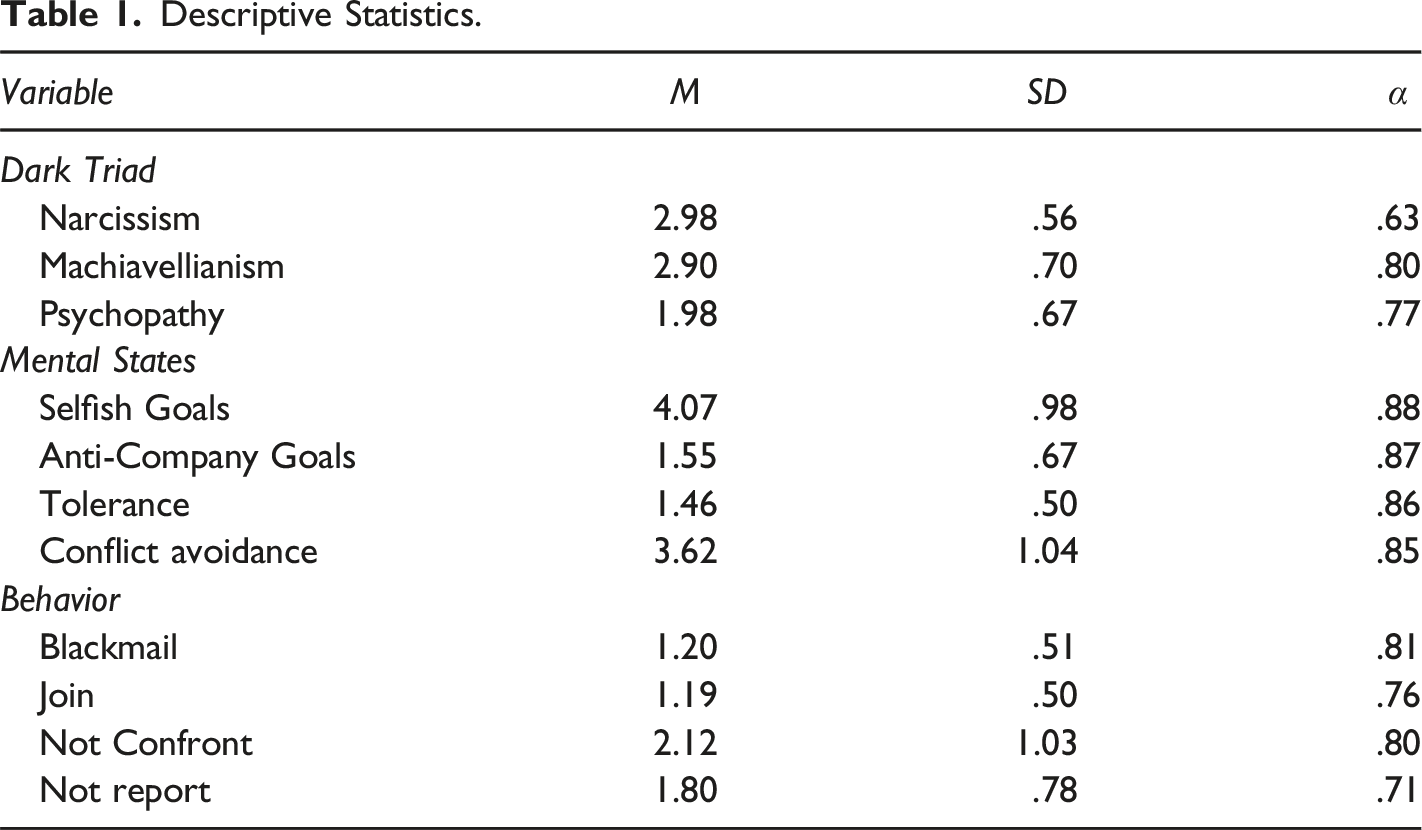
Descriptive Statistics.
Mental States
For each vignette, participants responded to the same six questions regarding how much they (dis)agreed (1 = strongly disagree; 5 = strongly agree) with possessing motives including wanting to: do “…what’s best for me” (selfish goals), do “…what’s best for the company” ([r]; anti-company goals), and “…avoid any conflict” (conflict avoidance). The same items were averaged across vignettes to compute a total score for each motive. 1 Also, for each vignette, participants responded to six questions regarding how much they (dis)agreed (1 = strongly disagree; 5 = strongly agree) that their co-worker’s behavior was immoral/wrong (e.g., “This behavior is wrong” [r]) and normative (e.g., “This behavior is expected in the workplace”). The items were collapsed across the three vignettes and averaged into a tolerance index (tolerance).
Behavior
For each vignette, participants responded to the same five questions regarding how (un)likely (1 = very unlikely; 5 = very likely) they would be to report the misconduct (“Report this misconduct to a supervisor” [r]; not report), confront the co-worker to have them stop (“Tell your coworker to stop engaging in the misconduct” [r]; not confront), join in (“Try to join in on the misconduct”; join), and blackmail the offender (“‘Blackmail’ the coworker, essentially letting them know that you won’t turn them in if they do you a favor”; blackmail). The same items were averaged across the three vignettes to compute a total score for each behavior. 2
Short Dark Triad (SD3; Jones & Paulhus, 2014)
Finally, participants reported (dis)agreement (1 = Strongly disagree; 5 = Strongly agree) with 27 items assessing narcissism, Machiavellianism, and psychopathy (9 items per subscale). Scores were created separately for each construct by averaging responses per subscale after appropriate reverse coding.
Analytic Technique
We first calculated z-scores for narcissism, Machiavellianism, psychopathy, and the respective interactions. Then, we regressed each outcome variable on condition (0 = no-incentive condition; 1 = incentive condition) and, in separate models, either narcissism, Machiavellianism, or psychopathy at Step 1. The respective two-way interaction was added at Step 2. For exploratory purposes, we regressed each outcome variable on condition and all DT constructs entered simultaneously at Step 1, and their respective two-way interactions at Step 2. We report semi-partial rs (srs) as indices of effect size and p-values for significance testing. Given the number of analyses, alpha was set to .01.
Results
Common Method Bias Check
Common method bias may occur when utilizing self-report questionnaires. To test for this bias, we conducted Harman’s single-factor test (Podsakoff et al., 2003), which entailed including all the study’s variables into an unrotated exploratory factor analysis. If only one component emerges from the analysis, or if the first component explains over 40% of the covariance, then a severe common method bias is likely present. In the analysis, four components emerged explaining 65.48% of the variance, and the first component explained only 28.58% of the covariance. Therefore, we did not find evidence of severe common method bias.
Main Results
Predicting Bad-Begets-Bad Outcomes from Dark Triad Constructs (Modelled Separately or Simultaneously), Condition, and Their Respective Interactions.
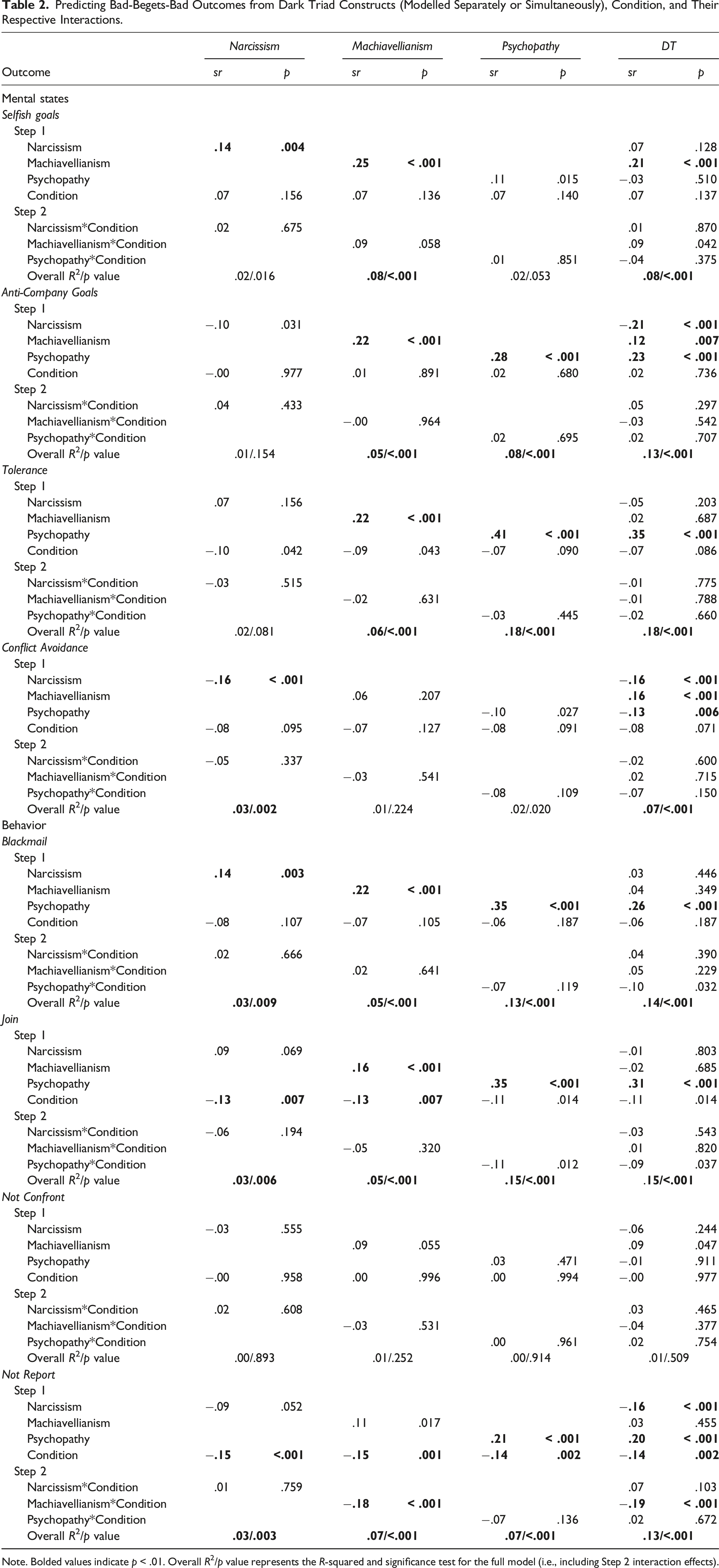
Note. Bolded values indicate p < .01. Overall R2/p value represents the R-squared and significance test for the full model (i.e., including Step 2 interaction effects).
Generally, the findings aligned with the Malicious Two perspective. Specifically, narcissism and Machiavellianism related positively to selfish goals; both Machiavellianism and psychopathy related positively to anti-company goals, tolerance of the offense, blackmail, and join; and psychopathy related positively to not report. However, psychopathy was unrelated to selfish goals, neither Machiavellianism nor psychopathy related to not confront, and Machiavellianism was unrelated to not report.
Also, some findings aligned with the Cautious and Adaptive Machiavellian perspective. Specifically, as anticipated by this perspective, Machiavellianism interacted with condition to influence not report. Specifically, in the no-incentive condition, Machiavellianism was positively related to not report (sr = .21 p < .001); however, in the incentive condition, Machiavellianism was unrelated to not report (sr = −.06, p = .231). This interactive effect is depicted in Figure 2. However, partially inconsistent with this perspective, we found no relationships between Machiavellianism and increased conflict avoidance or psychopathy and decreased conflict avoidance, but we did find a relationship between narcissism and decreased conflict avoidance. Finally, unexpectedly, and not directly related to either perspective, narcissism related positively to blackmail. Effects of Machiavellianism and condition on not report.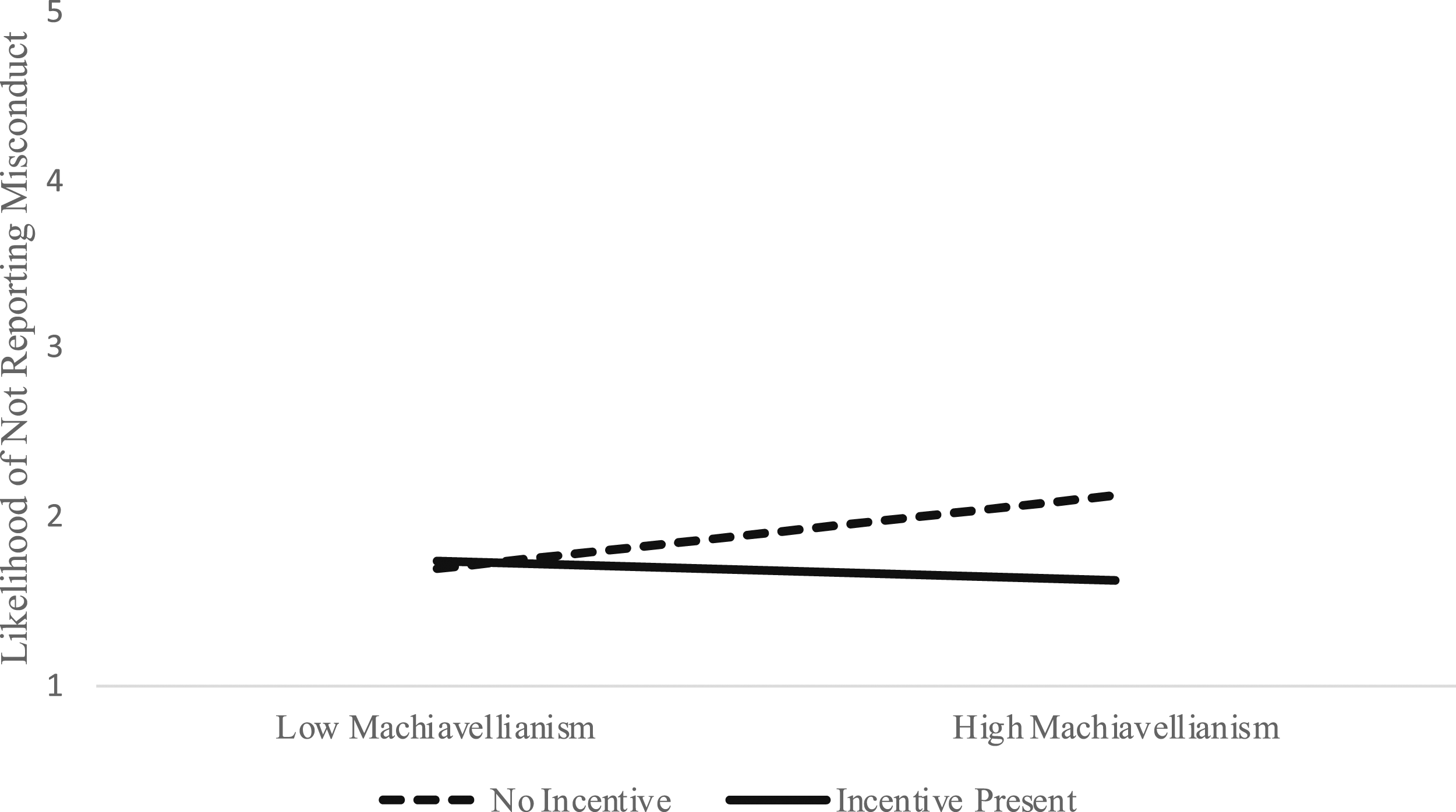
Unique Effects of DT Constructs
Variance unique to psychopathy related to enhanced anti-company goals, enhanced tolerance of offense, reduced conflict avoidance, enhanced blackmail, enhanced join, and enhanced not report. Variance unique to Machiavellianism related to enhanced selfish goals, enhanced anti-company goals, and enhanced conflict avoidance. Also, variance unique to Machiavellianism interacted with condition to influence not report whereby Machiavellianism was positively related to not report in the no-incentive condition (sr = .15, p < .001) but unrelated to not report in the incentive condition (sr = −.11, p = .013). Finally, variance unique to narcissism related to reduced anti-company goals, reduced conflict avoidance, and reduced not report.
Discussion
The “bad-begets-bad” phenomenon describes how witnessing or perceiving misconduct in an organization increases one’s own likelihood of engaging in misconduct. To build on this area, we used the Malicious Two and the Cautious and Adaptable Machiavellian perspectives to propose how individual differences included in the DT (narcissism, Machiavellianism, psychopathy) relate outcomes associated with the bad-begets-bad phenomenon.
The data were generally consistent with the Malicious Two perspective on the DT (e.g., Rauthmann & Kolar, 2012). Specifically, Machiavellianism and psychopathy, more so than narcissism, emerged as distinct risk factors for counterproductive responding to workplace misconduct (i.e., bad-begets-bad outcomes). Both constructs related positively to joining in on misconduct and blackmailing co-workers. Also, Machiavellianism and psychopathy were associated with increased likelihood to not report misconduct, albeit this effect of Machiavellianism was specific to conditions without a reporting incentive. Machiavellianism and psychopathy were associated with more tolerance of misconduct, and the “malicious two” related positively to anti-company goals. Also, like narcissism, the “malicious two” were positively related to selfish goals, albeit the relation between psychopathy and selfish goals did not reach statistical significance.
However, not all the findings were consistent with our predictions based in the malicious two perspective. For example, we did not find that Machiavellianism and psychopathy were any more or less likely to ask the offender to stop the misconduct (i.e., confront them). People with elevated Machiavellianism and psychopathy may be less averse to confronting the offender relative to reporting because they prefer to portray the self as strong and dominant (Ickes et al., 1986), and the confrontation can serve that purpose. Also, although narcissism’s relationship to blackmail was unanticipated, this relation makes sense in retrospect because blackmail is a strong-arming tactic that generally aligns with a narcissistic goal to boldly exert dominance and control over others (Jones & Paulhus, 2014). Indeed, in this study, narcissism was also associated with less concern for conflict avoidance.
The Cautious and Adaptable Machiavellian perspective also received some support. Although the data did not show that individuals with elevated Machiavellianism were more interested in avoiding conflict, the data did show that such individuals were more willing to adapt their reporting behavior to incentives. Specifically, only Machiavellianism interacted with condition wherein people higher (vs. lower) in Machiavellianism were less willing to report misconduct if reporting was not incentivized by the organization. Indeed, Machiavellianism may uniquely encompass features that facilitate regulating behavior to be consistent with self-interest (e.g., Bereczkei, 2018; Jones & Paulhus, 2014). Previous research suggests that some levels of Machiavellianism can be beneficial to the organization because individuals engage in performance-enhancing and organizational citizenship behaviors to achieve personal success (Szabo et al., 2018; Zettler & Solga, 2013).
The findings from multivariate analyses generally reinforced the value in distinguishing between DT constructs in predicting bad-begets-bad outcomes. Unique variance of narcissism seemed to generally oppose bad-begets-bad outcomes; it only related to reduced concerns about avoiding conflict with the offender, reduced anti-company goals (i.e., caring more about the company), and reduced likelihood of not reporting. Such findings accord with Chatterjee and Hambrick’s (2007) suggestion that individuals higher in narcissism, per se, can occasionally benefit the organization because they may enhance the organization to enhance the self by association (Grapsas et al., 2020). Unique variance of Machiavellianism related to outcomes suggestive of selfishness, caution, and opportunistic adaptability. It related to enhanced goals to benefit the self, enhanced anti-company goals, enhanced goals to avoid conflict, and reduced likelihood of not reporting as a function of whether reporting is versus is not incentivized. Unique variance of psychopathy related to enhanced anti-company goals, increased tolerance of misconduct, reduced goals to avoid conflict, increased likelihood of blackmailing coworkers, increased likelihood to join in, and increased likelihood to not report witnessed misconduct (regardless of incentive condition). Considering these multivariate findings, it seems that the features of psychopathy (e.g., criminality; rebelliousness; erratic and risky tendencies) may act as the primary driver of the bad-begets-bad phenomenon.
The present findings have various implications. First, broadly, they highlight the importance of considering the effects individual differences have on witnessed immoral behavior – a consideration that has been somewhat neglected in studies on the bad-begets-bad phenomenon. Although people can certainly be influenced by bad/immoral working environments (Cialdini et al., 1991; Gino et al., 2009), the point of the present study is to highlight that certain people are more or less likely to curtail or exacerbate immoral behavior (e.g., workplace misconduct) at the offset. Also, personality features can interact with pro-company initiatives (i.e., incentivizing reporting) to influence behavior. These realities highlight the importance of considering individual differences, such as the DT, in hiring decisions. If organizations are aware of individuals who may exacerbate (or at least cover up) present misconduct, they can be advised to avoid these individuals during employee selection processes (i.e., Kish-Gephart et al., 2010) and potentially prevent unnecessary losses (Segal, 2021) and the further corruption of work environments.
Second, more specifically, the data contribute to understanding the negative impact of the DT in organizational settings. Whereas prior studies have examined the DT in relation to perpetrating workplace misconduct (e.g., O’Boyle et al., 2012) or negative work-related attitudes (Galvin et al., 2015; Volmer et al., 2016), the present study extended this research to consider how people higher in DT respond to witnessing another’s misconduct. Such an extension is important because it suggests that, even if individuals higher in DT constructs are not the initiators of misconduct, they may, particularly if elevated in Machiavellianism or psychopathy, adopt mental states (e.g., anti-company goals) and behavior (e.g., not report or join in) that exacerbates the misconduct and creates an even more dysfunctional environment.
Third, the findings contribute to the broader matter of whether the DT constructs are distinct antagonistic orientations. Specifically, controversy surrounds whether Machiavellianism and psychopathy measurements assess different constructs (e.g., Miller et al., 2017). The present research suggests that these constructs, as assessed via the Short Dark Triad, can be differentiated when researchers study (a) adaptation to situations involving self-gain and (b) outcomes that support their theoretical differentiation, such as exercising social caution versus riskiness outcomes (e.g., Jones & Paulhus, 2017; Paulhus et al., 2018). So, although the DT may share antagonism as a core feature (Rose et al., 2023), the DT, as assessed via the Short Dark Triad, still appears to represent distinct antagonistic orientations.
Like all studies, ours is not without limitation. First, the sample consisted mostly of college students. As for most convenience samples, the results are not readily generalizable to any population. Therefore, it is important for the results to be replicated among full-time employee samples. Second, the study is based on hypothetical responding to vignettes. Although this design feature ensures increases in internal validity (e.g., situations are controlled over the DT constructs), it reduces external validity. To reach secure conclusions, follow-ups are required using observer reports including actual organizational behavior. Third, this study’s conclusions are based in conceptualizing each DT construct as unidimensional. However, DT constructs are multidimensional, so follow-up studies are needed to provide a fine-grained, facet-level analysis of each construct on these outcomes. Relatedly, fourth, because most psychological phenomena are sensitive to context, we hope future work can more effectively address the role of contextual features. For example, we did not specify a relationship between the participant and the offender; if the offender were, for example, a friend (vs. enemy) of the participant, reduced negative effects of Machiavellianism on reporting would be unsurprising given that individuals higher in Machiavellianism may seek to benefit from their friends’ misconduct (e.g., Hart et al., 2018), which suggests they may avoid reporting friends, specifically, for expedient reasons. Fifth, the study did not include a direct manipulation check for the incentive manipulation; however, as shown in Table 2, not report was lower in the no-incentive versus incentive condition, which implies a successful manipulation of incentive.
Despite a need for more research, the current study provides novel findings regarding how individual differences, namely the DT, are associated with the bad-begets-bad phenomenon in the workplace. Machiavellianism and psychopathy were associated with enhancements in outcomes consistent with the bad-begets-bad phenomenon; however, unlike people higher in psychopathy, people higher in Machiavellianism show an enhanced willingness to report misconduct if such reporting was incentivized. We hope the results stimulate future work in the area.
Supplemental Material
Supplemental Material - Coworkers Behaving Badly: How the Dark Triad Influences Responses to Witnessing Workplace Misconduct
Supplemental Material for Coworkers Behaving Badly: How the Dark Triad Influences Responses to Witnessing Workplace Misconduct by Braden T. Hall, Joshua T. Lambert, Danielle Wahlers, and William Hart in Psychological Reports
Footnotes
Declaration of Conflicting Interests
The author(s) declared no potential conflicts of interest with respect to the research, authorship, and/or publication of this article.
Funding
The author(s) received no financial support for the research, authorship, and/or publication of this article.

Data Availability Statement
Supplemental Material
Supplemental material for this article is available online.
Notes
Author Biographies
References
Supplementary Material
Please find the following supplemental material available below.
For Open Access articles published under a Creative Commons License, all supplemental material carries the same license as the article it is associated with.
For non-Open Access articles published, all supplemental material carries a non-exclusive license, and permission requests for re-use of supplemental material or any part of supplemental material shall be sent directly to the copyright owner as specified in the copyright notice associated with the article.
