






Abstract
Interacting with speakers of different accents is a prevalent global phenomenon. Given the considerable influence of accents in daily life, it is important to conduct a comprehensive review of listeners’ accent attitudes. This paper provides an integrative summary of research on accent attitudes, drawing from the Affective, Behavioral, and Cognitive (ABC) perspectives. We begin by outlining the social meaning of accents and laying out the theoretical foundations of the ABC approach. Then, we organize and integrate existing research findings using the ABC framework. Next, we illustrate how the perspectives intersect by discussing pertinent research findings. Drawing from various sociocultural contexts over many years, this review underscores the significant impact of accents on people’s thoughts, feelings, and behaviors. The review concludes by discussing limitations, proposing future directions, highlighting real-world relevance, and suggesting areas for research expansion.
Keywords
Accent refers to a manner of pronunciation as a result of grammatical, syntactical, morphological, and lexical aspects of an individual’s native language or a manner of pronunciation associated with particular group memberships, be they social, regional, ethnic, or so on (Giles, 1970, 1973). Accent represents the speech pattern that exhibits the phonological variety of a spoken language (Giles, 1970; Lippi-Green, 1997). Accent strongly influences social categorization and stereotyping, affecting how individuals are perceived, evaluated, and treated. Language attitudes, which concern with the social meanings tied to language—including accent—highlight the influence of factors such as geographical origin, native language, cultural background, and social status on how people speak and how people are being perceived (Lippi-Green, 1997). Given the high levels of globalization and migration, there are increasing populations that speak a language with a nonnative accent (e.g., Eurostat, 2022; NCES, 2022). According to the International Organization for Migration (2020), there were nearly 272 million international migrants in 2019, accounting for 3.5% of the global population. These facts suggest that many individuals likely speak a language that is not their native tongue and thus have a nonnative accent. Within a given language, there are also native variations reflecting regional, ethnic, or socioeconomic differences within a country, as well as native variations of a language between countries (Spence et al., 2022). Therefore, the study of accents is relevant for both intra-national and international relations, and has implications for several important areas of psychology, including stereotyping, prejudice and discrimination, social status, political psychology, and organizational behavior, among others.
The purpose of the present paper is to discuss how accent interplays with the listener’s attitudes and to synthesize research on accent attitudes (i.e., how people feel about different accents, Dragojevic et al., 2021) from affective, behavioral, cognitive, and a combination of these perspectives. We specifically focus on accent literature; however, it is important to note that listeners may also use other non-accent cues such as skin color and clothing to infer the speaker’s social group memberships (Giles & Rakić, 2014). These non-accent cues may interact with or override accent as the basis for social categorization, resulting in markedly different evaluative reactions.
Accent Classification and Social Significance
Most accents can be classified based on whether they are considered standard or nonstandard within a particular nation or society. Standard varieties follow written and agreed-upon rules for “correct” usage in grammar, pronunciation, and vocabulary. It is often used in formal settings and educational systems (Kretzschmar, 2021). Nonstandard varieties, on the other hand, do not follow these rules in the same way (Dragojevic et al., 2018). Standard accents are perceived as lacking distinctive regional, ethnic, or socioeconomic characteristics and are often referred to as “accent-free” or “accent-neutral” speech, whereas speakers of nonstandard and foreign varieties are saddled with having “an accent” (Lippi-Green, 1997). For instance, the accents of the educated upper classes or those that have tendencies towards rhoticity and the preservation of secondary stress are often perceived as standard American English (Kretzschmar, 2021), and British Received Pronunciation is considered standard in the UK. In contrast, nonstandard accents are often linked to specific regions (e.g., American Southern English), ethnicities (e.g., African-American Vernacular English), and nations (e.g., Vietnamese-accented English in the U.S.) (Dragojevic et al., 2016). Nonnative accent varieties are, by definition, nonstandard. They are not only a marker of nonstandardness but can also indicate national or cultural group memberships (Bauman, 2013).
Being attributed as having an “accent” or “no accent” has immediate consequences for the evaluation of a speaker (Giles & Rakić, 2014). As accent constitutes an important part of social identity that conveys the speaker’s background such as hometown, country of origin, ethnic group, and socioeconomic status (Giles, 1970), the listener uses accent as a cue to decode social information about the speaker (Giles & Rakić, 2014). It serves as a fundamental dimension of person perception, reflecting the listener’s attitudes toward the speaker (Pietraszewski & Schwartz, 2014). Accent also serves as a marker in a social hierarchy of prestige, reflecting social group stereotypes and socio-structural relations between groups in society (Dragojevic et al., 2021). A standard variety is often associated with being more prestigious, having more power, being more pleasant to listen to, and having more usage in the media (Cargile et al., 1994; Gluszek & Dovidio, 2010b; Lippi-Green, 1997). These opinions come from what is called the “myth of a standard language ideology”—a preference for a simplified, idealized, and uniform spoken language—and any differences are seen negatively (Lippi-Green, 1997). This suggests that accent shapes the listener’s attitudes toward the speaker, while people generally prefer standard over nonstandard-accented speech (e.g., Lindemann, 2005; Van Bezooijen, 2002).
Studying accent attitudes has important, universal significance. Beyond the increasing interactions among individuals from diverse accent backgrounds due to globalization, accents also serve as reflections of people’s cultural identities. These phenomena are particularly common in societies with large number of migrants like the U. S. and Germany, and multicultural societies like Singapore, where encounters with different accents are frequent. People’s attitudes toward accents shape how effectively messages are conveyed and understood in communications (Dragojevic et al., 2018; Dragojevic & Giles, 2016). This subsequently affects communication outcomes, social interaction qualities, employment opportunities, and personal relationships, to name a few (e.g., Hideg et al., 2022; Lev-Ari & Keysar, 2010; Lin & Ramírez-Esparza, 2024). Additionally, accents often serve as markers of people’s cultural identities and affiliations. For individuals with multicultural backgrounds, different accents may trigger their associated cultural scripts and prompt these individuals to behave according to the designated cultural norms (Dehghani et al., 2015). Some individuals who are familiar with different accents may switch between them to facilitate communication and foster a sense of belonging (Dumanig et al., 2023). Understanding accent attitudes thus deepens insights into multicultural dynamics within societies, encompassing both interpersonal communication and its consequences as well as intrapersonal identity exploration. Together, the study of accent attitudes transcends cultural and geographical boundaries, offering insights into universal aspects of human interaction and identity formation.
To comprehensively understand the social implications associated with accent standardness, the following section revisits current literature on accent attitudes. This groundwork sets the stage for our synthesis, which highlights the Affective, Behavioral, and Cognitive (ABC) framework.
Existing Literature on Accent Attitudes
Over the past few decades, several reviews and meta-analyses have explored the effects of accents. They consistently show that people can deduce accents from voices and form attitudes based on whether an accent is standard or nonstandard (e.g., Dragojevic et al., 2021; Giles & Marlow, 2011). This research extends to broader contexts, such as message content, the comparative reference frame, and linguistic landscapes, emphasizing the role of accents in shaping social identities and behaviors (Dragojevic et al., 2021; Giles & Rakić, 2014). These reviews also highlight the real-world implications of accents, revealing that children prefer native accents, dialects, and languages (Spence et al., 2021). In counseling and work settings, nonstandard accents can lead to unfavorable outcomes such as being less preferred for psychotherapy and lower employability (Fuertes et al., 2002; Hideg et al., 2022; Spence et al., 2022). However, recent studies suggest that, as diversity and inclusivity are becoming a prominent social norm, biases against nonstandard accents may be controlled and not overtly expressed, particularly in employment settings (Roessel et al., 2020). Together, these studies suggest that accents serve as cues to social group membership, acting as markers for categorization and triggering stereotyping, prejudice, and discrimination.
However, accent’s pivotal role in shaping interpersonal interactions extends to attitudes about accents themselves (e.g., the accent sounds pleasant and melodious, Cargile et al., 1994; Giles & Niedzielski, 1998) and efforts to control bias against accents (e.g., people are motivated to avoid being prejudiced, Roessel et al., 2020). Thus, a more fine-grained analysis of the accent literature to dissect the impact of accents on people’s thoughts, feelings, and actions is important to advancing the field. For instance, Gluszek and Dovidio (2010b) introduced the Stigma of Nonnative Accents in Communication Model (SNAC). This model expands on the Social Process Model of Language Attitudes (Cargile et al., 1994), which asserts that speakers, listeners, and interpersonal history have an impact on language attitudes as they change over time. In Cargile and colleagues’ (1994) model, the speaker is the producer of the speech, and the speaker’s speech style activates beliefs about the speaker in the listener’s mind (e.g., the speaker’s group memberships). These beliefs then transfer to the listener’s attitudes toward the speaker and the outcomes of the conversation. The interpersonal history and experiences of the listener and the speaker also influence attitudes. For example, the listener may be more motivated to start conversations if they are more familiar with the speaker’s style of speech (Cargile et al., 1994). Broadening this previous framework, SNAC focused on stigma towards nonnative accents in communication. SNAC highlighted the experience of stigma from the nonnative speaker’s (as opposed to the native listener’s) perspective. According to this model, the speaker’s perceived communication challenges and social beliefs, together with the listener’s evaluation, shape the communication outcomes. The above models suggest that the listener’s accent attitudes impact their choice of actions, which in turn influences the speaker’s perceived challenges. Together, these processes shape communication outcomes.
According to the above language attitude models, the listener’s attitudes (i.e., favorable or unfavorable reactions) toward language consist of three components: learned cognition (i.e., beliefs), affect evaluation (i.e., feelings), and behavioral predisposition (i.e., encouraging certain actions) (Cargile et al., 1994; Gluszek & Dovidio, 2010b). The Social Process Model of Language Attitudes proposes that language triggers beliefs about the speaker, such as group memberships and attributes of those group members. Cognitive processes like stereotyping and intergroup relations, such as speaking Spanish-accented English in the United States cause associations with undocumented Mexican immigrants, shape these beliefs. The emotions associated with these beliefs are then triggered (e.g., negative feelings toward undocumented immigrants). Beliefs about people with a certain accent and the feelings that come from those beliefs make people more likely to act in certain ways, like voting to find a person with a particular accent guilty of a crime in court (Cargile et al., 1994; Dávila et al., 1991).
Following this theorization, in this review, we aim to enhance previous models by highlighting research on accent attitudes across affective, behavioral, cognitive, or a combination of these dimensions. Prior reviews have employed various frameworks for organizing accent attitudes literature, including theoretical and methodological (Raheja, 2019) and the field’s core research foci (Dragojevic et al., 2021). To build upon this work, we have adopted the affective, behavioral, cognitive approach to structure our review. Although some prior reviews have touched upon the ABC perspectives (e.g., Gluszek & Dovidio, 2010b), they have mainly focused on individual dimensions, such as the cognition (Strelluf, 2023) and behavior (Hideg et al., 2022; Spence et al., 2022). By building on these reviews that have emphasized the ABC framework (e.g., Giles & Marlow, 2011), this paper provides summaries of literature that consider the ABC dimensions simultaneously, illustrating the dynamic interplay between them. We discuss studies that explore cognition, emotion, behavior, or their combinations in relation to attitudes toward accents. Our goal is to enrich the existing ABC framework by presenting examples of how these dimensions interact, thereby pushing forward research on accent attitudes. By emphasizing the integrated ABC approach and the interactions between each perspective, our synthesis offers an additional heuristic lens for understanding and organizing the literature on accent attitudes. In the next section, we elaborate on our review’s ABC framework.
ABC Perspectives of Accent Attitudes
The Affective, Behavioral, Cognitive (ABC) approach extends beyond the traditional emphasis on the social processes of language attitudes as outlined by many language attitudes models (Giles & Marlow, 2011). This framework examines the impact of accent attitudes across the affective, behavioral, and cognitive dimensions. More specifically, the approach underlies the classic three-component view of attitudes, positing that attitudes are unobservable constructs that can be manifested through beliefs, feelings, and behaviors (Breckler, 1984; Fazio & Olson, 2003; Rosenberg & Hovland, 1960). Because attitudes exist within an individual’s mind, they need to be searched in more observable realms, that is, from people’s beliefs, feelings, and behaviors. The cognitive and affective components are thought to be shown through behaviors. However, they are different from the behavioral component in that beliefs and feelings do not always lead to behaviors. As accent attitudes are not confined to mental processes, beliefs and feelings toward nonstandard-accented speakers may be the key output of interest in accent attitudes, while behaviors may be subsequent responses derived from these socially meaningful inputs (Dragojevic et al., 2021).
Accent attitudes develop through cognitive, affective, or behavioral processes. There is no assumption on which component might predominate in accent attitudes, and the existence of one component does not necessarily imply the existence or causal relationship of the other two elements (Fazio & Olson, 2003). Drawing on this rationale, synthesizing research using the ABC approach adds to the body of knowledge on how attitude components determine accent’s impacts. From the cognitive route, nonstandard-accented speakers possess (un)desirable attributes, which will bring (un)desired outcomes (Fazio & Olson, 2003). Accent attitudes are functions of people’s salient beliefs about the speaker who speaks a given accent (e.g., French-accented English is romantic) and their evaluations of those beliefs (e.g., romantic is good; see the expectancy-value model, Fishbein & Ajzen, 1975). In other words, these attitudes result from social learning processes, involving categorization and stereotyping (Giles & Marlow, 2011; Lambert, 1967; Ryan, 1983). From the affective route, accent attitudes stem from emotional reactions toward the accent. With more exposures or previous associations to certain accents, listeners may be more familiar with the accent in question, which breeds liking even in the absence of beliefs. From the behavior route, the individual’s past behavior or experience can imply their attitudes toward a given accent without the involvement of beliefs or feelings. Through observing their own behavior, such as making friends with nonstandard-accented speakers in the past, people make inferences that they favor people with all accents (see self-perception theory, Bem, 1972).
According to Fazio and Olson (2003), accent attitudes can be based on any combination of these three components, given their interconnected nature and mutual influence. Their interrelationship is supported by cognitive dissonance theory, in which inconsistency among these components leads people to experience discomfort (Festinger, 1957). Thus, people are motivated to resolve this inconsistency by matching their cognitive, affective, and behavioral components of attitudes. For instance, when people believe (cognitive) that cilantro tastes bad and eating it will make them feel disgusted (affective), they will avoid eating cilantro (behavioral). Yet, if they accidentally ate cilantro, they might justify their beliefs by thinking that cilantro is good for health and does not taste so bad. These changes in cognitive and affective components of attitudes, influenced by behaviors, reflect the interplay of the ABC perspectives of attitudes. Additionally, neurological studies suggest that attitudes activate particular areas of the brain’s motor cortex that support specific actions (McCall et al., 2012). For example, our motivation to comprehend others’ speech is driven by our affective evaluation of good versus bad. If an individual finds their conversation partner friendly (affective), they may be more motivated to understand (cognition) or ask for clarification when their partner’s accent interferes with the conversation. This cognition then guides the individual’s behavior to either continue or avoid the conversation with their partner (Harmon-Jones et al., 2015). Thus, the study of accent attitudes can be thought of as the study of how people think, feel, and act when they hear different accents. See Figure 1 for a detailed illustration of the ABC approach of accent attitudes. ABC approach of accent attitudes.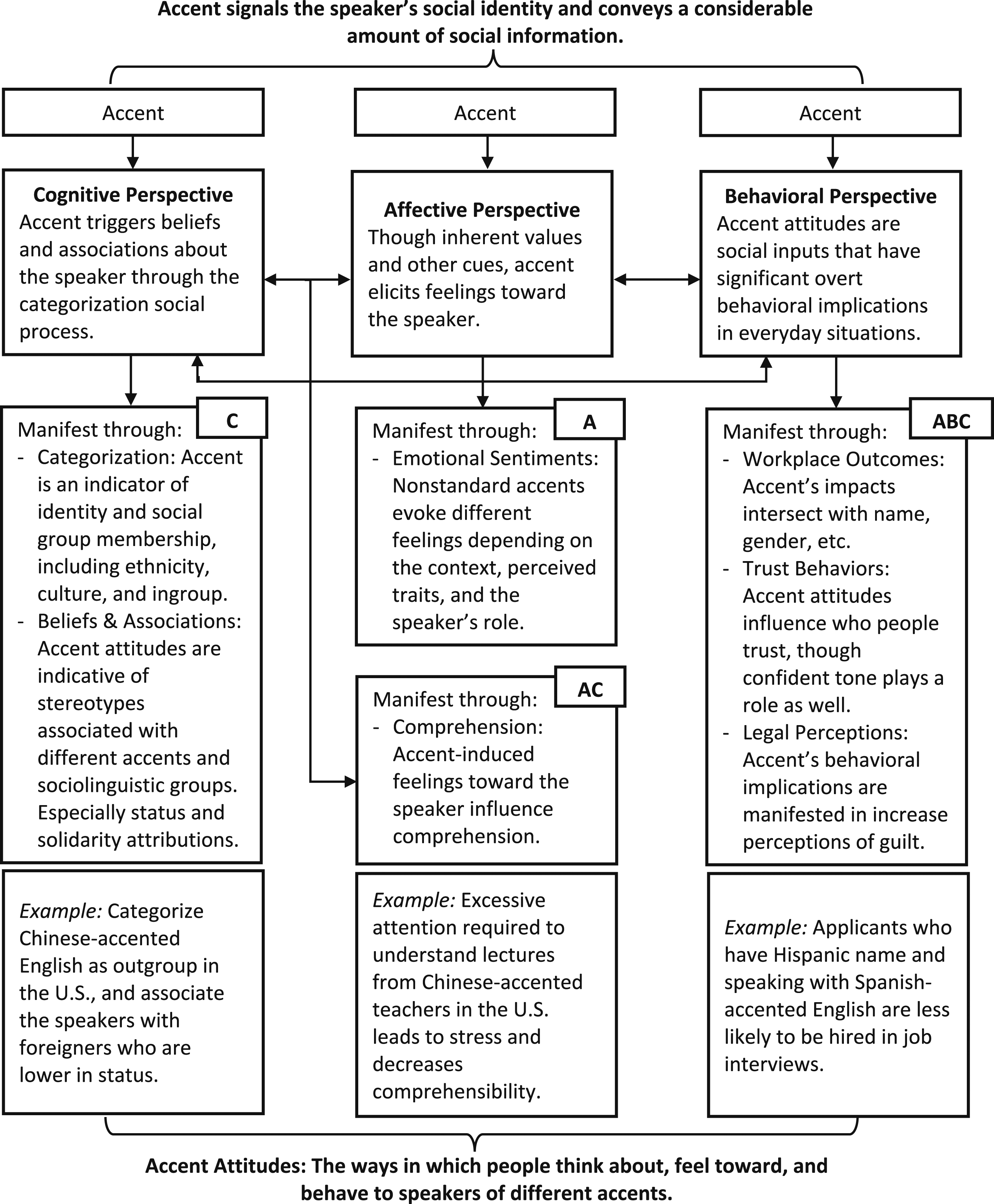
In this review, we integrate the accent literature by synthesizing accent attitudes using the existing ABC approach. We highlight the influence of accent on the listener’s attitudes and take an inclusive approach by examining a range of accents, including standard and nonstandard accents in different language contexts. The overarching goal of this review is to synthesize research on accent attitudes using the ABC approach and illustrate the interplay of these dimensions. Putting forward thoughtful consideration of research on accent attitudes can stimulate understanding of and reflection on accent’s influences in daily lives.
Literature Review Method and Scope
Given the focus of this literature review on accent attitudes in ABC dimensions, we draw upon literature from a variety of disciplines, including social psychology, language, communication, development, law, organizational sciences, and more. To identify relevant papers, we first searched electronic databases (PsychINFO, Scopus, and Google Scholar) using the keywords “accent,” “attitude,” and variations of these keywords, such as “nonnative accent” and “nonstandard accent.” We excluded keywords containing “neuro” and its variations, such as “neurocognition” or “neuroscience.” 1 We focused on papers published (i.e., not first posting) in the English language. Because our goal was to draw from literature across disciplines, we used the broad interdisciplinary citation database Scopus as the primary search source, complemented by additional searches on PsychINFO and Google Scholar. In Scopus, we set exclusion criteria to exclude subject areas beyond the scope of the current review, such as medicine, neuroscience, nursing, computer science, engineering, immunology and microbiology, biochemistry, genetics, and molecular biology. Most of our search results were categorized under the subject area of psychology.
Summary of Studies Included in the Review (n = 45).

Note. Dragojevic and Giles (2014) is reviewed in both Cognitive: Categorization section and Cognitive: Beliefs and Associations section.
This review will unfold as follows: Begin with a review of literature from cognitive perspectives such as categorization, and beliefs and associations. Follow with literature from an affective perspective focusing on emotional sentiments. Then, we review the literature on comprehension, which reflects the interplay between cognitive and affective perspectives. Next, we discuss behavioral implications manifested by cognition and affection, such as workplace outcomes, trust behaviors, and legal perceptions. Then, we present a summary of the ABC approach of accent attitudes. After discussing the gaps in the research and the field’s future directions, we highlight accent attitudes’ real-world implications. We end with suggestions for methodological expansions, accent-bias mitigation practices, and applications in smart assistants.
Cognitive Perspective
The mental processes of acquiring knowledge and understanding through thought are defined as cognition. It reflects how people think and what people believe (Breckler, 1984). From the cognitive perspective, accent attitudes are social learning processes resulting from categorization and stereotyping (Giles & Marlow, 2011; Lambert, 1967; Ryan, 1983). According to self-categorization theory by Turner et al. (1987), one possible explanation is that the similarity between the speaker’s accent and the listener’s accent affects whether people see themselves as part of a group that is different from the speakers. When someone hears an accent from an outgroup, it sends conflicting social identity cues that make them act in ways that are in line with their ingroup social identity. This makes them value traits that are typical of their ingroup and sets them apart from outgroup members. Because people have the tendency to simplify information in a complex environment to reduce the effortful processing of interpersonal information (Allport, 1954), the accent-induced outgroup distinction elicits stereotypes toward speakers with different accents (see social identity theory, Turner et al., 1979). In essence, people distinguish and make inferences about the speaker’s social group memberships based on accents, then attribute the speaker’s status and solidarity attributions associated with those inferred group memberships (Lambert, 1967). Accordingly, accent attitudes are products of social categorization processes that mirror people’s stereotypes (i.e., status and solidarity) about different sociolinguistic groups. In the following sections, we discuss accent attitudes from cognitive standpoints, focusing on categorization, and beliefs and associations.
Categorization
Accents can serve as salient indicators, signaling the speaker’s social group memberships. As a social learning process, Kinzler and DeJesus (2013) found that familiarity with accents guides children’s initial social categorization. Relatedly, 5- to 6-year-old children were found to prioritize accent over race when making social categorizations (e.g., Kinzler et al., 2009). These studies showed that accent signals social categories, and this process is early forming. Additionally, Pietraszewski and Schwartz (2014) demonstrated that accent is a dedicated dimension in person perception and categorization (like sex), which remains unaffected by other environmental cues. When presenting with other relevant social information, accent elicits the same high level of categorization compared to when presenting accent cues alone. These findings suggest that accent is a robust social cue that signals the speaker’s social group memberships, and this learning process forms early in life.
Supporting accent’s role as a cue for social categorization, Rakić and colleagues (2011) explored whether accent is a stronger marker of ethnic categorization as compared to physical appearance. The study found that participants correctly categorized German-accented and Italian-accented German voices according to their respective ethnic group (i.e., German or Italian) when tested among German students using the “who said what paradigm”, in which participants were asked to observe a small group discussion and match speakers with statements (Taylor et al., 1978). The results show that accent is a meaningful cue for ethnic categorization. Similarly, another study conducted in the U.S. examined whether accent induces cultural frame switching among bicultural participants, that is, individuals who have internalized different cultural values (Dehghani et al., 2015). In other words, whether accent serves as a cultural marker that prompts bicultural individuals to infer attributions and make decisions according to the respective cultural scripts (Hong et al., 2000). The study used standard American English accent as compared to Chinese, Iranian, and Spanish English accents and tested among Chinese-American, Iranian-American, and Mexican-American biculturals. The results showed that accent induces a cultural frame shift because bicultural participants reasoned their behaviors and made social decisions in accordance with the culture associated with the accent they heard. Dehghani and colleagues (2015) then concluded that accent is a meaningful indicator of culture and serves as a salient cue to people’s social identities.
Further evidence also showed that accents are markers of ingroup categorization. In a study conducted by Paladino and Mazzurega (2020), Italian participants were asked to perform a mouse tracker categorization task (Italian vs. foreign) after being presented with different target combinations (race: white or black, accent: native or nonnative). The mouse movement was tracked, and the study found that participants categorized targets faster when being presented with native accents. Participants also relied more on accent than race to categorize targets as ingroup members. It is then concluded that for native speakers, a nonnative accent is a sufficient cue to be seen as an outgroup member, regardless of their racial appearance. The above findings illustrate that accent elicits categorizations such as ethnicity, culture, and ingroup memberships, and can be a more potent categorization cue than race.
Significantly, past research has mainly focused on standard-accented speakers’ categorization of others as standard or nonstandard-accented speakers. There is a notable gap in understanding how second language learners categorize different accents. Due to the differential familiarity of a given accent, different social groups vary in their ability to correctly categorize speakers, leading to different attitudes toward speakers with the same accent variety. This variation in social categorization is consequential since it activates different stereotypes, which in turn prompts distinct perceptions (Dragojevic et al., 2018). For instance, Cantonese-speaking English learners prefer native English accents but are often unable to identify which accent samples are native (Hu & Lindemann, 2009). Inaccurate categorization of the speaker can result in biased perceptions (e.g., idealizing the “sounded” native accents). This highlights the challenge that nonnative listeners often encounter in correctly identifying the speaker’s social group memberships based on accent alone (e.g., Goatley-Soan & Baldwin, 2018; Hu & Lindemann, 2009; Lindemann, 2003; Yook & Lindemann, 2013). Additional research examining how nonnative speakers categorize accents is needed to make generalization of accent’s role as a social categorization cue.
Furthermore, although past research provides robust evidence that accents are social categorization cues, whether they are fixed cognitive structures is not extensively explored. For instance, Dragojevic and Giles (2014) studied how intergroup frames of reference can influence attitudes by altering people’s perceptions of intergroup boundaries. In the study, Californian undergraduate students listened to speech with either Californian-accented and American Southern-accented English or Punjabi-accented and American Southern-accented English. Results revealed that when hearing Punjabi-accented and American Southern-accented English, participants perceived the American Southern accent as more similar to them, indicating ingroup categorization. In contrast, when listening to Californian-accented and American Southern-accented English, participants perceived American Southern accent as outgroup. These findings highlight the context-dependent nature of accent-induced categorization, suggesting that changes in salient intergroup boundaries can influence categorizations of the same accent as ingroup or outgroup.
In sum, previous research demonstrated that accent is one of the first characteristics people learn about others and that it serves as a reference for categorizing them (Hansen, 2013). However, additional exploration is needed to understand the accent categorization process among second language learners and the fluid nature of this process across contexts. Moving further, we discuss how accent—as a social group indicator—influences the listener’s beliefs and associations of the speaker.
Beliefs and Associations
Accent attitudes are indicative of an individual’s knowledge of stereotypes associated with different sociocultural groups, resulting in subjective judgments about the speaker’s speech and traits. Social perceptions of accents, such as the tendency for many Americans to associate a French accent with romance, often stem from learned stereotypes. The traits attributed by the listener align with implied social categories (Giles & Marlow, 2011; Lambert, 1967; Ryan, 1983). Children begin forming accent attitudes as young as 3 years old, and by 9–10 years old, they have already learned prevalent accent stereotypes (e.g., American North accent is “smarter”, South accent sounds “nicer”, Kinzler & DeJesus, 2013). This highlights the early-forming and consequential nature of accent-induced social bias.
According to Fiske et al. (2002), stereotypes are split into two dimensions based on competence and warmth. Similarly, accent-based stereotypes are often organized along two main perceptual dimensions: status (e.g., “smart”, “competent”, “successful”) and solidarity (e.g., “warm”, “friendly”, “likeable”) (Dragojevic et al., 2018, 2021). Past research has shown that speakers of standard and nonstandard varieties elicit different evaluative reactions. Speakers with a nonstandard accent are often viewed as less intelligent (Bradac, 1990; Iheduru-Anderson, 2020) and less attractive (Bauman, 2013) than their standard-accented counterparts. Status attributions are based primarily on perceptions of socioeconomic status (Fiske et al., 2002). Across studies that have explored a variety of English accents over the course of several decades—regional English accents in the UK (Cheyne, 1970), Mexican-American versus standard American English accent (Bradac & Wisegarver, 1984), Scottish regional versus Received Pronunciation British English accent (Abrams & Hogg, 1987), different social class English accents in the U.S. (Larimer et al., 1988), Korean versus standard American English accent (Lindemann, 2003), Korean/Chinese-accented English versus Mainstream American English (Bauman, 2013), and American Southern versus Californian and Punjabi English accent (Dragojevic & Giles, 2014)—they generally found that listeners rated standard accents with higher status compared to nonstandard accents. People typically prefer accents spoken by historically powerful groups (Lindemann, 2003). However, the speaker’s gender affects the ratings, such that accent-driven status discrepancies are greater for males than females (Cheyne, 1970), while female speakers are regarded more favorably than male speakers (Bauman, 2013). Interestingly, when comparing different standard accents, Stewart and colleagues (1985) found that American native speakers rated British English accent higher than standard American English accent on status attributions.
Solidarity attributions (e.g., perceived warmth, friendliness, or likability), on the other hand, reflect perceived ingroup loyalty. Accent symbols ingroup social identity, which enhances feelings of solidarity within an individual’s linguistic community. Accordingly, despite being downgraded on the status dimension, nonstandard-accented speakers can possess covert prestige, which they attribute more solidarity to members of their linguistic ingroup. Covert prestige is in contrast to the typical case of linguistic prestige in which standard accents are considered prestigious; it facilitates group identity for nonstandard-accented speakers by viewing nonstandard speech with high linguistic prestige (Dragojevic et al., 2018; Giles & Marlow, 2011). In light of this, some studies found that nonstandard accents are perceived as warmer and friendlier on solidarity attributions than standard accents by undergraduate students in the U.S. (e.g., Mexican-American vs. standard American English accent, Bradac & Wisegarver, 1984). Other studies showed that American students viewed standard American English accents as warmer and more friendly than Mexican-accented English (Ryan & Carranza, 1975), Spanish-accented English (Ryan & Sebastian, 1980), German-accented English (Ryan & Bulik, 1982), and British English accents (Stewart et al., 1985). Similar results were found in the Australian context. Both Anglo- and Greek-Australian participants rated standard Australian accent as being warmer and more friendly than Greek-accented English (Callan et al., 1983).
In short, our cognition section concludes that when people hear different accents, they tend to perceive standard accents as higher in status attributions, with the speaker’s gender moderating these perceptions. For solidarity attributions, listeners generally perceive standard-accented speakers as friendlier and warmer than their nonstandard-accented counterparts. Importantly, these perceptions may vary depending on the characteristics of the listeners. In the next section, we transition to review the affective perspective to the ABC approach of accent attitudes, highlighting how feelings and emotions shape these attitudes.
Affective Perspective: Emotional Sentiments
Accent attitudes are affective because they involve feelings toward speakers with different accents (Cargile et al., 1994). The feelings can vary from pleasurable (e.g., happy) to unpleasurable (e.g., unhappy) and elicit emotional responses (Breckler, 1984). Sometimes, attitudes toward accents may be largely, or even entirely, affective in nature. One argument is that listeners do not have prior knowledge of an unfamiliar accent that they can categorize the speakers with; thus, their evaluations of the speakers are simply based on their genuine feelings toward the accent (e.g., the accent sounds pleasant; the accent is melodious, Cargile et al., 1994). The idea referred to as the inherent value hypothesis (Giles & Niedzielski, 1998) posits that accent attitudes vary based on the distinctive qualities associated with each accent type, such as perceived language proficiency or aesthetic appeal. Below, we discuss some research that focused on the affective perspective of accent attitudes.
Research focusing on the affective dimension of accent attitudes has mainly been interested in how people feel about speakers with nonstandard accents (Dragojevic et al., 2021). Interestingly, the findings are context-dependent. For example, in the U.S., speech with Vietnamese-accented English elicits more negative feelings and requires more attention from listeners as compared to a standard American English accent. This was assessed by listeners’ responses to survey questions, including measures of positive affect, negative affect, and attentiveness, after listening to speeches in different accents (Hosoda et al., 2007). In contrast, in the UK, Welsh regional accented English (as opposed to Received Pronunciation British English accent) serves as an important cue of ethnic identity and elicits positive feelings, such that these speakers are more desired. This was measured by listeners’ ratings of speakers’ personality traits after listening to audio recordings in different speech accents. Examples of personality traits rated include understanding, sociable, trustworthy, friendly, self-confident, arrogant, and snobbish (Bourhis et al., 1973). Bresnahan et al. (2002) further found that listener’s feelings toward foreign accents differ depending on whether the speaker is seen as intelligible and whether the speaker is a friend or a teaching assistant in college. Participants in this study listened to audio recordings of speakers with different accents and were told that the speakers are either friends or teaching assistants. The accents were manipulated for intelligibility (i.e., how well a speaker can be understood) and nativeness (i.e., native or foreign), and these attributes were tested prior to the study. Then, participants were asked to rate how pleasant they felt toward the speakers. Based on an American student sample, the study showed that intelligible foreign accents resulted in more pleasant feelings compared to unintelligible foreign accents. Although intelligible foreign-accented teaching assistants elicit more pleasant feelings than native-accented teaching assistants, friends who have intelligible foreign accents were viewed as equally pleasant as native-accented friends.
In short, the above studies show that accents elicit different feelings that shape distinct accent attitudes. Depending on the context, perceived traits, and role, a nonstandard accent can evoke different feelings. It is important to note that the studies discussed above employed similar methodologies, where participants listened to audio recordings featuring speakers with different accents, then rated their feelings toward these speakers. Consequently, the conclusions drawn are largely based on these study methods. In the next section, we will review literature on the interplay between accent-induced feelings and cognition.
Cognitive and Affective Perspective: Comprehension
By explaining people’s attitudes toward different accents, some studies suggest that accent attitudes are internalized through the socialization process rather than being determined by an accent’s inherent superiority or aesthetic quality (i.e., imposed norms, Dragojevic et al., 2018; 2021). That is, accent attitudes are thought to be formed through a socialization process that involves both affective and cognitive factors. According to Fazio and Olson (2003), people learn accent attitudes through socialization. They found that operant conditioning, classic conditioning, and simple exposure are the three main ways that listeners form affective-based accent attitudes. Through operant conditioning, attitudinal responses that lead to positive outcomes are more likely to occur again (Skinner, 1935; Thorndike, 1898). For example, children raised in linguistically diverse environments are more receptive to nonnative speech accents, though not necessarily more tolerant of them (Cohen & Haun, 2013). Repeated exposure to the negative experiences nonnative accented speakers have, such as restaurant staff invisibilizing immigrant parents who speak with a foreign accent, leads to more negative feelings and attitudes toward the accent in question (Spence et al., 2021). In agreement with this, classical conditioning says that repeatedly pairing an accent with certain traits helps create and maintain accent attitudes (Watson, 1913). Media is an important agent of accent-based socialization (Dragojevic et al., 2016). For instance, Lippi-Green (2012) found that foreign-accented characters tended to be portrayed in more negative roles than standard American English-accented characters in Disney movies. With more associations between “speaking with a foreign accent” and “villains,” viewers learn that foreign accents represent evil characters and form attitudes toward these accents accordingly. Last but not least, the premise of the mere exposure effect is that the more an accent is accessible to people’s perception, the more familiar people will be with the accent, and this breeds liking even in the absence of beliefs (Zajonc, 1968). Following the media example, standard-accented characters tend to have more presence in the media, which reflects these speakers’ power and influence in society (Dragojevic et al., 2016). Increasing exposure to standard accents reinforces that these accents are the “correct” form of speech and portrays them as the “norm.” Therefore, seeing accents in the media over and over again can help shape and maintain accent attitudes by making standard accents seem like the norm and nonstandard accents as traits that can be fixed if desired (Dragojevic et al., 2016). Together, repeated exposure to stereotypical portrayals of accents can contribute to the formation and maintenance of accent-based stereotypes. The attitudes toward standard and nonstandard-accented speakers may thus be based on learned stereotypic associations rather than the inherent properties of the accent itself. Below, we discuss accent attitudes literature, focusing on comprehension, which encompasses both affective and cognitive perspectives.
The processing fluency lens explains how accent attitudes affect speech comprehension. This approach theorizes that nonstandard accents are associated with a higher level of difficulty with which information is processed (Dragojevic & Giles, 2016). Standard accents are easier to understand and thus require fewer cognitive resources, which do not denigrate the evaluation of the speaker. In turn, the listener is more likely to treat the speaker fairly (Dragojevic & Giles, 2016). Vice versa, understanding the speaker’s nonstandard accent is effortful and thus requires more attention and longer processing time. This drains more cognitive resources from the listener, which leads to negative interpersonal outcomes as the listener is cognitively exhausted (Russo et al., 2017; Van Engen & Peelle, 2014).
The extent to which information conveyed by a speaker with a nonstandard accent can be recalled and understood is influenced by processing fluency. As the listener may perceive nonstandard speech accents as opposite to the norm (Dragojevic et al., 2016; Van Bezooijen, 2002), they may experience difficulty processing the speech and experience more cognitive depletion. Together, they are less likely to comprehend the speech contents (Dragojevic & Giles, 2016). Gill (1994) found that undergraduate students in the U.S. comprehended more information when the lecture was delivered by teachers with a standard American accent rather than British or Malaysian English accents. After listening to lecture recordings recorded by different accented speakers, students recalled the lecture contents. They recalled lecture information better when listening to teachers with the standard American accent than to teachers with nonstandard American accents, showing that nonstandard and less familiar accents require more cognitive resources and attention to understand, leaving fewer resources to learn what is being said. In contrast, Rubin and Smith (1990) found that American undergraduates had equal comprehension in college classes when the class was delivered by native and nonnative-accented teaching assistants. Students first listened to single-speech tapes about a lecture topic with either Chinese-accented or standard American-accented English, followed by a listening comprehension test. Interestingly, the results showed that students’ comprehension scores did not differ when listening to lectures with different accents, showing that accent does not impact lecture comprehension.
The studies above show that nonstandard accents do not consistently reduce comprehensibility. The discrepancies may arise from the listener’s goals. When the listener is striving to acquire new knowledge, a nonstandard-accented speech could lead to cognitive depletion, potentially resulting in frustration (e.g., Gill, 1994). This frustration may also stem from a sense of embarrassment resulting from difficulty understanding the speech. In other words, the listener’s feelings and expectations play a crucial role in how accurately the speech is comprehended. If the listener experiences frustration with nonstandard accented-speech, they may choose to avoid clarifying when having difficulty understanding the speaker. The listener is essentially treating the speaker as incompetent because they do not believe the speaker can convey information clearly. Similarly, if the listener fails to acknowledge that the speaker in fact conveys information clearly due to their accent-induced frustration, they may perceive the conversation as hard to understand, although the comprehensibility is in reality not affected (Lindemann, 2002). To further examine the effects of comprehensibility on accent attitudes, future research could control listener’s speech understanding through subtitle design (e.g., the auto-generated subtitles in Zoom and WebEx). Should accent-induced bias decrease following the resolution of comprehension problems, it suggests that the bias is primarily rooted in a lack of understanding. In contrast, if the bias persists, it implies that the bias may be driven by other factors such as outgroup categorization, and beliefs and associations about the speakers. In brief, in addition to cognitive depletion, the interpersonal goals of the interactions also play some roles in how accent-induced feelings affect comprehension. In the following section, we move from reviewing accent attitudes as key outputs of interest—categorization, beliefs and associations, emotional sentiments, and comprehension—to reviewing accent attitudes as socially meaningful inputs that have behavioral implications.
Behavioral Implications from Affective and Cognitive Perspectives
Behavioral implications of attitudes are important and observable outputs. Accent not only shapes attitudes, but these attitudes have significant implications in everyday situations. Drawing from individuals’ past actions or emotions (Fazio & Olson, 2003), people decide whether to be friendly and helpful (like approaching or hiring someone with a different accent) or to be mean and hostile (like avoiding or discriminating against them) toward people who speak with a different accent (Breckler, 1984; Cargile et al., 1994). A rich literature has looked into how accent attitudes are implied in the real world, including but not limited to persuasion, accommodation, and relationships in counseling settings (e.g., Fuertes et al., 2002). Below, we discuss literature relevant to workplace outcomes, trust behaviors, and legal perceptions, providing examples of how people’s feelings and beliefs toward different accents are manifested by behaviors.
Workplace Outcomes
A recent review conducted by Hideg and colleagues (2022) uncovered that speakers with nonnative accents experienced negative workplace outcomes, including lower employability, undermined competence, and a lower sense of belonging. Although the processing fluency lens is a plausible explanation of the biased workplace outcomes—because it is more difficult and requires more cognitive resources to understand nonstandard accents, these accents impede communication and, by extension, can make employees less effective in their job—Spence et al.’s (2022) meta-analysis provided evidence for the alternative explanation, prejudice.
From the prejudice lens, nonstandard accents signal “otherness,” and speakers with these accents are devalued as a result. Rooted in social categorization and stereotype perceptions (see above Cognitive Perspective section; Turner et al., 1987), accents signal the speaker’s social group memberships, which activate stereotypes associated with those social groups that are then attributed to the speaker (Giles & Marlow, 2011; Lambert, 1967; Ryan, 1983). Because standard accents are associated with higher status and prestige, speakers with these accents are rated as more capable in the workplace than their nonstandard-accented counterparts (Seggie et al., 1982). According to Spence et al. (2022), who supported the stereotype lens, accent bias is unaffected by how strong the speaker’s accent is or how simple the listener feels they can understand. Instead, voices that simultaneously signal multiple marginalized identities (e.g., nonstandard accent, ethnic minority, female) are subjected to stronger discrimination in hiring contexts compared to voices that signal a single marginalized identity (e.g., nonstandard accent). It is thus possible that accents by themselves do not work against candidates, but how accents draw attention to the speaker’s “otherness” influences hiring decisions.
Interestingly, past literature did not come to an agreement on nonstandard accents’ disadvantages in the workplace. Some studies across contexts have reported that speakers with nonstandard accents are given a lower employability rating and are more suitable for lower-status jobs (e.g., in the U.S., Carlson & McHenry, 2006; in Australia, Seggie et al., 1982). Although other studies found that speaking with a nonstandard accent does not directly prevent an individual from employment, those speakers are rated equally suitable for different job types (e.g., Goatley-Soan & Baldwin, 2018). However, simply concluding that nonstandard accents have or not have disadvantages in employment overlooks the intersectional influences of other factors. For instance, previous studies found that having a nonstandard accent alone does not have as negative an impact on employment as having both a nonstandard accent and an ethnically-associated name (Segrest Purkiss et al., 2006; see; Spence et al., 2022). Applicants speaking with standard American English accent were evaluated equally, irrespective of having an ethnically-associated name (Cargile, 2000). Moreover, Spence and colleagues (2022) documented that accent bias was more pronounced among female than male candidates in hiring decisions. Standard-accented female candidates were strongly favored over nonstandard-accented candidates. Accordingly, conclusions of how accent influences workplace outcomes should be drawn upon an intersectional perspective. Considering how accent intersects with other markers of identity (e.g., name, gender) is critical to understanding the inconsistent findings in workplace outcomes.
Another perspective worth investigating is the effect of aversive prejudice. In many parts of the world today, there is an increasing social norm of displaying unbiased attitudes towards nonstandard-accented speakers. Listeners are more motivated to control their bias, although negative biases may still exist in spontaneous situations. Consequently, nonstandard accents do not always lead to negative outcomes in the workplace (Roessel et al., 2020). Even when the speaker’s accent has an impact on the listener’s opinions and feelings (such as not wanting to hire a candidate because of their accent), the listener might not act in a biased manner (Mendes & Koslov, 2013; Pantos & Perkins, 2013). Yet, more examination is needed to testify this assumption.
In brief, the feeling and belief components of accent attitudes intersect with other identity markers, such as name and gender, to influence workplace outcomes. However, the intersectional effects of accents in the workplace remain understudied. A thorough examination of how accent interacts with other identity markers could enhance our understanding of current findings. Moving next, we turn to reviewing trust behaviors influenced by accent attitudes, which serves as another example of how affective and cognitive perspectives of accent attitudes shape behavioral outcomes.
Trust Behaviors
Accent signifies membership of a social group and access to knowledge that is relevant to a particular cultural or linguistic group (Corriveau et al., 2013). This membership can influence trust behavior, as people are more likely to trust information that is easier to process, such as messages that frequently occur or convey clarity (i.e., processing fluency; Boduch-Grabka & Lev-Ari, 2021). For example, in a U.S. study, native-English speaking participants listened to pre-recorded neutral trivia statements made by speakers with a native, mild, or heavy foreign accent. Participants were then asked to rate the truthfulness of the statement after being informed that people’s accents may influence whether or not their statements will be believed. Results showed that even when participants were informed that accent affects credibility judgment, they still judged the speakers with heavy foreign accents as less credible, although the bias against speakers with mild accents decreased (Lev-Ari & Keysar, 2010). These findings provide some support for a processing fluency lens, in which statements were rated less credible, at least partly due to misattribution of the lower processing fluency. Instead of perceiving the statements as more difficult to understand, they perceived them as less truthful. Relatedly, another study conducted in the United Kingdom found similar results. Participants rated statements made by British English speakers as more trustworthy than those made by Polish-accented English speakers (Boduch-Grabka & Lev-Ari, 2021). These findings further support the notion of truth-bias when evaluating native speakers. That is, listeners are more likely to assume native speakers are telling the truth than lying, which is partially attributed to processing fluency (e.g., Da Silva & Leach, 2013; Elliott & Leach, 2016).
Interestingly, the tendency to trust native speakers over nonnative speakers was also found among nonnative-speaking listeners. In Canada, native French and Spanish speakers gave more tokens (i.e., indications of trust) to native English speakers than foreign-accented speakers in a social interactive trusting game. However, participants also used different sources of vocal cues to guide their trusting decisions. In addition to native-foreign judgements, participants considered the speakers’ vocal expressions of confidence. The study found that participants judged confident voices as more believable than doubtful tones. This effect reduced the negative judgment toward nonnative accents, as speakers with foreign accents who spoke confidently were trusted as much as native speakers (Caballero & Pell, 2020). These findings suggest that in the context of confident speech, the usual disadvantage of nonnative accents on perceived believability can be mitigated. Accordingly, the vocal expression of confidence is a key factor in the process of evaluating interpersonal believability and trust. When speakers sound highly confident, they are generally perceived as more competent, educated, intelligent, and possessing a higher social status than speakers making doubtful statements (see Jiang et al., 2020, for neurological evidence). This effect is irrespective of accent, yet greater for native than nonnative accents (Jiang et al., 2020; Kertesz et al., 2021).
Additionally, some studies also examine children’s trusting behaviors driven by their accent attitudes. Children’s preferences for native-accented speakers emerge remarkably early in life and continue throughout early childhood. These selective preferences may guide not only children’s choices among social partners but also contribute to the strategies that children employ in learning new information. In other words, children learn who to trust when acquiring new knowledge (Kinzler et al., 2011). Across different American children samples ranging from 3 to 7 years-old using behavioral tasks, past works generally found that young children demonstrate selective trust in native-accented speakers (Corriveau et al., 2013; Kertesz et al., 2021; Kinzler et al., 2011). The findings persist even when the speakers convey non-meaningful content and the information provided is non-linguistic (Kinzler et al., 2011). However, similar to adults, children also consider speakers’ confidence expressions when evaluating whom to trust. Although children have the preference to learn from native-accented speakers, they show no preference between native and nonnative-accented speakers when nonnative-accented speakers expresses certainty (Kertesz et al., 2021). This accent-guided preference for native over nonnative-accented speakers is also influenced by the perceived reliability of speakers (i.e., whether speakers provide accurate information) as children get older (Corriveau et al., 2013).
In sum, people’s feelings and beliefs about accents influence their choice of whom to trust. Due to the difficulty in processing, listeners may be more likely to trust standard-accented speakers over nonstandard-accented speakers. This tendency exists regardless of the linguistic background of the participant or their own status as foreign users of the language. However, this effect might be mitigated when nonstandard-accented speakers express confidence in their speech. This phenomenon is also observed among young children, although other factors, such as the speaker’s perceived reliability may influence their trust decisions. Importantly, the literature reviewed in this section focuses on English-speaking contexts (USA, Canada, UK) with a majority of native English listeners. Future work could benefit from investigating a wider range of accent variations, including regional and ethnic accents, beyond the English-speaking context to determine whether accent driven trust behaviors are generalizable across populations. Nonetheless, understanding how accent influences people’s trust behaviors has substantial real-world implications. In education, this preference affects which teacher children are more likely to listen to (e.g., Kertesz et al., 2021). In legal settings, this tendency influences judicial decisions, affecting how witness and accuser testimonies are evaluated. Accordingly, we will review the legal perceptions driven by accent attitudes next.
Legal Perceptions
Accents influence perceived credibility, as discussed in the above section. Previous findings demonstrated that nonstandard accents are less preferred than standard accents in terms of credibility and trust. However, the speakers’ speech certainty and confidence can mitigate this effect. This dynamics is particularly impactful in legal settings, where it can affect judgments of suspicion and guilt. For instance, Dixon and colleagues (2002) explored whether British participants in the UK attribute more guilt to suspects with regional accents compared to those with a Received Pronunciation British English accent. The study found that suspects who speak with a nonstandard accent are rated as more guilty than suspects who speak with a standard accent. However, examining the same accents and testing with similar populations, Dixon and Mahoney (2004) later found that when presented with weak legal evidence, suspects with nonstandard accents were not rated as more guilty. Despite its strength, the existence of evidence encourages raters to evaluate the suspect’s attributions of guilt based on the legal facts rather than the characteristics of the suspect. Together, these findings suggest that accent drives people’s judgment of guilt in legal settings, which in turn impacts judicial decisions.
In another study conducted in the UK, researchers examined whether the status of accents affects how people are perceived in courtrooms (Frumkin & Stone, 2020). British participants were instructed to listen to eyewitness testimonies recorded by individuals with either high- or low-status accents. High-status accents are associated with high levels of education, coming from an upper- or middle-class background, and working in professional occupations. Low-status accents are associated with a lower level of education, a working-class background, and working in manual occupations. After listening to different testimonies, participants were asked to rate how favorable they perceived the witness to be. The results revealed that high-status accents are rated more favorably than low-status accents. Participants used high- or low-status accents as cues to judge the witness’s favorability. Consequently, these judgments impact whether the witness’s testimonies are considered in judicial decisions.
Accent has also been found to affect the police’s impressions in the Netherlands (Vrij & Winkel, 1994) and eyewitness credibility in the U.S. (Frumkin, 2007). These previous studies suggest that nonstandard accents do not always impact judgments, but when they do, the impact is often negative. This negative impact may manifest in decreased perceived credibility and trustworthiness, while increasing perceptions of guilt.
In brief, studies related to the behavioral implications show that accent has significant impacts in real-world contexts, such as workplace outcomes, trust behaviors, and legal perceptions. Accents serve as both status cues (cognition) and social preference guides (affection) that have behavioral implications. Therefore, implementing accent training programs that teach people to listen to different accents is crucial for increasing accent awareness (Derwing et al., 2002; Subtirelu & Lindemann, 2014). This may encourage listeners to engage more with nonstandard-accented speakers in conversations. Below, we conclude the findings of accent attitudes from cognitive, affective, and behavioral perspectives.
Summary of the ABC Approach of Accent Attitudes
Accent attitudes research in cognitive, affective, and behavioral domains consistently found that accent signals a speaker’s social identity and conveys a considerable amount of social information (Giles & Johnson, 1987). From a cognitive perspective, accent plays an important role in the categorization as well as the beliefs and associations of the speaker. Accent is a marker of social group membership and activates different status and solidarity perceptions, which contribute to forming and maintaining accent attitudes. From an affective perspective, accent alone can elicit different emotional reactions. Different nonstandard accents evoke different feelings depending on the context, perceived traits, and role of the speaker. From the interplay of cognitive and affective perspectives, feelings toward different accents also influence comprehension. The feeling and belief components of accent attitudes are also meaningful inputs that have behavioral implications, including but not limited to workplace outcomes, trust behaviors, and legal decisions. While the studies reviewed in the present paper have focused on accent attitudes from the ABC perspectives, it is important to note that other non-accent cues, such as gender and name, may also intersect with accents to shape these attitudes. However, only a limited number of studies have explored these intersectional perspectives, highlighting the need for further research to understand how different cues combine to impact ABCs.
Accent attitudes impact message processing and subsequent behavior (Giles & Marlow, 2011). Consequently, accent attitudes significantly influence people’s opportunities in real life (Giles & Marlow, 2011; Kalin, 1982). Nonstandard-accented speakers often face prejudice and discrimination and are perceived as having lower prestige. They often adopt the negative opinions others hold about them, and in some situations, nonstandard-accented speakers even exaggerate these negative opinions (i.e., minority group reaction, Lambert, 1967). This tendency challenges the speaker’s linguistic confidence and identity (Baker-Bell, 2020). However, forming an attitude based on an accent is biased. Listeners frequently misidentify the speaker’s origin or social group memberships based on their accent alone, leading to biased attitudes (e.g., Hu & Lindemann, 2009; Yook & Lindemann, 2013). Despite potential inaccuracies, an individual’s accent and its social meanings, together with the ABC responses they garner, have incontestably significant real-world implications. Beyond the integration of studies on accent attitudes from the ABC perspectives, we also discuss the limitations and future directions of accent attitudes research, which we turn to next.
Limitations and Future Directions
Although the ABC approach of accent attitudes summarizes how accent shapes attitudes cognitively and affectively, and highlights accent’s behavioral implications, caution is needed in interpreting the findings and making generalizations. Below, we outline the gaps in the current literature and suggest directions for future research. Specifically, we discuss the language and cultural contexts, the perspectives of nonstandard-accented listeners, and the influences of demographic characteristics in accent attitudes research.
Non-English or WEIRD Contexts
Although the current paper attempts to include studies in various languages and accents, the majority of studies reviewed were conducted in the U.S., suggesting that most of our knowledge about accent attitudes is based on comparisons between American English accents and other accents (Hideg et al., 2022). However, the impact of accent attitudes varies depending on the context. While studies conducted in the U.S. found that American undergraduates rated standard-accented eyewitnesses more credible (Frumkin, 2007), research in the Netherlands showed no negative police’s impressions for nonstandard-accented speakers (Vrij & Winkel, 1994). The aforementioned examples provide a glimpse of how accent attitudes may vary across contexts.
For studies conducted outside of the U.S., they have mostly focused on the Anglosphere and WEIRD societies. That is, developed English-speaking nations with historical and cultural ties (Bennett, 2001) and Western, educated, industrialized, rich, and democratic societies (Henrich et al., 2010). Given that most of the world’s populations are neither American, Anglosphere, nor WEIRD, it is unjustifiable to generalize the findings found in these communities (Henrich et al., 2010). Specifically, as these societies represent populations with high socioeconomic status (Henrich et al., 2010), limited investigations in these contexts suggest that accent attitudes are issues exclusively for populations that are affluent and powerful. However, as discussed in this review, interacting with speakers with a variety of accents is a global phenomenon. Thus, investigations in other languages and contexts are necessary to provide a better understanding of accent attitudes. For instance, studying people’s attitudes toward different Mandarin Chinese accents not only broaden the scope of accent attitudes literature to more than 10% of the world’s populations but also provides grounds for regional socio-educational policy development (Eberhard et al., 2019).
Additionally, despite the fact that the world’s populations are becoming more diverse linguistically and culturally (Grosjean, 2015), accent attitudes have not been widely explored in multilingual or multicultural contexts. In fact, accent attitudes among bilingual listeners differ from those of monolingual listeners following their experiences with different languages. Multilingual children raised in linguistically diverse environments may be better equipped to detect accent variations, but they may not prefer nonstandard accents to standard accents. Instead, their accent attitudes are likely shaped by the nature and outcome of their interactions with various accents (Spence et al., 2021). Likewise, accents serve as meaningful indicators of cultural identity for multicultural individuals, which influence consequent behaviors (Dehghani et al., 2015). In a multilingual, multicultural setting, a person’s attitudes toward the related cultures as well as their experiences with various accents shape their accent attitudes. Thus, investigating listeners’ attitudes in multilingual multicultural contexts such as Singapore, Hong Kong, and South Africa is crucial for a more comprehensive understanding of accent attitudes.
Attitudes of Nonstandard-Accented Listeners
Although a variety of populations, including students (e.g., Hosoda et al., 2007), police (Vrij & Winkel, 1994), and children (e.g., Corriveau et al., 2013; Kinzler et al., 2009), have been used as samples to explore accent attitudes, they are mostly native speakers of the language in question. Given that more than half of the world’s populations are bilingual (Grosjean, 2015) and numerous corporations have adopted a common lingua franca (Neeley, 2012), there is a need to explore how listeners with nonstandard accents evaluate other nonstandard-accented speakers. Yet, limited research has focused on the perspective of nonstandard-accented listeners.
A recent study provided some evidence that nonstandard-accented speakers may share attitudes with their standard-accented counterparts in whom to trust when evaluating based on speakers’ accents (Caballero & Pell, 2020). In this study, native English-speaking Canadians as well as Spanish and French native speakers (i.e., nonstandard-accented English speakers) were asked how many tokens they would give to their interaction partner, who speak English with either native (i.e., standard Canadian accent and Australian accent) or foreign (i.e., French accent) accents. Participants were told that giving tokens to the partner may lead to a higher profit after the interaction if the partner reciprocates, but also to potential losses; thus, the number of tokens participants give is an implicit indicator of how much they trust their partner. The study found that regardless of the linguistic background of the participants (i.e., either native or foreign speaker of English), they gave more tokens to native-speaking partners (Caballero & Pell, 2020). These findings demonstrated that nonstandard-accented speakers may share similar attitudes with standard-accented speakers in which they show a preference toward standard accents, at least in trusting behaviors.
Alternatively, nonstandard-accented speakers may perceive other nonstandard-accented speakers as similar to themselves and as fellow members of their ingroup. Consequently, they may perceive other nonstandard-accented speakers more positively (Byrne, 1971; see social identity theory, Turner et al., 1979; see self-categorization theory, Turner et al., 1987). They may form a new identity based on accents and feel a sense of belonging with other nonstandard-accented speakers. This is especially beneficial when people first move to a new environment (e.g., international students). However, these novel possibilities have not been tested. Future work may benefit from exploring nonstandard-accented listener’s attitudes toward different accents, and the circumstances under which nonstandard accents have positive impacts.
Investigations from multiple angles will help us gain a better understanding of how accent impacts people’s everyday interactions and lay the foundation for practical diversity and inclusion strategies. This research is crucial for fostering more inclusive and equitable environments, particularly in our increasingly multilingual world (Grosjean, 2015), where heterogeneous accents are becoming prevalent. By understanding the attitudes of nonstandard-accented listeners, we can better understand who is endorsing accented-related biases and discriminations. This will be beneficial in developing communication practices and policies that promote mutual respect and understanding, between standard and nonstandard-accented speakers, as well as among nonstandard-accented speakers themselves. With this knowledge, we can facilitate better understanding and communication, which may foster the integration and acceptance of individuals from various accent backgrounds.
The Impact of Demographic Characteristics
Although the ABC approach of accent attitudes demonstrated that accent has a significant influence on attitudes, it is unclear what impacts the speaker’s and the listener’s demographic characteristics have (e.g., gender, social class, fluency). Not all of the studies in this review found clear effects of the speaker’s gender (Bauman, 2013; Callan et al., 1983; Cheyne, 1970; Larimer et al., 1988; Ryan & Carranza, 1975) and social class (Larimer et al., 1988; Ryan & Bulik, 1982; Ryan & Sebastian, 1980; Stewart et al., 1985). For instance, Larimer and colleagues (1988) found that the speaker’s gender did not influence listeners’ ratings of nonstandard-accented speakers, whereas Bauman (2013) revealed that female nonstandard-accented speakers are rated more favorably than males. Relatedly, the fluency and proficiency of the nonstandard speaker may alter listeners’ attitudes (Riches & Foddy, 1989). Speaking the language fluently goes against the listener’s expectations because nonstandard-accented speakers are thought to be less proficient in the given language; the violation, however, leads to better evaluations (see expectation violation theory, Jussim et al., 1987). Hence, future work could examine the influence of demographic characteristics to gain a more thorough understanding of accent attitudes. With a solid understanding of accent’s impacts on different demographic populations, policymakers can propose initiatives that consider the lived experiences of diverse social groups. Moving next, we discuss the broad implications of accent attitudes in the real-world.
Real-World Implications
Conversing with speakers who speak various accents is a global experience. The current review shows that accent shapes the listener’s attitudes from cognitive, affective, and behavioral perspectives. These attitudes have significant implications for people’s everyday lives. For instance, socio-political factors such as the number of immigrants from a given country may contribute to the listener’s attitudes toward certain nonnative accents (Lindemann, 2005). In a country where a large number of immigrants come from similar regions, these newcomers’ accents become more saliently identified (Lindemann, 2005). These individuals are therefore associated with being foreign (e.g., Bauman, 2013). For listeners who, explicitly or implicitly, have negative attitudes toward people who originate from outside the nation (i.e., xenophobia, International Labour Office et al., 2001), they may negatively evaluate these speakers. As a result, speakers with such accents are denied equal opportunities. For example, Turkish-accented German speakers may face hiring discrimination as they are associated with refugees in Germany (e.g., Lindemann, 2005). Unfortunately, protection against accent discrimination does not benefit from legal scrutiny like race, gender, and age (Kinzler & DeJesus, 2013; Matsuda, 1991). Thus, developing strategies to promote inclusivity and reduce accent-based discrimination is important for mitigating accent-induced bias.
Policymakers can apply our synthesis on cognitive and affective perspectives to develop language training programs for both standard and nonstandard-accented speakers. These programs can emphasize understanding different accent varieties to enhance communication skills, thereby improving the processing fluency and comprehension of listeners (e.g., Dragojevic & Giles, 2016). Given the significant impact of accents on real-world outcomes in the workplace, trust behaviors, and legal perceptions (see Behavioral Implications from Affective and Cognitive Perspectives section), these training programs can have substantial benefits in these contexts. In work settings, management can implement language training programs that teach employees to listen to speech in a variety of accents. This initiative can encourage employees to engage in conversations with nonstandard-accented speakers, which places the communication burden equally on all conversation partners (Roessel et al., 2020). When working with international partners, trained employees may feel more confident in understanding the conversations, leading to more successful collaborations. Similarly, legal professionals can benefit from training that raises awareness of accent biases and teaches strategies to evaluate testimony based on content rather than linguistic presentation. Reducing accent biases can create more equitable judgements and support judicial fairness.
Moreover, media plays a crucial role in accent-based socialization, shaping public perceptions and reinforcing biases (Dragojevic et al., 2016). Strategies to include diverse accents in the media can challenge accent stereotypes and normalize linguistic diversity. This may have a broader positive impact on societal attitudes towards nonstandard-accented speakers. Together, policymakers can use our synthesis to inform programs that promote linguistic inclusivity and increase public awareness of these issues. These are some of the first steps in changing accent attitudes and working towards a more inclusive and equitable society. In the last part of the paper, we propose promising avenues for expanding the field of accent attitudes through enhancements in methodology, actions at the individual-level, and applications in smart assistants.
Recommendations on Future Avenues
Methodological Expansion
Most studies we reviewed used matched-guise and verbal-guise techniques to examine how accent attitudes shape perceptions of the speaker’s traits (Lambert, 1967; Lambert et al., 1960). The matched-guise technique involves speakers who are proficient in multiple accents and participants listen to a series of tape recordings in different accents recorded by the same speakers. Whereas the verbal-guise technique involves multiple speakers per accent condition, providing assurance against single-speaker artifacts (Dragojevic & Goatley-Soan, 2022). Yet, these techniques rely on listeners’ ratings of pre-recorded audio featuring different accents in lab settings. This raises the question of whether the results are replicable in real-world contexts. Thus, expanding the research method and context to non-lab settings could provide further support of the current findings.
For example, Kinzler and colleagues (2009) examined accent’s impact on children’s friendship preferences using a behavioral approach. Native English-speaking children were asked to put a sticker on the face of the person they wanted to be friends with after listening to the voice clips of each person. The voice clips were either in American or French-accented English. The study found that native English-speaking children preferred to befriend members of their social ingroup who share similar accents.
Furthermore, Harris and Klingbeil (1976) demonstrated that accent has impacts on real-life helping behaviors. Using a field approach, the authors called U.S. residents to ask for a small favor. The study found that people are more likely to help standard American English-accented callers than Spanish-accented English callers. These studies highlighted the use of behavioral tasks and field experiments, and future studies could incorporate alternative methodologies in naturalistic settings (e.g., record and analyze people’s everyday conversations). This approach would help bridge the gap between laboratory findings and real-world contexts in accent attitudes research. In the next section, we turn to discuss individual-level actions that help mitigate accent-induced bias.
Redistributing Communication Burden
The current literature on accent attitudes predominately focuses on the listener’s perspective, mirroring the real-world bias towards evaluating speakers. The idealization of a homogenous language with a standard accent, known as standard language ideology (Lippi-Green, 2012), places the burden of communication on nonstandard-accented speakers who are expected to conform to the “norm.” Negative attitudes toward nonstandard accents can hinder understanding (Rubin, 1992), leading to assumptions about poor language skills (Lindemann, 2005). This adversely affects the mental health of nonstandard-accented speakers, leading to perceived stigmatization, anticipating communication difficulties, and lacking a sense of belonging (Gluszek & Dovidio, 2010a; Goto et al., 2002; Kim et al., 2011).
Despite the additional burden given to nonstandard-accented speakers, little effort has been put into reallocating the communicative responsibility to both the speaker and the listener. Programs teaching listeners to engage with nonstandard-accented speech are beneficial as they increase the listener’s awareness and confidence in communicating with speakers who do not share a similar accent (e.g., increase familiarity and comprehension, Derwing et al., 2002; Subtirelu & Lindemann, 2014). Additionally, shifting the listener’s inferences of foreignness, nonstandardness, and dissimilarity may motivate the listener to engage in communication. Instead of perceiving the speech as nonstandard, the listener may upgrade attitudes toward the speaker by viewing them as a native speaker of another language who speaks a nonnative language competently (e.g., perspective taking, Ryan & Bulik, 1982; Subtirelu & Lindemann, 2014). The above strategies involve both the listener and the speaker, which may result in positive real-world outcomes through redistributing communication responsibilities equally among interlocutors (Roessel et al., 2020). This, in turn, may enhance communication qualities among people from different sociolinguistic groups. As protection against accent discrimination does not benefit from legal scrutiny like race, gender, and age (Kinzler & DeJesus, 2013; Matsuda, 1991), actions taken at the individual-level in everyday contexts become particularly important. These actions represent an initial stride toward altering accent attitudes that result in accent-induced bias reduction. Next, we discuss how accent plays a role in voice control assistants and suggest some actionable strategies.
Applications in Voice Control Technologies
Accent attitudes have applications in voice control assistants (e.g., Google Home and Amazon Alexa). Despite increasing numbers of people using voice assistant technology (Petrock, 2020), many users reported having dissatisfactory experiences as they have difficulties receiving correct feedback from the assistants (Pal et al., 2019). This is especially common among users who speak a language different from the voice assistants or people who have a nonstandard accent in a given language. These users are more likely to be misunderstood by the assistants, be met with silence, or be responded to with, “Sorry, I didn’t get that.” In fact, Harwell (2018) reported that Alexa understands American Midwest accents two percent less than American East Coast accents. The disparities arise from the training data used (i.e., voice control assistants learn different languages and accents by processing training data and learning the patterns, phrases, words, and sounds), with nonstandard accents being less commonly incorporated (Harwell, 2018). The unsatisfactory interactions with voice assistants can mirror real-life communication challenges, which impact users’ sense of belonging and well-being (Gluszek & Dovidio, 2010a; Goto et al., 2002; Kim et al., 2011). Thus, not only is implementing diversified accent training data a crucial next step, but evaluating the impacts voice assistants have on nonstandard-accented speakers is also an important consideration. Implementing a real-time interactive accent detection or training program could potentially alleviate users’ discomfort by training the voice assistants to recognize more accents.
Conclusion
Today’s increasingly diverse world makes it common to interact with people speaking with a variety of accents. The current review presents a holistic summary of the existing knowledge based on the robust ABC approach of accent attitudes. People develop meaningful conclusions about others based upon their accent, from how they think and feel to how they behave toward others. We also discuss the problems with the current research, propose new research directions, and recommendations that can help us understand accent’s impacts from different points of view. Although it is widely used, it is indeed imprecise to describe a speaker as “having an accent,” as every individual speaks with some kind of accent, whether or not they recognize it (Lippi-Green, 1997; Matsuda, 1991). Often, standard accents are perceived as “accentless” because they grant access to political, economic, and social forums, while nonstandard accents impart stigma upon speakers. However, we have observed numerous nonstandard-accented speakers engaging in conversations that differ somewhat, yet remain valuable. Thus, by setting a forward-thinking research agenda, we hope to spur additional research on accent attitudes and broaden the scope of questions to include more accent varieties in various contexts.
Footnotes
Acknowledgments
We thank Seth Kalichman, PhD, Ling-Hwei Kuo, PhD, Shu Jiang, PhD, Renee El-Krab, PhD, Lisset Martinez-Berman, Alan D. Kuo, and Sarah Bertekap for comments on the earlier draft. We also thank Ruth Salazar for helping with literature search.
Declaration of Conflicting Interests
The author(s) declared no potential conflicts of interest with respect to the research, authorship, and/or publication of this article.
Funding
The author(s) received no financial support for the research, authorship, and/or publication of this article.

Data Availability Statement
Data sharing not applicable to this article as no datasets were generated or analyzed during the current study.
Note
Author Biographies