





Abstract
Following the well-researched two-dimensional model of attachment-system functioning, based on the concepts of hyperactivation and deactivation, a two-dimensional model of the power behavioral system has recently been proposed. The power system is aimed at activating, organizing, and implementing action patterns that protect or restore a sense of power or dominance. Here, we tested predictions derived from the two-dimensional model of power-system functioning regarding the contribution of a ‘problematic’ high-high pattern, characterized by the coexistence of both hyperactivating and deactivating strategies, to psychopathological symptoms. A non-clinical sample of Italian adults (N = 385) completed the Power Behavioral System Scale together with self-report measures of anxiety and depression symptoms and difficulties in executive control. Multiple regression analyses showed that higher deactivation and hyperactivation scores, characteristic of the ‘problematic’ pattern, significantly predicted anxiety and depression symptoms as well as executive function difficulties. These results provide initial support for the pathogenic implications of the ‘problematic’ high-high pattern of power-system functioning.
Introduction
Based on Bowlby’s (1969/1982) construct of “behavioral systems” – species universal neural programs that govern the choice, activation, and termination of behavioral sequences in ways that, over evolutionary history, increased the likelihood of survival and reproductive success (e.g., attachment, caregiving, sexuality). Mikulincer and Shaver (2012; Shaver et al., 2011) proposed the existence of a power behavioral system which presumably evolved because it contributes to the propagation of one’s genes in a competitive social environment. According to this fitness logic, acquiring and controlling precious resources – the main biological function of the power behavioral system – is important for increases one’s chances of survival and gene proliferation.
The main goal of the power behavioral system is to remove threats and obstacles that interfere with a person’s sense of power. In other words, the power system endeavours to maintain a stable inner sense of power and to restore this sense when one perceives that others are attempting to constrain one’s access to valuable resources or influence one’s behavior in a particular situation. This system is thought to be activated when resources are scarce and people compete to control them or when an event or a social interaction is perceived as a threat to one’s sense of power or dominance (Shaver et al., 2011). The system is deactivated when the desired resources are controlled or others who have seemed threatening emit signals of submission, indicating their inferiority and one’s own superiority (Mikulincer & Shaver, 2012). The primary strategy of the power system is to activate, organize, and implement action patterns aimed at protecting or restoring a sense of power or dominance (Mikulincer & Shaver, 2012). When the power system works properly, it contributes greatly to one’s subjective well-being and social adaptation (Keltner et al., 2003). Research shows that people with a sense of power devote attention to rewards and goal pursuit, have more frequent positive emotions, and experience fewer threat-related thoughts and emotions (for a review, see Keltner et al., 2003).
In animals, power is determined by the capacity to win a challenge and gain access to desired resources; it manifests through behaviors relating to an individual’s strength, body size, and availability of tools (resource holding power; Parker, 1974). In primates, especially humans, power is also determined by the capacity to be socially attractive, competent, and influential; it manifests through behaviors aimed at highlighting one’s social status, talents, or skills (which Gilbert, 2000, called social attention holding power strategies).
Although everyone is presumably born with the potential to possess a stable sense of power, the functioning of the power system can be impaired by experiencing repeated failures to obtain desired resources, remove threats, or defeat actual or symbolic rivals (Keltner et al., 2003; Mikulincer & Shaver, 2012; Shaver et al., 2011). Such failures may elicit doubts about one’s power and dominance and result in one or both of two nonoptimal (i.e., secondary) power strategies: hyperactivation or deactivation of the power system (Shaver et al., 2011). These strategies are originally fight-flight instinctive reactions to the failure to obtain desired outcomes or remove threats, but they can become intentional goal-oriented actions organized around the more instinctive responses (Shaver et al., 2011). Hyperactivation refers to a persistent, exaggerated activation of the system. It is characterized by aggressive and hostile behaviors toward anyone perceived as a potential rival with a propensity to attack even when confronted with only ambiguous or minimal signals of threat (Shaver et al., 2011). Power-system deactivation is characterized by the tendency to give up when facing threats to one’s sense of power or dominance, become submissive rather than assertive, and inhibit “fight” responses even in the presence of explicit provocation (Shaver et al., 2011).
Recently, based on a successful two-dimensional model of adult attachment behavior (Bartholomew, 1990; Bartholomew & Horowitz, 1991; Fraley et al., 2015; Shaver & Mikulincer, 2002), a similar dimensional view of the activation and functioning of the power system has been proposed (the two-dimensional model of behavioral systems; Salzano & Conson, 2022). In this model, variations in power-system functioning are organized in terms of two dimensions, dominance and submission, corresponding to hyperactivation and deactivation strategies, respectively. By arranging these two main dimensions to form a two-dimensional space (see Figure 1), four activation patterns of the power system can be identified: functional, hyperactivated, inhibited, and problematic patterns. The four activation patterns of the power system based on the two-dimensional model of behavioral system functioning (Salzano & Conson, 2022).
According to the two-dimensional model of behavioral systems (Salzano & Conson, 2022), the functional activation pattern implies that the behavioral system relies on primary strategies of goal attainment. It is mainly activated by goal relevant stimuli, and it is deactivated by stimuli or outcomes signalling the achievement of the desired goal. Thus, the functional activation pattern of the power system is characteristic of people who can take on a challenge and fight to assert their power (low submission), but they can also stop fighting and accept defeats or compromises with opponents (low dominance). This activation pattern has been referred to as the assertive type.
In the case of the hyperactivated pattern, the system relies on hyperactivating strategies. The system is frequently activated even in the absence of the relevant stimuli, and it cannot be fully deactivated even when the attainment of the desired goal is signalled. Thus, the hyperactivated pattern of the power system is characteristic of people who activate dominance strategies even when overt signals of threat are lacking (high dominance) and have difficulty accepting defeats or abandoning a fight when the competition becomes unfavourable (low submission). This activation pattern has been labelled the competitive type.
In the inhibited activation pattern, the behavioral system is ruled by deactivating strategies. Its activation is systematically reduced even if the goal has not yet been achieved. Thus, the inhibited pattern of the power system is characteristic of people who tend to avoid situations that require assertion of one’s rights and opinions, such as competitions, arguments, disputes, and interpersonal conflicts (high submission). Such people tend to accept defeat with resignation, without asserting themselves even in presence of clear signals of threat or incitement (low dominance). This pattern has been identified as the surrender type.
The problematic activation pattern is characterized by the coexistence of both hyperactivating and deactivating strategies, producing an incoherent and confused way of coping. Such a combination of strategies leads to chaotic and dysfunctional behavioral sequences. Thus, the problematic pattern of the power system characterizes people who perceive themselves as constantly involved in an unfair comparison. They tend to avoid competing against others due to fear of losing (high submission) while strongly wishing to win, which might lead them to unexpectedly adopt aggressive and dominant behaviors (high dominance). This activation pattern has been identified as the frustrated or problematic type. In the more established model of attachment-system activation, the problematic activation pattern corresponds to the fearful avoidant type, characterized by the concurrent presence of both hyperactivated and deactivated attachment action tendencies (Bartholomew, 1990; Bartholomew & Horowitz, 1991; Fraley et al., 2015; Shaver & Mikulincer, 2002). This activation pattern indicates the most severe form of attachment insecurity (Adams et al., 2018). People with a fearful avoidant attachment pattern simultaneously want to approach and avoid their attachment figures, and their behavior under stress reflects an incoherent combination of inconsistent and ineffective approach and avoidance tendencies (Simpson & Karantzas, 2019). Empirical research demonstrates that adolescents and adults with a fearful avoidant attachment pattern have severe problems in regulating emotions and sustaining satisfactory close relationships (Favez & Tissot, 2019). This pattern has been associated with higher rates of psychopathology (Carr et al., 2018; Meuti et al., 2015; Woodhouse et al., 2015).
Based on the evidence showing that the fearful avoidant attachment pattern (high anxiety and high avoidance) is especially relevant to clinical settings, we hypothesize that the frustrated or problematic pattern of power-system activation (high dominance and high submission) might also put people at risk for developing psychopathological symptoms (Salzano & Conson, 2022). This prediction also relies on another line of evidence showing that dysfunctional manifestations of the power system are related to indicators of psychopathology (Johnson et al., 2012, 2021). For instance, dysfunction of the power system has been found important in the genesis and maintenance of depression and social anxiety (Gilbert, 2000; Price et al., 1994; Trower & Gilbert, 1989). Whereas depression can be viewed as an outcome of an individual’s over-reliance on deactivation (submission) strategies, such as the implicit losing strategy (Price et al., 1994), social anxiety can be viewed as stemming from an unmet need for power and a strong focus on power hierarchies and competition combined with a painful sense of inferiority (Trower & Gilbert, 1989). In Trower and Gilbert’s (1989) terms, people suffering from social anxiety tend to adopt submissive behaviors aimed at avoiding negative judgments or rejection from people who hold power.
In the present study, we investigated the contribution of the problematic pattern of power-system functioning to psychopathological symptoms in a non-clinical sample. Specifically, we aimed at testing whether the co-existence of both hyperactivating and deactivating strategies, a proxy respectively to high dominance and high submission dimensions, is related to increased psychopathological signs. To this aim, we asked participants to complete the Power Behavioral System Scale (Shaver et al., 2011), tapping patterns of power-system hyperactivation and deactivation, together with scales assessing anxiety sensitivity (various concerns related to anxiety symptoms; Taylor et al., 2007) and depression symptoms (Beck et al., 1996). We also measured executive control dysfunctions (Roth et al., 2005), which are considered to be a transdiagnostic proxy for psychopathological vulnerability (Bloemen et al., 2018; Snyder et al., 2019; Vanes & Dolan, 2021; Zelazo, 2020). We expected to find that higher levels of hyperactivation and deactivation of the power system were both associated with increased signs of depression and anxiety and more severe executive control alterations.
Method
Transparency and Openness
We report how we determined our sample size, all data exclusions, all manipulations, and all measures in the study. All data and analysis codes are available at DOI:10.17605/OSF.IO/CMU9K. Research materials correspond to well-validated self-report measures for which it is possible to refer to cited literature. The assessment was performed through an online platform (Google Forms, Google Inc., MountainView, CA, USA). All analyses were performed using the Statistical Package for Social Sciences (SPSS Inc, version 22.0). The study protocol complies with the local ethical regulations and the Declaration of Helsinki and was approved by the Ethics Committee of the Department of Psychology at the University of Campania ‘Luigi Vanvitelli’. Written informed consent was obtained from all participants prior to testing. This study’s design and statistical analysis were not pre-registered.
Participants
To identify a proper target sample size, we conducted an a priori power analysis with GLIMMPSE software (Kreidler et al., 2013), a tool for calculating power and sample size for the general linear multivariate model (GLMM). The analysis indicated that we needed at least 196 participants to detect an effect of critical interest with a power of 0.90 at an alpha level of 0.05. To be included in the study, a participant had to meet the following inclusion and exclusion criteria: i) lack of any neurological or neurodevelopmental condition and lack of any history of psychiatric conditions (e.g., depression, bipolar illness, or psychosis); ii) age range from 18 to 45 years.
Participants were recruited on a voluntary basis through advertisements placed on the laboratory’s social channels. These advertisements specified that participants aged between 18 and 45 years who did not have any past or current history of neurological or psychiatric conditions or a diagnosis of a neurodevelopmental disorder could take part in the research. If interested, potential participants were invited to provide their email address via a link in order to be contacted again. A total of 405 participants responded to the advertisement, providing their email address. Subsequently, they were sent a link containing the informed consent and, only after signing it, they completed the personal data form and the four self-report measures (see Measures section). The experimental protocol was administered through an online platform (Google Forms, Google Inc., MountainView, CA, USA).
After filling out a personal data form (including sex, age, native language, and anamnestic data on past and current psychiatric, neurological, and neurodevelopmental conditions), participants completed four psychometrically valid self-report questionnaires. Of the initial 405 respondents, 11 participants were no longer available to participate in the research and three participants did not provide consent. Moreover, one participant reported a past depression diagnosis and five did not complete the measures (Figure 2). Consequently, the final sample included 385 participants (207 females; mean age = 30.56, SD = 5.05; range: 18–45 years). The sample had a mean socioeconomic status (SES; Hollingshead, 1975; Venuti & Senese, 2007) of 28.19 (SD = 13.33; range: 6–66). Flow chart showing the study procedure.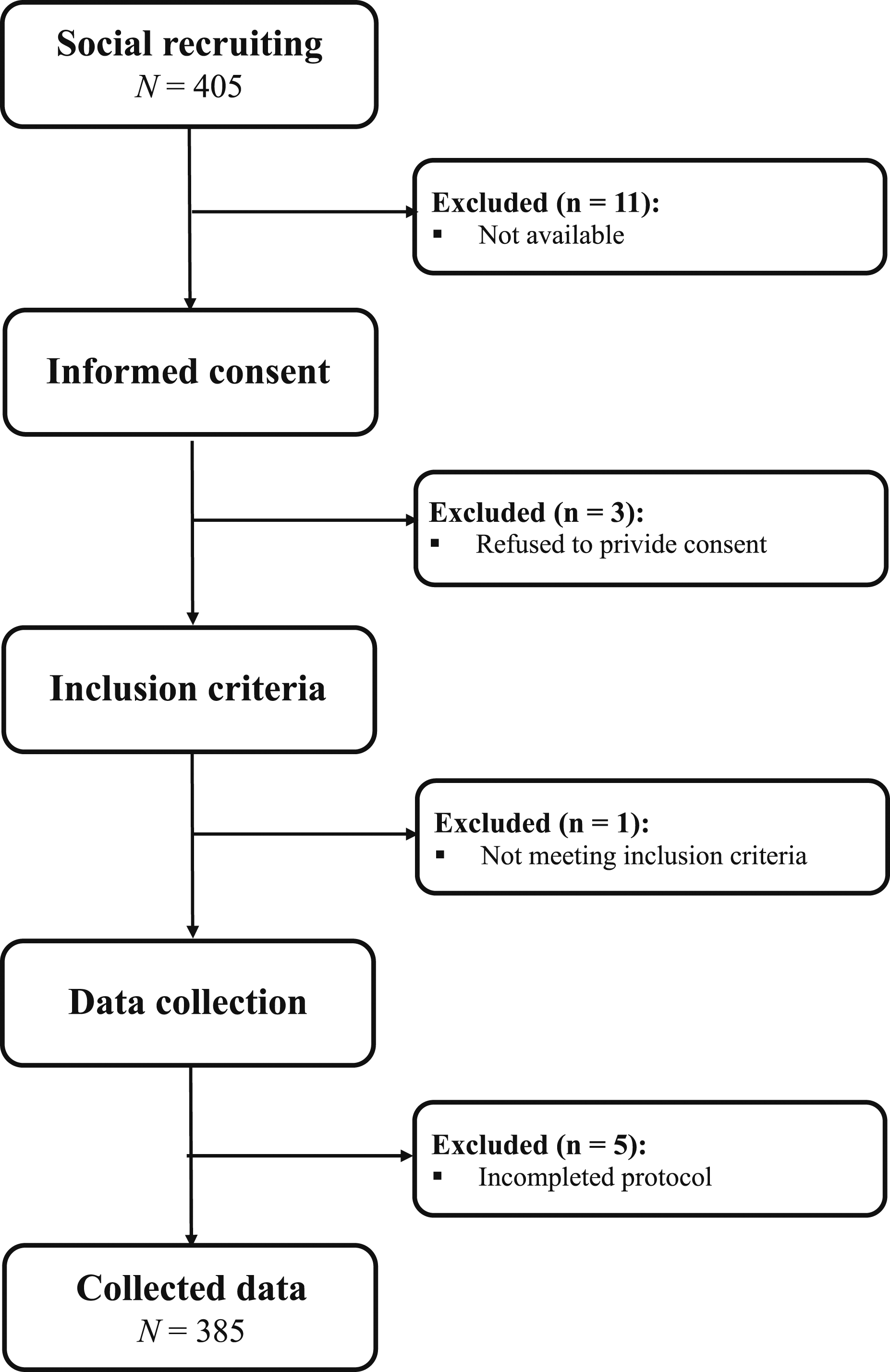
Measures
Power Behavioral System Scale
Patterns of power-system functioning were assessed with the Power Behavioral System Scale (PBSS; Shaver et al., 2011; Salzano, Zappullo, Senese, et al., 2023), a self-report measure of a person’s global orientation to power and assertion. The 28-item Italian version of the PBSS includes two subscales, one tapping deactivation (De) and one tapping hyperactivation (Hy) of the power system. The 14 deactivation items (i.e., odd-numbered items) assess the tendency to avoid asserting power and authority and avoiding competitions and disputes. The 14 hyperactivation items (i.e., even-numbered items) assess desire for power and control over resources and other people and intense worries about losing power. Items are rated on a 7-point scale, ranging from 1 (strongly disagree) to 7 (strongly agree), with higher scores indicating greater deactivation and hyperactivation of the power system. In the present sample, Cronbach αs were adequate for the 14 deactivation items (α = 0.81, 95% CI = 0.78–0.84) and the 14 hyperactivation items (α = 0.82, 95% CI = 0.80–0.85). We therefore computed two total scores (hyperactivation and deactivation) for each participant by summing the relevant item ratings.
Anxiety Sensitivity Index-3
Anxiety sensitivity was measured with the Anxiety Sensitivity Index-3 (ASI-3; Petrocchi et al., 2014; Taylor et al., 2007) which assesses concerns about possible negative consequences of anxiety-related symptoms. It comprises 18 items covering three domains of concerns: physical (e.g., “When I feel pain in my chest, I worry that I’m going to have a heart attack”), social (e.g., “I worry that other people will notice my anxiety”), and cognitive (e.g., “When my thoughts seem to speed up, I worry that I might be going crazy.“). Participants rate the extent to which each item applies to them on a five-point scale ranging from 0 (very little) to 4 (very much). Higher scores indicated higher anxiety sensitivity. In the present sample, Cronbach α for the 18 items was high (α = 0.92, 95% CI = 0.91–0.93). We therefore computed a total anxiety sensitivity score for each participant by summing the 18 ratings.
Beck Depression Inventory-II
Depressive symptoms were evaluated with the well-known Beck Depression Inventory-II (BDI-II, Beck et al., 1996; Sica & Ghisi, 2007). This scale is one of the most widely used psychometric tests for the assessment of depression severity. The BDI-II is composed by 21 items describing specific depressive symptoms, such as sense of failure, guilt, social withdrawal, insomnia, or weight loss. Each item is scored on a 4-point scale, ranging from 0 to 3, with higher scores indicating greater severity of depression. In the present sample, Cronbach α for the 21 items was 0.87, 95% CI = 0.85 - 0.89. We therefore computed a total depression severity score for each participant by summing the 21 ratings.
Behavior Rating Inventory of Executive Function–Adult
Difficulties in executive control were assessed with the 75-item Behavior Rating Inventory of Executive Function–Adult (BRIEF-A; Roth et al., 2005). This scale assesses nine aspects of executive functioning in two broad domains: (a) the ability to maintain appropriate control over one’s thoughts, behaviors, and emotions (i.e., Behavioral Regulation Index, including inhibition, shifting, emotion control, self-monitoring), and (b) the ability to manage one’s attention and problem-solving (i.e., Metacognition Index, including task initiation, working memory, organization, planning, and task monitoring). Items are rated on a 3-point scale, ranging from 1 (never) to 3 (often). A higher score indicates more severe impairments in executive control. Roth et al. (2005) recommended computing a Global Executive Composite (GEC) score by summing a participant’s ratings on all 75 items. In the present study, we used the GEC score (Cronbach α = 0.94, 95% CI = 0.93–0.95) to assess overall dysfunction of executive control.
Statistical Analysis
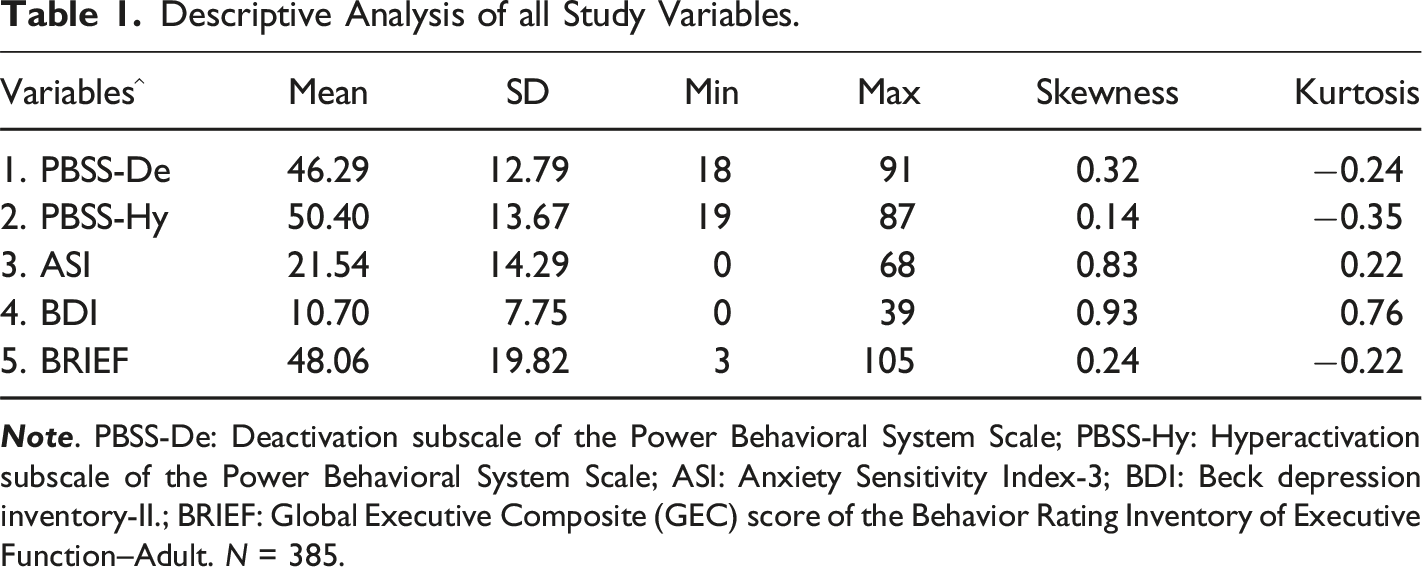
Preliminary descriptive analyses were carried out to examine missing values and variable distributions. Univariate distributions of observed variables were assessed for normality (Tabachnick & Fidell, 1996), and Pearson correlations were computed to examine bivariate associations between variables. Then, a multivariate hierarchical multiple regression analysis was performed to test the contribution of the two PBSS total scores (deactivation, hyperactivation) to affective symptoms (ASI-3 and BDI-II total scores) and dysfunctions in executive control (the GEC score of the BRIEF-A). In the first step, the two PBSS total scores were included, and in the second step their interaction was added.
Results
Descriptive Analysis of all Study Variables.
Pearson Correlations Between Study Variables.
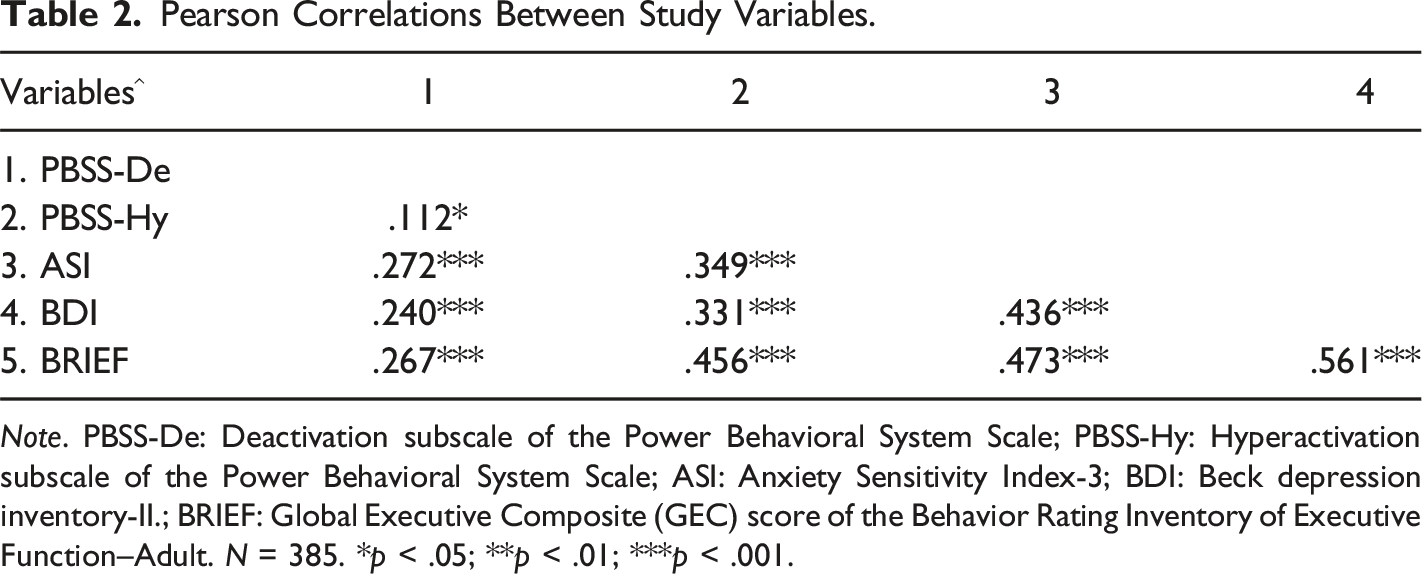
Note. PBSS-De: Deactivation subscale of the Power Behavioral System Scale; PBSS-Hy: Hyperactivation subscale of the Power Behavioral System Scale; ASI: Anxiety Sensitivity Index-3; BDI: Beck depression inventory-II.; BRIEF: Global Executive Composite (GEC) score of the Behavior Rating Inventory of Executive Function–Adult. N = 385. *p < .05; **p < .01; ***p < .001.
Univariate Multiple Regression Analyses Predicting Anxiety Sensitivity, Depression, and Dysfunction of Executive Control From PBSS Scores.
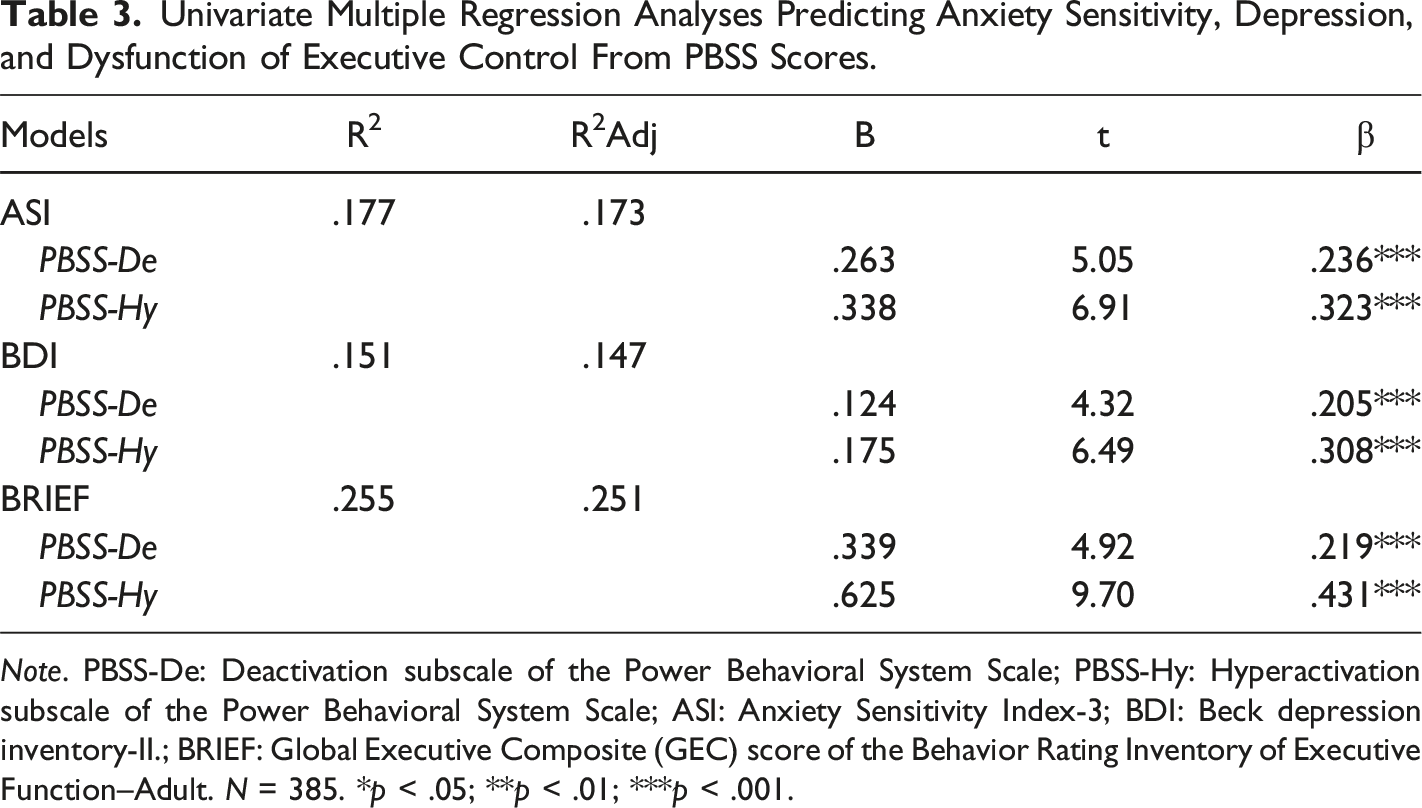
Note. PBSS-De: Deactivation subscale of the Power Behavioral System Scale; PBSS-Hy: Hyperactivation subscale of the Power Behavioral System Scale; ASI: Anxiety Sensitivity Index-3; BDI: Beck depression inventory-II.; BRIEF: Global Executive Composite (GEC) score of the Behavior Rating Inventory of Executive Function–Adult. N = 385. *p < .05; **p < .01; ***p < .001.

Regression plots of ASI, BDI and BRIEF, separately with Deactivation (top panels) and Hyperactivation (bottom panels) scales of the PBSS. Higher deactivation and hyperactivation scores were significantly associated with higher anxiety, depression, and dysfunction of executive control. PBSS-De: Deactivation subscale of the Power Behavioral System Scale; PBSS-Hy: Hyperactivation subscale of the Power Behavioral System Scale; ASI: Anxiety Sensitivity Index-3; BDI: Beck depression inventory-II.; BRIEF: Global Executive Composite (GEC) score of the Behavior Rating Inventory of Executive Function–Adult. N = 385. *p < .05; **p < .01; ***p < .001.
Discussion
Results showed that higher degrees of hyperactivation and deactivation of the power system are both associated with more severe symptoms of depression and anxiety and more severe executive control dysfunctions. This finding confirms our expectations based on the two-dimensional model of behavioral system functioning according to which the problematic activation of the power system is related to augmented risk of psychopathology (Salzano & Conson, 2022). It is noteworthy that the interaction between the two dimensions of dominance (hyperactivation) and submission (deactivation) only approached statistical significance. This result does not necessarily go against the expectation that heightened levels on both dimensions characterize a pattern of power-system functioning in which higher levels of psychopathological signs can be found. However, it suggests that more research should be conducted testing the two-dimensional model of behavioral systems (Salzano & Conson, 2022) and determining how the two dimensions interact in defining the four activation patterns of the power system.
The problematic pattern of power-system functioning is characterized by chaotic and unpredictable behaviors varying from the tendency to give up competitions and fights (high submission) to frantic search for dominance and victory (high dominance). In clinical literature, this chaotic mixture of submission and dominance has been referred to as passive-aggressive behavior (Millon, 1993; Hopwood, 2018; Laverdière et al., 2019). Individuals characterized by passive-aggressive behavior are described as constantly being worried about being unappreciated while, at the same time, being eager to exercise power (Hopwood, 2018). Moreover, they seem to harbour a hostile outlook toward others that is not directly expressed in anger or overt aggression but can lead to interpersonal problems, threaten relationship quality and stability, and predispose people to emotional difficulties (Laverdière et al., 2019; Millon, 1993; Schanz et al., 2021). In our view, the problematic pattern of power-system functioning can be viewed as the psychological basis of passive-aggressive responses and their relation to psychopathology.
Understanding individual differences in the activation and functioning of the power system may thus be useful in understanding the psychological bases and outcomes of different clinical conditions (Johnson et al., 2012). In this respect, considering individual differences in power-system functioning could be useful in case formulation. It could allow the therapist to gain a more comprehensive understanding of clients’ cognitive, affective, and behavioral reactions to interpersonal tensions, disagreements, and conflicts, while using this information for increasing clients’ awareness on their unmet need for power and unexpressed fears and hostility (Salzano, Zappullo, Baiano, & Conson, 2023). Increasing clients’ awareness of these power-related motives, fears, and hostility may be important for choosing among clinical interventions and successfully alleviating emotional problems (Ames et al., 2017; Sutton, 2016). Finally, being able to help regulate the functioning of the power system might be a primary goal of the therapy (Johnson et al., 2012). Several studies demonstrate that assertiveness training favouring a functional activation of the power system can be a useful intervention for dealing with various clinical conditions (Speed et al., 2018).
Before ending this discussion, we should acknowledge methodological limitations of the current study. First, the study is correlational, so our ability to deduce a causal relationship between individual variations in power-system functioning and psychopathology is limited. In addition, the study was conducted with a convenient, non-clinical sample of Italian adults. Further studies should attempt to test the replicability of the current findings in other countries as well as in clinical samples.
Despite these limitations, the current results might open new avenues of research on the implications of individual differences in power-system functioning for mental health while showing that both anxious hyperactivation and avoidant deactivation of the power system are associated with heightened risk for depression and anxiety and executive control dysfunctions. When encountering a therapy client who scores quite high on both dimensions, it may be very worthwhile to consider this as a problematic pattern that requires special consideration. Regarding executive functions in particular, a growing body of literature indicates that reduced efficiency of executive functions can be considered a transdiagnostic marker of psychopathological risk (Bloemen et al., 2018; Harden et al., 2020; Snyder et al., 2015, 2019). Because our results suggest that the problematic pattern of power-system functioning is related to problems in executive function, we suggest that clinically addressing problems in power-system functioning will be useful in moderating this transdiagnostic marker (Salzano, Zappullo, Baiano, & Conson, 2023; Zelazo, 2020).
Footnotes
Author’s Contribution
S.S. developed the study concept. All authors contributed to the study design. Testing and data collection were performed by A.C., R.C., and I.Z. and V.P.S. performed the data analysis and interpretation under the supervision of S.S., M.C., M.M. and P.R.S. Furthermore, S.S., M.C., I.Z. and V.P.S drafted the paper, and M.M. and P.R.S. provided critical revisions. All authors approved the final version of the paper for submission.
Declaration of Conflicting Interests
The author(s) declared no potential conflicts of interest with respect to the research, authorship, and/or publication of this article.
Funding
The author(s) received no financial support for the research, authorship, and/or publication of this article.
