







Abstract
Elevated rates of suicide among older adults continue to be a major public health problem globally. Improving our understanding of the precursors and the underlying mechanisms that lead to an increased risk of suicide in older adults is key to preventing suicide in this high-risk group. This study examined relationships between known risk factors of suicidal ideation (i.e., depression, hopelessness, thwarted belongingness, and perceived burdensomeness) in a sample of 284 community-dwelling older adults (Mage = 73.3 years, SD = 7.1 years; 56% women; 86% White/European American). Bivariate correlational results revealed that both depression (r = .62, p < .001) and hopelessness (r = .56, p < .001) were strongly and positively associated with suicidal ideation. The predictor variables (depression, hopelessness, thwarted belongingness, and perceived burdensomeness) were also significantly and positively correlated with each other, ranging between r = .35, p < .001 for thwarted belongingness and depression and r = .63, p < .001 for hopelessness and depression. We further investigated perceived burdensomeness as a moderator of the association between depression and suicidal ideation. Suicidal ideation was found to be elevated only when depressive symptoms are combined with the perception of being a burden. These findings underscore the importance of considering not only depressive symptoms when addressing suicide prevention efforts in older adults but also to focus on perceived burdensomeness as a strong contributing factor. Future research directions are discussed.
Introduction
Estimates from the World Health Organization (WHO, 2024) suggest that about 726,000 people worldwide die by suicide each year. In the United States, 49,476 people died by suicide in 2022 (CDC, 2022). In particular, suicide among older adults is a serious public health problem worldwide, with especially elevated suicide death rates across later life (16.0 per 100,000 in people 65–74 years old, 20.3 per 100,000 in people 75–84 years old, and 23 per 100,000 in people 85 years and older in 2022) (CDC, 2024). Indeed, older adults are overrepresented in deaths by suicide. Given the elevated risk of suicide among older adults, a better understanding of suicide risk and protective factors has been identified as a critical public health concern (Caine, 2013; Franklin et al., 2017). Suicidal ideation (i.e., thinking about killing oneself) is predictive of suicide attempts and death by suicide, and thus it is of particular interest for treatment and intervention among older people (Conwell et al., 2002; Conwell et al., 2011).
In addition, the presence of depression and hopelessness are among the most consistently reported risk factors for suicidal behavior (O’Connor & Nock, 2014). Regarding older adults, Conwell and Thompson (2008) reported that up to 95% of older people who died by suicide had a diagnosable mental disorder before their death, with depression being identified as the most significant risk factor for suicidal ideation and suicide completion (Awata et al., 2005; Conwell et al., 2002; Préville et al., 2005). Likewise, hopelessness is also known to play a critical role in the presence and severity of suicide ideation among older adults (Britton et al., 2008; Cukrowicz et al., 2013; Szanto et al., 2007).
The Interpersonal-Psychological Theory of Suicide (IPTS; Joiner et al., 2009; Van Orden et al., 2010) is an influential theoretical framework designed to explain suicidal behavior, introducing additional variables that may contribute to suicide ideation. According to the IPTS, suicide ideation is driven by the simultaneous presence of two proximal, presumably causal risk factors: (1) thwarted belongingness (TB) and perceived burdensomeness (PB). TB is conceptualized as a sense of profound alienation that results in feeling disconnected from significant others, which may develop through a lack of reciprocal caring relationships (Van Orden et al., 2010). PB refers to a self-view that one is defective, flawed, and unwanted, to the point of being a notable liability or burden on others (Van Orden et al., 2010). The IPTS does not propose that TB and PB are the only factors that lead to suicidal desire, but rather that their joint presence is highly likely to result in an exceptionally dangerous form of suicidal desire (i.e., suicide ideation). However, the development of active suicidal behavior and lethal self-injury is assumed to result through the additional presence of the acquired capacity to carry out the act of suicide (i.e., the acquired capability for self-harm; Van Orden et al., 2010).
Recent meta-analytic studies supported the main tenets assumed by the IPTS, whereby the effect of PB on suicidal ideation was the most strongly supported relationship (Chu et al., 2017; Ma et al., 2019). These findings have been replicated in South Korea (Shim et al., 2021) and Germany (Forkmann et al., 2021) and in an older adult study (Cukrowicz et al., 2011) where PB was found to be an independent predictor of suicide ideation, even after depressive symptoms, hopelessness, and functional impairment were controlled. Less support in the literature, however, has been found for the proposed interaction effect of TB and PB (Cero et al., 2015; Ma et al., 2016; Ma et al., 2019), although a study conducted in Australia found that there was a significant interaction effect for passive suicidal ideation (Batterham et al., 2018). Hagan et al. (2015) found that, among students, the interaction between TB and PB was a significant predictor of suicidal ideation when levels of hopelessness are elevated, suggesting that it is the confluence of all three components that leads to suicidal desire and risk.
Overall, research examining older adult suicide risk supports significant and generally strong bivariate associations between PB, TB, and suicidal ideation (e.g., Cukrowicz et al., 2011; Cukrowicz et al., 2013; Eades et al., 2019; Gendron et al., 2023; Jahn & Cukrowicz, 2011; Jahn et al., 2015; Marty et al., 2012), even when hopelessness, functional impairment, and depressive symptoms were controlled for (Cukrowicz et al., 2013). In some regards, PB seems to be an especially salient aspect of Joiner’s theory when applied to older adults. For example, according to Jahn and Cukrowicz (2011), older adults’ perceptions of burden falling on younger generations (e.g., children and grandchildren) were associated with greater PB and suicide ideation than perceptions of burden on one’s own generation and or older generations. This finding is troubling, given that many frail older adults rely on their children and other younger individuals as their primary caregiver(s). Of interest, in a follow-up study, Jahn et al. (2013) found that the most severe form of PB (specifically the belief that others would be better off if the person was gone) was related to burden on one’s spouse compared to burden on one’s child, suggesting that PB manifests on a continuum of severity and one must also consider who is being burdened.
Although a growing body of research provides support for significant associations between TB, PB, and suicidal ideation, most studies were conducted with either clinical samples or among people who made a suicide attempt. Including samples of community-dwelling older adults, however, is critical to advance the understanding of factors that lead to suicidal ideation as many older adults in the community experience a broad range of suicide risk factors (Cukrowicz et al., 2013). In addition, given that older adults tend to under-report suicidal ideation in general (Bryant et al., 2008), assessing for Joiner’s components of TB and PB may be an alternative way to detect possible suicidal risk in older adults.
Moreover, although there is no singular underlying explanation for suicidal behaviors, a great deal of research has concentrated solely on bivariate associations between potential risk factors and suicidal behavior (Dhingra et al., 2015). To evaluate the significance of potential risk factors, which themselves are most often highly correlated (e.g., depression and hopelessness), it is important to analyze these factors simultaneously to consider their shared variance. Underexplored in previous research also is the identification of potential underlying mechanisms through which risk factors translate into suicidal ideation. In this regard, TB and PB might have a moderating effect on the association between other important proximal individual risk factors (e.g., depression and hopelessness) and suicidal ideation (e.g., O’Connor & Nock, 2014).
Thus, the aims of the present study were to (1) investigate the simple bivariate associations between known risk factors of suicidal ideation (i.e., depression, hopelessness, TB, and PB) with suicide ideation in a sample of community-dwelling older adults, and to (2) investigate the potentially moderating effect of TB and PB in this relationship. Specifically, this investigation examines whether the direction and strength of the relationship between specific risk factors with suicidal ideation depend on the manifestation of TB and PB.
Method
Participants and Procedure
The sample consisted of 284 community-dwelling older adults (Mage = 73.3 years, SD = 7.1 years; age range = 64–96 years; 56% women; 86% White/European American, 3.6% Native American/Alaskan Native, .7% Asian/Native Hawaiian/Pacific Islander, 3.2% Black/African American, 2.9% Hispanic/Latino, 2.9% Multiracial, .7% Unknown) recruited from the voter registry of El Paso County, Colorado. The education level of participants ranged from 8 to 25 years (M = 15.0 years, SD = 3.0 years). See Marty et al. (2012) for a more detailed description of the sampling procedure and for other demographic information. Participants provided informed consent and then they completed a self-report questionnaire packet, followed by debriefing. The procedures, protocol, and informed consent for the present study were approved by the University’s Institutional Review Board.
Measures
The
The
The
The
Results
Analyses were conducted using R (version 4.4.3) and SPSS (version 21). Missing values constituted between 4.6% (PB) and 9.5% (suicide ideation) of the data. Five cases were identified as extreme outliers (i.e., +3 SD) and were excluded from subsequent analyses to reduce the risk of the results influenced by outliers (Tabachnick & Fidell, 2019). Missing data were handled by multiple imputation.
To examine the effect of gender on the two main IPTS variables (perceived burdensomeness and thwarted belongingness), as well as the other key variables (depression and hopelessness), a series of independent t-tests were run. With regards to perceived burdensomeness, there was no significant difference between men (M = 10.71, SD = 3.69) and women (M = 11.75, SD = 5.17), t(260) = −1.90, p = .06, and the effect size as measured by Cohen’s d was small (d = −.226). Similarly, there was no significant difference between men (M = 21.06, SD = 10.78) and women (M = 20.78, SD = 12.05) on thwarted belongingness, t(262) = .194, p = .85 and the effect size was also small (d = .024). For the other 2 variables, there was no significant difference between men (M = 2.27, SD = 2.96) and women (M = 2.74, SD = 3.18) on depression scores, t(269) = −1.24, p = .22, d = −.15, and no significant difference between men (M = 29.86, SD = 7.45) and women (M = 30.66, SD = 8.48) on hopelessness scores, t(264) = −.81, p = .42, d = −.10, both with small effects.
Descriptive Statistics and Bivariate Correlations.
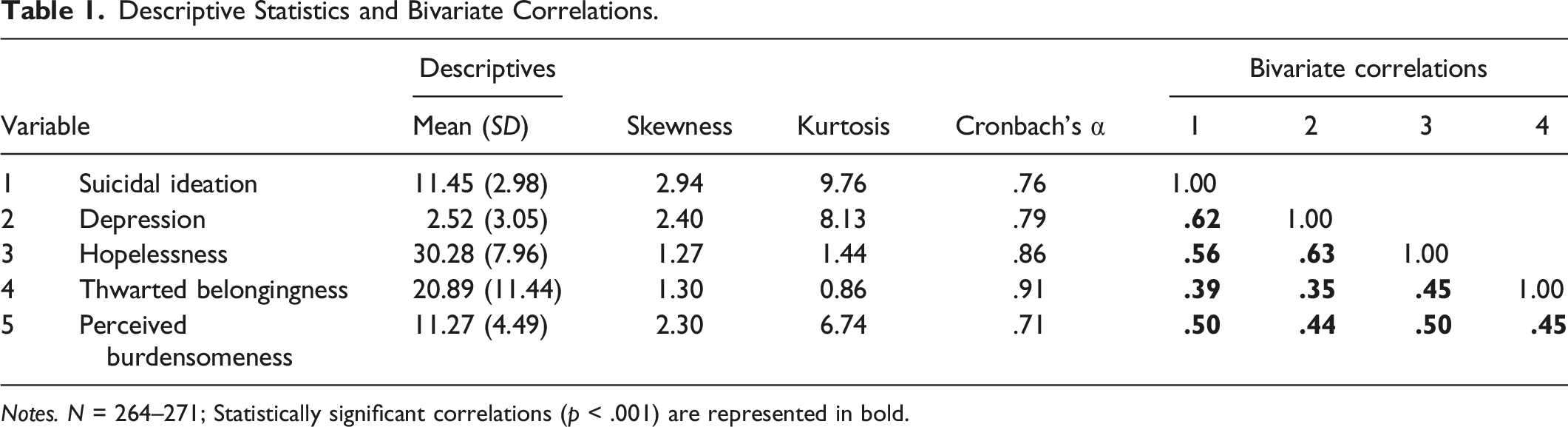
Notes. N = 264–271; Statistically significant correlations (p < .001) are represented in bold.
Regression Results.
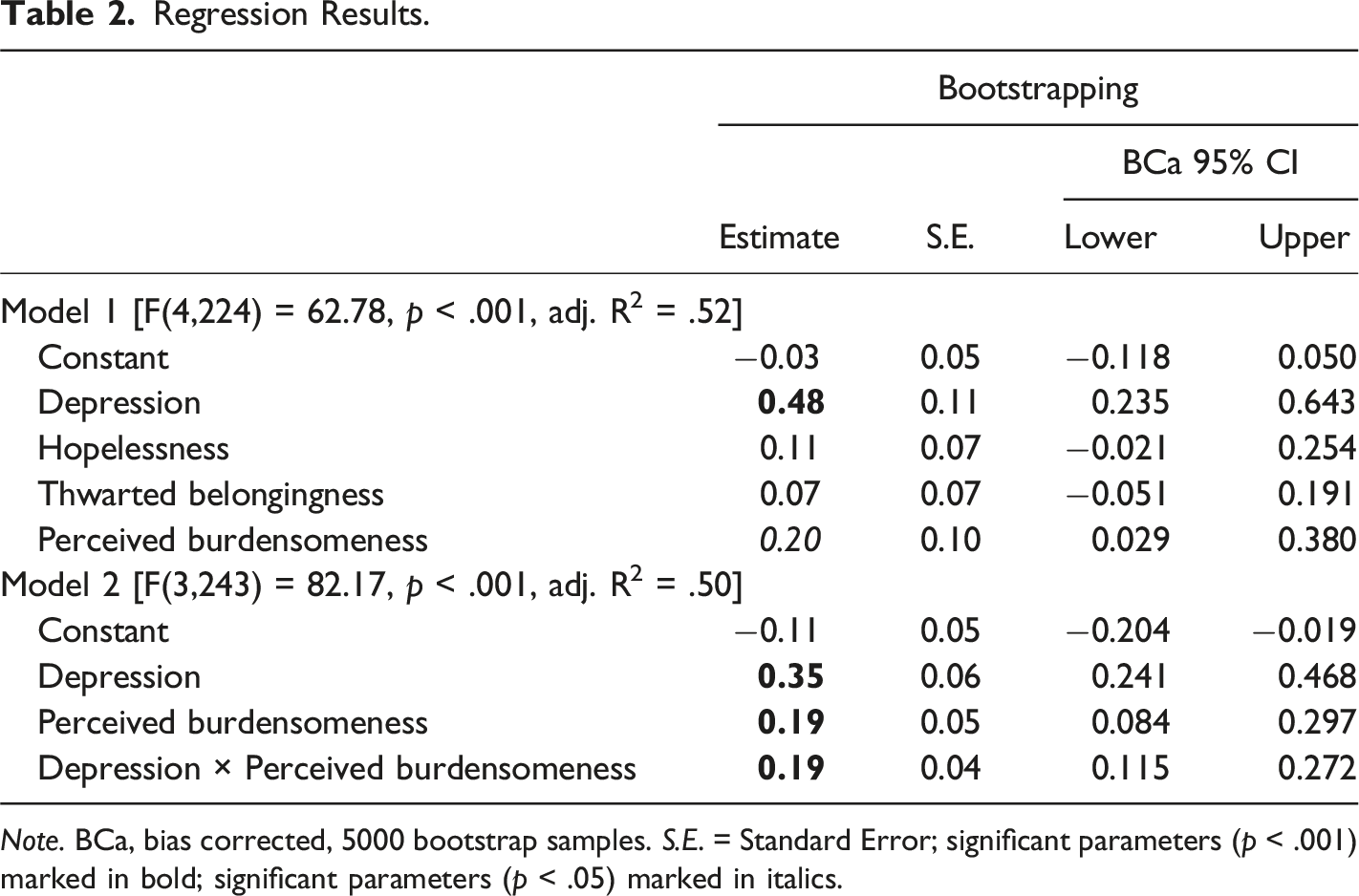
Note. BCa, bias corrected, 5000 bootstrap samples. S.E. = Standard Error; significant parameters (p < .001) marked in bold; significant parameters (p < .05) marked in italics.
Discussion
Suicide is a devastating public health problem with far-reaching impacts on individuals, families, and communities, although it is potentially preventable (O’Connor & Nock, 2014). Knowledge about the interplay between risk factors for suicidal ideation, a well-established precursor of lethal suicide attempts, is essential for accurate risk assessment and for crafting individual treatments (Franklin et al., 2017). Our bivariate findings support previous research showing that the four investigated risk factors are positively associated with suicide ideation in a sample of community-dwelling older adults. As expected, depression, hopelessness, and PB were strongly associated with suicidal ideation with large effect sizes, whereas the association between TB and suicide ideation was of a medium effect size.
Notably, when accounting for the interrelatedness of the risk factors in the multiple regression analysis, only depression and PB were confirmed as significant predictors of suicidal ideation. This finding provides further support for the role of depression and PB as risk factors associated with suicidal ideation in older adults and are partly consistent with the predictions of the IPTS. The greater relevance of PB compared to TB in samples of community-dwelling older adults is consistent with findings from Jahn et al. (2011) and Cukrowicz et al. (2013) and indicates that the strong perception of feeling like a burden on others is a highly salient risk factor among older adults. Jahn and Cukrowicz (2011) previously found that perceptions of burden are strongly evoked within caregiving contexts, whether it be from younger family members or spouses. As the Baby Boomer population ages, caregiving needs are expected to exponentially increase, which may portend a troubling prospect of increased perceptions of burden among a large group of people.
An interesting study by Vanyukov et al. (2017) further suggests that PB arises in the context of maladaptive personality factors (neuroticism, impulsivity, and interpersonal conflict). In a study of older adults recruited from a primary care clinic, Jahn et al. (2015) found that PB, TB, and depressive symptoms (but not hopelessness) mediated the relation between the total number of personality disorder traits and suicide ideation. In a related and more recent study among community dwelling older adults, Eades et al. (2019) found that personality disorder traits explained a large amount of variance in both TB (R 2 = .46) and PB (R 2 = .33). Indeed, further studies focusing on the role of diverse forms of normative and maladaptive personality traits on TB, PB, and the acquired capability for suicide are sorely needed, especially among older adults.
To further examine potential underlying mechanisms that might further elucidate the nature of the relationship between proximal risk factors (i.e., depression) and suicide ideation, we investigated the moderating effect of PB on the association between depression and suicide ideation. Exploring such interaction effects are of special importance for the development of individual treatment efforts as they can inform specific targets of intervention. Our findings from the moderation analysis suggest that suicide ideation is especially elevated when depressive symptoms are combined with strong feelings of being a burden. In contrast, high PB combined with low depressive symptomatology was not associated with elevated suicidal thoughts, nor was the sole presence of depressive symptoms.
To our knowledge, only one study previously investigated the moderating effect of PB on the association between depression and suicide ideation in older adults (Jahn et al., 2011), and their findings were highly similar to findings in the present study. Specifically, they found that PB mediated the relation between depression and suicide ideation among older adults in primary care, accounting for 68% of the variance in suicide ideation, although this study did not use the INQ to measure burdensomeness. Our results are also in concordance with a meta-analytic review on social relationships and suicidal ideation among older adults, indicating a 57% likelihood increase of suicidal ideation for older adults with impaired social relationships (Chang et al., 2017). Among the measures of social relationships, perceived loneliness and lack of social support, both of which are relevant for the perception of being a burden to others, had the second and third strongest effect size (OR = 2.24; 95% CI [1.73, 2.90]; OR = 1.59; 95% CI [1.37, 1.83]). Reducing PB might therefore be a promising strategy in reducing suicidal ideation among older adults with elevated depressive symptomatology, perhaps in combination with more traditional approaches to reducing depressive symptoms. Some specific psychotherapeutic strategies to reduce PB might include cognitive restructuring, which combined with psychoeducation significantly reduced PB and subsequent suicidal thoughts at a six month follow up in a study that targeted reducing TB and PB (Allan et al., 2018). An example of using cognitive bias modification in the context of mitigating PB may entail helping the client challenge unhealthy or unrealistic thoughts about being a burden (perceptions of burden do not always correspond to actual burden) and elucidating their strengths and how they might possibly contribute more to their family or other relationships. Increasing one’s self-efficacy is another strategy that one might use to try to reduce perceptions of PB.
There are several limitations of the present study. First, the data presented are cross-sectional in nature, so we cannot draw conclusions about causality or age-changes. Although it seems reasonable to hypothesize that PB is a moderator of the relationship between depression and suicidal ideation (see O’Connor & Nock, 2014), longitudinal data are needed to further establish the exact causal chain. Also, several studies have proposed additional risk factors of suicide ideation. One such recent study found that the impact of internalized ageism was beyond that of PB and TB in predicting suicidal ideation (Gendron et al., 2023). Testing a comprehensive model of the development of suicidal ideation that considers other risk factors in longitudinal and prospective studies appears to be an important next step, especially with older adults. Some key variables include normative and dysfunctional personality features, impulsivity, perfectionism, optimism and resilience, cognitive rigidity, rumination, thought suppression, fearlessness, agitation, coping and problem solving, attentional biases, future thinking, goal disengagement, and feelings of defeat and entrapment (see thorough review by O’Connor & Nock, 2014). The present study was also limited by a relatively homogenous sample of primarily white older adults, with little ethnic and cultural diversity. Future studies should include more ethnically and culturally diverse samples of older adults and should also extend the present findings to clinical and diverse treatment-seeking samples.
In conclusion, our results provide additional insight into the associations between key risk factors and suicidal ideation in older adults. Our results suggest a strong moderating effect of PB on the relationship between depression and suicide ideation in this sample of community-dwelling older adults. Clinicians seeing older adults should assess for depression and PB when determining suicide risk, and they should be especially vigilant when both are elevated. Our findings especially speak to the growing awareness of the deleterious impact of PB in later life, as part of the IPTS. From a clinical perspective, it is vitally important to further understand the phenomenology and clinical correlates of suicide ideation, because such ideation is predictive of suicide attempts and death.
Footnotes
Acknowledgements
The authors wish to thank Juliana Gottschling, PhD for her statistical and technical contributions to this paper.
Declaration of Conflicting Interests
The author(s) declared no potential conflicts of interest with respect to the research, authorship, and/or publication of this article.
Funding
The author(s) received no financial support for the research, authorship, and/or publication of this article.
Ethical Statement

Data Availability Statement
Data not shared.