







Abstract
Semantic coherence judgments address whether a set of words share a common associative link and reflect an intuitive understanding of semantic relationships. This paper investigates how semantic priming impacts these judgments, specifically examining its effects on the accuracy of identifying semantic coherence and confidence in these judgments. In Study 1, the influence of semantic priming on participants’ ability to judge semantic coherence and their confidence levels was investigated. Findings indicated that solution priming significantly enhanced the accuracy of coherence judgments and participants’ confidence, highlighting the role of processing fluency and metacognitive evaluations. Study 2 built on these results by introducing a more demanding task, the Dyads of Triads (DoT), in which participants had to indicate a semantically coherent triad. The results confirmed that semantic priming maintained its positive effect on the accuracy of intuitive judgments and confidence, further emphasizing the importance of processing fluency and metacognitive awareness in intuitive semantic processing under more complex conditions. Together, these studies demonstrate that semantic priming facilitates a deeper intuitive grasp of semantic coherence, thereby showing the critical roles of processing fluency and metacognitive processes in intuitive semantic coherence judgments.
Introduction
Intuition, an inherently rapid and often unconscious process, plays a pivotal role in psychological research, particularly in understanding how individuals make judgments with little conscious deliberation (Morewedge & Kahneman, 2010). This concept, embodying processes that are swift, effortless, and seemingly autonomous from intention, remains an enigmatic yet fascinating domain within cognitive and other fields of psychology (Hodgkinson et al., 2008). Research on intuition tries to unravel the complex interplay of automatic and conscious processes, affective states, and cognitive mechanisms behind intuitive decision-making, intuitive judgment, and intuitive evaluations (Ambady, 2010; Dijkstra et al., 2012; Haidt, 2001).
Among the various manifestations of intuition, semantic coherence judgments stand out as a unique instance (Bowers et al., 1990). Semantic coherence judgments involve the ability of individuals to identify common associative links within word triads, distinguishing between coherent and incoherent sets without explicit access to the associative link, showcasing an implicit, intuitive understanding of semantic relationships (Zander et al., 2016, 2017). Therefore, these judgments rely on implicit, intuitive comprehension of semantic relationships (Maldei et al., 2020).
Processing fluency for coherent triads is crucial for enhancing semantic coherence judgments, leading to a positive affective response that aids coherence assessment (Sweklej et al., 2014; Topolinski & Strack, 2009a). Affective states, particularly subtle positive responses resulting from increased processing fluency, have been found to support coherence judgments (Balas et al., 2012). Also, positive mood has been shown to enhance intuitive coherence judgments by facilitating the activation of weak or remote associates in memory, thereby improving judgment accuracy (Bolte et al., 2003). Moreover, neuroscientific studies have explored the neural mechanisms underlying intuitive coherence judgments, showing that activity in brain regions such as the orbitofrontal cortex during intuition-based decisions is related to semantic coherence (Horr et al., 2014; Zander et al., 2016). Thus, semantic coherence judgments exemplify a form of intuition that operates implicitly, drawing on processing fluency, affective responses, and neural mechanisms to identify common associative links within word triads. Understanding the interplay of these factors provides insight into the complex nature of intuitive semantic coherence judgments. Also, semantic coherence judgments assess whether a set of words shares a common associative link, reflecting an intuitive understanding of semantic relationships. While the Remote Associates Task (RAT) is frequently used to measure these judgments, we argue that the concept of semantic coherence extends beyond this specific task. It represents a domain-general cognitive construct, as recognizing meaningful connections among seemingly unrelated items is critical to problem-solving, language comprehension, and memory retrieval.
Building on the foundational insights from Topolinski and Strack’s (Topolinski et al. 2009; Topolinski & Strack, 2009a) work on the fluency-affect model of intuition, this manuscript aims to dig deeper into the intuitive processes underlying semantic coherence judgments. At the core of our inquiry is examining how semantic priming influences intuitive judgments of semantic coherence (Fukawa & Niedrich, 2015; Heider et al., 2017; Labroo et al., 2008; Rajaram & Geraci, 2000). Semantic coherence refers to the ability to intuitively recognize a meaningful associative link among a set of words, reflecting the underlying semantic relationship that connects them. Tasks like the Remote Associates Test (RAT) rely on this intuitive recognition to determine whether seemingly unrelated words share a common connection. In our study, processing fluency—the ease with which cognitive operations are performed—serves as the mechanism by which semantic priming enhances judgment. Specifically, processing fluency is driven by the semantic relationship between a primed solution and the triad of words, facilitating the recognition of coherence and leading to more confident and accurate judgments. We hypothesize that priming with a solution word increases processing fluency, which in turn improves participants’ ability to make correct coherence judgments and increases their confidence in these judgments.
Furthermore, we explore whether the degree of semantic similarity between primes and triads influences the effectiveness of priming. Using Word2Vec to quantify the semantic similarity between primes and the words in the triads, we aim to assess whether a stronger semantic connection between the prime and triad is associated with greater accuracy and confidence in coherence judgments. This approach provides evidence that semantic priming operates through semantic networks, supporting the hypothesized mechanism that greater semantic similarity increases processing fluency and enhances intuitive judgments.
Processing fluency, conceptualized as the ease with which information is retrieved and processed, is proposed to be a key mechanism through which semantic priming operates, facilitating a more intuitive grasp of semantic coherence (Topolinski et al., 2009). This fluency, in turn, is posited to generate a subtle positive affect, which informs the judgment itself and bolsters the confidence with which such judgments are made (Balas et al., 2012; Sweklej & Balas, 2024; Topolinski & Strack, 2009b). From this perspective, semantic priming catalyzes a heightened intuitive awareness, leading to more accurate and confident judgments of semantic coherence. While previous studies have shown that positive affect often enhances processing fluency and can contribute to increased confidence in judgments (Balas et al., 2012; Topolinski & Strack, 2009a), we did not directly measure participants’ affect in the current experiments. Instead, we infer that the heightened confidence observed in our primed conditions may be partially driven by positive affect, as supported by existing research on processing fluency and intuitive judgment.
Moreover, confidence in intuitive judgments is understood as linked to metacognitive processes, reflecting an individual’s awareness and evaluation of their cognitive operations (Rudolph et al., 2017). Metacognition, as defined by Anderson et al. (J. R. Anderson et al., 2011; N. J. Anderson, 2002), refers to the awareness and active regulation of one’s cognitive processes. More broadly, Metcalfe (2024) defines metacognition as people’s ability to reflect and make judgments about their memory, perception, and other mental states and processes and to use those reflections to alter their own knowledge and mental processes (see also O’Leary & Fletcher, 2024). This process allows individuals to be self-determined rather than stimulus-determined. In the context of this study, we assume that metacognition plays a critical role in intuitive judgment, particularly when participants are tasked with evaluating their confidence in a solution.
Confidence judgments in our task reflect an intuitive sense of correctness, supported by processing fluency and enhanced by semantic priming. However, it is important to distinguish between confidence and self-efficacy. Self-efficacy refers to task-specific beliefs about one’s ability to succeed in a given task, whereas confidence in this context reflects a metacognitive judgment of the accuracy of one’s performance (Anderson et al., 2011). While confidence influences self-efficacy over time by reinforcing task-specific abilities, the two constructs operate at different levels of cognitive processing. Our study explores how semantic priming influences confidence directly, which may contribute to increased self-efficacy through repeated success in intuitive coherence judgments. Therefore, we assert how metacognitive processes, such as monitoring and control, support participants in making coherence judgments and adjusting their confidence levels based on their accuracy self-assessment.
As such, our investigation extends to how semantic priming, by enhancing processing fluency and evoking positive affect, also impacts metacognitive assessments of judgment accuracy. Focus on accuracy and confidence allows for a comprehensive exploration of the interplay between cognitive, affective, and metacognitive components in intuitive semantic processing. The primary hypotheses driving our research posit that semantic priming not only elevates the accuracy of intuitive judgments of semantic coherence but also significantly increases the confidence in these judgments, thereby shedding light on the mechanisms underpinning intuitive semantic coherence detection.
Study 1
This study investigated how masked semantic priming influences the intuitive judgments of semantic coherence. Specifically, the research seeks to explore how the presentation of solvable and unsolvable triads, primed with solution words or nonwords, influences participants’ ability to detect semantic coherence, confidence in intuitive judgments, and ability to propose solutions to the triads judged as coherent.
Method
Participants
A total of 107 participants (49 men and 58 women) were recruited from the general population via the Prolific online platform for this study. Participants ages ranged from 23 to 40 years, with a mean of 33.62 years (SD = 4.46). All participants were native English speakers. They volunteered for the study and were compensated for their time. The Ethics Committee of SWPS University approved both studies’ sampling, design, and materials (Review No. 55/2018).
Materials
Sixty triads were constructed in this study. First, 40 solvable triads were selected from Bowden and Jung-Beeman (2003) set of remote associate problems (like cottage, Swiss, cake where the solution is cheese). Second, another 20 triads were assembled by randomly sampling words from (Bowden & Jung-Beeman, 2003). Finally, two sets of primes were selected. The first set of primes (N = 40) consisted of solution words to the solvable triads. The second set of primes included 40 two-syllable nonwords. Those were randomly assigned on a participant basis. The materials used across Studies 1 and 2 are presented in Appendix 1.
Procedure
After informed consent and detailed instructions, participants were shown 60 triad trials, each displaying three words for 5 seconds. Participants were presented with two types of triads: solvable triads, where a coherent solution word existed, and unsolvable triads, where no solution was possible. These triads were primed with either a solution word (for 20 solvable triads) or a nonword (for both 20 solvable and 20 unsolvable triads). The prime was briefly presented for 80 milliseconds before the triad, masked by hash marks (######) both before and after the prime presentation, to ensure participants were not consciously aware of the prime. Participants then made judgments about whether the triad had a solution and rated their confidence in that judgment.
Each trial required participants to determine whether a given triad had a commonly associated solution word by pressing the relevant key (Y or N) and to rate their confidence in judgment on a Likert scale from 1 (complete uncertainty) to 10 (absolute certainty) after each response. If they judged a triad coherent, participants were instructed to write a proposed solution word in a textbox or indicate a “do not know” response with a question mark. If they proposed a solution, they were subsequently asked to rate their confidence in its accuracy on an identical Likert scale. If they indicated a “do not know” answer, the trial stopped, and the subsequent trial started after a short 1500 ms interval.
An attention check followed the triad trials. Participants were instructed NOT to mention any sports activities they practiced and given a list of some sports activities to choose from. A failure to comply with the explicit instruction resulted in excluding their data from further analysis. This check ensured attentiveness and compliance with study protocols.
We conducted paired-sample t-tests and ANOVA designs to compare performance across experimental conditions, given that the design involved repeated measures within participants. Cohen’s d was calculated to provide an estimate of the effect size, offering a standardized measure of the magnitude of the difference between conditions. We chose Cohen’s d for its interpretability in measuring effect size, with values of 0.2, 0.5, and 0.8 conventionally interpreted as small, medium, and large effects, respectively. Post hoc analyses were conducted where necessary to explore significant interactions and provide a more nuanced understanding of the results. These analyses were corrected for multiple comparisons to reduce the likelihood of Type I error. The Holm test was selected because it provides a more robust alternative to the Bonferroni correction while controlling the familywise error rate. This method sequentially adjusts p-values based on the ranked significance of tests, making it less conservative than Bonferroni while maintaining a solid control over Type I errors. The choice of the Holm test was intended to strike a balance between controlling for false positives and preserving statistical power, particularly given the exploratory nature of our analyses. The overall approach was chosen to align with the study’s exploratory nature, focusing on detecting the potential effects of semantic priming on intuitive coherence judgments.
In addition to the primary analysis of coherence judgments and confidence, we also conducted a supplementary analysis to examine the relationship between the semantic similarity of primes and triads and the accuracy and confidence of judgments. We quantified the semantic similarity between each prime and its corresponding triad using a Word2Vec model (Google News Vectors, 300-dimensional). Cosine similarity was calculated between the prime and each word in the triad, and the mean similarity score was used to represent the overall semantic similarity between the prime and triad. This analysis was performed to test whether higher semantic similarity between the prime and triad would result in greater accuracy and confidence in coherence judgments.
Results
Three out of 107 participants failed the attention check and were excluded from subsequent analyses.
Accuracy of Judgments
A significant effect of Triad Type on the accuracy of coherence judgments was observed (F (2, 212) = 126.309, p < .001, η 2 = .544), indicating a strong influence of the type of priming on participants’ accuracy. Incoherent triads primed with nonwords and coherent triads with semantic primes led to higher accuracy (M = .813 and .802, respectively) than coherent triads primed with nonwords (M = .438). Post hoc comparisons revealed that incoherent triads with nonword primes and coherent triads with semantic primes significantly improved accuracy compared to coherent triads primed with nonword primes (mean differences = .375 and −.364, respectively; both p < .001 after Holm adjustment). The negligible difference between incoherent triads primed with nonwords and coherent triads with semantic primes (mean difference = .011, p = .676) suggests that both types of priming are similarly effective in enhancing judgment accuracy.
Confidence in Judgments
The type of triad significantly affected participants’ confidence in coherence judgments (F (2, 212) = 140.686, p < .001, η 2 = .570). The confidence levels associated with each priming condition varied significantly. Incoherent triads primed with nonwords led to a mean confidence level of 5.652 (SD = 1.805), coherent triads with nonword primes to 6.589 (SD = 1.449), whereas coherent triads primed with solutions to the highest confidence level of 8.054 (SD = 1.613). Further analysis through post hoc comparisons showed a significant difference in confidence between incoherent and coherent triads with nonword primes (mean difference = −.937, p < .001), as well as between incoherent triad primed with nonwords and coherent triads with solution primes (mean difference = −2.402, p < .001). The comparison between coherent triads with nonword primes and coherent triads primed with solutions also revealed a significant difference (mean difference = −1.465, p < .001), with Holm-adjusted p-values underscoring the robustness of these findings.
Accuracy of Solutions
A paired samples t test was run to examine differences in the accuracy of proposed solutions, revealing a significant difference (t (102) = −8.768, p < .001, Cohen’s d = .864). Cohen’s d was calculated using the pooled standard deviation as the denominator. Although the t test result indicated a negative direction of the mean difference, Cohen’s d is presented as positive by convention. This indicates a robust effect size, where the mean accuracy for coherent triads primed with solution (M = .807, SD = .296, SE = .029) was significantly higher compared to coherent triads with nonword primes (M = .609, SD = .295, SE = .029).
Confidence in Solutions
To analyze participants’ confidence in proposed solutions, we filtered out responses that were either “do not know” or missing data. A within-subjects ANOVA revealed significant effects of Triad/Prime on participants’ confidence levels (F (2, 76) = 65.688, p < .001, η 2 = .634). Mean confidence levels were lowest for incoherent triads with nonword primes (M = 5.399, SD = 1.934), intermediate for coherent triads with nonword primes (M = 7.794, SD = 1.257), and highest for coherent triads primed with solutions (M = 8.510, SD = 1.303). Post hoc comparisons further delineated these effects, showing significant differences between all priming conditions: incoherent and coherent with nonword primes (mean difference = −2.395, SE = .284, p < .001, Cohen’s d = 1.566), incoherent with nonword primes and coherent triads primed with solution (mean difference = −3.110, SE = .284, p < .001, Cohen’s d = 2.034), and between coherent with nonword primes and coherent triads primed with solution (mean difference = −.716, SE = .284, p = .014, Cohen’s d = .468).
Accuracy and Confidence in Intuitive Judgments
As we see above, participants frequently declared no knowledge (or even supposition) of solutions in most trials. We deem those cases intuitive because of a lack of awareness of solutions. The analysis of the mean accuracy of intuitive coherence judgments revealed a significant difference in accuracy between triads primed with nonwords and triads with solution primes t (45) = −5.104, p < .001, Cohen’s d = 0.753. The mean accuracy was notably lower for triads primed with nonwords (M = .501, SD = .152, SE = .022) than for triads with solution primes (M = .669, SD = .165, SE = .024).
The analysis of average confidence in intuitive coherence judgments with repeated measures ANOVA 2 (Type of Prime: nonword vs. solution) x 2 (Accuracy of Coherence Judgments: error vs. hit) revealed a significant effect of Accuracy (F (1, 45) = 185.839, p < .001, η
2
= .600), indicating a substantial impact on confidence levels depending on the accuracy (error vs. hit) of coherence judgments without knowing the solutions. An interaction between Type of Prime (nonword vs. solution) and Accuracy of Coherence Judgments (error vs. hit) showed a moderate but significant interaction (F (1, 45) = 6.684, p = .013, η
2
= .013, Figure 1). Descriptive statistics for confidence levels across conditions underscore these findings. For errors, confidence was slightly higher with a solution prime (M = 5.240, SD = 1.360) compared to a nonword prime (M = 5.033, SD = 1.183), whereas for hits, confidence significantly increased with a solution prime (M = 7.396, SD = 1.004) over a nonword prime (M = 7.001, SD = 1.133). This illustrates how confidence correlates with the accuracy of coherence judgments, particularly emphasizing the role of correct solutions in enhancing confidence. No significant effect was found for the Type of Prime alone (F (1, 45) = .365, p = .549), implying that the type of prime by itself did not significantly alter confidence levels without considering accuracy. Mean confidence in intuitive judgments depending on the prime type and accuracy of intuitive coherence judgments. Whiskers represent 95% CI.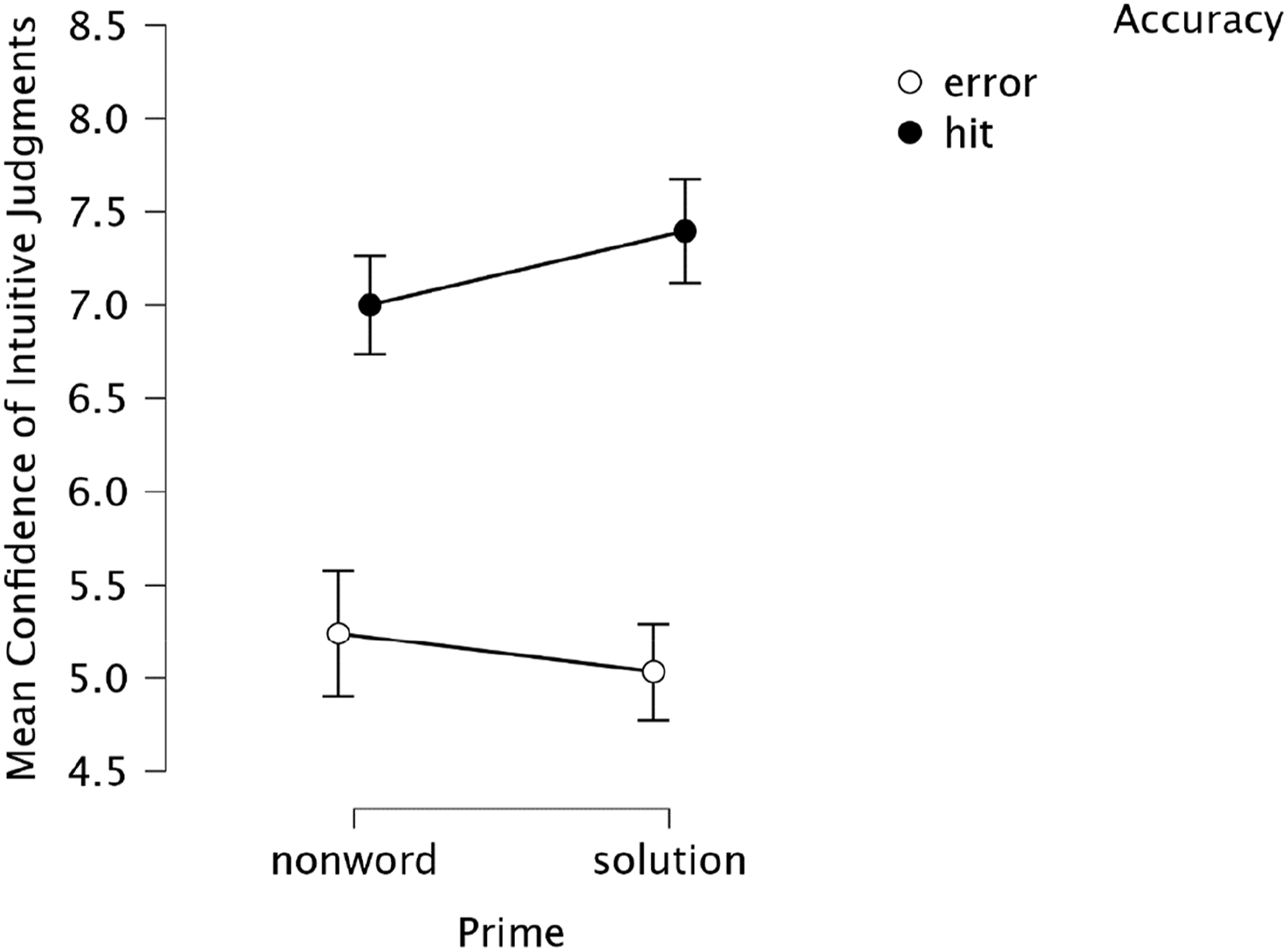
Semantic Similarity Analysis
To assess whether the degree of semantic similarity between primes and triads influenced accuracy and confidence, we computed the correlation between semantic similarity (as measured by Word2Vec) and both accuracy and confidence. A positive correlation was found between similarity and accuracy (r = 0.27, p = .089), suggesting that higher semantic similarity between primes and triads is associated with improved accuracy in coherence judgments. Additionally, similarity was positively correlated with confidence (r = 0.37, p = .0197), indicating that participants were more confident in their judgments when primes were more semantically related to the triads. These findings suggest that semantic similarity plays an important role in enhancing the intuitive recognition of semantic coherence.
Discussion
The findings from Study 1 present compelling evidence that priming with solutions can significantly enhance the accuracy of semantic coherence judgments and the confidence participants have in these judgments. This suggests increased processing fluency when participants are primed with solutions, aligning with the hypothesis that priming facilitates the intuitive recognition of semantic coherence. Particularly when participants were unaware of the solutions, their accuracy in identifying coherent triads, and their confidence in these judgments. This increase in confidence, in conjunction with high accuracy, underscores the role of metacognitive knowledge in evaluating semantic coherence. When primed with solutions, participants’ ability to recognize coherence in triads indicates an intuitive understanding of semantic connections facilitated by the priming.
The negligible difference in accuracy between incoherent triads primed with nonwords and coherent triads with semantic primes, yet a significant variance in confidence levels, highlights the nuanced influence of priming on cognitive assessments and metacognitive evaluations. These findings suggest that while priming can similarly enhance the accuracy of coherence judgments regardless of the triad’s inherent coherence, the confidence with which these judgments are made is significantly increased by solution primes. This enhanced confidence in judgments when solutions are unknown reflects a metacognitive acknowledgment of semantic coherence, further emphasizing the importance of processing fluency and metacognitive knowledge in intuitive reasoning about semantic relationships.
In addition, our supplementary analysis revealed that the degree of semantic similarity between primes and triads positively influenced accuracy and confidence in coherence judgments. This finding suggests that primes more closely related to the triad words lead to greater processing fluency, further supporting our hypothesis that semantic priming enhances both accuracy and confidence in intuitive coherence judgments through increased processing fluency.
Study 2
Study 2 aimed to replicate and extend the findings of Study 1 by introducing a more demanding cognitive task, the Dyads of Triads (DoT) task. While Study 1 focused on the effects of priming with solutions on the accuracy and confidence of semantic coherence judgments in individual triads, Study 2 sought to explore whether these effects would persist in a more complex scenario where participants were tasked with identifying the coherent triad from a pair of presented triads. This progression was designed not only to validate the initial findings under more challenging conditions but also to elucidate further the impact of solution priming on processing fluency and metacognitive awareness in the context of semantic coherence. Comparing the performance on the DoT task with the results from Study 1 is thought to provide a deeper understanding of how priming influences intuitive semantic processing and confidence across different cognitive demands.
As in Study 1, we conducted an additional analysis to examine the relationship between the semantic similarity of primes and triads and the accuracy and confidence of judgments. Semantic similarity was quantified using the Word2Vec model (Google News Vectors, 300-dimensional). Cosine similarity scores were computed between the prime and each word in the triad, and the mean similarity score was used to represent the overall semantic similarity between the prime and triad. We aimed to investigate whether a higher degree of semantic similarity would lead to improved accuracy and greater confidence in participants’ judgments.
Method
Participants
A total of 110 participants (55 men and 55 women) volunteered for the study via the Prolific online platform for monetary compensation. The age range of participants spanned from 22 to 56 years (M = 33.02, SD = 5.26). All participants were English native speakers.
Meterials
In Study 2, the construction of materials followed a similar framework to that of Study 1. The study used a set of 40 solvable and 40 unsolvable triads composed of a random assembly of words taken from the same original set (Bowden & Jung-Beeman, 2003). Two types of primes were employed: 40 solution words that matched solvable triads and 40 two-syllable nonwords (see Appendix 1).
Procedure
The procedure for Study 2 employed the Dyads of Triads (DoT), similar to Bowers et al. (Bowers et al., 1990). Each DoT trial started with an 80 ms masked presentation of a prime (20 nonwords and 20 solution words) followed by the presentation of a pair of triads (one coherent and one incoherent) for 8 seconds. The triads were presented side by side centrally on a screen. On any DoT trial, one triad was semantically coherent. Both coherent and incoherent triads were randomly drawn from the stimuli pool. The left versus right position of the triads on a screen was randomized on a participant basis. Each trial required participants to identify the coherent triad by pressing the corresponding key (A for left or B for right) and to rate the certainty of their choice on a Likert scale ranging from 1 (complete uncertainty) to 10 (absolute certainty) after each choice. Subsequently, participants were prompted to propose a solution word for the triad they identified as semantically coherent or to indicate a “do not know” answer with a question mark. If they proposed a solution, they rated their confidence using the same Likert scale. If they indicated a “do not know” answer, the last confidence rating was omitted, and the subsequent trial started after 1500 ITI. An attention check, identical to that in Study 1, concluded the experiment.
Results
Six out of 110 participants failed the attention check and were excluded from further analyses.
Accuracy of Choices
A paired samples t test revealed a significant difference in the accuracy of identifying semantically coherent triads, with the solution prime condition showing higher accuracy (t (103) = −11.112, p < .001, Cohen’s d = 1.090). The mean accuracy for trials with nonword primes was .628 (SD = .140, SE = .014). In contrast, trials with solutions as primes demonstrated a higher mean accuracy of .828 (SD = .161, SE = .016), indicating a substantial improvement in the ability to discern semantically coherent triads when primed with solutions to coherent triads.
Confidence in Choices
Another paired samples t test was conducted to compare the confidence levels between nonword-primed and solution-primed DoTs. This comparison revealed a profound difference in confidence levels, with participants demonstrating significantly higher confidence when primed with solution words (t (103) = −111.155, p < .001, Cohen’s d = 1.094). Specifically, the mean confidence level when nonwords were presented as primes was 4.904 (SD = 1.651, SE = .162), whereas, for solutions as primes, the mean confidence increased to 7.159 (SD = 1.943, SE = .191), illustrating a substantial boost in confidence with priming.
Accuracy of Solutions
Across all trials, participants indicated a “do not know” answer in 35.87% of cases. This leaves enough cases of participants proposing a solution to a coherent triad to analyze the accuracy of proposed solutions. A paired samples t test was conducted to compare the accuracy of solutions proposed to triads between those primed with nonwords and primed with solutions and showed a significant increase in accuracy when participants were primed with solutions (t (103) = −7.892, p < .001, Cohen’s d = .774). Specifically, the mean accuracy for the nonword prime condition was .395 (SD = .325, SE = .032), whereas, for the solution prime condition, it significantly improved to .646 (SD = .376, SE = .037), demonstrating the effectiveness of priming in enhancing solution accuracy.
Confidence in Solutions
As in Study 1, we filtered out responses that were either “do not know” or missing data from the database to look for the differences in how confident participants were in the solutions they proposed. A paired samples t test demonstrated a significant enhancement in confidence for triads primed with (t (103) = −8.128, p < .001, Cohen’s d = .797). The average confidence in proposed solutions for triads primed with nonwords was 6.066 (SD = 1.812, SE = .178), significantly increasing to 7.551 (SD = 1.927, SE = .187) in trials where triads were primed with solutions. This notable rise in confidence underscores the effectiveness of priming in bolstering participants’ confidence in their ability to identify semantically coherent triads and propose viable solutions accurately.
Accuracy and Confidence in Intuitive Judgments
As in Study 1, participants frequently (in 34.92% of the trials) declared no knowledge (or even supposition) of solutions in most trials. We deem those cases intuitive because of a lack of awareness of solutions. The accuracy of intuitive choices within the DoT task was analyzed with a paired samples t test. It revealed a significant enhancement in accuracy when participants were provided with solutions (t (85) = −9.099, p < .001, Cohen’s d = .981). Specifically, the mean accuracy of intuitive choices in trials with nonword primes was .625 (SD = .139, SE = .014). The trial with solution primes significantly increased to .797 (SD = .158, SE = .017).
Participants’ confidence in intuitive choices was analyzed with a paired samples t test that revealed a significant difference in confidence levels between trials with nonword primes and those with solution primes (t (85) = −19.365, p < .001, Cohen’s d = 1.010). The mean confidence level when nonwords were used as primes was 4.841 (SD = 1.637, SE = .164), significantly rising to 6.766 (SD = 1.872, SE = .202) on DoT trials with solution primes.
The 2 (Prime: nonword vs. solution) x 2 (Choice Accuracy: error vs. hit) analysis of confidence in intuitive choices revealed the Prime effect (F (1, 76) = 37.205, p < .001, η
2
= .058) and the Choice Accuracy effect (F (1, 76) = 127.221, p < .001, η
2
= .414). Additionally, the interaction between Prime and Choice Accuracy was significant (F (1, 76) = 40.863, p < .001, η
2
= .057, Figures 2(a) and (b)). (a) Mean confidence in intuitive choices when participants chose the coherent triad as coherent (hits) and (b) the incoherent triad as coherent (errors).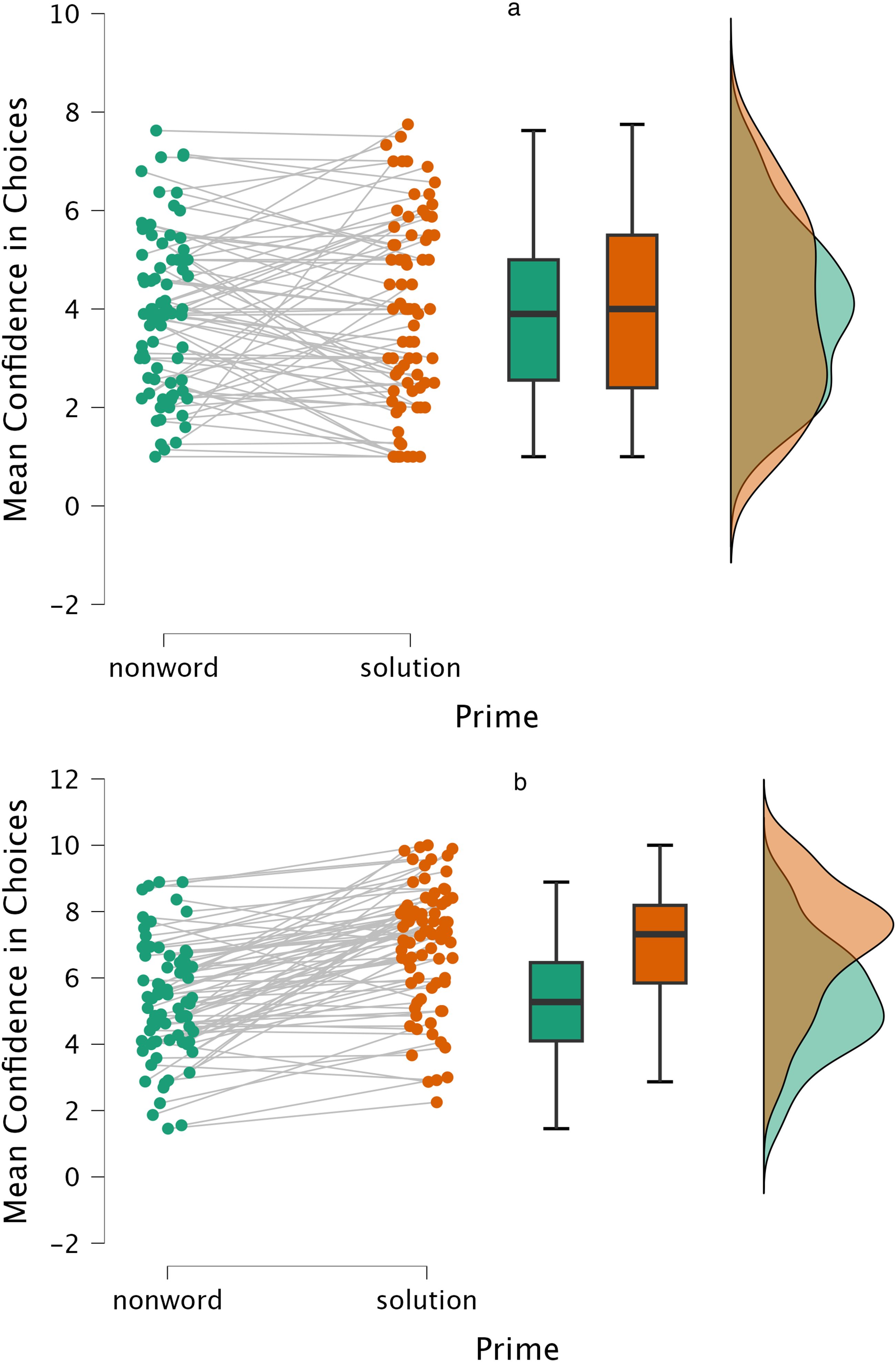
Descriptive statistics provided insight into the effects, with mean confidence levels for errors and hits being 3.920 and 5.314 under nonword primes and 3.926 and 6.961 under solution primes, respectively. This indicates a substantial increase in confidence for accurate choices, particularly under solution primes. Post-hoc comparisons showed that the mean difference in confidence between nonword error and solution error trials was negligible (−.006, SE = .187, p = .975, Cohen’s d = .003), indicating no significant difference in confidence for errors between prime types. However, significant differences emerged when comparing nonword error to nonword hit (−1.394, SE = .235, p < .001, Cohen’s d = .785), solution error to solution hit (−3.041, SE = .239, p < .001, Cohen’s d = 1.713), and between the hits of nonword and solution primes (−1.647, SE = .187, p < .001, Cohen’s d = .928), showing that confidence significantly increases for hits, especially under solution primes.
Semantic Similarity Analysis
We also investigated whether the degree of semantic similarity between primes and triads influenced accuracy and confidence judgments in Study 2. A positive correlation was found between similarity and accuracy (r = 0.24, p = .13), suggesting a weak association between greater semantic similarity and improved accuracy in coherence judgments, though this relationship was not statistically significant in this study.
On the other hand, semantic similarity was significantly correlated with confidence (r = 0.33, p = .035), suggesting that primes with greater semantic similarity to the triad words led to higher confidence in participants’ judgments. These results reinforce the role of semantic similarity in driving confidence, even when its effect on accuracy was weaker.
Discussion
Study 2 extended the investigation into the impact of priming on semantic coherence judgment by employing the Dyads of Triads (DoT) task. The results indicate that priming with solutions significantly increased the accuracy of identifying coherent triads and the confidence in these choices. When participants were unaware of the solutions to the coherent triads, solution primes still substantially enhanced their ability to recognize semantic coherence intuitively. This reinforces the notion that solution priming increases processing fluency, facilitating a more efficient and intuitive grasp of semantic relationships.
Moreover, the significant rise in confidence levels associated with choices when solutions were used as primes highlights the importance of metacognitive knowledge in semantic coherence judgments. Participants exhibited higher confidence in their choices when primed with solutions suggesting a more profound, albeit supposedly unconscious, processing of semantic content facilitated by the primes. This enhanced confidence in intuitive choices highlights the metacognitive aspect of semantic processing, where individuals possess an implicit awareness of their cognitive processes’ accuracy. The findings from Study 2, therefore, not only corroborate the results of Study 1 in illustrating the positive effects of solution priming on processing fluency and metacognitive evaluation but also expand our understanding of how individuals navigate and make judgments about semantic coherence in more complex cognitive tasks. This highlights the interplay between unconscious semantic processing, facilitated by priming, and conscious confidence in semantic coherence judgments.
The results of Study 2 further highlight that semantic similarity influences intuitive judgments. Although the relationship between semantic similarity and accuracy was not statistically significant, the positive trend aligns with the findings from Study 1, where greater semantic similarity was marginally predictive of accuracy. More robustly, the significant relationship between semantic similarity and confidence in Study 2 highlights the role of semantic networks in influencing participants’ confidence in their intuitive judgments. Taken together, the results of both studies suggest that while semantic similarity may have a more consistent impact on confidence than accuracy, the underlying semantic connections between primes and triads play a critical role in shaping participants’ metacognitive experiences during coherence judgments.
General Discussion
The overarching goal of this research was to examine how priming with solutions influences the intuitive judgments of semantic coherence, focusing on both the accuracy of these judgments and the confidence with which they are made. Across two studies, we found compelling evidence that priming significantly enhances processing fluency, improving the accuracy of identifying semantically coherent triads and the confidence in these identifications. Study 1 demonstrated that participants primed with solutions showed markedly higher accuracy and confidence in their semantic coherence judgments than those primed with nonwords. Study 2 built upon these findings by introducing a more challenging task, the Dyads of Triads (DoT), and confirmed that the beneficial effects of solution priming persist even under more complex cognitive demands.
A comparison between the two studies reveals a consistent pattern: solution priming facilitates the accurate recognition of semantic coherence and enhances participants’ metacognitive knowledge about their judgments, as evidenced by increased confidence levels. This suggests a theoretical model wherein priming acts as a cognitive cue that triggers a more efficient retrieval and processing of semantic information, leading to a stronger intuition of coherence and a metacognitive recognition of this intuition’s accuracy. It suggests that semantic priming enhances the recognition of semantic coherence, as evidenced by improvements in accuracy and confidence across both studies. Although the RAT was used as the primary paradigm, we suggest that semantic coherence reflects a broader cognitive mechanism. This construct is likely engaged in various tasks that require individuals to detect meaningful associations, such as language comprehension and memory recall. Future research could explore how semantic coherence operates in other cognitive domains, providing further insight into its generalizability.
This model explicitly refers to and is neatly aligned with literature suggesting that processing semantically coherent stimuli increases the fluency of processing and ignites subtle positive affective responses. These responses might, in turn, be used as a cue for semantic coherence, hence increasing the accuracy of intuitive coherence judgments (Balas et al., 2012; Sweklej et al., 2014; Topolinski & Strack, 2009a, 2009b). Moreover, the same positive response may boost participants’ confidence in intuitive judgments (see (Angie et al., 2011). Therefore, positive affect triggered by processing fluency can help participants be more accurate and more confident in the context of semantic coherence detection.
It is important to note that although we discuss the potential role of positive affect in enhancing processing fluency, we did not directly assess affective responses in this study. Our conclusions about the contribution of positive affect are based on existing theoretical models and past research that has demonstrated a link between processing fluency, positive affect, and confidence (Balas et al., 2012; Topolinski & Strack, 2009b). Future research could benefit from directly measuring affective states to better understand their role in facilitating intuitive judgments of semantic coherence.
Semantic similarity analyses in both Study 1 and Study 2 provide valuable insights into the role of semantic relationships in shaping participants’ coherence judgments. Across both studies, we found that the degree of semantic similarity between primes and triads influenced participants’ accuracy and confidence, although the effects were more pronounced for confidence than for accuracy.
In both studies, greater semantic similarity between primes and triads was associated with higher confidence levels in participants’ judgments. This suggests that when the prime and triad words are semantically related, participants experience enhanced processing fluency, which in turn strengthens their certainty about their judgments. The consistent influence of semantic similarity on confidence across both studies highlights the importance of semantic priming in metacognitive processes. Even when accuracy did not significantly increase, participants tended to feel more confident when the prime was semantically connected to the triad.
Confidence judgments are seen here as a reflection of metacognitive awareness, where participants monitor and assess the accuracy of their intuitive decisions. In line with Anderson et al. (2011) and Metcalfe (2024), metacognition involves monitoring cognitive processes and controlling subsequent decisions or behaviors based on that monitoring. This distinction is important, as metacognition is not merely passive reflection but an active process by which participants adjust their behavior—such as their confidence judgments—based on their awareness of their cognitive performance. In the context of intuitive coherence judgments, participants supposedly engage in metacognitive monitoring by evaluating the strength of the relationships between triads and primes.
However, the impact of semantic similarity on accuracy was more nuanced. While there was a positive relationship between similarity and accuracy in both studies, this effect was weaker and less consistent than its effect on confidence. This indicates that while semantic priming can facilitate more accurate judgments, other factors may moderate this effect, such as task complexity or the triads’ nature. The discrepancy between the effects on accuracy and confidence suggests that confidence, as a metacognitive experience, may be more sensitive to the subjective feeling of fluency generated by semantic similarity than accuracy itself.
Together, these findings reinforce the idea that semantic priming operates through semantic networks, enhancing processing fluency and metacognitive evaluations like confidence (Sweklej & Balas, 2024). The results suggest that while participants’ subjective certainty is reliably influenced by the semantic similarity between primes and triads, their actual judgment accuracy may rely on additional cognitive processes. This underscores the importance of considering both accuracy and confidence as separate yet related outcomes in studies of intuitive judgment, as they may be driven by overlapping but distinct mechanisms.
However, there are limitations to consider. Both studies relied on a specific set of semantic triads, and the priming effect might vary depending on the linguistic or conceptual material type used. Furthermore, using a primarily English-speaking, Prolific-recruited participant pool may limit the generalizability of these findings across languages and cultures. Future studies should explore the applicability of these results using a more comprehensive array of materials and a more diverse participant sample.
Potential directions for future research include investigating the underlying neural mechanisms of semantic priming and its impact on processing fluency, exploring cross-linguistic and cross-cultural variations in priming effects, and examining the role of individual differences in cognitive and metacognitive responses to priming in the context of intuitive coherence judgments (see Zander et al., 2016). Additionally, integrating alternative methodologies, such as eye-tracking (Purcell et al., 2022) or neuroimaging techniques, could offer deeper insights into the temporal dynamics and neural substrates of priming effects on semantic coherence judgments. Also, combining semantic priming manipulation with other sources of affective responses in intuitive semantic coherence judgments may further explore the limits of intuitive cognitive processing (Balas et al., 2012; Sweklej & Balas, 2024; Sweklej et al., 2014, 2015).
In summary, our findings offer preliminary insights into the role of solution priming in enhancing the accuracy and confidence of semantic coherence judgments. These results suggest that solution priming may influence processing fluency and metacognitive evaluations. However, we recommend that future research replicate and extend these findings to confirm their generalizability and explore their implications further. This work underscores the significance of processing fluency and metacognitive awareness in the intuitive assessment of semantic relations, offering a valuable perspective for further exploration in cognitive psychology and related fields.
Footnotes
Declaration of Conflicting Interests
The author(s) declared no potential conflicts of interest with respect to the research, authorship, and/or publication of this article.
Funding
The author(s) disclosed receipt of the following financial support for the research, authorship, and/or publication of this article: This work was supported by the This work was supported by a grant awarded to Joanna Sweklej by the National Science Centre grant no. (2017/25/B/HS6/00551).

Data Availability Statement
The data analyzed in this paper is available: https://www.doi.org/10.58142/swps-wpwwjs-02.24 (Sweklej, 2024).