







Abstract
This study examines the effects of a short-term workcation on psychological and physiological responses. A group of corporate executives (n = 20) volunteered to participate in a three-day workcation program (WG) along with a control group (n = 20) working on daily jobs at usual office (CG). Psychological responses were obtained three times, namely in the week before the workcation, at the end of the workcation day, and one week after the workcation. The heart rate (HR) was acquired on the first day of the workcation (not on a working day) and the end of next day after remote work. The HR variabilities of the LF/HF ratio and HF values were used to evaluate sympathetic and parasympathetic nervous activities. The results were as follows. The workcation increased positive feelings such as liveliness (WG: 15.8 vs. CG: 11.9, p < .05) and well-being (WG: 15.9 vs. CG: 9.6, p < .05) after the workcation; notably, the heightened sense of liveliness of the WG persisted even after one week (end of workcation: 14.5 vs. after one week: 11.6, p < .05). Furthermore, the workcation appeared to cause relief from the work-related stress that could arise from taking a vacation. The HR (bpm) of the WG increased more than that of the CG after the end of the workcation (WG: 76.1 vs. CG: 67.1, p < .05) and the LF/HF ratio of the WG increased from day off to after work (day off: 2.0 vs. after work: 5.4, p <.05), suggesting that sympathetic activities were heightened and might have increased the performance of work-related activities on the workcation program. These findings indicate that a workcation can produce positive effects on psychological and physiological responses.
Introduction
The novel coronavirus disease (COVID-19) pandemic has drastically changed people’s lifestyles globally. It also had considerable influence in Japan, where daily behaviors changed in many aspects. Particularly in businesses, working at office was replace by other ways of working, such as working from somewhere remotely. A new work style—workcation (also spelled workation)—has attracted attention in Japan, with a synergistic effect on the work–life balance, which has been promoted by the Japanese government. In April 2019, the Japanese Parliament enacted workstyle reform laws to change the way people work. One of three focus areas was the “realization of flexible work arrangements.” The law has encouraged companies to introduce new styles of work, such as workcation.
Workcation—a combination of the English words “work” and “vacation” that has originated in the US—is defined as a type of remote work (Nagata, 2021; Pecsek, 2018; Voll et al., 2023). A search across 14 academic databases of EBSCOhost showed that “workation” was used in the American business magazine T + D in May 2003 (T + D, 2003). However, the academic definition of workcation is ambiguous, because, while the word has been used in many situations, the literature on this term is scarce. For example, Pecsek (2018) mentioned that the word workcation was defined only in informal dictionaries as “a paid work trip that can be combined with aspects of taking a vacation. From ‘work’ + ‘vacation’.” Neither the situation nor the description has changed since then (The Online Slang Dictionary, 2023). Pecsek (2018) provided another definition from a tourism perspective: “Workcation is a hybrid type of tourism when tourists travel for either leisure or dual (business and leisure) motive and due to the modern technology, they perform both work and leisure activities away from home” (p. 5). The most up-to-date definition of workcation in western literature might be that of Voll et al. (2023), who subcategorized workcation into three types: “traditional workation (workation in the narrower sense),” characterized by working from a typically vacation destination; “coworkation,” characterized by an “event” because it is often offered as a package with a fixed start and end date; and “workation retreats,” where leisure and community are equally linked, while the domain of the work is the center of attention.
In Japan, although a few studies have attempted to classify and define a Japanese-style workcation, the definition and interpretation vary among researchers, public institutions, and companies (Tanaka & Ishiyama, 2020; Yoshida, 2021). Furthermore, Yoshida (2021) has indicated that workcation has been defined with divergent meanings in Japan, which are different from the European or American meanings. According to Yoshida (2021), a workcation in Japan implies “trying to enhance learning, introspection, and creativity through deep connections with the community” (p. 27), emphasizing a close association with community activities and opportunities of personal growth. In other words, in Japan, a workcation is not only remote work in which individuals leave their workplaces to perform their daily duties, but also intensively includes “coworking,” in some cases, coupling it with a “workation retreat” (Voll et al., 2023) through cooperation with the local community, depending on the arbitrary intentions of the organizers.
Altogether, the academic definition of workcation is still equivocal and needs to be further clarified. Nagata (2021) has simplified the definition as “spontaneously staying at unusual places during working hours for work and leisure time” (p. 23), which provides a good starting point from both tourism and community perspective, as it considers the spontaneity of workers. Without this spontaneity, it should not be called “workcation” but a “business trip.” However, the phrase “during working hours” in the definition implies the local time in the business base; therefore, priority seems to be given to the time of companies.
The emphasis on “working hours” could reduce the advantages of on-demand jobs from a remote place anywhere in the world. Therefore, we define here workcation as “a lifestyle, in which one spontaneously enjoys the time, other than pre-determined working hours, for leisure or private activities, while continuing their regular job from a distant, unusual resort or place, at the local time.” This definition regards workcation as a lifestyle rather than a work style (Japan Workcation Association, 2020). Therefore, work during a workcation should be the same as normal duties over a certain time, while the remaining time could be spent for leisure or personal activities. This definition could be regarded as “traditional workation” + “workation retreat” as described by Voll et al. (2023).
Three perspectives regarding workcation are worth noting: (1) the general healthcare of workers, which supports the appropriate work–life balance in a business context to promote physical and mental health and wellbeing (Arai et al., 2022; Miyamoto & Ogata, 2023; Negoro & Kobayashi, 2022); (2) human resource management, including the recruitment, hiring, placement, and management of employees for better performance (Miyamoto & Ogata, 2023); and (3) tourism, in which travel could have a significant economic impact not only on companies but also on local communities and governments (Ogata & Miyamoto, 2023; Pecsek, 2018; Shin et al., 2024). This study mainly aims to clarify the general healthcare of workers concerning their physiological and psychological reactions to changing the work mode from office to remote working during a workcation.
There is a lack of empirical evidence regarding the concept of workcation (Voll et al., 2023), although some empirical studies do exist. According to the findings of these studies, a workcation reduces participants’ psychological “stress,” improves positive emotions (Arai et al., 2022; Lee et al., 2024; Miyamoto & Ogata, 2023), and increases work engagement and psychological detachment (physical and mental detachment from work outside work hours) (Iwaasa et al., 2022; Lee et al., 2024). Lee et al. (2024) conducted interviews with 21 company employees who had experienced a workcation during the past two months and categorized the impacts of the workcation. They showed positive effects such as enhanced levels of work engagement, increased innovativeness at work, improving subjective well-being, and a desire to experience a workcation again. In their study of remote work, Nawijn and Damen (2014) compared emotional experiences between individuals who worked during their vacation and those who did not. However, they reported no significant differences in emotional experiences, suggesting that work during vacation does not reduce positive emotions. In addition, according to self-determination theory, autonomy enhances intrinsic motivation and improves well-being (Ryan & Deci, 2000). Therefore, if people can achieve fulfillment of work and vacation autonomously as part of a workcation, a workcation has the potential to enhance positive feelings among participants. The effects of workcation on physiological responses have been also studied for a five-day workcation program, showing that a workcation improves the cardiovascular parasympathetic function during sleep (Negoro & Kobayashi, 2022). However, all these studies on workcation focused either on psychological or physiological responses, few having measured both psychological and physiological responses to evaluate the impact of workcations on mental health. It is known that psychological and physiological responses to stress are interrelated and have been reported to influence general health (Gianaros & Wager, 2015). Therefore, we approach the issue from both the psychological and physiological perspectives in this study.
Based on the above-mentioned consideration, Imai et al. (2022) conducted a preliminary study to investigate the effects of a short-term workcation on the mental and physiological responses of business-management workers and regular service workers. During the two-day workcation at a resort hotel, the effects of a self-development program and normal duty jobs on psychological and physiological reactions were examined. The results showed that the cardiovascular reaction of the high frequency component (HF, 0.15–0.4 Hz frequency band), a power value calculated from the R-R wave interval of electrocardiograms (ECG) that reflects parasympathetic nervous activity, increased significantly one week after the workcation in regular service workers, although there was no significant effect on psychological measures. However, the results were inconclusive because of the small sample size. Therefore, we need to accumulate further evidence on the effects of workcation.
An important issue in human resource management in Japan is that few companies allow employees to follow a workcation lifestyle. In other words, whether the concept of workcation will spread in Japan depends on corporate and human resource management. As such, human resource professionals, such as managers, should experience workcations themselves and explore their effects on their physical and mental health. In this study, we examined the effects of the spontaneous participation in a short-term workcation of three days with leisure activities on the psychological and physiological responses of corporate executives and managers.
Method
Participants
Two groups were constructed to either participate in the workcation program (workcation group; WG) or engage in their daily jobs (control group; CG). The WG consisted of 20 adult men (mean age 50.8 ± 6.6 years), who were all corporate middle-level executives or general managers. They were recruited through web-based news sites, social networking services, and newspaper articles and spontaneously consented to participate in this program. Twelve of them came from large companies (over a thousand employees) and eight from small and medium-sized enterprises (below a thousand employees). Their industrial classifications of corporation were as follows: eight were in “living-related and personal services and amusement services,” seven in “manufacturing,” two in “scientific research, professional and technical services,” and one each in “wholesale and retail trade,” “finance and insurance,” and “information and communications.” The CG comprised 20 adult men (mean age 45.0 ± 11.3 years) for matching the gender of the WG, of which were 10 management-level employees and 10 general employees; they also spontaneously consented to participate in this research project. Ten of them came from large companies and 10 from small and medium-sized enterprises. There were 10 participants each from “living-related and personal services and amusement services” and “real estate and goods rental and leasing.” Informed consent was obtained from all participants before the study. The institutional ethics board of the author’s university approved the experimental protocol (No. 22013, 2022).
Experimental Design
The experimental design was a two-factorial mixed design: WG/CG and measurement time of psychological indexes (pre-workcation (pre)/workcation/post-workcation (post)) or of physiological indexes (day off/workcation).
Psychological Measures
The questionnaires used to measure psychological states were created on an exclusive website using the online questionnaire creation platform Qualtrics (https://www.qualtrics.com/jp/). The following four aspects were measured to examine changes in the subjective emotional and stress states. The questionnaires used to assess the following psychological measures had been thoroughly tested for reliability and validity in the original studies.
Multiple Mood Scale (Short Version)
The Multiple Mood Scale (MMS; Terasaki et al., 1992) measures various emotional states and consists of eight factors with 10 items (five items in the short version) each. In this study, we used five items each from the MMS-short version to measure the pleasant emotional states of “Liveliness” and “Well Being.” In the MMS, liveliness is measured by items reflecting feelings of being energetic and vigorous, thus representing an active positive state. By contrast, Well-being is assessed by feeling calm and relaxed, indicating a passive positive state. The participants were asked to indicate the degree to which they were currently feeling these emotions on a four-point scale (1: not at all, 2: not very much, 3: a little, and 4: clearly).
Mood Inventory
The Mood Inventory measures a wide range of emotional states such as fatigue, tension, and pleasant feelings (Sakano et al., 1994). It consists of five factors with eight items each. Of these, we used eight items for the three factors of “Tension and Excitement,” “Refreshing Mood,” and “Fatigue,” for a total of 24 items. Participants responded to each item by choosing the option most applicable to their current mood on a four-point scale, ranging from “not at all” (1 point) to “very much” (4 points).
Workplace Segmentation Preferences
The Workplace Segmentation Preferences scale was developed by Kreiner (2006) and uses four items to measure the general attitude toward the workplace and home on a seven-point Likert-type scale, with 1 representing “strongly disagree,” 4 “neutral,” and 7 “strongly agree.” The four items are as follows: “I don’t like to have to think about work when I’m at home,” “I prefer to keep work life at work,” “I don’t like work issues creeping into my home life,” and “I like to be able to leave work behind when I go home.” This scale was translated into Japanese by the authors.
The Brief Job Stress Questionnaire
To measure job-related stress, we used the Brief Job Stress Questionnaire (short version; Kato, 2000). The questionnaire comprises 23 items, of which we used 17 items: six for “Job Stress” (work burden and work control) and 11 for “Psychological Stress Reactions” (e.g., severe fatigue, exhaustion, and others). Participants were asked to rate each item with 1 for “almost never,” 2 for “sometimes,” 3 for “often,” and 4 for “almost always” as the most applicable case for the job or condition.
Physiological Measure
Electrocardiogram (ECG)
The ECG was recorded as a physiological cardiovascular response. A portable ECG recording device (Checkme Pro Advance B model, SAN-EI MEDISYS) with a sampling rate of 500 Hz was used. To ensure stable ECG recordings, an optional lead wire for ECG measurement and disposable electrodes were used. Electrodes were attached to the right and left wrists on the palmar side to measure using lead I. During measurement, the participants were asked to relax and not move. To suppress irregular arm movements, they were asked to sit on a chair with their arms resting on a table during the 5 minutes of measurement.
Procedure
WG
In late October 2022, we conducted a three-day/two-night workcation program with recreational activities on the first and the last days and remote working on the second day at a resort hotel in Chino City, Nagano Prefecture, Japan. Psychological indexes were measured on three occasions: one week before the workcation program (pre-response), immediately after the work-day (workcation), and one week after the program (post-response). The questionnaires were answered between 18:00 and 20:00 for all occasions, in accordance with the time progression of the workcation program, and all responses were collected online. Physiological responses were measured twice: after the end of the first day and immediately after the work-day of workcation program.
The workcation program started in the afternoon of the first day with a recreational activity. On this day, all participants first visited a long-established Japanese sake brewery in Suwa City next to Chino City for 1 hour and attended 1 hour talk by the brewery owner on the essentials of the sake brewery business. After the talk, all participants were gathered in a seminar room at the hotel and participated to a one-hour group discussion to reflect and review the talk given by the brewery owner. Subsequently, the ECG measurement process was explained to them. Following the instruction, each participant operated the device and recorded their own ECG for 5 minutes (day off). On the second day, after work and completion of the measurement of subjective indexes, they were asked to record the five-minute ECG in their own rooms (after work; Figure 1(A)). On the last day, in the morning, all participants freely enjoyed recreational activities such as golf, molkky, forest adventures, walking, or their own private activities, and the workcation program was closed in the afternoon. Experimental schedules for the workcation and control groups. (A) Workcation group (WG), (B) Control group (CG).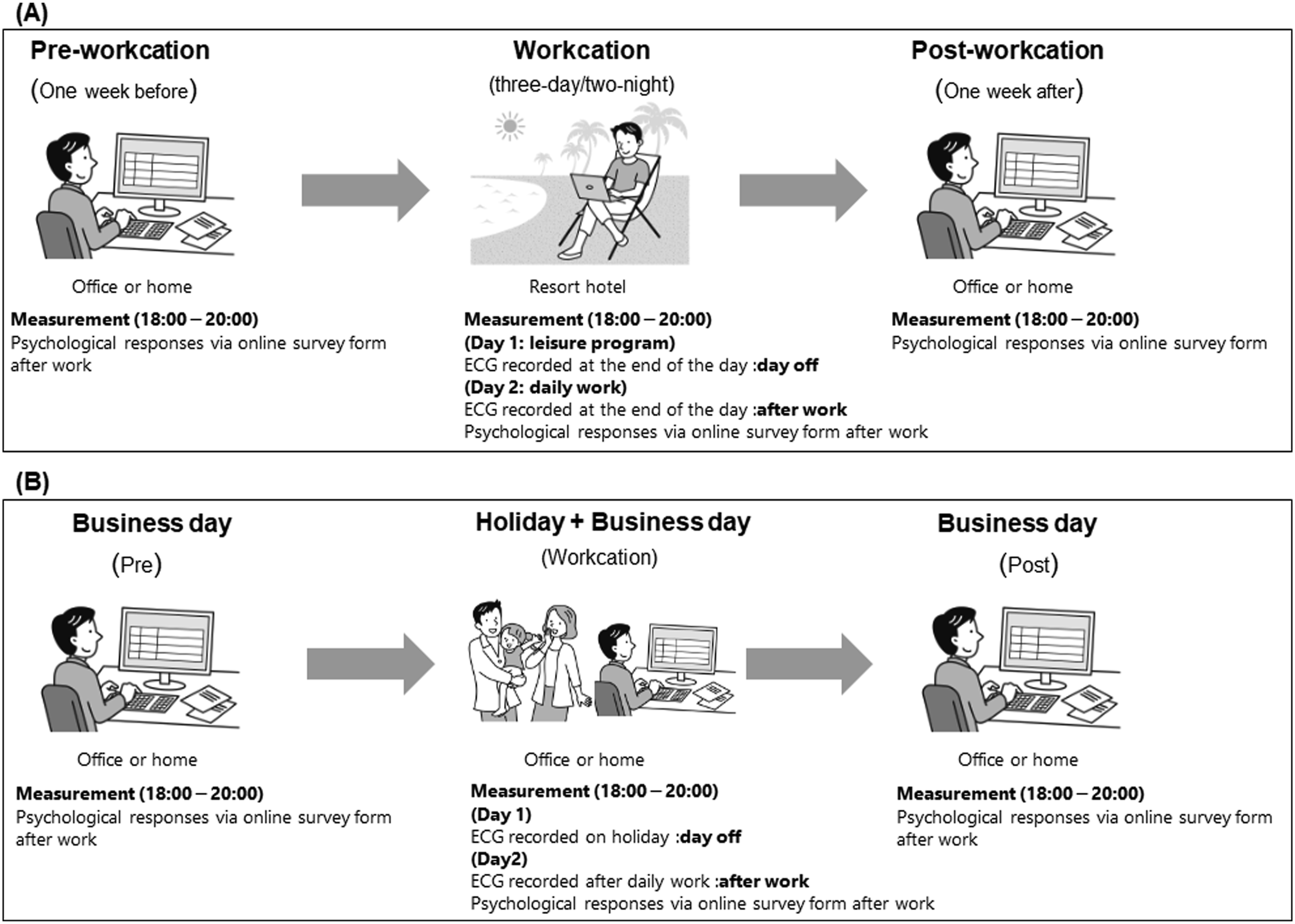
CG
The data of the CG were collected in early November 2022. The CG was requested to cooperate in measuring the psychological and physiological responses by email with the help of an instructional manual. Each participant responded to all online questionnaire items on three occasions following the same procedure as the WG. The first occasion was the end of a work-day. After one week, the second occasion was immediately after the end of the “working day following a holiday” (this day corresponded to “after work” for the WG for ECG measurement). The third occasion was immediately after the end of a “working day,” which was one week after the second occasion. The response time was between 18:00 and 20:00. Physiological responses were measured twice by self-recording of ECG on a holiday (corresponding to “day off” for the WG) and on the end of the work-day immediately following the holiday. The CG were asked to record the ECG between 18:00 and 20:00 before dinner, and requested to refrain from drinking, eating, and smoking before each measurement (Figure 1(B)).
Data Analysis
We conducted a two-way repeated-measures ANOVA with group and occasion factors. Post-hoc analyses were performed for each factor using Shaffer’s modified sequentially rejective Bonferroni procedure (p < .05). The Greenhouse–Geisser correction of degrees of freedom (df) was applied if the sphericity assumption was violated. The analyses were carried out using R version 4.3.2 and the R function “anovakun” (free software by Ryuta Iseki, version 4.8.9).
For the psychological indexes, data for only those who responded to the questionnaires on all three occasions were analyzed. Six respondents in the WG and eight in the CG missed one of three occasions to respond, and these data were excluded from analysis. There were 14 participants in the WG (mean age 50.8 ± 7.5 years) and 12 in the CG (mean age 45.4 ± 10.8 years) included in the analysis. The CG consisted of six managers (mean age: 51.2 ± 7.6 years) and six general employees (mean age: 39.7 ± 11.0 years). The ECG data for only those who recorded two ECG measurements were also analyzed. One participant in the CG missed the measurement and seven recorded the ECG at the wrong time. There were 20 participants in the WG and eight managers (mean age 54.3 ± 5.1 years) and four general employees (mean age 39.5 ± 10.3 years) in the CG. 1 We decided it was essential to maintain data recording time and condition constant as possible, not only for psychological data but especially for physiological responses, so the missing data were not compensated.
Psychological Measures
For each psychological index, coefficients of reliability were calculated for each item. The coefficient was low for work stress (α = .50), but high for the other indexes (α = .80 to .99). Therefore, the sum of the rating scores for each measurement occasion was analyzed.
Physiological Measures
The data stored in the portable ECG recording devices were extracted using handmade software. Then, the average heart rate (HR) over a five-minute period was calculated as a beat-per-minute (bpm) value. In addition, heart rate variability (HRV) scores were used as indexes to indicate the degree of involvement of the sympathetic and parasympathetic nervous systems separately. The HRV separates high frequency (HF) and low frequency (LF) components and analyzes the variability of each component. Each R-R wave interval of the ECG was serially scored as a bpm value and plotted sequentially like a tachograph. These accumulated bpm values were calculated by fast Fourier transformation (FFT) and separated into two frequency bands of the LF (0.04–0.15 Hz) and HF components (0.15–0.4 Hz). The LF value reflects the results of blood pressure regulation and fluctuates according to the activation of both the sympathetic and parasympathetic nervous systems. The HF value reflects the fluctuation of the HR due to respiration and changes according to the parasympathetic nervous system activity. The LF/HF ratio was calculated to obtain an index to evaluate the sympathetic nervous system activity modulated for the parasympathetic nervous system activity and the HF value as an index of parasympathetic nervous system activity.
Data Analysis after the Experiment for the CG
As the CG included participants with different job positions, job position effects were preliminarily analyzed within the CG. No significant main effect of job position or occasion or interaction effect between job position and occasion was found for all psychological and physiological indexes. Therefore, the data for 12 participants were analyzed.
Results
Psychological Measures
The descriptive statistics for Liveliness and Well Being, which showed significant interaction effects between group and measurement occasion, are presented in Figure 2(A) and (B). The descriptive statistics for other psychological measures are summarized in Supplement 1. Total scores for psychological and physiological measures for each group across three measurement points. (A) Total score for Liveliness, (B) Total score for Well-Being, (C) Mean HR, (D) Mean low and high frequency (LF/HF) ratio, (E) Mean high frequency (HF) value. The error bars reflect within-subject SEM. WG means workcation group and CG control group.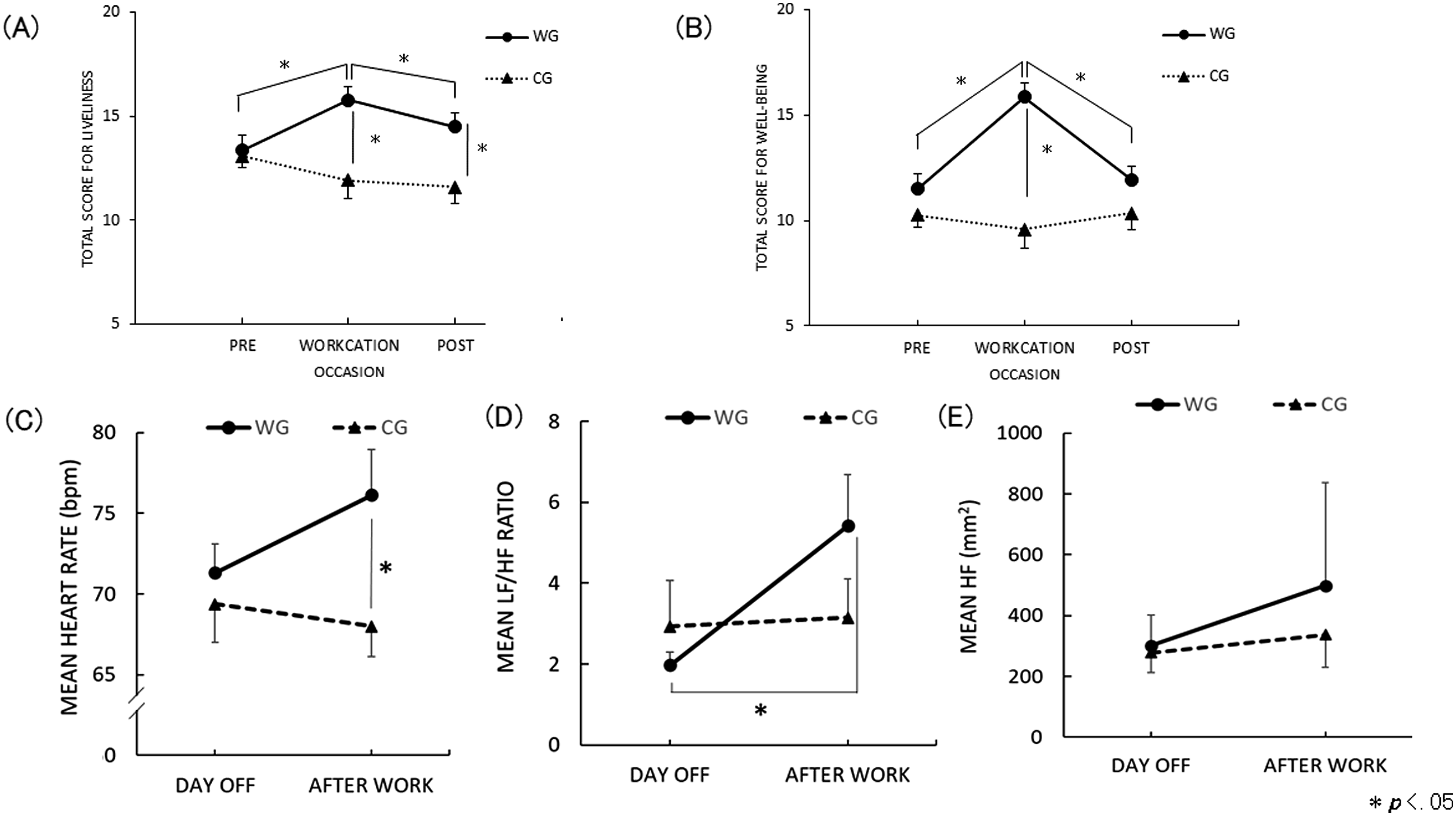
Liveliness
Figure 2(A) shows the mean liveliness scores for each group on three occasions. An analysis of variance (ANOVA) revealed significant main group and interaction effects between group and occasion (F (1, 24) = 8.59, p < .01, ηp2 = .26 for group; F (2, 48) = 6.34, p < .01, ηp2 = .21, ε = .96 for interaction). The main effect of occasion was not significant (F (2, 48) = 1.32, n.s., ηp2 = .05).
Simple main effects for each group were significant for workcation and post-workcation (F (1, 24) = 12.94, p < .01, ηp2 = .35 for workcation; F (1, 24) = 8.66, p < .01, ηp2 = .27 for post), but not for the pre-workcation (F (1, 24) = 0.08, n.s., ηp2 = .00). Scheffe’s multiple comparison revealed significant differences between pre- and workcation and between pre- and post-workcation in the WG. The simple main effect of occasion was not significant in the CG (F (2, 22) = 2.14, n.s., ηp2 = .16). The analyses showed significant increase in Liveliness scores during the workcation compared to pre- and post-workcation only in the WG.
Well-Being
Figure 2(B) shows the mean Well-Being scores for each group on the three occasions. The ANOVA revealed significant main effects for both group and occasion, as well as the interaction between the two (F (1, 24) = 8.05, p < .01, ηp2 = .25 for group; F (2, 48) = 4.31, p < .01, ηp2 = .15, ε = .91 for occasion; F (2, 48) = 8.49, p < .01, ηp2 = .26, ε = .91 for interaction) were observed.
A simple main effect of group was significant in workcation (F (1, 24) = 28.18, p < .01, ηp2 = .54), but not in pre and post (F (1, 24) = 0.91, n.s., ηp2 = .04 for pre; F (1, 24) = 1.16, n.s., ηp2 = .05 for post). A simple main effect of occasion in the WG was significant (F (2, 26) = 11.59, p < .01, ηp2 = .47). Scheffe’s multiple comparisons revealed significant differences between pre- and workcation and between pre- and post-workcation. The simple main effect of occasion was not significant in the CG (F (2, 22) = 0.42, n.s., ηp2 = .04). The analyses showed significant increase in Well-Being scores during workcation compared to pre and post only in the WG. In addition, compared to the CG, the WG showed a significantly higher Well- Being score during the workcation.
Tension and Excitement
The ANOVA revealed that the main effects of group and occasion and the interaction between the two were not significant (F (1, 24) = 0.19, n.s., ηp2 = .00 for group; F (2, 48) = 1.24, n.s., ηp2 = .05, ε = .71 for occasion; F (2, 48) = 1.32, n.s., ηp2 = .05, ε = .71 for interaction). Thus, Tension and Excitement scores did not differ significantly either with or without workcation program, or for different occasions of measurement.
Refreshing Mood
The ANOVA revealed the significant main effects of group and occasion (F (1, 24) = 8.20, p < .01, ηp2 = .25 for group; F (2, 48) = 4.88, p < .01, ηp2 = .17 for occasion), while interaction between them was not significant (F (2, 48) = 1.26, n.s., ηp2 = .05). A subsequent analysis showed that both groups had significantly higher Refreshing Mood scores in workcation than in both pre and post. The WG also indicated significantly higher Refreshing Mood scores than the CG.
Fatigue
The ANOVA showed a significant main group effect (F (1, 24) = 4.91, p < .01, ηp2 = .04). The main occasion effect and the interaction between both main effects were not significant (F (2, 48) = 0.76, n.s., ηp2 = .03 for occasion; F (2, 48) = 0.63, n.s., ηp2 = .03 for interaction). The CG consistently showed significantly higher Fatigue scores than the WG for all three occasions.
Segmentation Preferences
The ANOVA revealed a significant main group effect (F (1, 24) = 7.53, p < .05, ηp2 = .24), with consistently higher score in the CG than in the WG on all occasions. The main occasion effect and the interaction between both main effects were not significant (F (2, 48) = 0.26, n.s., ηp2 = .01 for occasion; F (2, 48) = 1.23, n.s., ηp2 = .05 for interaction).
Job Stress
The ANOVA revealed that the main effects of both group and occasion and their interaction were insignificant (F (1, 24) = 0.57, n.s., ηp2 = .02 for group; F (2, 48) = 3.00, n.s., ηp2 = .11 for occasion; F (2, 48) = 1.41, n.s., ηp2 = .05 for interaction). The analysis also indicated that the Job Stress scores did not differ significantly with or without workcation or across the three occasions.
Physical and Mental Stress
The ANOVA revealed that the main effects of both group and occasion, as well as their interaction, were all insignificant (F (1, 24) = 0.90, n.s., ηp2 = .04 for group; F (2, 48) = 1.12, n.s., ηp2 = .04 for occasion; F (2, 48) = 2.45, n.s., ηp2 = .09 for interaction). The analysis also showed that the Physical and Mental Stress scores did not differ significantly with or without workcation or across the three occasions.
Physiological Measures
HR
Figure 2(C) shows the mean HR for each group on the two occasions of day off and after work. ANOVA revealed a significant interaction between main effects (F 1, 30) = 4.41, p < .05, ηp2 = .13). There was also a marginal difference (F (1, 30) = 3.50, p < .08, ηp2 = .10) for the main group effect. Simple main effect tests showed only a significant difference between the WG and CG on after work (F (1, 30) = 5.48, p < .05, ηp2 = .15) and a marginal tendency of increase in HR from the day off to after work in the WG (F (1, 30) = 3.61, p < .10, ηp2 = .11).
LF/HF Ratio
Figure 2(D) shows the mean LF/HF ratio for each group on two occasions. ANOVA revealed a significant main occasion effect (F (1, 30) = 5.35, p < .05, ηp2 = .15) and an interaction between main effects (F (1, 30) = 4.34, p < .05, ηp2 = .13). Simple main effect tests showed that the increase in the LF/HF ratio from day off to after work was significant only in the WG (F (1, 30) = 8.69, p < .01, ηp2 = .31).
HF Values
Figure 2(E) shows the mean HF values for each group on two occasions. ANOVA found that both main effects and interaction were not significant (F (1, 30) = 0.01, n.s., ηp2 = .00 for group; F (1, 30) = 1.25, n.s., ηp2 = .04 for occasion; F (1, 30) = 0.01, n.s., ηp2 = .00 for interaction).
Discussion
We examined the effects of participation in a short-term workcation program with leisure activities on the psychological and physiological responses of participants in the WG, mainly corporate executives and managers, relative to those of a CG. The results supported improvements in psychological and physiological responses after attending the workcation program.
Psychological Measures
Liveliness and Well-Being scores were significantly higher in the WG than in the CG at the end of the workcation day. In addition, only the WG showed significantly higher Liveliness and Well-Being at the end of the day of workcation compared to the CG before (pre) and after (post) the workcation. In particular, the Liveliness score was significantly higher in the WG even one week after the workcation. The WG felt more refreshed and was less-fatigued than the CG on all measurement occasions. No significant differences were observed in Tension and Excitement between the groups on any occasion. These findings indicate that positive emotions, including liveliness, characterized by high-activated pleasantness, and well-being, defined as low-activated pleasantness, increase following a short-term workcation. In addition, liveliness persisted one week after the workcation. Therefore, WG felt more refreshed and less fatigued than the CG after attending the workcation.
Various positive effects of workcations have been reported, including decreased work-related stress and improved mental health, work–life balance, productivity, and flexibility (Kurniasari et al., 2022). The increase in positive affects in this study is thus consistent with extant findings. The effects of workcation on psychological feelings obtained in this study appeared as increases in positive feelings of liveliness as “full of activity” and “full of energy” and well-being as “relaxed” and “comfortable” (Terasaki et al., 1992). These changes in positive affects suggest that the feelings related to activity and energy, as well as those related to relaxation and comfort, have enhanced, because the workcation program was conducted in an environment different from the usual workplace. The results are also consistent with the extant finding that 21 company employees reported an increase in subjective well-being after experiencing workcation in the last two months (Lee et al., 2024).
It is noteworthy that the Liveliness scores for the WG remained significantly higher than those for the CG even one week after the workcation. This suggests that the increase in liveliness induced by the workcation persisted for at least a week. Existing studies have shown that a vacation has stress-relieving effects and that positive emotions increase during vacations (De Bloom et al., 2010; Nawijn, 2011). However, these effects may be temporary, as the heightened positive mood during a vacation can rapidly decrease and fatigue can increase when people return to work (De Bloom et al., 2009). Furthermore, indicators of health status, mood, tension, energy levels, and satisfaction reach the usual levels one week after a vacation (De Bloom et al., 2010). In our study, the result that the positive mood enhancement by the workcation persisted for at least one week after the workcation suggests that the workcation could have a more sustained positive effect for psychological states compared to a vacation. As self-determination theory (Ryan & Deci, 2000) proposes, when people can autonomously choose between vacation and work, such as in a workcation, it may enhance well-being and sustain positive emotions.
The higher Refreshing Mood and lower Fatigue scores in the WG on all occasions could be due to the prior knowledge of attending the workcation program. The WG completed the questionnaire one week before participating in the workcation, and this procedure made them “excited” for traveling to a different location in near future, which may have heightened their feeling of having a refreshing mood. The same reason may be considered for the lower fatigue level. In other words, the differences between WG and CG in Refreshing Mood and Fatigue scores could be due to the effects of the expectation of participating in the workcation, as people report more intense emotions during anticipation of, than during retrospection about, emotional events that were positive and negative (Van Boven & Ashworth, 2007).
The tendency to separate work and personal life was indicated by the significantly lower Segmentation Preferences score in the WG than that in the CG on all occasions. Considering the recruitment method used in this experiment, it is likely that only participants with high motivation joined the workcation program. One aim of a workcations is to blur the boundaries between personal life and work. Therefore, individuals who scored low on Segmentation Preferences may have found the new workstyle of workcation appealing and chose to participate.
For general stresses, there were no significant differences in job stress and physical and mental stress between groups on any occasion and among occasions for both groups. Although a previous study has showed the reduction of job-related stress as the effect of a workcation (Kurniasari et al., 2022), no such influence was observed in this study. The duration of a workcation and differences in job types may have resulted in inconsistent findings with those showing the reduction of job-related stress. In this study, the workcation program was scheduled for two nights and three days, whereas Kurniasari et al. (2022) reported that 78% of participants had workcations lasting more than three days. Additionally, they asked participants about the notion of reducing effect of job stress by workcation using “yes–no” forced-choice technique, but items for job stress were rated on four-point scale in our study. These methodological differences in contents and context of questionnaire items may have caused the inconsistencies between findings.
Moreover, while the workcation increased subjective well-being, the absence of differences in stress levels seems contradictory at first glance. Well-being has complex and broad meanings. It contains positive feelings but also physical or mental health or a good quality of life (Ryan & Deci, 2001). By contrast, the stress indicators used in this study were focused on work-related measurements, which likely assess the actual burden of work. In other words, even if participants subjectively felt more relaxed, the quantity of work remained unchanged, which might explain the lack of reduction in work-specific stress.
Further, no effect on job stress suggests that participants in the workcation may be free from work-related stress. For example, under the usual job routine in which the work and vacation are separated, workers would easily experience “working-ahead stress,” in which they have to work harder to take vacations (De Bloom et al., 2010). Additionally, they could experience “catch-up stress” that they will have a larger-than-expected workload after vacation (De Bloom et al., 2010; Fritz & Sonnentag, 2006). Since these stresses could impair job performance and well-being (De Bloom et al., 2010; Fritz & Sonnentag, 2006), some controversies exist on the effects of vacations. Conversely, a workcation might not produce the negative effects of increased workloads. In other words, a workcation would have the advantage of relief from “stress of leaving from work” associated with a vacation rather than reducing work stress directly. As such, research on the effects of workcation on job stress should be considered in relation to “work and vacation” stress if it is practiced in the daily business. In addition, the season of the workcation should be considered as an important determinant. If the company experiences a busy period, it would be challenging to opt for a workcation, especially in a social context as that in Japan, where workcations are not prevalent. In the present study, we conducted the workcation program in late October when the workload is comparatively lower than usual, which contributed to relatively low psychological stress, regardless of the work style. To clarify the impact of workcation on job stress, the effects of the workcation program should be examined both in an ordinary season and in a peak season.
Physiological Measures
In general, HR increases during physical activity and excitement and decreases during rest. In this present study, the HR of the CG did not change significantly from the day off to after work. However, that of the WG increased significantly on the day of workcation compared to the day off (corresponded to the holiday for the CG). Early studies examining HR have shown that during a simple language task, it increased for high performance more than it did for low performance (Andreassi, 1966) and was higher during excellent tracking trials than during low performance ones (Malmo, 1965). Thus, high performance in a task involving low stress is associated with high HR. Considering these results, HR in the CG did not change between a normal holiday and the next work-day, suggesting no change based on stressful reactions or typical performance. However, HR increased after the end of workday in the WG, suggesting that the level of performance may have increased in participants who spontaneously attended the workcation program. Recently, however, findings of HR increase in relation to task performance in the literature have been equivocal. For instance, higher HR was obtained by a warm-up period before vineyard work with higher work performance after warm-up (Larinier et al., 2024). While HR changed to olfactory stimulations in accordance with the stimuli for the direction of the increase (stress-inducing) or decrease (relaxing), the performance of decision-making task did not differ among olfactory conditions (McDermott et al., 2022). Further, the performance of cognitive tasks was better in visual stimulation of home office design in virtual reality environment than olfactory and olfactory + visual stimulations, and HR did not change between those three stimulations (Li & Kim, 2024). As we did not examine an index of performance in this workcation program, it is unclear whether the increase in HR could be related to performance enhancement. Future studies should measure performance indexes closely related to daily work of participants. Another possibility is that the workcation itself was a “stressful” environment for the WG because it was different from their daily routine. HR has been shown to increase during stressful tasks such as zip-wire sliding (Lewis et al., 1984). However, this may not be the case based on the results of higher scores in psychological responses such as liveliness and well-being.
For the LF/HF ratio, the interaction between group and occasion was significant, indicating that the ratio increased significantly from the day off to after work only in the WG. In the CG, there was no change between day off and after work, indicating that sympathetic nervous activities after a holiday are similar to those after a usual workday in the CG. Conversely, sympathetic nervous activities after work were higher than those of “holiday (day off)” in the WG, suggesting that the workcation program increased physiological activities more than a usual day off.
By contrast, no significant effects were observed in HF. Therefore, parasympathetic nervous activities did not change between the day before and on the day of workcation, suggesting that the activities dis not vary depending on work in short-term workcation program or in usual office.
In summary, the findings regarding cardiovascular responses suggest that a short-term workcation program increases sympathetic nervous system activities after it ends, resulting in increases in HR and LF/HF ratio compared to the previous holiday. Since there was no effect of group or occasion on the HF value, the increase in sympathetic nervous system activity was more pronounced in the WG for our short-term workcation program.
Studies focusing on HR variability such as the LF/HF ratio in cardiovascular responses has reported that the high HR variability group had faster reaction times and higher correct response rates for the cognitive tasks (Hansen et al., 2003) and that high HR variability at rest was associated with higher individual emotion regulation ability (Thayer & Lane, 2009). More recently, the LF/HF ratio when viewing positive emotion evoking videos was found as higher compared to that when viewing negative emotion evoking ones (Nakajima et al., 2017). The fact that the LF/HF ratio increased after the workcation day may be associated to an increase in performance with a higher emotion regulation ability in individuals in management positions and may be related to the increased emotional states such as liveliness and well-being. Park et al. (2022) suggested that the HR or HRV are adequate for assessing negative emotions. Although our findings were not consistent with their conclusions, they suggest that some positive feelings could be related to the cardiovascular response at a workcation environment.
Considering the psychological and physiological effects together, a workcation may contribute to amplifying job resources. According to the job demands–resources model (Demerouti & Bakker, 2011), every occupation has specific risk factors associated with occupational stress. These factors are categorized into the two groups of job demands and job resources. Job resources have the potential to enhance motivation, which can in turn lead to improve job engagement and performance. A workcation, which provides a refreshing environment that enhances positive emotions and increases job satisfaction, may have a motivational role for job resources.
Limitations and Future Research Scope
Some comments are remarked for limitation of our findings and future research. First, we organized a control group to distinguish the effects of the workcation for the WG. Empirical research findings on workcations are being increasingly reported (Arai et al., 2022; Kurniasari et al., 2022; Miyamoto & Ogata, 2023; Ogata & Miyamoto, 2023; Pecsek, 2018; Shin et al., 2024; Tanaka & Ishiyama, 2020); all these studies but one (Iwaasa et al., 2022), have examined effects of workcation using a “within-subject design.” The demand effect is an issue when participants interpret the experimenter’s intention and behave accordingly or provide answers to satisfy their perceptions of the experimenter’s expectations and consciously/unconsciously change their behavior (Rosenthal, 1976; White, 1977). Charness et al. (2012) reviewed these issues that surround within-subject and between-subjects designs and has noted that “We ourselves tend to prefer between designs whenever these are practical, as we believe these represent more conservative tests and we would rather err on the side of caution.” We have learned the merits of within-subject design, agree with Charness et al. (2012), and believe that the between-subject design is preferable to examine the effects of unknown and relatively new phenomena in reality. At the same time, our results should be interpreted cautiously, because of the relatively small number of participants in the study. As the limited time management of this study did not allow us to find a different way to collect a larger sample, further research on this topic with larger samples will add to the knowledge on the relation between workcations and general healthcare.
Second, we did not assess the work performance of the participants and the effects of the workcation on their performance are unclear. In this workcation program, the participants were executives or managers, had a large variety of job types, and the nature of their work on the workcation and/or daily jobs was at their own discretion. It is challenging to obtain an index of performance on a “real” work situation in a corporate office; however, a large accumulation of evidence should make the effects of a workcation on real performance more comprehensible.
Third, we applied HR and HRV as physiological indexes and a set of psychological inventories used mainly for Japanese individuals. Our purpose was to elucidate issues on the general healthcare of workers as a result of the physiological and psychological reactions to enjoying in the workcation environment. Physiological responses such as EEG, cortisol, and blood pressure have been shown to be good indicators of stress and general health (Tyra et al., 2024). Psychophysiological indicators of interoceptive processing such as heartbeat-evoked potentials, respiratory-related potentials, cardiac modulation of startle, or EEG–ECG single trials seem promising for assessing general health in the absence of participant reports (Farb et al., 2015; Garfinkel et al., 2017); however, these are not easy to measure in a field study. Thus, we relied on ECG as a physiological response, as it can be measured easily by non-experts. As our findings of physiological response of HR and HRV were thus limited to the cardiovascular response, using other indexes could be useful to accumulate the research evidence in this field. This also applies to the psychological indexes measured in this study. There are many psychological scales for measuring emotional states and general health, and the results could vary as such. The findings on psychological responses should still be interpreted conservatively.
Fourth, the findings are based on a three-day short-term workcation, and it is unclear whether the effects of a long-term workcation program have potential impacts on psychological, physiological, and behavioral reaction. Negoro and Kobayashi (2022) conducted a five-day workcation program and showed improvements in cardiovascular parasympathetic function during sleep; the five-day program is still short-term. A longitudinal study examining a couple of weeks or months of workcation program should provide more robust and new findings about the long-term impact of workcations.
Finally, all participants were men, and the study was not balanced in terms of gender and did not consider personal attributes such as life circumstances. Because the manner of recruitment for the workcation program relied on the “spontaneity” of the participants in this study, we included only male corporate managers based on social media advertising. This likely led to having more male participants because female corporate managers are few in Japan (8.4%; Teikoku Databank, 2024; 8.2% in study year, 2022). As such, it may be difficult to request female corporate managers to join a workcation program. We hope to be able to involve female managers in workcations in the near future.
Conclusions
The workcation increased positive feelings such as liveliness and wellbeing; notably, the heightened sense of liveliness persisted even after one week. Furthermore, the workcation showed potential for providing relief from the work-related stress that may arise from taking a vacation. From physiological aspects, the HR and LF/HF increased after the end of workcation, suggesting that sympathetic nerve activities and the level of performance may have increased. These findings indicate that workcations may produce positive psychological and physiological effects.
Supplemental Material
Supplemental Material - Effects of Participating in a Short-Term Workcation on Psychological and Physiological Responses
Supplemental Material for Effects of Participating in a Short-Term Workcation on Psychological and Physiological Responses by Akira Imai, Mariko Shirai, Soutaro Fujio and Yasuto Hayashi in Psychological Reports.
Footnotes
Acknowledgements
We gratefully thank Tsuyoshi Ishibashi, Tokyu Resorts & Stays Co., Ltd, and Hiroshi Uchida, Tokyu Fudosan R & D Centre Inc., for their overall devoted support in conducting this research project. We also acknowledge Kunihiro Yamazaki and Tomoko Suketa, Tokyu Resorts & Stays Co., Ltd for their invaluable assistance in practicing the workcation program on the spot. Part of this research was presented at the 87th Annual Convention of the Japanese Psychological Association, Kobe, 2023.
Declaration of Conflicting Interests
The authors declared no potential conflicts of interest with respect to the research, authorship, and/or publication of this article.
Funding
The authors disclosed receipt of the following financial support for the research, authorship, and/or publication of this article: This study was funded by Tokyu Fudosan R & D Centre Inc.
Ethical Statement

Data Availability Statement
The data that support the findings of this study are available from the corresponding author upon reasonable request.
Supplemental Material
Supplemental material for this article is available online.
Note
Author Biographies
References
Supplementary Material
Please find the following supplemental material available below.
For Open Access articles published under a Creative Commons License, all supplemental material carries the same license as the article it is associated with.
For non-Open Access articles published, all supplemental material carries a non-exclusive license, and permission requests for re-use of supplemental material or any part of supplemental material shall be sent directly to the copyright owner as specified in the copyright notice associated with the article.
