






Abstract
The widespread growth of smartphones in recent decades has significantly influenced the social and daily lives of individuals. The proliferation of technological devices along with their unique features has become one of the major challenges for individuals, especially young people. The present study examines the relationship between smartphone addiction, Narcissism, impulsivity with the moderating role of gender in young people in Tehran. A correlation approach using structural equation modeling is used to investigate these relationships. The statistical population was all young people aged 18 to 35 in Tehran, 347 people (M = 24.51, SD = 5.63) were selected using convenience sampling who were provided with the Smartphone Addiction Inventory by Lin et al. (2014), Ames’s Narcissistic Personality Inventory (1988), and the Barratt Impulsiveness Scale (2004). Data were analyzed using SPSS 26 software and AMOUS software was used to analyze the moderating role of gender. The results of this study showed that individuals with high levels of narcissism and impulsivity are more likely to develop addiction to smartphones. The results particularly emphasized that gender acts as an important moderating variable in these relationships. The relationship between narcissism, impulsivity, and smartphone addiction is stronger in women and weaker in men. The findings of this research can be useful for organizations, educational institutions, and addiction therapists, especially in the field of virtual addictions, as an effective tool for understanding and preventing smartphone addiction.
Introduction
The increasing use of smartphones in recent years has dramatically changed the way information is transmitted, the way communication is carried out, and the interests of users in general. According to available statistics, the number of users will reach approximately 6.5 billion by 2025 (Statista, 2025). These statistics have raised many concerns about excessive use and addiction to smartphones worldwide (Olson et al., 2025). There are still doubts about the standard definition and diagnostic criteria for Internet and smartphone addiction. The Diagnostic and Statistical Manual of Mental Disorders, Fifth Edition, has not yet included Internet and smartphone addiction as an official disorder (American Psychological Association, 2013), but generally, addiction to smartphones is defined as a strong and persistent desire to use smartphones, despite awareness of its negative consequences (Lazarotto Schroeder et al., 2023). Among different age groups, adolescents and young people are more particularly vulnerable to internet and smartphone addiction (Mishra et al., 2024), as confirming identity and creating new relationships play a fundamental role in their developmental tasks, and when their desired identity is not achieved through the physical world, they resort to the virtual world provided by the Internet and smartphones (Schivinski et al., 2020). This is while addiction to smartphones can be associated with various harmful consequences including obesity and sedentary lifestyle (Kumban et al., 2025), academic performance decline (Qanash et al., 2021) ,anxiety and depression (Nikolic et al., 2023), and decreased self-esteem (Alazwari, 2024). Therefore, identifying factors that increase the risk of smartphone addiction can be important. One of the factors that can play a significant role in smartphone addiction is narcissism (T. Li et al., 2024). The mechanism through which narcissism and smartphone addiction can be explained is that the internet and cyberspace allow individuals to present an unrealistic persona, exaggerate their successes, and seek validation and admiration from others. In this regard, narcissistic individuals may become addicted to this communicative environment, as it fulfills their needs (Casale & Banchi, 2020). Another factor that may make individuals more susceptible to smartphone and social media addiction is impulsivity (Guo et al., 2022). Impulsivity refers to a predisposition toward rapid, unplanned reactions to internal or external stimuli without due consideration of the negative consequences, which frequently result in maladaptive or detrimental effects (Zhao et al., 2024). According to researches, impulsivity has been identified as a prominent risk factor for many addictive behaviors, including addiction to drugs (Vassileva & Psederska, 2024), overeating (Carr et al., 2021), and pathological gambling (Demetrovics et al., 2022). Considering that individuals displaying impulsive behaviors often fail to effectively manage their time, do not plan ahead, and do not think before acting (Gustavson et al., 2024), it can be assumed that this feature may also be related to addiction to smartphones, because individuals who are addicted to smartphones also have difficulty planning, do not use their time optimally, and have a very strong desire to live in the present moment (Rozgonjuk et al., 2022). Numerous studies have highlighted gender differences in smartphone addiction, impulsivity and narcissism. For instance, research indicates that women may experience stronger associations between smartphone addiction and psychological factors such as depression, anxiety, and interpersonal attachment, potentially due to gendered patterns in communication and social media use (Davey et al., 2020; Wu & Chou, 2023). In contrast, males might show addiction linked more to gaming, instrumental uses, or phubbing behaviors, though impulsivity remains a common risk factor across genders (Taywade & Khubalkar, 2019; Varchetta et al., 2024). Men tend to exhibit impulsivity in ways that are more externalizing and thrill-seeking, while women tend to exhibit it in ways that are more internalizing and emotion-driven (Cross et al., 2011; T. Li et al., 2024). In addition, in a meta-analysis study by (Grijalva et al., 2015) on gender differences in narcissism, it was found that men had significantly higher scores in three dimensions of narcissism (Exhibitionism, Authority, Entitlement). However, while these gender differences are well-documented globally, limited studies have explored the moderating role of gender in the interplay between narcissism, impulsivity, and smartphone addiction, specifically among Iranian youth. Therefore, to address this gap, the present study aims to investigate the predictive role of narcissism and impulsivity on smartphone addiction among Iranian youth, with a specific focus on examining whether gender moderates these relationships. Based on the existing literature, we hypothesize that: (1) Both narcissism and impulsivity will be significant positive predictors of smartphone addiction. (2) Gender will significantly moderate these relationships, with the associations being stronger for women compared to men.
Method
The present research employed a structural equation modeling (SEM) approach. The statistical population for this study consisted of young individuals aged 18 to 35 in Tehran. In accordance with the Helsinki ethical principles, a code of ethics permit number IR. UMA.REC.1401.080 was obtained from the Ethics Committee of Mohaghegh Ardabili University to conduct the research. Participants were selected through convenience sampling. First, the questionnaire link was created in the Porsline software. The link was posted in large groups on social networks. When sending the questionnaire link along with the consent form, explanations were given about the research topic and entry requirements. It was also mentioned that entry into the research was voluntary and the data would be used only in the form of numbers without mentioning names. Data analysis was conducted using SPSS 26, and the stages of examining the mediation model were performed in AMOS 24.
The inclusion criteria for the present study were as follows: (1) Age range of 18 to 35 years. (2) Absence of any diagnosed mental illnesses. (3) Average daily smartphone usage of approximately 4 hours. (4) No use of illicit drugs or addictive substances.
347 individuals participated in this study (M = 24.51, SD = 5.63). Out of this sample, 212 were female and 135 were male. The educational backgrounds of participants were as follows: 20 individuals (5.8%) had a high school diploma, 12 (3.5%) had an associate degree, 218 (62.8%) had a bachelor’s degree, 85 (24.5%) had a master’s degree, and 12 (3.5%) held a doctoral degree.
Measurement
Smartphone Addiction Inventory (SPAI)
The 26 items SPAI was developed by (Lin et al., 2014). The items are scored on a four-point Likert scale, ranging from 1 (strongly disagree) to 4 (strongly agree). Initially designed to measure addiction to smartphones based on internet addiction characteristics among Taiwanese youth, and its Persian version was standardized by (Imani et al., 2019). The total score is obtained by summing all items, with higher scores indicating higher levels of smartphone addiction. While the SPAI does not provide universal clinical cutoff points, higher scores are generally interpreted as greater risk for problematic use. For the total SPAI score, Cronbach’s alpha coefficient indicates very high reliability (α = 0.92). In the present study, Cronbach’s alpha for the total SPAI score was 0.91, indicating excellent internal consistency.
Narcissistic Personality Inventory-16 (NPI-16)
The original version of the Narcissistic Personality Inventory was created by (Raskin & Terry, 1988) and consists of 40 items. In 2006, Ames, Rose, and Anderson developed a 16-item version of this questionnaire. Unlike the original version, which has 7 subscales, the 16-item version of this tool does not have subscales and is unifactorial. This questionnaire consists of 16 pairs of statements and aims to assess narcissistic personality traits. Responses are scored dichotomously: the narcissistic option receives a score of 1, while the non-narcissistic option receives a score of 0. The total score is obtained by summing the responses across all items, yielding a range from 0 to 16, with higher scores indicating greater levels of narcissistic traits. As a cutoff point, a score of 8 or above indicates a narcissistic personality in the individual (Ames et al., 2006). Mohammadzadeh (2009) validated the questionnaire Persian version in a cross-sectional study among 342 university students. The test-retest reliability coefficient, split-half reliability coefficient, and Cronbach’s alpha coefficient for internal consistency were calculated as 0.84, 0.74, and 0.79, respectively. In the present study, the Cronbach’s alpha of this questionnaire was obtained 0.71
Barratt Impulsiveness Scale (BIS-11)
The Barratt Impulsiveness Scale (BIS-11), was developed by (Patton et al., 1995). This questionnaire consists of 30 items, which assess attentional impulsivity (8 items), motor impulsivity (11items), and non-planning impulsivity (11items). The questionnaire items are scored on a Likert scale ranging from 1 (never) to 4 (very frequent). Among the 11 reversed-scored items, the following are included: 1, 7, 8, 9, 10, 12, 13, 15, 20, 29, and 30 (Barratt, 2013). The total score is obtained by summing responses across all 30 items, while subscale scores are computed by summing the items corresponding to each factor. Higher scores indicate higher levels of impulsivity. The BIS-11 does not provide standardized cutoff points. The validity and reliability of the Persian version of this questionnaire, conducted by (Ekhtiari et al., 2008). The internal reliability of the Barrett Impulsivity Scale was obtained using Cronbach’s alpha coefficient method, with the first factor being 0.81, the second factor being 0.67, and the third factor being 0.70, and the total score being 0.77. In the present study, the Cronbach’s alpha coefficients were 0.75 for Attentional Impulsivity, 0.69 for Motor Impulsivity, and 0.71 for Non-planning Impulsivity, with an overall internal consistency of α = 0.63.
Plan
Three research variables were placed in the model as the total score of all items. Descriptive statistics and correlations between research variables were conducted using SPSS 26 software, and moderation model examination was performed in AMOS 24 software. There were no missing or outlier data. After confirming the goodness-of-fit indices for the overall model, the role of gender moderation was investigated. The multigroup method was employed for moderation analysis.
Results
Preliminary Analyses
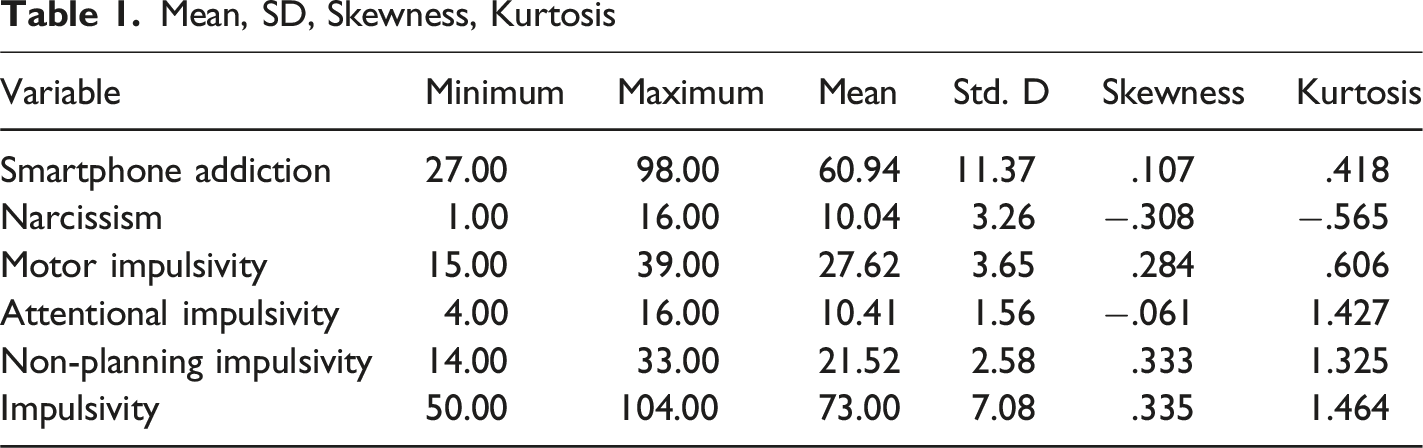
Mean, SD, Skewness, Kurtosis
Correlation Between Variables
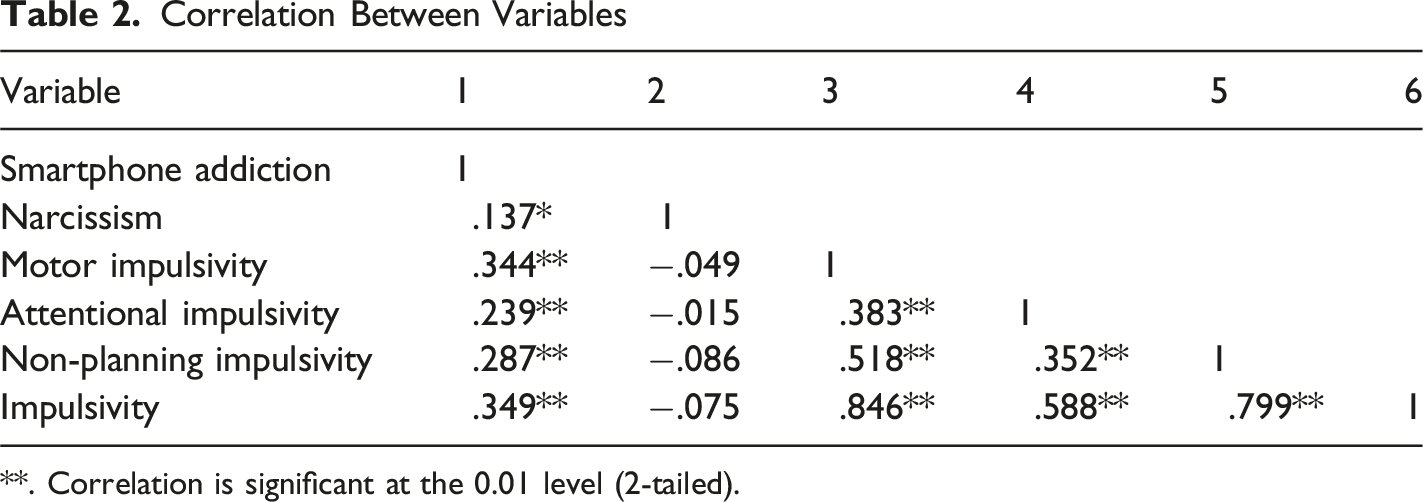
**. Correlation is significant at the 0.01 level (2-tailed).
The first step in structural equation modeling is confirmatory factor analysis for each variable. Items with factor loadings less than 0.3 are removed from the analysis (Kline, 2015). After examination, items 6 and 10 related to narcissistic personality traits were excluded from the analysis, while the remaining items and variables were retained.
Indicates of Fitness

The next step involves testing research hypotheses through structural equation modeling. A significant relationship exists between narcissism and smartphone addiction (β = 0.15, p < 0.05), as well as between impulsivity and smartphone addiction (β = 0.44, p < 0.05) (See Figure 1). Structure Model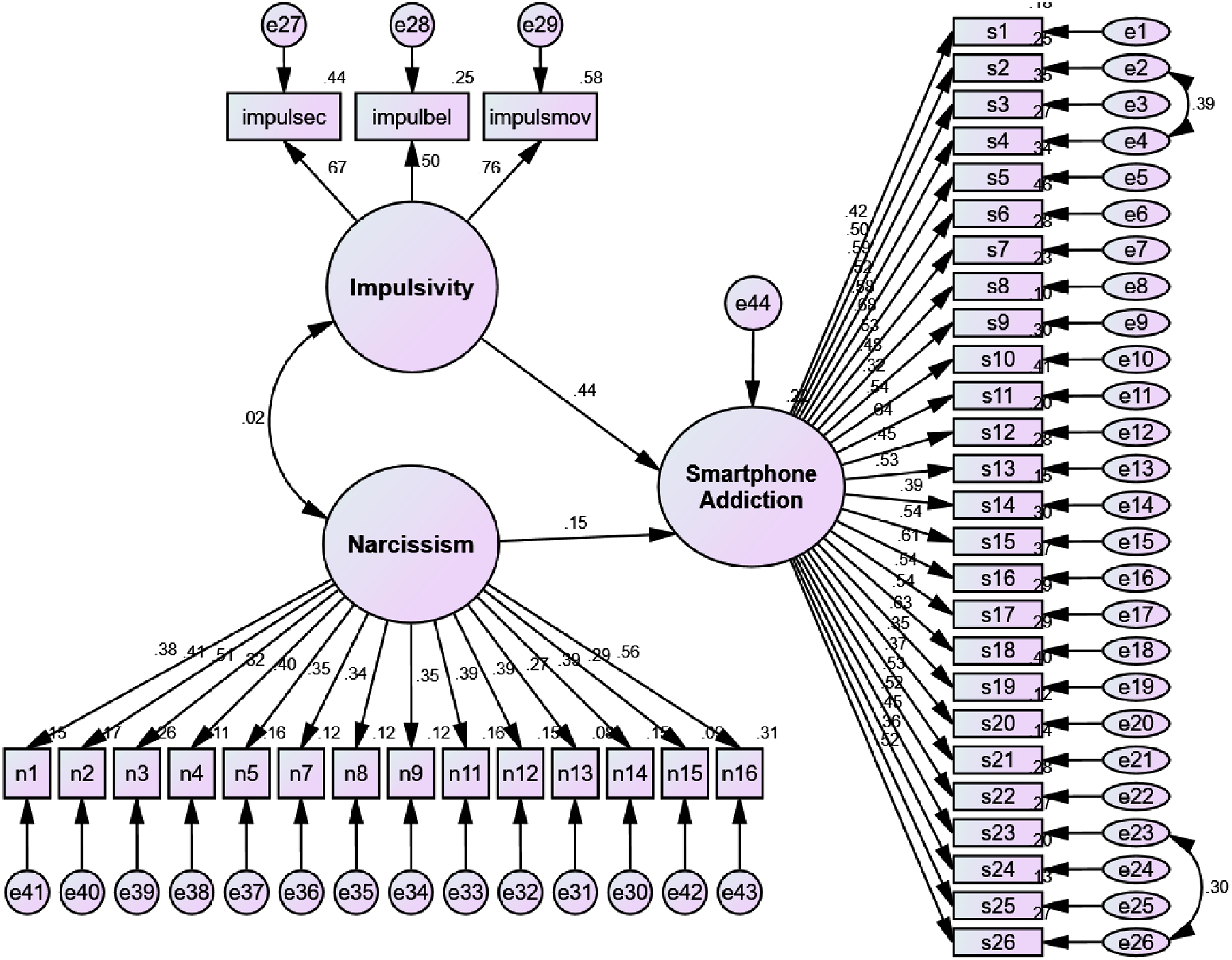
Comparing Between Models

Moderating Role of Gender
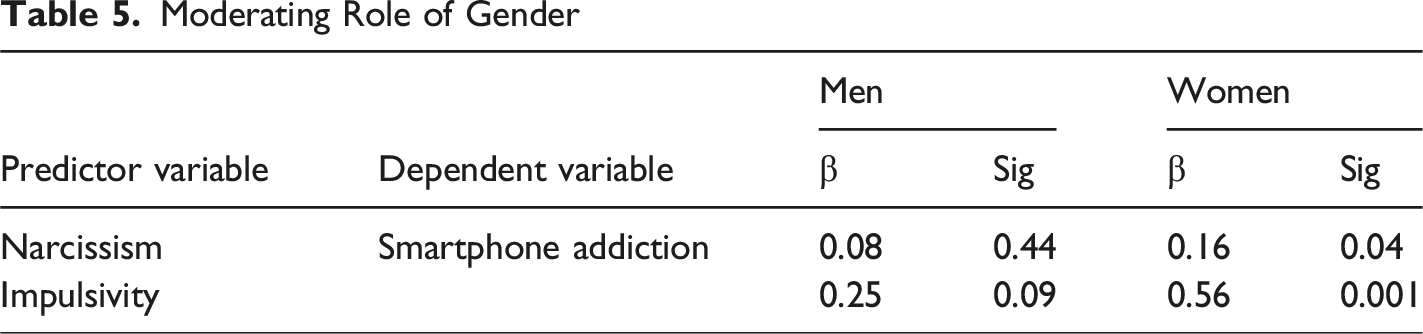
Furthermore, in the women’s group, there was a significant relationship between impulsivity and smartphone addiction (β = 0.56, p < 0.05), while this relationship was not significant in the men’s group (β = 0.25, p > 0.05). Thus, gender seems to act as a moderator in this relationship (see Table 5).
Discussion and Conclusion
This study investigates the relationship between smartphone addiction based on narcissism and impulsivity, considering the moderating role of gender among Iranian young adults.
The results of this research indicate that individuals with higher levels of narcissism are more likely to develop smartphone addiction. These findings align with previous studies (Andreassen et al., 2017; Busch & McCarthy, 2021; Giancola et al., 2025; Lyvers et al., 2022; Maftei & Pătrăuşanu, 2024) . One theoretical framework that can be applied to predict smartphone addiction based on narcissism is the Social Expectancy Theory (Boursier et al., 2020). This theory has been widely used in various addiction-related behaviors and novel technology contexts. In essence, the Social Expectancy Theory defines individuals as those who attach importance to social expectations in their decision-making process and seek validation from others (Rozgonjuk, Sinderman & Elhai., 2020). Consequently, a pronounced concern for social image and personal credibility predisposes those with narcissistic traits to actively seek external validation, thereby reinforcing their behavioral patterns (Noë et al., 2019). Smartphones function as a potent instrument for individuals high in narcissism, enabling them to cultivate a desired public identity, seek external validation, and satisfy their pronounced social needs through continuous connection. Furthermore, the results suggest that individuals with higher levels of impulsivity are more likely to develop smartphone addiction. These findings also align with previous studies (Hong et al., 2021; Lewin et al., 2023; Miezah et al., 2024; Sheinov, 2021; Yılbaş & Karadeniz, 2022). One theoretical framework that can be applied to predict smartphone addiction based on impulsivity is the Impulsivity-Compulsivity Theory (Kheradmand et al., 2023). This theoretical model frames addictive behavior through the lens of impulsivity. Individuals exhibiting high levels of impulsivity demonstrate a tendency toward rapid responses to immediate stimuli while discounting delayed repercussions. Consequently, the instantaneous access to facilities provided by smartphones makes them a particularly salient stimulus for the development of excessive use behaviors in this population (Zhao, Jia, Wang et al., 2022). Additionally, compulsivity is related to the inclination to engage in repetitive and recurrent behaviors in an attempt to reduce stress and anxiety. In this context, individuals may turn to smartphones as a tool for escaping unpleasant realities or for immediate stress reduction. A mobile phone usage pattern predicated on the avoidance of adverse internal sensations may precipitate long-term detrimental consequences (Lewin et al., 2023; Ruiz-Ruano et al., 2020).
Furthermore, the analysis identified gender as a significant moderating variable. While both narcissism and impulsivity were reliable predictors of addictive use across the sample, the strength of these relationships was not uniform. The results indicate that the positive association between these traits and smartphone addiction was significantly more pronounced in women than in men, suggesting that gender may play a critical role in determining vulnerability to this behavioral. The findings of this study align with previous research (Busch & McCarthy, 2021; Carretero et al., 2025; Kuss & Griffiths, 2017; Lopez-Fernandez, 2017; Reed & Haas, 2025; Samaha & Hawi, 2016). While the traits (impulsivity, narcissism) are present in both genders, their behavioral expression is often channeled through socially conditioned avenues. Research suggests that narcissism in men tends to manifest more in traits associated with grandiosity and authority, often expressed in overt, dominance-seeking behaviors. In contrast, narcissism in women is more frequently expressed through vanity and a preoccupation with social appearance and relational status (a facet of vulnerable narcissism). Smartphones, particularly social media platforms, are perfectly designed tools for this latter expression. They provide immediate access to curate one’s image, seek validation via likes and comments, and engage in social comparison—activities that directly feed the core needs of this narcissistic expression more common in women (Balta et al., 2020). Paying attention to gender moderations helps us better understand the role and impact of each variable on a specific gender and, based on that, more direct policies and interventions can be developed to reduce the likelihood of smartphone addiction.
The present study faced certain limitations. A notable limitation of this study is the use of a convenience sampling method. Given the research topic, the team of authors decided that the participants would be people who are active on social networks, so convenience sampling was chosen and the questionnaire link was provided to large social groups. While practical and efficient, this approach may limit the generalizability of our findings. The sample, drawn from a specific geographic and cultural context (young adults in Tehran), may not fully represent the diversity of the broader Iranian youth population or other cultural settings. Individuals who volunteer for such studies might share certain characteristics (e.g., higher comfort with technology or greater interest in the topic) that are not representative of the general population. This is particularly important in the Iranian context, where factors such as socioeconomic status, urban versus rural residency, and varying levels of access to technology and alternative leisure activities can significantly influence smartphone usage patterns and the associated psychological correlates. Therefore, caution should be exercised when extrapolating these results. Future research should employ more robust sampling strategies, such as stratified or random sampling, across multiple cities and diverse socioeconomic backgrounds in Iran to enhance the external validity and cultural applicability of the findings. Another consideration is that the current study was conducted cross-sectionally, meaning that causal relationships between variables cannot be established with certainty. To explore causal relationships, longitudinal study designs would be appropriate. Furthermore, only some variables were examined in this study. Other factors, such as economic status, cultural influences, and additional psychological variables, may play a significant role in the relationship between narcissism, impulsivity, and smartphone addiction.
It is suggested that gender-specific prevention and treatment programs be designed. Interventions for women should prioritize mitigating rumination and breaking the cycle of social validation-seeking behaviors, whereas programs for men may focus more on managing impulsive tendencies and fostering alternative sources of gratification. Encourage engagement in offline activities that build self-esteem and provide non-digital rewards to reduce reliance on online validation. Technology companies should adopt humane design principles, such as allowing users to hide like counts and offering personalized well-being nudges, to mitigate risks for vulnerable users. In future researches, examine other potential moderating variables, such as culture, age, and sexual orientation, and differentiate between subtypes of narcissism (e.g., grandiose vs. vulnerable) in predictive models.
In conclusion, these findings move us beyond a blanket view of smartphone addiction and toward a more nuanced, personalized understanding. The practical and research suggestions emphasize the need to target underlying psychological motivations and to acknowledge that the pathway to addiction is different for different people.
Footnotes
Acknowledgments
We would like to thank the participants who voluntarily agreed to participate in this research. Their patience and willingness to contribute to the study are much appreciated.

Ethical Considerations
The ethical approval code for this study is IR. UMA.REC.1401.080, which the Ethics Committee in Research has approved at the University of Mohaghegh Ardabili.
Consent to Participate
A formal consent form along with the questionnaire was sent to all volunteer participants, and they were asked to complete the consent form along with the questionnaires.
Author Contributions
ZJ, SB and NR had access to all of the data in the study and took responsibility for the integrity of the data and the accuracy of the data analysis. ZJ and NR designed the concept. ZJ and SP did the acquisition. AT did analysis, or interpretation of data. AT, NR, ZJ and SP drafted the manuscript. AT provided administrative, Technical, or material support. SB, NR and ZJ contributed to important editorial changes in the manuscript. All authors read and approved the final manuscript. All authors have participated sufficiently in the work and agreed to be accountable for all aspects.
Funding
The authors received no financial support for the research, authorship, and/or publication of this article.
Declaration of Conflicting Interests
The authors declared no potential conflicts of interest with respect to the research, authorship, and/or publication of this article.
Data Availability Statement
The data is available to the corresponding author and will be provided if needed.