







Abstract
Firearm suicide is one of the leading causes of preventable death in the United States. From 2019 to 2022, the firearm suicide rate increased by approximately 11%, mirroring a steady increase in overall suicide rate over the past two decades (Kaczkowski et al., 2023). In fact, firearm suicides contributed to over half of all suicides in 2022 (Kaczkowski et al., 2023). Amongst other risk factors, such as depression and financial stressors (Elbogen et al., 2020), studies have consistently demonstrated an increased risk of suicide among those with firearm access (Anglemyer et al., 2014; RAND Corporation, 2018). Despite this evidence, preventing firearm suicide has been challenging for prevention science and necessitates investigating additional factors that may predict outcomes.
A growing body of literature has demonstrated an association between the risk of suicidal behaviors and non-firearm violence victimization among adolescents and adults, including intimate partner violence, physical and sexual assault, and abuse (McManus et al., 2022; Wang et al., 2023). However, few studies have assessed the relationship between experiencing interpersonal firearm violence and suicidality, and the ones that have primarily focused on youth populations. For example, in a cohort study of 24,047 adolescents with depression, having been shot was associated with a 1.7 times higher risk for documented suicidal ideation, and increased cumulative exposure to firearm violence magnified the odds of suicidal behaviors in adolescents with depression (Wang et al., 2023). In another county-wide representative survey of 1,609 youth in Allegheny County, Pennsylvania, homicide survivorship was significantly associated with suicide attempts after adjusting for demographics and childhood adversity (Bamwine et al., 2020).
Only a few studies have examined associations between interpersonal firearm violence and suicide behavior among adults. For example, a cross-sectional survey study conducted by Semenza et al. among 3,105 Black or African American adults in the U.S. demonstrated that being threatened by a firearm or knowing someone who has been shot was associated with increased odds of lifetime suicidal ideation and attempt (Semenza et al., 2024). Another cross-sectional survey of 1,165 adults from four urban metropolitan cities demonstrated that individuals exposed to firearm fatalities had significantly higher odds of suicidal ideation (Smith et al., 2020). Studies have also demonstrated associations between secondary exposure to mass shootings and increased risk of suicidal behaviors, as well as other negative mental health outcomes (Joseph et al., 2019; Lowe & Galea, 2017). However, gaps in the literature of associations between firearm violence exposure and subsequent suicide behavior among adults persist despite the fact that adults die by firearm suicide at higher rates than youth (Kegler et al., 2022) and can legally purchase firearms. Further, to our knowledge, no studies have examined whether suicidality predicts firearm behavior and violence among adults.
Preventing firearm suicide also requires understanding factors that increase risks of engaging in firearm suicide, such as firearm beliefs and behavior. Few studies have examined associations between suicide outcomes and beliefs or behaviors pertaining to firearm use. Among a national subsample of 2,311 adult firearm owners, Bryan et al. (2020) investigated the relationship between owning a firearm for self-protection and perceived threats to self and risk of suicidal behavior. The prevalence of self-reported past-month suicidal behaviors were significantly elevated among firearm owners who kept firearms for protection and increased with the amount of perceived threats to self (Bryan et al., 2020). In another cross-sectional survey of 2,677 adolescents that examined the association of firearm carrying behaviors and suicidality demonstrated that youth who carried a firearm in the past month were almost four times more likely to attempt suicide compared to students who did not carry (Romero et al., 2017). Although these studies provide a foundation for examining associations between firearm suicide and firearm beliefs and behavior, these studies were conducted in large broad samples (e.g., national samples). Little research has examined this association among adults who have experienced interpersonal violence. Further, few studies have examined the extent to which suicidal behavior predicts firearm behavior.
A growing body of evidence suggests that experiencing interpersonal violence may increase individuals’ beliefs and behaviors supporting firearm usage. For example, Wamser-Nanney et al. (2021) found that posttraumatic intrusive thoughts were positively associated with positive firearm beliefs as a means of protection among a sample of undergraduate college students who had experienced interpersonal violence. In two national studies of adolescents, findings indicated that both bullying victimization and witnessing both firearm and non-firearm-related violence increased adolescent firearm carriage (Pontes & Pontes, 2021; Sokol et al., 2023). These findings underscore the importance of examining firearm beliefs and behavior among populations exposed to interpersonal violence. Individuals who have experienced interpersonal violence may have an increased risk for favorable firearm beliefs and behaviors and, consequently, suicidal behavior.
The aim of this study was to examine if (1) firearm beliefs were associated with suicidal behavior, and (2) if firearm violence types (e.g., motivation, subtypes) were associated with suicidal behavior among violently injured adults. We tested these associations in both directions to capture how suicidality, firearm violence, and firearm beliefs may intersect in this high-risk group. Prior research suggests that firearm beliefs, such as perceiving guns as protective, may increase suicide risk by normalizing access and reinforcing perceived readiness to use firearms. At the same time, suicidality may reflect broader vulnerabilities, including impulsivity, trauma exposure, and hopelessness, which can also elevate the likelihood of firearm violence. Modeling firearm beliefs as predictors of suicidality and suicidality as a predictor of firearm violence allowed us to examine overlapping risk domains rather than imply causality. This approach highlights that suicide risk and firearm violence often co-occur in violently injured adults, underscoring the importance of prevention strategies that address both simultaneously.
Method
Participants
This study included a total of 371 violently injured adults, ages 18-75 (M = 32.58, SD = 12.72), from an Urban Level 1 Trauma Center in Virginia. Participants were primarily male (72%) and identified as African American/Black (80%), Caucasian/White (17%), Asian (0.8%), or other (2.2%). Most participants attained a 12th-grade or higher education level (79%). Participants’ injuries included 53.5% gunshot wounds, 36% assault, and 7.5% stab wounds. Twenty-two percent had been hospitalized for a violent-related injury in the past and forty-eight percent reported having access to a firearm.
Procedure
Participants were recruited from the inpatient setting or the emergency department via daily screenings of live medical records from a level 1 trauma center as part of an ongoing study. Recruitment occurred from August 2021 to June 2024. During the consent process, participants were informed that their involvement was for research and not part of the medical care and that their involvement in research would not impact the medical care they received. After consent, they completed a series of self-report assessments. Participants received $160 for the assessments. This study is part of a larger research project to evaluate a hospital-based prevention program for reducing retaliatory firearm violence. All study procedures were approved by the institution IRB (approved 12/4/2020; IRB# HM20020621), and a Certificate of Confidentiality was received from the CDC.
Measures
Suicidal Behavior
The Suicide Behavior Questionnaire-Revised (SBQ-R; Osman et al., 2001) is a 4-item assessment of past suicide ideation and attempts. Item 1 assesses lifetime suicide ideation and attempts (1 = never, 6 = I have attempted to kill myself, and really hoped to die); item 2 assesses the frequency of suicide ideation over the past year (1 = never, 5 = very often/5 or more times); item 3 assesses the threat of suicide behavior (1 = no, 5 = yes, more than once, and really wanted to do it); item 4 assesses the likelihood of suicidal behavior (1 = never, 6 = very likely). The total score ranged from 3-18 and showed good internal reliability, α = .85.
Firearm Behaviors and Beliefs
The Gun Behaviors and Beliefs Scale (GBBS; Wamser-Nanney et al., 2020) contains two scales: Gun Beliefs and Gun Behaviors. The Gun Beliefs scale includes 24 items rated on a 6-point scale (1 = strongly disagree, 7 = strongly agree). The items assess five types of firearm beliefs: safety (7 items; e.g., “Carrying a gun helps to protect people from being assaulted”), emotional risk (6 items; e.g., “It would be emotionally troubling for me if I had to shoot someone, even in self-defense”), neighborhood factors (4 items; e.g., “In my neighborhood, you are seen as an easy mark if people think you won’t fight back”), gun presence (4 items; e.g., “Guns are common in my neighborhood”), and social perceptions (3 items; e.g., “My friends would think I am weak or soft if I did not carry a gun”). The firearm belief subscales yielded good internal reliability (safety, α = .90; emotional risk, α = .85; neighborhood concerns, α = .87; gun presence, α = .85; social perception, α = .78). The Gun Behavior scale includes 18 items rated on a 6-point scale (1 = never, 7 = everyday). The items comprise defensive (8 items; e.g., “I have pulled out my gun to prevent victimization”) and offensive (10 items; e.g., “I have pulled out my gun to get what I want”) firearm behaviors (Kjærvik et al., 2025). The total behavior scale and the subscales yielded good internal reliability (total, α = .92; defensive, α = .88; offensive, α = .82).
Firearm Violence
The Gun Violence Questionnaire (GVQ; Thomson et al., 2025) consists of 15 items rated on a 3-point scale (0 = never, 2 = often). The scale was developed using the Reactive-Proactive Aggression Questionnaire (RPQ; Raine et al., 2006). The GVQ contains two subscales: reactive (6 items; e.g., “Used a gun when I was provoked by others”), and proactive (8 items; e.g., “Used a gun to take things from others”). Higher scores indicate more firearm violence. The total scale and the subscales showed good internal reliability (total, α = .93; reactive, α = .83; proactive, α = .90).
Data Analysis Plan
Data analyses were conducted in July 2024. First, we examined bivariate correlations to examine unadjusted associations among the main study variables. Next, we used multiple regression analysis to assess if suicidal behavior was significantly associated with firearm beliefs and if firearm behaviors and firearm violence were significantly associated with suicidal behavior. Sex, age, and race were included as covariates across models. Due to high skewness (<3) and kurtosis (<10), firearm behavior and firearm violence measures were log-transformed prior to analysis, which is consistent with prior firearm research (Kjærvik et al., 2025). We conducted all analyses using R (R Core Team, 2021).
Results
Prevalence Statistics
Of the 371 participants, 252 had been non-suicidal, 51 had suicide risk ideation, 31 had planned suicide, and 37 had attempted suicide in their lifetime. Additionally, 319 reported that there was no likelihood of suicidal behavior in the future, 39 reported that it was rather unlikely to unlikely, and 13 reported that it was likely to very likely. Moreover, 57 reported having threatened to commit suicide once, and 23 reported having threatened to commit suicide more than once.
Unadjusted Associations Between Main Variables
Correlation and Descriptive Statistics for Gun Behavior and Beliefs (GBBS) and Gun Violence Questionnaire (GVQ)
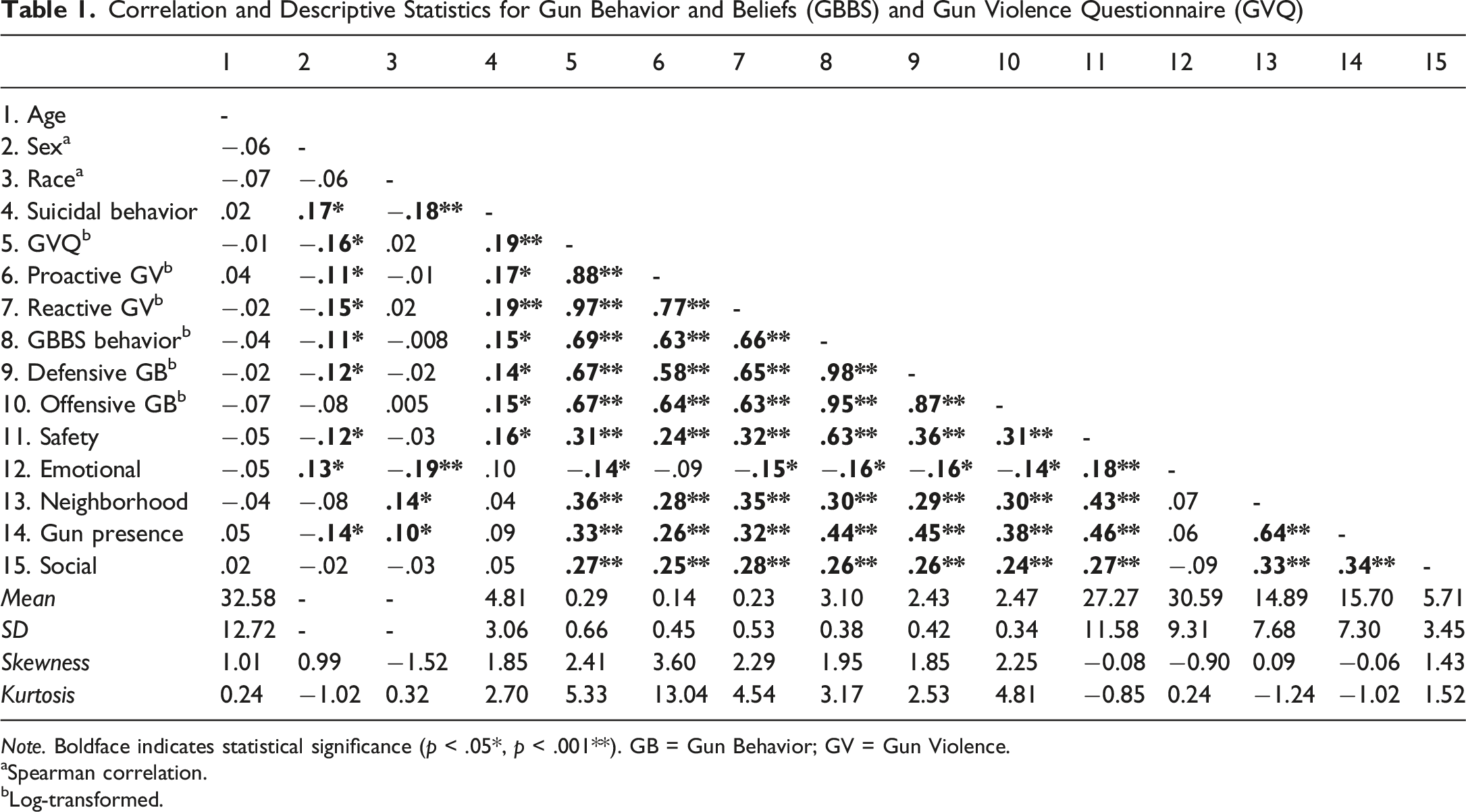
Note. Boldface indicates statistical significance (p < .05*, p < .001**). GB = Gun Behavior; GV = Gun Violence.
aSpearman correlation.
bLog-transformed.
Suicidal Behavior and Firearm Beliefs, Firearm Behaviors, and Firearm Violence
Adjusted Associations Between Firearm Beliefs and Suicidal Behavior
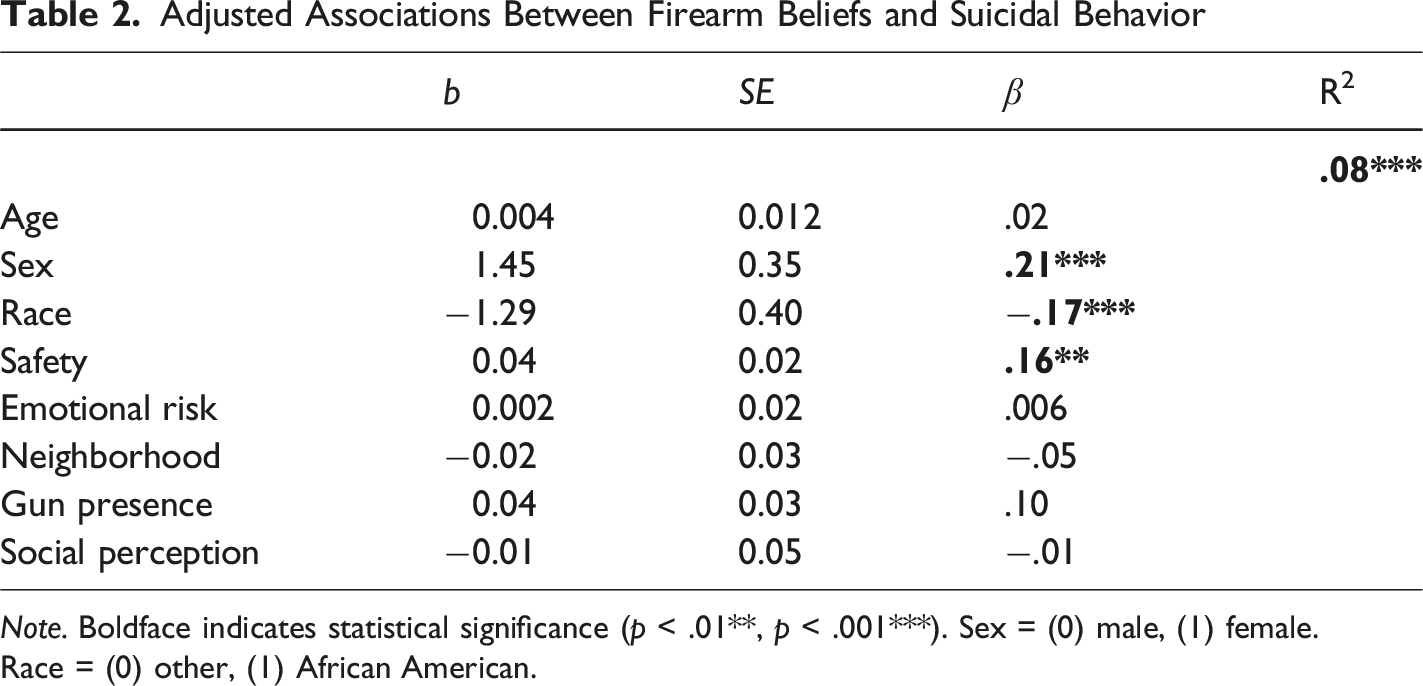
Note. Boldface indicates statistical significance (p < .01**, p < .001***). Sex = (0) male, (1) female.
Race = (0) other, (1) African American.
Adjusted Associations Between Suicidal Behavior and Firearm Behavior and Firearm Violence
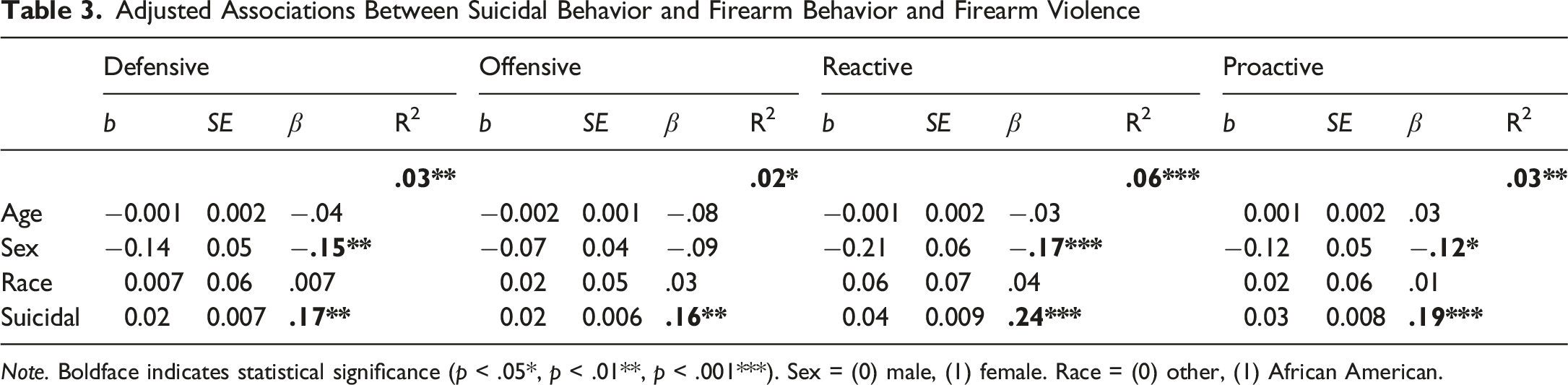
Note. Boldface indicates statistical significance (p < .05*, p < .01**, p < .001***). Sex = (0) male, (1) female. Race = (0) other, (1) African American.
Discussion
Firearm suicide persists as a leading cause of death among adults in the United States despite intervention and prevention efforts. There are multiple risk factors thought to increase risk of firearm suicide, including interpersonal violence exposure, and favorable firearm beliefs and behaviors (McManus et al., 2022; Wang et al., 2023). However, gaps have persisted in the literature regarding the extent to which suicidal behavior and firearm beliefs and behaviors are associated among individuals exposed to interpersonal violence. The present study helps fill this gap by examining associations between suicidal behavior and firearm behaviors, beliefs, and violence among violently injured adults.
Our cross-sectional design precludes causal inference, yet the pattern of results is consistent with two complementary interpretations that may strengthen prevention efforts. First, firearm beliefs such as viewing guns as protective were associated with suicidality. This may reflect that endorsing protective firearm beliefs is linked with greater firearm access and carriage, which increases familiarity with firearms. Over time, such exposure may contribute to an acquired capacity for suicide, consistent with the Interpersonal Theory of Suicide (Van Orden et al., 2010) and prior evidence linking firearm access to suicide risk (Anglemyer et al., 2014) and protective beliefs to firearm carriage among trauma survivors (Wamser-Nanney et al., 2021). Second, suicidality was associated with all forms of firearm violence. This suggests that suicidal behavior may reflect broader vulnerabilities, including impulsivity, trauma sequelae, and hopelessness, that elevate risk for both suicide and community violence (Simonetti, 2024; Thomson, 2024). Together, these findings underscore the importance of cross-cutting prevention strategies that address overlapping risks of self-directed and other-directed firearm harm.
Consistent with our predictions, suicidal behavior was positively correlated with favorable firearm beliefs and was predicted by firearm safety beliefs (for example, the belief that carrying a gun helps protect people from assault). This finding is consistent with prior studies, such as Bryan et al. (2020), and indicates that favorable firearm beliefs and behaviors, even for protection, are linked with higher risk of suicidal behavior. This pattern suggests that firearm carriage and related beliefs do not reduce suicide risk among victims of interpersonal violence. It is also possible that possessing a firearm or holding positive beliefs about firearms increases an individual’s capacity for firearm suicide through habituation and familiarity (Romero et al., 2017; Van Orden et al., 2010).
Another important finding was that firearm behavior was positively predicted by suicidal behavior. Prior work has rarely examined suicidal ideation as a predictor of firearm behavior and violence among adults with recent violent injury. One interpretation is that acquired capacity for suicide may co-occur with an acquired capacity for violence toward others through repeated exposure to painful or provocative experiences. Alternatively, the association may be partly explained by confounding variables. For example, perceived threat or threat anxiety may increase both suicidal behavior and firearm carriage (Bryan et al., 2020). Similarly, beliefs supporting aggression, which were associated with suicidal behavior in the current study, have also been linked to firearm behavior among adolescents (O’Connor et al., 2023).
Importantly, these findings have implications for prevention. Targeting beliefs about firearms, particularly beliefs related to firearms for safety, may help reduce firearm suicide and firearm behavior among adults who have experienced interpersonal violence. These findings also underscore the importance of identifying individuals who may be at increased risk of firearm suicide and providing education on risks related to firearm access and storage. Taken together, prevention efforts that address protective firearm beliefs, perceived safety, and suicide risk factors, and that offer positive coping and support strategies following violent injuries, could help reduce subsequent firearm suicide and violence.
Limitations
This study has several limitations that warrant discussion. First, we used a cross-sectional design, which limits the ability to draw conclusions of causality. Second, this sample was primarily male and Black/African American which may limit the generalizability of these findings. All measures were self-report which can be subject to social desirability bias. Lastly, although all variables were measured at the time of enrollment, the recruitment window spanned three years. Time-related trends in firearm violence or suicidality could therefore influence the generalizability of the results, which is a limitation common to multi-year observational studies.
Conclusion
Findings from this study provide insight for suicide and violence prevention. Beliefs about firearms were associated with suicidal behavior, and suicidal behavior predicted multiple forms of firearm violence among violently injured adults. These results suggest that suicide risk and firearm violence risk often co-occur in this population. Interventions that address protective firearm beliefs, reduce access during periods of risk, and mitigate suicidality may help prevent both firearm suicide and subsequent firearm violence.
Footnotes

Ethical Considerations
All study procedures were approved by the institution IRB (approved 12/4/2020; IRB# HM20020621). All participants provided written consent to participate in study procedures.
Author Contributions
Nicholas D. Thomson: Conceptualization, Funding acquisition, Writing - original draft, Investigation, Writing - review & editing.
Sarah K. Pittman: Writing – original draft, Writing - review & editing.
Sophie L. Kjærvik: Data analysis, Writing – original draft.
Vivek A. Ashok: Writing – original draft, Writing - review & editing.
Joseph A. Simonetti: Writing – original draft, Writing - review & editing.
Funding
The authors disclosed receipt of the following financial support for the research, authorship, and/or publication of this article: Research reported in this publication was supported by the Centers for Disease Control and Prevention under award number (R01CE003296: PI Thomson) and Health Resources and Services Administration (T32HP46118-02: Vivek A. Ashok). The content is solely the responsibility of the authors and does not necessarily represent the official views of the CDC.
Declaration of Conflicting Interests
The authors declared no potential conflicts of interest with respect to the research, authorship, and/or publication of this article.
Data Availability Statement
Data and materials may be made available upon request from the corresponding author. Data are not publicly available due to the potential for personal identification of participants in a sensitive population. This study was not pre-registered.