







Abstract
The primary aim of this study was to provide additional validation for a brief version of the well-documented Celebrity Attitude Scale (CAS-7) in an American sample. This study sought to determine if there is a significant association with the strength of one’s admiration for a favorite celebrity and (1) a pathological concern for the needs of others (2) symptoms of depression, anxiety and stress, (3) and adverse childhood experiences. The CAS-7, the Pathological Concern Questionnaire (PCQ), the Depression, Anxiety Stress Scale (DASS-9), and the Revised Adverse Childhood Experiences scale (R-ACE) were administered to 367 undergraduate students (80.66% women, M age = 20.26 years, SD = 3.63) from four American institutions. Zero-order correlations indicated that psychological distress and pathological concern were positively associated with both healthy and unhealthy dimensions of celebrity worship. In the path model, psychological distress showed a robust positive association with intense–pathological celebrity worship. Adverse childhood experiences displayed opposing conditional pathways—a small, positive, indirect association via psychological distress and a weak, negative, direct association with intense–pathological celebrity worship—implying a heterogeneous pattern of associations. The findings also provide further support for the validity of the CAS-7 in an American sample.
Introduction
Over the course of several years, McCutcheon et al. (Ashe et al., 2005; Grabbe et al., 2022; Griffith et al., 2013; Maltby et al., 2002, 2011; Maltby & McCutcheon, 2001) have measured degrees of admiration for a favorite celebrity using the Celebrity Attitude Scale (CAS; McCutcheon et al., 2002). Its 23 items were created to measure the extent to which individuals admired their favorite celebrities. Factor analysis resulted in three subscales: Entertainment-social, Intense-personal, and Borderline-pathological. The first subscale refers to persons who admire their favorite personality primarily because that celebrity is a source of entertainment that can be discussed with like-minded friends. The other two subscales reflect persons who have become increasingly absorbed in or addicted to the personal lives of their favorite celebrity. High scores on these latter two factors are often associated with measures of depression and anxiety (Jia et al., 2023; Maltby & McCutcheon, 2001, 2011; McCutcheon et al., 2016), low self-esteem (Dianito et al., 2023; Zsila et al., 2021), problematic use of the Internet (Mauli & Agustina, 2022; Zsila et al., 2018), excessive gambling (Lian et al., 2019) and difficulty maintaining intimate relationships (McCutcheon et al., 2016). To date, more than 135 published articles have used the CAS, and a host of studies have established its reliability and its convergent and external validities (e.g., Griffith et al., 2013, Hitlan et al., 2021; Williams et al., 2024, & see Brooks, 2021, for a review).
There is a need for short assessment instruments when the researcher has limited administration time and/or there are several other measures being administered in the same study (Bőthe et al., 2021; Danner et al., 2019). Recently, Zsila et al. (2024) developed and validated a seven-item version of the CAS based on the psychometrically most appropriate items from the 23-item version. The sample consisted of 769 adults ranging in age from 18 to 64 from Hungary. Factor analysis revealed that a bifactor model was the best fit for the data. The first factor, ‘healthy’ in the present study, consisted of three items from the Entertainment-social subscale of the 23-item version of the CAS. The second factor, labeled ‘unhealthy’ in the present study, combined two items from the Intense-personal subscale and two items from the Borderline-pathological subscale of the 23-item CAS. Zsila et al. (2024) validated this brief version (CAS-7) in part by finding that it correlated positively with a measure that combined depression, anxiety and stress. Depression, anxiety, and stress are three separate mental health concerns, but these are all indicators of poor mental health (Lovibond & Lovibond, 1995; Tafet & Nemeroff, 2015; Yusoff, 2013; Zsila et al., 2024). Depression, anxiety, and stress levels were assessed using the nine-item Depression, Anxiety, Stress Scale (DASS-9; Yusoff, 2013) in the present study, similar to Zsila et al. (2024).
In recent years, there has been a great deal of psychological research on prosocial and altruistic behavior as well as related attitudes and behaviors such as generosity, empathy, compassion, gratitude, and concern for others (Aspinwall & Staudinger, 2003; Friedemann et al., 2016). However, the motivations underlying these prosocial behaviors are sometimes overpowered by self-oriented or neurotic attitudes and values (Friedemann et al., 2016; Gerber et al., 2015; Shavit & Tolmacz, 2014; Siegler & Luchner, 2024). Barbanel (2006) recognized the pathological tendencies of some individuals whose caregiving and helpfulness to others came at the expense of the helper’s own desires and needs, and described the characteristics associated with pathological concern. Specifically, these characteristics include guilt, low self-esteem, a compulsive need to belong, a feeling of emotional emptiness, loneliness, dissatisfaction with life, repression of the need for pleasure, and the fear of being left alone and unloved. Persons who are pathologically concerned about others avoid conflict and expressions of anger so they can maintain their fragile relationships. Because they can reliably be counted on to be helpful, others frequently take them for granted and take advantage of them, sometimes even to the point of abuse.
Bowlby (1979) theorized that compulsive caregiving stems from childhood experiences of giving care but not receiving it. Such persons supposedly had mothers who could not or would not care for the child but encouraged or even demanded that the child become the caregiver for the parent. In time, the child learns that sacrificing personal needs is the best way to maintain a relationship with a mother, and this later generalizes to relationships with others.
An adverse childhood experience (ACE) is a traumatic event that occurs before a child reaches the age of 18. ACEs are generally ongoing and long-term events, such as neglect, physical and verbal abuse, and bullying (Siegler & Luchner, 2024). According to Merrick et al. (2018), over half of the population has been exposed to at least one ACE, with about 17.3% having experienced more than four ACEs. There are often negative consequences in adulthood for those who experienced many ACEs. For example, Felitti et al. (1998) found that ACEs predispose adults to pathological disorders. McLaughlin et al. (2010) linked ACEs with later poor physical health, Bower and Baldwin (2017) correlated ACEs with drug use, and Ferguson (2011) found that ACEs were related to hostile behaviors.
There are some striking similarities between celebrity worshipers who are strongly attached to their favorite celebrities, persons who are pathologically concerned about the needs of others, persons who are depressed and anxious, and persons who have negative childhood experiences. According to Barbanel (2006), Gerber et al. (2015) and Shavit and Tolmacz (2014), pathologically concerned individuals tend to display several characteristics that are also present in extreme celebrity worshipers: low self-esteem (Dianito et al., 2023; Stepanyan, 2019; Zsila et al., 2021), loneliness (Aufa et al., 2019; Lestari & Pohan, 2023; McCutcheon, Reyes, et al., 2021), anxiety, depression and angry hostility (Maltby et al., 2011), low life satisfaction (Aruguete et al., 2019), and social anxiety (Jia et al., 2023). Extreme worshipers also tend to have a neurotic need to belong (Pirzade et al., 2024), difficulty maintaining intimate relationships (McCutcheon et al., 2016), and difficulty regulating emotions (Rad & Abadi, 2023).
The Absorption-Addiction model (McCutcheon et al., 2002) explains the development of excessive celebrity admiration. According to this model, persons with certain vulnerabilities (e.g., unclear identity and self-concept, poorer mental health) are more prone to become absorbed in the life of celebrities. Such vulnerabilities can possibly root in adverse childhood experiences. Indeed, a recent study has found that adverse childhood experiences predicted symptoms of depression and anxiety, and this association was mediated by lower self-concept clarity (Sharratt & Ridout, 2025), a personal characteristic often identified in relation to excessive levels of celebrity worship (e.g., Cui & Fang, 2022; Gong et al., 2025). In some cases, this absorption can evolve into compulsive and impulsive behaviors often experienced in relation to addictions (e.g., feeling compelled to learn the personal habits of the celebrity).
Based on the findings by Zsila et al. (2024), we hypothesize that (1) R- ACE will be associated with higher PCQ and DASS-9 scores; (2) higher scores on the PCQ and DASS-9 will be associated with higher scores on the CAS-7 unhealthy subscale in an American sample, thus partially replicating the results obtained with the Hungarian sample. Finally, (3) R-ACE will be associated with higher scores on the CAS-7 unhealthy subscale. Based on the theoretical foundation of the Absorption-Addiction model (McCutcheon et al., 2002), structurally, these associations are explored in a path model. In this model, adverse childhood experiences are structurally positioned as predictors of PCQ and DASS-9 based on Sharratt and Ridout (2025), which in turn are expected to predict the unhealthy dimension of CAS-7 based on Zsila et al. (2024). The healthy dimension of the CAS-7 is also included for exploratory purposes.
Method
Participants
We recruited 390 participants (76.67% female, Mage = 20.23, SD = 3.61, age range: 17–49 years) from institutions located in Florida, Illinois, Kentucky, and New York. A minimal amount of course credit was awarded to each participant. The following exclusion criteria were utilized: (1) being a minor (<18 years; n = 4), (2) information on socio-demographics missing (i.e., gender or age; n = 17), and (3) items on all study-variables missing (n = 2). Our final sample consisted of 367 undergraduate students (80.66% women, M age = 20.26 years, SD = 3.63, range: 18–49 years of age). Most participants ethnically identified as White (n = 223), followed by Latinx (n = 58), Asian-American (n = 29), and African American (n = 25). A smaller proportion selected ‘other’ ethnic group (n = 7), while 21 individuals identified as multiracial. Informed consent was sought and provided by the participants. Ethical approvals were gained from the Institutional Review Boards of the principal investigators’ institutions. The present study aligns with the fundamental principles of the Declaration of Helsinki.
Measures
Celebrity Attitude Scale (CAS-7)
The CAS-7 (Zsila et al., 2024) consists of two subscales. Entertainment-social (three items) is reflected in agreement with items like “I like watching and hearing about my favorite celebrity when I am in a large group of people.” A second level of celebrity worship (Intense-pathological, four items) is characterized by more intensely personal and borderline-pathological involvement, represented by items like “I often feel compelled to learn the personal habits of my favorite celebrity.” The response format for the CAS-7 is a five-point scale, ranging from 1 (strongly disagree) to 5 (strongly agree). High scores indicate a strong attachment to one’s favorite celebrity. The CAS-7 is based on the seven psychometrically sound items derived from the 23-item Celebrity Attitude Scale (McCutcheon et al., 2002, 2004; Zsila et al., 2024). Previous studies have established the reliability and convergent and external validities of the 23-item CAS (e.g., see Greenwood et al., 2018; Griffith et al., 2013, Hitlan et al., 2021; Williams et al., 2024; & see Brooks, 2021, for a review). Zsila et al. (2024) validated the seven-item version (CAS-7) by finding that it correlated positively with measures of depression, anxiety, stress, and problematic Internet use. The CAS-7 also correlated positively with a measure of parasocial relationships. Typical alphas for the 23-item CAS total scale range from .84 to .94 (McCutcheon et al., 2006). Item correlations between the Entertainment-social (ES) items and CAS-7 total ranged from .45 to .62. Item correlations between the Intense-pathological (IPBP) items and CAS-7 total ranged from .64 to .85. Alphas in the validation study by Zsila et al. (2024) were .81 for the Entertainment-social subscale and .88 for the Intense-pathological subscale. Alphas in the present study were .80 for the Entertainment-social subscale and .78 for the Intense-pathological subscale.
Pathological Concern Questionnaire (PCQ)
The PCQ (Shavit & Tolmacz, 2014) is a 18-item scale measuring thoughts, feelings and behaviors related to the repression and denial of one’s needs and a pathological concern about satisfying the needs of others. Ratings are on a Likert-type, seven-point scale ranging from 1 (not at all) to 7 (very much). Sample items include ”I usually repress my need for joy and pleasure” and “My focus on others allows me to conceal crises which I am currently going through.” High scores indicate a person who is experiencing a pathological concern for others. Shavit and Tolmacz (2014) validated the PCQ by showing that it was associated with low self-esteem, low life satisfaction and attachment insecurities. Alphas in previous studies were .88 (Siegler & Luchner, 2024) and .89 (Shavit & Tolmacz, 2014). Alpha in the present study was .91.
Depression, Anxiety, Stress Scale (DASS)
The DASS-9 (Yusoff, 2013) consists of nine items. Items were rated on a four-point scale from 0 (did not apply to me at all) to 3 (applied to me very much, or most of the time). Participants were instructed to indicate the extent to which they experienced any of the nine symptoms during the previous week. A sample item for depression is “I felt that I had nothing to look forward to.” A sample item for anxiety is “I felt I was close to panic.” A sample item for stress is “I found myself getting agitated.” As correlations between subscales were high in the present study (rs ranged between .57 and .64), a total score was used in further analysis, following the protocol by Yusoff (2013). High total scores suggest a person who has higher psychological distress. McDowell (2006) found that a longer version of the DASS differentiated between psychiatric and non-psychiatric patients, and Yusoff (2013) found good construct validity using the DASS-9. Zsila et al. (2024) found an alpha coefficient of .91 using the DASS-9, and we obtained an alpha of .87 in the present study.
Revised Adverse Childhood Experiences (R-ACE)
The R-ACE (Finkelhor et al., 2015) consists of 14 items. Finkelhor et al. (2015) added four additional items to the originally 10-item scale. Sample items from the original 10-item scale include “Prior to your 18th birthday did you often or very often feel that no one in your family loved you or thought you were important or special, or your family didn’t look out for each other, feel close to each other, or support each other?” Another original item is “Prior to your 18th birthday was a biological parent ever lost to you through divorce, abandonment, or other reason?” One of the four new items is “Prior to your 18th birthday did you live for 2 or more years in a neighborhood that was dangerous, or where you saw people being assaulted?” According to a large-scale meta-analysis, clinical samples report 4 or more ACEs (Hughes et al., 2017), indicating that a reliable determinant of psychopathological concerns could be the threshold of 4 or more ACEs (Briggs et al., 2021). Therefore, following the protocol by Briggs et al. (2021), this construct was coded and used in the present analysis as 0 = less than 4 ACEs, 1 = 4 or more ACEs reported by the participants. A large proportion of the participants in the present sample reported 4 or more ACEs (65.7%).
Procedure
After obtaining permission from our Institutional Review Boards (i.e., Farmingdale State College, protocol number: #270; Elmhurst University, protocol number: FY024-67; Western Kentucky University, protocol number: IRB#24-324), we administered the four scales in random order to minimize the likelihood of systematic order bias to potential participants in Qualtrics. The authors declare that they used artificial intelligence for language editing purposes when writing this manuscript. Data analysis was conducted using SPSS 21.0 and Mplus 7.4 (Muthén & Muthén, 1998–2017).
To examine the potential impact of common method variance, a sensitivity analysis was conducted by estimating an extended model that included a latent common method factor loading on all self-report indicators. Correlations between the method factor and the substantive latent variables were fixed to zero in order to separate method-related variance from construct-related variance. Given the use of categorical indicators and the mean- and variance-adjusted weighted least squares (WLSMV) estimation, this analysis was conceptualized as a robustness check rather than a formal statistical correction.
Subsequently, a path model was constructed to investigate the associations between R-ACE (as a predictor), PCQ and DASS (as mediators), and the two dimensions (i.e., ES and IPBP) of the CAS-7 (as outcome variables). As conditional effects are estimated in the comprehensive path model, preceding hypothesis testing on the direct associations was performed based on the zero-order correlations underlying the path model. Wald test was conducted to compare the strength of associations among the paths of Entertainment-social and Intense-pathological dimensions with the predictors based on the protocol by Meng et al. (1992).
A WLSMV estimator was used in the models consistently, which is appropriate for binary and categorical data such as R-ACE (Finney & DiStefano, 2013). All variables were defined as latent variables in the models, except for the control variables (i.e., age and gender [1 = male, 2 = female]) and R-ACE. Model fit was evaluated based on the commonly applied threshold for fit indices suggested by Bentler (1990) and Brown (2015).
Results
Investigating the Possibility of Common Method Variance Bias
The inclusion of the method factor yielded acceptable overall model fit (Comparative Fit Index [CFI] = .943, Tucker-Lewis Index [TLI] = .934, Root-Mean-Square Error of Approximation [RMSEA] = .049 [.044-.053]), while the measurement structure and the key structural associations remained largely unchanged (see SM Table 1). Loadings on the method factor were generally small and inconsistent across indicators (ranging from −.19 to .69), and the factor did not account for substantial variance in the outcome measures (ranging from 2.4% to 17.4%). Taken together, these findings indicate that common method variance is unlikely to account for the substantive associations observed in the present study.
Path Model on the Associations Between Adverse Childhood Experiences, Disress, and Celebrity Worship
The path model yielded satisfactory fit (χ 2 = 1,289.492, df = 611, p < .001; CFI = .922, TLI = .916, RMSEA = .055 [90% CI = .051–.059]). Zero-order correlations underlying the path model (see SM Table 1) showed that R-ACE was very weakly and positively associated with PCQ and DASS-9, supporting H1. PCQ was positively and weakly, while DASS-9 was positively and moderately associated with IPBP, confirming H2. Additionally, ES was also positively and weakly associated with both PCQ and DASS-9. In contrast to H3, R-ACE showed a negligible, negative association with IPBP, while it was not associated with ES.
Although pathological concern was positively correlated with Intense–pathological celebrity worship, its direct effect in the path model (see Figure 1) was negative, indicating a negative suppression effect due to shared variance with psychological distress. This pattern indicates that the association between pathological concern and Intense–pathological celebrity worship is primarily driven by variance shared with psychological distress. When distress is accounted for in the path model, the direct association between pathological concern and Intense–pathological celebrity worship becomes negative. This finding is consistent with a negative suppression effect, suggesting that the component of pathological concern, that is independent of distress, does not contribute to extreme forms of celebrity worship. Importantly, all path coefficients represent conditional effects and should be interpreted within the context of the full multivariate model. Path model representing the associations between adverse childhood experiences, distress, and celebrity worship dimensions (N = 367)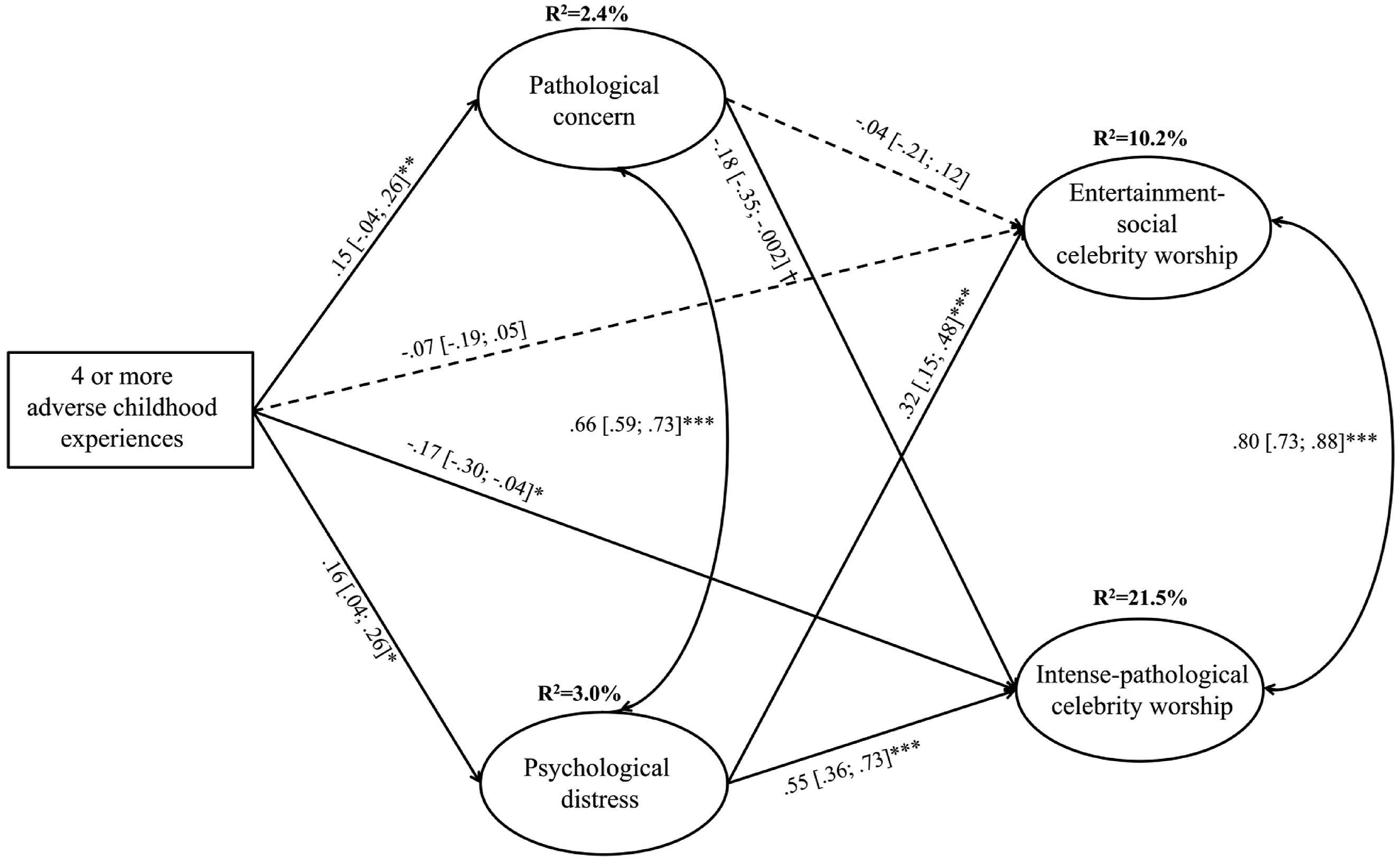
Adverse childhood experiences showed small but statistically significant, positive zero-order correlations with pathological concern (r = .14; p = .015) and psychological distress (r = .14; p = .015). In contrast, the zero-order association between adverse childhood experiences and Intense–pathological celebrity worship was small and negative (r = −.13; p = .036). In the path model, adverse childhood experiences showed a small, negative, direct association with Intense–pathological celebrity worship. In addition, bootstrapped mediation analysis indicated a statistically significant indirect effect via psychological distress (indirect effect, 95% bootstrapped CI = .085 [.015, .155]). A similar bootstrapped indirect effect via psychological distress was observed for the Entertainment–social dimension (.049 [.003, .096]).
Within the path model, psychological distress (DASS-9) was positively associated with both dimensions of the CAS-7; however, a Wald test indicated that the strength of these associations differed significantly across dimensions (Wald = 6.18, p = .013), with a stronger association observed for the Intense–pathological dimension. This pattern was also evident at the zero-order level, where psychological distress showed a significantly stronger correlation with the Intense–pathological dimension than with the Entertainment–social dimension (r = .41 versus r = .31. Williams’ t (364) = 2.99, p = .003).
Within the path model, the association between Intense–pathological celebrity worship and psychological distress was significantly stronger in absolute terms than its association with pathological concern, based on a Wald test comparing the magnitudes of the corresponding path coefficients (Wald = 6.74, p = .009). This pattern was already evident at the zero-order level, where Intense–pathological celebrity worship showed a stronger correlation with psychological distress (r = .31) than with pathological concern (r = .18; Williams’ t (364) = 2.55, p = .011).
The model components explained 10.2% of the total variance of the healthy dimension of CAS-7, while the explained variance was greater for the unhealthy dimension (21.5%, respectively).
Discussion
The purpose of the present study was to examine potential connections between celebrity worship and the variables of depression, anxiety, and stress (DASS-9), pathological concern for others (PCQ), and adverse childhood events (R-ACE). There were three hypotheses that were examined: (1) R-ACE would be associated with higher scores on the PCQ and DASS-9; (2) PCQ and DASS-9 scores would be associated with higher scores on the CAS-7 unhealthy subscale; and (3) R-ACE scores would be associated with higher scores on the CAS-7 unhealthy subscale.
In line with the current literature suggesting that those reporting four or more adverse childhood experiences are more prone to psychological difficulties, such as depression and anxiety (Sharratt & Ridout, 2025) and psychoactive substance use problems (Hughes et al., 2017), the present study demonstrated positive associations of R-ACE with PCQ and DASS-9, supporting the first hypothesis. However, these associations were particularly weak.
The second hypothesis postulated that there would be a positive relationship between scores on the CAS-7 unhealthy subscale and scores on the DASS-9 and the PCQ in an American sample. Based on the correlation analysis, this hypothesis was confirmed. Zsila et al. (2024) also found a positive relationship between scores on the CAS-7 unhealthy subscale and scores on the DASS-9. However, the IPBP’s association with the PCQ was particularly weak, and became negative in the comprehensive path model. Therefore, the negative direct effect of pathological concern with the unhealthy dimension of the CAS-7 in the present multivariate model indicates that the association between pathological concern and unhealthy celebrity worship is largely contingent on shared variance with psychological distress. This suggests that distress-related aspects of pathological concern may be central to its link with extreme forms of celebrity worship, whereas distress-independent components of pathological concern do not appear to exert a positive influence. This pattern suggests that the link between pathological concern and unhealthy levels of celebrity worship is primarily driven by distress-related processes. When distress is accounted for, pathological concern appears to reflect a form of interpersonal focus that lacks the affective dysregulation necessary to sustain intense celebrity involvement.
Furthermore, scores on the healthy dimension of the CAS-7 were weakly, positively associated with PCQ in the correlation analysis. Consistent with the findings reported by Zsila et al. (2024), scores on the healthy dimension of the CAS-7 were also positively, but weakly correlated with the DASS-9 in the present study. Although hypotheses were not formulated regarding the positive relationships between the healthy dimension of celebrity worship, PCQ, and DASS-9, these associations were also worth investigating. In line with the Absorption-Addiction Model of celebrity worship (McCutcheon et al., 2002), persons first become attached to their favorite celebrities for social and entertainment reasons. Then, a small number of these celebrity followers become increasingly absorbed and addicted to their favorite celebrities. Therefore, this hierarchical model suggests that unhealthy levels of attachment often develop from behaviors typical to general (healthy) fan activities (e.g., following the news regarding the favorite celebrity). The strong association between the two dimensions of the CAS-7 (Zsila et al., 2024) also in the current study confirms this assumption. Moreover, the construct of celebrity worship, which comprises both a healthy and unhealthy dimension (McCutcheon, 2025), is defined as an excessive behavior (McCutcheon et al., 2002), often characterized by impulsive and compulsive cognitive, affective, and behavioral features, which can be associated with mental health problems (Sansone & Sansone, 2014; McCutcheon, 2025). The present findings provide further support that even mild forms of admiration towards celebrities can be associated with mental health concerns (see Brooks, 2021), however, the association of psychological distress was found to be stronger for the unhealthy dimension than for the healthy dimension of celebrity worship. Moreover, the unhealthy dimension of celebrity worship showed a stronger relationship with psychological distress than with pathological concern.
The third hypothesis postulated a positive association between R-ACE and scores on the CAS-7 unhealthy subscale. The hypothesis was not supported. This result is counterintuitive given prior evidence, considering that high scores on these latter two factors are often associated with measures of loneliness (Aufa et al., 2019; Lestari & Pohan, 2023; McCutcheon et al., 2021), depression and anxiety (Jia et al., 2023; Maltby & McCutcheon, 2001, 2011; McCutcheon et al., 2016), low self-esteem (Dianito et al., 2023; Zsila et al., 2021), and difficulty maintaining intimate relationships (McCutcheon et al., 2016). Based on the Absorption-Addiction Model (McCutcheon et al., 2002) and recent findings on the role of ACEs in later mental health concerns (Sharratt & Ridout, 2025), it was assumed that R-ACE would be directly associated with celebrity worship. However, the small, negative zero-order association between adverse childhood experiences and Intense–pathological celebrity worship in the present path model suggests that severe early adversity is not uniformly associated with heightened celebrity worship. While adverse childhood experiences may increase vulnerability to unhealthy celebrity worship indirectly through elevated distress, these may also be linked to patterns of emotional disengagement or reduced tendency toward unhealthy levels of celebrity involvement, resulting in a weak, negative, direct association. Overall, these findings highlight the heterogeneity of psychological responses to early adversity, and underscore the importance of distinguishing between indirect, distress-driven pathways and conditional direct effects when interpreting associations within complex multivariate models.
It is also important to acknowledge that a large proportion of participants (65.7%) reported 4 or more ACEs in the present study, which is much higher than the prevalence rates in the large-scale meta-analysis by Hughes et al. (2017), which were between 1 and 38%. It is plausible that coping with these adverse childhood experiences led to an earlier recognization of problematic behavioral patterns, such as excessive celebrity admiration, in order to prevent individuals from further psychological harms. However, it is also possible that a rewarding engagement with a favorite celebrity can serve as a coping strategy to cope with these harmful experiences. Alternatively, adverse childhood experiences may not play a substantial role in how adults are attached to admired celebrities later. For instance, some ACEs may not be closely associated with the phenomenon of emotional engagement with celebrities (e.g., the individual lived with someone who went to jail or prison). Future research should investigate whether there are specific ACEs related to celebrity worship for different groups of individuals.
Limitations
The use of correlational data precludes the possibility of drawing causal conclusions. The use of self-report scales leaves open the possibility that behavioral observations might lead to slightly different conclusions.
Conclusion
Based on the present findings, psychological distress and pathological concern were positively associated with celebrity worship dimensions. Psychological distress showed a consistent, positive association with Intense–pathological celebrity worship in the path model, while the celebrity worship–pathological concern association became negative. Adverse childhood experiences demonstrated opposing conditional pathways in this model, indicating heterogenous associations.
The present study provides further evidence for the reliability and validity of the CAS-7 in an American sample, suggesting it is a useful alternative to the original scale. The current findings highlight that psychological distress is a key predictor of both healthy and unhealthy dimensions of celebrity worship. Furthermore, the relationship between pathological concern and celebrity worship is primarily driven by shared variance with distress, rather than interpersonal focus alone. Most importantly, the impact of adverse childhood experiences (R-ACE) is complex: while early adversity may increase vulnerability to unhealthy celebrity worship indirectly through psychological distress, it also shows a negative direct association, suggesting patterns of emotional disengagement in some individuals. These results underscore the heterogeneity of psychological responses to early trauma and emphasize the need for complex multivariate models to understand the development of excessive celebrity admiration.
Supplemental Material
Supplemental material - Is Excessive Celebrity Admiration Related to Pathological Concern for Others, Distress, and Adverse Childhood Experiences?
Supplemental material for Is Excessive Celebrity Admiration Related to Pathological Concern for Others, Distress, and Adverse Childhood Experiences? by Lynn E. McCutcheon, Frederick G. Grieve, Marla Jorgensen, Patrick J. Nebl, Andrew F. Luchner, Róbert Urbán and Ágnes Zsila in Psychological Reports
Footnotes

Ethical Considerations
Ethical approvals were obtained from the researchers’ Institutional Review Boards – Farmingdale State College, protocol number: #270; Elmhurst University, protocol number: FY024-67; Western Kentucky University, protocol number: IRB#24-324.
Consent to Participate
Written informed consent was obtained from all participants.
Author Contributions
LEM: conceptualization, methodology, writing–original draft; FGG: investigation, data curation, writing–original draft; MJ: investigation, writing–original draft; AFL: investigation, writing–original draft; PJN: investigation, writing–original draft; RU: formal analysis, writing–review & editing; ÁZ: formal analysis, writing–original draft.
Funding
Ágnes Zsila was supported by the János Bolyai Research Scholarship of the Hungarian Academy of Sciences. Project no. 153493 has been implemented with the support provided by the Ministry of Culture and Innovation of Hungary from the National Research, Development and Innovation Fund, financed under the STARTING_25 funding scheme.
Declaration of Conflicting Interests
The authors declare no conflicts of interest with respect to the research, authorship, and/or publication of this article.
Data Availability Statement
The dataset analyzed during the current study is publicly available from the OSF repository (McCutcheon et al., 2025).
Declaration of Generative AI and AI-Assisted Technologies in the Writing Process
The authors used artificial intelligence tools only for language editing and to improve clarity of expression.
Compliance with Ethical Standards
Ethical approvals were granted by the Institutional Review Boards of the principal investigators’ institutions. This study aligns with the fundamental principles of the Declaration of Helsinki and the American Psychological Association’s guidance on research with human participants.
Supplemental Material
Supplemental material is available online.
Author Biographies
References
Supplementary Material
Please find the following supplemental material available below.
For Open Access articles published under a Creative Commons License, all supplemental material carries the same license as the article it is associated with.
For non-Open Access articles published, all supplemental material carries a non-exclusive license, and permission requests for re-use of supplemental material or any part of supplemental material shall be sent directly to the copyright owner as specified in the copyright notice associated with the article.
