






Abstract
One of the most important theories proposed in the explanation and etiology of dyslexia are theories that consider the cognitive deficits of these children, including attention, working memory, planning and organization to be involved in the occurrence of this disability. The aim was to investigate the effects of combining sensory integrative techniques with direct reading comprehension on improving working memory and attention span in students with Developmental dyslexia. This randomized trial with blinded assessors study was performed with a between-subjects factor ‘group’ (control group vs. intervention group) and within-subjects factor ‘time’ (measurement at pre-intervention and post-intervention). Data collection started in February 2024 and ended in October 2024. Sixty children with Developmental dyslexia were recruited to the study following formal diagnostic and behavioral pre-intervention assessments. Continuous Performance Test (CPT) and The Arabic Wechsler Intelligence Scale for Children - Fourth Edition (WISC-IV) were used to collect data. Linear regression models were used to assess within-person differences within conditions for each outcome. Findings did directly support the hypotheses; results from regression analyses suggest that sensory integrative techniques with direct reading comprehension did have a significant impact on working memory and attention span in students with Developmental dyslexia. Sensory integration method and direct instruction for comprehension can increase working memory and attention span in children with dyslexia.
Keywords
Introduction
Dyslexia is a neurodevelopmental disorder characterized by difficulties with accurate and fluent word recognition and spelling despite normal intelligence, adequate educational resources, and motivation, and not accompanied by intellectual disability, hearing, vision, neurological, or psychiatric problems (Li et al., 2021; Lorusso et al., 2021). Developmental dyslexia (DD) is diagnosed at the end of the second year of schooling, when children are approximately 7 or 8 years old. Risk factors for dyslexia include family history and language disorders (Lorusso et al., 2014). Speech delay and subsequent phonological impairment may be precursors to later dyslexia. Approximately 3.6–17.5% of school-aged children are known to suffer from dyslexia (Bishop et al., 2017; Li et al., 2021). Delayed language development is common in young children, occurring in approximately 7% of preschool children aged 5 (Ottosson et al., 2022). Children with DLD exhibit deficits in receptive (language comprehension) and expressive (speech production) language skills, small vocabularies, word-finding difficulties, and phonological processing deficits (Claessen et al., 2013). These may be accompanied by problems in cognitive, behavioral, and sensory-motor functions (Bishop et al., 2017).
However, the causal relationship between these problems and developmental language disorder is unknown (Bishop et al., 2017). The negative effects of developmental language disorder increase as children age. Increases in learning difficulties, as well as declines in academic success, are particularly striking (Dubois et al., 2020). The late diagnosis of children with dyslexia also hinders early intervention. Since speech delay and phonological disorders are among the precursor symptoms of dyslexia, early diagnosis and intervention will ensure that individuals with dyslexia do not fall behind their peers throughout their educational careers(Carrion-Castillo et al., 2021; Li et al., 2021; Lorusso et al., 2021; Okur & Aksoy, 2025). The core cognitive processes have been linked to multiple instrumental learning outcomes in early education—not only literacy but also numeracy—across longitudinal and predictive studies (Aragón et al., 2015; Cirino et al., 2018; Navarro et al., 2011).
Currently, one of the most important theories proposed in the explanation and etiology of dyslexia are theories that consider the cognitive deficits of these children, including attention, working memory, planning and organization to be involved in the occurrence of this disability; according to these theories, the basic cognitive functions of these students have not reached their necessary development and maturity, and such deficits are the basis for the occurrence of dyslexia. In this regard, research has also shown that students with learning disabilities have deficits in their cognitive functions, including attention, working memory, planning and organization, and response inhibition (Ceruti et al., 2025; Kofler et al., 2024).
Working memory (WM) refers to a cognitive system with limited energy that temporarily stores and processes information while an individual is performing cognitive tasks. It is the core of human cognitive activities (Spencer-Smith et al., 2020). Baddeley et al.(2000) first proposed a three-component model of working memory, which states that working memory consists of three parts: the phonological loop, the visuo-spatial sketchpad, and the central executive system. The working memory component related to the phonological loop is usually called verbal working memory, and the working memory component related to the visuo-spatial sketchpad is called visuo-spatial working memory (Baddeley, 2000). The central executive system is the core of the working memory model. It has limited processing power and can only store information for a short period of time. It is mainly responsible for selecting and executing various control processes and coordinating the connection between subsystems (Hitch et al., 2024). The phonological loop is mainly responsible for the storage of sound-based information. The system consists of two parts: pronunciation storage and pronunciation control processing (Hitch et al., 2024). The visual-spatial template is mainly responsible for the storage of visual and spatial related information. Later, in order to resolve the conflict between the speech loop and the visual-spatial template, Baddeley revised the early hypothesis and proposed the episodic buffer, a subsystem directly connected to the central executive system, to serve the interaction between working memory and long-term memory (Baddeley, 2000).
Reading is an activity that requires both the support of existing experience and the processing of current materials. Working memory extracts experience from long-term memory and processes current materials in cognitive processing, so working memory is particularly important for the smooth progress of reading activities (Okur & Aksoy, 2025). Berninger et al.(2006)believe that the working memory model can integrate many years of research on developmental dyslexia and believe that defects in working memory may be an important cause of developmental dyslexia (Berninger et al., 2006). Deficits in central executive function will cause people with developmental dyslexia to have problems in focusing and switching attention and be insensitive to certain sensory stimuli (Smith-Spark et al., 2016).
It is also difficult to quickly and efficiently operate memory representations (Smith-Spark & Fisk, 2007). Deficits in verbal working memory may lead to the inability to pronounce and repeat the input information (Schwering & MacDonald, 2020), and there are defects in phonetic awareness and rapid naming. Some researchers have also pointed out that children with developmental dyslexia have verbal and visual-spatial working memory defects, and the defects are more serious in children with dyslexia and mathematical disabilities (Li et al., 2022). Developmental dyslexia is the highest proportion of learning disabilities. In-depth research and intervention on developmental dyslexia is an important part of promoting inclusive education and improving the quality of special education. Working memory defects have many effects on the learning ability and social adaptability of developmental dyslexia (López-Zamora et al., 2025).
In the field of dyslexia education and treatment, one of the most important methods introduced is the sensory integration method, which refers to the processing of sensory integration whose information is transmitted to the brain through the eyes, ears, skin, muscles, joints, mouth, nose, and sense of balance (Madadi & Grine, 2024). The sensory integration therapeutic model creates a training aspect in sensory coordination by engaging the child’s senses by performing game-like tasks, which ultimately leads to improved coordination and accuracy of sensory function (Passarello et al., 2022). Since attentional focus plays a decisive role in maintaining integration and better performance in learning, it seems that it can be effective in reading and writing disorders (Madadi & Grine, 2024). In fact, the main assumption of this educational method is that children with learning disorders face problems in these sensory pathways.
Some studies have been conducted on the effectiveness of this educational method for students with learning disorders. For example, Leong et al. (2015) also conducted a meta-analysis of studies on sensory integration-related treatments for developmental and learning disorders. The results of this meta-analysis of 30 studies showed that the evidence for the effectiveness of this treatment method is contradictor. The lack of clarity about the exact treatment process, the number of sessions, and such cases have made it impossible to accurately extract the results of the effectiveness or ineffectiveness of the sensory integration method, and there is currently a need for more research in this field. Yang et al. (2017) in their study examined the effect of reading comprehension training on working memory and reading skills of students with dyslexia. The results of this study showed that reading comprehension training has a significant effect on students' working memory and has improved the scope of this cognitive ability.
Another popular educational method for dyslexic students is the reading comprehension method, which is considered one of the most important cognitive skills in the reading process. Comprehension is considered one of the cognitive skills in reading, and studies have shown that many people who have difficulty reading also have deficiencies in the comprehension process (Nilsson et al., 2025). Studies have also shown the importance of comprehension in the reading process; for example, Holmqvist et al. (2017) examined the effect of explaining and interpreting material on the comprehension ability of adults with a history of dyslexia. The results of the study showed that teaching comprehension through text and image explanations can have a desirable effect on improving the reading skills of individuals with a history of dyslexia. Barbara (2018) indicated that comprehension skills improve reading and even listening skills, and actually increase the amount of working memory of these students. Notably, cognitive processes such as inhibitory control, working memory, phonological awareness, and naming speed have shown predictive links with early reading and mathematics achievement, underscoring their trans-domain relevance in primary education (Aragón et al., 2015; Cerda et al., 2012; Navarro et al., 2011).”
Present Study
Helping students with learning disabilities to develop normally requires a revision of the educational methods and facilities program, extensive use of educational sciences, psychology and counseling specialties in all areas of education, especially in the general education period. In today’s world, in addition to the issue of recognizing the phenomenon of dyslexia, prevention, education and treatment should be considered. It is possible that combining educational methods can be more effective in addressing the problem of dyslexia in children, and applying integrated methods to dyslexic children can cover more aspects of the cognitive components of these children. Evidence for sensory-integration efficacy is mixed, situating the present trial as a needed. Considering the above and the review of the research background, the two educational methods of sensory integration and comprehension training are complementary to each other, and it can be expected that the simultaneous use of these two educational methods will bring more desirable results. In this regard, the present study aimed to investigate the effects of combining sensory integrative techniques with direct reading comprehension on improving working memory and attention span in students with developmental dyslexia.
Primary Hypotheses
It was hypothesized that combining sensory integrative techniques with direct reading comprehension would have a pre-to-post intervention effect on working memory and attention span in students with developmental dyslexia randomly assigned to the experimental combining sensory integrative techniques with direct reading comprehension condition would show improvements in working memory and attention span compared to those in the control condition. Students with developmental dyslexia assigned to the control condition were not expected to have significant changes in scores from pre-to-post intervention time points.
Methods
Participants
This randomized trial with blinded assessors study was performed with a between-subjects factor ‘group’ (control group vs. intervention group) and within-subjects factor ‘time’ (measurement at pre-intervention and post-intervention). Data collection started in February 2024 and ended in October 2024. First, an invitation letter was sent from the educational administration at Taif to the principals of the public elementary schools in this region for referring students with reading deficiency (Refer to Figure 1). After the invitation, children with reading difficulties, reported by their teachers or those with a previous diagnosis of DD, were participated in preliminary screening. Then, the word recognition, Pseudoword Reading, word spelling, and phonological awareness subtests of the validated and reliable Saudi battery of Dyslexia Scale (Khalid, 2022) were used to confirm the existence of DD. Children who obtained a score of 25% or less for these subtests in the preliminary screening were included in the study (Khalid, 2022). A flow chart illustrating the procedure of recruiting the participants
Inclusion criteria were normal IQ, normal attention, normal vision/hearing conditions, right-handed, native-Arabic language, and average socio-economic status as reported by the families. The Wechsler Intelligence Scale for Children-Fourth Edition (WISC-IV) was used to test the IQ and subjects with a WISC-IV total score <90 excluded from the study (Farghaly et al., 2018). Also, the Arabic version of Conners test (Farghaly et al., 2018). Subjects with total scores of 1–18 items ≥7 were excluded from the study (Farghaly et al., 2018). Furthermore, none of the children had a history of neurological or psychiatric disorders and were taking no drugs affecting the central nervous system. According to Figure 1, 60 children with DD were recruited to the study following formal diagnostic and behavioral pre-intervention assessments. However, with an approximate drop-out rate of 9%, data collected from 60 subjects entered the statistical analysis. The Block randomization method in a 1:1 ratio was performed, by a computer, to allocate participants into two groups (Kim & Shin, 2014). Randomization was performed in blocks of eight to ensure a balance in sample size across groups. Also, both groups were matched by age (years), height (cm), weight (kg), full-IQ score (tested by WISC-IV, and attention, as possible confounders. All students in both groups completed 4 weeks, 2 days per week, one session per day, and 45–60 min per session intervention. It has been determined to exclude three students’ data from the statistical analysis. All procedures in studies involving human participants were performed in accordance with the ethical standards of the institution’s Human Research Ethics Committee of Tabiah University.
Measures
Continuous Performance Test (CPT): Continuous performance test is widely used in the assessment of ADHD. Its main purpose is to measure sustained attention, response inhibition, response speed, and impulsivity. The continuous performance test involves the rapid presentation of a series of visual or auditory stimuli, usually geometric shapes, numbers, or letters, over a period of time. Individuals are trained to respond to the target stimulus and to avoid responding to non-target stimuli. The non-target response is called a commission error, and the failure to respond to the target stimuli is called an omission error. This test consists of 5 items: 1. Errors in response time 2. Reaction time (RT) 3. Response omission 4. Response commissions 5. This response is also used to measure impulsivity, indicating a weak response in inhibition. There are 150 Arabic numbers or images as stimuli, and of these, 30 stimuli (20%) are considered target stimuli and the remaining 80% are considered non-target stimuli. The duration of each stimulus is 200 thousandths of a second and the interval between 2 stimuli is one second. The duration of the test, including the practice phase that is carried out in order to better understand the subject before performing the main phase, is 200 s. In this test, two types of errors are scored: omission error and commission error. In this test, a series of numbers appear at a certain time interval and two stimuli are determined as the target stimuli. The participant must press the corresponding key on the computer screen as quickly as possible upon seeing the desired numbers. The variables measured in this test are omission error (not pressing the target key against the stimulus), commission error (pressing the key against the non-target stimulus) and reaction time (the average reaction time of correct responses against the stimulus in thousandths of a second). In this test, omission error and reaction time are related to attention deficit and false positive error to impulsivity. In this study, the reliability coefficients (retest) of the different parts of the test were conducted on 90 male elementary school students with an interval of 20 days; they range from 0.66 to 0.93. All calculated coefficients have a significant correlation at the 0.001 level. The validity of the test was performed using the criterion validation method by comparing the two normal and ADHD groups. The statistical comparison of the means of the two groups in different parts of the test showed a significant difference between the performance of these two groups (p < .001).
The Arabic Wechsler Intelligence Scale for Children - Fourth Edition (WISC-IV): Translated and standardized by (Al-Buhairi, 2017), which provides a measure of general mental function (FSIQ) and four score indicators: the Verbal Comprehension Index (VCI), represented by the main subtests: Similarities, Vocabulary, Comprehension, and two supplementary tests: Information and Word Inference. The second indicator is the Perceptual Reasoning Index (PRI), which is measured by the main tests: Cube Design, Picture Concepts, Matrix Reasoning, and a supplementary test for picture completion. The third indicator is the Working Memory Index (WMI), which measures the main subtests: Number Repetition, Letter-Number Sequence, and a supplementary test for arithmetic. The fourth indicator is the Processing Speed Index (PSI), which is measured by the main subtests: Encoding, Symbol Search, and a supplementary test for deletion. Thus, the scale aims to consist of 15 subtests distributed among 10 main subtests and 5 supplementary tests. The validity of the scale was verified by checking the content validity and then using exploratory factor analysis (Abdul Raqib Al-Bahri, (2017) using the principal components method and using oblique rotation. The results were consistent with the predicted factor model and that the main saturation of each main subtest clearly falls on its corresponding factor as predicted. Confirmatory factor analysis was also verified on the ten main tests of the general factor, a two-factor model, a three-factor model, and a four-factor model as interpreted by Wechsler. However, the scale needed improvements by linking measurement errors in the subtests. The fit indicators indicate that the first-order four-factor model was met. The hierarchical structure was verified on the subtests and supplementary tests through Wechsler’s view of intelligence for the four-factor model and one general factor. The results showed that the model had a good fit. The subtests and supplementary tests were not addressed together in the first-order models, and the convergent and discriminant validity and composite reliability of these models were not explained. Carroll’s view was not used to interpret the factors through the first-order, hierarchical, and binary models. The use of binary modeling is an addition to the current research and a continuation of what was done in the study (Al-Buhairi, 2017). The reliability of the scale was verified using several methods, as reviewed in the scale manual (Al-Buhairi, 2017). Among these methods is reliability using Cronbach’s alpha equation, where the overall reliability coefficients ranged from 0.74 for the cube design to 0.91 for the linguistic and arithmetic items, in the case of the subtests. As for the composite scales, they ranged from 0.87 for the total IQ score to 0.90 for the verbal comprehension index. Reliability was also verified using the re-application method on a sample of 100 children in four age groups. The results indicated that the Wechsler Intelligence Scale for Children possesses sufficient stability across time for the four groups. The average corrected reliability coefficient for the concepts of pictures, picture completion, and information was 0.97, and the average reliability The corrected reliability coefficient for the design or drawings of cubes, similarities and coding, letter-number sequence, matrix reasoning and comprehension came in the range of (0.90) and the average corrected reliability coefficient for the other subtests and treatment scores came in the range of (0.80) and the average corrected reliability coefficient for the composite scores were all in the range of (0.90 or more).
Intervention and Implementation
Students in the treatment group had Super Brain Yoga movement training in which the person holds the opposite earlobe with their hands and sits and stands up - walking like an ant on straight/broken and curved lines - walking and jumping forward, backward and sideways. Students used rhythmic walking and counting directly and in unison, placing the thumb in front of the other fingers from the little finger to the last and vice versa = moving on the balance board and standing on the rotating balance board - throwing the ball at the target alternately with both hands. They stood on one leg alternately with eyes closed for 10 to 20 min - Filling in blank words written with finger paint or sticking peas, etc. Inside them - Hitting a ball with the dominant and non-dominant hands while naming them - Swinging and simultaneously throwing the ball into the basket - Walking barefoot on different surfaces such as carpet/sandpaper and soft fabrics. Students practiced turning a pencil in the right and left hand, drawing geometric shapes, especially circles, in space with the finger with eyes closed and also writing the words spoken by the teacher, arranging the pictures of the story and completing incomplete sentences. They Skipped with one foot and caught the ball with the opposite hand. They moved as a car between the lines. The teacher told a short story to the students and then asked questions about the story such as who - why – where. Students simultaneously placed ten matches on both sides of a box into the box, and the distance between the matches on both sides of the box should be one centimeter. The teacher told a short story to the students and then they gave answers to the questions about the story after listening. Students jumped over a rope about 40 centimeters high, picked up plastic alphabet letters with clothespins and made a word that the teacher had said. Students read a story book and the teacher summarized it. Students in the control group received a low-dose version of the training. They were training in verbal working memory tasks, visuospatial working memory tasks, and central executive tasks.
Statistical Analysis
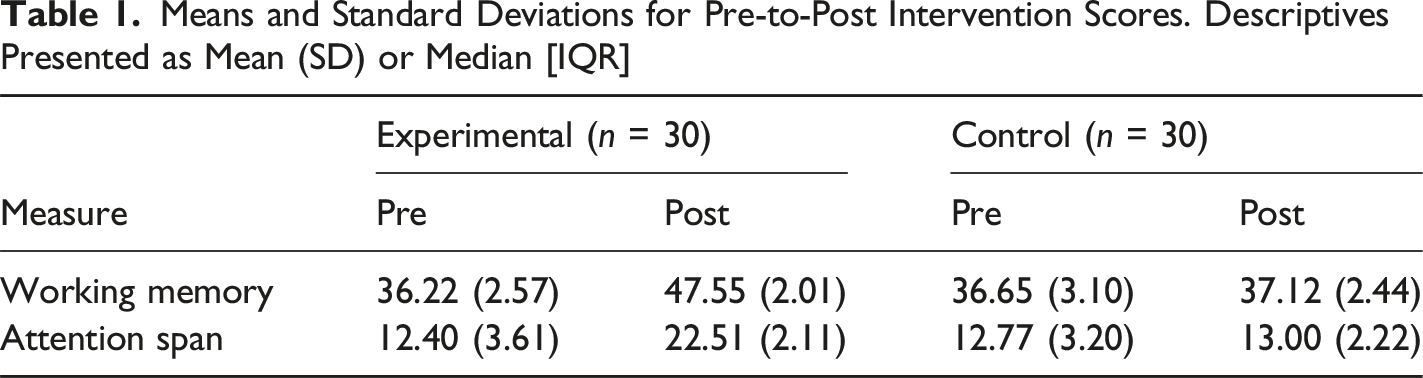
Means and Standard Deviations for Pre-to-Post Intervention Scores. Descriptives Presented as Mean (SD) or Median [IQR]
Results
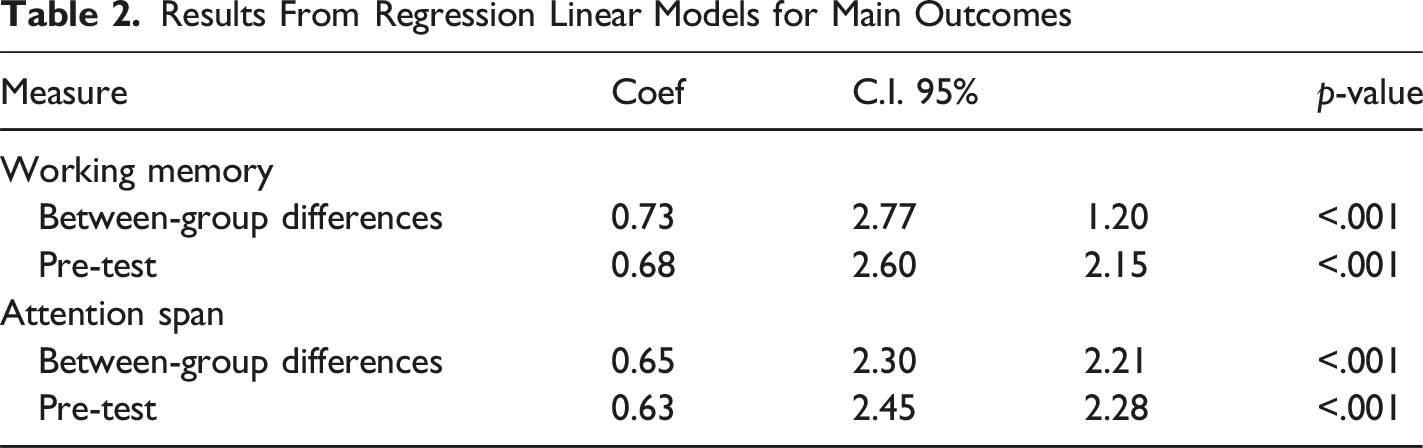
Results From Regression Linear Models for Main Outcomes
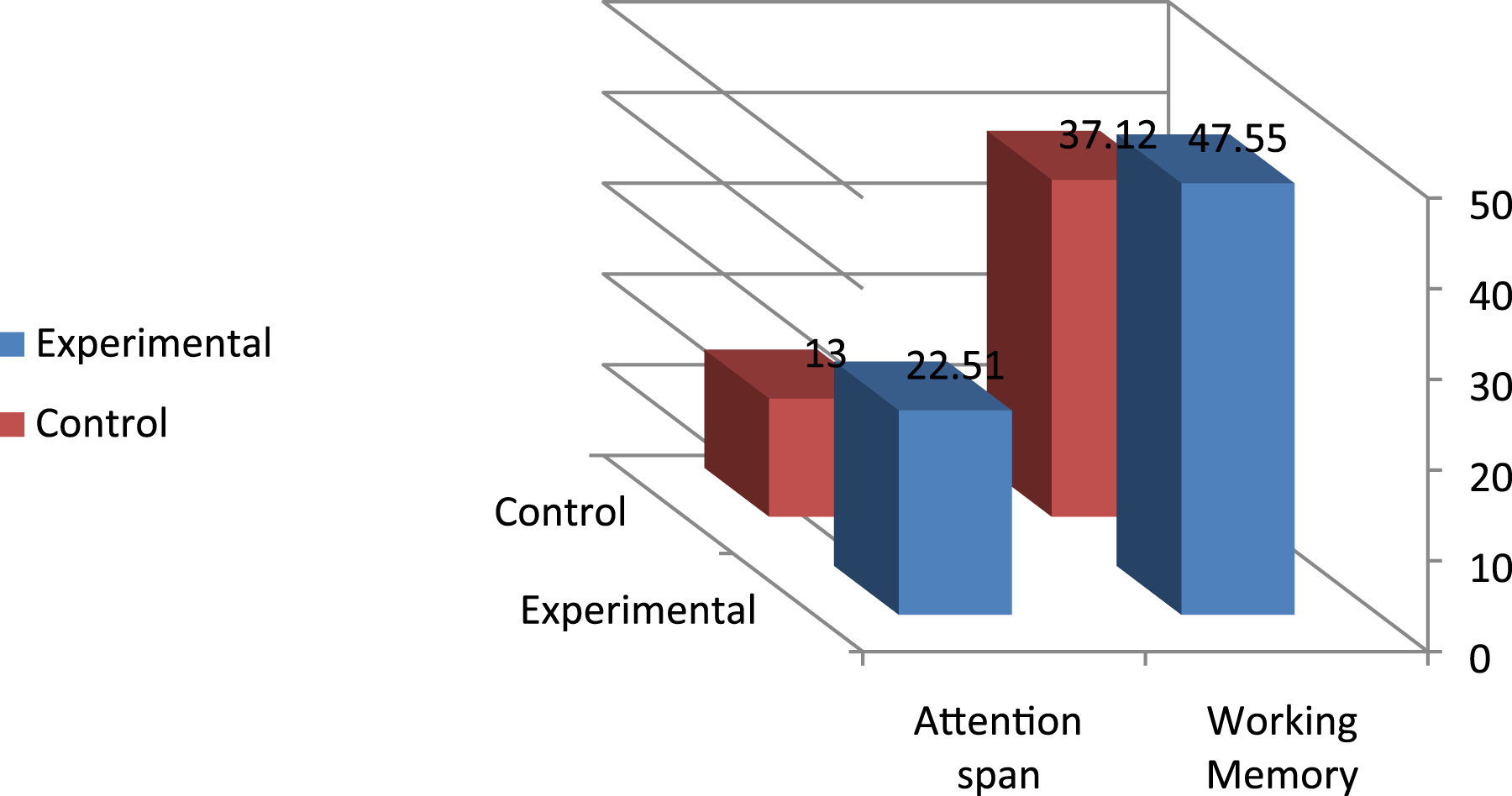
The differences between the two groups in post test in study variables
Sensitivity analyses then showed that while participants in the experimental condition reported significant changes in working memory scores from pre-intervention to post-intervention (t (30) = 6.55, p = .001), participants from the control condition did not report reported significantly differences in working memory scores from pre-intervention to post-intervention (t(30) = −0.20, p = 0.89). As for attention span, descriptive statistics showed that while participants in the experimental condition reported a significant increase in their attention span scores from pre-intervention to post-intervention (t (30) = 7.03, p = .001), participants from the control condition did not report significantly differences in scores from pre-intervention to post-intervention (t(30) = −.26, p = .86).
Discussion
The aim of the present study was to investigate the effectiveness of combining sensory integrative techniques with direct reading comprehension on improving working memory and attention span in students with Developmental dyslexia. In order to investigate this study, descriptive statistics are presented separately for each condition considering pre-to-post-intervention scores. Linear regression models were used to assess within-person differences within conditions for each outcome. Normality of data distribution of dependent variable and variance, homogeneity of regression slope and linearity of the relationship between variables have been proven using appropriate statistical methods. After removing the effect of pretest on posttest, a significant difference was obtained in the mean scores of the groups in pretest and posttest. A significant difference in the effectiveness of combining sensory integration and direct comprehension training on strengthening working memory between the experimental and control groups was confirmed.
This result was consistent with the results of Leung et al. (2015). In confirmation of this finding, the findings of covariance analysis of Karimi et al. (2021) showed that sensory-motor integration training program had a significant effect on working memory and visual- motor coordination of dyslexic students. Mahmoudi et al. (2019)concluded that there is a significant difference between the two experimental and control groups in increasing working memory and attention span of dyslexic students, and that the program combining sensory integration and direct comprehension instruction strengthens working memory and attention span of dyslexic students Sensory integrative techniques are neurological processes that require organizing sensations from key receptors for use in daily activities, the main elements of which are: creating sensory capacities, promoting student success, creating confidence in physical safety, helping with self-organization, and fostering unity, which are used as key components to identify sensory-motor integration therapy. On the other hand, working memory is only one of several different executive functions that control cognitive function.
The results of this study can be justified by Piaget’s cognitive theories. According to this theory, the environment and Experience can play a decisive role in learning motor skills. According to Piaget, human development is based on the interaction and mutual relationship between the individual and the environment, and humans reach development and progress through developmental stages as a result of the interaction between external stimuli and their psychological system. According to Piaget, humans are active and reactive beings who communicate with their environment and organize and control it.
Working memory consists of three parts: phonological store, visual-spatial screen, and central executive. The program of combining sensory integration and direct comprehension training includes increasing the store. Phonology, spatial visualization, visual perception of sensory integration stimuli, comprehension, and perceptual reasoning have also been confirmed, and this hypothesis is based on the positive effect of these items on improving working memory, because the rehabilitation program was planned according to the type of cognitive deficit of the subject.
The combination of the sensory-motor integration method and direct comprehension training caused all angles, shapes, lines, and spatial orientation of objects and bodies to be processed in the mind and formed in the form of movements, and by modifying the way the four senses contact and communicate with the surrounding world, active memory becomes more mature. Jasmine and Connolly (2015) concluded in a study that using a multisensory integrated approach and teaching comprehension through visual, auditory, kinesthetic-tactile activities increases students’ spelling accuracy and memory. When students practice skills in a multisensory way, they are completely. They are involved in stimulation and concentration, so that they complete their tasks on time. A significant difference in the effectiveness of combining the sensory integration method and direct comprehension training on strengthening attention span between the experimental and control groups was confirmed. Fusco et al. (2015) conducted a study to investigate the effectiveness of a perceptual-motor-visual skill intervention program for dyslexic students. The perceptual-motor-visual intervention program, which included exercises for visual-motor coordination, visual discrimination, visual memory, spatial relationship, shape stability, memory sequence, and visual-spatial coordination (visual perception), was used. The results showed that the average correct responses of the dyslexic group of students in the perceptual-motor skills test increased and the quality of handwriting improved. The results of this study indicated that the developed intervention program for dyslexic students seems appropriate and has positive effects because it improves the visual perception skills and writing quality of students with developmental dyslexia.
Students who use the combination of multisensory methods with comprehension during spelling, the accuracy and correctness of spelling increases with increased attention and memory strengthening, because a greater number of senses are involved and with the comprehension teaching method, the vocabulary also increases, and in the learning process they have a greater chance of retaining and retrieving information (Tarjiah et al., 2023). The result of Tarjiah et al. (2023) showed that there were four key factors in determining the success of reading in a student with dyslexia, namely (1) remedial teaching, (2) application of multisensory methods, (3) reading media use, and (4) parental support.
This study contributes to the growing body of literature exploring combining sensory integrative techniques with direct reading comprehension as a potential tool for enhancing working memory and attention span in students with developmental dyslexia. While further research is warranted, these initial findings hold promise for developing novel therapeutic interventions in this population. The present study had limitations, including the lack of appropriate conditions for follow-up several months after training. It is suggested that in future studies, an experimental group that uses medication at the same time be added and the effect of the sensory integration method and direct instruction for comprehension intervention program should be investigated by controlling more intervening variables and following up several months after training.
Conclusion
Sensory integration method and direct instruction for comprehension can increase working memory and attention span in children with dyslexia. Therefore, it can be acknowledged that this method is an approved treatment method. In children with learning disabilities, when one or more stimuli enter the sensory systems and the person is unable to process or prevent them from entering, sensory overload occurs, and this sensory overload causes irregularity in brain function and the brain cannot respond to them naturally. The sensory-motor integration training program, by engaging different senses and performing game-like activities, causes coherence and organization in the brain’s central nervous system and controls the processing of the senses. There is a controversy around sensory-integration efficacy (meta-analytic mixed evidence).
Footnotes

Funding
The authors received no financial support for the research, authorship, and/or publication of this article.
Declaration of Conflicting Interests
The authors declared no potential conflicts of interest with respect to the research, authorship, and/or publication of this article.Dta
Data Availability Statement
Data sharing not applicable to this article as no datasets were generated or analyzed during the current study.